EP4044504B1 - Confidentialité de données d'utilisateur - Google Patents
Confidentialité de données d'utilisateur Download PDFInfo
- Publication number
- EP4044504B1 EP4044504B1 EP22156078.2A EP22156078A EP4044504B1 EP 4044504 B1 EP4044504 B1 EP 4044504B1 EP 22156078 A EP22156078 A EP 22156078A EP 4044504 B1 EP4044504 B1 EP 4044504B1
- Authority
- EP
- European Patent Office
- Prior art keywords
- user
- network
- privacy
- data
- privacy rule
- Prior art date
- Legal status (The legal status is an assumption and is not a legal conclusion. Google has not performed a legal analysis and makes no representation as to the accuracy of the status listed.)
- Active
Links
Images


Classifications
-
- H—ELECTRICITY
- H04—ELECTRIC COMMUNICATION TECHNIQUE
- H04L—TRANSMISSION OF DIGITAL INFORMATION, e.g. TELEGRAPHIC COMMUNICATION
- H04L63/00—Network architectures or network communication protocols for network security
- H04L63/10—Network architectures or network communication protocols for network security for controlling access to devices or network resources
- H04L63/102—Entity profiles
-
- H—ELECTRICITY
- H04—ELECTRIC COMMUNICATION TECHNIQUE
- H04L—TRANSMISSION OF DIGITAL INFORMATION, e.g. TELEGRAPHIC COMMUNICATION
- H04L63/00—Network architectures or network communication protocols for network security
- H04L63/20—Network architectures or network communication protocols for network security for managing network security; network security policies in general
Definitions
- the present disclosure relates to protection of user data in the context of a communication network, such as, for example, a cellular communication network.
- roaming situations present additional challenges in implementing a uniform protection to user data.
- Document US2017/308715 A1 discloses control of data usage using structured data governance metadata, wherein an action is allowed or disallowed for data based on data governance metadata and rules for the action.
- Document US2014/099920 A1 discloses managing opt-in and opt-out for private data access, wherein a mobile device may determine whether a program requesting user data is permitted to access the user data, based on a rule.
- an apparatus comprising means for performing: processing a request for data of at least one user of a communication system, the request comprising an indication of an intended use of the data, the request received directly or indirectly from a network function consumer in a service based architecture communication network, obtaining at least one user privacy rule relating to the at least one user, and determining how to respond to the request based at least in part on the intended use of the data and the at least one user privacy rule relating to the at least one user, wherein the obtaining comprises obtaining the at least one user privacy rule in a heartbeat response message from a network repository function.
- an apparatus comprising means for performing: functioning as a network repository function in a service based architecture communication network, receiving a heartbeat message from a network function producer, and responding to the heartbeat message with a heartbeat response to the network function producer, the heartbeat response comprising at least one user privacy rule relating to at least one user.
- a method comprising processing, by an apparatus, a request for data of at least one user of a communication system, the request comprising an indication of an intended use of the data, the request received directly or indirectly from a network function consumer in a service based architecture communication network, obtaining at least one user privacy rule relating to the at least one user, and determining how to respond to the request based at least in part on the intended use of the data and the at least one user privacy rule relating to the at least one user, wherein the obtaining comprises obtaining the at least one user privacy rule in a heartbeat response message from a network repository function.
- a computer program configured to cause an apparatus to perform at least the following, when run on a computer: process a request for data of at least one user of a communication system, the request comprising an indication of an intended use of the data, the request received directly or indirectly from a network function consumer in a service based architecture communication network, obtain at least one user privacy rule relating to the at least one user, and determine how to respond to the request based at least in part on the intended use of the data and the at least one user privacy rule relating to the at least one user, wherein the obtaining comprises obtaining the at least one user privacy rule in a heartbeat response message from a network repository function.
- a computer program configured to cause an apparatus to perform at least the following, when run on a computer: function as a network repository function in a service based architecture communication network, receive a heartbeat message from a network function producer, and respond to the heartbeat message with a heartbeat response to the network function producer, the heartbeat response comprising at least one user privacy rule relating to at least one user.
- a privacy rule enforcement mechanism enables setting network-wide privacy rules in a standardized manner, enabling a control mechanism applied to network functions of the network to handle user data of a same type using a same privacy rule.
- the standardized setting of network-wide privacy rules may also enable interworking of the policies in other networks as the other networks may be capable of applying the standardized privacy rules.
- NFs may comprise at least some of an access and mobility management function, AMF, a session management function, SMF, a network slice selection function, NSSF, a network exposure function, NEF, a network repository function, NRF, a unified data management, UDM, a unified data repository, UDR, an authentication server function, AUSF, a policy control function, PCF, and an application function, AF.
- a NEF is configured to provide access to exposed network services and capabilities.
- a UDM is configured to manage network user data in a single, centralized element.
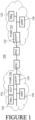
- the SEPP 130, 132 is a network node at the boundary of an operator's network that may be configured to receive a message, such as an HTTP request or HTTP response from an NF, to apply protection for sending and to forward the thus reformatted message through a chain of intermediate nodes, such as IP exchanges, IPX, towards a receiving SEPP.
- the receiving SEPP receives a message sent by the sending SEPP and forwards the message towards an NF within its operator's network, e.g. the AUSF.
- NFc 120 and NFp 122 communication between a service-consuming NF and a service-producing NF, henceforth referred to as NFc 120 and NFp 122. They may also be referred to as NF service consumer and NF service producer, respectively.
- the NFc and NFp may reside in the same PLMN or in different PLMNs.
- the NFp offers a service the NFc is interested in obtaining, for example, the NFc may be interested in obtaining chunks of data of one user, or plural users, of the PLMN.
- a service communication proxy, SCP, 150 may be deployed for indirect communication between network functions, NFs.
- An SCP is an intermediate network entity to assist in indirect communication between an NFc and an NFp, including routing messages, such as, for example, control plane messages between the NFs, and optionally including discovering and selecting NFp 122 on behalf of NFc 120 or requesting an access token from the NRF 140, 142 or an Authorization Server on behalf of NFc 120 to access the service of NFp 122.
- Direct communication may be applied between NFc 120 and NFp 122 for an NF service, or NF service communication may be performed indirectly via SCP(s) 150.
- the NFc 120 performs discovery of the target NFp 122 by local configuration or via local NRF, such as cNRF 140.
- the NFc 120 may delegate the discovery of the target NFp 122 to the SCP 150.
- the SCP may use parameters provided by NFc 120 to perform discovery and/or selection of the target NFp 122, for example with reference to one or more NRF.
- NF discovery and NF service discovery enable entities, such as NFc or SCP, to discover a set of NF instance(s) and NF service instance(s) for a specific NF service or an NFp type.
- the NFc and/or the SCP may be core network entities.
- the network repository function, NRF may comprise a function that is used to support the functionality of NF and NF service registration, discovery, authorization and, optionally, also status notification. Additionally or alternatively, the NRF may be configured to act as an authorization server.
- the NRF may maintain an NF profile of available NFp entities and their supported services. The NRF may notify about newly registered, updated, or deregistered NFp entities along with its NF services to a subscribed NFc or SCP.
- An NRF may thus advise NFc or SCP entities concerning where, that is, from which NFp entities, they may obtain services they need.
- An NRF may be co-located together with an SCP, for example, run in a same computing substrate.
- NRF may be in a physically distinct node than an SCP or even hosted by a service provider.
- NFc 120 or SCP 150 may initiate, based on local configuration, a discovery procedure with an NRF, such as cNRF 140.
- the discovery procedure may be initiated by providing the type of the NFp and optionally a list of the specific service(s) it is attempting to discover.
- the NFc 120 or SCP 150 may additionally or alternatively provide other service parameters, such as information relating to network slicing.
- a system implementing an embodiment of the present disclosure comprises both fourth generation, 4G, and fifth generation, 5G, parts.
- a network support function such as an NRF may further be configured to act as an authorization server, and provide the NFc, or an SCP acting on behalf of the NFc, with a cryptographic access token authorizing the NFc to use the service provided by the NFp.
- an NRF is a terminological example of a network support node.
- an SCP is a terminological example of a proxy entity.
- the NFc or SCP may include the access token in a request message when requesting the service from the NFp, for example in an "authorization bearer" header.
- Such an access token may be referred to herein briefly as a token.
- the NRF may act as an OAuth 2.0 authentication server.
- the token may comprise identifiers of the NFc, NRF and/or NFp, a timestamp and/or an identifier of the specific service which is authorised for the NFc with the token, for example.
- the token may comprise a token identifier of itself, for example a serial number.
- the token may be cryptographically signed using a private key of the NRF. A validity of such a cryptographic signature may be verified using the corresponding public key of the NRF, which the NFp may obtain in connection with registering with the NRF the service(s) it offers, for example.
- the NFc contacts the NFp it may present the access token, which the NFp may then verify, for example at least in part by using its copy of the public key of the NRF.
- NFp nodes are configured to send heartbeat messages, which may alternatively be called heartbeat messages, to at least one NRF.
- heartbeat messages may alternatively be called heartbeat messages
- the NRF may know that the NFp is still available to provide service, and has not been deactivated.
- the heartbeat message may be sent every five or ten seconds.
- the NRF may respond to the heartbeat to acknowledge the heartbeat and correspondingly inform the NFp it remains active.
- FIGURE 2 illustrates examples of privacy rules of specific users in accordance with at least some embodiments.
- Privacy rule 210 comprises a user indication 212 comprising an identity of a user or user group the data of which privacy rule 210 is to be applied to.
- the user indication 212 may take the value of a default indication indicating that privacy rule 210 is to be applied to all users. In some embodiments where user indication 212 is absent, such privacy rules are to be applied to all users. In some embodiments, both user-specific and group specific, and/or network specific privacy rules are present.
- Privacy rule 210 comprises user data category 214, defining the type of user data to which privacy rule 210 is to be applied.
- user data category 214 may comprise an indication that identity of the user is the type of user data to which privacy rule 210 applies.
- Privacy rule 210 comprises privacy requirement 216 defining a privacy preserving action, or filter, which is to be applied to user data of the type identified in user data category 214.
- privacy requirement 216 may define that the actual user identity is to be removed and replaced with a randomly or pseudo-randomly generated spoof identity, to protect the actual user identity.
- Privacy rule 210 may further comprise an intended use indication 218, defining a purpose of user data use for which privacy rule 210 applies.
- the intended use indication 218 may define that privacy rule 210 is to be applied when the intended use is advertising. In that case, privacy rule 210 is not applied when the user data, even of the type identified in user data category 214, is sought for a different purpose from the one defined in intended use indication 218.
- the intended use indication 218 relates to advertising, the user data may be used for the purpose of network coverage optimization despite privacy rule 210.
- FIGURE 2 further illustrates privacy rule 220.
- Privacy rule 220 comprises user indication 222 comprising an identity of a user the data of whom privacy rule 220 is to be applied to. For example, an IMSI may be used as this indication.
- Privacy rule 220 further comprises user data category 224 defining user identity as the type of user data to which privacy rule 220 is to be applied.
- Privacy rule 220 comprises privacy requirement 226 defining that the user identity is to be removed and replaced with an identity of an identity pool when privacy rule 220 is applied.
- An identity pool may correspond to a list of user identities, with the significance that where a user identity identifies the pool, it is known that the user data belongs to one of the users in the pool, but it is not known specifically which user in the pool is the owner of the user data.
- Privacy rule 220 comprises intended use indication 228, which may comprise advertising or public safety, for example.
- a privacy rule may comprise the user data category and the privacy requirement.
- a privacy rule may further include one of the following three options: firstly, the user indication, secondly, the user indication and the intended use indication and thirdly, only the intended use indication.
- the user data category comprises an indication which is comprised in a hierarchic relationship with other user data category indications.
- a broad indication of user data category may indicate the privacy rule is to be applied to all user data types hierarchically comprised, in the hierarchic relationship, under the indication included in the privacy rule, unless a separate privacy rule includes a more specific user data category indication requesting different treatment for the more specific user data type, only.
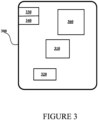
- Processor 310 may be furnished with a transmitter arranged to output information from processor 310, via electrical leads internal to device 300, to other devices comprised in device 300.
- a transmitter may comprise a serial bus transmitter arranged to, for example, output information via at least one electrical lead to memory 320 for storage therein.
- the transmitter may comprise a parallel bus transmitter.
- processor 310 may comprise a receiver arranged to receive information in processor 310, via electrical leads internal to device 300, from other devices comprised in device 300.
- Such a receiver may comprise a serial bus receiver arranged to, for example, receive information via at least one electrical lead from receiver 340 for processing in processor 310.
- the receiver may comprise a parallel bus receiver.
- Device 300 may comprise further devices not illustrated in FIGURE 3 .
- the UDM/UDR may also provide any privacy rules relating to user data categories hierarchically below the one(s) indicated in the request of phase 420.
- NFp may also perform a Subscribe/Notify subscription to privacy rule(s) of this specific user, so that the NFp will always have a latest copy of the user privacy rule(s), for example in cases where user privacy data is updated over period of time.
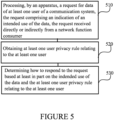
- FIGURE 5 is a flow graph of a method in accordance with at least some embodiments.
- the phases of the illustrated method may be performed in an apparatus such as an NFp, for example, or in a control device configured to control the functioning thereof, when installed therein.
- Phase 510 comprises processing, by an apparatus, a request for data of at least one user of a communication system, the request comprising an indication of an intended use of the data, the request received directly or indirectly from a network function consumer.
- Phase 520 comprises obtaining at least one user privacy rule relating to the at least one user.
- phase 530 comprises determining how to respond to the request based at least in part on the intended use of the data and the at least one user privacy rule relating to the at least one user.
- a user privacy rule may relate to a user when the user privacy rule restricts how data of the user is handled.
- phase 530 comprises determining how to respond to the request based at least in part on the intended use of the data and/or the at least one user privacy rule relating to the at least one user.
Landscapes
- Engineering & Computer Science (AREA)
- Computer Security & Cryptography (AREA)
- Computer Hardware Design (AREA)
- Computing Systems (AREA)
- General Engineering & Computer Science (AREA)
- Computer Networks & Wireless Communication (AREA)
- Signal Processing (AREA)
- Mobile Radio Communication Systems (AREA)
Claims (12)
- Appareil (300) qui agit en tant que producteur de fonction de réseau comprenant des moyens pour effectuer les étapes suivantes :- traiter (510) une demande de données d'au moins un utilisateur d'un système de communication, la demande étant reçue directement ou indirectement d'un consommateur de fonction de réseau dans un réseau de communication à architecture basée sur les services ;- obtenir (520) au moins une règle de confidentialité d'utilisateur relative à l'au moins un utilisateur ; et- déterminer (530) comment répondre à la demande en se basant au moins en partie sur une utilisation prévue des données et la au moins une règle de confidentialité d'utilisateur relative à l'au moins un utilisateur ;
caractérisé en ce que- l'obtention (520) comprend l'obtention de la au moins une règle de confidentialité d'utilisateur dans un message de réponse de battement de coeur provenant d'une fonction de référentiel de réseau, et en ce que la demande comprend une indication d'une utilisation prévue des données. - Appareil (300) selon la revendication 1, dans lequel chacune des au moins une règle de confidentialité d'utilisateur comprend une catégorie de données d'utilisateur et une exigence de confidentialité pour la catégorie de données d'utilisateur.
- Appareil (300) selon la revendication 2, dans lequel la au moins une règle de confidentialité d'utilisateur comprend une règle comprenant une identité en tant que catégorie de données d'utilisateur, et dans lequel l'exigence de confidentialité est une exigence de changement de l'identité en une identité aléatoire.
- Appareil (300) selon la revendication 2, dans lequel la au moins une règle de confidentialité d'utilisateur comprend une règle comprenant une identité en tant que catégorie de données d'utilisateur, et dans lequel l'exigence de confidentialité est une exigence de changement de l'identité en une identité de groupe.
- Appareil (300) selon la revendication 2, dans lequel la au moins une règle de confidentialité d'utilisateur comprend une règle comprenant un emplacement en tant que catégorie de données d'utilisateur, et dans lequel l'exigence de confidentialité est une exigence de réduction de la précision de l'emplacement.
- Appareil (300) selon l'une des revendications précédentes, dans lequel les moyens comprennent au moins un processeur (310) ; et au moins une mémoire (320) comportant un code de programme informatique, la au moins une mémoire (320) et le code de programme informatique étant configurés pour, avec le au moins un processeur (310), commander l'appareil (300).
- Appareil (300) comprenant des moyens pour effectuer :- le fonctionnement en tant que fonction de référentiel de réseau (140) dans un réseau de communication à architecture basée sur les services ;caractérisé en ce que les moyens sont en outre configurés pour effectuer les étapes suivantes :- recevoir un message de battement de coeur d'un producteur de fonction de réseau (122) ; et- répondre au message de battement de coeur avec une réponse de battement de coeur au producteur de fonction de réseau (122), la réponse de battement de coeur comprenant au moins une règle de confidentialité d'utilisateur relative à au moins un utilisateur.
- Appareil (300) selon la revendication 7, dans lequel les moyens comprennent au moins un processeur (310) ; et au moins une mémoire (320) comportant un code de programme informatique, la au moins une mémoire (320) et le code de programme informatique étant configurés pour, avec le au moins un processeur (310), commander l'appareil (300).
- Procédé, comprenant les étapes suivantes :- traiter (510), par un appareil agissant en tant que producteur de fonction de réseau, une demande de données d'au moins un utilisateur d'un système de communication, la demande étant reçue directement ou indirectement d'un consommateur de fonction de réseau dans un réseau de communication à architecture basée sur les services ;- obtenir (520) au moins une règle de confidentialité d'utilisateur relative à l'au moins un utilisateur ; et- déterminer (530) comment répondre à la demande en se basant au moins en partie sur l'utilisation prévue des données et au moins une règle de confidentialité d'utilisateur relative à l'au moins un utilisateur ;
caractérisé en ce que- l'obtention (520) comprend l'obtention de la au moins une règle de confidentialité d'utilisateur dans un message de réponse de battement de coeur d'une fonction de référentiel de réseau, et en ce que la demande comprend une indication d'une utilisation prévue des données. - Procédé, comprenant- un appareil (300) fonctionnant en tant que fonction de référentiel de réseau (140) dans un réseau de communication à architecture basée sur les services ;
caractérisé par- la réception d'un message de battement de coeur d'un producteur de fonction de réseau (122), et- la réponse au message de battement de coeur avec une réponse de battement de coeur au producteur de fonction de réseau (122), la réponse de battement de coeur comprenant au moins une règle de confidentialité d'utilisateur relative à au moins un utilisateur. - Programme informatique comprenant des instructions pour effectuer au moins les étapes de la revendication 9.
- Programme informatique comprenant des instructions pour effectuer au moins les étapes de la revendication 10.
Applications Claiming Priority (1)
| Application Number | Priority Date | Filing Date | Title |
|---|---|---|---|
| FI20215141 | 2021-02-12 |
Publications (2)
| Publication Number | Publication Date |
|---|---|
| EP4044504A1 EP4044504A1 (fr) | 2022-08-17 |
| EP4044504B1 true EP4044504B1 (fr) | 2024-12-04 |
Family
ID=80928640
Family Applications (1)
| Application Number | Title | Priority Date | Filing Date |
|---|---|---|---|
| EP22156078.2A Active EP4044504B1 (fr) | 2021-02-12 | 2022-02-10 | Confidentialité de données d'utilisateur |
Country Status (1)
| Country | Link |
|---|---|
| EP (1) | EP4044504B1 (fr) |
Family Cites Families (2)
| Publication number | Priority date | Publication date | Assignee | Title |
|---|---|---|---|---|
| US8983434B2 (en) * | 2012-10-08 | 2015-03-17 | At&T Intellectual Property I, L.P. | Managing opt-in and opt-out for private data access |
| US10389718B2 (en) * | 2016-04-26 | 2019-08-20 | Adobe Inc. | Controlling data usage using structured data governance metadata |
-
2022
- 2022-02-10 EP EP22156078.2A patent/EP4044504B1/fr active Active
Also Published As
| Publication number | Publication date |
|---|---|
| EP4044504A1 (fr) | 2022-08-17 |
Similar Documents
| Publication | Publication Date | Title |
|---|---|---|
| JP7406512B2 (ja) | サービス加入者のプライバシのためのデータ匿名化 | |
| EP3962136A1 (fr) | Gestion de jetons d'accès dans des réseaux de communication | |
| KR102802497B1 (ko) | 애플리케이션 프로그래밍 인터페이스 관리를 위한 방법 및 장치 | |
| EP4075847B1 (fr) | Contrôle d'abonnement de service de fonction réseau | |
| US10798577B2 (en) | Unified data repository proxy | |
| US12192359B2 (en) | Authorization of network request | |
| EP3886390A1 (fr) | Gestion de jeton | |
| US11770267B2 (en) | Systems and methods for selective provisioning of a charging function in a wireless network | |
| EP3937460B1 (fr) | Identification améliorée dans des réseaux de communication | |
| EP3852339B1 (fr) | Activation de la qualité de service pour les fonctions de réseau de tiers fiables dans des réseaux principaux | |
| CN111435924A (zh) | 调用应用程序接口的方法和装置 | |
| US12028383B2 (en) | Systems and methods for supporting internet protocol multimedia subsystem services in fifth-generation networks | |
| WO2022175593A1 (fr) | Itinérance dans des réseaux de communications cellulaires | |
| WO2022062889A1 (fr) | Procédé et appareil de gestion de tranche, et dispositif de communication | |
| CN114466346A (zh) | 获取边缘服务的方法和装置 | |
| US20230030315A1 (en) | Network Security | |
| WO2021176131A1 (fr) | Autorisation améliorée dans des réseaux de communication | |
| US20240292204A1 (en) | Systems and methods for optimized propagation of data change notifications | |
| WO2021198552A1 (fr) | Autorisation améliorée dans des réseaux de communication | |
| EP4027678B1 (fr) | Autorisation dans des systèmes de communication cellulaire | |
| EP4044504B1 (fr) | Confidentialité de données d'utilisateur | |
| US12218986B2 (en) | Systems and methods for facilitating provisioning of internet protocol multimedia subsystem services | |
| US20260067693A1 (en) | Registering smart contract on a blockchain network | |
| EP4092982A1 (fr) | Authentification d'une demande de réseau | |
| US20240244416A1 (en) | Systems and methods for optimized discovery of a network device |
Legal Events
| Date | Code | Title | Description |
|---|---|---|---|
| PUAI | Public reference made under article 153(3) epc to a published international application that has entered the european phase |
Free format text: ORIGINAL CODE: 0009012 |
|
| STAA | Information on the status of an ep patent application or granted ep patent |
Free format text: STATUS: THE APPLICATION HAS BEEN PUBLISHED |
|
| AK | Designated contracting states |
Kind code of ref document: A1 Designated state(s): AL AT BE BG CH CY CZ DE DK EE ES FI FR GB GR HR HU IE IS IT LI LT LU LV MC MK MT NL NO PL PT RO RS SE SI SK SM TR |
|
| STAA | Information on the status of an ep patent application or granted ep patent |
Free format text: STATUS: REQUEST FOR EXAMINATION WAS MADE |
|
| 17P | Request for examination filed |
Effective date: 20230213 |
|
| RBV | Designated contracting states (corrected) |
Designated state(s): AL AT BE BG CH CY CZ DE DK EE ES FI FR GB GR HR HU IE IS IT LI LT LU LV MC MK MT NL NO PL PT RO RS SE SI SK SM TR |
|
| GRAP | Despatch of communication of intention to grant a patent |
Free format text: ORIGINAL CODE: EPIDOSNIGR1 |
|
| STAA | Information on the status of an ep patent application or granted ep patent |
Free format text: STATUS: GRANT OF PATENT IS INTENDED |
|
| INTG | Intention to grant announced |
Effective date: 20240701 |
|
| GRAS | Grant fee paid |
Free format text: ORIGINAL CODE: EPIDOSNIGR3 |
|
| GRAA | (expected) grant |
Free format text: ORIGINAL CODE: 0009210 |
|
| STAA | Information on the status of an ep patent application or granted ep patent |
Free format text: STATUS: THE PATENT HAS BEEN GRANTED |
|
| AK | Designated contracting states |
Kind code of ref document: B1 Designated state(s): AL AT BE BG CH CY CZ DE DK EE ES FI FR GB GR HR HU IE IS IT LI LT LU LV MC MK MT NL NO PL PT RO RS SE SI SK SM TR |
|
| REG | Reference to a national code |
Ref country code: CH Ref legal event code: EP |
|
| REG | Reference to a national code |
Ref country code: DE Ref legal event code: R096 Ref document number: 602022008270 Country of ref document: DE |
|
| REG | Reference to a national code |
Ref country code: IE Ref legal event code: FG4D |
|
| REG | Reference to a national code |
Ref country code: LT Ref legal event code: MG9D |
|
| REG | Reference to a national code |
Ref country code: NL Ref legal event code: MP Effective date: 20241204 |
|
| PG25 | Lapsed in a contracting state [announced via postgrant information from national office to epo] |
Ref country code: HR Free format text: LAPSE BECAUSE OF FAILURE TO SUBMIT A TRANSLATION OF THE DESCRIPTION OR TO PAY THE FEE WITHIN THE PRESCRIBED TIME-LIMIT Effective date: 20241204 |
|
| PG25 | Lapsed in a contracting state [announced via postgrant information from national office to epo] |
Ref country code: FI Free format text: LAPSE BECAUSE OF FAILURE TO SUBMIT A TRANSLATION OF THE DESCRIPTION OR TO PAY THE FEE WITHIN THE PRESCRIBED TIME-LIMIT Effective date: 20241204 |
|
| PG25 | Lapsed in a contracting state [announced via postgrant information from national office to epo] |
Ref country code: BG Free format text: LAPSE BECAUSE OF FAILURE TO SUBMIT A TRANSLATION OF THE DESCRIPTION OR TO PAY THE FEE WITHIN THE PRESCRIBED TIME-LIMIT Effective date: 20241204 |
|
| PG25 | Lapsed in a contracting state [announced via postgrant information from national office to epo] |
Ref country code: ES Free format text: LAPSE BECAUSE OF FAILURE TO SUBMIT A TRANSLATION OF THE DESCRIPTION OR TO PAY THE FEE WITHIN THE PRESCRIBED TIME-LIMIT Effective date: 20241204 |
|
| PG25 | Lapsed in a contracting state [announced via postgrant information from national office to epo] |
Ref country code: NO Free format text: LAPSE BECAUSE OF FAILURE TO SUBMIT A TRANSLATION OF THE DESCRIPTION OR TO PAY THE FEE WITHIN THE PRESCRIBED TIME-LIMIT Effective date: 20250304 |
|
| PG25 | Lapsed in a contracting state [announced via postgrant information from national office to epo] |
Ref country code: LV Free format text: LAPSE BECAUSE OF FAILURE TO SUBMIT A TRANSLATION OF THE DESCRIPTION OR TO PAY THE FEE WITHIN THE PRESCRIBED TIME-LIMIT Effective date: 20241204 Ref country code: GR Free format text: LAPSE BECAUSE OF FAILURE TO SUBMIT A TRANSLATION OF THE DESCRIPTION OR TO PAY THE FEE WITHIN THE PRESCRIBED TIME-LIMIT Effective date: 20250305 |
|
| PG25 | Lapsed in a contracting state [announced via postgrant information from national office to epo] |
Ref country code: RS Free format text: LAPSE BECAUSE OF FAILURE TO SUBMIT A TRANSLATION OF THE DESCRIPTION OR TO PAY THE FEE WITHIN THE PRESCRIBED TIME-LIMIT Effective date: 20250304 |
|
| PG25 | Lapsed in a contracting state [announced via postgrant information from national office to epo] |
Ref country code: NL Free format text: LAPSE BECAUSE OF FAILURE TO SUBMIT A TRANSLATION OF THE DESCRIPTION OR TO PAY THE FEE WITHIN THE PRESCRIBED TIME-LIMIT Effective date: 20241204 |
|
| REG | Reference to a national code |
Ref country code: AT Ref legal event code: MK05 Ref document number: 1749313 Country of ref document: AT Kind code of ref document: T Effective date: 20241204 |
|
| PG25 | Lapsed in a contracting state [announced via postgrant information from national office to epo] |
Ref country code: SM Free format text: LAPSE BECAUSE OF FAILURE TO SUBMIT A TRANSLATION OF THE DESCRIPTION OR TO PAY THE FEE WITHIN THE PRESCRIBED TIME-LIMIT Effective date: 20241204 |
|
| PG25 | Lapsed in a contracting state [announced via postgrant information from national office to epo] |
Ref country code: PL Free format text: LAPSE BECAUSE OF FAILURE TO SUBMIT A TRANSLATION OF THE DESCRIPTION OR TO PAY THE FEE WITHIN THE PRESCRIBED TIME-LIMIT Effective date: 20241204 |
|
| PG25 | Lapsed in a contracting state [announced via postgrant information from national office to epo] |
Ref country code: IS Free format text: LAPSE BECAUSE OF FAILURE TO SUBMIT A TRANSLATION OF THE DESCRIPTION OR TO PAY THE FEE WITHIN THE PRESCRIBED TIME-LIMIT Effective date: 20250404 |
|
| PG25 | Lapsed in a contracting state [announced via postgrant information from national office to epo] |
Ref country code: PT Free format text: LAPSE BECAUSE OF FAILURE TO SUBMIT A TRANSLATION OF THE DESCRIPTION OR TO PAY THE FEE WITHIN THE PRESCRIBED TIME-LIMIT Effective date: 20250404 |
|
| PG25 | Lapsed in a contracting state [announced via postgrant information from national office to epo] |
Ref country code: EE Free format text: LAPSE BECAUSE OF FAILURE TO SUBMIT A TRANSLATION OF THE DESCRIPTION OR TO PAY THE FEE WITHIN THE PRESCRIBED TIME-LIMIT Effective date: 20241204 |
|
| PG25 | Lapsed in a contracting state [announced via postgrant information from national office to epo] |
Ref country code: RO Free format text: LAPSE BECAUSE OF FAILURE TO SUBMIT A TRANSLATION OF THE DESCRIPTION OR TO PAY THE FEE WITHIN THE PRESCRIBED TIME-LIMIT Effective date: 20241204 Ref country code: AT Free format text: LAPSE BECAUSE OF FAILURE TO SUBMIT A TRANSLATION OF THE DESCRIPTION OR TO PAY THE FEE WITHIN THE PRESCRIBED TIME-LIMIT Effective date: 20241204 |
|
| PG25 | Lapsed in a contracting state [announced via postgrant information from national office to epo] |
Ref country code: SK Free format text: LAPSE BECAUSE OF FAILURE TO SUBMIT A TRANSLATION OF THE DESCRIPTION OR TO PAY THE FEE WITHIN THE PRESCRIBED TIME-LIMIT Effective date: 20241204 |
|
| PG25 | Lapsed in a contracting state [announced via postgrant information from national office to epo] |
Ref country code: CZ Free format text: LAPSE BECAUSE OF FAILURE TO SUBMIT A TRANSLATION OF THE DESCRIPTION OR TO PAY THE FEE WITHIN THE PRESCRIBED TIME-LIMIT Effective date: 20241204 |
|
| PG25 | Lapsed in a contracting state [announced via postgrant information from national office to epo] |
Ref country code: IT Free format text: LAPSE BECAUSE OF FAILURE TO SUBMIT A TRANSLATION OF THE DESCRIPTION OR TO PAY THE FEE WITHIN THE PRESCRIBED TIME-LIMIT Effective date: 20241204 |
|
| REG | Reference to a national code |
Ref country code: DE Ref legal event code: R097 Ref document number: 602022008270 Country of ref document: DE |
|
| PG25 | Lapsed in a contracting state [announced via postgrant information from national office to epo] |
Ref country code: SE Free format text: LAPSE BECAUSE OF FAILURE TO SUBMIT A TRANSLATION OF THE DESCRIPTION OR TO PAY THE FEE WITHIN THE PRESCRIBED TIME-LIMIT Effective date: 20241204 |
|
| PG25 | Lapsed in a contracting state [announced via postgrant information from national office to epo] |
Ref country code: MC Free format text: LAPSE BECAUSE OF FAILURE TO SUBMIT A TRANSLATION OF THE DESCRIPTION OR TO PAY THE FEE WITHIN THE PRESCRIBED TIME-LIMIT Effective date: 20241204 |
|
| REG | Reference to a national code |
Ref country code: CH Ref legal event code: PL |
|
| PG25 | Lapsed in a contracting state [announced via postgrant information from national office to epo] |
Ref country code: DK Free format text: LAPSE BECAUSE OF FAILURE TO SUBMIT A TRANSLATION OF THE DESCRIPTION OR TO PAY THE FEE WITHIN THE PRESCRIBED TIME-LIMIT Effective date: 20241204 |
|
| PLBE | No opposition filed within time limit |
Free format text: ORIGINAL CODE: 0009261 |
|
| STAA | Information on the status of an ep patent application or granted ep patent |
Free format text: STATUS: NO OPPOSITION FILED WITHIN TIME LIMIT |
|
| PG25 | Lapsed in a contracting state [announced via postgrant information from national office to epo] |
Ref country code: LU Free format text: LAPSE BECAUSE OF NON-PAYMENT OF DUE FEES Effective date: 20250210 |
|
| PG25 | Lapsed in a contracting state [announced via postgrant information from national office to epo] |
Ref country code: CH Free format text: LAPSE BECAUSE OF NON-PAYMENT OF DUE FEES Effective date: 20250228 |
|
| 26N | No opposition filed |
Effective date: 20250905 |
|
| REG | Reference to a national code |
Ref country code: BE Ref legal event code: MM Effective date: 20250228 |
|
| PG25 | Lapsed in a contracting state [announced via postgrant information from national office to epo] |
Ref country code: FR Free format text: LAPSE BECAUSE OF NON-PAYMENT OF DUE FEES Effective date: 20250228 |
|
| PG25 | Lapsed in a contracting state [announced via postgrant information from national office to epo] |
Ref country code: BE Free format text: LAPSE BECAUSE OF NON-PAYMENT OF DUE FEES Effective date: 20250228 |
|
| PG25 | Lapsed in a contracting state [announced via postgrant information from national office to epo] |
Ref country code: IE Free format text: LAPSE BECAUSE OF NON-PAYMENT OF DUE FEES Effective date: 20250210 |
|
| PGFP | Annual fee paid to national office [announced via postgrant information from national office to epo] |
Ref country code: DE Payment date: 20251230 Year of fee payment: 5 |