EP4044862B1 - Einfach anziehbarer schuh mit schuhbandverriegelung - Google Patents
Einfach anziehbarer schuh mit schuhbandverriegelung Download PDFInfo
- Publication number
- EP4044862B1 EP4044862B1 EP20800466.3A EP20800466A EP4044862B1 EP 4044862 B1 EP4044862 B1 EP 4044862B1 EP 20800466 A EP20800466 A EP 20800466A EP 4044862 B1 EP4044862 B1 EP 4044862B1
- Authority
- EP
- European Patent Office
- Prior art keywords
- cord
- footwear
- passage
- medial
- lateral
- Prior art date
- Legal status (The legal status is an assumption and is not a legal conclusion. Google has not performed a legal analysis and makes no representation as to the accuracy of the status listed.)
- Active
Links
Images





Classifications
-
- A—HUMAN NECESSITIES
- A43—FOOTWEAR
- A43C—FASTENINGS OR ATTACHMENTS OF FOOTWEAR; LACES IN GENERAL
- A43C1/00—Shoe lacing fastenings
- A43C1/06—Shoe lacing fastenings tightened by draw-strings
-
- A—HUMAN NECESSITIES
- A43—FOOTWEAR
- A43B—CHARACTERISTIC FEATURES OF FOOTWEAR; PARTS OF FOOTWEAR
- A43B11/00—Footwear with arrangements to facilitate putting-on or removing, e.g. with straps
-
- A—HUMAN NECESSITIES
- A43—FOOTWEAR
- A43B—CHARACTERISTIC FEATURES OF FOOTWEAR; PARTS OF FOOTWEAR
- A43B3/00—Footwear characterised by the shape or the use
- A43B3/06—Shoes with flaps; Footwear with divided uppers
-
- A—HUMAN NECESSITIES
- A43—FOOTWEAR
- A43B—CHARACTERISTIC FEATURES OF FOOTWEAR; PARTS OF FOOTWEAR
- A43B3/00—Footwear characterised by the shape or the use
- A43B3/24—Collapsible or convertible
- A43B3/242—Collapsible or convertible characterised by the upper
-
- A—HUMAN NECESSITIES
- A43—FOOTWEAR
- A43B—CHARACTERISTIC FEATURES OF FOOTWEAR; PARTS OF FOOTWEAR
- A43B3/00—Footwear characterised by the shape or the use
- A43B3/24—Collapsible or convertible
- A43B3/246—Collapsible or convertible characterised by the sole
-
- A—HUMAN NECESSITIES
- A43—FOOTWEAR
- A43C—FASTENINGS OR ATTACHMENTS OF FOOTWEAR; LACES IN GENERAL
- A43C7/00—Holding-devices for laces
Definitions
- the present disclosure generally relates to an article of footwear.
- WO 2014/033396 A1 relates to the field of footwear, and in particular to an articulated shoe comprising a front portion, a rear portion, a sole connecting said front and rear portions, and a member for tightening around the foot, arranged at least on the front portion.
- the front portion includes a front upper and an insole secured to one another
- the rear portion includes a heel seat
- the sole includes an articulation enabling said rear portion to move, relative to said front portion, between a first open position and a second closed position.
- US 474 574 A relates to an articulated shoe comprising a front portion, a rear portion, a sole connecting said front and rear portions, and a member for tightening around the foot.
- the present disclosure generally relates to an article of footwear configured for easy access with respect to foot insertion and withdrawal, and also configured for quick and secure adjustment of the fit of the footwear upper to the wearer's foot.
- the footwear upper may be a divided footwear upper including a front upper portion fixed to the front sole portion, and a rear upper portion fixed to the rear sole portion.
- the rear upper portion may define a heel region of the footwear upper.
- the closure system may include at least one of a medial strap or a medial hook extending from a medial side of the front upper portion and a lateral strap or a lateral hook extending from a lateral side of the front upper portion.
- the straps may be securable to the rear upper portion to secure the front upper portion to the rear upper portion in the use position.
- the closure system may further comprise at least one of a medial cord guide secured to the medial side of the front upper portion and a lateral cord guide secured to the lateral side of the front upper portion.
- the adjustment cord may engage the medial cord guide and the lateral cord guide between the anchor location and the cord lock.
- the medial cord guide may be secured to the medial strap and the lateral cord guide may be secured to the lateral strap.
- the medial cord guide may be secured to an inner side of the medial strap, and the lateral cord guide may be secured to an inner side of the lateral strap.
- the second body may be configured symmetrically with the first body about a longitudinal axis of the article of footwear.
- the adjustment cord may be tensioned by pulling the loop portion away from the first body and the second body.
- Such a configuration enables a user to pull on the loop portion of the adjustment cord extending from the first body to the second body to tighten the cord and the upper attached thereto, and then reposition the loop portion of the cord to lock the cord to the first body and the second body.
- the looped configuration may allow adjustment (tightening) and locking to be accomplished with one hand.
- the sole structure may pivot at a transverse axis of the sole structure between the use position and the access position and may be elevated at the transverse axis further away from a ground plane in the access position than in the use position.
- the rear sole portion may incline from a rear end of the rear sole portion to the transverse axis.
- the front sole portion may incline from a forward end of the front sole portion to the transverse axis in the access position.
- the front sole portion may include a front midsole component and the rear sole portion may include a rear midsole component discontinuous from the front midsole component.
- the sole structure may include a connecting member connecting the front midsole component to the rear midsole component and defining a groove extending transversely between the front midsole component and the rear midsole component.
- the front midsole component and the rear midsole component may be pivotable relative to one another at the groove between a use position and an access position.
- the groove may be relatively open in the use position, and the groove may be relatively closed in the access position.
- the connecting member may comprise a plate defining the groove and secured to a rear wall of the front midsole component and to a front wall of the rear midsole component at the groove.
- a rib may be secured at a wall of the connecting member in the groove and may extend outward into the groove.
- the sole structure may include an outsole with a front portion underlying and secured to the front midsole component forward of the plate, and a rear portion underlying and secured to the rear midsole component rearward of the plate.
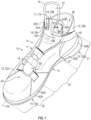
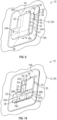
- FIG. 1 shows an article of footwear 10 that includes a footwear upper 12 and a closure system 14 (also referred to herein as a tensioning system) configured for quick and easy adjustment of the fit of the upper 12.
- the article of footwear 10 includes a sole structure 15 movable between an access position and a use position as described herein.
- the closure system 14 is configured to function compatibly with the sole structure 15 such that tensioning of the closure system 14 may also help to secure the footwear 10 in the use position.
- the article of footwear 10 herein is depicted as an athletic shoe or a leisure shoe, but the present teachings also include an article of footwear that is a work shoe, a dress shoe, a sandal, a slipper, a boot, or any other category of footwear.
- the sole structure 15 has a front sole portion 15A and a rear sole portion 15B that is pivotable relative to the front sole portion 15A between a use position and an access position for ease of access, as further described herein.
- the footwear 10 is shown in the use position in FIG. 1 .
- the footwear upper 12 is configured as a divided footwear upper that includes a front upper portion 12A and a rear upper portion 12B.
- the front upper portion 12A is fixed to the front sole portion 15A and defines a forefoot region 25 of the footwear 10.
- the rear upper portion 12B is fixed to the rear sole portion 15B and defines a heel region 21 of the footwear 10.
- the front upper portion 12A and the rear upper portion 12B together define an ankle opening 17 that leads into a foot-receiving cavity 26.
- a wearer's foot (not shown) is disposed in the foot-receiving cavity 26 during use, and the closure system 14 ensures that the footwear upper 12 is secured around the foot with a fit selected by the wearer according to the tension of an adjustment cord 16 which is retained due to a cord lock 18.
- the front upper portion 12A and the rear upper portion 12B may be portions of a single, unitary, undivided upper.
- the upper 12 may include gussets, folds, pleats, relatively elastic portions, or the like extending between and connecting the front upper portion 12A and the rear upper portion 12B as a single, unitary upper while still allowing the upper 12 to widen at the ankle opening 17 to the access position.
- the article of footwear 10 has the heel region 21, as well as a midfoot region 23 and the forefoot region 25.
- the heel region 21 generally includes portions of the article of footwear 10 corresponding with rear portions of a human foot, including the calcaneus bone, when the human foot of a size corresponding with the article of footwear 10 is disposed in the foot-receiving cavity 26 and is supported on the sole structure 15.
- the forefoot region 25 of the article of footwear 10 generally includes portions of the article of footwear 10 corresponding with the toes and the joints connecting the metatarsals with the phalanges of the human foot (interchangeably referred to herein as the "metatarsal-phalangeal joints" or "MPJ" joints).
- Each of the front sole portion 15A and the rear sole portion 15B may include one or more sole components that may be sole layers, such as an outsole and a midsole.
- the front sole portion 15A is secured to a lower portion of the front upper portion 12A such as by stitching, adhesive or otherwise, and underlies the front upper portion 12A in the use position.
- the rear sole portion 15B is secured to a lower portion of the rear upper portion 12B such as by stitching, adhesive or otherwise, and underlies the rear upper portion 12B in the use position.
- Each of the front sole portion 15A and the rear sole portion 15B may comprise, for example, a midsole of an elastomeric foam such as a polyurethane or ethylvinylacetate foam to attenuate ground reaction forces (e.g., provide cushioning) when compressed between the foot and the ground during walking, running, or other ambulatory activities.
- the front sole portion 15A and/or the rear sole portion 15B may incorporate fluid-filled chambers, plates, moderators, or other elements that further attenuate forces, enhance stability, or influence the motions of the foot.
- the front sole portion 15A includes a front midsole component 80A and a front outsole portion 82A secured to the bottom of the front midsole component 80A and wrapping partially up medial and lateral side walls of the front midsole component 80A.
- the rear sole portion 15B includes a rear midsole component 80B and a rear outsole portion 82B secured to the bottom of the rear midsole component 80B and wrapping partially up medial and lateral side walls of the rear midsole component 80B.
- the front midsole component 80A is separate and discontinuous from the rear midsole component 80B.
- the front outsole portion 82A is separate and discontinuous from the rear outsole portion 82B.
- a connecting member 84 (visible, for example, in FIGS. 4 and 6 ) connects the front midsole component 80A to the rear midsole component 80B and defines a groove 27, as further discussed herein.
- the connecting member 84 may also be referred to as a plate 84 herein.
- the midsole components 80A, 80B may comprise, for example, an elastomeric foam such as a polyurethane or ethylvinylacetate foam to attenuate ground reaction forces (i.e., provide cushioning) when compressed between the foot and the ground during walking, running, or other ambulatory activities.
- an elastomeric foam such as a polyurethane or ethylvinylacetate foam to attenuate ground reaction forces (i.e., provide cushioning) when compressed between the foot and the ground during walking, running, or other ambulatory activities.
- either or both of the midsole components 80A, 80B may incorporate fluid-filled chambers, plates, moderators, or other elements that further attenuate forces, enhance stability, or influence the motions of the foot.
- the foam of the cushioning layer may include a foamed polymeric material and may be at least partially a polyurethane (PU) foam or a polyurethane ethylene-vinyl acetate (EVA) foam, and may include heat-expanded and molded EVA foam pellets.
- PU polyurethane
- EVA polyurethane ethylene-vinyl acetate
- the foamed polymeric material may include one or more polymers.
- the one or more polymers may include an elastomer, including a thermoplastic elastomer (TPE).
- TPE thermoplastic elastomer
- the one or more polymers may include aliphatic polymers, aromatic polymers, or mixture of both.
- the one or more polymers may include homopolymers, copolymers (including terpolymers), or mixtures of both.
- the copolymers may be random copolymers, block copolymers, alternating copolymers, periodic copolymers, or graft copolymers, for instance.
- the one or more polymers may include olefinic homopolymers or copolymers or a mixture of olefinic homopolymers and copolymers.
- olefinic polymers include polyethylene (PE) and polypropylene (PP).
- the PE may be a PE homopolymer such as a low density PE or a high density PE, a low molecular weight PE or an ultra-high molecular weight PE, a linear PE or a branched chain PE, etc.
- the PE may be an ethylene copolymer such as, for example, an ethylene-vinyl acetate (EVA) copolymer, an ethylene-vinyl alcohol (EVOH) copolymer, an ethylene-ethyl acrylate copolymer, an ethylene-unsaturated mono-fatty acid copolymer, etc.
- EVA ethylene-vinyl acetate
- EVOH ethylene-vinyl alcohol copolymer
- ethylene-ethyl acrylate copolymer an ethylene-unsaturated mono-fatty acid copolymer, etc.
- the one or more polymers may include a polyacrylate such as a polyacrylic acid, an ester of a polyacrylic acid, a polyacrylonitrile, a polyacrylic acetate, a polymethyl acrylate, a polyethyl acrylate, a polybutyl acrylate, a polymethyl methacrylate, a polyvinyl acetate, etc., including derivatives thereof, copolymers thereof, and any mixture thereof, in one example.
- the one or more polymers may include an ionomeric polymer.
- the ionomeric polymer may be a polycarboxylic acid or a derivative of a polycarboxylic acid, for instance.
- the ionomeric polymer may be a sodium salt, a magnesium salt, a potassium salt, or a salt of another metallic ion.
- the ionomeric polymer may be a fatty acid modified ionomeric polymer. Examples of ionomeric polymers include polystyrene sulfonate, and ethylene-methacrylic acid copolymers.
- the one or more polymers may include a polycarbonate.
- the one or more polymers may include a fluoropolymer.
- the one or more polymers may include a polysiloxane.
- the one or more polymers may include a vinyl polymer such as polyvinyl chloride (PVC), polyvinyl acetate, polyvinyl alcohol, etc.
- the one or more polymers may include a polystyrene.
- the polystyrene may be a styrene copolymer such as, for example, an acrylonitrile butadiene styrene (ABS), a styrene acrylonitrile (SAN), a styrene ethylene butylene styrene (SEBS), a styrene ethylene propylene styrene (SEPS), a styrene butadiene styrene (SBS), etc.
- the one or more polymers may include a polyamide (PA).
- the PA may be a PA 6, PA 66, PA 11, or a copolymer thereof.
- the polyester may be an aliphatic polyester homopolymer or copolymer such as polyglycolic acid, polylactic acid, polycaprolactone, polyhydroxybutyrate, and the like.
- the polyester may be a semi-aromatic copolymer such as polyethylene terephthalate (PET) or polybutylene terephthalate (PBT).
- PET polyethylene terephthalate
- PBT polybutylene terephthalate
- the one or more polymers may include a polyether such as a polyethylene glycol or polypropylene glycol, including copolymers thereof.
- the one or more polymers may include a polyurethane, including an aromatic polyurethane derived from an aromatic isocyanate such as diphenylmethane diisocyanate (MDI) or toluene diisocyanate (TDI), or an aliphatic polyurethane derived from an aliphatic isocyanate such as hexamethylene diisocyanate (HDI) or isophone diisocyanate (IPDI), or a mixture of both an aromatic polyurethane and an aliphatic polyurethane.
- an aromatic polyurethane derived from an aromatic isocyanate such as diphenylmethane diisocyanate (MDI) or toluene diisocyanate (TDI)
- MDI diphenylmethane diisocyanate
- TDI toluene diisocyanate
- an aliphatic polyurethane derived from an aliphatic isocyanate such as hexamethylene diisocyan
- the foamed polymeric material may be a chemically foamed polymeric material, which is foamed using a chemical blowing agent that forms a gas when heated.
- the chemical blowing agent can be an azo compound such as adodicarbonamide, sodium bicarbonate, or an isocyanate.
- the foamed polymeric material may be a physically foamed polymeric material, which is foamed using a physical blowing agent which changes phase from a liquid or a supercritical fluid to a gas due to changes in temperature and/or pressure.
- the polymeric material may further include one or more fillers such as glass fiber, powdered glass, modified or natural silica, calcium carbonate, mica, paper, wood chips, modified or natural clays, modified or unmodified synthetic clays, talc, etc.
- the polymeric material optionally may further include one or more colorants, such as pigments or dyes.
- Other optional components of the polymeric material include processing aids, ultraviolet light absorbers, and the like.
- the foamed polymeric material may be a crosslinked foamed polymeric material, i.e., a foamed material in which covalent crosslinking bonds exist between at least a portion of the one or more polymers.
- a crosslinked foamed polymeric material can be formed by including a crosslinking agent in the polymeric material used to form the foam.
- the crosslinking agent can be a peroxide-based crosslinking agent such as dicumyl peroxide.
- the foamed polymeric material can be an uncrosslinked foamed polymeric material which has thermoplastic properties.
- the foamed polymeric material may be an elastomeric foamed material.
- the midsole components 80A, 80B may each comprise one or more bladder elements that may be blow-molded or formed from polymeric sheets that may comprise a variety of materials including various polymers that can resiliently retain a fluid such as air or another gas.
- polymer materials for the polymeric sheets include thermoplastic urethane, polyurethane, polyester, polyester polyurethane, and polyether polyurethane.
- the polymeric sheets can each be formed of layers of different materials.
- each polymeric sheet is formed from thin films having one or more thermoplastic polyurethane layers with one or more barrier layers of a copolymer of ethylene and vinyl alcohol (EVOH) that is impermeable to the pressurized fluid contained therein as disclosed in U.S. Patent No. 6,082,025 .
- EVOH ethylene and vinyl alcohol
- Each polymeric sheet may also be formed from a material that includes alternating layers of thermoplastic polyurethane and ethylene-vinyl alcohol copolymer, as disclosed in U.S. Patent Nos. 5,713,141 and 5,952,065 to Mitchell et al. .
- the layers may include ethylene-vinyl alcohol copolymer, thermoplastic polyurethane, and a regrind material of the ethylene-vinyl alcohol copolymer and thermoplastic polyurethane.
- the polymeric sheets may also each be a flexible microlayer membrane that includes alternating layers of a gas barrier material and an elastomeric material, as disclosed in U.S. Patent Nos. 6,082,025 and 6,127,026 to Bonk et al. .
- suitable materials for the polymeric sheets are disclosed in U.S. Patent Nos. 4,183,156 and 4,219,945 to Rudy .
- Further suitable materials for the polymeric sheets include thermoplastic films containing a crystalline material, as disclosed in U.S. Patent Nos. 4,936,029 and 5,042,176 to Rudy , and polyurethane including a polyester polyol, as disclosed in U.S. Patent Nos. 6,013,340 , 6,203,868 , and 6,321,465 to Bonk et al. .
- engineering properties such as tensile strength, stretch properties, fatigue characteristics, dynamic modulus, and loss tangent can be considered.
- the thicknesses of polymeric sheets can be selected to provide these characteristics.
- the front outsole portion 82A and/or the rear outsole portion 82B may be formed from materials that may generally include natural or synthetic rubber or other suitably durable materials.
- the material or materials for the outsole portions may be selected to provide a desirable combination of durability and flexibility.
- Synthetic rubbers that may be used include ethylene propylene rubber (EPR), styrene isoprene styrene (SIS) copolymer rubber, and styrene butadiene rubber.
- EPR ethylene propylene rubber
- SIS styrene isoprene styrene copolymer rubber
- SIS styrene butadiene rubber
- the outsole portions 82A, 82B may be a harder material than the midsole components 80A, 80B, such as a natural or synthetic rubber or composite including rubber, with a hardness greater than the hardness of the midsole components 80A, 80B.
- the outsole portions 82A, 82B may be natural or synthetic leather or another material. Hardness may be measured according to any suitable scale for measuring the hardness of foams and rubber, such as a Shore A or Shore D scale, and according to any associated durometer test method. Fatigue life and environmental testing may be used to select appropriate materials for the outsole portions 82A, 82B. The ability of the outsole portions 82A, 82B to bond to the midsole components 80A, 80B may also be considered in selecting materials for the outsole portions 82A, 82B.
- the closure system 14 includes the adjustment cord 16 and the cord lock 18.
- the adjustment cord 16 is operatively secured to the front upper portion 12A at an anchor location 20.
- the cord lock 18 is also secured to the front upper portion 12A in a fixed position so that the cord lock 18 does not move relative to the front upper portion 12A.
- the cord lock 18 includes a first body 18A and a second body 18B both fixed at a tongue region of the front upper portion 12A, as further discussed herein.
- the cord lock 18 interfits with and locks the adjustment cord 16.
- the cord lock 18 is configured so that the adjustment cord 16 slides through the cord lock 18 when under tension to tighten the footwear upper 12, and is pivotable relative to the cord lock 18 from a first position shown in FIG.
- Adjustment is made by simply pulling a loop portion 16A of an adjustment cord 16 to tension the cord 16 and pivoting the loop portion 16A of the cord from the first position to the second position.
- the loop portion 16A is continuous with a remaining portion 16B of the cord 16.
- the loop portion 16A is that portion that extends from a first exit opening 24A of the first body 18A to a first exit opening 24B of the second body 18B.
- the adjustment cord 16 may be tensioned by pulling the loop portion 16A away from the first body 18A and the second body 18B as further discussed herein.
- an adjustment cord such as adjustment cord 16 is a flexible, resiliently elastic or inelastic, elongated tensile element, and is a structure capable of withstanding a tensile load and may include, but is not limited to, a lace, a strand, a wire, a cord, a thread, or a string, among others.
- a loop portion such as loop portion 16A is a portion that is continuous and may form a curve but need not be circular or semicircular.
- a loop portion may be configured as two ends secured to one another.
- the portion 16A need not be a continuous loop, and may instead include a portion at a medial end of the cord 16 extending through the first body 18A, and a portion at a lateral end of the cord 16 extending through the second body 18B.
- the cord 16 may be an elastic cord that resiliently stretches to a greater overall length and reduced thickness when tensioned by pulling on the loop portion 16A, and then returns to a greater thickness and shorter overall length when tension is released.
- the cord 16 may include an elastic core 16D of rubber or other resiliently stretchable material surrounded by a woven sheath 16C.
- the elastic core 16D may be slidable within and relative to the sheath 16C.
- the sheath 16C may be loosely woven or otherwise configured so that it may also stretch to a greater length as the cord 16 is tensioned.
- the cord 16 may be an inelastic material.
- an inelastic cord 16 may be tensioned and may lock to the lock 18 by a friction fit, such as by compressing when manually pushed into the lock 18.
- the cord 16 locks to the bodies 18A, 18B so that the portion 16B of the cord 16 extending between entrance openings 34A, 34B of the bodies 18A, 18B remains tensioned and, if elastic, may have a slightly lesser thickness or diameter D2 than the loop portion 16A, indicating that it is tensioned in the locked position and the loop portion 16A is not.
- the closure system 14 also includes a medial strap 45 extending from the medial side 13 of the front upper portion 12A and a lateral strap 43 (shown in FIG. 2 ) extending from the lateral side 11 of the front upper portion 12A.
- the medial strap 45 and the lateral strap 43 are securable to the rear upper portion 12B to secure the front upper portion 12A to the rear upper portion 12B in the use position.
- the straps 43,45 may secure to the rear upper portion 12B via hook-and-loop fastener components or other types of fastener components as further discussed herein.
- the cord lock 18 includes a first body 18A and a second body 18B.
- the first body 18A is secured to a lateral side 11 of the front upper portion 12A at a tongue region 12AA of the front upper portion 12A.
- the second body 18B is secured to a medial side 13 of the front upper portion 12A at the tongue region 12AA.
- the second body 18B is configured symmetrically with the first body 18A about a longitudinal axis LM of the article of footwear 10, such as the longitudinal midline.
- the first and second bodies 18A, 18B are mirror images of one another, and are spaced apart from one another on the tongue region 12AA.
- Each body 18A, 18B includes a flange 19A, 19B, respectively.
- the flange 19A is integral with the first body 18A, and the flange 19B is integral with the second body 18B, each as a unitary, one-piece component.
- the bodies 18A, 18B may be secured to the respective flanges 19A, 19B to be made integral therewith.
- the bodies 18A, 18B and flanges 19A, 19B may include a thermoplastic material such as Nylon 12 (PA), also referred to as Nylon polyamide 12 or Nylon (PA12) available from Arkema Inc. in King of Prussia, Pennsylvania USA. Additionally, the thermoplastic material may be reinforced, such as with glass, or may not be reinforced.
- the bodies 18A, 18B and flanges 19A, 19B may include a molded rubber material. The flanges 19A, 19B are stitched, adhered, thermally bonded, or otherwise secured to the tongue region 12AA.
- FIG. 3 shows the article of footwear 10 in the access position, with the rear sole portion 15B mostly hidden due to foreshortening in the front perspective view in which the heel region 21 appears smaller than the forefoot region 25.
- the cord 16 is elastic and is shown in an untensioned state, as is apparent by the generally equal and uniform thickness of a portion 16B of the cord 16 extending through the cord guides 22A-22D, and a portion 16A of the cord 16 extending from a first exit opening 24A of the first body 18A to a first exit opening 24B of the second body 18B.
- the portion 16A is referred to herein as the loop portion.
- the portion 16B extends from the anchor location 20 to an entrance opening 34A (see FIG.
- the elastic core portion of cord 16 may have a uniform thickness or diameter D1 both in the loop portion 16A and in the remaining portion 16B.
- the overall thickness of the loop portion 16A may appear larger due to bunching of the sheath 16C covering the elastic core 16D.
- the cord 16 may be hollow, solid, or stranded core cable.
- the cord 16 may have a circular cross-section of diameter D1 (see FIG. 1 ) or may have a non-circular cross-section with a cross-sectional area equal to that of a circular cross-section of D1.
- the cord 16 may be round with a round cross-section, or may be flat with a rectangular cross-section, or may have another cross-sectional shape. In embodiments in which the cord 16 is flat, for example, it may be manually folded along its length at the loop portion 16A before it is repositioned into the cord lock 18. Such a flat cord 16 may be elastic or inelastic.
- the closure system 14 includes forefoot cord guides 22A, 22B anchored to the front upper portion 12A in the forefoot region 25.
- the adjustment cord 16 is operatively secured to the front upper portion 12A at an anchor location 20.
- the anchor location 20 is the area on the front upper portion 12A where lateral forefoot cord guide 22A and medial forefoot cord guide 22B are stitched or otherwise secured to the front upper portion 12A.
- the cord guides 22A, 22B are sleeves through which the cord 16 extends.
- the medial forefoot cord guide 22B is secured to the medial side 13 of the front upper portion 12A in the forefoot region 25.
- the lateral forefoot cord guide 22A is secured to the lateral side 11 of the front upper portion 12A in the forefoot region 25. Accordingly, the cord 16 is operatively secured to the outer surface of the front upper portion 12A at the anchor location 20 in an indirect manner via the cord guides 22A, 22B through which the cord 16 may slide. Alternatively, the cord 16 could be stitched or otherwise operatively secured directly to the front upper portion 12A such that it is fixed to the front upper portion 12A at the anchor location in a manner in which it is not slidable relative to the front upper portion 12A at the anchor location 20.
- the closure system 14 also includes a lateral cord guide 22C secured to the lateral side 11 of the front upper portion 12A (see FIG. 4 ) and a medial cord guide 22D secured to the medial side 13 of the front upper portion 12A (see FIG. 6 ).
- the adjustment cord 16 engages the medial cord guide 22D and the lateral cord guide 22C between the anchor location 20 and the cord lock 18.
- the medial cord guide 22D is secured to an inner side 45A the medial strap 45 and the lateral cord guide 22C is secured to the inner side 43A of the lateral strap 43.
- the cord 16 engages the cord guides 22A-22D when the cord 16 is tensioned by pulling loop portion 16A. Referring again to FIG.
- the closure system 14 may further include at least one additional cord guide (such as cord guide 22E and/or cord guide 22F) that is secured to the front upper portion 12A, with the adjustment cord 16 engaging the additional cord guide 22E and/or 22F between the forefoot cord guides 22A, 22B and the cord lock 18.
- the cord guides 22A-22F are depicted as flexible but relatively non-elastic loops, and may be a woven or mesh nylon material, or may be other materials or configurations such as webbing, rigid hooks, or eyelets.
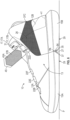
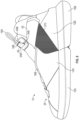
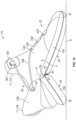
- the sole structure 15 is shown pivoted about a transverse pivot axis PA from the use position of FIG. 1 to an access position.
- the transverse pivot axis PA extends transversely across the sole structure 15 (e.g., from the lateral side 11 to the medial side 13) over the groove 27 defined by the connecting member 84.
- the groove 27 extends across a bottom surface 29 of the sole structure 15 between the front sole portion 15A and the rear sole portion 15B.
- the groove 27 is best shown in FIG. 6 and extends from the lateral side 11 to the medial side 13 of the sole structure 15.
- the groove 27 is relatively closed in the access position, enabling the sole structure 15 to be elevated at the transverse axis PA, e.g., further above a ground plane P in the access position than in the use position.
- the groove 27 is relatively open, and a front wall 35 of the connecting member 84 is further from a rear wall 37 of the connecting member 84 than in the closed position.
- confronting surfaces (e.g., the walls 35, 37) of the connecting member 84 are further from one another in the open position than in the closed position.
- the peak of the groove 27 or top of the cross-section through the groove 27 is configured to permit flexing of the material of the connecting member 84 for opening and closing of the groove 27 while minimizing or reducing stress concentrations or fatigue.
- a top of the groove 27 extends from the lateral side 11 to the medial side 13 of the sole structure 15, then internal forces resulting from the flexing are spread across the width of the sole structure 15, reducing stress concentrations in the connecting member 84.
- the top of the groove 27 has a relatively rounded rather than a relatively pointed shape (e.g., does not have a pointed apex), internal forces are spread over a greater area of the material, reducing stress concentrations in comparison to a pointed groove.
- the rear sole portion 15B inclines from a rear end 39 of the rear sole portion 15B to the transverse axis PA and the front sole portion 15A inclines from a forward end 47 of the front sole portion 15A to the transverse axis PA.
- the front upper portion 12A and the rear upper portion 12B are spaced apart from one another so that the ankle opening 17 is larger than in the use position. More specifically, a front 17A of the ankle opening 17 (as defined by the tongue region 12AA) is further from a rear 17B of the ankle opening 17 (as defined by the rear upper portion 12B).
- the front 17A is closer to the rear 17B than in the access position so that the ankle opening 17 snugly fits around the wearer's ankle.
- the footwear 10 is shown without a foot disposed therein. Because the upper 12 is comprised of relatively stretchable and flexible material or materials around the ankle, the ankle opening 17 appears slightly smaller than it would when stretched around an ankle.
- FIG. 5 shows the footwear 10 in the access position as described with respect to FIG. 4 but shows the rear upper portion 12B and the rear sole portion 15B in phantom so that a heel footbed 41 that extends rearward from the front sole portion 15A is visible.
- the heel footbed 41 extends rearward over and rests on the rear sole portion 15B.
- the heel footbed 41 is shown in hidden lines in this position in FIG. 6 .
- the heel footbed 41 serves as a visual target for a person inserting a foot into the foot-receiving cavity 26 of the front upper portion 12A and the front sole portion 15A.
- a person will typically insert the foot forward and downward in the direction of arrow C toward the foot-receiving cavity 26.
- the sole of the foot exerts downward force on the front sole portion 15A, including on the heel footbed 41, the foot will be guided correctly into position on the heel footbed 41 onto the top side of the rear sole portion 15B with the rear upper portion 12B wrapping around the rear of the wearer's heel.
- Properly placing the foot on the heel footbed 41 helps ensure correct alignment of the foot over the front sole portion 15A so that when the sole structure 15 pivots downward to the use position under the weight of the wearer, the rear upper portion 12B will easily slip around the rear of the wearer's foot.
- FIGS. 5 and 6 show the lateral cord guide 22C secured to the inner side 43A of the lateral strap 43 ( FIG. 5 ) and the medial cord guide 22D secured to the inner side 45A of the medial strap 45 ( FIG. 6 ).
- Lower portions of the straps 43, 45 are secured to the front upper portion 12A, such as by stitching, and the cord guides 22C, 22D are secured to these lower portions at the inner sides of the straps 43, 45, respectively.
- the cord guides 22C and 22D are looped sleeves that allow the cord 16 to slide through a space between the cord guide and the front upper portion 12A.
- the adjustment cord 16 engages the medial cord guide 22D and the lateral cord guide 22C between the anchor location 20 and the cord lock 18.
- the cord guides 22C and 22D and the cord 16 are disposed between the inner sides 43A, 45A of the respective straps 43 and 45 and the front upper portion 12A.
- the straps 43,45 may each have a resiliently stretchable portion 31 adjacent the fastener components 37A, 37B (described below) and the cord guides 22C, 22D, which enables further tightening of the front upper portion 12A to the rear upper portion 12B when the straps 43, 45 are stretched.
- the cord 16 may be slightly further rearward when the straps 43, 45 are stretched at the resiliently stretchable portions 31 and secured to the rear upper portion 12B.
- the cord 16 follows a non-linear path from the anchor location 20 at the cord guides 22A, 22B through the cord guides 22C, 22D to the lock bodies 18A, 18B.
- At least one fastener component 37A is secured to the inner side 43A of strap 43, and at least one fastener component 37B is secured to the inner side 45A of strap 45.
- the fastener components 37A, 37B are releasably securable to one or more complementary fastener components 37C that are secured to the rear upper portion 12B.
- FIG. 7 shows the lateral side strap 43 secured to the rear upper portion 12B at the fastener component 37C.
- FIG. 8 shows the medial strap 45 secured to the rear upper portion 12B at the fastener component 37C.
- the fastener components 37A, 37B, 37C are hook and loop fasteners.
- the fastener components 37A, 37B may be include a plurality of loops, and the fastener component 37C may include a plurality of hooks to which the loops are securable.
- the fastener components 37A, 37B could include a plurality of hooks and the fastener component 37C may include a plurality of loops.
- each of the fastener components 37A, 37B, 37C could include both hooks and loops configured so that the fastener components 37A and 37B can secure to the fastener component 37C.
- the fastener component 37C is shown as a single, continuous fastener component extending around the rear of the rear upper portion 12B and on both the lateral side 11 and medial side 13 of the rear upper portion 12B. This large expanse of the fastener component 37C allows the straps 43, 45 to be secured at various locations on the fastener component 37C to affect, in combination with the adjustment cord 16 and lock 18, a desired fit of the upper 12 (e.g., upper portions 12A, 12B) to the foot. In other embodiments, multiple smaller and discrete fastener components 37C may be secured to the rear upper portion 12B instead of one large, continuous fastener component 37C.
- Tensioning of the adjustment cord 16 when the lateral strap 43 and the medial strap 45 are secured to the rear upper portion 12B may also further pull the rear upper portion 12B toward the front upper portion 12A due to the engagement of the cord 16 with the lateral cord guide 22C and the medial cord guide 22D at the inner sides 45A, 43A of the medial strap 45 and the lateral strap 43.
- the cord 16 may be tensioned by pulling on the loop portion 16A and then may be locked to the cord lock 18 to retain the tension. Tensioning and locking may occur either before or after securing the straps 43, 45 to the rear upper portion 12B. In FIG. 7 , the straps 43, 45 have been secured to the rear upper portion 12B before the cord 16 is secured to the cord lock 18.
- the loop portion 16A is shown in the untensioned position in FIG. 7 .
- the cord 16 locks to the cord lock 18 when the loop portion 16A is manually pulled outward in the direction of the force F and pivoted in the direction of arrow G to the locked position of FIG. 8 (shown in phantom in FIG. 7 as locked position L).
- first body 18A is shown and described in greater detail.
- the description of the first body 18A applies equally to the second body 18B as the second body 18B is configured symmetrically to the first body 18A.
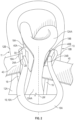
- Each body 18A, 18B includes a first passage 28 and a second passage 30 that branches from an intermediate portion 32 of the first passage 28. Stated differently, the passages 28, 30 are in communication with one another at the intermediate portion 32.
- the body 18A defines an entrance opening 34A and a first exit opening 24A, and the first passage 28 extends from the entrance opening 34A to the first exit opening 24A.
- the second passage 30 extends from the first passage 28 to a second exit opening 40A defined by the body 18A.
- the first passage 28 includes a first segment 28A and a second segment 28B.
- the first segment 28A extends from the entrance opening 34A to the edge 33 (see FIG. 10 ) of the second passage 30 furthest from the entrance opening 34A.
- the second segment 28B extends from the edge 33 of the second passage 30 to the first exit opening 24A.
- the first passage 28 is cylindrical and has a first diameter D3.
- a longitudinal axis A2 of the second passage 30 is disposed at an obtuse angle B with respect to the longitudinal axis A1 of the first passage 28, with the obtuse angle B being the angle between the longitudinal axis A1 at the entrance opening 34A and the longitudinal axis A2 at the second exit opening 40A.
- the second body 18B has corresponding first and second passages 28, 30 arranged in an identical manner relative to one another as in the first body 18A with an entrance opening 34B, a first exit opening 24B, and a second exit opening 40B (see FIG. 8 ).
- the second passage 30 is in communication with the first passage 28 as an entrance 38 (see FIG. 10 ) of the second passage begins at the intermediate portion 32.
- the second passage 30 is cylindrical and has a second diameter D4 that is less than the first diameter D3 of the first passage 28. Accordingly, the first cross-sectional area of the first passage 28 is greater than the second cross-sectional area of the second passage 30 as both are proportional to the square of their respective diameters D3, D4.
- the cross-sectional area of each passage 28 or 30 is taken perpendicular to its center axis A1 or A2. In other embodiments, only a portion of the second passage 30 has a smaller diameter than the first passage. For example, only a narrowed portion somewhere along the second passage 30 need be narrower than the untensioned diameter D1 of the cord 16 in order to lock the loop portion 16A of the cord 16 to the body 18A in the second passage 30.
- the adjustment cord 16 is configured so that its diameter D2 when tensioned is less than the diameter D3 of the first passage 28.
- the cord 16 is elastic, and is cylindrical in cross-section (e.g., at a section through the cord 16 taken perpendicular to its longitudinal axis). Accordingly, the cross-sectional area of the cord 16 when tensioned is less than the cross-sectional area of the first passage 28. This allows the cord 16 to move longitudinally relative to the first passage 28 (e.g., slide within the first passage 28) when the loop portion 16A is pulled away from the bodies 18A, 18B, such as in a direction along the longitudinal axis A1 of the first passage 28.
- the cross-sectional area of the cord 16 when tensioned may also be at least slightly less than the cross-sectional area of the second passage 30 and slightly less than the narrowed portion at width D5 (discussed in FIG. 11 ) to allow the tensioned cord 16 to pass into the second passage 30 when the loop portion 16A is repositioned from the first passage 28 to the second passage 30.
- the cross-sectional area of the cord 16 when not tensioned e.g., its cross-sectional area when it has a diameter D1 is greater than a cross-sectional area of the second passage 30.
- This configuration allows the cord 16 to fit into the second passage 30 when pivoted to the second position, and then lock to the second passage 30 when the force F is removed, with the cord 16 filling the second passage 30 as it tries to return to its untensioned diameter D1.
- the cord 16 is inelastic
- its cross-sectional area may remain relatively unchanged when tensioned, but it may lock to the lock 18 in the second passage 30 by a friction fit and/or may slightly compress when manually placed in the second passage 30 (e.g., such as by pushing the cord 16 into the second passage 30 when pivoted).
- the lock bodies 18A, 18B thus act as pinch points on the cord 16, and the portion 16B between the anchor location 20 and the lock 18 remains tensioned.
- the portion of the cord 16 between the second exit opening 40A of the first body 18A and the second exit opening 40B of the second body 18B (e.g., the loop portion 16A) is untensioned (e.g., slack) and may have the diameter D1.
- an exterior surface 42 of the body 18A defines a slot 44 that extends from the first exit opening 24A to the second exit opening 40A.
- the slot 44 also extends inward from the exterior surface 42 into the body 18A along the segment 28B of the first passage 28 and along the second passage 30.
- the slot 44 does not extend along the segment 28A of the first passage 28 that is between the entrance opening 34A and the beginning of the second passage 30 (e.g., first segment 28A).
- the slot 44 enables the loop portion 16A of the adjustment cord 16 to be repositionable by pivoting the cord 16 in the body 18A through the slot 44 from the first position ( FIG. 2 ) in which the adjustment cord 16 extends through the first exit opening 24A to the second position ( FIG. 1 ) in which the adjustment cord 16 extends through the second exit opening 40A.
- the adjustment cord 16 extends through the entrance opening 34A in both the first position and the second position.
- the body 18A includes a first side wall 48 and a second side wall 50 spaced apart from the first side wall 48 by the slot 44.
- the first side wall 48 and the second side wall 50 extend along the segment 28B of the first passage 28. Stated differently, the first side wall 48 and the second side wall 50 extend beyond the intermediate portion 32 (where the second passage 30 branches from the first passage 28) all the way to the first exit opening 24A.
- the first side wall 48 and the second side wall 50 also extend along the second passage 30 to the second exit opening 40A.
- a top 52 of each of the side walls 48, 50 extends forward from the second exit opening 40A the length of the segment 28B.
- a front 54 of each of the side walls 48, 50 extends upward to meet the top 52.
- the second passage 30 and the segment 28B are thus completely within the body 18A.
- a forward portion of the first passage 28 e.g., the second segment 28B closest to the front 54
- an upper portion of the second passage 30 e.g., a portion closest to the top 52
- the slot 44 enables the cord 16 to exit the second passage 30 when the cord 16 is pivoted back to the segment 28B.
- the first side wall 48 and the second side wall 50 are configured such that the slot 44 is narrower at an axial opening 64 of the second passage 30 bordering the slot 44 than at the front 54 of the body 18A.
- the inner surface 60 of the first side wall 48 angles inward (e.g., into the slot 44) toward the second side wall 50 from the exterior surface 42 at the front 54 to the second passage 30 to narrow the slot 44.
- the inner surface 62 of the second side wall 50 angles inward toward the first side wall 48 in a similar manner. In other embodiments, only the first side wall 48 or only the second side wall 50 angles inward.
- the axial opening 64 of the second passage 30 to the slot 44 has a width D5 that is less than the diameter D4 of the second passage 30.
- the narrowing of the slot 44 to the width D5 will further help to retain the cord 16 in the second passage 30 until it is again tensioned by an applied pulling force to thin the cord 16 to its tensioned diameter D2, which is less than the width D5, allowing the cord 16 to be pivoted back to the first passage 28 through the axial opening 64, and to thereby loosen the front upper portion 12A.
- the cord 16 is inelastic
- its cross-sectional area may remain relatively unchanged when tensioned, but it may lock to the lock 18 in the second passage 30 by a friction fit and/or may slightly compress when manually placed in the second passage 30 (e.g., such as by pushing the cord 16 into the second passage 30 when pivoted).
- the cord 16 may be folded along its length at the second passage 30 before or while being inserted into the second passage 30 by the pivoting motion.
- the flat cord is elastic and is tensioned, the total cross-sectional of the flat cord is less than when it is untensioned. Additionally, folding a flat cord along its length will further enable it to lock in the lock body as its thickness will be doubled and it is biased to attempt to unfold and return to an unfolded state which will cause it to press against the lock body in the second passage 30.
- the second passages 30 of the bodies 18A, 18B thus act as pinch points on the cord 16, and the portion 16B between the anchor location 20 and the lock 18 remains tensioned.
- the portion of the cord 16 between the second exit opening 40A of the first body 18A and the second exit opening 40B of the second body 18B e.g., the loop portion 16A
- is untensioned e.g., slack
- the inner surfaces 60, 62 of the side walls 48 and 50 protrude inward just above the first passage 28, as shown at the protrusions 66.
- the protrusions 66 ensure that the slot 44 also has only the width D5 at the axial opening 68 of the first passage 28 to the slot 44.
- a series of protrusions configured as ribs may extend along the inner surfaces 60, 62 of the side walls 48 and 50 in a direction from the front 54 toward the axial opening 64. These protrusions may help prevent the cord 16 from moving from the second passage 30 to the first passage 28 without a manually-applied tensioning force narrowing the cord or otherwise enabling the cord 16 to be intentionally removed from the passage 30.
- the first side wall 48 may be configured to flex away from the second side wall 50 when the adjustment cord 16 encounters the protrusions 66 with sufficient force during repositioning of the adjustment cord 16.
- the first passage 28 of each of the first body 18A and the second body 18B extends forward and upward from the entrance opening 34A, 34B to the first exit opening 24A, 24B, respectively.
- the loop portion 16A extends generally forward from the first exit openings 24A, 24B when the adjustment cord 16 is in the first passage 28 and exits the first exit openings 24A, 24B.
- the cord 16 is in the untensioned state, with the loop portion 16A disposed in the first passages 28.
- the adjustment cord 16 thus makes a forward and upward turn from the cord guides 22C and 22D (disposed under the straps 43,45) to route through the respective first passages 28.
- the first body 18A, the lateral cord guide 22C and the cord guide 22A at the anchor location 20 are arranged in a triangular spacing. Pulling the loop portion 16A in the direction of the force F (upward and forward) along the axes A1 of the first passages 28 (shown in FIG. 10 ), and while maintaining the force F, and subsequently or simultaneously pivoting the loop portion 16A (as represented by pivot arrow G in FIG. 7 ) rearward through the slot 44 of each of the bodies 18A, 18B to the second passage 30 moves the loop portion 16A to the locked position of FIG. 8 , in which the tension in the portion 16B of the cord 16 is maintained.
- each of the first body 18A and the second body 18B extends rearward and upward from the intermediate portion 32 of each first passage 28 to the second exit opening 40A, 40B, respectively.
- the loop portion 16A extends generally upward and slightly rearward when the loop portion 16A extends in the second passages 30 and exits the second exit openings 40A, 40B.
- the front upper portion 12A is slightly closer to the front sole portion 15A over the midfoot region 23 and the forefoot region 25 (e.g., at the anchor location 20), and the lock 18 (e.g., bodies 18A, 18B) may be shifted slightly rearward relative to its positions in FIG. 7 .
- the loop portion 16A is pulled upward and rearward along the axes A2 of the second passages 30, and simultaneously or subsequently pivoted through the slot 44 in the opposite direction of arrow G while maintaining the applied force to return to the untensioned, first position of FIG. 7 , at which time the force F is released so that the adjustment cord 16, including the loop portion 16A and the portion 16B, returns to its untensioned state.
- Both tightening and loosening of the cord 16 and the resulting adjustment of the upper 12 can occur by pulling and pivoting the cord 16 as described with only one hand. The other hand is not needed to complete the adjustment and need not even be in contact with the footwear 10 during the adjustment.
- FIGS. 13 and 14 show an alternative embodiment of an article of footwear 110 that is alike in all aspects to the article of footwear 10 except that a medial hook 145 and a lateral hook 143 are provided and the following components are not provided: the medial strap 45, the lateral strap 43, fastener components 37A, 37B, and 37C, and guides 22C and 22D.
- the medial hook 145 extends from the medial side 13 of the rear upper portion 12B.
- the lateral hook 143 extends from the lateral side 11 of the rear upper portion 12B.
- the cord 16 engages the medial hook 145 and the lateral hook 143 between the anchor location 20 and the lock bodies 18A, 18B of the cord lock 18.
- the engagement of the cord 16 with the hooks 143, 145 helps to retain the rear upper portion 12B and the front upper portion 12A in the use position.
- the cord 16 may extend through the hooks 143, 145 in the access position (as shown extending through the lateral hook 143 in FIG. 14 ), or the cord 16 may be disengaged from the hooks 143, 145 in the access position, and then positioned in the hooks 143, 145 once the footwear 110 is moved to the access position and prior to locking the cord 16 to the lock bodies 18A, 18B.
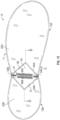
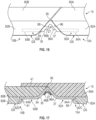
- FIG. 15 shows the connecting member 84 (e.g. the plate 84) included in both the article of footwear 10 and the article of footwear 110 in greater detail.
- the plate 84 may be a rigid or semi-rigid plastic such as a thermoplastic polyurethane and is pre-molded with the groove 27.
- the plate 84 may be stiffer than the material of the front and rear outsole portions 82A, 82B to minimize torsion of the sole structure 15 at the plate 84.
- the plate 84 may be the same material as the front and rear outsole portions 82A, 82B and may be considered to be part of the outsole.
- the plate 84 is connected to a rear wall 86 of the front midsole component 80A, and to the bottom of the front midsole component 80A forward of the rear wall 86.
- the plate 84 is also connected to the front wall 88 of the rear midsole component 80B, and to the bottom of the rear midsole component 80B just rearward of the rear wall 86.
- the plate 84 thus lines the front wall 88 and the rear wall 86 at the groove 27 and the groove 27 extends transversely between the medial side 13 and the lateral side 11 of the article of footwear 10.
- the plate 84 has notches 94A, 94B at side edges of the plate 84 at the medial side 13 and the lateral side 11, respectively, near a peak 95 of the plate 84 over the groove 27 to reduce stress concentrations at the medial and lateral sides of the peak 95.
- the notches 94A, 94B may be smaller than shown, or the plate 84 may have no notches.
- Ribs 96A, 96B may be secured at the respective walls 37, 35 of the plate 84 in the groove 27 and may extend outward into the groove 27.
- the ribs 96A, 96B may be the same material as the plate, or may be a harder or softer material, and may serve as reinforcing members and/or bumpers or spacers in the groove 27.
- the ribs 96A, 96B may extend slightly outward from the walls 37, 35 into the groove 27 so that the ribs 96A, 96B rather than the walls 37, 35 contact one another in the access position (e.g., when the groove 27 is closed).
- the ribs 96A, 96B do not extend across the top of the groove 27 between the walls 37, 35 so as not to increase resistance to pivoting of the sole structure 15 at the groove 27.
- the front outsole portion 82A underlies and is secured to the front midsole component 80A forward of the plate 84.
- the rear outsole portion 82B underlies and is secured to the rear midsole component 80B rearward of the plate 84.
- the front midsole component 80A and the rear midsole component 80B may be connected to the respective outsole portions 82A, 82B and to the plate 84 in this manner by bonding such as with adhesive, or by insert molding, co-molding, or additive 3-D printing.
- the plate 84 and the outsole portions 82A, 82B may be configured to interfit.
- a rear edge 89 of the outsole portion 82A may be shaped to follow and/or abut a front rim 84A of the plate 84 from the medial side 13 to the lateral side 11 of the sole structure 15.
- a forward edge 91 of the outsole portion 82B may be shaped to follow and/or abut a rear rim 84B of the plate 84 from the medial side 13 to the lateral side 11.
- the plate 84 may extend forward and rearward slightly beyond the rims 84A, 84B, respectively.
- the front outsole portion 82A may include a lip 82C that covers the front edge of the plate 84 forward of the front rim 84A.
- the rear outsole portion 82B may include a lip 82D that covers the rear edge of the plate 84 rearward of the rear rim 84B.
- the outsole portions 82A, 82B are thicker than the plate 84 so that the plate 84 does not form part of the ground contact surface GS of the sole structure 15 (e.g., the surface of the sole structure 15 that would come into contact with the level ground plane P when the article of footwear 10 or 110 is in the use position).
- the thicker outsole portions 82A, 82B extending downward from the midsole components 80A, 80B create a first recess 92A at the bottom surface of the front sole portion 15A and a second recess 92B at the bottom surface of the rear sole portion 15B.
- the plate 84 is nested in the first recess 92A and in the second recess 92B so that it is raised from the ground contact surface GS of the outsole portions 82A, 82B.
- An "article of footwear”, a “footwear article of manufacture”, and “footwear” may be considered to be both a machine and a manufacture. Assembled, ready to wear footwear articles (e.g., shoes, sandals, boots, etc.), as well as discrete components of footwear articles (such as a midsole, an outsole, an upper component, etc.) prior to final assembly into ready to wear footwear articles, are considered and alternatively referred to herein in either the singular or plural as "article(s) of footwear”.
- footwear articles e.g., shoes, sandals, boots, etc.
- discrete components of footwear articles such as a midsole, an outsole, an upper component, etc.
- longitudinal refers to a direction extending a length of a component.
- a longitudinal direction of a shoe extends between a forefoot region and a heel region of the shoe.
- the term “forward” or “anterior” is used to refer to the general direction from a heel region toward a forefoot region, and the term “rearward” or “posterior” is used to refer to the opposite direction, i.e., the direction from the forefoot region toward the heel region.
- a component may be identified with a longitudinal axis as well as a forward and rearward longitudinal direction along that axis.
- the longitudinal direction or axis may also be referred to as an anterior-posterior direction or axis.
- transverse refers to a direction extending a width of a component.
- a transverse direction of a shoe extends between a lateral side and a medial side of the shoe.
- the transverse direction or axis may also be referred to as a lateral direction or axis or a mediolateral direction or axis.
- vertical refers to a direction generally perpendicular to both the lateral and longitudinal directions. For example, in cases where a sole is planted flat on a ground surface, the vertical direction may extend from the ground surface upward. It will be understood that each of these directional adjectives may be applied to individual components of a sole.
- upward or “upwards” refers to the vertical direction pointing towards a top of the component, which may include an instep, a fastening region and/or a throat of an upper.
- downward or “downwards” refers to the vertical direction pointing opposite the upwards direction, toward the bottom of a component and may generally point towards the bottom of a sole structure of an article of footwear.
- the "interior" of an article of footwear refers to portions at the space that is occupied by a wearer's foot when the shoe is worn.
- the “inner side” of a component refers to the side or surface of the component that is (or will be) oriented toward the interior of the component or article of footwear in an assembled article of footwear.
- the “outer side” or “exterior” of a component refers to the side or surface of the component that is (or will be) oriented away from the interior of the shoe in an assembled shoe.
- other components may be between the inner side of a component and the interior in the assembled article of footwear.
- other components may be between an outer side of a component and the space external to the assembled article of footwear.
- the terms “inward” and “inwardly” refer to the direction toward the interior of the component or article of footwear, such as a shoe
- the terms “outward” and “outwardly” refer to the direction toward the exterior of the component or article of footwear, such as the shoe.
- proximal refers to a direction that is nearer a center of a footwear component or is closer toward a foot when the foot is inserted in the article of footwear as it is worn by a user.
- distal refers to a relative position that is further away from a center of the footwear component or is further from a foot when the foot is inserted in the article of footwear as it is worn by a user.
- proximal and distal may be understood to provide generally opposing terms to describe relative spatial positions.
Landscapes
- Footwear And Its Accessory, Manufacturing Method And Apparatuses (AREA)
Claims (13)
- Ein Fußbekleidungsartikel (10; 110), der Folgendes umfasst:eine Sohlenstruktur (15) mit einem vorderen Sohlenabschnitt (15A) und einem hinteren Sohlenabschnitt (15B), der relativ zum vorderen Sohlenabschnitt (15A) zwischen einer Gebrauchsposition und einer Zugangsposition schwenkbar ist;einem Schuhwerk-Oberteil (12), das am vorderen Sohlenabschnitt (15A) und am hinteren Sohlenabschnitt (15B) befestigt ist; undeinem Verschlusssystem (14), das Folgendes umfasst:
eine Einstellkordel (16), die funktionsfähig am Schuhwerk-Oberteil (12) an einer Verankerungsstelle (20) befestigt ist;dadurch gekennzeichnet, dass das Verschlusssystem ferner Folgendes umfasst:
einen Kordelverschluss (18), die am Oberteil (12) des Schuhwerks in einer festen Position befestigt ist;wobei der Kordelverschluss (18) mit der Einstellkordel (16) zusammenpasst und diese verriegelt, um das Oberteil (12) des Schuhwerks festzuziehen, wenn sich die Sohlenstruktur (15) in der Gebrauchsposition befindet, um die Spannung in der Einstellkordel (16) aufrechtzuerhalten;wobei:der Kordelverschluss (18) einen ersten Körper (18A) beinhaltet, der an einer lateralen Seite eines Zungenbereichs des Oberteils (12) des Schuhwerks befestigt ist;der Kordelverschluss (18) ferner einen zweiten Körper (18B) beinhaltet, der an einer medialen Seite (13) des Zungenbereichs des Oberteils (12) des Schuhwerks befestigt ist; und wobeidie Einstellkordel (16) einen Schlaufenabschnitt (16A) beinhaltet, der sich von einem Austritt des ersten Körpers (18A) aus und von einem Austritt des zweiten Körpers (18B) aus erstreckt;wobeider erste Körper (18A) und der zweite Körper (18B) jeweils mit einem ersten Durchgang (28) und einem zweiten Durchgang (30) konfiguriert sind, der von einem Zwischenabschnitt (32) des ersten Durchgangs (28) abzweigt, wobei der zweite Durchgang (30) schmaler ist als der erste Durchgang (28),die Einstellkordel (16) unter Spannung durch den ersten Durchgang (28) gleitend verschiebbar ist, um das Oberteil (12) des Schuhwerks in der Gebrauchsposition festzuziehen; unddie Einstellkordel (16) von einem Segment (28B) des ersten Durchgangs (28) zum zweiten Durchgang (30) schwenkbar ist und im zweiten Durchgang (30) am Kordelverschluss (18) verriegelt ist, um die Spannung in der Einstellkordel (16) aufrechtzuerhalten;wobei jeder des ersten Körpers (18A) und des zweiten Körpers (18B) des Kordelverschlusses (18) Folgendes definiert:eine Eintrittsöffnung (34A), eine erste Austrittsöffnung (24A), eine zweite Austrittsöffnung (40A, 40B), wobei sich der erste Durchgang (28) von der Eintrittsöffnung (34A) zur ersten Austrittsöffnung (24A) erstreckt, der zweite Durchgang (30) sich von dem Zwischenabschnitt (32) des ersten Durchgangs (28) zur zweiten Austrittsöffnung (40A, 40B) erstreckt; und wobeidas Segment (28B) des ersten Durchgangs (28), das sich vom Zwischenabschnitt (32) zur ersten Austrittsöffnung (24A) erstreckt, mit dem zweiten Durchgang (30) in Verbindung steht; undwobei der Schlaufenabschnitt (16A) der Einstellkordel (16) sich im Allgemeinen nach vorne von der ersten Austrittsöffnung (24A) erstreckt, wenn die Einstellkordel (16) im ersten Durchgang (28) verläuft, und sich im Allgemeinen nach oben von der zweiten Austrittsöffnung (40A, 40B) erstreckt, wenn der Schlaufenabschnitt (16A) im zweiten Durchgang (30) verläuft. - Der Fußbekleidungsartikel (10; 110) nach Anspruch 1, wobei das Schuhwerk-Oberteil (12) Folgendes beinhaltet: einen vorderen Oberteilabschnitt (12A), der am vorderen Sohlenabschnitt (15A) befestigt ist und einen Vorfußbereich (25) des Schuhwerk-Oberteils (12) definiert, und einen hinteren Oberteilabschnitt (12B), der am hinteren Sohlenabschnitt (15B) befestigt ist und einen Fersenbereich (21) des Schuhwerk-Oberteils (12) definiert; unddas Verschlusssystem (14) ferner Folgendes umfasst: mindestens eines von einem medialen Riemen (45), der von einer medialen Seite (13) des vorderen Oberteilabschnitts (12A) ausgeht, und einem lateralen Riemen (43), der von einer lateralen Seite (11) des vorderen Oberteilabschnitts (12A) ausgeht, wobei der mindestens eine von dem medialen Riemen (45) und dem lateralen Riemen (43) am hinteren Oberteilabschnitt (12B) befestigbar ist, um in der Gebrauchsposition den vorderen Oberteilabschnitt (12A) am hinteren Oberteilabschnitt (12B) zu befestigen;und wobei optional der mindestens eine von dem medialen Riemen (45) und dem lateralen Riemen (43) sowohl den medialen Riemen (45) als auch den lateralen Riemen (43) beinhaltet, wobei der mediale Riemen (45) und der laterale Riemen (43) jeweils eine Befestigungskomponente (37A, 37B) beinhalten, und der hintere Oberteilabschnitt (12B) eine oder mehrere komplementäre Befestigungskomponenten (37C) beinhaltet, an denen die Befestigungskomponente (37B) des medialen Riemens (45) und die Befestigungskomponente (37B) des lateralen Riemens (43) selektiv befestigbar und lösbar sind.
- Der Fußbekleidungsartikel (10; 110) nach Anspruch 2, wobei das Verschlusssystem (14) ferner Folgendes umfasst:
mindestens eine von einer medialen Kordelführung (22D), die an der medialen Seite (13) des vorderen Oberteilabschnitts (12A) befestigt ist, und eine laterale Kordelführung (22C), die an der lateralen Seite (11) des vorderen Oberteilabschnitts (12A) befestigt ist, wobei die Einstellkordel (16) zwischen der Verankerungsstelle (20) und dem Kordelverschluss (18) in die mindestens eine von der medialen Kordelführung (22D) und der lateralen Kordelführung (22C) eingreift. - Der Fußbekleidungsartikel (10; 110) nach Anspruch 3, wobei der mindestens eine von dem medialen Riemen (45) und dem lateralen Riemen (43) sowohl den medialen Riemen (45) als auch den lateralen Riemen (43) beinhaltet, wobei die mediale Kordelführung (22D) am medialen Riemen (45) befestigt ist, und die laterale Kordelführung (22C) am lateralen Riemen (43) befestigt ist.
- Der Fußbekleidungsartikel (10; 110) nach Anspruch 4, wobei die mediale Kordelführung (22D) an einer Innenseite (45A) des medialen Riemens (45) befestigt ist, und die laterale Kordelführung (22C) an einer Innenseite (43A) des lateralen Riemens (43) befestigt ist.
- Der Fußbekleidungsartikel (10; 110) nach irgendeinem der Ansprüche von 2 bis 5, wobei das Verschlusssystem (14) ferner mindestens eine Vorfuß-Kordelführung (22A, 22B) umfasst, die im Vorfußbereich (25) am vorderen Oberteilabschnitt (12A) verankert ist; und wobei die Einstellkordel (16) in die mindestens eine Vorfuß-Kordelführung (22A, 22B) eingreift, um die Einstellkordel (16) funktional am vorderen Oberteilabschnitt (12A) zu befestigen,
und optional, wobei die mindestens eine Vorfuß-Kordelführung (22A, 22B) Folgendes beinhaltet: eine mediale Vorfuß-Kordelführung (22B), die an der medialen Seite (13) des vorderen Oberteilabschnitts (12A) im Vorfußbereich (25) befestigt ist, und eine laterale Vorfuß-Kordelführung (22A), die an der lateralen Seite (11) des vorderen Oberteilabschnitts (12A) im Vorfußbereich (25) befestigt ist. - Der Fußbekleidungsartikel (10; 110) nach Anspruch 6, wobeidas Verschlusssystem (14) ferner mindestens eine zusätzliche Kordelführung (22E, 22F) umfasst, die am vorderen Oberteilabschnitt (12A) befestigt ist; und wobeidie Einstellkordel (16) zwischen der mindestens einen Vorfuß-Kordelführung (22A, 22B) und dem Kordelverschluss (18) in die mindestens eine zusätzliche Kordelführung (22E, 22F) eingreift.
- Der Fußbekleidungsartikel (10; 110) nach Anspruch 1, wobei das Schuhwerk-Oberteil (12) Folgendes beinhaltet: einen vorderen Oberteilabschnitt (12A), der am vorderen Sohlenabschnitt (15A) befestigt ist und einen Vorfußbereich (25) des Schuhwerk-Oberteils (12) definiert, und einen hinteren Oberteilabschnitt (12B), der am hinteren Sohlenabschnitt (15B) befestigt ist, wobei der hintere Oberteilabschnitt (12B) einen Fersenbereich (21) des Schuhwerk-Oberteils (12) definiert; und wobei
das Verschlusssystem (14) ferner Folgendes umfasst: einen medialen Haken (145), der von einer medialen Seite (13) des hinteren Oberteilabschnitts (12B) ausgeht, und einen lateralen Haken (143), der von einer lateralen Seite (11) des hinteren Oberteilabschnitts (12B) ausgeht, wobei die Einstellkordel (16) zwischen der Verankerungsstelle (20) und dem Kordelverschluss (18) in den medialen Haken (145) und den lateralen Haken (143) eingreift. - Der Fußbekleidungsartikel (10; 110) nach irgendeinem der vorstehenden Ansprüche, wobeijeder des ersten Körpers (18A) und des zweiten Körpers (18B) eine innere Seitenwand (50), eine von der inneren Seitenwand (50) beabstandete äußere Seitenwand (48) und mindestens einen Vorsprung (66) beinhaltet, der von der inneren Seitenwand (50) oder von der äußeren Seitenwand (48) ausgeht; und wobeidie innere Seitenwand (50) zwischen dem Schuhwerk-Oberteil (12) und der äußeren Seitenwand (48) liegt.
- Der Fußbekleidungsartikel (10; 110) nach irgendeinem der vorstehenden Ansprüche, wobeiin jedem von dem ersten Körper (18A) und dem zweiten Körper (18B) sich die Einstellkordel (16) ausgehend von der Verankerungsstelle (20) und durch den ersten Durchgang (28) von der Eintrittsöffnung (34A) zur ersten Austrittsöffnung (24A) erstreckt, und umpositionierbar ist vom Segment (28B) des ersten Durchgangs (28) zum zweiten Durchgang (30), um durch die zweite Austrittsöffnung (40A, 40B) auszutreten; und wobeizumindest ein Abschnitt des zweiten Durchgangs (30) schmaler ist als der erste Durchgang (28), um die Einstellkordel (16) am ersten Körper (18A) und am zweiten Körper (18B) zu verriegeln, wenn sich die Einstellkordel (16) im zweiten Durchgang (30) des ersten Körpers (18A) und im zweiten Durchgang (30) des zweiten Körpers (18B) befindet.
- Der Fußbekleidungsartikel (10; 110) nach irgendeinem der vorstehenden Ansprüche, wobei ein Winkel zwischen einer Längsachse des ersten Durchgangs (28) und einer Längsachse des zweiten Durchgangs (30) und zwischen der Eingangsöffnung (34A) und der zweiten Ausgangsöffnung (40A, 40B) ein stumpfer Winkel ist.
- Der Fußbekleidungsartikel (10; 110) nach irgendeinem der vorstehenden Ansprüche, wobei die Sohlenstruktur (15) um eine Querachse (PA) der Sohlenstruktur (15) zwischen der Gebrauchsposition und der Zugangsposition schwenkbar ist und in der Zugangsposition an der Querachse (PA) weiter von einer Bodenebene (P) entfernt angehoben ist als in der Gebrauchsposition, wobei der hintere Sohlenabschnitt (15B) von einem hinteren Ende (39) des hinteren Sohlenabschnitts (15B) zur Querachse (PA) geneigt ist, und wobei der vordere Sohlenabschnitt (15A) von einem vorderen Ende (47) des vorderen Sohlenabschnitts (15A) zur Querachse (PA) in der Zugangsposition geneigt ist.
- Der Fußbekleidungsartikel (10; 110) nach irgendeinem der vorstehenden Ansprüche, wobeider vordere Sohlenabschnitt (15A) eine vordere Zwischensohlenkomponente (80A) beinhaltet und der hintere Sohlenabschnitt (15B) eine hintere Zwischensohlenkomponente (80B) beinhaltet, die relativ zur vorderen Zwischensohlenkomponente (80A) diskontinuierlich ist;die Sohlenstruktur (15) ein Verbindungselement (84) beinhaltet, das die vordere Zwischensohlenkomponente (80A) mit der hinteren Zwischensohlenkomponente (80B) verbindet und eine Nut (27) definiert, die sich quer zwischen der vorderen Zwischensohlenkomponente (80A) und der hinteren Zwischensohlenkomponente (80B) erstreckt;die vordere Zwischensohlenkomponente (80A) und die hintere Zwischensohlenkomponente (80B) an der Nut (27) zwischen einer Gebrauchsposition und einer Zugangsposition relativ zueinander schwenkbar sind; und wobeieinander zugewandte Flächen (35, 37) des Verbindungselements (84) an der Nut (27) in der Zugangsposition näher beieinander liegen als in der Gebrauchsposition, sodass die Nut (27) in der Gebrauchsposition relativ offen ist, und die Nut (27) in der Zugangsposition relativ geschlossen ist;und optional, wobei das Verbindungselement (84) eine Platte (84) umfasst, die die Nut (27) definiert und an einer Rückwand (86) der vorderen Zwischensohlenkomponente (80A) und an einer Vorderwand (88) der hinteren Zwischensohlenkomponente (80B) an der Nut (27) befestigt ist.
Applications Claiming Priority (2)
| Application Number | Priority Date | Filing Date | Title |
|---|---|---|---|
| US201962923013P | 2019-10-18 | 2019-10-18 | |
| PCT/US2020/055208 WO2021076440A1 (en) | 2019-10-18 | 2020-10-12 | Easy-access article of footwear with cord lock |
Publications (2)
| Publication Number | Publication Date |
|---|---|
| EP4044862A1 EP4044862A1 (de) | 2022-08-24 |
| EP4044862B1 true EP4044862B1 (de) | 2025-06-18 |
Family
ID=73040317
Family Applications (1)
| Application Number | Title | Priority Date | Filing Date |
|---|---|---|---|
| EP20800466.3A Active EP4044862B1 (de) | 2019-10-18 | 2020-10-12 | Einfach anziehbarer schuh mit schuhbandverriegelung |
Country Status (4)
| Country | Link |
|---|---|
| US (1) | US11707113B2 (de) |
| EP (1) | EP4044862B1 (de) |
| CN (1) | CN114554899B (de) |
| WO (1) | WO2021076440A1 (de) |
Families Citing this family (24)
| Publication number | Priority date | Publication date | Assignee | Title |
|---|---|---|---|---|
| CA2784281C (en) | 2009-11-12 | 2015-02-03 | Ogio International, Inc. | Rapid-entry shoe |
| CN115316746B (zh) | 2016-04-22 | 2024-05-28 | 飞思特知识产权有限责任公司 | 具有回弹配合系统的快速进入式鞋类 |
| US10653209B2 (en) | 2018-06-28 | 2020-05-19 | Fast Ip, Llc | Rapid-entry footwear having an actuator arm |
| AU2019420589B2 (en) | 2019-01-07 | 2021-05-13 | Fast Ip, Llc | Rapid-entry footwear having a compressible lattice structure |
| EP3930527B1 (de) | 2019-02-26 | 2025-09-24 | Fast IP, LLC | Schuhwerk für schnelles anziehen mit einem fersenarm und einem elastischen element |
| EP4640101A3 (de) | 2019-07-29 | 2025-12-24 | Fast IP, LLC | Schuh zum schnellen anziehen mit einem stabilisator und einem elastischen element |
| WO2021045902A1 (en) | 2019-09-03 | 2021-03-11 | Fast Ip, Llc | Rapid-entry footwear having a pocket for a compressed medium |
| EP4027825B1 (de) | 2019-09-09 | 2025-11-26 | Fast IP, LLC | Schuh zum schnellen anziehen, der arme zum erweitern einer öffnung aufweist |
| EP4044863B1 (de) | 2019-10-17 | 2025-10-08 | Fast IP, LLC | Schnelleinstiegsschuhe aus einem einheitlichen material |
| WO2021155058A1 (en) | 2020-01-28 | 2021-08-05 | Fast Ip, Llc | Rapid-entry footwear having rotatable straps |
| AU2021360489B2 (en) | 2020-10-13 | 2023-12-07 | Fast Ip, Llc | Rapid-entry footwear having a rotating rear portion and a fulcrum |
| EP4247207A4 (de) | 2020-11-20 | 2024-09-11 | Fast IP, LLC | Schnelleintrittsschuhwerk mit geteiltem rücken |
| AU2022221720A1 (en) | 2021-02-17 | 2023-07-27 | Fast Ip, Llc | Rapid-entry footwear having a transforming footbed |
| WO2022204444A1 (en) | 2021-03-24 | 2022-09-29 | Fast Ip, Llc | Rapid-entry footwear having a rotating tongue |
| US20230263270A1 (en) * | 2022-02-18 | 2023-08-24 | Christian Jones | Adaptive footwear |
| EP4285770A1 (de) * | 2022-06-03 | 2023-12-06 | Björn Poëll | Biegbarer schuh |
| USD1062184S1 (en) * | 2022-09-02 | 2025-02-18 | Under Armour, Inc. | Shoe |
| US12144400B2 (en) * | 2022-09-26 | 2024-11-19 | Gregory Glenn Johnson | Shoelace tightening system |
| WO2024118458A1 (en) * | 2022-11-28 | 2024-06-06 | Nike Innovate C.V. | Footwear with jointed sole structure for ease of access |
| EP4626274A1 (de) * | 2022-11-29 | 2025-10-08 | All Star C.V. | Verschlussmechanismen für schuhartikel |
| CN116349983A (zh) * | 2023-04-18 | 2023-06-30 | 泉州寰球鞋服有限公司 | 一种桥拉索联动包裹防倾倒鞋 |
| WO2025042760A1 (en) * | 2023-08-23 | 2025-02-27 | Nike Innovate C.V. | Article of footwear having a closure mechanism |
| CN121398705A (zh) | 2023-08-31 | 2026-01-23 | 耐克创新有限合伙公司 | 用于鞋类制品的包括具有鞋类板的框架的装置 |
| US20260047641A1 (en) * | 2024-08-15 | 2026-02-19 | Under Armour, Inc. | Article of Footwear with Elastic Heel Support |
Citations (1)
| Publication number | Priority date | Publication date | Assignee | Title |
|---|---|---|---|---|
| US474574A (en) * | 1892-05-10 | bruzon |
Family Cites Families (404)
| Publication number | Priority date | Publication date | Assignee | Title |
|---|---|---|---|---|
| US4497A (en) | 1846-05-02 | Overshoe | ||
| US75048A (en) | 1868-03-03 | Charles peelet | ||
| US503588A (en) | 1893-08-22 | Otto p | ||
| US537627A (en) | 1895-04-16 | Burial-shoe | ||
| US417460A (en) | 1889-12-17 | Christian wuetele | ||
| US171301A (en) | 1875-12-21 | Improvement in shoe-fastenings | ||
| US2736110A (en) | 1956-02-28 | hardimon | ||
| US558937A (en) | 1896-04-28 | Device for retaining rubbers or overshoes on shoes | ||
| US808948A (en) | 1904-04-18 | 1906-01-02 | Noadiah P Bowler | Overshoe. |
| US827330A (en) | 1905-01-05 | 1906-07-31 | William H Tillson | Overshoe attachment. |
| US863549A (en) | 1906-07-23 | 1907-08-13 | Henry Metz | Overshoe. |
| US955337A (en) | 1909-06-25 | 1910-04-19 | Michael William Lawlor | Running-shoe. |
| US1081678A (en) | 1911-07-06 | 1913-12-16 | Meyer Langerak | Shoe. |
| US1494236A (en) | 1923-05-19 | 1924-05-13 | Holly G Greathouse | Overshoe clasp |
| US1585049A (en) | 1924-06-28 | 1926-05-18 | Joseph A Skoglund | Heel lining |
| US1686175A (en) | 1924-08-11 | 1928-10-02 | David Y Read | Footwear retainer |
| US1603144A (en) | 1926-01-28 | 1926-10-12 | Samuel D Nichols | Shoe-fastening means |
| US1812622A (en) | 1929-12-30 | 1931-06-30 | Dominic B George | Shoe |
| US1863592A (en) * | 1931-03-20 | 1932-06-21 | Robert T Dawes | Footwear |
| US2069752A (en) | 1935-08-17 | 1937-02-09 | Maxwell E Sparrow | Slipper, sandal, and the like |
| US2252315A (en) | 1939-12-02 | 1941-08-12 | Doree Silvia | Scuff |
| US2302596A (en) | 1941-03-27 | 1942-11-17 | Bigio Albert | Shoe |
| US2357980A (en) | 1943-05-24 | 1944-09-12 | Spiro Sam | Baby shoe and lacing therefor |
| US2450250A (en) | 1945-03-14 | 1948-09-28 | John R Napton | Hinged heel shoe |
| US2452502A (en) | 1945-04-25 | 1948-10-26 | John P Tarbox | Shoe construction |
| US2487227A (en) | 1945-12-29 | 1949-11-08 | Philip F Eberle | Shoe with pointed sole and ribbed upper |
| US2452649A (en) | 1946-11-30 | 1948-11-02 | Charles H Graves | Slipper |
| US2619744A (en) | 1951-05-10 | 1952-12-02 | William T Mattes | Foot enclosing device |
| US2693039A (en) | 1953-01-26 | 1954-11-02 | Raymond R Balut | Quarter construction for slippers |
| US2746178A (en) | 1954-12-15 | 1956-05-22 | William B Miller | Heel lift for shoes |
| US2825155A (en) | 1955-05-03 | 1958-03-04 | Us Rubber Co | Overshoe with heel grip |
| US3039207A (en) | 1955-09-16 | 1962-06-19 | Lincors Harry | Shoe flexing device |
| US2920402A (en) | 1957-03-18 | 1960-01-12 | Salvador A Minera | Shoe with movable counter |
| US3146535A (en) | 1963-06-13 | 1964-09-01 | David Clayman | Overshoe |
| US3192651A (en) | 1963-12-16 | 1965-07-06 | Robert D Smith | Shoe having a rear opening |
| US3283423A (en) | 1964-03-18 | 1966-11-08 | Miller Paul J | Overshoe |
| GB1154145A (en) | 1965-07-07 | 1969-06-04 | Hoffmann Gmbh Gustav | Improvements in or relating to Shoes. |
| US3349505A (en) | 1965-12-11 | 1967-10-31 | Segundo C Lopez | Children's footwear |
| US3400474A (en) | 1967-05-12 | 1968-09-10 | Tendler Jack | Accessory device for shoe heel and shoe construction embodying said device |
| US3436842A (en) | 1968-03-11 | 1969-04-08 | Maxwell Sachs | Footwear sole with bridging parts and resilient parts and footwear sole with adjustable parts |
| FR2087535A5 (de) | 1970-05-22 | 1971-12-31 | Bidegain | |
| GB1358470A (en) | 1972-12-19 | 1974-07-03 | Israel Footwear Ltd Louis | Footwear and particularly to pram boots |
| US4095356A (en) | 1976-10-15 | 1978-06-20 | Scott Usa, Inc. | Boot with pivoted upper |
| US8745893B2 (en) | 2011-08-10 | 2014-06-10 | Gavrieli Brands LLC | Split-sole footwear |
| US4183156A (en) | 1977-01-14 | 1980-01-15 | Robert C. Bogert | Insole construction for articles of footwear |
| US4288891A (en) | 1977-03-07 | 1981-09-15 | Boden Ogden W | Cord lock having depressable plunger |
| US4136468A (en) | 1978-02-21 | 1979-01-30 | Munschy Dorothy G | Footwear |
| US4219945B1 (en) | 1978-06-26 | 1993-10-19 | Robert C. Bogert | Footwear |
| US4309832A (en) | 1980-03-27 | 1982-01-12 | Hunt Helen M | Articulated shoe sole |
| AR228821A1 (es) | 1982-02-22 | 1983-04-15 | Dassler Puma Sportschuh | Calzado deportivo |
| FR2536963B1 (fr) | 1982-12-06 | 1985-10-04 | Boussac Saint Freres Bsf | Chaussure enveloppante a chaussage aise, adaptable a la conformation du pied |
| DE3310988A1 (de) | 1983-03-25 | 1984-09-27 | Johannes 7982 Baienfurt Bohr | Schuh fuer kleinkinder oder babys |
| US4489509A (en) | 1983-09-28 | 1984-12-25 | Libit Sidney M | Overshoe |
| US4559724A (en) | 1983-11-08 | 1985-12-24 | Nike, Inc. | Track shoe with a improved sole |
| US4562651A (en) | 1983-11-08 | 1986-01-07 | Nike, Inc. | Sole with V-oriented flex grooves |
| US4573457A (en) | 1983-12-29 | 1986-03-04 | Parks Thomas J | Toe lifting shoe |
| US4615126A (en) | 1984-07-16 | 1986-10-07 | Mathews Dennis P | Footwear for physical exercise |
| US4649656A (en) | 1985-05-07 | 1987-03-17 | Cox Michael D | Wet suit boot |
| US4594798A (en) | 1985-05-24 | 1986-06-17 | Autry Industries, Inc. | Shoe heel counter construction |
| US4665634A (en) | 1985-10-25 | 1987-05-19 | Diaz Alberto O | Child's bootlet with separable front and rear portions |
| US4776111A (en) | 1986-08-27 | 1988-10-11 | Crowley Kevin J | Footwear stabilizer |
| DE8707691U1 (de) | 1987-05-06 | 1987-07-30 | adidas Sportschuhfabriken Adi Dassler Stiftung & Co KG, 8522 Herzogenaurach | Sportschuh mit elastischer Fersenkappe |
| CN87209219U (zh) | 1987-06-14 | 1988-05-25 | 冯井川 | 自动拔跟皮鞋 |
| CN87103983A (zh) | 1987-06-14 | 1988-12-28 | 冯井川 | 自动拔跟皮鞋 |
| JPH0181910U (de) | 1987-11-21 | 1989-06-01 | ||
| AT395801B (de) | 1987-12-30 | 1993-03-25 | Dynafit Skischuh Gmbh | Skischuh |
| US4944099A (en) | 1988-08-30 | 1990-07-31 | Slingshot Corporation | Expandable outsole |
| US5042176A (en) | 1989-01-19 | 1991-08-27 | Robert C. Bogert | Load carrying cushioning device with improved barrier material for control of diffusion pumping |
| US4936029A (en) | 1989-01-19 | 1990-06-26 | R. C. Bogert | Load carrying cushioning device with improved barrier material for control of diffusion pumping |
| WO1990014779A1 (de) | 1989-06-03 | 1990-12-13 | Puma Aktiengesellschaft Rudolf Dassler Sport | Mit einer schliessvorrichtung versehener schuh mit nachgiebigem schaftmaterial |
| US5090140A (en) | 1989-08-28 | 1992-02-25 | Wolverine World Wide, Inc. | Footwear with integrated counterpocket shoe horn |
| CN2052208U (zh) | 1989-09-02 | 1990-02-07 | 王柏森 | 方便童鞋 |
| US4972613A (en) | 1989-10-10 | 1990-11-27 | Wolverine World Wide, Inc. | Rear entry athletic shoe |
| US5127170A (en) | 1990-01-05 | 1992-07-07 | Robert Messina | Collapsible athletic shoe |
| US5060401A (en) | 1990-02-12 | 1991-10-29 | Whatley Ian H | Footwear cushinoning spring |
| US5054216A (en) | 1990-04-19 | 1991-10-08 | Lin Kuo Yang | Kind of leisure shoes |
| USD333377S (en) | 1990-07-27 | 1993-02-23 | Nike, Inc. | Heel element of a shoe upper |
| DE4107376A1 (de) | 1990-09-10 | 1992-03-12 | Martin Muranyi | Schnellschliessschuh |
| US5222313A (en) | 1991-05-07 | 1993-06-29 | Dowdy Steven F | Slipper and method for application and removal of water sports apparel |
| US5184410A (en) | 1991-06-13 | 1993-02-09 | Hamilton Paul R | Pivoting shoe construction |
| US5152082A (en) | 1991-12-16 | 1992-10-06 | Culpepper Thomas C | Shoe and ankle support therefor |
| US5345698A (en) | 1992-01-16 | 1994-09-13 | Salomon S.A. | Alpine ski boot |
| US5279051A (en) | 1992-01-31 | 1994-01-18 | Ian Whatley | Footwear cushioning spring |
| DE4216336A1 (de) | 1992-05-16 | 1993-11-18 | Opti Patent Forschung Fab | Schuh, insbesondere Halbschuh, und Reißverschluß als auswechselbarer Bestandteil des Schuhs |
| DE9209867U1 (de) | 1992-07-22 | 1993-11-25 | Puma Ag Rudolf Dassler Sport, 91074 Herzogenaurach | Schuh, insbesondere Sport- oder Freizeitschuh |
| US5282327A (en) | 1993-02-16 | 1994-02-01 | Ogle Estel E | Pivotal heel for footwear |
| CN2161101Y (zh) | 1993-06-09 | 1994-04-13 | 吴俊� | 后翻板式方便鞋 |
| US5557866A (en) | 1993-09-07 | 1996-09-24 | Prengler; Randall | Athletic footwear with hinged entry and fastening system |
| US5371957A (en) | 1993-12-14 | 1994-12-13 | Adidas America, Inc. | Athletic shoe |
| US5467537A (en) * | 1994-03-18 | 1995-11-21 | Nike, Inc. | Shoe with adjustable closure system |
| US5952065A (en) | 1994-08-31 | 1999-09-14 | Nike, Inc. | Cushioning device with improved flexible barrier membrane |
| US5481814A (en) | 1994-09-22 | 1996-01-09 | Spencer; Robert A. | Snap-on hinged shoe |
| JP3014857U (ja) | 1995-02-17 | 1995-08-22 | 株式会社ドンイルジャパン | 伸縮自在靴 |
| US5570523A (en) | 1995-05-31 | 1996-11-05 | Lin; Ji-Tyan | Adjustable child shoes |
| US6013340A (en) | 1995-06-07 | 2000-01-11 | Nike, Inc. | Membranes of polyurethane based materials including polyester polyols |
| CZ295382B6 (cs) | 1995-06-07 | 2005-07-13 | Nike International, Ltd. | Membrána tvořící stěnu dutého předmětu a způsob její výroby |
| US7101604B1 (en) | 1995-09-05 | 2006-09-05 | Minges Donald L | Footwear sole having a natural grip |
| DE19534249A1 (de) | 1995-09-18 | 1997-03-20 | Siegfried Drost | Schuhwerk |
| FR2743988B1 (fr) | 1996-01-30 | 1998-03-20 | Salomon Sa | Chaussure de sport |
| SE9601116D0 (sv) | 1996-03-22 | 1996-03-22 | Dan Ahlstroem | Anordning vid skodon |
| DE19611797A1 (de) | 1996-03-26 | 1997-10-02 | Richter Monika Dr | Schuh, der ohne Hände oder andre Hilfsmittel angezogen werden kann |
| CN2262929Y (zh) | 1996-05-22 | 1997-09-24 | 何丽娟 | 可调节尺寸大小的直排溜冰鞋 |
| CN2275814Y (zh) | 1996-07-12 | 1998-03-11 | 古正煇 | 滑雪鞋固定器尾部简易穿进结构 |
| CN2268406Y (zh) | 1996-07-12 | 1997-11-26 | 古正煇 | 滑雪鞋固定器可掀调式后背的弹性卡定装置 |
| US5813144A (en) | 1996-08-21 | 1998-09-29 | Prengler; Randall | Hinged entry footwear with inflatable brace |
| DE29723911U1 (de) | 1996-12-17 | 1999-05-27 | Salomon S.A., Metz-Tessy | Blockiereinrichtung |
| FR2757026B1 (fr) * | 1996-12-17 | 1999-02-26 | Salomon Sa | Ensemble bloqueur |
| CN2281094Y (zh) | 1997-03-07 | 1998-05-13 | 毛良模 | 多用保暖鞋 |
| US5842292A (en) | 1997-03-14 | 1998-12-01 | Kathy J. Siesel | Shoe insert |
| FR2765083B1 (fr) | 1997-06-27 | 1999-08-27 | Salomon Sa | Semelle multicouche couplee a un renfort de la tige de la chaussure |
| CN1068510C (zh) | 1997-07-08 | 2001-07-18 | 周龙交 | 鞋带自动穿系暨脱解复动的鞋子 |
| GB9719089D0 (en) | 1997-09-10 | 1997-11-12 | Scott Edward | Apparatus for fastening open heel footwear,including swimming fins |
| DE19744613A1 (de) | 1997-10-09 | 1999-04-15 | Ms Trade Handels Gmbh | Willkürlich schließ- und lösbare Verbindungseinrichtung |
| US6189239B1 (en) * | 1997-10-31 | 2001-02-20 | D. Gasparovic | Articulated footwear having a flexure member |
| US6298582B1 (en) | 1998-01-30 | 2001-10-09 | Nike, Inc. | Article of footwear with heel clip |
| US6896128B1 (en) | 1998-03-26 | 2005-05-24 | Gregory G. Johnson | Automated tightening shoe |
| DE29809404U1 (de) | 1998-05-13 | 1998-08-06 | Ruloff, Daniel, 12279 Berlin | Behindertengerechte Fußbekleidung |
| US6082025A (en) | 1998-09-11 | 2000-07-04 | Nike, Inc. | Flexible membranes |
| US6127026A (en) | 1998-09-11 | 2000-10-03 | Nike, Inc. | Flexible membranes |
| EP1059044A1 (de) | 1999-06-11 | 2000-12-13 | Peter Niggli | Fussbekleidung mit schwenkbarem Fersenteil |
| AU5731600A (en) | 1999-06-15 | 2001-01-02 | Burton Corporation, The | Strap for a snowboard boot, binding or interface |
| US6185798B1 (en) * | 1999-07-06 | 2001-02-13 | Huy That Anh Ton | Shoelace fastener |
| CN2384464Y (zh) | 1999-07-26 | 2000-06-28 | 红蚂蚁鞋业有限公司 | 兼具拖鞋的皮鞋 |
| CN2438353Y (zh) | 2000-07-28 | 2001-07-11 | 周龙交 | 变比传控式鞋带自动系解互动的鞋子 |
| US7581337B2 (en) | 1999-11-12 | 2009-09-01 | Inchworm, Inc. | Expandable shoe having screw drive assemblies |
| US6574888B2 (en) | 1999-11-12 | 2003-06-10 | Harry Miller Company, Inc. | Expandable shoe and shoe assemblies |
| US6438872B1 (en) | 1999-11-12 | 2002-08-27 | Harry Miller Co., Inc. | Expandable shoe and shoe assemblies |
| US6807754B2 (en) | 1999-11-12 | 2004-10-26 | Inchworm, Inc. | Expandable shoe and shoe assemblies |
| US6772541B1 (en) * | 1999-11-17 | 2004-08-10 | Deckers Outdoor Corporation | Footwear securement system |
| JP2001149394A (ja) | 1999-11-30 | 2001-06-05 | Keiai Gishi Zairyo Hanbaisho:Kk | 小児用整形靴 |
| TW411263B (en) | 1999-11-30 | 2000-11-11 | Taiwan Ind Fastener Corp | Braid buckle |
| US6334240B1 (en) | 2000-05-18 | 2002-01-01 | Ying-Chi Li | Lace buckle device |
| CN2482829Y (zh) | 2001-03-22 | 2002-03-27 | 周龙交 | 自动穿脱鞋的改良控制装置 |
| TW435102U (en) | 2000-09-18 | 2001-05-16 | Jiang Deng Feng | Moveable rear wrapping portion for shoes |
| CN2456500Y (zh) | 2000-10-09 | 2001-10-31 | 江登逢 | 活动式鞋后包部 |
| US6378230B1 (en) | 2000-11-06 | 2002-04-30 | Visual3D Ltd. | Lace-less shoe |
| FR2823077B1 (fr) | 2001-04-06 | 2003-07-18 | Salomon Sa | Chaussure de marche comportant un renfort de tige amovible, et renfort pour une telle chaussure |
| US20020174568A1 (en) | 2001-04-30 | 2002-11-28 | Roger Neiley | Footwear fit system |
| US6964119B2 (en) | 2001-06-08 | 2005-11-15 | Weaver Iii Robert B | Footwear with impact absorbing system |
| US6557271B1 (en) | 2001-06-08 | 2003-05-06 | Weaver, Iii Robert B. | Shoe with improved cushioning and support |
| US6578288B2 (en) | 2001-06-29 | 2003-06-17 | Noam Bernstein | Side entry footwear |
| DE10133489B4 (de) | 2001-07-10 | 2005-11-03 | Egon Voswinkel | Vorrichtung zur Betätigung einer Schnürzugeinrichtung eines Schuhs |
| CN1403041A (zh) | 2001-09-11 | 2003-03-19 | 江登逢 | 活动式鞋后包部 |
| DE20118134U1 (de) | 2001-11-07 | 2002-03-14 | Neumeyer, Max, 64289 Darmstadt | Schließmechanismus für Schuhe |
| US6718658B2 (en) | 2001-11-27 | 2004-04-13 | Midori Karasawa | Shoemaking method and shoes |
| NL1020208C1 (nl) | 2002-03-20 | 2003-09-23 | Albert Adriaan Flinterman | Schoeisel met scharnierende zool. |
| US7685747B1 (en) | 2002-04-29 | 2010-03-30 | Hatchbacks, Inc. | Footwear architecture(s) and associated closure systems |
| US20030200680A1 (en) | 2002-04-29 | 2003-10-30 | David Chang | Shoe with a counter portion |
| CN2559235Y (zh) | 2002-08-07 | 2003-07-09 | 李树峰 | 一种鞋底 |
| DE10247163B4 (de) | 2002-10-05 | 2015-11-19 | Prüf- und Forschungsinstitut Pirmasens e.V. | Ohne Hilfsmittel, ohne Hilfe der Hände oder ohne entweder Lösen oder Öffnen von Verschlusselementen an- und ausziehbarer Schuh |
| ES1053061Y (es) | 2002-10-28 | 2003-06-16 | Francis Raluy | Calzado con cierre automatico. |
| FR2847129B1 (fr) | 2002-11-18 | 2005-10-07 | Rossignol Sa | Passant/bloqueur pour lacet de chaussure |
| US6684533B1 (en) | 2002-11-20 | 2004-02-03 | Cheng-Wen Su | Pivotal back for a sandal style shoe |
| US7905033B1 (en) | 2002-11-21 | 2011-03-15 | Stephen Perenich | Energy-return shoe system |
| US7950166B1 (en) | 2002-11-21 | 2011-05-31 | Stephen Perenich | Simplified energy-return shoe system |
| US7290354B2 (en) | 2002-11-21 | 2007-11-06 | Stephen Perenich | Shoe suspension system |
| DE10254933B4 (de) | 2002-11-25 | 2006-07-27 | Adidas International Marketing B.V. | Schuh |
| US20040107604A1 (en) | 2002-12-10 | 2004-06-10 | Ki-Ho Ha | Length adjustable shoe |
| FR2848390B1 (fr) | 2002-12-12 | 2005-07-08 | Salomon Sa | Article chaussant notamment pour l'escalade |
| JP3683881B2 (ja) | 2002-12-18 | 2005-08-17 | 有限会社フェアベリッシュ | 甲被がスライドファスナーにより横側から水平に開閉可能な靴 |
| US6957504B2 (en) | 2003-01-17 | 2005-10-25 | Sculpted Footwear Llc | Footwear with surrounding ornamentation |
| DE60304116T2 (de) | 2003-01-24 | 2006-08-17 | Liu, Kun-Chung | Schuh mit automatisierter Spanneinrichtung |
| JP2004236860A (ja) | 2003-02-06 | 2004-08-26 | Suminosuke Kawase | 靴べらなしで履ける履物 |
| US6662415B1 (en) * | 2003-03-10 | 2003-12-16 | Wen-Chi Lin | Fastener for lace |
| US6925732B1 (en) | 2003-06-19 | 2005-08-09 | Nike, Inc. | Footwear with separated upper and sole structure |
| US20160242493A1 (en) | 2003-08-22 | 2016-08-25 | Elizabeth Stillwagon | Shoes with interchangeable and inter-zippable tops |
| TW585748B (en) | 2003-08-27 | 2004-05-01 | Jin Jeng Shin Entpr Co Ltd | Mobile device for shoe heel |
| US6938361B2 (en) | 2003-10-14 | 2005-09-06 | Cheng-Wen Su | Pivotal counter assembly for a shoe |
| US7178270B2 (en) | 2003-10-21 | 2007-02-20 | Nike, Inc. | Engaging element useful for securing objects, such as footwear and other foot-receiving devices |
| US7287294B2 (en) | 2003-10-24 | 2007-10-30 | Harry Miller Co., Inc. | Method of making an expandable shoe |
| JP2005152490A (ja) * | 2003-11-28 | 2005-06-16 | Asics Corp | ベルトにより足にフィットする靴 |
| US7281341B2 (en) * | 2003-12-10 | 2007-10-16 | The Burton Corporation | Lace system for footwear |
| HUP0400271A2 (en) | 2004-01-27 | 2006-02-28 | Laszlo Oroszi | Sport shoe with improved features |
| DE102004005288A1 (de) | 2004-02-03 | 2005-08-11 | Florian Meyer | Schuh insbesondere Sportschuh, mit einem schnell und sicher handhabbaren Verschlusssystem |
| AT500787B1 (de) | 2004-05-03 | 2006-12-15 | Ronald Ehtreiber | Einrichtung für einen automatisch schliessenden schuh und schuh mit einer derartigen einrichtung |
| US20070209234A1 (en) | 2004-07-20 | 2007-09-13 | Lung-Chiao Chou | Automatic tying and loosing shoes |
| CN2712118Y (zh) | 2004-07-20 | 2005-07-27 | 周龙交 | 自动穿脱鞋结构 |
| US7225563B2 (en) | 2004-08-10 | 2007-06-05 | Eddie Chen | Shoe with adjustable fitting |
| KR100662805B1 (ko) | 2004-08-19 | 2006-12-28 | 주식회사 엘림코퍼레이션 | 발뒤꿈치를 밑창에 고정하는 레저스포츠용 신발의발등조임장치. |
| US7131219B2 (en) * | 2004-10-15 | 2006-11-07 | Eddie Chen | Shoe with leg support |
| US7284341B2 (en) | 2004-10-27 | 2007-10-23 | Moseley Marshall G | Sand walking sandal |
| US7243399B2 (en) * | 2004-11-19 | 2007-07-17 | Eric Liao | Wrapping device for packages |
| TWM275736U (en) | 2005-01-25 | 2005-09-21 | Lung-Jiau Jou | Shoes capable of automatically wearing and taking off |
| US7188438B1 (en) | 2005-02-03 | 2007-03-13 | 311 Industries, Inc. | Step-in/step out overshoe |
| US7448148B2 (en) | 2005-02-04 | 2008-11-11 | Viamerica Enterprises Llc | Articulated foldable sandals |
| CN2783792Y (zh) | 2005-05-04 | 2006-05-31 | 张和丰 | 方便鞋套鞋 |
| CN2819852Y (zh) | 2005-06-10 | 2006-09-27 | 张宝英 | 多功能拖鞋 |
| US20070000105A1 (en) | 2005-06-14 | 2007-01-04 | K-2 Corporation | Lace locking device |
| EP1890565A1 (de) | 2005-06-16 | 2008-02-27 | TECNICA SpA | Sportfussbekleidung, insbesondere skistiefel, zum leichten anziehen und ausziehen |
| US20070011917A1 (en) | 2005-07-18 | 2007-01-18 | Hayes Kenneth S | False heel training shoe component |
| US20070039208A1 (en) | 2005-08-22 | 2007-02-22 | Fila Luxembourg S.A.R.L. | Adaptable shoe having an expandable sole assembly |
| WO2007030497A2 (en) | 2005-09-09 | 2007-03-15 | Kirt Lander | Hoof boot with pivoting heel captivator |
| SG131774A1 (en) | 2005-10-05 | 2007-05-28 | Ching Ting Leong | Retractable type lining foot-wears |
| US8549774B2 (en) | 2005-11-15 | 2013-10-08 | Nike, Inc. | Flexible shank for an article of footwear |
| US8225534B2 (en) * | 2005-11-15 | 2012-07-24 | Nike, Inc. | Article of footwear with a flexible arch support |
| US7607242B2 (en) | 2005-11-21 | 2009-10-27 | John Fotis Karandonis | Footwear |
| JP2007152066A (ja) | 2005-12-07 | 2007-06-21 | Tatsutoshi Hashimoto | 踵部のある履物 |
| ES2258936B1 (es) | 2006-01-13 | 2007-04-01 | Francis Raluy | Calzado con dispositivo automatico de cierre en el empeine. |
| US7439837B2 (en) | 2006-01-30 | 2008-10-21 | Nike, Inc. | Article of footwear incorporating a heel strap system |
| US7735244B1 (en) | 2006-02-02 | 2010-06-15 | Ameche H Kathleen | Portable travel footwear |
| US7472495B2 (en) | 2006-02-08 | 2009-01-06 | Jack Milbourn | Postural corrective ankle stabilizing insole |
| US20070186441A1 (en) | 2006-02-13 | 2007-08-16 | Chen Stephen L | Device and method for shoe covering |
| US7707748B2 (en) | 2006-02-24 | 2010-05-04 | Nike, Inc. | Flexible foot-support structures and products containing such support structures |
| US7650707B2 (en) | 2006-02-24 | 2010-01-26 | Nike, Inc. | Flexible and/or laterally stable foot-support structures and products containing such support structures |
| CN2901950Y (zh) | 2006-03-27 | 2007-05-23 | 周龙修 | 自动穿脱鞋的动作调整机构 |
| US8904671B2 (en) | 2006-05-25 | 2014-12-09 | Nike, Inc. | Footwear incorporating a tensile element with a deposition layer |
| US7587841B2 (en) | 2006-07-03 | 2009-09-15 | Culpepper Thomas C | Shoe and ankle support with artificial spider web silk |
| KR100720653B1 (ko) * | 2006-08-10 | 2007-05-21 | 황보연 | 신축성을 보유한 신발 |
| US9089184B1 (en) | 2006-09-11 | 2015-07-28 | Mary Kiser | Sandal with formed hinge and method of use |
| US7694435B1 (en) | 2006-09-11 | 2010-04-13 | Mary Kiser | Foldable flip flop with formed hinge |
| US8087188B2 (en) | 2006-10-15 | 2012-01-03 | Frederick Labbe | Weight-activated tying shoe |
| US20080115334A1 (en) | 2006-11-17 | 2008-05-22 | Button International Co., Ltd. | Drawstring toggle |
| US20080141562A1 (en) | 2006-12-13 | 2008-06-19 | Fila Luxembourg S.A.R.L. | Adjustable arch support assembly |
| US8161669B2 (en) | 2007-01-11 | 2012-04-24 | X-Swiss, Inc. | Infant shoe having a pivoting heel portion |
| US7793438B1 (en) | 2007-01-26 | 2010-09-14 | Reebok International Ltd. | Rear entry footwear |
| GB0702182D0 (en) | 2007-02-05 | 2007-03-14 | Tomlinson Rachel | Dynamically self-enclosing footwear |
| US7823299B1 (en) | 2007-02-07 | 2010-11-02 | Brigham John P | Interchangeable flip-flop/sandal |
| JP2008206629A (ja) | 2007-02-26 | 2008-09-11 | Mizuno Corp | ヒールカウンタを備えたシューズ |
| US7946058B2 (en) | 2007-03-21 | 2011-05-24 | Nike, Inc. | Article of footwear having a sole structure with an articulated midsole and outsole |
| CN201005111Y (zh) | 2007-03-29 | 2008-01-16 | 李宁体育(上海)有限公司 | 一种可快速穿脱的鞋 |
| FR2914542B1 (fr) | 2007-04-03 | 2009-06-26 | Promiles Snc | Chaussure notamment de sport ou de loisirs |
| US8020317B1 (en) | 2007-04-05 | 2011-09-20 | Nike, Inc. | Footwear with integrated biased heel fit device |
| AU2007203390B2 (en) * | 2007-04-26 | 2012-10-04 | Yew Jin Fong | Improved lace fastener |
| GB0711361D0 (en) | 2007-06-13 | 2007-07-25 | Clark C & J Int Ltd | An article of footwear |
| US7676957B2 (en) | 2007-06-14 | 2010-03-16 | Johnson Gregory G | Automated tightening shoe |
| NL2000779C2 (nl) | 2007-07-25 | 2009-01-27 | Univ Delft Tech | Schoen. |
| US20090025260A1 (en) | 2007-07-27 | 2009-01-29 | Wolverine World Wide, Inc. | Sole component for an article of footwear and method for making same |
| ITTV20070151A1 (it) | 2007-09-12 | 2009-03-13 | Franco Malenotti | Calzatura con talloniera d'apertura per la facile calzata e regolabile. |
| US7975403B2 (en) | 2007-10-09 | 2011-07-12 | Mercury International Trading Corporation | Footwear with pivoting tongue |
| CN201157014Y (zh) | 2008-01-02 | 2008-12-03 | 喻体刚 | 后跟带拉链的两用鞋 |
| TW200930315A (en) | 2008-01-07 | 2009-07-16 | Jen-Lung David Tai | Shoe |
| WO2009089572A1 (en) | 2008-01-16 | 2009-07-23 | James Neville Somerville | Heel-lock shoe |
| CN101485505A (zh) | 2008-01-17 | 2009-07-22 | 戴人龙 | 鞋子 |
| CN201167619Y (zh) | 2008-02-20 | 2008-12-24 | 吴振宇 | 穿脱方便的鞋 |
| CN101518380A (zh) | 2008-02-27 | 2009-09-02 | 福建省莆田市双驰体育用品有限公司 | 运动鞋可拆式后踵包部 |
| US8245418B2 (en) * | 2008-03-01 | 2012-08-21 | Paintin Janet A | Front-opening footwear systems |
| US8065819B2 (en) | 2008-03-05 | 2011-11-29 | Steven Kaufman | Hands-free step-in closure apparatus |
| US8499474B2 (en) | 2008-03-05 | 2013-08-06 | Steven Kaufman | Hands-free step-in closure apparatus |
| US8256146B2 (en) | 2008-04-30 | 2012-09-04 | The Stride Rite Corporation | Infant shoes |
| WO2009154350A1 (ko) | 2008-06-16 | 2009-12-23 | Shim Sang-Ok | 신발용 뒤축 보조구 |
| US8468723B2 (en) * | 2008-07-21 | 2013-06-25 | Tilag Brands, Llc | Adjustable shoe |
| EP2332433B1 (de) | 2008-09-30 | 2015-06-10 | ASICS Corporation | Sportschuh mit Fersengegenstück zum Erhalten der Form des Fersenabschnitts |
| WO2010048203A1 (en) | 2008-10-21 | 2010-04-29 | Scott Sports Sa | Heel-entry athletic shoe |
| WO2010059716A2 (en) | 2008-11-18 | 2010-05-27 | Weaver Robert B | Footwear with impact absorbing system |
| KR101045992B1 (ko) | 2008-12-23 | 2011-07-01 | 주식회사 버즈런 | 스노우보드 바인딩 |
| FR2941355B1 (fr) * | 2009-01-29 | 2011-03-25 | Salomon Sas | Dispositif de blocage de brins souples |
| US8245421B2 (en) | 2009-04-03 | 2012-08-21 | Nike, Inc. | Closure systems for articles of footwear |
| US8539698B1 (en) | 2009-04-13 | 2013-09-24 | Michael J. Woodruff | Footwear safety apparatus, device, and method |
| DE102009023689B4 (de) | 2009-06-03 | 2018-01-18 | Max Neumeyer | Schuh mit Einstieghilfe |
| CN102595952B (zh) | 2009-06-19 | 2015-04-01 | 专业自行车部件公司 | 后面穿入式自行车鞋 |
| CN201426430Y (zh) | 2009-06-19 | 2010-03-24 | 桑东宁 | 一种自带鞋拔的鞋 |
| WO2011004946A1 (ko) | 2009-07-07 | 2011-01-13 | 주식회사 버즈런 | 신발끈 조임장치 |
| US9015962B2 (en) | 2010-03-26 | 2015-04-28 | Reebok International Limited | Article of footwear with support element |
| CN101961158B (zh) | 2009-07-21 | 2017-04-12 | 锐步国际有限公司 | 鞋及其制造方法 |
| US9392843B2 (en) | 2009-07-21 | 2016-07-19 | Reebok International Limited | Article of footwear having an undulating sole |
| US9433256B2 (en) | 2009-07-21 | 2016-09-06 | Reebok International Limited | Article of footwear and methods of making same |
| US20110023335A1 (en) | 2009-07-31 | 2011-02-03 | Totes Isotoner Corporation | Slipper with Adjustable Heel Strap |
| CN201831038U (zh) | 2009-08-05 | 2011-05-18 | 林楠 | 一类配有辅助穿脱鞋装置的鞋 |
| EP2465373A4 (de) | 2009-08-11 | 2015-12-30 | Sang-Ok Shim | Absatzstützendes element für einen schuh |
| US8276921B2 (en) | 2009-09-04 | 2012-10-02 | Brendan Walker | Snowboard binding |
| CN201504620U (zh) | 2009-09-30 | 2010-06-16 | 上海基泉商贸有限公司 | 多功能轻便拖鞋 |
| US20120204450A1 (en) | 2009-10-19 | 2012-08-16 | Wurzburg Holding S.A. | Easy-to-wear lace up article of footwear |
| CA2784281C (en) | 2009-11-12 | 2015-02-03 | Ogio International, Inc. | Rapid-entry shoe |
| US9061096B2 (en) | 2009-12-16 | 2015-06-23 | Water Pik, Inc. | Powered irrigator for sinus cavity rinse |
| TW201130440A (en) | 2010-03-02 | 2011-09-16 | Chris Stylis Stanley | Shoes |
| US20110247238A1 (en) | 2010-04-08 | 2011-10-13 | Seven Wells, Llc | Flapped heel shoe |
| US20140310992A1 (en) | 2010-05-02 | 2014-10-23 | Stand Alone Ltd. | Foldable footwear |
| IL205479A (en) | 2010-05-02 | 2012-10-31 | Gal Sivan Shalom | A foldable shoe |
| US8225535B2 (en) * | 2010-05-10 | 2012-07-24 | Deckers Outdoor Corporation | Footwear including a foldable heel |
| WO2011140584A1 (en) | 2010-05-10 | 2011-11-17 | Jonathan Andrew Herreen | An orthopaedic footwear device |
| US8365443B2 (en) | 2010-05-17 | 2013-02-05 | Chi Huynh | Shoe with transverse aperture and cover |
| JP5687850B2 (ja) | 2010-06-02 | 2015-03-25 | 株式会社ニフコ | コードロック |
| CN101991227B (zh) | 2010-07-05 | 2012-08-22 | 柳清高 | 一种具有支撑件的鞋 |
| CN201743039U (zh) | 2010-07-05 | 2011-02-16 | 柳清高 | 一种具有支撑件的鞋 |
| US9414640B2 (en) | 2010-08-02 | 2016-08-16 | Colt Carter Nichols | Cycling shoe |
| USD648512S1 (en) | 2010-08-09 | 2011-11-15 | Davmar, Inc. | Footwear |
| US20120079746A1 (en) | 2010-10-01 | 2012-04-05 | Converse Inc. | Heel-End Slip Shoe |
| DE102010060365A1 (de) | 2010-11-04 | 2012-05-10 | Stefan Lederer | Luftdurchlässige Zunge für Schuhe mit einem rigiden und dennoch flexiblen Zungenteil |
| DE202010016915U1 (de) | 2010-12-23 | 2012-04-02 | Puma Aktiengesellschaft Rudolf Dassler Sport | Schuh, insbesondere Sportschuh |
| NL1038472C2 (nl) | 2010-12-23 | 2012-06-27 | Jurrien Theuvenet | Inrichting voor het met elkaar verbinden van veters. |
| US8769845B2 (en) | 2011-01-18 | 2014-07-08 | Shu-Hua Lin | Shoe conveniently put on and taken off |
| US9095188B2 (en) | 2011-02-09 | 2015-08-04 | Nike, Inc. | Adjustable heel support member for article of footwear |
| CN201967803U (zh) | 2011-02-15 | 2011-09-14 | 福建南安市南华鞋业有限公司 | 一种便于穿着的童鞋 |
| USD680719S1 (en) | 2011-05-02 | 2013-04-30 | The Timberland Company | Folding zipper shoe |
| FR2975263B1 (fr) * | 2011-05-16 | 2014-04-11 | Salomon Sas | Dispositif de blocage de brins de fil |
| ITPN20110042A1 (it) | 2011-06-06 | 2012-12-07 | Giovanni Zago | Scarpa con calzata facilitata |
| NL2006983C2 (en) | 2011-06-22 | 2013-01-02 | Buckney Shoes B V | Shoe with pivoting sole. |
| CN202211219U (zh) | 2011-08-03 | 2012-05-09 | 浙江起步儿童用品有限公司 | 一种便穿童鞋 |
| NL2007393C2 (en) | 2011-09-12 | 2013-03-13 | Buckney Shoes B V | Pivoting shoe with seal. |
| US20130283639A1 (en) * | 2011-10-06 | 2013-10-31 | Andrew Williams | Device for rapidly securing and obscuring footwear laces |
| US9032646B2 (en) | 2011-11-23 | 2015-05-19 | Stephen Perenich | Energy-return shoe system |
| US9532625B2 (en) * | 2011-12-01 | 2017-01-03 | Ektio Inc. | Athletic shoe |
| FR2984084B1 (fr) | 2011-12-15 | 2014-01-10 | Salomon Sas | Chaussure a serrage de tige ameliore |
| FR2984694B1 (fr) | 2011-12-22 | 2014-01-10 | Salomon Sas | Element chaussant muni d'un dispositif de serrage ameliore |
| CN103211348B (zh) | 2012-01-19 | 2016-04-06 | 郑贤雄 | 符合人体工学的鞋子 |
| US20130185959A1 (en) | 2012-01-23 | 2013-07-25 | Edward Albert Coleman | Step-In Apparatus, Counter And Shoe |
| US8919015B2 (en) | 2012-03-08 | 2014-12-30 | Nike, Inc. | Article of footwear having a sole structure with a flexible groove |
| JP5796133B2 (ja) | 2012-03-09 | 2015-10-21 | プーマ エス イーPuma Se | 靴、特にスポーツ靴 |
| NL2008680C2 (en) | 2012-04-23 | 2013-10-28 | Buckney Shoes B V | Shoe with hinged sole. |
| KR101371005B1 (ko) | 2012-04-24 | 2014-03-11 | 정준엽 | 탈착이 용이한 기능성 신발 |
| CA2871483C (en) * | 2012-04-30 | 2020-10-27 | Acute Innovations Llc | System for binding bone |
| US9044063B2 (en) | 2012-05-16 | 2015-06-02 | Srl, Llc | Infant footwear |
| US9119437B2 (en) | 2012-06-08 | 2015-09-01 | Axel Weller | Reconfigurable shoe |
| WO2013187288A1 (ja) | 2012-06-15 | 2013-12-19 | KATAKAMI Yoshiki | 簡易着脱履物 |
| KR102073399B1 (ko) | 2012-06-22 | 2020-02-05 | 벨로스 미디어 인터내셔널 리미티드 | 화상 부호화 방법, 화상 복호 방법, 화상 부호화 장치, 화상 복호 장치 및 화상 부호화 복호 장치 |
| US20140012406A1 (en) | 2012-07-05 | 2014-01-09 | Nike, Inc. | Rapid Manufacturing Customization Of Footwear Components |
| US8656613B2 (en) | 2012-07-13 | 2014-02-25 | Skechers U.S.A., Inc. Ii | Article of footwear having articulated sole member |
| CN202819794U (zh) | 2012-08-17 | 2013-03-27 | 刘艳春 | 室内外两用拖鞋 |
| FR2994800B1 (fr) | 2012-09-03 | 2015-03-20 | Decathlon Sa | Chaussure articulee a serrage automatique. |
| NL2009421C2 (en) | 2012-09-05 | 2014-03-10 | Buckney Shoes B V | PIVOTING ANATOMICAL SHOE. |
| US9572398B2 (en) | 2012-10-26 | 2017-02-21 | Nike, Inc. | Sole structure with alternating spring and damping layers |
| WO2014074928A1 (en) * | 2012-11-09 | 2014-05-15 | Fuerst Group, Inc. | Footwear article having cord structure |
| TWM449484U (zh) | 2012-11-16 | 2013-04-01 | Footwear & Recreation Technology Res Inst | 易穿脫鞋體 |
| US9314055B2 (en) | 2012-12-07 | 2016-04-19 | Timothy Moran | Article of clothing |
| US9445644B2 (en) | 2013-01-11 | 2016-09-20 | Sylvia G. Cressman | Footwear with sliding cap |
| US9839261B2 (en) | 2013-01-17 | 2017-12-12 | Nike, Inc. | Easy access articles of footwear |
| US9265305B2 (en) | 2013-01-17 | 2016-02-23 | Nike, Incorporated | Easy access articles of footwear |
| US9185948B2 (en) * | 2013-01-28 | 2015-11-17 | Jezekiel Ben-Arie | Buckle-lace: lace fastening device |
| JP2014176633A (ja) | 2013-02-12 | 2014-09-25 | Next Innovation合同会社 | 靴、靴の踵部材、及び、脱靴補助部材 |
| US20140096415A1 (en) | 2013-02-28 | 2014-04-10 | Jerry Long | Footwear System |
| US20140250723A1 (en) | 2013-03-07 | 2014-09-11 | Nike, Inc. | Flexible sole supports for articles of footwear |
| US9480299B2 (en) | 2013-03-14 | 2016-11-01 | Red Wing Shoe Company, Inc. | Slip-on footwear with foot securing system |
| FR3003139B1 (fr) | 2013-03-14 | 2015-04-10 | Decathlon Sa | Chaussure articulee et son procede de montage |
| CN203121188U (zh) | 2013-03-15 | 2013-08-14 | 龙浩天地股份有限公司 | 一种易穿脱的鞋子 |
| CN203137220U (zh) | 2013-04-03 | 2013-08-21 | 任碧龙 | 便于穿上脚或脱离脚的鞋子 |
| TWM458848U (zh) | 2013-04-16 | 2013-08-11 | New Internat Corp | 鞋後踵穩定器 |
| US10596023B2 (en) * | 2013-04-26 | 2020-03-24 | Doak Ostergard | Ankle brace |
| US9254018B2 (en) | 2013-05-14 | 2016-02-09 | Derrick Bliss | Shoe with automatic closure mechanism |
| US9474330B2 (en) | 2013-06-10 | 2016-10-25 | Nike, Inc. | Article with adjustable rearward covering portion |
| GB2517399A (en) | 2013-06-21 | 2015-02-25 | Muhammad Arslaan Malik | The press-on footwear |
| FR3007255B1 (fr) | 2013-06-25 | 2015-11-06 | Carolina Cirillo | Systeme de chaussure interchangeable |
| MA36083B1 (fr) | 2013-07-02 | 2016-07-29 | Hankir Hassan | Systeme de fermeture automatique de chaussure,ou la personne n'a pas besoin d'utiliser ses mains pour mettre sa chaussure |
| US9392844B1 (en) | 2013-07-18 | 2016-07-19 | Howard Burrell | Composite footwear having a programmable visual display |
| US20150020416A1 (en) | 2013-07-18 | 2015-01-22 | Ryan Wiens | Shoe |
| CN105491905B (zh) | 2013-08-13 | 2017-08-15 | 安德阿默有限公司 | 功能性鞋 |
| EP2848140A1 (de) | 2013-09-13 | 2015-03-18 | Mickael Pais | Schuhwerk mit beweglicher Hinterkappe |
| US20150096197A1 (en) | 2013-10-06 | 2015-04-09 | Elsa Salinas | Shoe With Retractable Heel |
| TWM469778U (zh) | 2013-10-14 | 2014-01-11 | Lin Chih Feng | 易穿脫之鞋子 |
| US10524542B2 (en) | 2013-11-22 | 2020-01-07 | Nike, Inc. | Sole structure with side stiffener for article of footwear |
| CN203841187U (zh) | 2013-12-24 | 2014-09-24 | 泉州宝峰鞋业有限公司 | 一种两用鞋 |
| US20150196095A1 (en) | 2014-01-15 | 2015-07-16 | Kiri Christa Chapman | Heel strap device and method to use the same |
| US20150216252A1 (en) | 2014-01-31 | 2015-08-06 | Zubits, Llc | Footwear with magnetic closures |
| US9144262B2 (en) | 2014-02-07 | 2015-09-29 | Donald B Ardell | Fast transition running shoe |
| US9119436B1 (en) | 2014-02-07 | 2015-09-01 | Donald B Ardell | Fast transition running shoe |
| US9226543B2 (en) | 2014-03-15 | 2016-01-05 | Shirlene Andrea Campbell | Transforming shoe with rotating, sliding; and pivoting panels |
| US9629418B2 (en) | 2014-04-15 | 2017-04-25 | Nike, Inc. | Footwear having motorized adjustment system and elastic upper |
| US20150305442A1 (en) | 2014-04-25 | 2015-10-29 | Suganthi Ravindran | Footwear with an Integrated Donning Mechanism |
| US20170049190A1 (en) | 2014-04-25 | 2017-02-23 | Mighty Styley Sl | Shoe |
| EP2937007A1 (de) | 2014-04-25 | 2015-10-28 | Mighty Styley Sl | Schuh |
| US20150305432A1 (en) | 2014-04-28 | 2015-10-29 | Dutch Ideas, Llc | Magnetic footwear fasteners and magnetic footwear utilizing the same |
| CN203913577U (zh) | 2014-05-13 | 2014-11-05 | 泉州华光职业学院 | 一种休闲家居两用鞋 |
| CN203884822U (zh) | 2014-06-17 | 2014-10-22 | 杭州伊恩鞋业有限公司 | 劳保鞋 |
| WO2015198460A1 (ja) | 2014-06-26 | 2015-12-30 | 勝保 大森 | 脱着容易な靴の踵部分を開閉できる履物 |
| US20160166006A1 (en) | 2014-06-26 | 2016-06-16 | Joseph DiFrancisco | Easy Access Footwear with Zipper Closure |
| US20150374065A1 (en) | 2014-06-26 | 2015-12-31 | Joseph DiFrancisco | Easy Access Footwear |
| US20150374527A1 (en) * | 2014-06-30 | 2015-12-31 | Je3.Llc | Ankle-foot orthotic for treatment of foot drop |
| FR3023132B1 (fr) | 2014-07-07 | 2017-04-28 | Dominique Laboureau | Chaussure a systeme de serrage munie d'un mecanisme pour faciliter l'ouverture et la fermeture de la chaussure |
| CN204070772U (zh) | 2014-09-15 | 2015-01-07 | 浙江华耐鞋业有限公司 | 便穿式鞋子 |
| USD763068S1 (en) | 2014-10-21 | 2016-08-09 | Bluelounge Pte. Ltd. | Fastening device |
| US9901139B2 (en) * | 2014-10-31 | 2018-02-27 | Nike, Inc. | Strap securing system, E.G., for articles of footwear and other foot-receiving devices |
| GB2533809A (en) | 2014-12-31 | 2016-07-06 | Start-Rite Shoes Ltd | Footwear retention arrangement and footwear item |
| US20190000180A1 (en) * | 2015-06-26 | 2019-01-03 | Asics Corporation | Shoe having shoe sole with divided rear foot portion |
| CN107205523B (zh) | 2015-06-29 | 2020-05-22 | Zeba设计有限责任公司 | 可收缩鞋跟 |
| JP6060465B1 (ja) | 2015-07-24 | 2017-01-18 | 株式会社 ネオスノーレンタル | スノーボードビンディング |
| US9675132B2 (en) | 2015-08-25 | 2017-06-13 | Nike, Inc. | Shoe with collapsible heel |
| CN205040743U (zh) | 2015-09-13 | 2016-02-24 | 重庆强步鞋业有限公司 | 一种鞋子 |
| US20170099906A1 (en) | 2015-10-12 | 2017-04-13 | Bernard FIGUEROA | Pivotable footwear device |
| CN205568021U (zh) | 2015-11-18 | 2016-09-14 | 钟胜和 | 一种鞋后帮可弹起的鞋子 |
| USD776420S1 (en) | 2015-11-20 | 2017-01-17 | Nike, Inc. | Shoe midsole |
| US9980536B2 (en) * | 2016-01-20 | 2018-05-29 | Nike, Inc. | Article of footwear with a tensioning system |
| DE202016001813U1 (de) | 2016-03-18 | 2017-06-21 | Max Neumeyer | Schuh mit Einstiegshilfe |
| CN205512619U (zh) | 2016-03-23 | 2016-08-31 | 黎明职业大学 | 一种可折叠的休闲鞋 |
| CN115316746B (zh) | 2016-04-22 | 2024-05-28 | 飞思特知识产权有限责任公司 | 具有回弹配合系统的快速进入式鞋类 |
| CN205658453U (zh) | 2016-06-01 | 2016-10-26 | 王众城 | 后帮可活动的鞋 |
| CN205671573U (zh) | 2016-06-06 | 2016-11-09 | 陈一毅 | 一种方便使用的鞋子 |
| CN105876979A (zh) | 2016-06-06 | 2016-08-24 | 陈毅 | 一种方便使用的鞋子 |
| CN205795015U (zh) | 2016-06-29 | 2016-12-14 | 浙江奥康鞋业股份有限公司 | 一种隐形鞋拔鞋 |
| CN206025369U (zh) | 2016-08-25 | 2017-03-22 | 琪尔特有限公司 | 一种易穿脱童鞋 |
| US9730494B1 (en) | 2016-09-23 | 2017-08-15 | Feinstein Patents, Llc | Self-fitting, self-adjusting, automatically adjusting and/or automatically fitting shoe/sneaker/footwear |
| US10405608B2 (en) | 2016-10-26 | 2019-09-10 | Nike, Inc. | Lacing system with loops for tightening and loosening |
| CN113876075B (zh) | 2016-10-26 | 2024-07-26 | 耐克创新有限合伙公司 | 用于鞋类物品的鞋面部件 |
| WO2018081088A1 (en) * | 2016-10-26 | 2018-05-03 | Nike Innovate C.V. | Hinged footwear sole structure for foot entry and method of manufacturing |
| KR102545974B1 (ko) | 2016-10-26 | 2023-06-20 | 나이키 이노베이트 씨.브이. | 신발류 물품 |
| US10912348B2 (en) | 2016-10-26 | 2021-02-09 | Nike, Inc. | Easy access articles of footwear |
| US20180116343A1 (en) * | 2016-11-01 | 2018-05-03 | Black Brass, Inc. | Closure and fastening system for shoes |
| IT201600115444A1 (it) | 2016-11-15 | 2018-05-15 | Vibram Spa | Suola per calzatura nonche' calzatura dotata di una tale suola |
| TWI581730B (zh) | 2016-12-28 | 2017-05-11 | 中原大學 | Easy to wear automatic shoes body |
| US10499710B2 (en) | 2017-02-01 | 2019-12-10 | Nike, Inc. | Footwear with closing mechanism permitting easy donning and doffing |
| US20180213882A1 (en) | 2017-02-01 | 2018-08-02 | Steven Karl Morse | Toddlers Shoe with fully pivoting counter, providing easy rear entry of foot into the shoe |
| US10159304B2 (en) | 2017-02-17 | 2018-12-25 | Christian B. Farage | Footwear having pivotable heel |
| JP7179747B2 (ja) * | 2017-03-06 | 2022-11-29 | フエースト グループ インコーポレイテッド | 履物物品 |
| WO2018167573A1 (en) * | 2017-03-13 | 2018-09-20 | Xpand Inc. | Shoe lace lock and system and method for lacing shoes |
| CN110290718B (zh) | 2017-03-17 | 2021-11-19 | 全星有限合伙公司 | 在足部插入或取出构型与足部支撑构型之间过渡的鞋类用品 |
| US10758010B2 (en) | 2017-04-17 | 2020-09-01 | Nike, Inc. | Increased access footwear |
| WO2018193276A1 (en) | 2017-04-20 | 2018-10-25 | Alexander Widmann | Shoe with hinged sole |
| CN110691532B (zh) | 2017-05-23 | 2022-04-01 | 耐克创新有限合伙公司 | 具有可移动鞋跟部分的后方进入式鞋类物品 |
| US10159310B2 (en) * | 2017-05-25 | 2018-12-25 | Nike, Inc. | Rear closing upper for an article of footwear with front zipper to rear cord connection |
| US11000091B1 (en) | 2017-09-01 | 2021-05-11 | Kentigern Kyle | Bimodal shoe |
| CN207544444U (zh) | 2017-09-30 | 2018-06-29 | 杜金链 | 一种新型易穿鞋 |
| CN107692396A (zh) | 2017-10-10 | 2018-02-16 | 东莞华南设计创新院 | 一种婴儿鞋及其3d打印方法 |
| CN207949063U (zh) | 2018-02-07 | 2018-10-12 | 百卓鞋业(恩平)有限公司 | 一种穿着快捷安全鞋 |
| US10779607B1 (en) | 2018-09-11 | 2020-09-22 | Nital Chandel | Extendible shoe |
| WO2020146176A1 (en) | 2019-01-07 | 2020-07-16 | Fast Ip, Llc | Rapid-entry footwear having an expandable opening |
| TWI720835B (zh) | 2020-03-06 | 2021-03-01 | 谷振義 | 風力發電裝置 |
-
2020
- 2020-10-12 EP EP20800466.3A patent/EP4044862B1/de active Active
- 2020-10-12 US US17/068,081 patent/US11707113B2/en active Active
- 2020-10-12 WO PCT/US2020/055208 patent/WO2021076440A1/en not_active Ceased
- 2020-10-12 CN CN202080073027.7A patent/CN114554899B/zh active Active
Patent Citations (1)
| Publication number | Priority date | Publication date | Assignee | Title |
|---|---|---|---|---|
| US474574A (en) * | 1892-05-10 | bruzon |
Also Published As
| Publication number | Publication date |
|---|---|
| EP4044862A1 (de) | 2022-08-24 |
| CN114554899A (zh) | 2022-05-27 |
| US11707113B2 (en) | 2023-07-25 |
| US20210112924A1 (en) | 2021-04-22 |
| WO2021076440A1 (en) | 2021-04-22 |
| CN114554899B (zh) | 2025-08-19 |
Similar Documents
| Publication | Publication Date | Title |
|---|---|---|
| US11707113B2 (en) | Easy-access article of footwear with cord lock | |
| EP3629807B1 (de) | Hinteres schliessendes oberteil für ein schuhwerk mit frontreissverschluss und hinterer kordelverbindung | |
| US11484095B2 (en) | Footwear heel spring device | |
| EP3962314B1 (de) | Schuhoberteil mit einem einheitlichen stützrahmen | |
| TWI732504B (zh) | 具有分支前足帶的鞋類物品及鞋面 | |
| EP4099865B1 (de) | Spannsystem für schuhwerk | |
| CN120304613A (zh) | 鞋类物品 | |
| JP2022516463A (ja) | 容易なアクセスのための接合されたソール構造を備える履物 | |
| JP7445054B2 (ja) | 足進入のための磁気保持開口を備える履物アッパー | |
| US20220369769A1 (en) | Lock for an adjustment cord of a wearable article | |
| HK40068864B (en) | Footwear upper with branched forefoot straps | |
| HK40073857B (en) | Footwear upper with magnetic hold open for foot entry | |
| HK40073857A (en) | Footwear upper with magnetic hold open for foot entry |
Legal Events
| Date | Code | Title | Description |
|---|---|---|---|
| STAA | Information on the status of an ep patent application or granted ep patent |
Free format text: STATUS: UNKNOWN |
|
| STAA | Information on the status of an ep patent application or granted ep patent |
Free format text: STATUS: THE INTERNATIONAL PUBLICATION HAS BEEN MADE |
|
| PUAI | Public reference made under article 153(3) epc to a published international application that has entered the european phase |
Free format text: ORIGINAL CODE: 0009012 |
|
| STAA | Information on the status of an ep patent application or granted ep patent |
Free format text: STATUS: REQUEST FOR EXAMINATION WAS MADE |
|
| 17P | Request for examination filed |
Effective date: 20220324 |
|
| AK | Designated contracting states |
Kind code of ref document: A1 Designated state(s): AL AT BE BG CH CY CZ DE DK EE ES FI FR GB GR HR HU IE IS IT LI LT LU LV MC MK MT NL NO PL PT RO RS SE SI SK SM TR |
|
| DAV | Request for validation of the european patent (deleted) | ||
| DAX | Request for extension of the european patent (deleted) | ||
| P01 | Opt-out of the competence of the unified patent court (upc) registered |
Effective date: 20230515 |
|
| STAA | Information on the status of an ep patent application or granted ep patent |
Free format text: STATUS: EXAMINATION IS IN PROGRESS |
|
| 17Q | First examination report despatched |
Effective date: 20240717 |
|
| GRAP | Despatch of communication of intention to grant a patent |
Free format text: ORIGINAL CODE: EPIDOSNIGR1 |
|
| STAA | Information on the status of an ep patent application or granted ep patent |
Free format text: STATUS: GRANT OF PATENT IS INTENDED |
|
| INTG | Intention to grant announced |
Effective date: 20241122 |
|
| GRAJ | Information related to disapproval of communication of intention to grant by the applicant or resumption of examination proceedings by the epo deleted |
Free format text: ORIGINAL CODE: EPIDOSDIGR1 |
|
| STAA | Information on the status of an ep patent application or granted ep patent |
Free format text: STATUS: EXAMINATION IS IN PROGRESS |
|
| GRAP | Despatch of communication of intention to grant a patent |
Free format text: ORIGINAL CODE: EPIDOSNIGR1 |
|
| STAA | Information on the status of an ep patent application or granted ep patent |
Free format text: STATUS: GRANT OF PATENT IS INTENDED |
|
| INTC | Intention to grant announced (deleted) | ||
| INTG | Intention to grant announced |
Effective date: 20250319 |
|
| GRAS | Grant fee paid |
Free format text: ORIGINAL CODE: EPIDOSNIGR3 |
|
| GRAA | (expected) grant |
Free format text: ORIGINAL CODE: 0009210 |
|
| STAA | Information on the status of an ep patent application or granted ep patent |
Free format text: STATUS: THE PATENT HAS BEEN GRANTED |
|
| AK | Designated contracting states |
Kind code of ref document: B1 Designated state(s): AL AT BE BG CH CY CZ DE DK EE ES FI FR GB GR HR HU IE IS IT LI LT LU LV MC MK MT NL NO PL PT RO RS SE SI SK SM TR |
|
| REG | Reference to a national code |
Ref country code: GB Ref legal event code: FG4D |
|
| REG | Reference to a national code |
Ref country code: CH Ref legal event code: EP |
|
| REG | Reference to a national code |
Ref country code: DE Ref legal event code: R096 Ref document number: 602020053003 Country of ref document: DE |
|
| REG | Reference to a national code |
Ref country code: CH Ref legal event code: EP |
|
| REG | Reference to a national code |
Ref country code: IE Ref legal event code: FG4D |
|
| PG25 | Lapsed in a contracting state [announced via postgrant information from national office to epo] |
Ref country code: FI Free format text: LAPSE BECAUSE OF FAILURE TO SUBMIT A TRANSLATION OF THE DESCRIPTION OR TO PAY THE FEE WITHIN THE PRESCRIBED TIME-LIMIT Effective date: 20250618 |
|
| REG | Reference to a national code |
Ref country code: LT Ref legal event code: MG9D |
|
| PG25 | Lapsed in a contracting state [announced via postgrant information from national office to epo] |
Ref country code: NO Free format text: LAPSE BECAUSE OF FAILURE TO SUBMIT A TRANSLATION OF THE DESCRIPTION OR TO PAY THE FEE WITHIN THE PRESCRIBED TIME-LIMIT Effective date: 20250918 Ref country code: GR Free format text: LAPSE BECAUSE OF FAILURE TO SUBMIT A TRANSLATION OF THE DESCRIPTION OR TO PAY THE FEE WITHIN THE PRESCRIBED TIME-LIMIT Effective date: 20250919 |
|
| PG25 | Lapsed in a contracting state [announced via postgrant information from national office to epo] |
Ref country code: BG Free format text: LAPSE BECAUSE OF FAILURE TO SUBMIT A TRANSLATION OF THE DESCRIPTION OR TO PAY THE FEE WITHIN THE PRESCRIBED TIME-LIMIT Effective date: 20250618 |
|
| PGFP | Annual fee paid to national office [announced via postgrant information from national office to epo] |
Ref country code: GB Payment date: 20250821 Year of fee payment: 6 |
|
| PG25 | Lapsed in a contracting state [announced via postgrant information from national office to epo] |
Ref country code: HR Free format text: LAPSE BECAUSE OF FAILURE TO SUBMIT A TRANSLATION OF THE DESCRIPTION OR TO PAY THE FEE WITHIN THE PRESCRIBED TIME-LIMIT Effective date: 20250618 |
|
| PGFP | Annual fee paid to national office [announced via postgrant information from national office to epo] |
Ref country code: FR Payment date: 20250808 Year of fee payment: 6 |
|
| PG25 | Lapsed in a contracting state [announced via postgrant information from national office to epo] |
Ref country code: RS Free format text: LAPSE BECAUSE OF FAILURE TO SUBMIT A TRANSLATION OF THE DESCRIPTION OR TO PAY THE FEE WITHIN THE PRESCRIBED TIME-LIMIT Effective date: 20250918 |
|
| REG | Reference to a national code |
Ref country code: NL Ref legal event code: MP Effective date: 20250618 |
|
| PG25 | Lapsed in a contracting state [announced via postgrant information from national office to epo] |
Ref country code: LV Free format text: LAPSE BECAUSE OF FAILURE TO SUBMIT A TRANSLATION OF THE DESCRIPTION OR TO PAY THE FEE WITHIN THE PRESCRIBED TIME-LIMIT Effective date: 20250618 |
|
| PG25 | Lapsed in a contracting state [announced via postgrant information from national office to epo] |
Ref country code: NL Free format text: LAPSE BECAUSE OF FAILURE TO SUBMIT A TRANSLATION OF THE DESCRIPTION OR TO PAY THE FEE WITHIN THE PRESCRIBED TIME-LIMIT Effective date: 20250618 |
|
| PG25 | Lapsed in a contracting state [announced via postgrant information from national office to epo] |
Ref country code: PT Free format text: LAPSE BECAUSE OF FAILURE TO SUBMIT A TRANSLATION OF THE DESCRIPTION OR TO PAY THE FEE WITHIN THE PRESCRIBED TIME-LIMIT Effective date: 20251020 |
|
| REG | Reference to a national code |
Ref country code: AT Ref legal event code: MK05 Ref document number: 1803385 Country of ref document: AT Kind code of ref document: T Effective date: 20250618 |
|
| PG25 | Lapsed in a contracting state [announced via postgrant information from national office to epo] |
Ref country code: IS Free format text: LAPSE BECAUSE OF FAILURE TO SUBMIT A TRANSLATION OF THE DESCRIPTION OR TO PAY THE FEE WITHIN THE PRESCRIBED TIME-LIMIT Effective date: 20251018 |
|
| PGFP | Annual fee paid to national office [announced via postgrant information from national office to epo] |
Ref country code: DE Payment date: 20250819 Year of fee payment: 6 |
|
| PG25 | Lapsed in a contracting state [announced via postgrant information from national office to epo] |
Ref country code: AT Free format text: LAPSE BECAUSE OF FAILURE TO SUBMIT A TRANSLATION OF THE DESCRIPTION OR TO PAY THE FEE WITHIN THE PRESCRIBED TIME-LIMIT Effective date: 20250618 Ref country code: SM Free format text: LAPSE BECAUSE OF FAILURE TO SUBMIT A TRANSLATION OF THE DESCRIPTION OR TO PAY THE FEE WITHIN THE PRESCRIBED TIME-LIMIT Effective date: 20250618 |
|
| PG25 | Lapsed in a contracting state [announced via postgrant information from national office to epo] |
Ref country code: CZ Free format text: LAPSE BECAUSE OF FAILURE TO SUBMIT A TRANSLATION OF THE DESCRIPTION OR TO PAY THE FEE WITHIN THE PRESCRIBED TIME-LIMIT Effective date: 20250618 |
|
| PG25 | Lapsed in a contracting state [announced via postgrant information from national office to epo] |
Ref country code: PL Free format text: LAPSE BECAUSE OF FAILURE TO SUBMIT A TRANSLATION OF THE DESCRIPTION OR TO PAY THE FEE WITHIN THE PRESCRIBED TIME-LIMIT Effective date: 20250618 |
|
| PG25 | Lapsed in a contracting state [announced via postgrant information from national office to epo] |
Ref country code: EE Free format text: LAPSE BECAUSE OF FAILURE TO SUBMIT A TRANSLATION OF THE DESCRIPTION OR TO PAY THE FEE WITHIN THE PRESCRIBED TIME-LIMIT Effective date: 20250618 |
|
| PG25 | Lapsed in a contracting state [announced via postgrant information from national office to epo] |
Ref country code: SK Free format text: LAPSE BECAUSE OF FAILURE TO SUBMIT A TRANSLATION OF THE DESCRIPTION OR TO PAY THE FEE WITHIN THE PRESCRIBED TIME-LIMIT Effective date: 20250618 |
|
| PG25 | Lapsed in a contracting state [announced via postgrant information from national office to epo] |
Ref country code: ES Free format text: LAPSE BECAUSE OF FAILURE TO SUBMIT A TRANSLATION OF THE DESCRIPTION OR TO PAY THE FEE WITHIN THE PRESCRIBED TIME-LIMIT Effective date: 20250618 |
|
| PG25 | Lapsed in a contracting state [announced via postgrant information from national office to epo] |
Ref country code: RO Free format text: LAPSE BECAUSE OF FAILURE TO SUBMIT A TRANSLATION OF THE DESCRIPTION OR TO PAY THE FEE WITHIN THE PRESCRIBED TIME-LIMIT Effective date: 20250618 |
|
| REG | Reference to a national code |
Ref country code: DE Ref legal event code: R097 Ref document number: 602020053003 Country of ref document: DE |
|
| PG25 | Lapsed in a contracting state [announced via postgrant information from national office to epo] |
Ref country code: DK Free format text: LAPSE BECAUSE OF FAILURE TO SUBMIT A TRANSLATION OF THE DESCRIPTION OR TO PAY THE FEE WITHIN THE PRESCRIBED TIME-LIMIT Effective date: 20250618 |
|
| PG25 | Lapsed in a contracting state [announced via postgrant information from national office to epo] |
Ref country code: IT Free format text: LAPSE BECAUSE OF FAILURE TO SUBMIT A TRANSLATION OF THE DESCRIPTION OR TO PAY THE FEE WITHIN THE PRESCRIBED TIME-LIMIT Effective date: 20250618 |
|
| PLBE | No opposition filed within time limit |
Free format text: ORIGINAL CODE: 0009261 |
|
| STAA | Information on the status of an ep patent application or granted ep patent |
Free format text: STATUS: NO OPPOSITION FILED WITHIN TIME LIMIT |
|
| REG | Reference to a national code |
Ref country code: CH Ref legal event code: L10 Free format text: ST27 STATUS EVENT CODE: U-0-0-L10-L00 (AS PROVIDED BY THE NATIONAL OFFICE) Effective date: 20260430 |