EP4052883A1 - Verfahren zur herstellung einer uhrenkomponente - Google Patents
Verfahren zur herstellung einer uhrenkomponente Download PDFInfo
- Publication number
- EP4052883A1 EP4052883A1 EP21160550.6A EP21160550A EP4052883A1 EP 4052883 A1 EP4052883 A1 EP 4052883A1 EP 21160550 A EP21160550 A EP 21160550A EP 4052883 A1 EP4052883 A1 EP 4052883A1
- Authority
- EP
- European Patent Office
- Prior art keywords
- structured
- manufacturing
- component
- insert
- model element
- Prior art date
- Legal status (The legal status is an assumption and is not a legal conclusion. Google has not performed a legal analysis and makes no representation as to the accuracy of the status listed.)
- Pending
Links
Images


Classifications
-
- B—PERFORMING OPERATIONS; TRANSPORTING
- B29—WORKING OF PLASTICS; WORKING OF SUBSTANCES IN A PLASTIC STATE IN GENERAL
- B29C—SHAPING OR JOINING OF PLASTICS; SHAPING OF MATERIAL IN A PLASTIC STATE, NOT OTHERWISE PROVIDED FOR; AFTER-TREATMENT OF THE SHAPED PRODUCTS, e.g. REPAIRING
- B29C45/00—Injection moulding, i.e. forcing the required volume of moulding material through a nozzle into a closed mould; Apparatus therefor
- B29C45/17—Component parts, details or accessories; Auxiliary operations
- B29C45/26—Moulds
- B29C45/37—Mould cavity walls, i.e. the inner surface forming the mould cavity, e.g. linings
- B29C45/372—Mould cavity walls, i.e. the inner surface forming the mould cavity, e.g. linings provided with means for marking or patterning, e.g. numbering articles
-
- B—PERFORMING OPERATIONS; TRANSPORTING
- B29—WORKING OF PLASTICS; WORKING OF SUBSTANCES IN A PLASTIC STATE IN GENERAL
- B29B—PREPARATION OR PRETREATMENT OF THE MATERIAL TO BE SHAPED; MAKING GRANULES OR PREFORMS; RECOVERY OF PLASTICS OR OTHER CONSTITUENTS OF WASTE MATERIAL CONTAINING PLASTICS
- B29B11/00—Making preforms
- B29B11/06—Making preforms by moulding the material
-
- B—PERFORMING OPERATIONS; TRANSPORTING
- B29—WORKING OF PLASTICS; WORKING OF SUBSTANCES IN A PLASTIC STATE IN GENERAL
- B29C—SHAPING OR JOINING OF PLASTICS; SHAPING OF MATERIAL IN A PLASTIC STATE, NOT OTHERWISE PROVIDED FOR; AFTER-TREATMENT OF THE SHAPED PRODUCTS, e.g. REPAIRING
- B29C41/00—Shaping by coating a mould, core or other substrate, i.e. by depositing material and stripping-off the shaped article; Apparatus therefor
- B29C41/02—Shaping by coating a mould, core or other substrate, i.e. by depositing material and stripping-off the shaped article; Apparatus therefor for making articles of definite length, i.e. discrete articles
- B29C41/12—Spreading-out the material on a substrate, e.g. on the surface of a liquid
-
- A—HUMAN NECESSITIES
- A44—HABERDASHERY; JEWELLERY
- A44C—PERSONAL ADORNMENTS, e.g. JEWELLERY; COINS
- A44C27/00—Making jewellery or other personal adornments
- A44C27/001—Materials for manufacturing jewellery
-
- A—HUMAN NECESSITIES
- A44—HABERDASHERY; JEWELLERY
- A44C—PERSONAL ADORNMENTS, e.g. JEWELLERY; COINS
- A44C5/00—Bracelets; Wrist-watch straps; Fastenings for bracelets or wrist-watch straps
- A44C5/0053—Flexible straps
-
- A—HUMAN NECESSITIES
- A44—HABERDASHERY; JEWELLERY
- A44C—PERSONAL ADORNMENTS, e.g. JEWELLERY; COINS
- A44C5/00—Bracelets; Wrist-watch straps; Fastenings for bracelets or wrist-watch straps
- A44C5/0053—Flexible straps
- A44C5/0069—Flexible straps extensible
-
- B—PERFORMING OPERATIONS; TRANSPORTING
- B29—WORKING OF PLASTICS; WORKING OF SUBSTANCES IN A PLASTIC STATE IN GENERAL
- B29C—SHAPING OR JOINING OF PLASTICS; SHAPING OF MATERIAL IN A PLASTIC STATE, NOT OTHERWISE PROVIDED FOR; AFTER-TREATMENT OF THE SHAPED PRODUCTS, e.g. REPAIRING
- B29C41/00—Shaping by coating a mould, core or other substrate, i.e. by depositing material and stripping-off the shaped article; Apparatus therefor
- B29C41/02—Shaping by coating a mould, core or other substrate, i.e. by depositing material and stripping-off the shaped article; Apparatus therefor for making articles of definite length, i.e. discrete articles
-
- B—PERFORMING OPERATIONS; TRANSPORTING
- B29—WORKING OF PLASTICS; WORKING OF SUBSTANCES IN A PLASTIC STATE IN GENERAL
- B29C—SHAPING OR JOINING OF PLASTICS; SHAPING OF MATERIAL IN A PLASTIC STATE, NOT OTHERWISE PROVIDED FOR; AFTER-TREATMENT OF THE SHAPED PRODUCTS, e.g. REPAIRING
- B29C41/00—Shaping by coating a mould, core or other substrate, i.e. by depositing material and stripping-off the shaped article; Apparatus therefor
- B29C41/34—Component parts, details or accessories; Auxiliary operations
- B29C41/38—Moulds, cores or other substrates
-
- B—PERFORMING OPERATIONS; TRANSPORTING
- B29—WORKING OF PLASTICS; WORKING OF SUBSTANCES IN A PLASTIC STATE IN GENERAL
- B29C—SHAPING OR JOINING OF PLASTICS; SHAPING OF MATERIAL IN A PLASTIC STATE, NOT OTHERWISE PROVIDED FOR; AFTER-TREATMENT OF THE SHAPED PRODUCTS, e.g. REPAIRING
- B29C45/00—Injection moulding, i.e. forcing the required volume of moulding material through a nozzle into a closed mould; Apparatus therefor
- B29C45/14—Injection moulding, i.e. forcing the required volume of moulding material through a nozzle into a closed mould; Apparatus therefor incorporating preformed parts or layers, e.g. injection moulding around inserts or for coating articles
-
- B—PERFORMING OPERATIONS; TRANSPORTING
- B29—WORKING OF PLASTICS; WORKING OF SUBSTANCES IN A PLASTIC STATE IN GENERAL
- B29C—SHAPING OR JOINING OF PLASTICS; SHAPING OF MATERIAL IN A PLASTIC STATE, NOT OTHERWISE PROVIDED FOR; AFTER-TREATMENT OF THE SHAPED PRODUCTS, e.g. REPAIRING
- B29C45/00—Injection moulding, i.e. forcing the required volume of moulding material through a nozzle into a closed mould; Apparatus therefor
- B29C45/17—Component parts, details or accessories; Auxiliary operations
- B29C45/26—Moulds
- B29C45/2673—Moulds with exchangeable mould parts, e.g. cassette moulds
-
- G—PHYSICS
- G04—HOROLOGY
- G04B—MECHANICALLY-DRIVEN CLOCKS OR WATCHES; MECHANICAL PARTS OF CLOCKS OR WATCHES IN GENERAL; TIME PIECES USING THE POSITION OF THE SUN, MOON OR STARS
- G04B45/00—Time pieces of which the indicating means or cases provoke special effects, e.g. aesthetic effects
- G04B45/0076—Decoration of the case and of parts thereof, e.g. as a method of manufacture thereof
-
- B—PERFORMING OPERATIONS; TRANSPORTING
- B29—WORKING OF PLASTICS; WORKING OF SUBSTANCES IN A PLASTIC STATE IN GENERAL
- B29C—SHAPING OR JOINING OF PLASTICS; SHAPING OF MATERIAL IN A PLASTIC STATE, NOT OTHERWISE PROVIDED FOR; AFTER-TREATMENT OF THE SHAPED PRODUCTS, e.g. REPAIRING
- B29C45/00—Injection moulding, i.e. forcing the required volume of moulding material through a nozzle into a closed mould; Apparatus therefor
- B29C45/14—Injection moulding, i.e. forcing the required volume of moulding material through a nozzle into a closed mould; Apparatus therefor incorporating preformed parts or layers, e.g. injection moulding around inserts or for coating articles
- B29C45/14754—Injection moulding, i.e. forcing the required volume of moulding material through a nozzle into a closed mould; Apparatus therefor incorporating preformed parts or layers, e.g. injection moulding around inserts or for coating articles being in movable or releasable engagement with the coating, e.g. bearing assemblies
- B29C2045/1477—Removable inserts, e.g. the insert being peeled off after moulding
-
- B—PERFORMING OPERATIONS; TRANSPORTING
- B29—WORKING OF PLASTICS; WORKING OF SUBSTANCES IN A PLASTIC STATE IN GENERAL
- B29C—SHAPING OR JOINING OF PLASTICS; SHAPING OF MATERIAL IN A PLASTIC STATE, NOT OTHERWISE PROVIDED FOR; AFTER-TREATMENT OF THE SHAPED PRODUCTS, e.g. REPAIRING
- B29C33/00—Moulds or cores; Details thereof or accessories therefor
- B29C33/0011—Moulds or cores; Details thereof or accessories therefor thin-walled moulds
-
- B—PERFORMING OPERATIONS; TRANSPORTING
- B29—WORKING OF PLASTICS; WORKING OF SUBSTANCES IN A PLASTIC STATE IN GENERAL
- B29C—SHAPING OR JOINING OF PLASTICS; SHAPING OF MATERIAL IN A PLASTIC STATE, NOT OTHERWISE PROVIDED FOR; AFTER-TREATMENT OF THE SHAPED PRODUCTS, e.g. REPAIRING
- B29C33/00—Moulds or cores; Details thereof or accessories therefor
- B29C33/0011—Moulds or cores; Details thereof or accessories therefor thin-walled moulds
- B29C33/0016—Lost moulds, e.g. staying on the moulded object
-
- B—PERFORMING OPERATIONS; TRANSPORTING
- B29—WORKING OF PLASTICS; WORKING OF SUBSTANCES IN A PLASTIC STATE IN GENERAL
- B29C—SHAPING OR JOINING OF PLASTICS; SHAPING OF MATERIAL IN A PLASTIC STATE, NOT OTHERWISE PROVIDED FOR; AFTER-TREATMENT OF THE SHAPED PRODUCTS, e.g. REPAIRING
- B29C39/00—Shaping by casting, i.e. introducing the moulding material into a mould or between confining surfaces without significant moulding pressure; Apparatus therefor
- B29C39/02—Shaping by casting, i.e. introducing the moulding material into a mould or between confining surfaces without significant moulding pressure; Apparatus therefor for making articles of definite length, i.e. discrete articles
- B29C39/026—Shaping by casting, i.e. introducing the moulding material into a mould or between confining surfaces without significant moulding pressure; Apparatus therefor for making articles of definite length, i.e. discrete articles characterised by the shape of the surface
-
- B—PERFORMING OPERATIONS; TRANSPORTING
- B29—WORKING OF PLASTICS; WORKING OF SUBSTANCES IN A PLASTIC STATE IN GENERAL
- B29K—INDEXING SCHEME ASSOCIATED WITH SUBCLASSES B29B, B29C OR B29D, RELATING TO MOULDING MATERIALS OR TO MATERIALS FOR MOULDS, REINFORCEMENTS, FILLERS OR PREFORMED PARTS, e.g. INSERTS
- B29K2021/00—Use of unspecified rubbers as moulding material
-
- B—PERFORMING OPERATIONS; TRANSPORTING
- B29—WORKING OF PLASTICS; WORKING OF SUBSTANCES IN A PLASTIC STATE IN GENERAL
- B29K—INDEXING SCHEME ASSOCIATED WITH SUBCLASSES B29B, B29C OR B29D, RELATING TO MOULDING MATERIALS OR TO MATERIALS FOR MOULDS, REINFORCEMENTS, FILLERS OR PREFORMED PARTS, e.g. INSERTS
- B29K2083/00—Use of polymers having silicon, with or without sulfur, nitrogen, oxygen, or carbon only, in the main chain, as moulding material
-
- B—PERFORMING OPERATIONS; TRANSPORTING
- B29—WORKING OF PLASTICS; WORKING OF SUBSTANCES IN A PLASTIC STATE IN GENERAL
- B29L—INDEXING SCHEME ASSOCIATED WITH SUBCLASS B29C, RELATING TO PARTICULAR ARTICLES
- B29L2029/00—Belts or bands
-
- B—PERFORMING OPERATIONS; TRANSPORTING
- B29—WORKING OF PLASTICS; WORKING OF SUBSTANCES IN A PLASTIC STATE IN GENERAL
- B29L—INDEXING SCHEME ASSOCIATED WITH SUBCLASS B29C, RELATING TO PARTICULAR ARTICLES
- B29L2031/00—Other particular articles
- B29L2031/727—Fastening elements
- B29L2031/7276—Straps or the like
-
- B—PERFORMING OPERATIONS; TRANSPORTING
- B29—WORKING OF PLASTICS; WORKING OF SUBSTANCES IN A PLASTIC STATE IN GENERAL
- B29L—INDEXING SCHEME ASSOCIATED WITH SUBCLASS B29C, RELATING TO PARTICULAR ARTICLES
- B29L2031/00—Other particular articles
- B29L2031/743—Jewellery
Definitions
- the present invention relates to a method for manufacturing a structured insert for a mold for manufacturing a watch or jewelry component. It also relates to a process for manufacturing a watch or jewelry component which uses such a structured insert. It also relates to a watch component as such, in particular a bracelet strand, particularly an elastomer bracelet strand, obtained by such a process.
- Another complementary approach consists in modifying the appearance of the surface of the bracelet strand after it comes out of a mold, by one or more additional finishing steps, for example by a calendering step. Such an approach likewise complicates the method by adding one or more additional steps. Moreover, it does not make it possible to form all types of textures.
- the object of the present invention is to improve the known methods of manufacturing a watchmaking or jewelry component, and in particular to achieve all or part of the following objects.
- the first object of the invention is to be able to manufacture a watch or jewelry component having a defined technical functionality, in particular a hydrophilic or hydrophobic character, and/or having an attractive aesthetic appearance, in particular having a structured surface with a chosen pattern.
- a second object of the invention is to be able to manufacture a watch or jewelry component comprising a structured elastomer surface.
- a third object of the invention is to be able to manufacture a watch or jewelry component comprising a structured surface of complex shape.
- a fourth object of the invention is to be able to manufacture a watch or jewelry component comprising a structured surface suitable for small production runs, in particular with the aim of being able to easily change the pattern of the structured surface of the watch component to be manufactured.
- the invention also relates to an assembly comprising a model element and such a horological component, characterized in that the horological component comprises a structured surface which reproduces a structured surface of the model element with a resolution less than or equal to 1 ⁇ m, or even less than or equal to 100 nm, or even less than or equal to 10 nm, or even less than or equal to 1 nm.
- the invention achieves the desired objects by the intermediate manufacture of a structured insert, intended to be inserted into a mold for manufacturing a timepiece or jewelry component to form a structured surface of the timepiece component which is manufactured in such a mold.
- the method for manufacturing a watch component comprises a first phase of manufacturing a structured insert for a mold for manufacturing a watch component, represented schematically by the figure 1 .
- the method comprises a first step consisting in providing E1 with a model element 50 comprising a structured surface 51 with a pattern to be reproduced.
- the pattern of the structured surface of this model element is called "master pattern”: it is an existing pattern that one wishes to reproduce in an identical manner, with very high precision, on a surface of a bracelet strand .
- the model element can also be called by its English name of “master”.
- structured surface is meant a surface which has reliefs, positive and/or negative, that is to say projecting or recessed relative to said surface. These reliefs form a master pattern of the structured surface.
- this structured surface may or may not be flat, for example curved.
- the method according to the invention advantageously makes it possible to reproduce a wide variety of master patterns, including complex patterns and/or patterns involving very small dimensions, in particular micrometric, or even nanometric. Naturally, the invention does not relate to the master pattern as such, which can be arbitrary.
- the master pattern may be a natural pattern, such as that present on the surface of animal skin, leather, alligator skin, bark, leaf, microcrystals, in particular silicon carbide crystals or ruthenium crystals, etc.
- it may be unnatural, artificial, and produced on a substrate by any known technique such as traditional machining, laser engraving, etc.
- It can for example be formed by a metal textured by abrasion, in particular by forming a sunburst or any other form of satin-finishing, by traditional etching, by laser or by electrochemistry, or by a wafer having electroformed decorations obtained by deposition of a metal in the cavities of a photopolymerized photosensitive resin, or by a surface of a silicon wafer, or by a weaving of fibers, etc.
- the master pattern can be complex.
- it may comprise hollow portions forming cavities of complex shape, in particular having an opening narrower than its width or more widely comprising a lower section parallel to the structured surface with a larger area than another section. parallel superimposed above the lower section, that is to say have a shape such that it presents a bottleneck during the demolding of the cavity.
- the figures 2a to 2d illustrate examples of complex cavities seen in section, in a plane perpendicular to the structured surface 51 of a model element, which structured surface 51 thus comprises at least one such complex cavity 52, or even a multitude of complex, identical or different cavities.
- a complex cavity 52 comprises an opening 53 opening onto the structured surface 51, then extends into the depth of the model element.
- This complex cavity 52 comprises at least one section, as shown in these figures, such that the greatest width L of this section in a plane parallel to the structured surface 51 is greater than the width I of the opening 53.
- a complex cavity can comprise a first section parallel to the structured surface 51 of the model element of greater area than a second superimposed parallel section positioned above this first parallel section, that is to say more close to the opening 53.
- the complexity can also come from a very large number of reliefs, projecting and/or hollow, which can be juxtaposed or intersect.
- the complexity may come from the resolution of the master pattern, which may involve very small dimensions.
- the structured surface 51 of the model element can comprise at least one relief of height H, measured in the direction perpendicular to the structured surface 51, comprised between 1 nm and 2 mm, or even between 1 nm and 500 ⁇ m, even between 1 nm and 10 ⁇ m, even between 1 nm and 10 nm.
- the method then comprises a second step consisting in covering E2 said structured surface of the model element 50 with a molding resin, capable of reproducing a negative pattern of said master pattern of the model element, after solidification of the molding resin, to obtain a structured insert 10.
- the molding resin has a viscosity before solidification at ambient temperature and pressure of between 0.5 and 70,000 Pa.s -1 , or even between 0.5 and 30,000 Pa.s -1 , or even between 0.5 and 1,000 Pa.s -1 .
- a viscosity before solidification at ambient temperature and pressure favors its infiltration into cavities, including complex cavities, of the structured surface of the model element 50. It thus penetrates into the smallest recesses of the structured surface of the model element 50, to reproduce with a very great precision the shape of this structured surface. As it solidifies, all the details of the surface on which the molding resin has been applied are reproduced very precisely.
- the precision of the reproduction can be of the order of a micrometer, or even of the order of a nanometer.
- the molding resin comprises polyurethane, latex, acrylic resin, fluoroelastomer such as FKM, PDMS (PolyDimethylSiloxane), an epoxy resin, or two-component silicone, in particular two-component vulcanizing by addition, in particular of the family of vinyl-polydimethyl-siloxanes, or in particular comprising vinyl, silicic acid and aggregation materials.
- the molding resin may further comprise one or more additives selected from an adjuvant, an aggregation material, and a colorant.
- a more viscous resin or even a pasty or solid material, such as raw fluorocarbon rubber (FKM)
- FKM raw fluorocarbon rubber
- the molding resin forms a structured insert 10.
- this structured insert 10 is flexible.
- its flexibility is adapted to its release from the model element 50, in particular in the case where this model element comprises a pattern with complex cavities.
- the molding resin exhibits little or even zero shrinkage, in order to faithfully reproduce and preserve the characteristics of the pattern to be reproduced.
- the shrinkage is less than or equal to 2 ⁇ , or even less than or equal to 1 ⁇ .
- the molding resin is chosen so as to achieve, once solidified, a flexibility compatible with the extraction stress, calculated using the following formula: 1 ⁇ Minimum dimension of the ′ orifice d ′ extraction Maximum internal dimension
- Constraint d ′ Extraction in %
- the molding resin is chosen so as to form a structured insert 10 which can be separated from the model element without damaging the model element or the structured insert.
- the solidification of the molding resin corresponds to its polymerization. It consists of two steps: setting the resin, following which the resin is dry to the touch, then curing the resin, following which the final mechanical properties of the resin are achieved.
- the polymerization kinetics of the molding resin for impression taking is generally rapid.
- the polymerization time at room temperature can be between 1 and 30 minutes, preferably between 1 and 15 minutes.
- the setting time at ambient temperature (20° C.) is between 15 and 90 seconds.
- the hardening time is between 1 and 10 minutes.
- this silicone as molding resin is particularly advantageous: its solidification time is short and this silicone can be implemented with a very simple installation.
- the method then comprises a third step consisting in separating E3 the structured insert 10 from the model element 50, this structured insert 10 comprising a structured surface 11 reproducing the master pattern in negative.
- the solidified molding resin retains a flexibility which allows it easy demolding of the model element 50, without deterioration of the pattern of the structured surface 11.
- the structured insert 10 thus comprises a structured surface 11, which corresponds to the identical negative reproduction of the structured surface 51 of the model element 50.
- the model element is preferably cleaned before the application of the molding resin to present a receiving surface, comprising the surface structured to reproduce, perfectly clean when applying the molding resin.
- this surface can also be coated with a release agent.
- the structured insert is resistant to compression while remaining quite flexible, which results in a hardness of between 20 and 90 Shore A, or even between 20 and 40 Shore A or between 50 and 70 Shore A or between 80 and 90 Shore A.
- this resistance combined with the flexibility of the insert, is adapted to the model element used.
- the structured insert 10 obtained is sufficiently flexible to be able to match the possibly non-planar shape of the surface of the mold on which it is intended to be positioned, as will be detailed below.
- the apparent modulus of the structured insert 10 for a deformation of 100% is advantageously less than 300 MPa, or even less than 50 MPa, or even less than 10 MPa.
- the resistance to tearing without a notch according to standard ISO 34-1 B(a) of the structured insert 10 is preferably greater than or greater than 5, or even greater than 10.
- the structured insert 10 is directly obtained.
- the method comprises an additional step of cutting the molding resin separated from the model element to form the structured insert in its final format.
- the method may comprise an optional additional step of depositing a coating of a mold release agent on the structured insert 10, in particular by coating, by chemical vapor deposition (CVD), by deposition physical vapor phase (PVD), by atomic layer deposition (ALD), by sol-gel deposition, by SAM (Self Assembled Monolayer) deposition, or by depositing a fluorinated coating on the structured insert, for example in a material from polytetrafluoroethylene (PTFE), fluorinated ethylene propylene (FEP), or perfluoroalkoxy (PFA).
- CVD chemical vapor deposition
- PVD physical vapor phase
- ALD atomic layer deposition
- sol-gel deposition by SAM (Self Assembled Monolayer) deposition
- fluorinated coating for example in a material from polytetrafluoroethylene (PTFE), fluorinated ethylene propylene (FEP), or perfluoroalkoxy (PFA).
- PTFE polyte
- the method of manufacturing a watch component then comprises a second phase of manufacturing a watch component as such, represented by the figures 3a to 3c , which uses the structured insert 10 manufactured by the method for manufacturing the structured insert described previously, which therefore forms the first phase of the method for manufacturing a timepiece component.
- This method comprises a fourth step consisting in positioning E4 the structured insert 10 in a mold 1 for manufacturing a watch component, in particular a metal mold, for example made of steel, as shown in picture 3a .
- this positioning is achieved by simple insertion into a housing provided for this purpose in the mould, in a sufficiently adjusted manner to induce maintenance of the structured insert 10. The latter is therefore advantageously maintained in the mold without gluing or fixing.
- This mold housing is in the form of a cavity whose shape and thickness correspond to those of the structured insert.
- the structured insert 10 can have any shape, and occupy all or part of the mold surface. In addition, it has sufficient flexibility to perfectly match the shape of the housing provided to receive it, without leaving any gaps. Its material also allows it not to adhere to the mould. It can thus be demoulded easily, without the need to add a demoulding agent to the surface of the mould.
- the structured insert 10 can be manufactured in the first phase according to a shape at rest (corresponding to that of the model element) which corresponds to that of the housing of the mold, so that it will be perfectly adapted to this housing with no need (or little) to deform it.
- the method then comprises a step consisting in filling E5 the manufacturing mold 1 including the structured insert 10 with a material of the component, as represented by the figure 3b , including filling in the negative pattern of the structured surface of the structured insert 10, then letting the material of the component solidify to obtain a blank 20 of the timepiece component comprising a structured surface comprising the identical reproduction of the master pattern of the model element.
- the material of the component is an elastomer or based on an elastomer, that is to say comprising at least 50% by weight of elastomer.
- the elastomer material can be a fluoroelastomer (FKM, FFKM or FEPM), or a natural (NR) or synthetic (SBR, HNBR, EPDM) rubber.
- the material of the component is a polymer, thermoplastic or thermoset, provided that the geometry of the structure makes it possible to separate the insert from the component without degrading the latter.
- the choice of component material is such that it is adapted to a more or less complex specific shape of the timepiece component to be manufactured, the most complex shapes requiring the use of a component material with the most efficient mechanical properties.
- the timepiece component is thus advantageously flexible.
- it may have a non-planar shape at rest, induced by the shape of the manufacturing mold.
- This shape is advantageously curved or arcuate, in particular concave or convex.
- the timepiece component can be rigid at rest, that is to say retain a predefined shape at rest, which can advantageously be modified by elastic deformation, in particular in the case of a bracelet, due to the flexible material used.
- the resin for molding the structured insert is naturally chosen to be compatible with the filling conditions in the mold 1 of the material of the component.
- the structured insert resists the vulcanization conditions of the elastomer forming the timepiece component. For this, it withstands temperatures of 160° C., or even up to 180° C., or even up to 250° C., for at least 15 minutes and preferably for several hours. At these temperatures, the structured insert additionally withstands pressures of between 80 bar and 150 bar, or even between 80 bar and 90 bar, without deformation.
- the structured insert for example, advantageously withstands several cycles of vulcanization of an elastomer, from 5 to 15 minutes each.
- the step consisting in filling E5 the manufacturing mold therefore advantageously comprises casting or injecting the material of the component, and makes it possible to form a timepiece component comprising a structured surface in one piece.
- the method then comprises a step consisting in removing E6 the blank 20 of the timepiece component from the mould.
- the structured insert 10 remains secured to said blank 20, due to their interlocking at the level of the structured surface, and due to the fact that there is no attachment of the insert. structured on the manufacturing mould, as represented by the figure 3c .
- the structured insert 10 fulfills a second function of protecting the structured surface of the blank 20 of the timepiece component.
- This blank 20 can indeed undergo one or more other steps consisting in finishing E7 the component, optional, such as for example deburring, sanding, marking, and/or decoration, etc., during which its structured surface remains perfectly intact. thanks to the protection of the structured insert 10.
- the method then comprises a step consisting in separating E8 the blank 20 of the timepiece component from the structured insert 10 to obtain the timepiece component.
- the structured insert 10 can be separated from the blank 20 during the step consisting in removing E6 the blank 20 from the mold 1. This structured insert 10 can be reused within the mold to manufacture a new blank and another identical watch component.
- the invention also relates to a structured insert for a mold for manufacturing a watch component, characterized in that it is made of resin and comprises a structured surface comprising a negative pattern of a pattern to be reproduced on a watch component.
- This structured insert can be flexible, with an apparent modulus for a deformation of 100% less than or equal to 300 MPa, or even less than or equal to 50 MPa, or even less than or equal to 10 MPa.
- It can have a hardness between 20 and 90 Shore A, or even between 20 and 40 Shore A or between 50 and 70 Shore A or between 80 and 90 Shore A. Its tear strength without notch can be greater than or equal to 5, or even greater than or equal to 10.
- It can withstand a temperature of 160°C, or even a temperature of 180°C, or even a temperature of 250°C, for at least 15 minutes or even at least one or two hours. It can withstand these temperatures without deformation at a maximum pressure of between 80 bar and 150 bar.
- the structured insert can be for single use or used for the manufacture of a small number of watch components, for example up to 50 watch components.
- the invention also relates to a watch or jewelry component as such obtained by the process according to the invention.
- a horological component can be a bracelet.
- it can be any exterior component of a wristwatch, such as a watch bezel or a middle part.
- Such a timepiece component therefore has a structured surface, defining a pattern which may be complex.
- This pattern can for example comprise at least one cavity whose opening is narrower than the width or comprising a lower section of larger area than another section superimposed above the lower section. It may comprise at least one height relief, measured in the direction perpendicular to said structured surface, of between 1 nm and 2 mm, or even between 1 nm and 500 ⁇ m, or even between 1 nm and 10 ⁇ m, or even between 1 nm and 10 n.
- the timepiece component can be wholly or partly in one piece, or even in one piece.
- the watch component may include one or more inserts such as a reinforcing blade as described in the document EP2783592A1 .
- the structured surface may comprise several intersecting reliefs.
- the invention also relates to a wristwatch comprising at least one horological component as described above.
- the invention also relates to an assembly comprising a model element and a horological component, which comprises a structured surface which reproduces a structured surface of the model element with a resolution less than or equal to 1 ⁇ m, or even less than or equal to 100 nm, or even less than or equal to 10 nm, or even less than or equal to 1 nm.
- the chosen "master" pattern is formed by silicon carbide crystals, for example formed from an upper surface of a silicon carbide washer as represented by the figure 4 , which thus represents the chosen model element.
- the figure 5 represents an enlarged view of this upper surface, making it possible to visualize its texture.
- the structured surface considered extends in a plane. It is cleaned and degreased, then dried.
- a two-component silicone, containing vinyl, silicic acid and aggregation materials, is used to make the structured insert. This material may be that known by its trade name Plastiform TM F50 or Plastiform TM F85.
- the two silicone components are mixed in a dosing gun, which allows the mixture to be deposited on part of the structured surface of the model element, i.e.
- the structured insert does not comprise a fixed shape at rest, it is flexible enough to match the shape of a support on which it is positioned.
- the structured insert has a maximum thickness comprised between 0.2 mm and 2 mm, or even between 0.2 mm and 1 mm. The insert is then placed in a bracelet strand injection mold. It perfectly fits the curved housing made in the mold to receive it.
- An elastomer material preferably a fluorinated elastomer (FKM)
- FKM fluorinated elastomer
- Vulcanization at 180° C. is then carried out in 15 minutes, then the mold is cooled, opened, and the blank obtained by this injection is removed.
- the structured insert is retained on the structured surface of this bracelet blank, to serve as protection for subsequent manufacturing steps, in particular deburring or sandblasting.
- a wristwatch bracelet strand is formed, comprising a structured surface faithfully reproducing the master patterns of the upper surface of the silicon carbide washer.
- Such patterns could not be obtained through conventional mold machining.
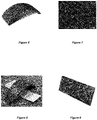
- the figure 6 shows a perspective view from above of the manufactured bracelet strand, the upper surface of which is structured, identically reproducing the pattern of the upper surface of part of the silicon carbide washer.
- the figure 7 represents an enlarged view of this structured surface of the bracelet, making it possible to clearly distinguish its pattern.
- the model element is an alligator skin, which makes it possible to obtain a bracelet strand made of elastomeric material as represented by the figure 8 .
- the model element is a metal plate, one surface of which is engraved, represented by the figure 9 .
Landscapes
- Engineering & Computer Science (AREA)
- Mechanical Engineering (AREA)
- Manufacturing & Machinery (AREA)
- Physics & Mathematics (AREA)
- General Physics & Mathematics (AREA)
- Chemical & Material Sciences (AREA)
- Materials Engineering (AREA)
- Moulds For Moulding Plastics Or The Like (AREA)
- Injection Moulding Of Plastics Or The Like (AREA)
Priority Applications (4)
| Application Number | Priority Date | Filing Date | Title |
|---|---|---|---|
| EP21160550.6A EP4052883A1 (de) | 2021-03-03 | 2021-03-03 | Verfahren zur herstellung einer uhrenkomponente |
| US17/683,722 US20220305700A1 (en) | 2021-03-03 | 2022-03-01 | Method for manufacturing a timepiece component |
| JP2022030691A JP2022135997A (ja) | 2021-03-03 | 2022-03-01 | 時計部品の製造方法 |
| CN202210204827.9A CN115139429A (zh) | 2021-03-03 | 2022-03-03 | 制造钟表部件的方法 |
Applications Claiming Priority (1)
| Application Number | Priority Date | Filing Date | Title |
|---|---|---|---|
| EP21160550.6A EP4052883A1 (de) | 2021-03-03 | 2021-03-03 | Verfahren zur herstellung einer uhrenkomponente |
Publications (1)
| Publication Number | Publication Date |
|---|---|
| EP4052883A1 true EP4052883A1 (de) | 2022-09-07 |
Family
ID=74858224
Family Applications (1)
| Application Number | Title | Priority Date | Filing Date |
|---|---|---|---|
| EP21160550.6A Pending EP4052883A1 (de) | 2021-03-03 | 2021-03-03 | Verfahren zur herstellung einer uhrenkomponente |
Country Status (4)
| Country | Link |
|---|---|
| US (1) | US20220305700A1 (de) |
| EP (1) | EP4052883A1 (de) |
| JP (1) | JP2022135997A (de) |
| CN (1) | CN115139429A (de) |
Citations (9)
| Publication number | Priority date | Publication date | Assignee | Title |
|---|---|---|---|---|
| JPS6260510A (ja) * | 1985-09-12 | 1987-03-17 | カシオ計算機株式会社 | 合成樹脂製の腕時計バンド及びその製造方法 |
| JPH06312434A (ja) * | 1993-04-28 | 1994-11-08 | Banbi:Kk | プリント柄付き合成樹脂製時計バンドの製造方法およびその時計バンド |
| JPH078308A (ja) * | 1993-06-28 | 1995-01-13 | Regurusu:Kk | 時計用装飾バンド及びその製造方法 |
| JP2001112517A (ja) * | 1999-10-21 | 2001-04-24 | Arii Gosei Kogyosho:Kk | 時計バンドの製造方法 |
| US20050089671A1 (en) * | 1999-04-23 | 2005-04-28 | Takeshi Kubota | Shaped sheet and method for producing the same |
| EP2783592A1 (de) | 2011-04-06 | 2014-10-01 | Rolex Sa | Uhrarmband |
| US20170197345A1 (en) * | 2014-05-30 | 2017-07-13 | Ube Machinery Corporation, Ltd. | Method of manufacturing resin molded product, mold for injection molding, injection molding machine and resin molded product |
| CH713911A2 (fr) * | 2017-06-22 | 2018-12-28 | Rolex Sa | Procédé de fabrication d'un composant horloger en élastomère comprenant un insert métallique. |
| JP2019058406A (ja) * | 2017-09-27 | 2019-04-18 | Ktx株式会社 | 腕時計バンドの成形方法並びに金型及びその製造方法 |
Family Cites Families (12)
| Publication number | Priority date | Publication date | Assignee | Title |
|---|---|---|---|---|
| JPS5229950B2 (de) * | 1972-07-18 | 1977-08-04 | ||
| JPS54787B2 (de) * | 1974-04-22 | 1979-01-16 | ||
| JPS5361453A (en) * | 1976-11-11 | 1978-06-01 | Tooru Mashida | Method of producing bands |
| JPH08229961A (ja) * | 1995-02-27 | 1996-09-10 | Nec Corp | ポリウレタン樹脂成形体の製造方法 |
| FR2772302B1 (fr) * | 1997-12-11 | 2000-01-21 | Essilor Int | Procede d'obtention d'une lentille ophtalmique comportant une microstructure utilitaire en surface et lentilles ophtalmiques ainsi obtenues |
| US20140363610A1 (en) * | 2009-10-14 | 2014-12-11 | Daniel Elliot Sameoto | Compression, extrusion and injection molding of interlocking dry adhesive microstructures with flexible mold technology |
| US10124332B2 (en) * | 2009-10-24 | 2018-11-13 | The Governors Of The University Of Alberta | Reversible bonding of microfluidic channels using dry adhesives |
| US9079349B2 (en) * | 2013-08-19 | 2015-07-14 | Microcontinuum, Inc. | Methods for forming patterns on curved surfaces |
| FR3034036B1 (fr) * | 2015-03-25 | 2017-09-08 | Maped | Insert en deux parties comportant des motifs de texturation pour moulage de pieces en materiau polymerique |
| EP3266905B1 (de) * | 2016-07-04 | 2020-05-13 | Richemont International S.A. | Verfahren zur herstellung einer uhrenkomponente |
| JP7563876B2 (ja) * | 2019-04-05 | 2024-10-08 | ビウイ ソシエテ アノニム | 参照標準モデルに基づき複製によって作られるエラストマ部品の製造 |
| JP7792337B2 (ja) * | 2019-12-30 | 2025-12-25 | コベストロ、ドイチュラント、アクチエンゲゼルシャフト | 水性ポリウレタン樹脂組成物及び当該組成物を用いるコーティング材料 |
-
2021
- 2021-03-03 EP EP21160550.6A patent/EP4052883A1/de active Pending
-
2022
- 2022-03-01 US US17/683,722 patent/US20220305700A1/en active Pending
- 2022-03-01 JP JP2022030691A patent/JP2022135997A/ja active Pending
- 2022-03-03 CN CN202210204827.9A patent/CN115139429A/zh active Pending
Patent Citations (9)
| Publication number | Priority date | Publication date | Assignee | Title |
|---|---|---|---|---|
| JPS6260510A (ja) * | 1985-09-12 | 1987-03-17 | カシオ計算機株式会社 | 合成樹脂製の腕時計バンド及びその製造方法 |
| JPH06312434A (ja) * | 1993-04-28 | 1994-11-08 | Banbi:Kk | プリント柄付き合成樹脂製時計バンドの製造方法およびその時計バンド |
| JPH078308A (ja) * | 1993-06-28 | 1995-01-13 | Regurusu:Kk | 時計用装飾バンド及びその製造方法 |
| US20050089671A1 (en) * | 1999-04-23 | 2005-04-28 | Takeshi Kubota | Shaped sheet and method for producing the same |
| JP2001112517A (ja) * | 1999-10-21 | 2001-04-24 | Arii Gosei Kogyosho:Kk | 時計バンドの製造方法 |
| EP2783592A1 (de) | 2011-04-06 | 2014-10-01 | Rolex Sa | Uhrarmband |
| US20170197345A1 (en) * | 2014-05-30 | 2017-07-13 | Ube Machinery Corporation, Ltd. | Method of manufacturing resin molded product, mold for injection molding, injection molding machine and resin molded product |
| CH713911A2 (fr) * | 2017-06-22 | 2018-12-28 | Rolex Sa | Procédé de fabrication d'un composant horloger en élastomère comprenant un insert métallique. |
| JP2019058406A (ja) * | 2017-09-27 | 2019-04-18 | Ktx株式会社 | 腕時計バンドの成形方法並びに金型及びその製造方法 |
Also Published As
| Publication number | Publication date |
|---|---|
| JP2022135997A (ja) | 2022-09-15 |
| US20220305700A1 (en) | 2022-09-29 |
| CN115139429A (zh) | 2022-10-04 |
Similar Documents
| Publication | Publication Date | Title |
|---|---|---|
| EP2347036B1 (de) | Heterogenes liga-verfahren | |
| EP0220154A1 (de) | Verfahren zur Vorbereitung einer geformten Schicht durch Sprühen | |
| EP1462277A1 (de) | Reifen mit farbigem Muster und Verfahren zur Herstellung | |
| EP0722816B1 (de) | Verfahren und Vorrichtung zur Herstellung zumindest eines Teils einer Reifenform mit zumindest einem Formteil zur Formgebung eines nichtentformbaren Musters | |
| CH704086B1 (fr) | Pièces métalliques multi-niveaux obtenues par un procédé du type LIGA et méthode de fabrication s'y référant. | |
| EP3168058B1 (de) | Herstellungsverfahren eines werkstücks aus metall mit mindestens einem motiv mit optischen täuschungselementen | |
| EP4052883A1 (de) | Verfahren zur herstellung einer uhrenkomponente | |
| WO2024046958A1 (fr) | Composant horloger et procédé de fabrication d'un composant horloger | |
| EP2965855B1 (de) | Herstellungsverfahren eines reliefmotivs aus einem material vom typ polymer auf einem substrat | |
| TWI317321B (de) | ||
| EP3902668B1 (de) | Verfahren zur herstellung eines formteils für eine reifenform | |
| CH699145B1 (fr) | Pièce comportant une structure en métal et munie d'un revêtement et procédé pour l'obtention d'une telle pièce. | |
| WO1999003662A1 (fr) | Procede de moulage d'un pneumatique | |
| EP3718727A1 (de) | Herstellung von werkstücken aus elastomer durch duplikation eines referenzstandardmodells | |
| EP4729205A1 (de) | Verfahren zum umspritzen | |
| CH719091B1 (fr) | Objet manufacturé thermochromique et son procédé de réalisation. | |
| EP4729206A1 (de) | Verfahren zum umspritzen | |
| EP4519057A1 (de) | Verfahren zur herstellung eines teils mit integrierter elektronischer funktion | |
| EP4372485A1 (de) | Herstellung einer uhrenkomponente und uhrenkomponente | |
| CH710919B1 (fr) | Insert en deux parties comportant des motifs de texturation pour moulage de pièces en matériau polymérique. | |
| CH716042A2 (fr) | Réalisaton de pièces en élastomère élaborées par duplication, à partir d'un modèle étalon de référence. | |
| FR2579525A1 (fr) | Produit en resine moulee et appareil de prise de vues l'utilisant | |
| CH718036A2 (fr) | Objet manufacturé photochromique et son procédé de réalisation. | |
| CH704450A2 (fr) | Pièce de micromécanique complexe et son procédé de fabrication. | |
| EP1930792A2 (de) | Organ für eine Uhr |
Legal Events
| Date | Code | Title | Description |
|---|---|---|---|
| PUAI | Public reference made under article 153(3) epc to a published international application that has entered the european phase |
Free format text: ORIGINAL CODE: 0009012 |
|
| STAA | Information on the status of an ep patent application or granted ep patent |
Free format text: STATUS: THE APPLICATION HAS BEEN PUBLISHED |
|
| AK | Designated contracting states |
Kind code of ref document: A1 Designated state(s): AL AT BE BG CH CY CZ DE DK EE ES FI FR GB GR HR HU IE IS IT LI LT LU LV MC MK MT NL NO PL PT RO RS SE SI SK SM TR |
|
| STAA | Information on the status of an ep patent application or granted ep patent |
Free format text: STATUS: REQUEST FOR EXAMINATION WAS MADE |
|
| 17P | Request for examination filed |
Effective date: 20230307 |
|
| RBV | Designated contracting states (corrected) |
Designated state(s): AL AT BE BG CH CY CZ DE DK EE ES FI FR GB GR HR HU IE IS IT LI LT LU LV MC MK MT NL NO PL PT RO RS SE SI SK SM TR |
|
| P01 | Opt-out of the competence of the unified patent court (upc) registered |
Effective date: 20230530 |
|
| STAA | Information on the status of an ep patent application or granted ep patent |
Free format text: STATUS: EXAMINATION IS IN PROGRESS |
|
| 17Q | First examination report despatched |
Effective date: 20250218 |