EP4052984A1 - Traverser, basiseinheit und mobile einheit - Google Patents
Traverser, basiseinheit und mobile einheit Download PDFInfo
- Publication number
- EP4052984A1 EP4052984A1 EP20883125.5A EP20883125A EP4052984A1 EP 4052984 A1 EP4052984 A1 EP 4052984A1 EP 20883125 A EP20883125 A EP 20883125A EP 4052984 A1 EP4052984 A1 EP 4052984A1
- Authority
- EP
- European Patent Office
- Prior art keywords
- travel
- roller
- unit
- moving unit
- drive
- Prior art date
- Legal status (The legal status is an assumption and is not a legal conclusion. Google has not performed a legal analysis and makes no representation as to the accuracy of the status listed.)
- Pending
Links
- 230000005540 biological transmission Effects 0.000 claims abstract description 101
- 230000007246 mechanism Effects 0.000 claims abstract description 76
- 238000004891 communication Methods 0.000 claims description 32
- 238000003860 storage Methods 0.000 claims description 19
- 230000002093 peripheral effect Effects 0.000 claims description 9
- 230000008859 change Effects 0.000 claims description 4
- 238000009434 installation Methods 0.000 claims description 4
- 239000006096 absorbing agent Substances 0.000 description 7
- 230000035939 shock Effects 0.000 description 7
- 238000000034 method Methods 0.000 description 5
- 238000005192 partition Methods 0.000 description 5
- 238000003825 pressing Methods 0.000 description 5
- 238000010586 diagram Methods 0.000 description 4
- 239000000126 substance Substances 0.000 description 4
- 238000010168 coupling process Methods 0.000 description 3
- 238000001514 detection method Methods 0.000 description 3
- 230000009471 action Effects 0.000 description 2
- 239000000470 constituent Substances 0.000 description 2
- 230000008878 coupling Effects 0.000 description 2
- 238000005859 coupling reaction Methods 0.000 description 2
- 238000011144 upstream manufacturing Methods 0.000 description 2
- 229910000831 Steel Inorganic materials 0.000 description 1
- 239000003990 capacitor Substances 0.000 description 1
- 239000000428 dust Substances 0.000 description 1
- 230000000694 effects Effects 0.000 description 1
- 230000005684 electric field Effects 0.000 description 1
- 230000005674 electromagnetic induction Effects 0.000 description 1
- 239000007788 liquid Substances 0.000 description 1
- 238000007726 management method Methods 0.000 description 1
- 238000004519 manufacturing process Methods 0.000 description 1
- 230000003287 optical effect Effects 0.000 description 1
- 238000009774 resonance method Methods 0.000 description 1
- 239000007787 solid Substances 0.000 description 1
- 239000010959 steel Substances 0.000 description 1
Images







Classifications
-
- B—PERFORMING OPERATIONS; TRANSPORTING
- B65—CONVEYING; PACKING; STORING; HANDLING THIN OR FILAMENTARY MATERIAL
- B65G—TRANSPORT OR STORAGE DEVICES, e.g. CONVEYORS FOR LOADING OR TIPPING, SHOP CONVEYOR SYSTEMS OR PNEUMATIC TUBE CONVEYORS
- B65G13/00—Roller-ways
- B65G13/02—Roller-ways having driven rollers
- B65G13/06—Roller driving means
- B65G13/07—Roller driving means having endless driving elements
-
- B—PERFORMING OPERATIONS; TRANSPORTING
- B65—CONVEYING; PACKING; STORING; HANDLING THIN OR FILAMENTARY MATERIAL
- B65G—TRANSPORT OR STORAGE DEVICES, e.g. CONVEYORS FOR LOADING OR TIPPING, SHOP CONVEYOR SYSTEMS OR PNEUMATIC TUBE CONVEYORS
- B65G41/00—Supporting frames or bases for conveyors as a whole, e.g. transportable conveyor frames
- B65G41/02—Frames mounted on wheels for movement on rail tracks
-
- B—PERFORMING OPERATIONS; TRANSPORTING
- B65—CONVEYING; PACKING; STORING; HANDLING THIN OR FILAMENTARY MATERIAL
- B65G—TRANSPORT OR STORAGE DEVICES, e.g. CONVEYORS FOR LOADING OR TIPPING, SHOP CONVEYOR SYSTEMS OR PNEUMATIC TUBE CONVEYORS
- B65G43/00—Control devices, e.g. for safety, warning or fault-correcting
- B65G43/04—Control devices, e.g. for safety, warning or fault-correcting detecting slip between driving element and load-carrier, e.g. for interrupting the drive
-
- B—PERFORMING OPERATIONS; TRANSPORTING
- B65—CONVEYING; PACKING; STORING; HANDLING THIN OR FILAMENTARY MATERIAL
- B65G—TRANSPORT OR STORAGE DEVICES, e.g. CONVEYORS FOR LOADING OR TIPPING, SHOP CONVEYOR SYSTEMS OR PNEUMATIC TUBE CONVEYORS
- B65G47/00—Article or material-handling devices associated with conveyors; Methods employing such devices
- B65G47/52—Devices for transferring articles or materials between conveyors i.e. discharging or feeding devices
-
- B—PERFORMING OPERATIONS; TRANSPORTING
- B65—CONVEYING; PACKING; STORING; HANDLING THIN OR FILAMENTARY MATERIAL
- B65G—TRANSPORT OR STORAGE DEVICES, e.g. CONVEYORS FOR LOADING OR TIPPING, SHOP CONVEYOR SYSTEMS OR PNEUMATIC TUBE CONVEYORS
- B65G47/00—Article or material-handling devices associated with conveyors; Methods employing such devices
- B65G47/52—Devices for transferring articles or materials between conveyors i.e. discharging or feeding devices
- B65G47/64—Switching conveyors
- B65G47/641—Switching conveyors by a linear displacement of the switching conveyor
- B65G47/642—Switching conveyors by a linear displacement of the switching conveyor in a horizontal plane
-
- B—PERFORMING OPERATIONS; TRANSPORTING
- B65—CONVEYING; PACKING; STORING; HANDLING THIN OR FILAMENTARY MATERIAL
- B65G—TRANSPORT OR STORAGE DEVICES, e.g. CONVEYORS FOR LOADING OR TIPPING, SHOP CONVEYOR SYSTEMS OR PNEUMATIC TUBE CONVEYORS
- B65G47/00—Article or material-handling devices associated with conveyors; Methods employing such devices
- B65G47/52—Devices for transferring articles or materials between conveyors i.e. discharging or feeding devices
- B65G47/64—Switching conveyors
- B65G47/641—Switching conveyors by a linear displacement of the switching conveyor
- B65G47/643—Switching conveyors by a linear displacement of the switching conveyor in a vertical plane
-
- B—PERFORMING OPERATIONS; TRANSPORTING
- B65—CONVEYING; PACKING; STORING; HANDLING THIN OR FILAMENTARY MATERIAL
- B65G—TRANSPORT OR STORAGE DEVICES, e.g. CONVEYORS FOR LOADING OR TIPPING, SHOP CONVEYOR SYSTEMS OR PNEUMATIC TUBE CONVEYORS
- B65G2203/00—Indexing code relating to control or detection of the articles or the load carriers during conveying
- B65G2203/02—Control or detection
- B65G2203/0266—Control or detection relating to the load carrier(s)
- B65G2203/0291—Speed of the load carrier
Definitions
- the present invention relates to a traverser.
- a traverser that includes a conveyor on a mobile carriage and transfers a work between two points (for example, PTL 1). This traverser moves between two points including the downstream end of the conveyor located at one end portion of a moving path through which the mobile carriage moves and the upstream end of the conveyor located at the other end portion of the moving path and transfers a work.
- a traverser comprising: a base unit including a rail member; a moving unit configured to reciprocally move on the rail member between a first position and a second position; and a conveyance unit mounted on the moving unit and configured to convey a conveyance target object
- the moving unit comprises: a first travel roller that is a drive roller; and a drive mechanism configured to give a rotation driving force to the first travel roller, and the drive mechanism includes: a travel motor configured to supply the rotation driving force; and a friction transmission mechanism configured to transmit the rotation driving force of the travel motor to the first travel roller by a friction force.
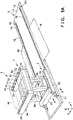
- Fig. 1A is a perspective view of a traverser 100 according to an embodiment of the present invention.
- the traverser 100 includes a base unit 1, a moving unit 2, and a conveyance unit 3.
- the moving unit 2 and the conveyance unit 3 constitute a traverser main body T.
- the base unit 1 is extended in the Y direction and includes a travel path (rail member 12) for the traverser main body T (moving unit 2).
- the moving unit 2 is a travel unit that reciprocally moves on the travel path of the base unit 1, and is stopped at stop positions P1 and P2 located at the two end portions of the travel path.
- the conveyance unit 3 is mounted on the moving unit 2 via a plurality of columns 2a, and loads/unloads a conveyance target object W.
- the conveyance unit 3 is a roller conveyor including conveyance rollers 32 and 33.
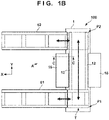
- the traverser 100 is used to transfer the conveyance target object W between conveyors 61 and 62. More specifically, the stop positions P1 and P2 of the moving unit 2 are provided in correspondence with the positions of the conveyors 61 and 62.
- the conveyor unit (to be described later) of the conveyance unit 3 faces the unload end (downstream end) of one conveyor 61. In this state, delivery (transfer) of the conveyance target object W from the one conveyor 61 to the conveyance unit 3 is performed.
- the traverser main body T to which the conveyance target object W is transferred moves along the travel path and stops at the stop position P2.
- the conveyor unit of the conveyance unit 3 faces the load end (upstream end) of the other conveyor 62. In this state, delivery of the conveyance target object W from the conveyance unit 3 to the other conveyor 62 is performed.
- the conveyance unit 3 conveys the conveyance target object W in the X direction.
- the conveyance target object W may be conveyed in a horizontal direction crossing the X direction.
- the traverser main body T (moving unit 2) may be provided with a turn unit configured to change the direction of the conveyance target object W such that conveyance unit 3 can rotate about the Z-axis. This can change the conveyance direction of the conveyance unit 3 in accordance with the tilt of the conveyance direction of the conveyors 61 and 62 with respect to the travel path.
- the base unit 1 includes a box-shaped frame body 10 opening upward, a cover 11 that covers the opening of the frame body 10 and forms the upper surface of the base unit 1, and a pair of rail members 12 apart in the X direction.
- the base unit 1 also includes passage members 16.
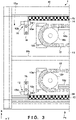
- Fig. 2 is a plan view of the base unit 1 seen through the cover 11 to show an internal space 10a of the frame body 10, and Figs. 3 and 4 are enlarged views of portions 1A and 1B in Fig. 2 .
- the pair of rail members 12 are plate-shaped members, which are extended in the Y direction and in parallel fixed to the frame body 10.
- the pair of rail members 12 form the travel path.
- the upper surface of each rail member 12 is exposed to the upper surface of the base unit 1.
- the moving unit 2 (traverser main body T) travels on the base unit 1.
- a gap 14 extending in the Y direction along the rail member 12 is formed.
- the internal space 10a surrounded by the cover 11 and the frame body 10 communicates with the external space above the base unit 1 via the gap 14.
- the passage members 16 are tilting plates arranged on both sides of the frame body 10 in the X direction.
- the passage members 16 form steps used by an operator to cross the base unit 1.
- the passage members 16 define a passage in the base unit 1, which is used by the operator to cross the base unit 1.
- Fig. 15 is a sectional view taken along a line C - C in Fig. 1B .
- the passage member 16 is extended from an installation surface (the floor surface in the factory) G on which the base unit 1 is installed to the upper surface of the rail member 12.
- the passage member 16 is formed by, for example, a steel plate, and includes a tilting portion 16a and a horizontal portion 16b. Since the tilting portion 16a is provided, the step difference between the frame body 10 and the installation surface G can be eliminated, and a smooth slope can be formed.
- the horizontal portion 16b is fixed to a constituent member 17 of the frame body 10. To fix the horizontal portion 16b to the constituent member 17, a screwing structure may be used, or a structure that engages engaging portions (for example, bent portions or concave and convex portions) provided on these may be employed.
- the frame body 10a defined by the frame body 10 also functions as a storage space for a cable 13 connected the moving unit 2.
- the internal space 10a is divided into two parts by a partition member 18c.
- the cable 13 includes at least a power cable used to supply power from an external electric circuit to a travel motor 271 of the moving unit 2.
- the cable 13 may also include a communication cable used for communication between a host device (not shown) and a control circuit 4.
- the cover 11 is a thin plate member that covers the internal space (storage space) 10a, and the cover 11 suppresses entry of dust and the like into the internal space 10a.
- the cable 13 is supported by a cable protection guide device (cable bear ® ) 17.
- two cable protection guide devices 17 in a laid state are provided in the frame body 10. If the cable 13 includes a power cable and a communication cable, one cable protection guide device 17 may support the power cable, and the other cable protection guide device 17 may support the communication cable. Note that a configuration that does not partition the internal space 10a by the partition member 18c can also be employed. In this case, one cable protection guide device 17 is provided. If the cable 13 includes a power cable and a communication cable, these cables may be supported by the one one cable protection guide device 17.
- Each cable protection guide device 17 is disposed to meander in the internal space 10a, and its movement is guided by a plurality of guides 18a provided in the frame body 10, the partition member 18c, and one roller 18b.
- the plurality of guides 18a include a linear member 18a-1, and an arc member 18a-2 around the roller 18b.
- the partition member 18c functions as a linear guide.
- One end 17a of the cable protection guide device 17 is connected to the moving unit 2 via a connecting tool (not shown) that passes through the gap 14, and the other end 17b is fixed to the frame body 10.
- One end 13a of the cable 13 is extended to the outside of the frame body 10 via the gap 14.
- the one end 13a is connected to the power supply unit (not shown) of the moving unit 2.
- the power supply unit supplies power to the travel motor 271 of a drive unit 25, a conveyance motor 371 of a drive unit 35, and the like.
- the other end 13b is connected to an external electric circuit (for example, a power supply device) (not shown) arranged outside the base unit 1.
- the one end 13a is connected to the control circuit 4 of the moving unit 2 via the gap 14.
- the control circuit 4 controls the travel motor 271 of the drive unit 25 and the conveyance motor 371 of the drive unit 35.
- the other end 13b is connected to a host device (for example, a PLC) (not shown) arranged outside the base unit 1.
- each of the rail members 12 in the frame body 10 are provided with stop members 15 that are brought into contact with the moving unit 2.
- Each stop member 15 is fixed to the frame body 10 via a support member 16.
- four stop members 15 are provided. Of these, the two stop members 15 shown in Fig. 3 stop the moving unit 2 (traverser main body T) at the stop position PI, and the remaining two stop members 15 shown in Fig. 4 stop the moving unit 2 at the stop position P2.
- each stop member 15 is a shock absorber that mitigates an impact when contacting the moving unit 2, and includes a rod 15a, and a cylinder 15b that stores the rod 15a such that it can freely move back and forth.
- the stop members 15 are arranged near the end portions of the rail members 12 while making the rods 15a face each other in the Y direction.
- the distal end of each rod 15a forms a contact portion that comes into contact with the moving unit 2, and is located near the lower portion of the gap 14.
- the cylinder 15b stores, for example, a spring that biases the rod 15a in a forward direction, a piston provided at an end portion of the rod 15a, and a liquid that resists the movement of the piston.
- the rod 15a moves backward in the cylinder 15b and mitigates the impact of contact.
- a solid member may be used.
- a shock absorber including a movable portion is used, as in this embodiment, the durability of the traverser 100 can be improved.
- Fig. 5 is a perspective view of the moving unit 2 viewed from the bottom surface side.
- the moving unit 2 includes two roller units 20 arranged in parallel while being apart in the X direction, and the drive unit 25 that is provided to connect the two roller units 20 and functions as the drive source of the moving unit 2.
- the two roller units 20 are connected by a plurality of connecting members 2b, and this holds the roller units 20 apart in parallel.
- Each roller unit 20 includes a roller array in which the travel roller 22 that is a drive roller and the plurality of travel rollers 23 that are driven rollers are arrayed along the moving direction (Y direction).
- the travel rollers 22 and 23 roll on the rail member 12, and this makes the moving unit 2 travel in the Y direction.
- Each roller unit 20 includes a support body (frame) 21 that supports the travel rollers 22 and 23 and mechanisms to be described later.
- the support body 21 includes a base plate 21a that forms the bottom portion of the roller unit 20 and extends in the Y direction, and support plates 21c provided at the front and rear ends of the base plate 21a in the Y direction.
- Each support plate 21c includes a stopper contact portion 29.
- the stopper contact portion 29 is a portion that contacts the stop member 15 at the stop position P1 or P2.
- the stopper contact portion 29 has an L shape including a support portion 29a extending downward in the Z direction from the lower surface of the support plate 21c, and a contact portion main body 29b extending from the lower end portion of the support portion 29a to the center of the roller unit 20.
- the support portion 29a moves along the gap 14, and the contact portion main body 29b contacts the rod 15a of the stop member 15.
- the lower surface of the support plate 21c also supports a rail contact portion 28 to be described later (see Fig. 6 ).
- Fig. 6 is a plan view of the moving unit 2 whose exterior portion is removed.
- the drive unit 25 includes a drive mechanism 27 supported by a support body (a frame; see Fig. 5 , not shown in Fig. 6 ) 26.
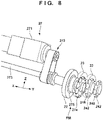
- the drive mechanism 27 is a mechanism configured to give a rotation driving force to the travel rollers 22 and 23, and includes the travel motor 271 that supplies the rotation driving force, a belt transmission mechanism 272, a drive shaft 273, a drive wheel 274, and a friction transmission mechanism FM.
- Fig. 7 is a longitudinal sectional view (a sectional view taken in the direction of arrows B in Fig. 6 ) of the moving unit 2 near the drive shaft 273.
- Fig. 8 is a partial perspective view of the drive mechanism 27.
- the travel motor 271 is, for example, a DC motor, and includes a control board (not shown) configured to control the rotation direction and speed of the rotating shaft.
- the rotating shaft is supported, by the support body 26, above the drive shaft 273 and in parallel to the drive shaft 273.
- the control board includes, for example, a processor represented by a CPU, a storage device such as a RAM or a ROM, an input/output interface that relays between an external device and the processor, and a communication interface that performs communication with a host controller such as a PLC.
- the control board is arranged, for example, inside the housing of the travel motor 271 and connected to a power supply unit that supplies power to the travel motor 271 and the like.
- the control board outputs a control signal representing the rotation direction of the rotating shaft and a PWM (Pulse Width Modulation) signal representing the rotation speed, and controls the rotation of the rotating shaft of the travel motor 271.
- PWM Pulse Width Modulation
- a rotary encoder 41 is attached to the rotating shaft of the travel motor 271.
- the rotation amount of the rotating shaft detected by the rotary encoder 41 is input to the control board.
- control board stops outputting the control signal (CW or CCW signal) for instructing rotation of the travel motor 271. This stops the drive of the travel motor 271.
- the control board of the travel motor 271 stops the drive of the rotating shaft of the travel motor 271.
- the physical stop of the rotation of the rotating shaft of the travel motor 271 is detected using the rotary encoder.
- the physical stop of the rotation of the rotating shaft of the travel motor 271 may be detected using the current value of the control signal (CW or CCW signal) for instructing rotation.
- the current value of the control signal increases when the rotation of the rotating shaft is impeded.
- a current value when a load is applied to the rotating shaft of the rotating travel motor 271, and the rotation of the rotating shaft physically stops is set to a threshold. If it is detected that the current value of the control signal (CW or CCW signal) continuously exceeds the threshold for a predetermined time, the physical stop of the rotating shaft of the travel motor 271 can be detected.
- the travel motor 271 "stops the drive of the rotating shaft of the travel motor 271 if the rotation of the rotating shaft of the travel motor 271 is not detected for a predetermined time", as described above. Hence, even if the rotation of the rotating shaft of the travel motor 271 is physically stopped, the drive of the rotating shaft of the travel motor 271 is stopped upon detecting this.
- the belt transmission mechanism 272 transmits the rotation driving force of the travel motor 271 to the drive shaft 273 and rotates the drive shaft 273.
- the drive shaft 273 is a member extended in the X direction.
- a plurality of shafts are connected via shaft couplings to form one shaft as a whole.
- the support body 21 of each roller unit 20 includes a pair of support plates 21b that rotatably support the rotation center shafts of the travel rollers 22 and 23.
- the pair of support plates 21b are provided apart from each other at an arbitrary interval in the X direction and in parallel stand on the base plate 21a.
- the travel rollers 22 and 23 are arranged between the support plates 21b.
- the drive shaft 273 is rotatably and pivotally supported by the pair of support plates 21b located apart in the X direction.
- the travel roller 22 is provided between the pair of support plates 21b, and each travel roller 22 is attached to the drive shaft 273 via the friction transmission mechanism FM.
- the friction transmission mechanism FM is a mechanism configured to transmit the rotation driving force of the travel motor 271 to the travel roller 22 by a friction force, and includes a friction transmission member 275 in this embodiment.
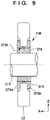
- Fig. 9 is a longitudinal sectional view of the travel roller 22.
- the friction transmission member 275 includes a pair of ring members that are provided on the peripheral surface of the drive shaft 273 and attach the travel roller 22 to the drive shaft 273.
- the friction transmission member 275 is formed by a pair of flanged bushes 275a and 275b fitted in the center hole of the travel roller 22.
- a bush 276 is provided on the peripheral surface of the drive shaft 273.
- the drive shaft 273 is fitted in the hole of the bush 276.
- the portion of the bush 276 on the drive shaft 273 is inserted into a hole 275h at the center of the friction transmission member 275, and the bush 276 is located in the hole 275h of the friction transmission member 275.
- the friction transmission member 275 and the bush 276 are not fixed. Transmission of the rotation driving force from the drive shaft 273 to the friction transmission member 275 is done by friction transmission. Hence, if an excessive load that resists the rotation of the travel roller 22 acts on the travel roller 22, idling (slip) occurs between the bush 276 provided on the drive shaft 273 and the friction transmission member 275.
- the drive shaft 273 continuously rotates, but the travel roller 22 stops rotating.
- the drive wheels 274 are provided at the two end portions of the drive shaft 273.
- the drive wheels 274 are fixed to the drive shaft 273 and rotate integrally with the drive shaft 273.
- the rotation driving force of each drive wheel 274 is transmitted to the travel rollers 23 via a travel transmission mechanism 24 provided in the roller unit 20.
- the travel transmission mechanism 24 includes drive shafts 241 of the travel rollers 23, the drive wheels 242 provided at the outer end portions of the drive shafts 241, and the driving force transmission member 246.
- the drive shafts 241 are provided in parallel to the drive shaft 273 and rotatably supported by the pair of support plates 21b.
- the drive wheel 242 is provided at one end of each drive shaft 241 (the end of the moving unit 2 on the outer side in the widthwise direction).
- one drive wheel 274 provided on the drive shaft 273, and the plurality of drive wheels 242 provided on the drive shafts 241 are arrayed in one line along the Y direction.
- the endless driving force transmission member 246 is wound around the drive wheels 274 and 242. Hence, along with the rotation of the drive shaft 273, the drive wheel 274 rotates, and the drive wheels 242 are rotated by the rotation of the drive wheel 274.
- the driving force transmission member 246 is a chain
- the drive wheels 274 and 242 are sprockets that mesh with the chain. These form a chain transmission mechanism.
- a belt transmission mechanism may be employed in place of the chain transmission mechanism.
- a gear mechanism in which the drive wheels 274 and 242 and the driving force transmission member 246 are made of gears may be employed.
- Fig. 10 is a longitudinal sectional view of the periphery of the travel roller 23.
- the travel roller 23 is formed integrally with the drive shaft 241, and the drive shaft 241 is supported by the pair of support plates 21b via a ball bearing.
- a transmitted portion 249 and a friction transmission member 244 are provided on the peripheral surface of the drive shaft 241.
- the transmitted portion 249 is a disc-shaped member provided in the middle of the drive shaft 241 and extending outward in the radial direction of the drive shaft 241.
- the transmitted portion 249 is fixed to the drive shaft 241 and rotates integrally with the drive shaft 241.
- the transmitted portion 249 and the drive shaft 241 may be formed as one member.
- the friction transmission member 244 is provided on the peripheral surface of the drive shaft 241 and intervenes between the drive wheel 242 and the drive shaft 241.
- the friction transmission member 244 is formed by a pair of flanged bushes.
- the flanged bushes are attached from both sides of the drive wheel 242 to cover both sides of the drive wheel 242 and the inner peripheral surface of the drive wheel 242.
- the friction transmission member 244 forms flange portions 244a whose end portions in the axial direction of the drive shaft 241 project in the radial direction.
- the drive wheel 242 is attached between the flange portions 244a, and the side surfaces of the drive wheel 242 and the flange portions 244a are in contact.
- One flange portion 244a is sandwiched between one side surface of the drive wheel 242 (the side surface on the side of the travel roller 23) and the transmitted portion 249.
- the friction transmission member 244 and the drive shaft 241 are not fixed. Transmission of the rotation driving force from the drive wheel 242 to the drive shaft 241 is done by friction transmission between the one side surface of the drive wheel 242 (the side surface on the side of the travel roller 23 (the left side in Fig. 10 )) and the transmitted portion 249 via the flange portion 244a.
- a biasing member 245 is provided.
- the biasing member 245 is a coil spring.
- another elastic member such as rubber may be used.
- the through hole 241a is a stepped hole whose diameter is small on the side of the drive wheel 242 and large on the opposite side (the side of the travel roller 23).
- a rod 247 is inserted in the through hole 241a.
- a pressing member 248 is fixed to one end portion of the rod 247 (the end portion on the side of the drive wheel 242), and a stopper portion 247a is formed at the other end portion.
- the biasing member 245 is interposed between the stopper portion 247a and the wall surface of the step portion of the through hole 241a.
- the pressing member 248 is a disc-shaped member that contacts the flange portion 244a on the opposite side of the friction transmission member 244 (the side not in contact with the transmitted portion 249).
- the rod 247 and the pressing member 248 are biased to the side of the travel roller 23. Accordingly, a sandwiching force for pressing the flange portion 244a on the side (the left side in Fig. 10 ) in contact with the transmitted portion 249 is generated between the one side surface of the drive wheel 242 (the side surface on the side of the travel roller 23) and the transmitted portion 249. Hence, the rotation driving force of the drive wheel 242 is frictionally transmitted to the drive shaft 241 via the flange portion 244a. If an excessive load that resists the rotation of the travel roller 23 acts on the travel roller 23, idling (slip) occurs between the drive shaft 241 and the friction transmission member 244. The drive wheel 242 continuously rotates, but the travel roller 23 stops rotating.
- the biasing member 245 is incorporated in the drive shaft 241.
- any other structure in which, for example, the biasing member 245 is arranged on the peripheral surface of the drive shaft 241 can also be employed. It is only necessary to bias the sandwiching force between the one side surface of the drive wheel 242 (the side surface on the side of the travel roller 23) and the transmitted portion 249.
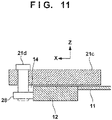
- Fig. 11 is a sectional view taken along a line A - A in Fig. 1A , and shows the arrangement of the rail contact portion 28 and peripheral components in a state in which the moving unit 2 is mounted on the base unit 1.
- the rail contact portion 28 is a roller arranged on the lower side of the support plate 21c.
- the support portion 21d is a shaft member extending in the vertical direction (Z direction). The upper end portion is fixed to the support plate 21c, and the rail contact portion 28 is rotatably supported on the lower end portion.
- the support portion 21d extends up to the lower side of the cover 11 via the gap 14.
- the rail contact portion 28 provided at the lower end of the support portion 21d contacts the side surface of the rail member 12 (in Fig. 11 , the left side surface or the inner side surface of each of the rail members 12 provided in parallel). Hence, the four rail contact portions 28 prevent the moving unit 2 from derailing from the rail members 12 when the moving unit 2 moves on the rail members 12.
- Fig. 12 is a plan view of the conveyance unit 3 whose exterior portion is removed.
- the conveyance unit 3 includes two roller units 30 arranged in parallel while being apart in the Y direction, and the drive unit 35 that is provided to connect the two roller units 30 and functions as the drive source of the conveyance unit 3.
- the two roller units 30 are connected by a plurality of connecting members 3a, and this holds the roller units 30 apart in parallel.
- the roller units 30 and the drive unit 35 have the same structures as the roller units 20 and the drive unit 25 except the number of rollers.
- the travel mechanism of the moving unit 2 and the conveyance mechanism of the conveyance unit 3 have the same structure. Hence, both can be formed using common components. This makes it possible to decrease the number of components of the traverser main body T and reduce the cost, and also facilitates component management.
- Each roller unit 30 includes a roller array in which the conveyance roller 32 that is a drive roller and the plurality of conveyance rollers 33 that are driven rollers are arrayed in one line (X direction). As the conveyance rollers 32 and 33 rotate, the conveyance target object W on these rollers is conveyed in the X direction. As the conveyance roller 32, the same roller as the travel roller 22 can be used. As the conveyance rollers 33, the same roller as the travel roller 23 can be used.
- Each roller unit 30 includes a support body (frame) 31 that supports the conveyance rollers 22 and 23 and mechanisms to be described later.
- the support body 31 has the same configuration as the support body 21 of the moving unit 2, and includes a base plate 31a that forms the bottom portion of the roller unit 30 and extends in the X direction, and a pair of support plates 31b.
- the support body 31 of the conveyance unit 3 does not have a configuration corresponding to the support plate 21c.
- the conveyance unit 3 does not have configurations corresponding to the contact portions 28 and 29 of the moving unit 2.
- the drive unit 35 includes a drive mechanism 37 supported by a support body (frame) 36.
- the drive mechanism 37 is a mechanism configured to give a rotation driving force to the conveyance rollers 32, and includes the conveyance motor 371 that supplies the rotation driving force, a belt transmission mechanism 372, a drive shaft 373, and a drive wheel 374.
- the drive mechanism 37 has the same configuration as the drive mechanism 27 and can use the same components.
- the conveyance motor 371 is, for example, a DC motor, and includes a control board (not shown) configured to control the rotation direction and speed of the rotating shaft.
- the rotating shaft is supported, by the support body 36, above the drive shaft 373 and in parallel to the drive shaft 373.
- the control board has the same configuration as the control board of the drive unit 25. If the rotation of the conveyance motor 371 stops for a predetermined time, the control board stops the conveyance motor 371.
- the belt transmission mechanism 372 transmits the rotation driving force of the conveyance motor 371 to the drive shaft 373 and rotates the drive shaft 373.
- the drive shaft 373 is a member extended in the Y direction. In this embodiment, a plurality of shafts are connected via shaft couplings to form one shaft as a whole.
- the support body 31 of each roller unit 30 includes a pair of support plates 21b that rotatably support the rotation center shafts of the conveyance rollers 22 and 23.
- the pair of support plates 21b are provided apart from each other at an arbitrary interval in the Y direction and in parallel stand on the base plate 31a.
- the conveyance rollers 32 and 33 are arranged between the support plates 31b.
- the drive shaft 373 is rotatably supported by the pair of support plates 21b located apart in the Y direction.
- the conveyance roller 32 is provided between the pair of support plates 21b, and each conveyance roller 32 is attached to the drive shaft 373 via a friction transmission member (not shown).
- the conveyance roller 32 is attached to the drive shaft 373 via a friction transmission member corresponding to the friction transmission member 275 and bushes (neither are shown).
- the drive wheels 374 are provided at the two end portions of the drive shaft 373.
- the drive wheels 374 are fixed to the drive shaft 373 and rotate integrally with the drive shaft 373.
- the rotation driving force of each drive wheel 374 is transmitted to the conveyance rollers 33 via a conveyance transmission mechanism 34 provided in the roller unit 30.
- the conveyance transmission mechanism 34 is the same mechanism as the travel transmission mechanism 24 except the number of rollers, and is a mechanism configured to transmit the rotation driving force of the drive wheels 374 to a drive wheel 342 of each conveyance roller 33 via a driving force transmission member 346.
- the mechanism of each conveyance roller 33 is also the same as the mechanism of each travel roller 23 shown in Fig. 10 .
- the same components can be used here as well.
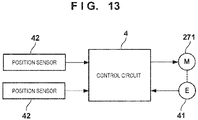
- Fig. 13 is a block diagram of the control system of the moving unit 2.
- the moving unit 2 includes the control circuit 4 that controls the travel motor 271.
- the rotary encoder 41 is attached to the drive shaft of the travel motor 271, and the rotation amount of the drive shaft detected by the rotary encoder 41 is input to the control circuit 4.
- the traverser 100 is provided with position sensors 42 configured to detect the position of the moving unit 2.
- the position sensors 42 according to this embodiment are provided at the two stop positions P1 and P2, respectively.
- One position sensor 42 detects whether the moving unit 2 exists at the stop position PI, and the other position sensor 42 detects whether the moving unit 2 exists at the stop position P2.
- Each position sensor 42 is, for example, a mechanical sensor that is turned on by contact with the moving unit 2 or an optical sensor such as a photointerrupter that optically detects the existence of the moving unit 2.
- the control circuit 4 is a microcomputer including, for example, a processor represented by a CPU, a storage device such as a RAM or a ROM, an input/output interface that relays between an external device and the processor, a communication interface that performs communication with a host controller, and the drive circuit of the travel motor 271.
- the control circuit 4 can be arranged, for example, inside the housing of the drive unit 25. To supply power to the travel motor 271 and the like, the cable 13 wired via the gap 14 is connected to the control circuit 4.
- Control of the conveyance unit 3 may be performed by the control circuit 4 or a control circuit provided in the conveyance unit 3.
- a rotary encoder may be provided on the conveyance motor 371 to detect the rotation amount of the drive shaft of the conveyance motor 371.
- the control circuit provided in the conveyance unit 3 may have the same configuration as the control circuit 4, and may be configured to communicate with the control circuit 4.
- the conveyance rollers and the travel rollers can have the same configuration, and the conveyance transmission mechanism and the travel transmission mechanism can have the same configuration, the manufacturing cost can be suppressed.
- the control circuit 4 moves the moving unit 2 from the stop position P1 to the stop position P2 or from the stop position P2 to the stop position P1 in accordance with an instruction of the host controller. More specifically, the control circuit 4 controls the rotation direction, the start and stop of rotation, and the rotation speed of the travel motor 271.
- the traverser main body T is moved from the stop position P1 to the stop position P2.
- the stopper contact portions 29 mechanically/physically contact the stop members 15. This impedes the movement of the traverser main body T, and the traverser main body T stops at the stop position P2.
- the travel motor 271, the drive shaft 273, the drive wheels 274, the driving force transmission members 246, and the drive wheels 242 continuously rotate, but the rotation of the travel rollers 22 and 23 stops.
- the conveyance target object W is transferred from the conveyor 62 on the unloading side to the conveyance unit 3.
- the traverser main body T moves from the stop position P2 to the stop position P1.
- the stopper contact portions 29 mechanically/physically contact the stop members 15. This impedes the movement of the traverser main body T, and the traverser main body T stops at the stop position P1.
- the travel motor 271, the drive shaft 273, the drive wheels 274, the driving force transmission members 246, and the drive wheels 242 continuously rotate, but the rotation of the travel rollers 22 and 23 stops.
- the conveyance target object W is transferred from the conveyance unit 3 to the conveyor 61 on the loading side.
- the traverser main body T moves from the stop position P1 to the stop position P2.
- the traverser 100 can convey the conveyance target object W between the conveyors 61 and 62.
- the stopper contact portions 29 mechanically/physically contact the stop members 15, thereby impeding the movement of the traverser main body T.
- the rotation driving force of the travel motor 271 is transmitted to the travel rollers 22 and 23 by friction transmission.
- the travel motor 271 continuously rotates, but the rotation of the travel rollers 22 and 23 stops. That is, the travel rollers 22 and 23 have an accumulate function (also called a free flow function).
- the traverser main body T can be stopped while keeping the travel motor 271 rotating, without separately providing a torque limiter or the like on the inverter control of the travel motor 271 or the drive shaft of the travel motor 271.
- the travel rollers 22 and 23 stop, but a force for moving forward continuously acts on the travel rollers 22 and 23.
- the travel rollers 22 and 23 never rotate in the direction (backward direction) opposite to the moving direction. That is, the travel rollers 22 and 23 (traverser main body T) are anti-back rollers and therefore never move backward.
- the traverser main body T continuously stops at the stop position P1 (or P2) where it contacts the stop members 15, and the correct positioning state at the stop position P1 (or P2) is held.
- the traverser main body T and the conveyors 61 and 62 need to be correctly positioned on a millimeter order.
- a positioning device for the traverser main body is prepared, and the traverser main body T is positioned at a stop position.
- a mechanism configured to fix the relative positional relationship between the traverser main body and a conveyor for example, a butting mechanism, a clamp mechanism, or the like is necessary, resulting in a large-scale apparatus configuration.
- the traverser main body T can be positioned at a correct position only by the configuration of the stop members 15 and the stopper contact portions 29. This obviates the necessity of the positioning device that is conventionally essential.
- the stopper contact portions 29 continue pressing the shock absorbers against the push back by the springs of the shock absorbers. For this reason, the traverser main body T is stopped while keeping the stopper contact portions 29 in contact with the shock absorbers. Hence, the traverser main body T can correctly be positioned at the stop position P1 (or P2) only by the shock absorbers.
- the rotation of the travel motor 271 is continued for a predetermined time until loading/unloading of the conveyance target object W ends.
- the travel motor 271 may be stopped.
- the rotation driving force is transmitted to the travel rollers 22 and 23 by friction transmission.
- the traverser main body T contacts an operator or the like halfway through the movement from the stop position P1 to P2 or from the stop position P2 to PI, and an overload more than the friction transmission force acts, the transmission of the rotation driving force to the travel rollers 22 and 23 is cut off, and the rotation of the travel rollers 22 and 23 stops.
- the traverser main body T if an overload more than the friction transmission force acts at the time of movement of the traverser main body T, the traverser main body T can be stopped safely and instantaneously even without providing auxiliary equipment such as a safety fence, a light curtain, or an area sensor.
- wired power supply using the cable 13 is used as power supply equipment to the moving unit 2.
- wireless power supply for supplying power from a unit on a power transmission side to a unit on a power reception side in a noncontact (wireless) state may be used.
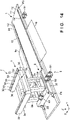
- Fig. 14 is a view showing an example of a traverser 100 including a wireless power supply device 5.
- the wireless power supply device 5 includes power transmission units 51 provided on a base unit 1, a power reception unit 52 provided on a moving unit 2, and a power storage device 53 such as a battery or a capacitor.
- Each power transmission unit 51 is connected to an external electric circuit (for example, a power supply device) (not shown) and arranged such that when a traverser main body T stops at a stop position P1 or a stop position P2, the power transmission unit 51 and the power reception unit 52 are close and face each other (to supply power).
- an external electric circuit for example, a power supply device
- the power reception unit 52 is installed on a side surface of the moving unit 2 and electrically connected to the power storage device 53.
- This electrical connection can be either wired power supply or wireless power supply.
- the power storage device 53 may be provided independently of the power reception unit 52 but may be integrated with the power reception unit 52, as a matter of course.
- the power transmission unit 51 provided at the stop position P1 (or P2) supplies power to the power reception unit 52 by wireless power supply.
- the power reception unit 52 stores, in the power storage device 53, the power supplied from the power transmission unit 51. Using the power stored in the power storage device 53, a control circuit 4 drives a travel motor 271.
- the arrangement of the power reception unit 52, the power transmission unit 51, and the power storage device 53 in Fig. 14 is merely an example, and various arrangements can be employed.
- only one power transmission unit 51 may be provided.
- the power transmission unit 51 may be stored in an internal space 10a of the base unit 1.
- an electromagnetic induction method can suitably be used from the viewpoint of the transfer efficiency and the transmission distance.
- any one of a magnetic field resonance method, an electric field coupling method, and a radio wave reception method, which are generally used as a wireless power supply method, can be applied.
- a control circuit 4 may be arranged outside a moving unit 2.
- Fig. 16 is a perspective view of a traverser 100 showing as an example
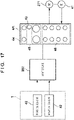
- Fig. 17 is a block diagram of a control system in the example shown in Fig. 16 .
- a communication unit 4A is provided as a control unit in place of the control circuit 4.
- the communication unit 4A includes a display unit 43, and is arranged such that an operator can visually recognize the display unit 43 from outside of the moving unit 2.
- the communication unit 4A is fixed to a support portion 30a on the outer wall portion of a conveyance unit 3 and exposed to the outside as a whole.
- the place to fix the communication unit 4A may be the outer wall portion of the moving unit 2.
- the communication unit 4A includes connectors 44 to 46.
- a communication cable that connects the communication unit 4A and a host device 200 is connected to the connector 44.
- a power supply cable that connects the communication unit 4A and an external power supply is connected to the connector 45.
- a control target device such as a travel motor 271 or a rotary encoder 41 is connected to the connector 46.
- the communication unit 4A includes, for example, a processor represented by a CPU, a storage device such as a RAM or a ROM, an input/output interface that relays between the control target device and the processor, and a communication interface that performs communication with a host controller. Note that the communication unit 4A may communicate with the host device 200 by wireless communication.
- the communication unit 4A receives an instruction from the host device 200 and controls drive of the travel motor 271. Note that the communication unit 4A may also control the conveyance unit 3.
- a detection signal from a position sensor 42 is input to the host device 200 via the communication unit 4A. Based on the detection signal from the position sensor 42, the host device 200 transmits an operation stop instruction or the like to the communication unit 4A. Based on the instruction from the host device 200 and the detection result of the rotary encoder 41, the communication unit 4A controls drive of the travel motor 271.
- the display unit 43 performs display concerning control of the travel motor 271.
- the display unit 43 is formed by a plurality of light-emitting elements. Each light-emitting element is provided, for example, for each connector of the communication unit 4A, and lights during transmission of a control signal from a corresponding connector to the control target device or the host device. Also, each light-emitting element is associated with a type of control signal from the host device 200 and lights during reception of a corresponding control instruction from the host device 200. The operator can confirm the display portion of the display unit 43 and confirm whether the operation of the moving unit 2 or the like is normally being performed.
Landscapes
- Engineering & Computer Science (AREA)
- Mechanical Engineering (AREA)
- Platform Screen Doors And Railroad Systems (AREA)
- Intermediate Stations On Conveyors (AREA)
Applications Claiming Priority (2)
| Application Number | Priority Date | Filing Date | Title |
|---|---|---|---|
| JP2019200206 | 2019-11-01 | ||
| PCT/JP2020/038343 WO2021085090A1 (ja) | 2019-11-01 | 2020-10-09 | トラバーサ、ベースユニット及び移動ユニット |
Publications (2)
| Publication Number | Publication Date |
|---|---|
| EP4052984A1 true EP4052984A1 (de) | 2022-09-07 |
| EP4052984A4 EP4052984A4 (de) | 2023-03-29 |
Family
ID=75715224
Family Applications (1)
| Application Number | Title | Priority Date | Filing Date |
|---|---|---|---|
| EP20883125.5A Pending EP4052984A4 (de) | 2019-11-01 | 2020-10-09 | Traverser, basiseinheit und mobile einheit |
Country Status (5)
| Country | Link |
|---|---|
| US (1) | US12030722B2 (de) |
| EP (1) | EP4052984A4 (de) |
| JP (1) | JP7284827B2 (de) |
| CN (1) | CN114641441B (de) |
| WO (1) | WO2021085090A1 (de) |
Cited By (1)
| Publication number | Priority date | Publication date | Assignee | Title |
|---|---|---|---|---|
| WO2025040211A1 (de) * | 2023-08-21 | 2025-02-27 | Dürr Systems Ag | Fördervorrichtung zum fördern von werkstücken in einer behandlungsanlage, tunnel zum schutz von behandelten werkstücken und zur reduzierung von fluidemissionen und behandlungsanlage zum behandeln von werkstücken |
Families Citing this family (8)
| Publication number | Priority date | Publication date | Assignee | Title |
|---|---|---|---|---|
| CN113726262B (zh) * | 2021-09-02 | 2024-04-19 | 上海捷勃特机器人有限公司 | 一种磁输送线驱动系统、磁输送线和磁输送线驱动方法 |
| CN113981201B (zh) * | 2021-10-28 | 2023-06-23 | 中冶南方工程技术有限公司 | 堆垛钢板运输系统及热轧板连续热处理方法 |
| CN115092449B (zh) * | 2022-07-22 | 2024-04-12 | 湖南楠海科技有限公司 | 一种智能调度转运机及运输方法 |
| CN115385061A (zh) * | 2022-10-12 | 2022-11-25 | 苏州旗开得电子科技有限公司 | 一种自动进出板升降传输机构设备 |
| CN115848901A (zh) * | 2022-12-29 | 2023-03-28 | 重庆德铭铝业有限公司 | 一种多自由度上料工作站 |
| CN116161412B (zh) * | 2023-04-26 | 2023-07-11 | 成都正恒动力股份有限公司 | 一种发动机缸体加工跨生产线自动转运辊道及方法 |
| CN117416747B (zh) * | 2023-11-10 | 2024-04-19 | 常熟耀皮汽车玻璃有限公司 | 一种夹层玻璃商标印刷检测分流输送装置 |
| CN117922908B (zh) * | 2023-12-22 | 2024-10-11 | 新疆天鹅现代农业机械装备有限公司 | 一种滑轨式可调节张紧力的采棉机水平棉花运移输送带 |
Family Cites Families (32)
| Publication number | Priority date | Publication date | Assignee | Title |
|---|---|---|---|---|
| DE3002978A1 (de) * | 1980-01-29 | 1981-07-30 | Koukal, Anton, 7326 Heinigen | Gleitfuehrungseinrichtung an arbeitsmaschinen |
| DE3930626A1 (de) * | 1989-09-13 | 1991-03-14 | Schmidt Irmgart | Nutzfahrzeug mit beweglichem ladeboden |
| JPH04107163U (ja) * | 1991-02-28 | 1992-09-16 | 株式会社椿本チエイン | ガイドローラを具えたキヤリヤ |
| JP3112200B2 (ja) * | 1992-04-21 | 2000-11-27 | オークラ輸送機株式会社 | ローラ駆動ユニット、ローラ制動ユニットおよびローラコンベヤ |
| JPH0665330U (ja) * | 1993-02-24 | 1994-09-16 | 村田機械株式会社 | ガイドレールに沿って走行する台車の停止装置 |
| JP2548562Y2 (ja) * | 1993-02-26 | 1997-09-24 | 昭和アルミニウム株式会社 | アプローチ等の組立建物における横樋 |
| JP3742162B2 (ja) * | 1996-11-26 | 2006-02-01 | 新日本製鐵株式会社 | 親子台車のレール継ぎ装置 |
| JP2000136093A (ja) * | 1998-10-30 | 2000-05-16 | Baitaru Kogyo Kk | 巻上機の過負荷防止装置 |
| JP2000168548A (ja) * | 1998-12-09 | 2000-06-20 | Tsubakimoto Chain Co | 自走式台車装置 |
| DE10034756C2 (de) * | 2000-07-18 | 2002-09-19 | Ssi Schaefer Noell Gmbh | Rollenbahn für den Transport von stückigen Gütern |
| US6837364B2 (en) * | 2003-02-25 | 2005-01-04 | Van Der Graaf Inc. | Clutch and brake for a conveyor drive roll |
| JP4625782B2 (ja) * | 2006-03-31 | 2011-02-02 | アイシン・エィ・ダブリュ株式会社 | 台車移動装置 |
| CN201305319Y (zh) * | 2008-12-03 | 2009-09-09 | 大连现代辅机开发制造有限公司 | 圆锥齿轮纵向单弹簧摩擦传动装置 |
| BRPI0923921A2 (pt) | 2009-01-09 | 2016-01-12 | Hirata Spinning | conjunto de rolete, unidade de roletes, e, aparelho transportador. |
| JP5155230B2 (ja) * | 2009-03-30 | 2013-03-06 | 平田機工株式会社 | ワーク組立装置及びその制御方法 |
| JP5639486B2 (ja) * | 2010-02-23 | 2014-12-10 | コマツNtc株式会社 | 搬送台車および搬送方法 |
| JP5273564B2 (ja) * | 2010-03-26 | 2013-08-28 | 株式会社ダイフク | ワーク搬送設備 |
| CN102060172A (zh) * | 2010-11-18 | 2011-05-18 | 苏州工业园区热处理设备厂有限公司 | 一种辊筒过载保护装置 |
| KR101707929B1 (ko) | 2012-10-04 | 2017-02-17 | 히라따기꼬오 가부시키가이샤 | 반송 시스템 및 제어 방법 |
| CN203127595U (zh) * | 2013-03-01 | 2013-08-14 | 青岛诺力达智能科技有限公司 | 双主线双输出托盘库自动码垛系统 |
| CN103231888B (zh) * | 2013-05-02 | 2015-07-29 | 宁夏巨能机器人系统有限公司 | 一种摩擦力可调的动力辊筒料道 |
| US9809308B2 (en) * | 2015-10-06 | 2017-11-07 | General Electric Company | Load transport and restraining devices and methods for restraining loads |
| CN105564906A (zh) * | 2016-02-22 | 2016-05-11 | 佛山科学技术学院 | 一种低速重载防卡死过载保护的链轮传动装置 |
| US10351353B1 (en) * | 2017-09-28 | 2019-07-16 | Skarlupka Mfg., Inc. | Narrow belt conveyor with 90 degree cross transfer |
| CN207604451U (zh) * | 2017-12-28 | 2018-07-13 | 广东顺德凯雷机械有限公司 | 一种新型冰鲜鱼切粒机 |
| CN207890470U (zh) * | 2018-01-31 | 2018-09-21 | 重庆奔飞机电设备有限公司 | 一种用于汽车发动机装配线托盘输送的摩擦组件 |
| EP3539904B1 (de) * | 2018-03-12 | 2023-08-02 | Interroll Holding AG | Antriebsvorrichtung für einen rollenförderer |
| US11439921B2 (en) * | 2018-06-25 | 2022-09-13 | Universal City Studios Llc | Multi-dimensional bogie and track system |
| CN108923581A (zh) * | 2018-07-11 | 2018-11-30 | 上海新世纪机器人有限公司 | 微型直流减速电机的过载保护装置 |
| CN109625819A (zh) * | 2019-01-09 | 2019-04-16 | 南阳柯丽尔科技有限公司 | 自动移载装置及胶片老化线的自动移载系统 |
| US10882703B2 (en) * | 2019-06-06 | 2021-01-05 | Intelligrated Headquarters, Llc | Methods, systems, and apparatuses, for operating a material handling system |
| US11117752B2 (en) * | 2019-11-19 | 2021-09-14 | Toyota Motor Engineering & Manufacturing North America, Inc. | Automated dolly assemblies with loading and unloading racks |
-
2020
- 2020-10-09 CN CN202080075823.4A patent/CN114641441B/zh active Active
- 2020-10-09 EP EP20883125.5A patent/EP4052984A4/de active Pending
- 2020-10-09 WO PCT/JP2020/038343 patent/WO2021085090A1/ja not_active Ceased
- 2020-10-09 JP JP2021554276A patent/JP7284827B2/ja active Active
-
2022
- 2022-04-26 US US17/729,349 patent/US12030722B2/en active Active
Cited By (1)
| Publication number | Priority date | Publication date | Assignee | Title |
|---|---|---|---|---|
| WO2025040211A1 (de) * | 2023-08-21 | 2025-02-27 | Dürr Systems Ag | Fördervorrichtung zum fördern von werkstücken in einer behandlungsanlage, tunnel zum schutz von behandelten werkstücken und zur reduzierung von fluidemissionen und behandlungsanlage zum behandeln von werkstücken |
Also Published As
| Publication number | Publication date |
|---|---|
| CN114641441A (zh) | 2022-06-17 |
| JP7284827B2 (ja) | 2023-05-31 |
| CN114641441B (zh) | 2024-04-09 |
| WO2021085090A1 (ja) | 2021-05-06 |
| US12030722B2 (en) | 2024-07-09 |
| US20220250847A1 (en) | 2022-08-11 |
| EP4052984A4 (de) | 2023-03-29 |
| JPWO2021085090A1 (de) | 2021-05-06 |
Similar Documents
| Publication | Publication Date | Title |
|---|---|---|
| EP4052984A1 (de) | Traverser, basiseinheit und mobile einheit | |
| KR101918187B1 (ko) | 트롤리 호이스트 | |
| CN116101745B (zh) | 旋转移载机 | |
| CN106183945A (zh) | 一种具有上下料对接装置的agv载物车 | |
| WO2021220686A1 (ja) | 走行台車、及び、自動倉庫 | |
| KR102197322B1 (ko) | 호이스트 유닛 및 이를 갖는 비히클 | |
| CN116512970A (zh) | 电池抽换装置、电池抽换方法及电源设备 | |
| KR101614314B1 (ko) | 무인 운반차용 배터리 이송유닛 및 이를 갖는 무인 운반차의 배터리 자동 교환장치 | |
| CN215796648U (zh) | 零件下料装置 | |
| KR20210059372A (ko) | 스마트홈 디바이스 천정 이송장치 | |
| US20240409131A1 (en) | Article transport device | |
| CN210972754U (zh) | 一种rgv小车 | |
| CN115489975B (zh) | 升降对位装置及输送系统 | |
| CN113636499A (zh) | 一种移动式液压调节装置 | |
| CN109533085B (zh) | 一种重载agv | |
| US20230166910A1 (en) | Pallet Lifting Rack and Pallet Handling System | |
| CN211393742U (zh) | 无人搬运车 | |
| CN117566001A (zh) | 一种自动运输车 | |
| CN216071912U (zh) | 托盘定位装置 | |
| EP3658444A1 (de) | Bewegliche plattform für ein schubplattenförderystem einer fahrzeugmontagestrasse | |
| JP5633957B2 (ja) | 部品搬送システム | |
| US20240409311A1 (en) | Article transport facility and traveling vehicle | |
| KR100764127B1 (ko) | 자가 구동 팔레트 장치 | |
| KR101346670B1 (ko) | 벨트풀리를 이용한 반송장치 | |
| CN112209044A (zh) | 一种法兰储料装置 |
Legal Events
| Date | Code | Title | Description |
|---|---|---|---|
| STAA | Information on the status of an ep patent application or granted ep patent |
Free format text: STATUS: THE INTERNATIONAL PUBLICATION HAS BEEN MADE |
|
| PUAI | Public reference made under article 153(3) epc to a published international application that has entered the european phase |
Free format text: ORIGINAL CODE: 0009012 |
|
| STAA | Information on the status of an ep patent application or granted ep patent |
Free format text: STATUS: REQUEST FOR EXAMINATION WAS MADE |
|
| 17P | Request for examination filed |
Effective date: 20220525 |
|
| AK | Designated contracting states |
Kind code of ref document: A1 Designated state(s): AL AT BE BG CH CY CZ DE DK EE ES FI FR GB GR HR HU IE IS IT LI LT LU LV MC MK MT NL NO PL PT RO RS SE SI SK SM TR |
|
| RIC1 | Information provided on ipc code assigned before grant |
Ipc: B65G 47/64 20060101ALI20221122BHEP Ipc: B65G 41/02 20060101ALI20221122BHEP Ipc: B65G 47/52 20060101ALI20221122BHEP Ipc: B61B 13/00 20060101AFI20221122BHEP |
|
| DAV | Request for validation of the european patent (deleted) | ||
| DAX | Request for extension of the european patent (deleted) | ||
| A4 | Supplementary search report drawn up and despatched |
Effective date: 20230301 |
|
| RIC1 | Information provided on ipc code assigned before grant |
Ipc: B65G 47/64 20060101ALI20230223BHEP Ipc: B65G 41/02 20060101ALI20230223BHEP Ipc: B65G 47/52 20060101ALI20230223BHEP Ipc: B61B 13/00 20060101AFI20230223BHEP |
|
| STAA | Information on the status of an ep patent application or granted ep patent |
Free format text: STATUS: EXAMINATION IS IN PROGRESS |
|
| 17Q | First examination report despatched |
Effective date: 20241024 |