EP4053317A2 - Tissu tissé de protection - Google Patents
Tissu tissé de protection Download PDFInfo
- Publication number
- EP4053317A2 EP4053317A2 EP22159822.0A EP22159822A EP4053317A2 EP 4053317 A2 EP4053317 A2 EP 4053317A2 EP 22159822 A EP22159822 A EP 22159822A EP 4053317 A2 EP4053317 A2 EP 4053317A2
- Authority
- EP
- European Patent Office
- Prior art keywords
- den
- core component
- warp
- weft
- woven fabric
- Prior art date
- Legal status (The legal status is an assumption and is not a legal conclusion. Google has not performed a legal analysis and makes no representation as to the accuracy of the status listed.)
- Pending
Links
Images
Classifications
-
- D—TEXTILES; PAPER
- D02—YARNS; MECHANICAL FINISHING OF YARNS OR ROPES; WARPING OR BEAMING
- D02G—CRIMPING OR CURLING FIBRES, FILAMENTS, THREADS, OR YARNS; YARNS OR THREADS
- D02G3/00—Yarns or threads, e.g. fancy yarns; Processes or apparatus for the production thereof, not otherwise provided for
- D02G3/44—Yarns or threads characterised by the purpose for which they are designed
- D02G3/442—Cut or abrasion resistant yarns or threads
-
- D—TEXTILES; PAPER
- D02—YARNS; MECHANICAL FINISHING OF YARNS OR ROPES; WARPING OR BEAMING
- D02G—CRIMPING OR CURLING FIBRES, FILAMENTS, THREADS, OR YARNS; YARNS OR THREADS
- D02G3/00—Yarns or threads, e.g. fancy yarns; Processes or apparatus for the production thereof, not otherwise provided for
- D02G3/22—Yarns or threads characterised by constructional features, e.g. blending, filament/fibre
- D02G3/32—Elastic yarns or threads ; Production of plied or cored yarns, one of which is elastic
- D02G3/328—Elastic yarns or threads ; Production of plied or cored yarns, one of which is elastic containing elastane
-
- D—TEXTILES; PAPER
- D03—WEAVING
- D03D—WOVEN FABRICS; METHODS OF WEAVING; LOOMS
- D03D1/00—Woven fabrics designed to make specified articles
- D03D1/0035—Protective fabrics
-
- D—TEXTILES; PAPER
- D03—WEAVING
- D03D—WOVEN FABRICS; METHODS OF WEAVING; LOOMS
- D03D15/00—Woven fabrics characterised by the material, structure or properties of the fibres, filaments, yarns, threads or other warp or weft elements used
- D03D15/20—Woven fabrics characterised by the material, structure or properties of the fibres, filaments, yarns, threads or other warp or weft elements used characterised by the material of the fibres or filaments constituting the yarns or threads
- D03D15/283—Woven fabrics characterised by the material, structure or properties of the fibres, filaments, yarns, threads or other warp or weft elements used characterised by the material of the fibres or filaments constituting the yarns or threads synthetic polymer-based, e.g. polyamide or polyester fibres
-
- D—TEXTILES; PAPER
- D03—WEAVING
- D03D—WOVEN FABRICS; METHODS OF WEAVING; LOOMS
- D03D15/00—Woven fabrics characterised by the material, structure or properties of the fibres, filaments, yarns, threads or other warp or weft elements used
- D03D15/40—Woven fabrics characterised by the material, structure or properties of the fibres, filaments, yarns, threads or other warp or weft elements used characterised by the structure of the yarns or threads
- D03D15/47—Woven fabrics characterised by the material, structure or properties of the fibres, filaments, yarns, threads or other warp or weft elements used characterised by the structure of the yarns or threads multicomponent, e.g. blended yarns or threads
-
- D—TEXTILES; PAPER
- D03—WEAVING
- D03D—WOVEN FABRICS; METHODS OF WEAVING; LOOMS
- D03D15/00—Woven fabrics characterised by the material, structure or properties of the fibres, filaments, yarns, threads or other warp or weft elements used
- D03D15/50—Woven fabrics characterised by the material, structure or properties of the fibres, filaments, yarns, threads or other warp or weft elements used characterised by the properties of the yarns or threads
- D03D15/513—Woven fabrics characterised by the material, structure or properties of the fibres, filaments, yarns, threads or other warp or weft elements used characterised by the properties of the yarns or threads heat-resistant or fireproof
-
- D—TEXTILES; PAPER
- D03—WEAVING
- D03D—WOVEN FABRICS; METHODS OF WEAVING; LOOMS
- D03D15/00—Woven fabrics characterised by the material, structure or properties of the fibres, filaments, yarns, threads or other warp or weft elements used
- D03D15/50—Woven fabrics characterised by the material, structure or properties of the fibres, filaments, yarns, threads or other warp or weft elements used characterised by the properties of the yarns or threads
- D03D15/56—Woven fabrics characterised by the material, structure or properties of the fibres, filaments, yarns, threads or other warp or weft elements used characterised by the properties of the yarns or threads elastic
-
- D—TEXTILES; PAPER
- D03—WEAVING
- D03D—WOVEN FABRICS; METHODS OF WEAVING; LOOMS
- D03D15/00—Woven fabrics characterised by the material, structure or properties of the fibres, filaments, yarns, threads or other warp or weft elements used
- D03D15/50—Woven fabrics characterised by the material, structure or properties of the fibres, filaments, yarns, threads or other warp or weft elements used characterised by the properties of the yarns or threads
- D03D15/573—Tensile strength
-
- D—TEXTILES; PAPER
- D10—INDEXING SCHEME ASSOCIATED WITH SUBLASSES OF SECTION D, RELATING TO TEXTILES
- D10B—INDEXING SCHEME ASSOCIATED WITH SUBLASSES OF SECTION D, RELATING TO TEXTILES
- D10B2331/00—Fibres made from polymers obtained otherwise than by reactions only involving carbon-to-carbon unsaturated bonds, e.g. polycondensation products
- D10B2331/10—Fibres made from polymers obtained otherwise than by reactions only involving carbon-to-carbon unsaturated bonds, e.g. polycondensation products polyurethanes
-
- D—TEXTILES; PAPER
- D10—INDEXING SCHEME ASSOCIATED WITH SUBLASSES OF SECTION D, RELATING TO TEXTILES
- D10B—INDEXING SCHEME ASSOCIATED WITH SUBLASSES OF SECTION D, RELATING TO TEXTILES
- D10B2401/00—Physical properties
- D10B2401/06—Load-responsive characteristics
- D10B2401/061—Load-responsive characteristics elastic
-
- D—TEXTILES; PAPER
- D10—INDEXING SCHEME ASSOCIATED WITH SUBLASSES OF SECTION D, RELATING TO TEXTILES
- D10B—INDEXING SCHEME ASSOCIATED WITH SUBLASSES OF SECTION D, RELATING TO TEXTILES
- D10B2501/00—Wearing apparel
- D10B2501/04—Outerwear; Protective garments
Definitions
- the present invention relates to protective woven fabrics and the manufacture thereof, namely to woven fabrics having resistance to abrasion, and in particular to elastic woven fabric resistant to abrasion.
- Abrasion resistant fabrics particularly in garments for use with motorcycles are known in the art.
- protective garments that consists of fabrics provided with additional hard or reinforcing materials are known. These hard materials usually provide an uncomfortable feeling to the wearer.
- These garments and fabrics are also often unattractive and unappealing.
- An aim of the present invention is to solve the problems of the prior art, by providing a protective fabric that, when tailored into a garment, is comfortable and attractive for the wearer of the garment.
- a further aim of the present invention is to provide such a fabric, that is easy to produce and to treat, and in particular, to dye.
- an object of the present invention is a woven fabric according to claim 1 and a garment according to claim 15. Preferred aspect are recited in the dependent claims.
- an aspect of the present invention relates to a woven fabric having warp yarns and weft yarns, wherein said warp yarns and said weft yarns comprise a core and a sheath, said core comprising a first core component and a second core component, wherein first core component has a breaking tenacity of at least 6g/denier (52.98 cN/tex), more preferably of at least 10 g/den (88.30 cN/tex), most preferably of at least 14 g/den, while the second core component comprises one or more elastomeric elements, and wherein elasticity of the fabric (i.e. the fabric stretch) in warp direction is at least 20% (measured according to ASTM D3107) and elasticity of the fabric (i.e. the fabric stretch) in weft direction is at least 20%.
- an elastomeric element can be stretched at least up to two times its original length.
- the second core component can be stretched 400% more than of its original length.
- Exemplary testing machine suitable for testing elongation at break of elastic yarns are known in the art, e.g. Uster Tensorapid apparatuses.
- the breaking tenacity of the first core component is at least 14 g/denier, even more preferably 20 g/denier, i.e. 20 grams per denier, that is at least 176.60 cN/tex.
- the first core component can comprise a single element or multiple elements, e.g. can be a single filament, or it an comprise multiple filaments. Multiple filaments can be coalesced (filaments that are stuck together) or uncoalesced (separate) filaments. Unless specified otherwise, properties of the first core component are thus referred to the sum of all the elements of the first core components. As an example, the count of the first component is the sum of the counts of all the elements. Breaking tenacity is discussed as a relative property, i.e. as a function of the denier of the component. As a result, the elements of the first component can be tested together or separately and the relevant results combined.
- the first core component is preferably made of one or more UHMWPE filaments.
- UHMWPE i.e. ultra-high-molecular-weight polyethylene
- the first core component is preferably used in the core of both warp and weft yarns and provides a high abrasion resistance to the fabric (and thus to the final garment), while presence of the sheath prevents the UHMWPE from (uncomfortably) touching the skin of the user and from being visible.
- UHMWPE filaments are the most preferred material for the first core component. In fact, it was surprisingly found that they have high tenacity and abrasion resistance, while still preventing grin through. In other words, in normal use said filaments remain centered in the core portion of warp/weft yarns within the sheath, without surfacing, even after several cycles of elongation and retraction of the fabric.
- the second core component can consist of a single element or it can comprise a plurality of elements, e.g. a single filament or a plurality of filaments.
- the use of elastomeric filaments in both warp and weft cores provides elasticity in every direction to the final fabric.
- Such an effect further provides a garment that is comfortable to wear, especially for motorcycle use; in fact, elasticity in both direction allows the fabric to extend in warp and weft direction, so that the garment to move with the body of the user.
- the garment is a pair of trousers, the user is not limited or restrained during a sitting position, avoiding an uncomfortable feeling especially in the knees and hips areas.
- the fabric has a single layer weave, preferably selected from sateen, twill and canvas. These weaves, in particular sateen and twill, can provide the usual denim look to the fabric.
- the most preferred weave is twill, preferably a 3/1 twill weave.
- the first core component and the second core component are connected together by intermingling, twisting or co-feeding.
- the first core component comprises, preferably consists of, a plurality of UHMWPE filaments and the second core component comprises, preferably consists of, a plurality of elastomeric filaments.
- UHMWPE other filaments such as aramid filaments, liquid crystal polymer filaments, high strength polyester or polyamide filaments having at least 6 g/den, preferably at least 10 or 14 or 20 g/den breaking tenacity may be used.
- Suitable elastomeric filaments include elastane and rubber, preferably elastane. Before combining the abrasion resistant filaments and the elastomeric filaments, the latter are drafted in a ratio within the range of 1.5:1 to 6:1, i.e. they are drafted by 50% to 500% more than their initial length.
- the sheath comprises, preferably consist of, staple fibers.
- Preferred fibers for the sheath are natural fibers, more preferably cotton fibers. Other possible natural fibers are e.g. wool and linen. Synthetic materials can be also used fort the sheath such as polyester and polyamide.
- the sheath in particular a cotton sheath, provides a soft and natural feel on the skin of a user.
- a cotton surface can be dyed (even if undyed embodiments are possible) e.g. with indigo, black or other dyestuffs e.g. by ecru dyeing, rope dyeing, slash dyeing or other suitable processes.
- the combination of above materials, and preferably also the coupling of core components also provides a washable fabric, such as classic denim fabric that can undergo several different washes, without surfacing of the core, i.e. so that the visible surface of the yarn is substantially 100% the material of the sheath, e.g. 100% cotton.
- elasticity of the fabric in weft direction is at least 30%. According to a possible aspect, the elasticity in warp direction is comprised between 25% and 40%.
- the same yarn is used for the warp yarns and for the weft yarns of the fabric.
- the warp yarns are different from the weft yarns.
- the warp yarns and the weft yarns are made from the same kind of yarn. It is however possible that the weft yarns have a different count with respect to the warp yarns and the nature of the core components are the same in warp and weft yarns.
- the count of the warp yarns and of the weft yarns is comprised between NE 4 and NE 80, more preferably between NE 8 and NE 60, even more preferably between NE 10 and NE 20.
- the final yarn is typically not combined with other yarns (e.g. via twisting), the count is thus preferably between NE 4/1 and NE 80/1, more preferably within NE 8/1 and NE 60/1, even more preferably between NE 10/1 and NE 20/1.
- the count of the first core component i.e. the count of the only element, typically a filament, forming the first core component, or the sum of the counts of all the different elements of the first core component, typically the sum of all the filaments of the first core component
- the count of the first core component is comprised between 30 den and 500 den, more preferably between 60 and 200 den, even more preferably between 75 and 150 den.
- the count of the second core component (i.e. as per above the count of the only element forming the second core component or the sum of the counts of the different elements forming the second core component) is comprised between 20 and 500 den, more preferably between 40 and 200 den, even more preferably between 70 and 105 den.
- the elements of the first core component are made from the same material and/or have the same count.
- the elements of the second core component have are made from the same material and/or have the same count.
- the element(s) of the first core component is/are made from a material different from the material of the element(s) of the second core component.
- elongation at break of the first core component is less than 10%, more preferably less than 8%, tested with DIN EN ISO 2062. Preferably, this value applies also to each of the elements of the first core component.
- composition of the warp and weft yarn is as follows: the first core component is at least 10% of the weight of the yarn, second core component is at least 1.5% of the weight of the yarn, the sheath is at least 40% of the weight of the yarn. Preferred ranges (in weight) are as follows: first core component between 10% and 60%, second core component between 1.5% and 40%, sheath between 38.5% or 40% and 88.5%.
- the warp density of the final fabric is between 15 and 70 warps/cm, and the weft density is between 15 and 50 wefts/cm.
- Preferred embodiments have warp density between 20 and 60 warps/cm, and/or weft density between 18 and 40 wefts/cm.
- High tenacity yarns in particular UHMWPE yarns, have usually low melting/softening points.
- typically UHMWPE has a melting point of about 120°C - 140°C.
- the fabric is not heat set. More in general, during production of the fabric, it is preferably avoided any heat treatment causing heating of the fabric to above about 100°C - 110°C.
- dying is performed at lower than 100°C temperature or at room temperature.
- the weave is chosen so that shrinking of the final garment at washing is reduced.
- Preferred fabric use the densities and counts as above discussed, preferably having weight between 9 and 22 oz sq yd.
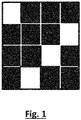
- a preferred weave is a twill, in particular a 3/1 twill, as the one shown in fig. 1 .
- this weave contains 4 different moves in the loom.
- sequence movements of 4 warp yarns and 4 weft yarns of the shown repeat unit all come together and make a pattern. After the 4th movement on the warp side, the pattern turns back to the first movement that warp and weft make together. All these warp and weft movements occurs in 4 different sequences in one report and after one full report the pattern comes back to first sequence of movements warp/weft make together.
- the warp pattern from left to right is 2b/1a/1b, 1b/1a/2b, 1a/3b, 3b/1a; wherein "a” is an under portion and "b” is an over portion
- the warp tensile strength and weft tensile strength of the fabric measured with ASTM D5034, typically ASTM D5034 G-E (i.e. fabric grab tensile tests with constant rate of extension testing machine) on a sample 15x10 cm (length x width), are greater than 50 Kg, more preferably greater than 80 Kg. In a preferred embodiment, at least the warp tensile strength (possibly also the weft tensile strength) is greater than 100 kg.
- the warp tear strength and weft tear strength, of the fabric, measured with ASTM D1424, typically on a sample 10x7,5 cm (length x width), and cutting die as per fig. 1(a) of ASTM D1424 are greater than 10000 g, preferably higher than 13900 g.
- a further aspect of the invention also relates to a garment, wherein at least a portion of the garment is made from the woven fabric according to any preceding claim.
- a preferred embodiment of a garment is a pair of trousers.
- a further aspect of the present invention relates to a yarn comprising a core and a sheath, the core comprising a first core component and a second core component, wherein the first core component has a breaking tenacity of at least 6g/den, more preferably at least 10 g/den, and the second core component comprises elastomeric elements.
- Even more preferred embodiments have a breaking tenacity of the first core component of at least 20 g/den.
- the first core component has elongation at break that is less than 10%, even more preferably less than 8%.
- Elongation at break of the second core component is preferably greater than 200%, even more preferably greater than 400%.
- Elongation at break of the first core component can be measured with DIN EN ISO 2062, while elongation at break of the second component can be measured with a suitable method, i.e. there is at least one method allowing, at room temperature, stretching of the second core component of at least 200%, more preferably of at least 400%.
- a preferred composition of the yarn is as follows: the first core component is between 10% and 60% of the weight of the yarn, the second core component is between 1.5% and 40% of the weight of the yarn, the sheath is between is between 40% and 88.5% of the weight of the yarn.
- the yarn has a count comprised between NE 4 and NE 80, more preferably between NE 8 and NE 60, even more preferably between NE 10 and NE 20, wherein count of the first core component is comprised between 30 den and 500 den, more preferably between 60 and 200 den, even more preferably between 75 and 150 den, wherein count of the second core component is comprised between 20 and 500 den, more preferably between 60 and 150 den, even more preferably between 70 and 105 den.
- First and second core component are preferably combined with each other via co-feeding, twisting or intermingling.
- the present yarn provides a resistance to abrasion to the final fabric, allowing to weave an elastic (stretchable) fabric, notwithstanding the presence of a high resistant component that is generally inelastic.
- Figure 1 is a preferred weaving report for the present invention.
- the present invention relates to a woven fabric having warp yarns and weft yarns.
- the warp and weft yarns have the same structure, i.e. a core comprising a first core component and a second core component, the core being covered by a sheath.
- the core does not comprise other components.
- the core comprises a single first core component and a single second core component. It is not however excluded that the core comprises more than one first and/or more than one second yarn.
- the first core component provides high resistance to abrasion and is typically a low elastic component.
- the fist core component when tested with ISO 2062 has a breaking tenacity equal to or greater than 6 g/den, more preferably equal to or greater than 10 g/den, even more preferably greater than or equal to 14 g/den. Most preferred embodiments have breaking tenacity greater than or equal to 20 g/den, e.g. between 20 g/den and 50 g/den.
- the first core component has low elasticity, and thus low stretchability.
- elongation at break of the first core component is less than 10%, more preferably less than 8%.
- the first core component may be a single filament yarn, or a yarn comprising a plurality of filaments and/fibers.
- the first core component is typically a UHMWPE yarn.
- the count of the first core component is comprised between 30 den and 500 den, more preferably between 60 and 200 den, even more preferably between 75 and 150 den.
- the second core component is preferably a single filament yarn, or a yarn comprising a plurality of filaments.
- Preferred elastomeric yarns are elastane yarns.
- Count of the second core component is comprised between 20 and 500 den, more preferably between 40 and 200 den, even more preferably between 70 and 105 den.
- an elastomeric yarn is a non-textured yarn which can be stretched repeatedly at room temperature to at least twice its original length and which after removal of the tensile force will immediately and forcibly return to approximately its original length.
- the two core components are combined via twisting, intermingling or co-feeding.
- the co-feeding technique is the preferred solution.
- Twisting is a known technique. Twisting is usually performed so that the two core components (i.e. the first core component and the second core component) so as to obtain 20-2500 twists/meter, preferably 100-1000, twists/meter, and most preferably 300-600 twist per meter.
- Intermingling can be carried out according to the known techniques of the art, such as open or closed intermingling jets.
- the system is arranged to provide a number of connecting points that is within the range of 20 to 200 points per meter, preferably 50 to 120 points per meter and most preferably 95 to 105.
- the method of measuring the number of intermingling point is by direct count of the combined fibers; in the latter method, the elastic core "yarn" is put on a black or dark surface and is inspected by eye, possibly with a magnifying glass, and the connecting points in a meter of yarn are manually counted.
- co-feeding also known as coextrusion.
- co-feeding the two core components are forced through a restriction where the two yarns are compressed together to such a degree that they remain attached also after exiting the restriction.
- a suitable restriction is e.g. a "V"- shaped roll; in a preferred embodiment, the two core components are fed to a roll having a V-shape, in particular, they are fed together and forced into the bottom of the "V" where they are compressed together and remain bound.
- the co-fed yarns are preferably spun with the fibers of the sheath immediately after the co-feeding step.
- the core is covered with a sheath, typically a sheath of staple fibers, typically cotton fibers.
- the final warp and weft yarns have thus a count that is preferably comprised between NE 4 and NE 80, more preferably between NE 8 and NE 60, even more preferably between NE 10 and NE 20.
- the warp and weft are woven via a single layer weave, preferably chosen between a canvas weave, a sateen weave and a twill weave.
- Warp density of the final fabric is preferably comprised between 15 and 70 warps/cm, more preferably 20 and 50 warps/cm, even more preferably between 25 and 35 warps/cm.
- Weft density of the final fabric is preferably comprised between 15 and 50 wefts/cm, more preferably between 20 and 30 wefts/cm.
- Elasticity of the fabric in warp direction and in weft direction is at least 20%, measured according to ASTM D3107.
- a sample may be stretched by means of a weight of 3.0 lb or 4.0 lb. It has been proven that there are no significant differences in the test results if either a 3.0 lb or 4.0 lb weight is used. In the present disclosure, stretch according to ASTM D3107 was measured by means of a 3.0 lb weight.
- the woven fabric of the present invention is thus characterized in that it has an elasticity, i.e. it can be stretched, in warp direction of at least 20%, preferably between 30% and 40%, and in that elasticity in the weft direction is at least 20%, more preferably at least 30%, even more preferably, at least 35%.
- the fabric of the present invention is a woven stretch fabric, both in warp and weft direction, as e.g. discussed in ASTM D4850, according to which a stretch woven fabric is a woven fabric which is capable of at least 20% stretch in either warp or filling direction, or both, under forces and conditions encountered in use, and almost complete recovery after removal of the force.
- elasticity of the fabric in weft direction is higher than the elasticity of the fabric in warp direction. It is however possible that the two values are substantially identical, or that elasticity of the fabric in warp direction is higher than the elasticity of the fabric in weft direction
- the woven fabric of the present invention has high elasticity in both warp and weft direction, it can be defined as a "bi-stretch" woven fabric.
- Another advantage of the bi-stretch fabric of the present invention is that, providing high elasticity in both warp and weft direction, an improvement of recovery, and a reduction of the growth, is obtained.
- Test method EN 17092 provides five different classes of protective garments, according to their performance (from best to worst): AAA, AA, A, B and C.
- a protective fabric according to the present invention is at least an "A" fabric. The invention will now be disclosed with reference to the following non-limiting examples.
- the fabric has the features as per table 1.
- the warp yarns are different from the weft yarns.
- the warp yarns are a NE 16 / 1 yarn, having a 75 den UHMWPE yarn as a first core components coupled via co-feeding process to a 70 den elastane yarn as the second core component.
- the elastane Before coupling with the first core component, the elastane has a 3.7 draft. Composition of the warp yarn, by weight, is thus 71.5% cotton, 22.5% UHMWPE, 6% elastane. Twist multiple of the final warp yarn is 3.40, while the number of twists per meter of the final yarn is 535.
- the elastane yarn is coarser (105 den), but the sheath is finer, so that the final yarn is finer (count of 20 NE).
- Composition of the weft yarn, by weight, is thus 60.5% cotton, 28.2% UHMWPE, 11.3% elastane
- Twist multiple of the final weft yarn is 4.20, while the number of twists per meter of the final yarn is 828.
- the fabric has a twill 3 / 1 weave and, on the reed, has 20 warps / cm an 18.2 wefts / cm, while in the final fabric there are 35.8 warps / cm and 22 wefts / cm.
- Weight of the fabric is 12.2 oz.
- the fabric was black overdyed, with black warp yarns and weft black yarns.
- the fabric was tested with ASTM D3107 for elasticity, with ASTM D5034 for tensile strength, and with ASTM D1424 for tear strength. Results of the tests are as per table 2. Please note that testing machine for tear strength had a maximum weight applicable of 13900 grams (g). When tested at this maximum level, the fabric did not break, so tear strength is recited as greater than 13900 g .
- the fabric has the features as per table 1.
- the warp yarns are identical to the weft yarns.
- the warp and weft yarns are NE 10 / 1 yarns, having a 150 den UHMWPE yarn as a first core components coupled via co-feeding process to a 70 den elastane yarn as the second core component.
- the elastane Before coupling with the first core component, the elastane has a 3.7 draft.
- Composition of the warp and weft yarns, by weight, is thus 68% cotton, 28.2% UHMWPE, 3.8% elastane.
- Twist multiple of the final warp and weft yarns is 4.20, while the number of twists per meter of the final yarns is 523.
- the fabric has a twill 3 / 1 weave and, on the reed, has 18 warps / cm an 14.2 weftslcm, while in the final fabric there are 25 warps / cm and 18 weftslcm.
- Weight of the fabric is 14.5 oz.
- the warp yarns of the fabric were indigo dyed.
- the fabric was tested with ASTM D3107 for elasticity, with ASTM D5034 for tensile strength, and with ASTM D1424 for tear strength. Results of the tests are as per table 2. Please note that testing machine for tear strength had a maximum weight applicable of 13900 grams (g). When tested at this maximum level, the fabric did not break, so tear strength is recited as greater than 13900 g .
- Fabric of example 3 uses the same yarns and the same weave of example 2.
- the dying technique is however different.
- the fabric was black overdyed, with black warp yarns and black weft yarns. Due to the different dyeing technique, values of elasticity, strength and fabric weight are different with respect to example 2, (weight being 13.3 oz).
- a fabric according to the present invention tailored into a garment, in particular a protective fabric for motorcycle, as a protective pair of pants or a protective jacket.
- At least a portion of the garment consist in the present fabric.
- the inner surface of the fabric coincides with the inner surface of the garment, as well as the outer surface of the fabric coincides with the outer surface of the fabric, such that no other layers of fabrics are superimposed to the fabric of the present invention for at least part of the garment.
- at least a portion of the garment is made of a single layer fabric according to the present invention.
Landscapes
- Engineering & Computer Science (AREA)
- Textile Engineering (AREA)
- Mechanical Engineering (AREA)
- Woven Fabrics (AREA)
- Yarns And Mechanical Finishing Of Yarns Or Ropes (AREA)
Applications Claiming Priority (1)
| Application Number | Priority Date | Filing Date | Title |
|---|---|---|---|
| EP21160233 | 2021-03-02 |
Publications (2)
| Publication Number | Publication Date |
|---|---|
| EP4053317A2 true EP4053317A2 (fr) | 2022-09-07 |
| EP4053317A3 EP4053317A3 (fr) | 2022-09-21 |
Family
ID=74856627
Family Applications (1)
| Application Number | Title | Priority Date | Filing Date |
|---|---|---|---|
| EP22159822.0A Pending EP4053317A3 (fr) | 2021-03-02 | 2022-03-02 | Tissu tissé de protection |
Country Status (5)
| Country | Link |
|---|---|
| US (1) | US12344964B2 (fr) |
| EP (1) | EP4053317A3 (fr) |
| JP (1) | JP7590062B2 (fr) |
| CN (1) | CN115552062A (fr) |
| WO (1) | WO2022184789A1 (fr) |
Families Citing this family (1)
| Publication number | Priority date | Publication date | Assignee | Title |
|---|---|---|---|---|
| EP4053317A3 (fr) * | 2021-03-02 | 2022-09-21 | Sanko Tekstil Isletmeleri San. Ve Tic. A.S. | Tissu tissé de protection |
Citations (2)
| Publication number | Priority date | Publication date | Assignee | Title |
|---|---|---|---|---|
| EP3502327A1 (fr) * | 2017-12-22 | 2019-06-26 | Sanko Tekstil Isletmeleri San. Tic. A.S. | Fil à âme composite, article d'habillement comprenant un fil à âme composite, procédé de production d'un fil à âme composite et utilisation d'un fil à âme composite |
| CN212477006U (zh) * | 2020-01-11 | 2021-02-05 | 长江纺织(浙江)有限公司 | 一种氨纶/涤纶/超高分子量聚乙烯纤维高强度包覆纱 |
Family Cites Families (42)
| Publication number | Priority date | Publication date | Assignee | Title |
|---|---|---|---|---|
| DE1250403B (de) * | 1955-12-30 | 1967-09-21 | De Bell &. Richardson Inc Hazardville Conn (V St A) | Verfahren zur Herstellung überzogener Gewebe |
| BE555243A (fr) * | 1956-02-24 | |||
| US3448573A (en) * | 1968-02-12 | 1969-06-10 | Ici Ltd | High tenacity yarns made from polyethylene terephthalate,particularly for sailcloth |
| US3838561A (en) * | 1968-08-31 | 1974-10-01 | Akzona Inc | Unique polyethylene terephthalate fiber and yarn |
| US3966867A (en) * | 1968-08-31 | 1976-06-29 | Akzona Incorporated | Manufacture of unique polyethylene terephthalate fiber |
| US3858386A (en) * | 1971-07-06 | 1975-01-07 | Fiber Industries Inc | Polyester yarn production |
| US4228118A (en) * | 1977-11-03 | 1980-10-14 | Monsanto Company | Process for producing high tenacity polyethylene fibers |
| US4356138A (en) * | 1981-01-15 | 1982-10-26 | Allied Corporation | Production of high strength polyethylene filaments |
| US5644907A (en) * | 1985-08-16 | 1997-07-08 | Kolmes; Nathaniel H. | Cut resistant yarn and protective garment made therefrom |
| US5171504A (en) * | 1991-03-28 | 1992-12-15 | North Carolina State University | Process for producing high strength, high modulus thermoplastic fibers |
| US5806295A (en) * | 1994-04-22 | 1998-09-15 | Robins; Steven D. | Protective apparel, multiple core cut-resistant yarn, and method of constructing a multiple core cut-resistant yarn |
| US6155084A (en) * | 1996-10-11 | 2000-12-05 | World Fibers, Inc | Protective articles made of a composite fabric |
| US6381940B1 (en) * | 2000-04-19 | 2002-05-07 | Supreme Elastic Corporation | Multi-component yarn and method of making the same |
| US7100352B2 (en) * | 2004-01-21 | 2006-09-05 | Robins Steven D | Protective composite yarn |
| US7401460B2 (en) * | 2004-08-13 | 2008-07-22 | Klaus Bloch | Textile thread having a polytetrafluoroethylene wrapped core |
| US9630031B2 (en) * | 2006-03-29 | 2017-04-25 | Chapman Thermal Products, Inc. | Lightweight protective fabrics and clothing for protection against hot or corrosive materials |
| US7740779B2 (en) * | 2007-04-13 | 2010-06-22 | Bae Systems Tensylon H.P.M., Inc | Multiple calender process for forming non-fibrous high modulus ultra high molecular weight polyethylene tape |
| ES2932215T3 (es) * | 2007-04-17 | 2023-01-16 | The Lycra Company Uk Ltd | Hilos elásticos compuestos y tejidos fabricados con ellos, y métodos y aparatos para elaborar los mismos |
| JP2009249758A (ja) * | 2008-04-04 | 2009-10-29 | Toyobo Co Ltd | 被覆性及び耐摩耗性に優れた芯鞘複合糸及び織編物 |
| US9133315B2 (en) * | 2009-03-06 | 2015-09-15 | National University Corporation Gunma University | Method for producing ultrahigh molecular weight polyethylene film |
| US8671462B2 (en) * | 2010-01-12 | 2014-03-18 | Nathaniel H. Kolmes | Stab resistant knit fabric having ballistic resistance made with layered modified knit structure and soft body armor construction containing the same |
| PL2638192T3 (pl) * | 2010-11-12 | 2016-11-30 | Kompozytowa przędza rozciągliwa, sposób i tkanina | |
| US20130101781A1 (en) * | 2011-10-24 | 2013-04-25 | Bestkey Textiles Limited | Woven and knitted fabrics with improved properties and core spun yarns for producing the same |
| US20150176160A1 (en) * | 2011-10-24 | 2015-06-25 | Best Key Textiles Limited | Woven and knitted fabrics with improved properties and core spun yarns for producing the same |
| US9982372B2 (en) * | 2012-03-30 | 2018-05-29 | INVISTA North America S.à.r.l. | Stretch wovens with a control yarn system |
| US11000443B2 (en) * | 2012-11-20 | 2021-05-11 | Sanko Tekstil Isletmeleri San. Ve Tic. A.S. | Portable therapeutic mat with thermochromic properties |
| US20150181956A1 (en) * | 2013-03-15 | 2015-07-02 | World Fibers, Inc. | Protective glove with enhanced exterior sections |
| US10130128B2 (en) * | 2013-03-15 | 2018-11-20 | World Fibers, Inc. | Cut resistant gloves and methods of making same |
| US9877529B2 (en) * | 2013-03-15 | 2018-01-30 | World Fibers, Inc. | Protective glove with enhanced exterior sections |
| US10988868B2 (en) * | 2015-03-20 | 2021-04-27 | Sysco Guest Supply, Llc | Textile structures comprising core spun yarns and associated methods for manufacture |
| US20160281275A1 (en) * | 2015-03-26 | 2016-09-29 | Sanko Tekstil Isletmeleri San. Ve Tic. A.S. | Elastic fabric and process of preparation |
| JP6652796B2 (ja) * | 2015-08-12 | 2020-02-26 | Kbセーレン株式会社 | コアスパン糸及びそれを用いた織編物 |
| US10465316B2 (en) * | 2015-08-20 | 2019-11-05 | Glen Raven, Inc. | Outdoor fabric |
| US10434445B2 (en) * | 2016-02-11 | 2019-10-08 | Willacoochee Industrial Fabrics, Inc. | Woven geotextile filtration fabrics including core-sheath spun yarns |
| JP6340128B1 (ja) * | 2017-10-06 | 2018-06-06 | 東洋紡Stc株式会社 | 複合糸及びこれを含む織編物 |
| US20190186055A1 (en) * | 2017-12-14 | 2019-06-20 | The Gap, Inc. | Yarn formed from recycled cotton and recycled para-aramid, and fabrics made therefrom |
| WO2020006043A1 (fr) * | 2018-06-28 | 2020-01-02 | Dupont Industrial Biosciences Usa, Llc | Filé comprenant une fibre discontinue de polyester et tissu le comprenant |
| PL3599304T3 (pl) * | 2018-07-27 | 2025-08-04 | Sanko Tekstil Isletmeleri San. Ve Tic. A.S. | Przędza zawierająca rdzeń i osłonę z włókien |
| DK3599303T3 (da) * | 2018-07-27 | 2025-10-20 | Sanko Tekstil Isletmeleri San Ve Tic As | Tråd omfattende en kerne og en kappe |
| EP3626879A1 (fr) * | 2018-09-19 | 2020-03-25 | Sanko Tekstil Isletmeleri San. Ve Tic. A.S. | Composition pour le revêtement d'articles textiles et articles textiles la comprenant |
| KR20200102224A (ko) | 2019-02-21 | 2020-08-31 | 효성티앤씨 주식회사 | 신축성과 회복 특성이 향상된 코어스펀얀이 포함된 제직물 |
| EP4053317A3 (fr) * | 2021-03-02 | 2022-09-21 | Sanko Tekstil Isletmeleri San. Ve Tic. A.S. | Tissu tissé de protection |
-
2022
- 2022-03-02 EP EP22159822.0A patent/EP4053317A3/fr active Pending
- 2022-03-02 WO PCT/EP2022/055312 patent/WO2022184789A1/fr not_active Ceased
- 2022-03-02 US US17/684,546 patent/US12344964B2/en active Active
- 2022-03-02 JP JP2022560459A patent/JP7590062B2/ja active Active
- 2022-03-02 CN CN202280004036.XA patent/CN115552062A/zh active Pending
Patent Citations (2)
| Publication number | Priority date | Publication date | Assignee | Title |
|---|---|---|---|---|
| EP3502327A1 (fr) * | 2017-12-22 | 2019-06-26 | Sanko Tekstil Isletmeleri San. Tic. A.S. | Fil à âme composite, article d'habillement comprenant un fil à âme composite, procédé de production d'un fil à âme composite et utilisation d'un fil à âme composite |
| CN212477006U (zh) * | 2020-01-11 | 2021-02-05 | 长江纺织(浙江)有限公司 | 一种氨纶/涤纶/超高分子量聚乙烯纤维高强度包覆纱 |
Also Published As
| Publication number | Publication date |
|---|---|
| CN115552062A (zh) | 2022-12-30 |
| US12344964B2 (en) | 2025-07-01 |
| EP4053317A3 (fr) | 2022-09-21 |
| JP2023533891A (ja) | 2023-08-07 |
| JP7590062B2 (ja) | 2024-11-26 |
| US20220290338A1 (en) | 2022-09-15 |
| WO2022184789A1 (fr) | 2022-09-09 |
Similar Documents
| Publication | Publication Date | Title |
|---|---|---|
| EP0644820B1 (fr) | Tissu a l'epreuve des rayonnements ultraviolets | |
| CA3126906C (fr) | Tissu tisse, son procede de fabrication et produit fibreux contenant ledit tissu tisse | |
| US10472741B2 (en) | Garment and process of preparation | |
| KR100540558B1 (ko) | 잠재 신축성 공기교락사 및 상기 사로 제조한 신축성스웨이드조 직물 | |
| EP1302577B1 (fr) | Denim avec des fils de chaîne envers | |
| US7405170B2 (en) | Stretchable fabrics comprising elastics incorporated into NYCO for use in combat uniforms | |
| CN101313094A (zh) | 具有改进的耐化学性和耐用性的阻燃耐热弹力织物 | |
| EP4053317A2 (fr) | Tissu tissé de protection | |
| EP2633108B1 (fr) | Fil élastique, procédé de fabrication dudit fil et tissu élastique composé dudit fil | |
| WO2018227232A1 (fr) | Textile et vêtement comprenant une double armure de matériaux composites | |
| JP2018127743A (ja) | 嵩高性織物及びその製造方法 | |
| HK40082275A (en) | Protective woven fabric | |
| JP2003138452A (ja) | 伸縮性綿織物 | |
| JP6621999B2 (ja) | ストレッチシルキー織物 | |
| AU2005327468B2 (en) | Stretchable fabrics comprising elastics incorporated into NYCO for use in combat uniforms | |
| BR112022022320B1 (pt) | Pano entrelaçado, peça de vestuário e fio | |
| CN210190785U (zh) | 一种提花绉防辐射面料 | |
| JP7081961B2 (ja) | 織物および衣料 | |
| JP2024051962A (ja) | 織物製品 | |
| JP2025145622A (ja) | 高視認性難燃布帛および繊維製品 | |
| KR100464783B1 (ko) | 잠재권축 필라멘트사를 이용한 신축성 장단 복합사 직물의가공방법 | |
| HK1013275B (en) | Ultraviolet protective fabric | |
| JPH101838A (ja) | 被覆弾性糸 |
Legal Events
| Date | Code | Title | Description |
|---|---|---|---|
| PUAI | Public reference made under article 153(3) epc to a published international application that has entered the european phase |
Free format text: ORIGINAL CODE: 0009012 |
|
| STAA | Information on the status of an ep patent application or granted ep patent |
Free format text: STATUS: THE APPLICATION HAS BEEN PUBLISHED |
|
| PUAL | Search report despatched |
Free format text: ORIGINAL CODE: 0009013 |
|
| AK | Designated contracting states |
Kind code of ref document: A2 Designated state(s): AL AT BE BG CH CY CZ DE DK EE ES FI FR GB GR HR HU IE IS IT LI LT LU LV MC MK MT NL NO PL PT RO RS SE SI SK SM TR |
|
| AK | Designated contracting states |
Kind code of ref document: A3 Designated state(s): AL AT BE BG CH CY CZ DE DK EE ES FI FR GB GR HR HU IE IS IT LI LT LU LV MC MK MT NL NO PL PT RO RS SE SI SK SM TR |
|
| RIC1 | Information provided on ipc code assigned before grant |
Ipc: D03D 1/00 20060101ALI20220815BHEP Ipc: D03D 15/573 20210101ALI20220815BHEP Ipc: D03D 15/56 20210101ALI20220815BHEP Ipc: D03D 15/513 20210101ALI20220815BHEP Ipc: D03D 15/47 20210101ALI20220815BHEP Ipc: D03D 15/292 20210101ALI20220815BHEP Ipc: D02G 3/36 20060101ALI20220815BHEP Ipc: D02G 3/32 20060101ALI20220815BHEP Ipc: D03D 15/283 20210101AFI20220815BHEP |
|
| STAA | Information on the status of an ep patent application or granted ep patent |
Free format text: STATUS: REQUEST FOR EXAMINATION WAS MADE |
|
| 17P | Request for examination filed |
Effective date: 20230321 |
|
| RBV | Designated contracting states (corrected) |
Designated state(s): AL AT BE BG CH CY CZ DE DK EE ES FI FR GB GR HR HU IE IS IT LI LT LU LV MC MK MT NL NO PL PT RO RS SE SI SK SM TR |
|
| REG | Reference to a national code |
Ref country code: HK Ref legal event code: DE Ref document number: 40082275 Country of ref document: HK |
|
| P01 | Opt-out of the competence of the unified patent court (upc) registered |
Effective date: 20230419 |
|
| STAA | Information on the status of an ep patent application or granted ep patent |
Free format text: STATUS: EXAMINATION IS IN PROGRESS |
|
| 17Q | First examination report despatched |
Effective date: 20240606 |
|
| GRAP | Despatch of communication of intention to grant a patent |
Free format text: ORIGINAL CODE: EPIDOSNIGR1 |
|
| STAA | Information on the status of an ep patent application or granted ep patent |
Free format text: STATUS: GRANT OF PATENT IS INTENDED |
|
| INTG | Intention to grant announced |
Effective date: 20260202 |