EP4063359A1 - Heterocyclische verbindung, organische lichtemittierende vorrichtung damit, zusammensetzung für die organische schicht einer organischen lichtemittierenden vorrichtung und verfahren zur herstellung einer organischen lichtemittierenden vorrichtung - Google Patents
Heterocyclische verbindung, organische lichtemittierende vorrichtung damit, zusammensetzung für die organische schicht einer organischen lichtemittierenden vorrichtung und verfahren zur herstellung einer organischen lichtemittierenden vorrichtung Download PDFInfo
- Publication number
- EP4063359A1 EP4063359A1 EP20889890.8A EP20889890A EP4063359A1 EP 4063359 A1 EP4063359 A1 EP 4063359A1 EP 20889890 A EP20889890 A EP 20889890A EP 4063359 A1 EP4063359 A1 EP 4063359A1
- Authority
- EP
- European Patent Office
- Prior art keywords
- unsubstituted
- group
- substituted
- chemical formula
- light emitting
- Prior art date
- Legal status (The legal status is an assumption and is not a legal conclusion. Google has not performed a legal analysis and makes no representation as to the accuracy of the status listed.)
- Pending
Links
Images


Classifications
-
- C—CHEMISTRY; METALLURGY
- C07—ORGANIC CHEMISTRY
- C07D—HETEROCYCLIC COMPOUNDS
- C07D405/00—Heterocyclic compounds containing both one or more hetero rings having oxygen atoms as the only ring hetero atoms, and one or more rings having nitrogen as the only ring hetero atom
- C07D405/14—Heterocyclic compounds containing both one or more hetero rings having oxygen atoms as the only ring hetero atoms, and one or more rings having nitrogen as the only ring hetero atom containing three or more hetero rings
-
- C—CHEMISTRY; METALLURGY
- C07—ORGANIC CHEMISTRY
- C07B—GENERAL METHODS OF ORGANIC CHEMISTRY; APPARATUS THEREFOR
- C07B59/00—Introduction of isotopes of elements into organic compounds ; Labelled organic compounds per se
- C07B59/002—Heterocyclic compounds
-
- C—CHEMISTRY; METALLURGY
- C07—ORGANIC CHEMISTRY
- C07D—HETEROCYCLIC COMPOUNDS
- C07D209/00—Heterocyclic compounds containing five-membered rings, condensed with other rings, with one nitrogen atom as the only ring hetero atom
- C07D209/56—Ring systems containing three or more rings
- C07D209/80—[b, c]- or [b, d]-condensed
- C07D209/82—Carbazoles; Hydrogenated carbazoles
- C07D209/86—Carbazoles; Hydrogenated carbazoles with only hydrogen atoms, hydrocarbon or substituted hydrocarbon radicals, directly attached to carbon atoms of the ring system
-
- C—CHEMISTRY; METALLURGY
- C07—ORGANIC CHEMISTRY
- C07D—HETEROCYCLIC COMPOUNDS
- C07D409/00—Heterocyclic compounds containing two or more hetero rings, at least one ring having sulfur atoms as the only ring hetero atoms
- C07D409/14—Heterocyclic compounds containing two or more hetero rings, at least one ring having sulfur atoms as the only ring hetero atoms containing three or more hetero rings
-
- C—CHEMISTRY; METALLURGY
- C07—ORGANIC CHEMISTRY
- C07D—HETEROCYCLIC COMPOUNDS
- C07D491/00—Heterocyclic compounds containing in the condensed ring system both one or more rings having oxygen atoms as the only ring hetero atoms and one or more rings having nitrogen atoms as the only ring hetero atoms, not provided for by groups C07D451/00 - C07D459/00, C07D463/00, C07D477/00 or C07D489/00
- C07D491/02—Heterocyclic compounds containing in the condensed ring system both one or more rings having oxygen atoms as the only ring hetero atoms and one or more rings having nitrogen atoms as the only ring hetero atoms, not provided for by groups C07D451/00 - C07D459/00, C07D463/00, C07D477/00 or C07D489/00 in which the condensed system contains two hetero rings
- C07D491/04—Ortho-condensed systems
- C07D491/044—Ortho-condensed systems with only one oxygen atom as ring hetero atom in the oxygen-containing ring
- C07D491/048—Ortho-condensed systems with only one oxygen atom as ring hetero atom in the oxygen-containing ring the oxygen-containing ring being five-membered
-
- C—CHEMISTRY; METALLURGY
- C07—ORGANIC CHEMISTRY
- C07D—HETEROCYCLIC COMPOUNDS
- C07D495/00—Heterocyclic compounds containing in the condensed system at least one hetero ring having sulfur atoms as the only ring hetero atoms
- C07D495/02—Heterocyclic compounds containing in the condensed system at least one hetero ring having sulfur atoms as the only ring hetero atoms in which the condensed system contains two hetero rings
- C07D495/04—Ortho-condensed systems
-
- C—CHEMISTRY; METALLURGY
- C07—ORGANIC CHEMISTRY
- C07D—HETEROCYCLIC COMPOUNDS
- C07D519/00—Heterocyclic compounds containing more than one system of two or more relevant hetero rings condensed among themselves or condensed with a common carbocyclic ring system not provided for in groups C07D453/00 or C07D455/00
-
- C—CHEMISTRY; METALLURGY
- C09—DYES; PAINTS; POLISHES; NATURAL RESINS; ADHESIVES; COMPOSITIONS NOT OTHERWISE PROVIDED FOR; APPLICATIONS OF MATERIALS NOT OTHERWISE PROVIDED FOR
- C09K—MATERIALS FOR MISCELLANEOUS APPLICATIONS, NOT PROVIDED FOR ELSEWHERE
- C09K11/00—Luminescent materials, e.g. electroluminescent or chemiluminescent
- C09K11/06—Luminescent materials, e.g. electroluminescent or chemiluminescent containing organic luminescent materials
-
- H—ELECTRICITY
- H10—SEMICONDUCTOR DEVICES; ELECTRIC SOLID-STATE DEVICES NOT OTHERWISE PROVIDED FOR
- H10K—ORGANIC ELECTRIC SOLID-STATE DEVICES
- H10K50/00—Organic light-emitting devices
- H10K50/10—OLEDs or polymer light-emitting diodes [PLED]
- H10K50/11—OLEDs or polymer light-emitting diodes [PLED] characterised by the electroluminescent [EL] layers
-
- H—ELECTRICITY
- H10—SEMICONDUCTOR DEVICES; ELECTRIC SOLID-STATE DEVICES NOT OTHERWISE PROVIDED FOR
- H10K—ORGANIC ELECTRIC SOLID-STATE DEVICES
- H10K50/00—Organic light-emitting devices
- H10K50/10—OLEDs or polymer light-emitting diodes [PLED]
- H10K50/14—Carrier transporting layers
- H10K50/16—Electron transporting layers
-
- H—ELECTRICITY
- H10—SEMICONDUCTOR DEVICES; ELECTRIC SOLID-STATE DEVICES NOT OTHERWISE PROVIDED FOR
- H10K—ORGANIC ELECTRIC SOLID-STATE DEVICES
- H10K85/00—Organic materials used in the body or electrodes of devices covered by this subclass
- H10K85/60—Organic compounds having low molecular weight
- H10K85/615—Polycyclic condensed aromatic hydrocarbons, e.g. anthracene
- H10K85/622—Polycyclic condensed aromatic hydrocarbons, e.g. anthracene containing four rings, e.g. pyrene
-
- H—ELECTRICITY
- H10—SEMICONDUCTOR DEVICES; ELECTRIC SOLID-STATE DEVICES NOT OTHERWISE PROVIDED FOR
- H10K—ORGANIC ELECTRIC SOLID-STATE DEVICES
- H10K85/00—Organic materials used in the body or electrodes of devices covered by this subclass
- H10K85/60—Organic compounds having low molecular weight
- H10K85/615—Polycyclic condensed aromatic hydrocarbons, e.g. anthracene
- H10K85/626—Polycyclic condensed aromatic hydrocarbons, e.g. anthracene containing more than one polycyclic condensed aromatic rings, e.g. bis-anthracene
-
- H—ELECTRICITY
- H10—SEMICONDUCTOR DEVICES; ELECTRIC SOLID-STATE DEVICES NOT OTHERWISE PROVIDED FOR
- H10K—ORGANIC ELECTRIC SOLID-STATE DEVICES
- H10K85/00—Organic materials used in the body or electrodes of devices covered by this subclass
- H10K85/60—Organic compounds having low molecular weight
- H10K85/649—Aromatic compounds comprising a hetero atom
- H10K85/654—Aromatic compounds comprising a hetero atom comprising only nitrogen as heteroatom
-
- H—ELECTRICITY
- H10—SEMICONDUCTOR DEVICES; ELECTRIC SOLID-STATE DEVICES NOT OTHERWISE PROVIDED FOR
- H10K—ORGANIC ELECTRIC SOLID-STATE DEVICES
- H10K85/00—Organic materials used in the body or electrodes of devices covered by this subclass
- H10K85/60—Organic compounds having low molecular weight
- H10K85/649—Aromatic compounds comprising a hetero atom
- H10K85/657—Polycyclic condensed heteroaromatic hydrocarbons
- H10K85/6572—Polycyclic condensed heteroaromatic hydrocarbons comprising only nitrogen in the heteroaromatic polycondensed ring system, e.g. phenanthroline or carbazole
-
- H—ELECTRICITY
- H10—SEMICONDUCTOR DEVICES; ELECTRIC SOLID-STATE DEVICES NOT OTHERWISE PROVIDED FOR
- H10K—ORGANIC ELECTRIC SOLID-STATE DEVICES
- H10K85/00—Organic materials used in the body or electrodes of devices covered by this subclass
- H10K85/60—Organic compounds having low molecular weight
- H10K85/649—Aromatic compounds comprising a hetero atom
- H10K85/657—Polycyclic condensed heteroaromatic hydrocarbons
- H10K85/6574—Polycyclic condensed heteroaromatic hydrocarbons comprising only oxygen in the heteroaromatic polycondensed ring system, e.g. cumarine dyes
-
- H—ELECTRICITY
- H10—SEMICONDUCTOR DEVICES; ELECTRIC SOLID-STATE DEVICES NOT OTHERWISE PROVIDED FOR
- H10K—ORGANIC ELECTRIC SOLID-STATE DEVICES
- H10K85/00—Organic materials used in the body or electrodes of devices covered by this subclass
- H10K85/60—Organic compounds having low molecular weight
- H10K85/649—Aromatic compounds comprising a hetero atom
- H10K85/657—Polycyclic condensed heteroaromatic hydrocarbons
- H10K85/6576—Polycyclic condensed heteroaromatic hydrocarbons comprising only sulfur in the heteroaromatic polycondensed ring system, e.g. benzothiophene
-
- C—CHEMISTRY; METALLURGY
- C07—ORGANIC CHEMISTRY
- C07B—GENERAL METHODS OF ORGANIC CHEMISTRY; APPARATUS THEREFOR
- C07B2200/00—Indexing scheme relating to specific properties of organic compounds
- C07B2200/05—Isotopically modified compounds, e.g. labelled
-
- C—CHEMISTRY; METALLURGY
- C09—DYES; PAINTS; POLISHES; NATURAL RESINS; ADHESIVES; COMPOSITIONS NOT OTHERWISE PROVIDED FOR; APPLICATIONS OF MATERIALS NOT OTHERWISE PROVIDED FOR
- C09K—MATERIALS FOR MISCELLANEOUS APPLICATIONS, NOT PROVIDED FOR ELSEWHERE
- C09K2211/00—Chemical nature of organic luminescent or tenebrescent compounds
- C09K2211/10—Non-macromolecular compounds
- C09K2211/1003—Carbocyclic compounds
- C09K2211/1011—Condensed systems
-
- C—CHEMISTRY; METALLURGY
- C09—DYES; PAINTS; POLISHES; NATURAL RESINS; ADHESIVES; COMPOSITIONS NOT OTHERWISE PROVIDED FOR; APPLICATIONS OF MATERIALS NOT OTHERWISE PROVIDED FOR
- C09K—MATERIALS FOR MISCELLANEOUS APPLICATIONS, NOT PROVIDED FOR ELSEWHERE
- C09K2211/00—Chemical nature of organic luminescent or tenebrescent compounds
- C09K2211/10—Non-macromolecular compounds
- C09K2211/1018—Heterocyclic compounds
- C09K2211/1025—Heterocyclic compounds characterised by ligands
- C09K2211/1029—Heterocyclic compounds characterised by ligands containing one nitrogen atom as the heteroatom
-
- C—CHEMISTRY; METALLURGY
- C09—DYES; PAINTS; POLISHES; NATURAL RESINS; ADHESIVES; COMPOSITIONS NOT OTHERWISE PROVIDED FOR; APPLICATIONS OF MATERIALS NOT OTHERWISE PROVIDED FOR
- C09K—MATERIALS FOR MISCELLANEOUS APPLICATIONS, NOT PROVIDED FOR ELSEWHERE
- C09K2211/00—Chemical nature of organic luminescent or tenebrescent compounds
- C09K2211/10—Non-macromolecular compounds
- C09K2211/1018—Heterocyclic compounds
- C09K2211/1025—Heterocyclic compounds characterised by ligands
- C09K2211/1044—Heterocyclic compounds characterised by ligands containing two nitrogen atoms as heteroatoms
- C09K2211/1048—Heterocyclic compounds characterised by ligands containing two nitrogen atoms as heteroatoms with oxygen
-
- C—CHEMISTRY; METALLURGY
- C09—DYES; PAINTS; POLISHES; NATURAL RESINS; ADHESIVES; COMPOSITIONS NOT OTHERWISE PROVIDED FOR; APPLICATIONS OF MATERIALS NOT OTHERWISE PROVIDED FOR
- C09K—MATERIALS FOR MISCELLANEOUS APPLICATIONS, NOT PROVIDED FOR ELSEWHERE
- C09K2211/00—Chemical nature of organic luminescent or tenebrescent compounds
- C09K2211/10—Non-macromolecular compounds
- C09K2211/1018—Heterocyclic compounds
- C09K2211/1025—Heterocyclic compounds characterised by ligands
- C09K2211/1044—Heterocyclic compounds characterised by ligands containing two nitrogen atoms as heteroatoms
- C09K2211/1051—Heterocyclic compounds characterised by ligands containing two nitrogen atoms as heteroatoms with sulfur
-
- C—CHEMISTRY; METALLURGY
- C09—DYES; PAINTS; POLISHES; NATURAL RESINS; ADHESIVES; COMPOSITIONS NOT OTHERWISE PROVIDED FOR; APPLICATIONS OF MATERIALS NOT OTHERWISE PROVIDED FOR
- C09K—MATERIALS FOR MISCELLANEOUS APPLICATIONS, NOT PROVIDED FOR ELSEWHERE
- C09K2211/00—Chemical nature of organic luminescent or tenebrescent compounds
- C09K2211/10—Non-macromolecular compounds
- C09K2211/1018—Heterocyclic compounds
- C09K2211/1025—Heterocyclic compounds characterised by ligands
- C09K2211/1059—Heterocyclic compounds characterised by ligands containing three nitrogen atoms as heteroatoms
-
- C—CHEMISTRY; METALLURGY
- C09—DYES; PAINTS; POLISHES; NATURAL RESINS; ADHESIVES; COMPOSITIONS NOT OTHERWISE PROVIDED FOR; APPLICATIONS OF MATERIALS NOT OTHERWISE PROVIDED FOR
- C09K—MATERIALS FOR MISCELLANEOUS APPLICATIONS, NOT PROVIDED FOR ELSEWHERE
- C09K2211/00—Chemical nature of organic luminescent or tenebrescent compounds
- C09K2211/10—Non-macromolecular compounds
- C09K2211/1018—Heterocyclic compounds
- C09K2211/1025—Heterocyclic compounds characterised by ligands
- C09K2211/1088—Heterocyclic compounds characterised by ligands containing oxygen as the only heteroatom
-
- C—CHEMISTRY; METALLURGY
- C09—DYES; PAINTS; POLISHES; NATURAL RESINS; ADHESIVES; COMPOSITIONS NOT OTHERWISE PROVIDED FOR; APPLICATIONS OF MATERIALS NOT OTHERWISE PROVIDED FOR
- C09K—MATERIALS FOR MISCELLANEOUS APPLICATIONS, NOT PROVIDED FOR ELSEWHERE
- C09K2211/00—Chemical nature of organic luminescent or tenebrescent compounds
- C09K2211/10—Non-macromolecular compounds
- C09K2211/1018—Heterocyclic compounds
- C09K2211/1025—Heterocyclic compounds characterised by ligands
- C09K2211/1092—Heterocyclic compounds characterised by ligands containing sulfur as the only heteroatom
-
- H—ELECTRICITY
- H10—SEMICONDUCTOR DEVICES; ELECTRIC SOLID-STATE DEVICES NOT OTHERWISE PROVIDED FOR
- H10K—ORGANIC ELECTRIC SOLID-STATE DEVICES
- H10K2101/00—Properties of the organic materials covered by group H10K85/00
- H10K2101/10—Triplet emission
-
- H—ELECTRICITY
- H10—SEMICONDUCTOR DEVICES; ELECTRIC SOLID-STATE DEVICES NOT OTHERWISE PROVIDED FOR
- H10K—ORGANIC ELECTRIC SOLID-STATE DEVICES
- H10K2101/00—Properties of the organic materials covered by group H10K85/00
- H10K2101/30—Highest occupied molecular orbital [HOMO], lowest unoccupied molecular orbital [LUMO] or Fermi energy values
-
- H—ELECTRICITY
- H10—SEMICONDUCTOR DEVICES; ELECTRIC SOLID-STATE DEVICES NOT OTHERWISE PROVIDED FOR
- H10K—ORGANIC ELECTRIC SOLID-STATE DEVICES
- H10K2101/00—Properties of the organic materials covered by group H10K85/00
- H10K2101/90—Multiple hosts in the emissive layer
-
- H—ELECTRICITY
- H10—SEMICONDUCTOR DEVICES; ELECTRIC SOLID-STATE DEVICES NOT OTHERWISE PROVIDED FOR
- H10K—ORGANIC ELECTRIC SOLID-STATE DEVICES
- H10K50/00—Organic light-emitting devices
- H10K50/10—OLEDs or polymer light-emitting diodes [PLED]
- H10K50/14—Carrier transporting layers
- H10K50/15—Hole transporting layers
-
- H—ELECTRICITY
- H10—SEMICONDUCTOR DEVICES; ELECTRIC SOLID-STATE DEVICES NOT OTHERWISE PROVIDED FOR
- H10K—ORGANIC ELECTRIC SOLID-STATE DEVICES
- H10K50/00—Organic light-emitting devices
- H10K50/10—OLEDs or polymer light-emitting diodes [PLED]
- H10K50/14—Carrier transporting layers
- H10K50/16—Electron transporting layers
- H10K50/165—Electron transporting layers comprising dopants
-
- H—ELECTRICITY
- H10—SEMICONDUCTOR DEVICES; ELECTRIC SOLID-STATE DEVICES NOT OTHERWISE PROVIDED FOR
- H10K—ORGANIC ELECTRIC SOLID-STATE DEVICES
- H10K50/00—Organic light-emitting devices
- H10K50/10—OLEDs or polymer light-emitting diodes [PLED]
- H10K50/17—Carrier injection layers
- H10K50/171—Electron injection layers
-
- H—ELECTRICITY
- H10—SEMICONDUCTOR DEVICES; ELECTRIC SOLID-STATE DEVICES NOT OTHERWISE PROVIDED FOR
- H10K—ORGANIC ELECTRIC SOLID-STATE DEVICES
- H10K50/00—Organic light-emitting devices
- H10K50/10—OLEDs or polymer light-emitting diodes [PLED]
- H10K50/18—Carrier blocking layers
-
- H—ELECTRICITY
- H10—SEMICONDUCTOR DEVICES; ELECTRIC SOLID-STATE DEVICES NOT OTHERWISE PROVIDED FOR
- H10K—ORGANIC ELECTRIC SOLID-STATE DEVICES
- H10K85/00—Organic materials used in the body or electrodes of devices covered by this subclass
- H10K85/30—Coordination compounds
- H10K85/341—Transition metal complexes, e.g. Ru(II)polypyridine complexes
- H10K85/342—Transition metal complexes, e.g. Ru(II)polypyridine complexes comprising iridium
Definitions
- the present specification relates to a heterocyclic compound, an organic light emitting device comprising the same, a composition for an organic material layer of an organic light emitting device, and a method for manufacturing an organic light emitting device.
- An organic electroluminescent device is one type of self-emissive display devices, and has an advantage of having a wide viewing angle, and a high response speed as well as having an excellent contrast.
- An organic light emitting device has a structure disposing an organic thin film between two electrodes. When a voltage is applied to an organic light emitting device having such a structure, electrons and holes injected from the two electrodes bind and pair in the organic thin film, and light emits as these annihilate.
- the organic thin film may be formed in a single layer or a multilayer as necessary.
- a material of the organic thin film may have a light emitting function as necessary.
- compounds capable of forming a light emitting layer themselves alone may be used, or compounds capable of performing a role of a host or a dopant of a host-dopant-based light emitting layer may also be used.
- compounds capable of performing roles of hole injection, hole transfer, electron blocking, hole blocking, electron transfer, electron injection and the like may also be used as a material of the organic thin film.
- organic light emitting device comprising a compound capable of satisfying conditions required for materials usable in an organic light emitting device, for example, satisfying proper energy level, electrochemical stability, thermal stability and the like, and having a chemical structure capable of performing various roles required in an organic light emitting device depending on substituents have been required.
- the present application relates to a heterocyclic compound, an organic light emitting device comprising the same, a composition for an organic material layer of an organic light emitting device, and a method for manufacturing an organic light emitting device.
- One embodiment of the present application provides a heterocyclic compound represented by the following Chemical Formula 1.
- an organic light emitting device comprising a first electrode; a second electrode provided opposite to the first electrode; and one or more organic material layers provided between the first electrode and the second electrode, wherein one or more layers of the organic material layers comprise one or more of the heterocyclic compound represented by Chemical Formula 1.
- one embodiment of the present application provides a composition for an organic material layer of an organic light emitting device, the composition comprising the heterocyclic compound represented by Chemical Formula 1 and a heterocyclic compound represented by the following Chemical Formula 2.
- one embodiment of the present application provides a method for manufacturing an organic light emitting device, the method comprising preparing a substrate; forming a first electrode on the substrate; forming one or more organic material layers on the first electrode; and forming a second electrode on the organic material layer, wherein the forming of organic material layers comprises forming one or more organic material layers using the composition for an organic material layer according to one embodiment of the present application.
- a compound described in the present specification can be used as a material of an organic material layer of an organic light emitting device.
- the compound is capable of performing a role of a hole injection material, a hole transfer material, a light emitting material, an electron transfer material, an electron injection material or the like.
- the compound can be used as a light emitting material of the organic light emitting device.
- the compound can be used alone as a light emitting material, or two of the compounds can be used together as a light emitting material, and can be used as a host material of a light emitting layer.
- the compound of Chemical Formula 1 has an O atom with high electronegativity in the center of the core structure and thereby has an excellent electron transfer ability, and has properties suitable for exciton blocking as well.
- the HOMO orbital and the LUMO orbital can be separated due to steric, which facilitates electron transfer.
- a "case of a substituent being not indicated in a chemical formula or compound structure” means that a hydrogen atom bonds to a carbon atom.
- deuterium ( 2 H) is an isotope of hydrogen, some hydrogen atoms may be deuterium.
- a "case of a substituent being not indicated in a chemical formula or compound structure” may mean that positions that may come as a substituent may all be hydrogen or deuterium.
- positions that may come as a substituent may all be hydrogen or deuterium.
- deuterium is an isotope of hydrogen
- some hydrogen atoms may be deuterium that is an isotope, and herein, a content of the deuterium may be from 0% to 100%.
- hydrogen and deuterium may be mixed in compounds when deuterium is not explicitly excluded such as a deuterium content being 0% or a hydrogen content being 100%.
- an expression of "substituent X is hydrogen” does not exclude deuterium such as a hydrogen content being 100% or a deuterium content being 0%, and therefore, may mean a state in which hydrogen and deuterium are mixed.
- deuterium is one of isotopes of hydrogen, is an element having deuteron formed with one proton and one neutron as a nucleus, and may be expressed as hydrogen-2, and the elemental symbol may also be written as D or 2H.
- an isotope means an atom with the same atomic number (Z) but with a different mass number (A), and may also be interpreted as an element with the same number of protons but with a different number of neutrons.
- having a deuterium content of 20% in a phenyl group represented by means that the total number of substituents that the phenyl group may have is 5 (T1 in the formula), and the number of deuterium among these is 1 (T2 in the formula) .
- having a deuterium content of 20% in a phenyl group may be represented by the following structural formulae.
- a phenyl group having a deuterium content of 0% may mean a phenyl group that does not comprise a deuterium atom, that is, a phenyl group that has 5 hydrogen atoms.
- the halogen may be fluorine, chlorine, bromine or iodine.
- the alkyl group comprises linear or branched having 1 to 60 carbon atoms, and may be further substituted with other substituents.
- the number of carbon atoms of the alkyl group may be from 1 to 60, specifically from 1 to 40 and more specifically from 1 to 20.
- Specific examples thereof may comprise a methyl group, an ethyl group, a propyl group, an n-propyl group, an isopropyl group, a butyl group, an n-butyl group, an isobutyl group, a tert-butyl group, a sec-butyl group, a 1-methyl-butyl group, a 1-ethyl-butyl group, a pentyl group, an n-pentyl group, an isopentyl group, a neopentyl group, a tert-pentyl group, a hexyl group, an n-hexyl group, a 1-methylpentyl group, a 2-methylpentyl group, a 4-methyl-2-pentyl group, a 3,3-dimethylbutyl group, a 2-ethylbutyl group, a heptyl group, an n-heptyl group,
- the alkenyl group comprises linear or branched having 2 to 60 carbon atoms, and may be further substituted with other substituents.
- the number of carbon atoms of the alkenyl group may be from 2 to 60, specifically from 2 to 40 and more specifically from 2 to 20.
- Specific examples thereof may comprise a vinyl group, a 1-propenyl group, an isopropenyl group, a 1-butenyl group, a 2-butenyl group, a 3-butenyl group, a 1-pentenyl group, a 2-pentenyl group, a 3-pentenyl group, a 3-methyl-1-butenyl group, a 1,3-butadienyl group, an allyl group, a 1-phenylvinyl-1-yl group, a 2-phenylvinyl-1-yl group, a 2,2-diphenylvinyl-1-yl group, a 2-phenyl-2-(naphthyl-1-yl)vinyl-1-yl group, a 2,2-bis(diphenyl-1-yl)vinyl-1-yl group, a stilbenyl group, a styrenyl group and the like, but are not limited thereto.
- the alkynyl group comprises linear or branched having 2 to 60 carbon atoms, and may be further substituted with other substituents.
- the number of carbon atoms of the alkynyl group may be from 2 to 60, specifically from 2 to 40 and more specifically from 2 to 20.
- the alkoxy group may be linear, branched or cyclic.
- the number of carbon atoms of the alkoxy group is not particularly limited, but is preferably from 1 to 20. Specific examples thereof may comprise methoxy, ethoxy, n-propoxy, i-propyloxy, n-butoxy, isobutoxy, tert-butoxy, secbutoxy, n-pentyloxy, neopentyloxy, isopentyloxy, n-hexyloxy, 3,3-dimethylbutyloxy, 2-ethylbutyloxy, n-octyloxy, n-nonyloxy, n-decyloxy, benzyloxy, p-methylbenzyloxy and the like, but are not limited thereto.
- the cycloalkyl group comprises monocyclic or polycyclic having 3 to 60 carbon atoms, and may be further substituted with other substituents.
- the polycyclic means a group in which the cycloalkyl group is directly linked to or fused with other cyclic groups.
- the other cyclic groups may be a cycloalkyl group, but may also be different types of cyclic groups such as a heterocycloalkyl group, an aryl group and a heteroaryl group.
- the number of carbon groups of the cycloalkyl group may be from 3 to 60, specifically from 3 to 40 and more specifically from 5 to 20.
- Specific examples thereof may comprise a cyclopropyl group, a cyclobutyl group, a cyclopentyl group, a 3-methylcyclopentyl group, a 2,3-dimethylcyclopentyl group, a cyclohexyl group, a 3-methylcyclohexyl group, a 4-methylcyclohexyl group, a 2,3-dimethylcyclohexyl group, a 3,4,5-trimethylcyclohexyl group, a 4-tert-butylcyclohexyl group, a cycloheptyl group, a cyclooctyl group and the like, but are not limited thereto.
- the heterocycloalkyl group comprises O, S, Se, N or Si as a heteroatom, comprises monocyclic or polycyclic having 2 to 60 carbon atoms, and may be further substituted with other substituents.
- the polycyclic means a group in which the heterocycloalkyl group is directly linked to or fused with other cyclic groups.
- the other cyclic groups may be a heterocycloalkyl group, but may also be different types of cyclic groups such as a cycloalkyl group, an aryl group and a heteroaryl group.
- the number of carbon atoms of the heterocycloalkyl group may be from 2 to 60, specifically from 2 to 40 and more specifically from 3 to 20.
- the aryl group comprises monocyclic or polycyclic having 6 to 60 carbon atoms, and may be further substituted with other substituents.
- the polycyclic means a group in which the aryl group is directly linked to or fused with other cyclic groups.
- the other cyclic groups may be an aryl group, but may also be different types of cyclic groups such as a cycloalkyl group, a heterocycloalkyl group and a heteroaryl group.
- the aryl group comprises a spiro group.
- the number of carbon atoms of the aryl group may be from 6 to 60, specifically from 6 to 40 and more specifically from 6 to 25.
- aryl group may comprise a phenyl group, a biphenyl group, a triphenyl group, a naphthyl group, an anthryl group, a chrysenyl group, a phenanthrenyl group, a perylenyl group, a fluoranthenyl group, a triphenylenyl group, a phenalenyl group, a pyrenyl group, a tetracenyl group, a pentacenyl group, a fluorenyl group, an indenyl group, an acenaphthylenyl group, a benzofluorenyl group, a spirobifluorenyl group, a 2,3-dihydro-1H-indenyl group, a fused ring group thereof, and the like, but are not limited thereto.
- the fluorenyl group may be substituted, and adjacent substituents may bond to each other to form a ring.
- the heteroaryl group comprises S, O, Se, N or Si as a heteroatom, comprises monocyclic or polycyclic having 2 to 60 carbon atoms, and may be further substituted with other substituents.
- the polycyclic means a group in which the heteroaryl group is directly linked to or fused with other cyclic groups.
- the other cyclic groups may be a heteroaryl group, but may also be different types of cyclic groups such as a cycloalkyl group, a heterocycloalkyl group and an aryl group.
- the number of carbon atoms of the heteroaryl group may be from 2 to 60, specifically from 2 to 40 and more specifically from 3 to 25.
- heteroaryl group may comprise a pyridyl group, a pyrrolyl group, a pyrimidyl group, a pyridazinyl group, a furanyl group, a thiophene group, an imidazolyl group, a pyrazolyl group, an oxazolyl group, an isoxazolyl group, a thiazolyl group, an isothiazolyl group, a triazolyl group, a furazanyl group, an oxadiazolyl group, a thiadiazolyl group, a dithiazolyl group, a tetrazolyl group, a pyranyl group, a thiopyranyl group, a diazinyl group, an oxazinyl group, a thiazinyl group, a dioxynyl group, a triazinyl group, a tetrazinyl group, a te
- the amine group may be selected from the group consisting of a monoalkylamine group; a monoarylamine group; a monoheteroarylamine group; -NH 2 ; a dialkylamine group; a diarylamine group; a diheteroarylamine group; an alkylarylamine group; an alkylheteroarylamine group; and an arylheteroarylamine group, and although not particularly limited thereto, the number of carbon atoms is preferably from 1 to 30.
- the amine group may comprise a methylamine group, a dimethylamine group, an ethylamine group, a diethylamine group, a phenylamine group, a naphthylamine group, a biphenylamine group, a dibiphenylamine group, an anthracenylamine group, a 9-methyl-anthracenylamine group, a diphenylamine group, a phenylnaphthylamine group, a ditolylamine group, a phenyltolylamine group, a triphenylamine group, a biphenylnaphthylamine group, a phenylbiphenylamine group, a biphenylfluorenylamine group, a phenyltriphenylenylamine group, a biphenyltriphenylenylamine group and the like, but are not limited thereto.
- the arylene group means the aryl group having two bonding sites, that is, a divalent group.
- the descriptions on the aryl group provided above may be applied thereto except for those that are each a divalent group.
- the heteroarylene group means the heteroaryl group having two bonding sites, that is, a divalent group.
- the descriptions on the heteroaryl group provided above may be applied thereto except for those that are each a divalent group.
- Specific examples of the phosphine oxide may comprise a diphenylphosphine oxide group, a dinaphthylphosphine oxide group and the like, but are not limited thereto.
- the silyl group is a substituent comprising Si, having the Si atom directly linked as a radical, and is represented by -SiR104R105R106.
- R104 to R106 are the same as or different from each other, and may be each independently a substituent formed with at least one of hydrogen; deuterium; a halogen group; an alkyl group; an alkenyl group; an alkoxy group; a cycloalkyl group; an aryl group; and a heterocyclic group.
- silyl group may comprise a trimethylsilyl group, a triethylsilyl group, a t-butyldimethylsilyl group, a vinyldimethylsilyl group, a propyldimethylsilyl group, a triphenylsilyl group, a diphenylsilyl group, a phenylsilyl group and the like, but are not limited thereto.
- the "adjacent" group may mean a substituent substituting an atom directly linked to an atom substituted by the corresponding substituent, a substituent sterically most closely positioned to the corresponding substituent, or another substituent substituting an atom substituted by the corresponding substituent.
- two substituents substituting ortho positions in a benzene ring, and two substituents substituting the same carbon in an aliphatic ring may be interpreted as groups "adjacent" to each other.
- the structures illustrated as the cycloalkyl group, the cycloheteroalkyl group, the aryl group and the heteroaryl group described above may be used except for those that are not a monovalent group.
- substitution means a hydrogen atom bonding to a carbon atom of a compound being changed to another substituent
- position of substitution is not limited as long as it is a position at which the hydrogen atom is substituted, that is, a position at which a substituent can substitute, and when two or more substituents substitute, the two or more substituents may be the same as or different from each other.
- R, R' and R" are the same as or different from each other, and each independently a substituted or unsubstituted C1 to C60 alkyl group; a substituted or unsubstituted C6 to C60 aryl group; or a substituted or unsubstituted C2 to C60 heteroaryl group.
- R, R' and R" are the same as or different from each other, and each independently a substituted or unsubstituted C1 to C40 alkyl group; a substituted or unsubstituted C6 to C40 aryl group; or a substituted or unsubstituted C2 to C40 heteroaryl group.
- R, R' and R" are the same as or different from each other, and each independently a substituted or unsubstituted C1 to C40 alkyl group; or a substituted or unsubstituted C6 to C40 aryl group.
- R, R' and R" are the same as or different from each other, and each independently a substituted or unsubstituted C1 to C20 alkyl group; or a substituted or unsubstituted C6 to C20 aryl group.
- R, R' and R" are the same as or different from each other, and each independently a C1 to C20 alkyl group; or a C6 to C20 aryl group.
- R, R' and R" are the same as or different from each other, and each independently a C1 to C10 alkyl group; or a C6 to C10 aryl group.
- R, R' and R" are the same as or different from each other, and each independently a linear C1 to C10 alkyl group; or a monocyclic C6 to C10 aryl group.
- R, R' and R" are the same as or different from each other, and each independently a methyl group; or a phenyl group.
- One embodiment of the present application provides a heterocyclic compound represented by Chemical Formula 1.
- Chemical Formula 1 may be represented by one of the following Chemical Formulae 3 to 6.
- N-Het, L, A, Ra, R1 to R6, a, b, c and d have the same definitions as in Chemical Formula 1.
- Chemical Formulae 1-1 to 1-6 means a position linked to Chemical Formula 1.
- R12 and R13 bond to each other to form an unsubstituted C6 to C60 aromatic hydrocarbon ring or an unsubstituted C2 to C60 heteroring in Chemical Formula 1-1 and Chemical Formula 1-3 of the present application
- at least one of R11, R14, R15 to R18 and Rb of Chemical Formula 1-1 and Chemical Formula 1-3 may be selected from the group consisting of deuterium; a substituted or unsubstituted C1 to C60 alkyl group; a substituted or unsubstituted C6 to C60 aryl group; and a substituted or unsubstituted C2 to C60 heteroaryl group.
- R12 and R13 bond to each other to form an unsubstituted C6 to C40 aromatic hydrocarbon ring in Chemical Formula 1-1 and Chemical Formula 1-3 of the present application
- at least one of R11, R14, R15 to R18 and Rb of Chemical Formula 1-1 and Chemical Formula 1-3 may be selected from the group consisting of deuterium; a substituted or unsubstituted C6 to C60 aryl group; and a substituted or unsubstituted C2 to C60 heteroaryl group.
- R12 and R13 bond to each other to form an unsubstituted benzene ring in Chemical Formula 1-1 and Chemical Formula 1-3 of the present application
- at least one of R11, R14, R15 to R18 and Rb of Chemical Formula 1-1 and Chemical Formula 1-3 may be selected from the group consisting of deuterium; a phenyl group; a biphenyl group; and a naphthyl group.
- R11 to R14 are the same as or different from each other, and each independently selected from the group consisting of hydrogen; deuterium; a substituted or unsubstituted C1 to C60 alkyl group; a substituted or unsubstituted C6 to C60 aryl group; and a substituted or unsubstituted C2 to C60 heteroaryl group, or R11 and R12; or R13 and R14 may bond to each other to form a substituted or unsubstituted C6 to C60 aromatic hydrocarbon ring or a substituted or unsubstituted C2 to C60 heteroring.
- R11 to R14 are the same as or different from each other, and each independently selected from the group consisting of hydrogen; deuterium; a substituted or unsubstituted C1 to C60 alkyl group; a substituted or unsubstituted C6 to C60 aryl group; and a substituted or unsubstituted C2 to C60 heteroaryl group, or R11 and R12; or R13 and R14 may bond to each other to form a substituted or unsubstituted C6 to C60 aromatic hydrocarbon ring.
- R11 to R14 are each independently selected from the group consisting of hydrogen; deuterium; a phenyl group; a biphenyl group; and a naphthyl group, or R11 and R12; or R13 and R14 may bond to each other to form a benzene ring.
- N-Het is a C2 to C60 monocyclic or polycyclic heteroring substituted or unsubstituted, and comprising one or more Ns.
- N-Het is a C2 to C60 monocyclic or polycyclic heteroring unsubstituted or substituted with one or more substituents selected from the group consisting of a C6 to C60 aryl group and a C2 to C60 heteroaryl group, and comprising one or more Ns.
- N-Het is a C2 to C40 monocyclic or polycyclic heteroring unsubstituted or substituted with one or more substituents selected from the group consisting of a C6 to C40 aryl group and a C2 to C40 heteroaryl group, and comprising one or more Ns.
- N-Het is a C2 to C30 monocyclic or polycyclic heteroring unsubstituted or substituted with one or more substituents selected from the group consisting of a C6 to C30 aryl group and a C2 to C30 heteroaryl group, and comprising one or more Ns.
- N-Het is a C2 to C30 monocyclic or polycyclic heteroring unsubstituted or substituted with one or more substituents selected from the group consisting of a phenyl group, a biphenyl group, a naphthyl group, a dibenzofuran group, a dibenzothiophene group and a dimethylfluorenyl group, and comprising one or more Ns.
- N-Het is a C2 to C30 monocyclic or polycyclic heteroring unsubstituted or substituted with one or more substituents selected from the group consisting of a phenyl group, a biphenyl group, a naphthyl group, a dibenzofuran group, a dibenzothiophene group and a dimethylfluorenyl group, and comprising one or more and three or less Ns.
- N-Het may be a triazine group unsubstituted or substituted with one or more substituents selected from the group consisting of a phenyl group, a biphenyl group, a naphthyl group, a dibenzofuran group, a dibenzothiophene group and a dimethylfluorenyl group.
- N-Het may be a triazine group unsubstituted or substituted with one or more substituents selected from the group consisting of a phenyl group, a biphenyl group, a naphthyl group, a dibenzofuran group, a dibenzothiophene group and a dimethylfluorenyl group; a pyrimidine group unsubstituted or substituted with one or more substituents selected from the group consisting of a phenyl group and a naphthyl group; a quinazoline group unsubstituted or substituted with a phenyl group, a biphenyl group or a naphthyl group; a quinoline group unsubstituted or substituted with a phenyl group, a biphenyl group or a naphthyl group; a quinoxaline group unsubstituted or substituted with a phenyl group or a naph
- the benzofuro[3,2-d]pyrimidine group may have the following structure.
- the benzofuro[2,3-d]pyrimidine group may have the following structure.
- the benzo[4,5]thieno[3,2-d]pyrimidine group may have the following structure.
- the benzo[4,5]thieno[2,3-d]pyrimidine group may have the following structure.
- N-Het may be further substituted with a C6 to C20 aryl group; or deuterium.
- N-Het may be further substituted with deuterium; a phenyl group; or a naphthyl group.
- N-Het may be represented by the following Chemical Formula 2-1.
- Chemical Formula 2-1 means a position linked to L of Chemical Formula 1.
- Chemical Formula 2-1 may be selected from among the following structural formulae.
- R21 to R25 have the same definitions as in Chemical Formula 2-1.
- L may be a direct bond; a substituted or unsubstituted C6 to C60 arylene group; or a substituted or unsubstituted C2 to C60 heteroarylene group.
- L may be a direct bond; a substituted or unsubstituted C6 to C40 arylene group; or a substituted or unsubstituted C2 to C40 heteroarylene group.
- L may be a direct bond; a C6 to C40 arylene group; or a C2 to C40 heteroarylene group.
- L may be a direct bond; a C6 to C40 monocyclic arylene group; or a C2 to C40 monocyclic heteroarylene group.
- L may be a direct bond; or a phenylene group.
- L may be a direct bond
- L may be a phenylene group.
- N-Het of Chemical Formula 1 may be a C2 to C60 monocyclic or polycyclic heteroring substituted or unsubstituted, and comprising one or more and two or less Ns.
- N-Het of Chemical Formula 1 may be a C2 to C40 monocyclic or polycyclic heteroring substituted or unsubstituted, and comprising one or more and two or less Ns.
- N-Het of Chemical Formula 1 may be a C2 to C20 monocyclic or polycyclic heteroring substituted or unsubstituted, and comprising one or more and two or less Ns.
- N-Het of Chemical Formula 1 may be a C2 to C20 monocyclic or polycyclic heteroring unsubstituted or substituted with a C6 to C20 aryl group, and comprising one or more and two or less Ns.
- N-Het of Chemical Formula 1 may be a pyrimidine group unsubstituted or substituted with one or more substituents selected from the group consisting of a phenyl group and a naphthyl group; a quinazoline group unsubstituted or substituted with a phenyl group, a biphenyl group or a naphthyl group; a quinoline group unsubstituted or substituted with a phenyl group, a biphenyl group or a naphthyl group; a quinoxaline group unsubstituted or substituted with a phenyl group or a naphthyl group; a be
- a deuterium content in Chemical Formula 1 may be greater than or equal to 10% and less than or equal to 100%.
- a deuterium content in Chemical Formula 1 may be greater than or equal to 15% and less than or equal to 90%.
- a deuterium content in Chemical Formula 1 may be greater than or equal to 20% and less than or equal to 80%.
- a deuterium content in Chemical Formula 1 may be greater than or equal to 20% and less than or equal to 40%.
- the deuterium content in Chemical Formula 1 may mean a ratio of substitution by deuterium among positions of Chemical Formula 1 to which substituents may be introduced. In other words, when there are a total of 40 positions that may be substituted by substituents in Chemical Formula 1 and 20 of them are substituted with deuterium, the deuterium content in Chemical Formula 1 may be represented as 50%.
- L of Chemical Formula 1 may be a substituted or unsubstituted C6 to C60 arylene group; or a substituted or unsubstituted C2 to C60 heteroarylene group.
- L of Chemical Formula 1 may be a substituted or unsubstituted C6 to C40 arylene group; or a substituted or unsubstituted C2 to C40 heteroarylene group.
- L of Chemical Formula 1 may be a substituted or unsubstituted C6 to C20 arylene group; or a substituted or unsubstituted C2 to C20 heteroarylene group.
- L of Chemical Formula 1 may be a C6 to C20 arylene group; or a C2 to C20 heteroarylene group.
- L of Chemical Formula 1 may be a C6 to C20 arylene group.
- L of Chemical Formula 1 may be a phenylene group.
- N-Het of Chemical Formula 1 may be a C2 to C60 monocyclic or polycyclic heteroring substituted or unsubstituted and comprising one or more and two or less Ns, or the deuterium content in Chemical Formula 1 is greater than or equal to 10% and less than or equal to 100%, or L of Chemical Formula 1 may be a substituted or unsubstituted C6 to C60 arylene group; or a substituted or unsubstituted C2 to C60 heteroarylene group.
- A may be a substituted or unsubstituted C6 to C60 aryl ring; or a substituted or unsubstituted C2 to C60 heteroaryl ring.
- A may be a substituted or unsubstituted C6 to C40 aryl ring; or a substituted or unsubstituted C2 to C40 heteroaryl ring.
- A may be a substituted or unsubstituted C6 to C40 aryl ring.
- A may be a substituted or unsubstituted benzene ring or a substituted or unsubstituted naphthyl ring.
- A may be a benzene ring unsubstituted or substituted with a C6 to C30 aryl group, or a naphthyl ring unsubstituted or substituted with a C6 to C30 aryl group.
- A may be a benzene ring or naphthyl ring unsubstituted or substituted with a phenyl group.
- A may be further substituted with deuterium.
- Ra is selected from the group consisting of hydrogen; deuterium; a substituted or unsubstituted C6 to C60 aryl group; and a substituted or unsubstituted C2 to C60 heteroaryl group, or two or more groups adjacent to each other may bond to each other to form a substituted or unsubstituted C6 to C60 aromatic hydrocarbon ring or a substituted or unsubstituted C2 to C60 heteroring.
- Ra is selected from the group consisting of hydrogen; deuterium; a substituted or unsubstituted C6 to C40 aryl group; and a substituted or unsubstituted C2 to C40 heteroaryl group, or two or more groups adjacent to each other may bond to each other to form a substituted or unsubstituted C6 to C40 aromatic hydrocarbon ring or a substituted or unsubstituted C2 to C40 heteroring.
- Ra is selected from the group consisting of hydrogen; deuterium; and a C6 to C40 aryl group, or two or more groups adjacent to each other may bond to each other to form a C6 to C40 aromatic hydrocarbon ring.
- Ra is selected from the group consisting of hydrogen; deuterium; and a C6 to C40 monocyclic or polycyclic aryl group, or two or more groups adjacent to each other may bond to each other to form a C6 to C40 monocyclic or polycyclic aromatic hydrocarbon ring.
- Ra is selected from the group consisting of hydrogen; deuterium; and a phenyl group, or two or more groups adjacent to each other may bond to each other to form a benzene ring.
- R1 to R4 are each independently selected from the group consisting of hydrogen; deuterium; halogen; a cyano group; a substituted or unsubstituted C1 to C60 alkyl group; a substituted or unsubstituted C2 to C60 alkenyl group; a substituted or unsubstituted C2 to C60 alkynyl group; a substituted or unsubstituted C1 to C60 alkoxy group; a substituted or unsubstituted C3 to C60 cycloalkyl group; a substituted or unsubstituted C2 to C60 heterocycloalkyl group; a substituted or unsubstituted C6 to C60 aryl group; a substituted or unsubstituted C2 to C60 heteroaryl group; a substituted or unsubstituted phosphine oxide group; a substituted or unsubstituted silyl group; and a
- R1 to R4 are each independently selected from the group consisting of hydrogen; deuterium; a substituted or unsubstituted C1 to C60 alkyl group; a substituted or unsubstituted C6 to C60 aryl group; and a substituted or unsubstituted C2 to C60 heteroaryl group, or two or more groups adjacent to each other may bond to each other to form a substituted or unsubstituted C6 to C60 aromatic hydrocarbon ring or a substituted or unsubstituted C2 to C60 heteroring.
- R1 to R4 are each independently selected from the group consisting of hydrogen; deuterium; and a substituted or unsubstituted C6 to C40 aryl group, or two or more groups adjacent to each other may bond to each other to form a substituted or unsubstituted C6 to C60 aromatic hydrocarbon ring.
- R1 to R4 are each independently selected from the group consisting of hydrogen; deuterium; and a monocyclic or polycyclic C6 to C40 aryl group, or two or more groups adjacent to each other may bond to each other to form a monocyclic or polycyclic C6 to C60 aromatic hydrocarbon ring.
- R1 to R4 are each independently selected from the group consisting of hydrogen; deuterium; and a monocyclic or polycyclic C6 to C20 aryl group, or two or more groups adjacent to each other may bond to each other to form a monocyclic or polycyclic C6 to C30 aromatic hydrocarbon ring.
- R1 to R4 are each independently selected from the group consisting of hydrogen; deuterium; a phenyl group; a biphenyl group; and a naphthyl group, or two or more groups adjacent to each other may bond to each other to form a benzene ring.
- R5 and R6 may be hydrogen.
- R5 and R6 may be deuterium.
- R5 and R6 may be hydrogen; or deuterium.
- R5 and R6 may all be hydrogen.
- R5 and R6 may all be deuterium.
- the heterocyclic compound of Chemical Formula 1 may be further substituted with deuterium.
- the heterocyclic compound of Chemical Formula 1 may be substituted with deuterium by greater than or equal to 10% and less than or equal to 100%.
- R11 to R14 are the same as or different from each other, and each independently selected from the group consisting of hydrogen; deuterium; a substituted or unsubstituted C1 to C60 alkyl group; a substituted or unsubstituted C6 to C60 aryl group; and a substituted or unsubstituted C2 to C60 heteroaryl group, or two or more groups adjacent to each other may bond to each other to form a substituted or unsubstituted C6 to C60 aromatic hydrocarbon ring or a substituted or unsubstituted C2 to C60 heteroring.
- R11 to R14 are each independently selected from the group consisting of hydrogen; deuterium; and a substituted or unsubstituted C6 to C40 aryl group, or two or more groups adjacent to each other may bond to each other to form a substituted or unsubstituted C6 to C60 aromatic hydrocarbon ring.
- R11 to R14 are each independently selected from the group consisting of hydrogen; deuterium; and a monocyclic or polycyclic C6 to C40 aryl group, or two or more groups adjacent to each other may bond to each other to form a monocyclic or polycyclic C6 to C60 aromatic hydrocarbon ring.
- R11 to R14 are each independently selected from the group consisting of hydrogen; deuterium; and a monocyclic or polycyclic C6 to C20 aryl group, or two or more groups adjacent to each other may bond to each other to form a monocyclic or polycyclic C6 to C30 aromatic hydrocarbon ring.
- R11 to R14 are each independently selected from the group consisting of hydrogen; deuterium; a phenyl group; a biphenyl group; and a naphthyl group, or two or more groups adjacent to each other may bond to each other to form a benzene ring.
- R15 to R18 are the same as or different from each other, and may be each independently hydrogen; deuterium; a substituted or unsubstituted C1 to C60 alkyl group; a substituted or unsubstituted C6 to C60 aryl group; or a substituted or unsubstituted C2 to C60 heteroaryl group.
- R15 to R18 are the same as or different from each other, and may be each independently hydrogen; deuterium; a substituted or unsubstituted C6 to C60 aryl group; or a substituted or unsubstituted C2 to C60 heteroaryl group.
- R15 to R18 are the same as or different from each other, and may be each independently hydrogen; deuterium; a substituted or unsubstituted C6 to C40 aryl group; or a substituted or unsubstituted C2 to C40 heteroaryl group.
- R15 to R18 are the same as or different from each other, and may be each independently hydrogen; deuterium; a C6 to C40 aryl group; or a C2 to C40 heteroaryl group.
- R15 to R18 are the same as or different from each other, and may be each independently hydrogen; deuterium; or a monocyclic or polycyclic C6 to C40 aryl group.
- R15 to R18 are the same as or different from each other, and may be each independently hydrogen; deuterium; or a phenyl group.
- Rb may be hydrogen; deuterium; or a substituted or unsubstituted C6 to C60 aryl group.
- Rb may be hydrogen; deuterium; or a substituted or unsubstituted C6 to C40 aryl group.
- Rb may be hydrogen; deuterium; or a substituted or unsubstituted C6 to C20 aryl group.
- Rb may be hydrogen; deuterium; or a C6 to C20 aryl group.
- Rb may be hydrogen; deuterium; or a C6 to C20 monocyclic or polycyclic aryl group.
- Rb may be hydrogen; deuterium; or a phenyl group.
- R21 to R25 are the same as or different from each other, and may be each independently hydrogen; deuterium; a substituted or unsubstituted C1 to C60 alkyl group; a substituted or unsubstituted C6 to C60 aryl group; or a substituted or unsubstituted C2 to C60 heteroaryl group.
- R21 to R25 are the same as or different from each other, and may be each independently hydrogen; deuterium; a substituted or unsubstituted C6 to C60 aryl group; or a substituted or unsubstituted C2 to C60 heteroaryl group.
- R21 to R25 are the same as or different from each other, and may be each independently hydrogen; deuterium; a C6 to C60 aryl group unsubstituted or substituted with deuterium, a C1 to C60 alkyl group or a C6 to C60 aryl group; or a C2 to C60 heteroaryl group.
- R21 to R25 are the same as or different from each other, and may be each independently hydrogen; deuterium; a C6 to C40 aryl group unsubstituted or substituted with deuterium, a C1 to C10 alkyl group or a C6 to C20 aryl group; or a C2 to C40 heteroaryl group.
- R21 to R25 are the same as or different from each other, and may be each independently hydrogen; deuterium; a phenyl group unsubstituted or substituted with deuterium or a naphthyl group; a naphthyl group unsubstituted or substituted with a phenyl group; a biphenyl group; a dibenzofuran group; a dibenzothiophene group; or a dimethylfluorenyl group.
- X1, X3 and X5 may be N.
- At least two of X1, X3 and X5 may be N.
- Chemical Formula 1 may be represented by any one of the following compounds, but is not limited thereto.
- the energy band gap may be finely controlled, and meanwhile, properties at interfaces between organic materials are enhanced, and material applications may become diverse.
- one embodiment of the present application provides an organic light emitting device comprising a first electrode; a second electrode provided opposite to the first electrode; and one or more organic material layers provided between the first electrode and the second electrode, wherein one or more layers of the organic material layers comprise one or more of the heterocyclic compound according to Chemical Formula 1.
- an organic light emitting device comprising a first electrode; a second electrode provided opposite to the first electrode; and one or more organic material layers provided between the first electrode and the second electrode, wherein one or more layers of the organic material layers comprise one heterocyclic compound according to Chemical Formula 1.
- an organic light emitting device comprising a first electrode; a second electrode provided opposite to the first electrode; and one or more organic material layers provided between the first electrode and the second electrode, wherein one or more layers of the organic material layers comprise two heterocyclic compounds according to Chemical Formula 1.
- types of the heterocyclic compound may be the same as or different from each other.
- the first electrode may be an anode
- the second electrode may be a cathode
- the first electrode may be a cathode
- the second electrode may be an anode
- the organic light emitting device may be a blue organic light emitting device
- the heterocyclic compound according to Chemical Formula 1 may be used as a material of the blue organic light emitting device.
- the heterocyclic compound according to Chemical Formula 1 may be included in a host material of a blue light emitting layer of the blue organic light emitting device.
- the organic light emitting device may be a green organic light emitting device, and the heterocyclic compound according to Chemical Formula 1 may be used as a material of the green organic light emitting device.
- the heterocyclic compound according to Chemical Formula 1 may be included in a host material of a green light emitting layer of the green organic light emitting device.
- the organic light emitting device may be a red organic light emitting device
- the heterocyclic compound according to Chemical Formula 1 may be used as a material of the red organic light emitting device.
- the heterocyclic compound according to Chemical Formula 1 may be included in a host material of a red light emitting layer of the red organic light emitting device.
- the organic light emitting device of the present disclosure may be manufactured using common organic light emitting device manufacturing methods and materials except that one or more of the organic material layers are formed using the heterocyclic compound described above.
- the heterocyclic compound may be formed into an organic material layer through a solution coating method as well as a vacuum deposition method when manufacturing the organic light emitting device.
- the solution coating method means spin coating, dip coating, inkjet printing, screen printing, a spray method, roll coating and the like, but is not limited thereto.
- the organic material layer of the organic light emitting device of the present disclosure may be formed in a single layer structure, but may be formed in a multilayer structure in which two or more organic material layers are laminated.
- the organic light emitting device of the present disclosure may have a structure comprising a hole injection layer, a hole transfer layer, a light emitting layer, an electron transfer layer, an electron injection layer and the like as the organic material layer.
- the structure of the organic light emitting device is not limited thereto, and may comprise a smaller number of organic material layers.
- the organic material layer may comprise a light emitting layer, and the light emitting layer may comprise the heterocyclic compound.
- the organic material layer comprises a light emitting layer
- the light emitting layer comprises a host material
- the host material may comprise the heterocyclic compound.
- the organic material layer comprising the heterocyclic compound comprises the heterocyclic compound represented by Chemical Formula 1 as a host, and an iridium-based dopant may be used therewith.
- the organic material layer comprises an electron injection layer or an electron transfer layer, and the electron transfer layer or the electron injection layer may comprise the heterocyclic compound.
- the organic material layer comprises an electron blocking layer or a hole blocking layer, and the electron blocking layer or the hole blocking layer may comprise the heterocyclic compound.
- the organic light emitting device of the present disclosure may further comprise one, two or more layers selected from the group consisting of a light emitting layer, a hole injection layer, a hole transfer layer, an electron injection layer, an electron transfer layer, an electron blocking layer and a hole blocking layer.
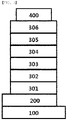
- FIG 1 to FIG. 3 illustrate a lamination order of electrodes and organic material layers of an organic light emitting device according to one embodiment of the present application.
- the scope of the present application is not limited to these diagrams, and structures of organic light emitting devices known in the art may also be used in the present application.
- FIG. 1 illustrates an organic light emitting device in which an anode (200), an organic material layer (300) and a cathode (400) are consecutively laminated on a substrate (100).
- the structure is not limited to such a structure, and as illustrated in FIG. 2 , an organic light emitting device in which a cathode, an organic material layer and an anode are consecutively laminated on a substrate may also be obtained.
- FIG. 3 illustrates a case of the organic material layer being a multilayer.
- the organic light emitting device according to FIG. 3 comprises a hole injection layer (301), a hole transfer layer (302), a light emitting layer (303), a hole blocking layer (304), an electron transfer layer (305) and an electron injection layer (306).
- a hole injection layer 301
- a hole transfer layer 302
- a light emitting layer 303
- a hole blocking layer a hole blocking layer
- an electron transfer layer (305)
- an electron injection layer (306).
- the scope of the present application is not limited to such a lamination structure, and as necessary, layers other than the light emitting layer may not be included, and other necessary functional layers may be further added.
- the organic material layer comprising the compound of Chemical Formula 1 may further comprise other materials as necessary.
- the organic material layer may further comprise a heterocyclic compound of the following Chemical Formula 2.
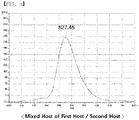
- an exciplex phenomenon occurs.
- the exciplex phenomenon refers to forming a bicomplex in an excited state due to electron exchanges between a molecule having strong donor properties and a molecule having strong acceptor properties.
- FIG. 4 is a diagram explaining the exciplex phenomenon.
- new S 1 energy level and T 1 energy level are formed, and red shifted changes in PL may be identified compared to in each of the molecules.
- the compound of Chemical Formula 1 is a bipolar compound and does not have a strong acceptor ability, however, by introducing a donor (p-host) that is the heterocyclic compound of Chemical Formula 2 having a favorable hole transfer ability, exciplex may be formed based on the observation of red shifted changes in the PL, which resultantly helps with enhancement in light emission properties.
- a donor (p-host) that is the heterocyclic compound of Chemical Formula 2 having a favorable hole transfer ability
- exciplex may be formed based on the observation of red shifted changes in the PL, which resultantly helps with enhancement in light emission properties.
- the compound (donor(p-host)) corresponding to Chemical Formula 2 of the present application having a favorable hole transfer ability the lifetime may be significantly improved due to a proper movement of a light emitting zone in a light emitting layer.
- Chemical Formula 2 may be represented by any one of the following Chemical Formulae 10 to 12.
- Chemical Formula 10 may be represented by the following Chemical Formula 10-1 or 10-2.
- Chemical Formula 11 may be represented by the following Chemical Formula 11-1 or 11-2.
- Chemical Formula 12 may be represented by any one of the following Chemical Formulae 12-1 to 12-4.
- Ar2 to Ar4 are the same as or different from each other, and may be each independently hydrogen; deuterium; a substituted or unsubstituted C1 to C60 alkyl group; a substituted or unsubstituted C6 to C60 aryl group; or a substituted or unsubstituted C2 to C60 heteroaryl group.
- Ar2 to Ar4 are the same as or different from each other, and may be each independently hydrogen; deuterium; a substituted or unsubstituted C1 to C40 alkyl group; a substituted or unsubstituted C6 to C40 aryl group; or a substituted or unsubstituted C2 to C40 heteroaryl group.
- Ar2 to Ar4 are the same as or different from each other, and may be each independently hydrogen; deuterium; a C6 to C40 aryl group unsubstituted or substituted with one or more substituents selected from the group consisting of a halogen group, a C1 to C20 alkyl group, a C6 to C40 aryl group and a C2 to C40 heteroaryl group; or a C2 to C40 heteroaryl group unsubstituted or substituted with one or more substituents selected from the group consisting of deuterium, a C6 to C40 aryl group and a C2 to C40 heteroaryl group.
- R61 to R70 may be hydrogen; or deuterium.
- R71 to R74 are the same as or different from each other, and each independently selected from the group consisting of hydrogen; deuterium; a substituted or unsubstituted C1 to C60 alkyl group; a substituted or unsubstituted C6 to C60 aryl group; and a substituted or unsubstituted C2 to C60 heteroaryl group, or two or more groups adjacent to each other may bond to each other to form a substituted or unsubstituted C6 to C60 aromatic hydrocarbon ring or a substituted or unsubstituted C2 to C60 heteroring.
- R71 to R74 are the same as or different from each other, and each independently hydrogen; or deuterium, or two or more groups adjacent to each other may bond to each other to form a substituted or unsubstituted C6 to C60 aromatic hydrocarbon ring or a substituted or unsubstituted C2 to C60 heteroring.
- R71 to R74 are the same as or different from each other, and each independently hydrogen; or deuterium, or two or more groups adjacent to each other may bond to each other to form a substituted or unsubstituted C6 to C60 aromatic hydrocarbon ring.
- R71 to R74 are the same as or different from each other, and each independently hydrogen; or deuterium, or two or more groups adjacent to each other may bond to each other to form a C6 to C60 aromatic hydrocarbon ring.
- R71 to R74 are the same as or different from each other, and each independently hydrogen; or deuterium, or two or more groups adjacent to each other may bond to each other to form a C6 to C40 aromatic hydrocarbon ring.
- R71 to R74 are the same as or different from each other, and each independently hydrogen; or deuterium, or two or more groups adjacent to each other may bond to each other to form a benzene ring.
- Rd and Re are the same as or different from each other, and may be each independently a substituted or unsubstituted C1 to C60 alkyl group; or a substituted or unsubstituted C6 to C60 aryl group.
- Rd and Re are the same as or different from each other, and may be each independently a substituted or unsubstituted C1 to C60 alkyl group.
- Rd and Re are the same as or different from each other, and may be each independently a C1 to C40 alkyl group.
- Rd and Re may be a methyl group.
- R81 and R82 are the same as or different from each other, and may be each independently a substituted or unsubstituted C10 or higher aryl group; or a substituted or unsubstituted C2 to C60 heteroaryl group.
- R81 and R82 are the same as or different from each other, and may be each independently a substituted or unsubstituted C10 or higher and C60 or lower aryl group; or a substituted or unsubstituted C2 to C60 heteroaryl group.
- R81 and R82 are the same as or different from each other, and may be each independently a substituted or unsubstituted C10 or higher and C40 or lower aryl group; or a substituted or unsubstituted C2 to C40 heteroaryl group.
- R81 and R82 are the same as or different from each other, and may be each independently a C10 or higher and C40 or lower aryl group unsubstituted or substituted with a C1 to C20 alkyl group; or a C2 to C40 heteroaryl group unsubstituted or substituted with one or more substituents selected from the group consisting of a C6 to C40 aryl group and a C2 to C40 heteroaryl group.
- R81 and R82 may be represented by the following Chemical Formula 13.
- R83 is a substituted or unsubstituted lower than C10 aryl group.
- R83 is a lower than C10 aryl group unsubstituted or substituted with a C6 to C10 aryl group or a C2 to C20 heteroaryl group.
- R83 may be a phenyl group unsubstituted or substituted with a phenyl group or a dibenzofuran group; a biphenyl group; or a naphthyl group.
- R91 to R95 are the same as or different from each other, and each independently hydrogen; deuterium; or a substituted or unsubstituted C6 to C60 aryl group, or two or more groups adjacent to each other may bond to each other to form a substituted or unsubstituted C6 to C60 aromatic hydrocarbon ring.
- R91 to R95 are the same as or different from each other, and each independently hydrogen; or deuterium, or two or more groups adjacent to each other may bond to each other to form a benzene ring.
- R96 to R98 are the same as or different from each other, and may be each independently hydrogen; deuterium; a substituted or unsubstituted C1 to C60 alkyl group; a substituted or unsubstituted C6 to C60 aryl group; or a substituted or unsubstituted C2 to C60 heteroaryl group.
- R96 to R98 are the same as or different from each other, and may be each independently hydrogen; deuterium; a C1 to C20 alkyl group; or a C6 to C40 aryl group unsubstituted or substituted with one or more substituents selected from the group consisting of a C1 to C20 alkyl group, a C6 to C40 aryl group and a C2 to C40 heteroaryl group.
- the heterocyclic compound represented by Chemical Formula 2 may be any one of the following compounds.
- Chemical Formula 2 may be included in a light emitting layer of the organic material layer.
- Chemical Formula 2 may be included in a light emitting layer of the organic material layer, and may be specifically used as a host material of the light emitting layer.
- the host material of the light emitting layer of the organic light emitting device may comprise the heterocyclic compound of Chemical Formula 1 and the compound of Chemical Formula 2 at the same time.
- compositions for an organic material layer of an organic light emitting device comprising the heterocyclic compound represented by Chemical Formula 1 and the compound represented by Chemical Formula 2.
- the heterocyclic compound represented by Chemical Formula 1 may have a weight ratio of 1:10 to 10:1, and the weight ratio may be from 1:8 to 8:1, 1:5 to 5:1 or 1:2 to 2:1, but is not limited thereto.
- One embodiment of the present application provides a method for manufacturing an organic light emitting device, the method comprising preparing a substrate; forming a first electrode on the substrate; forming one or more organic material layers on the first electrode; and forming a second electrode on the organic material layer, wherein the forming of organic material layers comprises forming one or more organic material layers using the composition for an organic material layer according to one embodiment of the present application.
- the forming of organic material layers is forming the heterocyclic compound represented by Chemical Formula 1 and the compound represented by Chemical Formula 2 using a thermal vacuum deposition method after pre-mixing.
- the pre-mixing means first mixing the heterocyclic compound represented by Chemical Formula 1 and the compound represented by Chemical Formula 2 in one source of supply before depositing on the organic material layer.
- the premixed material may be referred to as the composition for an organic material layer according to one embodiment of the present application.
- anode material materials having relatively large work function may be used, and transparent conductive oxides, metals, conductive polymers or the like may be used.
- the anode material comprise metals such as vanadium, chromium, copper, zinc and gold, or alloys thereof; metal oxides such as zinc oxide, indium oxide, indium tin oxide (ITO) and indium zinc oxide (IZO); combinations of metals and oxides such as ZnO:Al or SnO 2 :Sb; conductive polymers such as poly(3-methylthiophene), poly[3,4-(ethylene-1,2-dioxy)thiophene] (PEDOT), polypyrrole and polyaniline, and the like, but are not limited thereto.
- metals such as vanadium, chromium, copper, zinc and gold, or alloys thereof
- metal oxides such as zinc oxide, indium oxide, indium tin oxide (ITO) and indium zinc oxide (IZO); combinations of metals and oxides such as ZnO:A
- the cathode material materials having relatively small work function may be used, and metals, metal oxides, conductive polymers or the like may be used.
- Specific examples of the cathode material comprise metals such as magnesium, calcium, sodium, potassium, titanium, indium, yttrium, lithium, gadolinium, aluminum, silver, tin and lead, or alloys thereof; multilayer structure materials such as LiF/Al or LiO 2 /Al, and the like, but are not limited thereto.
- hole injection material known hole injection materials may be used, and for example, phthalocyanine compounds such as copper phthalocyanine disclosed in US Patent No. 4,356,429 , or starburst-type amine derivatives such as tris(4-carbazoyl-9-ylphenyl)amine (TCTA), 4,4',4"-tri[phenyl(m-tolyl)amino]triphenylamine (m-MTDATA) or 1,3,5-tris[4-(3-methylphenylphenylamino)phenyl]benzene (m-MTDAPB) described in the literature [ Advanced Material, 6, p.677 (1994 )], polyaniline/dodecylbenzene sulfonic acid, poly(3,4-ethylenedioxythiophene)/poly(4-styrenesulfonate), polyaniline/camphor sulfonic acid or polyaniline/poly(4-styrene-sulfonate) that
- hole transfer material pyrazoline derivatives, arylamine-based derivatives, stilbene derivatives, triphenyldiamine derivatives and the like may be used, and low molecular or high molecular materials may also be used.
- LiF is typically used in the art, however, the present application is not limited thereto.
- red, green or blue light emitting materials may be used, and as necessary, two or more light emitting materials may be mixed and used.
- two or more light emitting materials may be used by being deposited as individual sources of supply or by being premixed and deposited as one source of supply.
- fluorescent materials may also be used as the light emitting material, however, phosphorescent materials may also be used.
- materials emitting light by bonding electrons and holes injected from an anode and a cathode, respectively may be used alone, however, materials having a host material and a dopant material involving in light emission together may also be used.
- same series hosts may be mixed, or different series hosts may be mixed.
- any two or more types of materials among n-type host materials or p-type host materials may be selected and used as a host material of a light emitting layer.
- the organic light emitting device may be a top-emission type, a bottom-emission type or a dual-emission type depending on the materials used.
- the heterocyclic compound according to one embodiment of the present application may also be used in an organic electronic device comprising an organic solar cell, an organic photo conductor, an organic transistor and the like under a similar principle used in the organic light emitting device.
- Target Compound A was synthesized in the same manner as in Preparation Example 1 except that Intermediate A of the following Table 1 was used instead of 2-chloro-4,6-diphenyl-1,3,5-triazine, and Intermediate B of the following Table 1 was used instead of 5H-benzo[b]carbazole. [Table 1] Compou nd No.
- Target Compound A was synthesized in the same manner as in Preparation Example 2 except that Intermediate A of the following Table 2 was used instead of 5H-benzo[b]carbazole, and Intermediate B of the following Table 2 was used instead of 2-chloro-4,6-diphenyl-1,3,5-triazine.
- Intermediate A of the following Table 2 was used instead of 5H-benzo[b]carbazole
- Intermediate B of the following Table 2 was used instead of 2-chloro-4,6-diphenyl-1,3,5-triazine.
- [Table 2] Compou nd No. Intermediate A Intermediate B Target Compound A Yield 22 45% 34 55% 37 50% 187 60% 198 44% 208 46% 212 51% 333 72% 335 67% 419 65% 509 71% 510 80% 617 59%
- Compound 51 was synthesized in the same manner as in Preparation Example 1 except that 1-bromo-4-chloro-3-fluoro-2-iodobenzene was used instead of 1-bromo-5-chloro-3-fluoro-2-iodobenzene.
- Target compounds were synthesized in the same manner as in Preparation Example 3 except that Intermediate A and Intermediate B of the following Table 3 were used.
- [Table 3] Compo und No. Intermediate A Intermediate B Target Compound A Yield 52 55% 53 60% 57 57% 62 61% 65 53% 72 64% 151 51% 155 49% 157 45% 158 67% 160 57% 161 56% 162 50% 163 49% 169 61% 170 62% 172 58% 175 45% 177 66% 179 54% 215 42% 220 67% 319 71% 323 65% 411 73% 413 69% 506 81% 613 61%
- Target compounds were synthesized in the same manner as in Preparation Example 4 except that Intermediate A and Intermediate B of the following Table 4 were used. [Table 4] Compo und No. Intermediate A Intermediate B Target Compound A Yield 77 36% 79 38% 81 40% 88 37% 95 42% 96 55% 222 41% 340 56% 342 47% 346 51% 430 61% 516 54% 621 47%
- 155 ⁇ 8.55(d, 1H), 8.28(d, 1H), 8.11 ⁇ 8.09(d, 2H), 7.96 ⁇ 7.89(m, 5H), 7.78 ⁇ 7.69(m, 3H), 7.55 ⁇ 7.50(m, 7H), 7.40 ⁇ 7.28(m, 6H), 7.16(t, 1H).
- 157 ⁇ 8.95(d, 1H), 8.55(d, 2H), 8.36 ⁇ 8.28(d, 3H), 8.11 ⁇ 8.09(m, 2H), 7.98 ⁇ 7.94(m, 5H), 7.77 ⁇ 7.69(m, 3H), 7.55 ⁇ 7.50(m, 7H), 7.40 ⁇ 7.31(m, 7H), 7.16(t, 1H).
- 158 ⁇ 8.55(d, 1H), 8.36(d, 2H), 8.18(s, 1H), 8.11(d, 1H), 7.98 ⁇ 7.90(m, 4H), 7.75 ⁇ 7.68(m, 4H), 7.55 ⁇ 7.50(m, 7H), 7.40 ⁇ 7.28(m, 6H), 7.16(t, 1H).
- 160 ⁇ 8.55(d, 1H), 8.28(d, 1H), 8.11 ⁇ 8.08(d, 2H), 7.96 ⁇ 7.88(m, 7H), 1.75 ⁇ 7.69(m, 4H), 7.55 ⁇ 7.25(m, 16H),7.16(t, 1H).
- a glass substrate on which indium tin oxide (ITO) was coated as a thin film to a thickness of 1,500 ⁇ was cleaned with distilled water ultrasonic waves. After the cleaning with distilled water was finished, the substrate was ultrasonic cleaned with solvents such as acetone, methanol and isopropyl alcohol, then dried, and UVO treatment was conducted for 5 minutes using UV in a UV cleaner. After that, the substrate was transferred to a plasma cleaner (PT), and after conducting plasma treatment under vacuum for ITO work function and residual film removal, the substrate was transferred to a thermal deposition apparatus for organic deposition.
- PT plasma cleaner
- a light emitting layer was thermal vacuum deposited thereon as follows.
- the light emitting layer was deposited to 500 ⁇ using a compound described in the following Table 8 as a host and (piq) 2 (Ir) (acac) as a red phosphorescent dopant by doping the (piq) 2 (Ir) (acac) to the host in a weight ratio of 3%.
- BCP was deposited to 60 ⁇ as a hole blocking layer
- Alq 3 was deposited to 200 ⁇ thereon as an electron transfer layer.
- an electron injection layer was formed on the electron transfer layer by depositing lithium fluoride (LiF) to a thickness of 10 ⁇ , and then a cathode was formed on the electron injection layer by depositing an aluminum (Al) cathode to a thickness of 1,200 ⁇ , and as a result, an organic electroluminescent device was manufactured.
- LiF lithium fluoride
- Al aluminum
- electroluminescent (EL) properties were measured using M7000 manufactured by McScience Inc., and with the measurement results, T90 was measured when standard luminance was 6,000 cd/m 2 through a lifetime measurement system (M6000) manufactured by McScience Inc..
- HOMO, LUMO and band gap of the organic compounds of the present disclosure are as shown in the following Table 7.
- HOMO, LUMO and band gap of the comparative compounds and the compounds of the present application may be identified in Table 7. From the results, it was seen that the heterocyclic compound of Chemical Formula 1 according to the present application has an increased conjugation effect with the benzene ring of the carbazole being extended (fused) leading to a reduced band gap and a smaller T1 level compared to Comparative Compounds A to F, which was suitable as a red host of an organic light emitting device.
- Table 8 shows examples of using a single host material
- Table 9 shows examples of employing the compound (acceptor (n-host)) corresponding to Chemical Formula 1 of the present application having a favorable electron transfer ability as a first host and the compound (donor (p-host)) corresponding to Chemical Formula 2 of the present application having a favorable hole transfer ability as a second host, and depositing the two host compounds as one source of supply.
- the exciplex phenomenon refers to forming a bicomplex in an excited state due to electron exchanges between a molecule having strong donor properties and a molecule having strong acceptor properties.
- FIG. 4 is a diagram explaining the exciplex phenomenon.
- new S 1 energy level and T 1 energy level are formed, and red shifted changes in PL may be identified compared to in each of the molecules.
- FIG. 5 shows data measuring photoluminescence (PL) of each of the first host and the second host according to Example 71 of the present application
- FIG. 6 shows data measuring photoluminescence (PL) when comprising both the first host and the second host according to Example 71 of the present application.
- the compound of Chemical Formula 1 is a bipolar compound and does not have a strong acceptor ability, however, by introducing a donor (p-host) that is the heterocyclic compound of Chemical Formula 2 having a favorable hole transfer ability, exciplex may be formed based on the observation of red shifted changes in the PL, which resultantly helps with enhancement in light emission properties.
- a donor p-host
- the compound (donor(p-host)) corresponding to Chemical Formula 2 of the present application having a favorable hole transfer ability the lifetime was significantly improved due to a proper movement of a light emitting zone in the light emitting layer.
- a glass substrate on which indium tin oxide (ITO) was coated as a thin film to a thickness of 1,500 ⁇ was cleaned with distilled water ultrasonic waves. After the cleaning with distilled water was finished, the substrate was ultrasonic cleaned with solvents such as acetone, methanol and isopropyl alcohol, then dried, and ultraviolet ozone (UVO) treatment was conducted for 5 minutes using UV in an ultraviolet (UV) cleaner. After that, the substrate was transferred to a plasma cleaner (PT), and after conducting plasma treatment under vacuum for ITO work function and residual film removal, the substrate was transferred to a thermal deposition apparatus for organic deposition.
- ITO indium tin oxide
- a hole injection layer 2-TNATA (4, 4 ', 4 "-tris[2-naphthyl(phenyl)amino] triphenylamine) and a hole transfer layer NPB (N,N'-di(1-naphthyl)-N,N'-diphenyl-(1,1'-biphenyl)-4,4'-diamine), which are common layers, were formed.
- a light emitting layer was thermal vacuum deposited thereon as follows. Specifically, each of the compounds of Examples 1 to 26 of the following Table 10 was used as a red host of the light emitting layer, and (piq) 2 (Ir) (acac), a red phosphorescent dopant, was doped to the red host by 3 wt% to deposit the light emitting layer having a thickness of 500 ⁇ . After that, bathocuproine (hereinafter, BCP) was deposited to 60 ⁇ as a hole blocking layer, and Alq 3 was deposited to 200 ⁇ thereon as an electron transfer layer.
- BCP bathocuproine
- an electron injection layer was formed on the electron transfer layer by depositing lithium fluoride (LiF) to a thickness of 10 ⁇ , and then a cathode was formed on the electron injection layer by depositing an aluminum (Al) cathode to a thickness of 1,200 ⁇ , and as a result, an organic light emitting device was manufactured.
- LiF lithium fluoride
- Al aluminum
- T 90 was measured when standard luminance was 6,000 cd/m 2 through a lifetime measurement system (M6000) manufactured by McScience Inc.. T 90 means a lifetime (unit: h, hour), a time taken to become 90% with respect to initial luminance.
- a glass substrate on which indium tin oxide (ITO) was coated as a thin film to a thickness of 1,500 ⁇ was cleaned with distilled water ultrasonic waves. After the cleaning with distilled water was finished, the substrate was ultrasonic cleaned with solvents such as acetone, methanol and isopropyl alcohol, then dried, and ultraviolet ozone (UVO) treatment was conducted for 5 minutes using UV in an ultraviolet (UV) cleaner. After that, the substrate was transferred to a plasma cleaner (PT), and after conducting plasma treatment under vacuum for ITO work function and residual film removal, the substrate was transferred to a thermal deposition apparatus for organic deposition.
- ITO indium tin oxide
- a hole injection layer 2-TNATA (4, 4', 4 "-tris[2-naphthyl(phenyl)amino] triphenylamine) and a hole transfer layer NPB (N,N'-di(1-naphthyl)-N,N'-diphenyl-(1,1'-biphenyl)-4,4'-diamine), which are common layers, were formed.
- a light emitting layer was thermal vacuum deposited thereon as follows. Specifically, each of the compounds of Examples 1 to 26 of the following Table 11 was used as a red host of the light emitting layer, and (piq) 2 (Ir) (acac), a red phosphorescent dopant, was doped to the red host by 3 wt% to deposit the light emitting layer having a thickness of 500 ⁇ . After that, bathocuproine (hereinafter, BCP) was deposited to 60 ⁇ as a hole blocking layer, and Alq 3 was deposited to 200 ⁇ thereon as an electron transfer layer.
- BCP bathocuproine
- an electron injection layer was formed on the electron transfer layer by depositing lithium fluoride (LiF) to a thickness of 10 ⁇ , and then a cathode was formed on the electron injection layer by depositing an aluminum (Al) cathode to a thickness of 1,200 ⁇ , and as a result, an organic light emitting device was manufactured.
- LiF lithium fluoride
- Al aluminum
- T 90 was measured when standard luminance was 6,000 cd/m 2 through a lifetime measurement system (M6000) manufactured by McScience Inc.. T 90 means a lifetime (unit: h, hour), a time taken to become 90% with respect to initial luminance.
- Table 11 shows cases of comprising the heterocyclic compound of Chemical Formula 1 and the heterocyclic compound of Chemical Formula 2 at the same time in the organic material layer of the organic light emitting device, and as described above, an exciplex phenomenon may be expected to occur by comprising the two compounds at the same time.
- heterocyclic compound of Chemical Formula 2 serves as an electron blocking layer (EBL) based on a high LUMO level, which creates an effective light emitting area by helping excited electrons to stay in the light emitting layer area.
- EBL electron blocking layer
Landscapes
- Chemical & Material Sciences (AREA)
- Organic Chemistry (AREA)
- Physics & Mathematics (AREA)
- Engineering & Computer Science (AREA)
- Materials Engineering (AREA)
- Spectroscopy & Molecular Physics (AREA)
- Optics & Photonics (AREA)
- Electroluminescent Light Sources (AREA)
- Plural Heterocyclic Compounds (AREA)
- Heterocyclic Carbon Compounds Containing A Hetero Ring Having Oxygen Or Sulfur (AREA)
Applications Claiming Priority (2)
| Application Number | Priority Date | Filing Date | Title |
|---|---|---|---|
| KR20190150714 | 2019-11-21 | ||
| PCT/KR2020/016200 WO2021101220A1 (ko) | 2019-11-21 | 2020-11-17 | 헤테로고리 화합물, 이를 포함하는 유기 발광 소자, 유기 발광 소자의 유기물층용 조성물 및 유기 발광 소자의 제조 방법 |
Publications (2)
| Publication Number | Publication Date |
|---|---|
| EP4063359A1 true EP4063359A1 (de) | 2022-09-28 |
| EP4063359A4 EP4063359A4 (de) | 2023-12-06 |
Family
ID=75980923
Family Applications (1)
| Application Number | Title | Priority Date | Filing Date |
|---|---|---|---|
| EP20889890.8A Pending EP4063359A4 (de) | 2019-11-21 | 2020-11-17 | Heterocyclische verbindung, organische lichtemittierende vorrichtung damit, zusammensetzung für die organische schicht einer organischen lichtemittierenden vorrichtung und verfahren zur herstellung einer organischen lichtemittierenden vorrichtung |
Country Status (7)
| Country | Link |
|---|---|
| US (1) | US20220259187A1 (de) |
| EP (1) | EP4063359A4 (de) |
| JP (2) | JP2023500759A (de) |
| KR (2) | KR102756300B1 (de) |
| CN (1) | CN114096535B (de) |
| TW (1) | TWI795694B (de) |
| WO (1) | WO2021101220A1 (de) |
Families Citing this family (24)
| Publication number | Priority date | Publication date | Assignee | Title |
|---|---|---|---|---|
| WO2020153713A1 (ko) * | 2019-01-21 | 2020-07-30 | 주식회사 엘지화학 | 화합물 및 이를 포함하는 유기 발광 소자 |
| KR102263104B1 (ko) * | 2019-03-15 | 2021-06-09 | 주식회사 엘지화학 | 유기 발광 소자 |
| CN113372370B (zh) * | 2021-06-30 | 2023-03-03 | 武汉天马微电子有限公司 | 一种有机化合物及其应用 |
| KR20230027363A (ko) * | 2021-08-18 | 2023-02-28 | 엘티소재주식회사 | 헤테로고리 화합물, 이를 포함하는 유기 발광 소자, 및 유기 발광 소자의 유기물층용 조성물 |
| DE102022128880A1 (de) | 2021-11-02 | 2023-05-04 | Rohm And Haas Electronic Materials Korea Ltd. | Organische elektrolumineszierende verbindung, mehrere wirtsmaterialien und diese umfassende organische elektrolumineszierende vorrichtung |
| CN117396015A (zh) * | 2022-09-08 | 2024-01-12 | 陕西莱特光电材料股份有限公司 | 有机电致发光器件和电子装置 |
| KR20250121357A (ko) | 2022-12-08 | 2025-08-12 | 메르크 파텐트 게엠베하 | 유기 전자 디바이스 및 유기 전자 디바이스용 특수 재료 |
| KR20250124370A (ko) | 2022-12-19 | 2025-08-19 | 메르크 파텐트 게엠베하 | 전자 디바이스용 재료 |
| WO2024194264A1 (de) | 2023-03-20 | 2024-09-26 | Merck Patent Gmbh | Materialien für organische elektrolumineszenzvorrichtungen |
| WO2025045816A1 (en) | 2023-08-29 | 2025-03-06 | Merck Patent Gmbh | Materials for organic electroluminescent devices |
| KR20260058884A (ko) | 2023-08-30 | 2026-04-29 | 메르크 파텐트 게엠베하 | 유기 발광 디바이스용 재료들 |
| EP4772014A1 (de) | 2023-08-30 | 2026-07-08 | Merck Patent GmbH | Materialien für organische lichtemittierende vorrichtungen |
| KR20260058224A (ko) | 2023-08-30 | 2026-04-28 | 메르크 파텐트 게엠베하 | 유기 발광 디바이스를 위한 재료 |
| WO2025073675A1 (en) | 2023-10-04 | 2025-04-10 | Merck Patent Gmbh | Materials for organic electroluminescent devices |
| WO2025104058A1 (de) | 2023-11-16 | 2025-05-22 | Merck Patent Gmbh | Materialien für organische elektronische vorrichtungen |
| CN122342295A (zh) | 2023-12-05 | 2026-07-03 | 默克专利有限公司 | 用于有机电致发光器件的材料组合物 |
| WO2025168515A1 (de) | 2024-02-06 | 2025-08-14 | Merck Patent Gmbh | Materialien für organische elektronische vorrichtungen |
| WO2025195961A1 (de) | 2024-03-19 | 2025-09-25 | Merck Patent Gmbh | Organische lichtemittierende vorrichtungen |
| WO2025228800A1 (de) | 2024-04-30 | 2025-11-06 | Merck Patent Gmbh | Materialien für organische elektronische vorrichtungen |
| WO2026017611A1 (en) | 2024-07-15 | 2026-01-22 | Merck Patent Gmbh | Organic light emitting device |
| WO2026017612A1 (en) | 2024-07-15 | 2026-01-22 | Merck Patent Gmbh | Organic light-emitting device |
| WO2026017608A1 (de) | 2024-07-15 | 2026-01-22 | Merck Patent Gmbh | Materialien für organische lichtemittierende vorrichtungen |
| WO2026017607A1 (en) | 2024-07-15 | 2026-01-22 | Merck Patent Gmbh | Organic light-emitting device |
| WO2026162564A1 (en) | 2025-01-31 | 2026-08-06 | Merck Patent Gmbh | Materials for organic electroluminescent devices |
Family Cites Families (24)
| Publication number | Priority date | Publication date | Assignee | Title |
|---|---|---|---|---|
| US4356429A (en) | 1980-07-17 | 1982-10-26 | Eastman Kodak Company | Organic electroluminescent cell |
| KR101603070B1 (ko) * | 2009-03-31 | 2016-03-14 | 롬엔드하스전자재료코리아유한회사 | 신규한 유기 발광 화합물 및 이를 채용하고 있는 유기 전계발광 소자 |
| JP5886945B2 (ja) * | 2011-05-27 | 2016-03-16 | ユニバーサル ディスプレイ コーポレイション | 多成分発光層を有するoled |
| KR101820865B1 (ko) * | 2013-01-17 | 2018-01-22 | 삼성전자주식회사 | 유기광전자소자용 재료, 이를 포함하는 유기발광소자 및 상기 유기발광소자를 포함하는 표시장치 |
| US9732069B2 (en) * | 2014-05-21 | 2017-08-15 | Samsung Electronics Co., Ltd. | Carbazole compound and organic light emitting device including the same |
| US9947872B2 (en) * | 2014-07-15 | 2018-04-17 | E I Du Pont De Nemours And Company | Hole transport materials |
| US20170170408A1 (en) * | 2014-07-18 | 2017-06-15 | Rohm And Haas Electronic Materials Korea Ltd. | Organic electroluminescent device |
| KR101805686B1 (ko) * | 2015-07-27 | 2017-12-07 | 희성소재(주) | 헤테로고리 화합물 및 이를 이용한 유기 발광 소자 |
| KR102376394B1 (ko) * | 2015-09-22 | 2022-03-18 | 덕산네오룩스 주식회사 | 유기전기 소자용 화합물, 이를 이용한 유기전기소자 및 그 전자 장치 |
| KR101991428B1 (ko) * | 2015-11-17 | 2019-06-20 | 주식회사 엘지화학 | 헤테로고리 화합물 및 이를 포함하는 유기 전자 소자 |
| CN107973786B (zh) * | 2016-10-25 | 2021-07-09 | 株式会社Lg化学 | 新型化合物以及利用其的有机发光元件 |
| KR101885899B1 (ko) * | 2016-11-07 | 2018-08-06 | 주식회사 엘지화학 | 신규한 헤테로 고리 화합물 및 이를 이용한 유기발광 소자 |
| KR101915716B1 (ko) * | 2016-12-20 | 2018-11-08 | 희성소재 (주) | 유기 발광 소자 및 유기 발광 소자의 유기물층용 조성물 |
| KR102649285B1 (ko) * | 2017-02-28 | 2024-03-19 | 덕산네오룩스 주식회사 | 유기전기 소자용 화합물, 이를 이용한 유기전기소자 및 그 전자 장치 |
| WO2018174679A1 (ko) * | 2017-03-24 | 2018-09-27 | 희성소재(주) | 유기 발광 소자 및 유기 발광 소자의 유기물층용 조성물 |
| KR102155883B1 (ko) * | 2017-07-31 | 2020-09-15 | 엘티소재주식회사 | 헤테로고리 화합물 및 이를 포함하는 유기 발광 소자 |
| KR101856728B1 (ko) * | 2017-08-10 | 2018-05-10 | 주식회사 엘지화학 | 유기 발광 소자 |
| KR102119954B1 (ko) * | 2017-08-28 | 2020-06-08 | 주식회사 엘지화학 | 헤테로고리 화합물 및 이를 이용한 유기 발광 소자 |
| CN108424411A (zh) * | 2017-09-30 | 2018-08-21 | 北京绿人科技有限责任公司 | 具有对称结构的三嗪化合物及其应用和有机电致发光器件 |
| WO2019160315A1 (ko) * | 2018-02-13 | 2019-08-22 | 주식회사 엘지화학 | 헤테로고리 화합물 및 이를 포함하는 유기 발광 소자 |
| WO2020080822A1 (ko) * | 2018-10-16 | 2020-04-23 | 주식회사 엘지화학 | 화합물 및 이를 포함하는 유기 발광 소자 |
| WO2020153713A1 (ko) * | 2019-01-21 | 2020-07-30 | 주식회사 엘지화학 | 화합물 및 이를 포함하는 유기 발광 소자 |
| WO2020189984A1 (ko) * | 2019-03-15 | 2020-09-24 | 주식회사 엘지화학 | 유기 발광 소자 |
| KR102263104B1 (ko) * | 2019-03-15 | 2021-06-09 | 주식회사 엘지화학 | 유기 발광 소자 |
-
2020
- 2020-11-17 EP EP20889890.8A patent/EP4063359A4/de active Pending
- 2020-11-17 US US17/612,956 patent/US20220259187A1/en active Pending
- 2020-11-17 JP JP2021571737A patent/JP2023500759A/ja active Pending
- 2020-11-17 KR KR1020200154059A patent/KR102756300B1/ko active Active
- 2020-11-17 CN CN202080048175.3A patent/CN114096535B/zh active Active
- 2020-11-17 WO PCT/KR2020/016200 patent/WO2021101220A1/ko not_active Ceased
- 2020-11-20 TW TW109140677A patent/TWI795694B/zh active
-
2024
- 2024-09-27 JP JP2024168191A patent/JP7800950B2/ja active Active
-
2025
- 2025-01-03 KR KR1020250000574A patent/KR20250012680A/ko active Pending
Also Published As
| Publication number | Publication date |
|---|---|
| TWI795694B (zh) | 2023-03-11 |
| KR20250012680A (ko) | 2025-01-24 |
| KR20210062568A (ko) | 2021-05-31 |
| EP4063359A4 (de) | 2023-12-06 |
| US20220259187A1 (en) | 2022-08-18 |
| JP2023500759A (ja) | 2023-01-11 |
| JP7800950B2 (ja) | 2026-01-16 |
| WO2021101220A1 (ko) | 2021-05-27 |
| CN114096535A (zh) | 2022-02-25 |
| JP2025000803A (ja) | 2025-01-07 |
| CN114096535B (zh) | 2025-03-07 |
| KR102756300B1 (ko) | 2025-01-20 |
| TW202128955A (zh) | 2021-08-01 |
| KR102756300B9 (ko) | 2026-01-12 |
Similar Documents
| Publication | Publication Date | Title |
|---|---|---|
| KR102756300B1 (ko) | 헤테로고리 화합물, 이를 포함하는 유기 발광 소자, 유기 발광 소자의 유기물층용 조성물 및 유기 발광 소자의 제조 방법 | |
| JP7479697B2 (ja) | ヘテロ環化合物、これを含む有機発光素子、有機発光素子の有機物層用組成物および有機発光素子の製造方法 | |
| EP3604297B1 (de) | Heterocyclische verbindung und organisches lichtemittierendes element damit | |
| EP4219483A1 (de) | Heterocyclische verbindung, diese enthaltende organische lichtemittierende vorrichtung und zusammensetzung für organische materialschicht | |
| EP4190779A1 (de) | Heterocyclische verbindung, organische lichtemittierende vorrichtung damit und zusammensetzung für organische schicht einer organischen lichtemittierenden vorrichtung | |
| KR102377867B1 (ko) | 유기 발광 소자 및 유기물층 형성용 조성물 | |
| EP3683217A1 (de) | Heterocyclische verbindung und organisches lichtemittierendes element damit | |
| EP4036091B1 (de) | Heterocyclische verbindung und organische lichtemittierende vorrichtung damit | |
| EP3757095A2 (de) | Heterocyclische verbindung und organische lichtemittierende vorrichtung mit verwendung davon | |
| EP4032876B1 (de) | Heterocyclische verbindung und organische lichtemittierende vorrichtung damit | |
| JP2022101491A (ja) | ヘテロ環化合物、これを含む有機発光素子、その製造方法および有機物層用組成物 | |
| EP4044268A1 (de) | Organische lichtemittierende vorrichtung, verfahren zu ihrer herstellung und zusammensetzung für organische materialschicht einer organischen lichtemittierenden vorrichtung | |
| EP3862353A1 (de) | Heterocyclische verbindung, organische lichtemittierende diode damit, zusammensetzung für die organische schicht einer organischen lichtemittierenden diode und verfahren zur herstellung einer organischen lichtemittierenden diode | |
| EP4141000A1 (de) | Heterocyclische verbindung, organische lichtemittierende vorrichtung damit, herstellungsverfahren dafür und zusammensetzung für organische schicht | |
| EP4043454A1 (de) | Heterocyclische verbindung, organische lichtemittierende diode damit, zusammensetzung für die organische schicht einer organischen lichtemittierenden diode und verfahren zur herstellung einer organischen lichtemittierenden diode | |
| EP4160708A1 (de) | Organische lichtemittierende vorrichtung, herstellungsverfahren dafür und zusammensetzung für organische materialschicht einer organischen lichtemittierenden vorrichtung | |
| EP4074705A1 (de) | Heterocyclische verbindung und organisches lichtemittierendes element damit | |
| EP4137488A1 (de) | Heterozyklische verbindung, organische lichtemittierende vorrichtung damit und zusammensetzung für eine organische schicht einer organischen lichtemittierenden vorrichtung | |
| EP4212519A1 (de) | Heterocyclische verbindung und organisches lichtemittierendes element damit | |
| EP4201930A1 (de) | Heterocyclische verbindung, organische lichtemittierende vorrichtung damit und zusammensetzung für organische materialschicht einer organischen lichtemittierenden vorrichtung | |
| EP4206198A1 (de) | Heterocyclische verbindung, organische lichtemittierende vorrichtung damit und zusammensetzung für organische materialschicht einer organischen lichtemittierenden vorrichtung | |
| EP4227301A1 (de) | Heterocyclische verbindung und organische lichtemittierende vorrichtung damit | |
| KR102143585B1 (ko) | 헤테로고리 화합물 및 이를 포함하는 유기 발광 소자 | |
| EP4174060B1 (de) | Verbindung und organische lichtemittierende vorrichtung damit | |
| EP4134370A1 (de) | Heterocyclische verbindung und organische lichtemittierende vorrichtung damit |
Legal Events
| Date | Code | Title | Description |
|---|---|---|---|
| STAA | Information on the status of an ep patent application or granted ep patent |
Free format text: STATUS: THE INTERNATIONAL PUBLICATION HAS BEEN MADE |
|
| PUAI | Public reference made under article 153(3) epc to a published international application that has entered the european phase |
Free format text: ORIGINAL CODE: 0009012 |
|
| STAA | Information on the status of an ep patent application or granted ep patent |
Free format text: STATUS: REQUEST FOR EXAMINATION WAS MADE |
|
| 17P | Request for examination filed |
Effective date: 20220504 |
|
| AK | Designated contracting states |
Kind code of ref document: A1 Designated state(s): AL AT BE BG CH CY CZ DE DK EE ES FI FR GB GR HR HU IE IS IT LI LT LU LV MC MK MT NL NO PL PT RO RS SE SI SK SM TR |
|
| DAV | Request for validation of the european patent (deleted) | ||
| DAX | Request for extension of the european patent (deleted) | ||
| A4 | Supplementary search report drawn up and despatched |
Effective date: 20231108 |
|
| RIC1 | Information provided on ipc code assigned before grant |
Ipc: C07D 209/86 20060101ALI20231102BHEP Ipc: H10K 85/60 20230101ALI20231102BHEP Ipc: C09K 11/06 20060101ALI20231102BHEP Ipc: C07D 409/14 20060101ALI20231102BHEP Ipc: C07D 405/14 20060101AFI20231102BHEP |
|
| STAA | Information on the status of an ep patent application or granted ep patent |
Free format text: STATUS: EXAMINATION IS IN PROGRESS |
|
| 17Q | First examination report despatched |
Effective date: 20260116 |