EP4063671B1 - Dispositif de connexion pour fixer deux poutres l'un à l'autre, procédé d'utilisation du dispositif de connexion et tour comprenant le dispositif de connexion - Google Patents
Dispositif de connexion pour fixer deux poutres l'un à l'autre, procédé d'utilisation du dispositif de connexion et tour comprenant le dispositif de connexion Download PDFInfo
- Publication number
- EP4063671B1 EP4063671B1 EP21165262.3A EP21165262A EP4063671B1 EP 4063671 B1 EP4063671 B1 EP 4063671B1 EP 21165262 A EP21165262 A EP 21165262A EP 4063671 B1 EP4063671 B1 EP 4063671B1
- Authority
- EP
- European Patent Office
- Prior art keywords
- shaft
- eccentric ring
- pin
- connecting device
- hole
- Prior art date
- Legal status (The legal status is an assumption and is not a legal conclusion. Google has not performed a legal analysis and makes no representation as to the accuracy of the status listed.)
- Active
Links
Images




Classifications
-
- F—MECHANICAL ENGINEERING; LIGHTING; HEATING; WEAPONS; BLASTING
- F16—ENGINEERING ELEMENTS AND UNITS; GENERAL MEASURES FOR PRODUCING AND MAINTAINING EFFECTIVE FUNCTIONING OF MACHINES OR INSTALLATIONS; THERMAL INSULATION IN GENERAL
- F16B—DEVICES FOR FASTENING OR SECURING CONSTRUCTIONAL ELEMENTS OR MACHINE PARTS TOGETHER, e.g. NAILS, BOLTS, CIRCLIPS, CLAMPS, CLIPS OR WEDGES; JOINTS OR JOINTING
- F16B7/00—Connections of rods or tubes, e.g. of non-circular section, mutually, including resilient connections
- F16B7/04—Clamping or clipping connections
- F16B7/0406—Clamping or clipping connections for rods or tubes being coaxial
- F16B7/0413—Clamping or clipping connections for rods or tubes being coaxial for tubes using the innerside thereof
- F16B7/042—Clamping or clipping connections for rods or tubes being coaxial for tubes using the innerside thereof with a locking element, e.g. pin, ball or pushbutton, engaging in a hole in the wall of at least one tube
-
- B—PERFORMING OPERATIONS; TRANSPORTING
- B66—HOISTING; LIFTING; HAULING
- B66C—CRANES; LOAD-ENGAGING ELEMENTS OR DEVICES FOR CRANES, CAPSTANS, WINCHES, OR TACKLES
- B66C23/00—Cranes comprising essentially a beam, boom, or triangular structure acting as a cantilever and mounted for translatory of swinging movements in vertical or horizontal planes or a combination of such movements, e.g. jib-cranes, derricks, tower cranes
- B66C23/18—Cranes comprising essentially a beam, boom, or triangular structure acting as a cantilever and mounted for translatory of swinging movements in vertical or horizontal planes or a combination of such movements, e.g. jib-cranes, derricks, tower cranes specially adapted for use in particular purposes
- B66C23/26—Cranes comprising essentially a beam, boom, or triangular structure acting as a cantilever and mounted for translatory of swinging movements in vertical or horizontal planes or a combination of such movements, e.g. jib-cranes, derricks, tower cranes specially adapted for use in particular purposes for use on building sites; constructed, e.g. with separable parts, to facilitate rapid assembly or dismantling, for operation at successively higher levels, for transport by road or rail
- B66C23/28—Cranes comprising essentially a beam, boom, or triangular structure acting as a cantilever and mounted for translatory of swinging movements in vertical or horizontal planes or a combination of such movements, e.g. jib-cranes, derricks, tower cranes specially adapted for use in particular purposes for use on building sites; constructed, e.g. with separable parts, to facilitate rapid assembly or dismantling, for operation at successively higher levels, for transport by road or rail constructed to operate at successively higher levels
- B66C23/283—Cranes comprising essentially a beam, boom, or triangular structure acting as a cantilever and mounted for translatory of swinging movements in vertical or horizontal planes or a combination of such movements, e.g. jib-cranes, derricks, tower cranes specially adapted for use in particular purposes for use on building sites; constructed, e.g. with separable parts, to facilitate rapid assembly or dismantling, for operation at successively higher levels, for transport by road or rail constructed to operate at successively higher levels with frameworks composed of assembled elements
- B66C23/286—Cranes comprising essentially a beam, boom, or triangular structure acting as a cantilever and mounted for translatory of swinging movements in vertical or horizontal planes or a combination of such movements, e.g. jib-cranes, derricks, tower cranes specially adapted for use in particular purposes for use on building sites; constructed, e.g. with separable parts, to facilitate rapid assembly or dismantling, for operation at successively higher levels, for transport by road or rail constructed to operate at successively higher levels with frameworks composed of assembled elements with locking devices
-
- E—FIXED CONSTRUCTIONS
- E04—BUILDING
- E04H—BUILDINGS OR LIKE STRUCTURES FOR PARTICULAR PURPOSES; SWIMMING OR SPLASH BATHS OR POOLS; MASTS; FENCING; TENTS OR CANOPIES, IN GENERAL
- E04H12/00—Towers; Masts or poles; Chimney stacks; Water-towers; Methods of erecting such structures
- E04H12/34—Arrangements for erecting or lowering towers, masts, poles, chimney stacks, or the like
- E04H12/342—Arrangements for stacking tower sections on top of each other
Definitions
- the present invention relates to a connecting device for securing two beams to each other, and a method for securing two beams to each other using the connecting device.
- the present invention also relates to a tower comprising a plurality of tower segments attached to each other by means of a plurality of connecting devices.
- the tower is, for example, a tower of a tower crane or a wind turbine tower.
- EP3434639A1 discloses a tower crane for elevating components to a wind turbine for performing maintenance on the wind turbine.
- the tower crane comprises a plurality of tower segments which together form an elongated tower with an adjustable height.
- the tower is built close to the wind turbine on site.
- the tower segments are mechanically secured to each other during building of the tower by using attachment means, e.g., bolts, making the lifting assembly more stable.
- the tower segments are assembled before the maintenance can take place and dissembled when the maintenance is finished.
- the time needed for assembling and dissembling of the tower segments is a part of the total maintenance time.
- the connection between the two tower segments can stand high load and is resistant to torque since the tower is exposed to forces due to the wind.
- EP0530114 discloses a device for securing two hollow-section members end to end, by means of an internal splice piece of corresponding cross-section.
- the splice piece is fixed to each member by two connection pins which are orthogonal to each other and pass-through bores in the splice piece and other bores made in the members.
- Each connection pin is provided with means for immobilising it in translation and in rotation.
- connection pins to be fitted in bores in the beams A problem with using connection pins to be fitted in bores in the beams is that the pins must be tightly fitted in the bores to avoid play between the beams. This is particularly important if the connecting device is used to attach many tower segments on top of each other to build a high tower, since a play between the tower segments will cause instability of the tower which can lead to wobbling of the tower. To avoid a play, the bore must have a diameter close to the diameter of the pin. This makes it difficult to enter the pins through the bores. Today, the pins are pushed into the bores using sledges or hammers. This is time-consuming and can be dangerous for the personnel mounting the towers since they often need to work at high altitudes when mounting the tower segments.
- EP 2 327 886 A1 discloses a joint having a plate designed in the form of a flat disk and projecting from an inner area of a hollow profile into an inner area of another hollow profile.
- An eccentric bolt is arranged at an aperture of the former hollow profile.
- An insertion part is inserted into the former hollow profile and movable only in a profile direction.
- the eccentric bolt and the plate run through an aperture in the insertion part.
- a hole runs through opposite casing surfaces of the latter hollow profiles, and a front side of the bolt is designed as a flat circular cylinder.
- the connecting device comprises a pin, a shaft, and at least one splice element provided with a first through hole for receiving the shaft, and a second through hole spaced apart from the first through hole for receiving the pin.
- the splice element can be fixed to each of the beams by the pin and the shaft which pass through the first and second through holes respectively and corresponding holes in the beams. There is a gap between the pin and the splice element when the pin is inserted in the second through hole.
- the shaft is rotatable with respect to splice element about a rotational axis when the shaft is inserted in the first through hole.
- the connecting device comprises an eccentric ring arranged in the first through hole so that the eccentric ring is rotatable with respect to the first through hole.
- the eccentric ring has an opening for receiving the shaft, and the opening in the eccentric ring is designed so that the eccentric ring is rotated upon rotation of the shaft when the shaft is inserted into the opening, and the centre of the eccentric ring is offset from the rotational axis of the shaft so that the splice element is moved with respect to the pin upon rotation of the shaft and by that closes the gap on one side of the pin.
- the shaft and eccentric ring make it possible to close the gap between the pin and the splice element on one side of the pin, and by that avoid play between beams.
- the shaft and the eccentric ring are preferably mounted on one of the beams beforehand, for example, at the factory, and thus the beams are connected to each other on site by the pin.
- the connecting device according to the invention makes it fast and easy to connect two beams to each other on site. Typically, it takes about 30 second to connect two beams to each other by entering the pin through the holes in the beam and the splice element and rotating the shaft until the gap is closed on one side of the pin and the splice element is pressed against the pin.
- the rotational axis of the shaft coincides with the longitudinal axis of the shaft.
- the centre of the opening of the eccentric ring is displaced with respect to the centre of the periphery of the eccentric ring.
- here will be an offset between the rotational axis of the shaft and the centre of the eccentric ring.
- the thickness of the eccentric ring varies in a radial direction along the periphery of the eccentric ring. Due to the offset between the rotational axis of the shaft and the centre of the eccentric ring, the thickness of the eccentric ring in a radial direction varies along the periphery of the eccentric ring.
- the eccentric ring comprises a first portion and a second portion, and the thickness in a radial direction of the first portion is larger than the thickness of the second portion.
- the offset between the rotational axis of the shaft and the centre of the eccentric ring is at least half the size of the gap between the pin and the splice element. Due to the eccentricity of the ring, the splice element can be moved twice the length of the offset between the rotational axis of the shaft and the centre of the eccentric ring during rotation of the shaft. Thus, the offset should be at least half the size of the gap in order to entirely close the gap.
- the offset between the rotational axis of the shaft and the centre of the eccentric ring is larger than half the size of the gap between the pin and the splice element.
- the offset between the rotational axis of the shaft and the centre of the eccentric ring is 10 - 20% larger than half the size of the gap to provide a satisfactory pretension.
- the gap between the pin and the splice element is between 0.5 and 3 mm, and preferably between 0.5 and 2 mm. This size of the gap makes it easy to enter the pin through the second through hole without the need of a tool, such as a sledge or a hammer.
- the offset between the rotational axis and the centre of the eccentric ring is between 0.3 and 5 mm.
- the periphery of the eccentric ring is circular, and the first through hole is circular. This enables the eccentric ring to be rotated with respect to the first through hole when the shaft is rotated.
- the first and second through holes are arranged spaced apart with their centre axes in parallel and the splice element is moved along an axis perpendicular to the centre axes of the first and second through holes and extending between the first and second through holes.
- the splice element is plate-shaped. This is advantageous since it makes it possible to make the splice element in high strength steel.
- the splice element is made of high strength steel. It is advantageous to be able to have high strength steel in the splice element since it needs to be able to stand high load and to be resistant to torque.
- high strength steel is meant steels that have yield strength levels of 550 megapascal pressure units (MPa) or higher.
- the splice element is elongate.
- the splice element has an upper part provided with the second through hole and a lower part provided with the first through hole
- the connecting device comprises a support part having a space for receiving and supporting the lower part of the splice element.
- the support part is arranged for attaching to one of the beams.
- the support part facilitates the mounting of the splice element on one of the beams.
- the support part is arranged so that the shaft is allowed to extend through the support part from one end to the opposite end of the support part and to extend through the first through hole when the lower part of the splice element is inserted in the space.
- the connecting device comprises a second splice element provided with a first through hole for receiving the shaft, and a second through hole spaced apart from the first through hole for receiving the pin, and there is a gap between the pin and the second splice element when the pin is inserted in the second through hole, the shaft is rotatable with respect to the first and second splice elements when the shaft is inserted in the first through holes of the splice elements
- the connecting device comprises a second eccentric ring arranged in the first through hole of the second splice element so that the second eccentric ring is rotatable with respect to the first through hole of the second splice element, the second eccentric ring has an opening for receiving the shaft, the opening in the second eccentric ring is designed so that the second eccentric ring is rotated upon rotation of the shaft when the shaft is inserted into the second opening, and the centre of the second eccentric ring is offset from the rotational axis of the shaft so that the second splice element is moved with respect to
- a tower crane comprising a plurality of tower segments which together form an elongated tower, wherein the tower segments are attached to each other by means of a plurality of connecting devices according to the invention.
- the aim is further achieved by a method for securing a first and a second beams to each other using the connecting device according to the invention.
- the method comprises:
- the connecting device is, for example, suitable for attaching a plurality of tower segments to each other to form an elongated tower, such as a tower crane or a wind tower.
- the tower segments are attached to each other by means of a plurality of connecting devices.
- the connecting device according to the invention can advantageously be used for connecting two tower segments of a tower crane.
- the connecting device can also be used for connecting other components including beams, such as tower segments of a wind turbine tower.
- FIG. 1 shows an example of a connecting device 1 in an exploded view.
- the connecting device 1 comprises a pin 2, a shaft 4, and a splice element 6.
- the splice element 6 is provided with a first through hole 8 for receiving the shaft 4, and a second through hole 10 spaced apart from the first through hole 8 and adapted to receiving the pin 2.
- the splice element 6 has an upper part 6a provided with the second through hole 10 a lower part 6b provided with the first through hole 8.
- the splice element 6 is elongated and the first and second through holes 8, 10 are arranged spaced apart along the longitudinal axis of the splice element.
- the splice element 6 can be made of metal, or a metal alloy.
- the splice element 6 is made of steel, and preferably the splice element 6 is made of high strength steel.
- the splice element can be made of other materials, such as ceramic materials. It is advantageous to be able to have high strength steel in the splice element 6 since it needs to be able to stand high load and to be resistant to torque.
- the splice element is plate-shaped. This is advantageous since it makes it possible to make the splice element in high strength steel.
- the splice element can also have other shapes, such as a cuboid.
- the pin 2 is elongated and has a circular cross-section.
- the shape of the second through hole 10 is circular.
- the second through hole 10 can have other shapes, such as square or elliptic.
- the second through hole 10 and the pin 2 are designed so that there is a gap 14 between the pin 2 and the splice element 6 when the pin 2 is inserted in the second through hole 10, as shown in figure 3a .
- this is achieved if the diameter of the second through hole 10 is larger than the diameter of the pin 2.
- the size of the gap 14 in a radial direction is equal to the difference between the radius of the second through hole 10 and the radius of the pin 2.
- the pin 2 comprises a handle 12 secured to one end of the pin.
- the pin is made of metal or a metal alloy.
- the pin 2 is made of steel.
- the handle 12 facilitates insertion and removal of the pin 2.
- the connecting device 1 comprises an eccentric ring 16 designed to fit in the first through hole 8.
- the eccentric ring 16 is arranged rotatable with respect to the first through hole 8.
- the periphery 17 of the eccentric ring 16 is circular
- the first through hole 8 is circular. This enables the eccentric ring 16 to be rotated with respect to the first through hole 8.
- the eccentric ring 16 has an opening 18 adapted to receive the shaft 4.
- the shaft 4 is rotatable with respect to splice element 6 about a rotational axis A when the shaft 4 is inserted in the opening 18 of the eccentric ring 16.
- the shaft 4 comprises a crank 13 secured to one end of the shaft. The crank facilitates rotation of the shaft 4.
- the shaft can also be rotated by a separate tool.
- the connecting device 1 may comprise a locking mechanism for locking the shaft 4 in its position after the rotation.
- the shaft 4 is elongated and the rotational axis is preferably aligned with the longitudinal axis of the shaft.
- the opening 18 has a shape corresponding to the cross-sectional shape of the shaft 4 to allow the shaft to be entered through the opening 18 and so that the axis 4 is fitted in the opening 18.
- the opening 18 in the eccentric ring 16 is designed so that the eccentric ring is prevented from rotating with respect to the shaft 4 upon rotation of the shaft when the shaft is inserted into the opening.
- the eccentric ring 16 and the shaft 4 are designed so that the eccentric ring 16 is rotating with respect to the splice element when the shaft 4 is rotated.
- the shape of the opening in the eccentric ring is not rotationally symmetric to prevent the eccentric ring from rotating with respect to the shaft 4 when the shaft is inserted into the opening 18.
- the opening 18 in the eccentric ring 16 and the shaft are designed so that the shaft is engaged to the eccentric ring when the shaft is inserted into the opening 18 in the eccentric ring and the shaft is rotating.
- the eccentric ring 16 is prevented from rotating with respect to the shaft 4 upon rotation of the shaft.
- the shaft and the eccentric ring are made of metal or a metal alloy.
- the shaft and the eccentric ring are made of steel.
- the shaft 4 is substantially cylindrical, and the shaft 4 has one or more chamfers 20 arranged along the length of the shaft, and the opening 18 in the eccentric ring 16 is substantially circular and is provided with flat surfaces 21 corresponding to the chamfers 20 of the shaft 4 so that the shaft 4 is tightly fitted in the opening 18.
- the shaft has two chamfers 20 arranged on opposite sides of the shaft 4, and accordingly the eccentric ring 16 has two corresponding flat surfaces 21. The chamfers prevent the eccentric ring from rotating with respect to the shaft when the shaft is inserted into the opening.
- An advantage with this shape of the shaft is that it is easy to manufacture the shaft, as well as the opening in the eccentric ring.
- FIG 2a shows an example of an eccentric ring 16 in a perspective view.
- Figure 2b shows the eccentric ring 16 from above.
- the eccentric ring 16 is arranged so that the centre C1 of the periphery 17 of the eccentric ring 16 is displaced from the centre C2 of the opening 18 in the eccentric ring 16, as shown in figure 2a . Due to the fact that the shaft 4 and the opening 18 have corresponding shapes, the rotational axis of the shaft 4 goes through the centre C2 of the opening when the shaft is inserted into the opening 18. Thus, here will be an offset between the rotational axis of the shaft 4 and the centre C1 of the eccentric ring.
- the size of the offset between the rotational axis of the shaft 4 and the centre C1 of the eccentric ring is equal to the distance O between the centre C2 of the opening and the centre C1 of the periphery 17 of the eccentric ring 16.
- R1 is the radius of the eccentric ring16 and R2 is the radius of the opening 18 in the eccentric ring.
- the eccentric ring 16 comprises a first portion 23 and a second portion 24, and the thickness in a radial direction of the first portion 23 is larger than the thickness of the second portion 24.
- the first and second portions 23, 24 are disposed on opposite sides of the eccentric ring 16 with respect to the centre C2 of the opening 18 in the eccentric ring 16.
- Figures 3a - b show the splice element 6 with the pin 2 inserted in the second through hole 10, the eccentric ring 16 inserted in the first through hole 8, and the shaft 4 inserted in the opening 18 of the eccentric ring.
- the diameter of the second through hole 10 is larger than the diameter of the pin 2.
- a seen in figure 3a there is a gap 14 between the pin 2 and the splice element 6 when the pin 2 has been inserted in the second through hole 10.
- the position of the pin 2 is fixed relative the beams since the pin 2 also passes through corresponding holes in the beams. Due to the gap 14, it is easy to insert the pin in the second through hole on site.
- the gap 14 between the pin 2 and the splice element 6 is between 0.5 and 3 mm, and preferably between 0.5 and 2 mm.
- Figure 3a shows the connecting device 1 with the eccentric ring 16 in a first position where the first portion 23 of the eccentric ring is pointing towards the pin 2.
- Figure 3b shows the connecting device 1 with the eccentric ring 16 in a second position, rotated 180° with respect to the first position, so that the second portion 24 of the eccentric ring is pointing towards the pin 2.
- the eccentric ring 16 is rotated with respect to the first through hole 8 upon rotation of the shaft 4.
- the eccentric ring is in a position where the first portion 23 of the eccentric ring is closer to the pin 2 than the second portion 24.
- the eccentric ring 16 By rotating the shaft 4 about 180°, the eccentric ring 16 is also rotated about 180° so that the second portion 24 of the eccentric ring is closer to the pin 2 than the first portion 23, as shown in figure 3b . Due to the fact that the centre C1 of the eccentric ring is offset from the rotational axis of the shaft 4, the splice element 6 is moved with respect to the pin 2 upon rotation of the shaft 4 and by that the gap 14 above the pin 2 is closed, as shown in figure 3b . The splice element 6 is pressed against the upper part of the pin 2. Thus, the pin 2 cannot move with respect to the shaft 4 and accordingly there is no play between beams.
- first and second through holes 8, 10 are arranged spaced apart with their centre axes in parallel and the splice element 6 is moved along an axis perpendicular to the centre axes of the first and second through holes and extending between the first and second through holes.
- the offset O between the centre C1 of the eccentric ring 16 and the centre C2 of the opening 18 is at least half the size of the gap 14 between the pin and the splice element. Due to the eccentricity of the ring, the splice element 6 can be moved twice the length of the offset between the rotational axis of the shaft 4 and the centre C1 of the eccentric ring during rotation of the shaft. Thus, the offset should be at least half the size of the gap 14 in order to entirely close the gap.
- the offset O between the centre C1 of the eccentric ring 16 and the centre C2 of the opening 18 is larger than half the size of the gap 14 between the pin and the splice element.
- the offset between the rotational axis of the shaft and the centre of the eccentric ring is 10-20% larger than half the size of the gap 14 to provide a satisfactory pretension.
- the offset O between the centre C1 of the eccentric ring 16 and the centre C2 of the opening 18 is between 0.3 and 5 mm.
- Figure 4 illustrates connection of first and second beams 28, 30 by means of the connecting device 1.
- the beams 28, 30 are hollow.
- the beams can have other shapes, such as a fork with two fingers.
- the first beam 28 is provided with two holes 29a-b for receiving the shaft 4.
- the second beam 30 is provided with two holes 31, in the same way as the first beam 28, for receiving the pin 2.
- the shaft 4 and eccentric ring 16 are preferably mounted on the first beam 28 beforehand, for example, at the factory, and thus the beams 28, 30 are connected to each other on site by the pin 2.
- Figure 5 illustrates connection of the first and second beams 28, 30 by means of a connecting device 1 including a support part 34.
- the connecting device 1 may comprise a support part 34 having a space 36 for receiving and supporting the lower part 6b of the splice element 6.
- the support part 34 is adapted to be attached to the first beam 28.
- the support part facilitates mounting of the splice element 6 on the first beam 28.
- the first beam 28 is hollow and has an opening in its upper end for receiving the support part 34, and the support part 34 is designed so that it fits in the hollow beam.
- the support part 34 facilitates mounting of the lower part 6b of splice element in the upper end of a hollow beam.
- the support part 34 is arranged so that the shaft 4 can extend through the support part from one end to the opposite end of the support part, and to extend through the first through hole 8 when the lower part 6b of the splice element is inserted in the space 36.
- the support part 34 comprises one or two bores for receiving the shaft, and the bores are aligned with the first through hole 8 when the splice element 6 is received in the support part so that the shaft 4 passes through the first through hole 8 when the shaft 4 is inserted in the bore.
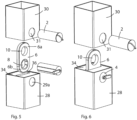
- Figures 6 - 9 illustrate the use of the connecting device 1 for connecting a first and a second beam 28, 30 to each other end to end.
- a method for securing the first and a second beams 28, 30 to each other using the connecting device 1 will now be described with reference to figures 6 - 9 .
- the connecting device has a support part 34
- the method comprises inserting the support part into an upper end of the first beam 28, and then inserting the lower part 6b of the splice element 6 into the space 36 in the support part.
- the method further comprises inserting the shaft 4 through the opening 18 of the eccentric ring 16 in the first through hole 8 of the splice element 6, and through the corresponding holes 29a-b in the first beam 28. This can preferably be done at the factory.
- a lower end of the second beam 30 is moved into contact with the upper end of the first beam 28, and the upper part 6a including the second through hole 10 of the splice element is inserted into the second beam 30.
- the pin 2 is inserted through the second through hole 10 of the splice element 6 and corresponding holes 31 in the second beam 30, as shown in figure 7 and 3a . Due to the difference in radius between the second through hole 10 and the pin 2, there is a gap 14 between the pin 2 and the splice element 6 when the pin 2 is inserted in the second through hole 10, as shown in figure 3a .
- the shaft 4 is rotated about its longitudinal axis until the splice element 6 is pressed against the pin 2 and the gap 14 between the pin 2 and the splice element 6 is closed on one side of the second opening 10, as shown in figure 3b .
- the shaft 4 is rotated about 180°.
- the connecting device is designed so that the gap 14 is closed when the shaft has been rotated 180°.
- the connecting device 1 makes it fast and easy to connect two beams to each other on site. Typically, it takes about 30 second to connect two beams to each other by entering the pin 2 through the holes 31 in the second beam 30 and the second through hole 10 in the splice element 6, and to rotate the shaft 4 until the gap 14 is closed on one side of the pin.
- the shaft 4 can be locked in its position after rotation of the shaft. However, this is not necessary.
- connection device It is also easy to disconnect the connection device and by that detach the beams from each other.
- the connection device is disconnected by performing the following steps:
- Figs. 10a-b show another example of a connecting device 1 including two splice elements 6.
- the second splice element 6 is designed in the same way as the first splice element 6, as shown in figure 1 .
- the shape of the first and the second splice elements 6 is identical.
- the second splice element 6 is provided with a first through hole 8 for receiving the shaft 4, and a second through hole 10 spaced apart from the first through hole 8 for receiving the pin 2.
- the first and second splice elements 6 are arranged in parallel and with the first through holes 8 aligned to allow the shaft 4 to extend through both first through holes 8, and with the second through holes 10 aligned to allow the shaft 4 to extend through both second through holes 10.
- the connecting device 1 comprises a second eccentric ring 16 arranged in the first through hole 8 of the second splice element 6 so that the second eccentric ring 16 is rotatable with respect to the first through hole 8 of the second splice element 6.
- the second eccentric ring is designed in the same way as the first eccentric ring 16, as shown in figures 2 a-b .
- the shape of the first and second eccentric rings 16 is identical.
- the second eccentric ring 16 has an opening 18 for receiving the shaft 4, and the opening in the second eccentric ring is designed so that the second eccentric ring 16 is rotated upon rotation of the shaft 4 when the shaft is inserted into the second opening 18.
- the opening 18 of the second eccentric ring has the same shape as the opening 18 of the first eccentric ring.
- the connecting device is, for example, suitable for attaching a plurality of tower segments to each other to form an elongated tower, such as a tower crane or a wind tower.
- the tower segments are attached to each other by means of a plurality of connecting devices 1.
- FIG 11 shows two tower segments 40, 41 attached to each other by means of a plurality of connecting devices 1.
- Each of the tower segments 40, 41 comprises four beams connected to four corresponding beams of a neighboring tower segment.
- the tower segments 40, 41 are connected to each other by means of four connecting devices 1.
- Figure 12 shows an example of a tower 45 having a plural tower segments 40, 41 attached to each other by means of the connecting devices 1.
- the connecting device may include three or more splice elements.
Landscapes
- Engineering & Computer Science (AREA)
- General Engineering & Computer Science (AREA)
- Mechanical Engineering (AREA)
- Architecture (AREA)
- Structural Engineering (AREA)
- Transportation (AREA)
- Civil Engineering (AREA)
- Snaps, Bayonet Connections, Set Pins, And Snap Rings (AREA)
- Joining Of Building Structures In Genera (AREA)
- Earth Drilling (AREA)
- Jib Cranes (AREA)
- Conveying And Assembling Of Building Elements In Situ (AREA)
- Input Circuits Of Receivers And Coupling Of Receivers And Audio Equipment (AREA)
Claims (15)
- Dispositif de raccordement (1) pour la fixation de deux poutres (28 ; 30) l'une à l'autre extrémité à extrémité, dans lequel le dispositif de raccordement comprend une broche (2), un arbre (4) et au moins un élément de jonction (6) pourvu d'un premier trou traversant (8) pour la réception de l'arbre (4), et d'un second trou traversant (10) espacé du premier trou traversant (8) pour la réception de la broche (2), dans lequel
il y a un espace (14) entre la broche (2) et l'élément de jonction (6) lorsque la broche (2) est insérée dans le second trou traversant (10), l'arbre (4) peut tourner par rapport à l'élément de jonction (6) autour d'un axe de rotation (A) lorsque l'arbre est inséré dans le premier trou traversant (8), caractérisé en ce que le dispositif de raccordement comprend une bague excentrique (16) agencée dans le premier trou traversant (8) de sorte que la bague excentrique (16) peut tourner par rapport au premier trou traversant (8), la bague excentrique (16) a une ouverture (18) pour la réception de l'arbre (4), l'ouverture (18) dans la bague excentrique est conçue de sorte que la bague excentrique (16) est tournée lors de la rotation de l'arbre (4) lorsque l'arbre est inséré dans l'ouverture, et le centre (C1) de la bague excentrique est décalé (O) de l'axe de rotation (A) de l'arbre de sorte que l'élément de jonction (6) est déplacé par rapport à la broche (2 ) lors de la rotation de l'arbre (4) et de ce fait ferme l'espace (14) sur un côté de la broche. - Dispositif de raccordement selon la revendication 1, dans lequel le décalage (O) entre l'axe de rotation (A) et le centre (C1) de la bague excentrique (16) est au moins la moitié de la taille de l'espace (14) entre la broche (2) et l'élément de jonction (6).
- Dispositif de raccordement selon l'une quelconque des revendications précédentes, dans lequel l'espace (14) entre la broche (2) et l'élément de jonction (6) est compris entre 0,5 et 3 mm, et de préférence entre 0,5 et 2 mm.
- Dispositif de raccordement selon l'une quelconque des revendications précédentes, dans lequel le décalage (O) entre l'axe de rotation (A) et le centre (C1) de la bague excentrique (16) est compris entre 0,3 et 5 mm.
- Dispositif de raccordement selon l'une quelconque des revendications précédentes, dans lequel la périphérie (17de la bague excentrique (16) est circulaire, et le premier trou traversant (8) est circulaire.
- Dispositif de raccordement selon l'une quelconque des revendications précédentes, dans lequel l'ouverture (18) dans la bague excentrique (16) et l'arbre (4) est conçu de sorte que l'arbre (4) est engagé à la bague excentrique (16) lorsque l'arbre (4) est inséré dans l'ouverture (18) dans la bague excentrique et que l'arbre (4) tourne.
- Dispositif de raccordement selon l'une quelconque des revendications précédentes, dans lequel la forme de l'ouverture (18) dans la bague excentrique (16) n'est pas symétrique en rotation, et l'arbre (4) a une forme qui correspond à la forme de l'ouverture (18) dans la bague excentrique.
- Dispositif de raccordement selon l'une quelconque des revendications précédentes, dans lequel l'arbre (4) est sensiblement cylindrique et a un ou plusieurs chanfreins (20) s'étendant le long de la longueur de l'arbre (4), et la forme de l'ouverture (18) dans la bague excentrique (16) a une forme correspondante.
- Dispositif de raccordement selon l'une quelconque des revendications précédentes, dans lequel l'au moins un élément de jonction (6) est en forme de plaque.
- Dispositif de raccordement selon l'une quelconque des revendications précédentes, dans lequel l'au moins un élément de jonction (6) est constitué d'acier à haute résistance.
- Dispositif de raccordement selon l'une quelconque des revendications précédentes, dans lequel l'élément de jonction a une partie supérieure (6a) pourvue du second trou traversant (10) et une partie inférieure (6b) pourvue du premier trou traversant (8), et le dispositif de raccordement (1) comprend une partie de support (34) ayant un espace (36) pour la réception et le support de la partie inférieure (6b) de l'élément de jonction (6).
- Dispositif de raccordement selon l'une quelconque des revendications précédentes, dans lequel le dispositif de raccordement comprend un second élément de jonction (6) pourvu d'un premier trou traversant (8) pour la réception de l'arbre (4), et un second trou traversant (10) espacé du premier trou traversant (8) pour la réception de la broche (2), et il y a un espace (14) entre la broche (2) et le second élément de jonction (6) lorsque la broche (2) est insérée dans le second trou traversant (10), l'arbre (4) peut tourner par rapport aux premier et second éléments de jonction (6) lorsque l'arbre (4) est inséré dans les premiers trous traversants (8) des éléments de jonction, le dispositif de raccordement comprend un second anneau excentrique (16) agencé dans le premier trou traversant (8) du second élément de jonction de sorte que le second anneau excentrique (16) peut tourner par rapport au premier trou traversant (8) du second élément de jonction, la seconde bague excentrique (16) a une ouverture (18) pour la réception de l'arbre (4), l'ouverture (18) dans la seconde bague excentrique (16) est conçue de sorte que la seconde bague excentrique (16) est tournée lors de la rotation de l'arbre (4) lorsque l'arbre est inséré dans l'ouverture (18), et le centre (C1) de la seconde bague excentrique (16) est décalé de l'axe de rotation (A) de l'arbre de sorte que le second élément de jonction ( 6) est déplacé par rapport à la broche (2) lors de la rotation de l'arbre (4).
- Utilisation du dispositif de raccordement selon l'une quelconque des revendications 1 à 12 pour l'attache d'une pluralité de segments de tour (40, 41) l'un à l'autre pour former une tour (45).
- Tour comprenant une pluralité de segments de tour (40, 41), dans lequel les segments de tour sont attachés l'un à l'autre au moyen d'une pluralité de dispositifs de raccordement (1) selon l'une quelconque des revendications 1 à 12.
- Procédé pour la fixation de première et seconde poutres (28, 30) l'une à l'autre à l'aide du dispositif de raccordement (1) selon l'une quelconque des revendications 1 à 12, dans lequel le procédé comprend :- l'insertion de l'arbre (4) à travers l'ouverture (18) de la bague excentrique (16) disposée dans le premier trou traversant (8) de l'au moins un élément de jonction (6) et à travers un ou plusieurs trous (29a-b) dans la première poutre (28),- l'insertion de la broche (2) à travers le second trou traversant (10) de l'au moins un élément de jonction (6) et un ou plusieurs trous (31) dans la seconde poutre (30), et- la rotation de l'arbre (4) autour de son axe longitudinal jusqu'à ce que l'élément de jonction (6) soit pressé contre la broche (2) et l'espace (14) entre la broche (2) et l'élément de jonction (6) soit fermé sur un côté de la broche.
Priority Applications (7)
| Application Number | Priority Date | Filing Date | Title |
|---|---|---|---|
| ES21165262T ES2951285T3 (es) | 2021-03-26 | 2021-03-26 | Un dispositivo de conexión para asegurar dos vigas entre sí, un método para usar el dispositivo de conexión y torre que incluye el dispositivo de conexión |
| EP21165262.3A EP4063671B1 (fr) | 2021-03-26 | 2021-03-26 | Dispositif de connexion pour fixer deux poutres l'un à l'autre, procédé d'utilisation du dispositif de connexion et tour comprenant le dispositif de connexion |
| CN202280023509.0A CN117083462A (zh) | 2021-03-26 | 2022-01-26 | 用于将两个梁彼此固定的连接设备、使用该连接设备的方法以及包括该连接设备的塔 |
| US18/550,413 US20240183375A1 (en) | 2021-03-26 | 2022-01-26 | Connecting device for securing two beams to each other, a method for using the connecting device, and tower including the connecting device |
| BR112023014176A BR112023014176A2 (pt) | 2021-03-26 | 2022-01-26 | Dispositivo de conexão para prender duas vigas uma na outra, método para usar o dispositivo de conexão, e torre que inclui o dispositivo de conexão |
| CA3204440A CA3204440A1 (fr) | 2021-03-26 | 2022-01-26 | Dispositif de liaison pour fixer deux poutres entre elles, procede d'utilisation du dispositif de liaison et tour comprenant le dispositif de liaison |
| PCT/EP2022/051772 WO2022199905A1 (fr) | 2021-03-26 | 2022-01-26 | Dispositif de liaison pour fixer deux poutres entre elles, procédé d'utilisation du dispositif de liaison et tour comprenant le dispositif de liaison |
Applications Claiming Priority (1)
| Application Number | Priority Date | Filing Date | Title |
|---|---|---|---|
| EP21165262.3A EP4063671B1 (fr) | 2021-03-26 | 2021-03-26 | Dispositif de connexion pour fixer deux poutres l'un à l'autre, procédé d'utilisation du dispositif de connexion et tour comprenant le dispositif de connexion |
Publications (3)
| Publication Number | Publication Date |
|---|---|
| EP4063671A1 EP4063671A1 (fr) | 2022-09-28 |
| EP4063671C0 EP4063671C0 (fr) | 2023-06-28 |
| EP4063671B1 true EP4063671B1 (fr) | 2023-06-28 |
Family
ID=75339406
Family Applications (1)
| Application Number | Title | Priority Date | Filing Date |
|---|---|---|---|
| EP21165262.3A Active EP4063671B1 (fr) | 2021-03-26 | 2021-03-26 | Dispositif de connexion pour fixer deux poutres l'un à l'autre, procédé d'utilisation du dispositif de connexion et tour comprenant le dispositif de connexion |
Country Status (7)
| Country | Link |
|---|---|
| US (1) | US20240183375A1 (fr) |
| EP (1) | EP4063671B1 (fr) |
| CN (1) | CN117083462A (fr) |
| BR (1) | BR112023014176A2 (fr) |
| CA (1) | CA3204440A1 (fr) |
| ES (1) | ES2951285T3 (fr) |
| WO (1) | WO2022199905A1 (fr) |
Families Citing this family (1)
| Publication number | Priority date | Publication date | Assignee | Title |
|---|---|---|---|---|
| WO2025261788A1 (fr) * | 2024-06-20 | 2025-12-26 | Shl Medical Ag | Ensemble connecteur |
Family Cites Families (17)
| Publication number | Priority date | Publication date | Assignee | Title |
|---|---|---|---|---|
| GB895056A (en) * | 1959-09-17 | 1962-04-26 | John Percival Beeston | Improvements in couplings for pipes and conduits |
| GB1502869A (en) * | 1975-12-24 | 1978-03-08 | Iberica Del Frio Sa | Wall construction |
| US5078534A (en) * | 1990-12-19 | 1992-01-07 | Samson Truss Corporation | Flush nut connectors |
| FR2680813B1 (fr) | 1991-08-30 | 1995-10-20 | Potain Sa | Dispositif d'assemblage demontable pour elements de charpente metallique. |
| US5393162A (en) * | 1993-02-24 | 1995-02-28 | Nissen; Carl-Erik M. | Pivoting joint assembly |
| US6183167B1 (en) * | 1999-01-15 | 2001-02-06 | Richard D. Ruiz, Llc | Pipe pier system |
| CN2856678Y (zh) * | 2004-12-28 | 2007-01-10 | 班杰明·P·瑞斯 | 偏心固锁式滑动接头 |
| US7467783B2 (en) * | 2007-03-21 | 2008-12-23 | The Boeing Company | Tensioning apparatus and method |
| ITBO20080178A1 (it) * | 2008-03-20 | 2009-09-21 | Rs Casting S R L | Dispositivo di giunzione fra due montanti |
| AT508762B1 (de) * | 2009-11-27 | 2011-04-15 | Marchhart Gmbh | Lösbare verbindung zwischen einem hohlprofil und einem weiteren profil |
| US8434963B2 (en) * | 2010-06-07 | 2013-05-07 | Orbus/P3 | Display support structure and method |
| CN102001596B (zh) * | 2010-11-10 | 2014-11-26 | 姜启胜 | 变速卷扬机以及带有该卷扬机的可折叠式随车吊车 |
| US8371768B1 (en) * | 2011-01-21 | 2013-02-12 | Alupro Enterprise Co., Ltd. | Connectin unit for tubes |
| EP3434639B1 (fr) | 2017-07-27 | 2019-10-02 | S&L Access Systems AB | Ensemble de levage pour élever des composants sur une éolienne et procédé d'utilisation de l'ensemble de levage |
| CN108302103A (zh) * | 2018-01-24 | 2018-07-20 | 北京理工大学 | 快拆固定夹及包含其的连接件 |
| DE102018127557A1 (de) * | 2018-11-05 | 2020-05-07 | Carl Zeiss Fixture Systems Gmbh | Trägersystem zur Platzierung von Referenzmarkierungen |
| US12305714B2 (en) * | 2023-08-14 | 2025-05-20 | Array Tech, Inc. | Torque tube coupler |
-
2021
- 2021-03-26 ES ES21165262T patent/ES2951285T3/es active Active
- 2021-03-26 EP EP21165262.3A patent/EP4063671B1/fr active Active
-
2022
- 2022-01-26 US US18/550,413 patent/US20240183375A1/en not_active Abandoned
- 2022-01-26 CA CA3204440A patent/CA3204440A1/fr active Pending
- 2022-01-26 WO PCT/EP2022/051772 patent/WO2022199905A1/fr not_active Ceased
- 2022-01-26 BR BR112023014176A patent/BR112023014176A2/pt not_active Application Discontinuation
- 2022-01-26 CN CN202280023509.0A patent/CN117083462A/zh active Pending
Also Published As
| Publication number | Publication date |
|---|---|
| US20240183375A1 (en) | 2024-06-06 |
| ES2951285T3 (es) | 2023-10-19 |
| CA3204440A1 (fr) | 2022-09-29 |
| CN117083462A (zh) | 2023-11-17 |
| EP4063671C0 (fr) | 2023-06-28 |
| WO2022199905A1 (fr) | 2022-09-29 |
| EP4063671A1 (fr) | 2022-09-28 |
| BR112023014176A2 (pt) | 2023-10-31 |
Similar Documents
| Publication | Publication Date | Title |
|---|---|---|
| EP3730782B1 (fr) | Ensemble de support, outillage d'épissure et procédé d'épissure | |
| EP3837437B1 (fr) | Ensemble comprenant un premier et un second élément et un connecteur et procédé d'assemblage d'un tel ensemble | |
| CN109642549B (zh) | 塔区段、塔部段、塔、风能设备以及用于制造塔区段和用于连接塔区段的方法 | |
| US20120261632A1 (en) | Quick-to-erect modular civil safety barrier | |
| US10119563B2 (en) | Offset bushing and method of use | |
| EP3134643B1 (fr) | Procédé et outil pour assembler des éléments de tour | |
| US5807007A (en) | Misalignment accommodating connector assembly | |
| MX2013008244A (es) | Aparato, metodo y sistema de andamio. | |
| DK2681381T3 (en) | coupling device | |
| US20240183375A1 (en) | Connecting device for securing two beams to each other, a method for using the connecting device, and tower including the connecting device | |
| EP1272717B1 (fr) | Echafaudage | |
| TW201420844A (zh) | 樁的無焊接接頭 | |
| US11846109B2 (en) | Assembly comprising a first and a second member and a connector, and a method of assembling such an assembly | |
| KR20210019563A (ko) | 원호상 부재의 위치 조정 방법 및 위치 조정 지그 | |
| RU234802U1 (ru) | Узел крепления сборно-разборных строительных конструкций | |
| CN115949148B (zh) | 装配式建筑梁柱钢结构连接构件 | |
| US11971067B2 (en) | Coupling device | |
| EP3808908A1 (fr) | Dispositif de connexion pour fixer deux composants l'un à l'autre et procédé d'utilisation du dispositif de connexion | |
| CN118814989B (zh) | 一种装配式建筑用异形柱节点连接结构 | |
| EP2253780A1 (fr) | Étai renforcé pour travaux de construction | |
| CN217627290U (zh) | 一种附着装置的连接结构 | |
| EP4174333B1 (fr) | Ensemble palier | |
| EP0811094A1 (fr) | Joints de structure | |
| EP4108913A1 (fr) | Système de repositionnement de deux composants d'une éolienne l'un par rapport à l'autre | |
| EP3676559B1 (fr) | Procédé et dispositif d'ascenseur d'indication et de commande de fonction d'un joint à vis |
Legal Events
| Date | Code | Title | Description |
|---|---|---|---|
| PUAI | Public reference made under article 153(3) epc to a published international application that has entered the european phase |
Free format text: ORIGINAL CODE: 0009012 |
|
| STAA | Information on the status of an ep patent application or granted ep patent |
Free format text: STATUS: THE APPLICATION HAS BEEN PUBLISHED |
|
| AK | Designated contracting states |
Kind code of ref document: A1 Designated state(s): AL AT BE BG CH CY CZ DE DK EE ES FI FR GB GR HR HU IE IS IT LI LT LU LV MC MK MT NL NO PL PT RO RS SE SI SK SM TR |
|
| STAA | Information on the status of an ep patent application or granted ep patent |
Free format text: STATUS: REQUEST FOR EXAMINATION WAS MADE |
|
| 17P | Request for examination filed |
Effective date: 20221116 |
|
| RBV | Designated contracting states (corrected) |
Designated state(s): AL AT BE BG CH CY CZ DE DK EE ES FI FR GB GR HR HU IE IS IT LI LT LU LV MC MK MT NL NO PL PT RO RS SE SI SK SM TR |
|
| GRAP | Despatch of communication of intention to grant a patent |
Free format text: ORIGINAL CODE: EPIDOSNIGR1 |
|
| STAA | Information on the status of an ep patent application or granted ep patent |
Free format text: STATUS: GRANT OF PATENT IS INTENDED |
|
| RAP3 | Party data changed (applicant data changed or rights of an application transferred) |
Owner name: SKYREX AB |
|
| INTG | Intention to grant announced |
Effective date: 20230413 |
|
| GRAS | Grant fee paid |
Free format text: ORIGINAL CODE: EPIDOSNIGR3 |
|
| GRAA | (expected) grant |
Free format text: ORIGINAL CODE: 0009210 |
|
| STAA | Information on the status of an ep patent application or granted ep patent |
Free format text: STATUS: THE PATENT HAS BEEN GRANTED |
|
| AK | Designated contracting states |
Kind code of ref document: B1 Designated state(s): AL AT BE BG CH CY CZ DE DK EE ES FI FR GB GR HR HU IE IS IT LI LT LU LV MC MK MT NL NO PL PT RO RS SE SI SK SM TR |
|
| REG | Reference to a national code |
Ref country code: CH Ref legal event code: EP |
|
| REG | Reference to a national code |
Ref country code: AT Ref legal event code: REF Ref document number: 1582913 Country of ref document: AT Kind code of ref document: T Effective date: 20230715 |
|
| REG | Reference to a national code |
Ref country code: IE Ref legal event code: FG4D |
|
| REG | Reference to a national code |
Ref country code: DE Ref legal event code: R096 Ref document number: 602021003090 Country of ref document: DE |
|
| U01 | Request for unitary effect filed |
Effective date: 20230717 |
|
| U07 | Unitary effect registered |
Designated state(s): AT BE BG DE DK EE FI FR IT LT LU LV MT NL PT SE SI Effective date: 20230725 |
|
| REG | Reference to a national code |
Ref country code: LT Ref legal event code: MG9D |
|
| REG | Reference to a national code |
Ref country code: ES Ref legal event code: FG2A Ref document number: 2951285 Country of ref document: ES Kind code of ref document: T3 Effective date: 20231019 |
|
| PG25 | Lapsed in a contracting state [announced via postgrant information from national office to epo] |
Ref country code: NO Free format text: LAPSE BECAUSE OF FAILURE TO SUBMIT A TRANSLATION OF THE DESCRIPTION OR TO PAY THE FEE WITHIN THE PRESCRIBED TIME-LIMIT Effective date: 20230928 |
|
| PG25 | Lapsed in a contracting state [announced via postgrant information from national office to epo] |
Ref country code: RS Free format text: LAPSE BECAUSE OF FAILURE TO SUBMIT A TRANSLATION OF THE DESCRIPTION OR TO PAY THE FEE WITHIN THE PRESCRIBED TIME-LIMIT Effective date: 20230628 Ref country code: HR Free format text: LAPSE BECAUSE OF FAILURE TO SUBMIT A TRANSLATION OF THE DESCRIPTION OR TO PAY THE FEE WITHIN THE PRESCRIBED TIME-LIMIT Effective date: 20230628 Ref country code: GR Free format text: LAPSE BECAUSE OF FAILURE TO SUBMIT A TRANSLATION OF THE DESCRIPTION OR TO PAY THE FEE WITHIN THE PRESCRIBED TIME-LIMIT Effective date: 20230929 |
|
| PG25 | Lapsed in a contracting state [announced via postgrant information from national office to epo] |
Ref country code: SK Free format text: LAPSE BECAUSE OF FAILURE TO SUBMIT A TRANSLATION OF THE DESCRIPTION OR TO PAY THE FEE WITHIN THE PRESCRIBED TIME-LIMIT Effective date: 20230628 |
|
| PG25 | Lapsed in a contracting state [announced via postgrant information from national office to epo] |
Ref country code: IS Free format text: LAPSE BECAUSE OF FAILURE TO SUBMIT A TRANSLATION OF THE DESCRIPTION OR TO PAY THE FEE WITHIN THE PRESCRIBED TIME-LIMIT Effective date: 20231028 |
|
| PG25 | Lapsed in a contracting state [announced via postgrant information from national office to epo] |
Ref country code: SM Free format text: LAPSE BECAUSE OF FAILURE TO SUBMIT A TRANSLATION OF THE DESCRIPTION OR TO PAY THE FEE WITHIN THE PRESCRIBED TIME-LIMIT Effective date: 20230628 Ref country code: SK Free format text: LAPSE BECAUSE OF FAILURE TO SUBMIT A TRANSLATION OF THE DESCRIPTION OR TO PAY THE FEE WITHIN THE PRESCRIBED TIME-LIMIT Effective date: 20230628 Ref country code: RO Free format text: LAPSE BECAUSE OF FAILURE TO SUBMIT A TRANSLATION OF THE DESCRIPTION OR TO PAY THE FEE WITHIN THE PRESCRIBED TIME-LIMIT Effective date: 20230628 Ref country code: IS Free format text: LAPSE BECAUSE OF FAILURE TO SUBMIT A TRANSLATION OF THE DESCRIPTION OR TO PAY THE FEE WITHIN THE PRESCRIBED TIME-LIMIT Effective date: 20231028 Ref country code: CZ Free format text: LAPSE BECAUSE OF FAILURE TO SUBMIT A TRANSLATION OF THE DESCRIPTION OR TO PAY THE FEE WITHIN THE PRESCRIBED TIME-LIMIT Effective date: 20230628 |
|
| PG25 | Lapsed in a contracting state [announced via postgrant information from national office to epo] |
Ref country code: PL Free format text: LAPSE BECAUSE OF FAILURE TO SUBMIT A TRANSLATION OF THE DESCRIPTION OR TO PAY THE FEE WITHIN THE PRESCRIBED TIME-LIMIT Effective date: 20230628 |
|
| REG | Reference to a national code |
Ref country code: DE Ref legal event code: R097 Ref document number: 602021003090 Country of ref document: DE |
|
| U20 | Renewal fee for the european patent with unitary effect paid |
Year of fee payment: 4 Effective date: 20240311 |
|
| PLBE | No opposition filed within time limit |
Free format text: ORIGINAL CODE: 0009261 |
|
| STAA | Information on the status of an ep patent application or granted ep patent |
Free format text: STATUS: NO OPPOSITION FILED WITHIN TIME LIMIT |
|
| 26N | No opposition filed |
Effective date: 20240402 |
|
| PGFP | Annual fee paid to national office [announced via postgrant information from national office to epo] |
Ref country code: ES Payment date: 20240412 Year of fee payment: 4 |
|
| REG | Reference to a national code |
Ref country code: CH Ref legal event code: PL |
|
| PG25 | Lapsed in a contracting state [announced via postgrant information from national office to epo] |
Ref country code: MC Free format text: LAPSE BECAUSE OF FAILURE TO SUBMIT A TRANSLATION OF THE DESCRIPTION OR TO PAY THE FEE WITHIN THE PRESCRIBED TIME-LIMIT Effective date: 20230628 |
|
| PG25 | Lapsed in a contracting state [announced via postgrant information from national office to epo] |
Ref country code: MC Free format text: LAPSE BECAUSE OF FAILURE TO SUBMIT A TRANSLATION OF THE DESCRIPTION OR TO PAY THE FEE WITHIN THE PRESCRIBED TIME-LIMIT Effective date: 20230628 |
|
| PG25 | Lapsed in a contracting state [announced via postgrant information from national office to epo] |
Ref country code: IE Free format text: LAPSE BECAUSE OF NON-PAYMENT OF DUE FEES Effective date: 20240326 |
|
| PG25 | Lapsed in a contracting state [announced via postgrant information from national office to epo] |
Ref country code: IE Free format text: LAPSE BECAUSE OF NON-PAYMENT OF DUE FEES Effective date: 20240326 Ref country code: CH Free format text: LAPSE BECAUSE OF NON-PAYMENT OF DUE FEES Effective date: 20240331 |
|
| U20 | Renewal fee for the european patent with unitary effect paid |
Year of fee payment: 5 Effective date: 20250317 |
|
| PG25 | Lapsed in a contracting state [announced via postgrant information from national office to epo] |
Ref country code: CY Free format text: LAPSE BECAUSE OF FAILURE TO SUBMIT A TRANSLATION OF THE DESCRIPTION OR TO PAY THE FEE WITHIN THE PRESCRIBED TIME-LIMIT; INVALID AB INITIO Effective date: 20210326 |
|
| PG25 | Lapsed in a contracting state [announced via postgrant information from national office to epo] |
Ref country code: HU Free format text: LAPSE BECAUSE OF FAILURE TO SUBMIT A TRANSLATION OF THE DESCRIPTION OR TO PAY THE FEE WITHIN THE PRESCRIBED TIME-LIMIT; INVALID AB INITIO Effective date: 20210326 |
|
| GBPC | Gb: european patent ceased through non-payment of renewal fee |
Effective date: 20250326 |
|
| PG25 | Lapsed in a contracting state [announced via postgrant information from national office to epo] |
Ref country code: TR Free format text: LAPSE BECAUSE OF FAILURE TO SUBMIT A TRANSLATION OF THE DESCRIPTION OR TO PAY THE FEE WITHIN THE PRESCRIBED TIME-LIMIT Effective date: 20230628 |
|
| PG25 | Lapsed in a contracting state [announced via postgrant information from national office to epo] |
Ref country code: GB Free format text: LAPSE BECAUSE OF NON-PAYMENT OF DUE FEES Effective date: 20250326 |
|
| REG | Reference to a national code |
Ref country code: ES Ref legal event code: FD2A Effective date: 20260427 |