EP4064100B1 - Système de traitement, circuit intégré associé, dispositif et procédé - Google Patents
Système de traitement, circuit intégré associé, dispositif et procédé Download PDFInfo
- Publication number
- EP4064100B1 EP4064100B1 EP22161788.9A EP22161788A EP4064100B1 EP 4064100 B1 EP4064100 B1 EP 4064100B1 EP 22161788 A EP22161788 A EP 22161788A EP 4064100 B1 EP4064100 B1 EP 4064100B1
- Authority
- EP
- European Patent Office
- Prior art keywords
- life
- reset
- circuit
- cycle
- processing system
- Prior art date
- Legal status (The legal status is an assumption and is not a legal conclusion. Google has not performed a legal analysis and makes no representation as to the accuracy of the status listed.)
- Active
Links
Images

Classifications
-
- G—PHYSICS
- G06—COMPUTING OR CALCULATING; COUNTING
- G06F—ELECTRIC DIGITAL DATA PROCESSING
- G06F11/00—Error detection; Error correction; Monitoring
- G06F11/07—Responding to the occurrence of a fault, e.g. fault tolerance
- G06F11/14—Error detection or correction of the data by redundancy in operations
- G06F11/1402—Saving, restoring, recovering or retrying
- G06F11/1415—Saving, restoring, recovering or retrying at system level
-
- G—PHYSICS
- G06—COMPUTING OR CALCULATING; COUNTING
- G06F—ELECTRIC DIGITAL DATA PROCESSING
- G06F21/00—Security arrangements for protecting computers, components thereof, programs or data against unauthorised activity
- G06F21/70—Protecting specific internal or peripheral components, in which the protection of a component leads to protection of the entire computer
- G06F21/71—Protecting specific internal or peripheral components, in which the protection of a component leads to protection of the entire computer to assure secure computing or processing of information
- G06F21/76—Protecting specific internal or peripheral components, in which the protection of a component leads to protection of the entire computer to assure secure computing or processing of information in application-specific integrated circuits [ASIC] or field-programmable devices, e.g. field-programmable gate arrays [FPGA] or programmable logic devices [PLD]
-
- G—PHYSICS
- G06—COMPUTING OR CALCULATING; COUNTING
- G06F—ELECTRIC DIGITAL DATA PROCESSING
- G06F9/00—Arrangements for program control, e.g. control units
- G06F9/06—Arrangements for program control, e.g. control units using stored programs, i.e. using an internal store of processing equipment to receive or retain programs
- G06F9/44—Arrangements for executing specific programs
- G06F9/4401—Bootstrapping
- G06F9/4403—Processor initialisation
-
- G—PHYSICS
- G06—COMPUTING OR CALCULATING; COUNTING
- G06F—ELECTRIC DIGITAL DATA PROCESSING
- G06F11/00—Error detection; Error correction; Monitoring
- G06F11/22—Detection or location of defective computer hardware by testing during standby operation or during idle time, e.g. start-up testing
- G06F11/2205—Detection or location of defective computer hardware by testing during standby operation or during idle time, e.g. start-up testing using arrangements specific to the hardware being tested
-
- G—PHYSICS
- G06—COMPUTING OR CALCULATING; COUNTING
- G06F—ELECTRIC DIGITAL DATA PROCESSING
- G06F9/00—Arrangements for program control, e.g. control units
- G06F9/06—Arrangements for program control, e.g. control units using stored programs, i.e. using an internal store of processing equipment to receive or retain programs
- G06F9/30—Arrangements for executing machine instructions, e.g. instruction decode
- G06F9/30098—Register arrangements
- G06F9/30101—Special purpose registers
Definitions
- Embodiments of the present disclosure relate to the failure analysis of processing systems, such as micro-controllers.
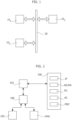
- FIG. 1 shows a typical electronic system, such as the electronic system of a vehicle, comprising a plurality of processing systems 10, such as embedded systems or integrated circuits, e.g., a Field Programmable Gate Array (FPGA), a Digital Signal Processor (DSP) or a micro-controller (e.g., dedicated to the automotive market).
- processing systems 10 such as embedded systems or integrated circuits, e.g., a Field Programmable Gate Array (FPGA), a Digital Signal Processor (DSP) or a micro-controller (e.g., dedicated to the automotive market).
- FPGA Field Programmable Gate Array
- DSP Digital Signal Processor
- micro-controller e.g., dedicated to the automotive market.
- the communication system may include a vehicle control bus, such as a Controller Area Network (CAN) bus, and possibly a multimedia bus, such as a Media Oriented Systems Transport (MOST) bus, connected to vehicle control bus via a gateway.
- vehicle control bus such as a Controller Area Network (CAN) bus
- multimedia bus such as a Media Oriented Systems Transport (MOST) bus
- the processing systems 10 are located at different positions of the vehicle and may include, e.g., an Engine Control Unit, a Transmission Control Unit (TCU), an Anti-lock Braking System (ABS), a Body Control Module (BCM), and/or a navigation and/or multimedia audio system.
- TCU Transmission Control Unit
- ABS Anti-lock Braking System
- BCM Body Control Module
- one or more of the processing systems 10 may also implement real-time control and regulation functions.
- These processing systems are usually identified as Electronic Control Units.
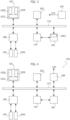
- FIG 2 shows a block diagram of an exemplary digital processing system 10, such as a micro-controller, which may be used as any of the processing systems 10 of Figure 1 .
- the processing system 10 comprises a microprocessor 102, usually the Central Processing Unit (CPU), programmed via software instructions.
- the software executed by the microprocessor 102 is stored in a non-volatile program memory 104, such as a Flash memory or EEPROM.
- the memory 104 is configured to store the firmware of the processing unit 102, wherein the firmware includes the software instructions to be executed by the microprocessor 102.
- the non-volatile memory 104 may also be used to store other data, such as configuration data, e.g., calibration data.
- the microprocessor 102 usually has associated also a volatile memory 104b, such as a Random-Access-Memory (RAM).
- a volatile memory 104b such as a Random-Access-Memory (RAM).
- RAM Random-Access-Memory
- the memory 104b may be used to store temporary data.
- the communication with the memories 104 and/or 104b is performed via one or more memory controllers 100.
- the memory controller(s) 100 may be integrated in the microprocessor 102 or connected to the microprocessor 102 via a communication channel, such as a system bus of the processing system 10.
- the memories 104 and/or 104b may be integrated with the microprocessor 102 in a single integrated circuit, or the memories 104 and/or 104b may be in the form of a separate integrated circuit and connected to the microprocessor 102, e.g., via the traces of a printed circuit board.
- the microprocessor 102 may have associated one or more (hardware) resources/peripherals 106 selected from the group of:
- a dedicated digital components DC may also correspond to a FPGA integrated in the processing system 10.
- the memory 104 may also comprise the program data for such a FPGA.
- the digital processing system 10 may support different functionalities.
- the behavior of the microprocessor 102 is determined by the firmware stored in the memory 104, e.g., the software instructions to be executed by a microprocessor 102 of a micro-controller 10.
- the firmware stored in the memory 104
- processing systems 10 e.g., micro-controllers adapted to be used in automotive applications
- micro-controllers are expected to exhibit an increase in complexity, mainly due to the increasing number of requested functionalities (new protocols, new features, etc.) and to the tight constraints of execution conditions (e.g., lower power consumption, increased calculation power and speed, etc.).
- multi-core processing systems 10 may be used to execute (in parallel) several of the processing systems 10 shown in Figure 1 , such as several processing systems of a vehicle.
- FIG 3 shows an example of a multi-core processing system 10.
- the processing system 10 comprises a plurality of n processing cores 102 1 ...102 n connected to a (on-chip) communication system 114.
- the processing cores 102 1 ...102 n may be ARM Cortex ® -R52 cores.
- the communication system 114 may comprise one or more bus systems, e.g., based on the Advanced eXtensible Interface (AXI) bus architecture, and/or a Network-on-Chip (NoC).
- AXI Advanced eXtensible Interface
- NoC Network-on-Chip
- each processing core 102 may comprise a microprocessor 1020 and a communication interface 1022 configured to manage the communication between the microprocessor 1020 and the communication system 114.
- the interface 1022 is a master interface configured to forward a given (read or write) request from the microprocessor 1020 to the communication system 114, and forward an optional response from the communication system 114 to the microprocessor 1020.
- the communication interface 1022 may also comprise a slave interface. For example, in this way, a first microprocessor 1020 may send a request to a second microprocessor 1020 (via the communication interface 1022 of the first microprocessor, the communication system 114 and the communication interface 1022 of the second microprocessor).
- each processing core 102 1 ...102 n may also comprise further local resources, such as one or more local memories 1026, usually identified as Tightly Coupled Memory (TCM).
- TCM Tightly Coupled Memory
- the processing cores 102 1 ...102 n are arranged to exchange data with a non-volatile memory 104 and/or a volatile memory 104b.
- these memories are system memories, i.e., shared for the processing cores 102 1 ...102 n .
- each processing cores 102 1 ...102 n may, however, comprise one or more additional local memories 1026.
- the processing system 10 may comprise one or more memory controllers 100 configured to connect at least one non-volatile memory 104 and at least one volatile memory 104b to the communication system 114.
- the memories 104 and/or 104b may be integrated in the integrated circuit of the processing system 10 or connected externally to the integrated circuit.
- the processing system 10 may comprise:
- the processing system 10 may comprise one or more resources 106, such as one or more communication interfaces or co-processors (e.g., a cryptographic co-processor).
- the resources 106 are usually connected to the communication system 114 via a respective communication interface 1062.
- the communication interface 1062 comprises at least a slave interface.
- a processing core 102 may send a request to a resource 106 and the resource returns given data.
- one or more of the communication interfaces 1062 may also comprise a respective master interface.
- such a master interface 1064 may be useful in case the resource has to start a communication in order to exchange data via (read and/or write) request with another circuit connected to the communication system 114, such as a resource 106 or a processing core 102.
- the communication system 114 may indeed comprise an Advanced Microcontroller Bus Architecture (AMBA) High-performance Bus (AHB), and an Advanced Peripheral Bus (APB) used to connect the resources/peripherals 106 to the AMBA AHB bus.
- AMBA Advanced Microcontroller Bus Architecture
- AHB Advanced Peripheral Bus
- a DMA controller 110 may be used to directly exchange data with a memory, e.g., the memory 104b, based on requests received from a resource 106.
- a communication interface IF may directly read data (via the DMA controller 110) from the memory 104b and transmit these data, without having to exchange further data with a processing unit 102.
- a DMA controller 110 may communicate with the memory or memories via the communication system 114 or via one or more dedicated communication channels.
- a typical product development involves several entities, such as the producer of the integrated circuit comprising the processing system 10, one or more hardware developers, which implement a more complex electronic circuit and one or more software developers, which write the firmware for the processing system 10.
- the hardware modules within the processing systems 10 implementing security functions are getting more and more important. For example, this may apply to a debug interface, and/or access to given memory locations in the non-volatile memory 104 and/or volatile memory 104b.
- various processing systems 10 provide the possibility to configure whether the access to the internal resource of the processing system 10 via a debug interface is blocked or permitted (possibly specifying whether data may only be read or also written). For example, usually during the development stage it should be possible to control the resources of the processing system 10 with a given degree of freedom, while the processing system 10 should be configured to activate certain security functions (which may not be altered) when the processing system 10 is "in field" (i.e., running in the final application).
- bit sequence LCD may indicate one of the following stages:
- the life-cycle data LCD are written such that once a certain stage is reached, it is not possible to revert it back to a previous stage, i.e., the life-cycle can only advance.
- the life-cycle data LCD are a permanent signature written into a non-volatile memory, which determines the stage of the processing system 10 during its life-time.
- each life-cycle may be encoded with a respective bit sequence.
- this bit sequence LCD may be stored to a one-time programmable memory 126.
- this may be implemented with a one-hot encoding in which a fuse is burned each time a given stage has been reached.
- the life-cycle data LCD may also be stored at reserved memory locations of the non-volatile memory 104.
- the advancing of the life-cycle to the next stage may be done by the entity who owns the device in the current life-cycle stage (e.g., chip producer will advance the life-cycle when it is shipped to the customer delivery stage; the 1st tier customer will advance the life-cycle when it is shipped to the OEM production stage, etc.).
- the entity who owns the device in the current life-cycle stage e.g., chip producer will advance the life-cycle when it is shipped to the customer delivery stage; the 1st tier customer will advance the life-cycle when it is shipped to the OEM production stage, etc.
- the life-cycle data LCD may be provided to:
- This operation blocks thus possible unauthorized accesses, e.g., by a hacker, but also limits the possibility to test/analyze the device, and the most critical scenario is when a device returns due to a malfunction.
- several security layers which could be put in place by the 1st Tier and OEM customers, need to be bypassed.
- This operation can be difficult for a hard-failing unit, therefore a stage, called Failure Analysis, is usually adopted, which automatically removes some non-security critical protections, making it possible to run failure analysis tests, i.e., the life-cycle data LCD may indicate the following further stage:
- the failure analysis stage represents a special situation, because the failure analysis stage may be reached by advancing the live cycle stage, but one or more of the previously activated security mechanisms are now disable, e.g., the debug interface is again enabled.
- modern processing systems 10 may enable, once the device reaches the failure analysis stage, other protection mechanisms, like a permanent impossibility to re-use the device in a car after the failure analysis stage is started.
- the entrance in the failure analysis stage has to be a well-controlled operation and should never happen accidentally.
- activating accidentally the failure analysis stage in a real-time electronic control system could have catastrophic consequences when the device is still active in the field.
- one or more of the above objectives is achieved by means of a processing system having the features specifically set forth in the claims that follow.
- Embodiments moreover concern a related integrated circuit, device and method.
- various embodiments of the present disclosure relate to a processing system, e.g., implemented in an integrated circuit.
- the processing system comprises a digital processing core comprising a microprocessor configured to execute software instruction.
- the processing system comprises also a hardware circuit, e.g., a peripheral of the processing system, configured to change operation as a function of decoded life-cycle data indicating a life-cycle stage.
- a non-volatile memory is configured to stored encoded life-cycle data indicating a life-cycle stage.
- the processing system comprises also a hardware configuration circuit configured to read the encoded life-cycle data from the non-volatile memory, generate the decoded life-cycle data by decoding the encoded life-cycle data, and provide the decoded life-cycle data to the hardware circuit.
- the processing system comprises a reset terminal, e.g., a pad or pin of a respective integrated circuit, configured to receive an external reset signal, and a reset circuit configured to monitor the external reset signal received via the reset terminal.
- the reset circuit is configured, in response to determining that the external reset signal has a first logic level, to execute a sequence of operations. Specifically, during a reset phase, the reset circuit generates a reset of the processing system.
- the reset circuit activates the hardware configuration circuit, whereby the hardware configuration circuit reads the encoded life-cycle data, decodes the encoded life-cycle data and provides the decoded life-cycle data to the hardware circuit.
- the reset circuit waits until the external reset signal has a second logic level. Conversely, in response to determining that the external reset signal has the second logic level, the reset circuit starts the microprocessor, i.e., the microprocessor starts to execute software instructions.
- the processing system comprises a communication interface activated during the wait phase and configured to receive a request from an external device.
- the communication interface may be a serial communication interface, preferably a JTAG interface.
- the processing system comprises a hardware verification circuit.
- this verification circuit is configured to verify (at least) whether the request comprises a given reference password and whether the reset circuit is in the wait phase.
- the verification circuit in response to determining that the request comprises a given reference password and the reset circuit is in the wait phase, the verification circuit generates a life-cycle advancement request signal indicating a request to advance the life-cycle stage indicated by the encoded life cycle data to a given predetermined life-cycle stage.
- the verification circuit may also verify further conditions.
- the processing system comprises a test-mode terminal configured to receive an external test-mode signal.
- the verification circuit may be configured to verify whether the external test-mode signal has a given logic level, and generate the life-cycle advancement request signal only when the external test-mode signal has the given logic level.
- the verification circuit may use an enable flag.
- the processing system comprises a plurality of configuration data clients, each configuration data client comprising a register for storing configuration data.
- the non-volatile memory may be configured to stored also configuration data
- the hardware configuration circuit may be configured, during the configuration phase, to read the configuration data from the non-volatile memory and transmit the configuration data to the plurality of configuration data clients.
- the verification circuit may be configured to receive the enable flag from a configuration data client, verify whether the enable flag has a given logic level and generate the life-cycle advancement request signal only when the enable flag has the given logic level.
- the verification circuit may be configured to receive similarly the reference password from a configuration data client.
- a write circuit of the non-volatile memory may be configured to monitor the life-cycle advancement request signal and, in response to determining that the life-cycle advancement request signal is set, write one or more bits of the encoded life-cycle data stored in the non-volatile memory, thereby advancing the life-cycle stage indicated by the encoded life cycle data to the given predetermined life-cycle stage.
- the processing system comprises at least three registers, wherein the life-cycle advancement request signal is stored to this at least three registers.
- the write circuit may be implemented with a state-machine, such as a hardware state-machine or a further microprocessor, wherein the state machine is configured to read the content of the at least three registers, determine the logic level of the majority of bits of the at least three registers and, in response to determining that the majority of bits are set, write the one or more bits of the encoded life-cycle data stored in the non-volatile memory.
- the at least three registers may be implemented with a register interface of the further microprocessor.
- the further microprocessor may be configured to read the content of the at least three registers and determine the logic level of the majority of bits of the at least three registers via software instructions executed by the further microprocessor.
- life-cycle data LCD in order to activate given security protection mechanisms, i.e., the hardware and/or software behavior of the processing system may change as a function of life-cycle data LCD.
- the security features are not activated exclusively based of the life-cycle data LCD, but additional security configuration data SCD are used to specify whether a given security feature should be activated, e.g., once a given life-cycle stage has been reached.
- these security configuration data SCD are stored together with other configuration data CD to a non-volatile memory 104, e.g., reserved memory locations of the non-volatile memory 104 configured to store the firmware of the processing unit(s) 102.
- These configuration data CD are typically read during a reset phase of the processing system by some circuit and distributed to the various components (e.g., the processing core(s) 102, the memory controller(s) 100, and/or the resources 106), whereby the security configuration data SCD are provided to the security framework and the security configuration data SCD are used to enable or disable the related protections also as a function of the life-cycle data LCD.
- the various components e.g., the processing core(s) 102, the memory controller(s) 100, and/or the resources 106
- At least part of the configuration data CD in particular the security configuration data SCD, may not be alterable anymore after being stored to the non-volatile memory. The reason is to guarantee that a certain security configuration is enforced and not alterable, so that the protection is always active.
- the processing core 102 may receive commands via a communication interface IF of the processing system, such as a CAN interface, and execute given (software) operations as a function of the command received, e.g. , read data from a given memory address or write data to a given memory address, wherein the memory addresses are associated, e.g. , with given memory locations in the memory 104 and/or 104b, and/or resources 106.
- a communication interface IF of the processing system such as a CAN interface
- the processing core 102 may even be configured to overwrite given security configuration data SCD, thereby disabling given security mechanisms, e.g. , enabling again the debug interface.
- the processing core 102 may implements a software debug interface (essentially a back-door), which may verify further conditions, e.g., verify whether the command comprises a correct password, which are usually not implemented in a hardware debug interface.
- a software debug interface essentially a back-door
- a password verification operation may however involve various operations. For example, the password has to be provided to the processing core 102 via a communication interface IF, the password has to be verified and eventually the result of the request has to be transmitted again via communication interface IF.
- the password verification operation may also involve encrypted password, wherein the processing core 102 has to forward the encrypted communication or only the encrypted password to a hardware secure module/cryptographic coprocessor of the processing system in order to obtain the plain-text password used for the verification operations. This means that, in some cases, some (hardware and/or software) cryptographic operations may be executed before the password can be used to bypass a certain security protection.
- a software debug interface may be useful to monitor the operation of the processing system, when the processing system is normally used ("in field" stage), in case of a device failure, it may be more suitable to advance the life-cycle stage of the processing system to the failure-analysis stage (if supported), whereby the processing system itself deactivates given hardware security protections, e.g., automatically reactivates the debug interface of the processing system.
- the processing core 102 may receive a command via a communication interface, verify a password (possibly including a cryptographic operation), and perform the operations in order to advance the life-cycle stage.
- a microprocessor 102 as debug interface or for advancing the life-cycle stage may be unsuitable, because a significant number of resources may be involved, such as a processing core 102, the non-volaille memory 104 having stored the software executed by the processing core 102, the volatile memory 104b for storing temporary results of the processing core 102, a communication interface IF and possible other resources 106 (such as a cryptographic co-processor).
- resources such as a processing core 102, the non-volaille memory 104 having stored the software executed by the processing core 102, the volatile memory 104b for storing temporary results of the processing core 102, a communication interface IF and possible other resources 106 (such as a cryptographic co-processor).
- the failure-analysis stage should be started in case a processing system has a hardware failure. Accordingly, such a software approach may not be suitable, because essentially all main components of the processing system are involved, and the failure of one of these components may inhibit that the processing core 102 may perform software debug operations or advance
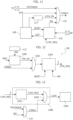
- FIG. 4 shows an embodiment of a processing system 10a according to the present description.
- the processing system 10a such as an integrated circuit, comprises:
- the behavior of the processing system 10a may also be varied based on configuration data CD and life-cycle data LCD.
- these configuration data CD and life-cycle data LCD may be written into specific areas of the non-volatile memory 104 and retrieved when the processing system 10a is powered on.
- the non-volatile memory 104 is integrated in the integrated circuit and may also be used to store the firmware of the processing core(s) 102.
- the firmware may also be stored in a separate non-volatile memory 104.
- the non-volatile program memory may be used, in case the program memory is integrated in the integrated circuit.
- an additional (small) internal non-volatile memory 104 may be used in case the program memory is an external memory.
- the configuration data CD and the life-cycle data LCD are stored in a non-volatile memory of the integrated circuit comprising the blocks requiring configuration data, such as the processing unit 102 and/or one or more of the hardware resources 106.
- the configuration data CD may comprise calibration data used to guarantee that the hardware behavior is uniform, thereby compensating possible production process tolerances. For example, this applies often to the calibration of analog components of the processing system, such as a temperature sensor, analog-to-digital converter, voltage reference, etc.
- a voltage monitor threshold level of an analog comparator could be "trimmed" to the exact intended value by adjusting some levels with configuration/calibration data, which are written by the producer of the hardware of the processing systems, e.g., the micro-controller producer.
- the configuration data CD may also be used to customize the behavior of the hardware, e.g., the hardware resources 106, according to different application needs. For example, once the firmware of the processing system has been stored in the processing system 10a, some configuration data CD, i.e., the security configuration data SCD, may be written in order to deactivate the debug interface, which e.g., could be used to download the firmware of the processing system 10a. Alternatively, only the access to the non-volatile memory via the debug interface may be disabled, i.e. , the debug interface as a whole may not be disabled, but the access of the debug interface to the other circuits may be limited.
- the security configuration data SCD i.e., the security configuration data SCD
- a first part of the configuration data CD may be written by the producer of the hardware of the processing system (e.g. , the producer of an integrated circuit), and/or a second part of the configuration data CD may be written by the developer of the firmware of the processing system 10a.
- the programmed configuration data CD may be read during a reset phase, which usually starts as soon as the processing system 10a is powered on.
- the processing system 10a may comprise for this purpose a hardware configuration circuit 108 configured to read the configuration data CD and the life-cycle data LCD from the non-volatile memory 104 and distribute these data within the processing system 10a.
- the hardware configuration module 108 may be configured to read the configuration data CD and the life-cycle data LCD from the non-volatile memory 104 by sending read requests to the memory controller 100 via the communication system 114. Additionally or alternatively, the hardware configuration module 108 may also be connected directly to the memory controller 100 or be configured to read directly the data from the memory 104.
- the hardware configuration module 108 may be configured to send the configuration data CD and the life-cycle data LCD to the various circuits by sending write requests via the communication system 114. However, the hardware configuration module 108 may also use a separate communication channel for the configuration data CD and/or the life-cycle data LCD.
- Figure 5 shows a possible embodiment of the configuration circuit 108.
- the configuration data CD are stored in reserved memory areas, e.g., in the form of a plurality of consecutive memory locations.
- the configuration module 108 accesses the reserved memory areas containing the configuration data CD, reads the configuration data CD and transmits the configuration data CD to a respective block 110 within the processing system 10a.
- the block 110 may correspond to any block of the processing system 10a requiring configuration data and may correspond to the processing unit 102, a hardware resource 106, or even a memory 104 and/or 104b.
- the block 110 may be a debug interface of the processing system 10a, which is enabled or disabled based on the configuration data CD.
- the configuration data CD may be used to configure read and/or write protected areas of a memory.
- each block 110 may have associated a respective configuration data client 112.
- each configuration data client 112 may be associated univocally to a single hardware block 110, and provided configuration data only to the associated hardware block 110, e.g., a specific hardware resource 106, or may be associated with a plurality of hardware blocks 110, e.g., a plurality of hardware resource 106.
- the configuration data clients 112a, 112b and 112c may also be integrated in the respective block 1 10a, 110b and 110c.
- the configuration module 108 may determine for each target block 110 to be configured the respective configuration data (selected from the configuration data CD) and transmit the configuration data associated with the target block 110 to the configuration data client 112 associated with the target block 110.
- the configuration module 108 may determine the target block(s) for the current configuration information and send the current configuration data to the configuration data client(s) associated with the respective target block(s).
- any communication may be used for transmitting the configuration data to the configuration data client 112, including both serial and parallel communications.
- the configuration module 108 and the configuration data clients 112 may be connected via the communication system 114 or an additional bus, and each configuration data clients 112 may have associated a respective target address.
- each configuration data client 112 is configured to receive the configuration data from the module 108, store them into the internal register, e.g., store them into one or more internal flip-flops or latches. The data stored in the register may then be used to generate one or more signals, which influence the behavior of one or more hardware blocks 110.
- Figure 6 shows in this respect a possible embodiment of the communication between the configuration module 108 and the configuration data clients 112.
- the processing system 10a comprises a configuration module 108 configured to read the configuration data CD from one or more non-volatile memories 104 and a plurality of configuration data clients 112 configured to receive respective configuration data from the module 108 and distribute them among a plurality of blocks 110 (not shown) requiring configuration data.
- each configuration data client 112 may be associate univocally with a respective circuit 110.
- the processing system 10a comprises again three configuration data clients 112a, 112b and 112c.
- the configuration module 108 comprises a data read module 1080 configured to read the configuration data CD from the memory 104 and a dispatch module 1082 configured to transmit the configuration data to the configuration data clients 112.
- any communication may be used for the communication between the dispatch module 1082 and the configuration data clients 112.
- the communication between the dispatch module 1082 and the configuration data clients 112 is based on data frames in accordance with a given format, called in the following Device Configuration Format (DCF).
- DCF Device Configuration Format
- each data frame comprises two fields: the payload (i.e., the real data), called DCF Format payload , and possible additional data attributes used to identify the receiver of the data, called DCF Format attributes , wherein the receiver is one of the configuration data clients 112 representing a DCF client.
- the data attributes may consist in 16 or 32 bits, wherein a given number of bits specifies the address of one of the configuration data clients 112, and the payload may consist in 16 or 32 bits.
- the data read module 1080 is configured to read blocks of 64 bits from the memory 104, wherein the first 32 bits contain the data attributes (including the address of a configuration data client) and the second 32 bits contain the configuration data to be transmitted to the address specified in the data attributes.
- the address may correspond to a physical address of the communication system 114 or of a separate communication bus.
- each configuration data client/DCF client 112 may be a hardware module, usually comprising a combinational circuit configured to store the received data in an internal register implemented, e.g. , with flip-flops/latches, thereby permitting to distribute, via one or more internal signals generated as a function of the data stored in the internal register, the configuration data received to various parts of the associate hardware circuit(s) 110.
- each configuration data client 112 may have associated a univocal address (i.e., univocal within each processing system 10a) and analyses the data transmitted by the dispatch module 1082 in order to determine whether the additional data attributes (DCF Format attributes) contain the address associated with the configuration data client 112.
- the module 108 may also comprises a state control module 1084 configured to manage the various configuration phases of the processing system 10a.
- a reset module 116 of the processing system 10a may generate a reset signal RESET, which is used to perform a reset of the various components of the processing system 10a.
- the reset signal RESET may correspond to a reset pulse of a given number of clock cycles, provided to the blocks 110 of the processing system 10a.
- the reset signal RESET may be used by the configuration data clients 112 in order to set the internal register to a given reset value.
- the reset circuit 116 may activate the state control module 1084, thereby activating the configuration phase.
- the data read module 1080 may read the configuration data CD from the memory 104 and the dispatch module 1082 may send the configuration data CD to the various configuration data clients 112, thereby overwriting the reset values.
- the dispatch module 1082 may generate a data signal DATA having a given number of bits (corresponding to the bits of the payload) containing the configuration data to be transmitted to a given configuration data client 112 and further control signals for selecting the target configuration data client 112.
- the dispatch module 1082 generates also an address signal ADR containing the address of the target configuration data client 112 and optionally a chip select signal CS used to signal that the address signal ADR and the data signal DATA are valid.
- the address signal ADR (and the chip select signal CS) may be provided to a decoder 124 configured to activate one of the configuration data clients 112 as a function of the address signal ADD.
- the decoder 124 may set a chip select signal CSa in order to indicate that the configuration data client 112a should read the data signal DATA when the address signal ADR corresponds to an address assigned to the configuration data client 112a (and the chip select signal CS is set).
- the decoder 124 may set a chip select signal CSb in order to indicate that the configuration data client 112b should read the data signal DATA when the address signal ADR corresponds to an address assigned to the configuration data client 112b (and the chip select signal CS is set), etc.
- the configuration data CD may also comprise security configuration data SCD used to activate or deactivate given security functions of the processing system 10a, such as:
- configuration data CD may comprise two sub-sets of configuration data:
- these groups of configuration data are written to different areas of the memory(ies) 104, thereby permitting that these groups may be configured independently, or the second group of configuration data may be appended to the first group of configuration data.
- the security configuration data SCD included in the first group of configuration data may also permit to set the access rights to the memory locations in which the first group of configuration data are stored.
- the first group of configuration data may not be overwritten, and/or the memory interface may inhibit a read access to the first group of configuration data (e.g., the processing unit 102).
- configuration data CD/security configuration data SCD included in the second group of configuration data may be used to configure the behavior of the blocks 110 from a functional point of view, e.g. , in order to enable or disable the debug interface, etc.
- the second group of configuration data may not be overwritten or read.
- the data read module 1080 may also read the life-cycle data LCD from the memory 104 and provided to a life-cycle circuit 1102.
- the life-cycle circuit 1102 may comprise an internal register, in which the life-cycle data LCD read from the memory 104 are stored. More specifically, in various embodiments, the life-cycle circuit 1102 is configured to receive encoded life-cycle data LCD, decode the life-cycle data LCD into decoded data LC identifying a current life-cycle stage, i.e., the data LC identifying a current life-cycle stage may be stored in the life-cycle circuit 1102 and provided to the other circuits.
- this operation may be managed by the state control module 1084, e.g., the state control module may drive the life-cycle module 1102, such that the life-cycle module 1102 decodes the life-cycle data LCD and stores the decoded data LC in the internal register, e.g. , when the processing system 10a is in the configuration phase (following the reset state).
- the life-cycle circuit 1102 may then provide the decoded life-cycle data LC to the various circuits 110.
- a separate communication channel is used to provide the same decoded life-cycle data LC to the various circuits 110, because it may be rather useless to use additional registers, e.g. , in the configuration data clients 112, for storing the information already stored in the register of the life-cycle circuit 1102.
- the hardware configuration circuit 108 is configured to read (via a suitable communication channel) the configuration data CD and the life-cycle data LCD from the non-volatile memory 104 and transmit the configuration data CD and the decoded life-cycle data LC to the various circuits 110, e.g., the processing core(s) 102, the memory controller 100 and the resources 106.
- the hardware configuration circuit reads the configuration data CD and the life-cycle data LCD after a reset, but before the processing core(s) 102 are activated.
- the first reset corresponds to a "simple" reset as described essentially in the foregoing, where some kind of reset event activates the internal reset stage 116 in order to perform a functional reset of the processing system.
- the second type of reset corresponds to a complex reset wherein further operations may be executed.
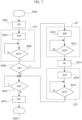
- Figure 7 schematically shows an embodiment of the operation of the reset circuit 116.
- the reset is activated and a reset is performed at a step 3002.
- the reset module 116 may set the signal RESET at the step 3002.
- the various latches/registers of the processing system 10a are reset (e.g. , the content of the configuration data clients 112 and the configuration module 108).
- the reset module 116 starts at a step 3004 the configuration phase, e.g. , by setting a signal SCP, which is provided to the state control module 1084.
- the configuration circuit 108 reads and distributes the configuration data CD and the life-cycle data LCD.
- the signal SCP is purely optionally because the configuration phase could be started automatically when the reset signal RESET is de-asserted.
- the configuration circuit 108 may set a signal ECP in order to indicate that the configuration phase is completed.
- the reset circuit 116 may proceeded from the step 3004 to a verification step 3006, where the reset module 116 waits until the signal ECP is set by the configuration circuit 108 (output "N" of the verification step 3006). Once the signal ECP is set (output "Y" of the verification step 3006), the processing system 10a is configured. Accordingly, the steps 3004 and 3006 implement a configuration phase CP1 of the processing system 10a.
- the processing core(s) 102 may be started at a step 3022 and the reset procedure may terminate at a step 3024. Accordingly, at the step 3022 is started a software runtime phase SW.
- the processing system 10a may also be configured to run a diagnostic phase DP where the processing system 10a executes one or more optional system diagnostic operations, i.e. , the processing system 10a executes a Built-In Self-Test (BIST).
- the processing system 10a comprise a hardware diagnostic circuit 118, which is activated via a signal SDP.
- the reset circuit 116 may set the signal SDP at a step 3010, thereby starting the diagnostic circuit 118.
- the reset module 116 may wait at a step 3012 until the diagnostic operations have been executed, i.e., the self-test has been completed.
- the diagnostic circuit 118 may set a signal EDP once the diagnostic operations have been executed.
- the reset circuit 116 may proceed from the step 3010 to a verification step 3012, where the reset module 116 waits until the signal EDP is set by the diagnostic circuit 118 (output "N" of the verification step 3012). Once the signal EDP is set (output "Y" of the verification step 3012), the diagnostic phase DP (steps 3010 and 3012) has been completed.
- the self-test operations executed by the diagnostic circuit 118 may test one or more registers of the processing system 10a, which usually involves write and/or read operations, thereby modifying the content of such registers may be modified.
- the reset module may execute a further reset of the processing system 10a at a step 3014.
- the reset circuit 116 may set again the signal RESET at the step 3014.
- the reset executed at the step 3002, representing a first reset, and the reset executed at the step 3016, representing a second reset may be different, e.g., with respect to the registers and/or circuits which are reset by the reset circuit 116.
- this is schematically shown in Figure 6 , where the reset circuit 116 generates also a reset mode signal RM, which is set to a first logic level at the step 3002 and a second logic level at the step 3014.
- the reset circuit could also set a first reset signal RESET1 at the step 3002 (used to reset a first sub-set of circuits) and a second reset signal RESET2 at the step 3014 (used to reset a second sub-set of circuits).
- the diagnostic circuit 118 may also test the registers of the configuration data clients 112 and the life-cycle circuit 1102. Accordingly, in this case, it is also useful to read again the configuration data CD and/or life-cycle data LCD at a second configuration phase CP2.
- the reset module 116 may proceed from the step 3014 to a step 3016, where the reset circuit 116 starts again a configuration phase, e.g. , by setting a signal SCP, which is provided to the state control module 1084.
- the configuration circuit 108 reads and distributes the configuration data CD and the life-cycle data LCD.
- the configuration circuit 108 sets again the signal ECP in order to indicate that the configuration phase is completed.
- the reset circuit 116 may proceed from the step 3016 to a verification step 3018, where the reset module 116 waits until the signal ECP is set by the configuration circuit 108 (output "N" of the verification step 3018). Once the signal ECP is set (output "Y" of the verification step 3018), the processing circuit may thus proceed to the step 3022 for starting the processing core(s) 102.
- the reset circuit 116 may be configured to optionally start the diagnostic phase DP after the configuration phase CP1.
- This configuration may be hardwired or programmable.
- the configuration data CD are already distributed at the end of the configuration phase CP1.
- the configuration data CD may also include data which indicate whether the self-test function should be activated or not, possibly also including data specifying which self-test should be executed.
- these data may be provided to the reset circuit 116 and/or diagnostic circuit 118 by associating respective configuration data clients 112 with these circuits.
- the reset circuit 116 may indeed proceed to a verification step 3008. Specifically, when the execution of the diagnostic phase DP is enabled (output "Y" of the verification step 3008), the reset module 116 proceeds to the step 3010. Conversely, when the execution of the self-test is disabled (output "N" of the verification step 3008), the procedure may directly proceed to the step 3022 in order to start the normal-operation mode of the processing system.
- a simple reset implements only a single reset (step 3002) and the configuration phase CP1.
- a complex reset implements also the diagnostic phase DP, the further reset at the step 3014 and optionally the further configuration phase CP2.
- the processing system 10a may also support both types of resets, wherein a complex reset is executed in response to a first set of events and a simple reset is executed in response to a second set of events (e.g., verified at the step 3008).
- a complex reset may be executed in response to a start-up of the processing system 10a or in response to given (critical) errors, while a simple reset may be executed in response to a reset request by the processing unit 102.
- the reset events may be static/hardwired or may be configurable.
- the first reset at the step 3002 is called "destructive reset" DR, because usually all registers of the processing system 10a are reset to a reset value, while the second reset at the step 3014 is usually identified as a functional reset FR, because not necessarily all registers of the processing system are reset, such as registers of one or more of the resources 106.
- the registers of the reset module 116 cannot be reset at the step 3016, because otherwise the reset module 116 would lose the information whether already a first reset at the step 3002 had been performed.
- the functional reset at the step 3014 may also be a so called "Short Functional Reset", where the processing system 10a is reset but the configuration circuit 108 does not read again the configuration data CD and the life-cycle data LCD, i.e., the configuration phase CP2 may be omitted.
- given events may trigger the complex reset procedure shown in Figure 7 (starting at a destructive reset 3002)
- other events e.g. , a reset requested by a resource 106
- may trigger only a functional reset i.e., start immediately the step 3016.
- further events e.g., a reset requested by a processing unit 102
- the reset triggers are classified as functional, short functional or destructive at design time, and/or may be configured via configuration data CD.
- the execution of the BIST may be set at design time, and/or may be configured via configuration data CD, possibly for each trigger associated with a destructive reset.
- the processing core(s) 102 when executing a complex or simple reset, i.e., between the steps 3002 and 3020, the processing core(s) 102 are not running, i.e., the processing core(s) 102 do not execute any software. For example, this may be obtained by keeping the processing core(s) 102 under reset.
- other circuits of the processing system 10a may be operative, e.g. , the reset circuit 116, the diagnostic circuit 118, the hardware configuration circuit 108, the non-volatile memory 104, one or more of the resources 106, etc.
- the reset circuit 116 and/or the state control module 1084 may also implement further steps, such as an initialization phase, where the reset circuit 116 and/or the state control module 1084, e.g. , waits that the non-volatile memory 104 completes its initialization, thereby ensuring that the data read circuit 1080 may read the configuration data CD and life-cycle data LCD from the non-volatile memory 104.
- the reset circuit 116 is configured to reset the processing system 10a in response to a signal received via a reset terminal RP of the processing system 10a, such as a pad of a respective integrated circuit die or a pin of a respective packaged integrated circuit. For example, this is schematically shown in Figure 6 .
- the reset circuit 116 is configured to verify at a step 3030 (before proceeding to the step 3022), whether the signal applied to the reset terminal RP is de-asserted.
- the processing system 10a may be configured to start a complex reset at the step 3000 when the signal applied to the reset terminal RP has a first logic value, e.g. , low.
- the reset circuit executes the steps 3002 to 3018, and the processing system 10a remains at the step 3020 while the signal applied to the reset terminal RP has the first logic level (output "Y" of the verification step 3020), i.e., the processing system 10a proceeds from the step 3020 to the step 3022 (output "N" of the verification step 3020) when the logic level of the signal applied to the reset terminal RP has a second logic level, e.g. , high. Accordingly, in the embodiment considered, the processing core(s) are only started at the step 3022 when the signal applied to the reset terminal RP has the second logic level.
- At least one communication interface IF_JTAG preferably a serial communication interface, such as a JTAG (Joint Test Action Group) interface, is operative during the step 3020.
- a serial communication interface such as a JTAG (Joint Test Action Group) interface
- JTAG Joint Test Action Group
- Figure 7 shows an embodiment, where the various reset phases are managed by the reset circuit 116, these phases could also be managed by the state control circuit 1084 or another state machine. Thus, in general the operation shown in Figure 7 may be implemented in any suitable manner by the processing system 10a.
- the inventors have observed that the above-described behavior may be used to manage, via the interface IF_JTAG, preferably a serial communication interface, such as a JTAG interface, the advancing of the life-cycle stage, without requiring the intervention of the processing core(s) 102.
- a serial communication interface such as a JTAG interface
- the processing system 10a is configured to enable or disable given security functions as a function of life-cycle data LCD and optional security configuration data SCD.
- the life-cycle data LCD may identify one of a plurality of life-cycle stages, such as:
- the development phase(s) may already be activated one or more security mechanisms and during the "in field” stage a maximum level of protection is activated. Conversely, in the "failure analysis” stage one or more of the security mechanisms activated during the "in field” stage are deactivated.
- the life-cycle data LCD may comprise a given number of bits, such as 32 or 64 bits, and a sub-set of a plurality of bits may be associated with each life-cycle stage, such as 4 or 8 bits.
- the life-cycle circuit 108 may be configure to:
- the first life cycle LC1 may be identified by life-cycle data LCD having all bits set to the reset value of the non-volatile memory.
- life-cycle data LCD with 32 bits with the following sub-sets of bits:
- the life-cycle circuit 1102 selects then the highest life-cycle stage, e.g., sets the signal LC in order to indicate the life-cycle stage LC5, when at least five bits of the subset of bits [24..31] are set to "0".
- life-cycle data LCD has to be configured, such that the life cycle stage may only advance, i.e. , it can never be reverted to an early stage.
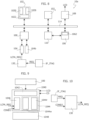
- Figure 8 shows an embodiment of a processing system 10a according to the present disclosure.
- the embodiment is essentially based on the embodiment shown in Figure 4 and comprises in addition:
- the verification circuit 130 is a separate hardware circuit and the advancing of the life-cycle stage may be requested without an intervention of the processing core(s) 102.
- the verification circuit 130 is configured to manage only the advancing of the life-cycle stage to the failure analysis stage LC5, while the advancing of the other life-cycle stages (LC1-LC4) may still be managed by the processing core(s) 102, e.g., by receiving respective requests via a CAN interface.
- the verification circuit 130 generates a signal LCFA_REQ when the request REQ indicates a request to advance the life-cycle stage to the failure analysis stage LC5.
- this signal LCFA_REQ is directly provided to the non-volatile memory 104 having stored the life-cycle data LCD, thereby avoiding that the communication has to be transmitted through the communication channel 114.
- Figure 9 shows an embodiment of the non-volatile memory 104 according to the present disclosure.
- the non-volatile memory 104 comprises:
- control circuit 1040 comprises:
- the read and write management circuit 1044 may indeed comprise two separate circuits: a read management circuit 1044r configured to manage read requests and a write management circuit 1044w configured to manage write requests.
- the memory controller 100 receives a read or write request from the communication system 114 and forwards the request to the control circuit 1040.
- the memory controller 100 may also form part of the control circuit 1040.
- control circuit 1040 in particular the security management circuit 1042, is configured to determine whether the read or write request is permitted.
- the security management circuit 1042 may determine whether the read or write request may access a given memory area based on configuration data CD, in particular the previous mentioned security configuration data SCD, and/or the life-cycle data LCD.
- control circuit 1040 may have associated a respective configuration data client 112 (with a respective address) and the security configuration data SCP may be provided to the security management circuit 1042 by storing the security configuration data SCP together with the configuration data CD in the non-volatile memory 104, wherein the security configuration data SCP are stored in the memory 104 in the form of DCF data packets also comprising the address of the configuration data client 112 associated with the control circuit 1040. Accordingly, in this way, the configuration circuit 108 will read the configuration data CD and transmit the respective security configuration data SCP to the configuration data client 112 associated with the control circuit 1040.
- the security management circuit 1042 determines that the request is permitted, the security management circuit 1042 forwards the request to the read and write management circuit 1044 (1044r or 1044w), which executes the read or write request.
- control circuit 1040 comprises a life-cycle program circuit 1046, which is configured to generate a write request to a given memory location of the memory areas 1048 when the signal LCFA_REQ is set.
- life-cycle program circuit 1046 may also verify one or more further conditions COND1, which will be described in greater detail in the following.
- the verification circuit 130 may generate the signal LCFA_REQ not only as a function of the request REQ, but also as a function of one or more conditions COND2.
- the verification circuit 130 and the life-cycle program circuit 1046 permit to advance the life-cycle stage to the failure analysis stage by using a minimum set of device resources, and bypassing all the protection layers described so far, e.g. , the security management circuit 1042. Accordingly, the advancement of the life-cycle stage to the failure analysis stage (and preferably only to this stage) may be accomplished separately with a reduced quantity of circuits involved, thereby reducing the risk that the malfunction of a circuit blocks the advancement of the life-cycle stage.
- this mechanism may still guarantee the needed level of security in order to ensure that the advancement cannot be done maliciously, and also the needed level for safety and availability, so that the life-cycle cannot advance to the failure analysis stage during the run-time of the processing system 10a.
- Figures 11 and 12 show a possible embodiment of the verification circuit 130.
- Figure 11 shows an embodiment of a circuit configured to verify the additional conditions COND2 of the verification circuit 130.
- the respective circuit may also be integrated directly within the verification circuit 130.
- the verification circuit 130 is configured to receive:
- the set of input conditions is chosen in order to guarantee security, safety, and availability, e.g. , these conditions have to ensure that:
- the first condition is verified by monitoring a signal TESTMODE applied to a terminal TP, such as a pin or pad of a respective integrated circuit.
- a terminal TP such as a pin or pad of a respective integrated circuit.
- the terminal TP (and thus the signal TESTMODE) is connected to a first logic level, e.g. , high, when the processing system 10a is in use.
- the verification circuit 130 may verify whether the signal TESTMODE applied to the terminal TP has a second logic level, e.g. , low. For example, in order to set the pin TP to low, the processing system 10a has to be removed from the application, e.g.
- the terminal TP may also be connected via a pull-up resistor to a supply voltage (i.e. , the logic high level), which ensures that an accidental break of the wire connecting the package pin or ball to the pad will not leave the pad at an undefined state.
- a pull-down resistor would be used in case the signal TESTMODE is active high, i.e. , the test-mode is activated when the terminal TP is connected externally to a logic high level.
- the second condition (security) is verified by providing within the verification circuit 130 a password verification circuit 1300 configured to verify whether the request REQ contains a reference password/keyword RK.
- the circuit 1300 is configured to generate a signal PW_OK when the request REQ provided via the communication interface IF_JTAG corresponds to a given predetermined bit sequence comprising the reference keyword RK.
- the reference password RK may be hard-wired or stored in the configuration data CD.
- the verification circuit 130 may have associated a respective configuration data client 112 (with a respective address) and the reference password RK may be provided to the verification circuit 130 by storing the reference password RK together with the configuration data CD in the non-volatile memory 104, wherein the reference password RK is stored in the memory 104 in the form of DCF data packets also comprising the address of the configuration data client 112 associated with the verification circuit 130. Accordingly, in this way, the configuration circuit 108 will read the configuration data CD and transmit the respective reference password RK to the configuration data client 112 associated with the verification circuit 130.
- the password verification circuit may be cited European patent application n. EP 3 432 190 A .
- the third condition is verified by ensuring that the processing system 10a is in the reset state, because this is considered by the ISO26262 standard as a safe state.
- the reset circuit 116 will start the reset procedure at the step 3000. Accordingly, the reset circuit 116 executes the reset and configuration phase CP1 (and optionally the diagnostic phase DP and configuration phase CP2). Moreover, the reset circuit 116 remains at the step 3020 until the logic level at the reset terminal/pin/pad RP is set to a second logic level, ( e.g. , high).
- a given logic level e.g. , low
- the reset circuit 116 executes the reset and configuration phase CP1 (and optionally the diagnostic phase DP and configuration phase CP2). Moreover, the reset circuit 116 remains at the step 3020 until the logic level at the reset terminal/pin/pad RP is set to a second logic level, ( e.g. , high).
- the communication interface IF_JTAG is active during the step 3022, thus permitting that requests REQ may be sent via the interface IF_JTAG. Due to the fact that the communication interface IF_JTAG is usually also active when the processing core(s) are running, the verification circuit 130 is thus configured to determine whether the reset circuit 116 is indeed at the step 3022.
- the verification circuit 130 receives from the reset circuit 116 a signal RA indicating that the reset module 116 is waiting at the step 3022.
- the verification circuit 130 may also monitor the signal ECP indicating that the configuration phase has been completed.
- the signal RA may also correspond to the signal at the terminal RP (or its inverted version).
- the verification circuit 130 may also verify the signal RM, which distinguishes the first reset phase from the second reset phase.
- the verification circuit 130 may also verify whether a given flag is set, which enables or disables the described operation for advancing the life-cycle stage.
- the verification circuit 130 monitors a signal LCFA_EN provided by a configuration data client 112 associated with the verification circuit 130. Accordingly, the signal LCFA_EN may be generated by storing a respective DCF data packet with the address of this configuration data client to the configuration data CD.
- the previous conditions are verified by generating the signal COND2 via a combinational logic circuit 132 as a function of the signals TESTMODE, ECP, LCFA_EN and RA.
- the verification circuit 130 generates the signal LCFA_REQ via a combinational logic circuit 1302 as a function of the signals PW_OK and COND2.
- the combinational logic circuits 132 and 1302 may also be combined.
- the signal LCFA_REQ is stored to a register 1304, preferably a plurality of redundant registers/flip-flops, such as three parallel flip-flops.
- the signal LCFA_REQ is only set when:
- a user may set the signal LCFA_REQ by setting the logic levels at the terminals TP and RP, and sending via the communication interface IF_JTAG a given request REQ (with the reference keywork RK) once the configuration phase CP2 has been completed.
- REQ with the reference keywork RK
- the register(s)/flip-flop(s) 1304 are only reset in response to the reset generated at the step 3002, but not in response to the reset at the step 3014.
- the register/flip-flop 1304 may be configured to:
- the register/flip-flop 1304 may be reset only in response to the reset signal RESET1 (generated at the step 3002/destructive reset DR) and not the reset signal RESET2 (generated at the step 3016/functional reset FR).
- the signal LCFA_REQ is also provided to the reset circuit 116.
- the operation of this feedback will be described in greater detail in the following with respect to the life-cycle program circuit 1046.
- writing data to a non-volatile memory is more complex than writing data to a RAM, where one single write instruction moves some data directly in the RAM and the data is then immediately latched in the memory.
- the programming requires usually a sequence of operations.
- the supply voltage of the memory is set to a higher voltage. This may involve a given time until the voltage settles to the new value. Similarly, the higher voltage should be removed once the programming operation is completed. Moreover, a single programming/write operation may indeed involve a complex sequence of micro-operation to control the whole programming operation. The reason is that for the non-volatile memory, undesired analog effects, which can be different depending on the non-volatile memory technology being used, might hinder the successful completion of the programming operation.
- a cell in the case of a Flash memory, a cell might become "depleted", which is a condition where the cell has lost its trapped charge: in such a case the cell drives an excessive flow of current along its connected bit-line and it would be extremely difficult to recover the cell and bring it to a programmed state.
- dedicated algorithms might be needed in order to restore a depleted cell.
- a processing core 102 has to execute a sequence of operations in order to write data to the non-volatile memory 104.
- a processing core 102 may be configured to execute the following steps for programing data to the non-volatile memory 104:
- control circuit 1040 may also manage a register interface, wherein each register (such as a write data register, a read data register, an address register and a control register) may have associated a respective address.
- each register such as a write data register, a read data register, an address register and a control register
- the software may just wait until the non-volatile memory 104 has completed the programming. From the software point of view, this is just a simple wait step, but in reality, during this timeframe the non-volatile memory 104 executes a complex sequence of micro-operations, like giving a short voltage pulse, then comparing the current cell with a reference cell, give another pulse if the current is not the target one and so on.
- V-I voltage-current
- the write management circuit 1044w has to execute a sequence of micro-operations in order to implement the programming operation.
- the write management circuit 1044w may be implemented with a hardware finite state machine or a microprocessor being programmed via software instructions.
- the microprocessor may have associated a programmable voltage source for setting the supply voltage of the memory areas 1048, and an analog-to-digital converter for monitoring the voltage of a given cell of the memory area 1048, etc.
- the use of a microprocessor is particularly useful in order to permit an improvement of the programming operation.
- such a microprocessor permits to use different sequences (at least during the development stage) or update the different sequence even later. Such sequences of micro-operations, executed by a microprocessor, is typically called "embedded-algo".
- a microprocessor provides more flexibility than a fixed state machined. Such a microprocessor may only be used to manage the more complex write operations, while the read operation may still be performed via a dedicated hardware circuit 1044r. In fact, while a microprocessor provides more flexibility, such a microprocessor usually has a higher power-consumption than a dedicated hardware circuit. For this reason, the microprocessor (but a similar issue may also exist for a complex state machine 1044w managing the write operation) is typically switched off (or at least suspended) during read operations. In fact, during run-time, the non-volatile memory 104 is mainly read and rarely written. For example, when a processing core 102 activates the programming mode of the non-volatile memory 104, indeed this step may switch on the write circuit/microprocessor 1044w of the non-volatile memory 104.
- the life-cycle programming circuit 1046 has to activate in some way the write circuit 1044w, e.g. , the respective microprocessor.
- the control circuit 1040 activates the write circuit 1044w only in response to one or more commands received from the memory controller 100.
- the control circuit 1040 is configured to activate the write circuit 1044w only when:
- this permits to avoid that the write circuit 1044w is activated due to an erroneous (isolated) first request or second request.
- the life-cycle programming circuit 1046 has to activate in some way write circuit 1044w in order to program the non-volatile memory areas 1048. Accordingly, the life-cycle programming circuit 1046 could execute the above-mentioned operations for starting the write circuit 1044.
- the circuit implementing the write circuit 1044w such as a microprocessor or a state machine, is activated, e.g. , in order to executes several internal initializations, and then the circuit is deactivated, i.e., in various embodiments, the circuit implementing the write circuit 1044w is activated in response to the reset generate at the step 3002 and the reset generated at the step 3014, and once the non-volatile memory 104 is initialized, the circuit implementing the write circuit 1044 is deactivated.
- the circuit implementing the write circuit 1044w such as a microprocessor or a state machine
- the reset circuit 116 activates the configuration phase CP1 during which the configuration data CD and life-cycle data LCD are read. Only once the configuration data have been read, possibly also executing the diagnostic phase DP, the further reset 3014 and the further configuration phase CP2, it is possible to maintain the processing system 10a in the reset stage via the signal at the reset terminal RP.
- the request REQ may be sent via the communication interface IF_JTAG and the verification circuit 130 verified the request REQ and the additional conditions COND2
- the circuit implementing the write circuit 1044w may indeed be already deactivated.
- the register(s)/flip-flops(s) 1304 are configured to be reset only in response to the reset at the step 3002/destructive reset DR, while the register(s)/flip-flops(s) 1304 maintain their values in response to a reset at the step 3014/functional reset FR.
- the circuit implementing the write circuit 1044w may be activated by starting a functional reset FR at the step 3014, i.e., the reset circuit 116 is configured to start a functional reset at the step 3014 in response to the signal LCFA_REQ being set.
- the reset circuit 116 may also verify additional conditions, such as the logic level of the terminal TP and/or the terminal RP (see the respective description of the verification circuit 130).
- the register(s)/flip-flops(s) 1304 are not reset, but the circuit implementing the write circuit 1044w is activated.
- the circuit implementing the write circuit 1044w may be configured to verify the signal LCFA_REQ when the circuit is activated, e.g. , in response to a reset. Moreover, in response to determining that the signal LCFA_REQ is set, the write circuit 1044w may perform the programming of the life-cycle data LCD in the memory area 1048 in order to advance the life-cycle stage to the failure analysis stage.
- the reset circuit 116 will execute the reset at the step 3002 and start the configuration phase CP1 (and optionally the diagnostic phase DP, the second reset at the step 3014 and the second configuration phase CP2). Accordingly, when the circuit implementing the write circuit 1044w is initialized in response to the reset at the step 3002 (and optionally the reset at the step 3014), the signal LCFA_REQ is not set (e.g., is low).
- this signal will also trigger a new reset at the step 3014.
- the register 1304 maintains its content during the reset at the step 3014.
- the signal LCFA_REQ is now set ( e.g., is high).
- Figure 13 shows in this respect a possible embodiment of the programming circuit 1046.
- the signal LCFA_REQ may also be provided directly to the write circuit 1044, i.e. , the programming circuit 1046 is purely optional.
- the additional programming circuit 1046 may be used:
- the programming circuit 1046 may verify via the combinational logic circuits 134 and 1050 at least one of:
- the programming operation of the life-cycle data LCD is only started, when the write circuit determines during an initialization phase, e.g. , via the programming circuit 1046, the following conditions:
- the signal LCFA_REQ, LCFA_REQ' and/or LCFA may be provided to a register interface of the microprocessor 1044w, e.g. , the so called Special-Function Registers (SFR) of the microprocessor implementing the write circuit 1044w.
- SFR Special-Function Registers
- the verification of the additional conditions COND1 is shown via hardware combinational circuits 134 and/or 1050, indeed at least part of these verifications may be performed via software instructions.
- the operation of the (voting) circuit 1052 may be performed via software instructions executed by the microprocessor 1044.
- a dedicated voting circuit 1052 because indeed the signal LCFA_REQ' may be used to signal the reset request to the reset module 116, i.e. , the reset circuit 116 may be configured to start the functional reset in response to the signal LCFA_REQ' (rather than the signal LCFA_REQ).
- the reset circuit 116 may be configured to start the functional reset in response to the signal LCFA_REQ' (rather than the signal LCFA_REQ).
- a similar voting circuit may be implemented directly in the reset circuit 116.
- the circuit 1052 may correspond to the register interface of the microprocessor implementing the write circuit 1044w, thereby providing directly the signals LCFA_REQ (provided by the registers 1304) to the microprocessor.
- the voting of the signals LCFA_REQ and at least the combination with the additional conditions at the circuit 1050 (and optionally also the operation of the circuit 134) is performed directly via software instructions.
- the reason to have all signals LCFA_REQ mirrored into respective register bits ( e.g. , 3) of the microprocessor 1044 is to protect this mechanism from a spurious activation, which would be catastrophic for the application because the device will enter the failure analysis stage, where the application would not run anymore.
- the microprocessor within the non-volatile memory 104 is not classified as an ASIL-D component, according to ISO26262 specification, and it can eventually fail. Conversely, an ASIL-D microprocessor would cost additional area and power. Thus, by reading a plurality of separate bits of the signal LCFA_REQ and implementing the voting via software instructions, such as a triple-vote decision, the probability to have a failure is significantly reduced.
- the non-volatile memory 104 starts its own initialization again and during this time the request for advancing the life-cycle stage to the failure analysis stage is activated, because the signal LCFA_REQ maintains its value.
- the life-cycle data LCD are encoded.
- a given bit sequence is associated with a sub-set of bits associated with the failure analysis stage.
- the life-cycle stage may be advanced to the failure analysis stage, irrespective of the previous life-cycle stage.
- the write circuit 1044 could also read first the old life-cycle data LCD.
- the processing circuit 10a reads again the life-cycle data LCD.
- the new reset may also be performed manually, e.g. :
- the advancement of the lift-cycle stage may involve:
- the circuit implementing the write circuit 1044w may also be activate in other ways in response to setting the signal(s) LCFA_REQ.
- the circuit implementing the write circuit 1044w may be activated directly in response to the signal(s) LCFA_REQ or the signal LCFA_REQ', e.g., by configuring the respective signal(s) as wake-up signals of the circuit implementing the write circuit 1044w.
- the present disclosure proposes a new scheme to easily advance a failing device to the failure analysis stage, bypassing most of the circuitry ordinarily involved for advancing the life-cycle stage.
- the advancement to the failure analysis stage is guaranteed with a higher probability compared to the standard methodology of life cycle programming via application software.
- the solution adopted does not compromise the overall security as it allows the life-cycle advancement only upon a successful challenge of a secret password.
- the proposed solution does not compromise the safety, because the operation is executed only during the reset phase, which is considered by ISO26262 standard a safe state.
- the proposed solution does not comprise the availability because a set of conditions are put in place in order to avoid any spurious activation of the live-cycle advancement.
- test life-cycle stage For example, while in the foregoing has been described a mechanism in order to advance the life-cycle stage to the failure analysis stage, modern processing systems may alternatively or additionally comprise a test life-cycle stage. Compared to the failure analysis stage, the test life-cycle stage has usually a reduced influence on the overall security. Thus, instead of advancing to the failure analysis stage, the write circuit 1044 could also advance to the test life-cycle stage. In fact, what is relevant for the present disclosure is that a separate mechanism is used to advance the life-cycle stage to a stage wherein reduced security mechanisms are active than in the in-field stage.
Landscapes
- Engineering & Computer Science (AREA)
- Theoretical Computer Science (AREA)
- Software Systems (AREA)
- Physics & Mathematics (AREA)
- General Engineering & Computer Science (AREA)
- General Physics & Mathematics (AREA)
- Computer Hardware Design (AREA)
- Computer Security & Cryptography (AREA)
- Quality & Reliability (AREA)
- Microelectronics & Electronic Packaging (AREA)
- Mathematical Physics (AREA)
- Storage Device Security (AREA)
- Hardware Redundancy (AREA)
- Advance Control (AREA)
Claims (14)
- Système de traitement (10a) comprenant :- un coeur de traitement numérique (102) comprenant un microprocesseur (1020) configuré pour exécuter une instruction logicielle ;- un circuit matériel (110) configuré pour changer de fonctionnement en fonction de données de cycle de vie décodées (LC) indiquant une étape de cycle de vie ;- une mémoire non volatile (104) configurée pour stocker des données de cycle de vie codées (LCD) indiquant une étape de cycle de vie ;- un circuit de configuration matériel (108) configuré pour :- lire lesdites données de cycle de vie codées (LCD) dans ladite mémoire non volatile (104),- produire lesdites données de cycle de vie décodées (LC) en décodant lesdites données de cycle de vie codées (LCD), et- fournir lesdites données de cycle de vie décodées (LC) audit circuit matériel (110) ;- une borne de réinitialisation (RP) configurée pour recevoir un signal de réinitialisation externe ;- un circuit de réinitialisation (116) configuré pour :- surveiller ledit signal de réinitialisation externe reçu via ladite borne de réinitialisation (RP),- lorsqu'il est déterminé que ledit signal de réinitialisation externe a un premier niveau logique, exécuter les opérations suivantes en séquence :a) pendant une phase de réinitialisation (3002), générer (3002) une première réinitialisation dudit système de traitement (10a),b) pendant une phase de configuration (CP1), activer (CP1) ledit circuit de configuration matériel (108), moyennant quoi ledit circuit de configuration matériel (108) lit lesdites données de cycle de vie codées (LCD), décode lesdites données de cycle de vie codées (LCD) et fournit lesdites données de cycle de vie décodées (LC) audit circuit matériel (110),c) pendant une phase d'attente (3022), attendre jusqu'à ce que ledit signal de réinitialisation externe ait un deuxième niveau logique, etd) lorsqu'il est déterminé que ledit signal de réinitialisation externe a ledit deuxième niveau logique, démarrer ledit microprocesseur (1020) ;- une interface de communication (IF_JTAG) activée pendant ladite phase d'attente (3022) et configurée pour recevoir une requête (REQ) ;- un circuit de vérification matériel (130) configuré pour :- vérifier (1300) si ladite requête (REQ) comprend un mot de passe de référence donné (RK),- vérifier (1302, 132) si ledit circuit de réinitialisation (116) est dans ladite phase d'attente (3022), et- lorsqu'il est déterminé que ladite requête (REQ) comprend un mot de passe de référence donné (RK) et que ledit circuit de réinitialisation (116) est dans ladite phase d'attente (3022), générer un signal de requête d'avance de cycle de vie (LCFA_REQ) indiquant une demande pour faire avancer l'étape de cycle de vie indiquée par lesdites données de cycle de vie codées (LCD) vers une étape de cycle de vie prédéterminée donnée ; etdans lequel ladite mémoire non volatile (104) comprend un circuit d'écriture (1044w) configuré pour :- surveiller ledit signal de requête d'avance de cycle de vie (LCFA_REQ), et- lorsqu'il est déterminé que ledit signal de requête d'avance de cycle de vie (LCFA_REQ) est valide, écrire un ou plusieurs bits desdites données de cycle de vie codées (LCD) stockées dans ladite mémoire non volatile (104), avançant ainsi l'étape de cycle de vie indiquée par lesdites données de cycle de vie codées (LCD) vers ladite étape de cycle de vie prédéterminée donnée.
- Système de traitement (10a) selon la revendication 1, comprenant une borne de mode de test (TP) configurée pour recevoir un signal de mode de test externe (TESTMODE), et dans lequel ledit circuit de vérification (130) est configuré pour :- vérifier (1300) si ledit signal de mode de test externe (TESTMODE) a un niveau logique donné, et- générer ledit signal de requête d'avance de cycle de vie (LCFA_REQ) uniquement lorsque ledit signal de mode de test externe (TESTMODE) a ledit niveau logique donné.
- Système de traitement (10a) selon la revendication 1 ou 2, comprenant une pluralité de clients de données de configuration (112), chaque client de données de configuration (112) comprenant un registre pour stocker des données de configuration,dans lequel ladite mémoire non volatile (104) est configurée pour stocker des données de configuration (CD), etdans lequel ledit circuit de configuration matériel (108) est configuré, pendant ladite phase de configuration (CP1), pour lire lesdites données de configuration (CD) dans ladite mémoire non volatile (104) et pour transmettre lesdites données de configuration (CD) à ladite pluralité de clients de données de configuration (112).
- Système de traitement (10a) selon la revendication 3, dans lequel ledit circuit de vérification est configuré pour recevoir un drapeau de validation (LCFA_EN) d'un client de données de configuration (112), et dans lequel ledit circuit de vérification (130) est configuré pour :- vérifier (1300) si ledit drapeau de validation (LCFA_EN) a un niveau logique donné, et- générer ledit signal de requête d'avance de cycle de vie (LCFA_REQ) uniquement lorsque ledit drapeau de validation (LCFA_EN) a ledit niveau logique donné.
- Système de traitement (10a) selon la revendication 3 ou 4, dans lequel ledit circuit de vérification (130) est configuré pour recevoir ledit mot de passe de référence (RK) d'un client de données de configuration (112).
- Système de traitement (10a) selon l'une quelconque des revendications précédentes, dans lequel ladite interface de communication (IF_JTAG) est une interface de communication série, de préférence une interface JTAG.
- Système de traitement (10a) selon l'une quelconque des revendications précédentes, comprenant au moins trois registres (1304), dans lequel ledit signal de requête d'avance de cycle de vie (LCFA_REQ) est stocké dans lesdits au moins trois registres (1304).
- Système de traitement (10a) selon la revendication 7, dans lequel ledit circuit d'écriture (1044w) est mis en oeuvre avec une machine à états, telle qu'une machine à états matérielle ou un microprocesseur supplémentaire, et dans lequel ladite machine à états est configurée pour :- lire le contenu desdits au moins trois registres (1304),- déterminer le niveau logique de la majorité des bits desdits au moins trois registres (1304), et- lorsqu'il est déterminé que la majorité des bits sont au niveau haut, écrire lesdits un ou plusieurs bits desdites données de cycle de vie codées (LCD) stockées dans ladite mémoire non volatile (104).
- Système de traitement (10a) selon la revendication 8, dans lequel ladite machine à états est un microprocesseur supplémentaire, dans lequel lesdits au moins trois registres (1304) sont mis en oeuvre avec une interface de registre dudit microprocesseur supplémentaire, et dans lequel ledit microprocesseur supplémentaire est configuré pour lire le contenu desdits au moins trois registres (1304) et pour déterminer le niveau logique de la majorité des bits desdits au moins trois registres (1304) par l'intermédiaire d'instructions logicielles exécutées par ledit microprocesseur supplémentaire.
- Système de traitement (10a) selon la revendication 8, dans lequel ledit circuit de réinitialisation (116) est configuré pour surveiller un signal de réinitialisation interne et, lorsqu'il est déterminé que ledit signal de réinitialisation interne est validé, pour générer (3014) une deuxième réinitialisation dudit système de traitement (10a), etdans lequel lesdits au moins trois registres (1304) sont configurés pour être réinitialisés en réponse à ladite première réinitialisation (3002) et pour maintenir les valeurs stockées par lesdits au moins trois registres (1304) en réponse à ladite deuxième réinitialisation (3014), etdans lequel ledit signal de réinitialisation interne correspond audit signal de requête d'avance de cycle de vie (LCFA_REQ).
- Système de traitement (10a) selon la revendication 10, dans lequel ladite machine à états est configurée pour être activée en réponse à ladite première réinitialisation et à ladite deuxième réinitialisation générées par ledit circuit de réinitialisation (116), et dans lequel ladite machine à états est configurée pour lire le contenu desdits au moins trois registres (1304) lorsqu'elle est activée.
- Circuit intégré comprenant un système de traitement (10a) selon l'une quelconque des revendications précédentes.
- Dispositif, tel qu'un véhicule, comprenant une pluralité de systèmes de traitement (10a) selon l'une quelconque des précédentes revendications 1 à 11, dans lequel lesdits systèmes de traitement (10a) sont reliés via un système de communication (20).
- Procédé d'utilisation d'un système de traitement (10a) selon l'une quelconque des précédentes revendications 1 à 11, comprenant les étapes suivantes :- appliquer ledit premier niveau logique à ladite borne de réinitialisation dudit système de traitement (10a), moyennant quoi ledit circuit de réinitialisation (116) exécute ladite phase de réinitialisation (3002), ladite phase de configuration (CP1) et ladite phase d'attente (WP) ;- envoyer ladite requête (REQ) via ladite interface de communication (IF_JTAG) dudit système de traitement (10a), ladite requête (REQ) comprenant ledit mot de passe de référence donné (RK), moyennant quoi ledit circuit de vérification (130) génère ledit signal de requête d'avance de cycle de vie (LCFA_REQ) et ledit circuit d'écriture (1044w) écrit lesdits un ou plusieurs bits desdites données de cycle de vie codées (LCD) stockées dans ladite mémoire non volatile (104), avançant de ce fait l'étape de cycle de vie indiquée par lesdites données de cycle de vie codées (LCD) vers ladite étape de cycle de vie prédéterminée donnée.
Applications Claiming Priority (1)
| Application Number | Priority Date | Filing Date | Title |
|---|---|---|---|
| IT102021000007475A IT202100007475A1 (it) | 2021-03-26 | 2021-03-26 | Sistema di elaborazione, relativo circuito integrato, dispositivo e procedimento |
Publications (2)
| Publication Number | Publication Date |
|---|---|
| EP4064100A1 EP4064100A1 (fr) | 2022-09-28 |
| EP4064100B1 true EP4064100B1 (fr) | 2024-07-31 |
Family
ID=76375528
Family Applications (1)
| Application Number | Title | Priority Date | Filing Date |
|---|---|---|---|
| EP22161788.9A Active EP4064100B1 (fr) | 2021-03-26 | 2022-03-14 | Système de traitement, circuit intégré associé, dispositif et procédé |
Country Status (4)
| Country | Link |
|---|---|
| US (1) | US11915008B2 (fr) |
| EP (1) | EP4064100B1 (fr) |
| CN (1) | CN115129511B (fr) |
| IT (1) | IT202100007475A1 (fr) |
Families Citing this family (3)
| Publication number | Priority date | Publication date | Assignee | Title |
|---|---|---|---|---|
| EP4138343B1 (fr) * | 2021-08-20 | 2024-02-21 | STMicroelectronics Application GmbH | Système de traitement, circuit intégré associé, dispositif et procédé |
| EP4400939A1 (fr) * | 2023-01-12 | 2024-07-17 | STMicroelectronics International N.V. | Dispositif numérique ayant un circuit de tampon de réinitialisation qui peut être soumis à une attaque par pirate informatique |
| US20250299764A1 (en) * | 2024-03-20 | 2025-09-25 | Advanced Micro Devices, Inc. | Apparatuses, systems, and methods for signal redundancy in stacked-chip architectures |
Family Cites Families (6)
| Publication number | Priority date | Publication date | Assignee | Title |
|---|---|---|---|---|
| JP2000048565A (ja) * | 1998-07-29 | 2000-02-18 | Mitsubishi Electric Corp | 同期型半導体記憶装置 |
| IT201700062788A1 (it) * | 2017-06-08 | 2018-12-08 | Stmicroelectronics Application Gmbh | Sistema di elaborazione, relativo circuito integrato, dispositivo e procedimento |
| IT201700082176A1 (it) | 2017-07-19 | 2019-01-19 | Stmicroelectronics Application Gmbh | Sistema di elaborazione, relativo circuito integrato e procedimento |
| IT201800001633A1 (it) * | 2018-01-22 | 2019-07-22 | Stmicroelectronics Application Gmbh | Sistema di elaborazione, relativo circuito integrato, dispositivo e procedimento |
| IT201800002895A1 (it) * | 2018-02-21 | 2019-08-21 | Stmicroelectronics Application Gmbh | Sistema di elaborazione, relativo circuito integrato, dispositivo e procedimento |
| IT201900005020A1 (it) | 2019-04-03 | 2020-10-03 | Stmicroelectronics Application Gmbh | Sistema di elaborazione, relativo circuito integrato, dispositivo e procedimento |
-
2021
- 2021-03-26 IT IT102021000007475A patent/IT202100007475A1/it unknown
-
2022
- 2022-03-11 US US17/654,537 patent/US11915008B2/en active Active
- 2022-03-14 EP EP22161788.9A patent/EP4064100B1/fr active Active
- 2022-03-25 CN CN202210307487.2A patent/CN115129511B/zh active Active
Also Published As
| Publication number | Publication date |
|---|---|
| CN115129511A (zh) | 2022-09-30 |
| US11915008B2 (en) | 2024-02-27 |
| IT202100007475A1 (it) | 2022-09-26 |
| US20220308892A1 (en) | 2022-09-29 |
| EP4064100A1 (fr) | 2022-09-28 |
| CN115129511B (zh) | 2025-03-21 |
Similar Documents
| Publication | Publication Date | Title |
|---|---|---|
| EP4064100B1 (fr) | Système de traitement, circuit intégré associé, dispositif et procédé | |
| US11210161B2 (en) | Processing system, related integrated circuit, device and method | |
| US12061530B2 (en) | Processing system, related integrated circuit, device and method | |
| US11474752B2 (en) | Processing system including one-time programmable memory with original life cycle data, related integrated circuit, device and method | |
| EP3287800B1 (fr) | Appareil de débogage jtag et procédé de débogage jtag | |
| US10922015B2 (en) | Processing system, related integrated circuit, device and method | |
| EP4064001B1 (fr) | Système de traitement, circuit intégré associé, dispositif et procédé | |
| EP3432190B1 (fr) | Système de traitement et circuit intégré de gestion de mots de passe | |
| EP4296850B1 (fr) | Système de traitement, circuit intégré associé, dispositif et procédé | |
| US20260128898A1 (en) | Processing system, related integrated circuit, device and method | |
| EP4187415B1 (fr) | Système de traitement, dispositif et procédé associés pour proteger des verrous ou des bascules d'un registre | |
| CN115145753A (zh) | 处理系统、相关集成电路、设备和方法 | |
| CN121996584A (zh) | 处理系统、相关集成电路、设备及方法 | |
| US20250307046A1 (en) | Processing system, related integrated circuit, device and method | |
| CN120724930A (zh) | 处理系统、相关集成电路、设备和方法 |
Legal Events
| Date | Code | Title | Description |
|---|---|---|---|
| PUAI | Public reference made under article 153(3) epc to a published international application that has entered the european phase |
Free format text: ORIGINAL CODE: 0009012 |
|
| STAA | Information on the status of an ep patent application or granted ep patent |
Free format text: STATUS: THE APPLICATION HAS BEEN PUBLISHED |
|
| AK | Designated contracting states |
Kind code of ref document: A1 Designated state(s): AL AT BE BG CH CY CZ DE DK EE ES FI FR GB GR HR HU IE IS IT LI LT LU LV MC MK MT NL NO PL PT RO RS SE SI SK SM TR |
|
| STAA | Information on the status of an ep patent application or granted ep patent |
Free format text: STATUS: REQUEST FOR EXAMINATION WAS MADE |
|
| 17P | Request for examination filed |
Effective date: 20230223 |
|
| RBV | Designated contracting states (corrected) |
Designated state(s): AL AT BE BG CH CY CZ DE DK EE ES FI FR GB GR HR HU IE IS IT LI LT LU LV MC MK MT NL NO PL PT RO RS SE SI SK SM TR |
|
| GRAP | Despatch of communication of intention to grant a patent |
Free format text: ORIGINAL CODE: EPIDOSNIGR1 |
|
| STAA | Information on the status of an ep patent application or granted ep patent |
Free format text: STATUS: GRANT OF PATENT IS INTENDED |
|
| INTG | Intention to grant announced |
Effective date: 20240517 |
|
| GRAS | Grant fee paid |
Free format text: ORIGINAL CODE: EPIDOSNIGR3 |
|
| GRAA | (expected) grant |
Free format text: ORIGINAL CODE: 0009210 |
|
| STAA | Information on the status of an ep patent application or granted ep patent |
Free format text: STATUS: THE PATENT HAS BEEN GRANTED |
|
| AK | Designated contracting states |
Kind code of ref document: B1 Designated state(s): AL AT BE BG CH CY CZ DE DK EE ES FI FR GB GR HR HU IE IS IT LI LT LU LV MC MK MT NL NO PL PT RO RS SE SI SK SM TR |
|
| REG | Reference to a national code |
Ref country code: CH Ref legal event code: EP Ref country code: GB Ref legal event code: FG4D |
|
| REG | Reference to a national code |
Ref country code: DE Ref legal event code: R096 Ref document number: 602022004881 Country of ref document: DE |
|
| REG | Reference to a national code |
Ref country code: IE Ref legal event code: FG4D |
|
| REG | Reference to a national code |
Ref country code: LT Ref legal event code: MG9D |
|
| REG | Reference to a national code |
Ref country code: NL Ref legal event code: MP Effective date: 20240731 |
|
| PG25 | Lapsed in a contracting state [announced via postgrant information from national office to epo] |
Ref country code: PT Free format text: LAPSE BECAUSE OF FAILURE TO SUBMIT A TRANSLATION OF THE DESCRIPTION OR TO PAY THE FEE WITHIN THE PRESCRIBED TIME-LIMIT Effective date: 20241202 |
|
| REG | Reference to a national code |
Ref country code: AT Ref legal event code: MK05 Ref document number: 1709138 Country of ref document: AT Kind code of ref document: T Effective date: 20240731 |
|
| PG25 | Lapsed in a contracting state [announced via postgrant information from national office to epo] |
Ref country code: PT Free format text: LAPSE BECAUSE OF FAILURE TO SUBMIT A TRANSLATION OF THE DESCRIPTION OR TO PAY THE FEE WITHIN THE PRESCRIBED TIME-LIMIT Effective date: 20241202 |
|
| PG25 | Lapsed in a contracting state [announced via postgrant information from national office to epo] |
Ref country code: NO Free format text: LAPSE BECAUSE OF FAILURE TO SUBMIT A TRANSLATION OF THE DESCRIPTION OR TO PAY THE FEE WITHIN THE PRESCRIBED TIME-LIMIT Effective date: 20241031 |
|
| PG25 | Lapsed in a contracting state [announced via postgrant information from national office to epo] |
Ref country code: NL Free format text: LAPSE BECAUSE OF FAILURE TO SUBMIT A TRANSLATION OF THE DESCRIPTION OR TO PAY THE FEE WITHIN THE PRESCRIBED TIME-LIMIT Effective date: 20240731 Ref country code: FI Free format text: LAPSE BECAUSE OF FAILURE TO SUBMIT A TRANSLATION OF THE DESCRIPTION OR TO PAY THE FEE WITHIN THE PRESCRIBED TIME-LIMIT Effective date: 20240731 Ref country code: GR Free format text: LAPSE BECAUSE OF FAILURE TO SUBMIT A TRANSLATION OF THE DESCRIPTION OR TO PAY THE FEE WITHIN THE PRESCRIBED TIME-LIMIT Effective date: 20241101 Ref country code: PL Free format text: LAPSE BECAUSE OF FAILURE TO SUBMIT A TRANSLATION OF THE DESCRIPTION OR TO PAY THE FEE WITHIN THE PRESCRIBED TIME-LIMIT Effective date: 20240731 |
|
| PG25 | Lapsed in a contracting state [announced via postgrant information from national office to epo] |
Ref country code: BG Free format text: LAPSE BECAUSE OF FAILURE TO SUBMIT A TRANSLATION OF THE DESCRIPTION OR TO PAY THE FEE WITHIN THE PRESCRIBED TIME-LIMIT Effective date: 20240731 |
|
| PG25 | Lapsed in a contracting state [announced via postgrant information from national office to epo] |
Ref country code: LV Free format text: LAPSE BECAUSE OF FAILURE TO SUBMIT A TRANSLATION OF THE DESCRIPTION OR TO PAY THE FEE WITHIN THE PRESCRIBED TIME-LIMIT Effective date: 20240731 |
|
| PG25 | Lapsed in a contracting state [announced via postgrant information from national office to epo] |
Ref country code: AT Free format text: LAPSE BECAUSE OF FAILURE TO SUBMIT A TRANSLATION OF THE DESCRIPTION OR TO PAY THE FEE WITHIN THE PRESCRIBED TIME-LIMIT Effective date: 20240731 Ref country code: IS Free format text: LAPSE BECAUSE OF FAILURE TO SUBMIT A TRANSLATION OF THE DESCRIPTION OR TO PAY THE FEE WITHIN THE PRESCRIBED TIME-LIMIT Effective date: 20241130 |
|
| PG25 | Lapsed in a contracting state [announced via postgrant information from national office to epo] |
Ref country code: HR Free format text: LAPSE BECAUSE OF FAILURE TO SUBMIT A TRANSLATION OF THE DESCRIPTION OR TO PAY THE FEE WITHIN THE PRESCRIBED TIME-LIMIT Effective date: 20240731 |
|
| PG25 | Lapsed in a contracting state [announced via postgrant information from national office to epo] |
Ref country code: ES Free format text: LAPSE BECAUSE OF FAILURE TO SUBMIT A TRANSLATION OF THE DESCRIPTION OR TO PAY THE FEE WITHIN THE PRESCRIBED TIME-LIMIT Effective date: 20240731 Ref country code: RS Free format text: LAPSE BECAUSE OF FAILURE TO SUBMIT A TRANSLATION OF THE DESCRIPTION OR TO PAY THE FEE WITHIN THE PRESCRIBED TIME-LIMIT Effective date: 20241031 |
|
| PG25 | Lapsed in a contracting state [announced via postgrant information from national office to epo] |
Ref country code: RS Free format text: LAPSE BECAUSE OF FAILURE TO SUBMIT A TRANSLATION OF THE DESCRIPTION OR TO PAY THE FEE WITHIN THE PRESCRIBED TIME-LIMIT Effective date: 20241031 Ref country code: PL Free format text: LAPSE BECAUSE OF FAILURE TO SUBMIT A TRANSLATION OF THE DESCRIPTION OR TO PAY THE FEE WITHIN THE PRESCRIBED TIME-LIMIT Effective date: 20240731 Ref country code: NO Free format text: LAPSE BECAUSE OF FAILURE TO SUBMIT A TRANSLATION OF THE DESCRIPTION OR TO PAY THE FEE WITHIN THE PRESCRIBED TIME-LIMIT Effective date: 20241031 Ref country code: NL Free format text: LAPSE BECAUSE OF FAILURE TO SUBMIT A TRANSLATION OF THE DESCRIPTION OR TO PAY THE FEE WITHIN THE PRESCRIBED TIME-LIMIT Effective date: 20240731 Ref country code: LV Free format text: LAPSE BECAUSE OF FAILURE TO SUBMIT A TRANSLATION OF THE DESCRIPTION OR TO PAY THE FEE WITHIN THE PRESCRIBED TIME-LIMIT Effective date: 20240731 Ref country code: IS Free format text: LAPSE BECAUSE OF FAILURE TO SUBMIT A TRANSLATION OF THE DESCRIPTION OR TO PAY THE FEE WITHIN THE PRESCRIBED TIME-LIMIT Effective date: 20241130 Ref country code: HR Free format text: LAPSE BECAUSE OF FAILURE TO SUBMIT A TRANSLATION OF THE DESCRIPTION OR TO PAY THE FEE WITHIN THE PRESCRIBED TIME-LIMIT Effective date: 20240731 Ref country code: GR Free format text: LAPSE BECAUSE OF FAILURE TO SUBMIT A TRANSLATION OF THE DESCRIPTION OR TO PAY THE FEE WITHIN THE PRESCRIBED TIME-LIMIT Effective date: 20241101 Ref country code: FI Free format text: LAPSE BECAUSE OF FAILURE TO SUBMIT A TRANSLATION OF THE DESCRIPTION OR TO PAY THE FEE WITHIN THE PRESCRIBED TIME-LIMIT Effective date: 20240731 Ref country code: ES Free format text: LAPSE BECAUSE OF FAILURE TO SUBMIT A TRANSLATION OF THE DESCRIPTION OR TO PAY THE FEE WITHIN THE PRESCRIBED TIME-LIMIT Effective date: 20240731 Ref country code: BG Free format text: LAPSE BECAUSE OF FAILURE TO SUBMIT A TRANSLATION OF THE DESCRIPTION OR TO PAY THE FEE WITHIN THE PRESCRIBED TIME-LIMIT Effective date: 20240731 Ref country code: AT Free format text: LAPSE BECAUSE OF FAILURE TO SUBMIT A TRANSLATION OF THE DESCRIPTION OR TO PAY THE FEE WITHIN THE PRESCRIBED TIME-LIMIT Effective date: 20240731 |
|
| PG25 | Lapsed in a contracting state [announced via postgrant information from national office to epo] |
Ref country code: DK Free format text: LAPSE BECAUSE OF FAILURE TO SUBMIT A TRANSLATION OF THE DESCRIPTION OR TO PAY THE FEE WITHIN THE PRESCRIBED TIME-LIMIT Effective date: 20240731 Ref country code: RO Free format text: LAPSE BECAUSE OF FAILURE TO SUBMIT A TRANSLATION OF THE DESCRIPTION OR TO PAY THE FEE WITHIN THE PRESCRIBED TIME-LIMIT Effective date: 20240731 Ref country code: SM Free format text: LAPSE BECAUSE OF FAILURE TO SUBMIT A TRANSLATION OF THE DESCRIPTION OR TO PAY THE FEE WITHIN THE PRESCRIBED TIME-LIMIT Effective date: 20240731 |
|
| PG25 | Lapsed in a contracting state [announced via postgrant information from national office to epo] |
Ref country code: EE Free format text: LAPSE BECAUSE OF FAILURE TO SUBMIT A TRANSLATION OF THE DESCRIPTION OR TO PAY THE FEE WITHIN THE PRESCRIBED TIME-LIMIT Effective date: 20240731 |
|
| PG25 | Lapsed in a contracting state [announced via postgrant information from national office to epo] |
Ref country code: CZ Free format text: LAPSE BECAUSE OF FAILURE TO SUBMIT A TRANSLATION OF THE DESCRIPTION OR TO PAY THE FEE WITHIN THE PRESCRIBED TIME-LIMIT Effective date: 20240731 |
|
| PG25 | Lapsed in a contracting state [announced via postgrant information from national office to epo] |
Ref country code: IT Free format text: LAPSE BECAUSE OF FAILURE TO SUBMIT A TRANSLATION OF THE DESCRIPTION OR TO PAY THE FEE WITHIN THE PRESCRIBED TIME-LIMIT Effective date: 20240731 Ref country code: SK Free format text: LAPSE BECAUSE OF FAILURE TO SUBMIT A TRANSLATION OF THE DESCRIPTION OR TO PAY THE FEE WITHIN THE PRESCRIBED TIME-LIMIT Effective date: 20240731 |
|
| REG | Reference to a national code |
Ref country code: DE Ref legal event code: R097 Ref document number: 602022004881 Country of ref document: DE |
|
| PLBE | No opposition filed within time limit |
Free format text: ORIGINAL CODE: 0009261 |
|
| STAA | Information on the status of an ep patent application or granted ep patent |
Free format text: STATUS: NO OPPOSITION FILED WITHIN TIME LIMIT |
|
| 26N | No opposition filed |
Effective date: 20250501 |
|
| PG25 | Lapsed in a contracting state [announced via postgrant information from national office to epo] |
Ref country code: SE Free format text: LAPSE BECAUSE OF FAILURE TO SUBMIT A TRANSLATION OF THE DESCRIPTION OR TO PAY THE FEE WITHIN THE PRESCRIBED TIME-LIMIT Effective date: 20240731 |
|
| PG25 | Lapsed in a contracting state [announced via postgrant information from national office to epo] |
Ref country code: MC Free format text: LAPSE BECAUSE OF FAILURE TO SUBMIT A TRANSLATION OF THE DESCRIPTION OR TO PAY THE FEE WITHIN THE PRESCRIBED TIME-LIMIT Effective date: 20240731 |
|
| REG | Reference to a national code |
Ref country code: CH Ref legal event code: H13 Free format text: ST27 STATUS EVENT CODE: U-0-0-H10-H13 (AS PROVIDED BY THE NATIONAL OFFICE) Effective date: 20251023 |
|
| PG25 | Lapsed in a contracting state [announced via postgrant information from national office to epo] |
Ref country code: LU Free format text: LAPSE BECAUSE OF NON-PAYMENT OF DUE FEES Effective date: 20250314 |
|
| REG | Reference to a national code |
Ref country code: BE Ref legal event code: MM Effective date: 20250331 |
|
| PG25 | Lapsed in a contracting state [announced via postgrant information from national office to epo] |
Ref country code: FR Free format text: LAPSE BECAUSE OF NON-PAYMENT OF DUE FEES Effective date: 20250331 |
|
| PG25 | Lapsed in a contracting state [announced via postgrant information from national office to epo] |
Ref country code: BE Free format text: LAPSE BECAUSE OF NON-PAYMENT OF DUE FEES Effective date: 20250331 |
|
| PG25 | Lapsed in a contracting state [announced via postgrant information from national office to epo] |
Ref country code: CH Free format text: LAPSE BECAUSE OF NON-PAYMENT OF DUE FEES Effective date: 20250331 |
|
| PG25 | Lapsed in a contracting state [announced via postgrant information from national office to epo] |
Ref country code: IE Free format text: LAPSE BECAUSE OF NON-PAYMENT OF DUE FEES Effective date: 20250314 |
|
| PGFP | Annual fee paid to national office [announced via postgrant information from national office to epo] |
Ref country code: DE Payment date: 20260219 Year of fee payment: 5 |