EP4075396A1 - Procédé et agencement de détection optique de la tête d'une personne - Google Patents
Procédé et agencement de détection optique de la tête d'une personne Download PDFInfo
- Publication number
- EP4075396A1 EP4075396A1 EP22167735.4A EP22167735A EP4075396A1 EP 4075396 A1 EP4075396 A1 EP 4075396A1 EP 22167735 A EP22167735 A EP 22167735A EP 4075396 A1 EP4075396 A1 EP 4075396A1
- Authority
- EP
- European Patent Office
- Prior art keywords
- person
- camera
- image
- head
- trajectory
- Prior art date
- Legal status (The legal status is an assumption and is not a legal conclusion. Google has not performed a legal analysis and makes no representation as to the accuracy of the status listed.)
- Granted
Links
Images


Classifications
-
- G—PHYSICS
- G06—COMPUTING OR CALCULATING; COUNTING
- G06V—IMAGE OR VIDEO RECOGNITION OR UNDERSTANDING
- G06V20/00—Scenes; Scene-specific elements
- G06V20/60—Type of objects
- G06V20/64—Three-dimensional [3D] objects
-
- G—PHYSICS
- G06—COMPUTING OR CALCULATING; COUNTING
- G06V—IMAGE OR VIDEO RECOGNITION OR UNDERSTANDING
- G06V40/00—Recognition of biometric, human-related or animal-related patterns in image or video data
- G06V40/10—Human or animal bodies, e.g. vehicle occupants or pedestrians; Body parts, e.g. hands
- G06V40/16—Human faces, e.g. facial parts, sketches or expressions
- G06V40/161—Detection; Localisation; Normalisation
- G06V40/166—Detection; Localisation; Normalisation using acquisition arrangements
Definitions
- the invention relates to a method for the optical detection of a person's head, in particular in an access control station or in particular when creating reference data for an identity document, and a corresponding arrangement for carrying out the method.
- Such methods and arrangements are used, for example, to create three-dimensional models or three-dimensional data of a person's head, which can be stored as reference data in an identity document or which can be used to compare reference data that has already been stored, for example in an access control system, in particular an automated access control.
- the portrait image which is printed on the identity card or personal document, is often used for the comparison.
- this two-dimensional portrait image could be falsified, so that a comparison with other data appears sensible and appropriate.
- modern face recognition systems will also make use of three-dimensional models (3D models) as reference data for face recognition systems. In order for this to succeed, the collection of high-quality reference data is required.
- multi-camera systems are used to capture the 3D models.
- the front head is viewed simultaneously from different defined angles. Since the positions and viewing directions of the individual cameras are known, the location of each point on the face in the 3D model can be determined. These can then be compared with stored reference data. An increased number of cameras usually goes hand in hand with improved accuracy in determining the position of the individual viewpoints. In addition, the use of multiple cameras makes it possible to compensate for possible occlusions in many cases.
- the disadvantage here is the high outlay on equipment and the high outlay involved in image processing.
- access controls e.g. to ensure downward compatibility with existing solutions
- access controls often require the storage of a two-dimensional image in addition to the 3D model as reference data. This is generated by means of a projection from the 3D model.
- the optical or acoustic stimulus By means of the optical or acoustic stimulus, which moves along a trajectory to a first stop, it can be ensured that the person's head is moved in a defined manner and can be detected from a desired angle. This enables improved user guidance and ensures that the person's head can be optically captured from as many directions or angles as possible.
- the stimulus By means of the stimulus, it becomes clear to the person in a simple way - unmistakably - what posture it has to adopt, so that a complete, high-quality three-dimensional model of the head can be created or full depth information can also be obtained in the peripheral area of the face.
- the stimulus enables the method to be carried out with a simplified arrangement. A single camera is sufficient to carry out the method.
- the acoustic stimulus can be applied using loudspeakers, for example, while the visual stimulus can be output using a display element, such as a screen, or using a plurality of light sources, in particular LEDs.
- the method is used as part of an access control, it has proven to be advantageous if, following the merging of the data sets, these and the depth information or the three-dimensional model are compared with reference values contained or stored on or in an identity document. If the combined data sets and the depth information or the three-dimensional model deviate from the reference values contained or stored on or in the identity document by a predetermined threshold value, access is denied. Accordingly, access is granted if the combined data sets and the depth information or the three-dimensional model match the reference values contained or stored on or in the identity document or match one another above a predetermined threshold value. Furthermore, it is advantageous if the combined data sets and/or the depth information are stored as further (new) reference data in a memory of the access control station.
- the method is used in the context of creating reference data for an identity document, it has proven to be advantageous if the merged data sets and the depth information or the three-dimensional model are deposited and/or stored in or on the identity document, for example as a biometric three-dimensional model Image of the person's head.
- the identity document can then be read in as part of an access control using a reading device for comparison with the access control merged data sets and the depth information or the three-dimensional model.
- the optical or acoustic stimulus moves further along the trajectory from one of the stops to the next of the stops, thereby causing the person to move their head following the stimulus to the next stop is initiated, and that at each of the stops, a further image of the head of the person to be checked is optically captured by the camera or a second camera, and a further two-dimensional data set is thus generated from the further image.
- This enables the optical detection, in particular of the edge area of the face, such as the chin, the neck, the ears or the hair.
- the visual or acoustic stimulus shifts continuously along the trajectory.
- the optical or the acoustic stimulus can also shift discontinuously along the trajectory, i. H. the stimulus can jump.
- loudspeakers, screens, display elements or light sources can be arranged at different locations at a distance from one another and can be activated or deactivated independently of one another.
- the trajectory is formed by a linear arrangement of light sources or pixels that are activated and/or deactivated in a predetermined order.
- the trajectory can consequently be formed as a band, in particular as an LED band or as a light snake.
- the trajectory can be formed as a surface with a plurality of light sources or areas having pixels, the areas being activated and/or deactivated independently of one another.
- a first area can be activated while the other areas remain deactivated, or a first area can be deactivated while the other areas remain activated.
- several, preferably adjacent, areas can be activated while the remaining areas are deactivated.
- the areas can differ in their emitted intensity or in their emission spectrum, ie the areas can emit with a higher intensity in the activated state than in the deactivated state, and vice versa.
- the regions can be attached in any two-dimensional arrangement, not just along one imaginary straight line. The user can thus be encouraged to move his head in a circle, for example.
- the position of the head that must be adopted in order to obtain the missing information is precalculated by localizing the missing image information and/or the missing pixels.
- a three-dimensional model of the person's head is created from the images and the data sets and the depth information obtained therefrom and if a two-dimensional image is created using the three-dimensional model by means of projection and stored in a memory.
- the two-dimensional image obtained in this way also has a high quality and a high resolution in the edge areas.
- the arrangement for performing the method has a first camera and a processor unit, which is designed to communicate with the camera via a communication link, the processor unit having an evaluation unit, which is designed to record data from the person using the first camera to be further processed.
- the first camera is set up to optically capture a first image of the person's head from a first direction - preferably frontally - with which the processor unit generates a first two-dimensional data set from the first image, with an attractor being present which is set up to have an optical or to move acoustic stimulus along a trajectory to a first stop, causing the person to move their head in order to follow the stimulus to the first stop, wherein a second image of the person's head can be captured from a second direction by means of the first camera, with which the processor unit generates a second two-dimensional data set from the second image in order to combine the data sets for determining depth information or a three-dimensional model by means of the evaluation unit.
- the device can be part of an access control station, with the evaluation unit being designed to further process data recorded by the first camera assigned to the access control station from the person to be checked and then to transmit a resulting processing result to an output unit.
- the evaluation unit is also a reading unit for reading an identity document, with which the evaluation unit is set up to compare the data sets and the depth information or the three-dimensional model with reference values contained or stored on or in the identity document.
- the arrangement according to the invention is thus designed in such a way that a verification—preferably at an access control station—of a person to be checked can be carried out, with a three-dimensional model or a three-dimensional data set being able to be processed with a small number of cameras.
- Simple user guidance is possible by means of the attractor, so that the three-dimensional information, ie the depth information, can be recorded from as many directions as possible.
- the device can thus be used both to create a three-dimensional model or a three-dimensional data set that can be used in an identification document, and to identify a person as part of an access control station.
- the attractor is formed as a linear array of light sources or pixels, ie if the attractor is for example an LED strip or a traveling light snake, the illuminated zone of which moves slowly.
- the attractor it is also possible for the attractor to be formed in the shape of a cross, with light sources or pixels arranged in the shape of a cross.
- the attractor in a further alternative and preferred embodiment, it is possible for the attractor to be formed as a surface with a plurality of light sources or areas having pixels, which can be activated or deactivated independently of one another by means of the processor unit.
- the different areas can differ in their emitted intensity or in their emission spectra. For example, after activation, an area emits with a higher intensity - i.e. brighter - than the deactivated areas, and vice versa.
- FIG 1 an arrangement 100 for the optical detection of a head of a person to be checked 200 at an access control station 104 is shown.
- the access control station 104 shown here as an example and the arrangement 100 include a first camera 102 and an optional second camera 112, the optical axes of which are aligned perpendicular to one another and are perpendicular to one another.
- the use of the second camera 112 is expedient but not absolutely necessary since the head of the person 200 to be checked could also be captured several times by the first camera 102 .
- Both cameras 102, 112 are connected via a communication connection shown in dotted lines to a processor unit 106, which in turn has an evaluation unit 108 in order to further process the data recorded by the camera 102, 112 from the person to be checked 200 so that they can then be poured into a processing result and, after transmission to an output unit 110, can be output by the latter.
- the first camera 102 is set up to capture a first image of the person 200 to be checked, this first image, preferably a frontally aligned portrait image, of the person 200 to be checked.
- the processor unit 106 generates a first two-dimensional data set from the first image.
- the access control station 104 or the arrangement 100 also has an attractor 300, which is set up to move an optical or acoustic stimulus along a trajectory 301 to a first stop 303, whereby the person 200 is caused to move his head to the stimulus to follow to the first stop 303.
- the first Camera 102 or the second camera 112 are set up to capture a second image of the head of the person to be checked 200 from a second direction—preferably from a profile.
- the processor unit 106 generates a second two-dimensional data set from the second image in order to subsequently combine the data sets for determining depth information or for generating a three-dimensional model using the evaluation unit 108 .
- arrangement 100 additionally comprises a reading unit (not shown in detail) for reading out the identity document, with which evaluation unit 108 is set up to compare the data records and the depth information or the 3D model with reference values contained or stored on or in the identity document in order to Output comparison result to the output unit 110 and then grant or prohibit access.
- a reading unit (not shown in detail) for reading out the identity document, with which evaluation unit 108 is set up to compare the data records and the depth information or the 3D model with reference values contained or stored on or in the identity document in order to Output comparison result to the output unit 110 and then grant or prohibit access.
- the attractor 300 has a trajectory 301 with several stops 302, so that the optical or acoustic stimulus moves along the Trajectory 301 from one of the stops 302 to a next stop 304 further shifts. This prompts the person 200 to move his head following the stimulus to the next stop 304, with a further image of the head of the person to be checked 200 being able to be optically captured by the first camera 102 or the second camera 112 at each stop 302 and so on further two-dimensional data set is generated from the further image.
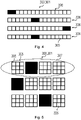
- FIG. 12 shows an attractor formed as a linear array 306 of light sources 305 or pixels.
- the attractor 300 can be formed as an LED strip or as a light snake.
- a time course of the optical stimulus along the trajectory 301 is shown.
- the optical stimulus shifts continuously along the trajectory 301, ie the light sources 305 are deactivated along the trajectory 301 in a predetermined order, ie one after the other.
- Activation, ie turning on means the emission of the light source 305 with a higher intensity, while when the light sources 305 are deactivated, they do not emit at all or at least emit with a lower intensity.
- the light sources 305 or pixels can of course also switch from a deactivated state to one after the other be put into an activated state.
- the attractor 300 is again shown as a linear arrangement 306, with a time course of the optical stimulus also being shown here.
- the stimulus jumps along the trajectory 301, ie the course is discontinuous.
- the evaluation unit 108 is set up to examine the images and/or the data sets and/or the three-dimensional model for incorrect pixels and/or missing image information. Missing image information can also be occlusions, such as those caused by glasses or hair.
- the processor unit 106 causes the attractor 300 to shift the optical or acoustic stimulus along the trajectory 301 to a further stop 302 or back to a previous stop 302 .
- the optical stimulus has been shifted back to a previous stop 302, causing the person 200 to move his head following the stimulus.
- Further images can then be recorded optically by means of the first camera 102 or the second camera 112 in order to generate further two-dimensional data sets, or the optical recording of images from a specific direction can also be repeated.
- the missing image information and/or the missing pixels can be detected from the further data sets generated in this way and compensated for in the depth information or in the three-dimensional model.
- the missing image information is preferably localized in the captured images, with evaluation unit 108 being set up to determine a posture to be assumed by the head in which the missing image information and/or the missing pixels can be optically captured by camera 102 or second camera 112.
- the evaluation unit 108 also determines that of the stops 302 along the trajectory for the stimulus, which causes the person 200 to adopt the posture in which the missing image information and/or the missing pixels can be optically detected.
- the optical or acoustic stimulus is then shifted along the trajectory 301 to the determined stop 302 and further images are optically recorded.
- the displacement of the optical or acoustic stimulus 301 along the trajectory 301 can also take place continuously within the scope of the quality control.
- the high-quality 3D depth information obtained in this way or the 3D model of the person's head can then be converted into a two-dimensional image by projection and stored in a memory.
- figure 5 shows a further embodiment of the attractor 300, which is formed in this case as a surface 307, with a plurality of light sources 305 having areas 308.
- the areas 308 can be activated and / or deactivated independently of each other, so from light to dark or from higher intensity can be switched to lower intensity.
Landscapes
- Engineering & Computer Science (AREA)
- Physics & Mathematics (AREA)
- General Physics & Mathematics (AREA)
- Multimedia (AREA)
- Theoretical Computer Science (AREA)
- Health & Medical Sciences (AREA)
- General Health & Medical Sciences (AREA)
- Oral & Maxillofacial Surgery (AREA)
- Human Computer Interaction (AREA)
- Length Measuring Devices By Optical Means (AREA)
Applications Claiming Priority (1)
| Application Number | Priority Date | Filing Date | Title |
|---|---|---|---|
| DE102021109140.3A DE102021109140A1 (de) | 2021-04-13 | 2021-04-13 | Verfahren und Anordnung zur optischen Erfassung eines Kopfes einer Person |
Publications (2)
| Publication Number | Publication Date |
|---|---|
| EP4075396A1 true EP4075396A1 (fr) | 2022-10-19 |
| EP4075396B1 EP4075396B1 (fr) | 2026-02-18 |
Family
ID=81307200
Family Applications (1)
| Application Number | Title | Priority Date | Filing Date |
|---|---|---|---|
| EP22167735.4A Active EP4075396B1 (fr) | 2021-04-13 | 2022-04-12 | Procédé et agencement de détection optique de la tête d'une personne |
Country Status (2)
| Country | Link |
|---|---|
| EP (1) | EP4075396B1 (fr) |
| DE (1) | DE102021109140A1 (fr) |
Cited By (2)
| Publication number | Priority date | Publication date | Assignee | Title |
|---|---|---|---|---|
| US20220078338A1 (en) * | 2018-12-28 | 2022-03-10 | Sony Group Corporation | Information processing apparatus, information processing method, and information processing program |
| CN116468884A (zh) * | 2023-03-31 | 2023-07-21 | 深圳大学 | 一种基于头部动作的视觉刺激反应监测方法及智能终端 |
Families Citing this family (1)
| Publication number | Priority date | Publication date | Assignee | Title |
|---|---|---|---|---|
| DE102024103385A1 (de) * | 2024-02-07 | 2025-08-07 | Bundesdruckerei Gmbh | Verfahren, Vorrichtung und System zum Aufnehmen eines Gesichtsbilds von dem Gesicht eines Nutzers, und ein entsprechendes Computerprogrammprodukt |
Citations (1)
| Publication number | Priority date | Publication date | Assignee | Title |
|---|---|---|---|---|
| US20150055085A1 (en) * | 2013-08-22 | 2015-02-26 | Bespoke, Inc. | Method and system to create products |
Family Cites Families (3)
| Publication number | Priority date | Publication date | Assignee | Title |
|---|---|---|---|---|
| DE102010015795A1 (de) | 2010-04-20 | 2011-10-20 | Hans-Joachim Ollendorf | Videozentriersystem mit Gesichtsfeldbewertung |
| US20180101989A1 (en) | 2016-10-06 | 2018-04-12 | Google Inc. | Headset removal in virtual, augmented, and mixed reality using an eye gaze database |
| DE102017119625A1 (de) | 2017-08-28 | 2019-02-28 | Bundesdruckerei Gmbh | Vorrichtung und verfahren zur erzeugung eines brillenglaslosen oder brillenlosen gesichtsbildes einer bebrillten person |
-
2021
- 2021-04-13 DE DE102021109140.3A patent/DE102021109140A1/de active Pending
-
2022
- 2022-04-12 EP EP22167735.4A patent/EP4075396B1/fr active Active
Patent Citations (1)
| Publication number | Priority date | Publication date | Assignee | Title |
|---|---|---|---|---|
| US20150055085A1 (en) * | 2013-08-22 | 2015-02-26 | Bespoke, Inc. | Method and system to create products |
Non-Patent Citations (1)
| Title |
|---|
| YUPING LIN ET AL: "Accurate 3D face reconstruction from weakly calibrated wide baseline images with profile contours", 2010 IEEE CONFERENCE ON COMPUTER VISION AND PATTERN RECOGNITION (CVPR), 13-18 JUNE 2010, SAN FRANCISCO, CA, USA, IEEE, PISCATAWAY, NJ, USA, 13 June 2010 (2010-06-13), pages 1490 - 1497, XP031725623, ISBN: 978-1-4244-6984-0 * |
Cited By (3)
| Publication number | Priority date | Publication date | Assignee | Title |
|---|---|---|---|---|
| US20220078338A1 (en) * | 2018-12-28 | 2022-03-10 | Sony Group Corporation | Information processing apparatus, information processing method, and information processing program |
| US12126895B2 (en) * | 2018-12-28 | 2024-10-22 | Sony Group Corporation | Side-view head and ear image capturing for head related transfer functions |
| CN116468884A (zh) * | 2023-03-31 | 2023-07-21 | 深圳大学 | 一种基于头部动作的视觉刺激反应监测方法及智能终端 |
Also Published As
| Publication number | Publication date |
|---|---|
| DE102021109140A1 (de) | 2022-10-13 |
| EP4075396B1 (fr) | 2026-02-18 |
Similar Documents
| Publication | Publication Date | Title |
|---|---|---|
| EP1062640B1 (fr) | Procede pour verifier l'authenticite d'une image enregistree au cours d'un processus d'identification de personne | |
| DE102019100575A1 (de) | Verfahren und system zum erzeugen eines bereichsbildes unter verwendung von daten mit geringer tiefe | |
| EP4046595B1 (fr) | Procédé de détermination d'une teinte de dent | |
| WO2015040001A2 (fr) | Dispositif, système et procédé d'identification d'une personne | |
| DE102012223481B4 (de) | Vorrichtung und Verfahren zum Verfolgen der Position eines peripheren Fahrzeugs | |
| DE102012108838A1 (de) | Verfahren und Vorrichtung zur Aufnahme von Fingerabdrücken auf Basis von Fingerabdruckscannern in zuverlässig hoher Qualität | |
| DE102012016160A1 (de) | Bilderfassung für eine spätere Nachfokussierung oder Fokusmanipulation | |
| DE19511713A1 (de) | Verfahren und Vorrichtung zur automatischen Bildaufnahme von Gesichtern | |
| EP3857304B1 (fr) | Procédé pour la mise au point d'une caméra | |
| EP4075396A1 (fr) | Procédé et agencement de détection optique de la tête d'une personne | |
| DE102020206006A1 (de) | Verfahren zum Kalibrieren und/oder Justieren und Steuereinheit für ein LiDAR-System, LiDAR-System und Arbeitsvorrichtung | |
| DE102012023623B4 (de) | Verfahren zum Zusammensetzen von Teilaufnahmen einer Oberfläche eines Objektes zu einer Gesamtaufnahme des Objektes und System zum Erstellen einer Gesamtaufnahme eines Objektes | |
| DE102005034597A1 (de) | Verfahren und Anordnung zur Erzeugung einer Tiefenkarte | |
| EP3839815A1 (fr) | Dispositif et procédé de détermination d'une caractéristique biométrique du visage d'une personne | |
| DE2749018A1 (de) | Kontrollsystem zur pruefung der echtheit von ausweisen | |
| EP3671543B1 (fr) | Appareil de détection des caractéristiques biométriques d'un visage d'une personne | |
| EP3726425B1 (fr) | Procédé de détection physique, en particulier optique, d'au moins un objet utile | |
| EP1578609B1 (fr) | Procede et dispositif de controle en temps reel d'images imprimees | |
| EP3944136A1 (fr) | Procédé de personnalisation d'un document d'identité et document d'identité | |
| WO2016169879A1 (fr) | Dispositif de capture d'images pour l'identification de personnes | |
| EP4184456B1 (fr) | Procédé et dispositif de détermination d'une image biométrique numérique pour un document de sécurité et procédé de personnalisation d'un document de sécurité | |
| DE102022201279B3 (de) | Verfahren zum Erfassen einer Umgebung eines Fahrzeugs, Kameravorrichtung und Fahrzeug | |
| DE102012211734A1 (de) | Verfahren und Vorrichtung zum Erfassen der Lage eines Objekts in einer Werkzeugmaschine | |
| DE19506328A1 (de) | Verfahren zur Objekterkennung in einem dreidimensionalen Raum | |
| EP3540507A1 (fr) | Dispositif de prise d'image et procédé de prise d'une image d'un document et utilisation |
Legal Events
| Date | Code | Title | Description |
|---|---|---|---|
| PUAI | Public reference made under article 153(3) epc to a published international application that has entered the european phase |
Free format text: ORIGINAL CODE: 0009012 |
|
| STAA | Information on the status of an ep patent application or granted ep patent |
Free format text: STATUS: THE APPLICATION HAS BEEN PUBLISHED |
|
| AK | Designated contracting states |
Kind code of ref document: A1 Designated state(s): AL AT BE BG CH CY CZ DE DK EE ES FI FR GB GR HR HU IE IS IT LI LT LU LV MC MK MT NL NO PL PT RO RS SE SI SK SM TR |
|
| STAA | Information on the status of an ep patent application or granted ep patent |
Free format text: STATUS: REQUEST FOR EXAMINATION WAS MADE |
|
| 17P | Request for examination filed |
Effective date: 20230418 |
|
| RBV | Designated contracting states (corrected) |
Designated state(s): AL AT BE BG CH CY CZ DE DK EE ES FI FR GB GR HR HU IE IS IT LI LT LU LV MC MK MT NL NO PL PT RO RS SE SI SK SM TR |
|
| P01 | Opt-out of the competence of the unified patent court (upc) registered |
Effective date: 20230526 |
|
| STAA | Information on the status of an ep patent application or granted ep patent |
Free format text: STATUS: EXAMINATION IS IN PROGRESS |
|
| 17Q | First examination report despatched |
Effective date: 20240909 |
|
| GRAP | Despatch of communication of intention to grant a patent |
Free format text: ORIGINAL CODE: EPIDOSNIGR1 |
|
| STAA | Information on the status of an ep patent application or granted ep patent |
Free format text: STATUS: GRANT OF PATENT IS INTENDED |
|
| INTG | Intention to grant announced |
Effective date: 20250917 |
|
| RAP3 | Party data changed (applicant data changed or rights of an application transferred) |
Owner name: BUNDESDRUCKEREI GMBH |
|
| GRAS | Grant fee paid |
Free format text: ORIGINAL CODE: EPIDOSNIGR3 |
|
| GRAA | (expected) grant |
Free format text: ORIGINAL CODE: 0009210 |
|
| STAA | Information on the status of an ep patent application or granted ep patent |
Free format text: STATUS: THE PATENT HAS BEEN GRANTED |
|
| AK | Designated contracting states |
Kind code of ref document: B1 Designated state(s): AL AT BE BG CH CY CZ DE DK EE ES FI FR GB GR HR HU IE IS IT LI LT LU LV MC MK MT NL NO PL PT RO RS SE SI SK SM TR |
|
| REG | Reference to a national code |
Ref country code: CH Ref legal event code: F10 Free format text: ST27 STATUS EVENT CODE: U-0-0-F10-F00 (AS PROVIDED BY THE NATIONAL OFFICE) Effective date: 20260218 Ref country code: GB Ref legal event code: FG4D Free format text: NOT ENGLISH |
|
| REG | Reference to a national code |
Ref country code: DE Ref legal event code: R096 Ref document number: 502022007059 Country of ref document: DE |
|
| REG | Reference to a national code |
Ref country code: IE Ref legal event code: FG4D Free format text: LANGUAGE OF EP DOCUMENT: GERMAN |
|
| PGFP | Annual fee paid to national office [announced via postgrant information from national office to epo] |
Ref country code: GB Payment date: 20260324 Year of fee payment: 5 |