EP4077808B1 - Produit en papier et procédé et son appareil de fabrication - Google Patents
Produit en papier et procédé et son appareil de fabrication Download PDFInfo
- Publication number
- EP4077808B1 EP4077808B1 EP19956697.7A EP19956697A EP4077808B1 EP 4077808 B1 EP4077808 B1 EP 4077808B1 EP 19956697 A EP19956697 A EP 19956697A EP 4077808 B1 EP4077808 B1 EP 4077808B1
- Authority
- EP
- European Patent Office
- Prior art keywords
- ply
- plies
- ribbed
- web
- tissue paper
- Prior art date
- Legal status (The legal status is an assumption and is not a legal conclusion. Google has not performed a legal analysis and makes no representation as to the accuracy of the status listed.)
- Active
Links
Images




Classifications
-
- D—TEXTILES; PAPER
- D21—PAPER-MAKING; PRODUCTION OF CELLULOSE
- D21H—PULP COMPOSITIONS; PREPARATION THEREOF NOT COVERED BY SUBCLASSES D21C OR D21D; IMPREGNATING OR COATING OF PAPER; TREATMENT OF FINISHED PAPER NOT COVERED BY CLASS B31 OR SUBCLASS D21G; PAPER NOT OTHERWISE PROVIDED FOR
- D21H27/00—Special paper not otherwise provided for, e.g. made by multi-step processes
- D21H27/002—Tissue paper; Absorbent paper
- D21H27/004—Tissue paper; Absorbent paper characterised by specific parameters
- D21H27/005—Tissue paper; Absorbent paper characterised by specific parameters relating to physical or mechanical properties, e.g. tensile strength, stretch, softness
-
- B—PERFORMING OPERATIONS; TRANSPORTING
- B31—MAKING ARTICLES OF PAPER, CARDBOARD OR MATERIAL WORKED IN A MANNER ANALOGOUS TO PAPER; WORKING PAPER, CARDBOARD OR MATERIAL WORKED IN A MANNER ANALOGOUS TO PAPER
- B31F—MECHANICAL WORKING OR DEFORMATION OF PAPER, CARDBOARD OR MATERIAL WORKED IN A MANNER ANALOGOUS TO PAPER
- B31F1/00—Mechanical deformation without removing material, e.g. in combination with laminating
- B31F1/07—Embossing, i.e. producing impressions formed by locally deep-drawing, e.g. using rolls provided with complementary profiles
-
- B—PERFORMING OPERATIONS; TRANSPORTING
- B31—MAKING ARTICLES OF PAPER, CARDBOARD OR MATERIAL WORKED IN A MANNER ANALOGOUS TO PAPER; WORKING PAPER, CARDBOARD OR MATERIAL WORKED IN A MANNER ANALOGOUS TO PAPER
- B31F—MECHANICAL WORKING OR DEFORMATION OF PAPER, CARDBOARD OR MATERIAL WORKED IN A MANNER ANALOGOUS TO PAPER
- B31F1/00—Mechanical deformation without removing material, e.g. in combination with laminating
- B31F1/12—Crêping
- B31F1/122—Crêping the paper being submitted to an additional mechanical deformation other than crêping, e.g. for making it elastic in all directions
-
- B—PERFORMING OPERATIONS; TRANSPORTING
- B32—LAYERED PRODUCTS
- B32B—LAYERED PRODUCTS, i.e. PRODUCTS BUILT-UP OF STRATA OF FLAT OR NON-FLAT, e.g. CELLULAR OR HONEYCOMB, FORM
- B32B29/00—Layered products comprising a layer of paper or cardboard
- B32B29/002—Layered products comprising a layer of paper or cardboard as the main or only constituent of a layer, which is next to another layer of the same or of a different material
- B32B29/005—Layered products comprising a layer of paper or cardboard as the main or only constituent of a layer, which is next to another layer of the same or of a different material next to another layer of paper or cardboard layer
-
- B—PERFORMING OPERATIONS; TRANSPORTING
- B32—LAYERED PRODUCTS
- B32B—LAYERED PRODUCTS, i.e. PRODUCTS BUILT-UP OF STRATA OF FLAT OR NON-FLAT, e.g. CELLULAR OR HONEYCOMB, FORM
- B32B3/00—Layered products comprising a layer with external or internal discontinuities or unevennesses, or a layer of non-planar shape; Layered products comprising a layer having particular features of form
- B32B3/26—Layered products comprising a layer with external or internal discontinuities or unevennesses, or a layer of non-planar shape; Layered products comprising a layer having particular features of form characterised by a particular shape of the outline of the cross-section of a continuous layer; characterised by a layer with cavities or internal voids ; characterised by an apertured layer
- B32B3/28—Layered products comprising a layer with external or internal discontinuities or unevennesses, or a layer of non-planar shape; Layered products comprising a layer having particular features of form characterised by a particular shape of the outline of the cross-section of a continuous layer; characterised by a layer with cavities or internal voids ; characterised by an apertured layer characterised by a layer comprising a deformed thin sheet, i.e. the layer having its entire thickness deformed out of the plane, e.g. corrugated, crumpled
-
- B—PERFORMING OPERATIONS; TRANSPORTING
- B32—LAYERED PRODUCTS
- B32B—LAYERED PRODUCTS, i.e. PRODUCTS BUILT-UP OF STRATA OF FLAT OR NON-FLAT, e.g. CELLULAR OR HONEYCOMB, FORM
- B32B3/00—Layered products comprising a layer with external or internal discontinuities or unevennesses, or a layer of non-planar shape; Layered products comprising a layer having particular features of form
- B32B3/26—Layered products comprising a layer with external or internal discontinuities or unevennesses, or a layer of non-planar shape; Layered products comprising a layer having particular features of form characterised by a particular shape of the outline of the cross-section of a continuous layer; characterised by a layer with cavities or internal voids ; characterised by an apertured layer
- B32B3/30—Layered products comprising a layer with external or internal discontinuities or unevennesses, or a layer of non-planar shape; Layered products comprising a layer having particular features of form characterised by a particular shape of the outline of the cross-section of a continuous layer; characterised by a layer with cavities or internal voids ; characterised by an apertured layer characterised by a layer formed with recesses or projections, e.g. hollows, grooves, protuberances, ribs
-
- B—PERFORMING OPERATIONS; TRANSPORTING
- B32—LAYERED PRODUCTS
- B32B—LAYERED PRODUCTS, i.e. PRODUCTS BUILT-UP OF STRATA OF FLAT OR NON-FLAT, e.g. CELLULAR OR HONEYCOMB, FORM
- B32B7/00—Layered products characterised by the relation between layers; Layered products characterised by the relative orientation of features between layers, or by the relative values of a measurable parameter between layers, i.e. products comprising layers having different physical, chemical or physicochemical properties; Layered products characterised by the interconnection of layers
- B32B7/04—Interconnection of layers
- B32B7/08—Interconnection of layers by mechanical means
-
- B—PERFORMING OPERATIONS; TRANSPORTING
- B32—LAYERED PRODUCTS
- B32B—LAYERED PRODUCTS, i.e. PRODUCTS BUILT-UP OF STRATA OF FLAT OR NON-FLAT, e.g. CELLULAR OR HONEYCOMB, FORM
- B32B7/00—Layered products characterised by the relation between layers; Layered products characterised by the relative orientation of features between layers, or by the relative values of a measurable parameter between layers, i.e. products comprising layers having different physical, chemical or physicochemical properties; Layered products characterised by the interconnection of layers
- B32B7/04—Interconnection of layers
- B32B7/12—Interconnection of layers using interposed adhesives or interposed materials with bonding properties
-
- D—TEXTILES; PAPER
- D21—PAPER-MAKING; PRODUCTION OF CELLULOSE
- D21H—PULP COMPOSITIONS; PREPARATION THEREOF NOT COVERED BY SUBCLASSES D21C OR D21D; IMPREGNATING OR COATING OF PAPER; TREATMENT OF FINISHED PAPER NOT COVERED BY CLASS B31 OR SUBCLASS D21G; PAPER NOT OTHERWISE PROVIDED FOR
- D21H27/00—Special paper not otherwise provided for, e.g. made by multi-step processes
- D21H27/002—Tissue paper; Absorbent paper
-
- D—TEXTILES; PAPER
- D21—PAPER-MAKING; PRODUCTION OF CELLULOSE
- D21H—PULP COMPOSITIONS; PREPARATION THEREOF NOT COVERED BY SUBCLASSES D21C OR D21D; IMPREGNATING OR COATING OF PAPER; TREATMENT OF FINISHED PAPER NOT COVERED BY CLASS B31 OR SUBCLASS D21G; PAPER NOT OTHERWISE PROVIDED FOR
- D21H27/00—Special paper not otherwise provided for, e.g. made by multi-step processes
- D21H27/30—Multi-ply
- D21H27/40—Multi-ply at least one of the sheets being non-planar, e.g. crêped
-
- B—PERFORMING OPERATIONS; TRANSPORTING
- B31—MAKING ARTICLES OF PAPER, CARDBOARD OR MATERIAL WORKED IN A MANNER ANALOGOUS TO PAPER; WORKING PAPER, CARDBOARD OR MATERIAL WORKED IN A MANNER ANALOGOUS TO PAPER
- B31F—MECHANICAL WORKING OR DEFORMATION OF PAPER, CARDBOARD OR MATERIAL WORKED IN A MANNER ANALOGOUS TO PAPER
- B31F2201/00—Mechanical deformation of paper or cardboard without removing material
- B31F2201/07—Embossing
- B31F2201/0707—Embossing by tools working continuously
-
- B—PERFORMING OPERATIONS; TRANSPORTING
- B31—MAKING ARTICLES OF PAPER, CARDBOARD OR MATERIAL WORKED IN A MANNER ANALOGOUS TO PAPER; WORKING PAPER, CARDBOARD OR MATERIAL WORKED IN A MANNER ANALOGOUS TO PAPER
- B31F—MECHANICAL WORKING OR DEFORMATION OF PAPER, CARDBOARD OR MATERIAL WORKED IN A MANNER ANALOGOUS TO PAPER
- B31F2201/00—Mechanical deformation of paper or cardboard without removing material
- B31F2201/07—Embossing
- B31F2201/0756—Characteristics of the incoming material, e.g. creped, embossed, corrugated
-
- B—PERFORMING OPERATIONS; TRANSPORTING
- B31—MAKING ARTICLES OF PAPER, CARDBOARD OR MATERIAL WORKED IN A MANNER ANALOGOUS TO PAPER; WORKING PAPER, CARDBOARD OR MATERIAL WORKED IN A MANNER ANALOGOUS TO PAPER
- B31F—MECHANICAL WORKING OR DEFORMATION OF PAPER, CARDBOARD OR MATERIAL WORKED IN A MANNER ANALOGOUS TO PAPER
- B31F2201/00—Mechanical deformation of paper or cardboard without removing material
- B31F2201/07—Embossing
- B31F2201/0758—Characteristics of the embossed product
- B31F2201/0761—Multi-layered
- B31F2201/0764—Multi-layered the layers being nested
-
- B—PERFORMING OPERATIONS; TRANSPORTING
- B31—MAKING ARTICLES OF PAPER, CARDBOARD OR MATERIAL WORKED IN A MANNER ANALOGOUS TO PAPER; WORKING PAPER, CARDBOARD OR MATERIAL WORKED IN A MANNER ANALOGOUS TO PAPER
- B31F—MECHANICAL WORKING OR DEFORMATION OF PAPER, CARDBOARD OR MATERIAL WORKED IN A MANNER ANALOGOUS TO PAPER
- B31F2201/00—Mechanical deformation of paper or cardboard without removing material
- B31F2201/07—Embossing
- B31F2201/0758—Characteristics of the embossed product
- B31F2201/0761—Multi-layered
- B31F2201/0769—Multi-layered the layers being shifted
-
- B—PERFORMING OPERATIONS; TRANSPORTING
- B31—MAKING ARTICLES OF PAPER, CARDBOARD OR MATERIAL WORKED IN A MANNER ANALOGOUS TO PAPER; WORKING PAPER, CARDBOARD OR MATERIAL WORKED IN A MANNER ANALOGOUS TO PAPER
- B31F—MECHANICAL WORKING OR DEFORMATION OF PAPER, CARDBOARD OR MATERIAL WORKED IN A MANNER ANALOGOUS TO PAPER
- B31F2201/00—Mechanical deformation of paper or cardboard without removing material
- B31F2201/07—Embossing
- B31F2201/0784—Auxiliary operations
- B31F2201/0787—Applying adhesive
-
- B—PERFORMING OPERATIONS; TRANSPORTING
- B32—LAYERED PRODUCTS
- B32B—LAYERED PRODUCTS, i.e. PRODUCTS BUILT-UP OF STRATA OF FLAT OR NON-FLAT, e.g. CELLULAR OR HONEYCOMB, FORM
- B32B2250/00—Layers arrangement
- B32B2250/03—3 layers
-
- B—PERFORMING OPERATIONS; TRANSPORTING
- B32—LAYERED PRODUCTS
- B32B—LAYERED PRODUCTS, i.e. PRODUCTS BUILT-UP OF STRATA OF FLAT OR NON-FLAT, e.g. CELLULAR OR HONEYCOMB, FORM
- B32B2250/00—Layers arrangement
- B32B2250/04—4 layers
-
- B—PERFORMING OPERATIONS; TRANSPORTING
- B32—LAYERED PRODUCTS
- B32B—LAYERED PRODUCTS, i.e. PRODUCTS BUILT-UP OF STRATA OF FLAT OR NON-FLAT, e.g. CELLULAR OR HONEYCOMB, FORM
- B32B2250/00—Layers arrangement
- B32B2250/05—5 or more layers
-
- B—PERFORMING OPERATIONS; TRANSPORTING
- B32—LAYERED PRODUCTS
- B32B—LAYERED PRODUCTS, i.e. PRODUCTS BUILT-UP OF STRATA OF FLAT OR NON-FLAT, e.g. CELLULAR OR HONEYCOMB, FORM
- B32B2250/00—Layers arrangement
- B32B2250/26—All layers being made of paper or paperboard
-
- B—PERFORMING OPERATIONS; TRANSPORTING
- B32—LAYERED PRODUCTS
- B32B—LAYERED PRODUCTS, i.e. PRODUCTS BUILT-UP OF STRATA OF FLAT OR NON-FLAT, e.g. CELLULAR OR HONEYCOMB, FORM
- B32B2307/00—Properties of the layers or laminate
- B32B2307/50—Properties of the layers or laminate having particular mechanical properties
- B32B2307/538—Roughness
-
- B—PERFORMING OPERATIONS; TRANSPORTING
- B32—LAYERED PRODUCTS
- B32B—LAYERED PRODUCTS, i.e. PRODUCTS BUILT-UP OF STRATA OF FLAT OR NON-FLAT, e.g. CELLULAR OR HONEYCOMB, FORM
- B32B2307/00—Properties of the layers or laminate
- B32B2307/70—Other properties
- B32B2307/718—Weight, e.g. weight per square meter
-
- B—PERFORMING OPERATIONS; TRANSPORTING
- B32—LAYERED PRODUCTS
- B32B—LAYERED PRODUCTS, i.e. PRODUCTS BUILT-UP OF STRATA OF FLAT OR NON-FLAT, e.g. CELLULAR OR HONEYCOMB, FORM
- B32B2307/00—Properties of the layers or laminate
- B32B2307/70—Other properties
- B32B2307/72—Density
-
- B—PERFORMING OPERATIONS; TRANSPORTING
- B32—LAYERED PRODUCTS
- B32B—LAYERED PRODUCTS, i.e. PRODUCTS BUILT-UP OF STRATA OF FLAT OR NON-FLAT, e.g. CELLULAR OR HONEYCOMB, FORM
- B32B2555/00—Personal care
Definitions
- the invention relates to a multi-ply tissue paper product, particularly a hygiene or wiping product, with at least a first outer ply, a second outer ply, and at least one inner ply, and a method of producing such a tissue product.
- tissue paper product relates to an absorbent paper based on cellulose wadding which is also called tissue paper base-sheet in this field of technology.
- Tissue paper is defined as a soft absorbent paper having a low basis weight, of for example 8 to 40 g/m 2 , preferably 10 to 25 g/m 2 per ply.
- the total basis weight of multi-ply tissue products may preferably be up to a maximum of 110 g/m 2 , more preferably to a maximum of 80 g/m 2 .
- Its density is typically below 0.6 g/cm 3 , preferably below 0.30 g/cm 3 and more preferably between 0.08 and 0.20 g/cm 3 .
- the production of tissue paper is distinguished from conventional paper production, e.g. printing paper production, by its relatively low basis weight and relatively high tensile energy absorption index (see ISO 12625-4).
- Conventional paper and tissue paper also differ in general with regard to the modulus of elasticity that characterises the stress/strain properties of these generally planar products as a material parameter.
- the fibres contained in the tissue paper are mainly cellulosic fibres, such as pulp fibres from chemical pulp (e.g. Kraft or sulphite), mechanical pulp (e.g. ground wood), thermo mechanical pulp, chemo-mechanical pulp and/or chemo- thermo-mechanical pulp (CTMP). Pulps derived from both deciduous (hardwood) and coniferous (softwood) can be used. Fibres may also come from non-wood plants e.g. cereal, bamboo, jute, and sisal. The fibres or a portion of the fibres may be recycled fibres, which may belong to any or all of the above categories. The fibres can be treated with additives, e.g.
- tissue paper may also contain other types of fibres, e.g. regenerated cellulosic fibres or synthetic fibres for enhancing, for instance, strength, absorption, smoothness or softness of the tissue paper.
- Tissue paper products in particular for use as hygiene or wiping products primarily include all kinds of dry-creped tissue paper, wet-creped paper, TAD-paper (Through Air Drying), tissue paper based on structured technologies such as ATMOS ® , NTT, UCTAD and cellulose or pulp-wadding, or combinations, laminates or mixtures thereof.
- Typical properties of these hygiene and wiping products include the ability to absorb tensile stress energy, their drapability, good textile-like flexibility, properties which are frequently referred to as bulk softness, a high surface softness and a high specific volume with a perceptible thickness.
- a liquid absorbency as high as possible and, depending on the application, a suitable wet and dry strength as well as an appealable visual appearance of the outer product's surfaces are desired.
- These properties allow these hygiene and wiping products to be used, for example, as cleaning wipes such as windscreen cleaning wipes, industrial wipes, kitchen paper or the like; as sanitary products such as for example bathroom tissue, handkerchiefs, household towels, towels and the like; as cosmetic wipes such as for example facials and as serviettes or napkins, just to mention some of the products that can be used.
- the hygiene and wiping products can be dry, moist, wet, printed or pre-treated in any manner.
- the hygiene and wiping products may be folded, interleaved or individually placed, stacked or rolled, connected or not, in any suitable manner.
- tissue paper is to be made out of pulp
- the process essentially comprises a forming step that includes a headbox- and a forming wire section, and a drying section, either through air drying or conventional drying on a Yankee cylinder.
- the production process also usually includes the crepe process essential for tissue paper and, finally, typically a monitoring and winding area.
- Tissue paper can be formed by placing the fibres, in an oriented or random manner, on one or between two endless continuously rotating wires or felts of a paper making machine while simultaneously removing water.
- crepe process which crucially influences the properties of the finished tissue product in conventional processes.
- the conventional dry crepe process involves creping on a usually 3.0 to 6.5 m diameter drying cylinder, the so-called Yankee cylinder, by means of a crepe doctor blade with the aforementioned final dry-solids content of the raw tissue paper. Wet creping can be used as well, if lower demands are made of the tissue quality.
- the creped, finally dry raw tissue paper, the so-called base tissue is then available for further processing into the paper product for a tissue paper product.
- the processing step from the base tissue to the finished tissue product occurs in processing machines (converting machines) which include operations such as unwinding the base tissue, calendering of the tissue, laminating, printing or embossing.
- plies may be combined together by a combining operation of a chemical nature (e.g. by adhesive bonding), or of a mechanical nature (e.g. by knurling or so-called edge-embossing), or a combination of both. Examples of such process steps for combining plies together will be described in more detail in the below.
- processing to finished tissue product may involve e.g. longitudinal cut, folding, cross cut etc.
- individual tissue products may be positioned and brought together to form stacks, which may be individually packaged.
- processing steps may also include application of substances like scents, lotions, softeners or other chemical additives.
- a film of adhesive is deposited over some or all of the surface of at least one of the plies, then the adhesive-treated surface is placed in contact with the surface of at least one other ply.
- the plies When several plies are combined together using mechanical bonding, the plies may be combined by knurling, by compression, by edge-embossing, union embossing and/or ultrasonic.
- Mechanical and adhesive bonding may also be combined to combine several plies together to form a multi-ply product.
- Embossing is to change the shape of a sheet from flat to shaped, so that there are areas that are raised and/or recessed from the rest of the surface. It therefore constitutes a deformation of the previously flat sheet, and results in a ply having a particular relief.
- the thickness of the ply or of the multiple plies is increased after embossing compared with its initial thickness.
- An embossing process is carried out between an embossing roll and an anvil roll.
- the embossing roll can have protrusions or depressions on its circumferential surface leading to embossed protrusions/depressions in the paper web.
- Anvil rolls may be softer than the corresponding embossing roll and may consist of rubber, such as natural rubber, or plastic materials, paper or steel. If the anvil roll is made of a softer material like rubber, a contact area/nip can be formed between the embossing roll (e.g. steel roll) and the anvil roll by the deformation of the softer roll.
- a pattern can be applied to a tissue paper fulfilling a decorative and/or functional purpose.
- a functional purpose may be to improve the properties of the hygiene paper product, that is, the embossment may improve the product thickness, absorbency, bulk, softness etc.
- a functional purpose may also be to provide a joint to another ply in a multi-ply product.
- construction embossment an embossment performed in order to form a bond or joint to another ply is referred to as "construction embossment”.
- a construction embossment may be made to perform joining of plies using adhesive and/or mechanical ply-bonding.
- pre-embossment Another type of embossment is referred to herein as a "pre-embossment".
- a pre-embossment could preferably be applied to a web or ply prior to its joining to the other plies of a multi-ply tissue product.
- Such pre-embossment may be made for a functional purpose e.g. as laid out in the above to increase the thickness of the ply, the absorbency, bulk and/or softness.
- embossments may in addition to their functional purpose also serve a decorative purpose, i.e. the embossment patterns may be designed to be decorative.
- Micro-embossment is used herein for an embossment pattern with a dense configuration.
- the micro-embossment may comprise dots in the range 25 to 100 dots per cm 2 , preferably 35 to 80 dots per cm 2 .
- a micro-embossment may advantageously be a pre-embossment.
- micro-embossed dots may have different relatively simple surface shapes such as circles, ovals, squares, rectangles or diamonds.
- a micro-embossed ply may be micro-embossed all over the surface of the ply.
- a micro-embossed ply may be micro-embossed over more than 60% of the surface of the ply, preferably more than 70%.
- Construction embossments often consist of more complex shapes than the micro-embossments, e.g. forming decorative elements such as flowers, logos, animals or the like. Typically, these elements are larger in size compared to the dots of a micro-embossment, and cover less than 10%, preferably between 3 and 6% of the tissue surface.
- embossing can lead to embossed elements all having the same height or to embossing elements having different heights.
- non-embossed ply as used herein is meant a ply which is not pre-embossed.
- a non-embossed ply could be provided with construction embossments, unless this is specifically excluded.
- a first web is directed through the nip between an embossing roll and an anvil roll. In this nip the web is provided with a construction embossing pattern. Thereafter, an application roll for adhesive applies adhesive to those parts of the first web at which there are protruding embossing elements in the embossing roll.
- the adhesive is transported from an adhesive bath via an adhesive transfer roll to the application roll.
- a second web is transported to the first web and adhesively bonded to the first web in the nip between the so-called marrying roll and the embossing roll. The adhesive bonding takes place at those portions of the embossing pattern at which the adhesive was applied.
- the second manufacturing method is very similar to the above-described Goffra Incolla method. It comprises an additional pair of rolls consisting of a second embossing roll and a second anvil roll. The additional pair of rolls serves to emboss the second web before it is adhesively bonded to the first web using the marrying roll. Typically, the additional pair of rolls is placed close to the first pair of rolls and the marrying roll. Especially when using the so-called Nested-method such close arrangement is important.
- the Nested-method can be considered as a special case of the general DESL-manufacturing method.
- the embossing elements of the first embossing roll and the embossing elements of the second embossing roll are arranged such that the embossed elements of the first embossed ply and the embossed elements of the second embossed ply fit into each other similar to a gearing system. This serves to achieve a mutual stabilization of the two plies.
- the third manufacturing method (Pin-to-Pin/Foot-to-Foot) is similar to the DESL method.
- both the upper ply and the lower ply are embossed, respectively.
- Adhesive is applied onto the embossed protrusions of the first ply.
- the ply bonding however, is not achieved by means of a marrying roll as in the DESL method but is achieved directly by means of the protruding embossing elements of the second embossing roll.
- the width of the nip between the first embossing roll and the second embossing roll is required, which is mainly defined by the individual thickness of both webs (upper ply and lower ply).
- the embossing rolls have to be designed such that the protruding embossing elements of both rolls face each other. This is the reason why the terminology Pin-to-Pin or Foot-to-Foot embossing is used.
- the first embossing roll is formed of a hard material, usually metal, especially steel, but there are also known embossing rolls made of hard rubber or hard plastics materials.
- the embossing rolls can be a male roll having individual protrusions.
- the embossing roll can be a female roll with individual embossing depressions.
- Typical heights/depths of the engraved embossing patterns are between 0.4 and 2.0 mm.
- the anvil roll typically has a rubber coating with a hardness between 35 Shore A and 85 Shore A.
- structurized anvil rolls especially rolls made of paper, rubber or plastics materials or steel are also known.
- the applicator roll for adhesive is usually also a rubber roll with a plain smooth circumferential surface, wherein the hardness of the rubber coating is between the hardness of the anvil roll and the hardness of the marrying roll. Commonly used values for the hardness of the rubber coating are 70 to 85 Shore A. When selecting the rubber material its compatibility with the adhesive to be applied has to be ensured.
- the application system for adhesive consisting of applicator roll, adhesive transfer roll and adhesive bath can be designed as a so-called immersion roll system in which the adhesive transfer roll is immersed into the adhesive bath and transports adhesive by means of surface tension and adhesive forces out of the adhesive bath.
- immersion roll system in which the adhesive transfer roll is immersed into the adhesive bath and transports adhesive by means of surface tension and adhesive forces out of the adhesive bath.
- Typical adhesives are polyvinyl alcohol and methyl cellulose based adhesives.
- Adhesive transfer rolls have become known having defined pit-shaped depressions in their circumferential surface. Such adhesive transfer rolls are known as anilox rolls. Such roll is usually made of ceramic material or it is a roll made of steel or copper and coated with chromium. Excessive adhesive is removed from the surface of the anilox roll by means of a blade. The amount of adhesive is determined by the volume and the number of depressions.
- a second possibility to influence the amount of adhesive transferred is the adjustment of the difference in circumferential speeds of the adhesive transfer roll and the applicator roll.
- the adhesive transfer roll rotates slower than the applicator roll.
- the circumferential speed of the adhesive transfer roll is usually between 5% and 100% of the first circumferential speed of the applicator roll.
- the adhesive bath can be designed as a simple trough, application systems with a blade can also be designed as chamber systems.
- the marrying roll commonly has a smooth rubber surface.
- a suitable material is e.g. NBR (acrylnitrile-butadien rubber).
- marrying rolls also have become known which, in addition to the rubber coating, are provided with a steel coating. Such steel coating is often provided in form of a steel band spirally wound onto the rubber coating.
- micro-pre-embossing device In case that the single layers individually or together are micro-embossed, a so-called micro-pre-embossing device can be used. Such pre-embossing device is often used in combination with the Goffra Incolla technology.
- Another well-known embossing technique comprises a steel embossing roll and a corresponding anvil steel roll (so called Union embossing). The surfaces of these rolls are being formed in such a manner that deformation of the paper and mechanical ply bonding without using adhesives are achieved within one single embossing step.
- the embossing technology also comprises so-called "double height embossing" whereby the embossing protrusions have different heights.
- the embossing not only serves to provide bulk to the fibrous product but also to provide an improved optical appearance to the product.
- the optical appearance can be improved by combining embossing and coloring steps. Another reason for embossing is to generate higher absorbency or improved perceived softness.
- the higher elements usually "act" as construction embossments to provide ply-bonding, whereas the lower elements are often micro-embossment providing thickness to the ply without providing a bonding to another ply(ies).
- Double height embossing is typically used for the Nesfip or NoveFip embossing technology as described in the patent applications referred to in the above.
- multi-ply tissues and methods for production thereof proposed in the past may be very useful in many applications, there is still a need for improvements.
- Such improvements may relate the thickness, softness, bulkiness, and absorption capacity of multi-ply tissue products.
- Such improvements may relate to user perceived properties such as feel and perceived softness. Further, this should preferably be obtained by using less paper fibres resulting in economic and environmental positive aspects.
- WO 2009/151544 A2 discloses features falling under the preamble of claim 1.
- An object of the product and method as proposed herein is to provide an improvement in relation to or more of the above-mentioned points.
- a first aspect of the present disclosure relates to a multi-ply tissue paper product, particularly a hygiene or wiping product, comprising a first inner ply being a creped ribbed ply, a first outermost ply, and a second outermost ply on each side of the inner ply.
- the first and second outermost plies are non-ribbed plies.
- a multi-ply product will hence comprise two outermost plies.
- outermost ply is meant a ply which forms an outermost surface of a product or web.
- inner ply is meant a ply on the interior of the product or web, i.e. any ply other than the outer most plies.
- a product or web may contain one or more inner plies.
- a creped ribbed ply is defined as a ply comprising creping lines extending along a first direction, and parallel ribs and values extending continuously along a second direction being substantially perpendicular to the first direction.
- the ribs and valleys give rise to an average core roughness Rk as measured along said first direction in the range 10 to 300 ⁇ m, and to a number of peaks being 4 to 12 ribs per cm as measured along said first direction.
- a non-ribbed ply is defined as a ply displaying no parallel ribs and valleys extending continuously along any direction of the ply or displaying parallel ribs and valleys extending continuously along any direction of the ply, said ribs and valleys providing a number of peaks being less than 4 per cm.
- the surface structures to be considered are the structures inherent in and extending all over the surface of the ply or sheet.
- construction embossment i.e. embossments serving the purpose of assembling more than one ply together in a multi-ply product, are to be disregarded when evaluating a ply for being a creped ribbed ply or a non-ribbed ply.
- the first direction is the cross-direction of the ply, whereas said second direction is the machine direction of the ply.
- the third direction being perpendicular to the first and second direction is a direction perpendicular to the generally two-dimensional extension of the ply.
- the ribs-and-valleys on at least one side of the ply should fulfil the requirements as set out in the definition in the above.
- the ribs-and-valleys on both sides of the ply should fulfil the requirements as set out in the definition in the above.
- the ribs on one side of the ply correspond to valleys on the other side of the ply, and the valleys on one side of the ply correspond to ribs on the other side of the ply.
- said ribs and valleys are non-embossed, i.e. said ribs and valleys are not formed by embossment. Instead, the ribs and valleys are formed during production of the ply. In particular, the ribs and valleys are achieved during the creping of the creped ribbed ply.
- the creped ribbed ply is produced using a creping blade provided with a rake edge comprising indentations.
- the creping blade comprising said indentations will deform the web upon removal from the Yankee drier hence creating the creped ribbed structure.
- the creped ribbed ply created using a creping blade with a rake edge comprising indentations will be regular in that the ribs and valleys display generally constant height, width, direction and distribution over the web or ply.
- crepe lines which are also created upon removal of the web form the Yankee drier.
- the crepe lines will typically extend over the cross-direction of a web. Crepe bars will generally appear with a slight irregularity, and although it is possible to measure/calculate i.e. the number of crepe lines per cm on average, the crepe lines will not extend in a regular manner continuously over the web or ply.
- embossed structures which are created by deformation of the web, usually within the later converting process.
- the ribs and valleys of the creped ribbed structure are non-embossed.
- the creped ribbed ply will generally display ribs and valleys on both faces of the ply.
- the height and shape of the ribs and valleys may vary slightly between the two sides. The number of ribs per cm will however be the same.
- Tissue paper webs having a creped ribbed structure and as produced using a creping blade with a rake edge comprising indentations are known and proposed for use in single-ply and multi-ply tissues and towels.
- the use of tissue paper webs having a creped ribbed structure has been limited primarily due to their limited softness.
- plies having a creped ribbed structure such as the relatively low fibre consumption with maintained thickness are rendered available to new types of products, in particular to relatively thin and soft multi-ply products.
- an inner ply being a creped ribbed ply may provide advantages in combination with different manners of joining the layers in the multi-ply product.
- the use of a creped ribbed ply may be possible where other structures for providing increased thickness, e.g. embossment, are unsuitable considering the risk for unintentional nesting between embossments of adjacent plies.
- the tissue paper products as proposed herein comprises a first inner ply having a basis weight of 10 to 30 gsm, the first inner ply being a creped ribbed ply as defined in the above.
- a non-ribbed ply may display no parallel ribs and valleys extending continuously along any direction of the ply.
- the non-ribbed ply may display parallel ribs and valleys extending continuously along any direction of the ply, but providing a number of peaks being less than 4 per cm, i.e. only scarcely distributed ribs and valleys.
- the non-ribbed plies will generally not be perceived as "ribbed” by a user feeling over the surface of the non-ribbed plies. Rather, the non-ribbed plies will be perceived as soft, in particular in relation to a creped ribbed ply.
- creping lines do not give rise to parallel ribs and valleys extending continuously over the ply. Rather, creping lines are irregular lines whose height, width and distribution may vary as seen over a ply.
- parallel ribs and valleys extending continuously will be ribs and valleys displaying essentially constant widths and heights, and extending linearly and in parallel over the ply.
- the non-ribbed plies may also be some kind of structured ply. As long as the plies do not display parallel ribs and valleys extending continuously along any direction of the ply, the outermost plies will be perceived as generally soft.
- said first inner ply comprises a number of peaks as measured along said first direction being 6 to 12 ribs per cm, preferably 8 to 12 ribs per cm and/or said said ribs and valleys of said first inner ply providing an average core roughness Rk in the range 20 to 150 ⁇ m.
- the first inner ply has a basis weight of 12 to 28 gsm, preferably 14 to 24 gsm.
- the tissue paper product comprises no more than two non-ribbed plies external of said inner ply.
- the tissue paper product comprises no more than one non-ribbed ply external of said inner ply.
- said ply or plies external of said inner ply and which are non-ribbed plies each have a basis weight being less than 30 gsm, between 10 and 30 gsm, most preferred between 12 and 25 gsm.
- the outermost ply or plies being a non-ribbed ply (plies) displays no parallel ribs and valleys extending continuously along any direction of the ply or each display parallel ribs and valleys extending continuously along any direction of the ply, said ribs and valleys providing a number of peaks being less than 2 per cm, preferably less than 1 per cm.
- the outermost ply or plies being a non-ribbed ply (plies) displays no parallel ribs and valleys extending continuously along any direction of the ply or each display parallel ribs and valleys extending continuously along any direction of the ply, said ribs and valleys providing said ribs and valleys providing an average core roughness Rk less than 10 ⁇ m, preferably less than 5 ⁇ m.
- the multi-ply tissue paper product comprises an adhesive joining at least two of the plies of said multi-ply tissue product, said adhesive being applied over a total adhesive area being less than 10% of a total area of said multi-ply tissue product, preferably less than 6 % of a total area of said multi-ply tissue product, most preferred 3 to 6 % of a total area of said multi-ply tissue product.
- the multi-ply tissue paper product comprises construction embossments joining at least two out of the plies of said multi-ply tissue product, said construction embossments being applied over a total construction embossment area being less than 10% of a total area of said multi-ply tissue product, preferably less than 6 % of a total area of said multi-ply tissue product, most preferred 3 to 6 % of a total area of said multi-ply tissue product.
- the multi-ply tissue paper product comprises no more than five plies, preferably no more than four plies, most preferred no more than three plies.
- the multi-ply tissue paper product comprises four plies only.
- the multi-ply tissue paper product comprises three plies only.
- said first and/or second outermost ply is a creped ply.
- said first and/or second outermost ply is a TAD ply.
- the first and/or second outermost ply is/are a pre-embossed plie(s), preferably micro-embossed.
- the product comprises at least a second inner ply.
- the second inner ply is a pre-embossed ply, preferably a micro-embossed ply.
- the second inner ply is a creped ribbed ply.
- the second inner ply may comprise 6 to 12 ribs per cm, preferably 8 to 12 ribs per cm as seen along said first direction.
- the second inner ply has a basis weight of 12 to 28 gsm, preferably 14 to 24 gsm.
- the product comprises one to four inner plies all being creped plies comprising a creped ribbed structure, optionally as set out in the above.
- the second inner ply is a non-ribbed ply.
- the product comprises a second inner ply
- the first inner ply is non-embossed
- the second inner ply is micro-embossed.
- the first and second inner plies are adjacent plies in the product.
- the first inner ply is non-embossed.
- the first inner ply is construction embossed in register with at least one, preferably both of two adjacent plies to said first inner ply, so as to form nested joints between the first inner ply and the adjacent ply or plies.
- At least one, preferably both of two adjacent plies to the first inner ply is/are construction embossed to join to the first inner ply.
- said adjacent plies are joined to the first inner ply by adhesive and/or said adjacent plies are joined to the first inner ply by mechanical ply-bonding.
- At least one, preferably both of said two adjacent plies to the first inner ply are pre-embossed.
- At least one of the two adjacent embossed plies is the first or second outermost ply, preferably said two adjacent embossed plies are the first and the second outermost plies.
- a first adjacent ply to the inner ply comprises a first embossment pattern and a second embossment pattern, the height of the second embossment pattern being less than the height of the first embossment pattern, wherein the inner ply and the first adjacent ply are joined at a level of at least part of the tops of the first embossment pattern of said first outer ply, whereby said first embossment pattern is a construction embossment pattern and said second embossment pattern is not a construction embossment pattern.
- the inner ply and the first adjacent ply are joined in a nested mode.
- first adjacent ply, the inner ply and the second adjacent ply to the inner ply are joined by adhesive joints at a level of the first embossment pattern.
- said first adjacent ply is said first outermost ply and/or said second adjacent ply is said second outermost ply.
- said first outermost ply comprises a first embossment pattern and a second embossment pattern, the height of the second embossment pattern being less than the height of the first embossment pattern, wherein said second outermost ply is micro-embossed, and wherein said first inner ply is non-embossed.
- the product comprises a second inner ply, said second inner ply being non-embossed or micro-embossed.
- the first embossment pattern of the first outermost ply is a construction embossment pattern and said second embossment pattern of the first outermost ply is not a construction embossment pattern.
- the inner ply and the first outermost ply are joined at a level of at least part of the tops of the first embossment pattern of said first outermost ply.
- the multi-ply tissue product according to the first or second aspect herein may both be combined with the optional features as mentioned in the above. All combinations of such features are considered to be a part of this disclosure.
- a method for manufacturing a multi-ply tissue paper web for tissue paper products having the features of claim 14.
- the step of providing a first inner web comprises providing a first creped ribbed web being produced using a creping blade provided with a rake edge comprising indentations.
- said rake edge comprises indentations in a number of 4 to 12 per cm over the rake edge length, and/or said indentations having a depth of 0.1 to 1.0 mm.
- the method comprises that the first web is embossed with a first embossment pattern and a second embossment pattern, the height of the second embossment pattern being less than the height of the first embossment pattern, wherein the inner web and the first web are joined at a level of at least part of the tops of the first embossment pattern of said first outer web, whereby said first embossment pattern is a construction embossment pattern and said second embossment pattern is not a construction embossment pattern.
- the first web, the inner ply and the second web are joined by adhesive joints at a level of the first embossment pattern.
- the method comprises providing the multi-ply web with perforations dividing the web into individual multi-ply products, or cutting the multi-ply web to form individual multi-ply products.
- the method comprises steps of producing a product according to any one of the options as stated in the above regarding the first aspect of the invention.
- the products as described herein may be used for different purposes, such as handkerchiefs, facials, napkins, wipes, household towels, or bathroom tissue.
- Fig. 1 is a perspective view schematically illustrating a ply being a creped ribbed ply as described herein.
- the creped ribbed ply displays creping lines as is typical for creped products.
- the creping lines extend generally along a first direction, which is the cross-direction of the ply. Creping lines, being the result of wrinkling when the creped product is removed from the dryer by the doctor blade, are usually slightly irregular in their nature.
- the creped ribbed ply also displays ribs and valleys extending continuously and in parallel along a second direction perpendicular to the first direction of the ply.
- the second direction would hence be the machine direction of the ply.
- the structure of the creped ribbed ply is regular, meaning that the distribution and shape of the ribs have a regular appearance over the ply.
- a plurality of ribs 300 extend in parallel forming valleys 400 between them.
- the ribs 300 and valleys 400 extend regularly and continuously all over the ply.
- the ribs and valleys are apparent also on a bottom side of the product, where the bottom side of the upwardly directed ribs 300 form bottom-side valleys 400' and the bottom side of the upwardly directed valleys 400 form bottom-side ribs 300'.
- the top side and the bottom side ribs 300, 300' may not be identical, but the height of the ribs may be greater on one of the sides.
- At least one inner ply of the multi-ply product claimed should be a creped ribbed ply as defined herein and as illustrated in Fig. 1 .
- creped ribbed ply is a ply comprising creping lines extending along a first direction, and parallel ribs and valleys extending continuously along a second direction being substantially perpendicular to said first direction, said ribs and valleys providing an average core roughness Rk in the range 10 to 300 ⁇ m, preferably 20 to 150 ⁇ m, and a number of peaks being 4 to 12 per cm as measured along said first direction.
- Core Roughness Rk is defined according to ISO 13565-1 and ISO 13565-2.
- the roughness profile as per ISO 13565-1 is generated by a special filtering technique minimizing profile distortions due to deep valleys in plateau profiles.
- a straight line divides the Abbott-Firestone curve (See Fig. 2 ) into three areas from which the parameters are then computed as per ISO 13565-2.
- Core roughness depth Rk is the depth of the roughness core profile. In other words, it is the core height of the profile along the Y-axis of the Abbott-Firestone curve generated by placing a 40% line on the curve at the minimum slope point and extending the lines to the 0% and the 100% points.
- Reduced peak height Rpk is the mean height of the protruding peaks above the roughness core profile.
- Reduced valley depth Rvk is the mean depth of the valleys protruding from the roughness core profile.
- Mr1 and Mr2 are the smallest and the highest material ratios of the roughness core profile.
- Evaluation length is the length over which the values of surface parameters are evaluated. It is recommended that the evaluation length consists of five sampling lengths although it may comprise any number of sampling lengths.
- Mean Line M is the reference line about which the profile deviations are measured.
- the mean line of the roughness profile is usually established by analogue or digital filters with the selected cut-off corresponding to the roughness sampling length.
- Profile Peak is the point of maximum height on a portion of a profile that lies above the mean line and between two intersections of the profile with the mean line.
- Profile valley is the point of maximum depth on a portion of a profile that lies below the mean line and between two intersections of the profile with the mean line.
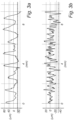
- Fig. 3a is a graph illustrating roughness measurements on a ply being a creped ribbed ply, as measured along the cross-direction of the ply. The regular ribs and valleys are clearly visible from the graph, and the number of peaks per cm - corresponding to the number of ribs per cm - may be counted. In this sample, there are 8 peaks/cm.
- Fig. 3b is a graph illustrating roughness measurements on a ply being an ordinary CWP ply, i.e. a creped ply not being defined as a creped ribbed ply. The measurement is made along the machine direction of the ply, and hence illustrates the appearance of the creping lines. It is seen how the creping lines lack the regular appearance of the ribs-and-valleys in Fig. 3a .
- the appearance of the ply if roughness is measured along the machine direction, i.e. parallel to the ribs and valleys, may be found to be similar to the one in Fig. 3b , namely to display conventional creping lines.
- a non-ribbed ply is defined herein as a ply displaying no parallel ribs and valleys extending continuously along any direction of the ply or displaying parallel ribs and valleys extending continuously along any direction of the ply, said ribs and valleys providing a number of peaks being less than 4 per cm.
- peaks-per-cm measurements such as those laid out in the above may be performed.
- Fig. 4 schematically illustrates a variant of a multi-ply tissue paper product 1. It includes three plies, namely a first outermost ply 2, a second outermost ply 3 and an inner ply 100.
- the inner ply 100 is a creped ribbed ply as described above, as illustrated by the undulations in the drawing forming ribs and valleys.
- outermost ply is meant an outermost ply of the multi-ply tissue paper product 1.
- first outermost ply 2 may be a top ply of the tissue paper product 1
- second outermost ply 3 may be a bottom ply of the tissue paper product 1.
- the outermost plies 2, 3 are non-ribbed plies as described above.
- a multi-ply tissue paper product 1 may be a three-ply product consisting of three plies being said first outermost ply 2, second outermost ply 3 and said inner ply 100.
- the inner ply 100 being a creped ribbed ply is sandwiched between the first and second outermost plies 2, 3.
- the plies of the tissue product may be combined together by a combining operation of a chemical nature (e.g. by adhesive bonding), or of a mechanical nature (e.g. by knurling or edge-embossing), or a combination of both as mentioned in the above.
- a chemical nature e.g. by adhesive bonding
- a mechanical nature e.g. by knurling or edge-embossing
- the first and/or second outermost ply may be embossed.
- the first and/or second outer ply 2, 3 may be creped plies.
- the first and/or second outer ply 2, 3 may be TAD plies.
- Fig. 5 is a schematic side view of another variant of a multi-ply tissue paper product 1 comprising a first outermost ply 2, a second outermost ply 3 and an inner ply 100.
- the inner ply 100 is, although not illustrated in the drawing, a creped ribbed ply.
- the first and second outermost plies 2, 3 are non-ribbed plies.
- the first outer ply 2, the second outer ply 3 and the inner ply 100 are all construction embossed to achieve the bonding between the plies 2, 3, 100.
- the first and second outermost plies 2, 3 may be non-embossed, i.e. they may have no other embossments than said construction embossments. Alternatively, the first and second outer plies 2,3 may be pre-embossed
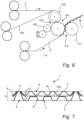
- Fig. 6 schematically illustrates a variant of a manufacturing method which may be used to provide a multi-ply tissue product.
- a first web 2' and a second web 100' are directed together through a nip between an embossing roll 101 and an anvil roll 102. In this nip the first web 2' and the second web 100' are simultaneously provided with an embossing pattern.
- an application roll 103 for adhesive applies adhesive to those parts of the second web 100' at which there are protruding embossing elements in the embossing roll 101.
- the adhesive is transported from an adhesive batch via an adhesive transfer roll to the application roll.
- a third web 3' is transported to the second web 100' and adhesively bonded to the second web 100' in a nip 110 between the embossing roll 101 and a marrying roll 111. The adhesive bonding takes place at those portions of the webs at which the adhesive was applied.
- the resulting multi-ply web 1' comprises three correspondingly embossed plies, bonded together by embossing and adhesive bonds.
- the multi-ply web 1' is formed to multi-ply tissue products e.g. by continued converting, in the tissue product 1 the first web 2' forms the first outermost ply 2, the second web 100' forms the inner ply 100 and the third web 3' forms the second outermost ply 3.
- the manufacturing method principally described in Fig. 6 is not limited to manufacturing of webs or products comprising three plies only. Instead, more than three plies may be achieved, for example four plies or five plies.
- a four-ply web or product may be achieved, in which the two inner plies are both creped ribbed plies as described in the above.
- Fig. 7 is a schematic side view of yet another multi-ply tissue product 1, which is assembled according to the method of the type referred to herein as "Nesfip" and as described in more detail in EP 1 081 284 A1 .
- the product 1 comprises a first outermost ply 2, a second outermost ply 3, and an inner ply 100.
- the inner ply 100 is, although not illustrated in the drawings, a creped ribbed ply.
- the first and second outer plies 2, 3 are non-ribbed plies.
- the first outermost ply 2 and the second outermost ply 3 are embossed with patterns 5, 7, 9 at least in part composed of discrete protrusions 6, 8, and 10.
- the protrusions face the inner ply 100.
- the inner ply 100 is non-embossed. As such, the inner ply 100 may serve to hinder unintentional nesting between the adjacent layers, i.e. the first and second outer plies 2, 3.
- the first outer ply 2 comprises a first embossment pattern 5 and a second embossment pattern 7.
- the height h of the second pattern 7 is less than the height H of the first pattern 5.
- the first pattern 5 comprises relatively high protrusions 6 with and the second pattern 7 comprises relatively low protrusions, the high protrusions 6 of the first pattern 5 being of heights H and the low protrusions 8 of the second pattern 7 having the height h less than those of the high protrusions, H>h.
- the second outer ply 3 comprises a single pattern 9, for example implemented by protrusions 12 of the height h'.
- the plies 2, 3, and 100 are combined by joining the distal areas of at least part of the high protrusions 6 of the first outermost ply 2 and of at least part of the second outermost ply 3 with the inner ply 100.
- At least one of the outer plies 2, 3 may comprise a pattern with a pattern density larger than 30 protrusions/cm 2 .
- Fig. 8 illustrates schematically a variant of a method for producing a multi-ply tissue product being a Nesfip-type method.
- a first web 2' to form the first outer ply 2 is embossed in a first embossing apparatus 12 including an engraved cylinder 13 and a mating rubber cylinder rotating in the opposite direction.
- the cylinder 13 is engraved in a first relatively high pattern having embossing tips of height H1 and a relatively shallower pattern of embossing tips of height h1.
- the first pattern 5 is composed at least partly of high discrete protrusions 6 of height H.
- This pattern 5 with a relatively high embossment height H1 may form decorative elements, for example picots and/or flowers.
- the second pattern 7 is composed of relatively low protrusions 8 of height h, for example micro dots.
- the heights H and h depend on the depths H1 and h1 of the engravings and also on the other embossing parameters, such as pressure, rubber quality, etc.
- the inner web 100' being a creped ribbed web as explained in the above, is previously non-embossed.
- the inner web 100' is moved into position and superposed on the protrusions 6', 8' of the first embossed outermost web 2' at the level of the engraved cylinder 13.
- the web 100' hugs the high protrusions 6' of the embossed outer web 2' while remaining substantially planar between two consecutive high protrusions 6', the planar areas of the low protrusions 8' being able to act as intermediary supports.
- an adhesive 11 is applied to the outer side of the inner web 100' using a glue dispenser 15.
- a second outer web 3' is embossed separately by means of a second embossing apparatus 19 into an embossment pattern 9 at least in part composed of discrete protrusions 10' of height h'.
- the apparatus 19 includes a cylinder 20 engraved with a pattern of embossing tips of height h4' a and a mating rubber cylinder.
- Fig. 9 is a schematic side view of another multi-ply tissue product 1.
- the tissue product 1 has a first outermost ply 2 which is a bottom ply and a second outermost ply 3 which is a top ply.
- the tissue product of Fig. 9 may be produced in accordance with a method of the type denoted herein as "NoveFip" and described in PCT/IB2018/001556.
- the first outermost ply 2 and the second outermost ply 3 are both provided with an embossing pattern including micro-embossed protrusions 8a, 8b.
- first and/or the second outermost ply 2, 3, as so-called structured plies, for example manufactured by means of a Through Air Drying Process (TAD).
- TAD Through Air Drying Process
- the first inner ply 100 is a creped ribbed ply.
- the first inner ply 100 is un-embossed (which means that first inner ply 100 is not embossed by means of a contact with an embossing roll before it is fed to the final ply-bonding).
- first inner ply 100 being a creped ribbed ply is adjacent to the bottom ply being the first outermost ply 2.
- the second inner ply 4 between the first inner ply 100 and the second outermost ply 3 is a non-ribbed ply.
- the second inner ply 4 is micro-embossed in order to increase the bulk of the tissue product 1.
- the first outermost ply 2 comprises a micro-embossed pattern comprising embossed protrusions 8b having a height h1.
- the second outermost ply 3 comprises a micro-embossed pattern comprising embossed protrusions 8a having a height h3.
- the height h3 of the micro-embossed pattern of the second outermost ply 3 may be different from the height h1 of the micro-embossed pattern of the first outermost ply 2.
- the second outermost ply 3 may comprise a décor embossed pattern comprising decor embossed protrusions 9.
- the décor embossed protrusions 9 may have a height h2 higher than the height of the micro-embossed protrusions 8a of the second outermost ply 3. At the décor embossed protrusions 9 with said height h2, ply-bonding between all of the plies is achieved.
- the application of adhesive may be restricted to an overall surface fraction of less than 10% of a total area of said multi-ply tissue product 1, preferably less than 6% of a total area of said multi-ply tissue product 1, most preferred 3 to 6%.
- the restricted amount of adhesive is beneficial for the perceived softness of the product.
- micro-embossed protrusions 19 of the second inner ply 4 and the micro-embossed protrusions 8a of the adjacent second outermost ply 3 are not in register with one another. This increases the bulk and absorbency of the tissue product 1 because the protrusions 19, 8a cannot nest one into the other which would reduce the thickness of the tissue product.
- micro-embossed protrusions 19 of the second inner ply 4 and the micro-embossed protrusions 8a of the adjacent second outermost ply 3 may have different densities so as to avoid/limit unintentional nesting between the protrusions 19, 8a which would reduce the thickness of the tissue product.
- the protrusions 19 of the micro-embossed second inner ply 4 cannot nest with the protrusions of the first outermost ply 2 as in between there is the non-embossed first inner ply 100.
- the thickness is not reduced which is positive for the bulk and absorbency of the tissue product 1.
- Fig. 10 schematically shows a device for manufacturing a multi-ply tissue product according a method of the type referred to herein as Novefip.
- the first outermost web 2, the second outermost web 3, the first inner web 100 and the second inner web 4 are directed into the device 30.
- the central element of the device 30 is the embossing roll S1 which is an engraved steel roll.
- the second outermost web 3 is directed into the nip between the embossing roll S1 and a counter roll 32 in order to emboss the second outermost web 3.
- the second inner web 4 joins the second outermost web 3.
- the second inner web 4 is micro-embossed in the nip between the engraved steel embossing roll S3 and the counter roll 34.
- glue is applied towards the second inner web 4 by means of a glue application device GU. Since the embossing roll S1 has micro-embossing protrusions of a smaller height and décor embossing protrusions of a greater height, the glue is only applied towards the second inner web 4 at the décor embossing protrusions with the greater height.
- the first inner web 100 is non-embossed and fed towards the embossing roll S1 downstream of the glue application device GU.
- the first inner web 100 is directed into the gap between the embossing roll S1 and a second embossing roll S2 which also runs against the counter roll 38.
- the second embossing roll S2 is also an engraved steel roll with a micro-embossing pattern.
- the first outermost web 2 is embossed.
- the first inner web 100 joins the second inner web 4 and the first outermost web 2 and becomes sandwiched between these two.
- the multi-ply structure After leaving the gap between the embossing roll S1 and the second embossing roll S2, the multi-ply structure is directed into the nip between the embossing roll S1 and a marrying roll M1 where the final ply bonding takes place. Downstream of the marrying roll M1, the multi-ply tissue web 1 can be directed to a perforating unit 40 at which the tissue web 1 receives perforation lines which are provided at regular intervals in a direction perpendicular to the longitudinal direction of the multi-ply tissue web 1.
- the tissue web 1 Downstream of the perforating unit 40, the tissue web 1 can be wound to a roll or folded to a stack. Instead of perforations, the web 1 could be separated into individual pieces and optionally be folded to become a stack of individual sheets.
- the different plies are combined using different ply-bonding methods.
- Non-ribbed plies used as outer plies are not limited to:
- Non-ribbed ply used as outer or inner ply is a non-ribbed ply used as outer or inner ply
- Creped ribbed ply
- the number of crepe lines of the Thunder E ply were 61/cm as measured in MD on the Hood side.
- Firmness is a compression value measured on roll radius with a compression mass of 1 kg.
- the roll is positioned on a core support, and with a measurement plate for applying 1 kg weight to the middle of the roll. The 1 kg weight is slowly put on the measurement plate. 5 s after applying the roll, the movement of the measurement plate is recorded.
- the firmness unit is 1/10 mm. For each roll, an average of 2 measurements is reported.
- the rolls are conditioned for 24 ⁇ 4 h at 50 ⁇ 10 % r. h. and 23 ⁇ 1 °C.
- Basis weight is determined in accordance with ISO 12625-6: 2016.
- the basis weight is determined in g/m 2 .
- Thickness is determined in accordance with ISO 12625-3.
- Dry tensile strength and tensile stretch are determined in accordance with ISO 12625-4.
- a load cell of 100N was used.
- Water absorption capacity is the amount of water the sample is able to absorb, reported in g/g (i.e. g water / g material in sample).
- TSA indicates herein measurements of softness made with a softness test method (TSA - Tissue Softness Anlalyzer), that uses acoustic waves and has demonstrated to correlate well with hand panel tests for thin materials like tissue.
- TSA softness test method
- the test method follows the general outline of the TSA instrument manual dated 2013-07-08 (Collection of the TSA Operating instruction, Multi Functional Measuring system, Tissue Softness Analyzer, 2012-12-12, available from EMTEC electronic GMBH with the settings as set forth therein or in WO 2019/221647 A1 by Essity Hygiene and Health Aktiebolag .
- the Tissue Softness Analyzer TSA simultaneously gathers the essential single relevant parameters which have an influence on the tissue softness, and provides a comfort prediction.
- the comfort prediction may be used to determine the softer one out of two tissues being compared. A higher value indicates a higher softness.
- Panel softness is determined by evaluation made by panel members. The panelists rank products in terms of softness. The Softness Panel values are therefore comparative values enabling a comparison between the samples tested, rather than an absolute parameter.
- tissue products finished goods
- tissue base sheets are not directly comparable as there are different scales/reference products.
- Each sample is composed of one product, i.e. a multi-ply tissue paper product.
- the dimensions of the samples are therefore the dimensions of the finished products.
- Samples are placed in MD before the panelists.
- Samples are conditioned for minimum 2 hours in a controlled area at 23°C and 50% relative humidity.
- the different samples are comfort rated by ten panelists, and an average comfort rating for each product is determined over the panelists.
- softness panel values are comparative values within a test and indicate the perceived softness of a product.
- softness panel values given in one and the same table are comparable and indicate the perceived relative softness of the products tested. The higher the value of the rating, the more comfortable is the product.
- the sample tests confirmed that thickness is increased in samples comprising the Thunder E ply being a creped ribbed ply compared to the samples having no creped ribbed ply. Moreover, absorption increased in all of the samples comprising the Thunder E ply compared to the reference ply.
- the basis weight decreased or was not significantly affected in the samples comprising the Thunder E ply compared to the samples comprising the Reference ply.
- an increased thickness is achieved using the inner ply(-ies) being a creped ribbed ply, although the basis weight of the multi-ply product is lower. This means that an increased thickness results using less material than in the reference sample.
- the softness of the samples including the Thunder E inner ply was the same or not significantly affected as compared to the samples including the Reference inner ply. This was surprising since it was expected that the ribbed structure of the ribbed ply would have a negative impact on softness.
- Nip sizes 30/30 mm, 32/31 mm and 34/32 mm were compared.
- the thickness of the total product increases, both for products including an inner ply being a ribbed ply and for products not including such a ply.
- the product with an inner ply being a ribbed ply was always found to be thicker than the product without a ribbed ply.
Landscapes
- Engineering & Computer Science (AREA)
- Mechanical Engineering (AREA)
- Paper (AREA)
- Sanitary Thin Papers (AREA)
Claims (15)
- Produit en papier absorbant multicouche (1), en particulier un produit d'hygiène ou d'essuyage, comprenant au moins trois plis (2, 100, 3), caractérisé en ce que le produit en papier absorbant (1) comprend un premier pli intérieur (100) qui est un pli crêpé nervuré et qui a un grammage de 10 à 30 g/m2, et un premier pli extérieur (2) et un deuxième pli extérieur (3) de chaque côté dudit pli intérieur (100), caractérisé en ce que lesdits premier et deuxième plis extérieurs (2, 3) sont des plis non nervurés,
dans lequelun pli crêpé nervuré est défini comme un pli comprenant des lignes de crépage s'étendant le long d'une première direction, et des nervures et creux parallèles s'étendant en continu le long d'une deuxième direction sensiblement perpendiculaire à ladite première direction, lesdits nervures et creux fournissant une rugosité de coeur moyenne Rk comprise entre 10 et 300 µm, et un nombre de pics étant de 4 à 12 par cm lorsque mesuré le long de ladite première direction ;et dans lequel un pli non nervuré est défini comme un pli ne présentant pas de nervures et creux parallèles s'étendant en continu le long d'une direction quelconque du pli ou présentant des nervures et creux parallèles s'étendant en continu le long d'une direction quelconque du pli, lesdits nervures et creux fournissant un nombre de pics inférieur à 4 par cm,dans lequel ledit produit en papier absorbant multicouche (1) comprend un adhésif joignant au moins deux des plis (2, 3, 100) dudit produit en papier absorbant multicouche, ledit adhésif étant appliqué sur une surface adhésive totale inférieure à 10 % d'une surface totale dudit produit en papier absorbant multicouche (1), la rugosité de coeur Rk étant définie selon ISO 13565-1 et ISO 13565-2. - Produit en papier absorbant multicouche selon la revendication 1, dans lequel lesdits nervures et creux dudit premier pli intérieur (100) fournissent un nombre de pics, lorsque mesuré le long de ladite première direction, qui est de 6 à 12 par cm, de préférence de 8 à 12 par cm, et/ou lesdits nervures et creux dudit premier pli intérieur (100) fournissent une rugosité de coeur moyenne Rk comprise entre 20 et 150 µm.
- Produit en papier absorbant multicouche selon la revendication 1 ou 2, dans lequel, sur au moins un côté dudit premier pli intérieur (100), de préférence sur chaque côté dudit premier pli intérieur (100), le produit en papier absorbant (1) ne comprend pas plus de deux plis (2, 3) qui sont des plis non nervurés externes par rapport audit premier pli intérieur (100), ou
le produit en papier absorbant (1) ne comprend pas plus d'un pli extérieur (2, 3) qui est un pli non nervuré externe par rapport audit pli intérieur (100). - Produit en papier absorbant multicouche selon l'une quelconque des revendications précédentes, dans lequel ledit pli ou lesdits plis extérieurs (2, 3) étant un ou des plis non nervurés externes par rapport audit pli intérieur (100) et a/ont chacun un grammage inférieur à 30 g/m2, de préférence entre 10 et 30 g/m2, plus préférentiellement entre 12 et 25 g/m2.
- Produit en papier absorbant multicouche selon l'une quelconque des revendications précédentes, dans lequel ledit pli ou lesdits plis extérieurs (2, 3) étant un ou des plis non nervurés ne présente(nt) pas de nervures et creux parallèles s'étendant en continu le long d'une direction quelconque du pli ou présente(nt) chacun des nervures et creux parallèles s'étendant en continu le long d'une direction quelconque du pli, lesdits nervures et creux fournissant un nombre de pics inférieur à 2 par cm, de préférence inférieur à 1 par cm, ou
lesdits nervures et creux fournissent une rugosité de coeur moyenne Rk inférieure à 10 µm, de préférence inférieure à 5 µm. - Produit en papier absorbant multicouche selon l'une quelconque des revendications précédentes, ledit adhésif étant appliqué sur une surface adhésive totale inférieure à 6 % d'une surface totale dudit produit en papier absorbant multicouche (1), de préférence de 3 à 6 % d'une surface totale dudit produit en papier absorbant multicouche (1), ou
dans lequel ledit produit en papier absorbant multicouche (1) comprend des gaufrages de construction joignant au moins deux des plis (2, 3, 100) dudit produit absorbant multicouche, lesdits gaufrages de construction étant appliqués sur une surface de gaufrage de construction totale inférieure à 10 % d'une surface totale dudit produit en papier absorbant multicouche (1), de préférence inférieure à 6 % d'une surface totale dudit produit en papier absorbant multicouche (1), plus préférentiellement de 3 à 6 % d'une surface totale dudit produit en papier absorbant multicouche (1). - Produit en papier absorbant multicouche selon l'une quelconque des revendications précédentes, dans lequel ledit produit en papier absorbant multicouche (1) ne comprend pas plus de cinq plis, de préférence pas plus de quatre plis, plus préférentiellement pas plus de trois plis.
- Produit en papier absorbant multicouche selon l'une quelconque des revendications précédentes, dans lequel ledit premier et/ou deuxième pli extérieur (2, 3) est un pli crêpé, de préférence ledit pli crêpé est produit par une technologie CWP, ou, dans lequel ledit premier et/ou deuxième pli extérieur (2, 3) est un pli structuré, de préférence un pli TAD, oudans lequel le premier et/ou le deuxième plis extérieurs (2, 3) est/sont un ou des pli(s) pré-gaufré(s), de préférence micro-gaufré(s).
- Produit en papier absorbant multicouche selon l'une quelconque des revendications précédentes, dans lequel le produit (1) comprend au moins un deuxième pli intérieur (4),dans lequel le deuxième pli intérieur (4) est un pli pré-gaufré, de préférence un pli micro-gaufré, oudans lequel ledit deuxième pli intérieur (4) est un pli crêpé nervuré, oudans lequel le deuxième pli intérieur (4) est un pli non nervuré.
- Produit en papier absorbant multicouche selon la revendication 9, dans lequel ledit premier pli intérieur (100) n'est pas gaufré et ledit deuxième pli intérieur (4) est micro-gaufré.
- Produit en papier absorbant multicouche selon l'une quelconque des revendications 9 ou 10, dans lequel lesdits premier et deuxième plis intérieurs (100, 4) sont des plis adjacents dans le produit (1).
- Produit en papier absorbant multicouche selon l'une quelconque des revendications précédentes, dans lequel ledit premier pli intérieur (100) n'est pas gaufré.
- Produit en papier absorbant multicouche selon l'une quelconque des revendications précédentes, dans lequel au moins un, de préférence les deux plis adjacents au premier pli intérieur (100) est/sont gaufrés en construction pour être joints au premier pli intérieur (100), et, de préférence,
dans lequel au moins un, de préférence lesdits deux plis adjacents au premier pli intérieur (100) sont pré-gaufrés. - Procédé de fabrication d'une bande de papier absorbant multicouche (1) pour des produits en papier absorbant comprenant les étapes suivantes- Fournir une première bande intérieure ayant un grammage de 10 à 30 g/m2 et étant une bande crêpée nervurée, une bande crépée nervurée étant définie comme une bande comprenant des lignes de crépage s'étendant le long d'une première direction, et des nervures et creux parallèles s'étendant en continu le long d'une deuxième direction sensiblement perpendiculaire à ladite première direction, lesdits nervures et creux fournissant une rugosité de coeur moyenne Rk comprise entre 10 et 300 µm et un nombre de pics étant de 4 à 12 par cm lorsque mesuré le long de ladite première direction ;- Fournir une première et une deuxième bandes extérieures qui sont des bandes non nervurées, dans lequel une bande non nervurée est définie comme une bande ne présentant pas de nervures et creux parallèles s'étendant en continu le long d'une direction quelconque de la bande ou présentant des nervures et creux parallèles s'étendant en continu le long d'une direction quelconque de la bande, lesdits nervures et creux fournissant un nombre de pics inférieur à 4 par cm ;- Positionner ladite première bande intérieure entre lesdites première et deuxième bandes extérieures ;- Coller lesdites bandes pour former une bande multicouche dans lequel lesdites première et deuxième bandes extérieures forment les plis extérieurs de la bande multicouche, dans lequel ledit produit en papier absorbant multicouche (1) comprend un adhésif joignant au moins deux des plis (2, 3, 100) dudit produit en papier absorbant multicouche, ledit adhésif étant appliqué sur une surface adhésive totale inférieure à 10 % d'une surface totale dudit produit en papier absorbant multicouche (1), la rugosité de coeur Rk étant définie selon ISO 13565-1 et ISO 13565-2.
- Procédé selon la revendication 14, dans lequel ladite étape de fourniture de ladite au moins une première bande intérieure comprend la fourniture d'une bande fabriquée à l'aide d'une lame de crépage munie d'un bord de râteau comprenant des indentations, et, de préférence
ladite lame de râteau comprend des indentations en nombre de 4 à 12 par cm sur la longueur du bord de râteau, et/ou lesdites indentations ont une profondeur de 0,1 à 1,0 mm.
Applications Claiming Priority (1)
| Application Number | Priority Date | Filing Date | Title |
|---|---|---|---|
| PCT/SE2019/051307 WO2021126026A1 (fr) | 2019-12-18 | 2019-12-18 | Produit en papier et procédé et son appareil de fabrication |
Publications (4)
| Publication Number | Publication Date |
|---|---|
| EP4077808A1 EP4077808A1 (fr) | 2022-10-26 |
| EP4077808A4 EP4077808A4 (fr) | 2023-11-29 |
| EP4077808C0 EP4077808C0 (fr) | 2025-01-29 |
| EP4077808B1 true EP4077808B1 (fr) | 2025-01-29 |
Family
ID=76477650
Family Applications (1)
| Application Number | Title | Priority Date | Filing Date |
|---|---|---|---|
| EP19956697.7A Active EP4077808B1 (fr) | 2019-12-18 | 2019-12-18 | Produit en papier et procédé et son appareil de fabrication |
Country Status (10)
| Country | Link |
|---|---|
| US (2) | US12351986B2 (fr) |
| EP (1) | EP4077808B1 (fr) |
| CN (1) | CN114829708B (fr) |
| CO (1) | CO2022008301A2 (fr) |
| CR (1) | CR20220349A (fr) |
| EC (1) | ECSP22055478A (fr) |
| ES (1) | ES3014399T3 (fr) |
| MX (1) | MX2022007532A (fr) |
| MY (1) | MY207252A (fr) |
| WO (1) | WO2021126026A1 (fr) |
Cited By (3)
| Publication number | Priority date | Publication date | Assignee | Title |
|---|---|---|---|---|
| US20230295880A1 (en) * | 2020-07-03 | 2023-09-21 | Essity Hygiene And Health Aktiebolag | Tissue paper products, rolls and stacks of tissue paper products, and manufacturing methods |
| US20240229362A1 (en) * | 2019-12-18 | 2024-07-11 | Essity Hygiene And Health Aktiebolag | Tissue product and method and apparatus for producing same |
| US12590417B2 (en) | 2020-07-03 | 2026-03-31 | Essity Hygiene And Health Aktiebolag | Coreless rolls of a tissue paper product and methods of manufacturing coreless rolls |
Families Citing this family (3)
| Publication number | Priority date | Publication date | Assignee | Title |
|---|---|---|---|---|
| SG11202106366XA (en) * | 2018-12-20 | 2021-07-29 | Essity Hygiene & Health Ab | Tissue product and method and apparatus for producing same |
| US12091820B2 (en) * | 2020-10-09 | 2024-09-17 | Kimberly-Clark Worldwide, Inc. | Embossed tissue |
| WO2025217618A1 (fr) * | 2024-04-11 | 2025-10-16 | Pregis Llc | Matériaux d'emballage dotés de liaisons activées par la chaleur entre des points de rattachement entre couches intermittents |
Family Cites Families (40)
| Publication number | Priority date | Publication date | Assignee | Title |
|---|---|---|---|---|
| GB456032A (en) | 1936-02-03 | 1936-11-02 | Ernest Pashley | Improvements in the manufacture of cellulose wadding |
| US3163575A (en) | 1962-02-26 | 1964-12-29 | Kimberly Clark Co | Doctor blade for differentially creping sheets from a drum |
| US3507745A (en) | 1966-05-23 | 1970-04-21 | Kimberly Clark Co | Doctor blade mechanism |
| US3738905A (en) * | 1970-04-29 | 1973-06-12 | Kimberly Clark Co | Paper toweling material and method of combining into multi ply products |
| GB1364916A (en) * | 1971-09-21 | 1974-08-29 | Kimberly Clark Co | Paper towelling material |
| US4637859A (en) * | 1983-08-23 | 1987-01-20 | The Procter & Gamble Company | Tissue paper |
| DE69218805D1 (de) * | 1991-01-15 | 1997-05-15 | James River Corp | Seidenpapier mit grosser Weichheit |
| ES2128705T3 (es) * | 1993-12-20 | 1999-05-16 | Procter & Gamble | Banda de papel prensada en humedo y metodo para fabricar la misma. |
| US5556509A (en) * | 1994-06-29 | 1996-09-17 | The Procter & Gamble Company | Paper structures having at least three regions including a transition region interconnecting relatively thinner regions disposed at different elevations, and apparatus and process for making the same |
| US5871887A (en) * | 1994-06-29 | 1999-02-16 | The Procter & Gamble Company | Web patterning apparatus comprising a felt layer and a photosensitive resin layer |
| MX9700023A (es) * | 1994-06-29 | 1997-04-30 | Procter & Gamble | Aparato formadora de patron de hoja que comprende una capa de fieltro y una capa de resina fotosensible. |
| US5814190A (en) * | 1994-06-29 | 1998-09-29 | The Procter & Gamble Company | Method for making paper web having both bulk and smoothness |
| US6425983B1 (en) | 1994-10-11 | 2002-07-30 | Fort James Corporation | Creping blade, creped paper, and method of manufacturing paper |
| US5685954A (en) | 1994-10-11 | 1997-11-11 | James River Corporation Of Virginia | Biaxially undulatory tissue and creping process using undulatory blade |
| US5690788A (en) | 1994-10-11 | 1997-11-25 | James River Corporation Of Virginia | Biaxially undulatory tissue and creping process using undulatory blade |
| US5693406A (en) * | 1995-08-25 | 1997-12-02 | The Procter & Gamble Company | Multi-ply paper product |
| US5906711A (en) * | 1996-05-23 | 1999-05-25 | Procter & Gamble Co. | Multiple ply tissue paper having two or more plies with different discrete regions |
| ES2205228T3 (es) * | 1996-05-23 | 2004-05-01 | THE PROCTER & GAMBLE COMPANY | Papel tisu de multiples capas con zonas de red continuas. |
| AU735270B2 (en) * | 1996-05-23 | 2001-07-05 | Procter & Gamble Company, The | Multiple ply tissue paper |
| JP3925759B2 (ja) | 1998-04-24 | 2007-06-06 | 株式会社アサヒペン | 粘着剤付紙シート |
| WO1999064673A1 (fr) | 1998-06-12 | 1999-12-16 | Fort James Corporation | Procede de fabrication d'une bande papier presentant un volume vide interieur eleve constitue de fibres secondaires et produit fabrique a l'aide dudit procede |
| TW580530B (en) | 1998-08-06 | 2004-03-21 | Kimberly Clark Co | Roll of tissue sheets having improved properties |
| US6187139B1 (en) | 1999-07-13 | 2001-02-13 | Fort James Corporation | Wet creping process |
| DE69937884T2 (de) | 1999-08-31 | 2009-01-02 | Georgia-Pacific France | Saugfähiges, mindestens dreilagiges Papierprodukt und Verfahren zu seiner Herstellung |
| ATE358016T1 (de) * | 1999-11-12 | 2007-04-15 | Georgia Pacific Corp | Ein- oder mehrlagiges, saugfähiges geprägtes papierprodukt |
| US6348131B1 (en) * | 1999-11-12 | 2002-02-19 | Fort James Corporation | Multi-ply embossed absorbent paper products |
| US6432267B1 (en) | 1999-12-16 | 2002-08-13 | Georgia-Pacific Corporation | Wet crepe, impingement-air dry process for making absorbent sheet |
| EP1358388A2 (fr) * | 2000-11-14 | 2003-11-05 | Kimberly-Clark Worldwide, Inc. | Produits du type serviettes papier multicouches |
| US6649025B2 (en) | 2001-12-31 | 2003-11-18 | Kimberly-Clark Worldwide, Inc. | Multiple ply paper wiping product having a soft side and a textured side |
| US7622020B2 (en) | 2002-04-23 | 2009-11-24 | Georgia-Pacific Consumer Products Lp | Creped towel and tissue incorporating high yield fiber |
| CA2725378C (fr) * | 2008-05-27 | 2016-11-22 | Georgia-Pacific Consumer Products Lp | Tissu de bain de premiere qualite |
| CA2722650C (fr) | 2009-12-07 | 2018-05-01 | Georgia-Pacific Consumer Products Lp | Procede de fabrication d'une feuille a base de papier crete absorbant l'humidite |
| US10711395B2 (en) * | 2015-07-24 | 2020-07-14 | The Procter & Gamble Company | Textured fibrous structures |
| MX387184B (es) * | 2016-01-27 | 2025-03-18 | Essity Hygiene & Health Ab | Producto fibroso de múltiples capas que comprende un adhesivo de laminación con un ácido dermatológicamente aceptable |
| CR20190473A (es) * | 2017-03-13 | 2020-02-14 | Essity Hygiene & Health Ab | Producto de papel tisú de múltiples pliegues y métodos de elaboración del mismo |
| US10968571B2 (en) * | 2017-08-22 | 2021-04-06 | The Procter & Gamble Company | Process for making multi-ply fibrous structure-containing articles |
| JP6462929B2 (ja) * | 2018-03-27 | 2019-01-30 | 大王製紙株式会社 | キッチンペーパー及びその製造方法 |
| PL3793501T3 (pl) | 2018-05-15 | 2024-09-02 | Essity Hygiene And Health Aktiebolag | Wyrób włóknisty |
| EP3873730A4 (fr) * | 2018-10-31 | 2022-06-01 | Kimberly-Clark Worldwide, Inc. | Produits de type mouchoirs en papiers gaufrés à épaisseurs multiples |
| MY207252A (en) * | 2019-12-18 | 2025-02-10 | Essity Hygiene & Health Ab | Tissue product and method and apparatus for producing same |
-
2019
- 2019-12-18 MY MYPI2022003237A patent/MY207252A/en unknown
- 2019-12-18 CN CN201980103118.8A patent/CN114829708B/zh active Active
- 2019-12-18 CR CR20220349A patent/CR20220349A/es unknown
- 2019-12-18 US US17/783,395 patent/US12351986B2/en active Active
- 2019-12-18 ES ES19956697T patent/ES3014399T3/es active Active
- 2019-12-18 MX MX2022007532A patent/MX2022007532A/es unknown
- 2019-12-18 WO PCT/SE2019/051307 patent/WO2021126026A1/fr not_active Ceased
- 2019-12-18 EP EP19956697.7A patent/EP4077808B1/fr active Active
-
2022
- 2022-06-14 CO CONC2022/0008301A patent/CO2022008301A2/es unknown
- 2022-07-18 EC ECSENADI202255478A patent/ECSP22055478A/es unknown
-
2024
- 2024-03-22 US US18/613,756 patent/US20240229362A1/en active Pending
Cited By (3)
| Publication number | Priority date | Publication date | Assignee | Title |
|---|---|---|---|---|
| US20240229362A1 (en) * | 2019-12-18 | 2024-07-11 | Essity Hygiene And Health Aktiebolag | Tissue product and method and apparatus for producing same |
| US20230295880A1 (en) * | 2020-07-03 | 2023-09-21 | Essity Hygiene And Health Aktiebolag | Tissue paper products, rolls and stacks of tissue paper products, and manufacturing methods |
| US12590417B2 (en) | 2020-07-03 | 2026-03-31 | Essity Hygiene And Health Aktiebolag | Coreless rolls of a tissue paper product and methods of manufacturing coreless rolls |
Also Published As
| Publication number | Publication date |
|---|---|
| CR20220349A (es) | 2022-12-20 |
| CN114829708A (zh) | 2022-07-29 |
| US20240229362A1 (en) | 2024-07-11 |
| CO2022008301A2 (es) | 2022-06-21 |
| EP4077808A1 (fr) | 2022-10-26 |
| ES3014399T3 (en) | 2025-04-22 |
| US12351986B2 (en) | 2025-07-08 |
| MX2022007532A (es) | 2022-07-19 |
| EP4077808C0 (fr) | 2025-01-29 |
| WO2021126026A1 (fr) | 2021-06-24 |
| US20230011745A1 (en) | 2023-01-12 |
| MY207252A (en) | 2025-02-10 |
| EP4077808A4 (fr) | 2023-11-29 |
| ECSP22055478A (es) | 2022-08-31 |
| CN114829708B (zh) | 2024-03-08 |
Similar Documents
| Publication | Publication Date | Title |
|---|---|---|
| US20240229362A1 (en) | Tissue product and method and apparatus for producing same | |
| EP2509783B1 (fr) | Produit fibreux, rouleau de gaufrage pour fabrication d'un tel produit fibreux, et dispositif et procédé de fabrication d'un tel produit fibreux | |
| AU2009352971B2 (en) | Fibrous product and method and device for manufacturing such a fibrous product | |
| EP3873732B1 (fr) | Produit en papier ouaté gaufré multi-plis | |
| US12281445B2 (en) | Tissue product and method and apparatus for producing same | |
| AU2008359630A1 (en) | Method and device for producing a multi-ply fibrous product and multi-ply fibrous product | |
| CN115715342B (zh) | 绵纸产品的无芯卷及制造无芯卷的方法 | |
| EP3894630B1 (fr) | Produit textile et procédé et appareil permettant de produire un produit textile | |
| HK40071839A (en) | Tissue product and method and apparatus for producing same | |
| HK40071839B (zh) | 棉纸产品及其制造方法和设备 | |
| HK40085786A (en) | Coreless rolls of a tissue paper product and methods of manufacturing coreless rolls | |
| HK40049586A (en) | Tissue product and method and apparatus for producing same | |
| HK40049586B (en) | Tissue product and method and apparatus for producing same | |
| HK40049021B (en) | Tissue product and method and apparatus for producing same | |
| HK1176036A (en) | Fibrous product, embossing roll for producing such fibrous product, and device and method for producing such fibrous product | |
| HK1176036B (en) | Fibrous product, embossing roll for producing such fibrous product, and device and method for producing such fibrous product |
Legal Events
| Date | Code | Title | Description |
|---|---|---|---|
| STAA | Information on the status of an ep patent application or granted ep patent |
Free format text: STATUS: THE INTERNATIONAL PUBLICATION HAS BEEN MADE |
|
| PUAI | Public reference made under article 153(3) epc to a published international application that has entered the european phase |
Free format text: ORIGINAL CODE: 0009012 |
|
| STAA | Information on the status of an ep patent application or granted ep patent |
Free format text: STATUS: REQUEST FOR EXAMINATION WAS MADE |
|
| 17P | Request for examination filed |
Effective date: 20220622 |
|
| AK | Designated contracting states |
Kind code of ref document: A1 Designated state(s): AL AT BE BG CH CY CZ DE DK EE ES FI FR GB GR HR HU IE IS IT LI LT LU LV MC MK MT NL NO PL PT RO RS SE SI SK SM TR |
|
| DAX | Request for extension of the european patent (deleted) | ||
| RAV | Requested validation state of the european patent: fee paid |
Extension state: TN Effective date: 20220628 Extension state: MA Effective date: 20220628 |
|
| A4 | Supplementary search report drawn up and despatched |
Effective date: 20231102 |
|
| RIC1 | Information provided on ipc code assigned before grant |
Ipc: B32B 29/00 20060101ALI20231026BHEP Ipc: B31F 1/12 20060101ALI20231026BHEP Ipc: B31F 1/07 20060101ALI20231026BHEP Ipc: D21H 27/40 20060101AFI20231026BHEP |
|
| GRAP | Despatch of communication of intention to grant a patent |
Free format text: ORIGINAL CODE: EPIDOSNIGR1 |
|
| STAA | Information on the status of an ep patent application or granted ep patent |
Free format text: STATUS: GRANT OF PATENT IS INTENDED |
|
| INTG | Intention to grant announced |
Effective date: 20240715 |
|
| GRAS | Grant fee paid |
Free format text: ORIGINAL CODE: EPIDOSNIGR3 |
|
| GRAA | (expected) grant |
Free format text: ORIGINAL CODE: 0009210 |
|
| STAA | Information on the status of an ep patent application or granted ep patent |
Free format text: STATUS: THE PATENT HAS BEEN GRANTED |
|
| AK | Designated contracting states |
Kind code of ref document: B1 Designated state(s): AL AT BE BG CH CY CZ DE DK EE ES FI FR GB GR HR HU IE IS IT LI LT LU LV MC MK MT NL NO PL PT RO RS SE SI SK SM TR |
|
| REG | Reference to a national code |
Ref country code: GB Ref legal event code: FG4D |
|
| REG | Reference to a national code |
Ref country code: CH Ref legal event code: EP |
|
| REG | Reference to a national code |
Ref country code: DE Ref legal event code: R096 Ref document number: 602019065570 Country of ref document: DE |
|
| REG | Reference to a national code |
Ref country code: IE Ref legal event code: FG4D |
|
| U01 | Request for unitary effect filed |
Effective date: 20250129 |
|
| U07 | Unitary effect registered |
Designated state(s): AT BE BG DE DK EE FI FR IT LT LU LV MT NL PT RO SE SI Effective date: 20250204 |
|
| REG | Reference to a national code |
Ref country code: ES Ref legal event code: FG2A Ref document number: 3014399 Country of ref document: ES Kind code of ref document: T3 Effective date: 20250422 |
|
| PG25 | Lapsed in a contracting state [announced via postgrant information from national office to epo] |
Ref country code: RS Free format text: LAPSE BECAUSE OF FAILURE TO SUBMIT A TRANSLATION OF THE DESCRIPTION OR TO PAY THE FEE WITHIN THE PRESCRIBED TIME-LIMIT Effective date: 20250429 |
|
| PG25 | Lapsed in a contracting state [announced via postgrant information from national office to epo] |
Ref country code: PL Free format text: LAPSE BECAUSE OF FAILURE TO SUBMIT A TRANSLATION OF THE DESCRIPTION OR TO PAY THE FEE WITHIN THE PRESCRIBED TIME-LIMIT Effective date: 20250129 |
|
| PG25 | Lapsed in a contracting state [announced via postgrant information from national office to epo] |
Ref country code: IS Free format text: LAPSE BECAUSE OF FAILURE TO SUBMIT A TRANSLATION OF THE DESCRIPTION OR TO PAY THE FEE WITHIN THE PRESCRIBED TIME-LIMIT Effective date: 20250529 Ref country code: NO Free format text: LAPSE BECAUSE OF FAILURE TO SUBMIT A TRANSLATION OF THE DESCRIPTION OR TO PAY THE FEE WITHIN THE PRESCRIBED TIME-LIMIT Effective date: 20250429 |
|
| PG25 | Lapsed in a contracting state [announced via postgrant information from national office to epo] |
Ref country code: HR Free format text: LAPSE BECAUSE OF FAILURE TO SUBMIT A TRANSLATION OF THE DESCRIPTION OR TO PAY THE FEE WITHIN THE PRESCRIBED TIME-LIMIT Effective date: 20250129 |
|
| PG25 | Lapsed in a contracting state [announced via postgrant information from national office to epo] |
Ref country code: GR Free format text: LAPSE BECAUSE OF FAILURE TO SUBMIT A TRANSLATION OF THE DESCRIPTION OR TO PAY THE FEE WITHIN THE PRESCRIBED TIME-LIMIT Effective date: 20250430 |
|
| PG25 | Lapsed in a contracting state [announced via postgrant information from national office to epo] |
Ref country code: SM Free format text: LAPSE BECAUSE OF FAILURE TO SUBMIT A TRANSLATION OF THE DESCRIPTION OR TO PAY THE FEE WITHIN THE PRESCRIBED TIME-LIMIT Effective date: 20250129 |
|
| PG25 | Lapsed in a contracting state [announced via postgrant information from national office to epo] |
Ref country code: CZ Free format text: LAPSE BECAUSE OF FAILURE TO SUBMIT A TRANSLATION OF THE DESCRIPTION OR TO PAY THE FEE WITHIN THE PRESCRIBED TIME-LIMIT Effective date: 20250129 |
|
| PG25 | Lapsed in a contracting state [announced via postgrant information from national office to epo] |
Ref country code: SK Free format text: LAPSE BECAUSE OF FAILURE TO SUBMIT A TRANSLATION OF THE DESCRIPTION OR TO PAY THE FEE WITHIN THE PRESCRIBED TIME-LIMIT Effective date: 20250129 |
|
| PLBE | No opposition filed within time limit |
Free format text: ORIGINAL CODE: 0009261 |
|
| STAA | Information on the status of an ep patent application or granted ep patent |
Free format text: STATUS: NO OPPOSITION FILED WITHIN TIME LIMIT |
|
| REG | Reference to a national code |
Ref country code: CH Ref legal event code: L10 Free format text: ST27 STATUS EVENT CODE: U-0-0-L10-L00 (AS PROVIDED BY THE NATIONAL OFFICE) Effective date: 20251210 |
|
| REG | Reference to a national code |
Ref country code: CH Ref legal event code: U11 Free format text: ST27 STATUS EVENT CODE: U-0-0-U10-U11 (AS PROVIDED BY THE NATIONAL OFFICE) Effective date: 20260101 |
|
| 26N | No opposition filed |
Effective date: 20251030 |
|
| PGFP | Annual fee paid to national office [announced via postgrant information from national office to epo] |
Ref country code: GB Payment date: 20251223 Year of fee payment: 7 |
|
| PGFP | Annual fee paid to national office [announced via postgrant information from national office to epo] |
Ref country code: TR Payment date: 20251127 Year of fee payment: 7 |
|
| U20 | Renewal fee for the european patent with unitary effect paid |
Year of fee payment: 7 Effective date: 20251223 |
|
| PGFP | Annual fee paid to national office [announced via postgrant information from national office to epo] |
Ref country code: ES Payment date: 20260122 Year of fee payment: 7 |
|
| VS25 | Lapsed in a validation state [announced via postgrant information from nat. office to epo] |
Ref country code: MA Free format text: LAPSE BECAUSE OF FAILURE TO SUBMIT A TRANSLATION OF THE DESCRIPTION OR TO PAY THE FEE WITHIN THE PRESCRIBED TIME-LIMIT; INVALID AB INITIO Effective date: 20191218 |
|
| PGFP | Annual fee paid to national office [announced via postgrant information from national office to epo] |
Ref country code: CH Payment date: 20260101 Year of fee payment: 7 |