EP4082783A1 - Film polymère, son procédé de préparation, et stratifié de film polymère le comprenant - Google Patents
Film polymère, son procédé de préparation, et stratifié de film polymère le comprenant Download PDFInfo
- Publication number
- EP4082783A1 EP4082783A1 EP21867203.8A EP21867203A EP4082783A1 EP 4082783 A1 EP4082783 A1 EP 4082783A1 EP 21867203 A EP21867203 A EP 21867203A EP 4082783 A1 EP4082783 A1 EP 4082783A1
- Authority
- EP
- European Patent Office
- Prior art keywords
- polymer film
- less
- polymer
- film
- preparation
- Prior art date
- Legal status (The legal status is an assumption and is not a legal conclusion. Google has not performed a legal analysis and makes no representation as to the accuracy of the status listed.)
- Pending
Links
Images

Classifications
-
- C—CHEMISTRY; METALLURGY
- C08—ORGANIC MACROMOLECULAR COMPOUNDS; THEIR PREPARATION OR CHEMICAL WORKING-UP; COMPOSITIONS BASED THEREON
- C08F—MACROMOLECULAR COMPOUNDS OBTAINED BY REACTIONS ONLY INVOLVING CARBON-TO-CARBON UNSATURATED BONDS
- C08F2/00—Processes of polymerisation
- C08F2/44—Polymerisation in the presence of compounding ingredients, e.g. plasticisers, dyestuffs, fillers
-
- C—CHEMISTRY; METALLURGY
- C08—ORGANIC MACROMOLECULAR COMPOUNDS; THEIR PREPARATION OR CHEMICAL WORKING-UP; COMPOSITIONS BASED THEREON
- C08J—WORKING-UP; GENERAL PROCESSES OF COMPOUNDING; AFTER-TREATMENT NOT COVERED BY SUBCLASSES C08B, C08C, C08F, C08G or C08H
- C08J5/00—Manufacture of articles or shaped materials containing macromolecular substances
- C08J5/18—Manufacture of films or sheets
-
- B—PERFORMING OPERATIONS; TRANSPORTING
- B32—LAYERED PRODUCTS
- B32B—LAYERED PRODUCTS, i.e. PRODUCTS BUILT-UP OF STRATA OF FLAT OR NON-FLAT, e.g. CELLULAR OR HONEYCOMB, FORM
- B32B27/00—Layered products comprising a layer of synthetic resin
- B32B27/12—Layered products comprising a layer of synthetic resin next to a fibrous or filamentary layer
-
- B—PERFORMING OPERATIONS; TRANSPORTING
- B32—LAYERED PRODUCTS
- B32B—LAYERED PRODUCTS, i.e. PRODUCTS BUILT-UP OF STRATA OF FLAT OR NON-FLAT, e.g. CELLULAR OR HONEYCOMB, FORM
- B32B27/00—Layered products comprising a layer of synthetic resin
- B32B27/30—Layered products comprising a layer of synthetic resin comprising vinyl (co)polymers; comprising acrylic (co)polymers
- B32B27/308—Layered products comprising a layer of synthetic resin comprising vinyl (co)polymers; comprising acrylic (co)polymers comprising acrylic (co)polymers
-
- B—PERFORMING OPERATIONS; TRANSPORTING
- B32—LAYERED PRODUCTS
- B32B—LAYERED PRODUCTS, i.e. PRODUCTS BUILT-UP OF STRATA OF FLAT OR NON-FLAT, e.g. CELLULAR OR HONEYCOMB, FORM
- B32B3/00—Layered products comprising a layer with external or internal discontinuities or unevennesses, or a layer of non-planar shape; Layered products comprising a layer having particular features of form
- B32B3/26—Layered products comprising a layer with external or internal discontinuities or unevennesses, or a layer of non-planar shape; Layered products comprising a layer having particular features of form characterised by a particular shape of the outline of the cross-section of a continuous layer; characterised by a layer with cavities or internal voids ; characterised by an apertured layer
- B32B3/266—Layered products comprising a layer with external or internal discontinuities or unevennesses, or a layer of non-planar shape; Layered products comprising a layer having particular features of form characterised by a particular shape of the outline of the cross-section of a continuous layer; characterised by a layer with cavities or internal voids ; characterised by an apertured layer characterised by an apertured layer, the apertures going through the whole thickness of the layer, e.g. expanded metal, perforated layer, slit layer regular cells B32B3/12
-
- B—PERFORMING OPERATIONS; TRANSPORTING
- B32—LAYERED PRODUCTS
- B32B—LAYERED PRODUCTS, i.e. PRODUCTS BUILT-UP OF STRATA OF FLAT OR NON-FLAT, e.g. CELLULAR OR HONEYCOMB, FORM
- B32B5/00—Layered products characterised by the non- homogeneity or physical structure, i.e. comprising a fibrous, filamentary, particulate or foam layer; Layered products characterised by having a layer differing constitutionally or physically in different parts
- B32B5/02—Layered products characterised by the non- homogeneity or physical structure, i.e. comprising a fibrous, filamentary, particulate or foam layer; Layered products characterised by having a layer differing constitutionally or physically in different parts characterised by structural features of a fibrous or filamentary layer
- B32B5/022—Non-woven fabric
-
- C—CHEMISTRY; METALLURGY
- C08—ORGANIC MACROMOLECULAR COMPOUNDS; THEIR PREPARATION OR CHEMICAL WORKING-UP; COMPOSITIONS BASED THEREON
- C08F—MACROMOLECULAR COMPOUNDS OBTAINED BY REACTIONS ONLY INVOLVING CARBON-TO-CARBON UNSATURATED BONDS
- C08F2/00—Processes of polymerisation
- C08F2/46—Polymerisation initiated by wave energy or particle radiation
- C08F2/48—Polymerisation initiated by wave energy or particle radiation by ultraviolet or visible light
- C08F2/50—Polymerisation initiated by wave energy or particle radiation by ultraviolet or visible light with sensitising agents
-
- C—CHEMISTRY; METALLURGY
- C08—ORGANIC MACROMOLECULAR COMPOUNDS; THEIR PREPARATION OR CHEMICAL WORKING-UP; COMPOSITIONS BASED THEREON
- C08F—MACROMOLECULAR COMPOUNDS OBTAINED BY REACTIONS ONLY INVOLVING CARBON-TO-CARBON UNSATURATED BONDS
- C08F220/00—Copolymers of compounds having one or more unsaturated aliphatic radicals, each having only one carbon-to-carbon double bond, and only one being terminated by only one carboxyl radical or a salt, anhydride ester, amide, imide or nitrile thereof
- C08F220/02—Monocarboxylic acids having less than ten carbon atoms; Derivatives thereof
- C08F220/04—Acids; Metal salts or ammonium salts thereof
- C08F220/06—Acrylic acid; Methacrylic acid; Metal salts or ammonium salts thereof
-
- C—CHEMISTRY; METALLURGY
- C08—ORGANIC MACROMOLECULAR COMPOUNDS; THEIR PREPARATION OR CHEMICAL WORKING-UP; COMPOSITIONS BASED THEREON
- C08K—Use of inorganic or non-macromolecular organic substances as compounding ingredients
- C08K5/00—Use of organic ingredients
- C08K5/04—Oxygen-containing compounds
- C08K5/05—Alcohols; Metal alcoholates
- C08K5/053—Polyhydroxylic alcohols
-
- C—CHEMISTRY; METALLURGY
- C08—ORGANIC MACROMOLECULAR COMPOUNDS; THEIR PREPARATION OR CHEMICAL WORKING-UP; COMPOSITIONS BASED THEREON
- C08L—COMPOSITIONS OF MACROMOLECULAR COMPOUNDS
- C08L33/00—Compositions of homopolymers or copolymers of compounds having one or more unsaturated aliphatic radicals, each having only one carbon-to-carbon double bond, and only one being terminated by only one carboxyl radical, or of salts, anhydrides, esters, amides, imides or nitriles thereof; Compositions of derivatives of such polymers
- C08L33/02—Homopolymers or copolymers of acids; Metal or ammonium salts thereof
-
- B—PERFORMING OPERATIONS; TRANSPORTING
- B32—LAYERED PRODUCTS
- B32B—LAYERED PRODUCTS, i.e. PRODUCTS BUILT-UP OF STRATA OF FLAT OR NON-FLAT, e.g. CELLULAR OR HONEYCOMB, FORM
- B32B2250/00—Layers arrangement
- B32B2250/40—Symmetrical or sandwich layers, e.g. ABA, ABCBA, ABCCBA
-
- B—PERFORMING OPERATIONS; TRANSPORTING
- B32—LAYERED PRODUCTS
- B32B—LAYERED PRODUCTS, i.e. PRODUCTS BUILT-UP OF STRATA OF FLAT OR NON-FLAT, e.g. CELLULAR OR HONEYCOMB, FORM
- B32B2262/00—Composition or structural features of fibres which form a fibrous or filamentary layer or are present as additives
- B32B2262/06—Vegetal fibres
- B32B2262/062—Cellulose fibres, e.g. cotton
-
- B—PERFORMING OPERATIONS; TRANSPORTING
- B32—LAYERED PRODUCTS
- B32B—LAYERED PRODUCTS, i.e. PRODUCTS BUILT-UP OF STRATA OF FLAT OR NON-FLAT, e.g. CELLULAR OR HONEYCOMB, FORM
- B32B2307/00—Properties of the layers or laminate
- B32B2307/70—Other properties
- B32B2307/718—Weight, e.g. weight per square meter
-
- B—PERFORMING OPERATIONS; TRANSPORTING
- B32—LAYERED PRODUCTS
- B32B—LAYERED PRODUCTS, i.e. PRODUCTS BUILT-UP OF STRATA OF FLAT OR NON-FLAT, e.g. CELLULAR OR HONEYCOMB, FORM
- B32B2307/00—Properties of the layers or laminate
- B32B2307/70—Other properties
- B32B2307/726—Permeability to liquids, absorption
-
- B—PERFORMING OPERATIONS; TRANSPORTING
- B32—LAYERED PRODUCTS
- B32B—LAYERED PRODUCTS, i.e. PRODUCTS BUILT-UP OF STRATA OF FLAT OR NON-FLAT, e.g. CELLULAR OR HONEYCOMB, FORM
- B32B2307/00—Properties of the layers or laminate
- B32B2307/70—Other properties
- B32B2307/732—Dimensional properties
-
- B—PERFORMING OPERATIONS; TRANSPORTING
- B32—LAYERED PRODUCTS
- B32B—LAYERED PRODUCTS, i.e. PRODUCTS BUILT-UP OF STRATA OF FLAT OR NON-FLAT, e.g. CELLULAR OR HONEYCOMB, FORM
- B32B2439/00—Containers; Receptacles
- B32B2439/70—Food packaging
-
- B—PERFORMING OPERATIONS; TRANSPORTING
- B32—LAYERED PRODUCTS
- B32B—LAYERED PRODUCTS, i.e. PRODUCTS BUILT-UP OF STRATA OF FLAT OR NON-FLAT, e.g. CELLULAR OR HONEYCOMB, FORM
- B32B2439/00—Containers; Receptacles
- B32B2439/80—Medical packaging
-
- B—PERFORMING OPERATIONS; TRANSPORTING
- B32—LAYERED PRODUCTS
- B32B—LAYERED PRODUCTS, i.e. PRODUCTS BUILT-UP OF STRATA OF FLAT OR NON-FLAT, e.g. CELLULAR OR HONEYCOMB, FORM
- B32B2607/00—Walls, panels
- B32B2607/02—Wall papers, wall coverings
-
- C—CHEMISTRY; METALLURGY
- C08—ORGANIC MACROMOLECULAR COMPOUNDS; THEIR PREPARATION OR CHEMICAL WORKING-UP; COMPOSITIONS BASED THEREON
- C08J—WORKING-UP; GENERAL PROCESSES OF COMPOUNDING; AFTER-TREATMENT NOT COVERED BY SUBCLASSES C08B, C08C, C08F, C08G or C08H
- C08J2333/00—Characterised by the use of homopolymers or copolymers of compounds having one or more unsaturated aliphatic radicals, each having only one carbon-to-carbon double bond, and only one being terminated by only one carboxyl radical, or of salts, anhydrides, esters, amides, imides, or nitriles thereof; Derivatives of such polymers
- C08J2333/02—Homopolymers or copolymers of acids; Metal or ammonium salts thereof
-
- C—CHEMISTRY; METALLURGY
- C08—ORGANIC MACROMOLECULAR COMPOUNDS; THEIR PREPARATION OR CHEMICAL WORKING-UP; COMPOSITIONS BASED THEREON
- C08J—WORKING-UP; GENERAL PROCESSES OF COMPOUNDING; AFTER-TREATMENT NOT COVERED BY SUBCLASSES C08B, C08C, C08F, C08G or C08H
- C08J2401/00—Characterised by the use of cellulose, modified cellulose or cellulose derivatives
- C08J2401/08—Cellulose derivatives
- C08J2401/26—Cellulose ethers
- C08J2401/28—Alkyl ethers
-
- C—CHEMISTRY; METALLURGY
- C08—ORGANIC MACROMOLECULAR COMPOUNDS; THEIR PREPARATION OR CHEMICAL WORKING-UP; COMPOSITIONS BASED THEREON
- C08L—COMPOSITIONS OF MACROMOLECULAR COMPOUNDS
- C08L2203/00—Applications
- C08L2203/16—Applications used for films
-
- C—CHEMISTRY; METALLURGY
- C08—ORGANIC MACROMOLECULAR COMPOUNDS; THEIR PREPARATION OR CHEMICAL WORKING-UP; COMPOSITIONS BASED THEREON
- C08L—COMPOSITIONS OF MACROMOLECULAR COMPOUNDS
- C08L2312/00—Crosslinking
-
- Y—GENERAL TAGGING OF NEW TECHNOLOGICAL DEVELOPMENTS; GENERAL TAGGING OF CROSS-SECTIONAL TECHNOLOGIES SPANNING OVER SEVERAL SECTIONS OF THE IPC; TECHNICAL SUBJECTS COVERED BY FORMER USPC CROSS-REFERENCE ART COLLECTIONS [XRACs] AND DIGESTS
- Y10—TECHNICAL SUBJECTS COVERED BY FORMER USPC
- Y10T—TECHNICAL SUBJECTS COVERED BY FORMER US CLASSIFICATION
- Y10T428/00—Stock material or miscellaneous articles
- Y10T428/24—Structurally defined web or sheet [e.g., overall dimension, etc.]
- Y10T428/24273—Structurally defined web or sheet [e.g., overall dimension, etc.] including aperture
-
- Y—GENERAL TAGGING OF NEW TECHNOLOGICAL DEVELOPMENTS; GENERAL TAGGING OF CROSS-SECTIONAL TECHNOLOGIES SPANNING OVER SEVERAL SECTIONS OF THE IPC; TECHNICAL SUBJECTS COVERED BY FORMER USPC CROSS-REFERENCE ART COLLECTIONS [XRACs] AND DIGESTS
- Y10—TECHNICAL SUBJECTS COVERED BY FORMER USPC
- Y10T—TECHNICAL SUBJECTS COVERED BY FORMER US CLASSIFICATION
- Y10T428/00—Stock material or miscellaneous articles
- Y10T428/24—Structurally defined web or sheet [e.g., overall dimension, etc.]
- Y10T428/24273—Structurally defined web or sheet [e.g., overall dimension, etc.] including aperture
- Y10T428/24322—Composite web or sheet
-
- Y—GENERAL TAGGING OF NEW TECHNOLOGICAL DEVELOPMENTS; GENERAL TAGGING OF CROSS-SECTIONAL TECHNOLOGIES SPANNING OVER SEVERAL SECTIONS OF THE IPC; TECHNICAL SUBJECTS COVERED BY FORMER USPC CROSS-REFERENCE ART COLLECTIONS [XRACs] AND DIGESTS
- Y10—TECHNICAL SUBJECTS COVERED BY FORMER USPC
- Y10T—TECHNICAL SUBJECTS COVERED BY FORMER US CLASSIFICATION
- Y10T428/00—Stock material or miscellaneous articles
- Y10T428/24—Structurally defined web or sheet [e.g., overall dimension, etc.]
- Y10T428/24273—Structurally defined web or sheet [e.g., overall dimension, etc.] including aperture
- Y10T428/24322—Composite web or sheet
- Y10T428/24331—Composite web or sheet including nonapertured component
-
- Y—GENERAL TAGGING OF NEW TECHNOLOGICAL DEVELOPMENTS; GENERAL TAGGING OF CROSS-SECTIONAL TECHNOLOGIES SPANNING OVER SEVERAL SECTIONS OF THE IPC; TECHNICAL SUBJECTS COVERED BY FORMER USPC CROSS-REFERENCE ART COLLECTIONS [XRACs] AND DIGESTS
- Y10—TECHNICAL SUBJECTS COVERED BY FORMER USPC
- Y10T—TECHNICAL SUBJECTS COVERED BY FORMER US CLASSIFICATION
- Y10T442/00—Fabric [woven, knitted, or nonwoven textile or cloth, etc.]
- Y10T442/60—Nonwoven fabric [i.e., nonwoven strand or fiber material]
- Y10T442/674—Nonwoven fabric with a preformed polymeric film or sheet
- Y10T442/676—Vinyl polymer or copolymer sheet or film [e.g., polyvinyl chloride, polyvinylidene chloride, polyvinyl acetate, etc.]
Definitions
- the present disclosure relates to a polymer film, a preparation method of the same, and a polymer film laminate including the polymer film.
- a super absorbent polymer is a type of synthetic polymeric material capable of absorbing 500 to 1000 times its own weight of moisture.
- SAM Super Absorbency Material
- AGM Absorbent Gel Material
- Such super absorbent polymers started to be practically applied in sanitary products, and they are now being widely used not only for hygiene products such as disposable diapers for children, sanitary napkins, etc., but also for water retaining soil products for gardening, water stop materials for the civil engineering and construction, sheets for raising seedling, fresh-keeping agents for food distribution fields, materials for poultices, or the like.
- hygiene products such as various diapers, sanitary napkins, or pads for urinary incontinence include an absorber containing super absorbent polymer particles.
- the absorber mainly includes the super absorbent polymer particles and fluff pulp to properly fasten the super absorbent polymer particles while maintaining the shape of the absorber and hygiene products.
- fluff pulp due to the presence of the fluff pulp, it was difficult to make the absorber and hygiene products slim and thin, and there was a problem such as poor wearability in which wearer's skin against the hygiene product becomes sweaty.
- the fluff pulp is mainly obtained from wood as a raw material, it has been contrary to the recent environmental protection trend, and the use of the fluff pulp has become one of the main reasons of increasing manufacturing costs of sanitary products.
- a method for preparing a sheet-type super absorbent polymer by kneading an acrylic acid-based monomer or pulverizing a hydrogel polymer obtained after polymerization to obtain a particulate hydrogel polymer, followed by molding is known.
- a diameter of the hydrogel polymer particles is about 0.2 to 2.0 mm, the above method had a limitation in providing an ultra-thin sheet having a thickness of 0.5 mm or less, and there was a problem in that an auxiliary substance such as fluff pulp is still required to secure shape retention and absorbency.
- Patent Document 1 Japanese Patent Publication No. 1995-154195
- a film-type polymer (super absorbent polymer) and a preparation method thereof which can replace the existing powder-type super absorbent polymer, has excellent absorption performance by including a pattern, and has good portability by exhibiting a low weight per unit area.
- a polymer film including
- the polymer film of the present disclosure can be manufactured into a product without scattering or leaking, and an auxiliary substance such as fluff pulp is unnecessary, so that it is possible to make products thinner and to reduce the manufacturing process and costs.
- a polymer film laminate having improved absorption performance by including a polymer film having a thin thickness and exhibiting excellent absorption performance, and a non-woven fabric.
- the polymer refers to a super absorbent polymer.
- a film-type polymer that is, a super absorbent polymer that can be used as an absorber by itself without an auxiliary agent such as pulp due to its excellent absorbency, and is free from scattering or leaking.
- the polymer film of the present disclosure has improved absorption performance by including a pattern having a hole structure penetrating the film, and has a light weight per unit area, making portability better when applied to products.
- thickness means a width between both sides of the film.
- the super absorbent polymer is obtained by polymerizing an acrylic acid-based monomer in the presence of a cross-linking agent to obtain a hydrogel polymer, and then drying, pulverizing and classifying the hydrogel polymer to prepare a base resin, followed by performing surface modification.
- the super absorbent polymer prepared in this way is in the form of a powder having a particle size of about 150 to 850 ⁇ m, and is mixed and compounded with an auxiliary substance such as fluff pulp to be applied to the product.
- the powder-type super absorbent polymer may scatter or leak from the product during the manufacturing process of an absorbent core, and it is difficult to uniformly disperse the polymer in the product, making it difficult to uniformly control absorption performance.
- it requires an auxiliary substance, so that there is a limitation in thinning the product.
- the existing sheet-type super absorbent polymer is manufactured by rolling a powder- or particulate-type super absorbent polymer or fixing the super absorbent polymer to a support such as a non-woven fabric for shape retention.
- the sheet-type super absorbent polymer prepared in this method has low process efficiency due to a complicated manufacturing method, and requires a lot of components other than the super absorbent polymer to be fixed to the support. Therefore, there is a limitation in increasing the content of the super absorbent polymer present in the final product, and absorption property is not good.
- the present inventors have conducted research on a new type of super absorbent polymer that does not require an auxiliary substance such as pulp, can be thinned, does not scatter, and can be used as an absorber by itself, resulting in the present invention.
- the polymer (super absorbent polymer) film prepared according to the present disclosure is in the form of a thin film rather than a powder, so there is no risk of scattering or leaking from the product during handling, and can be used without a separate auxiliary substance such as fluff pulp, and exhibits excellent absorption properties by itself.
- the polymer film refers to a super absorbent polymer in the form of a flexible and thin layer or film having a moisture content of 15 wt% or less, or 12 wt% or less, and preferably 11 wt% or less.
- the moisture content of the polymer film is 15 wt% or less, 12 wt% or less, 11 wt% or less, or 10 wt% or less, and 1 wt% or more, 2 wt% or more, 4 wt% % or more, or 6 wt% or more.
- the "moisture content" in the present disclosure indicates the amount of moisture contained in the sample as a percentage with respect to the weight of the sample before drying.
- the moisture content can be calculated by dividing a value obtained by subtracting the weight after drying of the sample from the weight before drying of the sample by the weight before drying of the sample, and then multiplying by 100.
- the drying condition for measuring the moisture content is that the temperature is increased to about 150 °C and maintained at 150 °C, and the total drying time is 20 min including 5 min of a heating step.
- the polymer film prepared according to the present disclosure may have a moisture content of 15% or less, and may be in the form of a colorless, transparent, elastic, and flexible film.
- the transparent polymer film means that a total light transmittance with respect to visible light is 89.5% or more when the thickness is in the range of 0.001 to 0.5 mm.
- the total light transmittance of the polymer film according to the embodiment of the present disclosure may be 90% or more, 90.4% or more, 91% or more, 91.5% or more, or 92% or more.
- the total light transmittance may be theoretically 100%, for example, it may be 99% or less.
- the polymer film of the present disclosure may have a yellow index of 2.6 or less, 2.5 or less, 2.4 or less, 2.3 or less, 1.9 or less, 1.5 or less, or 1.3 or less, when measured in accordance with ASTM D1925 with a thickness of 0.001 to 0.5 mm.
- the polymer film includes a pattern having a hole structure penetrating the film while satisfying the above-described thickness.
- the hole structure of the present disclosure may be understood as a hole shape penetrating the film.
- the shape of the hole structure, the size such as a maximum diameter, the distance between the holes, and the arrangement thereof are not particularly limited as long as physical properties such as absorption rate and centrifuge retention capacity, which will be described later, are satisfied.
- the cross-sectional shape of the hole structure is not particularly limited as long as physical properties such as absorption rate and centrifuge retention capacity, which will be described later, are satisfied.
- a circle-like shape such as a circle or an ellipse is preferable, and the repeated hole structure may be a rectangle as shown in FIG. 2 .
- the size and shape of the hole structures included in the single polymer film may be different from each other, it is preferable that the hole structures have the same size and shape.
- the hole structure of the polymer film may be arranged without any particular limitation as long as physical properties such as absorption rate and centrifuge retention capacity, which will be described later, are satisfied, such as randomly arranged or arranged at regular intervals in the polymer film.
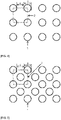
- the pattern in which the hole structure is repeated may be arranged such that one side of the simple cubic structure is repeated, or one side of the face-centered cubic structure is repeated when holes with the same size are repeated.
- a circular hole structure may be arranged in a pattern in which one side of a simple cubic structure is repeated.
- a maximum diameter of the hole included in the pattern of the polymer film is not particularly limited as long as physical properties such as absorption rate and centrifuge retention capacity, which will be described later, are satisfied.
- it may be 1 mm or more and 15 mm or less, and preferably, 2 mm or more, or 3 mm or more, and 13 mm or less, 11 mm or less, 10 mm or less, or 8 mm or less. If it is less than the above range, the effect of improving the absorption rate may be insignificant, and if it exceeds the above range, leakage of moisture such as salt water may occur.
- a distance between holes in the polymer film is not particularly limited as long as physical properties such as absorption rate and centrifuge retention capacity, which will be described later, are satisfied.
- it may be 1 mm or more and 10 mm or less, and preferably, 2 mm or more, or 3 mm or more, and 9 mm or less, or 8 mm or less.
- the "distance between holes” means a distance between one hole and another hole closest to the hole when the hole structure is randomly arranged on the film. When a certain arrangement is repeated, it means a length obtained by subtracting the diameter of the hole from the length of one side of the polygon, which is the smallest repeating unit of the arrangement.
- the circular hole structure of the polymer film has an arrangement in which one side of a simple cubic structure is repeated
- the one side has a square shape, so that a length obtained by subtracting the diameter of the hole from the length of the one side of the square is the distance between the holes.
- the same can be applied in the case of a hole structure having an arrangement in which one side of the face-centered cubic structure is repeated.
- the arrangement in which one side of the simple cubic structure is repeated may be understood with reference to FIG. 3
- the arrangement in which one side of the face-centered cubic structure is repeated may be understood with reference to FIG. 4 .
- a total area of the holes included in the pattern of the polymer film may be 15% or more, 18% or more, or 20% or more, and 80% or less, 70% or less, 60% or less, or 50% or less of the area of the polymer film. If it is less than the above range, the effect of improving the absorption rate may be insignificant, and if it exceeds the above range, leakage of moisture such as salt water may occur.
- a weight per unit area may be 100 g/m 2 or more and 210 g/m 2 or less.
- the weight per unit area may be 110 g/m 2 or more, 120 g/m 2 or more, or 130 g/m 2 or more, and 205 g/m 2 or less, or 200 g/m 2 or less.
- the weight per unit area of the polymer film is proportional to the thickness. That is, when the thickness of the polymer film is 0.1 mm, the weight per unit area may be 50 g/m 2 or more and 105 g/m 2 or less. The smaller the weight per unit area, the better the portability. If it is less than the above range, the absorbency per area for brine may be insufficient, and if it exceeds the above range, physical properties such as the absorbency per unit weight for brine may be reduced.
- an absorption rate of the polymer film may be 50 seconds or less, 45 seconds or less, 43 seconds or less, 41 seconds or less, or 40 seconds or less.
- the smaller absorption rate can be evaluated as the better there is no lower limit, but may be, for example, 10 seconds or more, 15 seconds or more, 20 seconds or more, or 25 seconds or more.
- the absorption rate is measured by the following method. A specimen is prepared by cutting the polymer film to a size of 10 cm * 25 cm (width * length) to have smooth cut surface, and a non-woven fabric with the same size is attached above and below the polymer film.
- a cylindrical plastic tube with an inner diameter of 60 mm is placed in the center of the polymer film, and 80 ml of 0.9 wt% saline is added at a rate of 15 ml/s using a funnel, followed by measuring the time taken until all the saline is absorbed.
- centrifuge retention capacity of the polymer film may be 30 g/g or more, 31 g/g or more, 32 g/g or more, 33 g/g or more, 34 g/g or more, or 35 g/g or more, and 50 g/g or less, 45 g/g or less, 43 g/g or less, 40 g/g or less, 38 g/g or less, or 37 g/g or less.
- the centrifuge retention capacity is measured according to the EDANA WSP 241.2.
- the polymer film is cut to have a weight (W0) of 0.08 to 0.12 g, put in a non-woven envelope, and sealed. Then, it is immersed in 0.9 wt% sodium chloride aqueous solution (physiological saline) at room temperature. After 30 minutes, the envelope is centrifuged at 250G for 3 minutes to drain, and the weight W2 (g) of the envelope is measured. Further, after carrying out the same operation without using the polymer film, the weight W1 (g) of the envelope is measured. Then, CRC (g/g) is calculated by using the obtained weight values according to the following Equation 2.
- CRC g / g W 2 g ⁇ W 1 g / W 0 g ⁇ 1
- the polymer film of the present disclosure may have an elongation of 100% or more, 150% or more, 180% or more, or 200% or more, and 550% or less, 530% or less, or 510% or less when the thickness is 0.001 to 0.5 mm.
- the elongation may be calculated according to the Equation 1, and the measurement method may be specified in Examples to be described later.
- the polymer film may have an absorption rate of 10 seconds or more and 50 seconds or less, and an elongation of 100% or more and 550% or less.
- the polymer film has improved absorption performance such as initial absorption rate while maintaining centrifuge retention capacity similar to that of conventional powder- or particulate-type super absorbent polymers. Accordingly, it may be used in absorbent cores of hygiene products such as diapers and sanitary napkins, wallpaper with moisture absorption and desorption property, absorbent pads for food for maintaining freshness in the food distribution field, pee pads for pets, medical bands, or the like.
- the polymer film may be prepared by a preparation method including the steps of:
- a monomer composition film is prepared from a monomer composition solution having a controlled viscosity by a solution casting method, and then polymerized and dried to prepare a polymer (super absorbent polymer) in the form of a film.
- a pattern is formed after drying in the present disclosure, a pattern having a hole structure penetrating the polymer film is formed, and accordingly, a polymer film having improved absorption performance such as absorption rate and reduced weight per unit area can be manufactured.
- the monomer composition which is a raw material of the polymer, contains an acrylic acid-based monomer having at least partially neutralized acidic groups, a cellulose-based thickener, a moisturizing agent, a polymerization initiator, and a solvent.
- the acrylic acid-based monomer is a compound represented by the following Chemical Formula 1: [Chemical Formula 1] R 1 -COOM 1 in Chemical Formula 1,
- the acrylic acid-based monomer includes at least one selected from the group consisting of acrylic acid, methacrylic acid, and a monovalent metal salt, a divalent metal salt, an ammonium salt, and an organic amine salt thereof.
- the acrylic acid-based monomers may be those having acidic groups which are at least partially neutralized.
- the acrylic acid-based monomer partially neutralized with an alkali substance such as sodium hydroxide, potassium hydroxide, ammonium hydroxide, or the like may be used.
- a degree of neutralization of the acrylic acid-based monomer may be 40 to 95 mol%, 40 to 80 mol%, or 45 to 75 mol%. The range of the degree of neutralization can be adjusted according to final properties. An excessively high degree of neutralization causes the neutralized monomers to be precipitated, and thus polymerization may not readily occur, whereas an excessively low degree of neutralization may deteriorate the absorbency of the polymer.
- potassium hydroxide may be used as the alkali substance.
- KOH potassium hydroxide
- a polymer film having better flexibility and dimensional stability may be prepared even with the moisture content of 10% or less.
- the concentration of the acrylic acid-based monomer may be about 20 to about 60 wt%, preferably about 40 to about 50 wt%, based on the monomer composition including the raw materials of the polymer and the solvent, and it may be appropriately selected in consideration of the reaction time and the reaction conditions.
- concentration of the monomer is excessively low, the yield of the polymer is low and there may be a problem in economic efficiency.
- concentration is excessively high, a problem may occur in the process such as some of the monomer is precipitated, and thus physical properties of the polymer may be deteriorated.
- a thickener and a moisturizing agent are contained in the monomer composition so that the monomer composition can be applied in the form of a film by a solution casting method.
- the monomer composition of the present disclosure may exhibit a viscosity suitable for casting in the form of a film, can maintain an appropriate moisture content in the polymerization process after film casting, and the polymer film to be prepared may have high flexibility.
- a cellulose-based thickener is used as the thickener, and specifically, at least one selected from the group consisting of nanocellulose, hydroxyethylcellulose, hydroxypropylcellulose, hydroxyethylmethylcellulose, and hydroxypropylmethylcellulose may be used.
- nanocellulose, hydroxyethylcellulose, or a combination thereof may be used.
- the cellulose-based thickener may be contained in an amount of 0.01 parts by weight or more, 0.1 parts by weight or more, 0.2 parts by weight or more, or 0.4 parts by weight or more, and 5 parts by weight or less, 3 parts by weight or less, 1 parts by weight or less, or 0.9 parts by weight or less based on 100 parts by weight of the solid content in the monomer composition.
- the solid content in the monomer composition refers to all components of the composition excluding the solvent. That is, the solid content refers to the total content of an acrylic acid-based monomer, an alkali material for neutralizing the acrylic monomer, a cellulose-based thickener, a moisturizing agent, a cross-linking agent, a thermal initiator, a photoinitiator, and an internal cross-linking agent.
- the content of the cellulose-based thickener is less than 0.01 parts by weight based on 100 parts by weight of the solid content in the monomer composition, sufficient thickening effect cannot be ensured, so it may be difficult to prepare a monomer composition film. Conversely, if it exceeds 5 parts by weight, the viscosity of the monomer composition becomes excessively high, so that the thickness of the film becomes thick, and it may be difficult to uniformly control the thickness of the film.
- the moisturizing agent a substance normally used as a moisturizing component in pharmaceuticals, cosmetics, chemical products, and the like may be used without limitation.
- the moisturizing agent include at least one selected from the group consisting of polyhydric alcohols having two or more hydroxyl groups in a molecule, citric acid, and citrate.
- the polyhydric alcohol a C3 to C30 polyhydric alcohol having 3 to 12 hydroxyl groups in a molecule may be used.
- the polyhydric alcohol may be at least one selected from the group consisting of glycerin; diglycerin; propylene glycol; butylene glycol; sorbitol; polyethylene glycol; polyglycerin-3; polyglycerin-6; polyglycerin-10; and polyglyceryl-10 distearate and a derivative thereof (C3 to C18).
- at least one selected from the group consisting of glycerin, diglycerin, ethylene glycol, and sorbitol may be preferably used.
- citric acid and/or citrate may also be used as the moisturizing agent.
- examples of the citrate include triethylcitrate, methylcitrate, sodium citrate, trisodium 2-methylcitrate, and the like.
- the moisturizing agent may be used in an amount of 5 parts by weight or more, 10 parts by weight or more, 20 parts by weight or more, or 30 parts by weight or more, and 70 parts by weight or less, 60 parts by weight or less, or 50 parts by weight or less based on 100 parts by weight of the acrylic acid-based monomer.
- the content of the moisturizing agent is less than 5 parts by weight based on 100 parts by weight of the acrylic acid-based monomer, the moisture content of the monomer composition film is not sufficient, so that the film may dry out or crumble in the subsequent polymerization and drying process and flexibility of the polymer film to be prepared cannot be achieved. Conversely, if the content of the moisturizing agent exceeds 70 parts by weight based on 100 parts by weight of the acrylic acid-based monomer, there may be a problem in that absorbency of the polymer film is reduced. Therefore, the content of the moisturizing agent preferably satisfies the above range.
- the monomer composition may optionally contain an internal cross-linking agent for cross-linking the polymer.
- an internal cross-linking agent those used in the preparation of a cross-linked polymer of a conventional super absorbent polymer may be used.
- the internal cross-linking agent may be a cross-linking agent having one or more ethylene-based unsaturated groups in addition to one or more functional groups which may react with a water-soluble substituent of the acrylic acid-based monomer; or a cross-linking agent having two or more functional groups which may react with a water-soluble substituent of the monomer and/or a water-soluble substituent formed by hydrolysis of the monomer.
- a C8-C12 bisacrylamide, bismethacrylamide, a poly(meth)acrylate of C2-C10 polyol, a poly(meth)allylether of C2-C10 polyol, or the like may be used.
- polyethylene glycol diacrylate may be used as the internal cross-linking agent.
- This internal cross-linking agent may be contained in a concentration of 3000 ppm or less with respect to the monomer composition, so that the polymerized polymer can be cross-linked.
- the internal cross-linking agent may be contained in 10 ppm or more, 50 ppm or more, 100 ppm or more or 500 ppm or more, and 3000 ppm or less, 2500 ppm or less, or 2000 ppm or less.
- the polymerization initiator generally used in the preparation of a super absorbent polymer may be used without limitation.
- the polymerization initiator a thermal polymerization initiator or a photopolymerization initiator with UV irradiation may be used depending on a polymerization method.
- the composition may additionally include the thermal polymerization initiator.
- a photopolymerization initiator and a thermal polymerization initiator may be used simultaneously as the polymerization initiator.
- any compound which can form a radical by light such as UV rays may be used as the photopolymerization initiator without limitation.
- the photopolymerization initiator may be one or more compounds selected from the group consisting of benzoin ether, dialkyl acetophenone, hydroxyl alkylketone, phenyl glyoxylate, benzyl dimethyl ketal, acyl phosphine, and ⁇ -aminoketone.
- acyl phosphine commercial lucirin TPO (2,4,6-Trimethylbenzoyldiphenylphosphine oxide), Irgacure 819 (Phenylbis(2,4,6-trimethylbenzoyl)phosphine oxide), and the like may be used. More various photopolymerization initiators are well disclosed in " UV Coatings: Basics, Recent Developments and New Application (Elsevier, 2007)" written by Reinhold Schwalm, p 115 , and the present disclosure is not limited thereto.
- a concentration of the photopolymerization initiator in the monomer composition may be 10 ppm or more, 20 ppm or more, or 40 ppm or more, and 2000 ppm or less, 1000 ppm or less, 500 ppm or less, or 100 ppm or less. If the concentration of the photopolymerization initiator is excessively low, the polymerization rate may become slow, and if the concentration is excessively high, the molecular weight of the super absorbent polymer may become low and properties may be uneven.
- one or more initiators selected from the group consisting of a persulfate-based initiator, an azo-based initiator, hydrogen peroxide, and ascorbic acid may be used.
- a concentration of the thermal polymerization initiator in the monomer composition may be 10 ppm or more, 100 ppm or more, or 500 ppm or more, and 2000 ppm or less, 1500 ppm or less, or 1000 ppm or less. If the concentration of the thermal polymerization initiator is excessively low, additional thermal polymerization hardly occurs and the effect of adding the thermal polymerization initiator may be insufficient. If the concentration of the thermal polymerization initiator is excessively high, the molecular weight of the super absorbent polymer may become low and the properties may be uneven.
- the monomer composition may further contain an additive such as a plasticizer, a preservation stabilizer, an antioxidant, or the like, if necessary.
- Raw materials such as the acrylic acid-based unsaturated monomer, internal cross-linking agent, polymerization initiator, and additive are prepared in the form of a monomer composition solution dissolved in a solvent.
- Any solvent which can dissolve the components may be used without limitation, and for example, water, ethanol, ethyleneglycol, diethyleneglycol, triethyleneglycol, 1,4-butanediol, propyleneglycol, ethyleneglycol monobutylether, propyleneglycol monomethylether, propyleneglycol monomethylether acetate, methylethylketone, acetone, methylamylketone, cyclohexanone, cyclopentanone, diethyleneglycol monomethylether, diethyleneglycol ethylether, toluene, xylene, butyrolactone, carbitol, methylcellosolve acetate, N,N-dimethylacetamide, and the like may be used alone or in combination.
- water may be used as the solvent.
- the monomer composition exhibits a viscosity suitable for a solution casting method by containing a cellulose-based thickener and a moisturizing agent.
- the viscosity at 25 °C of the monomer composition may be 100 mPa ⁇ s or more, 150 mPa ⁇ s or more, 200 mPa ⁇ s or more, or 240 mPa ⁇ s or more, and 5000 mPa ⁇ s or less, 2300 mPa ⁇ s or less, 2000 mPa ⁇ s or less, or 1600 mPa ⁇ s or less.
- the viscosity of the monomer composition may be measured with a viscometer (e.g., TV-22 manufactured by TOKI) under the conditions of spindle #1 and a rotational speed of 1 rpm.
- the viscosity of the monomer composition is less than 100 mPa ⁇ s, it may be difficult to cast the monomer composition to a uniform thickness. Conversely, if the viscosity of the monomer composition is more than 5000 mPa ⁇ s, it is difficult to prepare a uniform monomer composition, and flowability of the monomer composition is low, so that processability is deteriorated and defoaming is difficult.
- the monomer composition is prepared, and then casted on a substrate to prepare a monomer composition film. Then, it is polymerized while drawing to form a hydrogel polymer film. Casting and polymerization of the monomer composition may be continuously performed through a roll-to-roll process.
- a monomer composition film is prepared by applying a monomer composition on a substrate.
- the present disclosure immediately performs the drawing and polymerization process after the monomer composition is applied on the substrate so as not to decrease the moisture content.
- the moisture content of the monomer composition film preferably satisfies the range of 30 wt% to 60 wt%, 30 wt% to 50 wt%, or 30 wt% to 45 wt%.
- the thickness of the monomer composition film may be appropriately adjusted depending on the thickness of the desired polymer film. Although the thickness of the monomer composition film hardly changes during the polymerization step, the thickness may decrease by about 10 to 40% or 15 to 35% while the moisture content decreases during the drying process of the hydrogel polymer film after polymerization. In consideration of this, a monomer composition film may be prepared with an appropriate thickness.
- the thickness of the monomer composition film may be 0.8 mm or less, 0.6 mm or less, or 0.5 mm or less, and 0.001 mm or more, or 0.01 mm or more, but is not limited thereto. It can be appropriately adjusted depending on the composition of the monomer composition, specific conditions in the polymerization and drying steps, and the thickness of the desired polymer film.
- a polymerization reaction is performed by irradiating heat and/or light while drawing the monomer composition film in the longitudinal direction (MD direction), thereby forming a hydrogel polymer film.
- Drawing the film during the polymerization can control physical properties such as tensile strength of the polymer film to be prepared.
- the tension applied to the monomer composition film may be 40 N/m or more, 45 N/m or more, 50 N/m or more, or 60 N/m or more, and 100 N/m or less, 90 N/m or less, or 70 N/m or less. If the film is drawn by applying an excessively large tension, the monomer composition film may be broken or the thickness may be excessively thin. If the tension is too small, physical properties such as tensile strength of the film may not be secured.
- the polymerization temperature may be appropriately adjusted depending on the composition of the monomer composition, but is preferably 40 °C or more, or 50 °C or more for smooth reaction. In addition, if the temperature is too high, the solvent evaporates and components constituting the monomer composition may be precipitated. Therefore, the polymerization temperature is preferably 90 °C or less or 80 °C or less.
- the moisture content of the hydrogel polymer film prepared through the polymerization step may be about 20 wt% or more, preferably 25 wt% or more, and 40 wt% or less, or 35 wt% or less. Accordingly, a dried polymer film is prepared by drying the hydrogel polymer film.
- the temperature of the drying step may preferably be 80 to 150 °C, or 90 to 100 °C. Drying for about 5 to 30 minutes within the above temperature range may provide a dried polymer film having the moisture content of 15 wt% or less, 12 wt% or less, 10 wt% or less, or 9 wt% or less, and 1 wt% or more, 2 wt% or more, 4 wt% or more, or 6 wt% or more.
- a pattern is formed on the dried polymer film to form a final polymer film.
- the pattern is a pattern having a hole structure penetrating the film, and the "hole structure" is the same as described above.
- the pattern may be formed in a Print and Cut method.
- a device used for the Print and Cut method is not particularly limited, and for example, a CAMEO Cutting Printer (manufactured by Silhouette) may be used.
- the polymer film prepared according to the preparation method includes a pattern having a hole structure penetrating the film as described above, so that absorption performance such as absorption rate may be improved. Since the super absorbent polymer film of the present disclosure can be used as an absorbent by itself without compounding with an auxiliary substance such as pulp, it can be suitably used for slim and thin-film products, and can exhibit excellent absorption performance without deformation of the product.
- a polymer film laminate including a polymer in the form of a film and a non-woven fabric, wherein the polymer film can be used as an absorber by itself without an auxiliary agent such as pulp due to its excellent absorbency, and is free from scattering or leaking.
- the polymer film has improved absorption performance by including a pattern having a hole structure penetrating the film, and has a light weight per unit area, making it easier to carry when applied to products.
- a nonwoven fabric having a low density per unit area is included in the laminate, it is possible to provide a polymer film laminate having an excellent absorption rate while maintaining the centrifuge retention capacity at the same level.
- the non-woven fabric is widely used for various purposes due to its excellent breathability and flexibility. In the present disclosure, it is included in the laminate together with the polymer film, thereby contributing to the improvement of the absorption rate.
- a weight per unit area of the non-woven fabric having a thickness of 0.25 mm may be 60 g/m 2 or less, 55 g/m 2 or less, 50 g/m 2 or less, or 45 g/m 2 or less, and 10 g/m 2 or more, 15 g/m 2 or more, 20 g/m 2 or more, 25 g/m 2 or more, or 30 g/m 2 or more.
- weight per unit area is less than 10 g/m 2 , there are problems of difficulty in manufacturing the non-woven fabric and low strength, and if it exceeds 60 g/m 2 , the absorption rate is lowered and permeability of upper and lower polymer films (SAP Film) may be lowered.
- SAP Film upper and lower polymer films
- the polymer film laminate may include a polymer film above and below the non-woven fabric.
- Other laminated materials may be included between the non-woven fabric and the polymer film, but it is preferable that the non-woven fabric and the upper and lower polymer films are adjacent to each other.
- the above-described polymer film is applied.
- the preparation method of the polymer film included in the polymer film laminate is as described above.
- the polymer film laminate of the present disclosure may have centrifuge retention capacity of 30 g/g or more and 50 g/g or less.
- the centrifuge retention capacity is measured according to the EDANA WSP 241.2.
- the polymer film is cut to have a weight (W0) of 0.08 to 0.12 g, put in a non-woven envelope, and sealed. Then, it is immersed in 0.9 wt% sodium chloride aqueous solution (physiological saline) at room temperature. After 30 minutes, the envelope is centrifuged at 250G for 3 minutes to drain, and the weight W2 (g) of the envelope is measured. Further, after carrying out the same operation without using the polymer, the weight W1 (g) of the envelope is measured. Then, CRC (g/g) is calculated by using the obtained weight values according to the following Equation 2.
- CRC g / g W 2 g ⁇ W 1 g / W 0 g ⁇ 1
- the polymer film laminate of the present disclosure may have an absorption rate of 10 seconds or more, 12 seconds or more, 14 seconds or more, 16 seconds or more, 18 seconds or more, or 20 seconds or more, and 30 seconds or less, 28 seconds or less, 26 seconds or less, or 24 seconds or less.
- the absorption rate is measured by the following method.
- a polymer film laminate specimen is prepared by cutting the laminate to a size of 10 cm * 25 cm (width * length) to have smooth cut surface.
- a cylindrical plastic tube with an inner diameter of 60 mm is placed in the center of the laminate, and 80 ml of 0.9 wt% saline is added at a rate of 15 ml/s using a funnel, followed by measuring the time taken until all the saline is absorbed.
- the polymer film laminate includes the above-described non-woven fabric and the polymer film, the absorption performance such as an initial absorption rate is improved while maintaining the same level of centrifuge retention capacity. Accordingly, it may be used in hygiene products such as diapers and sanitary napkins, absorbent pads for food, pee pads for pets, and the like.
- the polymer film laminate may be prepared by laminating the above-described nonwoven fabric and the polymer film.
- the preparation method of the polymer film laminate of the present disclosure may include the steps of: laminating a lower polymer film; laminating a central non-woven fabric; and laminating an upper polymer film.
- the "central non-woven fabric” is the same as the non-woven fabric described above.
- the step of laminating the non-woven fabric and the polymer film there is no particular limitation in a method for fixing the material to be laminated.
- a method for fixing the material to be laminated For example, an adhesive commonly used in the art may be used, but an adhesive material for fixing may not be used.
- a step of laminating an additional non-woven fabric may be further included before the laminating step of the lower polymer film and after the laminating step of the upper polymer film.
- the additional non-woven fabric functions as a top sheet to prevent the upper and lower polymer films from being exposed to the outside.
- a structure of the polymer film laminate including the additional non-woven fabric may be understood with reference to FIG. 6 .
- the top sheet of FIG. 6 is the additional non-woven fabric
- SAP Film is the polymer film
- non-woven is the central non-woven fabric.
- the additional non-woven fabric is not particularly limited as long as it is a material commonly used in the art.
- a neutralized solution in which 70 mol% of acrylic acid was neutralized was prepared by mixing 55 g of acrylic acid, 66.6 g of a 45 wt% potassium hydroxide (KOH) solution, and 55 g of water.
- KOH potassium hydroxide
- PEGDA polyethylene glycol diacrylate
- HEC hydroxyethyl cellulose
- Irgacure 819 as a photopolymerization initiator
- PEGDA was added in an amount of 0.5 parts by weight based on 100 parts by weight of the solid content in the monomer composition
- HEC was added in an amount of 0.45 parts by weight based on 100 parts by weight of the solid content in the monomer composition
- glycerin was added in an amount of 40 parts by weight based on 100 parts by weight of acrylic acid.
- the thermal polymerization initiator and the photopolymerization initiator were added in an amount of 1000 ppm and 80 ppm based on the total weight of the monomer composition, respectively.
- a viscosity of the prepared monomer composition at 25 °C was measured using Brookfield DV2T LV TJ0 under the conditions of 1 rpm and spindle # 1, and the viscosity of the monomer composition was confirmed to be 735 mPa ⁇ s.
- the monomer composition was coated on one side of a polyethylene terephthalate (PET) film to form a 0.2 mm thick monomer composition film (moisture content of 30%).
- PET polyethylene terephthalate
- a comma coater Gap 700 ⁇ m
- the prepared hydrogel polymer film was 0.2 mm, and it was confirmed that there was no significant change compared to the monomer composition and the moisture content was 30 wt%. Then, the prepared hydrogel polymer was dried at a temperature of 90 °C for 10 minutes to prepare a dried polymer film having a moisture content of 10 wt% and a thickness of 0.2 mm.
- a hole structure pattern (a pattern in which one side of a simple cubic structure is repeated, wherein a diameter of the circular hole is 3 mm and a distance between the holes is 3 mm) was formed on the dried polymer film using CAMEO Cutting Printer from Silhouette in a Print & Cut method, thereby forming a polymer film (SAP film) having a moisture content of 10 wt% and a thickness of 0.2 mm.
- a polymer film was prepared in the same manner as in Example 1-1, except that the diameter of the circular hole of the pattern was 4 mm and the distance between the holes was 4 mm in the step of forming a pattern on the dried polymer film.
- a polymer film was prepared in the same manner as in Example 1-1, except that the diameter of the circular hole of the pattern was 4 mm and the distance between the holes was 8 mm in the step of forming a pattern on the dried polymer film.
- a polymer film was prepared in the same manner as in Example 1-1, except that the diameter of the circular hole of the pattern was 5 mm and the distance between the holes was 5 mm in the step of forming a pattern on the dried polymer film.
- a polymer film was prepared in the same manner as in Example 1-1, except that the diameter of the circular hole of the pattern was 6 mm and the distance between the holes was 6 mm in the step of forming a pattern on the dried polymer film.
- a polymer film was prepared in the same manner as in Example 1-1, except that the pattern was a pattern in which one side of the face-centered cubic structure was repeated in the step of forming a pattern on the dried polymer film.
- a polymer film was prepared in the same manner as in Example 1-1, except that the pattern was a pattern in which one side of the face-centered cubic structure was repeated, wherein the diameter of the circular hole of the pattern was 4 mm and the distance between the holes was 4 mm in the step of forming a pattern on the dried polymer film.
- a polymer film was prepared in the same manner as in Example 1-1, except that the pattern was a pattern in which one side of the face-centered cubic structure was repeated, wherein the diameter of the circular hole of the pattern was 4 mm and the distance between the holes was 8 mm in the step of forming a pattern on the dried polymer film.
- a polymer film was prepared in the same manner as in Example 1-1, except that the pattern was a pattern in which a rectangular hole structure was repeated, wherein one hole had the width of 6.06 mm and the length of 0.25 mm, and the distance between the holes was 1.12 mm in width and 1.72 mm in length in the step of forming a pattern on the dried polymer film.
- Specific specifications of the pattern of Example 1-9 may be understood with reference to FIG. 5 .
- a polymer film was prepared in the same manner as in Example 1-1, except that the thickness of the film was 0.1 mm.
- a polymer film was prepared in the same manner as in Example 1-1, except that the step of forming a pattern was omitted.
- the prepared polymer film (thickness: 0.2 mm or 0.1 mm) was cut to a size of 10 cm * 25 cm (width * length) to make a specimen, and then its weight was measured with a scale.
- a specimen was prepared by cutting the polymer film or sheet into a rectangular shape with a size of 20 mm x 60 mm to have smooth cut surface. Then, an initial gauge distance of a tensile strength measuring device (TAXTplus, manufactured by Stable Micro Systems) was set to 20 mm, and then the specimen was mounted. The specimen was pulled at a rate of 0.5 mm per minute to measure a gauge distance at fracture, and the elongation was obtained by dividing the value by the initial gauge distance.
- Elongation % L 1 ⁇ L 0 / L 0 * 100 in the Equation 1,
- a specimen was prepared by cutting the prepared polymer film to a size of 10 cm * 25 cm (width * length) to have smooth cut surface, and a non-woven fabric with the same size was attached above and below the polymer film. Then, a cylindrical plastic tube with an inner diameter of 60 mm was placed in the center of the polymer film, and 80 ml of 0.9 wt% saline was added at a rate of 15 ml/s using a funnel, followed by measuring the time taken until all the saline was absorbed.
- the centrifuge retention capacity (CRC) was measured according to the EDANA WSP 241.2.
- the moisture content of the polymer film of each Example and Reference Example to be measured is 10 wt% as described above, and the centrifuge retention capacity was measured without adjusting the moisture content.
- the polymer film was cut to have a weight (W0) of 0.08 to 0.12 g, put in a non-woven envelope, and sealed. Then, it was immersed in 0.9 wt% sodium chloride aqueous solution (physiological saline) at room temperature. After 30 minutes, the envelope was centrifuged at 250G for 3 minutes to drain, and the weight W2 (g) of the envelope was measured.
- the polymer films of Preparation Examples including the hole structure pattern had superior absorption performance such as absorption rate compared to Reference Example including no hole structure pattern, and had the same level of centrifuge retention capacity and elongation while having a small weight per unit area.
- the polymer film including the hole structure prepared in Example 1 -1 was cut into 2 sheets with a size of 10 cm * 25 cm.
- a TOP sheet DEMAO's Cellulose nonwoven fabric with a thickness of 0.25T was cut into 2 sheets with a size of 10 cm * 25 cm.
- a non-woven fabric located in the center a Cotton non-woven fabric having a thickness of 0.22 T and 40 gsm (manufactured by Namyang Nonwoven Fabric) was cut to a size of 10 cm * 25 cm.
- the cut film and non-woven fabric were laminated in the order of a top sheet, a lower polymer film, a central non-woven fabric, an upper polymer film, and a top sheet to prepare a super absorbent polymer film laminate.
- the structure of the polymer film laminate may be understood with reference to FIG. 6 .
- a polymer film laminate was prepared in the same manner as in Example 2-1, except that the upper polymer film was the polymer film prepared in Example 1-10.
- the structure of the polymer film laminate may be understood with reference to FIG. 6 .
- a polymer film laminate was prepared in the same manner as in Example 2-1, except that the lower polymer film was the polymer film prepared in Example 1-10.
- the structure of the polymer film laminate may be understood with reference to FIG. 6 .
- a polymer film laminate was prepared in the same manner as in Example 2-1, except that a Cotton non-woven fabric having a thickness of 0.22 T and 50 gsm (manufactured by Namyang Nonwoven Fabric) was used as the non-woven fabric located in the center.
- the structure of the polymer film laminate may be understood with reference to FIG. 6 .
- a polymer film laminate was prepared in the same manner as in Example 2-1, except that a Cotton non-woven fabric having a thickness of 0.22 T and 50 gsm (manufactured by Namyang Nonwoven Fabric) was used as the non-woven fabric located in the center, and the polymer film prepared in Example 1-10 was used as the upper polymer film.
- the structure of the polymer film laminate may be understood with reference to FIG. 6 .
- a polymer film laminate was prepared in the same manner as in Example 2-1, except that a Cotton non-woven fabric having a thickness of 0.22 T and 50 gsm (manufactured by Namyang Nonwoven Fabric) was used as the non-woven fabric located in the center, and the polymer film prepared in Example 1-10 was used as the lower polymer film.
- the structure of the polymer film laminate may be understood with reference to FIG. 6 .
- the polymer film not including the hole structure prepared in Reference Example 1 -1 was cut to a size of 10 cm * 25 cm.
- a TOP sheet DEMAO's Cellulose non-woven fabric was cut into 2 sheets with a size of 10 cm * 25 cm. Thereafter, the cut film and the non-woven fabric were laminated in the order of a top sheet, a polymer film, and a top sheet to prepare a polymer film laminate.
- a polymer film laminate was prepared in the same manner as in Comparative Example 1, except that the polymer film prepared in Example 1-1 was used as the polymer film.
- a polymer film laminate was prepared in the same manner as in Example 2-1, except that a Cotton non-woven fabric having a thickness of 0.22 T and 50 gsm (manufactured by Namyang Nonwoven Fabric) was used as the non-woven fabric located in the center, and the polymer film prepared in Reference Example 1 -1 was used as the upper and lower polymer films.
- the structure of the polymer film laminate may be understood with reference to FIG. 6 .
- the centrifuge retention capacity and absorption rate of the laminates prepared in Examples 2-1 to 2-6 and Comparative Examples 1 to 3 were measured by the following method, and are shown in Tables 2 and 3 below.
- the centrifuge retention capacity (CRC) was measured according to the EDANA WSP 241.2.
- the moisture content of the polymer film of each Example and Comparative Example to be measured is 10 wt% as described above, and the centrifuge retention capacity was measured without adjusting the moisture content.
- the polymer film laminate was cut to have a weight (W0) of 0.08 to 0.12 g, put in a non-woven envelope, and sealed. Then, it was immersed in 0.9 wt% sodium chloride aqueous solution (physiological saline) at room temperature. After 30 minutes, the envelope was centrifuged at 250G for 3 minutes to drain, and the weight W2 (g) of the envelope was measured.
- a specimen was prepared by cutting the prepared polymer film laminate to a size of 10 cm * 25 cm (width * length) to have smooth cut surface. Then, a cylindrical plastic tube with an inner diameter of 60 mm was placed in the center of the polymer film laminate, and 80 ml of 0.9 wt% saline was added at a rate of 15 ml/s using a funnel, followed by measuring the time taken until all the saline was absorbed.
- Example 2-1 Example 2-2
- Example 2-3 Example 2-4
- Example 2-5 Example 2-6 Laminate structure (from the bottom) Top sheet / lower polymer film / central nonwoven fabric / upper polymer film / Top sheet Hole diameter (mm) 3 3 3 3 3 3 3 3 3 Distance between holes (mm) 3 3 3 3 3 3 3 3 3 Material of nonwoven fabric Cotton Cotton Cotton Cotton Cotton Cotton Cotton Cotton Density of non-woven fabric (g/m 2 ) 40 40 40 50 50 50 50 50 Thickness of upper film (mm) 0.2 0.1 0.2 0.1 0.2 Thickness of lower film (mm) 0.2 0.2 0.1 0.2 0.1 CRC (g/g) 32 32 32 32 32 32 32 32 32 32 32 32 32 32 32 32 32 32 32 32 32 32 Absorptio n rate (s) 23 23 22 27 25 25 [Table 3] Comparative Example 1 Comparative Example 2 Comparative Example 3 Laminate structure (from the bottom) Top sheet / polymer film / Top sheet (from the bottom) Top sheet / lower polymer film /
Landscapes
- Chemical & Material Sciences (AREA)
- Health & Medical Sciences (AREA)
- Chemical Kinetics & Catalysis (AREA)
- Medicinal Chemistry (AREA)
- Polymers & Plastics (AREA)
- Organic Chemistry (AREA)
- Engineering & Computer Science (AREA)
- Manufacturing & Machinery (AREA)
- Materials Engineering (AREA)
- Textile Engineering (AREA)
- Manufacture Of Macromolecular Shaped Articles (AREA)
Applications Claiming Priority (4)
| Application Number | Priority Date | Filing Date | Title |
|---|---|---|---|
| KR20200114814 | 2020-09-08 | ||
| KR20200114813 | 2020-09-08 | ||
| KR1020210118477A KR102800448B1 (ko) | 2020-09-08 | 2021-09-06 | 고분자 필름, 이의 제조 방법 및 이를 포함하는 고분자 필름 적층체 |
| PCT/KR2021/095082 WO2022055338A1 (fr) | 2020-09-08 | 2021-09-07 | Film polymère, son procédé de préparation, et stratifié de film polymère le comprenant |
Publications (2)
| Publication Number | Publication Date |
|---|---|
| EP4082783A1 true EP4082783A1 (fr) | 2022-11-02 |
| EP4082783A4 EP4082783A4 (fr) | 2023-09-20 |
Family
ID=80632310
Family Applications (1)
| Application Number | Title | Priority Date | Filing Date |
|---|---|---|---|
| EP21867203.8A Pending EP4082783A4 (fr) | 2020-09-08 | 2021-09-07 | Film polymère, son procédé de préparation, et stratifié de film polymère le comprenant |
Country Status (4)
| Country | Link |
|---|---|
| US (1) | US12421358B2 (fr) |
| EP (1) | EP4082783A4 (fr) |
| CN (1) | CN115066332B (fr) |
| WO (1) | WO2022055338A1 (fr) |
Family Cites Families (87)
| Publication number | Priority date | Publication date | Assignee | Title |
|---|---|---|---|---|
| US4061846A (en) * | 1974-03-13 | 1977-12-06 | The Dow Chemical Company | Flexible water swellable crosslinked polyacrylate film |
| USRE31822E (en) * | 1976-06-07 | 1985-02-05 | The Dow Chemical Company | Absorbent films and laminates |
| JPS5346389A (en) * | 1976-10-07 | 1978-04-25 | Kao Corp | Preparation of self-crosslinking polymer of acrylic alkali metal salt |
| US4486489A (en) * | 1980-07-08 | 1984-12-04 | The B. F. Goodrich Company | Films of hydrophilic interpolymers of neutralized acrylic acid, hydroxyalkyl methacrylate or dialkylaminoalkyl (meth)acrylate and optionally a cross-linking agent |
| JPS58180233A (ja) * | 1982-04-19 | 1983-10-21 | Nippon Shokubai Kagaku Kogyo Co Ltd | 吸収剤 |
| EP0122085B1 (fr) * | 1983-04-06 | 1987-06-24 | Smith and Nephew Associated Companies p.l.c. | Pansement |
| US4734478A (en) * | 1984-07-02 | 1988-03-29 | Nippon Shokubai Kagaku Kogyo Co., Ltd. | Water absorbing agent |
| GB8422950D0 (en) * | 1984-09-11 | 1984-10-17 | Warne K J | Hydrogel |
| NL8500429A (nl) * | 1984-09-28 | 1986-04-16 | Stamicarbon | Werkwijze voor het bereiden van hoogverstrekbare polymere gelvoorwerpen. |
| US4861539A (en) * | 1986-11-20 | 1989-08-29 | Allied Colloids Ltd. | Process of making water-absorbent, water-insoluble, cross linked fiber or film |
| GB8705985D0 (en) * | 1987-03-13 | 1987-04-15 | Geistlich Soehne Ag | Dressings |
| JPH0819281B2 (ja) * | 1987-07-30 | 1996-02-28 | 三菱化学株式会社 | 吸水性樹脂組成物 |
| GB8811955D0 (en) * | 1988-05-20 | 1988-06-22 | Allied Colloids Ltd | Absorbent products & their manufacture |
| CA2001397A1 (fr) * | 1988-10-28 | 1990-04-28 | Tadao Shimomura | Procede de fabrication d'acrylates et d'acrylates a teneur de polymeres |
| DE3903672C1 (fr) * | 1989-02-08 | 1990-02-01 | Lohmann Gmbh & Co Kg | |
| JP3148307B2 (ja) * | 1991-11-07 | 2001-03-19 | ライオン株式会社 | 塩感応性ポリマー |
| GB9210955D0 (en) * | 1992-05-22 | 1992-07-08 | Courtaulds Plc | Fibres and filaments |
| JP3114518B2 (ja) | 1993-09-30 | 2000-12-04 | 株式会社村田製作所 | ラダー型フィルタ |
| JPH07155591A (ja) | 1993-12-08 | 1995-06-20 | Sanwa Kako Co Ltd | 高吸水性シートの製造方法 |
| JP3620866B2 (ja) | 1993-12-20 | 2005-02-16 | 住友精化株式会社 | 吸水性樹脂組成物 |
| JPH0873507A (ja) | 1994-07-01 | 1996-03-19 | Nippon Shokubai Co Ltd | シート状吸水体およびその製造方法、並びに吸水物品 |
| JP3335017B2 (ja) | 1994-11-29 | 2002-10-15 | キヤノン株式会社 | カメラ装置の制御装置 |
| DE19505708A1 (de) * | 1995-02-20 | 1996-08-22 | Stockhausen Chem Fab Gmbh | Flächenförmige, superabsorbierende Gebilde |
| DE69635897T2 (de) * | 1995-11-02 | 2006-10-19 | Nippon Shokubai Co. Ltd. | Wasserabsorbierendes harz, absorbierendes material und verfahren zur herstellung derselben |
| JP3883140B2 (ja) * | 1997-05-19 | 2007-02-21 | 株式会社日本吸収体技術研究所 | 吸水性樹脂凝集体及びシート状吸水体の製造方法 |
| GB9909349D0 (en) * | 1999-04-23 | 1999-06-16 | First Water Ltd | Process |
| JP2001277398A (ja) * | 2000-03-31 | 2001-10-09 | Unitika Ltd | シート状吸水体及びその製造方法 |
| US6906159B2 (en) * | 2000-08-03 | 2005-06-14 | Nippon Shokubai Co., Ltd. | Water-absorbent resin, hydropolymer, process for producing them, and uses of them |
| GB0027674D0 (en) * | 2000-11-13 | 2000-12-27 | Johnson & Johnson Medical Ltd | Hydrogel wound dressings |
| JP4198314B2 (ja) | 2000-12-08 | 2008-12-17 | 大王製紙株式会社 | 吸収体、その製造方法、およびその吸収体を備えた吸収性物品 |
| GB2377939B (en) * | 2001-07-26 | 2005-04-20 | Johnson & Johnson Medical Ltd | Apertured sheet materials |
| US6861477B2 (en) * | 2001-12-21 | 2005-03-01 | Kimberly-Clark Worldwide, Inc. | Microphase separated superabsorbent compositions and method for making |
| CN1309427C (zh) * | 2002-05-01 | 2007-04-11 | 巴斯福股份公司 | 增塑的超强吸收性聚合物片材及其在卫生制品中的应用 |
| DE10221176A1 (de) * | 2002-05-13 | 2003-11-27 | Basf Ag | Verfahren zur Herstellung geruchsarmer Hydrogelbildender Polymerisate |
| CN1301285C (zh) * | 2002-06-19 | 2007-02-21 | 昭和电工株式会社 | 水凝胶、水凝胶的制备方法及其用途 |
| US20040068093A1 (en) * | 2002-07-01 | 2004-04-08 | The Procter & Gamble Company | Polymerized hydrogel comprising low amounts of residual monomers and by-products |
| DE10231356B4 (de) | 2002-07-11 | 2007-02-15 | Stockhausen Gmbh | Wasserabsorbierende, schaumförmige Polymergebilde, Verfahren zu deren Herstellung, deren Verwendung sowie daraus hergestellte Verbunde |
| JP4194400B2 (ja) * | 2003-03-26 | 2008-12-10 | 積水化成品工業株式会社 | 高強度含水ゲルおよびその製造方法 |
| EP1677845B2 (fr) * | 2003-09-19 | 2016-06-22 | Nippon Shokubai Co., Ltd. | Composant hydrophile et procédé de fabrication associé |
| US7662745B2 (en) * | 2003-12-18 | 2010-02-16 | Kimberly-Clark Corporation | Stretchable absorbent composites having high permeability |
| DE502006002836D1 (de) * | 2005-08-16 | 2009-03-26 | Dow Wolff Cellulosics Gmbh | Verfahren zur herstellung von celluloseetherprodukten mit erhöhter viskosität und feinheit |
| US20070219521A1 (en) * | 2006-03-17 | 2007-09-20 | The Procter & Gamble Company | Absorbent article comprising a synthetic polymer derived from a renewable resource and methods of producing said article |
| CN100494227C (zh) * | 2007-06-04 | 2009-06-03 | 武汉理工大学 | 纳米可分散羧甲基纤维素-丙烯酸高分子吸水树脂的合成方法 |
| JP5292833B2 (ja) * | 2007-08-30 | 2013-09-18 | 凸版印刷株式会社 | 水分吸収能力を有する多層フィルム |
| BRPI0822305B8 (pt) * | 2008-02-25 | 2021-06-22 | Teikoku Seiyaku Kk | material de hidrogel protetor de feridas |
| WO2010071584A1 (fr) * | 2008-12-19 | 2010-06-24 | Sca Hygiene Products Ab | Composite polymère super-absorbant comprenant un polymère super-absorbant et des nanofibrilles cellulosiques |
| US8891923B2 (en) * | 2008-12-30 | 2014-11-18 | Draka Comteq, B.V. | Perforated water-blocking element |
| KR101367362B1 (ko) | 2010-03-19 | 2014-02-26 | 주식회사 엘지화학 | 중합 반응기 및 고흡수성 수지의 제조 방법 |
| EP2588036A1 (fr) * | 2010-07-01 | 2013-05-08 | Ecole Polytechnique Federale De Lausanne (EPFL) EPFL-TTO | Hydrogels composites |
| BR112013002033B1 (pt) | 2010-07-27 | 2021-05-25 | Dow Global Technologies Llc | método para aplicar uma composição aditiva em um produto tecido não-crepado e artigo |
| CN101962463B (zh) * | 2010-09-17 | 2012-03-21 | 东华大学 | 非水解可生物降解丙烯酸类聚合物纳米水凝胶的制备方法 |
| CN103282458B (zh) * | 2011-01-06 | 2015-05-13 | 积水化成品工业株式会社 | 粘合性水凝胶用组合物及其用途 |
| SG2013095260A (en) | 2011-08-03 | 2014-03-28 | Sumitomo Seika Chemicals | Water absorbing resin particles, method for manufacturing water absorbing resin particles, absorption body, absorptive article, and water-sealing material |
| CN103113700A (zh) * | 2013-01-18 | 2013-05-22 | 盐城工学院 | 互穿网络结构水凝胶创面敷料及其制备方法 |
| JP5952763B2 (ja) * | 2013-03-19 | 2016-07-13 | 積水化成品工業株式会社 | ハイドロゲル |
| US20170072088A1 (en) * | 2014-05-05 | 2017-03-16 | Lubrizol Advanced Materials, Inc. | Homogenous film compositions |
| KR20150144591A (ko) * | 2014-06-17 | 2015-12-28 | 주식회사 엘지화학 | 고흡수성 패드의 제조방법 |
| JP6417843B2 (ja) * | 2014-10-15 | 2018-11-07 | デクセリアルズ株式会社 | 吸水性ポリマーシートの製造方法 |
| CN107428949B (zh) * | 2015-03-31 | 2020-03-17 | 株式会社日本触媒 | 聚丙烯酸(盐)系吸水性树脂粉末及其制造方法、以及其评价方法 |
| US9346938B1 (en) * | 2015-05-21 | 2016-05-24 | King Fahd University Of Petroleum And Minerals | Poly(acrylic acid)-glycerol blends |
| WO2017051734A1 (fr) * | 2015-09-25 | 2017-03-30 | 積水化成品工業株式会社 | Hydrogel et son procédé de production |
| EP3315561A4 (fr) * | 2015-09-25 | 2019-03-20 | Sekisui Plastics Co., Ltd. | Hydrogel et son procédé de production |
| CN109310984A (zh) | 2016-03-28 | 2019-02-05 | 株式会社日本触媒 | 吸水剂的制造方法 |
| CN105732999B (zh) * | 2016-04-18 | 2018-08-24 | 北京师范大学 | 高强度交联水凝胶和弹性体及其制备方法 |
| JP6717680B2 (ja) * | 2016-06-17 | 2020-07-01 | 旭化成株式会社 | 延伸シート、シート製品 |
| JP6828301B2 (ja) | 2016-08-16 | 2021-02-10 | デクセリアルズ株式会社 | 吸水性シート |
| US10500104B2 (en) | 2016-12-06 | 2019-12-10 | Novomer, Inc. | Biodegradable sanitary articles with higher biobased content |
| RU2713985C1 (ru) | 2016-12-22 | 2020-02-11 | Као Корпорейшн | Впитывающее изделие |
| US20200023625A1 (en) * | 2017-02-22 | 2020-01-23 | Nippon Shokubai Co., Ltd. | Water absorbent sheet, elongated water absorbent sheet, and absorbent article |
| JP6404393B1 (ja) | 2017-03-30 | 2018-10-10 | 大王製紙株式会社 | 吸収性物品 |
| CN107446144A (zh) * | 2017-07-28 | 2017-12-08 | 南京林业大学 | 聚丙烯酰胺/纳米纤维素高强度双网络复合凝胶制备方法 |
| KR102191462B1 (ko) | 2017-08-22 | 2020-12-15 | 주식회사 엘지화학 | 고흡수성 수지 시트의 제조 방법 및 이로부터 제조된 고흡수성 수지 시트 |
| JP6409106B1 (ja) | 2017-08-30 | 2018-10-17 | 太陽インキ製造株式会社 | 硬化性樹脂組成物、ドライフィルム、硬化物およびプリント配線板 |
| KR102230189B1 (ko) * | 2017-12-14 | 2021-03-19 | 주식회사 엘지화학 | 고흡수성 수지 시트의 제조 방법 및 이로부터 제조된 고흡수성 수지 시트 |
| WO2019117670A1 (fr) * | 2017-12-14 | 2019-06-20 | 주식회사 엘지화학 | Procédé de production de feuille de résine superabsorbante et feuille de résine superabsorbante ainsi produite |
| JP7106795B2 (ja) | 2017-12-22 | 2022-07-27 | 日本製紙クレシア株式会社 | 尿取りパッドを併用するテープ止めタイプおむつ |
| WO2019216592A1 (fr) * | 2018-05-11 | 2019-11-14 | 주식회사 엘지화학 | Procédé de fabrication d'une feuille polymère superabsorbante |
| WO2019216591A1 (fr) * | 2018-05-11 | 2019-11-14 | 주식회사 엘지화학 | Procédé de préparation d'une feuille de polymère superabsorbant |
| JP7286280B2 (ja) | 2018-07-31 | 2023-06-05 | 日本製紙クレシア株式会社 | 吸収体及び該吸収体を備えた吸収性物品 |
| US12415895B2 (en) * | 2018-08-31 | 2025-09-16 | Sekisui Kasei Co., Ltd. | Hydrogel and uses therefor |
| CN109457472B (zh) * | 2018-10-22 | 2021-04-13 | 武汉轻工大学 | 一种纤维素纳米纤维水凝胶及其制备方法 |
| CN110078866A (zh) * | 2019-04-15 | 2019-08-02 | 中国科学院理化技术研究所 | 一种纳米纤维素-聚合物复合水凝胶及其制备方法和应用 |
| KR102079569B1 (ko) * | 2019-08-06 | 2020-02-21 | (주)페트로산업 | 수용성 아크릴계 방수 조성물, 이를 포함하는 방수시트 및 이를 이용한 방수 공법 |
| CN110820065B (zh) * | 2019-11-05 | 2021-08-10 | 东华大学 | 一种连续化制备高强度水凝胶纤维的方法 |
| US12600849B2 (en) * | 2020-03-23 | 2026-04-14 | Lg Chem, Ltd. | Super absorbent polymer film and preparation method thereof |
| EP4074764B1 (fr) * | 2020-03-23 | 2025-10-15 | Lg Chem, Ltd. | Méthode de préparation d'un film polymère super absorbant |
| EP4074763A4 (fr) * | 2020-03-23 | 2023-01-25 | Lg Chem, Ltd. | Film de résine super-absorbant et son procédé de préparation |
-
2021
- 2021-09-07 EP EP21867203.8A patent/EP4082783A4/fr active Pending
- 2021-09-07 US US17/802,796 patent/US12421358B2/en active Active
- 2021-09-07 WO PCT/KR2021/095082 patent/WO2022055338A1/fr not_active Ceased
- 2021-09-07 CN CN202180013763.8A patent/CN115066332B/zh active Active
Also Published As
| Publication number | Publication date |
|---|---|
| CN115066332B (zh) | 2024-09-13 |
| WO2022055338A1 (fr) | 2022-03-17 |
| CN115066332A (zh) | 2022-09-16 |
| US20230089009A1 (en) | 2023-03-23 |
| US12421358B2 (en) | 2025-09-23 |
| EP4082783A4 (fr) | 2023-09-20 |
Similar Documents
| Publication | Publication Date | Title |
|---|---|---|
| EP4074762B1 (fr) | Film polymère superabsorbant et procédé de préparation correspondant | |
| EP4074764B1 (fr) | Méthode de préparation d'un film polymère super absorbant | |
| EP3626765A1 (fr) | Procédé de production d'une feuille de polymère superabsorbant et feuille de polymère superabsorbant produite par ce procédé | |
| CN114929786B (zh) | 超吸收性聚合物膜及其制备方法 | |
| EP4137110A1 (fr) | Film polymère superabsorbant et produit absorbant le comprenant | |
| EP4095185B1 (fr) | Procédé de préparation d'un film polymère superabsorbant | |
| EP4082783A1 (fr) | Film polymère, son procédé de préparation, et stratifié de film polymère le comprenant | |
| KR102800448B1 (ko) | 고분자 필름, 이의 제조 방법 및 이를 포함하는 고분자 필름 적층체 | |
| KR20240041706A (ko) | 흡수성 시트, 이의 제조 방법, 및 이를 포함하는 흡수성 물품 | |
| KR102907310B1 (ko) | 고흡수성 수지 필름의 제조 방법 | |
| KR102803228B1 (ko) | 고흡수성 수지 필름의 제조 방법 | |
| KR20220134450A (ko) | 고흡수성 수지 필름 및 이를 포함하는 흡수성 물품 | |
| KR102899205B1 (ko) | 고흡수성 수지 필름 및 이의 제조 방법 | |
| KR20220027615A (ko) | 고흡수성 수지 필름 및 이의 제조 방법 | |
| KR20230030264A (ko) | 고흡수성 수지 필름 및 이의 제조 방법 | |
| KR102921585B1 (ko) | 고흡수성 수지 필름의 제조방법 | |
| KR102944610B1 (ko) | 고흡수성 수지 필름 제조용 모노머 조성물, 이를 이용한 고흡수성 수지 필름의 제조 방법, 및 이로부터 제조된 고흡수성 수지 필름 | |
| KR102769145B1 (ko) | 고흡수성 수지 필름 및 이의 제조 방법 | |
| US20240132640A1 (en) | Monomer Composition for Preparing Super Absorbent Polymer Film, Preparation Method for Super Absorbent Polymer Film Using the Same, and Super Absorbent Polymer Film Prepared from the Same | |
| KR20230150084A (ko) | 고흡수성 수지 필름의 제조 방법 | |
| KR20230030262A (ko) | 고흡수성 수지 필름 및 이의 제조 방법 | |
| KR20220163769A (ko) | 흡습성 및 방습성을 가지는 벽지 | |
| KR20230030263A (ko) | 고흡수성 수지 필름 및 이의 제조 방법 |
Legal Events
| Date | Code | Title | Description |
|---|---|---|---|
| STAA | Information on the status of an ep patent application or granted ep patent |
Free format text: STATUS: THE INTERNATIONAL PUBLICATION HAS BEEN MADE |
|
| PUAI | Public reference made under article 153(3) epc to a published international application that has entered the european phase |
Free format text: ORIGINAL CODE: 0009012 |
|
| STAA | Information on the status of an ep patent application or granted ep patent |
Free format text: STATUS: REQUEST FOR EXAMINATION WAS MADE |
|
| 17P | Request for examination filed |
Effective date: 20220727 |
|
| AK | Designated contracting states |
Kind code of ref document: A1 Designated state(s): AL AT BE BG CH CY CZ DE DK EE ES FI FR GB GR HR HU IE IS IT LI LT LU LV MC MK MT NL NO PL PT RO RS SE SI SK SM TR |
|
| REG | Reference to a national code |
Ref country code: DE Ref legal event code: R079 Free format text: PREVIOUS MAIN CLASS: B32B0027120000 Ipc: C08J0005180000 |
|
| A4 | Supplementary search report drawn up and despatched |
Effective date: 20230823 |
|
| RIC1 | Information provided on ipc code assigned before grant |
Ipc: C08F 220/06 20060101ALI20230817BHEP Ipc: C08F 2/50 20060101ALI20230817BHEP Ipc: C08F 2/44 20060101ALI20230817BHEP Ipc: C08J 5/18 20060101AFI20230817BHEP |
|
| DAV | Request for validation of the european patent (deleted) | ||
| DAX | Request for extension of the european patent (deleted) | ||
| STAA | Information on the status of an ep patent application or granted ep patent |
Free format text: STATUS: EXAMINATION IS IN PROGRESS |
|
| 17Q | First examination report despatched |
Effective date: 20250805 |