EP4082955A1 - Système d'aide à des données de modèle architectural et procédé d'aide à des données de modèle architectural - Google Patents
Système d'aide à des données de modèle architectural et procédé d'aide à des données de modèle architectural Download PDFInfo
- Publication number
- EP4082955A1 EP4082955A1 EP20904799.2A EP20904799A EP4082955A1 EP 4082955 A1 EP4082955 A1 EP 4082955A1 EP 20904799 A EP20904799 A EP 20904799A EP 4082955 A1 EP4082955 A1 EP 4082955A1
- Authority
- EP
- European Patent Office
- Prior art keywords
- model data
- architectural model
- assistance system
- unit
- doorway
- Prior art date
- Legal status (The legal status is an assumption and is not a legal conclusion. Google has not performed a legal analysis and makes no representation as to the accuracy of the status listed.)
- Pending
Links
Images




Classifications
-
- G—PHYSICS
- G06—COMPUTING OR CALCULATING; COUNTING
- G06Q—INFORMATION AND COMMUNICATION TECHNOLOGY [ICT] SPECIALLY ADAPTED FOR ADMINISTRATIVE, COMMERCIAL, FINANCIAL, MANAGERIAL OR SUPERVISORY PURPOSES; SYSTEMS OR METHODS SPECIALLY ADAPTED FOR ADMINISTRATIVE, COMMERCIAL, FINANCIAL, MANAGERIAL OR SUPERVISORY PURPOSES, NOT OTHERWISE PROVIDED FOR
- G06Q10/00—Administration; Management
- G06Q10/06—Resources, workflows, human or project management; Enterprise or organisation planning; Enterprise or organisation modelling
- G06Q10/063—Operations research, analysis or management
- G06Q10/0631—Resource planning, allocation, distributing or scheduling for enterprises or organisations
-
- G—PHYSICS
- G06—COMPUTING OR CALCULATING; COUNTING
- G06F—ELECTRIC DIGITAL DATA PROCESSING
- G06F30/00—Computer-aided design [CAD]
- G06F30/10—Geometric CAD
- G06F30/13—Architectural design, e.g. computer-aided architectural design [CAAD] related to design of buildings, bridges, landscapes, production plants or roads
-
- G—PHYSICS
- G06—COMPUTING OR CALCULATING; COUNTING
- G06F—ELECTRIC DIGITAL DATA PROCESSING
- G06F30/00—Computer-aided design [CAD]
- G06F30/20—Design optimisation, verification or simulation
-
- G—PHYSICS
- G06—COMPUTING OR CALCULATING; COUNTING
- G06Q—INFORMATION AND COMMUNICATION TECHNOLOGY [ICT] SPECIALLY ADAPTED FOR ADMINISTRATIVE, COMMERCIAL, FINANCIAL, MANAGERIAL OR SUPERVISORY PURPOSES; SYSTEMS OR METHODS SPECIALLY ADAPTED FOR ADMINISTRATIVE, COMMERCIAL, FINANCIAL, MANAGERIAL OR SUPERVISORY PURPOSES, NOT OTHERWISE PROVIDED FOR
- G06Q10/00—Administration; Management
- G06Q10/04—Forecasting or optimisation specially adapted for administrative or management purposes, e.g. linear programming or "cutting stock problem"
-
- G—PHYSICS
- G06—COMPUTING OR CALCULATING; COUNTING
- G06Q—INFORMATION AND COMMUNICATION TECHNOLOGY [ICT] SPECIALLY ADAPTED FOR ADMINISTRATIVE, COMMERCIAL, FINANCIAL, MANAGERIAL OR SUPERVISORY PURPOSES; SYSTEMS OR METHODS SPECIALLY ADAPTED FOR ADMINISTRATIVE, COMMERCIAL, FINANCIAL, MANAGERIAL OR SUPERVISORY PURPOSES, NOT OTHERWISE PROVIDED FOR
- G06Q50/00—Information and communication technology [ICT] specially adapted for implementation of business processes of specific business sectors, e.g. utilities or tourism
- G06Q50/08—Construction
Definitions
- the present invention relates to an architectural model data assistance system and an architectural model data assistance method.
- the architectural model data is data including a plurality of architectural model parts, and the architectural model parts are data indicating building materials constituting a high-rise building, facilities such as elevators, and the like.
- the information constituting the architectural model parts includes at least 2D or 3D shape data, and may further include any accompanying information such as specifications, model numbers, and manufacturers.
- the architectural model data also includes general BIM data.
- Patent Literature 1 discloses a method and a device for performing evaluation using a simulation technique using architectural model data incorporating architectural model parts of an elevator as an input.
- Patent Literature 2 discloses a device that reproduces detailed movements, determinations, and the like of a user at an elevator platform by a technique for simulating use of the elevator.
- Patent Literature 2 in order to reproduce the orderly boarding action at the elevator, it is necessary to input data of the front-of-line position at the elevator platform.
- Patent Literature 1 and Patent Literature 2 in an architectural model to which architectural model data is input, it is not considered to finely simulate the action of waiting at the platform or the action of orderly boarding when using the elevator without manually additionally inputting the front-of-line position or the like.
- an object of the present invention is to provide an architectural model data assistance system and an architectural model data assistance method capable of finely simulating an action of waiting at a platform or an action of orderly boarding by an elevator user without manually additionally inputting the front-of-line position or the like.
- the present application includes a plurality of means for solving the above problem, and as an example thereof, the present invention includes a storage unit that stores architectural model data and simulation data, an architectural model data reading unit that reads the architectural model data stored in the storage unit, and a front-of-line position estimation unit that estimates a front position of a line of people who use the elevator on the basis of the architectural model data read by the architectural model data reading unit.
- the present example an architectural model data assistance system of the first embodiment example of the present invention (hereinafter, referred to as "the present example”) will be described with reference to Figs. 1 to 6 .
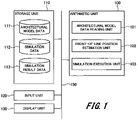
- Fig. 1 is a diagram illustrating a configuration of the architectural model data assistance system of the present example. An overall configuration of the architectural model data assistance system of the present example will be described with reference to Fig. 1 .
- the architectural model data assistance system of the present example includes an arithmetic unit 100, a storage unit 110, an input unit 120, and a display unit 130 connected by a bus 150.
- each unit of the architectural model data assistance system may be connected by a network instead of being connected by the bus 150.
- the input unit 120 and the display unit 130 are additional configurations, and are not necessarily required for the architectural model data assistance system of the present example.
- the storage unit 110 has a storage area for storing at least architectural model data 111 and simulation data 112, but may further have a storage area for storing simulation result data 113.
- the arithmetic unit 100 includes at least an architectural model data reading unit 101, a front-of-line position estimation unit 102, and a simulation execution unit 103.
- the arithmetic unit 100 may be configured as a single arithmetic unit, but the arithmetic unit 100 may be configured to be distributed into a plurality of parts such that a part of the arithmetic unit 100 is provided in a server, which is not illustrated.
- the architectural model data reading unit 101 of the arithmetic unit 100 reads the architectural model data 111 from the storage unit 110.
- the architectural model data reading unit 101 recognizes the shape of the architectural model data on the basis of the read architectural model data 111, and converts the architectural model data into data of a format that can be executed by the simulation execution unit 103.
- converting into data of an executable format means converting the architectural model data 111 into, for example, elevator platform data. That is, in the conversion into the data of an executable format, the architectural model data reading unit 101 extracts the elevator platform data from the architectural model data 111. Then, the architectural model data reading unit 101 inputs the extracted elevator platform data to the front-of-line position estimation unit 102.
- the front-of-line position estimation unit 102 estimates the front-of-line position on the basis of the input elevator platform data.
- the front-of-line position information estimated by the front-of-line position estimation unit 102 is input to the simulation execution unit 103.
- data obtained by converting the architectural model data 111 read by the architectural model data reading unit 101 into a simulation executable format is also input to the simulation execution unit 103.
- the simulation execution unit 103 estimates detailed movements of people at the elevator platform and stores the simulation result in the simulation result data 113 of the storage unit 110. Note that the simulation result may be directly output and displayed on the display unit 130 without being stored in the storage unit 110.
- simulation in the simulation execution unit 103 can be performed, for example, by using a known simulation technique disclosed in " Development of pedestrian flow simulator for smooth people movement in buildings” (FUJIWARA Masayasu, TORIYABE Satoru, and HATORI Takahiro) presented by the inventors in "The Proceedings of the Elevator, Escalator and Amusement Rides Conference” of The Japan Society of Mechanical Engineers held on January 19, 2018 .
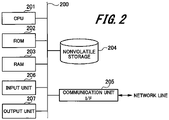
- Fig. 2 is a diagram illustrating a hardware configuration of the architectural model data assistance system of the present example illustrated in Fig. 1 .
- the architectural model data assistance system of the present example includes a central processing unit (CPU) 201, read only memory (ROM) 202, random access memory (RAM) 203, and a nonvolatile storage 204 connected to a bus 200.
- a communication interface (communication unit IF) 205 for communicating with the outside is provided.
- the CPU 201 reads, from the ROM 202, a program code of software for implementing the function of each unit of the architectural model data assistance system of the present example, and executes the program code. Variables and the like generated in the middle of arithmetic processing performed in the architectural model data assistance system of the present example are temporarily written in the RAM 203.
- the CPU 201 executes the program code recorded in the ROM 202, thereby implementing various functions of the architectural model data assistance system of the present example described above.
- the communication interface 205 for example, a network interface card (NIC) or the like is used. Although not illustrated in Fig. 1 , the communication interface 205 is used for communication with an external apparatus as necessary.
- NIC network interface card
- the nonvolatile storage 204 includes nonvolatile memory such as a solid state drive (SSD), and stores and holds programs, data, and the like necessary for the operation of the CPU 201.
- the nonvolatile storage 204 constitutes the storage unit 110 in Fig. 1 .
- an input unit 206 and an output unit 207 are provided in Fig. 2 , the input unit 206 and the output unit 207 are not necessarily essential for the hardware configuration of the architectural model data assistance system of the present example.
- the output unit 207 includes the display unit 130 in Fig. 1 .
- an orientation "d" of the largest number of doors is selected among the orientations of the doors of elevators (step S301). For example, in the case of a general face-to-face arrangement in which six elevators are arranged to face each other, the orientations of the doors of the three elevators face the three elevators. In such a case, since the number of elevators facing each other is "3", which is the maximum, one of the orientations in which the number is the maximum is selected and set to "d".
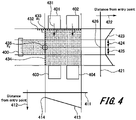
- Fig. 4 illustrates an elevator platform having a face-to-face arrangement in which four elevators are arranged so that two elevators face the two elevators.
- step S301 the orientation "d" of the door is acquired from each elevator, and in Fig. 4 , there are doors installed in the same direction for two elevators of elevators 401 and 402 and two elevators of elevators 403 and 404. Since the number of doors in a direction 431 is the same and is the maximum, the direction of the orientation 431 of the doors of the elevators 401 and 402 is set to "d". Even when the orientation of the doors of the elevators 403 and 404 is set to "d", the subsequent processing can be similarly performed.
- scanning is performed with a direction rotated by 90 degrees and a direction rotated by -90 degrees with respect to the direction "d" of the orientation 431 of the doors of the elevators as the scanning direction.
- a position where the distance to a doorway 400 is minimum is scanned regarding the direction rotated by 90 degrees from the direction "d" of the doors.
- this scanning position is indicated by a dotted line 432.
- the distance to the doorway 400 is obtained at each position of a scanning target, and a point 433 closest to the doorway 400 is calculated as "p1" (step S302).
- the distance between the scanning position and the doorway 400 is illustrated as a solid line graph 413.
- a horizontal axis 411 indicates the scanning position
- a vertical axis 412 indicates the distance from the doorway.
- a point closest to the doorway 400 is calculated, and this point 435 is set as "p2" (step S303).
- the distance to the doorway 400 is obtained at each position of the dotted line 434.
- the distance between each position of the dotted line 434 and the doorway 400 is indicated by a graph 423.
- a vertical axis 421 indicates the scanning position
- a horizontal axis 422 indicates the distance from the doorway 400.
- a portion where the distance from the doorway 400 is minimum is indicated by a range 424 and a range 425, and cannot be uniquely specified. Therefore, the scanning position 435 corresponding to a barycentric position 426 of the plurality of positions where the distance from the doorway 400 is minimum is set as the point "p2" closest to the doorway 400.
- step S304 the position "p2" of the scanning position 435, which is the point closest to the doorway 400, is output as the front-of-line position (step S304).
- the front-of-line position estimation processing process using Figs. 3 and 4 is as described above.
- scanning can be easily performed by determining points to be scanned discretely at regular intervals and searching the doorway 400 from the determined points.
- the distance from an arbitrary point of the scanning position to the doorway 400 is measured by discretizing the space.
- the scanning range may be arbitrarily limited. As an example of the limitation of the scanning range, it is conceivable to limit the range such that the distance to the nearest elevator does not exceed the upper limit.
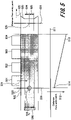
- Fig. 5 is a specific example of an elevator arrangement different from Fig. 4 , and illustrates elevator platform data of a planar arrangement in which four elevators are arranged in a line. The process of estimating the front-of-line position will be described below with reference to Fig. 5 .
- step S301 of Fig. 3 "d", which is the direction 531 of the door, is acquired from each elevator.
- the doors of four elevators 501, 502, 503, and 504 face in the same direction 531. Therefore, this direction 531 is the orientation of the largest number "four" elevators, and this direction is "d".
- step S302 of Fig. 3 a position where the distance to a doorway 500 is minimum is scanned in the direction rotated by 90 degrees from the direction 531 "d" of the doors.
- Fig. 5 scanning is performed along a dotted line 532, and the distance to the doorway 500 is obtained at each position of the scanning target.
- the distance between each scanning position and the doorway 500 is indicated by a graph 513.
- a horizontal axis 511 indicates the scanning position
- a vertical axis 512 indicates the distance from the doorway.
- step S303 of Fig. 3 a point closest to the doorway 500 is scanned from the position 533 "p1" at the end on the doorway 500 side in the same direction as the direction 531 "d" of the doors.
- a scanning position is indicated by a dotted line 534.
- the distance to the doorway 500 is obtained at each position of the scanning target.
- a relationship of the distance between each scanning position and the doorway 500 is indicated by a graph 523.
- a vertical axis 521 indicates the scanning position
- a horizontal axis 522 indicates the distance from the doorway.
- a portion where the distance from the doorway 500 is minimum is a range 524 and a range 525, and cannot be uniquely specified. Therefore, a scanning position 535 that is close to the doorway 500 and corresponds to a barycentric position 526 of the plurality of positions where the distance from the doorway 500 is minimum is set as "p2".
- step S304 of Fig. 3 the point "p2" of the scanning position 535 close to the doorway 500 is output as the front-of-line position. This is the end of the description of the front-of-line position estimation processing process using Fig. 5 .
- Fig. 6 is a planar arrangement in which four elevators are arranged in a line, but illustrates an elevator platform in which a doorway 600 faces a direction 631 of the doors of the elevators. The process of estimating the front-of-line position will be described below with reference to Fig. 6 .
- step S301 of Fig. 3 the direction "d" of the door of each elevator is acquired.
- the doors of four elevators 601, 602, 603, and 604 are arranged to face in the same direction 631. Therefore, this same direction 631 is the orientation of the largest number "four" elevators, and this direction 631 of the doors is "d".
- step S302 of Fig. 3 a position where the distance to the doorway 600 is minimum is scanned along a dotted line 632 in the direction rotated by 90 degrees from the direction 631 "d" of the doors. Then, the distance to the doorway 600 is obtained from each scanning position on the dotted line 632.
- the distance between each scanning position and the doorway 600 is indicated by a graph 613.
- a horizontal axis 611 indicates the scanning position and a vertical axis 612 indicates the distance from the doorway 600.
- a portion where the distance from the doorway 600 is minimum is a range 614 and a range 615, and cannot be uniquely specified.
- a scanning position 633 corresponding to a position 616, which is the barycenter of the ranges 614 and 615 where the distance from the doorway 600 is minimum, is set as point "p1".
- step S303 of Fig. 3 scanning is performed along a dotted line 634 from the point "p1" of the scanning position 633 to the doorway 600, and the distance between the position of the scanning target and the doorway 600 is obtained. Then, an end 635 of the scanning position closest to the doorway 600 is set as point "p2".
- a graph 623 indicates the distance between the scanning position and the doorway 600. In the graph 623, a vertical axis 621 indicates the scanning position, and a horizontal axis 622 indicates the distance from the doorway 600.
- the distance between the position of the end 635 on the doorway 600 side of the dotted line 634, which is the scanning position, and the doorway 600 is minimum.
- the position of the end 635 on the doorway 600 side is set as point "p2".
- step S304 of Fig. 3 the point "p2" of the end 635 on the doorway 600 side is output as the front-of-line position. This is the end of the description of the front-of-line position estimation processing process using Fig. 6 .
- Fig. 7 illustrates a functional device configuration of an architectural model data assistance system of the second embodiment example of the present invention. Note that since the hardware configuration is the same as that of the first embodiment example illustrated in Fig. 2 , the description thereof will be omitted.
- the second embodiment example of the present invention is different from the first embodiment example illustrated in Fig. 1 in that a measurement unit 140 is provided.
- the second embodiment example of the present invention is an embodiment example in which measurement data measured by the measurement unit 140 is used as an input of the front-of-line position estimation processing.
- differences from the first embodiment example will be mainly described with reference to Figs. 7 to 10 .
- the architectural model data assistance system of the second embodiment example of the present invention includes an arithmetic unit 100, a storage unit 110, and the measurement unit 140.
- the measurement unit 140 is connected to a bus 150 directly or via a network.
- an input unit 120 and a display unit 130 are not necessarily required configurations, but may be provided.
- At least architectural model data 111 and simulation data 112 are stored in the storage unit 110.
- simulation result data 113 is also stored as necessary.
- the arithmetic unit 100 includes an architectural model data reading unit 101, a front-of-line position estimation unit 102, and a simulation execution unit 103.
- the arithmetic unit 100 may be configured as a single arithmetic unit or may be configured to be distributed into a plurality of parts.
- an image sensor such as a camera, a depth sensor, an infrared sensor, or the like is used as the measurement unit 140.
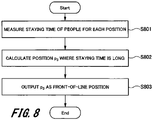
- Fig. 8 is a flowchart illustrating a flow of processing of the front-of-line position estimation unit 102 in the architectural model data assistance system of to the second embodiment example.
- the measurement unit 140 such as a camera or the like measures the staying time of people including an elevator user for each position of the elevator platform (step S801). Then, a position "p3" where the staying time of the people is long is calculated (step S802).
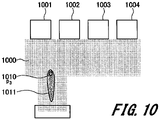
- the position "p3" where the staying time is long refers to a place where the density of people is high at the elevator platform, and, for example, a space indicated by numeral 1010 in Fig. 10 corresponds thereto.
- the front-of-line position estimation unit 102 outputs the position "p3" where the staying time is long as the front-of-line position (step S803).
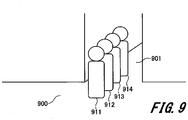
- Fig. 9 illustrates an example of image data of a measurement result measured by the measurement unit 140 such as a camera or the like installed at the elevator platform.
- This image data indicates an example of image data measured in a case where the measurement unit 140 such as a camera or the like is installed above an elevator platform 900 to face an entrance 901 of the elevator platform.
- This image data illustrates a situation in which four people of elevator users 911, 912, 913, and 914 are lined up at the entrance of the elevator platform and wait for the arrival of the elevator.
- Fig. 10 is a plan view of an elevator platform 1000 including four elevators 1001, 1002, 1003, and 1004. That is, Fig. 10 is a diagram illustrating the density of people on a plan view of the elevator platform 1000 from image data of a plurality of persons continuously measured by the measurement unit 140 such as a camera or the like.
- Fig. 10 illustrates the magnitude of the density of people
- numeral 1011 denotes a space having a relatively low density
- numeral 1010 denotes a space having a relatively high density.
- the space of numeral 1010 illustrated as the space having a high people density is a space equal to or larger than a predetermined threshold.
- the position of the space having a high people density indicated by numeral 1010 is the front-of-line position "p3". That is, in the second embodiment example, the position close to the elevator in the space having a high people density is estimated as the front-of-line position "p3".
- Fig. 11 illustrates an example of elevator platform data extracted from the architectural model data 111 stored in the storage unit 110.
- the architectural model data 111 includes elevator platform data.
- the elevator platform data includes at least information regarding a floor 1100 of the elevator platform, information regarding elevators 1101, 1102, 1103, and 1104, and information of a doorway or a position 1110 connected to the doorway.
- Fig. 11 illustrates these pieces of information as a plan view.
- the doorway of the architectural model data assistance system of the present invention includes not only a doorway of a building but also a doorway to a space owned by a tenant such as an office on each floor.
- the information of the doorway is included in the architectural model data 111.
- the flow of people in the building may be estimated by recognizing a door or a tenant area included in the architectural model data 111, or may be designated manually. From this floor information, it is possible to recognize a passable space of the elevator platform.
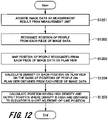
- Fig. 12 is a flowchart for describing processing of estimating the front-of-line position using a plurality of pieces of image data obtained by the measurement unit 140 such as a camera or the like illustrated in Fig. 7 as an input.
- the measurement unit 140 acquires the image data measured by the camera or the like as a measurement result (step S1201).
- the measurement unit 140 recognizes the position of people from each piece of image data acquired in step S1201 (step S1202).
- a widely known general image recognition method or a method such as machine learning is used.
- step S1203 the position of people recognized from each piece of the image data is mapped on a plan view.
- mapping on the plan view it is necessary to convert the position of people in the coordinate system of the image data into the coordinate system on the plan view.
- the distance to the position of the people recognized from the installation position of the measurement unit 140 is estimated according to the magnitude of the size of people recognized in the image. Then, conversion to the coordinate system on the plan view is performed using the estimated distance information, the position of the coordinate system of the image data, the coordinates and orientation of the installation position of the measurement unit 140, and the information of the angle of view of the measurement unit 140.
- the coordinate system conversion method is not limited to the method described here. Other methods can also be used.
- the density of each position on the plan view is calculated on the basis of the positions of people on the plan view obtained from each piece of the image data (step S1204).
- the density of people on a plane refers to a value obtained by calculating a ratio of the number of pieces of data of existing people to the number of pieces of measured image data for each position to be measured.
- the result of calculating the density of people in step S1204 has already been described with reference to Fig. 10 , and the position for which the density is calculated can also be evaluated by a grid discretized at an arbitrary interval.
- the position having a high people density is calculated, and the position where the density is high and the distance to the elevator is short is output as the front-of-line position (step S1205). It is sufficient if the position having a high people density is determined on the basis of whether a preset threshold is exceeded.
- a preset value may be used as the threshold, or the threshold may be dynamically changed according to the date and time or the time zone.
- the threshold can be changed depending on a position or a place. For example, it is also conceivable to change the threshold depending on the distance from a wall.
- the front-of-line position may be calculated only from a measurement result with a limited time zone such as the time zone at the time of going to work or leaving work and the time zone at lunch time.
- a certain threshold may be set for the density of people, and the front-of-line position may be estimated with respect to the measurement result for the time zone in which the density exceeds the threshold.
- the architectural model data assistance system it is possible to realize the architectural model data assistance system that estimates the front-of-line position by the measurement unit 140, uses the estimated front-of-line position and the architectural model data as inputs, and finely simulates the action of waiting at the platform or the action of orderly boarding when using the elevator in the input architectural model.
- the architectural model data assistance system it is possible to realize the architectural model data assistance system that uses the architectural model data as an input and finely simulates the action of waiting at the platform or the action of orderly boarding when using the elevator in the input architectural model without manually additionally inputting the front-of-line position or the like.
- each of the above-described configurations, functions, and the like may be realized by hardware, for example, by designing with an integrated circuit.
- each of the above-described configurations, functions, and the like may be realized by software by a processor interpreting and executing a program for realizing each function.
- Information such as a program, a table, and a file, and the like for realizing each function can be stored in a recording device such as memory, a hard disk, and a solid state drive (SSD), or a recording medium such as an IC card, an SD card, and a DVD, and the like.
- SSD solid state drive
- control lines and information lines considered to be necessary for description are illustrated, and not all control lines and information lines of a product are necessarily illustrated. In practice, it may be considered that almost all the configurations are connected to each other.
Landscapes
- Engineering & Computer Science (AREA)
- Physics & Mathematics (AREA)
- Business, Economics & Management (AREA)
- Theoretical Computer Science (AREA)
- General Physics & Mathematics (AREA)
- Geometry (AREA)
- Human Resources & Organizations (AREA)
- Computer Hardware Design (AREA)
- Strategic Management (AREA)
- Economics (AREA)
- General Engineering & Computer Science (AREA)
- Evolutionary Computation (AREA)
- Entrepreneurship & Innovation (AREA)
- Tourism & Hospitality (AREA)
- General Business, Economics & Management (AREA)
- Marketing (AREA)
- Mathematical Analysis (AREA)
- Pure & Applied Mathematics (AREA)
- Civil Engineering (AREA)
- Architecture (AREA)
- Mathematical Optimization (AREA)
- Structural Engineering (AREA)
- Computational Mathematics (AREA)
- Game Theory and Decision Science (AREA)
- Development Economics (AREA)
- Quality & Reliability (AREA)
- Operations Research (AREA)
- Educational Administration (AREA)
- Health & Medical Sciences (AREA)
- General Health & Medical Sciences (AREA)
- Primary Health Care (AREA)
- Indicating And Signalling Devices For Elevators (AREA)
- Management, Administration, Business Operations System, And Electronic Commerce (AREA)
Applications Claiming Priority (2)
| Application Number | Priority Date | Filing Date | Title |
|---|---|---|---|
| JP2019235688A JP7199341B2 (ja) | 2019-12-26 | 2019-12-26 | 建築モデルデータ支援システムおよび建築モデルデータ支援方法 |
| PCT/JP2020/041160 WO2021131332A1 (fr) | 2019-12-26 | 2020-11-04 | Système d'aide à des données de modèle architectural et procédé d'aide à des données de modèle architectural |
Publications (2)
| Publication Number | Publication Date |
|---|---|
| EP4082955A1 true EP4082955A1 (fr) | 2022-11-02 |
| EP4082955A4 EP4082955A4 (fr) | 2024-01-24 |
Family
ID=76575266
Family Applications (1)
| Application Number | Title | Priority Date | Filing Date |
|---|---|---|---|
| EP20904799.2A Pending EP4082955A4 (fr) | 2019-12-26 | 2020-11-04 | Système d'aide à des données de modèle architectural et procédé d'aide à des données de modèle architectural |
Country Status (5)
| Country | Link |
|---|---|
| US (1) | US20220414278A1 (fr) |
| EP (1) | EP4082955A4 (fr) |
| JP (1) | JP7199341B2 (fr) |
| CN (1) | CN114730406A (fr) |
| WO (1) | WO2021131332A1 (fr) |
Family Cites Families (16)
| Publication number | Priority date | Publication date | Assignee | Title |
|---|---|---|---|---|
| US7139409B2 (en) * | 2000-09-06 | 2006-11-21 | Siemens Corporate Research, Inc. | Real-time crowd density estimation from video |
| KR100999084B1 (ko) * | 2006-01-12 | 2010-12-07 | 오티스 엘리베이터 컴파니 | 엘리베이터 제어를 위한 비디오 지원 시스템 |
| DE102009028604A1 (de) * | 2009-08-18 | 2011-02-24 | Robert Bosch Gmbh | Vorrichtung zur Erkennung einer Objektschlange, Verfahren sowie Computerprogramm |
| JP5645315B2 (ja) | 2012-06-29 | 2014-12-24 | 東芝エレベータ株式会社 | Bimシステム、方法及びプログラム |
| JP2014189338A (ja) * | 2013-03-26 | 2014-10-06 | Hitachi Ltd | エレベーターシステム |
| EP2849151A1 (fr) * | 2013-09-13 | 2015-03-18 | Xovis AG | Procédé d'analyse de files d'attente libres |
| US9965684B2 (en) * | 2014-12-18 | 2018-05-08 | Sensormatic Electronics, LLC | Method and system for queue length analysis |
| US20170190544A1 (en) * | 2016-01-04 | 2017-07-06 | Otis Elevator Company | Lobby crowd control dispatching in mcrl system |
| WO2017199532A1 (fr) | 2016-05-18 | 2017-11-23 | 株式会社日立製作所 | Dispositif de simulation, procédé, et programme d'ordinateur |
| JP6611685B2 (ja) * | 2016-08-22 | 2019-11-27 | 株式会社日立製作所 | エレベーターシステム |
| US10386460B2 (en) * | 2017-05-15 | 2019-08-20 | Otis Elevator Company | Self-calibrating sensor for elevator and automatic door systems |
| CN111108500B (zh) * | 2017-08-08 | 2023-12-05 | 株式会社日立制作所 | 建筑物仿真器以及建筑物仿真方法 |
| US10509969B2 (en) * | 2017-09-12 | 2019-12-17 | Cisco Technology, Inc. | Dynamic person queue analytics |
| JP7029930B2 (ja) * | 2017-10-30 | 2022-03-04 | 株式会社日立製作所 | ビル内人流推定システムおよび推定方法 |
| WO2019087251A1 (fr) * | 2017-10-30 | 2019-05-09 | 株式会社日立製作所 | Système et procédé de sortie de journal d'utilisation d'ascenseur |
| JP6968660B2 (ja) * | 2017-10-30 | 2021-11-17 | 株式会社日立製作所 | ビル内交通予測システム、ビル内交通予測システムにおけるエレベーター乗り場レイアウトの生成方法及びプログラム |
-
2019
- 2019-12-26 JP JP2019235688A patent/JP7199341B2/ja active Active
-
2020
- 2020-11-04 CN CN202080078142.3A patent/CN114730406A/zh active Pending
- 2020-11-04 US US17/778,499 patent/US20220414278A1/en active Pending
- 2020-11-04 EP EP20904799.2A patent/EP4082955A4/fr active Pending
- 2020-11-04 WO PCT/JP2020/041160 patent/WO2021131332A1/fr not_active Ceased
Also Published As
| Publication number | Publication date |
|---|---|
| EP4082955A4 (fr) | 2024-01-24 |
| CN114730406A (zh) | 2022-07-08 |
| JP2021105768A (ja) | 2021-07-26 |
| JP7199341B2 (ja) | 2023-01-05 |
| WO2021131332A1 (fr) | 2021-07-01 |
| US20220414278A1 (en) | 2022-12-29 |
Similar Documents
| Publication | Publication Date | Title |
|---|---|---|
| Nikoohemat et al. | Indoor 3D reconstruction from point clouds for optimal routing in complex buildings to support disaster management | |
| TWI512645B (zh) | 使用深度影像之手勢辨識裝置及方法 | |
| JP7593964B2 (ja) | 行列検出システム、方法及びプログラム | |
| US20120230581A1 (en) | Information processing apparatus, information processing method, and program | |
| US11908337B2 (en) | Information processing device, intermediation device, simulation system, and information processing method | |
| US10440497B2 (en) | Multi-modal dereverbaration in far-field audio systems | |
| JP2013131100A (ja) | 人数予測方法、人数予測装置、移動ロボット及びプログラム | |
| US20130197887A1 (en) | Semi-autonomous digital human posturing | |
| US10565786B1 (en) | Sensor placement interface | |
| CN102612698B (zh) | 用于电子地图上的特征的自动化确定的方法和设备 | |
| CN106558096A (zh) | 三维点云数据的建模装置、程序和电梯导轨的建模方法 | |
| Zabulis et al. | Multicamera human detection and tracking supporting natural interaction with large-scale displays | |
| EP4113424A1 (fr) | Dispositif et procédé de création de modèle de construction | |
| Amaoka et al. | Personal space modeling for human-computer interaction | |
| EP4082955A1 (fr) | Système d'aide à des données de modèle architectural et procédé d'aide à des données de modèle architectural | |
| JP2020169083A (ja) | 昇降機の運行状態表示装置、運行状態表示システム及び運行状態表示方法 | |
| JP2019197345A (ja) | 画像処理装置および画像処理用プログラム | |
| JP7416348B1 (ja) | 移動方向判定装置、移動方向判定方法、及び移動方向判定プログラム | |
| EP4042177B1 (fr) | Détection de sortie/d'entrée automatique dans un système de positionnement acoustique | |
| JP2023027883A (ja) | レイアウトデータ表示システム及びレイアウトデータ表示方法 | |
| JP7836005B2 (ja) | 学習装置、三次元再構成装置、学習方法、三次元再構成方法、及びプログラム | |
| TW201447643A (zh) | 增強型呈現環境 | |
| KR102553042B1 (ko) | 영역 데이터 요청에 대응하는 영역 데이터를 자동으로 제공하는 공간 정보 처리 방법 | |
| JP7558227B2 (ja) | 三次元データの生成方法、生成装置及びコンピュータプログラム | |
| JP2026052981A (ja) | 高さ位置推定システム及び高さ位置推定方法 |
Legal Events
| Date | Code | Title | Description |
|---|---|---|---|
| STAA | Information on the status of an ep patent application or granted ep patent |
Free format text: STATUS: THE INTERNATIONAL PUBLICATION HAS BEEN MADE |
|
| PUAI | Public reference made under article 153(3) epc to a published international application that has entered the european phase |
Free format text: ORIGINAL CODE: 0009012 |
|
| STAA | Information on the status of an ep patent application or granted ep patent |
Free format text: STATUS: REQUEST FOR EXAMINATION WAS MADE |
|
| 17P | Request for examination filed |
Effective date: 20220726 |
|
| AK | Designated contracting states |
Kind code of ref document: A1 Designated state(s): AL AT BE BG CH CY CZ DE DK EE ES FI FR GB GR HR HU IE IS IT LI LT LU LV MC MK MT NL NO PL PT RO RS SE SI SK SM TR |
|
| DAV | Request for validation of the european patent (deleted) | ||
| DAX | Request for extension of the european patent (deleted) | ||
| REG | Reference to a national code |
Ref country code: DE Ref legal event code: R079 Free format text: PREVIOUS MAIN CLASS: B66B0003000000 Ipc: G06Q0010040000 |
|
| A4 | Supplementary search report drawn up and despatched |
Effective date: 20231221 |
|
| RIC1 | Information provided on ipc code assigned before grant |
Ipc: G06F 30/20 20200101ALI20231215BHEP Ipc: G06F 30/13 20200101ALI20231215BHEP Ipc: G06Q 50/08 20120101ALI20231215BHEP Ipc: G06Q 10/0631 20230101ALI20231215BHEP Ipc: G06Q 10/04 20120101AFI20231215BHEP |
|
| STAA | Information on the status of an ep patent application or granted ep patent |
Free format text: STATUS: EXAMINATION IS IN PROGRESS |
|
| 17Q | First examination report despatched |
Effective date: 20260305 |