EP4083076A1 - Élastomère à base de diène et composition de caoutchouc et procédé de fabrication d'un élastomère fonctionnalisé au benzoxazine - Google Patents
Élastomère à base de diène et composition de caoutchouc et procédé de fabrication d'un élastomère fonctionnalisé au benzoxazine Download PDFInfo
- Publication number
- EP4083076A1 EP4083076A1 EP22168674.4A EP22168674A EP4083076A1 EP 4083076 A1 EP4083076 A1 EP 4083076A1 EP 22168674 A EP22168674 A EP 22168674A EP 4083076 A1 EP4083076 A1 EP 4083076A1
- Authority
- EP
- European Patent Office
- Prior art keywords
- benzoxazine
- group
- spacer
- functionalized
- elastomer
- Prior art date
- Legal status (The legal status is an assumption and is not a legal conclusion. Google has not performed a legal analysis and makes no representation as to the accuracy of the status listed.)
- Granted
Links
Images
Classifications
-
- C—CHEMISTRY; METALLURGY
- C08—ORGANIC MACROMOLECULAR COMPOUNDS; THEIR PREPARATION OR CHEMICAL WORKING-UP; COMPOSITIONS BASED THEREON
- C08C—TREATMENT OR CHEMICAL MODIFICATION OF RUBBERS
- C08C19/00—Chemical modification of rubber
- C08C19/22—Incorporating nitrogen atoms into the molecule
-
- C—CHEMISTRY; METALLURGY
- C08—ORGANIC MACROMOLECULAR COMPOUNDS; THEIR PREPARATION OR CHEMICAL WORKING-UP; COMPOSITIONS BASED THEREON
- C08F—MACROMOLECULAR COMPOUNDS OBTAINED BY REACTIONS ONLY INVOLVING CARBON-TO-CARBON UNSATURATED BONDS
- C08F136/00—Homopolymers of compounds having one or more unsaturated aliphatic radicals, at least one having two or more carbon-to-carbon double bonds
- C08F136/02—Homopolymers of compounds having one or more unsaturated aliphatic radicals, at least one having two or more carbon-to-carbon double bonds the radical having only two carbon-to-carbon double bonds
- C08F136/04—Homopolymers of compounds having one or more unsaturated aliphatic radicals, at least one having two or more carbon-to-carbon double bonds the radical having only two carbon-to-carbon double bonds conjugated
- C08F136/14—Homopolymers of compounds having one or more unsaturated aliphatic radicals, at least one having two or more carbon-to-carbon double bonds the radical having only two carbon-to-carbon double bonds conjugated containing elements other than carbon and hydrogen
-
- B—PERFORMING OPERATIONS; TRANSPORTING
- B60—VEHICLES IN GENERAL
- B60C—VEHICLE TYRES; TYRE INFLATION; TYRE CHANGING; CONNECTING VALVES TO INFLATABLE ELASTIC BODIES IN GENERAL; DEVICES OR ARRANGEMENTS RELATED TO TYRES
- B60C1/00—Tyres characterised by the chemical composition or the physical arrangement or mixture of the composition
-
- B—PERFORMING OPERATIONS; TRANSPORTING
- B60—VEHICLES IN GENERAL
- B60C—VEHICLE TYRES; TYRE INFLATION; TYRE CHANGING; CONNECTING VALVES TO INFLATABLE ELASTIC BODIES IN GENERAL; DEVICES OR ARRANGEMENTS RELATED TO TYRES
- B60C1/00—Tyres characterised by the chemical composition or the physical arrangement or mixture of the composition
- B60C1/0008—Compositions of the inner liner
-
- B—PERFORMING OPERATIONS; TRANSPORTING
- B60—VEHICLES IN GENERAL
- B60C—VEHICLE TYRES; TYRE INFLATION; TYRE CHANGING; CONNECTING VALVES TO INFLATABLE ELASTIC BODIES IN GENERAL; DEVICES OR ARRANGEMENTS RELATED TO TYRES
- B60C1/00—Tyres characterised by the chemical composition or the physical arrangement or mixture of the composition
- B60C1/0016—Compositions of the tread
-
- B—PERFORMING OPERATIONS; TRANSPORTING
- B60—VEHICLES IN GENERAL
- B60C—VEHICLE TYRES; TYRE INFLATION; TYRE CHANGING; CONNECTING VALVES TO INFLATABLE ELASTIC BODIES IN GENERAL; DEVICES OR ARRANGEMENTS RELATED TO TYRES
- B60C1/00—Tyres characterised by the chemical composition or the physical arrangement or mixture of the composition
- B60C1/0025—Compositions of the sidewalls
-
- C—CHEMISTRY; METALLURGY
- C08—ORGANIC MACROMOLECULAR COMPOUNDS; THEIR PREPARATION OR CHEMICAL WORKING-UP; COMPOSITIONS BASED THEREON
- C08L—COMPOSITIONS OF MACROMOLECULAR COMPOUNDS
- C08L15/00—Compositions of rubber derivatives
-
- C—CHEMISTRY; METALLURGY
- C08—ORGANIC MACROMOLECULAR COMPOUNDS; THEIR PREPARATION OR CHEMICAL WORKING-UP; COMPOSITIONS BASED THEREON
- C08L—COMPOSITIONS OF MACROMOLECULAR COMPOUNDS
- C08L9/00—Compositions of homopolymers or copolymers of conjugated diene hydrocarbons
- C08L9/06—Copolymers with styrene
-
- B—PERFORMING OPERATIONS; TRANSPORTING
- B60—VEHICLES IN GENERAL
- B60C—VEHICLE TYRES; TYRE INFLATION; TYRE CHANGING; CONNECTING VALVES TO INFLATABLE ELASTIC BODIES IN GENERAL; DEVICES OR ARRANGEMENTS RELATED TO TYRES
- B60C1/00—Tyres characterised by the chemical composition or the physical arrangement or mixture of the composition
- B60C2001/0033—Compositions of the sidewall inserts, e.g. for runflat
-
- B—PERFORMING OPERATIONS; TRANSPORTING
- B60—VEHICLES IN GENERAL
- B60C—VEHICLE TYRES; TYRE INFLATION; TYRE CHANGING; CONNECTING VALVES TO INFLATABLE ELASTIC BODIES IN GENERAL; DEVICES OR ARRANGEMENTS RELATED TO TYRES
- B60C1/00—Tyres characterised by the chemical composition or the physical arrangement or mixture of the composition
- B60C2001/005—Compositions of the bead portions, e.g. clinch or chafer rubber or cushion rubber
-
- B—PERFORMING OPERATIONS; TRANSPORTING
- B60—VEHICLES IN GENERAL
- B60C—VEHICLE TYRES; TYRE INFLATION; TYRE CHANGING; CONNECTING VALVES TO INFLATABLE ELASTIC BODIES IN GENERAL; DEVICES OR ARRANGEMENTS RELATED TO TYRES
- B60C1/00—Tyres characterised by the chemical composition or the physical arrangement or mixture of the composition
- B60C2001/005—Compositions of the bead portions, e.g. clinch or chafer rubber or cushion rubber
- B60C2001/0058—Compositions of the bead apexes
Definitions
- the present invention relates to benzoxazine-functionalized diene-based elastomers, a method of making such elastomers, as well as rubber compositions comprising the latter.
- the rubber composition can also be used in an article of manufacture such as a tire.
- United States Patent 10,538,648 B2 discloses a rubber composition containing main-chain benzoxazine, in which benzoxazine is reported to generate no harmful materials during vulcanization and can thus be used in lieu of conventional phenol novolac resins which are commonly used as a resin component of conventional rubber compositions.
- This patent also reports that the use of benzoxazine, especially main-chain benzoxazine having a high molecular weight, facilitates the capability of maintaining excellent mechanical properties and exhibiting high flexibility.
- the rubber composition described in United States Patent 10,538,648 B2 is also reported to be useful for utilization in tires.
- United States Patent 10,538,648 B2 specifically claims a rubber composition comprising a raw rubber and a polymer comprising a benzoxazine ring in its main chain (main-chain benzoxazine).
- the main-chain benzoxazine can have a weight average molecular weight which is within the range of 500 g/mol to 10,000 g/mol.
- the invention relates a benzoxazine-functionalized diene-based elastomer in accordance with claim 1, to a rubber composition in accordance with claim 13, to an article of manufacture in accordance with claim 14, and to a method in accordance with claim 15.
- Dependent claims refer to preferred embodiments of the invention.
- One object of the present invention is to provide an advanced diene-based elastomer, and optionally a method of making such an elastomer.
- Another object of the invention is to provide a new reinforcing material which may be used to reinforce polymer matrixes.
- Another object of the invention may be to provide an elastomer comprising reinforcing properties.
- a benzoxazine-functionalized diene-based elastomer comprising polymer chains including repeat units having conjugated diolefin (or diene) monomers, and further comprising at least one benzoxazine connected to one of the polymer chains via a spacer (or spacer group), wherein the spacer has a length ranging from 3 to 8 (preferably from 4 to 8 or from 4 to 7) atoms.
- a functionalized, preferably end-functionalized, elastomer has a reinforcing function in view of the benzoxazine molecule or ring structure coupled to the polymer chain, such as to an end of the polymer chain. Neighboring, or in other words, adjacent atoms along of the spacer are covalently bound to each other.
- at least 20% of the repeat units are butadiene or isoprene units.
- the benzoxazine is connected to the spacer through its nitrogen atom (in particular, the nitrogen atom in a ring or ring structure of the benzoxazine).
- said repeat units further include residues of vinyl aromatic monomers (for instance styrene).
- the diene-based elastomer has or comprises the following structure: wherein R 1 is one of: a hydrogen atom, a hydrocarbon group, a cyclic hydrocarbon; R 2 is one of: a hydrogen atom, a hydrocarbon group, a cyclic hydrocarbon; R 3 is one of: a hydrogen atom, a hydrocarbon group, a cyclic hydrocarbon; and R 4 is a hydrogen atom, a hydrocarbon group, or a cyclic hydrocarbon, and wherein N is a nitrogen atom bonded to the polymer chain through the spacer.
- the above mentioned hydrocarbon group and/or the cyclic hydrocarbon may comprise one or more hetero atoms, such as sulfur (S) atoma, nitrogen (N) atoms, silicon (Si) atoms, or oxygen (O) atoms.
- hetero atoms such as sulfur (S) atoma, nitrogen (N) atoms, silicon (Si) atoms, or oxygen (O) atoms.
- such benzoxazine-functionalized elastomers can help to reinforce the rubber network in a rubber composition.
- At least one of R 1 and R 3 is a hydrogen atom.
- the ortho and/or the para positions preferably both carry only a hydrogen atom such that the benzoxazine can further react with other molecules or groups of the rubber matrix.
- said diene-based elastomer is chosen from polybutadiene rubber, polyisoprene rubber, isoprene-butadiene rubber, styrene-butadiene rubber (either solution polymerized or emulsion polymerized).
- diene-based elastomer includes 1,3-butadiene monomer (e.g., in cis, trans or vinyl configuration), isoprene monomer and/or styrene monomer repeat units.
- benzoxazine (or benzoxazine group or ring structure, respectively) has or comprises one of the following (preferred) structures:
- the benzoxazine-functionalized diene-based elastomer has or comprises the following structure: wherein R 5 is the spacer, Pol is the polymer chain, and R 6 is either a hydrogen atom or a functional group.
- the benzoxazine-functionalized diene-based elastomer has polymer chain of from 15 to 25,000 repeat units, and preferably of 25 to 25,000 repeat units; and/or has a weight average molecular weight (Mw) within a range of 1000 g/mol to 1,500,000, and preferably within a range of 1500 g/mol to 1,500,000 g/mol.
- the benzoxazine-functionalized diene-based elastomer or the polymer chain has from 15 to 200 repeat units, preferably from 25 to 200 repeat units, and even more preferably from 40 to 200 repeat units); and/or has a weight average molecular weight (Mw) within a range of 1000 g/mol to 10,000 g/mol and preferably 1500 g/mol to 10,000 g/mol.
- the benzoxazine-functionalized diene-based elastomer or the polymer chain has from 1000 to 25,000, and preferably from 1500 to 25,000 repeat units; and/or has a weight average molecular weight (Mw) within a range of 80,000 g/mol to 1,500,000 g/mol and preferably 85,000 g/mol to 1,400,000 g/mol).
- the end-functionalized diene-based elastomer has or comprises the following structure: wherein R 5 is the spacer, and R 6 is one of a hydrogen atom and a functional group.
- Such a benzoxazine end-functionalized polymer in particular a styrene butadiene rubber, is one of the most preferred embodiments.
- the depicted units x, y, z may be in different orders along the polymer chain from that explicitly shown.
- the styrene repeat units, cis-1,4-butadiene repeat units, trans-1,4-butadiene repeat units, and vinyl 1,2-butadiene repeat units can distributed in a random order, an essentially random order, or in a tapered order.
- the polymer chain length defined by the sum of the integers x, y, and z can vary over a wide range.
- the sum of x + y + z is within a range of 15 to 25000 repeat units.
- R 6 is selected from silane groups, siloxane groups, amine groups, and silicon tetrachloride groups (-SiCl 3 ).
- the majority of (covalent) bonds along the spacer are single bonds.
- at least the three bonds closest to the nitrogen atom are single bonds.
- double bonds are avoided at these positions to avoid formation of energetically favorable ring structures upon attack of formaldehyde.
- all of the bonds along the spacer are single bonds.
- the spacer (R 5 ) comprises along its length one of an ethylene, a propylene, a butylene, a pentylene, and a hexylene group, with or without one or more hetero atoms.
- the spacer (R 5 ) comprises a silyl group.
- the spacer (R 5 ) comprises a silyl group and the polymer chain is (directly) coupled via an oxygen atom to the silyl group.
- the spacer (R 5 ) is directly bonded to one of the repeat units, such as to one of the conjugated diolefins or diolefin monomers.
- the spacer (such as R 5 ) has the following structure: wherein R 7 is one of an ethylene, a propylene, a butylene, a pentylene, or a hexylene group, with or without one or more hetero atoms (R 7 being coupled to the benzoxazine), and wherein O is an oxygen atom bonded to the polymer chain.
- the spacer (R 5 ) is or comprises an alkylene group, with our without hetero atoms.
- the conjugated diolefin monomer contains from 4 to 8 carbon atoms.
- the conjugated diolefin monomer is selected from the group consisting of 1,3-butadiene, isoprene, 1,3-pentadiene, 1,3-hexadiene, 2,3-dimethyl-1,3-butadiene, 2-ethyl-1,3-butadiene, 2-methyl-1,3-pentadiene, 3-methyl-1,3-pentadiene, 4-methyl-1,3-pentadiene, and 2,4-hexadiene.
- a plurality of benzoxazines are covalently bonded to the polymer chains along the backbone of said polymer chains.
- the elastomer is void of benzoxazines along the backbone of said polymer chains.
- the invention is directed to a rubber composition, preferably for a tire or tire component, the rubber composition comprising 30 phr to 200 phr of a filler, 10 phr to 100 phr of a benzoxazine-functionalized (diene-based) elastomer as described in the first aspect and optionally according to one of its embodiments above.
- the rubber composition further comprises at least 0.5 phr of a sulfur donor, and/or at least 0.5 phr of a sulfur vulcanization accelerator.
- sulfur donor shall include herein also sulfur as such.
- such a rubber composition is a sulfur-vulcanizable rubber composition.
- the rubber composition preferred also comprises 5 phr to 60 phr of a resin, such as a traction resin.
- the rubber composition may include at least one additional diene-based rubber.
- Representative synthetic polymers may be the homopolymerization products of butadiene and its homologues and derivatives, for example, methylbutadiene, dimethylbutadiene and pentadiene as well as copolymers such as those formed from butadiene or its homologues or derivatives with other unsaturated monomers.
- acetylenes for example, vinyl acetylene
- olefins for example, isobutylene, which copolymerizes with isoprene to form butyl rubber
- vinyl compounds for example, acrylic acid, acrylonitrile (which polymerize with butadiene to form NBR), methacrylic acid and styrene, the latter compound polymerizing with butadiene to form SBR, as well as vinyl esters and various unsaturated aldehydes, ketones and ethers, e.g., acrolein, methyl isopropenyl ketone and vinylethyl ether.
- synthetic rubbers include neoprene (polychloroprene), polybutadiene (including cis 1,4-polybutadiene), polyisoprene (including cis 1,4-polyisoprene), butyl rubber, halobutyl rubber such as chlorobutyl rubber or bromobutyl rubber, styrene/isoprene/butadiene rubber, copolymers of 1,3-butadiene or isoprene with monomers such as styrene, acrylonitrile and methyl methacrylate, as well as ethylene/propylene terpolymers, also known as ethylene/propylene/diene monomer (EPDM), and in particular, ethylene/propylene/dicyclopentadiene terpolymers.
- neoprene polychloroprene
- polybutadiene including cis 1,4-polybutadiene
- Rubbers which may be used include alkoxy-silyl end functionalized solution polymerized polymers (SBR, PBR, IBR and SIBR), silicon-coupled and tin-coupled star-branched polymers.
- SBR alkoxy-silyl end functionalized solution polymerized polymers
- PBR polybutadiene
- SIBR silicon-coupled star-branched polymers
- Preferred rubber or elastomers may be in general natural rubber, synthetic polyisoprene, polybutadiene and SBR including SSBR.
- the composition may comprise at least two or at least two additional diene-based rubbers.
- a combination of two or more rubbers is preferred, such as cis 1,4-polyisoprene rubber (natural or synthetic, although natural is preferred), 3,4-polyisoprene rubber, styrene/isoprene/butadiene rubber, emulsion and solution polymerization derived styrene/butadiene rubbers, cis 1,4-polybutadiene rubbers, and emulsion polymerization prepared butadiene/acrylonitrile copolymers.
- an emulsion polymerization derived styrene-butadiene rubber might be used having a bound styrene content of 20 percent to 28 percent or, for some applications, an ESBR having a medium to relatively high bound styrene content, namely, a bound styrene content of 30 percent to 45 percent. In many cases the ESBR will have a bound styrene content which is within the range of 26 percent to 31 percent.
- emulsion polymerization prepared ESBR it may be meant that styrene and 1,3-butadiene are copolymerized as an aqueous emulsion. Such are well known to those skilled in such art.
- the bound styrene content can vary, for example, from 5 percent to 50 percent.
- the ESBR may also contain acrylonitrile to form a terpolymer rubber, as ESBAR, in amounts, for example, of 2 weight percent to 30 weight percent bound acrylonitrile in the terpolymer.
- ESBAR acrylonitrile to form a terpolymer rubber
- Emulsion polymerization prepared styrene/butadiene/acrylonitrile copolymer rubbers containing 2 weight percent to 40 weight percent bound acrylonitrile in the copolymer may also be contemplated as diene-based rubbers.
- solution polymerization prepared SBR may be used.
- Such an SSBR may for instance have a bound styrene content in a range of 5 percent to 50 percent, preferably 9 percent to 36, percent, and most preferably 26 percent to 31 percent.
- the SSBR can be conveniently prepared, for example, by anionic polymerization in an inert organic solvent. More specifically, the SSBR can be synthesized by copolymerizing styrene and 1,3-butadiene monomer in a hydrocarbon solvent utilizing an organo lithium compound as the initiator.
- the solution styrene butadiene rubber is a tin-coupled polymer.
- the SSBR is functionalized for improved compatibility with silica.
- the SSBR is thio-functionalized. This helps to improve stiffness of the compound and/or its hysteresis behavior.
- the SSBR may be a thio-functionalized, tin-coupled solution polymerized copolymer of butadiene and styrene.
- a synthetic or natural polyisoprene rubber may be used.
- Synthetic cis-1,4-polyisoprene and natural rubber are as such well known to those having skill in the rubber art.
- the cis 1,4-microstructure content may be at least 90% and is typically at least 95% or even higher.
- cis-1,4-polybutadiene rubber (BR or PBD) is used.
- Suitable polybutadiene rubbers may be prepared, for example, by organic solution polymerization of 1,3-butadiene.
- the BR may be conveniently characterized, for example, by having at least a 90 percent cis-1,4-microstructure content ("high cis” content) and a glass transition temperature (Tg) in a range of from -95 to -110oC.
- Suitable polybutadiene rubbers are available commercially, such as Budene ® 1207, Budene ® 1208, Budene ® 1223, or Budene ® 1280 from The Goodyear Tire & Rubber Company.
- These high cis-1,4-polybutadiene rubbers can for instance be synthesized utilizing nickle catalyst systems which include a mixture of (1) an organonickel compound, (2) an organoaluminum compound, and (3) a fluorine containing compound as described in United States Patent 5,698,643 and United States Patent 5,451,646, which are incorporated herein by reference.
- the benzoxazine-functionalized diene-based elastomer is comprised of polymer chains which include repeat units which include conjugated diolefin monomers and benzoxazine rings which are connected to the polymer chain via a spacer, wherein the spacer has a length ranging from 3 to 8 carbon atoms.
- spacers include ethylene groups, propylene groups, butylene groups, pentylene groups, and hexylene groups.
- the spacer can include a heteroatom.
- the conjugated diolefin monomer typically contains from 4 to 8 carbon atoms and is frequently selected from one or more monomers which are selected from 1,3-butadiene, isoprene, 1,3-pentadiene, 1,3-hexadiene, 2,3-dimethyl-1,3-butadiene, 2-ethyl-1,3-butadiene, 2-methyl-1,3-pentadiene, 3-methyl-1,3-pentadiene, 4-methyl-1,3-pentadiene, and 2,4-hexadiene.
- the polymer chains can also optionally include one or more vinyl aromatic monomers, such as styrene, p-methyl styrene, ⁇ -methyl styrene, and vinylnaphthalene.
- a plurality of benzoxazine rings are attached as pendent groups to the polymer chains along the backbones of said polymer chains.
- the benzoxazine-functionalized diene-based elastomer is void of benzoxazine rings which are situated at the chain ends of the polymer chains.
- a glass transition temperature, or Tg, of an elastomer or elastomer composition represents the glass transition temperature(s) of the respective elastomer or elastomer composition in its uncured state or possibly a cured state in the case of an elastomer composition.
- Tg is determined as a midpoint by a differential scanning calorimeter (DSC) at a temperature rate of increase of 10oC per minute, according to ASTM D3418.
- DSC differential scanning calorimeter
- phr refers to "parts by weight of a respective material per 100 parts by weight of rubber, or elastomer".
- a rubber composition is comprised of 100 parts by weight of rubber/elastomer.
- the rubber composition may comprise other rubbers/elastomers than explicitly mentioned in the claims, provided that the phr value of the claimed rubbers/elastomers is in accordance with claimed phr ranges and the amount of all rubbers/elastomers in the composition results in total in 100 parts of rubber.
- the composition may further comprise from 1 phr to 10 phr, optionally from 1 to 5 phr, of one or more additional diene-based rubbers, such as SBR, SSBR, ESBR, PBD/BR, NR and/or synthetic polyisoprene.
- the composition may include less than 5 phr, preferably less than 3, phr of an additional diene-based rubber or be also essentially free of such an additional diene-based rubber.
- the terms "compound” and “composition” and “formulation” may be used herein interchangeably, unless indicated otherwise.
- the rubber composition includes from 1 phr to 80 phr, or from 5 phr to 80 phr, of a resin, preferably having a glass transition temperature Tg greater than 20 °C.
- Tg for resins is determined as a peak midpoint by a differential scanning calorimeter (DSC) at a temperature rate of increase of 10 oC per minute, according to ASTM D6604 or equivalent.
- DSC differential scanning calorimeter
- the resin has a softening point above 70 °C as determined by ASTM E28 which might sometimes be referred to as a ring and ball softening point.
- the rubber composition includes from 10 phr to 60 phr or from 20 phr to 60 phr or from 30 phr to 60 phr of resin.
- the resin is selected from the group consisting of coumarone-indene resin, petroleum hydrocarbon resin, terpene polymers/resins, styrene/alphamethylstyrene resins, terpene phenol resin, rosin derived resins and copolymers and/or mixtures thereof.
- a coumarone-indene resin preferably contains coumarone and indene as monomer components making up the resin skeleton (main chain).
- Monomer ingredients other than coumarone and indene which may be incorporated into the skeleton are, for example, methyl coumarone, styrene, ⁇ -methylstyrene, methylindene, vinyltoluene, dicyclopentadiene, cyclopentadiene, and diolefins such as isoprene and piperlyene.
- Coumarone-indene resins have preferably melting points ranging from 10°C to 160°C (as measured by the ball-and-ring method). Even more preferably, the melting point ranges from 30oC to 100°C.
- Suitable petroleum resins include both aromatic and nonaromatic types. Several types of petroleum resins are available. Some resins have a low degree of unsaturation and high aromatic content, whereas some are highly unsaturated and yet some contain no aromatic structure at all. Differences in the resins are largely due to the olefins in the feedstock from which the resins are derived.
- Conventional derivatives in such resins include any C5 species (olefins and diolefines containing an average of five carbon atoms) such as cyclopentadiene, dicyclopentadiene, diolefins such as isoprene and piperylene, and any C9 species (olefins and diolefins containing an average of 9 carbon atoms) such as vinyltoluene, alphamethylstyrene and indene.
- Such resins are made by any mixture formed from C5 and C9 species mentioned above, and are known as C5/C9 copolymer resins. Petroleum resins are typically available with softening points ranging from 10°C. to 120°C. Preferably, the softening point ranges from 30oC to 100°C.
- Terpene resins preferably comprise polymers of at least one of limonene, alpha pinene, beta pinene and delta-3-carene. Such resins are available with melting points ranging from 10°C to 135°C.
- Terpene-phenol resins may be derived by copolymerization of phenolic monomers with terpenes such as limonenes, pinenes and delta-3-carene.
- resins derived from rosins and derivatives thereof are, for example, gum rosin, wood rosin and tall oil rosin. Gum rosin, wood rosin and tall oil rosin have similar compositions, although the amount of components of the rosins may vary. Such resins may be dimerized, polymerized or disproportionated. Such resins may be in the form of esters of rosin acids and polyols such as pentaerythritol or glycol.
- a styrene/ ⁇ -methylstyrene resin is considered herein to be a (preferably relatively short chain) copolymer of styrene and ⁇ -methylstyrene with a styrene/ ⁇ -methylstyrene molar ratio in a range of 0.05 to 1.50.
- such a resin can be suitably prepared, for example, by cationic copolymerization of styrene and ⁇ -methylstyrene in a hydrocarbon solvent.
- the contemplated styrene/ ⁇ -methylstyrene resin can be characterized, for example, by its chemical structure, namely, its styrene and alphamethylstyrene contents and by its glass transition temperature, molecular weight and molecular weight distribution.
- said resin may be partially or fully hydrogenated.
- the rubber composition may also include oil, in particular processing oil.
- Processing oil may be included in the rubber composition as extending oil typically used to extend elastomers. Processing oil may also be included in the rubber composition by addition of the oil directly during rubber compounding. The processing oil used may include both extending oil present in the elastomers, and process oil added during compounding.
- Suitable process oils may include various oils as are known in the art, including aromatic, paraffinic, naphthenic, vegetable oils, and low PCA oils, such as MES, TDAE, SRAE and heavy naphthenic oils.
- Suitable low PCA oils may include those having a polycyclic aromatic content of less than 3 percent by weight as determined by the IP346 method.
- Procedures for the IP346 method may be found in Standard Methods for Analysis & Testing of Petroleum and Related Products and British Standard 2000 Parts, 2003, 62nd edition, published by the Institute of Petroleum, United Kingdom .
- Some representative examples of vegetable oils that can be used include soybean oil, sunflower oil, canola (rapeseed) oil, corn oil, coconut oil, cottonseed oil, olive oil, palm oil, peanut oil, and safflower oil. Soybean oil and corn oil are typically preferred vegetable oils.
- the rubber composition may also include up to 70 phr of processing oil, preferably between 5 phr and 25 phr. In another scenario less than 10 phr oil, or even less than 5 phr of procession oil can be utilized.
- the rubber composition may include silica.
- siliceous pigments which may be used in the rubber compound include for instance conventional pyrogenic and precipitated siliceous pigments (silica).
- precipitated silica is used.
- the conventional siliceous pigments may be precipitated silicas such as, for example, those obtained by the acidification of a soluble silicate, e.g., sodium silicate.
- Such conventional silicas might be characterized, for example, by having a BET surface area, as measured using nitrogen gas.
- the BET surface area may be in the range of 40 to 600 square meters per gram.
- the BET surface area may be in a range of 50 to 300 square meters per gram.
- the BET surface area can be suitably determined according to ASTM D6556 or equivalent and is described in the Journal of the American Chemical Society, Volume 60, Page 304 (1930 ).
- the conventional silica may also be characterized by having a dibutylphthalate (DBP) absorption value in a range of 100 cm 3 /100g to 400 cm 3 /100g, alternatively 150 cm 3 /100 g to 300 cm 3 /100 g which can be suitably determined according to ASTM D 2414 or equivalent.
- a conventional silica might be expected to have an average ultimate particle size, for example, in the range of 0.01 to 0.05 micron as determined by the electron microscope, although the silica particles may be even smaller, or possibly larger, in size.
- Ranges of silica use could be for instance between 5 phr and 120 phr, preferably in a range of between 20 phr and 70 phr or 80 phr to 120 phr.
- Various commercially available silicas may be used, such as silicas commercially available from PPG Industries under the Hi-Sil trademark with designations 210, 315G, and EZ160G; silicas available from Solvay, with, for example, designations of Z1165MP and Premium200MP; and silicas available from Evonik AG with, for example, designations VN2, Ultrasil 6000GR, and 9100GR.
- the rubber composition may comprise pre-silanized and precipitated silica which may for instance have a CTAB adsorption surface area of between 130 m 2 /g and 210 m 2 /g, optionally between 130 m 2 /g and 150 m 2 /g and/or between 190 m 2 /g and 210 m 2 /g, or even between 195 m 2 /g and 205 m 2 /g.
- CTAB cetyl trimethyl ammonium bromide
- pre-silanized, or in other words pre-hydrophobated, precipitated silica utilized is hydrophobated prior to its addition to the rubber composition by treatment with at least one silane.
- Suitable silanes include but are not limited to alkylsilanes, alkoxysilanes, organoalkoxysilyl polysulfides and organomercaptoalkoxysilanes.
- the pre-hydrophobated precipitated silica may be pre-treated with a silica coupling agent comprised of, for example, an alkoxyorganomercapto-alkoxysilane or combination of alkoxysilane and organomercaptoalkoxysilane prior to blending the pre-treated silica with the rubber instead of reacting the precipitated silica with the silica coupling agent in situ within the rubber.
- a silica coupling agent comprised of, for example, an alkoxyorganomercapto-alkoxysilane or combination of alkoxysilane and organomercaptoalkoxysilane
- said pre-silanized precipitated silica is precipitated silica prereacted with a silica coupler comprised of bis(3-triethoxysilylpropyl)polysulfide containing an average of from 1 to 5 connecting sulfur atoms (preferably 2 to 4) in its polysulfidic bridge or an alkoxyorganomercaptosilane.
- a silica coupler comprised of bis(3-triethoxysilylpropyl)polysulfide containing an average of from 1 to 5 connecting sulfur atoms (preferably 2 to 4) in its polysulfidic bridge or an alkoxyorganomercaptosilane.
- the mercaptosilane with its thiol (-SH) groups may improve compatibility with the rubber material or rubber matrix and/or support the curing process.
- the amount mercapto groups on the surface of the silica may be in the range of between 0.1 and 1 weight percent, alternatively 0.4 to 1 weight percent or 0.4 to 0.6 weight percent.
- pre-treated silicas i.e., silicas that have been pre-surface treated with a silane
- silicas that have been pre-surface treated with a silane
- Coupsil ® 8113 (Degussa) that is the product of the reaction between organosilane bis(triethoxysilylpropyl) polysulfide (Si69) and Ultrasil ® VN3 silica
- Coupsil ® 6508 Agilon ® 400 silica from PPG Industries, Agilon ® 454 silica from PPG Industries, and Agilon ® 458 silica from PPG Industries.
- Some representative examples of preferred pre-silanized precipitated silicas include Agilon ® 400, Agilon ® 454 and Agilon ® 458
- the rubber composition may include carbon black.
- carbon blacks include N110, N121, N134, N220, N231, N234, N242, N293, N299, N315, N326, N330, N332, N339, N343, N347, N351, N358, N375, N539, N550, N582, N630, N642, N650, N683, N754, N762, N765, N774, N787, N907, N908, N990 and N991 grades.
- These carbon blacks have iodine absorptions ranging from 9 to 145 g/kg and a DBP number ranging from 34 cm 3 /100 g to 150 cm 3 /100 g.
- Iodine absorption values can be suitably determined according to ASTM D1510 or equivalent.
- Commonly employed carbon blacks can be used as a conventional filler such as in an amount ranging from 10phr to 150 phr. In another embodiment, from 20 phr to 80 phr of carbon black may be used.
- other fillers may be used in the rubber composition including, but not limited to, particulate fillers including ultra high molecular weight polyethylene (UHMWPE), crosslinked particulate polymer gels including but not limited to those disclosed in United States Patent 6,242,534 ; United States Patent 6,207,757 , United States Patent 6,133,364 , United States Patent 6,372,857 , United States Patent 5,395,891 , or United States Patent 6,127,488 , and a plasticized starch composite filler including but not limited to that disclosed in United States Patent 5,672,639 .
- UHMWPE ultra high molecular weight polyethylene
- Such other fillers may be used in an amount ranging from 1 to 30 phr.
- the rubber composition may contain sulfur containing organosilicon compounds or silanes.
- suitable sulfur containing organosilicon compounds are of the formula: Z - Alk - S n - Alk - Z in which Z is selected from the group consisting of and where R 1 is an alkyl group of 1 to 4 carbon atoms, cyclohexyl or phenyl; R 2 is an alkoxy of 1 to 8 carbon atoms, or cycloalkoxy of 5 to 8 carbon atoms; Alk is a divalent hydrocarbon of 1 to 18 carbon atoms and n is an integer of 2 to 8.
- the sulfur containing organosilicon compounds are the 3,3'-bis(trimethoxy or triethoxy silylpropyl) polysulfides. In one embodiment, the sulfur containing organosilicon compounds are 3,3'-bis(triethoxysilylpropyl) disulfide and/or 3,3'-bis(triethoxysilylpropyl) tetrasulfide. Therefore, as to formula I, Z may be where R 2 is an alkoxy of 2 to 4 carbon atoms, alternatively 2 carbon atoms; Alk is a divalent hydrocarbon of 2 to 4 carbon atoms, alternatively with 3 carbon atoms; and n is an integer of from 2 to 5, alternatively 2 or 4.
- suitable sulfur containing organosilicon compounds include compounds disclosed in United States Patent 6,608,125 .
- suitable sulfur containing organosilicon compounds include those disclosed in United States Patent Application Publication No. 2003/0130535 . The teachings of United States Patent Application Publication No.
- the sulfur containing organosilicon compound is Si-363 from Degussa.
- the amount of the sulfur containing organosilicon compound in a rubber composition may vary depending on the level of other additives that are used. Generally speaking, the amount of the compound may typically range from 0.5 phr to 20 phr. In one embodiment, the amount will range from 1 phr to 10 phr.
- the rubber composition may be compounded by methods generally known in the rubber compounding art, such as mixing the various sulfur-vulcanizable constituent rubbers with various commonly used additive materials such as, for example, sulfur donors, curing aids, such as activators and retarders and processing additives, such as oils, resins including tackifier resins and plasticizers, fillers, pigments, fatty acid, zinc oxide, waxes, antioxidants and antiozonants and peptizing agents.
- additives mentioned above are selected and commonly used in conventional amounts.
- sulfur donors include elemental sulfur (free sulfur), an amine disulfide, polymeric polysulfide and sulfur olefin adducts.
- the sulfur-vulcanizing agent is elemental sulfur.
- the sulfur-vulcanizing agent may for instance be used in an amount ranging from 0.5 phr to 8 phr, alternatively with a range of from 1.5 phr to 6 phr.
- Typical amounts of tackifier resins, if used, comprise for example 0.5 phr to 10 phr, usually 1 phr to 5 phr.
- processing aids if used, comprise for example 1 phr to 50 phr (this may comprise in particular oil).
- Typical amounts of antioxidants may for example comprise 1 phr to 5 phr.
- Representative antioxidants may be, for example, diphenyl-p-phenylenediamine and others, such as, for example, those disclosed in The Vanderbilt Rubber Handbook (1978), Pages 344 through 346 .
- Typical amounts of antiozonants, if used may for instance comprise 1 phr to 5 phr.
- Typical amounts of fatty acids, if used, which can include stearic acid may for instance comprise 0.5 phr to 3 phr.
- Typical amounts of waxes if used, may for example comprise 1 phr to 5 phr. Often microcrystalline waxes are used.
- Typical amounts of peptizers may for instance comprise 0.1 phr to 1 phr.
- Typical peptizers may be, for example, pentachlorothiophenol and dibenzamidodiphenyl disulfide.
- Accelerators may be preferably but not necessarily used to control the time and/or temperature required for vulcanization and to improve the properties of the vulcanizate.
- a single accelerator system may be used, i.e., primary accelerator.
- the primary accelerator(s) may be used in total amounts ranging from 0.5 phr to 4, alternatively 0.8 phr to 1.5, phr.
- combinations of a primary and a secondary accelerator might be used with the secondary accelerator being used in smaller amounts, such as from 0.05 phr to 3 phr, in order to activate and to improve the properties of the vulcanizate.
- accelerators might be expected to produce a synergistic effect on the final properties and are somewhat better than those produced by use of either accelerator alone.
- delayed action accelerators may be used which are not affected by normal processing temperatures but produce a satisfactory cure at ordinary vulcanization temperatures.
- Vulcanization retarders might also be used.
- Suitable types of accelerators that may be used in the present invention are for instance amines, disulfides, guanidines, thioureas, thiazoles, thiurams, sulfenamides, dithiocarbamates and xanthates.
- the primary accelerator is a sulfenamide.
- the secondary accelerator may be for instance a guanidine, dithiocarbamate or thiuram compound.
- Suitable guanidines include dipheynylguanidine and the like.
- Suitable thiurams include tetramethylthiuram disulfide, tetraethylthiuram disulfide, and tetrabenzylthiuram disulfide.
- the mixing of the rubber composition can be accomplished by methods known to those having skill in the rubber mixing art.
- the ingredients may be typically mixed in at least two stages, namely, at least one nonproductive stage followed by a productive mix stage.
- the final curatives including sulfur-vulcanizing agents may be typically mixed in the final stage which is conventionally called the "productive" mix stage in which the mixing typically occurs at a temperature, or ultimate temperature, lower than the mix temperature(s) of the preceding nonproductive mix stage(s).
- the rubber composition may be subjected to a thermomechanical mixing step.
- the thermomechanical mixing step generally comprises a mechanical working in a mixer or extruder for a period of time, for example suitable to produce a rubber temperature between 140°C and 190°C.
- the appropriate duration of the thermomechanical working varies as a function of the operating conditions, and the volume and nature of the components.
- the thermomechanical working may be carried out over a period which is within the range of 1 to 20 minutes.
- the present invention is directed to an article of manufacture comprising such a rubber composition.
- the article of manufacture is one of a tire, a power transmission belt, a hose, a track, an air sleeve, and a conveyor belt.
- the rubber composition may be incorporated in a variety of rubber components of a tire (or in other words tire components).
- the rubber component may be a tread (including tread cap and tread base), sidewall, apex, chafer, sidewall insert, wirecoat or innerliner.
- a tire may for example be a pneumatic tire or nonpneumatic tire, a race tire, a passenger tire, an aircraft tire, an agricultural tire, an earthmover tire, an off-the-road (OTR) tire, a truck tire, or a motorcycle tire.
- the tire may also be a radial or bias tire.
- Vulcanization of a pneumatic tire or rubber composition in accordance with an embodiment of the present invention may for instance be carried out at conventional temperatures ranging from 100°C to 200°C. In one embodiment, the vulcanization is conducted at temperatures ranging from 110°C to 180°C. Any of the usual vulcanization processes may be used such as heating in a press or mold, heating with superheated steam or hot air. Such tires can be built, shaped, molded and cured by various methods which are known and will be readily apparent to those having skill in such art.
- the invention is directed to a method of manufacturing a benzoxazine-functionalized elastomer (for instance as described above), the method comprising the following steps:
- said spacer (or spacer group) has a length of 3 to 8 atoms.
- the spacer has from 2 to 7 covalent bonds along the spacer or spacer group, respectively between the atoms of the spacer or spacer group along the spacer or spacer group.
- said amine-functionalized diene-based elastomer has the following structure: wherein R 5 is the spacer, Pol is the polymer chain, and R 6 is one of a hydrogen atom and a functional group.
- the polymer chain comprises one or more monomer units selected from the group of vinyl aromatic monomers, such as styrene and conjugated diolefin monomers, for example 1,3-butadiene, and/or isoprene.
- vinyl aromatic monomers such as styrene and conjugated diolefin monomers, for example 1,3-butadiene, and/or isoprene.
- one of the integers (and preferably at most two of the integers) x, y and z may be zero.
- the depicted order of repeat units does not limit the depicted molecule to the explicitly shown order. Rather the depicted monomers x, y, z may have different order along the polymer chain (i.e. between R 5 and R 6 ).
- the polymer chain length defined by the numbers x, y, z of repeat units can vary.
- the sum of x + y + z is within a range of 15 to 25000 repeat units, or in other words, monomer residues.
- the aldehyde derivative is selected from the group of formaldehyde, paraformaldehyde, polyoxymethylene, and aldehydes having the formula RCHO, wherein R is a substituted or unsubstituted aliphatic C 1 -C 20 alkyl group, with or without heteroatoms.
- R is a substituted or unsubstituted aliphatic C 1 -C 20 alkyl group, with or without heteroatoms.
- Formaldehyde would typically be preferred.
- polymer chain further comprises repeat units which are derived from a vinyl aromatic monomer.
- the vinyl aromatic monomer is selected from the group consisting of styrene, p-methyl styrene, ⁇ -methyl styrene, and vinylnaphthalene.
- the phenol is a diphenol or a derivative thereof.
- the phenol can also be a monophenol.
- the step of reacting said functionalized elastomer with a phenol is carried out at a temperature of between 50°C and 200°C, preferably between 60°C and 180°C.
- the step of reacting said functionalized elastomer with a phenol is carried out in an inert organic solvent.
- inert organic solvents include chloroform, 1,4-dioxane, n-heptane, mixed heptanes, tetrahydrofuran, and toluene.
- Some other solvents may be less preferable due to their relatively low boiling points.
- Such solvents having lower boiling points can optionally be used, but nornally required the reaction to be conducted in a pressurized reaction vessel.
- Examples of less favorable lower boiling solvents include methylene chloride, diethyl ether, and lower molecular weight alkanes.
- the functionalized elastomer is reacted with said phenol and a formaldehyde derivative for at least 8 hours, preferably at least 24 hours.
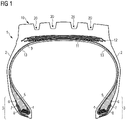
- Figure 1 is a schematic cross section of a tire which comprises a benzoxazine-functionalized elastomer according to an embodiment of the present invention.
- Figure 1 is a schematic cross-section of a tire 1.
- the tire 1 has a tread 10, an inner liner 13, a belt structure comprising four belt plies 11, a carcass ply 9, two sidewalls 2, and two bead regions 3 comprising bead filler apexes 5 and beads 4.
- the example tire 1 is suitable, for example, for mounting on a rim of a vehicle, e.g. a truck or a passenger car.
- the belt plies 11 may be covered by an overlay ply 12 and/or may include one or more breaker plies.
- the carcass ply 9 includes a pair of axially opposite end portions 6, each of which is associated with a respective one of the beads 4.
- Each axial end portion 6 of the carcass ply 9 may be turned up and around the respective bead 4 to a position to anchor each axial end portion 6.
- the turned-up portions 6 of the carcass ply 9 may engage the axial outer surfaces of two flippers 8 and axial inner surfaces of two chippers 7.
- the example tread 10 may have four circumferential grooves, each groove essentially defining a U-shaped opening in the tread 10.
- the main portion of the tread 10 may be formed of one or more tread compounds, which may be any suitable tread compound or compounds.
- Figure 1 suggests a plurality of tire components including for instance apexes 5, chippers 7, flippers 8 and overlay 12, such components are not mandatory for the invention.
- the turned-up end of the carcass ply 9 is not necessary for the invention or may pass on the opposite side of the bead area 3 and end on the axially inner side of the bead 4 instead of the axially outer side of the bead 4.
- the tire could also have for instance more or less than four grooves.
- one or more rubber components in particular, the tread 10 comprise a benzoxazine-functionalized elastomer.
- other rubber components such as a coating compound of the carcass ply 9, a coating compound of the overlay ply 12, the apexes 5 or other rubber components of the tire 1 can comprise such an elastomer.
- the elastomer may be blended with other elastomers, for instance with one or more solution polymerized styrene-butadiene rubbers, polybutadiene or polyisoprene rubber.
- a benzoxazine-functionalized elastomer is manufactured as shown herein below:
- the elastomer having a polymer chain R (such as a polybutadiene or a styrene-butadiene) is end-functionalized with an amine group NH 2 which is bound to the elastomer R via the depicted spacer.
- This elastomer is reacted in the present example with guaiacol (a monophenol) and formaldehyde. At elevated temperatures, it reacts to a benzoxazine end-functionalized elastomer.
- guaiacol a monophenol
- formaldehyde formaldehyde
- an elastomer having a polymer chain R (such as polybutadiene or a solution polymerized styrene-butadiene rubber) is again end-functionalized with an amine group (NH 2 )which is bound to the elastomer R via the depicted spacer (a propylene spacer in the reaction depicted above).
- This elastomer is reacted in the present example with bisphenol A and formaldehyde. After being heated to an elevated temperature, it reacts to a benzoxazine (end-)functionalized elastomer.
- two polymer chains have been connected at their ends to a respective phenyl group of bisphenol A based benzoxazine.
- Such a benzoxazine structure can also react as reinforcing agent in a rubber network. In particular, it can further react with other benzoxazines to form a reinforcing benzoxazine network.
- reaction is carried out in an inert organic solvent, such as a halogenated organic solvent (for example chloroform).
- a halogenated organic solvent for example chloroform
- other inert solvents can also be utilized.
- the reaction was conducted at a temperature of 70°C and the reaction was carried out for a period of 48 hours.
- the spacer starts with an atom directly bonded to the nitrogen atom of the benzoxazine ring (or ring structure) and ends with an atom directly bonded to a repeat unit of the polymer.
- Formaldehyde is a preferred but non-limiting example of an aldehyde derivative for a benzoxazine reaction in accordance with the present invention.
Landscapes
- Chemical & Material Sciences (AREA)
- Health & Medical Sciences (AREA)
- Chemical Kinetics & Catalysis (AREA)
- Medicinal Chemistry (AREA)
- Polymers & Plastics (AREA)
- Organic Chemistry (AREA)
- Engineering & Computer Science (AREA)
- Mechanical Engineering (AREA)
- General Chemical & Material Sciences (AREA)
- Compositions Of Macromolecular Compounds (AREA)
Applications Claiming Priority (2)
| Application Number | Priority Date | Filing Date | Title |
|---|---|---|---|
| US202163180303P | 2021-04-27 | 2021-04-27 | |
| US17/656,112 US12304979B2 (en) | 2021-04-27 | 2022-03-23 | Diene-based elastomer and a rubber composition |
Publications (2)
| Publication Number | Publication Date |
|---|---|
| EP4083076A1 true EP4083076A1 (fr) | 2022-11-02 |
| EP4083076B1 EP4083076B1 (fr) | 2025-11-12 |
Family
ID=81325544
Family Applications (1)
| Application Number | Title | Priority Date | Filing Date |
|---|---|---|---|
| EP22168674.4A Active EP4083076B1 (fr) | 2021-04-27 | 2022-04-15 | Élastomère à base de diène et composition de caoutchouc et procédé de fabrication d'un élastomère fonctionnalisé au benzoxazine |
Country Status (2)
| Country | Link |
|---|---|
| US (1) | US12304979B2 (fr) |
| EP (1) | EP4083076B1 (fr) |
Citations (16)
| Publication number | Priority date | Publication date | Assignee | Title |
|---|---|---|---|---|
| US5395891A (en) | 1992-06-24 | 1995-03-07 | Bayer Aktiengesellschaft | Rubber mixtures containing polybutadiene gel |
| US5451646A (en) | 1994-12-05 | 1995-09-19 | The Goodyear Tire & Rubber Company | Technique for reducing the molecular weight and improving the processability of cis-1,4-polybutadiene |
| US5672639A (en) | 1996-03-12 | 1997-09-30 | The Goodyear Tire & Rubber Company | Starch composite reinforced rubber composition and tire with at least one component thereof |
| US5698643A (en) | 1982-04-26 | 1997-12-16 | The Goodyear Tire & Rubber Company | Controlling the molecular weight of polybutadiene |
| US6127488A (en) | 1997-01-17 | 2000-10-03 | Bayer Ag | Rubber mixtures which contain SBR rubber gels |
| US6133364A (en) | 1998-08-01 | 2000-10-17 | Continental Aktiengesellschaft | Rubber composition, method of formulating the composition and vehicle tire made from the composition |
| US6207757B1 (en) | 1998-08-01 | 2001-03-27 | Continental Aktiengesellschaft | Rubber composition, method of adding and blending the composition and vehicle tire made from the composition |
| US6242534B1 (en) | 1998-08-01 | 2001-06-05 | Continental Aktiengesellschaft | Rubber composition, method of formulating and blending the same and article and tires made therefrom |
| US6372857B1 (en) | 1999-09-07 | 2002-04-16 | Bayer Aktiengesellschaft | Microgel-containing rubber mixtures with masked bi-functional mercaptans and vulcanization products produced therefrom |
| US20030130535A1 (en) | 2001-08-06 | 2003-07-10 | Degussa Ag, | Organosilicon compounds |
| US6608125B2 (en) | 1997-08-21 | 2003-08-19 | Crompton Corporation | Blocked mercaptosilane coupling agents for filled rubbers |
| US7214731B2 (en) | 2003-03-17 | 2007-05-08 | The Goodyear Tire & Rubber Company | Tire with low hydrocarbon emission rubber combination of tread and sidewall components with compositional limitations |
| KR20150017490A (ko) * | 2013-08-07 | 2015-02-17 | 코오롱인더스트리 주식회사 | 벤족사진 화합물 및 그 제조방법 |
| US20180186976A1 (en) * | 2015-06-16 | 2018-07-05 | Kolon Industries, Inc. | Rubber composition containing main-chain benzoxazine, and preparation method therefor |
| US20190300765A1 (en) * | 2016-10-26 | 2019-10-03 | Compagnie Generale Des Etablissements Michelin | Polybenzoxazine that can be used for coating metal and for the bonding of same to rubber |
| CN112457544A (zh) * | 2020-11-18 | 2021-03-09 | 江苏大学 | 一种苯并噁嗪改性丁基橡胶宽温域阻尼复合材料的制备方法 |
Family Cites Families (4)
| Publication number | Priority date | Publication date | Assignee | Title |
|---|---|---|---|---|
| CN100347208C (zh) | 2001-09-27 | 2007-11-07 | Jsr株式会社 | 共轭二烯均聚或共聚橡胶、均聚或共聚橡胶的制造方法、橡胶组合物、复合体以及轮胎 |
| US7956146B2 (en) * | 2009-02-24 | 2011-06-07 | The Goodyear Tire & Rubber Company | Tire with tread of polybutadiene rubber |
| JP2012158697A (ja) | 2011-02-01 | 2012-08-23 | Bridgestone Corp | 空気入りタイヤ |
| EP3888940B1 (fr) | 2020-04-01 | 2023-01-11 | The Goodyear Tire & Rubber Company | Composition de caoutchouc et produit en caoutchouc |
-
2022
- 2022-03-23 US US17/656,112 patent/US12304979B2/en active Active
- 2022-04-15 EP EP22168674.4A patent/EP4083076B1/fr active Active
Patent Citations (17)
| Publication number | Priority date | Publication date | Assignee | Title |
|---|---|---|---|---|
| US5698643A (en) | 1982-04-26 | 1997-12-16 | The Goodyear Tire & Rubber Company | Controlling the molecular weight of polybutadiene |
| US5395891A (en) | 1992-06-24 | 1995-03-07 | Bayer Aktiengesellschaft | Rubber mixtures containing polybutadiene gel |
| US5451646A (en) | 1994-12-05 | 1995-09-19 | The Goodyear Tire & Rubber Company | Technique for reducing the molecular weight and improving the processability of cis-1,4-polybutadiene |
| US5672639A (en) | 1996-03-12 | 1997-09-30 | The Goodyear Tire & Rubber Company | Starch composite reinforced rubber composition and tire with at least one component thereof |
| US6127488A (en) | 1997-01-17 | 2000-10-03 | Bayer Ag | Rubber mixtures which contain SBR rubber gels |
| US6608125B2 (en) | 1997-08-21 | 2003-08-19 | Crompton Corporation | Blocked mercaptosilane coupling agents for filled rubbers |
| US6133364A (en) | 1998-08-01 | 2000-10-17 | Continental Aktiengesellschaft | Rubber composition, method of formulating the composition and vehicle tire made from the composition |
| US6207757B1 (en) | 1998-08-01 | 2001-03-27 | Continental Aktiengesellschaft | Rubber composition, method of adding and blending the composition and vehicle tire made from the composition |
| US6242534B1 (en) | 1998-08-01 | 2001-06-05 | Continental Aktiengesellschaft | Rubber composition, method of formulating and blending the same and article and tires made therefrom |
| US6372857B1 (en) | 1999-09-07 | 2002-04-16 | Bayer Aktiengesellschaft | Microgel-containing rubber mixtures with masked bi-functional mercaptans and vulcanization products produced therefrom |
| US20030130535A1 (en) | 2001-08-06 | 2003-07-10 | Degussa Ag, | Organosilicon compounds |
| US7214731B2 (en) | 2003-03-17 | 2007-05-08 | The Goodyear Tire & Rubber Company | Tire with low hydrocarbon emission rubber combination of tread and sidewall components with compositional limitations |
| KR20150017490A (ko) * | 2013-08-07 | 2015-02-17 | 코오롱인더스트리 주식회사 | 벤족사진 화합물 및 그 제조방법 |
| US20180186976A1 (en) * | 2015-06-16 | 2018-07-05 | Kolon Industries, Inc. | Rubber composition containing main-chain benzoxazine, and preparation method therefor |
| US10538648B2 (en) | 2015-06-16 | 2020-01-21 | Kolon Industries, Inc. | Rubber composition containing main-chain benzoxazine, and preparation method therefor |
| US20190300765A1 (en) * | 2016-10-26 | 2019-10-03 | Compagnie Generale Des Etablissements Michelin | Polybenzoxazine that can be used for coating metal and for the bonding of same to rubber |
| CN112457544A (zh) * | 2020-11-18 | 2021-03-09 | 江苏大学 | 一种苯并噁嗪改性丁基橡胶宽温域阻尼复合材料的制备方法 |
Non-Patent Citations (3)
| Title |
|---|
| JOURNAL OF THE AMERICAN CHEMICAL SOCIETY, vol. 60, 1930, pages 304 |
| MCNEISH JOANNE R ET AL: "Halogenated poly(isobutylene-co-isoprene): influence of halogen leaving-group and polymer microstructure on chemical reactivity", CANADIAN JOURNAL OF CHEMISTRY, NRC RESEARCH PRESS, CA, vol. 91, no. 6, 1 January 2013 (2013-01-01), pages 420 - 427, XP009516331, ISSN: 0008-4042, DOI: 10.1139/CJC-2013-0068 * |
| SPECTROSCOPY CH�A ET AL: "Determination of the Structure of Butyl Rubber by NMR Introduction Butyl rubber is a generic name for a family of iso", MACROMOLECULES, 1 January 1985 (1985-01-01), pages 1423 - 1430, XP055699536, Retrieved from the Internet <URL:https://pubs.acs.org/doi/pdf/10.1021/ma00149a012> [retrieved on 20220916] * |
Also Published As
| Publication number | Publication date |
|---|---|
| EP4083076B1 (fr) | 2025-11-12 |
| US12304979B2 (en) | 2025-05-20 |
| US20220356277A1 (en) | 2022-11-10 |
Similar Documents
| Publication | Publication Date | Title |
|---|---|---|
| US11827791B2 (en) | Rubber composition and a tire | |
| EP3825146B1 (fr) | Une composition de caoutchouc pour pneumatiques comprenant un polyocténamère | |
| CN113493576A (zh) | 橡胶组合物和橡胶产品 | |
| EP4311690B1 (fr) | Composition de caoutchouc pour pneu de camion | |
| EP4282913B1 (fr) | Composition de caoutchouc et pneumatique comprenant une composition de caoutchouc | |
| US20220089844A1 (en) | Rubber composition and a tire | |
| US20210395501A1 (en) | Rubber composition and a tire | |
| EP4261049B1 (fr) | Composition de caoutchouc et pneumatique | |
| US12187895B2 (en) | Rubber composition and a tire | |
| US12435210B2 (en) | Rubber composition and a tire | |
| EP4159478A1 (fr) | Composition de caoutchouc et pneumatique | |
| US20230101160A1 (en) | Rubber composition and tire | |
| EP4253082A1 (fr) | Composition de caoutchouc pour pneu hivernal et pneu hivernal | |
| US12209183B2 (en) | Pneumatic tire having tread with three elastomers | |
| EP4083076B1 (fr) | Élastomère à base de diène et composition de caoutchouc et procédé de fabrication d'un élastomère fonctionnalisé au benzoxazine | |
| EP4311689A1 (fr) | Composition de caoutchouc et pneu de camion | |
| EP4311691A1 (fr) | Composition de caoutchouc et pneu de camion | |
| EP4335659B1 (fr) | Pneumatique | |
| EP4438328A1 (fr) | Pneumatique comportant une bande de roulement | |
| CN115246891A (zh) | 基于二烯的弹性体和橡胶组合物以及制备苯并噁嗪官能化的弹性体的方法 | |
| US20230323103A1 (en) | Rubber composition and a tire |
Legal Events
| Date | Code | Title | Description |
|---|---|---|---|
| PUAI | Public reference made under article 153(3) epc to a published international application that has entered the european phase |
Free format text: ORIGINAL CODE: 0009012 |
|
| STAA | Information on the status of an ep patent application or granted ep patent |
Free format text: STATUS: THE APPLICATION HAS BEEN PUBLISHED |
|
| AK | Designated contracting states |
Kind code of ref document: A1 Designated state(s): AL AT BE BG CH CY CZ DE DK EE ES FI FR GB GR HR HU IE IS IT LI LT LU LV MC MK MT NL NO PL PT RO RS SE SI SK SM TR |
|
| STAA | Information on the status of an ep patent application or granted ep patent |
Free format text: STATUS: REQUEST FOR EXAMINATION WAS MADE |
|
| 17P | Request for examination filed |
Effective date: 20230502 |
|
| RBV | Designated contracting states (corrected) |
Designated state(s): AL AT BE BG CH CY CZ DE DK EE ES FI FR GB GR HR HU IE IS IT LI LT LU LV MC MK MT NL NO PL PT RO RS SE SI SK SM TR |
|
| GRAP | Despatch of communication of intention to grant a patent |
Free format text: ORIGINAL CODE: EPIDOSNIGR1 |
|
| STAA | Information on the status of an ep patent application or granted ep patent |
Free format text: STATUS: GRANT OF PATENT IS INTENDED |
|
| INTG | Intention to grant announced |
Effective date: 20250613 |
|
| GRAS | Grant fee paid |
Free format text: ORIGINAL CODE: EPIDOSNIGR3 |
|
| GRAA | (expected) grant |
Free format text: ORIGINAL CODE: 0009210 |
|
| STAA | Information on the status of an ep patent application or granted ep patent |
Free format text: STATUS: THE PATENT HAS BEEN GRANTED |
|
| AK | Designated contracting states |
Kind code of ref document: B1 Designated state(s): AL AT BE BG CH CY CZ DE DK EE ES FI FR GB GR HR HU IE IS IT LI LT LU LV MC MK MT NL NO PL PT RO RS SE SI SK SM TR |
|
| REG | Reference to a national code |
Ref country code: CH Ref legal event code: F10 Free format text: ST27 STATUS EVENT CODE: U-0-0-F10-F00 (AS PROVIDED BY THE NATIONAL OFFICE) Effective date: 20251112 Ref country code: GB Ref legal event code: FG4D |
|
| REG | Reference to a national code |
Ref country code: DE Ref legal event code: R096 Ref document number: 602022024746 Country of ref document: DE |
|
| REG | Reference to a national code |
Ref country code: IE Ref legal event code: FG4D |
|
| REG | Reference to a national code |
Ref country code: NL Ref legal event code: MP Effective date: 20251112 |
|
| PGFP | Annual fee paid to national office [announced via postgrant information from national office to epo] |
Ref country code: GB Payment date: 20260319 Year of fee payment: 5 |
|
| PG25 | Lapsed in a contracting state [announced via postgrant information from national office to epo] |
Ref country code: ES Free format text: LAPSE BECAUSE OF FAILURE TO SUBMIT A TRANSLATION OF THE DESCRIPTION OR TO PAY THE FEE WITHIN THE PRESCRIBED TIME-LIMIT Effective date: 20251112 |
|
| REG | Reference to a national code |
Ref country code: LT Ref legal event code: MG9D |
|
| PG25 | Lapsed in a contracting state [announced via postgrant information from national office to epo] |
Ref country code: NO Free format text: LAPSE BECAUSE OF FAILURE TO SUBMIT A TRANSLATION OF THE DESCRIPTION OR TO PAY THE FEE WITHIN THE PRESCRIBED TIME-LIMIT Effective date: 20260212 |
|
| PG25 | Lapsed in a contracting state [announced via postgrant information from national office to epo] |
Ref country code: HR Free format text: LAPSE BECAUSE OF FAILURE TO SUBMIT A TRANSLATION OF THE DESCRIPTION OR TO PAY THE FEE WITHIN THE PRESCRIBED TIME-LIMIT Effective date: 20251112 Ref country code: AT Free format text: LAPSE BECAUSE OF FAILURE TO SUBMIT A TRANSLATION OF THE DESCRIPTION OR TO PAY THE FEE WITHIN THE PRESCRIBED TIME-LIMIT Effective date: 20251112 Ref country code: FI Free format text: LAPSE BECAUSE OF FAILURE TO SUBMIT A TRANSLATION OF THE DESCRIPTION OR TO PAY THE FEE WITHIN THE PRESCRIBED TIME-LIMIT Effective date: 20251112 |
|
| PGFP | Annual fee paid to national office [announced via postgrant information from national office to epo] |
Ref country code: IT Payment date: 20260319 Year of fee payment: 5 |
|
| REG | Reference to a national code |
Ref country code: AT Ref legal event code: MK05 Ref document number: 1856698 Country of ref document: AT Kind code of ref document: T Effective date: 20251112 |
|
| PG25 | Lapsed in a contracting state [announced via postgrant information from national office to epo] |
Ref country code: NL Free format text: LAPSE BECAUSE OF FAILURE TO SUBMIT A TRANSLATION OF THE DESCRIPTION OR TO PAY THE FEE WITHIN THE PRESCRIBED TIME-LIMIT Effective date: 20251112 |
|
| PG25 | Lapsed in a contracting state [announced via postgrant information from national office to epo] |
Ref country code: RS Free format text: LAPSE BECAUSE OF FAILURE TO SUBMIT A TRANSLATION OF THE DESCRIPTION OR TO PAY THE FEE WITHIN THE PRESCRIBED TIME-LIMIT Effective date: 20260212 |
|
| PG25 | Lapsed in a contracting state [announced via postgrant information from national office to epo] |
Ref country code: IS Free format text: LAPSE BECAUSE OF FAILURE TO SUBMIT A TRANSLATION OF THE DESCRIPTION OR TO PAY THE FEE WITHIN THE PRESCRIBED TIME-LIMIT Effective date: 20260312 |
|
| PGFP | Annual fee paid to national office [announced via postgrant information from national office to epo] |
Ref country code: FR Payment date: 20260320 Year of fee payment: 5 |
|
| PG25 | Lapsed in a contracting state [announced via postgrant information from national office to epo] |
Ref country code: PT Free format text: LAPSE BECAUSE OF FAILURE TO SUBMIT A TRANSLATION OF THE DESCRIPTION OR TO PAY THE FEE WITHIN THE PRESCRIBED TIME-LIMIT Effective date: 20260312 |
|
| PG25 | Lapsed in a contracting state [announced via postgrant information from national office to epo] |
Ref country code: PL Free format text: LAPSE BECAUSE OF FAILURE TO SUBMIT A TRANSLATION OF THE DESCRIPTION OR TO PAY THE FEE WITHIN THE PRESCRIBED TIME-LIMIT Effective date: 20251112 |
|
| PG25 | Lapsed in a contracting state [announced via postgrant information from national office to epo] |
Ref country code: LV Free format text: LAPSE BECAUSE OF FAILURE TO SUBMIT A TRANSLATION OF THE DESCRIPTION OR TO PAY THE FEE WITHIN THE PRESCRIBED TIME-LIMIT Effective date: 20251112 |