EP4084244A1 - Kühlvorrichtung für eine mittelspannungsschaltanlage - Google Patents
Kühlvorrichtung für eine mittelspannungsschaltanlage Download PDFInfo
- Publication number
- EP4084244A1 EP4084244A1 EP21171016.5A EP21171016A EP4084244A1 EP 4084244 A1 EP4084244 A1 EP 4084244A1 EP 21171016 A EP21171016 A EP 21171016A EP 4084244 A1 EP4084244 A1 EP 4084244A1
- Authority
- EP
- European Patent Office
- Prior art keywords
- section
- conduit
- liquid fluid
- evaporator section
- evaporator
- Prior art date
- Legal status (The legal status is an assumption and is not a legal conclusion. Google has not performed a legal analysis and makes no representation as to the accuracy of the status listed.)
- Withdrawn
Links
- 238000001816 cooling Methods 0.000 title claims abstract description 50
- 239000012530 fluid Substances 0.000 claims abstract description 165
- 239000007788 liquid Substances 0.000 claims abstract description 133
- 239000012212 insulator Substances 0.000 claims abstract description 38
- 239000007789 gas Substances 0.000 claims description 62
- 230000015556 catabolic process Effects 0.000 claims description 19
- IJGRMHOSHXDMSA-UHFFFAOYSA-N Atomic nitrogen Chemical compound N#N IJGRMHOSHXDMSA-UHFFFAOYSA-N 0.000 claims description 18
- 238000000034 method Methods 0.000 claims description 10
- 229910052757 nitrogen Inorganic materials 0.000 claims description 9
- 230000001419 dependent effect Effects 0.000 claims description 3
- 238000010438 heat treatment Methods 0.000 claims description 3
- 238000010792 warming Methods 0.000 description 27
- 239000003822 epoxy resin Substances 0.000 description 13
- 239000000463 material Substances 0.000 description 13
- 229920000647 polyepoxide Polymers 0.000 description 13
- 239000000919 ceramic Substances 0.000 description 7
- 239000003507 refrigerant Substances 0.000 description 7
- 229920001971 elastomer Polymers 0.000 description 6
- 239000011521 glass Substances 0.000 description 6
- 239000011810 insulating material Substances 0.000 description 6
- 239000004033 plastic Substances 0.000 description 6
- 238000009835 boiling Methods 0.000 description 5
- 239000003570 air Substances 0.000 description 4
- 239000000203 mixture Substances 0.000 description 4
- 239000012071 phase Substances 0.000 description 4
- RYGMFSIKBFXOCR-UHFFFAOYSA-N Copper Chemical compound [Cu] RYGMFSIKBFXOCR-UHFFFAOYSA-N 0.000 description 3
- 229910052802 copper Inorganic materials 0.000 description 3
- 239000010949 copper Substances 0.000 description 3
- 230000005684 electric field Effects 0.000 description 3
- 229920006395 saturated elastomer Polymers 0.000 description 3
- XLYOFNOQVPJJNP-UHFFFAOYSA-N water Substances O XLYOFNOQVPJJNP-UHFFFAOYSA-N 0.000 description 3
- 239000012080 ambient air Substances 0.000 description 2
- 230000005494 condensation Effects 0.000 description 2
- 238000009833 condensation Methods 0.000 description 2
- 239000000110 cooling liquid Substances 0.000 description 2
- 230000007423 decrease Effects 0.000 description 2
- 230000000694 effects Effects 0.000 description 2
- 230000005484 gravity Effects 0.000 description 2
- 230000000903 blocking effect Effects 0.000 description 1
- 239000012809 cooling fluid Substances 0.000 description 1
- 230000007613 environmental effect Effects 0.000 description 1
- 238000001704 evaporation Methods 0.000 description 1
- 230000017525 heat dissipation Effects 0.000 description 1
- 238000009413 insulation Methods 0.000 description 1
- 239000007791 liquid phase Substances 0.000 description 1
- 239000002808 molecular sieve Substances 0.000 description 1
- 239000000615 nonconductor Substances 0.000 description 1
- 230000005855 radiation Effects 0.000 description 1
- 230000000630 rising effect Effects 0.000 description 1
- URGAHOPLAPQHLN-UHFFFAOYSA-N sodium aluminosilicate Chemical compound [Na+].[Al+3].[O-][Si]([O-])=O.[O-][Si]([O-])=O URGAHOPLAPQHLN-UHFFFAOYSA-N 0.000 description 1
- 230000007704 transition Effects 0.000 description 1
Images


Classifications
-
- H—ELECTRICITY
- H02—GENERATION; CONVERSION OR DISTRIBUTION OF ELECTRIC POWER
- H02B—BOARDS, SUBSTATIONS OR SWITCHING ARRANGEMENTS FOR THE SUPPLY OR DISTRIBUTION OF ELECTRIC POWER
- H02B1/00—Frameworks, boards, panels, desks, casings; Details of substations or switching arrangements
- H02B1/56—Cooling; Ventilation
-
- H—ELECTRICITY
- H02—GENERATION; CONVERSION OR DISTRIBUTION OF ELECTRIC POWER
- H02G—INSTALLATION OF ELECTRIC CABLES OR LINES, OR OF COMBINED OPTICAL AND ELECTRIC CABLES OR LINES
- H02G5/00—Installations of bus-bars
- H02G5/10—Cooling
-
- H—ELECTRICITY
- H02—GENERATION; CONVERSION OR DISTRIBUTION OF ELECTRIC POWER
- H02B—BOARDS, SUBSTATIONS OR SWITCHING ARRANGEMENTS FOR THE SUPPLY OR DISTRIBUTION OF ELECTRIC POWER
- H02B13/00—Arrangement of switchgear in which switches are enclosed in, or structurally associated with, a casing, e.g. cubicle
- H02B13/02—Arrangement of switchgear in which switches are enclosed in, or structurally associated with, a casing, e.g. cubicle with metal casing
- H02B13/035—Gas-insulated switchgear
Definitions
- the present invention relates a cooling apparatus for a medium voltage switchgear, a cooling system for a medium voltage switchgear, and method of cooling at least one part of a medium voltage or high voltage switchgear with a cooling apparatus or system.
- thermosyphons As compartments of gas insulated switchgears are fully sealed, heat dissipation due to losses is one major tasks of thermal management of the panel.
- passive cooling elements such as heat sinks or gas cooler.
- thermosyphons A more compact solution with high efficiency consists of thermosyphons. They can deduct heat from a dedicated hot spot to areas with lower temperature outside of the compartment.
- Fig. 1 shows a thermosyphon already developed by the applicant.
- the heat source 1 e.g. a current-conducting busbar
- the thermosyphon in terms of a conduit 4 and an evaporator 6, is partially filled with specially selected dielectric fluid 5.
- the heat source 1 is in thermal contact with the evaporator 6 (lower part of the thermosyphon) containing dielectric fluid in the liquid phase 5a.
- the supplied heat leads to a liquid-vapour phase transition, with the vapour 5b rising through a tube to a condenser 7 positioned above the evaporator outside of the enclosure 2.
- the condenser (normally metallic for better thermal conduction and equipped with fins 8 in order to enhance the effective heat exchange with ambient air) has an internal chamber where vapour condensation takes place.
- the condensed liquid returns to the evaporator by the gravity force. If the condenser is placed outside of the compartment and is at the ground electric potential, an electrically insulating section 9, made of a ceramic or an epoxy resin, must be integrated into the metallic tubing of the thermosyphon.
- thermosyphons that also exhibit high GWP values, and new fluids that are "eco friendly" and have a low GWP are sought.
- a cooling apparatus for a medium voltage switchgear comprising:
- the evaporator section is configured to contact at least part of a current carrying contact.
- the conduit fluidly connects the evaporator section to the condenser section.
- the liquid fluid and NCG are contained within a volume formed by the evaporator section, the conduit, and the condenser section.
- the evaporator section is configured such that the liquid fluid can thermally contact an outer surface of the current carrying contact.
- An insulator section of the conduit is electrically insulating.
- the apparatus is configured such that in use:
- the cooling apparatus can cool the current carrying contact of a medium voltage switchgear and use a cooling liquid fluid that is "eco friendly" and has a low global warming potential number many times less than conventional fluids such as SF6, that evaporates and then re-condenses that can not in itself satisfy electrical breakdown requirements due to the vapour and liquid mix having a reduced breakdown potential value, but by providing a suitable gas that is does not condense but that sits above the liquid and vapour mix to raise the pressure of the vapour pressure of bubbles in the liquid to a level high enough to prevent electrical breakdown.
- a suitable gas that is does not condense but that sits above the liquid and vapour mix to raise the pressure of the vapour pressure of bubbles in the liquid to a level high enough to prevent electrical breakdown.
- a heat pipe or thermosyphon where the condensing section can be outside the switchgear enclosure where the condenser section is not at high potential because it is separated from the evaporator section by a conduit with an insulating section, and where environmental requirements are met in that the evaporating/condensing liquid used is ecologically benign with this functionality enabled through use of a suitable non-condensing gas to inhibit electrical breakdown.
- the evaporator section is configured such that the liquid fluid can contact the outer surface of the current carrying contact.
- At least part of the evaporator section is electrically insulating and wherein that at least part of the evaporator section that is electrically insulating is connected to the insulator section of the fluid conduit.
- thermosyphon is electrically insulating. This can be just a small part of the end of the thermosyphon, and the part of the conduit that is electrically insulating can be only the end part of the conduit next to the evaporator section.
- the apparatus comprises the current carrying contact, wherein the evaporator section is fixedly attached to the outer surface of the current carrying contact.
- the evaporator section can be integrated with the current carrying contact to form for example a busbar bushing.
- a fluid channel within the evaporator section surrounds the current carrying contact, wherein the fluid channel is configured such that the liquid fluid can contact the outer surface of the current carrying contact that extends around the current carrying contact, and wherein the fluid channel fluidly connects to the conduit.
- cooling of the current carrying contact is further improved, because the working fluid can be heated and turned into the vapour state at a surface encircling the current carrying contact.
- the condenser section comprises a gas reservoir configured to accommodate non-condensable gas.
- the condenser section comprises at least one heat exchange structure.
- the at least one heat exchange structure is located between the gas reservoir and the conduit.
- the liquid fluid is configured to exhibit a breakdown strength of at least 5 kV/mm.
- the liquid fluid is perfluroketone C6F12O.
- the non-condensable gas is configured to remain in the gaseous state over a temperature and pressure operating range of the apparatus.
- the non-condensable gas is nitrogen.
- a cooling system for a medium voltage switchgear comprising:
- the evaporator section is in contact with at least part of a current carrying contact.
- the conduit fluidly connects the evaporator section to the condenser section.
- the liquid fluid and NCG are contained within a volume formed by the evaporator section, the conduit, and the condenser section.
- the evaporator section is configured such that the liquid fluid thermally contacts an outer surface of the current carrying contact.
- An insulator section of the conduit is electrically insulating.
- the system is configured such that in use:
- a method of cooling at least one part of a medium voltage switchgear with a cooling apparatus or system comprising:
- Figs. 2-5 relate to a cooling apparatus and cooling system for a medium voltage switchgear, a methods of cooling at least one part of a medium voltage switchgear with a cooling apparatus or system.
- a thermosyphon is described that can form a cooling apparatus that can in effect be retro-fitted to a switchgear, or the thermosyphon can be already installed and in which case it forms in effect a cooling system.
- the cooling apparatus/system is described with respect to the cooling of a current carrying contact of a switchgear, but can be used to cool all manner of parts that form "hot spots" in electrical equipment.
- the cooling apparatus comprises an evaporator section 6, a conduit 4, a condenser section 7, a liquid fluid, and a non-condensable gas "NCG".
- the evaporator section is configured to contact at least part of a current carrying contact 1.
- the conduit fluidly connects the evaporator section to the condenser section.
- the liquid fluid and NCG are contained within a volume formed by the evaporator section, the conduit, and the condenser section.
- the evaporator section is configured such that the liquid fluid can thermally contact an outer surface of the current carrying contact.
- An insulator section 9 of the conduit is electrically insulating.
- the apparatus is configured such that in use:
- the evaporator section is configured to surround at least part of a current carrying contact.
- the evaporator section is configured to enable the liquid fluid to directly contact the outer surface of the current carrying contact.
- the evaporator section is located inside an enclosure 2 of a medium voltage switchgear and the condenser section or at least a part of the condenser section is located outside of the enclosure.
- the enclosure 2 is filled with an electrically insulating gas 3.
- the evaporator section is configured such that the liquid fluid can contact the outer surface of the current carrying contact.
- the liquid fluid has a low global warming potential (GWP).
- GWP global warming potential
- the liquid fluid has a global warming potential less than the global warming potential of SF6.
- the liquid fluid has a global warming potential less than 10000.
- the liquid fluid has a global warming potential less than 1000.
- the liquid fluid has a global warming potential less than 100.
- the liquid fluid has a global warming potential less than 10.
- the liquid fluid has a global warming potential approximately equal 1.
- the non-condensable gas is nitrogen.
- the current carrying contact is configured to connect to a primary contact, that for example is configured to connect to a terminal of a circuit breaker of the switchgear.
- the evaporator section is ring shaped.
- the evaporator section comprises an insulating material such as ceramic and glass materials.
- the evaporator section comprises plastic and/or rubber materials.
- the evaporator section comprises epoxy resin.
- the evaporator section comprises glass-fiber-reinforced epoxy resin.
- the evaporator section comprises copper.
- the insulator section comprises an insulating material such as ceramic and glass materials.
- the insulator section comprises plastic and/or rubber materials.
- the insulator section comprises epoxy resin.
- the insulator section comprises glass-fiber-reinforced epoxy resin.
- conduit can have a metallic wall, but at the insulator section the wall of the conduit is not metallic but is insulating.
- At least part of the evaporator section is electrically insulating and wherein the at least part of the evaporator section that is electrically insulating is connected to the insulator section of the fluid conduit.
- the apparatus comprises the current carrying contact, wherein the evaporator section is fixedly attached to the outer surface of the current carrying contact.
- the evaporator section can be integrated with the current carrying contact to form for example a busbar bushing.
- the evaporator section surrounds and is fixedly attached to the outer surface of the current carrying contact.
- the condenser section is located at a higher elevation than the evaporator section.
- a fluid channel within the evaporator section surrounds the current carrying contact.
- the fluid channel is configured such that the liquid fluid can contact the outer surface of the current carrying contact that extends around the current carrying contact, and the fluid channel fluidly connects to the conduit.
- the condenser section comprises a gas reservoir 10 configured to accommodate non-condensable gas.
- the reservoir comprises an adsorber for removing water from the vapourized fluid.
- the condenser section comprises at least one heat exchange structure 8.
- the at least one heat exchange structure comprises at least one cooling fin, rib or vertical channel.
- the at least one heat exchange structure is located between the gas reservoir and the conduit.
- the liquid fluid is configured to exhibit a breakdown strength of at least 5 kV/mm.
- the liquid fluid is perfluroketone C6F12O.
- the non-condensable gas is configured to remain in the gaseous state over a temperature and pressure operating range of the apparatus.
- the non-condensable gas has a partial pressure of at least 0.20 bar at minus 15C.
- the non-condensable gas is nitrogen.
- the cooling system comprises an evaporator section 6, a conduit 4, a condenser section 7, a liquid fluid, and a non-condensable gas "NCG".
- the evaporator section is in contact with at least part of a current carrying contact 1.
- the conduit fluidly connects the evaporator section to the condenser section.
- the liquid fluid and NCG are contained within a volume formed by the evaporator section, the conduit, and the condenser section.
- the evaporator section is configured such that the liquid fluid thermally contacts an outer surface of the current carrying contact.
- An insulator section 9 of the conduit is electrically insulating.
- the system is configured such that in use:
- the evaporator section is configured to surround at least part of a current carrying contact.
- the evaporator section is configured to enable the liquid fluid to directly contact the outer surface of the current carrying contact.
- the evaporator section is located inside an enclosure 2 of a medium voltage switchgear and the condenser section or at least a part of the condenser section is located outside of the enclosure.
- the enclosure 2 is filled with an electrically insulating gas 3.
- the evaporator section is configured such that the liquid fluid contacts the outer surface of the current carrying contact.
- the liquid fluid has a low global warming potential.
- the liquid fluid has a global warming potential less than the global warming potential of SF6.
- the liquid fluid has a global warming potential less than 10000.
- the liquid fluid has a global warming potential less than 1000.
- the liquid fluid has a global warming potential less than 100.
- the liquid fluid has a global warming potential less than 10.
- the liquid fluid has a global warming potential approximately equal 1.
- the non-condensable gas is nitrogen.
- the current carrying contact is configured to connect to a primary contact, that for example is configured to connect to a terminal of a circuit breaker of the switchgear.
- the evaporator section is ring shaped.
- the evaporator section comprises an insulating material such as ceramic and glass materials.
- the evaporator section comprises plastic and/or rubber materials.
- the evaporator section comprises epoxy resin.
- the evaporator section comprises glass-fiber-reinforced epoxy resin.
- the evaporator section comprises copper.
- the insulator section comprises an insulating material such as ceramic and glass materials.
- the insulator section comprises plastic and/or rubber materials.
- the insulator section comprises epoxy resin.
- the insulator section comprises glass-fiber-reinforced epoxy resin.
- At least part of the evaporator section is electrically insulating and the at least part of the evaporator section that is electrically insulating is connected to the insulator section of the fluid conduit.
- the evaporator section surrounds and is fixedly attached to the outer surface of the current carrying contact.
- a fluid channel within the evaporator section surrounds the current carrying contact.
- the fluid channel is configured such that the liquid fluid contacts the outer surface of the current carrying contact that extends around the current carrying contact, and the fluid channel fluidly connects to the conduit.
- the condenser section comprises a gas reservoir 10 configured to accommodate non-condensable gas.
- the reservoir comprises an adsorber for removing water from the vapourized fluid.
- the condenser section comprises at least one heat exchange structure 8.
- the at least one heat exchange structure comprises at least one cooling fin, rib or vertical channel.
- the at least one heat exchange structure is located between the gas reservoir and the conduit.
- the liquid fluid is configured to exhibit a breakdown strength of at least 5 kV/mm.
- the liquid fluid is perfluroketone C6F12O.
- the non-condensable gas is configured to remain in the gaseous state over a temperature and pressure operating range of the apparatus.
- the non-condensable gas has a partial pressure of at least 0.20 bar at minus 15C.
- the non-condensable gas is nitrogen.
- the cooling apparatus or system comprises an evaporator section 6, a conduit 4, a condenser section 7, a liquid fluid, and a non-condensable gas "NCG".
- the evaporator section is contacts at least part of a current carrying contact.
- the conduit fluidly connects the evaporator section to the condenser section.
- the liquid fluid and NCG are contained within a volume formed by the evaporator section, the conduit, and the condenser section.
- the evaporator section is configured such that the liquid fluid thermally contacts an outer surface of the current carrying contact.
- An insulator section 9 of the conduit is electrically insulating.
- the evaporator section is configured to surround at least part of a current carrying contact.
- the evaporator section is located inside an enclosure 2 of a medium voltage switchgear and the condenser section or at least a part of the condenser section is located outside of the enclosure
- the evaporator section is configured such that the liquid fluid can directly contact the outer surface of the current carrying contact.
- the liquid fluid has a low global warming potential.
- the liquid fluid has a global warming potential less than the global warming potential of SF6.
- the liquid fluid has a global warming potential less than 10000.
- the liquid fluid has a global warming potential less than 1000.
- the liquid fluid has a global warming potential less than 100.
- the liquid fluid has a global warming potential less than 10.
- the liquid fluid has a global warming potential approximately equal 1.
- the non-condensable gas is nitrogen.
- the current carrying contact is configured to connect to a primary contact, that for example is configured to connect to a terminal of a circuit breaker of the switchgear.
- the evaporator section is ring shaped.
- the evaporator section comprises an insulating material such as ceramic and glass materials.
- the evaporator section comprises plastic and/or rubber materials.
- the evaporator section comprises epoxy resin.
- the evaporator section comprises glass-fiber-reinforced epoxy resin.
- the evaporator section comprises copper.
- the insulator section comprises an insulating material such as ceramic and glass materials.
- the insulator section comprises plastic and/or rubber materials.
- the insulator section comprises epoxy resin.
- the insulator section comprises glass-fiber-reinforced epoxy resin.
- At least part of the evaporator section is electrically insulating and the at least part of the evaporator section that is electrically insulating is connected to the insulator section of the fluid conduit.
- the evaporator section surrounds and is fixedly attached to the outer surface of the current carrying contact.
- a fluid channel within the evaporator section surrounds the current carrying contact.
- the fluid channel is configured such that the liquid fluid contacts the outer surface of the current carrying contact that extends around the current carrying contact, and the fluid channel fluidly connects to the conduit.
- the condenser section comprises a gas reservoir 10 configured to accommodate non-condensable gas.
- the condenser section comprises at least one heat exchange structure 8.
- the at least one heat exchange structure comprises at least one cooling fin, rib or vertical channel.
- the at least one heat exchange structure is located between the gas reservoir and the conduit.
- the liquid fluid is configured to exhibit a breakdown strength of at least 5 kV/mm.
- the liquid fluid is perfluroketone C6F12O.
- the non-condensable gas is configured to remain in the gaseous state over a temperature and pressure operating range of the apparatus.
- the non-condensable gas has a partial pressure of at least 0.20 bar at minus 15C.
- the non-condensable gas is nitrogen.
- the cooling apparatus for a medium voltage switchgear the cooling system for a medium voltage switchgear, and the method of cooling at least one part of a medium voltage or high voltage switchgear with a cooling apparatus or system are further described in specific detail, where reference is again made to Figs. 2-5 .
- the inventors realised that in order to maintain the eco-friendly nature of the whole switchgear unit, not only must the insulating gas within the enclosure of the switchgear have a much lower global warming potential (GWP) that typically uses SF6 that has a GWP of 23900 and the GWP should ideally be 1, but the cooling fluid of the thermosyphon must also have a low GWP ⁇ 1.
- GWP global warming potential
- conventional refrigerants have GWP >> 1.
- the refrigerant must also satisfy certain requirements of non-flammability and dielectric strength. It is customary for the switchgear to be operational at ambient temperatures as low as -25°C.
- the dielectric breakdown strength of the fluid E bd should be higher than the critical value E bd,c , which depends on the electric field strength and geometry.
- the dielectric breakdown strength of the vapour phase decrease with vapour pressure which, in turn, decreases with temperature. Since, during operation, the boiling liquid in the evaporator contains some vapour (bubbles), a breakdown may be initiated in the vapour phase at low enough temperature T c at vapour pressure P c . The most critical conditions are at the start of operation, when the whole system is still cold, but bubbles of low-pressure vapour begin to appear in the liquid. The possibility of a breakdown in low-pressure vapour severely limits the choice of refrigerants for medium-voltage applications with conventionally designed thermosyphons.
- suitable NCG candidates with negligible GWP are technical air and nitrogen.
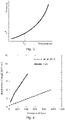
- the presence of NCG mixed with the operating fluid vapour above the liquid pool then raises the pressure of the gas mixture above the saturated pressure of the pure fluid shown in Fig. 3 . This way, the vapour pressure in bubbles of boiling liquid can be made high enough to prevent an electrical breakdown, if enough NCG is present in the thermosyphon.
- the NCG does not need to have particularly high dielectric strength.
- the working liquid however completely fills the insulating part 9 of the thermosyphon, as illustrated in Fig. 5 .
- the gas bubbles of boiling liquid contain only the fluid vapor, with a negligibly small amount of NCG if some is dissolved in the boiling liquid.
- the NCG resides predominantly in the upper part of the thermosyphon above the liquid level, where the electric field strength is small; that is, NCG helps in increasing the bubble vapour pressure but does not act itself as electrical insulator.
- thermosyphon design illustrated in Fig. 1
- a conventional thermosyphon design is not suitable for operation with an NCG for the following reasons.
- the refrigerant fluid vapour and NCG are homogeneously distributed above the liquid level; a small amount of NCG can also be dissolved in the liquid.
- vapour with NCG continuously rises from the evaporator to the condenser, where the working fluid condenses and returns to the evaporator by gravity. Only a small amount of NCG dissolves in the condensate and returns to the evaporator with the liquid. Therefore, most of the NCG tends to accumulate in the upper part of the thermosyphon, blocking the surface of the inner chamber of the condenser and so preventing the operation of the thermosyphon.
- the solution was to equip the thermosyphon with a gas reservoir 10 fluidly connected to the condenser inner chamber, in order to accommodate the NCG during operation.
- the refrigerant fluid vapour and NCG will be homogeneously distributed in the thermosyphon and the gas reservoir, but after a certain startup period of operation most of NCG will be mostly collected in the reservoir 10 and will not interfere with fluid vapour condensation in the condenser.
- the volume of gas reservoir is selected such, that it can accommodate almost all NCG during operation of the switchgear at typical conditions (such as the nominal heat load of the heat source 1 and the typical ambient temperature).
Landscapes
- Engineering & Computer Science (AREA)
- Power Engineering (AREA)
- Cooling Or The Like Of Electrical Apparatus (AREA)
Priority Applications (2)
| Application Number | Priority Date | Filing Date | Title |
|---|---|---|---|
| EP21171016.5A EP4084244A1 (de) | 2021-04-28 | 2021-04-28 | Kühlvorrichtung für eine mittelspannungsschaltanlage |
| PCT/EP2022/056666 WO2022228767A1 (en) | 2021-04-28 | 2022-03-15 | Cooling apparatus for a medium voltage switchgear |
Applications Claiming Priority (1)
| Application Number | Priority Date | Filing Date | Title |
|---|---|---|---|
| EP21171016.5A EP4084244A1 (de) | 2021-04-28 | 2021-04-28 | Kühlvorrichtung für eine mittelspannungsschaltanlage |
Publications (1)
| Publication Number | Publication Date |
|---|---|
| EP4084244A1 true EP4084244A1 (de) | 2022-11-02 |
Family
ID=75728758
Family Applications (1)
| Application Number | Title | Priority Date | Filing Date |
|---|---|---|---|
| EP21171016.5A Withdrawn EP4084244A1 (de) | 2021-04-28 | 2021-04-28 | Kühlvorrichtung für eine mittelspannungsschaltanlage |
Country Status (2)
| Country | Link |
|---|---|
| EP (1) | EP4084244A1 (de) |
| WO (1) | WO2022228767A1 (de) |
Cited By (2)
| Publication number | Priority date | Publication date | Assignee | Title |
|---|---|---|---|---|
| EP4404402A1 (de) * | 2023-01-17 | 2024-07-24 | Abb Schweiz Ag | System zur überwachung eines thermosyphons einer mittelspannungsschaltanlage |
| EP4636345A1 (de) * | 2024-04-19 | 2025-10-22 | Commissariat à l'Energie Atomique et aux Energies Alternatives | Thermische und mechanische verwaltungsvorrichtung und system mit solch einer vorrichtung |
Citations (4)
| Publication number | Priority date | Publication date | Assignee | Title |
|---|---|---|---|---|
| EP1657731A1 (de) * | 2004-11-16 | 2006-05-17 | Abb Research Ltd. | Hochspannungsleistungsschalter mit Kühlung |
| EP1737009A1 (de) * | 2005-06-23 | 2006-12-27 | Abb Research Ltd. | Elektrische Anlage mit einem Kühlelement und Verfahren zum Betrieb dieser Anlage |
| WO2017190936A1 (de) * | 2016-05-02 | 2017-11-09 | Abb Schweiz Ag | Generatorschalter mit einer kühlvorrichtung |
| EP3588707A1 (de) * | 2018-06-29 | 2020-01-01 | ABB Schweiz AG | Zweiphasige kühlvorrichtung für ein gekapseltes elektrisches gerät |
-
2021
- 2021-04-28 EP EP21171016.5A patent/EP4084244A1/de not_active Withdrawn
-
2022
- 2022-03-15 WO PCT/EP2022/056666 patent/WO2022228767A1/en not_active Ceased
Patent Citations (4)
| Publication number | Priority date | Publication date | Assignee | Title |
|---|---|---|---|---|
| EP1657731A1 (de) * | 2004-11-16 | 2006-05-17 | Abb Research Ltd. | Hochspannungsleistungsschalter mit Kühlung |
| EP1737009A1 (de) * | 2005-06-23 | 2006-12-27 | Abb Research Ltd. | Elektrische Anlage mit einem Kühlelement und Verfahren zum Betrieb dieser Anlage |
| WO2017190936A1 (de) * | 2016-05-02 | 2017-11-09 | Abb Schweiz Ag | Generatorschalter mit einer kühlvorrichtung |
| EP3588707A1 (de) * | 2018-06-29 | 2020-01-01 | ABB Schweiz AG | Zweiphasige kühlvorrichtung für ein gekapseltes elektrisches gerät |
Cited By (3)
| Publication number | Priority date | Publication date | Assignee | Title |
|---|---|---|---|---|
| EP4404402A1 (de) * | 2023-01-17 | 2024-07-24 | Abb Schweiz Ag | System zur überwachung eines thermosyphons einer mittelspannungsschaltanlage |
| EP4636345A1 (de) * | 2024-04-19 | 2025-10-22 | Commissariat à l'Energie Atomique et aux Energies Alternatives | Thermische und mechanische verwaltungsvorrichtung und system mit solch einer vorrichtung |
| WO2025219599A1 (en) * | 2024-04-19 | 2025-10-23 | Commissariat à l'Energie Atomique et aux Energies Alternatives | Thermal and mechanical management device and system comprising such a device |
Also Published As
| Publication number | Publication date |
|---|---|
| WO2022228767A1 (en) | 2022-11-03 |
Similar Documents
| Publication | Publication Date | Title |
|---|---|---|
| US12058840B2 (en) | Methods of immersion cooling with low-GWP fluids in immersion cooling systems | |
| RU2401473C2 (ru) | Высоковольтный выключатель с охлаждением | |
| US9953771B2 (en) | Heat dissipation from ACB toes | |
| US3609206A (en) | Evaporative cooling system for insulated bus | |
| US20130319024A1 (en) | Dual Port Heat Pipe Structure For Switchgear | |
| WO2022228767A1 (en) | Cooling apparatus for a medium voltage switchgear | |
| US10910138B2 (en) | Gas-insulated electrical apparatus, in particular gas-insulated transformer or reactor | |
| CN111247385A (zh) | 散热管、使用散热管传递热量的方法以及用于散热管的热传递流体 | |
| US12068668B2 (en) | Electric machine cooling | |
| KR102643033B1 (ko) | 중전압 또는 고전압 스위치기어를 위한 냉각 장치 | |
| CN115335940A (zh) | 用于中压开关设备或高压开关设备的冷却装置 | |
| US4260014A (en) | Ebullient cooled power devices | |
| JP2005126480A (ja) | フッ化ケトンを含む熱伝達作動液 | |
| EP3588707A1 (de) | Zweiphasige kühlvorrichtung für ein gekapseltes elektrisches gerät | |
| EP4151943A1 (de) | Kühlvorrichtung für eine mittelspannungs- oder hochspannungsschaltanlage | |
| EP3513639B1 (de) | Kühlanordnung | |
| EP3627522A1 (de) | Gasisolierte elektrische schaltanlage | |
| US20250243394A1 (en) | Compositions comprising a dielectric fluid and a phase-change fluid and uses thereof | |
| KR0158468B1 (ko) | 히이트파이프식반도체냉각기 | |
| CN118376115A (zh) | 一种高电压设备用热管及其制作方法 | |
| JPS59195852A (ja) | 電気機器の冷却装置 | |
| JPS59129578A (ja) | 電気機器の冷却装置 |
Legal Events
| Date | Code | Title | Description |
|---|---|---|---|
| PUAI | Public reference made under article 153(3) epc to a published international application that has entered the european phase |
Free format text: ORIGINAL CODE: 0009012 |
|
| STAA | Information on the status of an ep patent application or granted ep patent |
Free format text: STATUS: THE APPLICATION HAS BEEN PUBLISHED |
|
| AK | Designated contracting states |
Kind code of ref document: A1 Designated state(s): AL AT BE BG CH CY CZ DE DK EE ES FI FR GB GR HR HU IE IS IT LI LT LU LV MC MK MT NL NO PL PT RO RS SE SI SK SM TR |
|
| STAA | Information on the status of an ep patent application or granted ep patent |
Free format text: STATUS: REQUEST FOR EXAMINATION WAS MADE |
|
| 17P | Request for examination filed |
Effective date: 20230425 |
|
| RBV | Designated contracting states (corrected) |
Designated state(s): AL AT BE BG CH CY CZ DE DK EE ES FI FR GB GR HR HU IE IS IT LI LT LU LV MC MK MT NL NO PL PT RO RS SE SI SK SM TR |
|
| STAA | Information on the status of an ep patent application or granted ep patent |
Free format text: STATUS: THE APPLICATION HAS BEEN WITHDRAWN |
|
| 18W | Application withdrawn |
Effective date: 20240731 |