EP4085236B1 - Verfahren und systeme zum durchführen von gewichtsbasierten transaktionen - Google Patents
Verfahren und systeme zum durchführen von gewichtsbasierten transaktionen Download PDFInfo
- Publication number
- EP4085236B1 EP4085236B1 EP20909935.7A EP20909935A EP4085236B1 EP 4085236 B1 EP4085236 B1 EP 4085236B1 EP 20909935 A EP20909935 A EP 20909935A EP 4085236 B1 EP4085236 B1 EP 4085236B1
- Authority
- EP
- European Patent Office
- Prior art keywords
- weight
- shelf
- measurement data
- points
- products
- Prior art date
- Legal status (The legal status is an assumption and is not a legal conclusion. Google has not performed a legal analysis and makes no representation as to the accuracy of the status listed.)
- Active
Links
Images








Classifications
-
- G—PHYSICS
- G01—MEASURING; TESTING
- G01G—WEIGHING
- G01G19/00—Weighing apparatus or methods adapted for special purposes not provided for in the preceding groups
- G01G19/40—Weighing apparatus or methods adapted for special purposes not provided for in the preceding groups with provisions for indicating, recording, or computing price or other quantities dependent on the weight
- G01G19/42—Weighing apparatus or methods adapted for special purposes not provided for in the preceding groups with provisions for indicating, recording, or computing price or other quantities dependent on the weight for counting by weighing
-
- G—PHYSICS
- G01—MEASURING; TESTING
- G01G—WEIGHING
- G01G19/00—Weighing apparatus or methods adapted for special purposes not provided for in the preceding groups
- G01G19/40—Weighing apparatus or methods adapted for special purposes not provided for in the preceding groups with provisions for indicating, recording, or computing price or other quantities dependent on the weight
- G01G19/413—Weighing apparatus or methods adapted for special purposes not provided for in the preceding groups with provisions for indicating, recording, or computing price or other quantities dependent on the weight using electromechanical or electronic computing means
- G01G19/414—Weighing apparatus or methods adapted for special purposes not provided for in the preceding groups with provisions for indicating, recording, or computing price or other quantities dependent on the weight using electromechanical or electronic computing means using electronic computing means only
- G01G19/4144—Weighing apparatus or methods adapted for special purposes not provided for in the preceding groups with provisions for indicating, recording, or computing price or other quantities dependent on the weight using electromechanical or electronic computing means using electronic computing means only for controlling weight of goods in commercial establishments, e.g. supermarket, P.O.S. systems
-
- G—PHYSICS
- G06—COMPUTING OR CALCULATING; COUNTING
- G06Q—INFORMATION AND COMMUNICATION TECHNOLOGY [ICT] SPECIALLY ADAPTED FOR ADMINISTRATIVE, COMMERCIAL, FINANCIAL, MANAGERIAL OR SUPERVISORY PURPOSES; SYSTEMS OR METHODS SPECIALLY ADAPTED FOR ADMINISTRATIVE, COMMERCIAL, FINANCIAL, MANAGERIAL OR SUPERVISORY PURPOSES, NOT OTHERWISE PROVIDED FOR
- G06Q10/00—Administration; Management
- G06Q10/08—Logistics, e.g. warehousing, loading or distribution; Inventory or stock management
- G06Q10/087—Inventory or stock management, e.g. order filling, procurement or balancing against orders
-
- G—PHYSICS
- G01—MEASURING; TESTING
- G01G—WEIGHING
- G01G19/00—Weighing apparatus or methods adapted for special purposes not provided for in the preceding groups
- G01G19/52—Weighing apparatus combined with other objects, e.g. furniture
Definitions
- the present invention relates to weighing devices and assemblies, including weighing devices and assemblies for shelves on which non-homogeneous assortments of products can be arranged, and methods for their use in conducting transactions with respect to the products by tracking the weights, locations and identifications of products added to and removed from shelves.
- Unattended or autonomous retail and inventory management are examples of areas that can benefit from the use of methods for weighing and tracking products on shelves.
- Technical solutions have been suggested for intelligent shelving arrangements that would track the weight of products on a shelf, including changes in the weight resulting from the addition of products or the removal of products.
- An example of such a suggested solution is a shelf segment assembly with load cells attached to the underside so that when the shelf segment is placed atop an existing 'regular' shelf, weights of the products on the shelf can be tracked.
- Such solutions are lacking in terms of being able to disambiguate unique products in diverse collections of products, instead dedicating each small shelf or shelf insert to a single product or stock-keeping unit (SKU).
- SKU stock-keeping unit
- Examples of shelving arrangements include connected shelving bays and standalone shelving arrangements. Connected shelving bays use a familiar type of shelving unit common in supermarkets and other retail stores. Standalone shelving arrangements are usually not connected to other shelving units and are often used in smaller retail environments such as, for example, kiosks, convenience stores, public areas of shopping malls, or shops in public venues such as train stations or airports. Either type of shelving arrangement can be suitable for practicing the embodiments disclosed herein.
- Document US 10 198 710 B1 discloses systems and techniques for generating interaction data at an inventory location, such as in a materials handling facility.
- Embodiments of the present invention relate to methods and systems for conducting retail transactions by tracking the weights of non-homogeneous products on shelves, and identifying, from detected changes in weights and in weight distributions, which products are being added to or removed from shelves, or moved from place to place on a single shelf.
- Some of the embodiments relate to methods and systems for applying statistical analyses and/or probability distributions and other mathematical functions with relation to weights and products (including weights and products jointly), and machine learning algorithms including, without limitation, clustering algorithms, in the disambiguation of product identifications and of user actions taken with respect to those products.
- a method for conducting a retail transaction, using a plurality of weighing assemblies that are jointly operable to measure the combined weight of the shelf and of products arranged thereupon.
- the method comprises: monitoring weight measurement data corresponding to the shelf and a plurality of non-homogeneous products arranged thereupon, said weight measurement data transmitted by the plurality of weighing assemblies as respective streams of weight measurement data-points; responsively to a change over time in the values of said weight measurement data-points and contingent upon said values reaching respective steady states according to a stability-tracking rule, determining a set of weight-event parameters of a weight event, the determined set of weight-event parameters comprising one or more products and a product-action respective of each one of the one or more products; and performing at least one of: (i) recording information about the results of the determining in a non-transient, computer-readable medium, and (ii) displaying information about the results of the determining on a display device.
- the weight measurement corresponding to the shelf and a plurality
- the method can additionally comprise receiving an indication of a transaction-initiation, and said monitoring can be in response to the receiving.
- the stability-tracking rule can include that said respective steady states for the streams of weight measurement data-points are defined by respective response-amplitude thresholds.
- applying the stability tracking rule can include estimating bias in the weight measurement data-points and compensating for said bias.
- the weight measurement data-points can either comprise voltage inputs or solely comprise voltage inputs.
- said determining can include estimating a joint weight-location event-based product classifier.
- estimating the joint weight-location event-based product classifier can include estimating a joint weight-location probability density.
- estimating the joint weight-location event-based product classifier can include applying a statistical classification mechanism trained by weight and location information to perform a statistical inference.
- the weight measurement data-points can be the only inputs to said determining that are generated by sensors during the transaction.
- the method can additionally comprise, before said determining: responsively to a change over time in the values of transmitted weight measurement data-points, analyzing each of the streams of weight measurement data-points to detect at least one of noise and drift; and in response to the detection of said at least one of noise and drift, performing at least one of (A) at least partially filtering out the noise and/or drift and (B) at least partially compensating for the noise and/or drift in the weight measurement data points, such that the performing generates revised weight measurement data.
- a method for conducting a retail transaction, using a plurality of weighing assemblies that are jointly operable to measure the combined weight of the shelf and of non-homogeneous products arranged thereupon.
- the method comprises: monitoring weight measurement data corresponding to the weight of the shelf and of the products arranged thereupon, said weight measurement data transmitted from a plurality of weighing assemblies as respective streams of weight measurement data points; and responsively to a change over time in the values of said weight measurement data, determining a set of weight-event parameters of a weight event, the determined set of weight-event parameters comprising one or more products and a product-action respective of each one of the one or more products.
- the determining comprises: identifying one or more supported sets of weight-event parameters in a weight-location space, and applying a joint weight-location event-based classification function to select a set of weight-event parameters from the identified one or more supported sets.
- applying the joint weight-location event-based classification function can include estimating a joint weight-location probability density.
- a method for conducting applying the joint weight-location event-based classification function can include applying a statistical classification mechanism trained by weight and location information to perform a statistical inference.
- the determining can be based on product weight-distribution data retrieved from a product database. In some embodiments, the determining is based on a product positioning plan.
- the estimating of the joint weight-location probability density can include iteratively improving initial weight and/or location estimations.
- the applying of the classification function can include Bayesian hierarchical modelling.
- the weight measurement data-points can be the only inputs to said determining that are generated by sensors during the transaction.
- the determining can be carried out responsively to an absolute value of the change over time in the values of said weight measurement data exceeding a pre-determined threshold.
- the weight measurement data-points can either comprise voltage inputs or solely comprise voltage inputs.
- the determined set of weight-event parameters can be changed because of the compensating for the estimated bias.
- the determining can comprise: identifying one or more supported sets of weight-event parameters in a weight-location space, and applying a joint weight-location event-based classification function to select a set of weight-event parameters from the identified one or more supported sets.
- applying the joint weight-location event-based classification function can include estimating a joint weight-location probability density. In some embodiments, applying the joint weight-location event-based classification function can include applying a statistical classification mechanism trained by weight and location information to perform a statistical inference.
- the method can additionally comprise, before said determining: responsively to a change over time in the values of transmitted weight measurement data-points, analyzing each of the streams of weight measurement data points to detect at least one of noise and drift; and in response to the detection of said at least one of noise and drift, performing at least one of (A) at least partially filtering out the noise and/or drift and (B) at least partially compensating for the noise and/or drift in the weight measurement data points, such that the performing generates revised weight measurement data, wherein said determining is based on a change in values in said revised weight measurement data.
- the method can additionally comprise receiving an indication of a transaction-completion.
- said determining can comprise: identifying one or more supported sets of weight-event parameters in a weight-location space, and applying a joint weight-location event-based classification function to select a set of weight-event parameters from the identified one or more supported sets.
- the method can additionally comprise before said determining: responsively to a change over time in the values of transmitted weight measurement data-points, analyzing each of the streams of weight measurement data points to detect at least one of noise and drift; in response to the detection of said at least one of noise and drift, performing at least one of (A) at least partially filtering out the noise and/or drift and (B) at least partially compensating for the noise and/or drift in the weight measurement data points, such that the performing generates revised weight measurement data, wherein said determining is based on a change in values in said revised weight measurement data.
- said indication of the transaction-initiation includes one of (i) a mechanical shock indicating a door opening and/or closing, (ii) a lidar or radar reading of a hand reaching to the shelf, (iii) an electronic or optical reading of a payment or subscription medium, and (iv) a biometric reading of a user.
- said determining comprises: identifying one or more supported sets of weight-event parameters in a weight-location space, and applying a joint weight-location event-based classification function to select a set of weight-event parameters from the identified one or more supported sets.
- a system for conducting a retail transaction comprises: a plurality of weighing assemblies in contact with a shelf and jointly operable to measure a combined weight of a shelf and of products arranged thereupon; one or more computer processors; and a non-transient computer-readable storage medium comprising program instructions, which when executed by the one or more computer processors, cause the one or more computer processors to carry out the following steps: monitoring weight measurement data corresponding to the shelf and a plurality of non-homogeneous products arranged thereupon, said weight measurement data transmitted by the plurality of weighing assemblies as respective streams of weight measurement data-points; responsively to a change over time in the values of said weight measurement data-points and contingent upon said values reaching respective steady states according to a stability-tracking rule, determining a set of weight-event parameters of a weight event, the determined set of weight-event parameters comprising one or more products and a product-action respective of each one of the one or more products; and performing at least one of: (A
- the program instructions when executed by the one or more computer processors, can additionally cause the one or more computer processors to carry out the following step: receiving an indication of a transaction-initiation, and the carrying out of the monitoring step can be in response to the receiving.
- applying the stability tracking rule can include estimating bias in the weight measurement data-points and compensating for said bias.
- the weight measurement data-points can either comprise voltage inputs or solely comprise voltage inputs.
- the determining step can include estimating a joint weight-location event-based product classifier.
- estimating the joint weight-location event-based product classifier can include estimating a joint weight-location probability density.
- the program instructions when executed by the one or more computer processors, can additionally cause the one or more computer processors to carry out the following steps before the determining step: responsively to a change over time in the values of transmitted weight measurement data-points, analyzing each of the streams of weight measurement data-points to detect at least one of noise and drift; and in response to the detection of said at least one of noise and drift, performing at least one of (A) at least partially filtering out the noise and/or drift and (B) at least partially compensating for the noise and/or drift in the weight measurement data points, such that the performing generates revised weight measurement data.
- a system for conducting a retail transaction comprises: a plurality of weighing assemblies in contact with a shelf and jointly operable to measure a combined weight of a shelf and of products arranged thereupon; one or more computer processors; and a non-transient computer-readable storage medium comprising program instructions, which when executed by the one or more computer processors, cause the one or more computer processors to carry out the following steps: monitoring weight measurement data corresponding to the weight of the shelf and of the products arranged thereupon, said weight measurement data transmitted from a plurality of weighing assemblies as respective streams of weight measurement data points; and responsively to a change over time in the values of said weight measurement data, determining a set of weight-event parameters of a weight event, the determined set of weight-event parameters comprising one or more products and a product-action respective of each one of the one or more products, wherein the determining comprises: identifying one or more supported sets of weight-event parameters in a weight-location space, and applying a joint weight-location
- applying the joint weight-location event-based classification function can include estimating a joint weight-location probability density. In some embodiments, applying the joint weight-location event-based classification function includes applying a statistical classification mechanism trained by weight and location information to perform a statistical inference.
- the determining can be based on product weight-distribution data retrieved from a product database. In some embodiments, the determining can be based on a product positioning plan.
- the estimating of the joint weight-location probability density can include iteratively improving initial weight and/or location estimations.
- the applying of the classification function can include Bayesian hierarchical modelling.
- the weight measurement data-points can be the only inputs to said determining that are generated by sensors during the transaction.
- the determining step can be carried out responsively to an absolute value of the change over time in the values of said weight measurement data exceeding a pre-determined threshold.
- the weight measurement data-points can either comprise voltage inputs or solely comprise voltage inputs.
- a system for conducting a retail transaction comprises: a plurality of weighing assemblies in contact with a shelf and jointly operable to measure a combined weight of a shelf and of products arranged thereupon; one or more computer processors; and a non-transient computer-readable storage medium comprising program instructions, which when executed by the one or more computer processors, cause the one or more computer processors to carry out the following steps: receiving respective time-series of weight measurement data points from a plurality of weighing assemblies; updating an estimation of bias in the weight measurement data points received from one or more weighing assemblies of the plurality of weighing assemblies, by applying a clustering algorithm to said time-series; and determining a set of weight-event parameters of a weight event, the determined set of weight-event parameters comprising one or more products and a product-action respective of each one of the one or more products.
- the determining includes compensating for the estimated bias.
- updating the estimation of bias can include accessing historical bias data.
- the compensating for the estimated bias can include correcting an estimation of weight and/or location.
- the determining step can comprise: identifying one or more supported sets of weight-event parameters in a weight-location space, and applying a joint weight-location event-based classification function to select a set of weight-event parameters from the identified one or more supported sets.
- applying the joint weight-location event-based classification function can include estimating a joint weight-location probability density.
- applying the joint weight-location event-based classification function can include applying a statistical classification mechanism trained by weight and location information to perform a statistical inference.
- the program instructions when executed by the one or more computer processors, can additionally cause the one or more computer processors to carry out the following steps before the determining step: responsively to a change over time in the values of transmitted weight measurement data-points, analyzing each of the streams of weight measurement data points to detect at least one of noise and drift; and in response to the detection of said at least one of noise and drift, performing at least one of (A) at least partially filtering out the noise and/or drift and (B) at least partially compensating for the noise and/or drift in the weight measurement data points, such that the performing generates revised weight measurement data, wherein said determining is based on a change in values in said revised weight measurement data.
- a first stability-tracking rule can be based on tracking a dynamic response of a weighing assembly to said weight event.
- a second stability-tracking rule can be based on a stability attribute of a product.
- a third stability-tracking rule can be based on a stability attribute of the shelf.
- said transaction-initiation can include opening and/or closing a door, and a fourth stability-tracking rule can include tracking a shock response to said transaction-initiation.
- the determining step can comprise: identifying one or more supported sets of weight-event parameters in a weight-location space, and applying a joint weight-location event-based classification function to select a set of weight-event parameters from the identified one or more supported sets.
- the program instructions when executed by the one or more computer processors, can additionally cause the one or more computer processors to carry out the following steps before the determining step: responsively to a change over time in the values of transmitted weight measurement data-points, analyzing each of the streams of weight measurement data points to detect at least one of noise and drift; and in response to the detection of said at least one of noise and drift, performing at least one of (A) at least partially filtering out the noise and/or drift and (B) at least partially compensating for the noise and/or drift in the weight measurement data points, such that the performing generates revised weight measurement data wherein said determining is based on a change in values in said revised weight measurement data.
- a system for conducting a retail transaction comprises: a plurality of weighing assemblies in contact with a shelf and jointly operable to measure a combined weight of a shelf and of products arranged thereupon; one or more computer processors; and a non-transient computer-readable storage medium comprising program instructions, which when executed by the one or more computer processors, cause the one or more computer processors to carry out the following steps: receiving an indication of a transaction-initiation; in response to said receiving, monitoring weight measurement data corresponding to the shelf and a plurality of non-homogeneous products arranged thereupon, said weight measurement data transmitted by the plurality of weighing assemblies as respective streams of weight measurement data-points; and responsively to a change over time in the values of said weight measurement data-points, determining a set of weight-event parameters of a weight event using at least one stability rule, the determined set of weight-event parameters comprising one or more products and a product-action respective of each one of the one or more products.
- said indication of the transaction-initiation includes one of (i) a mechanical shock indicating a door opening and/or closing, (ii) a lidar or radar reading of a hand reaching to the shelf, (iii) an electronic or optical reading of a payment or subscription medium, and (iv) a biometric reading of a user.
- the determining step can comprises: identifying one or more supported sets of weight-event parameters in a weight-location space, and applying a joint weight-location event-based classification function to select a set of weight-event parameters from the identified one or more supported sets.
- a method for tracking non-homogeneous products on a shelf by using a plurality of weighing assemblies that are jointly operable to measure the combined weight of the shelf and of the products arranged thereupon comprises: monitoring weight measurement data corresponding to the weight of the shelf and the products arranged thereupon, said weight measurement data measured by the plurality of weighing assemblies and transmitted therefrom as respective streams of weight measurement data points, responsively to a change over time in the values of said weight measurement data, determining a set of weight-event parameters of a weight event, the set of weight-event parameters comprising a product identification and an action taken with respect to the product; and performing at least one of: recording information about the results of the determining in a non-transient, computer-readable medium, and displaying information about the results of the determining on a display device.
- the method can additionally comprise receiving an indication of a transaction-initiation, and said monitoring can be in response to the receiving.
- the stability-tracking rule can include that said respective steady states for the streams of weight measurement data-points are defined by respective response-amplitude thresholds.
- applying the stability tracking rule can include estimating bias in the weight measurement data-points and compensating for said bias.
- the weight measurement data-points can be the only inputs to said determining that are generated by sensors during the transaction.
- the method can additionally comprise, before said determining: responsively to a change over time in the values of transmitted weight measurement data-points, analyzing each of the streams of weight measurement data-points to detect at least one of noise and drift; and in response to the detection of said at least one of noise and drift, performing at least one of (A) at least partially filtering out the noise and/or drift and (B) at least partially compensating for the noise and/or drift in the weight measurement data points, such that the performing generates revised weight measurement data.
- the estimating of the joint weight-location probability density can include iteratively improving initial weight and/or location estimations.
- the applying of the classification function can include Bayesian hierarchical modelling.
- the determining includes compensating for the estimated bias.
- the updating the estimation of bias can include accessing historical bias data.
- the compensating for the estimated bias can include correcting an estimation of weight and/or location.
- applying the joint weight-location event-based classification function can include estimating a joint weight-location probability density. In some embodiments, applying the joint weight-location event-based classification function can include applying a statistical classification mechanism trained by weight and location information to perform a statistical inference.
- Subscripted reference numbers e.g., 10 1 or 101 L
- number-letter combinations e.g. 130a
- 101 1 is a single appearance (out of a plurality of appearances) of element 10
- 101 L is a left-side appearance (out of a plurality of appearances) of element 101
- 130a is a single appearance (out of a plurality of appearances) of element 130.
- methods and systems are disclosed for conducting transactions, including autonomous retail transactions.
- the transactions are conducted using weighing systems capable of identifying products added to, removed from, or moved within a shelf, using historical and derived data such as weight distributions for specific products, product placement plans and signal bias, by analyzing signals containing streams of weight measurement data points to detect changes in values over time as well as noise, drift (including periodic drift) and bias, and by building joint weight-location classifying functions for mapping product weight-events to products, events and locations.
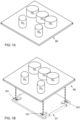
- a shelf 90 is provided for storing or displaying non-homogeneous products 70.
- Products can be diverse, e.g., 70 1 and 70 2 are different products, and any number of each type of different products can be placed on a shelf 90. While shown as differing in size and shape, they can also differ in weight or contents, and can be distinguished by having different SKUs, i.e., stock-keeping unit identification numbers, or by other unique identifiers.
- SKU stock-keeping unit identification numbers
- SKU-identifiers are standard means of identifying unique products across industries. Unique products can be, for example, products defined by unique combinations of physical characteristics, e.g., weight (whether nominal or average), volume, dimensions, etc. and/or non-physical characteristics, e.g., brand or packaging design.
- a particular brand of cookies may offer products with a number of different SKU-identifiers: a first SKU for the brand's large package of large chocolate cookies, a second SKU for the brand's small package of the same large chocolate cookies, and a third SKU for the brand's large package of small chocolate cookies, and so on.
- non-homogeneous means that the products in the group do not all share the same SKU-identifier, but should not be understood to imply that each product in a group has a unique SKU-identifier.
- a group of non-homogeneous products might include: (a) 10 large packages of large chocolate cookies bearing a first brand and having a first SKU-identifier, and (b) 2 large packages of small chocolate cookies from a second brand and having a second SKU-identifier, or, without limitation any combination of products having, in combination, two or more SKU-identifiers.
- Weighing assemblies 101 can include internal processors (not shown), which can be configured, for example, to sample continuous or discrete weight measurements and transmit streams of weight measurement data points to an external processor, using internal communications arrangements (not shown).
- the sampling rate is preferably at least 50 Hz, or at least 100 Hz, or at least 200 Hz, or higher.
- a high sampling rate can be helpful, for example, if it is desired to filter out noise.
- An electronic signal transmitting a stream of weight measurement data points can be analyzed to detect noise, for example by decomposing the signal into component frequencies using a Fourier transform, as is known in the art. Noise in the signal can come from mechanical and/or environmental sources, for example from vibrations due to mechanical equipment in the area.
- planar load cell assembly can be suitable for use herein.
- a planar load cell assembly suitable for use with the present invention is disclosed in co-pending PCT application PCT/IB2019/055488, titled “Systems and Methods for Weighing Products on a Shelf” and filed on June 28, 2019 . It can be desirable to employ a load cell with a 'high' ratio of width to thickness, where 'width' is the dimension across a plan view of the planar load cell assembly, and thickness is the dimension across a side view.
- Exemplary suitable load cell assemblies can have a width-to-thickness ratio of more than 10. In some embodiments, the 'high' width-to-thickness ratio can be more than 2, more than 3, more than 5, or more than 10.
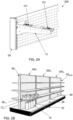
- a concatenated assembly of three shelving units 300 is shown schematically in Figure 2B as a non-limiting example of a plurality of weighing assemblies mounted in shelving units.
- a variety of products 70 are displayed in shelving unit 300 1 , including, on shelf 90 1-1 (the double subscript 1-1 indicating the first shelf of the first shelving unit 300 1 ) supported by shelf bracket 12 1-1 , a first plurality of products 70 1 with a first SKU-identifier and a second plurality of products 70 2 with a second SKU-identifier.
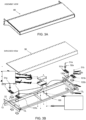
- Figs. 3A and 3B show an assembled weighing assembly 89 comprising two shelf brackets 12 L and 12 R according to embodiments of the present invention, and an exploded view of the weighing assembly.
- the weighing assembly 89 of Figs. 3A and 3B is self-stabilizing, i.e., does not require the use of an additional stabilizing element or connection to a back wall of a shelving unit, and can be installed in a shelving unit (e.g., shelving unit 300) without any tools and by a single employee.
- the two shelf brackets 12 L and 12 R are joined mechanically by a shelf frame 190 which, although illustrated as a simple frame, can include any member(s) that, when joined with the shelf brackets 12 L and 12 R , provide rigidity.
- the shelf frame 190 can be an 'open structural member' as shown in non-limiting example shown in Fig. 3B , as the 'openness' serves to reduce the weight and cost of the illustrated structural member, but this only is for purposes of illustration and the shelf frame need not be open if it is deemed desirable by a designer to use a solid, non-open member or assembly of members that provides structural rigidity at an acceptable weight and cost.
- Shelf frame 190 can be fabricated from any material such as a metal or a plastic deemed suitable in terms of rigidity, weight and cost.
- protruding elements 51 and joining elements 52 can be threaded (e.g., a threaded bolt and respective nut) and in other embodiments they can be unthreaded (e.g., a simple bolt and respective washer). In some embodiments both a threaded nut and a washer may be provided.
- load shelf 90
- load cell assemblies 101a, 101b can be provided.
- Shelf assemblies 290 are attached to one or two or three of left and right walls 281 L , 281 R and back wall 280.
- the shelf assembly 290 can be attached directly to any of the walls and preferably is by employing one or more attachment elements 285 such as, for example, the attachment elements 285 L1 , 285 L2 , 285 L3 in Fig. 4A .
- attachment elements 285 share similarities with uprights 85 used in open shelving bays, in that each comprises a plurality of attachment elements (e.g., recesses or holes) designed for the easy insertion and removal of shelf bracket hooks along a continuous strip, and are different from uprights 85 in that they are fixedly attached to a side wall 281 or back wall 280 of an enclosed shelving unit 200.
- left and right walls 281 L , 281 R can be partial walls or not be present at all, in which case the lack of a front-edge attachment element on the side wall (e.g., 285 L1 on the front edge of left wall 281 L ), or even no side wall attachment elements, in which the designer can put in additional structural elements for stabilizing and immobilizing the shelf assemblies 290.
- a front-edge attachment element on the side wall e.g., 285 L1 on the front edge of left wall 281 L
- no side wall attachment elements in which the designer can put in additional structural elements for stabilizing and immobilizing the shelf assemblies 290.
- a shelf assembly 290 is a type of weighing assembly that comprises a weighing base 299 and a shelf or shelf tray 291.
- the weighing base 299 can comprise a shelf base 295 and a plurality of load cell installation assemblies 101.
- load cell installation assemblies 101 L1 , 101 L2 (not shown, blocked by shelf tray 291 ), 101 R1 , 101 R2 are provided, but a higher or lower number of load cell installation assemblies can be provided while meeting the design goal of providing accurate weight indications of products 70 on a shelf assembly 290 or added thereto or removed therefrom.
- load cell assemblies 101 can be attached (by screw or rivet or any other appropriate attaching method) and, in this way, complete the installation of the load cell installation assemblies on the weighing base 299.
- the shelf tray 291 can include a receiving bracket (not shown) for securing and stabilizing a shelf tray 291 on a weighing base 299. In some embodiments a shelf tray 291 can be attached in other ways to a weighing bracket 299.
- a plurality of prior-art protruding elements 251 and a plurality of joining elements 252 (shown in Fig. 5C ) vertically aligned with respective protruding elements 251 for receiving the respective protruding elements 251 can be provided for transferring load to the load cell assemblies 101.
- the number of respective protruding elements 251 and joining elements 252 will be the same as the number of load cell assemblies 101 for any given shelf assembly 290. For, example, in the non-limiting example shown in Fig. 5B , the number of load cell assemblies 101 is four, and thus four respective protruding elements 251 and four joining elements 252 are used.
- the protruding elements 251 together with the joining elements 252 can function to transfer load (the weight of the shelf tray 291 and of products 70 displayed thereupon) to the load cell assemblies 101.
- the protruding elements 251 can transfer the load directly by having a lower end positioned in a receptacle in the load cell assembly 101, and in other embodiments the protruding elements function to ensure the positioning of the joining elements 252 around the holes 140 (in Fig. 4A ) on the load cell assemblies 101 so as to transfer the load to the load cell assemblies 101 via the joining elements 252.
- protruding elements 251 and joining elements 252 can be threaded (e.g., a threaded bolt and respective nut) and in other embodiments they can be unthreaded (e.g., a simple bolt and respective washer). In some embodiments both a threaded nut and a washer may be provided.
- a protruding element 251 can be deployed in any one of a number of approaches. For example, a protruding element 251 can be disposed on a receiving bracket.
- a protruding element 251 can be disposed on joining element 252.
- a protruding element 251 can be disposed on the shelf tray 291 (preferably flush with the upper surface of the shelf tray 251 ), the respective joining element 252 holding it in its place on the shelf tray 291.
- a weight distributor in the form of a button or disk can be provided to transfer load to joining element 251.
- shelf assembly 290 has a width that is at least 80% or at least 90% or at least 95% of the distance between left wall 281 L and right wall 281 R . According to embodiments, there is only a single shelf assembly 290 at any given height in shelving unit 220.
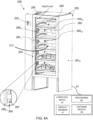
- a shelf assembly 390 for a refrigerator includes a weighing base 195 and a shelf 391.
- the shelf 391 can include a peripheral rim 292 to reduce the likelihood that a product leans against the internal wall of the refrigerator 200, which would reduce the force measurable on the shelf 391.
- Weighing base 195 includes opposing load-cell bases 191 L , 191 R detachedly attachable to respective left and right internal walls of the refrigerator. As shown in Fig. 5F , the bottom of the weighing base 195 (and therefore the bottom of the shelf assembly 390 ) includes attachment arrangements 286.
- Each of the load-cell bases 191 includes a plurality of load cells 101 (of any type, not necessarily planar load cells).
- the two load-cell bases 191 are joined to form a rigid, e.g., stable, resistant to twisting, and/or not flexible, frame.
- a single-member beam 190 is shown as joining the two load-cell bases 191 but any appropriate design and number of left-to-right beams can be used.
- the beam can be used to support electronic communication arrangements 60, for example transmitted via a communications channel 61, as shown in Fig. 5E .
- the load-cell bases 191 and/or the beam are covered with covers 192.
- the weighing base 195 can be desirable for the weighing base 195 to allow at least a minimum amount of vertical airflow to flow freely within the interior of the refrigerator/shelving unit 200, and for this purpose a portion of the horizontal surface of the weighing base 195 can be 'open' to a vertical airflow, the term 'vertical' meaning any airflow within the refrigerator, which in many implementations is vertical or predominantly vertical, e.g., within ⁇ 10° of vertical, or within ⁇ 20° of vertical, or within ⁇ 30° of vertical, or within ⁇ 40° of vertical, or within ⁇ 45° of vertical.
- At least 25% of the horizontal surface area of the weighing base 195 to vertical airflow or at least 30%, or at least 35%, or at least 40%, or at least 45%, or at least 50%.
- as much as 80% or as much as 70% or as much as 60% of the horizontal surface area of the weighing base 195 can be open to vertical airflow.
- a wire-grid shelf can include both thinner wires, e.g., front-to-back wires deployed across the shelf 391 for supporting products, and thicker wires, e.g., left-to-right wires for structural support.
- left-to-right wires 395 are spaced so as to transmit force, e.g., the weight of the shelf and of products displayed thereupon, to the load cells assemblies 101 in the load-cell bases 191.
- the load cell assemblies 101 mediate between the weighing base 195 and the shelf 391, and the shelf 391 does not sit directly on the weighing base 195 or on the cover 192.
- the left-to-right wires 395 are illustrated in Fig.
- 5E as being thicker than the front-to-back wires, but in other examples they can all be the same thickness and weight.
- a selection criterion for the left-to-right wires is sufficient rigidity, e.g., resistance to twisting, sagging, etc.
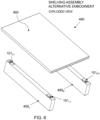
- FIG. 6 in which another embodiment of a shelf assembly 490 is shown.
- Respective left and right weighing bars 495 L , 495 R are provided as fixed attachments to left and right side-walls 281 L , 281 R of shelving unit 200.
- Each weighing bar comprises a pair of load cell installation assemblies 101.
- the shelf assembly 490 further comprises a shelf tray 493, which can be attached to the respective left and right weighing bars 495 L , 495 R by a receiving bracket (now shown) or by other fastening methods known in the art.
- Protruding elements 251 and receiving elements 252 can be used here in the same manner as in the embodiment illustrated in Fig. 5B .
- Fig. 7 includes a block diagram showing details of a system for executing unattended retail sales transactions and/or tracking inventory of products, using, for example, embodiments of weighing assemblies and shelving arrangements disclosed with respect to Figs. 2B , 3A and 3B .
- Such a system includes one or more shelving units 300 1 .. 300 N , each of which can include any of the weighing assembly features shown.
- Each shelving unit include a number of shelves 90, each supported by a left-and-right pair of weighing assemblies 10 including shelf brackets 12.
- Each pair of weighing assemblies 10 includes a weighing assembly 10 for supporting a different end of the shelf 90.
- weighing assemblies 10 L1-1 and 10 R1-1 are respective the left and right assemblies for support a first shelf 90 1-1 in first shelving unit 300 1 .
- Each of the load cell assemblies 101 installed in the system can communicate weight information with computing device 65. Once computing device 65 determines that a product has been added to or removed from a shelf, and further determines which specific product has been added to or removed from a shelf (as discussed earlier in connection with Fig. 15 ), then the information can be forwarded to a retail sales transaction system 401 and or an inventory tracking system 402. Not all of the elements in the block diagram in Fig. 7 need be present in order to practice the invention.
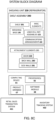
- Figs. 8A , 8B and 8C include block diagrams showing details of exemplary systems for executing unattended retail sales transactions and/or tracking inventory of products, using, for example, embodiments of shelving units and shelf assemblies disclosed with respect to Figs. 4 , 5A , 5B and 6 .
- Such a system includes a shelving unit 200, which can include any of the shelving unit features shown.
- Each shelving unit includes a number of shelf assemblies 290, or alternatively, shelf assemblies 490 as discussed above with respect to Fig. 6 .
- Each shelf assembly 290 includes shelf tray 291, weighing base 299, load cell installation assemblies 101, communications arrangements 60 by which the processors of load cell assemblies can communicate weight information with other system elements, and miscellaneous mechanical elements.
- Each shelf assembly 490 includes shelf tray 493, weighing bars 495 L and 495 R , load cell installation assemblies 101, communications arrangements 60 by which the processors of load cell assemblies can communicate with other system elements, and miscellaneous mechanical elements.
- Each of the load cell assemblies 101 of load cell installation assemblies 101 can communicate weight information with computing device 65. Once computing device 65 determines that a product has been added to or removed from a shelf, and further determines which specific product has been added to or removed from a shelf, then the information can be forwarded to a retail sales transaction system 401 and or an inventory tracking system 402. It will be appreciated by those of skill in the art that not all of the elements in the block diagram in Fig. 8 need be present in order to practice the invention.
- a first method for conducting a retail transaction using a plurality of weighing assemblies that are jointly operable to measure the combined weight of the shelf and of products arranged thereupon according to embodiments is now disclosed.
- the method is suitable for use with any of the embodiments of weighing assemblies and shelving arrangements disclosed herein.
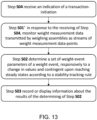
- the method comprises: Step S01, monitoring weight measurement data transmitted by weighing assemblies as streams of weight measurement data-points.
- the weight measurement data correspond to the shelf 90 (or, equivalently, shelf 290 or shelf 490 ) and to a plurality of non-homogeneous products 70 arranged thereupon.
- the weight measurement can include voltage measurements generated by load cells of the weighing assemblies 101; as is known in the art, as the spring element of a load cell deforms, the cell's strain gauges also change shape. The resulting alteration to the resistance in the strain gauges can be measured as voltage. In some embodiments, a change in voltage is transmitted. In some embodiments, an estimated voltage-to-gram conversion factor is applied at each of the load cell assemblies 101, producing a first-order estimation of the reaction force of each load cell, i.e., the force in reaction to the force applied by the weight of the shelf and products. Thus, it is possible to transmit the reaction force, or an estimated/calculated weight, from each weighing assembly - instead of the voltage data points or in addition thereto.
- Step S02 determining a set of weight-event parameters of a weight event, responsively to a change in values and contingent upon reaching steady states according to a stability-tracking rule.
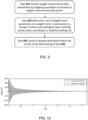
- a steady state is a state in which, following a transient period, weight measurement data are constant or 'nearly' constant according to a threshold defining 'nearly'.
- the transient period can be up to a second in length, or up to 5 seconds in length, or up to 10 seconds in length, or even longer.
- a stability-tracking rule is a rule that governs when the weight measurement data points have adequately reached a 'steady state' condition under which a determination of weight-event parameters of a weight event can take place.
- a stability-tracking rule that includes: 'steady state is reached N seconds after the peak response to a weight-event.
- a stability-tracking rule that includes the following: 'respective steady states for the streams of weight measurement data-points are defined by respective response-amplitude thresholds.
- the stability-tracking rule can be based on a height of the oscillation, i.e., above the mean, reaching a threshold.
- suitable thresholds include absolute thresholds (e.g., in grams) and relative thresholds (e.g., as a percentage of the mean).
- the purpose of the determining in Step S02 is to produce a deterministically identified set of weight-event parameters that can most reliably be associated with a weight-event and subsequently used for a retail transaction in respect of the weight event.
- the 'determining' functionality which receives no real-time sensor-generated information other than weight measurement data-points, is tasked to retroactively identify 'what happened' when a non-transient change in weight on the shelf is detected.
- a set of weight-event parameters includes a pairing of a product and a product-action respective of the product, i.e., one of: a removal of a product from a shelf, addition of a product to a shelf, or a displacement of a product from one location on a shelf to another location on the shelf. If the product is moved from one shelf to another, it would be modeled as a removal from the first shelf and an addition to the second shelf.
- the determining includes identifying one or more supported sets of weight-event parameters in a weight-location space.
- the regression model can be a linear regression model; in other non-limiting examples other regression models can be used, e.g., a binomial regression model.
- the preliminary location estimation can be refined using statistical inference.
- a shelf 90 defines an x-y plane having an origin at (0,0) and the diagonally opposite corner at (1,1).
- a product with weight of W and weight-center coordinates of (X,Y) is removed from the shelf.
- weighing assemblies (not shown) at (0,0), (0,1), (1,1), (1,0) could transmit respective weight measurement data points showing respective decreases in reaction forces/weight of (1- X )*(1- Y )* W, (1- X )* Y * W , X * Y* W, X *(1- Y )* W.
- the weight would be linearly distributed to the respective weighing assemblies and the total sum of the calculated reaction forces would be W .
- weight-location as a probability density function, as shown schematically in Fig. 12 solely for visualization purposes, where the weight decrease from the product removal at ( X ,Y) is represented as a mapped weight distribution at multiple (x,y) points.
- the bivariate probability density function shown in Fig. 12 is shown solely as an illustrative example; other suitable probability density functions are discussed hereinbelow.
- the weight of the product removed/added/moved is estimated by aggregating the estimated reaction forces, where each reaction force at a specific weighing assembly is a product of a voltage input and an estimated voltage-to-weight conversion factor.
- Weight and location estimations can be iteratively improved, i.e., improved weight information can be used to improve location data, and improved location data can be used to improve weight information.
- the estimation/improvement iterations can be continued until a 'stop' criterion is met, e.g., iteration-over-iteration change reaches a threshold.
- a probability density estimation using historical weight data for products, and/or product positioning plan data and/or other external product data as available can be used to posit a joint weight-location probability density function, and to create an ad hoc group of 'supported' event sets in the weight-location space of the post-weight-event shelf.
- the inventors have found, non-exhaustively, that Gaussian Mixture models, Multinomial Models, Piecewise-Uniform distribution models, Multivariate Beta distribution models and Multivariate Gamma distribution models are suitable for use in modeling joint weight-location probability density functions according to the disclosed embodiments; other probability models as known in the art can also be suitable.
- 'Supported' event sets are those which meet a minimum likelihood criterion for product weight and location.
- a joint weight-location event-based classification function can be used to select a single set of weight-event parameters from the identified one or more supported sets, and this single set is the 'determined' set of weight-event parameters.
- Step S02 In light of the operating requirement in Step S02 that the determining is contingent upon the system reaching a steady state in accordance with a stability-tracking rule, it can become necessary to 'disambiguate' or 'discretize' multiple discrete weight-events which can make up what appears to be a single weight-event, and this is handled by the joint weight-location event-based classification function.
- a user/customer removes two products that are two items with the same SKU identifier - simultaneously, e.g. two cans of soda with one hand, or sequentially, where the second product is removed before the system reaches steady-state following the first removal.
- Step S03 recording and/or displaying information about the results of the determining of Step S02.
- the recording is typically required for conducting/completing the retail transaction.
- the displaying can be used, for example, in indicating to a user/customer a sub-total or total price for a transaction, along with an identification of a product taken from a shelf (while removing products taken from a shelf and returned to a shelf, even if returned to a different shelf.
- the first method additionally comprises: Step S04, receiving an indication of a transaction-initiation.
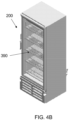
- the indication can include, for example, a physical shock such as from opening and/or closing a door of a retail unit (e.g., retail unit 200 of Fig. 4A or Fig. 4B ).
- the indication can include a sensed movement, such as a hand approaching a shelf, which can be sensed, for example, by an optical sensor or radar or lidar sensor.
- the weight-event itself can be the transaction-initiation.
- Step S01 is replaced by Step S01' in which the monitoring of weight measurement data transmitted by weighing assemblies as streams of weight measurement data-points is in response to the receiving of Step S04.
- the first method additionally comprises, in addition to Steps S01 .. S03: Step S05, responsively to a change in the values of weight measurement data-points, analyzing the streams of weight measurement data-points to detect noise and drift.
- the weight measurement data-points and the changes in their value over time are analyzed for the presence either or both of the two anomalous phenomena of noise and drift.
- Noise for the purposes of this disclosure comprises high-frequency, i.e., short-lived, changes in values of weight measurement data points in a stream of such data points transmitted by the weighing assemblies.
- noise can include spikes in value, which can be either 'plus' or 'minus' with respect to the baseline values, and which are substantially reversed (meaning at least 80% reversed, at least 90% reversed, at least 95% reversed, or at least 99% reversed) within less than 10 seconds after the spike begins, or within less than 5 seconds or within 1 second after the spike begins.
- the source of noise can be mechanical and/or environmental.
- noise can be caused by the vibration of an air conditioning condenser.
- Noise can be caused by simple mechanical events, such as a customer or employee touching a shelf or a product on the shelf. Opening and closing a door of a retail unit can be consider noise in some embodiments.
- Drift for the purposes of this disclosure is a low-frequency, i.e., long-lived, change in weight measurement values, usually changes that are relatively minor in magnitude. Examples of causes of drift are daily cycles of indoor temperatures, environmental conditions such as humidity and atmospheric pressure, and artifacts of a power supply. Unlike what is termed herein noise, drift is not quickly reversed, because it is generally caused by a persistent and/or repeating condition. In some embodiments, drift is periodic; for example, the same pattern or trend can repeat itself every day at a certain time, or at the start of every work shift, or even in on an annual cycle in line with seasonal changes in the environment.
- Step S06 in response to detection of noise and/or drift in Step S05, at least partially filtering out or compensating for the noise and/or drift, and thus generating revised weight measurement data.
- Noise and/or drift can mask true changes in weight embodied in the values of the weight measurement data points.
- Noise and/or drift can also affect the resolution and disambiguation of products and actions (weight-event parameters) by adding uncertainty and skewing probabilities. Therefore, it can be advantageous to filter out, or compensate for, noise and/or drift, at least partially.
- a signal can commonly be decomposed into its component frequencies using a Fourier transform. Carrying out this step results in revised weight measurement data that can be generated as a result of the filtering out and/or compensating for noise and drift.
- Step S04 and S01' can be combined with steps S02, S03, S05 and S06.
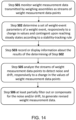
- Step S11 monitoring weight measurement data transmitted by weighing assemblies as streams of weight measurement data-points.
- Step S11 is identical to Step S01, and the discussion of Step S01 applies as well to Step S11.
- Step S12 determining a set of weight-event parameters of a weight event, responsively to a change in values in one or more streams of weight measurement data-points, the determining comprising (i) identifying one or more supported sets of weight-event parameters in a weight-location space, and (ii) applying a joint weight-location event-based classification function to select a set of weight-event parameters from the identified one or more supported sets.
- the weight of the product removed/added/moved is estimated by aggregating the estimated reaction forces, where each reaction force at a specific weighing assembly is a product of a voltage input and an estimated voltage-to-weight conversion factor.
- Weight and location estimations can be iteratively improved, i.e., improved weight information can be used to improve location data, and improved location data can be used to improve weight information.
- the estimation/improvement iterations can be continued until a 'stop' criterion is met, e.g., iteration-over-iteration change reaches a threshold.
- a probability density estimation using historical weight data for products, and/or product positioning plan data and/or other external product data as available can be used to posit a joint weight-location probability density function, and to create an ad hoc group of 'supported' event sets in the weight-location space of the post-weight-event shelf.
- the inventors have found that Gaussian Mixture models, Multinomial Models, Piecewise-Uniform distribution models, Multivariate Beta distribution models and Multivariate Gamma distribution models are suitable for use in modeling joint weight-location probability density functions; other probability models as known in the art can also be suitable.
- 'Supported' event sets are those which meet a minimum likelihood criterion for product weight and location.
- a joint weight-location event-based classification function can be used to select a single set of weight-event parameters from the identified one or more supported sets, and this single set is the 'determined' set of weight-event parameters.
- applying the joint weight-location event-based classification function includes estimating a joint weight-location probability density.
- applying the joint weight-location event-based classification function applying the joint weight-location event-based classification function includes applying a statistical classification mechanism trained by weight and location information to perform a statistical inference.
- applying the classification function includes Bayesian hierarchical modelling, including a Bayesian merge of the joint weight-location probability density function with the group of sets of supported events in the weight-location space.
- the third method comprises: Step S21, receiving respective time-series of weight measurement data points from a plurality of weighing assemblies.
- weight measurement data points can include calculated weight measurements and/or voltage inputs thereto. The data points are received simultaneously as separate time-series from each load cell assembly.
- Step S22 updating an estimation of bias in the weight measurement data points by applying a clustering algorithm to each of the time-series of weight measurement data-points.
- a 'bias history' can be maintained by the retail transaction system, and the bias history can be updated when encountering identified bias in ongoing transactions.
- the bias history is available to be updated on the basis of bias identified in Step S22.
- the updating includes identifying bias in the time streams.
- a preferred method of identifying bias is by using a clustering algorithm.
- the inventors have found, non-exhaustively, that Gaussian Mixture algorithm, K-means clustering, Hard clustering and a mixture of Beta distributions are suitable clustering algorithms according to the disclosed embodiments.
- Step S23 determining a set of weight-event parameters of a weight event, wherein the determining includes compensating for the estimated bias.
- compensating for the estimated bias includes correcting an estimation of weight and/or location. In some cases, they go together: correcting an estimation of weight can lead to correcting an estimation of location because of the iterative nature of the joint weight-location modeling.
- Step S23 can include features from Step S12 in that the determining can comprise (i) identifying one or more supported sets of weight-event parameters in a weight-location space, and (ii) applying a joint weight-location event-based classification function to select a set of weight-event parameters from the identified one or more supported sets.
- the third method can additionally include Steps S05 and S06, which were discussed hereinabove in respect of Fig. 14 .
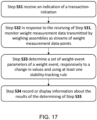
- the fourth method comprises: Step S31 (identical to Step S04 ), receiving an indication of a transaction-initiation.
- the indication can include, for example, a physical shock such as from opening and/or closing a door of a retail unit (e.g., retail unit 200 of Fig. 4A or Fig. 4B ).
- the indication can include a sensed movement, such as a hand approaching a shelf, which can be sensed, for example, by an optical sensor or radar or lidar sensor.
- the weight-event itself can be the transaction-initiation.
- Step S32 (identical to Step S01' ), in response to the receiving of Step S31, monitoring weight measurement data corresponding to the shelf and a plurality of non-homogeneous products arranged thereupon, said weight measurement data transmitted by the plurality of weighing assemblies as respective streams of weight measurement data-points.
- the weight measurement data correspond to the shelf 90 (or, equivalently, shelf 290 or shelf 490 ) and to a plurality of non-homogeneous products 70 arranged thereupon.
- Step S33 determining a set of weight-event parameters of a weight event, responsively to a change in values and using at least one stability-tracking rule.
- Step S33 can include features from Step S12 in that the determining can comprise (i) identifying one or more supported sets of weight-event parameters in a weight-location space, and (ii) applying a joint weight-location event-based classification function to select a set of weight-event parameters from the identified one or more supported sets.
- the at least one stability-tracking rule is/are can be selected from the following non-exhaustive list of stability-tracking rules:
- Step S34 recording and/or displaying information about the results of the determining of Step S33.
- the recording is typically required for conducting/completing the retail transaction.
- the displaying can be used, for example, in indicating to a user/customer a sub-total or total price for a transaction, along with an identification of a product taken from a shelf (while removing products taken from a shelf and returned to a shelf, even if returned to a different shelf.
- the method can comprise, in addition to Steps S31 .. S34: Step S35, receiving an indication of a transaction-completion.
- a transaction-completion can be inferred from context and circumstances, such as a door closing after a product is removed from a shelf and a predetermined amount of time has passed.
- there may be a specific and deliberate transaction-completion such as receiving payment, scanning a user (biometrically) or a user's transaction card or telephone screen, or simply leaving a store or a specific portion of the store where the shelving unit is located at which the instant transaction is being conducted.
- Step S37 in response to detection of noise and/or drift in Step S36, at least partially filtering out or compensating for the noise and/or drift, and thus generating revised weight measurement data.
- Steps S36 and S37 can be combined with steps S31 .. S35.
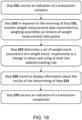
- Step S41 (identical to Step S04 ), receiving an indication of a transaction-initiation.
- the indication can include, for example, a physical shock such as from opening and/or closing a door of a retail unit (e.g., retail unit 200 of Fig. 4A or Fig. 4B ).
- the indication can include a sensed movement, such as a hand approaching a shelf, which can be sensed, for example, by an optical sensor or radar or lidar sensor.
- the weight-event itself can be the transaction-initiation.
- Step S42 determining a set of weight-event parameters of a weight event, responsively to a change in values.
- Step S42 can include features from Step S12 in that the determining can comprise (i) identifying one or more supported sets of weight-event parameters in a weight-location space, and (ii) applying a joint weight-location event-based classification function to select a set of weight-event parameters from the identified one or more supported sets.
- Step S43 (identical to Step S03 ), recording and/or displaying information about the results of the determining of Step S42.
- FIG. 21 a block diagram is shown of a system for conducting a retail transaction based on weight-events in respect of a non-homogeneous assortment of products 70 on a shelf 90 (or, equivalently, shelf 290 or shelf 490 ).
- the system 100 can include a plurality of weighing assemblies 101 that are in contact with a shelf 90, which as explained above can support a variety of products 70.
- the system can also include one or more computer processors 66 and at least one non-transient computer-readable storage medium 68, e.g., a mechanical, optical and/or solid-state storage device or a storage device using whatever data storage technology is suitable for the purpose.
- the one or more computer processors 66 can optionally be included in a computing device 65 that can be a component of the system 100 and which can optionally include other computer hardware such as communications gear 61, a display device 62, and user input accessories (not shown), such as a keyboard and a mouse.
- the storage medium 68 can include program instructions 50, as well as weight distribution mappings repository 51, a product database 67 and product positioning plan 69, all of which are discussed elsewhere in this disclosure.
- Program instructions 65 which when executed by computer processor(s) 66, are effective to cause the computer processor(s) to carry out any of the methods described hereinabove for conducting a retail transaction using a plurality of weighing assemblies that are jointly operable to measure the combined weight of the shelf and of products arranged thereupon.
- Transmissions of electronic signals from weighing assemblies 101 can be received by the one or more computer processors 66, for example by way of communications gear 61 and used for the purpose of tracking the weights of products 70 on the shelf 90, and especially of actions taken to products.
- Communications gear 61 can include any kind of wired or wireless communications arrangements, including, without limitation, direct connections, networked connections and internet connections. Actions include adding a product to a shelf, removing a product from a shelf, and moving a product from one place on a shelf to another.
- the moving the product includes lifting the product and putting it back down on the same shelf, it may be interpreted as a removal followed by an adding depending on the speed of the actions and the sampling rate of the weight measurement data, e.g., the number of weight measurement data points per second, as well as any stability-tracking rules applied.
- sliding a product from one place to another on the shelf might not change, at any given moment, the total weight measured by all of the weighing assemblies associated with a single shelf, but can change the weights measured by each of the individual weighing assemblies.
Landscapes
- Physics & Mathematics (AREA)
- Business, Economics & Management (AREA)
- Engineering & Computer Science (AREA)
- Theoretical Computer Science (AREA)
- General Physics & Mathematics (AREA)
- Economics (AREA)
- Mathematical Physics (AREA)
- Operations Research (AREA)
- General Business, Economics & Management (AREA)
- Human Resources & Organizations (AREA)
- Quality & Reliability (AREA)
- Strategic Management (AREA)
- Tourism & Hospitality (AREA)
- Development Economics (AREA)
- Marketing (AREA)
- Finance (AREA)
- Accounting & Taxation (AREA)
- Entrepreneurship & Innovation (AREA)
- Warehouses Or Storage Devices (AREA)
- Developing Agents For Electrophotography (AREA)
- Chemical Or Physical Treatment Of Fibers (AREA)
- Detergent Compositions (AREA)
Claims (11)
- System zum Durchführen einer Einzelhandelstransaktion, umfassend:a. eine Vielzahl von Wiegebaugruppen (101), die mit einem Regal (90) in Kontakt stehen und gemeinsam betreibbar sind, um ein kombiniertes Gewicht eines Regals und von darauf angeordneten Produkten zu messen;b. einen oder mehrere Computerprozessoren (66); undc. ein nichtflüchtiges computerlesbares Speichermedium (68), das Programmanweisungen umfasst, die, wenn sie durch den einen oder die mehreren Computerprozessoren ausgeführt werden, den einen oder die mehreren Computerprozessoren dazu veranlassen, die folgenden Schritte umzusetzen:wobei die Gewichtsmessdatenpunkte zumindest eine Art von Daten umfassen, die aus der Gruppe ausgewählt ist, die berechnete Gewichte und Spannungseingänge darin umfasst.i. Überwachen von Gewichtsmessdaten, die dem Regal und einer Vielzahl von darauf angeordneten inhomogenen Produkten entsprechen, wobei die Gewichtsmessdaten durch die Vielzahl von Wiegebaugruppen als jeweilige Ströme von Gewichtsmessdatenpunkten übertragen werden;ii. als Reaktion auf eine Änderung im Zeitverlauf der Werte der Gewichtsmessdatenpunkte und bedingt dadurch, dass die Werte jeweilige stationäre Zustände gemäß einer Stabilitätsverfolgungsregel erreichen, Bestimmen eines Satzes von Gewichtsereignisparametern eines Gewichtsereignisses, wobei der bestimmte Satz von Gewichtsereignisparametern ein oder mehrere Produkte und jeweils eine Produktaktion jedes von dem einen oder den mehreren Produkten umfasst; undiii. Vollführen von zumindest einem von Folgenden: (A) Aufzeichnen von Informationen über die Ergebnisse des Bestimmens in einem nichtflüchtigen, computerlesbaren Medium und (B) Anzeigen von Informationen über die Ergebnisse des Bestimmens auf einer Anzeigevorrichtung,
- System nach Anspruch 1, wobei die Programmanweisungen, wenn sie durch den einen oder die mehreren Computerprozessoren ausgeführt werden, den einen oder die mehreren Computerprozessoren zusätzlich dazu veranlassen, den folgenden Schritt umzusetzen:Empfangen einer Angabe einer Transaktionseinleitung,wobei das Umsetzen des Überwachungsschritts als Reaktion auf das Empfangen erfolgt.
- System nach einem der Ansprüche 1 oder 2, wobei die Stabilitätsverfolgungsregel enthält, dass die jeweiligen stationären Zustände für die Ströme von Gewichtsmessdatenpunkten durch jeweilige Reaktionsamplitudenschwellen definiert sind.
- System nach einem der Ansprüche 1 bis 3, wobei das Anwenden der Stabilitätsverfolgungsregel Schätzen einer Verzerrung in den Gewichtsmessdatenpunkten und Kompensieren der Verzerrung enthält.
- System nach einem der Ansprüche 1 bis 4, wobei die Gewichtsmessdatenpunkte entweder Spannungseingänge umfassen oder ausschließlich Spannungseingänge umfassen.
- System nach einem der Ansprüche 1 bis 5, wobei der Bestimmungsschritt Schätzen eines auf einem gemeinsamen Gewichts-Ort-Ereignis basierenden Produktklassifikators enthält.
- System nach Anspruch 6, wobei das Schätzen des auf einem gemeinsamen Gewichts-Ort-Ereignis basierenden Produktklassifikators Schätzen einer gemeinsamen Gewichts-Ort-Wahrscheinlichkeitsdichte enthält.
- System nach Anspruch 6, wobei das Schätzen des auf einem gemeinsamen Gewichts-Ort-Ereignis basierenden Produktklassifikators Anwenden eines statistischen Klassifizierungsmechanismus enthält, der durch Gewichts- und Ortsinformationen trainiert wird, um eine statistische Inferenz zu vollführen.
- System nach einem der Ansprüche 1 bis 8, wobei die Gewichtsmessdatenpunkte die einzigen Eingänge in den Bestimmungsschritt sind, die durch Sensoren während der Transaktion erzeugt werden.
- System nach Anspruch 2, wobei die zweite Stabilitätsverfolgungsregel auf einem Stabilitätsattribut eines Produkts basiert.
- System nach Anspruch 2, wobei die Stabilitätsverfolgungsregel auf einem Stabilitätsattribut des Regals basiert.
Applications Claiming Priority (2)
| Application Number | Priority Date | Filing Date | Title |
|---|---|---|---|
| GBGB2000005.5A GB202000005D0 (en) | 2020-01-01 | 2020-01-01 | Methods and systems for conducting weight-based transactions |
| PCT/IB2020/062590 WO2021137190A1 (en) | 2020-01-01 | 2020-12-31 | Methods and systems for conducting weight-based transactions |
Publications (4)
| Publication Number | Publication Date |
|---|---|
| EP4085236A1 EP4085236A1 (de) | 2022-11-09 |
| EP4085236A4 EP4085236A4 (de) | 2023-05-10 |
| EP4085236C0 EP4085236C0 (de) | 2025-04-09 |
| EP4085236B1 true EP4085236B1 (de) | 2025-04-09 |
Family
ID=69527993
Family Applications (1)
| Application Number | Title | Priority Date | Filing Date |
|---|---|---|---|
| EP20909935.7A Active EP4085236B1 (de) | 2020-01-01 | 2020-12-31 | Verfahren und systeme zum durchführen von gewichtsbasierten transaktionen |
Country Status (5)
| Country | Link |
|---|---|
| US (1) | US20230021719A1 (de) |
| EP (1) | EP4085236B1 (de) |
| GB (1) | GB202000005D0 (de) |
| IL (1) | IL294307A (de) |
| WO (1) | WO2021137190A1 (de) |
Families Citing this family (7)
| Publication number | Priority date | Publication date | Assignee | Title |
|---|---|---|---|---|
| US20220067688A1 (en) * | 2020-09-01 | 2022-03-03 | Lg Electronics Inc. | Automated shopping experience using cashier-less systems |
| CN113554802B (zh) * | 2021-04-21 | 2023-06-02 | 浙江星星冷链集成股份有限公司 | 一种称重装置及无人售货系统 |
| US20230005267A1 (en) * | 2021-06-30 | 2023-01-05 | Fujitsu Limited | Computer-readable recording medium, fraud detection method, and fraud detection apparatus |
| CA3260238A1 (en) * | 2022-07-06 | 2024-01-11 | Maplebear Inc. | LEARNING MODEL FOR IDENTIFYING ITEMS BASED ON IMAGE DATA AND LOAD CURVE DATA |
| EP4474779A1 (de) | 2023-06-09 | 2024-12-11 | Mettler-Toledo (Albstadt) GmbH | Verfahren und vorrichtungen zum verkaufen eines produkts durch gewicht beim pick-and-go-einkauf |
| US12567491B2 (en) | 2024-01-10 | 2026-03-03 | Fff Enterprises, Inc. | Storage devices and operation methods thereof |
| GB202400437D0 (en) * | 2024-01-12 | 2024-02-28 | Shekel Scales 2008 Ltd | Weighing-enabled shelving arrangements and methods |
Family Cites Families (8)
| Publication number | Priority date | Publication date | Assignee | Title |
|---|---|---|---|---|
| US5671362A (en) * | 1995-04-04 | 1997-09-23 | Cowe; Alan B. | Materials monitoring systems, materials management systems and related methods |
| US8374926B2 (en) * | 2005-08-01 | 2013-02-12 | Worthwhile Products | Inventory control system |
| JP2007241926A (ja) * | 2006-03-13 | 2007-09-20 | Fujitsu Ltd | 量り売り商品清算処理方法および量り売り商品清算システム |
| RU2722857C2 (ru) * | 2015-05-04 | 2020-06-04 | САНРАЙЗ Ар ЭНД Ди ХОЛДИНГЗ, ЭлЭлСи | Системы и способы для управления полочными блоками отображения и для графического представления информации на полочных блоках отображения |
| US10198710B1 (en) * | 2016-03-28 | 2019-02-05 | Amazon Technologies, Inc. | System to determine a change in weight at a load cell |
| US10921801B2 (en) * | 2017-08-02 | 2021-02-16 | Strong Force loT Portfolio 2016, LLC | Data collection systems and methods for updating sensed parameter groups based on pattern recognition |
| WO2019220400A1 (en) * | 2018-05-16 | 2019-11-21 | Shekel Scales (2008) Ltd | Weighing load cells and arrangements employing them in shelves |
| CN112219093A (zh) * | 2018-06-06 | 2021-01-12 | 磅秤 (2008)有限公司 | 用于对货架上的产品称重的系统和方法 |
-
2020
- 2020-01-01 GB GBGB2000005.5A patent/GB202000005D0/en not_active Ceased
- 2020-12-31 IL IL294307A patent/IL294307A/en unknown
- 2020-12-31 US US17/789,195 patent/US20230021719A1/en active Pending
- 2020-12-31 WO PCT/IB2020/062590 patent/WO2021137190A1/en not_active Ceased
- 2020-12-31 EP EP20909935.7A patent/EP4085236B1/de active Active
Also Published As
| Publication number | Publication date |
|---|---|
| US20230021719A1 (en) | 2023-01-26 |
| WO2021137190A1 (en) | 2021-07-08 |
| GB202000005D0 (en) | 2020-02-19 |
| IL294307A (en) | 2022-08-01 |
| EP4085236C0 (de) | 2025-04-09 |
| EP4085236A4 (de) | 2023-05-10 |
| EP4085236A1 (de) | 2022-11-09 |
Similar Documents
| Publication | Publication Date | Title |
|---|---|---|
| US20230021719A1 (en) | Methods and systems for conducting weight-based transactions | |
| US11933661B2 (en) | Systems and methods for weighing products on a shelf | |
| US11971293B2 (en) | Systems and methods for weighing products on a shelf | |
| US11946795B2 (en) | Weighing load cells and arrangements employing them in shelves | |
| US10753787B1 (en) | Sensor data processing for detection of changes in item quantities | |
| RU2630749C2 (ru) | Система слежения за товарами на полках (стп) | |
| US8738421B1 (en) | Driver moderator method for retail sales prediction | |
| US11468400B1 (en) | System to determine item weight using data from weight sensors | |
| US11636424B1 (en) | System and method to detect failures at a subset of load cells | |
| US11436557B1 (en) | Interaction determination using data from weight sensors | |
| Best et al. | On the causes of positive inventory discrepancies in retail stores | |
| WO2017037881A1 (ja) | オンライン予測システムおよび方法 | |
| CN110260796A (zh) | 货品感知系统、货品感知方法及电子设备 | |
| CN213365538U (zh) | 用于陈列物品的智能设备 | |
| CN219017036U (zh) | 智能售货柜 | |
| US11263583B1 (en) | Inferred determination of interaction using data from weight sensors | |
| US20240257049A1 (en) | Methods and systems employing load cells in shelving arrangements | |
| EP3179456B1 (de) | Kassenlade | |
| US11308442B1 (en) | Joint inference determination of interaction using data from weight sensors | |
| WO2020243985A1 (zh) | 托盘及货架 | |
| TW201246092A (en) | On-shelf tracking (OST) system | |
| WO2025149992A1 (en) | Weighing-enabled shelving arrangements and methods | |
| CN121745805A (zh) | 家装物料调度方法、模型训练方法、设备及介质 | |
| NZ716013A (en) | On-shelf tracking (ost) system |
Legal Events
| Date | Code | Title | Description |
|---|---|---|---|
| STAA | Information on the status of an ep patent application or granted ep patent |
Free format text: STATUS: THE INTERNATIONAL PUBLICATION HAS BEEN MADE |
|
| PUAI | Public reference made under article 153(3) epc to a published international application that has entered the european phase |
Free format text: ORIGINAL CODE: 0009012 |
|
| STAA | Information on the status of an ep patent application or granted ep patent |
Free format text: STATUS: REQUEST FOR EXAMINATION WAS MADE |
|
| 17P | Request for examination filed |
Effective date: 20220718 |
|
| AK | Designated contracting states |
Kind code of ref document: A1 Designated state(s): AL AT BE BG CH CY CZ DE DK EE ES FI FR GB GR HR HU IE IS IT LI LT LU LV MC MK MT NL NO PL PT RO RS SE SI SK SM TR |
|
| REG | Reference to a national code |
Ref country code: DE Ipc: G01G0019414000 Ref country code: DE Ref legal event code: R079 Ref document number: 602020049338 Country of ref document: DE Free format text: PREVIOUS MAIN CLASS: G01G0019000000 Ipc: G01G0019414000 |
|
| DAV | Request for validation of the european patent (deleted) | ||
| DAX | Request for extension of the european patent (deleted) | ||
| A4 | Supplementary search report drawn up and despatched |
Effective date: 20230406 |
|
| RIC1 | Information provided on ipc code assigned before grant |
Ipc: G06Q 10/08 20120101ALI20230331BHEP Ipc: G01G 19/00 20060101ALI20230331BHEP Ipc: G01G 19/414 20060101AFI20230331BHEP |
|
| REG | Reference to a national code |
Free format text: PREVIOUS MAIN CLASS: G01G0019414000 Ref country code: DE Ref legal event code: R079 Ref document number: 602020049338 Country of ref document: DE Free format text: PREVIOUS MAIN CLASS: G01G0019414000 Ipc: G01G0019420000 |
|
| GRAP | Despatch of communication of intention to grant a patent |
Free format text: ORIGINAL CODE: EPIDOSNIGR1 |
|
| STAA | Information on the status of an ep patent application or granted ep patent |
Free format text: STATUS: GRANT OF PATENT IS INTENDED |
|
| RIC1 | Information provided on ipc code assigned before grant |
Ipc: G01G 19/42 20060101AFI20241107BHEP |
|
| INTG | Intention to grant announced |
Effective date: 20241209 |
|
| GRAS | Grant fee paid |
Free format text: ORIGINAL CODE: EPIDOSNIGR3 |
|
| GRAA | (expected) grant |
Free format text: ORIGINAL CODE: 0009210 |
|
| STAA | Information on the status of an ep patent application or granted ep patent |
Free format text: STATUS: THE PATENT HAS BEEN GRANTED |
|
| AK | Designated contracting states |
Kind code of ref document: B1 Designated state(s): AL AT BE BG CH CY CZ DE DK EE ES FI FR GB GR HR HU IE IS IT LI LT LU LV MC MK MT NL NO PL PT RO RS SE SI SK SM TR |
|
| RAP3 | Party data changed (applicant data changed or rights of an application transferred) |
Owner name: SHEKEL SCALES (2008) LTD. |
|
| REG | Reference to a national code |
Ref country code: GB Ref legal event code: FG4D |
|
| REG | Reference to a national code |
Ref country code: CH Ref legal event code: EP |
|
| REG | Reference to a national code |
Ref country code: DE Ref legal event code: R096 Ref document number: 602020049338 Country of ref document: DE |
|
| REG | Reference to a national code |
Ref country code: IE Ref legal event code: FG4D |
|
| U01 | Request for unitary effect filed |
Effective date: 20250501 |
|
| U07 | Unitary effect registered |
Designated state(s): AT BE BG DE DK EE FI FR IT LT LU LV MT NL PT RO SE SI Effective date: 20250508 |
|
| PG25 | Lapsed in a contracting state [announced via postgrant information from national office to epo] |
Ref country code: ES Free format text: LAPSE BECAUSE OF FAILURE TO SUBMIT A TRANSLATION OF THE DESCRIPTION OR TO PAY THE FEE WITHIN THE PRESCRIBED TIME-LIMIT Effective date: 20250409 |
|
| PG25 | Lapsed in a contracting state [announced via postgrant information from national office to epo] |
Ref country code: NO Free format text: LAPSE BECAUSE OF FAILURE TO SUBMIT A TRANSLATION OF THE DESCRIPTION OR TO PAY THE FEE WITHIN THE PRESCRIBED TIME-LIMIT Effective date: 20250709 Ref country code: GR Free format text: LAPSE BECAUSE OF FAILURE TO SUBMIT A TRANSLATION OF THE DESCRIPTION OR TO PAY THE FEE WITHIN THE PRESCRIBED TIME-LIMIT Effective date: 20250710 |
|
| PG25 | Lapsed in a contracting state [announced via postgrant information from national office to epo] |
Ref country code: PL Free format text: LAPSE BECAUSE OF FAILURE TO SUBMIT A TRANSLATION OF THE DESCRIPTION OR TO PAY THE FEE WITHIN THE PRESCRIBED TIME-LIMIT Effective date: 20250409 |
|
| PG25 | Lapsed in a contracting state [announced via postgrant information from national office to epo] |
Ref country code: HR Free format text: LAPSE BECAUSE OF FAILURE TO SUBMIT A TRANSLATION OF THE DESCRIPTION OR TO PAY THE FEE WITHIN THE PRESCRIBED TIME-LIMIT Effective date: 20250409 |
|
| PG25 | Lapsed in a contracting state [announced via postgrant information from national office to epo] |
Ref country code: RS Free format text: LAPSE BECAUSE OF FAILURE TO SUBMIT A TRANSLATION OF THE DESCRIPTION OR TO PAY THE FEE WITHIN THE PRESCRIBED TIME-LIMIT Effective date: 20250709 |
|
| PG25 | Lapsed in a contracting state [announced via postgrant information from national office to epo] |
Ref country code: IS Free format text: LAPSE BECAUSE OF FAILURE TO SUBMIT A TRANSLATION OF THE DESCRIPTION OR TO PAY THE FEE WITHIN THE PRESCRIBED TIME-LIMIT Effective date: 20250809 |
|
| PGFP | Annual fee paid to national office [announced via postgrant information from national office to epo] |
Ref country code: GB Payment date: 20251217 Year of fee payment: 6 |
|
| PG25 | Lapsed in a contracting state [announced via postgrant information from national office to epo] |
Ref country code: SM Free format text: LAPSE BECAUSE OF FAILURE TO SUBMIT A TRANSLATION OF THE DESCRIPTION OR TO PAY THE FEE WITHIN THE PRESCRIBED TIME-LIMIT Effective date: 20250409 |
|
| PG25 | Lapsed in a contracting state [announced via postgrant information from national office to epo] |
Ref country code: CZ Free format text: LAPSE BECAUSE OF FAILURE TO SUBMIT A TRANSLATION OF THE DESCRIPTION OR TO PAY THE FEE WITHIN THE PRESCRIBED TIME-LIMIT Effective date: 20250409 |
|
| PG25 | Lapsed in a contracting state [announced via postgrant information from national office to epo] |
Ref country code: SK Free format text: LAPSE BECAUSE OF FAILURE TO SUBMIT A TRANSLATION OF THE DESCRIPTION OR TO PAY THE FEE WITHIN THE PRESCRIBED TIME-LIMIT Effective date: 20250409 |
|
| U20 | Renewal fee for the european patent with unitary effect paid |
Year of fee payment: 6 Effective date: 20251219 |
|
| PLBE | No opposition filed within time limit |
Free format text: ORIGINAL CODE: 0009261 |
|
| STAA | Information on the status of an ep patent application or granted ep patent |
Free format text: STATUS: NO OPPOSITION FILED WITHIN TIME LIMIT |
|
| REG | Reference to a national code |
Ref country code: CH Ref legal event code: L10 Free format text: ST27 STATUS EVENT CODE: U-0-0-L10-L00 (AS PROVIDED BY THE NATIONAL OFFICE) Effective date: 20260218 |
|
| 26N | No opposition filed |
Effective date: 20260112 |