EP4086331A1 - Bloc pour toilettes comprenant deux compositions différentes à pigments - Google Patents
Bloc pour toilettes comprenant deux compositions différentes à pigments Download PDFInfo
- Publication number
- EP4086331A1 EP4086331A1 EP21172204.6A EP21172204A EP4086331A1 EP 4086331 A1 EP4086331 A1 EP 4086331A1 EP 21172204 A EP21172204 A EP 21172204A EP 4086331 A1 EP4086331 A1 EP 4086331A1
- Authority
- EP
- European Patent Office
- Prior art keywords
- composition
- toilet
- toilet block
- pigments
- pigment
- Prior art date
- Legal status (The legal status is an assumption and is not a legal conclusion. Google has not performed a legal analysis and makes no representation as to the accuracy of the status listed.)
- Granted
Links
Images


Classifications
-
- C—CHEMISTRY; METALLURGY
- C11—ANIMAL OR VEGETABLE OILS, FATS, FATTY SUBSTANCES OR WAXES; FATTY ACIDS THEREFROM; DETERGENTS; CANDLES
- C11D—DETERGENT COMPOSITIONS; USE OF SINGLE SUBSTANCES AS DETERGENTS; SOAP OR SOAP-MAKING; RESIN SOAPS; RECOVERY OF GLYCEROL
- C11D17/00—Detergent materials or soaps characterised by their shape or physical properties
- C11D17/0047—Detergents in the form of bars or tablets
- C11D17/0056—Lavatory cleansing blocks
-
- C—CHEMISTRY; METALLURGY
- C11—ANIMAL OR VEGETABLE OILS, FATS, FATTY SUBSTANCES OR WAXES; FATTY ACIDS THEREFROM; DETERGENTS; CANDLES
- C11D—DETERGENT COMPOSITIONS; USE OF SINGLE SUBSTANCES AS DETERGENTS; SOAP OR SOAP-MAKING; RESIN SOAPS; RECOVERY OF GLYCEROL
- C11D17/00—Detergent materials or soaps characterised by their shape or physical properties
- C11D17/04—Detergent materials or soaps characterised by their shape or physical properties combined with or containing other objects
- C11D17/041—Compositions releasably affixed on a substrate or incorporated into a dispensing means
-
- C—CHEMISTRY; METALLURGY
- C11—ANIMAL OR VEGETABLE OILS, FATS, FATTY SUBSTANCES OR WAXES; FATTY ACIDS THEREFROM; DETERGENTS; CANDLES
- C11D—DETERGENT COMPOSITIONS; USE OF SINGLE SUBSTANCES AS DETERGENTS; SOAP OR SOAP-MAKING; RESIN SOAPS; RECOVERY OF GLYCEROL
- C11D3/00—Other compounding ingredients of detergent compositions covered in group C11D1/00
- C11D3/40—Dyes ; Pigments
Definitions
- Toilet cleaning pieces also known as toilet blocks
- rim blocks have long been used to clean, disinfect and scent toilets under the edge of the pool (so-called rim blocks) and in the water tank (in-tank blocks or cistern blocks).
- Aesthetics and performance have become increasingly important in recent years. This led, for example, to the development of solid or gel-like or liquid fragrance rinsing agents, some of which are offered in multi-chamber containers and thus allow the combination of a cleaning agent, which is released when the toilet is flushed, with permanent room scenting.
- a rim block is formed from a single composition.
- the composition is extruded, the strand is cut and optionally shaped.
- Rim blocks that have two different compositions have also been known for some time. This makes it possible to combine different active substances, such as dyes, fragrances in the form of perfume oils, or biocides in the toilet block.
- a multi-composition WC block can produce a different release profile than is possible with a single composition WC block.
- a first active can be used in the first composition and a second active can be used in the second composition.
- the second active cannot be used in the first composition, by using an additional second composition containing the second active ingredient, both active ingredients are nevertheless used in the toilet block.
- So toilet blocks are known from the prior art, which comprise two different compositions.
- the use of different compositions makes it possible to refine the profile of the fragrance or colorant release and can contribute to a more attractive appearance of the toilet block.
- a toilet block having at least a first composition and a second composition, wherein the first composition and the second composition at least partially form the surface of the toilet block; and the first composition and/or the second composition comprises a pigment.
- the use of pigments in at least one of the two phases made it possible to significantly reduce the tendency of the colors to diffuse between the phases. While in cases where neither composition contains pigments, the phase boundaries "blur" in those cases where at least one of the compositions contains pigments, the phases were clearly demarcated. Overall, the toilet blocks according to the invention were significantly more visually appealing than the toilet blocks without pigments.
- pigments are colorants, ie coloring substances which are present in the composition as solid particles and are water-insoluble.
- dye which are water-soluble.
- Pigments include colored pigments and white pigments.
- White pigments are also to be understood as pigments according to the invention, titanium dioxide, lithopone, barium sulphate, zinc oxide (zinc white), zinc sulphide and lead carbonate (white lead) being particularly worthy of mention, titanium oxide being preferred.
- Calcium aluminate sulphate is also a suitable white pigment. Titanium dioxide is a preferred white pigment.
- “colorful pigments” are understood to mean pigments which are colored. All pigments that are not white pigments are therefore understood to be “colorful pigments”.
- Preferred embodiments include combinations of white pigment and/or colored pigment for the first composition and the second composition, respectively.
- the pigments are present in the composition preferably in an amount of 0.0001 to 20% by weight, more preferably in an amount of 0.001 to 5% by weight, based on the entire toilet block.
- the one first composition has a colored pigment.
- the second composition can optionally have a white pigment.
- the white phase can also have no pigment, which means that this phase is then free of pigment and, of course, also free of water-soluble dyes.
- the one first composition comprises a colored pigment and the one second composition comprises a white pigment.
- the first composition comprises a colored pigment and a white pigment and the second composition comprises a colored pigment.
- the first composition has a colored pigment and a white pigment and the second composition has a colored pigment and a white pigment.
- the first composition and the second composition are essentially free of water-soluble dyes.
- the toilet block is entirely free of water-soluble dyes and only has pigments as colorants.
- the industrially most important pigments can be divided into eight substance classes. Specifically, these are titanium dioxide, carbon black, bismuth pigments, oxides and hydroxides, iron cyan blue, ultramarine, cadmium pigments and chromate pigments.
- the group of oxides and hydroxides is further divided into iron oxide pigments, chromium oxide and mixed phase oxide pigments such as Rinman's Green - the latter with the subgroups spinel pigments, hematite pigments, inverse spinel pigments and rutile derivatives.
- the group of chromate pigments is further divided into chrome yellow, chrome green and molybdate.
- Pigments typically arise in the form of primary particles.
- the primary particles can grow together over their surfaces to form aggregates.
- the toilet block is described in which the first composition and/or the second composition form a spiral pattern on the surface of the toilet block.
- a spiral too referred to as a helix, is a curve that runs around a point or axis and moves away from or towards this center depending on the viewer's perspective.
- phase boundaries are extended and, due to the curved spiral shape, are particularly susceptible to color diffusion.
- the phase boundaries "blur" so particularly noticeable.
- the effect according to the invention which occurs when at least one of the compositions contains pigments and the phases can thus be clearly distinguished from one another, is therefore particularly striking.
- Titanium oxide is a white pigment, which is also referred to as a pigment in connection with the present invention.
- the first composition and/or the second composition, which comprises titanium dioxide as a pigment preferably has no further pigments or dyes.
- the phase formed by the corresponding composition has a white appearance.
- the toilet block has a spherical geometry.
- extrusion stands for a process in which one or more compositions are pressed out of an opening under pressure, preferably continuously.
- the opening is also known to a person skilled in the art as a profile nozzle.
- the resulting body with the cross-section of the opening is called an extrudate.
- coextrusion stands for an extrusion process, in which at least one first composition and one second composition are brought together in an extrusion head or also called an extruder head.
- the extruder head forms a passageway, one end of the passageway being defined by a profile die through which the combined compositions can exit as an extrudate.
- the passage in the extruder head has a side wall.
- the first composition and the second composition are combined in the extruder head such that the first composition is in spatial contact with a portion of the side wall of the extruder head and the second composition is in spatial contact with another portion of the side wall of the extruder head.
- Such an arrangement differs in particular from concentric coextrusion, in which a first composition is entirely in spatial contact with the side wall of the extruder head and a second composition is extruded concentrically within the first composition, i.e. the second composition is not in spatial contact with the side wall of the extruder head is stationary. In the extrudate, the second composition is thus concentrically enclosed by the first composition.
- the extrudate according to the invention and thus also the toilet block according to the invention thus differs significantly from such a concentric extrudate known from the prior art.
- a toilet block according to the preceding claim wherein the first composition comprises a first active and the second composition comprises a second active, the first active and the second active being different from each other.
- the first active substance is preferably a first dye and the second active substance is a second dye.
- the invention preferably comprises a toilet block and a method for producing a toilet block, the production of the toilet block comprising a shaping step after the coextrusion step.
- compositions form the surface of the toilet block in substantially equal proportions.
- the toilet block according to the present invention preferably has at least one C 2 symmetry, ie the block is symmetrical in that at least one two-fold axis of rotation is present as the symmetry element.
- the invention preferably also includes a toilet block and a method for producing a toilet block, the toilet block being rotationally symmetrical, with at least one C ⁇ axis (C infinity axis) is present, which of course also includes more symmetrical geometries (e.g. several C ⁇ axes).
- a preferred geometry is the cylinder, which can be rinsed off evenly due to its rotationally symmetrical geometry, ie the water can run off evenly over the cylinder jacket in particular.
- Such symmetry is particularly preferred in a toilet block comprising two compositions which form the surface of the toilet block in substantially equal proportions. In combination with the symmetry of the toilet block, both compositions are simultaneously released into the flushing water. This is in contrast to a concentric geometry, where the shell is washed first and only then the core of the cylinder.
- a spherical shape is very particularly preferred, since its symmetrical geometry allows the toilet block to be flushed off essentially evenly, i.e. the water can run off evenly on all sides.
- Such symmetry is particularly preferred in a toilet block comprising two compositions which form the surface of the toilet block in substantially equal proportions. In combination with the symmetry of the toilet block, both compositions are simultaneously released into the flushing water.
- the invention preferably comprises a toilet block and a method for producing a toilet block, the extrudate being shaped into a sphere by the shaping step and the toilet block thus having a substantially spherical geometry.
- a beading step "weaves" the two compositions together on the surface so that that the two compositions are interwoven like streaks and are thus distributed completely evenly over the surface.
- Such a distribution of the compositions on the surface of the stone can be achieved in particular by simultaneously cutting and balling a cylindrical (non-concentric) coextrudate.
- a spherical shape is also particularly preferred since this is flushed off evenly due to the highly symmetrical geometry of the toilet blocks. In doing so, flushing water is guided evenly along the surface of the ball and it comes into even contact with the entire surface of the stone.
- the invention preferably comprises a toilet block and a method for producing a toilet block, the extrudate being cut into smaller units.
- the invention preferably comprises a toilet block and a method for producing a toilet block, the extrudate being cut into smaller units of approximately the same size.
- the invention preferably comprises a toilet block and a method for producing a toilet block, the passage being essentially cylindrical.
- the circumference of the part-cylinder of the extrudate corresponding to the first composition can be different than the circumference of the part-cylinder corresponding to the second composition. This allows the appearance and the release profile of the toilet block to be customized. It is possible, for example, that the first composition forms a partial cylinder with 3/4 circumference and the second composition forms a partial cylinder with 1/4 circumference. It is also possible, for example, that the first composition forms a partial cylinder with 2/3 circumference and the second composition forms a partial cylinder with 1/3 circumference. However, it is preferred that the two compositions each form a half-cylinder. In other words, if the passage is essentially cylindrical, the extrusion strand preferably has half cylinders of the same size.
- the invention preferably includes a toilet block and a method for producing a toilet block, the partial area of the side wall of the passage with which the first composition is in contact and the partial area of the side wall of the passage with which the second composition is in contact , have a substantially equal area.
- Dividing a cylinder by a plane containing its axis results in two congruent half cylinders. As with the cylinder, the radius and height determine the semi-cylinder. If the passage is essentially cylindrical, the extrusion line has half cylinders of the same size.
- the invention relates to a device comprising at least one toilet block according to one of the preceding claims, wherein the at least one toilet block is present in a chamber of the device, the device being mountable on the rim of a toilet.
- the device preferably has at least two, preferably at least three and more preferably at least four toilet blocks.
- the dispensing device consists of a container which has an inlet opening at its head end, through which flushing water can enter the container via the flushing water distribution element.
- the flushing water that has entered the container loosens some of the toilet cleaning block stored in the container, with the flushing water now loaded with the corresponding preparation leaving the container via the outlet opening and being discharged into the interior of the toilet bowl.
- the flushing water distribution element is shaped like a plate. In addition, however, trough-like, slide-like or ramp-like formations and any combinations thereof are also possible, for example.
- the flushing water distribution element engages in the flushing water flow of the toilet bowl, with the main flow direction of the flushing water flow usually being directed downwards in the direction of gravity.
- the rinsing water flow is broken by the rinsing water distribution element, which acts like a baffle plate, and distributed over the surface of the rinsing water distribution element.
- the surface of the flushing water distribution element that faces the flushing water flow can have liquid-conducting and/or liquid-distributing structures, such as transverse and/or longitudinal grooves, capillaries or grids.
- the flushing water distribution element can also have an opening through which flushing water can flow into the inlet opening of the container.
- the toilet basket shown has a holding element, through which the toilet basket can be releasably attached to the edge of a toilet bowl by a user.
- the holder has a first spring element and a second spring element, with the first spring element having a substantially vertical spring travel and the second spring element having a substantially horizontal spring travel when the toilet freshener is installed in the toilet, resulting in improved and more flexible fixing of the toilet -Basket on toilets with different pool edge thicknesses and designs is made possible.
- the dispensing device has a plate-like flushing water distribution element which, when the dispensing device is installed in a toilet bowl, extends directly from below the inlet opening of the container in the direction of the toilet rim.
- the passage has an internal cross-sectional area which is preferably about 1 to 10 cm 2 and more preferably is 2 to 5 cm 2 .
- the passage has an internal diameter which is preferably between 15 mm and 30 mm, more preferably between 15 and 25 mm and more preferably between 18 mm and 22 mm.
- the ball volume is preferably 2 cm 3 to 20 cm 3 , more preferably 5 cm 3 to 15 cm 3 and more preferably 8 cm 3 to 9 cm 3 .
- the ball diameter is preferably 10 mm to 40 mm, more preferably 15 mm to 30 mm and more preferably 22 mm to 28 mm.
- the ball weight is preferably 5 to 30 g, more preferably 5 to 20 g and more preferably 10 to 15 g.
- the invention relates to a method for producing a solid toilet block comprising a coextrusion step, the at least one first composition and one second composition being brought together in a passage of an extrusion head before leaving through a profile die in such a way that the first composition is in spatial contact with a portion of the passageway sidewall and the second composition is in spatial contact with another portion of the sidewall.
- the method is designed in such a way that the method further comprises: at least one cutting step, wherein the extrudate is cut into smaller units by the shaping step.
- the method is designed in such a way that the method further comprises: at least one cutting step, wherein the extrudate is cut into smaller units by the shaping step.
- the cutting step preferably takes place substantially simultaneously with a shaping step, which shaping step is preferably a balling step.
- the method is designed in such a way that the method further comprises: a shaping step, wherein the extrudate is shaped into a sphere by the shaping step and the toilet block thus has a substantially spherical geometry.
- the strand is preferably cut to dimensions that are similar in size in all three spatial directions. Subsequent ball or ball shaping is possible, but not absolutely necessary.
- the method is designed in such a way that the cutting step and the shaping step are carried out simultaneously.
- the strand is cut by rotating rollers and at the same time formed into a ball by the shape of the rollers.
- Such methods are known for single composition extrudates from the manufacture of chocolate balls.
- Puricolor Violett PVI 23-L & was used as the pigment violet and PV Fast Green GNX as the pigment green.
- Solvaperm Blue 2B was used as the blue dye, while Duasyn Brilliant Red F3B-SF Liquid was used as the red dye.
- the amounts given are percentages by weight based on the total weight of the toilet block.
- phase boundary can be further stabilized by the additional use of titanium dioxide in one of the two phases and even more preferably additionally in both phases.
- the spherical toilet blocks were obtained according to the described non-concentric coextrusion process.
- the two phases showed a spiral, intertwined course.
- phase 1 or “phase 2” corresponds to the first composition or the second composition according to the terminology otherwise used in the application.
- the toilet blocks were placed in a fixture, fitted to the rim of a toilet and flush tested, with all of the toilet blocks being observed to flush the two compositions substantially equally.
- compositions can contain only anionic surfactants, only nonionic surfactants, or mixtures thereof.
- Cationic surfactants are also conceivable.
- the compositions listed are therefore only to be understood as examples and not as restrictive.
- FIG 1 shows an extruder head (105) having a passage (110) used in a method to produce a solid toilet block according to the prior art.
- the extruder head provides an extrudate comprising at least a first composition (121) and a second composition (122).
- the first composition and the second composition are different from each other.
- the production of the toilet block includes a coextrusion step that takes place concentrically. at In the concentric extrusion, the first composition is in spatial contact with the entire sidewall of the passageway (110a), while the second composition is not in spatial contact with the sidewall of the passageway.
- FIG 2 shows an extruder head (205) having a cylindrical passage (210) used in a method to produce a solid toilet block according to the invention.
- the extruder head provides an extrudate comprising at least a first composition (221) and a second composition (222).
- the first composition and the second composition are different from each other.
- the production of the toilet block includes a coextrusion step that is non-concentric.
- the first composition is in spatial contact with a portion of the sidewall of the passageway (210a) while the second composition is in contact with another portion of the sidewall (210b) of the cylindrical passageway.
- FIG 3 shows an apparatus (300) comprising an extruder head (305) having a passage (310) used in a method to produce a solid toilet block according to the invention.
- the extruder head provides an extrudate comprising at least a first composition (321) and a second composition (322).
- the first composition and the second composition are different from each other.
- the production of the toilet block includes a coextrusion step that is non-concentric.
- the first composition is in spatial contact with a portion of the passageway sidewall (310a), while the second composition is in contact with another portion of the passageway sidewall (310b).
- the initially separate strands are combined in the extruder head.
- the coextruded strand is through a
- Profile nozzle (312) pressed out of the extruder head.
- One or more cutting steps follow.
- the method is designed in such a way that the block is separated into smaller units by several cuts. The cuts can be made simultaneously or at different times.
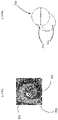
- FIG 4 shows a toilet block (402) that was produced by means of a coextrusion step that is non-concentric.
- the toilet block consists of two half cylinders, one half cylinder being of a first composition (421) and the other half cylinder being of a second composition (422). the inside figure 4
- the toilet block shown was obtained without a subsequent ball-forming step, ie the cylindrical extrudate was merely cut and thus divided into smaller pieces.
- FIG 5 shows a toilet block (502) that was produced by means of a coextrusion step that is non-concentric.
- the extrudate which consists of two half-cylinders, one half-cylinder being of a first composition (521) and the other half-cylinder being of a second composition (522), was cut into smaller pieces and shaped by a balling step, i.e. the cylindrical extrudate was cut and formed into a sphere.
- the two compositions are "interwoven" with one another on the surface by means of a ball-shaping step and form a spiral pattern, with the two compositions being interwoven with one another in a streak-like manner and occupying approximately equal areas of the surface of the toilet block.
- Such a distribution of the compositions on the surface of the stone can be achieved in particular by simultaneously cutting and balling a cylindrical (non-concentric) coextrudate.
- the cylindrical coextrudate positioned between two rotating rollers that "cut" the elongated strand into the individual toilet blocks, simultaneously forming each block into a ball.
- Such methods are known from the field of chocolate ball production.
- the manufacturer of such machines known as rolling machines for chocolate balls is, for example, the company Krüger & Salecker Maschinenbau GmbH & Co. KG, with the ARM 0252-0601 type being particularly preferred.
- the phase boundaries are extended and are particularly susceptible to color diffusion due to the curved spiral shape.
- the phase boundaries "blur" so particularly noticeable.
- the effect according to the invention which occurs when at least one of the compositions contains pigments and the phases can thus be clearly distinguished from one another, is therefore particularly striking.
Landscapes
- Chemical & Material Sciences (AREA)
- Life Sciences & Earth Sciences (AREA)
- Engineering & Computer Science (AREA)
- Chemical Kinetics & Catalysis (AREA)
- Oil, Petroleum & Natural Gas (AREA)
- Wood Science & Technology (AREA)
- Organic Chemistry (AREA)
- Detergent Compositions (AREA)
Priority Applications (2)
| Application Number | Priority Date | Filing Date | Title |
|---|---|---|---|
| EP21172204.6A EP4086331B1 (fr) | 2021-05-05 | 2021-05-05 | Bloc pour toilettes comprenant deux compositions différentes à pigments |
| PCT/EP2022/060690 WO2022233595A1 (fr) | 2021-05-05 | 2022-04-22 | Bloc de toilettes contenant deux compositions différentes comprenant des pigments |
Applications Claiming Priority (1)
| Application Number | Priority Date | Filing Date | Title |
|---|---|---|---|
| EP21172204.6A EP4086331B1 (fr) | 2021-05-05 | 2021-05-05 | Bloc pour toilettes comprenant deux compositions différentes à pigments |
Publications (2)
| Publication Number | Publication Date |
|---|---|
| EP4086331A1 true EP4086331A1 (fr) | 2022-11-09 |
| EP4086331B1 EP4086331B1 (fr) | 2024-06-12 |
Family
ID=75825489
Family Applications (1)
| Application Number | Title | Priority Date | Filing Date |
|---|---|---|---|
| EP21172204.6A Active EP4086331B1 (fr) | 2021-05-05 | 2021-05-05 | Bloc pour toilettes comprenant deux compositions différentes à pigments |
Country Status (2)
| Country | Link |
|---|---|
| EP (1) | EP4086331B1 (fr) |
| WO (1) | WO2022233595A1 (fr) |
Citations (3)
| Publication number | Priority date | Publication date | Assignee | Title |
|---|---|---|---|---|
| WO2006070209A1 (fr) * | 2004-12-31 | 2006-07-06 | Jeyes Group Limited | Pastille de nettoyage de toilettes |
| DE69934422T2 (de) * | 1998-10-19 | 2007-09-27 | Jeyes Group Ltd. | Toilettenreinigungsblock |
| EP3628726A1 (fr) * | 2018-09-27 | 2020-04-01 | Henkel AG & Co. KGaA | Bloc désodorisant pour wc comprenant deux compositions différentes |
-
2021
- 2021-05-05 EP EP21172204.6A patent/EP4086331B1/fr active Active
-
2022
- 2022-04-22 WO PCT/EP2022/060690 patent/WO2022233595A1/fr not_active Ceased
Patent Citations (3)
| Publication number | Priority date | Publication date | Assignee | Title |
|---|---|---|---|---|
| DE69934422T2 (de) * | 1998-10-19 | 2007-09-27 | Jeyes Group Ltd. | Toilettenreinigungsblock |
| WO2006070209A1 (fr) * | 2004-12-31 | 2006-07-06 | Jeyes Group Limited | Pastille de nettoyage de toilettes |
| EP3628726A1 (fr) * | 2018-09-27 | 2020-04-01 | Henkel AG & Co. KGaA | Bloc désodorisant pour wc comprenant deux compositions différentes |
Also Published As
| Publication number | Publication date |
|---|---|
| WO2022233595A1 (fr) | 2022-11-10 |
| EP4086331B1 (fr) | 2024-06-12 |
Similar Documents
| Publication | Publication Date | Title |
|---|---|---|
| DE10103649B4 (de) | Brausekopf | |
| DE60224520T2 (de) | Tabletten mit farbigen mustern und deren herstellung | |
| DE4439677A1 (de) | Reinigungsmittelstück für Spültoiletten | |
| DE102010012326A1 (de) | Strahlregler | |
| DE2151842A1 (de) | Extrudiertes Erzeugnis aus verschiedenen Materialien und Verfahren und Vorrichtung zu seiner Herstellung | |
| DE2426492A1 (de) | Verfahren und vorrichtung zur herstellung mehrfarbiger seife | |
| EP2620489B1 (fr) | Dispositif de distribution d'agent actif et procédé de fabrication d'un dispositif de distribution d'agent actif | |
| DE69839384T2 (de) | Zerstäubungsvorrichtung für behandlungsmittel von künstlichem haar | |
| DE60124001T2 (de) | Behälter zur ausgabe von schaum, sowie verfahren zum befüllen des behälters | |
| EP3628726B1 (fr) | Bloc désodorisant pour wc comprenant deux compositions différentes | |
| EP4086331B1 (fr) | Bloc pour toilettes comprenant deux compositions différentes à pigments | |
| DE4000881A1 (de) | Filtervorrichtung zur herstellung von aromaauszuegen | |
| DE1550419C3 (de) | Ventilverschlußstück und Verfahren zu seiner Herstellung | |
| EP3628725A1 (fr) | Agent de nettoyage et de désodorisant sanitaire et procédé de fabrication | |
| EP2620490B1 (fr) | Dispositif de distribution d'agent actif et procédé de fabrication d'un dispositif de distribution d'agent actif | |
| DE2261674C3 (de) | Vorrichtung zum Ansaugen und Beimischen von Zusatzstoffen in einen Flüssigkeitsstrom einer Badearmatur od.dgl | |
| EP3477010A1 (fr) | Petit panier de wc et système de rinçage de wc | |
| EP3469057B1 (fr) | Dispositif pourvu d'un agent de nettoyage pour le domaine des toilettes | |
| DE102015113834A1 (de) | WC-Körbchen | |
| DE2302223A1 (de) | Spruehvorrichtung | |
| DE102004037569B4 (de) | Verfahren zur Schaumbildung in einer Mischkammer | |
| DE60016009T4 (de) | Whirlpool | |
| DE2151843B2 (de) | Verfahren zur Herstellung von Stückseilen mit Perlglanzefiekt und Vorrichtung zur Durchführung dieses Verfahrens | |
| DE102004041796B4 (de) | Sanitärarmatur | |
| DE102011112744B4 (de) | Sanitärarmatur |
Legal Events
| Date | Code | Title | Description |
|---|---|---|---|
| PUAI | Public reference made under article 153(3) epc to a published international application that has entered the european phase |
Free format text: ORIGINAL CODE: 0009012 |
|
| STAA | Information on the status of an ep patent application or granted ep patent |
Free format text: STATUS: REQUEST FOR EXAMINATION WAS MADE |
|
| 17P | Request for examination filed |
Effective date: 20210505 |
|
| AK | Designated contracting states |
Kind code of ref document: A1 Designated state(s): AL AT BE BG CH CY CZ DE DK EE ES FI FR GB GR HR HU IE IS IT LI LT LU LV MC MK MT NL NO PL PT RO RS SE SI SK SM TR |
|
| P01 | Opt-out of the competence of the unified patent court (upc) registered |
Effective date: 20230530 |
|
| STAA | Information on the status of an ep patent application or granted ep patent |
Free format text: STATUS: EXAMINATION IS IN PROGRESS |
|
| 17Q | First examination report despatched |
Effective date: 20230905 |
|
| GRAP | Despatch of communication of intention to grant a patent |
Free format text: ORIGINAL CODE: EPIDOSNIGR1 |
|
| STAA | Information on the status of an ep patent application or granted ep patent |
Free format text: STATUS: GRANT OF PATENT IS INTENDED |
|
| INTG | Intention to grant announced |
Effective date: 20240408 |
|
| GRAS | Grant fee paid |
Free format text: ORIGINAL CODE: EPIDOSNIGR3 |
|
| GRAA | (expected) grant |
Free format text: ORIGINAL CODE: 0009210 |
|
| STAA | Information on the status of an ep patent application or granted ep patent |
Free format text: STATUS: THE PATENT HAS BEEN GRANTED |
|
| AK | Designated contracting states |
Kind code of ref document: B1 Designated state(s): AL AT BE BG CH CY CZ DE DK EE ES FI FR GB GR HR HU IE IS IT LI LT LU LV MC MK MT NL NO PL PT RO RS SE SI SK SM TR |
|
| REG | Reference to a national code |
Ref country code: GB Ref legal event code: FG4D Free format text: NOT ENGLISH |
|
| REG | Reference to a national code |
Ref country code: CH Ref legal event code: EP |
|
| REG | Reference to a national code |
Ref country code: DE Ref legal event code: R096 Ref document number: 502021003967 Country of ref document: DE |
|
| REG | Reference to a national code |
Ref country code: IE Ref legal event code: FG4D Free format text: LANGUAGE OF EP DOCUMENT: GERMAN |
|
| PG25 | Lapsed in a contracting state [announced via postgrant information from national office to epo] |
Ref country code: BG Free format text: LAPSE BECAUSE OF FAILURE TO SUBMIT A TRANSLATION OF THE DESCRIPTION OR TO PAY THE FEE WITHIN THE PRESCRIBED TIME-LIMIT Effective date: 20240612 |
|
| PG25 | Lapsed in a contracting state [announced via postgrant information from national office to epo] |
Ref country code: HR Free format text: LAPSE BECAUSE OF FAILURE TO SUBMIT A TRANSLATION OF THE DESCRIPTION OR TO PAY THE FEE WITHIN THE PRESCRIBED TIME-LIMIT Effective date: 20240612 Ref country code: FI Free format text: LAPSE BECAUSE OF FAILURE TO SUBMIT A TRANSLATION OF THE DESCRIPTION OR TO PAY THE FEE WITHIN THE PRESCRIBED TIME-LIMIT Effective date: 20240612 |
|
| REG | Reference to a national code |
Ref country code: LT Ref legal event code: MG9D |
|
| PG25 | Lapsed in a contracting state [announced via postgrant information from national office to epo] |
Ref country code: GR Free format text: LAPSE BECAUSE OF FAILURE TO SUBMIT A TRANSLATION OF THE DESCRIPTION OR TO PAY THE FEE WITHIN THE PRESCRIBED TIME-LIMIT Effective date: 20240913 |
|
| REG | Reference to a national code |
Ref country code: NL Ref legal event code: MP Effective date: 20240612 |
|
| PG25 | Lapsed in a contracting state [announced via postgrant information from national office to epo] |
Ref country code: ES Free format text: LAPSE BECAUSE OF FAILURE TO SUBMIT A TRANSLATION OF THE DESCRIPTION OR TO PAY THE FEE WITHIN THE PRESCRIBED TIME-LIMIT Effective date: 20240612 |
|
| PG25 | Lapsed in a contracting state [announced via postgrant information from national office to epo] |
Ref country code: LV Free format text: LAPSE BECAUSE OF FAILURE TO SUBMIT A TRANSLATION OF THE DESCRIPTION OR TO PAY THE FEE WITHIN THE PRESCRIBED TIME-LIMIT Effective date: 20240612 |
|
| PG25 | Lapsed in a contracting state [announced via postgrant information from national office to epo] |
Ref country code: NO Free format text: LAPSE BECAUSE OF FAILURE TO SUBMIT A TRANSLATION OF THE DESCRIPTION OR TO PAY THE FEE WITHIN THE PRESCRIBED TIME-LIMIT Effective date: 20240912 Ref country code: LV Free format text: LAPSE BECAUSE OF FAILURE TO SUBMIT A TRANSLATION OF THE DESCRIPTION OR TO PAY THE FEE WITHIN THE PRESCRIBED TIME-LIMIT Effective date: 20240612 Ref country code: HR Free format text: LAPSE BECAUSE OF FAILURE TO SUBMIT A TRANSLATION OF THE DESCRIPTION OR TO PAY THE FEE WITHIN THE PRESCRIBED TIME-LIMIT Effective date: 20240612 Ref country code: GR Free format text: LAPSE BECAUSE OF FAILURE TO SUBMIT A TRANSLATION OF THE DESCRIPTION OR TO PAY THE FEE WITHIN THE PRESCRIBED TIME-LIMIT Effective date: 20240913 Ref country code: FI Free format text: LAPSE BECAUSE OF FAILURE TO SUBMIT A TRANSLATION OF THE DESCRIPTION OR TO PAY THE FEE WITHIN THE PRESCRIBED TIME-LIMIT Effective date: 20240612 Ref country code: ES Free format text: LAPSE BECAUSE OF FAILURE TO SUBMIT A TRANSLATION OF THE DESCRIPTION OR TO PAY THE FEE WITHIN THE PRESCRIBED TIME-LIMIT Effective date: 20240612 Ref country code: BG Free format text: LAPSE BECAUSE OF FAILURE TO SUBMIT A TRANSLATION OF THE DESCRIPTION OR TO PAY THE FEE WITHIN THE PRESCRIBED TIME-LIMIT Effective date: 20240612 Ref country code: RS Free format text: LAPSE BECAUSE OF FAILURE TO SUBMIT A TRANSLATION OF THE DESCRIPTION OR TO PAY THE FEE WITHIN THE PRESCRIBED TIME-LIMIT Effective date: 20240912 |
|
| PG25 | Lapsed in a contracting state [announced via postgrant information from national office to epo] |
Ref country code: NL Free format text: LAPSE BECAUSE OF FAILURE TO SUBMIT A TRANSLATION OF THE DESCRIPTION OR TO PAY THE FEE WITHIN THE PRESCRIBED TIME-LIMIT Effective date: 20240612 |
|
| PG25 | Lapsed in a contracting state [announced via postgrant information from national office to epo] |
Ref country code: NL Free format text: LAPSE BECAUSE OF FAILURE TO SUBMIT A TRANSLATION OF THE DESCRIPTION OR TO PAY THE FEE WITHIN THE PRESCRIBED TIME-LIMIT Effective date: 20240612 |
|
| PG25 | Lapsed in a contracting state [announced via postgrant information from national office to epo] |
Ref country code: PT Free format text: LAPSE BECAUSE OF FAILURE TO SUBMIT A TRANSLATION OF THE DESCRIPTION OR TO PAY THE FEE WITHIN THE PRESCRIBED TIME-LIMIT Effective date: 20241014 |
|
| PG25 | Lapsed in a contracting state [announced via postgrant information from national office to epo] |
Ref country code: PT Free format text: LAPSE BECAUSE OF FAILURE TO SUBMIT A TRANSLATION OF THE DESCRIPTION OR TO PAY THE FEE WITHIN THE PRESCRIBED TIME-LIMIT Effective date: 20241014 |
|
| PG25 | Lapsed in a contracting state [announced via postgrant information from national office to epo] |
Ref country code: PL Free format text: LAPSE BECAUSE OF FAILURE TO SUBMIT A TRANSLATION OF THE DESCRIPTION OR TO PAY THE FEE WITHIN THE PRESCRIBED TIME-LIMIT Effective date: 20240612 |
|
| PG25 | Lapsed in a contracting state [announced via postgrant information from national office to epo] |
Ref country code: EE Free format text: LAPSE BECAUSE OF FAILURE TO SUBMIT A TRANSLATION OF THE DESCRIPTION OR TO PAY THE FEE WITHIN THE PRESCRIBED TIME-LIMIT Effective date: 20240612 |
|
| PG25 | Lapsed in a contracting state [announced via postgrant information from national office to epo] |
Ref country code: IS Free format text: LAPSE BECAUSE OF FAILURE TO SUBMIT A TRANSLATION OF THE DESCRIPTION OR TO PAY THE FEE WITHIN THE PRESCRIBED TIME-LIMIT Effective date: 20241012 |
|
| PG25 | Lapsed in a contracting state [announced via postgrant information from national office to epo] |
Ref country code: CZ Free format text: LAPSE BECAUSE OF FAILURE TO SUBMIT A TRANSLATION OF THE DESCRIPTION OR TO PAY THE FEE WITHIN THE PRESCRIBED TIME-LIMIT Effective date: 20240612 |
|
| PG25 | Lapsed in a contracting state [announced via postgrant information from national office to epo] |
Ref country code: RO Free format text: LAPSE BECAUSE OF FAILURE TO SUBMIT A TRANSLATION OF THE DESCRIPTION OR TO PAY THE FEE WITHIN THE PRESCRIBED TIME-LIMIT Effective date: 20240612 Ref country code: SK Free format text: LAPSE BECAUSE OF FAILURE TO SUBMIT A TRANSLATION OF THE DESCRIPTION OR TO PAY THE FEE WITHIN THE PRESCRIBED TIME-LIMIT Effective date: 20240612 |
|
| PG25 | Lapsed in a contracting state [announced via postgrant information from national office to epo] |
Ref country code: SM Free format text: LAPSE BECAUSE OF FAILURE TO SUBMIT A TRANSLATION OF THE DESCRIPTION OR TO PAY THE FEE WITHIN THE PRESCRIBED TIME-LIMIT Effective date: 20240612 |
|
| PG25 | Lapsed in a contracting state [announced via postgrant information from national office to epo] |
Ref country code: SM Free format text: LAPSE BECAUSE OF FAILURE TO SUBMIT A TRANSLATION OF THE DESCRIPTION OR TO PAY THE FEE WITHIN THE PRESCRIBED TIME-LIMIT Effective date: 20240612 Ref country code: SK Free format text: LAPSE BECAUSE OF FAILURE TO SUBMIT A TRANSLATION OF THE DESCRIPTION OR TO PAY THE FEE WITHIN THE PRESCRIBED TIME-LIMIT Effective date: 20240612 Ref country code: RO Free format text: LAPSE BECAUSE OF FAILURE TO SUBMIT A TRANSLATION OF THE DESCRIPTION OR TO PAY THE FEE WITHIN THE PRESCRIBED TIME-LIMIT Effective date: 20240612 Ref country code: PL Free format text: LAPSE BECAUSE OF FAILURE TO SUBMIT A TRANSLATION OF THE DESCRIPTION OR TO PAY THE FEE WITHIN THE PRESCRIBED TIME-LIMIT Effective date: 20240612 Ref country code: IS Free format text: LAPSE BECAUSE OF FAILURE TO SUBMIT A TRANSLATION OF THE DESCRIPTION OR TO PAY THE FEE WITHIN THE PRESCRIBED TIME-LIMIT Effective date: 20241012 Ref country code: EE Free format text: LAPSE BECAUSE OF FAILURE TO SUBMIT A TRANSLATION OF THE DESCRIPTION OR TO PAY THE FEE WITHIN THE PRESCRIBED TIME-LIMIT Effective date: 20240612 Ref country code: CZ Free format text: LAPSE BECAUSE OF FAILURE TO SUBMIT A TRANSLATION OF THE DESCRIPTION OR TO PAY THE FEE WITHIN THE PRESCRIBED TIME-LIMIT Effective date: 20240612 |
|
| PG25 | Lapsed in a contracting state [announced via postgrant information from national office to epo] |
Ref country code: IT Free format text: LAPSE BECAUSE OF FAILURE TO SUBMIT A TRANSLATION OF THE DESCRIPTION OR TO PAY THE FEE WITHIN THE PRESCRIBED TIME-LIMIT Effective date: 20240612 |
|
| REG | Reference to a national code |
Ref country code: DE Ref legal event code: R097 Ref document number: 502021003967 Country of ref document: DE |
|
| PG25 | Lapsed in a contracting state [announced via postgrant information from national office to epo] |
Ref country code: DK Free format text: LAPSE BECAUSE OF FAILURE TO SUBMIT A TRANSLATION OF THE DESCRIPTION OR TO PAY THE FEE WITHIN THE PRESCRIBED TIME-LIMIT Effective date: 20240612 |
|
| PLBE | No opposition filed within time limit |
Free format text: ORIGINAL CODE: 0009261 |
|
| STAA | Information on the status of an ep patent application or granted ep patent |
Free format text: STATUS: NO OPPOSITION FILED WITHIN TIME LIMIT |
|
| 26N | No opposition filed |
Effective date: 20250313 |
|
| PGFP | Annual fee paid to national office [announced via postgrant information from national office to epo] |
Ref country code: DE Payment date: 20250521 Year of fee payment: 5 |
|
| PGFP | Annual fee paid to national office [announced via postgrant information from national office to epo] |
Ref country code: GB Payment date: 20250527 Year of fee payment: 5 |
|
| PGFP | Annual fee paid to national office [announced via postgrant information from national office to epo] |
Ref country code: FR Payment date: 20250528 Year of fee payment: 5 |
|
| PGFP | Annual fee paid to national office [announced via postgrant information from national office to epo] |
Ref country code: AT Payment date: 20250721 Year of fee payment: 5 |
|
| PG25 | Lapsed in a contracting state [announced via postgrant information from national office to epo] |
Ref country code: SE Free format text: LAPSE BECAUSE OF FAILURE TO SUBMIT A TRANSLATION OF THE DESCRIPTION OR TO PAY THE FEE WITHIN THE PRESCRIBED TIME-LIMIT Effective date: 20240612 |
|
| REG | Reference to a national code |
Ref country code: CH Ref legal event code: H13 Free format text: ST27 STATUS EVENT CODE: U-0-0-H10-H13 (AS PROVIDED BY THE NATIONAL OFFICE) Effective date: 20251223 |
|
| PG25 | Lapsed in a contracting state [announced via postgrant information from national office to epo] |
Ref country code: LU Free format text: LAPSE BECAUSE OF NON-PAYMENT OF DUE FEES Effective date: 20250505 |
|
| PG25 | Lapsed in a contracting state [announced via postgrant information from national office to epo] |
Ref country code: CH Free format text: LAPSE BECAUSE OF NON-PAYMENT OF DUE FEES Effective date: 20250531 |
|
| REG | Reference to a national code |
Ref country code: BE Ref legal event code: MM Effective date: 20250531 |
|
| PG25 | Lapsed in a contracting state [announced via postgrant information from national office to epo] |
Ref country code: MC Free format text: LAPSE BECAUSE OF FAILURE TO SUBMIT A TRANSLATION OF THE DESCRIPTION OR TO PAY THE FEE WITHIN THE PRESCRIBED TIME-LIMIT Effective date: 20240612 |
|
| PG25 | Lapsed in a contracting state [announced via postgrant information from national office to epo] |
Ref country code: IE Free format text: LAPSE BECAUSE OF NON-PAYMENT OF DUE FEES Effective date: 20250505 |
|
| PG25 | Lapsed in a contracting state [announced via postgrant information from national office to epo] |
Ref country code: BE Free format text: LAPSE BECAUSE OF NON-PAYMENT OF DUE FEES Effective date: 20250531 |