EP4087667B1 - Dispositif d'apprentissage de l'appui tendu renversé - Google Patents
Dispositif d'apprentissage de l'appui tendu renversé Download PDFInfo
- Publication number
- EP4087667B1 EP4087667B1 EP20845386.0A EP20845386A EP4087667B1 EP 4087667 B1 EP4087667 B1 EP 4087667B1 EP 20845386 A EP20845386 A EP 20845386A EP 4087667 B1 EP4087667 B1 EP 4087667B1
- Authority
- EP
- European Patent Office
- Prior art keywords
- training device
- handstand
- handstand training
- support element
- support
- Prior art date
- Legal status (The legal status is an assumption and is not a legal conclusion. Google has not performed a legal analysis and makes no representation as to the accuracy of the status listed.)
- Active
Links
Images

Classifications
-
- A—HUMAN NECESSITIES
- A63—SPORTS; GAMES; AMUSEMENTS
- A63B—APPARATUS FOR PHYSICAL TRAINING, GYMNASTICS, SWIMMING, CLIMBING, OR FENCING; BALL GAMES; TRAINING EQUIPMENT
- A63B21/00—Exercising apparatus for developing or strengthening the muscles or joints of the body by working against a counterforce, with or without measuring devices
- A63B21/00047—Exercising devices not moving during use
- A63B21/0005—Exercising devices not moving during use specially adapted for head stands
-
- A—HUMAN NECESSITIES
- A63—SPORTS; GAMES; AMUSEMENTS
- A63B—APPARATUS FOR PHYSICAL TRAINING, GYMNASTICS, SWIMMING, CLIMBING, OR FENCING; BALL GAMES; TRAINING EQUIPMENT
- A63B69/00—Training appliances or apparatus for special sports
- A63B69/0057—Means for physically limiting movements of body parts
-
- A—HUMAN NECESSITIES
- A63—SPORTS; GAMES; AMUSEMENTS
- A63B—APPARATUS FOR PHYSICAL TRAINING, GYMNASTICS, SWIMMING, CLIMBING, OR FENCING; BALL GAMES; TRAINING EQUIPMENT
- A63B21/00—Exercising apparatus for developing or strengthening the muscles or joints of the body by working against a counterforce, with or without measuring devices
- A63B21/06—User-manipulated weights
- A63B21/068—User-manipulated weights using user's body weight
-
- A—HUMAN NECESSITIES
- A63—SPORTS; GAMES; AMUSEMENTS
- A63B—APPARATUS FOR PHYSICAL TRAINING, GYMNASTICS, SWIMMING, CLIMBING, OR FENCING; BALL GAMES; TRAINING EQUIPMENT
- A63B21/00—Exercising apparatus for developing or strengthening the muscles or joints of the body by working against a counterforce, with or without measuring devices
- A63B21/40—Interfaces with the user related to strength training; Details thereof
- A63B21/4027—Specific exercise interfaces
- A63B21/4033—Handles, pedals, bars or platforms
- A63B21/4035—Handles, pedals, bars or platforms for operation by hand
-
- A—HUMAN NECESSITIES
- A63—SPORTS; GAMES; AMUSEMENTS
- A63B—APPARATUS FOR PHYSICAL TRAINING, GYMNASTICS, SWIMMING, CLIMBING, OR FENCING; BALL GAMES; TRAINING EQUIPMENT
- A63B2208/00—Characteristics or parameters related to the user or player
- A63B2208/02—Characteristics or parameters related to the user or player posture
- A63B2208/028—Standing on the hands
-
- A—HUMAN NECESSITIES
- A63—SPORTS; GAMES; AMUSEMENTS
- A63B—APPARATUS FOR PHYSICAL TRAINING, GYMNASTICS, SWIMMING, CLIMBING, OR FENCING; BALL GAMES; TRAINING EQUIPMENT
- A63B2225/00—Miscellaneous features of sport apparatus, devices or equipment
- A63B2225/09—Adjustable dimensions
- A63B2225/093—Height
Definitions
- a handstand presents a significant challenge for athletes, as numerous motor movements are required for its execution. For example, in a handstand, finger work, hand angle, forearm strength, shoulder angle, shoulder opening, hip angle, leg position, head tilt, and gaze fixation must all be coordinated. Therefore, the handstand represents a highly complex system requiring the mastery of various muscles and body regions. People practicing a handstand almost always use a wall as support, primarily supporting the feet. The wall is used to move the legs in the event of a loss of balance and to place the feet or one foot against the wall for temporary stabilization. This has the disadvantage that the body, once at rest, must be disturbed again by larger movements of the legs, whereas in a handstand, even the smallest movements in various body regions are sufficient to maintain or lose balance.
- the present invention was developed against the background of the prior art described above.
- the object of the invention is to propose a handstand training device that allows the user to learn the handstand and ultimately stand freely in the handstand without any device.
- the handstand training device has a support element with a substantially vertical support surface for the associated arm.
- a hand is placed with the lower palm on a hand support surface or grasped by it in such a way that the arm is supported against the arm support surface of the support element. If the body and legs are accelerated upwards in a rotational movement, the static nature of the support surface brings the arm into a fixed position in the direction of swing of the trainee, which represents a significant inhibition of tipping over, so that the lower center of gravity region of the trainee is largely fixed.
- the arm is held in a vertical position and a somersault is reliably prevented.
- a stand can be provided, for example, which can be placed on a floor and which has a support surface for a hand that is essentially horizontal in relation to the horizontal plane of the floor.
- the spacer has a guide element and the support has a complementary guide, so that the spacer can be moved along the support and thus adjusted in height.
- This allows the arm to be supported in various areas, for example, in the From the forearm down to the wrist or in the upper arm area.
- the practitioner can accustom their nervous system to a reduced level of support, allowing them to become independent of the device. Unlike practicing with a wall, this allows them to quickly taper off the support and hold a handstand without any training equipment.
- the invention further comprises a set of two handstand training devices with the above-described feature combinations for the use of both hands or the support of both arms.
- the handstand training devices are arranged side by side during use.
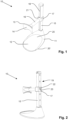
- Figure 1 shows a view of the handstand training device 10 from a front and side perspective.
- the handstand training device 10 has a base 11 that can be placed on the floor as its lower base.
- a slip-resistant rubber coating 20' is provided on its underside to prevent slipping during exercises.
- the base 11 On the upper side, the base 11 has an approximately oval, horizontal support surface 12 for a right or left hand, which also has a slip-resistant coating 20.
- the support 15 has a vertical groove 18 running parallel to its longitudinal axis, which serves as a guide for a guide element 17.
- the guide element 17 is attached to the support 15 for continuous vertical movement. It has a cube-like outer shape. A corresponding tongue 21 is attached to the guide element 17 and engages in the groove 18. The guide element 17 encloses an area of the four surfaces of the square support 15, which thereby serve as additional guides. This allows the Guide element 17 can be moved up and down and is still securely attached to the carrier 15.
- a horizontally extending spacer 16 is attached to the guide element 17 at its rear end.
- the support element 13 for the arm is attached to the opposite front end of the spacer 16.
- the support element 13 comprises an arm support surface 14 that is substantially vertical relative to the floor and concavely curved, thus adapting to the shape of an adjacent arm.
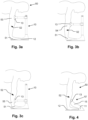
- the Figures 3a to 3c show a side view of the handstand training device 10 and a user 50, wherein the support element 13 is set at a different height in each case. Since the height of the support element 13 is continuously adjustable, all intermediate positions (not shown) can also be set.
- the user 50 is shown in the initial phase of a handstand, in which his upper body is still in a horizontal position. His hand 51 rests on the hand support surface 12. As a result, the body weight force is transferred from the hand 51 to the hand support surface 12 and the stand foot is pressed down onto the floor. As a result, despite the force of the arm 52 acting on the support element 13, the training device 10 is held stably on the floor and cannot tip over.
- the Figure 3c shows the support element 13 in the lowest position, in which the arm 52 is supported in the wrist area. This setting is suitable for very advanced users 52, since the support effect is only slight. If the user can Figure 3c Once you have safely performed a handstand in the lowest position shown, you can then train a free handstand without any device in the final training phase. You can also train first with a set of two devices 10 for both arms 52, then with just one device 10 for one arm 52, and finally freely.
- Figure 4 shows a side view of a second embodiment of the handstand training device 10' with a user 50.
- This embodiment 10' is formed in one piece. Like the previously shown embodiment 10, it has a base 11 with a hand support surface 12. However, the base 11 transitions directly into an S-shaped curved support 15 and a terminal support element 13.
- FIG. 5 shows a perspective detail view of a third embodiment of the handstand training device 10".
- the vertical support 15 is shown with the guide element 17, the horizontally extending spacer 16, and the support element 13.
- the spacer 16 is hollow.
- a pull-out element 24 is slidably arranged in the hollow space.
- Several spaced-apart openings 25 are provided in the pull-out element 24.
- the spacer 16 has an opening 25' in the end region.
- the pull-out element 24 can be fixed in a position where one of its openings 25 coincides with the opening 25' in the spacer 16 by inserting a pin 26 through both openings.
- the spacer 16 is thus adjustable in length, so that the distance between the support element 13 and the support 15 can be changed.
- the number of adjustment positions corresponds to the number of holes 25 in the pull-out element 24.
- FIG. 6 shows a perspective view of a fourth embodiment of the handstand training device 10′′′. Like the other embodiments, this also has a base 11 that can be placed on the floor, with a horizontal support surface 12 for a right or left hand 51 and a support element 13. Instead of a support 15, however, two vertical supports 15 are attached to the base 11 at a specific distance, with the support element 13 being arranged between the two supports. This is attached to a horizontally extending band 27, the two ends of which are each detachably attached to a support 15. For attaching the band 27, a plurality of hook-shaped recesses 28 are provided on the supports 15, to which the band 27 can be attached at the desired height.
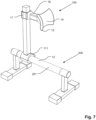
- Figure 7 shows a perspective view of a fifth embodiment of the handstand training device 100.
- the upper section of this embodiment 100 corresponds substantially to the upper section of the Figure 1
- the handstand training device 10 shown comprises the vertical support 15 with the guide element 17, which is vertically displaceably attached to the support 15.
- the horizontally extending spacer 16 with the support element 13 and its arm support surface 14 is attached to the guide element 17.
- a fastening element 111 for an external sports device 200 serves as the lower base element.
- the sports device 200 has a round bar 201, which forms the support surface 12 for a hand 51 (not shown).
- the base element or fastening element 111 is designed as a clamp that engages around the bar 201 and thus fixes the handstand training device 100 to the sports device 200.
Landscapes
- Health & Medical Sciences (AREA)
- General Health & Medical Sciences (AREA)
- Physical Education & Sports Medicine (AREA)
- Life Sciences & Earth Sciences (AREA)
- Biophysics (AREA)
- Orthopedic Medicine & Surgery (AREA)
- Rehabilitation Tools (AREA)
Claims (14)
- Dispositif d'entraînement (10, 100) à l'appui tendu renversé, comportant un élément de base (11, 111) et un élément de soutien (13), caractérisé en ce que l'élément de soutien (13) présente une surface d'appui (14) pour un bras (52), en ce qu'à l'élément de base (11, 111) est fixé au moins un support (15) sur lequel est disposé l'élément de soutien (13), et en ce qu'entre le support (15) et l'élément de soutien (13) est prévu un espaceur (16) qui s'étend ou est disposé essentiellement orthogonalement par rapport au support (15).
- Dispositif d'entraînement (10) à l'appui tendu renversé selon la revendication 1, caractérisé en ce que l'élément de base est configuré sous forme d'un socle réglable (11) présentant une surface d'appui (12) pour une main (51).
- Dispositif d'entraînement (100) à l'appui tendu renversé selon la revendication 1, caractérisé en ce que l'élément de base est configuré sous forme d'élément de fixation (111) pour un équipement de sport externe (200) qui comporte par exemple une barre (201) et la barre (201) constitue la surface d'appui (12) pour la main (51).
- Dispositif d'entraînement (10, 100) à l'appui tendu renversé selon l'une quelconque des revendications précédentes, caractérisé en ce qu'il est configuré de telle façon que lors d'un appui tendu renversé la force du poids du corps est transférée de la main (51) à la surface d'appui (12) pour la main et ainsi l'élément de base (11, 111) est également maintenu stable sur le sol lorsque la force du bras (52) est exercée sur l'élément de soutien (13).
- Dispositif d'entraînement (10, 100) à l'appui tendu renversé selon l'une quelconque des revendications précédentes, caractérisé en ce que le support (15) s'étend essentiellement verticalement.
- Dispositif d'entraînement (10, 100) à l'appui tendu renversé selon l'une quelconque des revendications précédentes, caractérisé en ce que l'espaceur (16) comporte un élément de guidage (17) et le support (15) comporte un guide (18) complémentaire, de sorte que l'espaceur (16) est configuré pour être mobile verticalement le long du support (15) et réglable en sa hauteur.
- Dispositif d'entraînement (10, 100) à l'appui tendu renversé selon l'une quelconque des revendications précédentes, caractérisé en ce que l'espaceur (16) est configuré pour être réglable en sa longueur et en particulier téléscopiquement extensible et rétractable et/ou encliquetable.
- Dispositif d'entraînement (10, 100) à l'appui tendu renversé selon l'une quelconque des revendications précédentes, caractérisé en ce que le support (15) comporte une échelle (19) pour l'ajustement de l'élément de soutien (13) à une hauteur définie.
- Dispositif d'entraînement (10, 100) à l'appui tendu renversé selon l'une quelconque des revendications précédentes, caractérisé en ce qu'il est constitué d'une seule partie.
- Dispositif d'entraînement (10, 100) à l'appui tendu renversé selon l'une quelconque des revendications précédentes, caractérisé en ce que deux supports (15) espacés sont prévus et l'élément de soutien (13) est disposé entre les deux supports (15) et de préférence réglable en hauteur.
- Dispositif d'entraînement (10, 100) à l'appui tendu renversé selon la revendication précédente, caractérisé en ce que l'élément de soutien (13) est fixé à un élément de maintien s'étendant essentiellement horizontalement, en particulier une bande (27) ou traverse, dont les deux extrémités sont fixées de façon amovible chacune à l'un des deux supports (15).
- Dispositif d'entraînement (10, 100) à l'appui tendu renversé selon la revendication précédente, caractérisé en ce que pour la fixation de l'élément de maintien (27) aux supports (15) sont prévues plusieurs échancrures (28) en forme de crochets, dans lesquelles l'élément de maintien (27) peut être suspendu à la hauteur voulue.
- Dispositif d'entraînement à l'appui tendu renversé selon l'une quelconque des revendications précédentes, caractérisé en ce que le socle (11) à la face inférieure et/ou la surface d'appui (12) pour la main (51) comporte ou comportent chacun(e) une structure anti-glissement (20) ou un revêtement anti-glissement (20).
- Ensemble destiné à l'utilisation par les deux bras (52) ou les deux mains (51), qui comprend deux dispositifs d'entraînement (10, 100) à l'appui tendu renversé selon l'une quelconque des revendications précédentes.
Applications Claiming Priority (2)
| Application Number | Priority Date | Filing Date | Title |
|---|---|---|---|
| DE102020100161.4A DE102020100161A1 (de) | 2020-01-07 | 2020-01-07 | Handstand-Trainingsvorrichtung |
| PCT/DE2020/101087 WO2021139851A1 (fr) | 2020-01-07 | 2020-12-29 | Dispositif d'apprentissage de l'appui tendu renversé |
Publications (3)
| Publication Number | Publication Date |
|---|---|
| EP4087667A1 EP4087667A1 (fr) | 2022-11-16 |
| EP4087667C0 EP4087667C0 (fr) | 2025-03-12 |
| EP4087667B1 true EP4087667B1 (fr) | 2025-03-12 |
Family
ID=74205575
Family Applications (1)
| Application Number | Title | Priority Date | Filing Date |
|---|---|---|---|
| EP20845386.0A Active EP4087667B1 (fr) | 2020-01-07 | 2020-12-29 | Dispositif d'apprentissage de l'appui tendu renversé |
Country Status (7)
| Country | Link |
|---|---|
| US (1) | US12330013B2 (fr) |
| EP (1) | EP4087667B1 (fr) |
| JP (1) | JP7714553B2 (fr) |
| CN (1) | CN114945416B (fr) |
| CA (1) | CA3166362A1 (fr) |
| DE (2) | DE102020100161A1 (fr) |
| WO (1) | WO2021139851A1 (fr) |
Family Cites Families (30)
| Publication number | Priority date | Publication date | Assignee | Title |
|---|---|---|---|---|
| US1348110A (en) * | 1919-08-25 | 1920-07-27 | William S Hasskarl | Stilt |
| US2919918A (en) * | 1957-11-25 | 1960-01-05 | Horn Clarence Leonard | Head stand |
| US2939704A (en) * | 1958-07-15 | 1960-06-07 | Charles P Pond | Athletic training accessory |
| US3114545A (en) * | 1961-06-27 | 1963-12-17 | Horn Clarence Leonard | Collapsible and adjustable head stand apparatus |
| US3173415A (en) * | 1963-02-11 | 1965-03-16 | Rubin Samuel | Massage and exercise device |
| US3667755A (en) * | 1970-05-18 | 1972-06-06 | Joseph H Manning | Adjustable stilt |
| US3879033A (en) * | 1973-12-26 | 1975-04-22 | Robert M Martin | Hand stand trainer |
| DE2724452A1 (de) | 1977-05-31 | 1978-12-14 | Siegfried Maisenhaelder | Sport - kreislauf - trimmgeraet |
| DE2736839A1 (de) * | 1977-08-16 | 1979-03-01 | Siegfried Maisenhaelder | Sport-entspannungs-kreislauf-aktivierungsgeraet |
| US4968025A (en) * | 1989-09-07 | 1990-11-06 | Carolina Gym Supply Corp. | Portable gymnastic training apparatus |
| JPH0482573A (ja) * | 1990-07-26 | 1992-03-16 | Sadamu Hoshino | 倒立補助器 |
| JP2546633Y2 (ja) * | 1992-01-28 | 1997-09-03 | 埼玉化工株式会社 | 逆立器 |
| US5569141A (en) * | 1995-11-03 | 1996-10-29 | Chou; Chen-Chang | Inversion practice exerciser |
| JPH09225063A (ja) * | 1996-02-21 | 1997-09-02 | Koichi Kurokawa | 倒立補助器具 |
| US6090024A (en) * | 1998-06-29 | 2000-07-18 | Tsou; Yeong Haw | Adjustable inversion supporter |
| JP2011019812A (ja) * | 2009-07-17 | 2011-02-03 | Saitama Univ | 倒立練習器具 |
| KR101152152B1 (ko) | 2010-03-22 | 2012-06-15 | 노광수 | 물구나무서기 운동용 보조용구 |
| US20120322622A1 (en) * | 2010-06-28 | 2012-12-20 | Doug Davis | Handstand cast trainer |
| US8172737B1 (en) * | 2010-12-14 | 2012-05-08 | International Gymnastics Innovations LLC | Back handspring training device |
| DE202011002013U1 (de) * | 2011-01-29 | 2011-05-05 | Reindl, Markus | Kopfstandbank |
| US9272174B2 (en) * | 2013-08-13 | 2016-03-01 | Russell Brands, Llc | Handstand training device |
| CN103933709A (zh) * | 2014-04-17 | 2014-07-23 | 苟小平 | 倒立凳 |
| KR101653647B1 (ko) * | 2014-09-23 | 2016-09-07 | 손승혁 | 물구나무 운동기구 |
| US9415260B2 (en) * | 2015-01-09 | 2016-08-16 | Edward J. Islas | Plantar exercise device |
| CN105536222B (zh) * | 2015-12-15 | 2018-11-30 | 宁波工程学院 | 双杠摆动手倒立训练器 |
| US9789346B1 (en) | 2016-01-19 | 2017-10-17 | Justin Kime | Handstand pushup device |
| CN205867453U (zh) * | 2016-08-08 | 2017-01-11 | 樊发祥 | 一种倒立训练用的支撑座 |
| CN207119101U (zh) * | 2017-03-31 | 2018-03-20 | 陈振国 | 一种人体倒立辅助支撑装置 |
| CN107029398B (zh) * | 2017-03-31 | 2019-04-12 | 陈焜 | 一种倒立行走训练装置 |
| CN209662520U (zh) * | 2019-03-08 | 2019-11-22 | 湖南信息职业技术学院 | 一种大学体育双杠训练装置 |
-
2020
- 2020-01-07 DE DE102020100161.4A patent/DE102020100161A1/de not_active Withdrawn
- 2020-12-29 US US17/788,921 patent/US12330013B2/en active Active
- 2020-12-29 CA CA3166362A patent/CA3166362A1/fr active Pending
- 2020-12-29 CN CN202080091772.4A patent/CN114945416B/zh active Active
- 2020-12-29 JP JP2022542258A patent/JP7714553B2/ja active Active
- 2020-12-29 DE DE112020006699.1T patent/DE112020006699A5/de not_active Withdrawn
- 2020-12-29 EP EP20845386.0A patent/EP4087667B1/fr active Active
- 2020-12-29 WO PCT/DE2020/101087 patent/WO2021139851A1/fr not_active Ceased
Also Published As
| Publication number | Publication date |
|---|---|
| CN114945416A (zh) | 2022-08-26 |
| EP4087667C0 (fr) | 2025-03-12 |
| JP7714553B2 (ja) | 2025-07-29 |
| DE112020006699A5 (de) | 2023-04-20 |
| WO2021139851A1 (fr) | 2021-07-15 |
| EP4087667A1 (fr) | 2022-11-16 |
| CA3166362A1 (fr) | 2021-07-15 |
| US12330013B2 (en) | 2025-06-17 |
| DE102020100161A1 (de) | 2021-07-08 |
| CN114945416B (zh) | 2024-08-16 |
| JP2023520959A (ja) | 2023-05-23 |
| US20220355157A1 (en) | 2022-11-10 |
Similar Documents
| Publication | Publication Date | Title |
|---|---|---|
| EP3551300B1 (fr) | Appareil d'entraînement pour effectuer des exercices d'équilibre, de méditation et/ou de yoga | |
| EP3498341A1 (fr) | Appareil de gymnastique ou d'exercice physique doté d'au moins une barre verticale pourvue d'alésages transversaux ainsi que des supports destinés à la fixation libérable et réglable en hauteur des différents éléments d'exercice sur la barre | |
| EP2962738B1 (fr) | Appareil de sport pouvant rouler | |
| EP0655263B1 (fr) | Appareil d'exercise multi-usage | |
| DE2639307C3 (de) | Gymnastikgerät | |
| EP3621704B1 (fr) | Appareil de fitness pour effectuer des exercices de type pompes | |
| EP4087667B1 (fr) | Dispositif d'apprentissage de l'appui tendu renversé | |
| DE9212561U1 (de) | Gymnastikgerät | |
| DE10138679C1 (de) | Ergotherapeutische Wippe | |
| EP3991808B1 (fr) | Appareil de remise en forme, en particulier banc d'haltérophilie | |
| DE202022001164U1 (de) | Trainingsgerät | |
| EP3609460B1 (fr) | Appareil d'entraînement à la mobilité | |
| DE202020106182U1 (de) | Fitnessgerät, insbesondere Hantelbank | |
| DE202017005305U1 (de) | Trainingsvorrichtung | |
| EP3912694B1 (fr) | Dispositif de gymnastique | |
| DE102017009577B4 (de) | Trainingsvorrichtung | |
| EP1338308A1 (fr) | Bâton de gymnastique | |
| DE20010414U1 (de) | Ergonomische Liegestützhilfe | |
| DE10041951C2 (de) | Trainingsgerät und Trainingsstation | |
| DE102019113634A1 (de) | Trainingsgerät für eine Rehabilitation | |
| DE202011052352U1 (de) | Vorrichtung zum Training für Senioren | |
| DE202017007567U1 (de) | Trainingsvorrichtung | |
| DE10028711A1 (de) | Ergonomische Liegestützhilfe | |
| DE3211826A1 (de) | Trainingsgeraet | |
| DE102018002087A1 (de) | Übungsgerät |
Legal Events
| Date | Code | Title | Description |
|---|---|---|---|
| STAA | Information on the status of an ep patent application or granted ep patent |
Free format text: STATUS: UNKNOWN |
|
| STAA | Information on the status of an ep patent application or granted ep patent |
Free format text: STATUS: THE INTERNATIONAL PUBLICATION HAS BEEN MADE |
|
| PUAI | Public reference made under article 153(3) epc to a published international application that has entered the european phase |
Free format text: ORIGINAL CODE: 0009012 |
|
| STAA | Information on the status of an ep patent application or granted ep patent |
Free format text: STATUS: REQUEST FOR EXAMINATION WAS MADE |
|
| 17P | Request for examination filed |
Effective date: 20220623 |
|
| AK | Designated contracting states |
Kind code of ref document: A1 Designated state(s): AL AT BE BG CH CY CZ DE DK EE ES FI FR GB GR HR HU IE IS IT LI LT LU LV MC MK MT NL NO PL PT RO RS SE SI SK SM TR |
|
| DAV | Request for validation of the european patent (deleted) | ||
| DAX | Request for extension of the european patent (deleted) | ||
| GRAP | Despatch of communication of intention to grant a patent |
Free format text: ORIGINAL CODE: EPIDOSNIGR1 |
|
| STAA | Information on the status of an ep patent application or granted ep patent |
Free format text: STATUS: GRANT OF PATENT IS INTENDED |
|
| INTG | Intention to grant announced |
Effective date: 20241004 |
|
| GRAS | Grant fee paid |
Free format text: ORIGINAL CODE: EPIDOSNIGR3 |
|
| GRAA | (expected) grant |
Free format text: ORIGINAL CODE: 0009210 |
|
| STAA | Information on the status of an ep patent application or granted ep patent |
Free format text: STATUS: THE PATENT HAS BEEN GRANTED |
|
| AK | Designated contracting states |
Kind code of ref document: B1 Designated state(s): AL AT BE BG CH CY CZ DE DK EE ES FI FR GB GR HR HU IE IS IT LI LT LU LV MC MK MT NL NO PL PT RO RS SE SI SK SM TR |
|
| REG | Reference to a national code |
Ref country code: GB Ref legal event code: FG4D Free format text: NOT ENGLISH |
|
| REG | Reference to a national code |
Ref country code: CH Ref legal event code: EP |
|
| REG | Reference to a national code |
Ref country code: DE Ref legal event code: R096 Ref document number: 502020010609 Country of ref document: DE |
|
| REG | Reference to a national code |
Ref country code: IE Ref legal event code: FG4D Free format text: LANGUAGE OF EP DOCUMENT: GERMAN |
|
| U01 | Request for unitary effect filed |
Effective date: 20250408 |
|
| U07 | Unitary effect registered |
Designated state(s): AT BE BG DE DK EE FI FR IT LT LU LV MT NL PT RO SE SI Effective date: 20250414 |
|
| PG25 | Lapsed in a contracting state [announced via postgrant information from national office to epo] |
Ref country code: RS Free format text: LAPSE BECAUSE OF FAILURE TO SUBMIT A TRANSLATION OF THE DESCRIPTION OR TO PAY THE FEE WITHIN THE PRESCRIBED TIME-LIMIT Effective date: 20250612 |
|
| PG25 | Lapsed in a contracting state [announced via postgrant information from national office to epo] |
Ref country code: ES Free format text: LAPSE BECAUSE OF FAILURE TO SUBMIT A TRANSLATION OF THE DESCRIPTION OR TO PAY THE FEE WITHIN THE PRESCRIBED TIME-LIMIT Effective date: 20250312 |
|
| PG25 | Lapsed in a contracting state [announced via postgrant information from national office to epo] |
Ref country code: NO Free format text: LAPSE BECAUSE OF FAILURE TO SUBMIT A TRANSLATION OF THE DESCRIPTION OR TO PAY THE FEE WITHIN THE PRESCRIBED TIME-LIMIT Effective date: 20250612 |
|
| PG25 | Lapsed in a contracting state [announced via postgrant information from national office to epo] |
Ref country code: HR Free format text: LAPSE BECAUSE OF FAILURE TO SUBMIT A TRANSLATION OF THE DESCRIPTION OR TO PAY THE FEE WITHIN THE PRESCRIBED TIME-LIMIT Effective date: 20250312 |
|
| PG25 | Lapsed in a contracting state [announced via postgrant information from national office to epo] |
Ref country code: GR Free format text: LAPSE BECAUSE OF FAILURE TO SUBMIT A TRANSLATION OF THE DESCRIPTION OR TO PAY THE FEE WITHIN THE PRESCRIBED TIME-LIMIT Effective date: 20250613 |
|
| PG25 | Lapsed in a contracting state [announced via postgrant information from national office to epo] |
Ref country code: SM Free format text: LAPSE BECAUSE OF FAILURE TO SUBMIT A TRANSLATION OF THE DESCRIPTION OR TO PAY THE FEE WITHIN THE PRESCRIBED TIME-LIMIT Effective date: 20250312 |
|
| PG25 | Lapsed in a contracting state [announced via postgrant information from national office to epo] |
Ref country code: PL Free format text: LAPSE BECAUSE OF FAILURE TO SUBMIT A TRANSLATION OF THE DESCRIPTION OR TO PAY THE FEE WITHIN THE PRESCRIBED TIME-LIMIT Effective date: 20250312 |
|
| PG25 | Lapsed in a contracting state [announced via postgrant information from national office to epo] |
Ref country code: CZ Free format text: LAPSE BECAUSE OF FAILURE TO SUBMIT A TRANSLATION OF THE DESCRIPTION OR TO PAY THE FEE WITHIN THE PRESCRIBED TIME-LIMIT Effective date: 20250312 |
|
| PG25 | Lapsed in a contracting state [announced via postgrant information from national office to epo] |
Ref country code: SK Free format text: LAPSE BECAUSE OF FAILURE TO SUBMIT A TRANSLATION OF THE DESCRIPTION OR TO PAY THE FEE WITHIN THE PRESCRIBED TIME-LIMIT Effective date: 20250312 |
|
| PG25 | Lapsed in a contracting state [announced via postgrant information from national office to epo] |
Ref country code: IS Free format text: LAPSE BECAUSE OF FAILURE TO SUBMIT A TRANSLATION OF THE DESCRIPTION OR TO PAY THE FEE WITHIN THE PRESCRIBED TIME-LIMIT Effective date: 20250712 |
|
| U20 | Renewal fee for the european patent with unitary effect paid |
Year of fee payment: 6 Effective date: 20251126 |
|
| REG | Reference to a national code |
Ref country code: CH Ref legal event code: U11 Free format text: ST27 STATUS EVENT CODE: U-0-0-U10-U11 (AS PROVIDED BY THE NATIONAL OFFICE) Effective date: 20260101 |
|
| PGFP | Annual fee paid to national office [announced via postgrant information from national office to epo] |
Ref country code: GB Payment date: 20251218 Year of fee payment: 6 |
|
| PLBE | No opposition filed within time limit |
Free format text: ORIGINAL CODE: 0009261 |
|
| STAA | Information on the status of an ep patent application or granted ep patent |
Free format text: STATUS: NO OPPOSITION FILED WITHIN TIME LIMIT |
|
| PGFP | Annual fee paid to national office [announced via postgrant information from national office to epo] |
Ref country code: IE Payment date: 20251218 Year of fee payment: 6 |
|
| REG | Reference to a national code |
Ref country code: CH Ref legal event code: L10 Free format text: ST27 STATUS EVENT CODE: U-0-0-L10-L00 (AS PROVIDED BY THE NATIONAL OFFICE) Effective date: 20260121 |
|
| 26N | No opposition filed |
Effective date: 20251215 |
|
| PGFP | Annual fee paid to national office [announced via postgrant information from national office to epo] |
Ref country code: CH Payment date: 20260101 Year of fee payment: 6 |