EP4095818B1 - Système et procédé permettant de faciliter la détection d'un accès non autorisé à un objet - Google Patents
Système et procédé permettant de faciliter la détection d'un accès non autorisé à un objet Download PDFInfo
- Publication number
- EP4095818B1 EP4095818B1 EP21176376.8A EP21176376A EP4095818B1 EP 4095818 B1 EP4095818 B1 EP 4095818B1 EP 21176376 A EP21176376 A EP 21176376A EP 4095818 B1 EP4095818 B1 EP 4095818B1
- Authority
- EP
- European Patent Office
- Prior art keywords
- uwb
- cir
- controller
- communication nodes
- uwb communication
- Prior art date
- Legal status (The legal status is an assumption and is not a legal conclusion. Google has not performed a legal analysis and makes no representation as to the accuracy of the status listed.)
- Active
Links
Images



Classifications
-
- H—ELECTRICITY
- H04—ELECTRIC COMMUNICATION TECHNIQUE
- H04W—WIRELESS COMMUNICATION NETWORKS
- H04W12/00—Security arrangements; Authentication; Protecting privacy or anonymity
- H04W12/08—Access security
-
- G—PHYSICS
- G08—SIGNALLING
- G08B—SIGNALLING SYSTEMS, e.g. PERSONAL CALLING SYSTEMS; ORDER TELEGRAPHS; ALARM SYSTEMS
- G08B29/00—Checking or monitoring of signalling or alarm systems; Prevention or correction of operating errors, e.g. preventing unauthorised operation
- G08B29/18—Prevention or correction of operating errors
- G08B29/185—Signal analysis techniques for reducing or preventing false alarms or for enhancing the reliability of the system
- G08B29/188—Data fusion; cooperative systems, e.g. voting among different detectors
-
- G—PHYSICS
- G08—SIGNALLING
- G08B—SIGNALLING SYSTEMS, e.g. PERSONAL CALLING SYSTEMS; ORDER TELEGRAPHS; ALARM SYSTEMS
- G08B13/00—Burglar, theft or intruder alarms
- G08B13/22—Electrical actuation
-
- G—PHYSICS
- G06—COMPUTING OR CALCULATING; COUNTING
- G06N—COMPUTING ARRANGEMENTS BASED ON SPECIFIC COMPUTATIONAL MODELS
- G06N20/00—Machine learning
-
- G—PHYSICS
- G06—COMPUTING OR CALCULATING; COUNTING
- G06N—COMPUTING ARRANGEMENTS BASED ON SPECIFIC COMPUTATIONAL MODELS
- G06N3/00—Computing arrangements based on biological models
- G06N3/02—Neural networks
- G06N3/04—Architecture, e.g. interconnection topology
-
- G—PHYSICS
- G06—COMPUTING OR CALCULATING; COUNTING
- G06N—COMPUTING ARRANGEMENTS BASED ON SPECIFIC COMPUTATIONAL MODELS
- G06N3/00—Computing arrangements based on biological models
- G06N3/02—Neural networks
- G06N3/08—Learning methods
-
- G—PHYSICS
- G08—SIGNALLING
- G08B—SIGNALLING SYSTEMS, e.g. PERSONAL CALLING SYSTEMS; ORDER TELEGRAPHS; ALARM SYSTEMS
- G08B13/00—Burglar, theft or intruder alarms
- G08B13/02—Mechanical actuation
- G08B13/08—Mechanical actuation by opening, e.g. of door, of window, of drawer, of shutter, of curtain, of blind
-
- G—PHYSICS
- G08—SIGNALLING
- G08B—SIGNALLING SYSTEMS, e.g. PERSONAL CALLING SYSTEMS; ORDER TELEGRAPHS; ALARM SYSTEMS
- G08B13/00—Burglar, theft or intruder alarms
- G08B13/18—Actuation by interference with heat, light, or radiation of shorter wavelength; Actuation by intruding sources of heat, light, or radiation of shorter wavelength
- G08B13/181—Actuation by interference with heat, light, or radiation of shorter wavelength; Actuation by intruding sources of heat, light, or radiation of shorter wavelength using active radiation detection systems
-
- G—PHYSICS
- G08—SIGNALLING
- G08B—SIGNALLING SYSTEMS, e.g. PERSONAL CALLING SYSTEMS; ORDER TELEGRAPHS; ALARM SYSTEMS
- G08B29/00—Checking or monitoring of signalling or alarm systems; Prevention or correction of operating errors, e.g. preventing unauthorised operation
- G08B29/18—Prevention or correction of operating errors
- G08B29/185—Signal analysis techniques for reducing or preventing false alarms or for enhancing the reliability of the system
- G08B29/186—Fuzzy logic; neural networks
-
- H—ELECTRICITY
- H04—ELECTRIC COMMUNICATION TECHNIQUE
- H04B—TRANSMISSION
- H04B1/00—Details of transmission systems, not covered by a single one of groups H04B3/00 - H04B13/00; Details of transmission systems not characterised by the medium used for transmission
- H04B1/69—Spread spectrum techniques
- H04B1/7163—Spread spectrum techniques using impulse radio
-
- H—ELECTRICITY
- H04—ELECTRIC COMMUNICATION TECHNIQUE
- H04L—TRANSMISSION OF DIGITAL INFORMATION, e.g. TELEGRAPHIC COMMUNICATION
- H04L25/00—Baseband systems
- H04L25/02—Details ; arrangements for supplying electrical power along data transmission lines
- H04L25/0202—Channel estimation
- H04L25/0212—Channel estimation of impulse response
-
- B—PERFORMING OPERATIONS; TRANSPORTING
- B60—VEHICLES IN GENERAL
- B60R—VEHICLES, VEHICLE FITTINGS, OR VEHICLE PARTS, NOT OTHERWISE PROVIDED FOR
- B60R25/00—Fittings or systems for preventing or indicating unauthorised use or theft of vehicles
- B60R25/10—Fittings or systems for preventing or indicating unauthorised use or theft of vehicles actuating a signalling device
- B60R25/1004—Alarm systems characterised by the type of sensor, e.g. current sensing means
Definitions
- the access to valuable objects, such as vehicles, should be limited to authorized users. However, successful attempts may be made to access such objects, while the persons making those attempts may not be authorized to access them. Thus, it is important to detect the unauthorized access to valuable objects, such as vehicles.
- a valuable object of the kind set forth is a building or a space within a building, such as a room.
- US 2020/348406 A1 describes a system and method where an operating state may be determined by selecting one or more transmitting nodes for transmitting one or more radio-frequency (RF) signals.
- One or more receiving nodes may receive the one or more RF signals that may include one or more channel state data.
- the operating state may be determined based on one or more features extracted from the one or more channel state data.
- a range compensation value may be determined by transmitting a radio-frequency (RF) signal from at least one transmitting node.
- the one or more receiving nodes may receive the RF signal and a channel state data may be estimated using the signal.
- the range compensation value may be determined using the channel state data and a position value indicating a location of the at least one transmitting node.
- a system for facilitating detecting an unauthorized access to an object, as defined in claim 1.
- the controller is further configured to execute one or more predefined operations in response to detecting the unauthorized access to the object.
- a computer program comprising executable instructions which, when executed by a controller, cause said controller to carry out a method of the kind set forth.
- the access to valuable objects should be limited to authorized users. However, successful attempts may be made to access such objects, while the persons making those attempts may not be authorized to access them. Thus, it is important to detect the unauthorized access to valuable objects, such as vehicles.
- smart vehicle access systems may allow a secure keyless access to a vehicle, using a smart phone or another device. These access systems are often based on ultra-wideband (UWB) technology.
- UWB ultra-wideband
- a smart vehicle access system does not prevent unauthorized intrusion to the vehicle or vehicle theft (e.g., through mechanical attacks). It is therefore important that unauthorized intrusions to an object can be detected.
- UWB ultra-wideband
- Another example of a valuable object of the kind set forth is a building or a space within a building, such as a room.
- Ultra-wideband is a technology that uses a high signal bandwidth, in particular for transmitting digital data over a wide spectrum of frequency bands with very low power.
- UWB technology may use the frequency spectrum of 3.1 to 10.6 GHz and may feature a high-frequency bandwidth of more than 500 MHz and very short pulse signals, potentially capable of supporting high data rates.
- the UWB technology enables a high data throughput for communication devices and a high precision for the localization of devices.
- UWB technology may be used for so-called ranging operations, i.e. for determining the distance between communicating devices.
- the AoA mode of operation is similar to the ranging mode, but it involves at least two antennas on one device.
- two phase values associated with at least two CIRs are calculated on one device.
- a phase difference of arrival (PDoA) is calculated based on the two phase values, and an AoA is calculated based on the PDoA.
- frames are transmitted by at least one device and those frames are received by the same device and/or by one or more other devices.
- the CIRs are estimated on the device or devices receiving the frames, and the range and/or velocity and/or AoA are calculated based on the estimated CIRs.
- the modes may be implemented differently, depending on the requirements imposed by the application, for example.
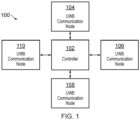
- the controller 102 may be send an instruction or command to the at least one of the UWB communication nodes 104, 106, 108, 110, which triggers said communication node or nodes to transmit the UWB messages.
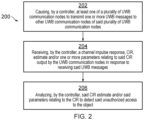
- the controller 102 is configured to receive a channel impulse response (CIR) estimate and/or one or more parameters relating to said CIR output by the UWB communication nodes 104, 106, 108, 110 in response to receiving said UWB messages.
- the controller 102 is configured to analyze the CIR estimate and/or the parameters relating to the CIR to detect the unauthorized access to the object. In this way, the detection of the unauthorized access is facilitated, without consuming a large amount of power.
- CIR channel impulse response
- the UWB communication nodes already present in an object or attached thereto for the purpose of enabling or granting access to the object may be reused to detect an intrusion to the object.
- These UWB communication nodes are often referred to as anchors.
- the object is a vehicle
- the UWB communication nodes are UWB anchors comprised in or attached to said vehicle.
- the UWB anchors can be used to exchange messages. This will allow to estimate the channel impulse response (CIR) and to derive parameters from the CIR.
- CIR channel impulse response
- the inventors have recognized that by analyzing this CIR and/or the parameters derived from the CIR, the aforementioned intrusion can easily be detected, while the power consumption of the system remains at an acceptable level.
- the existing UWB infrastructure in the vehicle may be re-used, by extending its purposes to intrusion detection.
- the power consumption and the computation effort are low.
- the use of anchor-to-anchor ranging may also increase the awareness of the environment around the vehicle, such that the results of the analysis may be used to improve the localization algorithms.
- information about the type of intrusion may be derived from the CIR and/or the parameters relating to the CIR (e.g., door opened, person inside, broken window).
- the CIR and/or the parameters relating to the CIR may provide an indication that one or more of the UWB anchors are being manipulated.
- the controller is configured to determine changes of the CIR estimate and/or of the parameters relating to the CIR, and to detect said unauthorized access by comparing the determined changes with predefined values and concluding that unauthorized access has occurred if the determined changes match with said predefined values within a given tolerance range. In this way, the detection of the unauthorized access is further facilitated.
- the controller is configured to cause different UWB communication nodes of said plurality of UWB communication nodes to transmit said UWB messages. In this way, the detection of the unauthorized access is further facilitated. By periodically changing the UWB communication node or nodes that transmit the messages, more intrusions may be detected. More specifically, it is possible that an intrusion is not be detected if a given UWB communication node transmits the messages, while it might be detected if another UWB communication node transmits the messages.
- the controller is configured to analyze said CIR estimate and/or said parameters relating to the CIR using a machine learning algorithm. In this way, the analysis of the estimated CIR and the parameters relating thereto is facilitated. This, in turn, further facilitates the detection of an intrusion.
- the machine learning algorithm is a decision tree algorithm, a neural network, a nearest neighbor algorithm, or a support vector machine.
- the controller is further configured to feed the machine learning algorithm with data indicative of an environment in which the object is located. In this way, the analysis of the estimated CIR and/or the parameters relating thereto may be optimized, in the sense that the environment of the object may be taken into account.
- the controller is configured to cause said at least at least one of the UWB communication nodes to transmit said UWB messages after the object has been locked. In this way, the system may be activated only at the appropriate time, which further reduces its power consumption.
- the controller is further configured to execute one or more predefined operations in response to detecting the unauthorized access to the object.
- the system may react in an appropriate way to a detected intrusion.
- the predefined operations comprise raising an alarm and/or activating one or more intrusion sensors. By raising an alarm, the intrusion may be brought to the attention of the owner of the object and/or to the attention of the authorities, for example. Furthermore, by activating one or more other intrusion sensors, the detected intrusion may be verified, for instance to avoid false alarms.
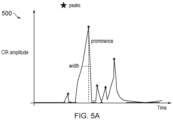
- the parameters relating to the CIR include at least one of the following parameters: a power level, a strongest path amplitude ratio, a strongest path time difference, a spectral power, a first path width, and a first path prominence. These parameters are particularly suitable for the purpose of detecting intrusions.
- Fig. 3 shows an illustrative embodiment of a vehicle 300.
- the vehicle 300 comprises a system for facilitating the detection of an unauthorized access of the kind set forth.
- the system includes a controller of the kind set forth, which is implemented as a body control module (BCM) 302.
- BCM body control module
- the system comprises a plurality of UWB communication nodes of the kind set forth, which are implemented as UWB anchors 304, 306, 308, 310, 312.
- the body control module (BCM) 302 is operatively coupled to the UWB anchors 304, 306, 308, 310, 312 through a network 314, which may be implemented as a controller area network (CAN).
- CAN controller area network
- the computer-readable medium may include the following: an electrical connection having one or more wires, a portable computer diskette, a random-access memory (RAM), a read-only memory (ROM), an erasable programmable read-only memory (EPROM or Flash memory), an optical fiber, a portable compact disc read-only memory (CDROM), a digital versatile disc (DVD), a Blu-ray disc (BD), and a memory card.
- RAM random-access memory
- ROM read-only memory
- EPROM or Flash memory erasable programmable read-only memory
- CDROM compact disc read-only memory
- DVD digital versatile disc
- BD Blu-ray disc
Landscapes
- Engineering & Computer Science (AREA)
- Physics & Mathematics (AREA)
- General Physics & Mathematics (AREA)
- Theoretical Computer Science (AREA)
- Software Systems (AREA)
- Computer Networks & Wireless Communication (AREA)
- Signal Processing (AREA)
- Computer Security & Cryptography (AREA)
- Evolutionary Computation (AREA)
- Mathematical Physics (AREA)
- Artificial Intelligence (AREA)
- Data Mining & Analysis (AREA)
- General Engineering & Computer Science (AREA)
- Computing Systems (AREA)
- Biophysics (AREA)
- Biomedical Technology (AREA)
- Computational Linguistics (AREA)
- Life Sciences & Earth Sciences (AREA)
- General Health & Medical Sciences (AREA)
- Molecular Biology (AREA)
- Health & Medical Sciences (AREA)
- Power Engineering (AREA)
- Automation & Control Theory (AREA)
- Fuzzy Systems (AREA)
- Computer Vision & Pattern Recognition (AREA)
- Medical Informatics (AREA)
- Mobile Radio Communication Systems (AREA)
Claims (13)
- Système (100) pour faciliter la détection d'un accès non autorisé à un objet, le système comprenant :une pluralité de nœuds de communication à bande ultra-large, UWB, (104, 106, 108, 110) ;un contrôleur (102) couplé de manière opérationnelle à ladite pluralité de nœuds de communication UWB (104, 106, 108, 110), où le contrôleur (102) est configuré pour :faire en sorte qu'au moins l'un des nœuds de communication UWB (104, 106, 108, 110) transmette un ou plusieurs messages UWB à d'autres nœuds de communication UWB de ladite pluralité de nœuds de communication UWB (104, 106, 108, 110) ;recevoir une estimation de réponse impulsionnelle de canal, CIR, et/ou un ou plusieurs paramètres relatifs à ladite sortie CIR par les nœuds de communication UWB (104, 106, 108, 110) en réponse à la réception desdits messages UWB ;analyser ladite estimation de CIR et/ou lesdits paramètres relatifs à la CIR pour détecter ledit accès non autorisé à l'objet ;caractérisé en ce que le contrôleur (102) est configuré pour amener différents nœuds de communication UWB de ladite pluralité de nœuds de communication UWB (104, 106, 108, 110) à transmettre lesdits messages UWB en changeant périodiquement le ou les nœuds de communication UWB qui transmettent les messages.
- Système (100) selon la revendication 1, dans lequel le contrôleur (102) est configuré pour déterminer les changements de l'estimation de la CIR et/ou des paramètres relatifs à la CIR, et pour détecter ledit accès non autorisé en comparant les changements déterminés avec des valeurs prédéfinies et en concluant qu'un accès non autorisé s'est produit si les changements déterminés correspondent auxdites valeurs prédéfinies dans une plage de tolérance donnée.
- Système (100) selon l'une quelconque des revendications précédentes, dans lequel le contrôleur (102) est configuré pour analyser ladite estimation de CIR et/ou lesdits paramètres relatifs à la CIR à l'aide d'un algorithme d'apprentissage automatique.
- Système (100) selon la revendication 3, dans lequel l'algorithme d'apprentissage automatique est un algorithme d'arbre de décision, un réseau neuronal, un algorithme du plus proche voisin ou une machine à vecteurs de support.
- Système (100) selon la revendication 3 ou la revendication 4, dans lequel le contrôleur (102) est en outre configuré pour fournir à l'algorithme d'apprentissage automatique des données indicatives d'un environnement dans lequel l'objet est situé.
- Système (100) selon l'une quelconque des revendications précédentes, dans lequel le contrôleur (102) est configuré pour amener au moins l'un des nœuds de communication UWB (104, 106, 108, 110) à transmettre lesdits messages UWB après que l'objet a été verrouillé.
- Système (100) selon l'une quelconque des revendications précédentes, dans lequel le contrôleur (102) est en outre configuré pour exécuter une ou plusieurs opérations prédéfinies en réponse à la détection de l'accès non autorisé à l'objet.
- Système (100) selon la revendication 7, dans lequel les opérations prédéfinies comprennent le déclenchement d'une alarme et/ou l'activation d'un ou plusieurs capteurs d'intrusion.
- Système (100) selon l'une quelconque des revendications précédentes, dans lequel les paramètres relatifs à la CIR comprennent au moins l'un des paramètres suivants :un niveau de puissance ;le rapport d'amplitude de trajet le plus fort ;la différence de temps de trajet la plus forte ;une puissance spectrale ;une première largeur de trajet ;une première proéminence de trajet.
- Système (100) selon l'une quelconque des revendications précédentes, dans lequel l'objet est un véhicule, et dans lequel les nœuds de communication UWB (104, 106, 108, 110) sont des ancres UWB comprises dans ledit véhicule ou fixées à celui-ci.
- Procédé (200) pour faciliter la détection d'un accès non autorisé à un objet, le procédé comprenant les étapes suivantes :faire en sorte (202), par un contrôleur, qu'au moins un d'une pluralité de nœuds de communication UWB transmette un ou plusieurs messages UWB à d'autres nœuds de communication UWB de ladite pluralité de nœuds de communication UWB ;recevoir (204), par le contrôleur, une estimation de réponse impulsionnelle de canal, CIR, et/ou un ou plusieurs paramètres relatifs à ladite CIR fournie par les nœuds de communication UWB en réponse à la réception desdits messages UWB ;analyser (206), par le contrôleur, ladite estimation de CIR et/ou lesdits paramètres relatifs à la CIR pour détecter ledit accès non autorisé à l'objet ;caractérisé en ce que le contrôleur fait en sorte que différents nœuds de communication UWB de ladite pluralité de nœuds de communication UWB transmettent lesdits messages UWB en changeant périodiquement le ou les nœuds de communication UWB qui transmettent les messages.
- Procédé (200) selon la revendication 11, dans lequel le contrôleur détermine les changements de l'estimation de la CIR et/ou des paramètres relatifs à la CIR, et détecte ledit accès non autorisé en comparant les changements déterminés avec des valeurs prédéfinies et en concluant qu'un accès non autorisé s'est produit si les changements déterminés correspondent auxdites valeurs prédéfinies dans une plage de tolérance donnée.
- Programme informatique comprenant des instructions exécutables qui, lorsqu'elles sont exécutées par un contrôleur, amènent ledit contrôleur à exécuter le procédé (200) selon la revendication 11 ou la revendication 12.
Priority Applications (3)
| Application Number | Priority Date | Filing Date | Title |
|---|---|---|---|
| EP21176376.8A EP4095818B1 (fr) | 2021-05-27 | 2021-05-27 | Système et procédé permettant de faciliter la détection d'un accès non autorisé à un objet |
| US17/705,468 US11941963B2 (en) | 2021-05-27 | 2022-03-28 | System and method for facilitating detecting an unauthorized access to an object |
| CN202210387008.2A CN115412919A (zh) | 2021-05-27 | 2022-04-13 | 用于促进检测对对象的未授权访问的系统和方法 |
Applications Claiming Priority (1)
| Application Number | Priority Date | Filing Date | Title |
|---|---|---|---|
| EP21176376.8A EP4095818B1 (fr) | 2021-05-27 | 2021-05-27 | Système et procédé permettant de faciliter la détection d'un accès non autorisé à un objet |
Publications (2)
| Publication Number | Publication Date |
|---|---|
| EP4095818A1 EP4095818A1 (fr) | 2022-11-30 |
| EP4095818B1 true EP4095818B1 (fr) | 2025-07-09 |
Family
ID=76250057
Family Applications (1)
| Application Number | Title | Priority Date | Filing Date |
|---|---|---|---|
| EP21176376.8A Active EP4095818B1 (fr) | 2021-05-27 | 2021-05-27 | Système et procédé permettant de faciliter la détection d'un accès non autorisé à un objet |
Country Status (3)
| Country | Link |
|---|---|
| US (1) | US11941963B2 (fr) |
| EP (1) | EP4095818B1 (fr) |
| CN (1) | CN115412919A (fr) |
Families Citing this family (11)
| Publication number | Priority date | Publication date | Assignee | Title |
|---|---|---|---|---|
| EP4109123A1 (fr) * | 2021-06-22 | 2022-12-28 | Nxp B.V. | Système et procédé pour faciliter la localisation d'un objet externe |
| US20230319811A1 (en) * | 2022-03-31 | 2023-10-05 | Robert Bosch Gmbh | Robust ultra-wideband system and method for in-vehicle sensing |
| US12526834B2 (en) | 2022-09-30 | 2026-01-13 | Robert Bosch Gmbh | Methods and systems for ultra-wideband localization |
| US12397743B2 (en) | 2023-03-10 | 2025-08-26 | Ford Global Technologies, Llc | Systems and methods for detecting/preventing vehicle parts theft |
| US12434648B2 (en) | 2023-06-20 | 2025-10-07 | Ford Global Technologies, Llc | Systems and methods for ultra-wide band based vehicle sensing |
| DE102023130087A1 (de) * | 2023-10-31 | 2025-04-30 | HELLA GmbH & Co. KGaA | Fahrzeug und Verfahren zur Detektion eines Eintretens einer Person in ein Gebäude |
| DE102023130055A1 (de) * | 2023-10-31 | 2025-04-30 | HELLA GmbH & Co. KGaA | Fahrzeug und Verfahren zur Niederschlagserkennung |
| EP4733806A1 (fr) * | 2024-10-22 | 2026-04-29 | STMicroelectronics International N.V. | Système et procédé de détection uwb pour localisation d'objets statiques dans des applications de stationnement de véhicules |
| DE102024131540A1 (de) * | 2024-10-29 | 2026-04-30 | HELLA GmbH & Co. KGaA | Verfahren zum Betrieb einer Diebstahlwarnanlage für ein Fahrzeug |
| DE102024131903A1 (de) * | 2024-10-31 | 2026-04-30 | HELLA GmbH & Co. KGaA | Verfahren zum Betrieb einer Diebstahlwarnanlage für ein Fahrzeug |
| DE102024210624A1 (de) * | 2024-11-05 | 2026-05-07 | Volkswagen Aktiengesellschaft | Verfahren zur kontaktlosen Erkennung zumindest einer Türstellung einer Tür in einem Kraftfahrzeug, Detektionsvorrichtung zur Durchführung eines solchen Verfahrens sowie Kraftfahrzeug mit einer derartigen Detektionsvorrichtung |
Family Cites Families (8)
| Publication number | Priority date | Publication date | Assignee | Title |
|---|---|---|---|---|
| US8461989B2 (en) | 2008-10-16 | 2013-06-11 | Lawrence Livermore National Security, Llc. | Smart container UWB sensor system for situational awareness of intrusion alarms |
| US8761322B2 (en) * | 2012-10-02 | 2014-06-24 | Qualcomm Incorporated | Methods and apparatuses for enhanced received signal processing based on a data-signal-aided channel impulse response estimation |
| US11181486B2 (en) * | 2019-12-18 | 2021-11-23 | Origin Wireless, Inc. | Method, apparatus, and system for wireless material sensing |
| WO2020128640A2 (fr) * | 2018-09-20 | 2020-06-25 | Bluecats Australia Pty Ltd. | Radar pour le suivi ou la génération d'images radar d'objets passifs |
| WO2020092413A1 (fr) | 2018-10-29 | 2020-05-07 | Metrom Rail, Llc | Procédés et systèmes de détection d'intrusion sur plateforme basée sur une bande ultralarge (uwb) |
| CN109246691B (zh) | 2018-11-19 | 2021-10-22 | 南京沃旭通讯科技有限公司 | 一种基于信道冲激响应的入侵检测方法 |
| US11402485B2 (en) * | 2019-04-30 | 2022-08-02 | Robert Bosch Gmbh | Ultra-wideband intelligent sensing system and method |
| US12078710B2 (en) * | 2020-06-26 | 2024-09-03 | Robert Bosch Gmbh | Occupancy sensing using ultra-wide band |
-
2021
- 2021-05-27 EP EP21176376.8A patent/EP4095818B1/fr active Active
-
2022
- 2022-03-28 US US17/705,468 patent/US11941963B2/en active Active
- 2022-04-13 CN CN202210387008.2A patent/CN115412919A/zh active Pending
Also Published As
| Publication number | Publication date |
|---|---|
| CN115412919A (zh) | 2022-11-29 |
| EP4095818A1 (fr) | 2022-11-30 |
| US20220383716A1 (en) | 2022-12-01 |
| US11941963B2 (en) | 2024-03-26 |
Similar Documents
| Publication | Publication Date | Title |
|---|---|---|
| EP4095818B1 (fr) | Système et procédé permettant de faciliter la détection d'un accès non autorisé à un objet | |
| US20220408400A1 (en) | System and method for facilitating localizing an external object | |
| US6400307B2 (en) | System and method for intrusion detection using a time domain radar array | |
| US11915537B2 (en) | Entry system and method of operating the same | |
| US10549722B2 (en) | Radar-based vehicle perimeter security and control | |
| US8354925B1 (en) | Monitoring using RF communication technology | |
| US20190330885A1 (en) | Door improvements and data mining via accelerometer and magnetometer electronic component | |
| JP6174419B2 (ja) | 侵入者検知システム | |
| CN109633571B (zh) | 一种77GHz毫米波道闸防砸雷达信号处理装置 | |
| JP4546717B2 (ja) | 車両の遠方からオートロックする方法 | |
| US20190107613A1 (en) | Radar detection methods and systems for identifying moving objects | |
| EP4198859B1 (fr) | Détermination d'un état de charge d'une plateforme à l'aide d'un test de rapport de vraisemblance | |
| KR20190069327A (ko) | 객체를 자동으로 개방하기 위한 방법 및 장치 | |
| EP3571521B1 (fr) | Système et procédé pour détecter un mouvement d'un actif mobile et pour commander des opérations de l'actif sur la base de son mouvement | |
| CN112470195A (zh) | 借助需要两项授权的识别系统操作机动车功能单元的方法及识别系统 | |
| JP2010158917A (ja) | 障害物検知システム及び車両装置 | |
| CN118036634B (zh) | Rfid柜门状态检测方法、系统、电子设备及存储介质 | |
| EP4321901B1 (fr) | Procédé et système de détection de cible | |
| US20250265914A1 (en) | A system and a method for collision and intrusion detection of a door | |
| CN108877124A (zh) | 应用于周界安防系统的入侵物检测方法及装置 | |
| CN121180145A (zh) | 车辆防盗检测方法、车辆及存储介质 | |
| CN120254855A (zh) | 障碍物检测方法、装置、车辆及存储介质 | |
| CN121789322A (zh) | 电动车门的解锁控制方法及车辆 | |
| CN119659525A (zh) | 用于启用车辆功能的方法以及相关联的启用设备 |
Legal Events
| Date | Code | Title | Description |
|---|---|---|---|
| PUAI | Public reference made under article 153(3) epc to a published international application that has entered the european phase |
Free format text: ORIGINAL CODE: 0009012 |
|
| STAA | Information on the status of an ep patent application or granted ep patent |
Free format text: STATUS: THE APPLICATION HAS BEEN PUBLISHED |
|
| AK | Designated contracting states |
Kind code of ref document: A1 Designated state(s): AL AT BE BG CH CY CZ DE DK EE ES FI FR GB GR HR HU IE IS IT LI LT LU LV MC MK MT NL NO PL PT RO RS SE SI SK SM TR |
|
| STAA | Information on the status of an ep patent application or granted ep patent |
Free format text: STATUS: REQUEST FOR EXAMINATION WAS MADE |
|
| 17P | Request for examination filed |
Effective date: 20230530 |
|
| RBV | Designated contracting states (corrected) |
Designated state(s): AL AT BE BG CH CY CZ DE DK EE ES FI FR GB GR HR HU IE IS IT LI LT LU LV MC MK MT NL NO PL PT RO RS SE SI SK SM TR |
|
| GRAP | Despatch of communication of intention to grant a patent |
Free format text: ORIGINAL CODE: EPIDOSNIGR1 |
|
| STAA | Information on the status of an ep patent application or granted ep patent |
Free format text: STATUS: GRANT OF PATENT IS INTENDED |
|
| INTG | Intention to grant announced |
Effective date: 20250225 |
|
| GRAS | Grant fee paid |
Free format text: ORIGINAL CODE: EPIDOSNIGR3 |
|
| GRAA | (expected) grant |
Free format text: ORIGINAL CODE: 0009210 |
|
| STAA | Information on the status of an ep patent application or granted ep patent |
Free format text: STATUS: THE PATENT HAS BEEN GRANTED |
|
| AK | Designated contracting states |
Kind code of ref document: B1 Designated state(s): AL AT BE BG CH CY CZ DE DK EE ES FI FR GB GR HR HU IE IS IT LI LT LU LV MC MK MT NL NO PL PT RO RS SE SI SK SM TR |
|
| REG | Reference to a national code |
Ref country code: GB Ref legal event code: FG4D |
|
| REG | Reference to a national code |
Ref country code: CH Ref legal event code: EP |
|
| REG | Reference to a national code |
Ref country code: IE Ref legal event code: FG4D |
|
| REG | Reference to a national code |
Ref country code: DE Ref legal event code: R096 Ref document number: 602021033650 Country of ref document: DE |
|
| REG | Reference to a national code |
Ref country code: NL Ref legal event code: MP Effective date: 20250709 |
|
| PG25 | Lapsed in a contracting state [announced via postgrant information from national office to epo] |
Ref country code: PT Free format text: LAPSE BECAUSE OF FAILURE TO SUBMIT A TRANSLATION OF THE DESCRIPTION OR TO PAY THE FEE WITHIN THE PRESCRIBED TIME-LIMIT Effective date: 20251110 |
|
| PG25 | Lapsed in a contracting state [announced via postgrant information from national office to epo] |
Ref country code: NL Free format text: LAPSE BECAUSE OF FAILURE TO SUBMIT A TRANSLATION OF THE DESCRIPTION OR TO PAY THE FEE WITHIN THE PRESCRIBED TIME-LIMIT Effective date: 20250709 |
|
| REG | Reference to a national code |
Ref country code: AT Ref legal event code: MK05 Ref document number: 1812616 Country of ref document: AT Kind code of ref document: T Effective date: 20250709 |
|
| PG25 | Lapsed in a contracting state [announced via postgrant information from national office to epo] |
Ref country code: IS Free format text: LAPSE BECAUSE OF FAILURE TO SUBMIT A TRANSLATION OF THE DESCRIPTION OR TO PAY THE FEE WITHIN THE PRESCRIBED TIME-LIMIT Effective date: 20251109 |
|
| PG25 | Lapsed in a contracting state [announced via postgrant information from national office to epo] |
Ref country code: NO Free format text: LAPSE BECAUSE OF FAILURE TO SUBMIT A TRANSLATION OF THE DESCRIPTION OR TO PAY THE FEE WITHIN THE PRESCRIBED TIME-LIMIT Effective date: 20251009 |
|
| REG | Reference to a national code |
Ref country code: LT Ref legal event code: MG9D |
|
| PG25 | Lapsed in a contracting state [announced via postgrant information from national office to epo] |
Ref country code: AT Free format text: LAPSE BECAUSE OF FAILURE TO SUBMIT A TRANSLATION OF THE DESCRIPTION OR TO PAY THE FEE WITHIN THE PRESCRIBED TIME-LIMIT Effective date: 20250709 |
|
| PG25 | Lapsed in a contracting state [announced via postgrant information from national office to epo] |
Ref country code: FI Free format text: LAPSE BECAUSE OF FAILURE TO SUBMIT A TRANSLATION OF THE DESCRIPTION OR TO PAY THE FEE WITHIN THE PRESCRIBED TIME-LIMIT Effective date: 20250709 |
|
| PG25 | Lapsed in a contracting state [announced via postgrant information from national office to epo] |
Ref country code: HR Free format text: LAPSE BECAUSE OF FAILURE TO SUBMIT A TRANSLATION OF THE DESCRIPTION OR TO PAY THE FEE WITHIN THE PRESCRIBED TIME-LIMIT Effective date: 20250709 |
|
| PG25 | Lapsed in a contracting state [announced via postgrant information from national office to epo] |
Ref country code: GR Free format text: LAPSE BECAUSE OF FAILURE TO SUBMIT A TRANSLATION OF THE DESCRIPTION OR TO PAY THE FEE WITHIN THE PRESCRIBED TIME-LIMIT Effective date: 20251010 |
|
| PG25 | Lapsed in a contracting state [announced via postgrant information from national office to epo] |
Ref country code: SE Free format text: LAPSE BECAUSE OF FAILURE TO SUBMIT A TRANSLATION OF THE DESCRIPTION OR TO PAY THE FEE WITHIN THE PRESCRIBED TIME-LIMIT Effective date: 20250709 |
|
| PG25 | Lapsed in a contracting state [announced via postgrant information from national office to epo] |
Ref country code: LV Free format text: LAPSE BECAUSE OF FAILURE TO SUBMIT A TRANSLATION OF THE DESCRIPTION OR TO PAY THE FEE WITHIN THE PRESCRIBED TIME-LIMIT Effective date: 20250709 |
|
| PG25 | Lapsed in a contracting state [announced via postgrant information from national office to epo] |
Ref country code: PL Free format text: LAPSE BECAUSE OF FAILURE TO SUBMIT A TRANSLATION OF THE DESCRIPTION OR TO PAY THE FEE WITHIN THE PRESCRIBED TIME-LIMIT Effective date: 20250709 Ref country code: BG Free format text: LAPSE BECAUSE OF FAILURE TO SUBMIT A TRANSLATION OF THE DESCRIPTION OR TO PAY THE FEE WITHIN THE PRESCRIBED TIME-LIMIT Effective date: 20250709 |
|
| PG25 | Lapsed in a contracting state [announced via postgrant information from national office to epo] |
Ref country code: RS Free format text: LAPSE BECAUSE OF FAILURE TO SUBMIT A TRANSLATION OF THE DESCRIPTION OR TO PAY THE FEE WITHIN THE PRESCRIBED TIME-LIMIT Effective date: 20251009 |
|
| PG25 | Lapsed in a contracting state [announced via postgrant information from national office to epo] |
Ref country code: ES Free format text: LAPSE BECAUSE OF FAILURE TO SUBMIT A TRANSLATION OF THE DESCRIPTION OR TO PAY THE FEE WITHIN THE PRESCRIBED TIME-LIMIT Effective date: 20250709 |
|
| PG25 | Lapsed in a contracting state [announced via postgrant information from national office to epo] |
Ref country code: SM Free format text: LAPSE BECAUSE OF FAILURE TO SUBMIT A TRANSLATION OF THE DESCRIPTION OR TO PAY THE FEE WITHIN THE PRESCRIBED TIME-LIMIT Effective date: 20250709 |
|
| PG25 | Lapsed in a contracting state [announced via postgrant information from national office to epo] |
Ref country code: DK Free format text: LAPSE BECAUSE OF FAILURE TO SUBMIT A TRANSLATION OF THE DESCRIPTION OR TO PAY THE FEE WITHIN THE PRESCRIBED TIME-LIMIT Effective date: 20250709 |
|
| PG25 | Lapsed in a contracting state [announced via postgrant information from national office to epo] |
Ref country code: IT Free format text: LAPSE BECAUSE OF FAILURE TO SUBMIT A TRANSLATION OF THE DESCRIPTION OR TO PAY THE FEE WITHIN THE PRESCRIBED TIME-LIMIT Effective date: 20250709 |
|
| PG25 | Lapsed in a contracting state [announced via postgrant information from national office to epo] |
Ref country code: CZ Free format text: LAPSE BECAUSE OF FAILURE TO SUBMIT A TRANSLATION OF THE DESCRIPTION OR TO PAY THE FEE WITHIN THE PRESCRIBED TIME-LIMIT Effective date: 20250709 |
|
| PG25 | Lapsed in a contracting state [announced via postgrant information from national office to epo] |
Ref country code: SK Free format text: LAPSE BECAUSE OF FAILURE TO SUBMIT A TRANSLATION OF THE DESCRIPTION OR TO PAY THE FEE WITHIN THE PRESCRIBED TIME-LIMIT Effective date: 20250709 Ref country code: EE Free format text: LAPSE BECAUSE OF FAILURE TO SUBMIT A TRANSLATION OF THE DESCRIPTION OR TO PAY THE FEE WITHIN THE PRESCRIBED TIME-LIMIT Effective date: 20250709 |