EP4109123A1 - Système et procédé pour faciliter la localisation d'un objet externe - Google Patents
Système et procédé pour faciliter la localisation d'un objet externe Download PDFInfo
- Publication number
- EP4109123A1 EP4109123A1 EP21180982.7A EP21180982A EP4109123A1 EP 4109123 A1 EP4109123 A1 EP 4109123A1 EP 21180982 A EP21180982 A EP 21180982A EP 4109123 A1 EP4109123 A1 EP 4109123A1
- Authority
- EP
- European Patent Office
- Prior art keywords
- cir
- uwb
- communication nodes
- controller
- parameters relating
- Prior art date
- Legal status (The legal status is an assumption and is not a legal conclusion. Google has not performed a legal analysis and makes no representation as to the accuracy of the status listed.)
- Pending
Links
Images



Classifications
-
- H—ELECTRICITY
- H04—ELECTRIC COMMUNICATION TECHNIQUE
- H04W—WIRELESS COMMUNICATION NETWORKS
- H04W64/00—Locating users or terminals or network equipment for network management purposes, e.g. mobility management
-
- G—PHYSICS
- G01—MEASURING; TESTING
- G01S—RADIO DIRECTION-FINDING; RADIO NAVIGATION; DETERMINING DISTANCE OR VELOCITY BY USE OF RADIO WAVES; LOCATING OR PRESENCE-DETECTING BY USE OF THE REFLECTION OR RERADIATION OF RADIO WAVES; ANALOGOUS ARRANGEMENTS USING OTHER WAVES
- G01S5/00—Position-fixing by co-ordinating two or more direction or position line determinations; Position-fixing by co-ordinating two or more distance determinations
- G01S5/02—Position-fixing by co-ordinating two or more direction or position line determinations; Position-fixing by co-ordinating two or more distance determinations using radio waves
- G01S5/0278—Position-fixing by co-ordinating two or more direction or position line determinations; Position-fixing by co-ordinating two or more distance determinations using radio waves involving statistical or probabilistic considerations
-
- G—PHYSICS
- G01—MEASURING; TESTING
- G01S—RADIO DIRECTION-FINDING; RADIO NAVIGATION; DETERMINING DISTANCE OR VELOCITY BY USE OF RADIO WAVES; LOCATING OR PRESENCE-DETECTING BY USE OF THE REFLECTION OR RERADIATION OF RADIO WAVES; ANALOGOUS ARRANGEMENTS USING OTHER WAVES
- G01S13/00—Systems using the reflection or reradiation of radio waves, e.g. radar systems; Analogous systems using reflection or reradiation of waves whose nature or wavelength is irrelevant or unspecified
- G01S13/02—Systems using reflection of radio waves, e.g. primary radar systems; Analogous systems
- G01S13/06—Systems determining position data of a target
- G01S13/08—Systems for measuring distance only
-
- G—PHYSICS
- G06—COMPUTING OR CALCULATING; COUNTING
- G06N—COMPUTING ARRANGEMENTS BASED ON SPECIFIC COMPUTATIONAL MODELS
- G06N20/00—Machine learning
-
- G—PHYSICS
- G06—COMPUTING OR CALCULATING; COUNTING
- G06N—COMPUTING ARRANGEMENTS BASED ON SPECIFIC COMPUTATIONAL MODELS
- G06N3/00—Computing arrangements based on biological models
- G06N3/02—Neural networks
-
- H—ELECTRICITY
- H04—ELECTRIC COMMUNICATION TECHNIQUE
- H04W—WIRELESS COMMUNICATION NETWORKS
- H04W4/00—Services specially adapted for wireless communication networks; Facilities therefor
- H04W4/80—Services using short range communication, e.g. near-field communication [NFC], radio-frequency identification [RFID] or low energy communication
-
- G—PHYSICS
- G01—MEASURING; TESTING
- G01S—RADIO DIRECTION-FINDING; RADIO NAVIGATION; DETERMINING DISTANCE OR VELOCITY BY USE OF RADIO WAVES; LOCATING OR PRESENCE-DETECTING BY USE OF THE REFLECTION OR RERADIATION OF RADIO WAVES; ANALOGOUS ARRANGEMENTS USING OTHER WAVES
- G01S5/00—Position-fixing by co-ordinating two or more direction or position line determinations; Position-fixing by co-ordinating two or more distance determinations
- G01S5/02—Position-fixing by co-ordinating two or more direction or position line determinations; Position-fixing by co-ordinating two or more distance determinations using radio waves
- G01S5/0284—Relative positioning
- G01S5/0289—Relative positioning of multiple transceivers, e.g. in ad hoc networks
-
- G—PHYSICS
- G07—CHECKING-DEVICES
- G07C—TIME OR ATTENDANCE REGISTERS; REGISTERING OR INDICATING THE WORKING OF MACHINES; GENERATING RANDOM NUMBERS; VOTING OR LOTTERY APPARATUS; ARRANGEMENTS, SYSTEMS OR APPARATUS FOR CHECKING NOT PROVIDED FOR ELSEWHERE
- G07C2209/00—Indexing scheme relating to groups G07C9/00 - G07C9/38
- G07C2209/60—Indexing scheme relating to groups G07C9/00174 - G07C9/00944
- G07C2209/63—Comprising locating means for detecting the position of the data carrier, i.e. within the vehicle or within a certain distance from the vehicle
-
- G—PHYSICS
- G07—CHECKING-DEVICES
- G07C—TIME OR ATTENDANCE REGISTERS; REGISTERING OR INDICATING THE WORKING OF MACHINES; GENERATING RANDOM NUMBERS; VOTING OR LOTTERY APPARATUS; ARRANGEMENTS, SYSTEMS OR APPARATUS FOR CHECKING NOT PROVIDED FOR ELSEWHERE
- G07C9/00—Individual registration on entry or exit
- G07C9/00174—Electronically operated locks; Circuits therefor; Nonmechanical keys therefor, e.g. passive or active electrical keys or other data carriers without mechanical keys
- G07C9/00309—Electronically operated locks; Circuits therefor; Nonmechanical keys therefor, e.g. passive or active electrical keys or other data carriers without mechanical keys operated with bidirectional data transmission between data carrier and locks
Definitions
- the present disclosure relates to a system for facilitating localizing an external object. Furthermore, the present disclosure relates to a corresponding method for facilitating localizing an external object, and to a corresponding computer program.
- Ultra-wideband is a technology that uses a high signal bandwidth, in particular for transmitting digital data over a wide spectrum of frequency bands with very low power.
- UWB technology may use the frequency spectrum of 3.1 to 10.6 GHz and may feature a high-frequency bandwidth of more than 500 MHz and very short pulse signals, potentially capable of supporting high data rates.
- the UWB technology enables a high data throughput for communication devices and a high precision for the localization of devices.
- UWB technology may be used for so-called ranging operations, i.e. for determining the distance between communicating devices.
- a system for facilitating localizing an external object, the system comprising: a plurality of ultra-wideband (UWB) communication nodes; a controller operatively coupled to said plurality of UWB communication nodes, wherein the controller is configured to: cause at least one of the UWB communication nodes to transmit one or more UWB messages to other UWB communication nodes of said plurality of UWB communication nodes; receive a channel impulse response (CIR) estimate and/or one or more parameters relating to said CIR output by the UWB communication nodes in response to receiving said UWB messages; analyze said CIR estimate and/or said parameters relating to the CIR; select a localization process in dependence on a result of analyzing said CIR estimate and/or said parameters relating to the CIR.
- UWB ultra-wideband
- the controller is configured to analyze said CIR estimate and/or said parameters relating to the CIR using a machine learning algorithm.
- the machine learning algorithm is primarily a decision tree algorithm, a neural network, a nearest neighbour algorithm, or a support vector machine.
- the controller is further configured to feed, in a training phase of the system, the machine learning algorithm with data indicative of an environment around the system.
- the parameters relating to the CIR include at least one of the following parameters: a power level; a strongest path amplitude ratio; a strongest path time difference; a spectral power; a first path width; a first path prominence.
- the localization process is an algorithm for localizing the external object.
- the algorithm for localizing the external object is a machine learning algorithm.
- the external object is a device for accessing a vehicle
- the UWB communication nodes are UWB anchors comprised in or attached to said vehicle.
- the device for accessing the vehicle is a key fob or a mobile device.
- a method for facilitating localizing an external object, the method comprising: causing, by a controller, at least one of a plurality of UWB communication nodes to transmit one or more UWB messages to other UWB communication nodes of said plurality of UWB communication nodes; receiving, by the controller, a channel impulse response, CIR, estimate and/or one or more parameters relating to said CIR output by the UWB communication nodes in response to receiving said UWB messages; analyzing, by the controller, said CIR estimate and/or said parameters relating to the CIR; selecting, by the controller, a localization process in dependence on a result of analyzing said CIR estimate and/or said parameters relating to the CIR.
- the controller analyzes said CIR estimate and/or said parameters relating to the CIR using a machine learning algorithm.
- the machine learning algorithm is primarily a decision tree algorithm, a neural network, a nearest neighbour algorithm, or a support vector machine.
- the controller feeds, in a training phase of the system, the machine learning algorithm with data indicative of an environment around the system.
- the parameters relating to the CIR include at least one of the following parameters: a power level; a strongest path amplitude ratio; a strongest path time difference; a spectral power; a first path width; a first path prominence.
- a computer program comprising executable instructions which, when executed by a controller, cause said controller to carry out a method of the kind set forth.
- ultra-wideband is a technology that uses a high signal bandwidth, in particular for transmitting digital data over a wide spectrum of frequency bands with very low power.
- UWB technology may use the frequency spectrum of 3.1 to 10.6 GHz and may feature a high-frequency bandwidth of more than 500 MHz and very short pulse signals, potentially capable of supporting high data rates.
- the UWB technology enables a high data throughput for communication devices and a high precision for the localization of devices.
- UWB technology may be used for so-called ranging operations, i.e. for determining the distance between communicating devices.
- UWB technology - also referred to as impulse-radio ultra-wideband (IR-UWB) - is a RF communication technology that uses pulses having a short duration for data communication.
- IR-UWB technology An important feature of IR-UWB technology is that it can be used for secure and accurate distance measurements between two or more devices. Typical distance measurement methods are the so-called single-sided two-way ranging (SS-TWR) method and the double-sided two-way ranging (DS-TWR) method.
- SS-TWR single-sided two-way ranging
- DS-TWR double-sided two-way ranging
- UWB technology has an accurate distance measurement capability, it may be used to advantage in access systems in which the position of devices should be determined to enable access to an object.
- a vehicle access system may comprise a user's smart device (e.g., key fob) and another smart device (e.g., an anchor embedded in the vehicle).
- the user's smart device must have a predefined range, velocity, and/or angle relative to the other smart device.
- UWB transceivers may operate in different modes of operation, such as a ranging mode, an angle-of-arrival (AoA) mode and a radar mode.
- UWB technology may be used for accessing a building or a predefined space within a building.
- frames will typically be exchanged between two devices via at least one antenna on each device, and at least a SS-TWR operation will be carried out (which may also be referred to as a ping-pong operation).
- a SS-TWR operation will be carried out (which may also be referred to as a ping-pong operation).
- CIRs channel impulse responses
- timestamps will be generated based on the CIRs on both devices, and those timestamps are exchanged.
- a time of flight (ToF) is calculated based on the timestamps and a range (i.e., a distance) is calculated based on the ToF.
- a DS-TWR operation may be carried out (which may also be referred to as a ping-pong-ping operation).
- the AoA mode of operation is similar to the ranging mode, but it involves at least two antennas on one device.
- two phase values associated with at least two CIRs are calculated on one device.
- a phase difference of arrival (PDoA) is calculated based on the two phase values, and an AoA is calculated based on the PDoA.
- frames are transmitted by at least one device and those frames are received by the same device and/or by one or more other devices.
- the CIRs are estimated on the device or devices receiving the frames, and the range and/or velocity and/or AoA are calculated based on the estimated CIRs.
- the modes may be implemented differently, depending on the requirements imposed by the application, for example.
- smart vehicle access systems may employ UWB technology to enable access to a vehicle, in particular by facilitating ranging operations between a key fob or a mobile device providing a similar functionality and one or more UWB anchors in the vehicle.
- localization processes that are based on an analysis of the channel impulse responses (CIRs) on the key fob or mobile device and UWB anchors, respectively, may be affected by the environment around the vehicle. More specifically, in some environments, a given localization process (i.e., a localization algorithm for localizing the key fob or mobile device) may perform well, while the same localization process may not perform well in another environment. Therefore, there may exist a need to facilitate a more robust localization of the key fob or mobile device by the localization system of the vehicle.
- CIRs channel impulse responses
- the external object may for example be a key fob or mobile device used for accessing a vehicle. More specifically, the presently disclosed system and method facilitate localizing the external object reliably in different environments in which the system may be used.
- Fig. 1 shows an illustrative embodiment of a system 100 for facilitating localizing an external object.
- the system 100 comprises a controller 102 and a plurality of UWB communication nodes 104, 106, 108, 110.
- the controller 102 is configured to cause at least one of the UWB communication nodes 104, 106, 108, 110 to transmit one or more UWB messages to other UWB communication nodes of said plurality of UWB communication nodes 104, 106, 108, 110.
- the controller 102 may send an instruction or command to the at least one of the UWB communication nodes 104, 106, 108, 110, which triggers said communication node or nodes to transmit the UWB messages.
- the controller 102 is configured to receive a channel impulse response (CIR) estimate and/or one or more parameters relating to said CIR output by the UWB communication nodes 104, 106, 108, 110 in response to receiving said UWB messages. Furthermore, the controller 102 is configured to analyze the CIR estimate and/or the parameters relating to the CIR. Furthermore, the controller 102 is configured to select a localization process in dependence on a result of analyzing said CIR estimate and/or said parameters relating to the CIR. In this way, a more robust localization of the external object is facilitated.
- CIR channel impulse response
- the UWB communication nodes already present in an object or attached thereto for the purpose of enabling or granting access to the object may be reused to select a suitable localization process.
- These UWB communication nodes are often referred to as anchors.
- the external object is a device for accessing a vehicle
- the UWB communication nodes are UWB anchors comprised in or attached to said vehicle.
- the UWB anchors can be used to exchange messages. This will allow to estimate the channel impulse response (CIR) and to derive parameters from the CIR.
- CIR channel impulse response
- the inventors have recognized that by analyzing this CIR and/or the parameters derived from the CIR, a suitable localization process for localizing the external object (e.g., a key fob or mobile device) may be selected, while the power consumption of the system remains at an acceptable level. Accordingly, the existing UWB infrastructure in the vehicle may be re-used, by extending its purposes to increasing the robustness of an access device localization. Compared to other techniques which might be used to increasing said robustness, such as techniques based on UWB-based radar, the power consumption and the computation effort are low.
- the controller is configured to analyze said CIR estimate and/or said parameters relating to the CIR using a machine learning algorithm. In this way, the analysis of the estimated CIR and the parameters relating thereto is facilitated. This, in turn, further facilitates properly localizing the external object.
- the machine learning algorithm is primarily a decision tree algorithm, a neural network, a nearest neighbour algorithm, or a support vector machine.
- the controller is further configured to feed, in a training phase of the system, the machine learning algorithm with data indicative of an environment around the system. In this way, the analysis of the estimated CIR and/or the parameters relating thereto may be optimized, in the sense that the environment of the system may be taken into account.
- the parameters relating to the CIR include at least one of the following parameters: a power level, a strongest path amplitude ratio, a strongest path time difference, a spectral power, a first path width, and a first path prominence. These parameters are particularly suitable for the purpose of selecting a suitable localization process.
- the parameters may be calculated from the CIR.
- the CIR has a peak every time there was a reflection in the signal.
- the first peak is thus the so-called first path (i.e., the shortest path the RF signal could travel from the transmitter to the responder).
- the strongest path can arrive later than the first path.
- the strongest path amplitude ratio is the ratio between the strongest path and the first path.
- strongest path time difference is the time (or distance) difference between the first path and the strongest path.
- the strongest path time difference may be the period that elapses between the moment the first path and the strongest path arrive at the receiver.
- the spectral power is the Fast Fourier Transform (FFT) of the CIR.
- the FP width is the width of the first path peak.
- the localization process is an algorithm for localizing the external object.
- the algorithm for localizing the external object is a machine learning algorithm.
- a machine learning algorithm is particularly suitable for the purpose of localizing an object.
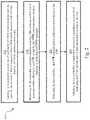
- Fig. 2 shows an illustrative embodiment of a method 200 for facilitating localizing an external object.
- the method 200 comprises the following steps.
- a controller causes at least one of a plurality of UWB communication nodes to transmit one or more UWB messages to other UWB communication nodes of said plurality of UWB communication nodes.
- the controller receives a CIR estimate and/or one or more parameters relating to said CIR output by the UWB communication nodes in response to receiving said UWB messages.
- the controller analyzes the CIR estimate and/or the parameters relating to the CIR.
- the controller selects a localization process in dependence on a result of analyzing said CIR estimate and/or said parameters relating to the CIR. As mentioned above, in this way, a more robust localization of the external object is facilitated.
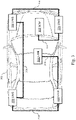
- Fig. 3 shows an illustrative embodiment of a vehicle 300.
- the vehicle 300 comprises a system for facilitating localizing an external object of the kind set forth.
- the system includes a controller of the kind set forth, which is implemented as a body control module (BCM) 302.
- BCM body control module
- the system comprises a plurality of UWB communication nodes of the kind set forth, which are implemented as UWB anchors 304, 306, 308, 310, 312.
- the body control module (BCM) 302 is operatively coupled to the UWB anchors 304, 306, 308, 310, 312 through a network 314, which may be implemented as a controller area network (CAN).
- CAN controller area network
- the UWB anchors 304, 306, 308, 310, 312 are connected to a central unit, i.e. the BCM 302, which is capable of controlling ranging operations and reading the results of said ranging operations.
- Each UWB anchor may be able to send and receive UWB messages and to output an estimate of the CIR resulting from the transmission and reception of the UWB messages.
- the UWB anchors 304, 306, 308, 310, 312 may be able to calculate parameters relating to the CIR, which may be provided to the BCM 302. It is noted that a typical architecture for car access applications uses four outside anchors (located at the corners of the car) and multiple inside anchors, for example three in the car cabin and one in the trunk area.
- the localization of a key fob or another access device may be negatively affected by changing environments.
- changing environments are typical for car access applications.
- a car or another vehicle may be located in a basement garage, in a crowded parking lot, or in an open space. These environments may have significantly different impacts on the performance of the localization process.
- Techniques like channel fingerprinting are not suitable for car access scenarios, since the environment is continually changing for a moving vehicle.
- the communication of a key fob to a car may be affected by the presence or absence of objects in the line of sight (LOS) path. Typically, it is not known whether the key fob communication is performed in an LOS scenario or not.
- LOS line of sight
- the presently disclosed system and method may be used as follows in a car access scenario, to facilitate a proper localization of a key fob.
- anchor-to-anchor communication may be used to scan the environment surrounding the vehicle.
- this anchor-to-anchor communication may yield information on the presence of other objects that can affect the communication with a key fob.
- By analyzing the channel impulse response from messages between the anchors it may be possible to obtain valuable information about the environment around the car. For instance, it may be possible to determine whether the car is located in a garage, in an empty parking lot, or in a dense parking lot. This information may help to choose which localization algorithm will be used to localize the key fob.
- the information about the environment may also be used to choose between different pre-trained machine learning algorithms that are used to localize the key fob.
- the localization algorithm may be a pre-trained machine learning algorithm.
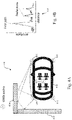
- Figs. 4A and 4B shows an illustrative embodiment of an environment 400 around a vehicle 402, and a corresponding channel impulse response 418, respectively.
- a car 402 is equipped for UWB-based smart access and/or for UWB-based relay protection.
- the car 402 contains several UWB anchors 404, 406, 408, 410, 412 distributed in different locations, for example some inside the car cabin, and some outside the car.
- UWB messages are typically exchanged between one or more anchors and an external key fob (not shown).
- the key fob is detected by means of Bluetooth low energy (BLE) communication with the car 402.
- BLE Bluetooth low energy
- the distance between the car 402 and the key fob is still large, so the determination of the environment using the CIR analysis based on anchor-to-anchor communication may still be performed while the key fob is far away.
- the anchor-to-anchor characterization i.e., the CIR analysis based on anchor-to-anchor communication
- the car 402 After the message exchange, the car 402 has an estimation of the distance of the key fob from each anchor, and a localization algorithm can be used to estimate the location of the key fob.
- the CIR 418 will show, in addition to the first path, peaks corresponding to the reflections caused by the walls 414, 416.
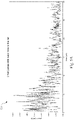
- Figs. 5A to 5C show illustrative embodiments of channel impulse responses 500, 502, 504 in different environments.
- Fig. 5A shows an illustrative embodiment of the channel impulse response 500 in a reflective environment, for example a small garage with walls close to the vehicle.
- Fig. 5B shows an illustrative embodiment of the channel impulse response 502 in a highly damped environment, for example an open parking lot on concrete or asphalt.
- Fig. 5C shows an illustrative embodiment of the channel impulse response in a fully damped environment, for example an open parking lot on grass. It is noted that the channel impulse responses 500, 502, 504 in the various environments are significantly different from each other.
- Fig. 6 shows an illustrative embodiment of a localization method 600.
- the method 600 contains an environment detection part 602 and a key fob localization part 608.
- a classification 606 may be performed which takes the CIR resulting from an anchor-to-anchor communication 604 as an input.
- it may be trained 604 by determining the CIR resulting from an anchor-to-anchor communication 604 in different environments, and store the CIR and/or data derived from as reference data for use by the classifier 606 when the latter enters into operation.
- the training 604 may need to be performed only once.
- the output of the classifier 606 is used to select a localization process which is used in the key fob localization part 608 of the method 600.
- the localization process is implemented by a classifier, which is thus selected in dependence on the output of the classifier 606 used in the first part 602 of the method 600.
- the selected classifier then performs a classification 614 on the CIR resulting from an anchor-to-fob communication 610, in order to determine the location of the fob.
- the system may use a machine learning algorithm that can first be trained 604.
- This training step 604 may be performed only once for a vehicle.
- the vehicle is placed in different environments and CIR data are collected during anchor-to-anchor communication 604.
- a classifier may be trained, and the model may be stored.
- anchor-to-anchor communication 604 is performed, the CIR may be analyzed through the stored model, and the output of the classifier 606 may be regarded as the most probable environment.
- the information on the detected environment i.e., the most probable environment
- the localization algorithm may also be a machine learning algorithm. In that case, several classifier models are stored in the vehicle, and the proper one is used for the analysis of the CIR in the anchor-to-fob communication 610.
- the systems and methods described herein may at least partially be embodied by a computer program or a plurality of computer programs, which may exist in a variety of forms both active and inactive in a single computer system or across multiple computer systems.
- they may exist as software program(s) comprised of program instructions in source code, object code, executable code or other formats for performing some of the steps.
- Any of the above may be embodied on a computer-readable medium, which may include storage devices and signals, in compressed or uncompressed form.
- the term "computer” refers to any electronic device comprising a processor, such as a general-purpose central processing unit (CPU), a specific-purpose processor or a microcontroller.
- a computer is capable of receiving data (an input), of performing a sequence of predetermined operations thereupon, and of producing thereby a result in the form of information or signals (an output).
- the term "computer” will mean either a processor in particular or more generally a processor in association with an assemblage of interrelated elements contained within a single case or housing.
- processor or “processing unit” refers to a data processing circuit that may be a microprocessor, a co-processor, a microcontroller, a microcomputer, a central processing unit, a field programmable gate array (FPGA), a programmable logic circuit, and/or any circuit that manipulates signals (analog or digital) based on operational instructions that are stored in a memory.
- memory refers to a storage circuit or multiple storage circuits such as read-only memory, random access memory, volatile memory, non-volatile memory, static memory, dynamic memory, Flash memory, cache memory, and/or any circuit that stores digital information.
- a "computer-readable medium” or “storage medium” may be any means that can contain, store, communicate, propagate, or transport a computer program for use by or in connection with the instruction execution system, apparatus, or device.
- the computer-readable medium may be, for example but not limited to, an electronic, magnetic, optical, electromagnetic, infrared, or semiconductor system, apparatus, device, or propagation medium.
- the computer-readable medium may include the following: an electrical connection having one or more wires, a portable computer diskette, a random-access memory (RAM), a read-only memory (ROM), an erasable programmable read-only memory (EPROM or Flash memory), an optical fiber, a portable compact disc read-only memory (CDROM), a digital versatile disc (DVD), a Blu-ray disc (BD), and a memory card.
- RAM random-access memory
- ROM read-only memory
- EPROM or Flash memory erasable programmable read-only memory
- CDROM compact disc read-only memory
- DVD digital versatile disc
- BD Blu-ray disc
Landscapes
- Engineering & Computer Science (AREA)
- Physics & Mathematics (AREA)
- Computer Networks & Wireless Communication (AREA)
- General Physics & Mathematics (AREA)
- Remote Sensing (AREA)
- Radar, Positioning & Navigation (AREA)
- Theoretical Computer Science (AREA)
- Signal Processing (AREA)
- Software Systems (AREA)
- Artificial Intelligence (AREA)
- General Engineering & Computer Science (AREA)
- Evolutionary Computation (AREA)
- Data Mining & Analysis (AREA)
- Mathematical Physics (AREA)
- Computing Systems (AREA)
- Biophysics (AREA)
- Computational Linguistics (AREA)
- Molecular Biology (AREA)
- General Health & Medical Sciences (AREA)
- Biomedical Technology (AREA)
- Computer Vision & Pattern Recognition (AREA)
- Medical Informatics (AREA)
- Life Sciences & Earth Sciences (AREA)
- Health & Medical Sciences (AREA)
- Probability & Statistics with Applications (AREA)
- Mobile Radio Communication Systems (AREA)
Priority Applications (3)
| Application Number | Priority Date | Filing Date | Title |
|---|---|---|---|
| EP21180982.7A EP4109123A1 (fr) | 2021-06-22 | 2021-06-22 | Système et procédé pour faciliter la localisation d'un objet externe |
| CN202210547786.3A CN115515224A (zh) | 2021-06-22 | 2022-05-18 | 便于定位外部对象的系统和方法 |
| US17/807,912 US12323943B2 (en) | 2021-06-22 | 2022-06-21 | System and method for facilitating localizing an external object |
Applications Claiming Priority (1)
| Application Number | Priority Date | Filing Date | Title |
|---|---|---|---|
| EP21180982.7A EP4109123A1 (fr) | 2021-06-22 | 2021-06-22 | Système et procédé pour faciliter la localisation d'un objet externe |
Publications (1)
| Publication Number | Publication Date |
|---|---|
| EP4109123A1 true EP4109123A1 (fr) | 2022-12-28 |
Family
ID=76600991
Family Applications (1)
| Application Number | Title | Priority Date | Filing Date |
|---|---|---|---|
| EP21180982.7A Pending EP4109123A1 (fr) | 2021-06-22 | 2021-06-22 | Système et procédé pour faciliter la localisation d'un objet externe |
Country Status (3)
| Country | Link |
|---|---|
| US (1) | US12323943B2 (fr) |
| EP (1) | EP4109123A1 (fr) |
| CN (1) | CN115515224A (fr) |
Families Citing this family (5)
| Publication number | Priority date | Publication date | Assignee | Title |
|---|---|---|---|---|
| US12078710B2 (en) * | 2020-06-26 | 2024-09-03 | Robert Bosch Gmbh | Occupancy sensing using ultra-wide band |
| EP4109123A1 (fr) * | 2021-06-22 | 2022-12-28 | Nxp B.V. | Système et procédé pour faciliter la localisation d'un objet externe |
| CN116338578A (zh) * | 2023-03-28 | 2023-06-27 | 大陆汽车电子(长春)有限公司 | 车辆周围环境的感知方法、装置、设备、介质和车辆 |
| CN121763288A (zh) * | 2024-09-29 | 2026-03-31 | 北京罗克维尔斯科技有限公司 | 一种障碍物识别方法、装置、车辆和存储介质 |
| EP4733806A1 (fr) * | 2024-10-22 | 2026-04-29 | STMicroelectronics International N.V. | Système et procédé de détection uwb pour localisation d'objets statiques dans des applications de stationnement de véhicules |
Citations (3)
| Publication number | Priority date | Publication date | Assignee | Title |
|---|---|---|---|---|
| US20090192709A1 (en) * | 2008-01-25 | 2009-07-30 | Garmin Ltd. | Position source selection |
| US20180234797A1 (en) * | 2017-02-10 | 2018-08-16 | Apple Inc. | Enhanced automotive passive entry |
| US20200348406A1 (en) * | 2019-04-30 | 2020-11-05 | Robert Bosch Gmbh | Ultra-wideband intelligent sensing system and method |
Family Cites Families (14)
| Publication number | Priority date | Publication date | Assignee | Title |
|---|---|---|---|---|
| US6121927A (en) * | 1996-10-29 | 2000-09-19 | Nokia Telecommunications Oy | Determination of terminal location in a radio system |
| AU2003220600A1 (en) * | 2002-03-27 | 2003-10-13 | Uraxs Communications, Inc. | Remote ultrawide band communication system with short messaging and other functions |
| US9166812B2 (en) * | 2006-01-31 | 2015-10-20 | Sigma Designs, Inc. | Home electrical device control within a wireless mesh network |
| USRE48832E1 (en) * | 2010-03-22 | 2021-11-23 | DecaWave, Ltd. | Measuring angle of incidence in an ultrawideband communication system |
| EP3268765B1 (fr) * | 2015-03-07 | 2024-01-17 | Verity AG | Systèmes et procédés de localisation distribués et appareil d'auto-localisation |
| US10972966B2 (en) * | 2019-03-27 | 2021-04-06 | Kabushiki Kaisha Toshiba | Managed flooding for bluetooth mesh networks |
| KR102771246B1 (ko) * | 2019-08-13 | 2025-02-24 | 주식회사 아모센스 | Uwb 안테나 모듈 및 이를 구비한 위치 측정 장치 |
| US11323294B2 (en) * | 2020-01-08 | 2022-05-03 | Nxp B.V. | Ultra-wideband device power optimization |
| US11102617B2 (en) * | 2020-01-15 | 2021-08-24 | Stmicroelectronics International N.V. | Indoor navigation and tracking with mesh network |
| US11714166B2 (en) * | 2020-03-26 | 2023-08-01 | Nxp B.V. | Key fob localization inside vehicle |
| EP4047383A1 (fr) | 2021-02-23 | 2022-08-24 | Nxp B.V. | Dispositif de communication et procédé de fonctionnement |
| EP4095818B1 (fr) * | 2021-05-27 | 2025-07-09 | Nxp B.V. | Système et procédé permettant de faciliter la détection d'un accès non autorisé à un objet |
| EP4109123A1 (fr) * | 2021-06-22 | 2022-12-28 | Nxp B.V. | Système et procédé pour faciliter la localisation d'un objet externe |
| US12073671B2 (en) * | 2021-09-09 | 2024-08-27 | Qualcomm Incorporated | Ultrawideband range accuracy |
-
2021
- 2021-06-22 EP EP21180982.7A patent/EP4109123A1/fr active Pending
-
2022
- 2022-05-18 CN CN202210547786.3A patent/CN115515224A/zh active Pending
- 2022-06-21 US US17/807,912 patent/US12323943B2/en active Active
Patent Citations (3)
| Publication number | Priority date | Publication date | Assignee | Title |
|---|---|---|---|---|
| US20090192709A1 (en) * | 2008-01-25 | 2009-07-30 | Garmin Ltd. | Position source selection |
| US20180234797A1 (en) * | 2017-02-10 | 2018-08-16 | Apple Inc. | Enhanced automotive passive entry |
| US20200348406A1 (en) * | 2019-04-30 | 2020-11-05 | Robert Bosch Gmbh | Ultra-wideband intelligent sensing system and method |
Also Published As
| Publication number | Publication date |
|---|---|
| US20220408400A1 (en) | 2022-12-22 |
| US12323943B2 (en) | 2025-06-03 |
| CN115515224A (zh) | 2022-12-23 |
Similar Documents
| Publication | Publication Date | Title |
|---|---|---|
| US12323943B2 (en) | System and method for facilitating localizing an external object | |
| EP4095818B1 (fr) | Système et procédé permettant de faciliter la détection d'un accès non autorisé à un objet | |
| US12604157B2 (en) | System and method for facilitating detecting an external object | |
| EP2789181B1 (fr) | Procédé, appareil et produit programme d'ordinateur pour estimer une distance de sécurité sur la base d'une mesure de direction | |
| US9207305B2 (en) | Methods and devices for channel identification | |
| US12339386B2 (en) | UWB ranging control device and UWB ranging method using the same | |
| US11973551B2 (en) | Communication device and operating method | |
| KR101150259B1 (ko) | 다중분리 레이더에서의 이동 표적 위치 추적 방법 및 장치와 이동 표적 위치 추적 방법을 실행하기 위한 프로그램이 기록된 기록매체 | |
| EP4059784A1 (fr) | Système d'entrée et son procédé de fonctionnement | |
| WO2014037687A1 (fr) | Procédés et dispositifs d'identification de canal | |
| EP3647990B1 (fr) | Localisation précise d'un objet à l'aide d'un dispositif réseau | |
| US12481052B2 (en) | Localization with reduced power consumption | |
| US20230039434A1 (en) | Communication device and position identification method | |
| US12255712B2 (en) | Communication device and method of operation | |
| KR101394603B1 (ko) | 침입 감지 장치 및 방법 | |
| EP4557803A1 (fr) | Procédé de détermination d'environnement de communication, appareil de traitement de données, véhicule et support de stockage | |
| Masek et al. | Improving the precision of wireless localization algorithms: ML techniques for indoor positioning | |
| US20230107754A1 (en) | System and method for facilitating detecting an external object | |
| KR20170054168A (ko) | 레이더 시스템의 씨파를 기반으로 하는 신호 처리 방법 및 그 장치 | |
| El-Awamry et al. | A novel multi-tag identification technique for frequency coded chipless RFID systems based on look-up-table approach | |
| Fernandes et al. | Wi-Fi intruder detection | |
| EP4321901B1 (fr) | Procédé et système de détection de cible | |
| WO2024150280A1 (fr) | Système de détection de condition, dispositif de détection, procédé de détection de condition et programme de détection de condition | |
| Jin | Machine Learning for Improved Ultra-wideband Localization | |
| Subramanian | Secure Proximity Detection and Verification |
Legal Events
| Date | Code | Title | Description |
|---|---|---|---|
| PUAI | Public reference made under article 153(3) epc to a published international application that has entered the european phase |
Free format text: ORIGINAL CODE: 0009012 |
|
| STAA | Information on the status of an ep patent application or granted ep patent |
Free format text: STATUS: THE APPLICATION HAS BEEN PUBLISHED |
|
| AK | Designated contracting states |
Kind code of ref document: A1 Designated state(s): AL AT BE BG CH CY CZ DE DK EE ES FI FR GB GR HR HU IE IS IT LI LT LU LV MC MK MT NL NO PL PT RO RS SE SI SK SM TR |
|
| STAA | Information on the status of an ep patent application or granted ep patent |
Free format text: STATUS: REQUEST FOR EXAMINATION WAS MADE |
|
| 17P | Request for examination filed |
Effective date: 20230628 |
|
| RBV | Designated contracting states (corrected) |
Designated state(s): AL AT BE BG CH CY CZ DE DK EE ES FI FR GB GR HR HU IE IS IT LI LT LU LV MC MK MT NL NO PL PT RO RS SE SI SK SM TR |
|
| STAA | Information on the status of an ep patent application or granted ep patent |
Free format text: STATUS: EXAMINATION IS IN PROGRESS |
|
| 17Q | First examination report despatched |
Effective date: 20250915 |