EP4097714B1 - Mise en oeuvre à complexité réduite pour annulation de bruit acoustique - Google Patents
Mise en oeuvre à complexité réduite pour annulation de bruit acoustique Download PDFInfo
- Publication number
- EP4097714B1 EP4097714B1 EP21724164.5A EP21724164A EP4097714B1 EP 4097714 B1 EP4097714 B1 EP 4097714B1 EP 21724164 A EP21724164 A EP 21724164A EP 4097714 B1 EP4097714 B1 EP 4097714B1
- Authority
- EP
- European Patent Office
- Prior art keywords
- filter
- signal
- impulse response
- output
- response
- Prior art date
- Legal status (The legal status is an assumption and is not a legal conclusion. Google has not performed a legal analysis and makes no representation as to the accuracy of the status listed.)
- Active
Links
Images



Classifications
-
- G—PHYSICS
- G10—MUSICAL INSTRUMENTS; ACOUSTICS
- G10K—SOUND-PRODUCING DEVICES; METHODS OR DEVICES FOR PROTECTING AGAINST, OR FOR DAMPING, NOISE OR OTHER ACOUSTIC WAVES IN GENERAL; ACOUSTICS NOT OTHERWISE PROVIDED FOR
- G10K11/00—Methods or devices for transmitting, conducting or directing sound in general; Methods or devices for protecting against, or for damping, noise or other acoustic waves in general
- G10K11/16—Methods or devices for protecting against, or for damping, noise or other acoustic waves in general
- G10K11/175—Methods or devices for protecting against, or for damping, noise or other acoustic waves in general using interference effects; Masking sound
- G10K11/178—Methods or devices for protecting against, or for damping, noise or other acoustic waves in general using interference effects; Masking sound by electro-acoustically regenerating the original acoustic waves in anti-phase
- G10K11/1785—Methods, e.g. algorithms; Devices
- G10K11/17855—Methods, e.g. algorithms; Devices for improving speed or power requirements
-
- G—PHYSICS
- G10—MUSICAL INSTRUMENTS; ACOUSTICS
- G10K—SOUND-PRODUCING DEVICES; METHODS OR DEVICES FOR PROTECTING AGAINST, OR FOR DAMPING, NOISE OR OTHER ACOUSTIC WAVES IN GENERAL; ACOUSTICS NOT OTHERWISE PROVIDED FOR
- G10K11/00—Methods or devices for transmitting, conducting or directing sound in general; Methods or devices for protecting against, or for damping, noise or other acoustic waves in general
- G10K11/16—Methods or devices for protecting against, or for damping, noise or other acoustic waves in general
- G10K11/175—Methods or devices for protecting against, or for damping, noise or other acoustic waves in general using interference effects; Masking sound
- G10K11/178—Methods or devices for protecting against, or for damping, noise or other acoustic waves in general using interference effects; Masking sound by electro-acoustically regenerating the original acoustic waves in anti-phase
- G10K11/1785—Methods, e.g. algorithms; Devices
- G10K11/17853—Methods, e.g. algorithms; Devices of the filter
- G10K11/17854—Methods, e.g. algorithms; Devices of the filter the filter being an adaptive filter
-
- G—PHYSICS
- G10—MUSICAL INSTRUMENTS; ACOUSTICS
- G10K—SOUND-PRODUCING DEVICES; METHODS OR DEVICES FOR PROTECTING AGAINST, OR FOR DAMPING, NOISE OR OTHER ACOUSTIC WAVES IN GENERAL; ACOUSTICS NOT OTHERWISE PROVIDED FOR
- G10K11/00—Methods or devices for transmitting, conducting or directing sound in general; Methods or devices for protecting against, or for damping, noise or other acoustic waves in general
- G10K11/16—Methods or devices for protecting against, or for damping, noise or other acoustic waves in general
- G10K11/175—Methods or devices for protecting against, or for damping, noise or other acoustic waves in general using interference effects; Masking sound
- G10K11/178—Methods or devices for protecting against, or for damping, noise or other acoustic waves in general using interference effects; Masking sound by electro-acoustically regenerating the original acoustic waves in anti-phase
- G10K11/1787—General system configurations
- G10K11/17879—General system configurations using both a reference signal and an error signal
-
- G—PHYSICS
- G10—MUSICAL INSTRUMENTS; ACOUSTICS
- G10K—SOUND-PRODUCING DEVICES; METHODS OR DEVICES FOR PROTECTING AGAINST, OR FOR DAMPING, NOISE OR OTHER ACOUSTIC WAVES IN GENERAL; ACOUSTICS NOT OTHERWISE PROVIDED FOR
- G10K11/00—Methods or devices for transmitting, conducting or directing sound in general; Methods or devices for protecting against, or for damping, noise or other acoustic waves in general
- G10K11/16—Methods or devices for protecting against, or for damping, noise or other acoustic waves in general
- G10K11/175—Methods or devices for protecting against, or for damping, noise or other acoustic waves in general using interference effects; Masking sound
- G10K11/178—Methods or devices for protecting against, or for damping, noise or other acoustic waves in general using interference effects; Masking sound by electro-acoustically regenerating the original acoustic waves in anti-phase
- G10K11/1787—General system configurations
- G10K11/17885—General system configurations additionally using a desired external signal, e.g. pass-through audio such as music or speech
-
- G—PHYSICS
- G10—MUSICAL INSTRUMENTS; ACOUSTICS
- G10K—SOUND-PRODUCING DEVICES; METHODS OR DEVICES FOR PROTECTING AGAINST, OR FOR DAMPING, NOISE OR OTHER ACOUSTIC WAVES IN GENERAL; ACOUSTICS NOT OTHERWISE PROVIDED FOR
- G10K11/00—Methods or devices for transmitting, conducting or directing sound in general; Methods or devices for protecting against, or for damping, noise or other acoustic waves in general
- G10K11/16—Methods or devices for protecting against, or for damping, noise or other acoustic waves in general
- G10K11/175—Methods or devices for protecting against, or for damping, noise or other acoustic waves in general using interference effects; Masking sound
- G10K11/178—Methods or devices for protecting against, or for damping, noise or other acoustic waves in general using interference effects; Masking sound by electro-acoustically regenerating the original acoustic waves in anti-phase
- G10K11/1787—General system configurations
- G10K11/17873—General system configurations using a reference signal without an error signal, e.g. pure feedforward
-
- G—PHYSICS
- G10—MUSICAL INSTRUMENTS; ACOUSTICS
- G10K—SOUND-PRODUCING DEVICES; METHODS OR DEVICES FOR PROTECTING AGAINST, OR FOR DAMPING, NOISE OR OTHER ACOUSTIC WAVES IN GENERAL; ACOUSTICS NOT OTHERWISE PROVIDED FOR
- G10K11/00—Methods or devices for transmitting, conducting or directing sound in general; Methods or devices for protecting against, or for damping, noise or other acoustic waves in general
- G10K11/16—Methods or devices for protecting against, or for damping, noise or other acoustic waves in general
- G10K11/175—Methods or devices for protecting against, or for damping, noise or other acoustic waves in general using interference effects; Masking sound
- G10K11/178—Methods or devices for protecting against, or for damping, noise or other acoustic waves in general using interference effects; Masking sound by electro-acoustically regenerating the original acoustic waves in anti-phase
- G10K11/1787—General system configurations
- G10K11/17875—General system configurations using an error signal without a reference signal, e.g. pure feedback
-
- G—PHYSICS
- G10—MUSICAL INSTRUMENTS; ACOUSTICS
- G10K—SOUND-PRODUCING DEVICES; METHODS OR DEVICES FOR PROTECTING AGAINST, OR FOR DAMPING, NOISE OR OTHER ACOUSTIC WAVES IN GENERAL; ACOUSTICS NOT OTHERWISE PROVIDED FOR
- G10K2210/00—Details of active noise control [ANC] covered by G10K11/178 but not provided for in any of its subgroups
- G10K2210/10—Applications
- G10K2210/108—Communication systems, e.g. where useful sound is kept and noise is cancelled
- G10K2210/1081—Earphones, e.g. for telephones, ear protectors or headsets
-
- G—PHYSICS
- G10—MUSICAL INSTRUMENTS; ACOUSTICS
- G10K—SOUND-PRODUCING DEVICES; METHODS OR DEVICES FOR PROTECTING AGAINST, OR FOR DAMPING, NOISE OR OTHER ACOUSTIC WAVES IN GENERAL; ACOUSTICS NOT OTHERWISE PROVIDED FOR
- G10K2210/00—Details of active noise control [ANC] covered by G10K11/178 but not provided for in any of its subgroups
- G10K2210/30—Means
- G10K2210/301—Computational
- G10K2210/3026—Feedback
-
- G—PHYSICS
- G10—MUSICAL INSTRUMENTS; ACOUSTICS
- G10K—SOUND-PRODUCING DEVICES; METHODS OR DEVICES FOR PROTECTING AGAINST, OR FOR DAMPING, NOISE OR OTHER ACOUSTIC WAVES IN GENERAL; ACOUSTICS NOT OTHERWISE PROVIDED FOR
- G10K2210/00—Details of active noise control [ANC] covered by G10K11/178 but not provided for in any of its subgroups
- G10K2210/30—Means
- G10K2210/301—Computational
- G10K2210/3027—Feedforward
-
- G—PHYSICS
- G10—MUSICAL INSTRUMENTS; ACOUSTICS
- G10K—SOUND-PRODUCING DEVICES; METHODS OR DEVICES FOR PROTECTING AGAINST, OR FOR DAMPING, NOISE OR OTHER ACOUSTIC WAVES IN GENERAL; ACOUSTICS NOT OTHERWISE PROVIDED FOR
- G10K2210/00—Details of active noise control [ANC] covered by G10K11/178 but not provided for in any of its subgroups
- G10K2210/30—Means
- G10K2210/301—Computational
- G10K2210/3031—Hardware, e.g. architecture
-
- G—PHYSICS
- G10—MUSICAL INSTRUMENTS; ACOUSTICS
- G10K—SOUND-PRODUCING DEVICES; METHODS OR DEVICES FOR PROTECTING AGAINST, OR FOR DAMPING, NOISE OR OTHER ACOUSTIC WAVES IN GENERAL; ACOUSTICS NOT OTHERWISE PROVIDED FOR
- G10K2210/00—Details of active noise control [ANC] covered by G10K11/178 but not provided for in any of its subgroups
- G10K2210/30—Means
- G10K2210/301—Computational
- G10K2210/3053—Speeding up computation or convergence, or decreasing the computational load
Definitions
- An active noise cancellation (ANC) system reduces or removes noise for the user of an audio playback system based on the external noise received from feedforward microphones and/or the feedback microphones.
- ANC systems emit an anti-noise audio signal from ambient noise, and add this signal to the audio output of the audio playback system so that it cancels or reduces noise at the eardrum of the user.
- these microphones are used to generate a correction audio signal from residual noise at the speaker of the audio playback system. The correction audio signal is also added or subtracted from the audio output of the audio playback system so that it cancels or reduces noise at the eardrum of the user.
- the computational architecture for such ANC system includes components that acquire/record the noise to be canceled, channel response filters that filter the noise using a transmission path transfer function and/or channel response filter, and components that subtract the resulting/recreated anti-noise signal and/or correction signal from the audio output.
- the channel response filters may include a channel response infinite impulse response (CR IIR) filter and a conventional channel response finite impulse response (CR FIR) filter.
- CR IIR channel response infinite impulse response
- CR FIR channel response finite impulse response
- the coefficients associated with the taps of these filters may be constantly adapted to track the transmission path and/or channel response, because the transmission path and/or channel is constantly varying.
- a conventional CR FIR filter may have several disadvantages.
- a filter may have a large response duration, as a result of requiring a large number of taps, such as 64-2048 taps.
- use of such a filter will be computationally expensive, as a result of its complexity, and produce significant power consumption in the ANC system.
- adapting and/or tracking coefficients for the taps of the conventional CR FIR filter will be computationally expensive and may lead to stability issues for the ANC system design.
- CN 107731217 A relates to the technical field of earphone noise reduction, in particular to an active noise reduction system and method for realizing frequency response fitting.
- the system comprises a noise collection path that includes a noise acquisition microphone and a first down-sampling filter in this order, a cascade noise reduction filter bank connected to the noise collection path which includes an IIR digital filter bank and an FIR digital filter cascaded with at least two IIR digital filters, the noise reference signal filtered by the cascaded noise reduction filter bank is coupled by an adder with an audio signal from a sound playback path that includes a sound playing unit, the output of the adder is filtered by an up-sampling filter.
- US 2018/115818 A1 describes a signal processing device including a first acquiring unit configured to acquire a sound collection result, a second acquiring unit configured to acquire a sound collection result, a first filter processing unit configured to generate a difference signal, a subtracting unit, a second filter processing unit configured to generate a noise reduction signal based on the subtraction signal, and an adding unit configured to add the difference signal and the noise reduction signal to the input acoustic signal and generate a drive signal.
- a further noise cancellation system is described in US 2012/155666 A1 , the system comprises a noise microphone followed by a fourth order decimator, a delay unit, followed by an adaptive digital FIR filter or a combination of FIR and IIR filters, the filter output is combined by an adder with a pulse code modulation sampled voice or music signal, the combined signal is passed to an interpolator to raise the over sampling rate for DAC.
- the invention is set forth in the independent claims. Specific embodiments are presented in the dependent claims.
- the present disclosure is directed to using a cascade filter configuration in an active noise canceling (ANC) system.
- the cascade filter configuration may include a simplified CR FIR filter and a response interpolator filter used in combination.
- one aspect of the subject matter described in this specification includes an active noise cancellation system.
- the system includes an infinite impulse response filter configured to filter a digital signal and output a first filtered digital signal.
- the system further includes a cascaded filter configuration in communication with the infinite impulse response filter.
- the cascaded filter configuration is configured to filter the first filtered digital signal and output an audio signal.
- the infinite impulse response filter may be coupled between the analog to digital converter and the cascaded filter configuration.
- the cascaded filter configuration includes an adaptive finite impulse response filter configured to filter the first filtered digital signal and to output a second filtered digital signal, and a response interpolator filter configured to filter the second filtered digital signal and output the audio signal.
- the active noise cancellation system may include one, several or all of the following features.
- the active noise cancellation system may include an adaptive tracker in communication with the cascaded filter configuration.
- the adaptive tracker may be configured to track, based on a channel response, non-zero coefficients of at least one of the infinite impulse response filter and the adaptive finite impulse response filter. The non-zero coefficients may be used by the at least one of the infinite impulse response filter and the adaptive finite impulse response filter.
- the response interpolator filter may be a fixed interpolator.
- the cascaded filter configuration may have a frequency response of a finite impulse response filter with a greater number of taps than the number of taps of the cascaded filter configuration.
- the adaptive finite impulse response filter may have interleaved zero coefficients.
- the adaptive finite impulse response filter may be implemented as a polyphase filter.
- the infinite impulse response filter may be implemented as a polyphase filter.
- the active noise cancellation system may further include an analog to digital converter in communication with the infinite impulse response filter.
- the analog to digital converter may be configured to convert at least one analog signal to the digital signal.
- the system further includes a subtractor in communication with the cascaded filter configuration. The subtractor is configured to receive a playback signal, and subtract the audio signal from the playback signal and output the result of the subtraction to a speaker.
- the active noise cancellation system may be within an earbud.
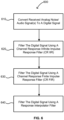
- a digital signal is filtered to produce a first filtered digital signal using an infinite impulse response filter.
- the first filtered digital signal is filtered to output a second filtered digital signal using an adaptive finite impulse response filter.
- the second filtered digital signal is filtered using a response interpolator filter.
- An audio signal is produced based on the output of the response interpolator filter.
- the audio signal output by the response interpolator filter is input to a subtractor, the subtractor configured to: receive a playback and/or voice audio signal;subtract the received audio signal from the playback and/or voice audio signal; and output the result of the subtraction to a speaker.
- the non-zero coefficients of at least one of the infinite impulse response filter and the adaptive finite impulse response filter may be tracked based on a channel response.
- the non-zero coefficients may be output for use by the at least one of the infinite impulse response filter and the adaptive finite impulse response filter.
- At least one analog signal may be converted to the digital signal.
- a CR FIR filter in a conventional ANC system may be replaced with a two filter cascade configuration.
- the first filter in the cascade filter configuration may be a CR FIR filter with interleaved zero coefficients and the second filter may be a response interpolator filter that is a fixed interpolator.
- the CR FIR filter in the two filter cascade may be adaptive and may have its non-zero coefficients tracked, updated, adapted, or computed using an adaptive tracker.
- the adaptive tracker may track the transmission path or channel response in order to update, adapt, or compute the coefficients of the CR FIR filter.
- the fixed interpolator in the two filter cascade is fixed and therefore non-adaptive.
- the fixed interpolator may have a fixed number of taps, such as 5-17 taps.
- the channel frequency response profile of the two filter cascade configuration may be similar to the channel frequency response profile of the conventional CR FIR filter that the cascade filter configuration replaces.
- the cascade filter configuration may have lower computational requirements when compared to conventional systems.
- the cascade filter configuration used in ANC systems may have a reduced number of non-zero filter taps, such as two to five times fewer taps when compared to conventional systems. This may allow for fewer non-zero coefficients which the adaptive tracker may need to track, update, adapt, or compute.
- the use of the cascade filter configuration in the ANC system may lead to a lower computational complexity, such as two to five times lower, when compared to conventional systems. As a result, this may lead to a lower power consumption by the cascade filter and the ANC system.
- the CR FIR filter of the two filter cascade may be adaptive, there may be fewer coefficients and/or taps to adapt, such as four to eight times fewer coefficients/taps to adapt when compared to conventional systems. Such a factor associated with a fewer number of coefficients and/or taps to adapt may be determined by an interpolation ratio. Thus, for a K-fold fixed interpolation, various savings scaled to K, such as the number of coefficients and/or taps to be adapted, may be achieved. As a result of the fewer number of coefficients and/or taps to adapt, the coefficient tracking and/or adaptation for this CR FIR filter within the cascade filter configuration may be less complex. This may lead to faster convergence rates when compared to conventional systems.
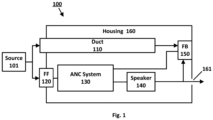
- FIG. 1 depicts a schematic illustration of audio playback system 100.
- the audio playback system 100 may include a housing 160 that contains various components of the system, including duct 110, feedforward microphone 120, ANC system 130, speaker 140, and feedback microphone 150.
- Source 101 may be any noise or audio information external to housing 160, including ambient noise or the like.
- Audio playback system 100 may be a speaker, a headphone, an earbud, or the like.
- audio playback system 100 may communicate with a computing device, such as a mobile phone, a tablet, a smart watch, or the like.
- the audio playback system 100 may include other components that are not shown in FIG. 1 , such as a communication interface, wireless transceiver, or the like.
- the computing device may provide audio playback system 100 with instructions to output sounds, such as voices, music, podcasts, system alert sounds, other audio signals, or the like.
- Housing 160 may include an exit opening 161 leading from an interior of the housing to the exterior of the housing. As such, exit opening 161 may allow for output from speaker 140 to exit audio playback system 100. For example, where audio playback system 100 is an earbud, exit opening 161 may allow for output audio to enter a user's ear from speaker 140.
- FIG. 2 depicts a block diagram of ANC system 200. While ANC system 130, described in connection with FIG. 1 , is depicted at a system component level, ANC system 200 depicts particular circuitry that may be within the ANC system 130. Similar to ANC system 130 of FIG. 1 , ANC system 200 may be included within an audio playback system, such as audio playback system 100 of FIG. 1 .
- ANC system 200 includes microphone(s) 202, an analog to digital converter 204, channel response infinite impulse response (CR IIR) filter 206, adaptive tracker 208, channel response finite impulse response (CR FIR) filter 210, and subtractor 212.
- CR IIR channel response infinite impulse response
- CR FIR channel response finite impulse response
- Microphone(s) 202 may be the feedforward and/or feedback microphones described in connection with FIG. 1 .
- microphone(s) 202 may include a feedforward microphone that may receive an external noise signal directly from a source. This received signal may be an analog signal.
- Microphone(s) 202 may include a feedback microphone that may receive an external noise signal from a source, other audio signals from a speaker, and/or other residual noise signals. The received signals may be analog signals.
- the microphone(s) 202 may output the signal(s) that it receives to the analog to digital converter (ADC) 204.
- ADC analog to digital converter
- Analog to digital converter (ADC) 204 converts analog signals to digital signals.
- the ADC 204 may receive analog noise and/or audio signal(s) from the microphone(s) 202 and convert these signals to digital signals.
- the digital signals may be processed further by various components, both shown and not shown, of the ANC system 200.
- the digital signals may be filtered by channel response infinite impulse response (CR IIR) filter 206.
- the CR IIR filter 206 may be a recursive filter.
- CR IIR filter 206 may be a filter that has an impulse response that is of infinite duration.
- the CR IIR filter 206 may use a linear combination of current and previous inputs, as well as previous outputs, to compute its current output. As a result of the use of its previous outputs, the CR IIR filter 206 may be considered to include feedback from its outputs.
- the linear combination of current and previous inputs as well as the previous outputs may make use of one or more filter coefficients as weights for each of these inputs/outputs.
- the filter coefficients may be associated with taps of the CR IIR filter 206.
- the CR IIR filter 206 may use its taps in filtering an input signal, such as by using its taps for computing the linear combination of its current and previous inputs and its previous outputs to compute an output signal.
- CR IIR filter 206 may be an adaptive filter.
- the coefficients associated with the taps of CR IIR filter 206 may be constantly adapted.
- the coefficients of CR IIR filter 206 may be constantly updated, adapted, and/or computed to track the transmission path and/or channel response of the transmission path and/or channel associated with use of the CR IIR filter 206. This transmission path and/or channel may be constantly varying, thereby causing the coefficients of CR IIR filter 206 to be constantly changing.
- Adaptive tracker 208 may track the transmission path and/or channel response in order to update, adapt, and/or compute filter coefficients. For example, in order to mimic the passage of an audio signal and/or noise through the transmission path and/or channel, such as the transmission path and/or channel in which the audio playback system 100 described in connection with FIG. 1 operates, adaptive tracker 208 may make various measurements associated with the transmission path and/or channel. Adaptive tracker 208 may compute various filter coefficients based on these measurements. Adaptive tracker 208 may output these coefficients to CR IIR filter 206 and/or to CR FIR filter 210 to be used as tap coefficients in these filters.
- CR FIR filter 210 may be a filter that has an impulse response that is of finite duration, settling to zero in finite time.
- the CR FIR filter 210 may use a linear combination of current and previous inputs in order to compute its current output.
- the CR FIR filter 210 may not use feedback from its previous outputs in order to compute the current output.
- the linear combination of current and previous inputs may make use of one or more filter coefficients as weights for each of these inputs.
- the filter coefficients may be associated with taps of the CR FIR filter 210.
- the CR FIR filter 210 may use its taps in filtering an input signal, such as by using its taps for computing the linear combination of its current and previous inputs to compute an output signal.
- CR FIR filter 210 may be an adaptive filter.
- the coefficients associated with the taps of CR FIR filter 210 may be constantly adapted.
- the coefficients of CR FIR filter 210 may be constantly updated, adapted, and/or computed to track the transmission path and/or channel response of the transmission path and/or channel associated with the CR FIR filter 210's use. This transmission path and/or channel may be constantly varying, thereby causing the coefficients of CR FIR filter 210 to be constantly changing.
- the coefficients may be changed, for example, in discrete, regular time intervals.
- CR FIR filter 210 may use adaptive tracker 208 to determine the values for its coefficients based on input information it receives from adaptive tracker 208.
- a mathematical representation of CR FIR filter 210 may be H FIR_OS .
- the output of CR FIR filter 210 may be input to subtractor 212.
- Subtractor 212 may subtract the output signal it receives from CR FIR filter 210 from a playback and/or voice audio signals that it receives.
- the playback and/or voice audio signals input to subtractor 212 may be received from a computing device.
- a computing device may provide the audio playback system, in which ANC system 200 operates, with signals and/or instructions to output audio playback signals such as sounds, music, podcasts, system alert sounds, and/or voice signals. These signals may be input to subtractor 212 and the output signal from CR FIR filter 210 may be subtracted from these signals.
- Subtractor 212 may output the result of the subtraction to a speaker, such as speaker 140 described in connection with FIG. 1 .
- subtractor 212 may instead be replaced by an adder that adds an anti-noise signal, such as the output signal from CR FIR filter 210 or a variant thereof, from the playback and/or voice audio signal.
- ANC system 200 may operate at a rate that may be substantially higher than the bandwidth of the audio signal(s) from which it reduces or removes noise. Such high rate operation may result in oversampling of signal(s) in the ANC system.
- ANC system 200 may operate at a sampling rate of 192 to 768 KHz, while the audio bandwidth may be less than 40 KHz.
- CR FIR filter 210 may have a large/long response duration, and may include a large number of taps.
- CR FIR filter 210 may have a number of taps that is between 64 and 2048. Because of the large number of taps, the number of filter coefficients that need to be tracked, updated, adapted, and/or computed may be large.
- FIG. 3 depicts a block diagram of ANC system 300, which has a reduced complexity, or the like, as compared to the ANC system 200 ( Fig. 2 ).
- ANC system 300 includes microphone(s) 302, an analog to digital converter 304, CR IIR filter 306, adaptive tracker 308, CR FIR filter 310a and response interpolator filter 310b, which are in a cascade filter configuration 310, and subtractor 312.
- ANC system 300 may be similar to ANC system 200 described in connection with FIG. 2 , however, CR FIR filter 210 in ANC system 200 may be replaced by CR FIR filter 310a and response interpolator filter 310b in the cascade filter configuration 310.
- CR IIR filter 306 may also vary from CR IIR filter 206.
- Microphone(s) 302 may be the feedforward and/or feedback microphones described in connection with FIG. 1 .
- microphone(s) 302 may include a feedforward microphone that may receive an external noise signal directly from a source. This received signal may be an analog signal.
- Microphone(s) 302 may include a feedback microphone that may receive an external noise signal from a source, other audio signals from a speaker, and/or other residual noise signals. The received signals may be analog signals.
- the microphone(s) 302 may output the signal(s) that it receives to the analog to digital converter (ADC) 304.
- ADC analog to digital converter
- the CR IIR filter 306 may be a recursive filter.
- CR IIR filter 306 may be a filter that has an impulse response that is of infinite duration.
- the CR IIR filter 306 may use a linear combination of the current and previous inputs as well as the previous outputs in order to compute its current output. As a result of the use of its previous outputs, the CR IIR filter 306 may be considered to include feedback from its outputs.
- the linear combination of current and previous inputs as well as the previous outputs may make use of one or more filter coefficients as weights for each of these inputs/outputs.
- the filter coefficients may be associated with taps of the CR IIR filter 306.
- the CR IIR filter 306 may use its taps in filtering an input signal, such as by using its taps for computing the linear combination of its current and previous inputs and its previous outputs to compute an output signal.
- CR IIR filter 306 may be an adaptive filter.
- the coefficients associated with the taps of CR IIR filter 306 may be constantly adapted.
- the coefficients of CR IIR filter 306 may be constantly updated, adapted, and/or computed to track the transmission path and/or channel response of the transmission path and/or channel associated with the CR IIR filter 306's use. This transmission path and/or channel may be constantly varying, thereby causing the coefficients of CR IIR filter 306 to be constantly changing.
- the coefficients may be changing, for example, in discrete, regular time intervals.
- CR IIR filter 306 may use adaptive tracker 308 to determine the values for its coefficients based on input information it receives from adaptive tracker 308.
- a mathematical representation of CR IIR filter 306 may be H IIR_CFC .
- the output of CR IIR filter 306 may be input to CR FIR filter 310a for further processing by CR FIR filter 310a.
- Response interpolator filter 310b may be fixed and therefore non-adaptive.
- the response interpolator filter 310b may have fixed coefficients and a pre-determined number of taps.
- the response interpolator filter 310b may receive an output signal from CR FIR filter 310a.
- the response interpolator filter 310b may up-sample and filter the signal it receives.
- response interpolator filter 310b may have its number of taps adjusted a-priori or during operation of the ANC system 300 based on the power limitations of ANC system 300 and/or the type of playback or voice signal for which ANC system 300 is being used.
- the response interpolator filter 310b may advantageously be implemented in a number of different ways.
- the response interpolator 310b may be of a constant length, and the composite response of the CR FIR filter 310a may be decomposed into a reduced length CR FIR filter and the response interpolator filter 310b to achieve an arbitrarily small error between the two filter designs as desired.
- the design of the response interpolator filter 310b may be selected from a number of interpolator designs, depending on the filter response desired and to yield further economy.
- the response interpolator 310b may be decomposed into several smaller filters, such as a cascaded integrator-comb (CIC) filter, to gain additional economy.
- the response interpolator filter 310b may be decomposed in polyphase form, such as what is described in greater detail below.
- CR IIR filter 306, CR FIR filter 310a, and response interpolator filter 310b may mimic the passage of an audio signal and/or noise through the transmission path and/or channel, such as the transmission path and/or channel in which the ANC system 300 and audio playback system 100, described in connection with FIG. 1 , operates. Therefore, CR IIR filter 306, CR FIR filter 310a, and response interpolator 310b may be used to emulate the channel response of the transmission path and/or channel in which the audio playback system 100 operates.
- the output of response interpolator filter 310b is input to subtractor 312.
- Subtractor 312 subtracts the output signal it receives from interpolator filter 310b from a playback and/or voice audio signals that it receives.
- the playback and/or voice audio signals input to subtractor 312 may be received from a computing device.
- a computing device may provide the audio playback system, in which ANC system 300 operates, with signals and/or instructions to output audio playback signals such as sounds, music, or podcasts, and/or voice signals. These signals may be input to subtractor 312 and the output signal from CR FIR filter 310b may be subtracted from these signals.
- Subtractor 312 outputs the result to a speaker, such as speaker 140 described in connection with FIG. 1 .
- subtractor 312 may instead be replaced by an adder that adds an anti-noise signal, such as the output signal from response interpolator filter 310b or a variant thereof, from the playback and/or voice audio signal.
- CR FIR filter 310a and response interpolator filter 310b may be in the cascade filter configuration 310. In some examples, CR FIR filter 310a and response interpolator filter 310b may be included together in a single hardware module. CR FIR filter 310a may be simpler in complexity and/or implementation when compared to CR FIR filter 210 described in connection with FIG. 2 . CR FIR filter 310a may include several non-zero coefficients interleaved with zero coefficients. As a result, CR FIR filter 310a may have a fewer number of taps, associated with the non-zero coefficients, when compared to FIR filter 210.
- FIR filter 310a may have four times to eight times fewer non-zero coefficients and filter taps when compared to FIR filter 210.
- CR FIR filter 310a may include fewer non-zero coefficients than zero coefficients.
- CR FIR filter 310a and response interpolator filter 310b in the cascade filter configuration 310 may have two times to five times fewer non-zero filter coefficients and corresponding filter taps when compared to CR FIR filter 210.
- CR FIR filter 310a and response interpolator filter 310b in the cascade filter configuration 310 may have two times to five times lower computational complexity when compared to CR FIR filter 210.
- CR IIR filter 306 represented by H IIR_CFC , may have poles and zeros away from the unit circle on a pole-zero plot of the filter. This may allow for easier implementation of the filter at lower word widths.
- the signal filtering performed within ANC system 300 may have benefits such as lower computational requirements, a lower number of filter taps, a reduced complexity, a lower power consumption, a faster response duration with faster convergence capability, a high degree of stability, and a lower computational expense when compared to the filtering performed within ANC system 200.
- FIG. 4 shows example graphs of the channel frequency responses of filters used in ANC systems.
- FIG. 4 may include channel frequency response graphs 410, 420, and 430.
- a channel frequency response graph of a filter may show the quantitative measure of the output frequency spectrum of the filter in response to an input.
- Such a channel frequency response graph for a particular filter may show the magnitude with which certain frequencies are accentuated or attenuated by the particular filter.
- channel frequency response graph 410 may show the frequency response of a CR FIR filter in a conventional ANC system, such as CR FIR filter 210 described in connection with FIG. 2 .
- the resulting filter which may be mathematically represented as H FIR_CFC , may have a frequency response profile substantially similar to what is shown in channel frequency response graph 420 described in connection with FIG. 4 .
- graph 420 may show a zero interleaved impulse response of the CR FIR filter, such as CR FIR filter 310a.
- the filter generated and mathematically represented by H FIR _ NYQUIST may have a response that is K times shorter than a conventional CR FIR filter, and may also have lower computational requirements than the conventional CR FIR filter.
- the resulting filter which may be mathematically represented as H IIR _ CFC , may not have a reduction in length, in terms of number of taps or order, when compared to a conventional CR IIR filter.
- the filter generated and mathematically represented by H IIR_NYQUIST may have poles and zeros away from the real axis on a pole-zero plot of the filter. This may allow for better stability and lower sensitivity of the filter when compared to a conventional CR IIR filter.
- FIG. 7 is a block diagram of an example electronic device 700.
- the electronic device 700 may include one or more processors 710, system memory 720, a bus 730, the networking interface(s) 740, and other components (not shown), such as storage(s), output device interface(s), input device interface(s).
- a bus 730 may be used for communicating between the processor 710, the system memory 720, the networking interface(s) 740, and other components.
Landscapes
- Physics & Mathematics (AREA)
- Engineering & Computer Science (AREA)
- Acoustics & Sound (AREA)
- Multimedia (AREA)
- Health & Medical Sciences (AREA)
- Audiology, Speech & Language Pathology (AREA)
- General Health & Medical Sciences (AREA)
- Soundproofing, Sound Blocking, And Sound Damping (AREA)
Claims (15)
- Système d'annulation active de bruit (130 ; 300 ; 500), le système (130 ; 300 ; 500) comprenant :un filtre à réponse impulsionnelle infinie (306 ; 506) configuré pour filtrer un signal numérique et délivrer en sortie un premier signal numérique filtré ; etune configuration de filtre en cascade (310) en communication avec le filtre à réponse impulsionnelle infinie (306 ; 506), la configuration de filtre en cascade (310) étant configurée pour filtrer le premier signal numérique filtré et délivrer en sortie un signal audio ;dans lequel la configuration de filtre en cascade (310) comporte :un filtre adaptatif à réponse impulsionnelle finie (310a ; 510) configuré pour filtrer le premier signal numérique filtré et pour délivrer en sortie un second signal numérique filtré, etun filtre interpolateur de réponse (310b ; 512) configuré pour filtrer le second signal numérique filtré et délivrer en sortie le signal audio, dans lequel le signal audio délivré en sortie par le filtre interpolateur de réponse (310b, 510) est entré dans un soustracteur (312), le soustracteur (312) étant configuré pour :recevoir un signal audio de lecture et/ou vocal ;soustraire le signal audio reçu à partir du signal audio de lecture et/ou vocal ; etdélivrer en sortie le résultat de la soustraction à un haut-parleur.
- Système (130 ; 300 ; 500) selon la revendication 1, comprenant également un dispositif de suivi adaptatif (308) en communication avec la configuration de filtre en cascade (310), le dispositif de suivi adaptatif (308) étant configuré pour suivre, sur la base d'une réponse de canal d'un canal dans lequel fonctionne un système de lecture audio (100) comprenant le système d'annulation active de bruit (130 ; 300 ; 500), des coefficients non nuls d'au moins un du filtre à réponse impulsionnelle infinie (306 ; 506) et du filtre adaptatif à réponse impulsionnelle finie (310a ; 510) ;
dans lequel, éventuellement, les coefficients non nuls sont utilisés par l'au moins un du filtre à réponse impulsionnelle infinie (306 ; 506) et du filtre adaptatif à réponse impulsionnelle finie (310a ; 510). - Système (130 ; 300 ; 500) selon la revendication 1, dans lequel le filtre interpolateur de réponse (310b ; 512) est un interpolateur fixe.
- Système (130 ; 300 ; 500) selon la revendication 1, dans lequel le filtre adaptatif à réponse impulsionnelle finie (310a ; 510) est mis en œuvre sous la forme d'un filtre polyphasé et/ou comporte des coefficients non nuls entrelacés avec des coefficients nuls.
- Système (130 ; 300 ; 500) selon la revendication 1, dans lequel le filtre à réponse impulsionnelle infinie (306 ; 506) est mis en œuvre sous la forme d'un filtre polyphasé.
- Système (130 ; 300 ; 500) selon la revendication 1, comprenant également un convertisseur analogique-numérique (304) en communication avec le filtre à réponse impulsionnelle infinie (306 ; 506), le convertisseur analogique-numérique étant configuré pour convertir au moins un signal analogique en signal numérique.
- Système (130 ; 300 ; 500) selon la revendication 1, comprenant également un soustracteur (312) en communication avec la configuration de filtre en cascade (310), le soustracteur (312) étant configuré pour :recevoir un signal de lecture, etsoustraire le signal audio à partir du signal de lecture.
- Système (130 ; 300 ; 500) selon la revendication 1, dans lequel le système d'annulation active de bruit (130 ; 300 ; 500) est agencé à l'intérieur d'un écouteur.
- Support non transitoire lisible par ordinateur (720) stockant des instructions qui, lorsqu'elles sont exécutées par un ou plusieurs processeurs (710), amènent les un ou plusieurs processeurs (710) à :filtrer un signal numérique pour produire un premier signal numérique filtré à l'aide d'un filtre à réponse impulsionnelle infinie (306 ; 506) ;filtrer le premier signal numérique filtré pour délivrer en sortie un second signal numérique filtré à l'aide d'un filtre adaptatif à réponse impulsionnelle finie (310a ; 510) ;filtrer le second signal numérique filtré à l'aide d'un filtre interpolateur de réponse (310b ; 512) ;délivrer en sortie un signal audio par le filtre interpolateur de réponse (310b ; 512) ; etentrer le signal audio délivré en sortie par le filtre interpolateur de réponse (310b, 510) dans un soustracteur (312), le soustracteur (312) étant configuré pour :recevoir un signal audio de lecture et/ou vocal ;soustraire le signal audio reçu à partir du signal audio de lecture et/ou vocal ; etdélivrer en sortie le résultat de la soustraction à un haut-parleur.
- Support non transitoire lisible par ordinateur (710) selon la revendication 9, dans lequel les instructions, lorsqu'elles sont exécutées par les un ou plusieurs processeurs (710), amènent les un ou plusieurs processeurs (710) à :suivre, sur la base d'une réponse de canal d'un canal dans lequel fonctionne un système de lecture audio (100) comprenant le système d'annulation active de bruit (130 ; 300 ; 500), des coefficients non nuls d'au moins un du filtre à réponse impulsionnelle infinie (306 ; 506) et du filtre adaptatif à réponse impulsionnelle finie (310a ; 510) ;dans lequel, éventuellement, les instructions, qui, lorsqu'elles sont exécutées par les un ou plusieurs processeurs (710), amènent les un ou plusieurs processeurs (710) à :
délivrer en sortie les coefficients non nuls pour utilisation par l'au moins un du filtre à réponse impulsionnelle infinie (306 ; 506) et du filtre adaptatif à réponse impulsionnelle finie (310a ; 510). - Support non transitoire lisible par ordinateur selon la revendication 9, dans lequel les instructions, lorsqu'elles sont exécutées par les un ou plusieurs processeurs (710), amènent les un ou plusieurs processeurs (710) à :
convertir au moins un signal analogique en signal numérique. - Support non transitoire lisible par ordinateur selon la revendication 9, dans lequel les instructions, lorsqu'elles sont exécutées par les un ou plusieurs processeurs (710), amènent les un ou plusieurs processeurs (710) à :recevoir un signal de lecture, etsoustraire le signal audio à partir du signal de lecture.
- Procédé (600) d'annulation active de bruit, le procédé comprenant :le filtrage (620) d'un signal numérique pour produire un premier signal numérique filtré à l'aide d'un filtre à réponse impulsionnelle infinie (306 ; 506) ;le filtrage (630) du premier signal numérique filtré pour délivrer en sortie un second signal numérique filtré à l'aide d'un filtre adaptatif à réponse impulsionnelle finie (310a ; 510) ;le filtrage (640) du second signal numérique filtré à l'aide d'un filtre interpolateur de réponse (310b ; 512) ; etla délivrance en sortie d'un signal audio par le filtre interpolateur de réponse (310b ; 512) etl'entrée du signal audio délivré en sortie par le filtre interpolateur de réponse (310b, 510) dans un soustracteur (312), le soustracteur (312) étant configuré pour :recevoir un signal audio de lecture et/ou vocal ;soustraire le signal audio reçu à partir du signal audio de lecture et/ou vocal ; etdélivrer en sortie le résultat de la soustraction à un haut-parleur.
- Procédé selon la revendication 13, comprenant également :
le suivi, sur la base d'une réponse de canal d'un canal dans lequel fonctionne un système de lecture audio (100) comprenant le système d'annulation active de bruit (130 ; 300 ; 500), des coefficients non nuls d'au moins un du filtre à réponse impulsionnelle infinie (306 ; 506) et du filtre adaptatif à réponse impulsionnelle finie (310a ; 510) ; et éventuellement : la délivrance en sortie des coefficients non nuls pour utilisation par l'au moins un du filtre à réponse impulsionnelle infinie (306 ; 506) et du filtre adaptatif à réponse impulsionnelle finie (310a ; 510). - Procédé selon la revendication 13, comprenant également :la conversion d'au moins un signal analogique en signal numérique ; oula réception d'un signal de lecture, etla soustraction du signal audio à partir du signal de lecture.
Applications Claiming Priority (1)
| Application Number | Priority Date | Filing Date | Title |
|---|---|---|---|
| PCT/US2021/028575 WO2022225521A1 (fr) | 2021-04-22 | 2021-04-22 | Mise en œuvre à complexité réduite pour annulation de bruit acoustique |
Publications (2)
| Publication Number | Publication Date |
|---|---|
| EP4097714A1 EP4097714A1 (fr) | 2022-12-07 |
| EP4097714B1 true EP4097714B1 (fr) | 2025-04-09 |
Family
ID=75850731
Family Applications (1)
| Application Number | Title | Priority Date | Filing Date |
|---|---|---|---|
| EP21724164.5A Active EP4097714B1 (fr) | 2021-04-22 | 2021-04-22 | Mise en oeuvre à complexité réduite pour annulation de bruit acoustique |
Country Status (4)
| Country | Link |
|---|---|
| US (1) | US20240054988A1 (fr) |
| EP (1) | EP4097714B1 (fr) |
| CN (1) | CN116940980A (fr) |
| WO (1) | WO2022225521A1 (fr) |
Family Cites Families (10)
| Publication number | Priority date | Publication date | Assignee | Title |
|---|---|---|---|---|
| WO2005094529A2 (fr) * | 2004-03-24 | 2005-10-13 | That Corporation | Filtre configurable utilise pour le traitement des signaux audio de television |
| US8094046B2 (en) * | 2007-03-02 | 2012-01-10 | Sony Corporation | Signal processing apparatus and signal processing method |
| WO2009155696A1 (fr) * | 2008-06-23 | 2009-12-30 | Kapik Inc. | Système et procédé pour traiter un signal avec un filtre en employant des éléments fir et iir |
| US8199924B2 (en) * | 2009-04-17 | 2012-06-12 | Harman International Industries, Incorporated | System for active noise control with an infinite impulse response filter |
| US8737636B2 (en) * | 2009-07-10 | 2014-05-27 | Qualcomm Incorporated | Systems, methods, apparatus, and computer-readable media for adaptive active noise cancellation |
| US20120155666A1 (en) * | 2010-12-16 | 2012-06-21 | Nair Vijayakumaran V | Adaptive noise cancellation |
| CN107431852B (zh) * | 2015-04-17 | 2019-10-01 | 索尼公司 | 信号处理装置、信号处理方法及计算机可读存储介质 |
| TWI648731B (zh) * | 2017-07-24 | 2019-01-21 | 驊訊電子企業股份有限公司 | 主動式降噪系統 |
| CN107731217B (zh) * | 2017-10-18 | 2020-09-25 | 恒玄科技(上海)股份有限公司 | 一种实现不同频率响应拟合的主动降噪系统及方法 |
| CN111566934B (zh) * | 2017-10-31 | 2024-04-09 | 谷歌有限责任公司 | 低延迟抽取滤波器和内插器滤波器 |
-
2021
- 2021-04-22 EP EP21724164.5A patent/EP4097714B1/fr active Active
- 2021-04-22 WO PCT/US2021/028575 patent/WO2022225521A1/fr not_active Ceased
- 2021-04-22 US US17/763,742 patent/US20240054988A1/en not_active Abandoned
- 2021-04-22 CN CN202180005950.1A patent/CN116940980A/zh active Pending
Also Published As
| Publication number | Publication date |
|---|---|
| EP4097714A1 (fr) | 2022-12-07 |
| US20240054988A1 (en) | 2024-02-15 |
| CN116940980A (zh) | 2023-10-24 |
| WO2022225521A1 (fr) | 2022-10-27 |
Similar Documents
| Publication | Publication Date | Title |
|---|---|---|
| US11205412B1 (en) | Hybrid active noise cancellation filter adaptation | |
| US11189261B1 (en) | Hybrid active noise control system | |
| US8655936B2 (en) | System and method for processing a signal with a filter employing FIR and IIR elements | |
| US8611551B1 (en) | Low latency active noise cancellation system | |
| US10904661B2 (en) | Low delay decimator and interpolator filters | |
| US8848935B1 (en) | Low latency active noise cancellation system | |
| JP3102986B2 (ja) | 能動型ノイズ消去装置 | |
| CN101803202A (zh) | 基于超采样数字处理的低延迟信号处理 | |
| CN116095553B (zh) | 一种用于耳机的anc系统、降噪方法及存储介质 | |
| EP0732838A2 (fr) | Annuleur d'écho acoustique | |
| CN109451398B (zh) | 声反馈消除设备、声反馈消除方法、音频处理系统 | |
| EP4097714B1 (fr) | Mise en oeuvre à complexité réduite pour annulation de bruit acoustique | |
| Lopes | Low-delay and low-cost sigma-delta adaptive controller for active noise control | |
| US10848131B1 (en) | Low power lattice wave filter systems and methods | |
| Abinaya et al. | Heuristic Analysis of Multiplierless Desensitized Half-Band Decimation Filter for Wireless Applications | |
| CN113661655A (zh) | 多通道、多速率、点阵波滤波器系统和方法 | |
| TWI774231B (zh) | 聲音輸入輸出系統及噪音消除電路 | |
| CN114913867B (zh) | 声音输入输出系统及噪音消除电路 | |
| Shanmugaraj et al. | Hearing aid speech signal enhancement via N-parallel FIR-multiplying polynomials for Tamil language dialect syllable ripple and transition variation | |
| Noor et al. | Improved, Low Complexity Noise Cancellation Technique for Speech Signals | |
| CN119767195A (zh) | 主动降噪方法和主动降噪耳机 | |
| Gruden et al. | Using spectral subtraction for suppression of noise in speech signals with analog integrated circuits | |
| Brennan et al. | Advances in subband adaptive filtering using a low-resource oversampled filterbank implementation |
Legal Events
| Date | Code | Title | Description |
|---|---|---|---|
| STAA | Information on the status of an ep patent application or granted ep patent |
Free format text: STATUS: UNKNOWN |
|
| STAA | Information on the status of an ep patent application or granted ep patent |
Free format text: STATUS: THE INTERNATIONAL PUBLICATION HAS BEEN MADE |
|
| PUAI | Public reference made under article 153(3) epc to a published international application that has entered the european phase |
Free format text: ORIGINAL CODE: 0009012 |
|
| STAA | Information on the status of an ep patent application or granted ep patent |
Free format text: STATUS: REQUEST FOR EXAMINATION WAS MADE |
|
| 17P | Request for examination filed |
Effective date: 20220405 |
|
| AK | Designated contracting states |
Kind code of ref document: A1 Designated state(s): AL AT BE BG CH CY CZ DE DK EE ES FI FR GB GR HR HU IE IS IT LI LT LU LV MC MK MT NL NO PL PT RO RS SE SI SK SM TR |
|
| RIN1 | Information on inventor provided before grant (corrected) |
Inventor name: HEYL, LAWRENCE, FREDERICK Inventor name: WARREN, NIEL, DAVID Inventor name: SUN, GUOHUA Inventor name: SHAH, ABHIJIT |
|
| STAA | Information on the status of an ep patent application or granted ep patent |
Free format text: STATUS: EXAMINATION IS IN PROGRESS |
|
| 17Q | First examination report despatched |
Effective date: 20231213 |
|
| DAV | Request for validation of the european patent (deleted) | ||
| DAX | Request for extension of the european patent (deleted) | ||
| GRAP | Despatch of communication of intention to grant a patent |
Free format text: ORIGINAL CODE: EPIDOSNIGR1 |
|
| STAA | Information on the status of an ep patent application or granted ep patent |
Free format text: STATUS: GRANT OF PATENT IS INTENDED |
|
| INTG | Intention to grant announced |
Effective date: 20241106 |
|
| RIN1 | Information on inventor provided before grant (corrected) |
Inventor name: HEYL, LAWRENCE FREDERICK Inventor name: WARREN, NIEL DAVID Inventor name: SUN, GUOHUA Inventor name: SHAH, ABHIJIT |
|
| GRAS | Grant fee paid |
Free format text: ORIGINAL CODE: EPIDOSNIGR3 |
|
| GRAA | (expected) grant |
Free format text: ORIGINAL CODE: 0009210 |
|
| STAA | Information on the status of an ep patent application or granted ep patent |
Free format text: STATUS: THE PATENT HAS BEEN GRANTED |
|
| AK | Designated contracting states |
Kind code of ref document: B1 Designated state(s): AL AT BE BG CH CY CZ DE DK EE ES FI FR GB GR HR HU IE IS IT LI LT LU LV MC MK MT NL NO PL PT RO RS SE SI SK SM TR |
|
| P01 | Opt-out of the competence of the unified patent court (upc) registered |
Free format text: CASE NUMBER: APP_10123/2025 Effective date: 20250227 |
|
| REG | Reference to a national code |
Ref country code: GB Ref legal event code: FG4D |
|
| REG | Reference to a national code |
Ref country code: CH Ref legal event code: EP |
|
| REG | Reference to a national code |
Ref country code: DE Ref legal event code: R096 Ref document number: 602021028905 Country of ref document: DE |
|
| REG | Reference to a national code |
Ref country code: IE Ref legal event code: FG4D |
|
| PGFP | Annual fee paid to national office [announced via postgrant information from national office to epo] |
Ref country code: NL Payment date: 20250427 Year of fee payment: 5 |
|
| REG | Reference to a national code |
Ref country code: NL Ref legal event code: FP |
|
| PGFP | Annual fee paid to national office [announced via postgrant information from national office to epo] |
Ref country code: DE Payment date: 20250425 Year of fee payment: 5 |
|
| PGFP | Annual fee paid to national office [announced via postgrant information from national office to epo] |
Ref country code: GB Payment date: 20250428 Year of fee payment: 5 |
|
| PGFP | Annual fee paid to national office [announced via postgrant information from national office to epo] |
Ref country code: AT Payment date: 20250721 Year of fee payment: 5 |
|
| REG | Reference to a national code |
Ref country code: AT Ref legal event code: MK05 Ref document number: 1784286 Country of ref document: AT Kind code of ref document: T Effective date: 20250409 |
|
| PG25 | Lapsed in a contracting state [announced via postgrant information from national office to epo] |
Ref country code: ES Free format text: LAPSE BECAUSE OF FAILURE TO SUBMIT A TRANSLATION OF THE DESCRIPTION OR TO PAY THE FEE WITHIN THE PRESCRIBED TIME-LIMIT Effective date: 20250409 Ref country code: PT Free format text: LAPSE BECAUSE OF FAILURE TO SUBMIT A TRANSLATION OF THE DESCRIPTION OR TO PAY THE FEE WITHIN THE PRESCRIBED TIME-LIMIT Effective date: 20250811 Ref country code: FI Free format text: LAPSE BECAUSE OF FAILURE TO SUBMIT A TRANSLATION OF THE DESCRIPTION OR TO PAY THE FEE WITHIN THE PRESCRIBED TIME-LIMIT Effective date: 20250409 |
|
| REG | Reference to a national code |
Ref country code: LT Ref legal event code: MG9D |
|
| PG25 | Lapsed in a contracting state [announced via postgrant information from national office to epo] |
Ref country code: GR Free format text: LAPSE BECAUSE OF FAILURE TO SUBMIT A TRANSLATION OF THE DESCRIPTION OR TO PAY THE FEE WITHIN THE PRESCRIBED TIME-LIMIT Effective date: 20250710 Ref country code: NO Free format text: LAPSE BECAUSE OF FAILURE TO SUBMIT A TRANSLATION OF THE DESCRIPTION OR TO PAY THE FEE WITHIN THE PRESCRIBED TIME-LIMIT Effective date: 20250709 |
|
| PG25 | Lapsed in a contracting state [announced via postgrant information from national office to epo] |
Ref country code: PL Free format text: LAPSE BECAUSE OF FAILURE TO SUBMIT A TRANSLATION OF THE DESCRIPTION OR TO PAY THE FEE WITHIN THE PRESCRIBED TIME-LIMIT Effective date: 20250409 |
|
| PG25 | Lapsed in a contracting state [announced via postgrant information from national office to epo] |
Ref country code: BG Free format text: LAPSE BECAUSE OF FAILURE TO SUBMIT A TRANSLATION OF THE DESCRIPTION OR TO PAY THE FEE WITHIN THE PRESCRIBED TIME-LIMIT Effective date: 20250409 |
|
| PG25 | Lapsed in a contracting state [announced via postgrant information from national office to epo] |
Ref country code: HR Free format text: LAPSE BECAUSE OF FAILURE TO SUBMIT A TRANSLATION OF THE DESCRIPTION OR TO PAY THE FEE WITHIN THE PRESCRIBED TIME-LIMIT Effective date: 20250409 |
|
| PG25 | Lapsed in a contracting state [announced via postgrant information from national office to epo] |
Ref country code: AT Free format text: LAPSE BECAUSE OF FAILURE TO SUBMIT A TRANSLATION OF THE DESCRIPTION OR TO PAY THE FEE WITHIN THE PRESCRIBED TIME-LIMIT Effective date: 20250409 |
|
| PG25 | Lapsed in a contracting state [announced via postgrant information from national office to epo] |
Ref country code: RS Free format text: LAPSE BECAUSE OF FAILURE TO SUBMIT A TRANSLATION OF THE DESCRIPTION OR TO PAY THE FEE WITHIN THE PRESCRIBED TIME-LIMIT Effective date: 20250709 |
|
| PG25 | Lapsed in a contracting state [announced via postgrant information from national office to epo] |
Ref country code: IS Free format text: LAPSE BECAUSE OF FAILURE TO SUBMIT A TRANSLATION OF THE DESCRIPTION OR TO PAY THE FEE WITHIN THE PRESCRIBED TIME-LIMIT Effective date: 20250809 |
|
| PG25 | Lapsed in a contracting state [announced via postgrant information from national office to epo] |
Ref country code: LV Free format text: LAPSE BECAUSE OF FAILURE TO SUBMIT A TRANSLATION OF THE DESCRIPTION OR TO PAY THE FEE WITHIN THE PRESCRIBED TIME-LIMIT Effective date: 20250409 |
|
| REG | Reference to a national code |
Ref country code: CH Ref legal event code: H13 Free format text: ST27 STATUS EVENT CODE: U-0-0-H10-H13 (AS PROVIDED BY THE NATIONAL OFFICE) Effective date: 20251125 |
|
| PG25 | Lapsed in a contracting state [announced via postgrant information from national office to epo] |
Ref country code: LU Free format text: LAPSE BECAUSE OF NON-PAYMENT OF DUE FEES Effective date: 20250422 |
|
| REG | Reference to a national code |
Ref country code: BE Ref legal event code: MM Effective date: 20250430 |
|
| REG | Reference to a national code |
Ref country code: DE Ref legal event code: R097 Ref document number: 602021028905 Country of ref document: DE |
|
| PG25 | Lapsed in a contracting state [announced via postgrant information from national office to epo] |
Ref country code: SM Free format text: LAPSE BECAUSE OF FAILURE TO SUBMIT A TRANSLATION OF THE DESCRIPTION OR TO PAY THE FEE WITHIN THE PRESCRIBED TIME-LIMIT Effective date: 20250409 Ref country code: DK Free format text: LAPSE BECAUSE OF FAILURE TO SUBMIT A TRANSLATION OF THE DESCRIPTION OR TO PAY THE FEE WITHIN THE PRESCRIBED TIME-LIMIT Effective date: 20250409 |
|
| PG25 | Lapsed in a contracting state [announced via postgrant information from national office to epo] |
Ref country code: BE Free format text: LAPSE BECAUSE OF NON-PAYMENT OF DUE FEES Effective date: 20250430 |
|
| PG25 | Lapsed in a contracting state [announced via postgrant information from national office to epo] |
Ref country code: CH Free format text: LAPSE BECAUSE OF NON-PAYMENT OF DUE FEES Effective date: 20250430 |
|
| PG25 | Lapsed in a contracting state [announced via postgrant information from national office to epo] |
Ref country code: CZ Free format text: LAPSE BECAUSE OF FAILURE TO SUBMIT A TRANSLATION OF THE DESCRIPTION OR TO PAY THE FEE WITHIN THE PRESCRIBED TIME-LIMIT Effective date: 20250409 |
|
| PG25 | Lapsed in a contracting state [announced via postgrant information from national office to epo] |
Ref country code: EE Free format text: LAPSE BECAUSE OF FAILURE TO SUBMIT A TRANSLATION OF THE DESCRIPTION OR TO PAY THE FEE WITHIN THE PRESCRIBED TIME-LIMIT Effective date: 20250409 |
|
| PG25 | Lapsed in a contracting state [announced via postgrant information from national office to epo] |
Ref country code: SK Free format text: LAPSE BECAUSE OF FAILURE TO SUBMIT A TRANSLATION OF THE DESCRIPTION OR TO PAY THE FEE WITHIN THE PRESCRIBED TIME-LIMIT Effective date: 20250409 |
|
| PG25 | Lapsed in a contracting state [announced via postgrant information from national office to epo] |
Ref country code: IT Free format text: LAPSE BECAUSE OF FAILURE TO SUBMIT A TRANSLATION OF THE DESCRIPTION OR TO PAY THE FEE WITHIN THE PRESCRIBED TIME-LIMIT Effective date: 20250409 |
|
| PG25 | Lapsed in a contracting state [announced via postgrant information from national office to epo] |
Ref country code: MC Free format text: LAPSE BECAUSE OF FAILURE TO SUBMIT A TRANSLATION OF THE DESCRIPTION OR TO PAY THE FEE WITHIN THE PRESCRIBED TIME-LIMIT Effective date: 20250409 |
|
| PG25 | Lapsed in a contracting state [announced via postgrant information from national office to epo] |
Ref country code: RO Free format text: LAPSE BECAUSE OF FAILURE TO SUBMIT A TRANSLATION OF THE DESCRIPTION OR TO PAY THE FEE WITHIN THE PRESCRIBED TIME-LIMIT Effective date: 20250409 |
|
| PLBE | No opposition filed within time limit |
Free format text: ORIGINAL CODE: 0009261 |
|
| STAA | Information on the status of an ep patent application or granted ep patent |
Free format text: STATUS: NO OPPOSITION FILED WITHIN TIME LIMIT |
|
| REG | Reference to a national code |
Ref country code: CH Ref legal event code: L10 Free format text: ST27 STATUS EVENT CODE: U-0-0-L10-L00 (AS PROVIDED BY THE NATIONAL OFFICE) Effective date: 20260218 |
|
| 26N | No opposition filed |
Effective date: 20260112 |
|
| PG25 | Lapsed in a contracting state [announced via postgrant information from national office to epo] |
Ref country code: IE Free format text: LAPSE BECAUSE OF NON-PAYMENT OF DUE FEES Effective date: 20250422 |
|
| PG25 | Lapsed in a contracting state [announced via postgrant information from national office to epo] |
Ref country code: FR Free format text: LAPSE BECAUSE OF NON-PAYMENT OF DUE FEES Effective date: 20250609 |