EP4102016A2 - Bande pour porte, un portail, un volet ou une fenêtre, système de bande doté d'une telle bande et d'une autre bande, ainsi que dispositif d'objet de verrouillage doté d'un tel système de bande - Google Patents
Bande pour porte, un portail, un volet ou une fenêtre, système de bande doté d'une telle bande et d'une autre bande, ainsi que dispositif d'objet de verrouillage doté d'un tel système de bande Download PDFInfo
- Publication number
- EP4102016A2 EP4102016A2 EP22165363.7A EP22165363A EP4102016A2 EP 4102016 A2 EP4102016 A2 EP 4102016A2 EP 22165363 A EP22165363 A EP 22165363A EP 4102016 A2 EP4102016 A2 EP 4102016A2
- Authority
- EP
- European Patent Office
- Prior art keywords
- bearing
- receiving part
- pin
- hinge
- eccentric bushing
- Prior art date
- Legal status (The legal status is an assumption and is not a legal conclusion. Google has not performed a legal analysis and makes no representation as to the accuracy of the status listed.)
- Pending
Links
Images



Classifications
-
- E—FIXED CONSTRUCTIONS
- E05—LOCKS; KEYS; WINDOW OR DOOR FITTINGS; SAFES
- E05D—HINGES OR SUSPENSION DEVICES FOR DOORS, WINDOWS OR WINGS
- E05D7/00—Hinges or pivots of special construction
- E05D7/0009—Adjustable hinges
- E05D7/0018—Adjustable hinges at the hinge axis
- E05D7/0045—Adjustable hinges at the hinge axis in a radial direction
- E05D7/0054—Adjustable hinges at the hinge axis in a radial direction by means of eccentric parts
-
- E—FIXED CONSTRUCTIONS
- E05—LOCKS; KEYS; WINDOW OR DOOR FITTINGS; SAFES
- E05D—HINGES OR SUSPENSION DEVICES FOR DOORS, WINDOWS OR WINGS
- E05D11/00—Additional features or accessories of hinges
- E05D11/02—Lubricating arrangements
-
- E—FIXED CONSTRUCTIONS
- E05—LOCKS; KEYS; WINDOW OR DOOR FITTINGS; SAFES
- E05D—HINGES OR SUSPENSION DEVICES FOR DOORS, WINDOWS OR WINGS
- E05D11/00—Additional features or accessories of hinges
- E05D11/04—Additional features or accessories of hinges relating to the use of free balls as bearing-surfaces
-
- E—FIXED CONSTRUCTIONS
- E05—LOCKS; KEYS; WINDOW OR DOOR FITTINGS; SAFES
- E05D—HINGES OR SUSPENSION DEVICES FOR DOORS, WINDOWS OR WINGS
- E05D7/00—Hinges or pivots of special construction
- E05D7/06—Hinges or pivots of special construction to allow tilting of the members
-
- E—FIXED CONSTRUCTIONS
- E05—LOCKS; KEYS; WINDOW OR DOOR FITTINGS; SAFES
- E05D—HINGES OR SUSPENSION DEVICES FOR DOORS, WINDOWS OR WINGS
- E05D7/00—Hinges or pivots of special construction
- E05D7/0009—Adjustable hinges
- E05D7/0018—Adjustable hinges at the hinge axis
- E05D7/0045—Adjustable hinges at the hinge axis in a radial direction
- E05D7/0054—Adjustable hinges at the hinge axis in a radial direction by means of eccentric parts
- E05D2007/0063—Eccentric hinge pins
-
- E—FIXED CONSTRUCTIONS
- E05—LOCKS; KEYS; WINDOW OR DOOR FITTINGS; SAFES
- E05D—HINGES OR SUSPENSION DEVICES FOR DOORS, WINDOWS OR WINGS
- E05D7/00—Hinges or pivots of special construction
- E05D7/0009—Adjustable hinges
- E05D7/0018—Adjustable hinges at the hinge axis
- E05D7/0045—Adjustable hinges at the hinge axis in a radial direction
- E05D2007/0081—Adjustable hinges at the hinge axis in a radial direction with swinging or rolling sleeves
-
- E—FIXED CONSTRUCTIONS
- E05—LOCKS; KEYS; WINDOW OR DOOR FITTINGS; SAFES
- E05D—HINGES OR SUSPENSION DEVICES FOR DOORS, WINDOWS OR WINGS
- E05D3/00—Hinges with pins
- E05D3/02—Hinges with pins with one pin
-
- E—FIXED CONSTRUCTIONS
- E05—LOCKS; KEYS; WINDOW OR DOOR FITTINGS; SAFES
- E05Y—INDEXING SCHEME ASSOCIATED WITH SUBCLASSES E05D AND E05F, RELATING TO CONSTRUCTION ELEMENTS, ELECTRIC CONTROL, POWER SUPPLY, POWER SIGNAL OR TRANSMISSION, USER INTERFACES, MOUNTING OR COUPLING, DETAILS, ACCESSORIES, AUXILIARY OPERATIONS NOT OTHERWISE PROVIDED FOR, APPLICATION THEREOF
- E05Y2201/00—Constructional elements; Accessories therefor
- E05Y2201/60—Suspension or transmission members; Accessories therefor
- E05Y2201/622—Suspension or transmission members elements
- E05Y2201/628—Bearings
-
- E—FIXED CONSTRUCTIONS
- E05—LOCKS; KEYS; WINDOW OR DOOR FITTINGS; SAFES
- E05Y—INDEXING SCHEME ASSOCIATED WITH SUBCLASSES E05D AND E05F, RELATING TO CONSTRUCTION ELEMENTS, ELECTRIC CONTROL, POWER SUPPLY, POWER SIGNAL OR TRANSMISSION, USER INTERFACES, MOUNTING OR COUPLING, DETAILS, ACCESSORIES, AUXILIARY OPERATIONS NOT OTHERWISE PROVIDED FOR, APPLICATION THEREOF
- E05Y2800/00—Details, accessories and auxiliary operations not otherwise provided for
- E05Y2800/10—Additional functions
- E05Y2800/108—Lubrication
-
- E—FIXED CONSTRUCTIONS
- E05—LOCKS; KEYS; WINDOW OR DOOR FITTINGS; SAFES
- E05Y—INDEXING SCHEME ASSOCIATED WITH SUBCLASSES E05D AND E05F, RELATING TO CONSTRUCTION ELEMENTS, ELECTRIC CONTROL, POWER SUPPLY, POWER SIGNAL OR TRANSMISSION, USER INTERFACES, MOUNTING OR COUPLING, DETAILS, ACCESSORIES, AUXILIARY OPERATIONS NOT OTHERWISE PROVIDED FOR, APPLICATION THEREOF
- E05Y2800/00—Details, accessories and auxiliary operations not otherwise provided for
- E05Y2800/40—Physical or chemical protection
- E05Y2800/404—Physical or chemical protection against component faults or failure
-
- E—FIXED CONSTRUCTIONS
- E05—LOCKS; KEYS; WINDOW OR DOOR FITTINGS; SAFES
- E05Y—INDEXING SCHEME ASSOCIATED WITH SUBCLASSES E05D AND E05F, RELATING TO CONSTRUCTION ELEMENTS, ELECTRIC CONTROL, POWER SUPPLY, POWER SIGNAL OR TRANSMISSION, USER INTERFACES, MOUNTING OR COUPLING, DETAILS, ACCESSORIES, AUXILIARY OPERATIONS NOT OTHERWISE PROVIDED FOR, APPLICATION THEREOF
- E05Y2800/00—Details, accessories and auxiliary operations not otherwise provided for
- E05Y2800/40—Physical or chemical protection
- E05Y2800/412—Physical or chemical protection against friction
-
- E—FIXED CONSTRUCTIONS
- E05—LOCKS; KEYS; WINDOW OR DOOR FITTINGS; SAFES
- E05Y—INDEXING SCHEME ASSOCIATED WITH SUBCLASSES E05D AND E05F, RELATING TO CONSTRUCTION ELEMENTS, ELECTRIC CONTROL, POWER SUPPLY, POWER SIGNAL OR TRANSMISSION, USER INTERFACES, MOUNTING OR COUPLING, DETAILS, ACCESSORIES, AUXILIARY OPERATIONS NOT OTHERWISE PROVIDED FOR, APPLICATION THEREOF
- E05Y2900/00—Application of doors, windows, wings or fittings thereof
- E05Y2900/10—Application of doors, windows, wings or fittings thereof for buildings or parts thereof
- E05Y2900/13—Type of wing
- E05Y2900/132—Doors
-
- E—FIXED CONSTRUCTIONS
- E05—LOCKS; KEYS; WINDOW OR DOOR FITTINGS; SAFES
- E05Y—INDEXING SCHEME ASSOCIATED WITH SUBCLASSES E05D AND E05F, RELATING TO CONSTRUCTION ELEMENTS, ELECTRIC CONTROL, POWER SUPPLY, POWER SIGNAL OR TRANSMISSION, USER INTERFACES, MOUNTING OR COUPLING, DETAILS, ACCESSORIES, AUXILIARY OPERATIONS NOT OTHERWISE PROVIDED FOR, APPLICATION THEREOF
- E05Y2900/00—Application of doors, windows, wings or fittings thereof
- E05Y2900/10—Application of doors, windows, wings or fittings thereof for buildings or parts thereof
- E05Y2900/13—Type of wing
- E05Y2900/148—Windows
Definitions
- the invention relates to a hinge for a door, a gate, a flap or a window, a hinge system with such a hinge and a further hinge, and a closure device with such a hinge system.
- the locking object device is, for example, a door, in particular a protective object door or panic door, a flap, in particular a protective object flap, a gate, in particular a protective object gate, or a window, in particular a protective object window, and the like.
- a lower door hinge which has a lower part, an upper part and a bolt. It has a first and a second pin, the central axes of which are offset approximately parallel to one another.
- One pin is guided approximately centrally in the lower part by means of a tapered roller bearing and at its free, tapered end by means of a spherical roller radial bearing.
- the tapered roller bearing primarily absorbs the axial loads and the spherical roller radial bearing primarily absorbs the radial loads that act on the journal.
- a joint fitting or a hinge fitting in particular a corner hinge or Corner bearing for a door, window or the like, comprising a fixed bearing mounted on the fixed frame and to which is fixed a pivot which can be rotated by means of an eccentric and which is intended to be inserted in a bush with which a mobile bearing is provided , which is attached to the sash of the door, window or the like.
- the object of the present invention is to provide an improved belt.
- this object is achieved by a strap with the features of patent claim 1, by a strap with the features of patent claim 11, by a strap with the features of patent claim 12, by a strap system according to patent claim 13 and/or by a closure object device according to patent claim 15 solved.
- a hinge for a door, gate, hatch or window comprising a first hinge, a second hinge and a hinge bolt having first and second spigots, the first spigot being in the first hinge and the second pivot is accommodated in the second hinge device, the second pivot being supported in the second hinge device by means of a radial bearing and a thrust bearing, the radial bearing being arranged in the longitudinal direction of the hinge bolt above the thrust bearing on the second pivot, the radial bearing having an inner and an outer bearing ring and the thrust bearing has an upper and a lower bearing ring has, and wherein the lower bearing ring of the thrust bearing has a spherical or spherical outer surface which lies on a circular path about a center of pressure of the radial bearing.
- the finding of the present invention is that an alignment error of the hinge bolt can be compensated for by the combination of the axial bearing with a ball-shaped or spherical outer surface, which lies on a circular path around the center of pressure of the radial bearing.
- the spherical or spherical outer surface of the axial bearing allows the hinge bolt to tilt sideways from a vertical position, with the axial bearing participating in this movement through its spherical or spherical outer surface and thus compensating for the misalignment.
- a hinge for a door, gate, flap or window comprising a first hinge device, a second hinge device and a hinge bolt with a first and a second pivot, the first pivot in one first receiving part of the first band device and the second pivot is received in a second receiving part of the second band device, the longitudinal axis of the first pivot being parallel and offset to the longitudinal axis of the second pivot, the first pivot being rotatable about its longitudinal axis in a direction about its longitudinal axis also rotatable eccentric bushing of the first receiving part is accommodated, the first pin having a plurality of longitudinal grooves arranged around its longitudinal axis on its circumference and the eccentric bushing having elongated holes corresponding to the longitudinal grooves of the first pin in its circumferential wall, the longitudinal grooves being different correspond to rotated positions of the first pin about its longitudinal axis and the elongated holes correspond to different rotated positions of the eccentric bushing about its longitudinal axis and the first pin and the eccentric bush
- the finding with regard to this other embodiment of the present invention is that by means of the longitudinal grooves of the first pin of the hinge bolt and the elongated holes of the eccentric bushing, the first pin and the eccentric bushing can be adjusted and fixed in their respective rotated position relative to one another without drilling is required.
- Such drilling also has the disadvantage that it has to be drilled again if it is determined that the position of the hinge pin and the eccentric bushing needs to be corrected. This can be avoided by means of the invention.
- the eccentric bush preferably has a through-threaded bore in which a threaded rod is accommodated, which can be brought into contact with the first pin for adjusting the height or the distance of the first receiving part relative to the second receiving part.
- the length of the elongated holes and longitudinal grooves is selected in such a way that height adjustment is also made possible.
- a strap system comprising a strap as described above and a further strap, the further strap having a first strap device, a second strap device and a strap bolt having a first and a second pivot, the first pivot being in the first band device and the second pivot is accommodated in the second band device, the second pivot being mounted in the second band device by means of a radial bearing.
- a fastener object device comprising a frame, a fastener element, and a strap system as described above, wherein the fastener element is longitudinally connected at the top to the first strap device and the frame is connected to the second strap device of the top band, and wherein the fastener element longitudinally below with the first hinge device and the frame with the second hinge device of the lower hinge, wherein the closure object device is preferably a door, a flap, a window or a gate and the closure element is a door wing, a flap wing, a window sash or is a gate leaf.
- the radial bearing is a self-aligning roller bearing and/or the axial bearing is an axial deep groove ball bearing.
- the pressure piece is preferably in contact with the inner bearing ring of the radial bearing and the upper bearing ring of the axial bearing.
- the pressure piece preferably has an incline such that the pressure piece rests only on the inner of the two bearing rings of the radial bearing.
- the first strap device has a first receiving part for receiving the first pin and the second strap device has a second receiving part for receiving the second pin.
- the first receiving part preferably has an eccentric bushing receptacle for receiving an eccentric bushing.
- the eccentric bush preferably has a pin receptacle for receiving the second pin and a threaded through hole for receiving a threaded rod for adjusting the height or the distance of the first receiving part relative to the second receiving part.
- the second receiving part preferably has a bearing seat for receiving the radial bearing and the axial bearing.
- the first and the second receiving part are preferably of identical construction.
- the first and second receiving part preferably each have a stepped through bore, which each consists, for example, of a first and a second cylindrical section.
- the first cylindrical section preferably has a larger diameter than the second cylindrical section.
- Both cylindrical sections preferably each form an open end of the first and second receiving part, respectively, in order to allow access to the interior of the two receiving parts and in particular to their second cylindrical section.
- the first cylindrical portion of the lower receiving part preferably forms the bearing seat and the second cylindrical portion of the lower receiving part preferably receives an outer end of the second trunnion.
- the second pin particularly preferably has a pin engagement section at its outer end for rotating the pin about its longitudinal axis.
- the first cylindrical section of the upper receiving part preferably forms the eccentric bushing receptacle and the second cylindrical section of the upper receiving part preferably receives the outer end of the eccentric bushing and the outer end of the threaded rod.
- the outer end of the threaded rod preferably has a threaded rod engagement section for screwing and unscrewing the threaded rod into the threaded through hole of the eccentric bushing.
- the longitudinal axis of the threaded rod and the longitudinal axis of the threaded through hole are coaxial.
- a washer is arranged between a bottom of the bearing seat and the lower bearing ring of the axial bearing.
- the washer has a surface corresponding to the spherical outer surface of the lower race of the thrust bearing.
- the bottom of the bearing seat of the second seat part can also be designed to correspond to the ball-shaped or spherical outer surface of the lower bearing ring of the axial bearing.
- the longitudinal axis of the first pin is to the longitudinal axis of the second pin of the hinge pin arranged in parallel and offset to provide an eccentric arrangement of the first trunnion and the second trunnion to each other.
- the first and second receiving parts, which are connected to the first and second pins, can be rotated or moved relative to one another by turning the hinge bolt into various eccentric positions, in particular by turning the second pin of the hinge bolt about its longitudinal axis.
- the eccentric bushing is preferably accommodated in the eccentric bushing receptacle of the first receiving part so as to be rotatable about its longitudinal axis, the longitudinal axis of the eccentric bushing corresponding to the longitudinal axis of the through-threaded bore in which the threaded rod is accommodated.
- the longitudinal axis of the eccentric bushing is arranged coaxially to the longitudinal axis of the second pin and, like the second pin, parallel and offset to the longitudinal axis of the first pin.
- the circumference of the first pin has a plurality of longitudinal grooves arranged around its longitudinal axis
- the eccentric bushing has elongated holes in its circumferential wall that correspond to the longitudinal grooves of the first journal.
- the first receiving part preferably has a securing hole for passing through and screwing in a securing screw, which can be inserted through the securing hole through the respective elongated hole of the eccentric bushing into the associated longitudinal groove of the first pin to fix the eccentric bushing and the first pin in the set position.
- the first pin can preferably also be clamped by means of the locking screw.
- the length of the longitudinal grooves and the length of the elongated holes preferably corresponds at least to the maximum adjustable height or distance of the first receiving part from the second receiving part.
- the eccentric bushing has a plurality of position marks on its outer circumference, the position marks corresponding to the number and position of the slots in the eccentric bushing.
- the first receiving part preferably has a sight hole through which a respective opposite position mark of the eccentric bushing is visible.
- the second pin of the hinge bolt has several position marks on its outer circumference, the position marks corresponding to the number and position of the longitudinal grooves of the first pin of the hinge bolt.
- the second receiving part preferably has a sight hole through which a respective opposite position mark of the second pin of the hinge bolt can be seen.
- a sealing attachment is provided at the open end of the first cylindrical section, which forms one of the open ends of the lower receiving part, for sealing the hinge pin and for supplying lubricant to the underlying radial bearing in the bearing seat of the second receiving part.
- the sealing attachment preferably has an annular cover, in particular an annular metal cover and particularly preferably a corrosion-resistant, annular metal cover, for the passage of the hinge bolt, preferably the second journal.
- the ring-shaped cover preferably has a receptacle on its top or outside, in which a shaft sealing ring is accommodated.
- the shaft sealing ring is preferably in sealing contact with the hinge bolt, in particular the second journal.
- the annular lid has on its underside or inside, preferably a recess for a the hinge bolt, in particular the second pin, provided retaining ring for the bearing assembly.
- the annular cover preferably has at least one radial bore and an axial bore connected to the radial bore on its underside or inside for providing a lubricant channel for lubricating the radial bearing.
- a lubricating nipple is particularly preferably arranged in the radial bore.
- the second receiving part has at least one radial bore, in particular a radial through bore, on its peripheral wall for providing a lubricant channel for lubricating the axial bearing.
- a grease nipple is preferably arranged in the radial bore.
- the annular cover has an annular seal, in particular an annular sealing disk, on its upper or outer side and/or on its lower or inner side.
- the ring-shaped seal preferably has a larger inside diameter than the diameter of the hinge bolt, in particular its second pin.
- the ring-shaped cover preferably has a ring-shaped cover plate on its top or outside.
- the ring-shaped cover plate preferably has a larger inside diameter than the diameter of the hinge bolt, in particular its second pin.
- the annular seal is preferably provided between the annular shroud and the annular lid.
- the open end of the first receiving part and a section of the eccentric bushing are sealed with an annular seal, in particular an annular sealing washer, and an annular cover plate.
- the hinge bolt, in particular its first pin, is guided through the ring-shaped seal and the ring-shaped cover plate.
- the respective inner diameter of the cover plate and the ring-shaped seal are selected such that the first pin and the eccentric bushing can each be rotated completely about their longitudinal axes without contacting the inner diameter of the cover plate and the ring-shaped seal.
- the outer open end of the first receiving part and/or the outer open end of the second receiving part is tightly sealed by a cover plate and preferably additionally by an O-ring.
- the cover plate is fastened to the first and second receiving parts by means of screws.
- the finding with regard to this embodiment of the present invention is that the sealing attachment with the shaft sealing ring and the lubricant channel on the one hand seals the second belt device of the belt and at the same time lubricates the bearing arrangement accommodated in the second belt device.
- a strap system is provided with a strap as described above and a further strap, the further strap having a first strap device, a second strap device and a strap bolt with a first and a second pin. the first trunnion being received in the first band device and the second trunnion being received in the second band device, the second trunnion being journalled in the second band device by means of a radial bearing.
- a fastener object device comprising a frame, a fastener element, and a strap system as previously described, wherein the fastener element is longitudinally connected at the top to the first strap device and the frame is connected to the second strap device of the top strap, and wherein the closure element longitudinally below is connected to the first belt device and the frame to the second belt device of the lower belt, wherein the closure object device is preferably a door, a flap, a window or a gate and the closure element is a door leaf, a flap leaf, a window sash or a gate wing.
- the sealing attachment has an annular cover in which the at least one lubricant channel is formed.
- the annular cover is preferably made of a corrosion-resistant material or combination of materials.
- the ring-shaped cover preferably has at least one radial bore and an axial bore connected to the radial bore on its underside to provide the at least one lubricant channel for lubricating the bearing arrangement.
- the longitudinal bore of the lubricant channel is preferably provided above a bearing arranged underneath, in particular a radial bearing, of the bearing arrangement.
- a grease nipple is preferably arranged in the radial bore of the lubricant channel.
- the bearing arrangement has at least one bearing, in particular a radial bearing and preferably a spherical roller bearing.
- the radial bearing is arranged in the second receiving part below or directly below the sealing attachment and in particular below the axial bore of the at least one lubricant channel.
- the ring-shaped cover has a receptacle on its outside or upper side, in which the sealing ring and preferably the shaft sealing ring is accommodated.
- the sealing ring and in particular the shaft sealing ring is always in sealing contact with the hinge bolt, in particular the second pin of the hinge bolt, in particular when the second pin is rotated completely about its longitudinal axis, the sealing ring, in particular the shaft sealing ring, is in sealing contact with it.
- the ring-shaped cover has a recess on its inside or underside, for example, for a retaining ring provided on the hinge bolt, in particular the second pin, for the bearing arrangement.
- annular sealing disk is provided on the upper side and/or the lower side of the annular cover.
- the inner diameter of the ring-shaped sealing disk on the underside of the ring-shaped cover is selected such that the ring-shaped sealing disk leaves the outlet, in particular the axial bore, of the at least one lubricant channel of the ring-shaped cover free.
- the ring-shaped sealing discs for the outside or top and the inside or bottom of the ring-shaped cover are preferably identical.
- the annular sealing discs for the outside or top and the inside or bottom of the annular lid preferably have the same inside and outside diameter. This makes it easy to prevent assembly errors caused by mixing up the sealing washers.
- annular cover plate is provided on the upper side of the annular cover.
- the inner diameter of the ring-shaped cover plate is preferably larger than the diameter of the second pin of the hinge bolt, which is passed through the sealing attachment.
- the ring-shaped cover plate preferably consists of a corrosion-resistant material or a corrosion-resistant material combination.
- the second receiving part has a further bearing, e.g. an axial bearing and preferably an axial grooved ball bearing.
- At least one lubricant channel for lubricating the further bearing is preferably provided on the peripheral wall of the second receiving part.
- the second receiving part has at least one radial bore, in particular a radial through bore, as the at least one lubricant channel.
- a lubricating nipple can also be optionally arranged in the radial bore.
- the second journal is mounted in the receiving part of the second belt device by means of the radial bearing and the axial bearing.
- the radial bearing is arranged, for example, in the longitudinal direction of the hinge bolt above the thrust bearing on the second pin.
- the radial bearing has, for example, an inner and an outer bearing ring
- the axial bearing has, for example, an upper and a lower bearing ring.
- the lower bearing ring of the thrust bearing has, for example, a spherical outer surface.
- a pressure piece can be provided between the radial bearing and the axial bearing.
- the pressure piece is preferably made of a corrosion-resistant material or a corrosion-resistant material combination.
- the longitudinal axis of the first pin is arranged parallel and offset to the longitudinal axis of the second pin of the hinge bolt.
- an eccentric arrangement of the first pin and the second pin with respect to one another is provided.
- the first and second receiving parts connected to the first and second trunnions can preferably be rotated to different eccentric positions by rotating the hinge bolt, e.g., by rotating the second trunnion of the hinge bolt about its longitudinal axis.
- the hinge bolt with the first and second pin is preferably made of a corrosion-resistant material or a corrosion-resistant material combination.
- the underside of the first receiving part has a lower open end with an eccentric bushing receptacle in which the eccentric bushing is accommodated.
- the eccentric bushing is accommodated in the eccentric bushing receptacle in particular so that it can rotate about its longitudinal axis.
- the eccentric bushing has a pin receptacle in which the first pin is received.
- the lower open end of the first receiving part and a section of the eccentric bush are preferably additionally sealed with an annular seal, eg an annular sealing disk, and/or an annular cover plate.
- the hinge bolt, in particular its first pin is passed through the ring-shaped seal or the ring-shaped cover plate.
- the respective inner diameter of the cover plate and the ring-shaped seal is preferably chosen such that the first pin and the eccentric bush can each be rotated about their longitudinal axes without contacting the inner diameter of the cover plate or the inner diameter of the ring-shaped seal.
- the cover plate is preferably made of a corrosion-resistant material or a corrosion-resistant combination of materials.
- a plain bearing bush is arranged between the first receiving part and the eccentric bush; and/or a sliding bearing bushing is arranged between the first journal and the journal receptacle of the eccentric bushing; and/or an annular sliding bearing disc is arranged between the bottom of the first cylindrical section and the eccentric bushing.
- at least one of the plain bearing bushes and/or the ring-shaped plain bearing washer is/are made of a corrosion-resistant material or a corrosion-resistant material combination.
- the first receiving part has an outer open end.
- the outer open end of the first receiving part is preferably closed, in particular tightly closed, by a cover plate and/or an O-ring.
- the cover plate is preferably made of a corrosion-resistant material or a corrosion-resistant combination of materials.
- the second receiving part has an outer open end.
- the outer open end of the second receiving part is preferably additionally closed, in particular tightly closed, by a cover plate and/or an O-ring.
- the cover plate is preferably made of a corrosion-resistant material or a corrosion-resistant combination of materials.
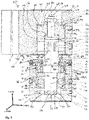
- 1 1 is a schematic diagram of a locking object device according to the invention, here a door, in particular a protective object door. More precisely shows 1 a schematic diagram of a door leaf 100 which is rotatably attached to a door frame 101 by means of a first or lower band 102 and a second or upper band 103 according to the invention.
- the first or lower belt 102 and the second or upper belt 103 each comprise a first or lower belt device 104 and a second or upper belt device 105, which are described below with reference to FIGS Figures 2 to 5 be described in more detail.
- lower belt 102 and upper belt 103 are used instead of first and second belt and first and second belt device.
- the upper hinge device 105 of the lower hinge 102 has a first or upper receiving part 13, with which the lower hinge 102 is connected to the door leaf 100 in 1 connected is.
- the upper receiving part 13 is connected to a strap tab 3, for example formed integrally with this.
- the hinge strap 3 is attached to the door leaf 100 in 1 fastened.
- the lower hinge device 104 of the lower hinge 102 has a second or lower receiving part 1, with which the lower hinge 102 is attached to the door frame 101 in 1 is attached.
- the lower band 102 forms a fixed bearing which absorbs an axial force F a1 and a radial force F r1 of the door leaf 100 .
- the upper hinge device 105 of the upper hinge 102 has a first or upper receiving part 13, with which the upper hinge 102 is connected to the door leaf 100 in 1 connected is.
- the upper receiving part 13 is connected to a strap tab 3, for example formed integrally with this.
- the hinge strap 3 is attached to the door leaf 100 in 1 fastened.
- the upper band 103 its lower band device 104 has a second or lower receiving part 1, with which the upper band 104 with the door frame 101 in 1 connected is. As in 1 is shown, the upper band 103 forms a loose bearing which absorbs a radial force F r2 of the door leaf 100 .
- lower and upper receiving part 1, 13 are used below for the lower and upper belt device 102, 103, respectively.
- In 1 is also the weight F g of the door leaf 100, the distance AT of the door leaf 101 to the respective bearing, the hinge distance AB of the upper and lower hinges 102, 103 from each other, the height of the door leaf HT and the width of the door leaf BT located.
- In 2 is a sectional view and in 3 12 is a perspective view, partially in section, of an embodiment of the first or lower band 102 and its lower and upper band devices 104, 105 as previously described in FIG 1 , shown.
- 4 shows a sectional view AA of the lower band according to FIG 2 along with four examples of hinge pin offset adjustment.
- the figure 5 and 6 further show the lower belt device 104 of the lower belt 102 according to FIG 1 , 2 and 3 , where in 6 the case is shown when misalignment occurs.
- the lower band 102 its upper band device 105 has the upper receiving part 13 with the band flap 3 .
- the band tab 3 is the upper band device 105 at one door leaf, as before in 1 indicated, a gate or window sash etc. can be fastened.
- the upper receiving part 13 is formed, for example, in one piece with the strap tab 3 or is attached to it as a separate component.
- the lower hinge device 104 of the lower hinge 102 has the lower receiving part 1, with which the lower hinge device 104 is attached to a door frame, as previously described in 1 indicated, a gate frame, or a window frame, etc. can be fastened.
- the lower receiving part 1 is arranged longitudinally below the upper receiving part 13 at the upper and lower belt devices 105,104.
- the lower band 102 also includes a band bolt 23 having a first or upper pivot 32 and a second or lower pivot 33 positioned eccentrically with respect to each other.
- upper and lower pins 32, 33 are used throughout in the following.
- the upper pin 32 is received in the upper receiving part 13 of the upper band device and the lower pin 33 is received in the lower receiving part 1 of the lower band device 104 .
- the two pins 32, 33 each have a circular cross section.
- the hinge pin 23 can be made, for example, from one piece, for example from a round steel, for example from a corrosion-free steel such as a martensitic chromium-nickel-molybdenum steel.
- the lower pin 33 of the lower band 102 is, as below with reference to FIG Figures 2 to 4 is explained, is mounted in the lower receiving part 1 by means of a radial bearing 34 and an axial bearing 35 .
- a hinge pin engaging portion 36 for example an external hexagon, for turning the lower pin 33 and thus the hinge pin 23, as shown in FIGS Figures 2-4 and before in 1 is shown.
- the upper hinge device 105 of the lower hinge 102 can be adjusted as shown in FIG 2 and 3 with reference to the X, Y, Z coordinate system and the 4 and 5 will be explained in more detail, in the X and Z direction and thus in a plane transverse to the longitudinal direction or Y direction relative to the lower belt device 104 of the lower belt 102 are adjusted.
- Various positions of the hinge pin 23, in which this is rotatable, are in the following 4 shown.
- the longitudinal axis 37 of the upper pin 32 and the longitudinal axis 38 of the lower pin 33 are arranged parallel and offset to one another and are therefore eccentric to one another.
- the two longitudinal axes 37, 38 of the upper pin 32 and the lower pin 33 are not coaxial but instead offset parallel to one another at a predetermined distance of, for example, 3 mm, as for example in FIG 2 , 4 and figure 5 is indicated.
- the longitudinal axis 37 of the upper pin 32 is offset by 3 mm to the longitudinal axis 38 of the lower pin 33 .
- the two pins 32, 33 with their longitudinal axes 37, 38 thus have a Distance or offset of 3mm to each other.
- the invention is limited to a distance or offset of 3 mm between the two longitudinal axes 37, 38 of the pins 32, 33 in the X direction in the coordinate system in Figures 2 to 5 not restricted.
- its hinge bolts 23 can be designed with a spacing or offset between the longitudinal axes 37, 38 of the two pins 32, 33 of greater or lesser than 3 mm.
- the upper pin 33 is received in a pin receptacle 39 of an eccentric bushing 31 .
- the eccentric bushing 31 is designed as a pot with a bottom which is provided on its outside with an additional eccentric bushing engagement section 40, for example an external hexagon, for turning the eccentric bushing 31, as will be described in more detail below. Furthermore, the bottom of the eccentric bushing 31 has a threaded through hole 11 for receiving a threaded rod 20 .
- the threaded rod 20 serves to adjust the height of the upper belt device 105 in relation to the lower belt device 104 of the lower belt 102, as will also be described in more detail below.
- the threaded rod 20 has at its outer end a threaded rod engagement section 41, for example an external hexagon.
- the eccentric bushing 31 is accommodated in an eccentric bushing receptacle 25 of the upper receptacle part 13 of the upper band device 105 .
- the upper receiving part 13 has a longitudinal direction of the lower band 102 extending, stepped through bore, for example of a first and a second cylindrical portion 42, 43 on.
- the first cylindrical section 42 has a larger diameter than the second cylindrical section 43 and forms the lower open end 45 of the upper receiving part 13.
- the second cylindrical section 43 in turn forms the upper open end 44 of the upper receiving part 13.
- the first or lower cylindrical section 42 with the larger diameter forms the eccentric bushing receptacle 25, as shown in FIGS Figures 2-3 is shown.
- the outer end of the eccentric bushing receptacle with its eccentric bushing engagement section 40 and the outer end of the threaded rod 20 with its threaded rod engagement section 41 are in turn arranged in the second or upper cylindrical section 43 with the smaller diameter.
- both the eccentric bushing 31 and the threaded rod 20 can be easily actuated via the upper, open end 44 of the upper receiving part 13 and, more precisely, its second or upper cylindrical section 43 .
- the eccentric bushing 31 can be easily inserted into the lower, open end 45 of the upper receiving part 13 and more precisely in its first or lower cylindrical section 42 as the eccentric bushing receptacle 25 and assembled.
- an additional support such as an annular PTFE (polytetrafluoroethylene) disc 22, as in Figs 2 and 3 is shown between the face of the eccentric bushing 31 and the eccentric bushing receptacle 25 of the upper receptacle part 13 are provided.
- This has the advantage that the friction between the eccentric bushing 31 and the upper receiving part 13 can be reduced.
- the eccentric bushing 31 has a cylindrical indentation 12 as a pin receptacle 39 .
- the longitudinal axis 46 of the pin receptacle 39 and in particular of the cylindrical depression 12 of the eccentric bushing 31 is coaxial with the longitudinal axis 37 of the upper pin 32.
- the distance and thus the height of the upper hinge device 105 in relation to the lower hinge device 104 is in the longitudinal direction of the belt 102, i.e. the Y direction in 2 , adjustable.
- the threaded rod 20 rests on the end face of the upper pin 32 accommodated in the pin receptacle 39 .
- the threaded rod 20 can be secured with an additional shaft nut 21, for example.
- the shaft nut 21 is rotated in the opposite direction on the threaded rod 20 and tightened so that the threaded rod 20 can be prevented from loosening itself.
- the invention is not limited to a lock nut 21 . Any other device or combination of devices that is suitable may be provided to prevent the threaded rod from loosening by itself.
- the longitudinal axis 48 of the through-threaded bore 11 of the eccentric bushing 31 corresponds to the longitudinal and here rotational axis of the eccentric bushing 31 about which the eccentric bushing 31 is rotated when the eccentric bushing engagement section 40 is actuated.
- the longitudinal axis 48 of the through-threaded bore 11 of the eccentric bushing 31, the longitudinal axis of the eccentric bushing and, correspondingly, the longitudinal axis 47 of the threaded rod 20 inserted into the through-threaded bore 11 are each coaxial with the longitudinal axis 38 of the lower pin 33 of the lower hinge device 104 in the exemplary embodiment in FIGS Figures 2 to 5 .
- the longitudinal axis 46 of the spigot socket 39 of the eccentric bushing 31 and the longitudinal axis 37 of the upper spigot 32, which is received in the spigot socket 39 of the eccentric bushing 31, are in turn coaxial with one another and correspondingly parallel and opposite the longitudinal axis 38 of the lower spigot 33 arranged offset, for example by 3 mm parallel and offset to the longitudinal axis 38 of the lower pin 33 arranged
- the upper belt device 105 and more precisely its upper receiving part 13 with the eccentric bushing 31 accommodated therein can be adjusted, for example, by a maximum of 10 mm in the height or in the longitudinal direction of the belt 102, i.e. in the Y direction 2 and 3 , Adjust relative to the lower receiving part 1 of the lower belt device 104.
- the invention is not limited to a maximum height adjustment of 10 mm.
- the band 102 can be designed in such a way that the height adjustment is less or more than a maximum of 10 mm, depending on the function and intended use of the band.
- the upper hinge assembly 105 can be locked in a desired position in the X and Z directions in Figures 2 to 5 relative to the lower belt assembly 104.
- the upper receiving part 31 can be positioned in one plane, more precisely an X, Z plane in Figures 2-5 , perpendicular to the longitudinal axis of the lower receiving part and the lower pin 33 received therein relative to the lower receiving part 1 in a desired position. This is achieved by the two journals 32, 32 of the hinge bolt which are arranged eccentrically to one another.
- FIGs 4a-4d four positions of the hinge bolt and its two pins 32, 33 are shown as an example.
- the hinge bolt is in a zero or 0° position, as also shown in 2 is shown.
- the hinge bolt is turned 90°, in Figure 4c by 180° and in Figure 4d by 270°.
- the lower belt 102 with its upper and lower belt device 105, 104 and its upper and lower receiving part 13, 1; 13, 1 is thus 3-dimensionally adjustable.
- the adjustability in the X and Z directions is assumed by the eccentric bushing 31 and the hinge bolt 23 with its two journals 32, 33 arranged eccentrically to one another lower pin 33 of the hinge bolt 23 is arranged.
- the longitudinal axis 46 of the spigot receptacle 39 of the eccentric bushing 31 by 3mm parallel and offset to the longitudinal axis 38 of the lower pin 33 of the hinge bolt 23 is arranged.
- the upper hinge device 105 with its upper receiving part 13 can thus be adjusted in the X and Z direction by a maximum of 6 mm in total, for example, as shown in FIG Figures 4a and 4c or. Figures 4b and 4d can be removed.
- the eccentric bushing 31 has a Ring of several slots 49, for example, six slots on.
- the upper pin 32 has on its outer circumference a ring of longitudinal grooves 50, in this case six longitudinal grooves, corresponding to the number and position of the elongated holes 49 of the eccentric bushing 31, for a gradual rotation of the hinge bolt 23 about the longitudinal axis 38 of its lower pin 33 and of the eccentric bushing 31 to provide a desired offset of the upper hinge device 105 with its upper receiving part 13 in relation to the lower hinge device 104 with its lower receiving part 1.
- the elongated holes 49 and longitudinal grooves 50 extend in the longitudinal direction of the hinge 104, i.e. in the Y direction 2 .
- the upper hinge device 105 with its upper receiving part 13 can be rotated opposite the lower hinge device 104 with its lower receiving part 1 in the X, Z -Level be gradually offset, as in the Figures 4a-4d is shown.
- the hinge pin 23 and the eccentric bushing 31 can be in the respective desired offset position of the example, six possible offset positions in the embodiment in the Figures 2-4 additionally fix by a pin element, eg a locking screw 26.
- the locking screw 26 is screwed into a corresponding threaded hole 51 in the peripheral wall of the upper receiving part 13 and extends through the slot 49 of the eccentric bushing 31 into the respective longitudinal groove 50 of the hinge bolt 23 and thereby fixes both the eccentric bushing 31 and the hinge bolt 23 in the circumferential direction and longitudinally in the set offset position.
- This has the advantage that it is no longer necessary to drill, ie a hole has to be drilled for inserting a locking screw for fixing the setting of a bolt of the belt. If it turns out in this case that the belt is incorrectly adjusted, it must be drilled again to fix the newly adjusted bolt. This can be prevented by the band 104, 105 according to the invention.
- the hinge bolt 23 can also be additionally clamped independently of the eccentric bushing 31.
- the locking screw 26 can optionally also be covered with a cap 24, as shown in FIGS 2 and 3 is shown.
- the offset position set by means of the elongated holes 49 of the eccentric bushing 31 and the longitudinal grooves 50 of the hinge bolt 23 can preferably be checked.
- the eccentric bushing 31 has position marks 52 on its outer circumference, e.g. six position marks, which are arranged in a ring around the longitudinal axis of the eccentric bushing on its circumference, corresponding to the number and position of the elongated holes 49 of the eccentric bushing 31.
- the upper receiving part 13 has a sight hole 53 on its peripheral wall opposite the ring of position marks 52.
- a user can look through the sight hole 53 to the position mark 52 behind it and thus determine the set offset position of the eccentric bushing 31 .
- at least one position mark 52 eg a position mark for an initial offset position, eg the 0° offset position in the 2 and 4a , colored or otherwise visibly marked or identified.
- the lower pin 33 of the hinge bolt 23 also has a ring of position marks 52, eg six position marks, corresponding to the number of possible offset positions, eg six offset positions, of the hinge bolt 23 on its outer circumference.
- the lower receiving part 1 of the lower hinge device 104 also has a sight hole 55 on its peripheral wall opposite the ring of position marks 54. A user can look through the sight hole 55 to the position mark 54 behind it and thus determine the set offset position of the hinge bolt 31 .
- at least one position mark 54 eg a position mark for an initial offset position, eg the 0° offset position in the 2 and 4a , colored or otherwise visibly marked or identified.
- the sight hole 53, 55 of the upper and lower receiving part 13, 1 can preferably also each be covered with a cap 10, as in the 2 , 3 and 5 is shown.
- the upper belt device 105 and more precisely its upper receiving part 13 with the eccentric bushing 31 accommodated therein can be adjusted by means of the threaded rod 20, for example by a maximum of 10 mm in height or in the longitudinal direction of the belt 104, ie in the Y direction 2 , 3 and 5 , relative to the lower receiving part 1 of the lower belt device 104 can be adjusted. Therefore, the length of the respective longitudinal groove 50 of the upper pin 32 and the corresponding length of the respective associated elongated hole 49 of the eccentric bushing 31 also preferably corresponds to the maximum intended height adjustment of the upper receiving part 13 compared to the lower receiving part 1 of the band 104. With a height adjustment of, for example, maximum 10mm, the longitudinal grooves 50 of the upper pin 32 and the elongated holes 49 of the eccentric bushing 31 have a length of 10mm or at least 10mm, for example.
- the lower hinge 102 is constructed in the same way as the upper hinge 103 and its upper hinge device 105, which was previously described in Fig.1 and subsequent 9 is shown.
- This modular design of the upper and lower bands 103, 102 can Manufacturing costs reduced and a modular system for the upper and lower belt 103, 102 are provided.
- a slide bearing bushing 14 can therefore optionally be provided between the pin receptacle 39 of the eccentric bushing 31 and the hinge bolt 23.
- the slide bearing bushing 14 as shown in 1 and subsequent 9 is shown, the advantage that the frictional moment between the hinge bolt 23 and the eccentric bushing 31 can be reduced when opening the door leaf connected to the upper hinge device 105 .
- the slide bearing bushing 14 has a corresponding opening 56 for the locking screw 26, with which the hinge bolt 23 can also be locked both in height and in the circumferential direction.
- a slide bearing bushing 15 can also optionally be additionally arranged between the eccentric bushing receptacle 25 of the upper receiving part 13 and the eccentric bushing 31, a slide bearing bushing 15 can also optionally be additionally arranged.
- This slide bearing bushing 15 has, in particular in the case of the upper band 103, which is structurally identical in this respect, as shown in 1 and subsequent 9 is shown, the advantage that the friction torque can be reduced.
- the plain bearing bushes 14.1 5 are, for example, PTFE plain bearing bushes.
- the coefficient of friction between steel and PTFE (polytetrafluoroethylene) is many times lower, which also reduces the friction torque. This also makes the adjustability of the respective band 102, 103 easier.
- an annular PTFE (polytetrafluoroethylene) washer 22 is also inserted between the eccentric bushing and the upper receiving part 13 .
- the upper band device 105 is used for radial load absorption and the lower band device 104 for radial and axial load absorption.
- the lower journal 33 is mounted in the lower receiving part 1 by means of a radial bearing 34, preferably a spherical roller bearing 29 below, and an axial bearing 35, preferably an axial grooved ball bearing 28 below.
- the axial deep groove ball bearing 28 is shown in a sectional view in 7 shown and additionally has a washer 64 on.
- the lower journal 33 has a first or upper bearing section 57 for the radial bearing 34, here spherical roller bearing 29, and a second or lower bearing section 58 for the axial bearing 35, here axial deep groove ball bearing 28.
- the terms upper and lower bearing section 57, 58 are used throughout in the following.
- the exemplary embodiment shown has the upper bearing section 57 for the spherical roller bearing 29, for example, having a larger diameter than the lower bearing section 58 for the thrust ball bearing 28.
- the upper bearing portion 57 for the spherical roller bearing 29 is further provided between the upper journal 32 and the lower bearing portion 58 for the thrust ball bearing 28 on the hinge pin 23 as shown in FIGS 2 , 3 , 5 and 6 is shown.
- the lower mounting part 1 has a bearing mount 59 for receiving the bearing arrangement for mounting the hinge bolt 23 .
- the lower receiving part 1 has a stepped through bore extending in the longitudinal direction, e.g. consisting of a first and a second cylindrical section 60, 61.
- the first cylindrical section 60 has a larger diameter than the second cylindrical section 61 .
- the first cylindrical section 60 forms the upper open end 62 of the lower receiving part 1 and the second cylindrical section 61 forms the lower open end 63 of the lower receiving part 1.
- the first or upper cylindrical portion 60 with the larger diameter forms the bearing mount 59, as shown in FIGS Figures 2-4 is shown.
- the outer end of the lower pin 33 of the hinge bolt 23 is in turn received with its hinge bolt engagement section 36, for example an external hexagon. With that he can Hinge bolts 23 are easily actuated via the lower open end 63 of the lower receiving part 1.
- the hinge pin 23 and the two bearings 28, 29 can easily be inserted through the upper open end 62 of the through hole or of the lower receiving part 1 into its bearing seat 59.
- the hinge bolt 23 is guided through the two bearings 28, 29 and held in the lower receiving part 1 by a retaining ring 30, as shown in FIG 2 , 3 , 5 and 6 is shown.
- the longitudinal axis 69 of the radial bearing 34, here the spherical roller bearing 29, and the longitudinal axis 70 of the axial bearing 35, here the axial deep groove ball bearing 28, are coaxial with one another and also coaxial with the longitudinal axis 38 of the lower journal 33 of the hinge bolt 23.
- the center of pressure 73 is on the longitudinal axis 69 of the spherical roller bearing 29.
- the spherical roller bearing 29 has an inner bearing ring 74 and an outer bearing ring 75. Between the inner and outer bearing rings 74, 75 are the rolling elements, here rollers.
- the center of pressure 73 of the radial self-aligning roller bearing 29 is the intersection of the obliquely opposite rollers or rolling elements of the radial self-aligning roller bearing.
- the spherical roller bearing 29 with its inner bearing ring 74 attached to the upper bearing portion 57 of the hinge pin 23 and with the outer bearing ring 75 to the inner wall 66 of the bearing seat 59.
- the lower thrust ball bearing 28 is, as in the 2 , 3 , 6 and 7 is shown, for example a single direction deep groove ball bearing with an additional washer 64 and more precisely, for example, the deep groove ball bearing 53411 from SKF ® with the washer (see 7 ).
- the washer 64 rests on the bottom 65 of the bearing mount 59 and is attached to the inner wall 66 of the bearing mount 59 .
- the axial deep groove ball bearing 28 has an upper bearing ring 67 and a lower bearing ring 68 .
- the upper bearing ring 68 is in turn fastened to the lower bearing section 58 of the hinge bolt 23 .
- the lower bearing ring 68 has a spherical or spherical outer surface 71 on its outer or underside. This ball-shaped or spherical outer surface 71 of the lower bearing ring 68 lies or runs on a circular path 72 around the center of pressure 73 of the radial bearing 34, here spherical roller bearing 29.
- the lower bearing ring 68 lies with its ball-shaped or spherical outer surface 71 on a corresponding surface of the washer 64 on and can move along this surface of the washer 64 on the circular path 72 about the center of pressure 73 of the spherical roller bearing, as indicated by a double arrow in FIGS Figures 6 and 7 is indicated.
- the lower bearing ring 68 can move on the washer 64 on a circular path 72 around the center of pressure 73 of the radial bearing 34, here, for example, the spherical roller bearing 29.
- An alignment error can thus be compensated for when the hinge bolt 23 inclines to the side with its longitudinal axis or tilts, as in 6 is indicated.
- a pressure piece 9 is provided between the radial bearing 34, here, for example, spherical roller bearing 29, and the thrust bearing 35, here, for example, thrust ball bearing 28, is in the embodiment in the Figures 1-4 , 6-8 .
- the pressure piece 9, for example a metal ring, is designed in such a way that its underside rests on the top of the upper bearing ring 67 of the axial bearing or axial deep groove ball bearing 28 and its top only rests on the underside of the inner bearing ring 74.
- the pressure piece 9 is beveled on its upper side opposite the rolling elements and the outer bearing ring of the radial bearing 34, here the spherical roller bearing 29. Due to the slanted top, the pressure piece 9 is only on the inner bearing ring 74 of the radial bearing 34, here spherical roller bearing 29 at.
- the pressure piece 9 has the effect that if an alignment error occurs in which the hinge bolt 23 and thus the longitudinal axis 38 of the lower pin 33 tilts from a vertical position into an inclined position 38*, for example as in FIG 6 is indicated, the spherical roller bearing 29 and the thrust ball bearing 28 absorb the tilting moment and compensate for the misalignment.
- the inner bearing ring 74 presses on the pressure piece 9 as in 6 is indicated by an arrow F1.
- the pressure piece 9 in turn presses on the axial deep groove ball bearing 28.
- the lower bearing ring 68 of the axial deep groove ball bearing 28 moves with its ball-shaped or spherical outer surface 71 along the circular path 72 around the center of pressure 73 of the spherical roller bearing 29 along the washer 64, as in 6 is indicated who the hinge pin 23 tilts to the side or from its vertical position. Thereby an alignment error compensation can be ensured by means of the two bearings 34, 35.
- the bottom 65 of the bearing seat 59 can also be formed with a surface that corresponds to the ball-shaped or spherical outer surface 71 of the lower bearing ring 68 of the axial deep groove ball bearing 28.
- two through-holes 76 are provided, each with a grease nipple 7 arranged therein for lubricating the opposite axial bearing 28.
- the two through-holes 76 are arranged diagonally opposite one another in the lower receiving part 1, for example, for the purpose of lubricating the axial bearing 28.
- the respective through-hole 76 can also be additionally covered with a cover cap 10 on the outside.
- a sealing attachment 77 is arranged at the upper, open end 62 of the lower receiving part 1 .
- the sealing attachment 77 for the lower band 102 in the 2 , 3 , 5 and for the upper band 103 below 9 is in 8 shown as an enlarged detail.
- the sealing attachment 77 has an annular cover 78, in particular an annular metal cover, through which the hinge pin 23 is passed.
- the longitudinal axis of the annular cover 78 is coaxial with the longitudinal axis 38 of the lower pin 33 of the hinge bolt 23.
- the inner wall 82 of the annular cover 78 is spaced from the outside of the hinge pin 23 and in particular its lower spigot 33, in particular sufficiently spaced so that the hinge pin 23 does not come into contact with the inner wall 82 of the annular cover 78 if the hinge pin 23 from its perpendicular position to the side, as in 6 is shown.
- an optional ring-shaped cover plate 5 which can be arranged on the upper side of the ring-shaped cover 78 and fastened to it, for example screwed on.
- An annular sealing disk 4 is preferably additionally provided between the annular cover plate 5 and the upper side of the annular cover 78 .
- an annular sealing disk 2 is also preferably provided on the underside of the annular cover 78, as is particularly evident in FIG 8 you can see.
- the two sealing disks 2 and 4 are preferably identical in construction and have the same inner and outer diameter.
- ring-shaped cover 78 for example, two radial bores 79, for example opposite one another, are provided, in each of which a lubricating nipple 7 is arranged.
- the respective radial bore 79 is connected to a longitudinal bore 80 which is formed on the underside of the annular cover 78 .
- the respective longitudinal bore 80 is arranged above the radial bearing 34 for lubricating the radial bearing 34.
- the inner diameter of the lower sealing disk 2 is selected in such a way that the sealing disk 2 ends with its inner diameter in front of the longitudinal bore 80 and thus does not cover it, as in 8 is shown.
- the respective radial bore 79 with its lubricating nipple 7 can also be covered with a cap 8 on the outside.
- the described arrangement of the lubricating nipples 7 in the through bores 76 and radial bores 79 can reliably ensure relubrication of the two bearings 35, 34.
- the inner wall 82 of the annular cover 78 is stepped and has a seat 84 for a shaft seal ring 6 at its top.
- the shaft seal 6 from the Figures 1-3 , 5 and 6 rests against the hinge bolt 23, more precisely against the lower pin 33 in a sealing manner, as can be seen from the enlarged sectional view in FIG 8 emerges. Furthermore, the shaft sealing ring 6 is sufficiently or suitably flexible and/or elastic to compensate for a misalignment of the hinge bolt 23 . In other words, the shaft sealing ring 6 is preferably continuous or always close to the hinge pin 23 and in particular its lower one Pin 33, even if the hinge pin 23 tilts from its vertical position to the side, as exemplified in 6 shown.
- annular cover 78 has a recess 81 on its underside, e.g. a gradation, for the securing ring 30 fastened to the hinge bolt 23 .
- the upper, open end of the receiving part 1 and the hinge bolt 23 received therein can be reliably sealed and at the same time, lubrication of the radial bearing 34 can be provided via the lubricating channel made up of the radial bore 79 and the axial bores 80 connected thereto.
- the lower, open end 63 of the lower receiving part 1 can be closed with an additional cover plate 16 to protect against corrosion, for example due to the ingress of water, as shown in FIG 2 , 3 is shown.
- a seal for example a round seal 27 , can optionally also be provided between the lower, open end 63 of the lower receiving part 1 and the cover plate 16 .
- the cover plate 16 can be screwed to the lower receiving part 1, for example.
- the cover plate 16 is fastened to the upper receiving part 13 by means of screws 82, for example.
- the eccentric bushing 31 accommodated in the eccentric bushing receptacle 25 is flush with the lower, open end 45 of the upper receptacle part 13, for example, or ends within the eccentric bushing receptacle 25, so that the eccentric bushing 31, in other words, does not protrude from the lower, open end 45 of the eccentric bush mount 25 protrudes.
- an annular cover plate 18 can also be provided at the lower, open end 45 of the upper receiving part 13, which partially extends over the lower end of the eccentric bushing 31.
- a round seal 19 can be provided between the annular cover plate 18 and the upper receiving part 13 and its eccentric bushing 31 .
- the annular cover plate 18 can also be fastened to the upper receiving part 13, for example by means of screws.
- the ring-shaped cover plate 18 preferably has the same dimensions and in particular the same inside and outside diameter as the ring-shaped cover plate 6 on the upper side of the ring-shaped cover 78 .
- the longitudinal axis of the ring-shaped cover plate 18 is, for example, coaxial with the longitudinal axis 38 of the lower pin 7 of the hinge bolt 23.
- the upper pin 32 can be adjusted within the annular cover plate 18 eccentrically relative to the lower pin 33.
- the Hinge bolts 23 do not contact the upper pin 32 on the annular cover plate 18 in the event of a misalignment.
- the sealing structure according to the invention of the upper and lower belt devices 104, 105 with the cover caps 8 and 10, the cover plates 16, 18, 5, the seals 17, 19, 27 and in particular the sealing attachment 77 can ensure optimum corrosion protection for the two belts 102, 103 and in particular the belt system made up of the two belts 102, 103 are provided.
- critical components of the band here lower band 104 in the Figures 2-4 , made of a corrosion-resistant material or a corrosion-resistant material combination.
- the hinge pin 23, the eccentric bushing 31, the pressure piece 9 between the two bearings 34, 35 of the lower hinge 104 and the threaded rod 20 are made of a corrosion-resistant material or a corrosion-resistant material combination, for example a martensitic chromium-nickel-molybdenum steel. This has very good mechanical properties as well as good corrosion resistance, high strength, good chemical resistance, good weldability and good polishability.
- the invention is not limited to a martensitic chromium-nickel-molybdenum steel for producing the components mentioned, such as the hinge bolt 23, the eccentric bushing 31, the pressure piece 9 and the threaded rod 20. Any other suitable corrosion resistant material or combination of materials may be used. Likewise, the parts mentioned can all be made of the same corrosion-resistant material or combination of materials or of different corrosion-resistant materials Materials or corrosion-resistant combination of materials, depending on the function and purpose.
- the lower band device 104 has the thrust ball bearing 28 for the axial load absorption and the spherical roller bearing 29 for the radial load absorption.
- the first or lower belt device 104 of the upper belt 103 has essentially the same construction as that previously referred to in FIG Figures 2-8 described first or lower belt assembly 104 of lower belt 102. Same components as previously in FIGS Figures 2-8 are in 9 been provided with the same reference numerals. In this regard, the description above in the Figures 2-8 referenced to avoid unnecessary repetition.
- the radial bearing 34 here for example the spherical roller bearing 29, and a pressure piece 83, ring-shaped pressure piece 83, are provided in the lower receiving part 1 of the upper band 103.
- the pressure piece 83 is designed in such a way that it rests on the bottom 65 of the bearing mount 59 and is beveled on its upper side in such a way that it only rests on the outer bearing ring 75 of the spherical roller bearing 29 and not on the inner bearing ring 74 of the spherical roller bearing 29.
- the second or upper band device 105 of the upper band 103 has substantially the same structure as that previously referred to in FIG Figures 2-8 described second or lower band device of the lower band.
- the same components as before in the Figures 2-8 are in 9 been provided with the same reference numerals. In this regard, the description above in the Figures 2-8 referenced to avoid unnecessary repetition.
- the upper band 105 has essentially the same upper band device 105 as the lower band and differs only in that no threaded rod with shaft nut is accommodated in the through-threaded bore 11 of the eccentric bushing 31 .
- the locking screw 26 is used as an example of a pin element and inserted through the corresponding slot 49 of the eccentric bushing 31 into the associated longitudinal groove 49 of the hinge bolt 23 to fix the eccentric bushing 31 and the hinge bolt 23 in a desired offset Position.
- the upper band device of the lower band is structurally identical to the upper band device 105 of the upper band 103, and only the threaded rod and the associated shaft nut were omitted from the upper band 103, a modular structure and a modular principle can be provided.
- the sealing concept and the provision of the two plain bearing bushes 14, 15 and the annular PTFE washer 22 is identical for both upper band devices 105 of the upper and lower band.
- Manufacturing and assembly costs can thus be reduced by such a modular design and a building block principle.
Landscapes
- Engineering & Computer Science (AREA)
- Mechanical Engineering (AREA)
- Hinges (AREA)
- Gates (AREA)
Applications Claiming Priority (1)
| Application Number | Priority Date | Filing Date | Title |
|---|---|---|---|
| DE102021002936.4A DE102021002936B3 (de) | 2021-06-08 | 2021-06-08 | Band für eine Tür, ein Tor, eine Klappe oder ein Fenster, Bandsystem mit einem solchen Band und einem weiteren Band sowie ein Verschlussobjektvorrichtung mit einem derartigen Bandsystem |
Publications (2)
| Publication Number | Publication Date |
|---|---|
| EP4102016A2 true EP4102016A2 (fr) | 2022-12-14 |
| EP4102016A3 EP4102016A3 (fr) | 2023-02-08 |
Family
ID=80266993
Family Applications (1)
| Application Number | Title | Priority Date | Filing Date |
|---|---|---|---|
| EP22165363.7A Pending EP4102016A3 (fr) | 2021-06-08 | 2022-03-30 | Bande pour porte, un portail, un volet ou une fenêtre, système de bande doté d'une telle bande et d'une autre bande, ainsi que dispositif d'objet de verrouillage doté d'un tel système de bande |
Country Status (2)
| Country | Link |
|---|---|
| EP (1) | EP4102016A3 (fr) |
| DE (1) | DE102021002936B3 (fr) |
Cited By (1)
| Publication number | Priority date | Publication date | Assignee | Title |
|---|---|---|---|---|
| CN120351241A (zh) * | 2025-06-23 | 2025-07-22 | 华普金属制品泰州有限公司 | 一种防尘型轴承铰链 |
Families Citing this family (1)
| Publication number | Priority date | Publication date | Assignee | Title |
|---|---|---|---|---|
| CN114658310A (zh) * | 2022-04-24 | 2022-06-24 | 华能新能源股份有限公司河北分公司 | 一种风电机组塔筒门门轴 |
Citations (2)
| Publication number | Priority date | Publication date | Assignee | Title |
|---|---|---|---|---|
| EP0803625A1 (fr) | 1996-04-19 | 1997-10-29 | FERCO INTERNATIONAL Ferrures et Serrures de Bâtiment, Société Anonyme | Ferrure d'articulation, notamment un support d'angle pour porte, fenêtre ou analogue |
| DE102008040659B3 (de) | 2008-07-23 | 2010-01-21 | Sommer Metallbau-Stahlbau Gmbh & Co. Kg | Türband sowie Tür |
Family Cites Families (3)
| Publication number | Priority date | Publication date | Assignee | Title |
|---|---|---|---|---|
| GB265388A (en) * | 1926-02-16 | 1927-02-10 | Chatwood Safe Company Ltd | Improvements relating to the doors of safes, strong rooms and the like |
| AUPP995799A0 (en) * | 1999-04-23 | 1999-05-20 | Esi Companies, Inc. | Improvements in hinges |
| CH700566B1 (de) | 2009-03-02 | 2013-04-30 | Christian Sitter | Scharnier. |
-
2021
- 2021-06-08 DE DE102021002936.4A patent/DE102021002936B3/de active Active
-
2022
- 2022-03-30 EP EP22165363.7A patent/EP4102016A3/fr active Pending
Patent Citations (2)
| Publication number | Priority date | Publication date | Assignee | Title |
|---|---|---|---|---|
| EP0803625A1 (fr) | 1996-04-19 | 1997-10-29 | FERCO INTERNATIONAL Ferrures et Serrures de Bâtiment, Société Anonyme | Ferrure d'articulation, notamment un support d'angle pour porte, fenêtre ou analogue |
| DE102008040659B3 (de) | 2008-07-23 | 2010-01-21 | Sommer Metallbau-Stahlbau Gmbh & Co. Kg | Türband sowie Tür |
Cited By (1)
| Publication number | Priority date | Publication date | Assignee | Title |
|---|---|---|---|---|
| CN120351241A (zh) * | 2025-06-23 | 2025-07-22 | 华普金属制品泰州有限公司 | 一种防尘型轴承铰链 |
Also Published As
| Publication number | Publication date |
|---|---|
| EP4102016A3 (fr) | 2023-02-08 |
| DE102021002936B3 (de) | 2022-03-10 |
Similar Documents
| Publication | Publication Date | Title |
|---|---|---|
| EP0266490B1 (fr) | Charnière pour porte de véhicule | |
| EP0259618B1 (fr) | Penture de porte et fenêtre, réglable pendant et après le montage | |
| EP3680431B1 (fr) | Bande de recouvrement pour portes | |
| DE69311075T2 (de) | Seilrollenblock | |
| DE102021002936B3 (de) | Band für eine Tür, ein Tor, eine Klappe oder ein Fenster, Bandsystem mit einem solchen Band und einem weiteren Band sowie ein Verschlussobjektvorrichtung mit einem derartigen Bandsystem | |
| EP0598878B1 (fr) | Fixation reglable de tourillons et de pivots, utile notamment pour portes et portails | |
| DE102010047774B4 (de) | Türscharnier | |
| EP0223186A2 (fr) | Penture réglable pour portes ou fenêtres | |
| EP1101007A1 (fr) | Charniere de porte avec frein de porte integre | |
| EP1215357B1 (fr) | Arrangement de charnière pour portes, fenêtres ou similaires | |
| EP0215281A2 (fr) | Palier pour un battant de fenêtre, porte ou similaire | |
| DE102008040659B3 (de) | Türband sowie Tür | |
| EP0318422A1 (fr) | Charnière réglable, en particulier pour portes | |
| EP0628688A2 (fr) | Elément de palier d'un support pour le support au moins pivotant d'une aile, d'une fenêtre, d'une porte ou similaire | |
| DE29713254U1 (de) | Drehlager für Fenster oder Türen | |
| EP0930411B1 (fr) | Penture de porte ou de fenêtre | |
| DE29803806U1 (de) | Tür- oder Fensterband | |
| EP0874123B1 (fr) | Ferrure pour supporter l'aile pivotante d'une fenêtre ou porte | |
| DE19607846C1 (de) | Band für Türen oder Fenster | |
| DE29617518U1 (de) | Türfeststeller | |
| EP0942136B1 (fr) | Support de broche de charnière réglable en hauteur | |
| DE20210361U1 (de) | Laufwagen für Schiebe- oder Kipp-Schiebe-Fenster oder -Türen | |
| AT413847B (de) | Band | |
| EP1405975A1 (fr) | Charnière réglable pour portes | |
| DE29714911U1 (de) | Drehverstelleinrichtung für Türen- oder Fensterbänder |
Legal Events
| Date | Code | Title | Description |
|---|---|---|---|
| PUAI | Public reference made under article 153(3) epc to a published international application that has entered the european phase |
Free format text: ORIGINAL CODE: 0009012 |
|
| STAA | Information on the status of an ep patent application or granted ep patent |
Free format text: STATUS: THE APPLICATION HAS BEEN PUBLISHED |
|
| AK | Designated contracting states |
Kind code of ref document: A2 Designated state(s): AL AT BE BG CH CY CZ DE DK EE ES FI FR GB GR HR HU IE IS IT LI LT LU LV MC MK MT NL NO PL PT RO RS SE SI SK SM TR |
|
| PUAL | Search report despatched |
Free format text: ORIGINAL CODE: 0009013 |
|
| AK | Designated contracting states |
Kind code of ref document: A3 Designated state(s): AL AT BE BG CH CY CZ DE DK EE ES FI FR GB GR HR HU IE IS IT LI LT LU LV MC MK MT NL NO PL PT RO RS SE SI SK SM TR |
|
| RIC1 | Information provided on ipc code assigned before grant |
Ipc: E05D 3/02 19680901ALN20230102BHEP Ipc: E05D 11/04 19680901ALI20230102BHEP Ipc: E05D 11/02 19680901ALI20230102BHEP Ipc: E05D 7/06 19680901ALI20230102BHEP Ipc: E05D 7/00 19680901AFI20230102BHEP |
|
| P01 | Opt-out of the competence of the unified patent court (upc) registered |
Effective date: 20230419 |
|
| STAA | Information on the status of an ep patent application or granted ep patent |
Free format text: STATUS: REQUEST FOR EXAMINATION WAS MADE |
|
| 17P | Request for examination filed |
Effective date: 20230710 |
|
| RBV | Designated contracting states (corrected) |
Designated state(s): AL AT BE BG CH CY CZ DE DK EE ES FI FR GB GR HR HU IE IS IT LI LT LU LV MC MK MT NL NO PL PT RO RS SE SI SK SM TR |
|
| STAA | Information on the status of an ep patent application or granted ep patent |
Free format text: STATUS: EXAMINATION IS IN PROGRESS |
|
| 17Q | First examination report despatched |
Effective date: 20260507 |