EP4105133B1 - Procédé et appareil pour emballer des articles - Google Patents
Procédé et appareil pour emballer des articles Download PDFInfo
- Publication number
- EP4105133B1 EP4105133B1 EP21179387.2A EP21179387A EP4105133B1 EP 4105133 B1 EP4105133 B1 EP 4105133B1 EP 21179387 A EP21179387 A EP 21179387A EP 4105133 B1 EP4105133 B1 EP 4105133B1
- Authority
- EP
- European Patent Office
- Prior art keywords
- continuous paper
- paper sheet
- feeding
- heating
- articles
- Prior art date
- Legal status (The legal status is an assumption and is not a legal conclusion. Google has not performed a legal analysis and makes no representation as to the accuracy of the status listed.)
- Active
Links
Images

Classifications
-
- A—HUMAN NECESSITIES
- A61—MEDICAL OR VETERINARY SCIENCE; HYGIENE
- A61J—CONTAINERS SPECIALLY ADAPTED FOR MEDICAL OR PHARMACEUTICAL PURPOSES; DEVICES OR METHODS SPECIALLY ADAPTED FOR BRINGING PHARMACEUTICAL PRODUCTS INTO PARTICULAR PHYSICAL OR ADMINISTERING FORMS; DEVICES FOR ADMINISTERING FOOD OR MEDICINES ORALLY; BABY COMFORTERS; DEVICES FOR RECEIVING SPITTLE
- A61J3/00—Devices or methods specially adapted for bringing pharmaceutical products into particular physical or administering forms
- A61J3/04—Devices or methods specially adapted for bringing pharmaceutical products into particular physical or administering forms into the form of ointments
-
- B—PERFORMING OPERATIONS; TRANSPORTING
- B65—CONVEYING; PACKING; STORING; HANDLING THIN OR FILAMENTARY MATERIAL
- B65B—MACHINES, APPARATUS OR DEVICES FOR, OR METHODS OF, PACKAGING ARTICLES OR MATERIALS; UNPACKING
- B65B9/00—Enclosing successive articles, or quantities of material, e.g. liquids or semiliquids, in flat, folded, or tubular webs of flexible sheet material; Subdividing filled flexible tubes to form packages
- B65B9/02—Enclosing successive articles, or quantities of material between opposed webs
-
- B—PERFORMING OPERATIONS; TRANSPORTING
- B65—CONVEYING; PACKING; STORING; HANDLING THIN OR FILAMENTARY MATERIAL
- B65B—MACHINES, APPARATUS OR DEVICES FOR, OR METHODS OF, PACKAGING ARTICLES OR MATERIALS; UNPACKING
- B65B29/00—Packaging of materials presenting special problems
- B65B29/02—Packaging of substances, e.g. tea, which are intended to be infused in the package
-
- B—PERFORMING OPERATIONS; TRANSPORTING
- B65—CONVEYING; PACKING; STORING; HANDLING THIN OR FILAMENTARY MATERIAL
- B65B—MACHINES, APPARATUS OR DEVICES FOR, OR METHODS OF, PACKAGING ARTICLES OR MATERIALS; UNPACKING
- B65B29/00—Packaging of materials presenting special problems
- B65B29/02—Packaging of substances, e.g. tea, which are intended to be infused in the package
- B65B29/028—Packaging of substances, e.g. tea, which are intended to be infused in the package packaging infusion material into filter bags
-
- B—PERFORMING OPERATIONS; TRANSPORTING
- B65—CONVEYING; PACKING; STORING; HANDLING THIN OR FILAMENTARY MATERIAL
- B65B—MACHINES, APPARATUS OR DEVICES FOR, OR METHODS OF, PACKAGING ARTICLES OR MATERIALS; UNPACKING
- B65B41/00—Supplying or feeding container-forming sheets or wrapping material
- B65B41/02—Feeding sheets or wrapper blanks
- B65B41/10—Feeding sheets or wrapper blanks by rollers
-
- B—PERFORMING OPERATIONS; TRANSPORTING
- B65—CONVEYING; PACKING; STORING; HANDLING THIN OR FILAMENTARY MATERIAL
- B65B—MACHINES, APPARATUS OR DEVICES FOR, OR METHODS OF, PACKAGING ARTICLES OR MATERIALS; UNPACKING
- B65B51/00—Devices for, or methods of, sealing or securing package folds or closures; Devices for gathering or twisting wrappers, or necks of bags
- B65B51/02—Applying adhesives or sealing liquids
-
- B—PERFORMING OPERATIONS; TRANSPORTING
- B65—CONVEYING; PACKING; STORING; HANDLING THIN OR FILAMENTARY MATERIAL
- B65B—MACHINES, APPARATUS OR DEVICES FOR, OR METHODS OF, PACKAGING ARTICLES OR MATERIALS; UNPACKING
- B65B51/00—Devices for, or methods of, sealing or securing package folds or closures; Devices for gathering or twisting wrappers, or necks of bags
- B65B51/10—Applying or generating heat or pressure or combinations thereof
- B65B51/16—Applying or generating heat or pressure or combinations thereof by rotary members
-
- B—PERFORMING OPERATIONS; TRANSPORTING
- B65—CONVEYING; PACKING; STORING; HANDLING THIN OR FILAMENTARY MATERIAL
- B65B—MACHINES, APPARATUS OR DEVICES FOR, OR METHODS OF, PACKAGING ARTICLES OR MATERIALS; UNPACKING
- B65B51/00—Devices for, or methods of, sealing or securing package folds or closures; Devices for gathering or twisting wrappers, or necks of bags
- B65B51/10—Applying or generating heat or pressure or combinations thereof
- B65B51/26—Devices specially adapted for producing transverse or longitudinal seams in webs or tubes
- B65B51/28—Rollers for producing longitudinal and transverse seams simultaneously
-
- B—PERFORMING OPERATIONS; TRANSPORTING
- B65—CONVEYING; PACKING; STORING; HANDLING THIN OR FILAMENTARY MATERIAL
- B65B—MACHINES, APPARATUS OR DEVICES FOR, OR METHODS OF, PACKAGING ARTICLES OR MATERIALS; UNPACKING
- B65B57/00—Automatic control, checking, warning, or safety devices
- B65B57/02—Automatic control, checking, warning, or safety devices responsive to absence, presence, abnormal feed, or misplacement of binding or wrapping material, containers, or packages
- B65B57/04—Automatic control, checking, warning, or safety devices responsive to absence, presence, abnormal feed, or misplacement of binding or wrapping material, containers, or packages and operating to control, or to stop, the feed of such material, containers, or packages
-
- A—HUMAN NECESSITIES
- A61—MEDICAL OR VETERINARY SCIENCE; HYGIENE
- A61J—CONTAINERS SPECIALLY ADAPTED FOR MEDICAL OR PHARMACEUTICAL PURPOSES; DEVICES OR METHODS SPECIALLY ADAPTED FOR BRINGING PHARMACEUTICAL PRODUCTS INTO PARTICULAR PHYSICAL OR ADMINISTERING FORMS; DEVICES FOR ADMINISTERING FOOD OR MEDICINES ORALLY; BABY COMFORTERS; DEVICES FOR RECEIVING SPITTLE
- A61J2200/00—General characteristics or adaptations
- A61J2200/70—Device provided with specific sensor or indicating means
Definitions
- the present invention relates in general to the packaging of articles, in particular of flat articles, i.e. articles having a thickness lower than the other dimensions.
- the invention relates to a method and an apparatus for forming packages comprising articles enclosed between two opposite paper sheets having their edges joined by a thermally-activated adhesive.
- US3140572 discloses a device and a method for packaging plasters comprising feeding heat sealable sheets with a heat activatable adhesive, wherein the sheets are positioned on opposite sides of a plaster, compressed and attached to each other by the thermally-activated adhesive.
- the invention was developed, in particular, with a view to its application in the field of packaging plasters, such as, for example, plasters for covering wounds, medicated plasters, pain-relieving plasters, heating plasters with and without medicaments.
- packaging plasters such as, for example, plasters for covering wounds, medicated plasters, pain-relieving plasters, heating plasters with and without medicaments.
- plasters In the medical field there are different types of plasters. In many cases, these products are boxed without being wrapped. In some cases, the plasters are packaged individually in envelope-shaped packages before being boxed.
- the adhesive used is a thermally-activated adhesive because it guarantees stable fixing of the sheets so that the articles are protected from external agents. Thanks to these thermally-activated adhesives, once the package is opened, it is no longer resealable, and this allows the health and hygiene standards relating to the marketing of plasters or other similar articles to be met.
- the packages may be formed by two sheets of paper, one of which has an inner surface on which a thermally-activated adhesive is applied.
- the sheet provided with the thermally-activated adhesive may be a layered material already provided with an adhesive.
- the packaging of the plasters between two flexible sheets is carried out by advancing a continuous array of plasters along a machine direction, spaced apart from each other, and two continuous paper sheets overlapping each other on opposite sides of the continuous array of plasters, one of which has a layer of thermally-activated adhesive, so as to form a continuous composite tape consisting of the two continuous paper sheets and the continuous array of plasters sandwiched between the two continuous paper sheets.
- the packages are closed by passing the continuous composite tape through at least one pair of pressure rollers.
- the fixing between the two paper sheets takes place by activating the thermally-activated adhesive, which occurs while the flexible sheets are compressed together along the compression lines.
- the packages are obtained by transversally cutting the continuous composite tape along the transverse welds between each pair of articles.
- the welding between the two paper sheets must meet precise quality requirements defined by the plaster manufacturers.
- the quality specifications are as follows:
- the current maximum speed of the packaging equipment is in the order of 50-60 m/min.
- This speed limit is due to the fact that as the speed of the machine increases, the pressure rollers are unable to give the flexible sheets sufficient energy to allow the correct transfer of the adhesive material from one sheet to another because the contact time is proportionally reduced between the pressure rollers and the sheets.
- increasing the speed of the apparatus beyond the limit of 50-60 m/min would compromise the quality requirements prescribed by the plaster manufacturers.
- US5613601A discloses a method and apparatus for heat-sealing dispensing packages comprising a water permeable bag formed by two non-woven webs which enclose predetermined quantities of a particulate product, such as tea or coffee that releases a flavoring substance in steeping liquid.
- the non-woven webs have a thermally activated bonding surface permitting to permanently close the bag by peripherally heat-sealing the bag walls to one another.
- the heat-sealing operation is performed simultaneously with enclosing the predetermined quantity of particulate product between the two non-woven webs.
- the object of the present invention is to provide a method and an apparatus for packaging articles enclosed between two opposite flexible sheets, joined together by a thermally-activated adhesive, which allow the production speed to be increased without compromising the quality requirements of the packages.
- this object is achieved by a method and by an apparatus having the characteristics forming the subject of claims 1 and 10.
- reference 10 indicates an apparatus for packaging flat articles A in envelope-shaped packages closed around each article A along the edges of the packages.
- the articles A may be wound-covering plasters, medicated plasters, pain-relief plasters, heating plasters, and the like.
- the articles A are aligned and spaced apart from each other in a continuous array that advances in a machine direction X on an inlet conveyor 12.
- the apparatus 10 comprises a first feeding assembly 14 and a second feeding assembly 16 that feed, respectively, a first continuous paper sheet 18 and a second continuous paper sheet 20 towards an overlapping unit 22.
- the first and second continuous paper sheet 18, 20 are unwound from respective reels 19, 21. At least one of the two continuous paper sheets 18, 20 comprises a thermally-activated adhesive.
- One of the two continuous paper sheets 18, 20 may be a layered material already equipped with a thermally-activated adhesive. In other embodiments, the thermally-activated adhesive may be applied in-line using an adhesive dispenser. The thermally-activated adhesive layer may be applied or already present on the entire surface of the continuous paper sheet 18, 20.
- the thermally-activated adhesive has no adhesive characteristics until it is heated above a preset temperature (activation temperature) for a preset time. After applying pressure, the thermally-activated adhesive fixes its state and, typically, even if heated again to the activation temperature, it no longer changes its state.
- the first continuous paper sheet 18 may have a specific weight of 8.3 g/m 2 and may have a layer of thermally-activated adhesive over an entire surface
- the second continuous paper sheet 20 may have a specific weight of 9 g/m 2 and may have on a surface a layer of silicone-like smooth material.
- the two continuous paper sheets 18, 20 are coupled so that the surface with the thermally-activated adhesive of the first continuous paper sheet 18 comes into contact with the smooth surface of the second continuous paper sheet 20.
- the overlapping unit 22 may comprise a pair of coupling rollers 24 tangential to each other and rotatable in opposite directions around respective axes parallel to each other and perpendicular to the machine direction X.
- the coupling rollers 24 may be idle around the respective axis of rotation.
- the two continuous paper sheets 18, 20 are kept in contact with the outer surfaces of the respective coupling rollers 24 while they advance towards the tangency area of the two coupling rollers 24.
- the articles A are fed in the direction X between the two continuous paper sheets 18, 20 towards the tangency area between the pair of coupling rollers 24.
- the two continuous paper sheets 18, 20 are overlapped to each other on opposite sides with respect to the articles A while passing through the tangency area of the pair of coupling rollers 24.
- a continuous composite tape 26 is formed, comprising two continuous paper sheets 18, 20 overlapped to each other, and a continuous array of articles A spaced apart longitudinally from each other and sandwiched between the two continuous paper sheets 18, 20.
- One of the two continuous paper sheets 18, 20 has a layer of thermally-activated adhesive arranged on its surface facing the other continuous paper sheets 18, 20.
- the apparatus 10 comprises a compression unit 28 configured to fix to each other the two continuous paper sheets 18, 20 by compressing the thermally-activated adhesive along sealing lines that extend around individual articles A.
- the overlapping unit 22 and the compression unit 28 are two separate modules independent of each other, so that the steps of overlapping and compressing the two continuous flexible sheets 18, 20 are separate.
- the compression step is carried out when the step of enclosing the articles A between the flexible sheets 18, 20 is completed, so that the articles are completely enclosed between the flexible sheets 18, 20 when the compression step is carried out.
- the compression unit 28 comprises a first and a second mutually cooperating compression rollers 30, 32, which are configured to compress the continuous composite tape 26 along a series of compression areas 34, each having a frame-like shape which surround respective articles A.
- the compression areas 34 are formed on the peripheral surface of the first compression roller 30.
- the compression areas 34 may be defined by two continuous longitudinal compression elements 36 and by a plurality of transversal compression elements 38.
- the compression areas 34 may be made of soft material, e.g. by silicone, in order to avoid the formation of markings on the two continuous paper sheets 18, 20.
- the first compression roller 30 is not heated, and the second compression roller 32 may be heated, e.g. by inner heating resistors.
- the second compression roller 32 may have a smooth outer surface pressed against the longitudinal compression elements 36 and the transversal compression elements 38 of the first compression roller 30.
- a first pair of feeding rollers 25 may be arranged between the coupling rollers 22 and the compression rollers 30, 32 and a second pair of feeding rollers 42 may be arranged downstream of the compression rollers 30, 32.
- the first and second pair of feeding rollers 25, 42 are driven at the same peripheral speed and have the purpose of controlling the feeding speed of the continuous composite tape 26 as it passes through the compression unit 28.
- the first and second pair of feeding rollers 25, 42 may have recessed central portions to avoid compressing the articles A.
- the apparatus 10 comprises a first and a second heating roller 44, 46, configured for heating the respective continuous paper sheets 18, 20 upstream of the overlapping unit 22.
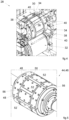
- each heating roller 44, 46 may be configured to heat the respective first or second continuous paper sheet 18, 20 along localized heating areas 48, each having a frame-like shape, formed on the outer surface of the heating roller 44, 46.
- the heating areas 48 have the same shape as the compression areas 34.
- Each of the heating roller 46, 48 may have the same structure as the compression roller 30 of the compression unit 28.
- the heating areas 48 may be defined by two continuous longitudinal heating elements 50 and by a plurality of transversal heating elements 52, which may be made of metal, e.g. by steel.
- Each heating area 48 surrounds an insulating portion 54 formed by a thermally insulating material, e.g. Teflon ⁇ or Ultem ⁇ .
- Portions 56 of thermally insulating material may also be arranged laterally outwardly to the longitudinal heating elements 52.
- the heating areas 48 of the heating rollers 44, 46 may be heated by heating elements arranged inside the heating rollers 44, 46.
- the heating elements may be electrical heating elements or fluid heating elements using a fluid, for example oil or air, as a heating medium.
- the first and second feeding assemblies 14, 16 feed the respective first and second continuous paper sheet 18, 20 on the outer surfaces of the respective heating rollers 44, 46.
- the first and second continuous paper sheet 18, 20 are wound on the outer surfaces of the respective heating rollers 44, 46 with an angular extension of about 280°.
- the wounding angle of the first and second continuous paper sheet 18, 20 on the outer surfaces of the respective heating rollers 44, 46 depends on the diameter of the heating rollers 44, 46 and on the feeding speed of the first and second continuous paper sheet 18, 20.
- the first and second continuous paper sheet 18, 20 should remain in contact with the outer surfaces of the respective heating rollers 44, 46 along respective arcs having an extension of 800-1000 mm.
- a feeding speed of the first and second continuous paper sheet 18, 20 of about 100 m/min it is sufficient that the first and second continuous paper sheet 18, 20 remain in contact with the outer surfaces of the respective heating rollers 44, 46 along respective arcs having an extension of about 505 mm.
- the heating rollers 44, 46 may be configured to heat the continuous paper sheets 18, 20 along the heating areas 48 at a temperature comprised between 100-200°C, preferably between 160-180°C.
- Heating of the first and second continuous paper sheet 18, 20 on the first and second heating roller 44, 46 may not completely activate the thermally-activated adhesive, so that the first and second continuous paper sheet 18, 20 are not glued to each other in the overlapping unit 22. In this case, full activation of the thermally-activated adhesive is carried out in the compression unit 28. In possible embodiments, heating of the continuous paper sheets 18, 20 on the heating rollers 44, 46 may fully activate the thermally-activated adhesive, so that the thermally-activated adhesive is fully activated before reaching the compression unit 28.
- the pressure roller 30 of the compression unit 28, and the heating rollers 44, 46 are controlled by an electronic control unit 78, which drives the heating rollers 44, 46 and the compression roller 30 around the respective axes at the same speed and maintains the heating areas 48 and the compression areas 34 in phase with each other, so that the continuous composite tape 26 is compressed in compression areas 34 overlapped to heating areas 48 of the first and second continuous paper sheet 18, 20.
- the preliminary heating of the continuous flexible sheets 18, 20 on the heating rollers 44, 46 allows a much greater speed of the continuous composite tape during the passage through the compression unit 28. It has been found that by heating the continuous flexible sheets 18, 20 to temperatures in the order of 160-180°C, it is possible to advance the continuous composite tape 26 through the compression unit 28 at speeds in the order of 200 m/min.
- the flexible sheets 18, 20 may advance through the compression unit 28 at a speed of 150 - 250 m/min, in particular 180 - 210 m/min.
- the preliminary heating ensures that, even with very high manufacturing speeds, the resulting packages meet all the quality requirements defined by the plaster manufacturers, in particular, uniform transfer of the thermally-activated adhesive to the sheet without the adhesive layer, optimal sealing of the weld, a uniform release force and the guarantee of absence of leaks.
- the first and second feeding assembly 14, 16 are configured for feeding the first and second continuous paper sheet 18, 20 along respective longitudinal directions with a longitudinal tension comprised between 50 and 200 N.
- An optimal tension is about 100 N. This tension is maintained in the path of the first and second continuous paper sheet 18, 20 extending from the respective feeding assembly 14, 16 up to the compression unit 28.
- the tension of the first and second continuous paper sheet 18, 20 is maintained up to the second pair of feeding rollers arranged downstream of the compression unit 28.
- the typical working tension of the continuous paper sheets is usually in a range comprised from a few N up to 20-30 N. It has been found that with feeding speed of the continuous paper sheets of about 200 m/1' with the tension used in the prior art methods there is a poor glue transfer at the center of the transversal sealing portions. It has also been found that as the tension of the first and second continuous paper sheet 18, 20 at the heating rollers 44, 46 increases, the sealing quality between the first and second continuous paper sheet 18, 20 at the center of the transversal sealing portions improves.
- the reason for an improved sealing quality as the tension increases is that a high tension of the continuous paper sheets 18, 20 on the heating rollers 44, 46 ensures a more uniform contact of the paper sheets on the heating rollers 44, 46 in a transversal direction.
- the sealing quality at the center of the transverse seal can further increase with higher feeding tensions.
- the upper limit of the feeding tension can be close to the breaking limit of the paper sheets (about 200 N for the paper sheet having the layer of thermally-activated adhesive and about 150 N for the paper sheet without the layer of thermally-activated adhesive).
- the lower limit of the feeding tensions is in the range of 50-60 N. It should be noted that these tension values are very different from the feeding tensions of non-woven webs, which usually are comprised in the range of 1-10 N. High feeding tensions in the solution according to the present invention are possible because paper is a material having very small deformability, which can be subjected to tensions close to the braking limit with small stretching.
- the first and second feeding assembly 14, 16 may comprise respective feeding rollers 60, 58 which may be driven with a peripheral speed lower than the peripheral speed of the feeding rollers 25, 42.
- the heating rollers 44, 46, the feeding rollers 25, 42 and the compression rollers 30, 32 are all driven at the same peripheral speed, so that the longitudinal tensions of the first and second continuous paper sheet 18, 20 are kept constant in the respective paths extending from the heating rollers 44, 46 up to the feeding rollers 42 located downstream of the compression rollers 30, 32.
- the peripheral speed of the compression rollers 30, 32 and of the heating rollers 44 e 46 may be slightly different from the peripheral speed of the feeding rollers 25, 42. In these conditions there is a slight slipping between the first and second continuous paper sheet 18, 20 and the compression rollers 30, 32 and heating rollers 44 e 46.
- the electronic control unit 78 may control the peripheral speed of the feeding rollers 60, 58 on the basis of signals provided by tension measuring devices 64, 66 which measure the longitudinal tension of the respective first and second continuous paper sheet 18, 20.
- Each tension measuring devices 64, 66 may comprise a load cell 68 formed by an idle roller on which the first or second continuous paper sheet 18, 22 is wound.
- the load cells 68 send to the electronic control unit 78 signals indicating the longitudinal tensions of the first and second continuous paper sheet 18, 22. If, for any reason, the longitudinal tension of the first and second continuous paper sheet 18, 20 varies with respect to the preset value, the electronic control unit 78 varies the speed of the feeding rollers 58, 60 to keep the tension of the first and second continuous paper sheet 18, 22 at the preset value.
- each of the first and second feeding assembly 14, 16 may comprise a tensioning device 70 which applies a transversal force on the respective first or second continuous paper sheet 18, 20 as it moves towards the respective heating roller 44, 46.
- the tensioning device 70 may comprise a tensioning roller 72 cooperating with the respective continuous paper sheet 18, 20 and movable in a direction transversal to the respective continuous paper sheet 18, 20.
- the tensioning roller 72 may be carried by a pivoting arm articulated about an axis parallel to the axis of rotation of the tensioning roller 72.
- a weight may be provided on the pivoting arm to adjust the force applied by the tensioning roller 72 to the respective continuous paper sheet 18, 20.
- the tensioning device 70 may comprise an actuator 74 which moves the tensioning roller 72 transversally to the respective continuous paper sheet 18, 20.
- the longitudinal tension of the first and second continuous paper sheet 18, 20 is equal to half of the force applied by the tensioning roller 74 to the respective continuous paper sheet 18, 20.
- Feeding the first and second continuous paper sheet 18, 20 with high longitudinal tensions solves the problem of a poor sealing quality at high speeds but introduces a problem when the apparatus is stopped. If the paper sheets 18, 20 remain stationary in contact with the heating rollers 44, 46 under a high longitudinal tension for a certain time (about 30 minutes) they can burn or be damaged to such an extent that they may break when the apparatus is restarted.
- the first and second feeding unit 14, 16 are configured for reducing the longitudinal tension of the respective first and second continuous paper sheet 18, 20 when feeding of the first and second continuous paper sheet 18, 20 is stopped. When the apparatus is stopped the longitudinal tension of the respective first and second continuous paper sheet 18, 20 may be reduced to 0-30 N.
- the reduction of the longitudinal tension of the first and second continuous paper sheet 18, 20 may be obtained by increasing the speed of the feeding rollers 58, 60 just before stopping the apparatus 10 or by driving for a short time the feeding rollers 58, 60 after the apparatus 10 is stopped.
- the reduction of the longitudinal tension of the first and second continuous paper sheet 18, 20 may be obtained by raising the tensioning roller 72, so as to reduce or eliminate the force applied by the tensioning roller 72 to the first and second continuous paper sheet 18, 20.
Landscapes
- Engineering & Computer Science (AREA)
- Mechanical Engineering (AREA)
- Health & Medical Sciences (AREA)
- Life Sciences & Earth Sciences (AREA)
- Medicinal Chemistry (AREA)
- Pharmacology & Pharmacy (AREA)
- Chemical & Material Sciences (AREA)
- Animal Behavior & Ethology (AREA)
- General Health & Medical Sciences (AREA)
- Public Health (AREA)
- Veterinary Medicine (AREA)
- Making Paper Articles (AREA)
- Containers And Plastic Fillers For Packaging (AREA)
- Folding Of Thin Sheet-Like Materials, Special Discharging Devices, And Others (AREA)
- Basic Packing Technique (AREA)
Claims (15)
- Procédé pour emballer des articles (A) comprenant :- l'acheminement dans des directions longitudinales respectives d'une première et d'une seconde feuille de papier continue (18, 20), dont au moins l'une présente un adhésif activé thermiquement sur une surface,- la mise en tension desdites première et seconde feuilles de papier continues (18, 20) le long de directions longitudinales respectives avec une tension longitudinale comprise entre 50 et 200 N,- le chauffage desdites première et seconde feuilles de papier continues (18, 20) sur des rouleaux de chauffage (44, 46) respectifs tout en étant tendues dans une direction longitudinale,- l'acheminement d'un flux d'articles (A) entre lesdites première et seconde feuilles de papier continues (18, 20),- le chevauchement des première et seconde feuilles de papier continues (18, 20) chauffées et tendues sur des côtés opposés dudit flux d'articles (A), et- la compression desdites première et seconde feuilles de papier continues (18, 20) autour desdits articles (A) pour fixer lesdites première et seconde feuilles de papier continues (18, 20) l'une à l'autre par ledit adhésif activé thermiquement.
- Procédé selon la revendication 1, dans lequel lesdites première et seconde feuilles de papier continues (18, 20) sont maintenues tendues depuis l'amont desdits rouleaux de chauffage (44, 46) jusqu'à ladite étape de compression.
- Procédé selon la revendication 1 ou la revendication 2, dans lequel lesdites première et seconde feuilles de papier continues (18, 20) sont tendues en commandant les vitesses d'acheminement respectives en amont desdits rouleaux de chauffage (44, 46).
- Procédé selon la revendication 3, comprenant la mesure de la tension longitudinale des première et seconde feuilles de papier continues (18, 20) et la commande desdites vitesses d'acheminement sur la base des tensions mesurées.
- Procédé selon la revendication 1 ou la revendication 2, dans lequel lesdites première et seconde feuilles de papier continues sont tendues en appliquant auxdites première et seconde feuilles de papier continues (18, 20) une force de tension transversale au moyen d'un rouleau de tension (72) respectif.
- Procédé selon l'une quelconque des revendications précédentes, dans lequel ladite tension longitudinale est réduite lorsque l'acheminement desdites première et seconde feuilles de papier continues (18, 20) est arrêté.
- Procédé selon l'une quelconque des revendications précédentes, dans lequel lesdites première et seconde feuilles de papier continues (18, 20) sont chauffées le long de zones de chauffage (48) présentant chacune une forme de type cadre.
- Procédé selon la revendication 7, dans lequel lesdites première et seconde feuilles de papier continues (18, 20) sont compressées le long de zones de compression (34) entourant des articles (A) respectifs, chacune présentant une forme de type cadre et chevauchant des zones de chauffage (48) respectives.
- Procédé selon la revendication 7, dans lequel pendant ladite étape de compression lesdites première et seconde feuilles de papier continues (18, 20) sont chauffées le long desdites zones de compression (34).
- Appareil pour emballer des articles (A) comprenant :- un premier et un second ensemble d'acheminement (14, 16) configurés pour acheminer dans des directions longitudinales respectives une première et une seconde feuille de papier continues (18, 20) dont au moins l'une présente un adhésif activé thermiquement sur une surface, les premier et second ensembles d'acheminement (14, 16) étant configurés pour acheminer lesdites première et seconde feuilles de papier continues (18, 20) avec une tension longitudinale comprise entre 50 et 200 N,- un premier et un second rouleau de chauffage (44, 46) configurés pour chauffer lesdites première et seconde feuilles de papier continues (18, 20) pendant qu'elles sont tendues dans une direction longitudinale,- un transporteur d'entrée (12) configuré pour acheminer un flux d'articles (A) entre lesdites première et seconde feuilles de papier continues (18, 20),- une unité de chevauchement (22) configurée pour faire se chevaucher l'une sur l'autre les première et seconde feuilles de papier continues (18, 20) chauffées et tendues sur des côtés opposés dudit flux d'articles (A), et- une unité de compression (28) configurée pour compresser lesdites première et seconde feuilles de papier continues (18, 20) autour desdits articles (A) pour fixer lesdites première et seconde feuilles de papier continues (18, 20) l'une à l'autre par ledit adhésif activé thermiquement.
- Appareil selon la revendication 10, dans lequel lesdits premier et second ensembles d'acheminement (14, 16) sont configurés pour commander la tension longitudinale des première et seconde feuilles de papier continues (18, 20) en commandant les vitesses d'acheminement respectives.
- Appareil selon la revendication 10, dans lequel lesdits premier et second ensembles d'acheminement (14, 16) comprennent des rouleaux de tension (72) respectifs configurés pour appliquer une force de tension transversale à la première et à la seconde feuille de papier continue (18, 20) respective.
- Appareil selon l'une quelconque des revendications 10 à 12, dans lequel lesdits premier et second ensembles d'acheminement (14, 16) sont configurés pour réduire la tension longitudinale desdites première et seconde feuilles de papier continues (18, 20) lorsque l'acheminement desdites première et seconde feuilles de papier continues (18, 20) est arrêté.
- Appareil selon l'une quelconque des revendications 10 à 13, dans lequel chacun desdits rouleaux de chauffage (44, 46) présente une pluralité de zones de chauffage (48) chacune présentant une forme de type cadre, entourées par un matériau isolant thermiquement.
- Appareil selon la revendication 14, dans lequel ladite unité de compression (28) comprend un rouleau de compression (30) présentant une pluralité de zones de compression (34) chacune présentant une forme de type cadre, en phase avec lesdites zones de chauffage (48) desdits rouleaux de chauffage (44, 46).
Priority Applications (6)
| Application Number | Priority Date | Filing Date | Title |
|---|---|---|---|
| PL21179387.2T PL4105133T3 (pl) | 2021-06-15 | 2021-06-15 | Sposób i aparat do pakowania artykułów |
| EP21179387.2A EP4105133B1 (fr) | 2021-06-15 | 2021-06-15 | Procédé et appareil pour emballer des articles |
| ES21179387T ES2985335T3 (es) | 2021-06-15 | 2021-06-15 | Procedimiento y aparato para el embalaje de artículos |
| BR102022009229-0A BR102022009229B1 (pt) | 2021-06-15 | 2022-05-12 | Um método e um aparelho para embalar artigos |
| US17/836,420 US12091206B2 (en) | 2021-06-15 | 2022-06-09 | Method and an apparatus for packaging articles |
| CN202210681212.5A CN115475099B (zh) | 2021-06-15 | 2022-06-15 | 用于包装制品的方法和设备 |
Applications Claiming Priority (1)
| Application Number | Priority Date | Filing Date | Title |
|---|---|---|---|
| EP21179387.2A EP4105133B1 (fr) | 2021-06-15 | 2021-06-15 | Procédé et appareil pour emballer des articles |
Publications (2)
| Publication Number | Publication Date |
|---|---|
| EP4105133A1 EP4105133A1 (fr) | 2022-12-21 |
| EP4105133B1 true EP4105133B1 (fr) | 2024-08-07 |
Family
ID=76483036
Family Applications (1)
| Application Number | Title | Priority Date | Filing Date |
|---|---|---|---|
| EP21179387.2A Active EP4105133B1 (fr) | 2021-06-15 | 2021-06-15 | Procédé et appareil pour emballer des articles |
Country Status (5)
| Country | Link |
|---|---|
| US (1) | US12091206B2 (fr) |
| EP (1) | EP4105133B1 (fr) |
| CN (1) | CN115475099B (fr) |
| ES (1) | ES2985335T3 (fr) |
| PL (1) | PL4105133T3 (fr) |
Families Citing this family (1)
| Publication number | Priority date | Publication date | Assignee | Title |
|---|---|---|---|---|
| EP4151541B1 (fr) * | 2021-09-20 | 2025-11-05 | Fameccanica.Data S.p.A. | Appareil et procédé de chauffage de bande mobile |
Family Cites Families (36)
| Publication number | Priority date | Publication date | Assignee | Title |
|---|---|---|---|---|
| US2486759A (en) * | 1938-02-28 | 1949-11-01 | Jesse R Crossan | Packaging method and apparatus |
| US2374504A (en) * | 1944-10-31 | 1945-04-24 | Ivers Lee Co | Sealing and crimping rollers for packaging machines |
| US2438089A (en) * | 1946-08-27 | 1948-03-16 | Wingfoot Corp | Packaging |
| US2579415A (en) * | 1946-12-04 | 1951-12-18 | Wingfoot Corp | Packaging process |
| US2586580A (en) * | 1948-04-06 | 1952-02-19 | Wingfoot Corp | Heat sealed wrapping machine and method of wrapping |
| US2871639A (en) * | 1957-02-04 | 1959-02-03 | Battle Creek Packaging Machine | Wrapper indexing mechanism for wrapping machines |
| US3140572A (en) * | 1957-09-17 | 1964-07-14 | American White Cross Lab Inc | Surgical dressing packaging |
| DE1266681B (de) * | 1963-03-02 | 1968-04-18 | Noack E Th Verpackungsmasch | Anlage zur Verpackung von Heftpflaster |
| US3751875A (en) * | 1971-09-09 | 1973-08-14 | H Membrino | Apparatus for filling, sealing and dispensing bags |
| EP0230137B1 (fr) * | 1985-12-24 | 1990-07-18 | Omnitech (Europe) Limited | Machines d'emballage du type "fermer-remplir-sceller" horizontal |
| US4711066A (en) * | 1986-09-09 | 1987-12-08 | The Surgimach Corporation | Method and apparatus for packaging medical gauze sponges |
| JP3110090B2 (ja) * | 1991-08-23 | 2000-11-20 | 積水化学工業株式会社 | 医療用貼付剤の製造方法 |
| US5456055A (en) | 1993-09-24 | 1995-10-10 | Johnson & Johnson, Inc. | Package for dispensing a fluid treating substance and method and apparatus for heat-sealing the dispensing package |
| EP0744341B1 (fr) * | 1995-05-23 | 2002-03-13 | Sumitomo Chemical Company, Limited | Procédé et appareil pour envelopper des feuilles |
| EP0845411B1 (fr) * | 1996-11-29 | 2002-02-13 | Kabushiki Kaisha Hayashibara Seibutsu Kagaku Kenkyujo | Emballage pour produit d'inclusion et son procédé de fabrication |
| SE509440C2 (sv) * | 1997-05-14 | 1999-01-25 | Tetra Laval Holdings & Finance | Sätt att framställa ett tryckfärgsdekorerat förpackningmaterial, speciellt för aseptiska förpackningar, samt förpackningsbehållare därav |
| US5875614A (en) * | 1997-09-25 | 1999-03-02 | Univenture Inc. | Apparatus and methods for forming flexible packaging containers for discs |
| IT1299941B1 (it) * | 1998-03-27 | 2000-04-04 | Tecnomeccanica Srl | Apparato per la formatura di un involucro in carta termosaldabile per confezionamento di un prodotto. |
| KR100416227B1 (ko) * | 2001-10-23 | 2004-01-31 | (주)제이브이메디 | 약제분포기용 포장지의 세로접합 거리조절장치 |
| US6979482B2 (en) * | 2002-11-08 | 2005-12-27 | Exopack-Technology, Llc | Multiwall bag with zipper and fin |
| US7302781B2 (en) * | 2004-09-21 | 2007-12-04 | C.G. Bretting Manufacturing Company, Inc. | Bander apparatus and method of using same |
| US7594372B2 (en) * | 2006-03-14 | 2009-09-29 | Scholle Corporation | Flexible container forming apparatus having integrated web surface deformation |
| US20090321283A1 (en) * | 2006-08-15 | 2009-12-31 | Zynon Technologies, Llc | Sealed package and method of making |
| US20080047658A1 (en) * | 2006-08-28 | 2008-02-28 | Curt G. Joa, Inc. | Bonding method for continuous traveling web |
| US8231024B2 (en) * | 2007-08-08 | 2012-07-31 | Clear Lam Packaging, Inc. | Flexible, stackable container and method and system for manufacturing same |
| US20120114810A1 (en) * | 2009-07-08 | 2012-05-10 | Nestec S.A. | Flexible sachet and manufacturing method |
| US20110083810A1 (en) * | 2009-10-13 | 2011-04-14 | David Lin | Container Sealing Machine for Food Packaging |
| JP6727126B2 (ja) * | 2013-08-20 | 2020-07-22 | シュバイツァー モウドゥイ インターナショナル インコーポレイテッド | 植物を含む、医薬用途、化粧用途、着色用途、又は皮膚用途のための製品 |
| CN106275645A (zh) * | 2015-05-15 | 2017-01-04 | 可口可乐公司 | 一种在线成型、填充并封装形成产品包装的系统和方法 |
| ITUB20153482A1 (it) * | 2015-09-08 | 2015-12-08 | Fameccanica Data Spa | Nastro composito tridimensionale, procedimento ed apparecchio per la sua produzione |
| PL3359470T3 (pl) * | 2015-10-06 | 2021-01-25 | Satellite Industries, Inc. | Opakowanie produktu do neutralizacji zapachu i sposób jego formowania |
| CN106214490A (zh) * | 2016-08-31 | 2016-12-14 | 贵州苗仁堂生物医药科技有限责任公司 | 一种连续式黑药膏机 |
| MX383478B (es) * | 2017-02-28 | 2025-03-13 | Kimberly Clark Co | Materiales elásticos con propiedades de estiramiento direccional. |
| WO2019060206A1 (fr) * | 2017-09-20 | 2019-03-28 | Triangle Package Machinery Co. | Machine verticale à former, remplir et sceller par scellement vertical aux ultrasons et accessoire d'attache refermable |
| JP7245491B2 (ja) * | 2018-10-04 | 2023-03-24 | 株式会社イシダ | 製袋包装機 |
| EP4387842A4 (fr) * | 2021-08-16 | 2025-07-16 | Millimeter Wave Products Inc Tlc | Système d'encapsulation d'échantillon |
-
2021
- 2021-06-15 EP EP21179387.2A patent/EP4105133B1/fr active Active
- 2021-06-15 ES ES21179387T patent/ES2985335T3/es active Active
- 2021-06-15 PL PL21179387.2T patent/PL4105133T3/pl unknown
-
2022
- 2022-06-09 US US17/836,420 patent/US12091206B2/en active Active
- 2022-06-15 CN CN202210681212.5A patent/CN115475099B/zh active Active
Also Published As
| Publication number | Publication date |
|---|---|
| US20220396381A1 (en) | 2022-12-15 |
| ES2985335T3 (es) | 2024-11-05 |
| US12091206B2 (en) | 2024-09-17 |
| PL4105133T3 (pl) | 2024-10-07 |
| CN115475099A (zh) | 2022-12-16 |
| BR102022009229A2 (pt) | 2022-12-27 |
| CN115475099B (zh) | 2025-06-20 |
| EP4105133A1 (fr) | 2022-12-21 |
Similar Documents
| Publication | Publication Date | Title |
|---|---|---|
| RU2564871C2 (ru) | Устройство и способы упаковывания пищевых продуктов | |
| US6228458B1 (en) | Package with tear tape and method of forming same | |
| US12091206B2 (en) | Method and an apparatus for packaging articles | |
| CZ9402005A3 (en) | Device for packaging foodstuffs when producing individually packed slices, and process for producing thereof | |
| US12415638B2 (en) | Method and an apparatus for packaging articles | |
| US12070910B2 (en) | Apparatus and method for heating a movable web | |
| EP3261952B1 (fr) | Appareils et méthodes pour former un paquet de produits alimentaires | |
| KR20170094132A (ko) | 실질적으로 평평한 연속 물질의 포장된 무한한 로드를 제조하기 위한 장치 및 방법 | |
| JP2008094456A (ja) | 縦シール機構 | |
| BR102022009229B1 (pt) | Um método e um aparelho para embalar artigos | |
| JP3835773B2 (ja) | 食肉二方シール自動包装機 | |
| JPH1086916A (ja) | 断裂開放用ストリップをフィルムウエブと接合する装置 | |
| TW201628925A (zh) | 橫向枕式包裝機及橫向枕式包裝方法 | |
| CN215662116U (zh) | 一种开窗袋生产制造设备 | |
| BR102022016813B1 (pt) | Aparelho e método para embalar artigos e unidade de aquecimento | |
| JP4574584B2 (ja) | 紙容器用縦シール接着機構 | |
| IT202400003913A1 (it) | Unita' per la giunzione di una striscia sigillante di materiale termosaldabile, apparato per applicare una striscia sigillante ad un nastro di materiale da confezionamento e macchina impacchettatrice per formare confezioni sigillate | |
| JP2004099133A (ja) | シール方法、シール装置及び充填包装機 | |
| FI4188809T3 (fi) | Laitteisto ja menetelmä kuorman käärimiseksi | |
| HK1141772A (en) | Method of forming a cutting auxiliary line | |
| HK1146399A (en) | Wrapping material | |
| TH4537B (th) | การประยุกต์ใช้กที่เป็นการหุ้มปิดแบบในแนวการผลิตเพื่อการบรรจุหีบห่อด้วยฟิล์ม | |
| JPH0637204B2 (ja) | 帯状連続包装物への熱溶融型接着剤の塗布装置 | |
| TH12725A (th) | การประยุกต์ใช้กที่เป็นการหุ้มปิดแบบในแนวการผลิตเพื่อการบรรจุหีบห่อด้วยฟิล์ม |
Legal Events
| Date | Code | Title | Description |
|---|---|---|---|
| PUAI | Public reference made under article 153(3) epc to a published international application that has entered the european phase |
Free format text: ORIGINAL CODE: 0009012 |
|
| STAA | Information on the status of an ep patent application or granted ep patent |
Free format text: STATUS: THE APPLICATION HAS BEEN PUBLISHED |
|
| AK | Designated contracting states |
Kind code of ref document: A1 Designated state(s): AL AT BE BG CH CY CZ DE DK EE ES FI FR GB GR HR HU IE IS IT LI LT LU LV MC MK MT NL NO PL PT RO RS SE SI SK SM TR |
|
| STAA | Information on the status of an ep patent application or granted ep patent |
Free format text: STATUS: REQUEST FOR EXAMINATION WAS MADE |
|
| 17P | Request for examination filed |
Effective date: 20230320 |
|
| RBV | Designated contracting states (corrected) |
Designated state(s): AL AT BE BG CH CY CZ DE DK EE ES FI FR GB GR HR HU IE IS IT LI LT LU LV MC MK MT NL NO PL PT RO RS SE SI SK SM TR |
|
| RIC1 | Information provided on ipc code assigned before grant |
Ipc: B65B 57/04 20060101ALI20230717BHEP Ipc: B65B 51/28 20060101ALI20230717BHEP Ipc: B65B 51/16 20060101ALI20230717BHEP Ipc: B65B 51/02 20060101ALI20230717BHEP Ipc: B65B 29/02 20060101ALI20230717BHEP Ipc: B65B 9/02 20060101AFI20230717BHEP |
|
| GRAP | Despatch of communication of intention to grant a patent |
Free format text: ORIGINAL CODE: EPIDOSNIGR1 |
|
| STAA | Information on the status of an ep patent application or granted ep patent |
Free format text: STATUS: GRANT OF PATENT IS INTENDED |
|
| INTG | Intention to grant announced |
Effective date: 20231024 |
|
| GRAJ | Information related to disapproval of communication of intention to grant by the applicant or resumption of examination proceedings by the epo deleted |
Free format text: ORIGINAL CODE: EPIDOSDIGR1 |
|
| GRAL | Information related to payment of fee for publishing/printing deleted |
Free format text: ORIGINAL CODE: EPIDOSDIGR3 |
|
| GRAS | Grant fee paid |
Free format text: ORIGINAL CODE: EPIDOSNIGR3 |
|
| STAA | Information on the status of an ep patent application or granted ep patent |
Free format text: STATUS: REQUEST FOR EXAMINATION WAS MADE |
|
| INTC | Intention to grant announced (deleted) | ||
| GRAP | Despatch of communication of intention to grant a patent |
Free format text: ORIGINAL CODE: EPIDOSNIGR1 |
|
| STAA | Information on the status of an ep patent application or granted ep patent |
Free format text: STATUS: GRANT OF PATENT IS INTENDED |
|
| INTG | Intention to grant announced |
Effective date: 20240419 |
|
| GRAS | Grant fee paid |
Free format text: ORIGINAL CODE: EPIDOSNIGR3 |
|
| GRAA | (expected) grant |
Free format text: ORIGINAL CODE: 0009210 |
|
| STAA | Information on the status of an ep patent application or granted ep patent |
Free format text: STATUS: THE PATENT HAS BEEN GRANTED |
|
| AK | Designated contracting states |
Kind code of ref document: B1 Designated state(s): AL AT BE BG CH CY CZ DE DK EE ES FI FR GB GR HR HU IE IS IT LI LT LU LV MC MK MT NL NO PL PT RO RS SE SI SK SM TR |
|
| REG | Reference to a national code |
Ref country code: GB Ref legal event code: FG4D |
|
| REG | Reference to a national code |
Ref country code: CH Ref legal event code: EP |
|
| REG | Reference to a national code |
Ref country code: NL Ref legal event code: FP Ref country code: IE Ref legal event code: FG4D |
|
| REG | Reference to a national code |
Ref country code: DE Ref legal event code: R096 Ref document number: 602021016692 Country of ref document: DE |
|
| REG | Reference to a national code |
Ref country code: SE Ref legal event code: TRGR |
|
| REG | Reference to a national code |
Ref country code: ES Ref legal event code: FG2A Ref document number: 2985335 Country of ref document: ES Kind code of ref document: T3 Effective date: 20241105 |
|
| REG | Reference to a national code |
Ref country code: AT Ref legal event code: UEP Ref document number: 1710676 Country of ref document: AT Kind code of ref document: T Effective date: 20240807 |
|
| REG | Reference to a national code |
Ref country code: LT Ref legal event code: MG9D |
|
| PG25 | Lapsed in a contracting state [announced via postgrant information from national office to epo] |
Ref country code: NO Free format text: LAPSE BECAUSE OF FAILURE TO SUBMIT A TRANSLATION OF THE DESCRIPTION OR TO PAY THE FEE WITHIN THE PRESCRIBED TIME-LIMIT Effective date: 20241107 |
|
| PG25 | Lapsed in a contracting state [announced via postgrant information from national office to epo] |
Ref country code: PT Free format text: LAPSE BECAUSE OF FAILURE TO SUBMIT A TRANSLATION OF THE DESCRIPTION OR TO PAY THE FEE WITHIN THE PRESCRIBED TIME-LIMIT Effective date: 20241209 Ref country code: GR Free format text: LAPSE BECAUSE OF FAILURE TO SUBMIT A TRANSLATION OF THE DESCRIPTION OR TO PAY THE FEE WITHIN THE PRESCRIBED TIME-LIMIT Effective date: 20241108 Ref country code: FI Free format text: LAPSE BECAUSE OF FAILURE TO SUBMIT A TRANSLATION OF THE DESCRIPTION OR TO PAY THE FEE WITHIN THE PRESCRIBED TIME-LIMIT Effective date: 20240807 |
|
| PG25 | Lapsed in a contracting state [announced via postgrant information from national office to epo] |
Ref country code: BG Free format text: LAPSE BECAUSE OF FAILURE TO SUBMIT A TRANSLATION OF THE DESCRIPTION OR TO PAY THE FEE WITHIN THE PRESCRIBED TIME-LIMIT Effective date: 20240807 |
|
| PG25 | Lapsed in a contracting state [announced via postgrant information from national office to epo] |
Ref country code: LV Free format text: LAPSE BECAUSE OF FAILURE TO SUBMIT A TRANSLATION OF THE DESCRIPTION OR TO PAY THE FEE WITHIN THE PRESCRIBED TIME-LIMIT Effective date: 20240807 |
|
| PG25 | Lapsed in a contracting state [announced via postgrant information from national office to epo] |
Ref country code: IS Free format text: LAPSE BECAUSE OF FAILURE TO SUBMIT A TRANSLATION OF THE DESCRIPTION OR TO PAY THE FEE WITHIN THE PRESCRIBED TIME-LIMIT Effective date: 20241207 |
|
| PG25 | Lapsed in a contracting state [announced via postgrant information from national office to epo] |
Ref country code: HR Free format text: LAPSE BECAUSE OF FAILURE TO SUBMIT A TRANSLATION OF THE DESCRIPTION OR TO PAY THE FEE WITHIN THE PRESCRIBED TIME-LIMIT Effective date: 20240807 |
|
| PG25 | Lapsed in a contracting state [announced via postgrant information from national office to epo] |
Ref country code: RS Free format text: LAPSE BECAUSE OF FAILURE TO SUBMIT A TRANSLATION OF THE DESCRIPTION OR TO PAY THE FEE WITHIN THE PRESCRIBED TIME-LIMIT Effective date: 20241107 |
|
| PG25 | Lapsed in a contracting state [announced via postgrant information from national office to epo] |
Ref country code: RS Free format text: LAPSE BECAUSE OF FAILURE TO SUBMIT A TRANSLATION OF THE DESCRIPTION OR TO PAY THE FEE WITHIN THE PRESCRIBED TIME-LIMIT Effective date: 20241107 Ref country code: PT Free format text: LAPSE BECAUSE OF FAILURE TO SUBMIT A TRANSLATION OF THE DESCRIPTION OR TO PAY THE FEE WITHIN THE PRESCRIBED TIME-LIMIT Effective date: 20241209 Ref country code: NO Free format text: LAPSE BECAUSE OF FAILURE TO SUBMIT A TRANSLATION OF THE DESCRIPTION OR TO PAY THE FEE WITHIN THE PRESCRIBED TIME-LIMIT Effective date: 20241107 Ref country code: LV Free format text: LAPSE BECAUSE OF FAILURE TO SUBMIT A TRANSLATION OF THE DESCRIPTION OR TO PAY THE FEE WITHIN THE PRESCRIBED TIME-LIMIT Effective date: 20240807 Ref country code: IS Free format text: LAPSE BECAUSE OF FAILURE TO SUBMIT A TRANSLATION OF THE DESCRIPTION OR TO PAY THE FEE WITHIN THE PRESCRIBED TIME-LIMIT Effective date: 20241207 Ref country code: HR Free format text: LAPSE BECAUSE OF FAILURE TO SUBMIT A TRANSLATION OF THE DESCRIPTION OR TO PAY THE FEE WITHIN THE PRESCRIBED TIME-LIMIT Effective date: 20240807 Ref country code: GR Free format text: LAPSE BECAUSE OF FAILURE TO SUBMIT A TRANSLATION OF THE DESCRIPTION OR TO PAY THE FEE WITHIN THE PRESCRIBED TIME-LIMIT Effective date: 20241108 Ref country code: FI Free format text: LAPSE BECAUSE OF FAILURE TO SUBMIT A TRANSLATION OF THE DESCRIPTION OR TO PAY THE FEE WITHIN THE PRESCRIBED TIME-LIMIT Effective date: 20240807 Ref country code: BG Free format text: LAPSE BECAUSE OF FAILURE TO SUBMIT A TRANSLATION OF THE DESCRIPTION OR TO PAY THE FEE WITHIN THE PRESCRIBED TIME-LIMIT Effective date: 20240807 |
|
| PG25 | Lapsed in a contracting state [announced via postgrant information from national office to epo] |
Ref country code: DK Free format text: LAPSE BECAUSE OF FAILURE TO SUBMIT A TRANSLATION OF THE DESCRIPTION OR TO PAY THE FEE WITHIN THE PRESCRIBED TIME-LIMIT Effective date: 20240807 Ref country code: SM Free format text: LAPSE BECAUSE OF FAILURE TO SUBMIT A TRANSLATION OF THE DESCRIPTION OR TO PAY THE FEE WITHIN THE PRESCRIBED TIME-LIMIT Effective date: 20240807 |
|
| PG25 | Lapsed in a contracting state [announced via postgrant information from national office to epo] |
Ref country code: EE Free format text: LAPSE BECAUSE OF FAILURE TO SUBMIT A TRANSLATION OF THE DESCRIPTION OR TO PAY THE FEE WITHIN THE PRESCRIBED TIME-LIMIT Effective date: 20240807 |
|
| PG25 | Lapsed in a contracting state [announced via postgrant information from national office to epo] |
Ref country code: CZ Free format text: LAPSE BECAUSE OF FAILURE TO SUBMIT A TRANSLATION OF THE DESCRIPTION OR TO PAY THE FEE WITHIN THE PRESCRIBED TIME-LIMIT Effective date: 20240807 |
|
| PG25 | Lapsed in a contracting state [announced via postgrant information from national office to epo] |
Ref country code: SK Free format text: LAPSE BECAUSE OF FAILURE TO SUBMIT A TRANSLATION OF THE DESCRIPTION OR TO PAY THE FEE WITHIN THE PRESCRIBED TIME-LIMIT Effective date: 20240807 |
|
| REG | Reference to a national code |
Ref country code: DE Ref legal event code: R097 Ref document number: 602021016692 Country of ref document: DE |
|
| PLBE | No opposition filed within time limit |
Free format text: ORIGINAL CODE: 0009261 |
|
| STAA | Information on the status of an ep patent application or granted ep patent |
Free format text: STATUS: NO OPPOSITION FILED WITHIN TIME LIMIT |
|
| PGFP | Annual fee paid to national office [announced via postgrant information from national office to epo] |
Ref country code: PL Payment date: 20250523 Year of fee payment: 5 Ref country code: DE Payment date: 20250627 Year of fee payment: 5 |
|
| PGFP | Annual fee paid to national office [announced via postgrant information from national office to epo] |
Ref country code: GB Payment date: 20250627 Year of fee payment: 5 |
|
| PGFP | Annual fee paid to national office [announced via postgrant information from national office to epo] |
Ref country code: NL Payment date: 20250626 Year of fee payment: 5 Ref country code: BE Payment date: 20250627 Year of fee payment: 5 |
|
| 26N | No opposition filed |
Effective date: 20250508 |
|
| PGFP | Annual fee paid to national office [announced via postgrant information from national office to epo] |
Ref country code: FR Payment date: 20250625 Year of fee payment: 5 |
|
| PGFP | Annual fee paid to national office [announced via postgrant information from national office to epo] |
Ref country code: AT Payment date: 20250721 Year of fee payment: 5 |
|
| PGFP | Annual fee paid to national office [announced via postgrant information from national office to epo] |
Ref country code: SE Payment date: 20250627 Year of fee payment: 5 |
|
| PGFP | Annual fee paid to national office [announced via postgrant information from national office to epo] |
Ref country code: ES Payment date: 20250701 Year of fee payment: 5 |
|
| PGFP | Annual fee paid to national office [announced via postgrant information from national office to epo] |
Ref country code: CH Payment date: 20250701 Year of fee payment: 5 |
|
| PG25 | Lapsed in a contracting state [announced via postgrant information from national office to epo] |
Ref country code: MC Free format text: LAPSE BECAUSE OF FAILURE TO SUBMIT A TRANSLATION OF THE DESCRIPTION OR TO PAY THE FEE WITHIN THE PRESCRIBED TIME-LIMIT Effective date: 20240807 |
|
| PG25 | Lapsed in a contracting state [announced via postgrant information from national office to epo] |
Ref country code: LU Free format text: LAPSE BECAUSE OF NON-PAYMENT OF DUE FEES Effective date: 20250615 |
|
| PG25 | Lapsed in a contracting state [announced via postgrant information from national office to epo] |
Ref country code: IE Free format text: LAPSE BECAUSE OF NON-PAYMENT OF DUE FEES Effective date: 20250615 |
|
| PG25 | Lapsed in a contracting state [announced via postgrant information from national office to epo] |
Ref country code: IT Free format text: LAPSE BECAUSE OF NON-PAYMENT OF DUE FEES Effective date: 20250615 Ref country code: RO Free format text: LAPSE BECAUSE OF FAILURE TO SUBMIT A TRANSLATION OF THE DESCRIPTION OR TO PAY THE FEE WITHIN THE PRESCRIBED TIME-LIMIT Effective date: 20240807 |