EP4112255A1 - Couvercle de récipient en résine synthétique, procédé de fabrication de celui-ci, et dispositif de post-traitement pour exécuter ledit procédé - Google Patents
Couvercle de récipient en résine synthétique, procédé de fabrication de celui-ci, et dispositif de post-traitement pour exécuter ledit procédé Download PDFInfo
- Publication number
- EP4112255A1 EP4112255A1 EP21761191.2A EP21761191A EP4112255A1 EP 4112255 A1 EP4112255 A1 EP 4112255A1 EP 21761191 A EP21761191 A EP 21761191A EP 4112255 A1 EP4112255 A1 EP 4112255A1
- Authority
- EP
- European Patent Office
- Prior art keywords
- scores
- container lid
- circumferential direction
- score
- inner end
- Prior art date
- Legal status (The legal status is an assumption and is not a legal conclusion. Google has not performed a legal analysis and makes no representation as to the accuracy of the status listed.)
- Granted
Links
Images




Classifications
-
- B—PERFORMING OPERATIONS; TRANSPORTING
- B26—HAND CUTTING TOOLS; CUTTING; SEVERING
- B26F—PERFORATING; PUNCHING; CUTTING-OUT; STAMPING-OUT; SEVERING BY MEANS OTHER THAN CUTTING
- B26F1/00—Perforating; Punching; Cutting-out; Stamping-out; Apparatus therefor
- B26F1/18—Perforating by slitting, i.e. forming cuts closed at their ends without removal of material
-
- B—PERFORMING OPERATIONS; TRANSPORTING
- B26—HAND CUTTING TOOLS; CUTTING; SEVERING
- B26D—CUTTING; DETAILS COMMON TO MACHINES FOR PERFORATING, PUNCHING, CUTTING-OUT, STAMPING-OUT OR SEVERING
- B26D1/00—Cutting through work characterised by the nature or movement of the cutting member or particular materials not otherwise provided for; Apparatus or machines therefor; Cutting members therefor
- B26D1/0006—Cutting members therefor
-
- B—PERFORMING OPERATIONS; TRANSPORTING
- B26—HAND CUTTING TOOLS; CUTTING; SEVERING
- B26D—CUTTING; DETAILS COMMON TO MACHINES FOR PERFORATING, PUNCHING, CUTTING-OUT, STAMPING-OUT OR SEVERING
- B26D1/00—Cutting through work characterised by the nature or movement of the cutting member or particular materials not otherwise provided for; Apparatus or machines therefor; Cutting members therefor
- B26D1/01—Cutting through work characterised by the nature or movement of the cutting member or particular materials not otherwise provided for; Apparatus or machines therefor; Cutting members therefor involving a cutting member which does not travel with the work
- B26D1/02—Cutting through work characterised by the nature or movement of the cutting member or particular materials not otherwise provided for; Apparatus or machines therefor; Cutting members therefor involving a cutting member which does not travel with the work having a stationary cutting member
- B26D1/03—Cutting through work characterised by the nature or movement of the cutting member or particular materials not otherwise provided for; Apparatus or machines therefor; Cutting members therefor involving a cutting member which does not travel with the work having a stationary cutting member with a plurality of cutting members
-
- B—PERFORMING OPERATIONS; TRANSPORTING
- B29—WORKING OF PLASTICS; WORKING OF SUBSTANCES IN A PLASTIC STATE IN GENERAL
- B29C—SHAPING OR JOINING OF PLASTICS; SHAPING OF MATERIAL IN A PLASTIC STATE, NOT OTHERWISE PROVIDED FOR; AFTER-TREATMENT OF THE SHAPED PRODUCTS, e.g. REPAIRING
- B29C70/00—Shaping composites, i.e. plastics material comprising reinforcements, fillers or preformed parts, e.g. inserts
- B29C70/04—Shaping composites, i.e. plastics material comprising reinforcements, fillers or preformed parts, e.g. inserts comprising reinforcements only, e.g. self-reinforcing plastics
- B29C70/28—Shaping operations therefor
- B29C70/54—Component parts, details or accessories; Auxiliary operations, e.g. feeding or storage of prepregs or SMC after impregnation or during ageing
- B29C70/545—Perforating, cutting or machining during or after moulding
-
- B—PERFORMING OPERATIONS; TRANSPORTING
- B29—WORKING OF PLASTICS; WORKING OF SUBSTANCES IN A PLASTIC STATE IN GENERAL
- B29D—PRODUCING PARTICULAR ARTICLES FROM PLASTICS OR FROM SUBSTANCES IN A PLASTIC STATE
- B29D99/00—Subject matter not provided for in other groups of this subclass
- B29D99/0096—Producing closure members for containers, e.g. closure caps or stoppers
-
- B—PERFORMING OPERATIONS; TRANSPORTING
- B65—CONVEYING; PACKING; STORING; HANDLING THIN OR FILAMENTARY MATERIAL
- B65D—CONTAINERS FOR STORAGE OR TRANSPORT OF ARTICLES OR MATERIALS, e.g. BAGS, BARRELS, BOTTLES, BOXES, CANS, CARTONS, CRATES, DRUMS, JARS, TANKS, HOPPERS, FORWARDING CONTAINERS; ACCESSORIES, CLOSURES, OR FITTINGS THEREFOR; PACKAGING ELEMENTS; PACKAGES
- B65D41/00—Caps, e.g. crown caps or crown seals, i.e. members having parts arranged for engagement with the external periphery of a neck or wall defining a pouring opening or discharge aperture; Protective cap-like covers for closure members, e.g. decorative covers of metal foil or paper
- B65D41/32—Caps or cap-like covers with lines of weakness, tearing-strips, tags, or like opening or removal devices, e.g. to facilitate formation of pouring openings
- B65D41/34—Threaded or like caps or cap-like covers provided with tamper elements formed in, or attached to, the closure skirt
- B65D41/3423—Threaded or like caps or cap-like covers provided with tamper elements formed in, or attached to, the closure skirt with flexible tabs, or elements rotated from a non-engaging to an engaging position, formed on the tamper element or in the closure skirt
- B65D41/3428—Threaded or like caps or cap-like covers provided with tamper elements formed in, or attached to, the closure skirt with flexible tabs, or elements rotated from a non-engaging to an engaging position, formed on the tamper element or in the closure skirt the tamper element being integrally connected to the closure by means of bridges
-
- B—PERFORMING OPERATIONS; TRANSPORTING
- B65—CONVEYING; PACKING; STORING; HANDLING THIN OR FILAMENTARY MATERIAL
- B65D—CONTAINERS FOR STORAGE OR TRANSPORT OF ARTICLES OR MATERIALS, e.g. BAGS, BARRELS, BOTTLES, BOXES, CANS, CARTONS, CRATES, DRUMS, JARS, TANKS, HOPPERS, FORWARDING CONTAINERS; ACCESSORIES, CLOSURES, OR FITTINGS THEREFOR; PACKAGING ELEMENTS; PACKAGES
- B65D55/00—Accessories for container closures not otherwise provided for
- B65D55/16—Devices preventing loss of removable closure members
-
- B—PERFORMING OPERATIONS; TRANSPORTING
- B26—HAND CUTTING TOOLS; CUTTING; SEVERING
- B26D—CUTTING; DETAILS COMMON TO MACHINES FOR PERFORATING, PUNCHING, CUTTING-OUT, STAMPING-OUT OR SEVERING
- B26D1/00—Cutting through work characterised by the nature or movement of the cutting member or particular materials not otherwise provided for; Apparatus or machines therefor; Cutting members therefor
- B26D1/0006—Cutting members therefor
- B26D2001/0033—Cutting members therefor assembled from multiple blades
-
- B—PERFORMING OPERATIONS; TRANSPORTING
- B26—HAND CUTTING TOOLS; CUTTING; SEVERING
- B26D—CUTTING; DETAILS COMMON TO MACHINES FOR PERFORATING, PUNCHING, CUTTING-OUT, STAMPING-OUT OR SEVERING
- B26D1/00—Cutting through work characterised by the nature or movement of the cutting member or particular materials not otherwise provided for; Apparatus or machines therefor; Cutting members therefor
- B26D1/0006—Cutting members therefor
- B26D2001/006—Cutting members therefor the cutting blade having a special shape, e.g. a special outline, serrations
-
- B—PERFORMING OPERATIONS; TRANSPORTING
- B26—HAND CUTTING TOOLS; CUTTING; SEVERING
- B26F—PERFORATING; PUNCHING; CUTTING-OUT; STAMPING-OUT; SEVERING BY MEANS OTHER THAN CUTTING
- B26F2210/00—Perforating, punching, cutting-out, stamping-out, severing by means other than cutting of specific products
- B26F2210/04—Making plastic pilferproof screw caps by cutting a tamper ring
-
- B—PERFORMING OPERATIONS; TRANSPORTING
- B29—WORKING OF PLASTICS; WORKING OF SUBSTANCES IN A PLASTIC STATE IN GENERAL
- B29K—INDEXING SCHEME ASSOCIATED WITH SUBCLASSES B29B, B29C OR B29D, RELATING TO MOULDING MATERIALS OR TO MATERIALS FOR MOULDS, REINFORCEMENTS, FILLERS OR PREFORMED PARTS, e.g. INSERTS
- B29K2023/00—Use of polyalkenes or derivatives thereof as moulding material
- B29K2023/04—Polymers of ethylene
- B29K2023/06—PE, i.e. polyethylene
-
- B—PERFORMING OPERATIONS; TRANSPORTING
- B29—WORKING OF PLASTICS; WORKING OF SUBSTANCES IN A PLASTIC STATE IN GENERAL
- B29K—INDEXING SCHEME ASSOCIATED WITH SUBCLASSES B29B, B29C OR B29D, RELATING TO MOULDING MATERIALS OR TO MATERIALS FOR MOULDS, REINFORCEMENTS, FILLERS OR PREFORMED PARTS, e.g. INSERTS
- B29K2023/00—Use of polyalkenes or derivatives thereof as moulding material
- B29K2023/10—Polymers of propylene
- B29K2023/12—PP, i.e. polypropylene
-
- B—PERFORMING OPERATIONS; TRANSPORTING
- B65—CONVEYING; PACKING; STORING; HANDLING THIN OR FILAMENTARY MATERIAL
- B65D—CONTAINERS FOR STORAGE OR TRANSPORT OF ARTICLES OR MATERIALS, e.g. BAGS, BARRELS, BOTTLES, BOXES, CANS, CARTONS, CRATES, DRUMS, JARS, TANKS, HOPPERS, FORWARDING CONTAINERS; ACCESSORIES, CLOSURES, OR FITTINGS THEREFOR; PACKAGING ELEMENTS; PACKAGES
- B65D2251/00—Details relating to container closures
- B65D2251/10—Details of hinged closures
- B65D2251/1008—Means for locking the closure in open position
-
- B—PERFORMING OPERATIONS; TRANSPORTING
- B65—CONVEYING; PACKING; STORING; HANDLING THIN OR FILAMENTARY MATERIAL
- B65D—CONTAINERS FOR STORAGE OR TRANSPORT OF ARTICLES OR MATERIALS, e.g. BAGS, BARRELS, BOTTLES, BOXES, CANS, CARTONS, CRATES, DRUMS, JARS, TANKS, HOPPERS, FORWARDING CONTAINERS; ACCESSORIES, CLOSURES, OR FITTINGS THEREFOR; PACKAGING ELEMENTS; PACKAGES
- B65D2401/00—Tamper-indicating means
- B65D2401/15—Tearable part of the closure
- B65D2401/30—Tamper-ring remaining connected to closure after initial removal
Definitions
- This invention relates to a synthetic-resin container lid having tamper-evident characteristics, the container lid being one which is applied to a container formed with an external thread on an outer peripheral surface of a mouth-neck portion, and a locking jaw section located below the external thread, and which is not separated, in its entirety, from the mouth-neck portion of the container even after the mouth-neck portion of the container is unsealed; a method for manufacturing the container lid; and a post-processing apparatus for executing this method.
- Patent Document 1 discloses a synthetic-resin container lid of a form including a body having a top panel wall, and a cylindrical skirt wall extending downward from the peripheral edge of the top panel wall, wherein an internal thread to be screwed to the external thread of the mouth-neck portion is formed on an inner peripheral surface of the skirt wall; and a cylindrical tamper-evident bottom portion which is connected to the skirt wall of the body via a plurality of breaking bridge sections disposed at intervals in a circumferential direction, and which has an inner peripheral surface where locking means to be locked to the locking jaw section is disposed.
- a protrusion piece protruding downward is disposed on the skirt wall of the body.
- non-breaking connection pieces which connect the skirt wall of the body and the tamper-evident bottom portion together and allow the upward movement of the body with respect to the tamper-evident bottom portion, are disposed.
- the container lid described above When the container lid described above is mounted on the mouth-neck portion of the container to seal the mouth-neck portion, the container lid is fitted to the mouth-neck portion and rotated in a closing direction to screw the internal thread of the container lid to the external thread of the mouth-neck portion. As the screwing proceeds, the container lid is lowered relative to the mouth-neck portion.
- the locking means formed in the tamper-evident bottom portion elastically climbs over the locking jaw section of the mouth-neck portion to settle below it. In unsealing the mouth-neck portion, the container lid is rotated in an opening direction to release the screwing of the external thread of the mouth-neck portion and the internal thread of the container lid.
- the body of the container lid is raised with respect to the mouth-neck portion, whereas the tamper-evident bottom portion is inhibited from ascending, because the locking means is locked to the locking jaw section of the mouth-neck portion.
- stress is generated in the breaking bridge sections, whereby the breaking bridge sections are broken.
- the body continues to ascend, and the body is finally spaced upward from the tamper-evident bottom portion. Accordingly, the non-breaking connection piece is deformed, but the non-breaking connection piece is free from breakage.
- the tamper-evident bottom portion continues to be mounted on the mouth-neck portion.
- the body of the container lid is turned in a direction away from the mouth-neck portion, with a predetermined site of the non-breaking connection piece as the center of turn.
- a leading end part of the protrusion piece formed in the skirt wall elastically climbs over the locking jaw section of the mouth-neck portion, and lies on the upper surface side of the locking jaw section. Consequently, the body is inhibited from returning to a direction toward the mouth-neck portion.
- the body is held at a position spaced from the mouth-neck portion, and the mouth-neck portion is maintained in an unsealed state.
- Patent Documents
- Patent Document 1 JP-A-2014-31202
- a synthetic-resin container lid having a body and a tamper-evident bottom portion connected together via non-breaking connection pieces, as described above, is usually formed by injection molding using a plurality of split molds, because its shape is relatively complicated.
- the container lid of a complicated shape is injection molded using the plurality of split molds, flow paths defined by the plurality of split molds are so complicated that the flowability of a molten resin in the flow paths declines, thus requiring a considerable time for molding.
- the mold for performing injection molding is also complicated, increasing the cost of manufacturing.
- the present invention has been accomplished in the light of the above facts. Its main technical challenge is to manufacture a synthetic-resin container lid having tamper-evident characteristics with rapidity and at a low cost, the container lid which is not separated, in its entirety, from a mouth-neck portion of a container even after the mouth-neck portion of the container is unsealed.
- the present inventors have conducted in-depth studies, and found that the above-described main technical challenge can be solved by forming a plurality of scores at predetermined positions, as a post-processing measure, in an incomplete container lid without formation of any scores.
- a synthetic-resin container lid which is applied to a container formed with an external thread, and a locking jaw section located below the external thread, on an outer peripheral surface of a mouth-neck portion
- the synthetic-resin container lid comprising: a body having a top panel wall, and a cylindrical skirt wall extending downward from the peripheral edge of the top panel wall, an inner peripheral surface of the skirt wall being formed with an internal thread to be screwed to the external thread; and a cylindrical tamper-evident bottom portion which is connected to the skirt wall via a breakable line extending in a circumferential direction, and which has an inner peripheral surface where locking means to be locked to the locking jaw section is disposed,
- the breakable line is defined by forming the plurality of first scores extending in the circumferential direction at intervals in the circumferential direction, except for the specific region.
- the fifth score is located axially below the fourth scores.
- each of the third scores is located in axial alignment with the breakable line, and the outer end of each of the third scores is directly connected to the breakable line. It is preferred that seventh scores extending axially, which connect outer end parts of each of the third scores to the breakable line, be further formed in the specific region.
- the incomplete container lid be allowed to revolve around an arcuate cutting tool, while rotating on its axis, along an outer peripheral edge or an inner peripheral edge of the arcuate cutting tool having the cutting blades arranged on the outer peripheral edge or the inner peripheral edge.
- a post-processing apparatus comprising:
- seventh cutting blades for forming the seventh scores can also be arranged in the second cutting tool.
- the breakable line, the second scores, the third scores, the fourth scores, the fifth score, and the sixth scores are formed respectively at predetermined positions.
- the foregoing synthetic-resin container lid of the present invention can be manufactured by initially molding an incomplete container lid of a relatively simple shape, and then forming, as post-processing, the breakable line, the second scores, the third scores, the fourth scores, the fifth score, and the sixth scores at required positions of the incomplete container lid.
- the incomplete container lid can be molded by compression molding as well as injection molding. Compression molding is capable of rapid molding as compared with injection molding. If the incomplete container lid is molded by compression molding, therefore, the synthetic-resin container lid of the present invention is manufactured very rapidly. Even when the incomplete container lid is molded by injection molding, the synthetic-resin container lid of the present invention is manufactured comparatively rapidly, because the structure of the incomplete container lid is itself relatively simple, so that the fluidity of the molten resin does not lower. Whichever of the molding methods is used to mold the incomplete container lid, moreover, the mold of a relatively simple shape is adopted. Hence, the manufacturing cost of the mold is curtailed, and eventually the manufacturing cost of the container lid is reduced.
- a container lid indicated entirely at 2 which can advantageously be integrally molded by injection molding or compression molding from a suitable synthetic resin such as polyethylene or polypropylene, includes a body 4 and a tamper-evident bottom portion 6.
- the body 4 has a circular top panel wall 8, and a cylindrical skirt wall 10 suspending downward from the peripheral edge of the top panel wall 8.
- two sealing pieces i.e., an outer annular sealing piece 12 and an inner, annular sealing piece 14, are formed.
- the outer annular sealing piece 12 and the inner annular sealing piece 14 is also formed a toroidal tiny ridge 16 projecting downward from the inner surface of the top panel wall 8.
- the outer peripheral surface of the skirt wall 10 is repeatedly formed with irregularities 18 for preventing the slippage of fingers to be engaged therewith.
- the inner peripheral surface of the skirt wall 10 is formed with an internal thread 20.
- the tamper-evident bottom portion 6 is in a cylindrical shape as a whole, and is connected to the skirt wall 10 of the body 4 via a breakable line 22 extending in a circumferential direction.
- the breakable line 22 is defined by forming a plurality of first scores 26 extending in the circumferential direction at intervals in the circumferential direction, except for a specific region 24 extending in the circumferential direction.
- the breakable line 22 may be defined by forming a groove continuously in the circumferential direction to reduce the residual thickness.
- locking means is disposed on the inner peripheral surface of the tamper-evident bottom portion 6.
- the locking means is composed of a plurality of arcuate locking pieces 28 formed at intervals in the circumferential direction. Each of the plurality of arcuate locking pieces 28 is extended out axially upwardly and radially inwardly from a base end thereof connected to the inner peripheral surface of the tamper-evident bottom portion 6.
- the locking means is constituted by the plurality of arcuate locking pieces 28 arranged at intervals in the circumferential direction. If desired, however, the locking means may be composed of an annular locking piece which extends continuously in the circumferential direction and which extends out axially upwardly and radially inwardly from the base end connected to the inner peripheral surface of the tamper-evident bottom portion 6.
- a pair of second scores 30 extending in the circumferential direction at intervals in the circumferential direction in a lower part of the skirt wall 10; a pair of third scores 32 extending in the circumferential direction at intervals in the circumferential direction in an upper part of the tamper-evident bottom portion 6; a pair of fourth scores 34 extending in the circumferential direction at intervals in the circumferential direction in the tamper-evident bottom portion 6 axially below the third scores 32; and a fifth score 36 extending in the circumferential direction in the tamper-evident bottom portion 6 axially below the third scores 32.
- the fifth score 36 is located axially below the fourth scores 34. Instead, however, the fifth score 36 may be disposed between the third scores 32 and the fourth scores 34 as viewed in the axial direction, and the inner ends of the pair of fourth scores 34 may be connected together.
- the second scores 30, the third scores 32, the fourth scores 34, and the fifth score 36 each extend circumferentially linearly and substantially horizontally.
- One of the pair of second scores 30 is circumferentially longer than the other; the other of the paired fourth scores 34 is circumferentially longer than one of them; and the circumferential length of each of the paired third scores 32 is the same. The reasons for these lengths will be described later.
- each of the third scores 32 is located circumferentially outside the inner end of each of the second scores 30; the outer end of each of the third scores 32 is located circumferentially outside the outer end of each of the second scores 30; the inner end of each of the fourth scores 34 is located circumferentially inside the inner end of each of the third scores 32; and each of both ends of the fifth score 36 is located circumferentially outside the inner end of each of the second scores 30 and the inner end of each of the fourth scores 34. If desired, each of both ends of the fifth score 36 may be located in alignment with the inner end of each of the second scores 30 and the inner end of each of the fourth scores 34.
- each of the second scores 30 and the inner end of each of the fourth scores 34 are located in alignment; each of both ends of the fifth score 36 is located circumferentially outside the inner end of each of the second scores 30 and the inner end of each of the fourth scores 34; and the sixth scores 38 extend linearly in the axial direction.
- axially extending seventh scores 40 are further formed which connect outer end parts of each of the third scores 32 to the breakable line 22.
- the outer end of each of the third scores 32 is located circumferentially outside each of both ends of the breakable line 22, and the seventh scores 40 extend linearly in the axial direction. If desired, the outer end of each of the third scores 32 may be located in alignment with each of both ends of the breakable line 22.
- each of the third scores 32 may be located in axial alignment with the breakable line 22 so that the outer end of each of the third scores 32 can be directly connected to the breakable line 22. In other words, each of the third scores 32 is located in axial alignment with the breakable line 22, whereby both ends of the third scores 32 can be directly connected to the breakable line 22, without the intermediary of the seventh scores 40.
- a protrusion piece 42 and a pair of non-breaking connection pieces 44a and 44b are defined in the specific region 24.
- the protrusion piece 42 is defined by the fifth score 36 and the sixth scores 38, and protrudes linearly downward from the lower end of the skirt wall 10.
- Each of the pair of non-breaking connection pieces 44a and 44b is defined by the second score 30, the third score 32, the fourth score 34, and the sixth score 38, and the paired non-breaking connection pieces 44a and 44b are located adjacent to both sides in the circumferential direction of the protrusion piece 42.
- the non-breaking connection piece 44a in the illustrated embodiment is composed of a first tilt part 46a connected to the lower edge of the skirt wall 10 and extending substantially horizontally to one side in the circumferential direction (to the right side in Fig. 1 ); an intermediate part 48a; and a second tilt part 50a continued from the intermediate part 48a, extending substantially horizontally to the other side in the circumferential direction (to the left side in Fig.
- the upper side of the first tilt part 46a is defined by the second score 30, while its lower side is defined by the third score 32.
- the intermediate part 48a is defined by a circumferential one end part (right end part in the drawing) of the second score 30 and the fourth score 34, and the sixth score 38, and has its upper section connected to the circumferential one end of the first tilt part 46a, and has its lower section connected to the circumferential one end of the second tilt part 50a.
- the upper side of the second tilt part 50a is defined by the third score 32, while its lower side is defined by the fourth score 34.
- the non-breaking connection piece 44b is also composed of a first tilt part 46b connected to the lower edge of the skirt wall 10 and extending substantially horizontally to one side in the circumferential direction (to the left side in Fig. 1 ); an intermediate part 48b; and a second tilt part 50b continued from the intermediate part 48b, extending substantially horizontally to the other side in the circumferential direction (to the right side in Fig. 1 ) below the first tilt part 46b, and connected to the tamper-evident bottom portion 6.
- the upper side of the first tilt part 46b is defined by the second score 30, while its lower side is defined by the third score 32.
- the intermediate part 48b is defined by a circumferential opposite end part (left end part in the drawing) of the second score 30, and the fourth score 34, and the sixth score 38, and has its upper section connected to the circumferential opposite end of the first tilt part 46b, and has its lower section connected to the circumferential opposite end of the second tilt part 46b.
- the upper side of the second tilt part 50b is defined by the third score 32, while its lower side is defined by the fourth score 34.
- the non-breaking connection piece 44a and the non-breaking connection piece 44b are not in line symmetry, and the circumferential dimensions of their components are somewhat different (in regard to reason for this difference, reference is requested to the descriptions of JP-A-2012-76771 whose patent application was filed previously by the applicant of the present application).
- the container lid 2 as described above is manufactured in the following manner: First, an incomplete container lid (not shown) of a shape without the formation of the breakable line 22, the second scores 30, the third scores 32, the fourth scores 34, the fifth score 36, and the sixth scores 38 is compression molded or injection molded (incomplete container lid molding step). Then, cutting blades are allowed to act on the incomplete container lid to form the breakable line 22, the second scores 30, the third scores 32, the fourth scores 34, the fifth score 36, and the sixth scores 38 (post-processing step). In the illustrated embodiment, the seventh scores 40 are also formed in the container lid 2. The seventh scores 40 are not formed in the incomplete container lid molding step, but formed in the post-processing step.
- the incomplete container lid is allowed to revolve around an arcuate cutting tool, while rotating on its own axis, along an outer peripheral edge or an inner peripheral edge of the arcuate cutting tool having cutting blades disposed on the outer peripheral edge or the inner peripheral edge, whereby the above respective scores are formed.
- the cutting blades and the arcuate cutting tool having them disposed therein, described above, will be further mentioned later.
- Fig. 3 illustrates a mouth-neck portion 52 of a container along with the container lid 2.
- the mouth-neck portion 52 of the container which can be formed from a suitable synthetic resin such as polyethylene terephthalate, or glass, is in a cylindrical shape as a whole, and is open at its upper surface.
- the outer peripheral surface of the mouth-neck portion 52 is formed with an external thread 54, and a locking jaw section 56 located below the external thread 54. Below the locking jaw section 56, a known support ring 58 is also formed.
- the container lid 2 In mounting the container lid 2 on the mouth-neck portion 52 to seal the mouth-neck portion 52, the container lid 2 is fitted to the mouth-neck portion 52 and rotated in a closing direction (clockwise in Fig. 3 when viewed from above) to screw the internal thread 20 of the container lid 2 to the external thread 54 of the mouth-neck portion 52. As the screwing of the internal thread 20 to the external thread 54 proceeds, the container lid 2 is gradually lowered relative to the mouth-neck portion 52. Once the container lid 2 is lowered relative to the mouth-neck portion 52 up to the state illustrated in Fig.
- the outer annular sealing piece 12 and the inner annular sealing piece 14 formed on the inner surface of the top panel wall 8 in the body 4 of the container lid 2 are brought into intimate contact with the inner peripheral surface and the outer peripheral surface, respectively, of the mouth-neck portion 52, and the tiny ridge 16 abuts on the top surface of the mouth-neck portion 52, thereby sealing the mouth-neck portion 52.
- Each of the plurality of arcuate locking pieces 28 arranged on the inner peripheral surface of the tamper-evident bottom portion 6 of the container lid 2 is elastically deformed, and located below the locking jaw section 56 of the mouth-neck portion 52.
- the container lid 2 In unsealing the mouth-neck portion 52, the container lid 2 is rotated in an opening direction (counterclockwise in Fig. 3 when viewed from above) to gradually release the screwing of the internal thread 20 of the container lid 2 to the external thread 54 of the mouth-neck portion 52. As the screwing is gradually released, the body 4 of the container lid 2 is rotated in the opening direction and raised. On the other hand, the tamper-evident bottom portion 6 is inhibited from ascending, because the upper surfaces of the arcuate locking pieces 28 are locked to the lower surface of the locking jaw section 56 of the mouth-neck portion 52. Hence, considerable stress is generated in the residual parts 27 of the breakable line 22, whereby the residual parts 27 are broken.
- the body 4 of the container lid 2 is raised while being rotated in the opening direction, and gradually spaced upward from the tamper-evident bottom portion 6.
- the first tilt part 46a of the non-breaking connection piece 44a and the second tilt part 50b of the non-breaking connection piece 44b are turned clockwise, namely tilted clockwise, in Figs. 3 and 4 around the intermediate part 48a and the lower end of the second tilt part 50b.
- the second tilt part 50a of the non-breaking connection piece 44a and the first tilt part 46b of the non-breaking connection piece 44b are turned counterclockwise, namely tilted counterclockwise, in Figs. 3 and 4 around the lower end and the upper end thereof, respectively.
- the inclination angles, with respect to the vertical lines, of the first tilt parts 46a and 46b and the second tilt parts 50a and 50b of the non-breaking connection pieces 44a and 44b are gradually decreased.
- the body 4 continues to be connected to the tamper-evident bottom portion 6, which continues to be mounted on the mouth-neck portion 52, via the non-breaking connection pieces 44a and 44b, and is thus not spaced from the mouth-neck portion 52 of the container.
- the body 4 of the container lid 2 is removed from the mouth-neck portion 52, the body 4 is turned in a direction away from the mouth-neck portion 52 up to a state as illustrated in Fig. 5 , with the intermediate parts 48a and 48b of the non-breaking connection pieces 44a and 44b as turning fulcrums.
- the outer surface of a lower end part (front end part) of the protrusion piece 42 formed in the body 4 abuts on the upper surface of the locking jaw section 56 of the mouth-neck portion 52, and the lower end of the skirt wall 10 of the body 4 abuts on or comes in proximity to the outer peripheral surface of the tamper-evident bottom portion 6, whereby the body 4 is releasably held at the position illustrated in Fig. 5 .
- a consumer can drink or eat the contents present in the container, such as a soft drink, without being impeded by the presence of the body 4.
- the body 4 held at the position illustrated in Fig. 5 is forcibly turned in a direction toward the mouth-neck portion 52 (counterclockwise in Fig. 5 ) and fitted to the mouth-neck portion 52 again.
- the container lid 2 is rotated in the closing direction to screw the internal thread 20 of the container lid 2 to the external thread 54 of the mouth-neck portion 52.
- the container lid 2 is positioned in the state illustrated in Fig. 3 again, so that the mouth-neck portion 52 can be provisionally sealed.
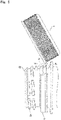
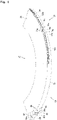
- a post-processing apparatus entirely indicated at 60 includes a first cutting tool 62, and a second cutting tool 64.
- the first cutting tool 62 is equipped with a first support member 66 shaped like an arcuate plate.
- a first cutting blade 68 of an arcuate plate shape for forming the breakable line 22; a second cutting blade 70 of an arcuate plate shape for forming the second scores 30; a third cutting blade 72 of an arcuate plate shape for forming the third scores 32; a fourth cutting blade 74 of an arcuate plate shape for forming the fourth scores 34; and a fifth cutting blade 76 of an arcuate plate shape for forming the fifth score 36 are stacked, and fixed by a suitable fixing method.
- the first cutting tool 62 further includes auxiliary plates 79 each of an arcuate plate shape (see Fig. 7 ) for making the first cutting blade 68 to the fifth cutting blade 76 arranged at required positions in the axial direction.
- the auxiliary plates 79 are stacked together with the first cutting blade 68 to the fifth cutting blade 76.
- the second cutting tool 64 is equipped with a second support member 78 shaped like an arcuate plate. At required positions in the circumferential direction of the outer peripheral surface of the second support member 78, a plurality of grooves 80 (four grooves in the illustrated embodiment) extending axially linearly are formed.
- the plurality of grooves 80 are, respectively, fitted with sixth cutting blades 82 for forming the sixth scores 38, and seventh cutting blades 84 for forming the seventh scores 40, and these cutting blades are fixed by a suitable method. Therefore, the sixth cutting blades 82 and the seventh cutting blades 84 are arranged parallel in the circumferential direction.
- the first cutting tool 62 and the second cutting tool 64 are connected together in the circumferential direction.
- the above-mentioned incomplete container lid (not shown) is rotated on its own axis and revolved round the first and second cutting tools 62, 64 along their outer peripheral surfaces.
- the first scores 26 (breakable line 22) to the seventh scores 40 are formed, as required, in the incomplete container lid.
- As a device for rotating the incomplete container lid on its own axis, while revolving it round the first cutting tool 62 and the second cutting tool 64, along their outer peripheral surfaces there is one, for example, disclosed in JP-B-2-23313 whose patent application was filed, prior to the present application, by the present applicant and which was already patented.
- the above JP-B-2-23313 actively rotates the incomplete container lid on its own axis with the use of a separate driving means such as an electric motor.
- a separate driving means such as an electric motor.
- arcuate plate-shaped auxiliary members 86 are disposed on the upper surfaces of the first cutting tool 62 and the second cutting tool 64; and irregularities 88 are formed on the outer peripheral surface of the auxiliary member 86, so that while the incomplete container lid is being revolved round the first and second cutting tools 62, 64 by a suitable revolving means (not shown), the incomplete container lid is passively allowed to rotate on its own axis upon the engagement between the irregularities 18 already formed in the incomplete container lid and the irregularities 88 formed in the outer peripheral surfaces of the auxiliary members 86.
- the incomplete container lid rotates on its own axis and revolves round the first and second cutting tools 62, 64 along their outer peripheral edges, whereby the incomplete container lid is formed with suitable slits.
- each cutting blade may be adapted to protrude diametrically inwardly of the cutting tool, and the incomplete container lid may be configured to rotate on its own axis and revolve around the first and second cutting tools along their inner peripheral edges.
- the breakable line, the second scores, the third scores, the fourth scores, the fifth score, and the sixth scores are formed respectively at predetermined positions.
- the whole of the container lid is not separated from the mouth-neck portion of the container, and the connection between the body and the tamper-evident bottom portion is maintained.
- Such a synthetic-resin container lid of the present invention can be manufactured by first molding an incomplete container lid of a comparatively simple shape, and then forming the breakable line, the second scores, the third scores, the fourth scores, the fifth score, and the sixth scores at required positions of the incomplete container lid, as post-processing.
- the incomplete container lid Since the incomplete container lid is of a relatively simple shape, it can be molded by compression molding as well as injection molding. Compared with injection molding, compression molding is capable of rapid molding. If the incomplete container lid is molded by compression molding, therefore, the synthetic-resin container lid of the present invention is manufactured very rapidly. Even when the incomplete container lid is molded by injection molding, the synthetic-resin container lid of the present invention is manufactured comparatively rapidly, because the structure of the incomplete container lid is itself relatively simple, so that the fluidity of the molten resin does not lower. Whichever of the molding methods is used to mold the incomplete container lid, moreover, the mold of a relatively simple shape is adopted. Hence, the manufacturing cost of the mold is curtailed, with the result that the manufacturing cost of the container lid is reduced.
Landscapes
- Engineering & Computer Science (AREA)
- Mechanical Engineering (AREA)
- Life Sciences & Earth Sciences (AREA)
- Forests & Forestry (AREA)
- Chemical & Material Sciences (AREA)
- Composite Materials (AREA)
- Closures For Containers (AREA)
Applications Claiming Priority (2)
| Application Number | Priority Date | Filing Date | Title |
|---|---|---|---|
| JP2020029028A JP7473358B2 (ja) | 2020-02-25 | 2020-02-25 | 合成樹脂製容器蓋及びこれを製造する方法並びにこの方法を遂行するための後加工装置 |
| PCT/JP2021/005178 WO2021172043A1 (fr) | 2020-02-25 | 2021-02-12 | Couvercle de récipient en résine synthétique, procédé de fabrication de celui-ci, et dispositif de post-traitement pour exécuter ledit procédé |
Publications (3)
| Publication Number | Publication Date |
|---|---|
| EP4112255A1 true EP4112255A1 (fr) | 2023-01-04 |
| EP4112255A4 EP4112255A4 (fr) | 2024-05-15 |
| EP4112255B1 EP4112255B1 (fr) | 2025-07-23 |
Family
ID=77491419
Family Applications (1)
| Application Number | Title | Priority Date | Filing Date |
|---|---|---|---|
| EP21761191.2A Active EP4112255B1 (fr) | 2020-02-25 | 2021-02-12 | Couvercle de récipient en résine synthétique, procédé de fabrication de celui-ci, et dispositif de post-traitement pour exécuter ledit procédé |
Country Status (5)
| Country | Link |
|---|---|
| US (1) | US11970311B2 (fr) |
| EP (1) | EP4112255B1 (fr) |
| JP (1) | JP7473358B2 (fr) |
| ES (1) | ES3038419T3 (fr) |
| WO (1) | WO2021172043A1 (fr) |
Cited By (1)
| Publication number | Priority date | Publication date | Assignee | Title |
|---|---|---|---|---|
| EP4247602A4 (fr) * | 2020-12-12 | 2024-08-28 | ThisCap Inc. | Outil de fabrication d'un couvercle pour un récipient |
Families Citing this family (7)
| Publication number | Priority date | Publication date | Assignee | Title |
|---|---|---|---|---|
| US12371235B2 (en) * | 2015-04-02 | 2025-07-29 | ThisCap, Inc. | Tool for manufacturing a cap for a container |
| US11312544B2 (en) * | 2020-03-30 | 2022-04-26 | ThisCap, Inc. | Cap for container |
| USD1063612S1 (en) * | 2020-09-28 | 2025-02-25 | Closure Systems International Inc. | Closure with tamper-evident band |
| USD1063613S1 (en) * | 2020-09-28 | 2025-02-25 | Closure Systems International Inc. | Closure with tamper-evident band |
| EP4277858B1 (fr) * | 2021-01-12 | 2026-02-25 | Sacmi Cooperativa Meccanici Imola Societa' Cooperativa | Capuchon pour récipient |
| CN116723988B (zh) * | 2021-01-27 | 2025-09-12 | 株式会社益力多本社 | 合成树脂盖 |
| IT202100017933A1 (it) * | 2021-07-07 | 2023-01-07 | Sacmi | Coltello per incidere capsule |
Family Cites Families (23)
| Publication number | Priority date | Publication date | Assignee | Title |
|---|---|---|---|---|
| IT1150264B (it) * | 1982-03-09 | 1986-12-10 | Guala Angelo Spa | Chiusura di garanzia,per bottiglie e contenitori in genere |
| US4784281A (en) * | 1984-12-10 | 1988-11-15 | Oleg Rozenberg | Tamper-evident closures |
| JPS61287560A (ja) * | 1985-05-31 | 1986-12-17 | 日本クラウンコルク株式会社 | 容器蓋における弱化ライン形成方法及び装置 |
| US5295600A (en) * | 1993-02-25 | 1994-03-22 | Owens-Illinois Closure Inc. | Tamper indicating closure |
| US6817276B1 (en) * | 1993-04-19 | 2004-11-16 | Owens-Illinois Closure Inc. | Apparatus for forming bridges in tamper-indicating closures |
| JP3727675B2 (ja) * | 1994-09-13 | 2005-12-14 | 日本クラウンコルク株式会社 | タンパーエビデント特性を備えた合成樹脂製容器蓋 |
| CN1631741A (zh) * | 2005-01-01 | 2005-06-29 | 郭永军 | 裂壁式简易提环 |
| CN1830730A (zh) * | 2005-01-01 | 2006-09-13 | 郭永军 | 铰接式防盗瓶盖 |
| RU2478542C2 (ru) * | 2008-07-08 | 2013-04-10 | Джапан Краун Корк Ко., Лтд. | Выполненная из синтетической смолы крышка контейнера |
| JP5330921B2 (ja) * | 2009-07-30 | 2013-10-30 | 日本クロージャー株式会社 | 合成樹脂製容器蓋 |
| JP5341729B2 (ja) * | 2009-11-26 | 2013-11-13 | 日本クロージャー株式会社 | 合成樹脂製容器蓋 |
| AU2010322960A1 (en) * | 2009-11-27 | 2012-06-14 | Tetra Laval Holdings & Finance S.A. | Lid having a break line |
| JP5520768B2 (ja) | 2010-09-30 | 2014-06-11 | 日本クロージャー株式会社 | 合成樹脂製容器蓋 |
| JP5697505B2 (ja) * | 2011-03-24 | 2015-04-08 | 日本クロージャー株式会社 | 合成樹脂製容器蓋 |
| JP5948181B2 (ja) | 2012-08-03 | 2016-07-06 | 日本クロージャー株式会社 | 合成樹脂製容器蓋 |
| TWI589498B (zh) | 2015-04-02 | 2017-07-01 | 邁可約瑟夫 麥奎爾 | 容器用之蓋子 |
| US11332290B2 (en) | 2015-04-02 | 2022-05-17 | ThisCap, Inc. | Cap for container |
| US10836549B2 (en) | 2015-04-02 | 2020-11-17 | Thiscap Inc. | Cap for container |
| US10836544B2 (en) * | 2018-05-09 | 2020-11-17 | Silgan White Cap LLC | Closure with hinge |
| US10654625B2 (en) * | 2018-10-12 | 2020-05-19 | Closure Systems International Inc. | Twist and flip lock closure |
| US11312549B2 (en) * | 2019-06-19 | 2022-04-26 | Taiwan Hon Chuan Enterprise Co., Ltd. | Bottle cap with non-break plates |
| US11505372B2 (en) * | 2019-09-30 | 2022-11-22 | Berry Global, Inc. | Retainable closure |
| FR3104144B1 (fr) * | 2019-12-04 | 2021-12-03 | Soc Lorraine De Capsules Metalliques Manufacture De Bouchage | Dispositif de bouchage à vis destiné à rester attaché à un récipient après ouverture du récipient. |
-
2020
- 2020-02-25 JP JP2020029028A patent/JP7473358B2/ja active Active
-
2021
- 2021-02-12 US US17/801,429 patent/US11970311B2/en active Active
- 2021-02-12 ES ES21761191T patent/ES3038419T3/es active Active
- 2021-02-12 WO PCT/JP2021/005178 patent/WO2021172043A1/fr not_active Ceased
- 2021-02-12 EP EP21761191.2A patent/EP4112255B1/fr active Active
Cited By (1)
| Publication number | Priority date | Publication date | Assignee | Title |
|---|---|---|---|---|
| EP4247602A4 (fr) * | 2020-12-12 | 2024-08-28 | ThisCap Inc. | Outil de fabrication d'un couvercle pour un récipient |
Also Published As
| Publication number | Publication date |
|---|---|
| ES3038419T3 (en) | 2025-10-13 |
| JP7473358B2 (ja) | 2024-04-23 |
| EP4112255B1 (fr) | 2025-07-23 |
| EP4112255A4 (fr) | 2024-05-15 |
| JP2021133932A (ja) | 2021-09-13 |
| US20230098984A1 (en) | 2023-03-30 |
| US11970311B2 (en) | 2024-04-30 |
| WO2021172043A1 (fr) | 2021-09-02 |
Similar Documents
| Publication | Publication Date | Title |
|---|---|---|
| US11970311B2 (en) | Synthetic-resin container lid, method for manufacturing same, and post-processing apparatus for executing the method | |
| CN112020466B (zh) | 用于容器的盖及其制造方法 | |
| CN105992742B (zh) | 容器的密封装置 | |
| CN113924257B (zh) | 用于容器的封闭盖及其制造方法 | |
| CN101495378B (zh) | 具有导向和拆卸功能的封闭系统 | |
| EP3925902B1 (fr) | Couvercle de récipient en résine synthétique | |
| JP6846960B2 (ja) | 合成樹脂製容器蓋 | |
| KR890002821B1 (ko) | 도용 방지 플라스틱 용기뚜껑 | |
| EP2380820A1 (fr) | Ensemble de fermeture | |
| JP5389550B2 (ja) | 打栓式開閉容易キャップ | |
| EP3976486B1 (fr) | Capuchon à charnière pour un conteneur | |
| JP7642385B2 (ja) | 樹脂キャップの製造方法 | |
| JP4227813B2 (ja) | Te性を有するプレスオンツイストオフキャップ及び該キャップと容器との閉栓構造 | |
| EP4389632B1 (fr) | Bouchon pour bouteille avec partie filetée pour fixer le bouchon à la bouteille | |
| EP0224649A1 (fr) | Fermeture en matière plastique pour un récipient | |
| JP2017137068A (ja) | 中栓付き容器 | |
| JP6876474B2 (ja) | 合成樹脂製容器蓋 | |
| JP7471155B2 (ja) | キャップ | |
| JP3470213B2 (ja) | 合成樹脂製容器蓋の圧縮成形用金型 | |
| CN119489998A (zh) | 一种使用方便的扳开式盖组件 | |
| JP2008239235A (ja) | タンパーエビデントキャップ | |
| BR112020018600B1 (pt) | Tampa para um recipiente e método para produzir uma tampa | |
| CN119032051A (zh) | 用于容器的盖子 | |
| JPH048304B2 (fr) |
Legal Events
| Date | Code | Title | Description |
|---|---|---|---|
| STAA | Information on the status of an ep patent application or granted ep patent |
Free format text: STATUS: THE INTERNATIONAL PUBLICATION HAS BEEN MADE |
|
| PUAI | Public reference made under article 153(3) epc to a published international application that has entered the european phase |
Free format text: ORIGINAL CODE: 0009012 |
|
| STAA | Information on the status of an ep patent application or granted ep patent |
Free format text: STATUS: REQUEST FOR EXAMINATION WAS MADE |
|
| 17P | Request for examination filed |
Effective date: 20220825 |
|
| AK | Designated contracting states |
Kind code of ref document: A1 Designated state(s): AL AT BE BG CH CY CZ DE DK EE ES FI FR GB GR HR HU IE IS IT LI LT LU LV MC MK MT NL NO PL PT RO RS SE SI SK SM TR |
|
| DAV | Request for validation of the european patent (deleted) | ||
| DAX | Request for extension of the european patent (deleted) | ||
| A4 | Supplementary search report drawn up and despatched |
Effective date: 20240416 |
|
| RIC1 | Information provided on ipc code assigned before grant |
Ipc: B65D 55/16 20060101ALI20240410BHEP Ipc: B26F 1/18 20060101ALI20240410BHEP Ipc: B26D 1/00 20060101ALI20240410BHEP Ipc: B65D 41/34 20060101ALI20240410BHEP Ipc: B26D 3/08 20060101ALI20240410BHEP Ipc: B26D 3/00 20060101ALI20240410BHEP Ipc: B26D 1/03 20060101AFI20240410BHEP |
|
| GRAP | Despatch of communication of intention to grant a patent |
Free format text: ORIGINAL CODE: EPIDOSNIGR1 |
|
| STAA | Information on the status of an ep patent application or granted ep patent |
Free format text: STATUS: GRANT OF PATENT IS INTENDED |
|
| RIC1 | Information provided on ipc code assigned before grant |
Ipc: B65D 55/16 20060101ALI20250304BHEP Ipc: B26F 1/18 20060101ALI20250304BHEP Ipc: B26D 1/00 20060101ALI20250304BHEP Ipc: B65D 41/34 20060101ALI20250304BHEP Ipc: B26D 3/08 20060101ALI20250304BHEP Ipc: B26D 3/00 20060101ALI20250304BHEP Ipc: B26D 1/03 20060101AFI20250304BHEP |
|
| INTG | Intention to grant announced |
Effective date: 20250314 |
|
| GRAS | Grant fee paid |
Free format text: ORIGINAL CODE: EPIDOSNIGR3 |
|
| GRAA | (expected) grant |
Free format text: ORIGINAL CODE: 0009210 |
|
| STAA | Information on the status of an ep patent application or granted ep patent |
Free format text: STATUS: THE PATENT HAS BEEN GRANTED |
|
| AK | Designated contracting states |
Kind code of ref document: B1 Designated state(s): AL AT BE BG CH CY CZ DE DK EE ES FI FR GB GR HR HU IE IS IT LI LT LU LV MC MK MT NL NO PL PT RO RS SE SI SK SM TR |
|
| REG | Reference to a national code |
Ref country code: GB Ref legal event code: FG4D |
|
| REG | Reference to a national code |
Ref country code: CH Ref legal event code: EP |
|
| REG | Reference to a national code |
Ref country code: DE Ref legal event code: R096 Ref document number: 602021034675 Country of ref document: DE |
|
| REG | Reference to a national code |
Ref country code: IE Ref legal event code: FG4D |
|
| REG | Reference to a national code |
Ref country code: ES Ref legal event code: FG2A Ref document number: 3038419 Country of ref document: ES Kind code of ref document: T3 Effective date: 20251013 |
|
| REG | Reference to a national code |
Ref country code: NL Ref legal event code: MP Effective date: 20250723 |
|
| PG25 | Lapsed in a contracting state [announced via postgrant information from national office to epo] |
Ref country code: PT Free format text: LAPSE BECAUSE OF FAILURE TO SUBMIT A TRANSLATION OF THE DESCRIPTION OR TO PAY THE FEE WITHIN THE PRESCRIBED TIME-LIMIT Effective date: 20251124 |
|
| PG25 | Lapsed in a contracting state [announced via postgrant information from national office to epo] |
Ref country code: NL Free format text: LAPSE BECAUSE OF FAILURE TO SUBMIT A TRANSLATION OF THE DESCRIPTION OR TO PAY THE FEE WITHIN THE PRESCRIBED TIME-LIMIT Effective date: 20250723 |
|
| REG | Reference to a national code |
Ref country code: AT Ref legal event code: MK05 Ref document number: 1815982 Country of ref document: AT Kind code of ref document: T Effective date: 20250723 |
|
| PG25 | Lapsed in a contracting state [announced via postgrant information from national office to epo] |
Ref country code: IS Free format text: LAPSE BECAUSE OF FAILURE TO SUBMIT A TRANSLATION OF THE DESCRIPTION OR TO PAY THE FEE WITHIN THE PRESCRIBED TIME-LIMIT Effective date: 20251123 |
|
| PG25 | Lapsed in a contracting state [announced via postgrant information from national office to epo] |
Ref country code: NO Free format text: LAPSE BECAUSE OF FAILURE TO SUBMIT A TRANSLATION OF THE DESCRIPTION OR TO PAY THE FEE WITHIN THE PRESCRIBED TIME-LIMIT Effective date: 20251023 |
|
| REG | Reference to a national code |
Ref country code: LT Ref legal event code: MG9D |
|
| PG25 | Lapsed in a contracting state [announced via postgrant information from national office to epo] |
Ref country code: AT Free format text: LAPSE BECAUSE OF FAILURE TO SUBMIT A TRANSLATION OF THE DESCRIPTION OR TO PAY THE FEE WITHIN THE PRESCRIBED TIME-LIMIT Effective date: 20250723 |
|
| PG25 | Lapsed in a contracting state [announced via postgrant information from national office to epo] |
Ref country code: FI Free format text: LAPSE BECAUSE OF FAILURE TO SUBMIT A TRANSLATION OF THE DESCRIPTION OR TO PAY THE FEE WITHIN THE PRESCRIBED TIME-LIMIT Effective date: 20250723 |
|
| PG25 | Lapsed in a contracting state [announced via postgrant information from national office to epo] |
Ref country code: HR Free format text: LAPSE BECAUSE OF FAILURE TO SUBMIT A TRANSLATION OF THE DESCRIPTION OR TO PAY THE FEE WITHIN THE PRESCRIBED TIME-LIMIT Effective date: 20250723 |
|
| PG25 | Lapsed in a contracting state [announced via postgrant information from national office to epo] |
Ref country code: GR Free format text: LAPSE BECAUSE OF FAILURE TO SUBMIT A TRANSLATION OF THE DESCRIPTION OR TO PAY THE FEE WITHIN THE PRESCRIBED TIME-LIMIT Effective date: 20251024 |
|
| PG25 | Lapsed in a contracting state [announced via postgrant information from national office to epo] |
Ref country code: SE Free format text: LAPSE BECAUSE OF FAILURE TO SUBMIT A TRANSLATION OF THE DESCRIPTION OR TO PAY THE FEE WITHIN THE PRESCRIBED TIME-LIMIT Effective date: 20250723 |
|
| PG25 | Lapsed in a contracting state [announced via postgrant information from national office to epo] |
Ref country code: LV Free format text: LAPSE BECAUSE OF FAILURE TO SUBMIT A TRANSLATION OF THE DESCRIPTION OR TO PAY THE FEE WITHIN THE PRESCRIBED TIME-LIMIT Effective date: 20250723 |
|
| PG25 | Lapsed in a contracting state [announced via postgrant information from national office to epo] |
Ref country code: BG Free format text: LAPSE BECAUSE OF FAILURE TO SUBMIT A TRANSLATION OF THE DESCRIPTION OR TO PAY THE FEE WITHIN THE PRESCRIBED TIME-LIMIT Effective date: 20250723 Ref country code: PL Free format text: LAPSE BECAUSE OF FAILURE TO SUBMIT A TRANSLATION OF THE DESCRIPTION OR TO PAY THE FEE WITHIN THE PRESCRIBED TIME-LIMIT Effective date: 20250723 |
|
| PG25 | Lapsed in a contracting state [announced via postgrant information from national office to epo] |
Ref country code: RS Free format text: LAPSE BECAUSE OF FAILURE TO SUBMIT A TRANSLATION OF THE DESCRIPTION OR TO PAY THE FEE WITHIN THE PRESCRIBED TIME-LIMIT Effective date: 20251023 |
|
| PG25 | Lapsed in a contracting state [announced via postgrant information from national office to epo] |
Ref country code: SM Free format text: LAPSE BECAUSE OF FAILURE TO SUBMIT A TRANSLATION OF THE DESCRIPTION OR TO PAY THE FEE WITHIN THE PRESCRIBED TIME-LIMIT Effective date: 20250723 |
|
| PGFP | Annual fee paid to national office [announced via postgrant information from national office to epo] |
Ref country code: GB Payment date: 20260225 Year of fee payment: 6 |
|
| PGFP | Annual fee paid to national office [announced via postgrant information from national office to epo] |
Ref country code: ES Payment date: 20260319 Year of fee payment: 6 |
|
| PG25 | Lapsed in a contracting state [announced via postgrant information from national office to epo] |
Ref country code: DK Free format text: LAPSE BECAUSE OF FAILURE TO SUBMIT A TRANSLATION OF THE DESCRIPTION OR TO PAY THE FEE WITHIN THE PRESCRIBED TIME-LIMIT Effective date: 20250723 |
|
| PGFP | Annual fee paid to national office [announced via postgrant information from national office to epo] |
Ref country code: DE Payment date: 20260225 Year of fee payment: 6 |
|
| PGFP | Annual fee paid to national office [announced via postgrant information from national office to epo] |
Ref country code: IT Payment date: 20260227 Year of fee payment: 6 |
|
| PGFP | Annual fee paid to national office [announced via postgrant information from national office to epo] |
Ref country code: FR Payment date: 20260225 Year of fee payment: 6 |
|
| PG25 | Lapsed in a contracting state [announced via postgrant information from national office to epo] |
Ref country code: CZ Free format text: LAPSE BECAUSE OF FAILURE TO SUBMIT A TRANSLATION OF THE DESCRIPTION OR TO PAY THE FEE WITHIN THE PRESCRIBED TIME-LIMIT Effective date: 20250723 |
|
| PG25 | Lapsed in a contracting state [announced via postgrant information from national office to epo] |
Ref country code: SK Free format text: LAPSE BECAUSE OF FAILURE TO SUBMIT A TRANSLATION OF THE DESCRIPTION OR TO PAY THE FEE WITHIN THE PRESCRIBED TIME-LIMIT Effective date: 20250723 Ref country code: EE Free format text: LAPSE BECAUSE OF FAILURE TO SUBMIT A TRANSLATION OF THE DESCRIPTION OR TO PAY THE FEE WITHIN THE PRESCRIBED TIME-LIMIT Effective date: 20250723 |