EP4112286A1 - Système et procédé de fabrication d'une structure de support - Google Patents
Système et procédé de fabrication d'une structure de support Download PDFInfo
- Publication number
- EP4112286A1 EP4112286A1 EP22177667.7A EP22177667A EP4112286A1 EP 4112286 A1 EP4112286 A1 EP 4112286A1 EP 22177667 A EP22177667 A EP 22177667A EP 4112286 A1 EP4112286 A1 EP 4112286A1
- Authority
- EP
- European Patent Office
- Prior art keywords
- tire assembly
- partially
- cured tire
- members
- spacer members
- Prior art date
- Legal status (The legal status is an assumption and is not a legal conclusion. Google has not performed a legal analysis and makes no representation as to the accuracy of the status listed.)
- Withdrawn
Links
- 238000000034 method Methods 0.000 title claims abstract description 28
- 238000004519 manufacturing process Methods 0.000 title claims abstract description 6
- 125000006850 spacer group Chemical group 0.000 claims abstract description 54
- 239000007788 liquid Substances 0.000 claims description 6
- 230000005611 electricity Effects 0.000 claims description 5
- 238000010438 heat treatment Methods 0.000 claims description 5
- 230000001965 increasing effect Effects 0.000 claims description 4
- 238000001723 curing Methods 0.000 description 18
- 229920001971 elastomer Polymers 0.000 description 7
- 229920000642 polymer Polymers 0.000 description 6
- 239000002131 composite material Substances 0.000 description 5
- 230000002787 reinforcement Effects 0.000 description 5
- 229920000049 Carbon (fiber) Polymers 0.000 description 4
- 230000000712 assembly Effects 0.000 description 4
- 238000000429 assembly Methods 0.000 description 4
- 239000004917 carbon fiber Substances 0.000 description 4
- VNWKTOKETHGBQD-UHFFFAOYSA-N methane Chemical compound C VNWKTOKETHGBQD-UHFFFAOYSA-N 0.000 description 4
- 229910000831 Steel Inorganic materials 0.000 description 3
- 239000000463 material Substances 0.000 description 3
- 239000005020 polyethylene terephthalate Substances 0.000 description 3
- 229920000139 polyethylene terephthalate Polymers 0.000 description 3
- 239000010959 steel Substances 0.000 description 3
- 239000004696 Poly ether ether ketone Substances 0.000 description 2
- 230000004323 axial length Effects 0.000 description 2
- 238000010276 construction Methods 0.000 description 2
- 229920002530 polyetherether ketone Polymers 0.000 description 2
- 229910000838 Al alloy Inorganic materials 0.000 description 1
- 229910001018 Cast iron Inorganic materials 0.000 description 1
- 229910000640 Fe alloy Inorganic materials 0.000 description 1
- 244000043261 Hevea brasiliensis Species 0.000 description 1
- FYYHWMGAXLPEAU-UHFFFAOYSA-N Magnesium Chemical compound [Mg] FYYHWMGAXLPEAU-UHFFFAOYSA-N 0.000 description 1
- 239000004677 Nylon Substances 0.000 description 1
- 229920002292 Nylon 6 Polymers 0.000 description 1
- 229920002302 Nylon 6,6 Polymers 0.000 description 1
- 239000004952 Polyamide Substances 0.000 description 1
- 229920000297 Rayon Polymers 0.000 description 1
- 239000000853 adhesive Substances 0.000 description 1
- 230000001070 adhesive effect Effects 0.000 description 1
- XAGFODPZIPBFFR-UHFFFAOYSA-N aluminium Chemical compound [Al] XAGFODPZIPBFFR-UHFFFAOYSA-N 0.000 description 1
- 229910052782 aluminium Inorganic materials 0.000 description 1
- 239000004760 aramid Substances 0.000 description 1
- 229920003235 aromatic polyamide Polymers 0.000 description 1
- 239000011324 bead Substances 0.000 description 1
- 150000001875 compounds Chemical class 0.000 description 1
- 238000004132 cross linking Methods 0.000 description 1
- 230000007423 decrease Effects 0.000 description 1
- 230000001419 dependent effect Effects 0.000 description 1
- 230000002708 enhancing effect Effects 0.000 description 1
- 239000003822 epoxy resin Substances 0.000 description 1
- 239000004744 fabric Substances 0.000 description 1
- 239000000835 fiber Substances 0.000 description 1
- 239000003365 glass fiber Substances 0.000 description 1
- LNEPOXFFQSENCJ-UHFFFAOYSA-N haloperidol Chemical compound C1CC(O)(C=2C=CC(Cl)=CC=2)CCN1CCCC(=O)C1=CC=C(F)C=C1 LNEPOXFFQSENCJ-UHFFFAOYSA-N 0.000 description 1
- 239000011777 magnesium Substances 0.000 description 1
- 229910052749 magnesium Inorganic materials 0.000 description 1
- 230000000116 mitigating effect Effects 0.000 description 1
- 229920003052 natural elastomer Polymers 0.000 description 1
- 229920001194 natural rubber Polymers 0.000 description 1
- 229920001778 nylon Polymers 0.000 description 1
- 229920001568 phenolic resin Polymers 0.000 description 1
- 239000005011 phenolic resin Substances 0.000 description 1
- 229920002647 polyamide Polymers 0.000 description 1
- 229920000647 polyepoxide Polymers 0.000 description 1
- -1 polyethylene terephthalate Polymers 0.000 description 1
- 239000002861 polymer material Substances 0.000 description 1
- 239000002964 rayon Substances 0.000 description 1
- 239000011208 reinforced composite material Substances 0.000 description 1
- 230000003014 reinforcing effect Effects 0.000 description 1
- 238000005096 rolling process Methods 0.000 description 1
- 238000005476 soldering Methods 0.000 description 1
- 239000000725 suspension Substances 0.000 description 1
- 229920001169 thermoplastic Polymers 0.000 description 1
Images






Classifications
-
- B—PERFORMING OPERATIONS; TRANSPORTING
- B29—WORKING OF PLASTICS; WORKING OF SUBSTANCES IN A PLASTIC STATE IN GENERAL
- B29D—PRODUCING PARTICULAR ARTICLES FROM PLASTICS OR FROM SUBSTANCES IN A PLASTIC STATE
- B29D30/00—Producing pneumatic or solid tyres or parts thereof
- B29D30/02—Solid tyres ; Moulds therefor
-
- B—PERFORMING OPERATIONS; TRANSPORTING
- B29—WORKING OF PLASTICS; WORKING OF SUBSTANCES IN A PLASTIC STATE IN GENERAL
- B29D—PRODUCING PARTICULAR ARTICLES FROM PLASTICS OR FROM SUBSTANCES IN A PLASTIC STATE
- B29D30/00—Producing pneumatic or solid tyres or parts thereof
- B29D30/0005—Pretreatment of tyres or parts thereof, e.g. preheating, irradiation, precuring
-
- B—PERFORMING OPERATIONS; TRANSPORTING
- B60—VEHICLES IN GENERAL
- B60C—VEHICLE TYRES; TYRE INFLATION; TYRE CHANGING; CONNECTING VALVES TO INFLATABLE ELASTIC BODIES IN GENERAL; DEVICES OR ARRANGEMENTS RELATED TO TYRES
- B60C7/00—Non-inflatable or solid tyres
- B60C7/10—Non-inflatable or solid tyres characterised by means for increasing resiliency
- B60C7/14—Non-inflatable or solid tyres characterised by means for increasing resiliency using springs
- B60C7/16—Non-inflatable or solid tyres characterised by means for increasing resiliency using springs of helical or flat coil form
- B60C7/18—Non-inflatable or solid tyres characterised by means for increasing resiliency using springs of helical or flat coil form disposed radially relative to wheel axis
-
- B—PERFORMING OPERATIONS; TRANSPORTING
- B60—VEHICLES IN GENERAL
- B60C—VEHICLE TYRES; TYRE INFLATION; TYRE CHANGING; CONNECTING VALVES TO INFLATABLE ELASTIC BODIES IN GENERAL; DEVICES OR ARRANGEMENTS RELATED TO TYRES
- B60C7/00—Non-inflatable or solid tyres
- B60C7/24—Non-inflatable or solid tyres characterised by means for securing tyres on rim or wheel body
-
- B—PERFORMING OPERATIONS; TRANSPORTING
- B29—WORKING OF PLASTICS; WORKING OF SUBSTANCES IN A PLASTIC STATE IN GENERAL
- B29D—PRODUCING PARTICULAR ARTICLES FROM PLASTICS OR FROM SUBSTANCES IN A PLASTIC STATE
- B29D30/00—Producing pneumatic or solid tyres or parts thereof
- B29D30/0016—Handling tyres or parts thereof, e.g. supplying, storing, conveying
- B29D2030/0027—Handling cured tyres, e.g. transferring or storing after vulcanizing
-
- B—PERFORMING OPERATIONS; TRANSPORTING
- B29—WORKING OF PLASTICS; WORKING OF SUBSTANCES IN A PLASTIC STATE IN GENERAL
- B29D—PRODUCING PARTICULAR ARTICLES FROM PLASTICS OR FROM SUBSTANCES IN A PLASTIC STATE
- B29D30/00—Producing pneumatic or solid tyres or parts thereof
- B29D30/0016—Handling tyres or parts thereof, e.g. supplying, storing, conveying
- B29D2030/0038—Handling tyre parts or semi-finished parts, excluding beads, e.g., storing, transporting, transferring
-
- B—PERFORMING OPERATIONS; TRANSPORTING
- B29—WORKING OF PLASTICS; WORKING OF SUBSTANCES IN A PLASTIC STATE IN GENERAL
- B29L—INDEXING SCHEME ASSOCIATED WITH SUBCLASS B29C, RELATING TO PARTICULAR ARTICLES
- B29L2030/00—Pneumatic or solid tyres or parts thereof
- B29L2030/006—Solid tyres
Definitions
- the present invention relates to wheel/tire assemblies, and more particularly, to a system and a method for manufacturing non-pneumatic wheel/tire assemblies.
- Radial pneumatic tires rely on the ply reinforcement to carry and transfer the load between the rim and the belt layer. These ply cords need to be tensioned to carry the load. Tensioning of these ply cords is achieved with the pressurized air in the inner chamber of the tire. If air pressure is lost, load carrying capacity of a pneumatic tire decreases significantly. Preventing the slow or sudden air pressure loss has been a challenge for the tire makers.
- One proposed solution is to use non-pneumatic tires.
- a top loader non-pneumatic tire can perform similar to a pneumatic tire if its durability, speed rating/limit and load capacity can be increased to the levels of a pneumatic tire.
- top loader non-pneumatic tires rely on the polymeric spokes to carry the load of the vehicle. Spokes transfer the load from the rim to the shear band. Due to the characteristics of the polymeric materials used in the spokes of these tires, performance of these tires is limited. It is an object of the present invention to overcome this limitation and increase the load carrying capacity and durability of these spokes and hence the performance of the top loader non-pneumatic tire while also reducing manufacturing flexibility.
- the invention relates to a system in accordance with claim 1 and to a method in accordance with claim 9.
- a system in accordance with a preferred aspect of the present invention cures and manufactures a partially-cured tire assembly.
- the system includes: a functional wheel member for rotating attachment to a vehicle, the wheel member being slid into a corresponding annular, radially inner surface of the partially-cured tire assembly; a plurality of elongate spacer members for maintaining corresponding uniform cavity dimensions in the partially-cured tire assembly tire assembly by fastening the spacer members to the hub member with flap members of the partially-cured tire assembly thereby enclosing a radially outermost surface of each of the spacer members; a first annular curing platen for axially securing the wheel member and spacer members relative to each other; a second annular curing platen for axially securing the wheel member and spacer members relative to each other; and a plurality of elongate inserts for creating a substantially smooth, uniform outer cylindrical surface formed by a radially outer surface of each insert and flap members of the tire assembly positioned by the radially outermost
- the wheel member has roughened up concave surfaces for increasing surface area and bond strength at an interface between the partially-cured tire assembly and the wheel member.
- the concave surfaces of the wheel member define raised tips for more efficient torque and force transfer between corresponding convex surfaces of the partially-cured tire assembly and the wheel member.
- use of the functional wheel member from the beginning of the overall system reduces overall complexity and eliminates a later step of assembling the wheel member and tire assembly before attachment to the vehicle.
- the elongate inserts have a triangular cross-section.
- the mold members are radially removable from around the complete, cured tire assembly.
- the curing platens are axially removable from the wheel member, the elongate spacer members, and elongate inserts.
- the curing platens are heated by a hot liquid.
- the elongate spacer members platens are heated by steam.
- the elongate inserts are heated by electricity.
- a method in accordance with a preferred aspect of the present invention completes the curing of a partially cured tire assembly.
- the method includes the steps of: sliding a functional wheel member into a corresponding annular, radially inner surface of the partially-cured tire assembly; maintaining a plurality of spacer members within corresponding uniform cavities in the partially-cured tire assembly; fastening the spacer members to the wheel member with uncured flap members of the partially-cured tire assembly enclosing a radially outermost surface of each of the spacer members; axially securing first and second curing platens, the wheel member, and spacer members relative to each other; and creating a substantially smooth, uniform outer cylindrical surface formed by a radially outer surface of each spacer member and each of the uncured flap members of the partially-cured tire assembly positioned by the radially outermost surfaces of the spacer members.
- a further step includes serially placing an uncured inner annular shear band and an uncured outer annular tread member of the partially-cured tire assembly circumferentially around the uniform outer cylindrical surface.
- a further step includes affixing the uncured inner annular shear band and the uncured outer annular tread member of the partially-cured tire assembly to each other.
- a further step includes placing a plurality of mold members circumferentially around a radially outer surface of the tread member.
- a further step includes forming a tread shaped outer surface in the outer surface of the tread member by radially inner surfaces of the mold members.
- a further step includes heating the spacer members, curing platens, elongate inserts, and mold members in order to form the flap members, shear band, and tread member into a fully-cured tire assembly.
- a further step includes radially removing the mold members from around the fully-cured tire assembly.
- a further step includes axially removing the curing platens from the wheel member.
- a further step includes axially withdrawing the spacer members and inserts from the fully-cured tire assembly to reveal stable cavities within a spoke structure of a fully-cured tire assembly.
- the heating step includes a medium from the group consisting of a hot liquid, steam, and electricity.
- a conventional wheel/tire assembly may have an outer ring, such as a shear band, flexibly connected to a central hub by means of lightweight composite springs.
- the springs may be plates fixed to the ring and to the hub.
- the hub may contain a speed reduction gear unit and/or an electric motor and may have a suspension mechanism for connecting a vehicle chassis to each wheel.
- the ring may be constructed from a flexible composite material, such as carbon fiber reinforced nylon material and have twin rubber tires and a plurality of circumferentially spaced-apart radial cleats which engage the ground and provide improved traction.
- the hub may also be formed from a carbon fiber reinforced composite material.
- Another conventional wheel may have a rubber strip with a molded tread bonded to a composite ring for improved grip.
- the springs interconnecting the ring and hub may be S-shaped lightweight composite springs.
- a conventional wheel/tire assembly may be formed from a lightweight composite material, such as carbon fiber reinforced polyamide.
- the assembly may have a cylindrical central hub and a circular outer flexible rim mounted on the central hub by an endless looped spring band extending between the central hub and the circular rim. Six radial loops may be defined by the spring band.
- the spring band may be attached to the central hub and to the circular rim by any suitable means, such as adhesion, cohesion, soldering and/or mechanical fixing by means of bolts, rivets, and/or clamps.
- an example tire assembly for use with the present invention is preferably formed from a lightweight polymer material, such as, for example, a standard tire rubber compound, a thermoplastic polymer, polyethylene terephthalate (PET), polyether ether ketone (PEEK), a cross-linking polymer like natural rubber, synthetic rubberlike polymers, epoxy resins, and/or phenolic resins.
- a lightweight polymer material such as, for example, a standard tire rubber compound, a thermoplastic polymer, polyethylene terephthalate (PET), polyether ether ketone (PEEK), a cross-linking polymer like natural rubber, synthetic rubberlike polymers, epoxy resins, and/or phenolic resins.
- the assembly preferably has an inner central rim, such as an automobile wheel (not shown), and a circular outer flexible ring, which may include a shear band and tread structure, mounted on the inner central rim by a continuous cord/fabric reinforced spoke structure extending between the inner central rim and the outer ring.
- an inner central rim such as an automobile wheel (not shown)
- a circular outer flexible ring which may include a shear band and tread structure, mounted on the inner central rim by a continuous cord/fabric reinforced spoke structure extending between the inner central rim and the outer ring.
- the spoke structure preferably defines a plurality of cavities disposed concentrically about the inner central rim allowing the spoke structure to deflect under load thereby defining a suitable balance between flexibility for ride comfort and traction within a footprint of the assembly and stiffness for vehicle handling, low rolling resistance, and low heat build-up within the spoke structure.
- the cavities of the spoke structure preferably further define openings for arms of the inner central rim to extend therethrough and secure the spoke structure to the inner central rim.
- the arms preferably engage portions in a mechanical interlocking arrangement.
- the inner central rim preferably further includes plates that, along with the arms sandwich the portions of the spoke structure and create a further frictional and/or adhesive securement between the inner central rim and the spoke structure.
- the spoke structure preferably comprises a homogenous or heterogeneous polymer and/or a filled polymer.
- the spokes preferably include one or more reinforcing layers.
- the layer(s) may be constructed of single end dipped cords, conventional pneumatic tire ply/cord arrangements, short fibers, and/or polymeric film. Further, these constructions may be PET, nylon 6, nylon 6,6, rayon, steel, glass fibers, carbon fiber, aramid, and/or a hybrid construction of these materials.
- the cords may be from 400 denier to 9000 denier.
- the polymeric film is preferably from 0.1 mm to 2.0 mm thick.
- the spokes may be oriented at angle between 0 degrees and 90 degrees.
- the reinforcement of the spokes may be continuously reinforced across their entire axial length. Continuous reinforcement layer(s) may extend radially outward to multiple locations adjacent to a shear band at the outer flexible ring.
- Each cavity preferably has a common cross-sectional profile about the axis of rotation of the assembly. Further, each cavity preferably has a common axial length equal to a uniform axial thickness of the spoke structure. Each cavity is preferably curvedly shaped to prevent "pinch" points on the reinforcement layer(s) and mitigate compressive stress concentrations on the reinforcement layer(s). The number of cavities may be between 2 and 60 for large scale tire assemblies.
- the inner central rim may include steel, cast iron, aluminum, aluminum alloys, magnesium allows, and/or iron alloys.
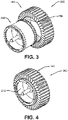
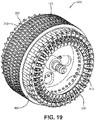
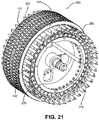
- FIGS. 3 -24 show a system 200 for use with the present invention that may cure and manufacture partially-cured pneumatic and/or non-pneumatic tire assemblies 140.
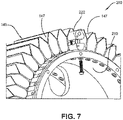
- the system 200 includes an annular hub member 210 slid into a corresponding annular, radially inner surface 142 of the tire assembly 140, a plurality of spacer members 220 for maintaining corresponding uniform cavity dimensions in the tire assembly 140 by fastening the spacer members 220 to the hub member 210 with flap members 147 of the tire assembly 140 enclosing a radially outermost surface 222 of each of the spacer members 220, first and second curing platens 230, 240 for axially securing the hub member 210 and spacer members 220 relative to each other, and a plurality of triangular inserts 250 for creating a substantially smooth, uniform outer cylindrical surface formed by a radially outer surface 252 of each triangular insert 250 and each of the flap members 147 of the tire assembly 140 positioned by the radially outermost surfaces 222 of the space
- an inner annular shear band 160 and an outer annular tread member 162 of the tire assembly 140 are serially placed circumferentially around the uniform outer cylindrical surface 164, 252 and affixed at least temporarily thereto and to each other 160, 162.
- This may be accomplished by building up layers 160, 162 around the assembly 200 similar to a conventional tire building method (not shown) or by forming a complete annular band structure from the shear band 160 and the tread member 162 ( FIG. 17 ).
- a plurality of mold members 260 (six shown in FIG. 18 ) is placed circumferentially around a radially outer surface 163 of the tread member 162.
- the mold members 260 preferably have radially inner surfaces 262 for together forming a tread shaped outer surface in the outer surface 163 of the tread member 162.
- the spacer members 220, curing platens 230, 240, triangular inserts 250, and mold members 260 are preferably heated in order to cure form the flap members 147, shear band 160, and tread member 162 (e.g., uncured parts of the tire assembly 140) into a molded integral part of a complete, cured tire assembly 170 having an appropriate tread 172 ( FIG. 23 ).
- the mold members 260 may be radially removed from around the complete tire assembly 170, the curing platens 230, 240 may be axially removed from the hub member 210, and the spacer members 220 and inserts 250 may be axially withdrawn from the tire assembly 170 to reveal stable cavities 176 within a spoke structure 174 of the mount-ready tire assembly 170.
- a method for use with the present invention cures and manufactures a partially-cured tire assembly 140 into a completed, "ready-to-install", completely cured tire assembly 170.
- the method preferably includes: a first step of sliding an annular hub member 210 into a corresponding annular, radially inner surface 142 of the partially-cured tire assembly 140; a second step of maintaining a plurality of spacer members 220 within corresponding uniform cavity dimensions in the partially-cured tire assembly 140; a third step of fastening the spacer members 220 to the hub member 210 with flap members 147 of the partially-cured tire assembly 140 enclosing a radially outermost surface 222 of each of the spacer members 220; a fourth step of axially securing first and second curing platens 230, 240, the hub member 210, and spacer members 220 relative to each other; a fifth step of utilizing a plurality of triangular inserts 250 for creating a substantially smooth, uniform outer cylindrical surface formed by a radially outer
- the method preferably further includes a tenth step of heating (e.g., by a hot liquid, steam, electricity, etc.) the spacer members 220, curing platens 230, 240, triangular inserts 250, and mold members 260 in order to cure/form the flap members 147, shear band 160, and tread member 162 (e.g., uncured parts of the partially-cured tire assembly 140) into a molded integral part of a complete, cured tire assembly 170 having an appropriate tread 172; an eleventh step of radially removing the mold members 260 from around the complete, fully-cured tire assembly 170; a twelfth step of axially removing the curing platens 230, 240 from the hub member 210; and a thirteenth step of axially withdrawing the spacer members 220 and inserts 250 from the fully-cured tire assembly 170 to reveal stable cavities 176 within a spoke structure 174 of the rim-mountable, fully-cured tire assembly 170.
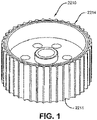
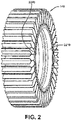
- the above first step of sliding an annular hub member 210 into a corresponding annular, radially inner surface 142 of the partially-cured tire assembly 140 is may be replaced with a step of sliding an annular wheel member 2210 into a corresponding annular, radially inner surface 142 of the partially-cured tire assembly 140 ( FIGS. 1-2 ).
- the wheel member 2210 is a completely functional rim for attaching the fully completed tire 170 to a fully operational vehicle.
- the wheel member 2210 preferably has roughened up concave surfaces 2211 for increasing surface area and bond strength at the interface between the rubber tire 170 and wheel member.
- the concave surfaces preferably further defines raised tips 2214 for more efficient torque and force transfer between corresponding convex surfaces 2245 of the tire assembly 140 and the wheel member.
- rubber/polymer components of the convex surfaces 2245 of the tire assembly 140 may be bonded to the concave surfaces 2211 of the wheel member 2210, similar to bonding between steel wire or bead wire and rubber/polymer components of a conventional pneumatic or non-pneumatic tire.
- the wheel member 2210 may thereby remain with tire assembly 140 throughout primary curing of the tire assembly 140 and the above secondary curing method such that a wheel member/tire assembly 2210, 170 may be rotatingly secured to a vehicle ( FIG. 2 ).
- the use of the operational wheel assembly 2210 from the beginning of the overall method may reduce overall complexity and eliminate a later step of assembling the wheel member 2210 and tire assembly 170.
Landscapes
- Engineering & Computer Science (AREA)
- Mechanical Engineering (AREA)
- Tires In General (AREA)
- Moulds For Moulding Plastics Or The Like (AREA)
- Tyre Moulding (AREA)
Applications Claiming Priority (1)
| Application Number | Priority Date | Filing Date | Title |
|---|---|---|---|
| US17/342,833 US11801651B2 (en) | 2021-06-09 | 2021-06-09 | System for manufacturing a support structure |
Publications (1)
| Publication Number | Publication Date |
|---|---|
| EP4112286A1 true EP4112286A1 (fr) | 2023-01-04 |
Family
ID=81975072
Family Applications (1)
| Application Number | Title | Priority Date | Filing Date |
|---|---|---|---|
| EP22177667.7A Withdrawn EP4112286A1 (fr) | 2021-06-09 | 2022-06-07 | Système et procédé de fabrication d'une structure de support |
Country Status (5)
| Country | Link |
|---|---|
| US (2) | US11801651B2 (fr) |
| EP (1) | EP4112286A1 (fr) |
| JP (1) | JP2022188758A (fr) |
| CN (1) | CN115447181A (fr) |
| BR (1) | BR102022010327A2 (fr) |
Citations (6)
| Publication number | Priority date | Publication date | Assignee | Title |
|---|---|---|---|---|
| US20150034225A1 (en) * | 2013-07-30 | 2015-02-05 | Caterpillar Inc. | Reinforced non-pneumatic tire and system for molding reinforced non-pneumatic tire |
| EP3321100A1 (fr) * | 2016-11-15 | 2018-05-16 | The Goodyear Tire & Rubber Company | Système et procédé de fabrication d'une structure de support non pneumatique |
| WO2018200142A1 (fr) * | 2017-04-27 | 2018-11-01 | Bridgestone Americas Tire Operations, Llc | Pneu à boucles à rayons |
| US20190299709A1 (en) * | 2018-03-28 | 2019-10-03 | The Goodyear Tire & Rubber Company | Wheel for a support structure |
| EP3785933A1 (fr) * | 2019-08-29 | 2021-03-03 | The Goodyear Tire & Rubber Company | Pneu non pneumatique doté d'un rayon en boucle flexible et son procédé de formation |
| EP4008539A2 (fr) * | 2020-12-02 | 2022-06-08 | The Goodyear Tire & Rubber Company | Système et procédé de fabrication d'une structure de support |
Family Cites Families (24)
| Publication number | Priority date | Publication date | Assignee | Title |
|---|---|---|---|---|
| US482175A (en) | 1892-09-06 | George hollafolla | ||
| US479255A (en) | 1892-07-19 | boyd dunlop | ||
| US1002003A (en) | 1910-07-23 | 1911-08-29 | Christian J Simonson | Steel tire. |
| US1233722A (en) | 1917-01-03 | 1917-07-17 | Frederick Kemppel | Resilient wheel. |
| US1389285A (en) | 1920-03-29 | 1921-08-30 | August W Althoff | Vehicle-wheel |
| US1451517A (en) | 1922-02-27 | 1923-04-10 | William H Smith | Spring wheel |
| US1930764A (en) | 1931-11-05 | 1933-10-17 | Wingfoot Corp | Pneumatic tire and method of making same |
| US3493027A (en) | 1966-05-20 | 1970-02-03 | Nasa | Deformable vehicle wheel |
| US4235270A (en) | 1978-06-30 | 1980-11-25 | The Goodyear Tire & Rubber Company | Tire with supporting and cushioning walls |
| US4226273A (en) | 1978-06-30 | 1980-10-07 | The Goodyear Tire & Rubber Company | Nonpneumatic tire and rim assembly |
| US4602823A (en) | 1981-08-18 | 1986-07-29 | Berg Charles A | Portable collapsible wheels |
| CA2043082A1 (fr) | 1991-02-27 | 1992-08-28 | James Edward Duddey | Pneu de secours sans chambre |
| US5800643A (en) | 1996-04-26 | 1998-09-01 | Inner Tire Corporation | Pneumatic inner tire |
| US6260598B1 (en) | 1997-07-11 | 2001-07-17 | Sumitomo Rubber Industries, Ltd. | Pneumatic tire with looped tread-sidewall reinforcement |
| US20040069385A1 (en) | 2002-07-01 | 2004-04-15 | Sean Timoney | Wheel |
| WO2009005945A1 (fr) | 2007-06-29 | 2009-01-08 | Societe De Technologie Michelin | Bande de cisaillement élastique à éléments cylindriques |
| FR2928865B1 (fr) | 2008-03-19 | 2010-03-19 | Michelin Soc Tech | Roue elastique non pneumatique |
| US9180732B2 (en) | 2009-08-28 | 2015-11-10 | Compagnie Generale Des Etablissements Michelin | Non-pneumatic wheel assembly with removable hub |
| CN204020424U (zh) * | 2014-06-20 | 2014-12-17 | 北京汽车股份有限公司 | 一种防爆轮胎及汽车 |
| WO2016100017A1 (fr) | 2014-12-18 | 2016-06-23 | Bridgestone Americas Tire Operations, Llc | Pneu à rayons arciformes |
| US10471773B2 (en) * | 2017-06-07 | 2019-11-12 | The Goodyear Tire & Rubber Company | Method of manufacturing a non-pneumatic support structure |
| KR102005417B1 (ko) | 2017-09-11 | 2019-07-30 | 금호타이어 주식회사 | 비공기입 타이어용 림 및 이를 포함하는 휠 |
| US10406852B2 (en) | 2017-10-27 | 2019-09-10 | The Goodyear Tire & Rubber Company | Non-pneumatic support structure |
| US10457094B2 (en) | 2017-12-11 | 2019-10-29 | The Goodyear Tire & Rubber Company | Wheel for a support structure |
-
2021
- 2021-06-09 US US17/342,833 patent/US11801651B2/en active Active
-
2022
- 2022-05-26 BR BR102022010327-5A patent/BR102022010327A2/pt not_active Application Discontinuation
- 2022-06-01 JP JP2022089370A patent/JP2022188758A/ja active Pending
- 2022-06-07 EP EP22177667.7A patent/EP4112286A1/fr not_active Withdrawn
- 2022-06-09 CN CN202210647513.6A patent/CN115447181A/zh active Pending
-
2023
- 2023-09-25 US US18/473,333 patent/US20240009947A1/en not_active Abandoned
Patent Citations (6)
| Publication number | Priority date | Publication date | Assignee | Title |
|---|---|---|---|---|
| US20150034225A1 (en) * | 2013-07-30 | 2015-02-05 | Caterpillar Inc. | Reinforced non-pneumatic tire and system for molding reinforced non-pneumatic tire |
| EP3321100A1 (fr) * | 2016-11-15 | 2018-05-16 | The Goodyear Tire & Rubber Company | Système et procédé de fabrication d'une structure de support non pneumatique |
| WO2018200142A1 (fr) * | 2017-04-27 | 2018-11-01 | Bridgestone Americas Tire Operations, Llc | Pneu à boucles à rayons |
| US20190299709A1 (en) * | 2018-03-28 | 2019-10-03 | The Goodyear Tire & Rubber Company | Wheel for a support structure |
| EP3785933A1 (fr) * | 2019-08-29 | 2021-03-03 | The Goodyear Tire & Rubber Company | Pneu non pneumatique doté d'un rayon en boucle flexible et son procédé de formation |
| EP4008539A2 (fr) * | 2020-12-02 | 2022-06-08 | The Goodyear Tire & Rubber Company | Système et procédé de fabrication d'une structure de support |
Also Published As
| Publication number | Publication date |
|---|---|
| US20220396044A1 (en) | 2022-12-15 |
| CN115447181A (zh) | 2022-12-09 |
| US11801651B2 (en) | 2023-10-31 |
| US20240009947A1 (en) | 2024-01-11 |
| BR102022010327A2 (pt) | 2022-12-27 |
| JP2022188758A (ja) | 2022-12-21 |
Similar Documents
| Publication | Publication Date | Title |
|---|---|---|
| US11020918B2 (en) | Method of manufacturing a non-pneumatic support structure | |
| US10603956B2 (en) | Wheel for a support structure | |
| EP3330098A1 (fr) | Ensemble roue pour une structure de support et système permettant de supporter une charge | |
| EP3321098A1 (fr) | Structure de support non pneumatique | |
| US10457094B2 (en) | Wheel for a support structure | |
| EP3599107B1 (fr) | Roue pour une structure de support | |
| US10471773B2 (en) | Method of manufacturing a non-pneumatic support structure | |
| EP4008539B1 (fr) | Système et procédé de fabrication d'une structure de support | |
| EP4008563B1 (fr) | Ensemble pneu/roue et procédé de support d'un véhicule | |
| EP3822092B1 (fr) | Ensemble roue pour une structure de support | |
| US11801651B2 (en) | System for manufacturing a support structure | |
| US12202219B2 (en) | System for manufacturing a support structure | |
| US11806960B2 (en) | System for manufacturing a support structure | |
| EP4197807B1 (fr) | Ensemble pneu/jante pour structure de support |
Legal Events
| Date | Code | Title | Description |
|---|---|---|---|
| PUAI | Public reference made under article 153(3) epc to a published international application that has entered the european phase |
Free format text: ORIGINAL CODE: 0009012 |
|
| STAA | Information on the status of an ep patent application or granted ep patent |
Free format text: STATUS: THE APPLICATION HAS BEEN PUBLISHED |
|
| AK | Designated contracting states |
Kind code of ref document: A1 Designated state(s): AL AT BE BG CH CY CZ DE DK EE ES FI FR GB GR HR HU IE IS IT LI LT LU LV MC MK MT NL NO PL PT RO RS SE SI SK SM TR |
|
| STAA | Information on the status of an ep patent application or granted ep patent |
Free format text: STATUS: THE APPLICATION IS DEEMED TO BE WITHDRAWN |
|
| 18D | Application deemed to be withdrawn |
Effective date: 20230705 |