EP4113675A2 - Traitement de modifications de composition de gaz variables et imprévisibles pour maximiser la santé et la performance de systèmes de pile à combustible - Google Patents
Traitement de modifications de composition de gaz variables et imprévisibles pour maximiser la santé et la performance de systèmes de pile à combustible Download PDFInfo
- Publication number
- EP4113675A2 EP4113675A2 EP22180082.4A EP22180082A EP4113675A2 EP 4113675 A2 EP4113675 A2 EP 4113675A2 EP 22180082 A EP22180082 A EP 22180082A EP 4113675 A2 EP4113675 A2 EP 4113675A2
- Authority
- EP
- European Patent Office
- Prior art keywords
- fuel
- stack
- gas
- fuel gas
- primary
- Prior art date
- Legal status (The legal status is an assumption and is not a legal conclusion. Google has not performed a legal analysis and makes no representation as to the accuracy of the status listed.)
- Pending
Links
Images




Classifications
-
- H—ELECTRICITY
- H01—ELECTRIC ELEMENTS
- H01M—PROCESSES OR MEANS, e.g. BATTERIES, FOR THE DIRECT CONVERSION OF CHEMICAL ENERGY INTO ELECTRICAL ENERGY
- H01M8/00—Fuel cells; Manufacture thereof
- H01M8/04—Auxiliary arrangements, e.g. for control of pressure or for circulation of fluids
- H01M8/04298—Processes for controlling fuel cells or fuel cell systems
- H01M8/04694—Processes for controlling fuel cells or fuel cell systems characterised by variables to be controlled
- H01M8/04746—Pressure; Flow
- H01M8/04753—Pressure; Flow of fuel cell reactants
-
- H—ELECTRICITY
- H01—ELECTRIC ELEMENTS
- H01M—PROCESSES OR MEANS, e.g. BATTERIES, FOR THE DIRECT CONVERSION OF CHEMICAL ENERGY INTO ELECTRICAL ENERGY
- H01M8/00—Fuel cells; Manufacture thereof
- H01M8/04—Auxiliary arrangements, e.g. for control of pressure or for circulation of fluids
- H01M8/04082—Arrangements for control of reactant parameters, e.g. pressure or concentration
- H01M8/04089—Arrangements for control of reactant parameters, e.g. pressure or concentration of gaseous reactants
-
- G—PHYSICS
- G01—MEASURING; TESTING
- G01N—INVESTIGATING OR ANALYSING MATERIALS BY DETERMINING THEIR CHEMICAL OR PHYSICAL PROPERTIES
- G01N33/00—Investigating or analysing materials by specific methods not covered by groups G01N1/00 - G01N31/00
- G01N33/0004—Gaseous mixtures, e.g. polluted air
- G01N33/0009—General constructional details of gas analysers, e.g. portable test equipment
- G01N33/0027—General constructional details of gas analysers, e.g. portable test equipment concerning the detector
- G01N33/0036—General constructional details of gas analysers, e.g. portable test equipment concerning the detector specially adapted to detect a particular component
-
- H—ELECTRICITY
- H01—ELECTRIC ELEMENTS
- H01M—PROCESSES OR MEANS, e.g. BATTERIES, FOR THE DIRECT CONVERSION OF CHEMICAL ENERGY INTO ELECTRICAL ENERGY
- H01M8/00—Fuel cells; Manufacture thereof
- H01M8/04—Auxiliary arrangements, e.g. for control of pressure or for circulation of fluids
- H01M8/04082—Arrangements for control of reactant parameters, e.g. pressure or concentration
- H01M8/04089—Arrangements for control of reactant parameters, e.g. pressure or concentration of gaseous reactants
- H01M8/04097—Arrangements for control of reactant parameters, e.g. pressure or concentration of gaseous reactants with recycling of the reactants
-
- H—ELECTRICITY
- H01—ELECTRIC ELEMENTS
- H01M—PROCESSES OR MEANS, e.g. BATTERIES, FOR THE DIRECT CONVERSION OF CHEMICAL ENERGY INTO ELECTRICAL ENERGY
- H01M8/00—Fuel cells; Manufacture thereof
- H01M8/04—Auxiliary arrangements, e.g. for control of pressure or for circulation of fluids
- H01M8/04298—Processes for controlling fuel cells or fuel cell systems
-
- H—ELECTRICITY
- H01—ELECTRIC ELEMENTS
- H01M—PROCESSES OR MEANS, e.g. BATTERIES, FOR THE DIRECT CONVERSION OF CHEMICAL ENERGY INTO ELECTRICAL ENERGY
- H01M8/00—Fuel cells; Manufacture thereof
- H01M8/04—Auxiliary arrangements, e.g. for control of pressure or for circulation of fluids
- H01M8/04298—Processes for controlling fuel cells or fuel cell systems
- H01M8/04313—Processes for controlling fuel cells or fuel cell systems characterised by the detection or assessment of variables; characterised by the detection or assessment of failure or abnormal function
- H01M8/0438—Pressure; Ambient pressure; Flow
-
- H—ELECTRICITY
- H01—ELECTRIC ELEMENTS
- H01M—PROCESSES OR MEANS, e.g. BATTERIES, FOR THE DIRECT CONVERSION OF CHEMICAL ENERGY INTO ELECTRICAL ENERGY
- H01M8/00—Fuel cells; Manufacture thereof
- H01M8/04—Auxiliary arrangements, e.g. for control of pressure or for circulation of fluids
- H01M8/04298—Processes for controlling fuel cells or fuel cell systems
- H01M8/04313—Processes for controlling fuel cells or fuel cell systems characterised by the detection or assessment of variables; characterised by the detection or assessment of failure or abnormal function
- H01M8/0438—Pressure; Ambient pressure; Flow
- H01M8/04388—Pressure; Ambient pressure; Flow of anode reactants at the inlet or inside the fuel cell
-
- H—ELECTRICITY
- H01—ELECTRIC ELEMENTS
- H01M—PROCESSES OR MEANS, e.g. BATTERIES, FOR THE DIRECT CONVERSION OF CHEMICAL ENERGY INTO ELECTRICAL ENERGY
- H01M8/00—Fuel cells; Manufacture thereof
- H01M8/04—Auxiliary arrangements, e.g. for control of pressure or for circulation of fluids
- H01M8/04298—Processes for controlling fuel cells or fuel cell systems
- H01M8/04313—Processes for controlling fuel cells or fuel cell systems characterised by the detection or assessment of variables; characterised by the detection or assessment of failure or abnormal function
- H01M8/0438—Pressure; Ambient pressure; Flow
- H01M8/04425—Pressure; Ambient pressure; Flow at auxiliary devices, e.g. reformers, compressors, burners
-
- H—ELECTRICITY
- H01—ELECTRIC ELEMENTS
- H01M—PROCESSES OR MEANS, e.g. BATTERIES, FOR THE DIRECT CONVERSION OF CHEMICAL ENERGY INTO ELECTRICAL ENERGY
- H01M8/00—Fuel cells; Manufacture thereof
- H01M8/04—Auxiliary arrangements, e.g. for control of pressure or for circulation of fluids
- H01M8/04298—Processes for controlling fuel cells or fuel cell systems
- H01M8/04313—Processes for controlling fuel cells or fuel cell systems characterised by the detection or assessment of variables; characterised by the detection or assessment of failure or abnormal function
- H01M8/0444—Concentration; Density
- H01M8/04447—Concentration; Density of anode reactants at the inlet or inside the fuel cell
-
- H—ELECTRICITY
- H01—ELECTRIC ELEMENTS
- H01M—PROCESSES OR MEANS, e.g. BATTERIES, FOR THE DIRECT CONVERSION OF CHEMICAL ENERGY INTO ELECTRICAL ENERGY
- H01M8/00—Fuel cells; Manufacture thereof
- H01M8/04—Auxiliary arrangements, e.g. for control of pressure or for circulation of fluids
- H01M8/04298—Processes for controlling fuel cells or fuel cell systems
- H01M8/04313—Processes for controlling fuel cells or fuel cell systems characterised by the detection or assessment of variables; characterised by the detection or assessment of failure or abnormal function
- H01M8/0444—Concentration; Density
- H01M8/04462—Concentration; Density of anode exhausts
-
- H—ELECTRICITY
- H01—ELECTRIC ELEMENTS
- H01M—PROCESSES OR MEANS, e.g. BATTERIES, FOR THE DIRECT CONVERSION OF CHEMICAL ENERGY INTO ELECTRICAL ENERGY
- H01M8/00—Fuel cells; Manufacture thereof
- H01M8/04—Auxiliary arrangements, e.g. for control of pressure or for circulation of fluids
- H01M8/04298—Processes for controlling fuel cells or fuel cell systems
- H01M8/04313—Processes for controlling fuel cells or fuel cell systems characterised by the detection or assessment of variables; characterised by the detection or assessment of failure or abnormal function
- H01M8/04537—Electric variables
- H01M8/04544—Voltage
- H01M8/04559—Voltage of fuel cell stacks
-
- H—ELECTRICITY
- H01—ELECTRIC ELEMENTS
- H01M—PROCESSES OR MEANS, e.g. BATTERIES, FOR THE DIRECT CONVERSION OF CHEMICAL ENERGY INTO ELECTRICAL ENERGY
- H01M8/00—Fuel cells; Manufacture thereof
- H01M8/04—Auxiliary arrangements, e.g. for control of pressure or for circulation of fluids
- H01M8/04298—Processes for controlling fuel cells or fuel cell systems
- H01M8/04313—Processes for controlling fuel cells or fuel cell systems characterised by the detection or assessment of variables; characterised by the detection or assessment of failure or abnormal function
- H01M8/04537—Electric variables
- H01M8/04574—Current
- H01M8/04589—Current of fuel cell stacks
-
- H—ELECTRICITY
- H01—ELECTRIC ELEMENTS
- H01M—PROCESSES OR MEANS, e.g. BATTERIES, FOR THE DIRECT CONVERSION OF CHEMICAL ENERGY INTO ELECTRICAL ENERGY
- H01M8/00—Fuel cells; Manufacture thereof
- H01M8/04—Auxiliary arrangements, e.g. for control of pressure or for circulation of fluids
- H01M8/04298—Processes for controlling fuel cells or fuel cell systems
- H01M8/04313—Processes for controlling fuel cells or fuel cell systems characterised by the detection or assessment of variables; characterised by the detection or assessment of failure or abnormal function
- H01M8/04537—Electric variables
- H01M8/04604—Power, energy, capacity or load
- H01M8/04619—Power, energy, capacity or load of fuel cell stacks
-
- H—ELECTRICITY
- H01—ELECTRIC ELEMENTS
- H01M—PROCESSES OR MEANS, e.g. BATTERIES, FOR THE DIRECT CONVERSION OF CHEMICAL ENERGY INTO ELECTRICAL ENERGY
- H01M8/00—Fuel cells; Manufacture thereof
- H01M8/04—Auxiliary arrangements, e.g. for control of pressure or for circulation of fluids
- H01M8/04298—Processes for controlling fuel cells or fuel cell systems
- H01M8/04694—Processes for controlling fuel cells or fuel cell systems characterised by variables to be controlled
- H01M8/04746—Pressure; Flow
- H01M8/04776—Pressure; Flow at auxiliary devices, e.g. reformer, compressor, burner
-
- H—ELECTRICITY
- H01—ELECTRIC ELEMENTS
- H01M—PROCESSES OR MEANS, e.g. BATTERIES, FOR THE DIRECT CONVERSION OF CHEMICAL ENERGY INTO ELECTRICAL ENERGY
- H01M8/00—Fuel cells; Manufacture thereof
- H01M8/04—Auxiliary arrangements, e.g. for control of pressure or for circulation of fluids
- H01M8/04298—Processes for controlling fuel cells or fuel cell systems
- H01M8/04694—Processes for controlling fuel cells or fuel cell systems characterised by variables to be controlled
- H01M8/04791—Concentration; Density
- H01M8/04798—Concentration; Density of fuel cell reactants
-
- H—ELECTRICITY
- H01—ELECTRIC ELEMENTS
- H01M—PROCESSES OR MEANS, e.g. BATTERIES, FOR THE DIRECT CONVERSION OF CHEMICAL ENERGY INTO ELECTRICAL ENERGY
- H01M8/00—Fuel cells; Manufacture thereof
- H01M8/04—Auxiliary arrangements, e.g. for control of pressure or for circulation of fluids
- H01M8/04298—Processes for controlling fuel cells or fuel cell systems
- H01M8/04694—Processes for controlling fuel cells or fuel cell systems characterised by variables to be controlled
- H01M8/04858—Electric variables
- H01M8/04865—Voltage
- H01M8/0488—Voltage of fuel cell stacks
-
- H—ELECTRICITY
- H01—ELECTRIC ELEMENTS
- H01M—PROCESSES OR MEANS, e.g. BATTERIES, FOR THE DIRECT CONVERSION OF CHEMICAL ENERGY INTO ELECTRICAL ENERGY
- H01M8/00—Fuel cells; Manufacture thereof
- H01M8/04—Auxiliary arrangements, e.g. for control of pressure or for circulation of fluids
- H01M8/04298—Processes for controlling fuel cells or fuel cell systems
- H01M8/04694—Processes for controlling fuel cells or fuel cell systems characterised by variables to be controlled
- H01M8/04858—Electric variables
- H01M8/04895—Current
- H01M8/0491—Current of fuel cell stacks
-
- H—ELECTRICITY
- H01—ELECTRIC ELEMENTS
- H01M—PROCESSES OR MEANS, e.g. BATTERIES, FOR THE DIRECT CONVERSION OF CHEMICAL ENERGY INTO ELECTRICAL ENERGY
- H01M8/00—Fuel cells; Manufacture thereof
- H01M8/04—Auxiliary arrangements, e.g. for control of pressure or for circulation of fluids
- H01M8/04298—Processes for controlling fuel cells or fuel cell systems
- H01M8/04992—Processes for controlling fuel cells or fuel cell systems characterised by the implementation of mathematical or computational algorithms, e.g. feedback control loops, fuzzy logic, neural networks or artificial intelligence
-
- H—ELECTRICITY
- H01—ELECTRIC ELEMENTS
- H01M—PROCESSES OR MEANS, e.g. BATTERIES, FOR THE DIRECT CONVERSION OF CHEMICAL ENERGY INTO ELECTRICAL ENERGY
- H01M8/00—Fuel cells; Manufacture thereof
- H01M8/06—Combination of fuel cells with means for production of reactants or for treatment of residues
- H01M8/0606—Combination of fuel cells with means for production of reactants or for treatment of residues with means for production of gaseous reactants
- H01M8/0612—Combination of fuel cells with means for production of reactants or for treatment of residues with means for production of gaseous reactants from carbon-containing material
- H01M8/0618—Reforming processes, e.g. autothermal, partial oxidation or steam reforming
-
- H—ELECTRICITY
- H01—ELECTRIC ELEMENTS
- H01M—PROCESSES OR MEANS, e.g. BATTERIES, FOR THE DIRECT CONVERSION OF CHEMICAL ENERGY INTO ELECTRICAL ENERGY
- H01M8/00—Fuel cells; Manufacture thereof
- H01M8/06—Combination of fuel cells with means for production of reactants or for treatment of residues
- H01M8/0662—Treatment of gaseous reactants or gaseous residues, e.g. cleaning
-
- H—ELECTRICITY
- H01—ELECTRIC ELEMENTS
- H01M—PROCESSES OR MEANS, e.g. BATTERIES, FOR THE DIRECT CONVERSION OF CHEMICAL ENERGY INTO ELECTRICAL ENERGY
- H01M8/00—Fuel cells; Manufacture thereof
- H01M8/24—Grouping of fuel cells, e.g. stacking of fuel cells
- H01M8/249—Grouping of fuel cells, e.g. stacking of fuel cells comprising two or more groupings of fuel cells, e.g. modular assemblies
-
- H—ELECTRICITY
- H01—ELECTRIC ELEMENTS
- H01M—PROCESSES OR MEANS, e.g. BATTERIES, FOR THE DIRECT CONVERSION OF CHEMICAL ENERGY INTO ELECTRICAL ENERGY
- H01M8/00—Fuel cells; Manufacture thereof
- H01M8/10—Fuel cells with solid electrolytes
- H01M8/12—Fuel cells with solid electrolytes operating at high temperature, e.g. with stabilised ZrO2 electrolyte
- H01M2008/1293—Fuel cells with solid oxide electrolytes
-
- H—ELECTRICITY
- H01—ELECTRIC ELEMENTS
- H01M—PROCESSES OR MEANS, e.g. BATTERIES, FOR THE DIRECT CONVERSION OF CHEMICAL ENERGY INTO ELECTRICAL ENERGY
- H01M2250/00—Fuel cells for particular applications; Specific features of fuel cell system
- H01M2250/20—Fuel cells in motive systems, e.g. vehicle, ship, plane
-
- Y—GENERAL TAGGING OF NEW TECHNOLOGICAL DEVELOPMENTS; GENERAL TAGGING OF CROSS-SECTIONAL TECHNOLOGIES SPANNING OVER SEVERAL SECTIONS OF THE IPC; TECHNICAL SUBJECTS COVERED BY FORMER USPC CROSS-REFERENCE ART COLLECTIONS [XRACs] AND DIGESTS
- Y02—TECHNOLOGIES OR APPLICATIONS FOR MITIGATION OR ADAPTATION AGAINST CLIMATE CHANGE
- Y02E—REDUCTION OF GREENHOUSE GAS [GHG] EMISSIONS, RELATED TO ENERGY GENERATION, TRANSMISSION OR DISTRIBUTION
- Y02E60/00—Enabling technologies; Technologies with a potential or indirect contribution to GHG emissions mitigation
- Y02E60/30—Hydrogen technology
- Y02E60/50—Fuel cells
Definitions
- aspects of this disclosure relate to fuel cell systems and methods, and more particularly, to a fuel cell system and method of controlling the fuel cell system.
- Fuel cells such as solid oxide fuel cells, are electrochemical devices which can convert energy stored in fuels to electrical energy with high efficiencies.
- High temperature fuel cells include solid oxide and molten carbonate fuel cells. These fuel cells may operate using hydrogen and/or hydrocarbon fuels.
- An embodiment fuel cell system includes a fuel inlet that receives a fuel gas from a fuel source, a gas analyzer that determines a composition of the fuel gas received by the fuel inlet, and a stack including fuel cells that generate electricity using the fuel gas received from the fuel source.
- the fuel cell system further includes a controller that controls at least one of a fuel utilization of the stack, current generated by the stack, or a voltage generated by the stack, based on the composition of the primary fuel gas determined by the gas analyzer.
- the controller may control the fuel cell system by increasing or decreasing a fuel flow rate to thereby increase or decrease the voltage generated by the stack to maintain a predetermined target voltage or to maintain a predetermined rate at which usable fuel is supplied to the stack based on composition.
- An embodiment method may include receiving a primary fuel gas from a first fuel source and determining a composition of the primary fuel gas using a gas analyzer.
- the method may include providing the primary fuel gas to a stack including fuel cells to thereby generate electricity using the primary fuel gas.
- the method may further include controlling at least one of a fuel utilization of the stack, current generated by the stack, or a voltage generated by the stack, based on the composition of the primary fuel gas as determined by the gas analyzer.
- a further disclosed method may include receiving a fuel gas from a fuel source, and providing the fuel gas to a stack including fuel cells to thereby generate electricity using the fuel gas.
- the method may include determining a voltage generated by the stack and determining that a frequency and/or amplitude of voltage changes exceed one or more respective thresholds.
- the method may further include controlling the voltage generated by the fuel cell system according to a voltage control mode.
- the voltage control mode may include performing a closed loop control method to maintain a predetermined target voltage generated by the stack.
- Solid oxide fuel cell (SOFC) systems are generally configured to operate most efficiently using natural gas. However, many gas utilities mitigate peak winter demands by using propane peak shaving and standby systems. Most of these systems produce "propane-air" for direct replacement of natural gas during peak demand periods. Typical delivered compositions can be as high as around 30% propane, 25% air, and 45% methane, however some regions may be as low as 1%/1% propane/air (e.g., liquid propane air (LPA) and natural gas mixture). In conventional SOFC systems, the inclusion of air appears to facilitate coking and/or deactivation of reformation catalysts, which may lead to coking and deactivation of fuel cell anodes.
- LPA liquid propane air
- Peak shaving gases may include higher hydrocarbons including more carbon atoms than methane, such as ethane, ethene, propane, propene, butane, pentane, isopentane, hexane, etc.
- Typical hydrocarbon fuels include saturated alkenes, such as ethane and propane (C 2 H 6 and C 3 H 8 ).
- Unsaturated alkenes, such as ethylene and propylene (C 2 H 4 and C 3 H 6 ) are not a normal constituent of natural gas in North America or worldwide, but may be introduced into some natural gas networks as a result of refining and chemical engineering processes (such as refinery by-products).
- unsaturated alkenes may result in the surface deposition of carbon (i.e., coking) with respect to various elements of fuel cell systems.
- coking may result in deactivation of catalyst surfaces and may provide nucleation sites for the creation of more coke.
- the lifetime of a catalytic reactor may be severely compromised. Therefore, the prevention of coke formation is of high importance in reforming process engineering, in order to allow fuel cell systems to operate using fuels that contain unsaturated alkenes.
- Exemplary fuels including higher hydrocarbons may include a combination of various molecules including CO, CO 2 , H 2 O, H 2 , O 2 , N 2 , Ar, CH 4 , C 2 H 6 , C 2 H 4 , C 3 H 8 , C 3 H 6 , n-C 4 H 10 (n-butane), i-C 4 H 10 (isobutane), C 5 H 12 , and C 6 H 14 and the various molecules may represent different molecular fractions (or percentages) of the overall fuel.
- CH 4 may represent from less than 96% of the molecules in the fuel in the fuel inlet stream, e.g., 40.496% to 95.994% of the molecules
- C 2 H 6 may represent from 1.250% and 8.00% of the molecules in the fuel in the fuel inlet stream
- C 2 H 4 may represent from 0.040% to 8.00% of the molecules in the fuel in the fuel inlet stream
- C 3 H 8 may represent from 0.360% to 30.760% of the molecules in the fuel in the fuel inlet stream
- C 3 H 6 may represent from 0.001% to 1.620% of the molecules in the fuel in the fuel inlet stream
- n-C 4 H 10 may represent from 0.001% to 0.400% of the molecules in the fuel in the fuel inlet stream
- i-C 4 H 10 may represent from 0.001% to 0.200% of the molecules in the fuel in the fuel inlet stream
- C 5 H 12 may represent from 0.001% to 0.090% of the molecules in the fuel in the fuel inlet stream
- C 6 H 14 may represent from 0.001%
- Table I Natural Gas Peak Shave Natural Gas Peak Shave Natural Gas Natural Gas Injected with Refinery Gases Natural Gas with higher Ethane and Propane Natural Gas with higher Ethane and Propane (from PG&E) High Propane, High Air Lower Propane, Lower Air High Ethane Medium Ethane Mole Fraction CO 0.001% 0.001% 0.001% 0.001% 0.001% CO 2 1.300% 0.300% 0.360% 4.000% 1.300% 2.200% H 2 O 0.001% 0.001% 0.001% 0.001% 0.001% 0.001% H 2 0.001% 0.001% 0.001% 0.001% 2.000% 0.001% 0.001% O 2 0.001% 5.300% 4.280% 0.001% 0.001% 0.001% N 2 0.400% 20.040% 16.200% 0.001% 0.400% 0.400% Ar 0.001% 0.001% 0.001% 0.001% CH 4 95.994% 40.496% 48.946% 74.991% 84.11
- FIG. 1 is a schematic representation of a SOFC system 10, according to various embodiments.
- the system 10 includes a hotbox 13 and various components disposed therein or adjacent thereto.
- the hot box 13 may contain fuel cell stacks 102, such as a solid oxide fuel cell stacks (where one solid oxide fuel cell of the stack contains a ceramic electrolyte, such as yttria stabilized zirconia (YSZ) or scandia stabilized zirconia (SSZ), an anode electrode, such as a nickel-YSZ or Ni-SSZ cermet, and a cathode electrode, such as lanthanum strontium manganite (LSM)).
- the stacks 102 may be arranged over each other in a plurality of columns.
- the hot box 13 may also contain an anode recuperator 110, a cathode recuperator 120, an anode tail gas oxidizer (ATO) 130, an anode exhaust cooler 140, a splitter 150, and a steam generator 160.
- the system 10 may also include a catalytic partial oxidation (CPOx) reactor 200, a mixer 210, a CPOx blower 204 (e.g., air blower), a system blower 208 (e.g., air blower), and an anode recycle blower 212, which may be disposed outside of the hotbox 13.
- CPOx catalytic partial oxidation
- the CPOx reactor 200 receives a fuel inlet stream from a fuel inlet 300, through fuel conduit 300A.
- the fuel inlet 300 may be a utility gas line including a valve to control an amount of fuel provided to the CPOx reactor 200.
- the CPOx blower 204 may provide air to the CPOx reactor 202.
- the fuel and/or air may be provided to the mixer 210 by fuel conduit 300B.
- Fuel e.g., the fuel stream 1721 described below with respect to FIGS. 4A-4C
- Fuel flows from the anode recuperator 110 to the stack 102 through fuel conduit 300D.
- the main air blower 208 may be configured to provide an air stream (e.g., air inlet stream) to the anode exhaust cooler 140 through air conduit 302A. Air flows from the anode exhaust cooler 140 to the cathode recuperator through air conduit 302B. The air flows from the cathode recuperator 120 to the stack 102 through air conduit 302C.
- an air stream e.g., air inlet stream
- Anode exhaust (e.g., the fuel exhaust stream 1723 described below with respect to FIGS. 4A-4C ) generated in the stack 102 is provided to the anode recuperator 110 through recycling conduit 308A.
- the anode exhaust may contain unreacted fuel.
- the anode exhaust may also be referred to herein as fuel exhaust.
- the anode exhaust may be provided from the anode recuperator 110 to a splitter 150 by recycling conduit 308B.
- a first portion of the anode exhaust may be provided from the splitter 150 to the anode exhaust cooler 140 by exhaust conduit 308C.
- a second portion of the anode exhaust may be provided from the splitter 150 to the ATO 130 by recycling conduit 308D.
- Anode exhaust may be provided from the anode exhaust cooler 140 to mixer 210 by exhaust conduit 308E.
- the anode recycle blower 212 may be configured to move anode exhaust though recycling conduit 308E, as discussed below.
- Cathode exhaust generated in the stack 102 flows to the ATO 130 through exhaust conduit 304A.
- Cathode exhaust and/or ATO exhaust generated in the ATO 130 flows from the ATO 130 to the cathode recuperator 120 through exhaust conduit 304B.
- Exhaust flows from the cathode recuperator 120 to the steam generator 160 through exhaust conduit 304C.
- Exhaust flows from the steam generator 160 and out of the hotbox 13 through exhaust conduit 304D.
- the steam generator 160 converts the water into steam using heat from the ATO exhaust provided by exhaust conduit 304C.
- Steam is provided from the steam generator 160 to the mixer 210 through water conduit 306B.
- the steam may be provided directly into the fuel inlet stream and/or the anode exhaust stream may be provided directly into the fuel inlet stream followed by humidification of the combined fuel streams.
- the mixer 210 is configured to mix the steam with anode exhaust and fuel. This fuel mixture may then be heated in the anode recuperator 110, before being provided to the stack 102.
- the system 10 may further include a gas analyzer 220 configured to analyze the fuel in fuel conduit 300A and a system controller 225 configured to control various elements of the system 10.
- the controller 225 may include a central processing unit configured to execute stored instructions.
- the controller 225 may be configured to control fuel and/or air flow through the system 10, according to fuel composition data received from the gas analyzer 220, as discussed in detail below.
- the system 10 may also include one or more fuel catalysts 112, 114, and 116, as discussed below.
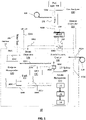
- FIG. 2 is a flow diagram showing fuel flow through the system 10, according to various embodiments.
- fuel flows from the fuel inlet 300 into the CPOx reactor 200 during all modes of operation (e.g., during startup, steady state, and shutdown operations).
- the fuel may include a hydrocarbon fuel such as ethane or propane.
- the fuel may also include unsaturated alkenes, such as ethylene and propylene.
- the fuel may also include a certain amount of oxygen, such as part of the "propane-air" discussed above.
- the gas analyzer 220 may be any detector configured to detect natural gas content, such as a hydrocarbon detector, a natural gas detector, a flame ionization detector, and/or an optical detector.
- the gas analyzer 220 may be an infrared absorption based on-line monitoring system configured for measurement of alkanes: methane, ethane, propane, butanes and pentanes, such as a Precisive hydrocarbon composition analyzer (HCA) manufactured by MKS Instruments, Inc.
- HCA Precisive hydrocarbon composition analyzer
- the gas analyzer may also include an optional oxygen sensor.
- the gas analyzer 220 may be configured to provide gas content to the overall fuel cell system controller 225, which may be configured to control one or more fuel cell stacks and/or systems at a given site (e.g., by increasing or decreasing an amount of fuel using a valve in the fuel inlet 300, and/or by increasing or decreasing a stack voltage or current, and/or by adjusting the speed of a fuel recycle blower 212 to control fuel utilization).
- This information may also be disseminated down to the individual fuel cell controllers for use in the control system algorithms. This information could be particularly useful for sensing substantial changes in gas quality/composition, and making according changes in control systems.
- the fuel is partially oxidized in the CPOx reactor 200 by injection of air from the CPOx blower 204.
- the CPOx reactor 200 may include a glow plug to initiate this catalytic reaction.
- the CPOx reactor 200 may be operated at a temperature ranging from about 600°C to about 800°C, such as from about 650°C to about 750°C, or about 700°C.
- the CPOx blower 204 generally operates during startup, and is usually not operated during steady-state system operation.
- the CPOx blower 204 may be operated to inject air into the fuel stream, without igniting the CPOx reaction (e.g., without operating a glow plug therein). As a result, some of the ethane may be converted to lower hydrocarbons downstream in the process by this injection.
- This method of air injection may be particularly applicable to SOFC systems that do not include a reformation catalyst configured to catalyze ethane and/or propane without a high probability of coking.
- this method may also be used with SOFC systems that do include such a reformation catalyst, when an ethane concentration exceeds the reformation capability thereof.
- reformation catalysts may be configured to reform gas mixtures that contain less than about 15%, such as less than about 12%, or less than about 9% ethane and/or propane.
- the fuel flows from the CPOx reactor 200 into the mixer 210, where it may be mixed with steam and/or anode exhaust stream in conduit 308E.
- the fuel then flows into the anode recuperator 110, where it is heated using hot anode exhaust emitted from the stack 102 via conduit 308A.
- One or more of the catalysts 112, 114, 116 may be disposed within the anode recuperator 110, according to some embodiments.
- one or more of the catalysts 112, 114, 116 may be disposed between walls of the anode recuperator 110, or may be disposed in an opening formed within the anode recuperator 110.
- one or more of the catalysts 112, 114, 116 may be in the form of pucks or disks.
- one or more of the catalysts 112, 114, 116 may be disposed outside of the anode recuperator 110 (e.g., upstream or downstream of the anode recuperator).
- the catalysts 112, 114, 116 may include a metallic/ceramic foam with a catalytic layer (e.g., palladium, nickel and/or rhodium), a metallic/ceramic foam without a catalytic layer where the base metal of the foam is catalytically active (e.g., nickel), a large number of coiled wires with a catalytic layer, a packed bed of catalyst pellets, or any combination thereof.
- a catalytic layer e.g., palladium, nickel and/or rhodium
- a metallic/ceramic foam without a catalytic layer where the base metal of the foam is catalytically active e.g., nickel
- a large number of coiled wires with a catalytic layer e.g., nickel
- the heated fuel enters an oxidation catalyst 112 either upstream of the anode recuperator 110 (if the oxidation catalyst 112 is located upstream of the anode recuperator 110) or while traveling through the anode recuperator 110 (if the oxidation catalyst 112 is located in the anode recuperator 110).
- the oxidation catalyst 112 may be a catalytic reactor configured to remove free oxygen (O 2 ) from the fuel.
- the oxidation catalyst 112 may facilitate the reaction of oxygen with H 2 , CO, and/or other natural gas components in the fuel.
- the removal of free oxygen prevents or reduces the oxidation of a reforming catalyst 116.
- the oxidation of the reforming catalyst 116 is thought to contribute to catalyst coking.
- the oxidation catalyst 112 may induce a small pressure drop to the fuel stream, such as approximately 10% or less of the normal reformer pressure loss.
- the oxidation catalyst 112 may be configured to operate at temperatures that can readily be achieved by heating with the anode exhaust.
- the oxidation catalyst 112 may be configured to operate at temperatures ranging from about 100°C to about 200°C, such as from about 125°C to about 175°C, or about 150°C.
- the oxidation catalyst 112 may include a nickel/rhodium catalyst layer on a ceramic base (e.g., support).
- the catalyst layer may also include other base metals such as zinc, cobalt and/or copper.
- the ceramic base of the oxidation catalyst may include any suitable ceramic base material, such as alumina, stabilized zirconia, lanthana and/or ceria.
- the oxidation catalyst 112 may be configured to remove from at least 90%, such as at least about 95%, at least about 97%, at least about 98%, or at least about 99% of the oxygen from the fuel.
- the oxidation catalyst 112 may be configured to remove free oxygen without excessive reformation of methane.
- the oxidation catalyst 112 may be configured to reform less than about 20%, such as less than about 18%, less than about 15%, less than about 12%, or less than about 10% of the methane and/or other higher hydrocarbons included in the fuel.
- the catalyst may be configured explicitly so as not to catalyze hydrocarbon reformation reactions.
- the system 10 may optionally include a thermocouple (T/C) 224, or similar temperature detector, configured to detect the temperature of the fuel exiting the oxidation catalyst 112. An increase in the detected temperature may be used to determine the approximate content of one or more components of the fuel, such as whether oxygen is present in the fuel and/or specific hydrocarbon levels in the fuel.
- the system may also include a T/C 227 configured to detect the temperature of fuel entering the oxidation catalyst 112, such that a temperature change of the fuel passing through the oxidation catalyst may be detected.
- the fuel may then flow into a hydrogenation catalyst 114.
- the hydrogenation catalyst 114 may be a catalytic reactor configured to combine unsaturated hydrocarbons, such as ethylene and/or propylene (alkenes), with available hydrogen in the fuel stream, resulting in saturated hydrocarbons, such as ethane and propane or other alkanes.
- the hydrogenation catalyst 114 may include a ceramic base, such as alumina, ceria, zirconia, or a mixture of ceria and zirconia, with a small percentage of a catalyst metal such as palladium.
- the hydrogenation catalyst 114 may include an amount of palladium ranging from about 0.1 wt% to about 5 wt%.
- the hydrogenation catalyst 114 may be configured to operate at temperatures ranging from about 200°C to about 450°C, such as from about 225°C to about 425°C, or from about 250°C to about 400°C.
- the hydrogenation catalyst 114 may be located in the anode recuperator 110.
- the system 10 may include a sampling port 223 disposed adjacent an exit of the hydrogenation catalyst 114.
- a gas analyzer 222 may be disposed at the sampling 223 port and may be configured as a general gas composition instrument, or an instrument configured to detect one water vapor content and/or more specific gas components.
- the fuel then flows into a reforming catalyst 116.
- the reforming catalyst 116 may be a catalytic reactor configured to partially reform the fuel before the fuel is delivered to the stack 102.
- the reformation reaction is endothermic (e.g., a steam methane reformation (SMR) reaction) and may operate to cool the fuel prior to feeding the stack.
- the reforming catalyst 116 may include one or more nickel/rhodium catalysts configured to reform higher hydrocarbons (C2 - C5) at very broad steam to carbon ratios.
- the reforming catalyst 116 may be configured to reform a fuel stream having at least 10 vol% of C2 and C3 hydrocarbons, without significant coke formation.
- the reforming catalyst 116 may be configured to reform a fuel stream having up to 20 vol%, up to 18 vol%, up to 16 vol %, up to 14 vol%, or up to 12 vol% of C2 and C3 hydrocarbons.
- the fuel is then reacted in the stack 102, and the resultant anode exhaust may include unreacted fuel components.
- the anode exhaust may be provided to the anode recuperator 110 to heat the incoming fuel.
- the anode exhaust may then be provided to the anode exhaust cooler 140, where the anode exhaust may be used to heat air entering the system 10, such as air provided by the system blower 208.
- the system controller 225 may be configured to adjust a fuel flow rate from the fuel inlet 300, an air flow rate from the CPOx blower 204, and/or a speed of the anode recycle blower 212, based on the composition of the fuel. For example, the fuel flow rate may be increased to prevent starvation of the stack 102, when the free oxygen content of the fuel is high, since fuel is consumed when the oxygen is removed in the oxidation catalyst 112.
- the system controller 225 may also use other feedback signals to determine correct fuel flow rate, such as stack voltage at operating current and the temperature of the ATO 130, in order to detect and/or respond to a peak shaving event. For example, a reduction in the temperature of the ATO 130 and/or a reduction in the fuel cell stack 102 voltage may indicate that the stack 102 is starved for fuel. If the fuel flow rate is too high, the temperature of the ATO 130 may rise above a normal operating temperature and/or the stack voltage may also experience a similar increase.
- correct fuel flow rate such as stack voltage at operating current and the temperature of the ATO 130
- the controller 225 may be configured to compare the measured stack voltage to a recent history of stack voltage at a similar current level, when no peak shaving event was occurring, in order to determine whether fuel flow, anode exhaust recycle flow, and/or air flow should be adjusted.
- the controller 225 may be configured to receive a supervisory control and data acquisition (SCADA) signal from a gas utility before a peak shaving event occurs.
- the signal may include the composition of the peak shaving gas and/or the timing of the peak shaving event.
- the controller 225 may be configured to control the operation of the system 10, based on the signal. For example, the controller 225 may cause the system 10 to return to normal operation after the peak shaving event expires.
- SCADA supervisory control and data acquisition
- the fuel cell system 10 may be configured to operate in a broad range of fuel environments, which may allow for the system 10 to be implemented in areas where operation was previously difficult or impractical because of prohibitive levels of air, propane, and/or ethane, ethylene, propylene, is provided in fuel.
- the system 10 may also provide for increased fuel cell stack life by providing more consistent pre-reformation across the whole range of natural gas quality/composition.
- FIG. 3A illustrates a central column 400 of the system 10, according to various embodiments.
- FIG. 3B illustrates an anode hub structure 600 disposed in a hot box base 500 on which the column 400 may be disposed.
- fuel cell stacks (not shown) may be disposed around the column 400, on the hot box base 500.
- the column 400 includes the anode recuperator 110, the ATO 130, and the anode exhaust cooler 140.
- the anode recuperator 110 is disposed radially inward of the ATO 130, and the anode exhaust cooler 140 is mounted over the anode recuperator 110 and the ATO 130.
- the oxidation catalyst 112 and/or the hydrogenation catalyst 114 may be located in the anode recuperator 110.
- the reforming catalyst 116 may also be located at the bottom of the anode recuperator 110 as a steam methane reformation (SMR) insert.
- SMR steam methane reformation
- the ATO 130 may include an outer cylinder 130A that is positioned around inner ATO insulation 130B/outer wall of the anode recuperator 110.
- the insulation 130B may be enclosed by an inner ATO cylinder 130C.
- the insulation 130B may be located between the anode recuperator 110 and the ATO 130.
- An ATO oxidation catalyst may be located in the space between the outer cylinder 130A and the ATO insulation 130B.
- An ATO thermocouple feed through 1601 extends through the anode exhaust cooler 140, to the top of the ATO 130. The temperature of the ATO 130 may thereby be monitored by inserting one or more thermocouples (not shown) through this feed through 1601.
- the anode hub structure 600 is positioned under the anode recuperator 110 and ATO 130 and over the hot box base 500.
- the anode hub structure 600 is covered by an ATO skirt 1603.
- a combined ATO mixer 801 and fuel exhaust splitter 150 is located over the anode recuperator 110 and ATO 130 and below the anode cooler 140.
- An ATO glow plug 1602, which initiates the oxidation of the stack fuel exhaust in the ATO during startup, may be located near the bottom of the ATO 130.
- the anode hub structure 600 is used to distribute fuel evenly from a central plenum to fuel cell stacks disposed around the central column 400.
- the anode flow hub structure 600 includes a grooved cast base 602 and a "spider" hub of fuel inlet conduits 300D and outlet conduits 308A. Each pair of conduits 300D, 308A connects to a fuel cell stack.
- Anode side cylinders e.g., anode recuperator 110 inner and outer cylinders and ATO outer cylinder 130A
- a lift base 1604 located under the hot box base 500.
- the lift base 1604 includes two hollow arms with which the forks of a fork truck can be inserted to lift and move the fuel cell unit, such as to remove the fuel cell unit from a cabinet (not shown) for repair or servicing.
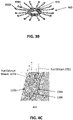
- FIGS. 4A and 4B are side cross-sectional views showing flow distribution through the central column 400, and 4C is top cross-sectional view taken through the anode recuperator 110.
- the anode recuperator 110 includes an inner cylinder 110A, a corrugated plate 110B, and an outer cylinder 110C that may be coated with the ATO insulation 130B.
- a fuel stream 1721 from fuel conduit 300C enters the top of the central column 400.
- the fuel stream 1721 then bypasses the anode cooler 140 by flowing through its hollow core and then flows through the anode recuperator 110, between the outer cylinder 110C and the and the corrugated plate 110B.
- the fuel stream 1721 then flows through the hub base 602 and conduits 300D of the anode hub structure 600 ( FIG. 3B ), to the stacks.
- a fuel exhaust stream 1723 flows from the stacks through conduits 308A into the hub base 602, and from the hub base 602 through the anode recuperator 110, between in inner cylinder 110A and the corrugated plate 110B, and into the splitter 150.
- a portion of the fuel exhaust flow stream 1723 flows from the splitter 150 to the anode cooler 140 through conduit 308C, while another portion flows from the splitter 150 to the ATO 130 through conduit 308D (see FIG. 1 ).
- Anode cooler inner core insulation 140A may be located between the fuel conduit 300C and bellows 852 / supporting cylinder 852A located between the anode cooler 140 and the ATO mixer 801, as shown in FIGS.
- Insulation 140A may also be located between conduit 300C and the anode cooler 140 to avoid heat transfer between the fuel inlet stream in conduit 300C and the streams in the anode cooler 140.
- a bellows 852 and a cylinder 852A may be disposed between the anode cooler 140 and the splitter 150.
- FIG. 4B also shows air flowing from the air conduit 302A to the anode cooler 140 (where it exchanges heat with the fuel exhaust stream), into conduit 302B to the cathode recuperator 120.
- Embodiments of the anode flow hub 600 may have one or more of the following advantages: lower cost manufacturing method, ability to use fuel tube in reformation process if required and reduced complexity.
- the fuel exhaust stream 1723 exits the anode recuperator 110 and is provided into splitter 150 through conduit 308B.
- the splitter 150 splits the anode exhaust stream into first and second anode exhaust streams.
- the first stream is provided to the ATO 130 through conduit 308D.
- the second stream is provided into the anode cooler 140 through conduit 308C.
- the relative amounts of anode exhaust provided to the ATO 130 and the anode exhaust cooler 140 is controlled by the anode recycle blower 212.
- the higher the blower 212 speed the larger portion of the fuel exhaust stream is provided into conduit 308C and a smaller portion of the fuel exhaust stream is provided to the ATO 130, and vice-versa.
- the splitter 150 may include an integral cast structure with the ATO mixer 801.
- the anode exhaust provided to the ATO 130 is not cooled in the anode exhaust cooler 140. This allows higher temperature anode exhaust to be provided into the ATO 130 than if the anode exhaust were provided after flowing through the anode exhaust cooler 140.
- the anode exhaust provided into the ATO 130 from the splitter 150 may have a temperature of above 350 °C, such as from about 350 to about 500 °C, for example, from about 375 to about 425 °C, or from about 390 to about 410 °C.
- the heat exchange area of the anode cooler 140 may be reduced.
- the anode exhaust stream provided to the ATO 130 may be combusted and provided to the cathode recuperator 120 through conduit 304B.
- FIG. 5 illustrates a modified central column 401 of the system 10, according to various embodiments.
- the central column 401 is similar to the central column 400 of FIG. 3 , so only the difference therebetween will be described in detail.
- an oxidation catalyst 112 is disposed in the column 401 between the inner cylinder 110A and corrugated plate 110B of the anode recuperator 110.
- the column 401 includes a catalyst housing 115 disposed inside a central cavity of the anode recuperator 110.
- the catalyst housing includes one or more catalyst pucks 117A - 117E. Each puck 117 may include the same catalyst, or one or more of the pucks 117 may include different catalysts.
- puck 117A may include the hydrogenation catalyst 114
- pucks 117B - 117E may include one or more reformer catalysts 116.
- the temperature in various portions of the anode recuperator 110 may be controlled by controlling the size and or length of various conduits therein.
- the target temperature and/or temperature range may be selected based on the properties (e.g., effectiveness, cost, etc.) of the catalyst located within the annular pre-reformer and/or an expected inlet fuel stream composition. As an example, a higher target temperature may be selected to support the conversion of higher hydrocarbons by a less effective catalyst (e.g., all nickel) while a lower target temperature may be selected for use with a more effective catalyst (e.g., all rhodium or all platinum).
- the target temperature and/or temperature range may be selected to favor the reformation of higher hydrocarbons over the reformation of methane in the pre-reformer (e.g., reforming catalyst 116).
- the oxidation catalyst 112 may be located within the anode recuperator 110 but may be separated radially from the annular anode exhaust passage of the anode recuperator 110 by one or more fuel inlet passages (e.g., conduits). For example, as shown in FIG.
- the oxidation catalyst 112 may be in the form of one or more of the pucks 117A - 117E located in the interior of the anode recuperator 110 (e.g., within the inner cylinder 110A which is separated from the anode recuperator fuel exhaust passage 118A by one or more fuel inlet passages 118B and/or 118C passing through the anode recuperator 110).
- the oxidation catalyst 112 may be located in fuel inlet passage 118C which is separated from the fuel exhaust passage 118A by the initial fuel inlet passage 118B.
- the ambient temperature of the oxidation catalyst 112 may be maintained at a temperature lower than the fuel inlet stream entering the annular pre-reformer from a fuel inlet passage of the anode recuperator 110 and lower than the temperature of the anode exhaust in the anode exhaust passage.
- a modular fuel cell system 10 is shown according to an exemplary embodiment.
- the modular system may contain modules and components described in U.S. Patent Number 9,755,263 B2 issued on September 5, 2017 and incorporated herein by reference in its entirety.
- the modular fuel cell system 10 includes at least one (preferably more than one or plurality) of power modules 12, one or more fuel input (i.e., fuel processing) modules 16, and one or more power conditioning (i.e., electrical output) modules 18.
- the power conditioning modules 18 are configured to deliver direct current (DC).
- the power conditioning modules 18 are configured to deliver alternating current (AC).
- the power condition modules include a mechanism to convert DC to AC, such as an inverter.
- the system enclosure may include any desired number of modules, such as 2-30 power modules, for example 3-12 power modules, such as 6-12 modules.
- FIG. 6 illustrates a system 10 containing six power modules 12 (one row of six modules stacked side to side), one fuel processing module 16, and one power conditioning module 18 on a common base 20.
- Each module 12, 16, 18 may have its own cabinet. Alternatively, as will be described in more detail below, modules 16 and 18 may be combined into a single input / output module 14 located in one cabinet. While one row of power modules 12 is shown, the system may include more than one row of modules 12. For example, the system may include two rows of power modules arranged back to back/end to end.
- Each power module 12 is configured to house one or more hot boxes 13.
- Each hot box contains one or more stacks or columns of fuel cells (not shown for clarity), such as one or more stacks or columns of solid oxide fuel cells having a ceramic oxide electrolyte separated by conductive interconnect plates.
- Other fuel cell types such as PEM, molten carbonate, phosphoric acid, etc. may also be used.
- the fuel cell stacks may include externally and/or internally manifolded stacks.
- the stacks may be internally manifolded for fuel and air with fuel and air risers extending through openings in the fuel cell layers and/or in the interconnect plates between the fuel cells.
- the fuel cell stacks may be internally manifolded for fuel and externally manifolded for air, where only the fuel inlet and exhaust risers extend through openings in the fuel cell layers and/or in the interconnect plates between the fuel cells, as described in U.S. Patent Number 7,713,649 , which is incorporated herein by reference in its entirety.
- the fuel cells may have a cross flow (where air and fuel flow roughly perpendicular to each other on opposite sides of the electrolyte in each fuel cell), counter flow parallel (where air and fuel flow roughly parallel to each other but in opposite directions on opposite sides of the electrolyte in each fuel cell) or co-flow parallel (where air and fuel flow roughly parallel to each other in the same direction on opposite sides of the electrolyte in each fuel cell) configuration.
- the modular fuel cell system 10 also contains one or more input or fuel processing modules 16.
- This module 16 includes a cabinet which contains the components used for preprocessing of fuel, such as adsorption beds (e.g., desulfurizer and/or other impurity adsorption) beds.
- the fuel processing modules 16 may be designed to process different types of fuel. For example, a diesel fuel processing module, a natural gas fuel processing module, and an ethanol fuel processing module may be provided in the same or in separate cabinets. A different bed composition tailored for a particular fuel may be provided in each module.
- the processing module(s) 16 may process at least one of the following fuels selected from natural gas provided from a pipeline, compressed natural gas, methane, propane, liquid petroleum gas, gasoline, diesel, home heating oil, kerosene, JP-5, JP-8, aviation fuel, hydrogen, ammonia, ethanol, methanol, syn-gas, bio-gas, bio-diesel and other suitable hydrocarbon or hydrogen containing fuels.
- a reformer 17 may be located in the fuel processing module 16.
- a separate reformer 17 may be located in each hot box 13 in a respective power module 12.
- an external reformer 17 may be omitted entirely.
- the modular fuel cell system 10 also contains one or more power conditioning modules 18.
- the power conditioning module 18 includes a cabinet which contains the components for converting the fuel cell stack generated DC power to AC power (e.g., DC/DC and DC/AC converters described in U.S. Patent Number 7,705,490 , incorporated herein by reference in its entirety), electrical connectors for AC power output to the grid, circuits for managing electrical transients, a system controller 225 (e.g., a computer or dedicated control logic device or circuit).
- the power conditioning module 18 may be designed to convert DC power from the fuel cell modules to different AC voltages and frequencies. Designs for 208V, 60Hz; 480V, 60Hz; 415V, 50Hz and other common voltages and frequencies may be provided.
- the fuel processing module 16 and the power conditioning module 18 may be housed in one input/output cabinet 14. If a single input/output cabinet 14 is provided, then modules 16 and 18 may be located vertically (e.g., power conditioning module 18 components above the fuel processing module 16 desulfurizer canisters / beds) or side by side in the cabinet 14.
- one input/output cabinet 14 is provided for one row of six power modules 12, which are arranged linearly side to side on one side of the input/output module 14.
- the row of modules may be positioned, for example, adjacent to a building for which the system provides power (e.g., with the backs of the cabinets of the modules facing the building wall). While one row of power modules 12 is shown, the system may include more than one row of modules 12. For example, as noted above, the system may include two rows of power modules stacked back to back.
- the linear array of power modules 12 is readily scaled. For example, more or fewer power modules 12 may be provided depending on the power needs of the building or other facility serviced by the fuel cell system 10.
- the power modules 12 and input/output modules 14 may also be provided in other ratios. For example, in other exemplary embodiments, more or fewer power modules 12 may be provided adjacent to the input/output module 14.
- the support functions could be served by more than one input/output module 14 (e.g., with a separate fuel processing module 16 and power conditioning module 18 cabinets). Additionally, while in the preferred embodiment, the input/output module 14 is at the end of the row of power modules 12, it could also be located in the center of a row power modules 12.
- the modular fuel cell system 10 may be configured in a way to ease servicing of the system. All of the routinely or high serviced components (such as the consumable components) may be placed in a single module to reduce amount of time required for the service person. For example, a purge gas (optional) and desulfurizer material for a natural gas fueled system may be placed in a single module (e.g., a fuel processing module 16 or a combined input/output module 14 cabinet). This would be the only module cabinet accessed during routine maintenance. Thus, each module 12, 14, 16, and 18 may be serviced, repaired or removed from the system without opening the other module cabinets and without servicing, repairing or removing the other modules.
- a purge gas (optional) and desulfurizer material for a natural gas fueled system may be placed in a single module (e.g., a fuel processing module 16 or a combined input/output module 14 cabinet). This would be the only module cabinet accessed during routine maintenance.
- each module 12, 14, 16, and 18 may be serviced, repaired or removed
- the enclosure 10 can include multiple power modules 12. When at least one power module 12 is taken off line (i.e., no power is generated by the stacks in the hot box 13 in the off line module 12), the remaining power modules 12, the fuel processing module 16 and the power conditioning module 18 (or the combined input/output module 14) are not taken off line. Furthermore, the fuel cell enclosure 10 may contain more than one of each type of module 12, 14, 16, or 18. When at least one module of a particular type is taken off line, the remaining modules of the same type are not taken off line.
- each of the modules 12, 14, 16, or 18 may be electrically disconnected, removed from the fuel cell enclosure 10 and/or serviced or repaired without stopping an operation of the other modules in the system, allowing the fuel cell system to continue to generate electricity.
- the entire fuel cell system does not have to be shut down if one stack of fuel cells in one hot box 13 malfunctions or is taken off line for servicing.
- the internal components of the power module 12 may need to be periodically removed, such as to be serviced, repaired or replaced.
- the components such as the hot box or the balance of plant components are removed from the power module 12 with a forklift.
- conventional fuel cell assemblies may require substantial space on all sides to position a forklift and remove the components from an enclosure, sometimes as much as four to five times the length of the hot box.
- a field replaceable fuel cell module (FCM) 70 includes the hot box sub-system 13, such as the cylindrical hot box 13 described above with respect to FIG. 1 , which contains the fuel cell stacks and heat exchanger assembly, as well as a balance of plant (BOP) sub-system including blowers, valves, and control boards, etc.
- the FCM 70 is mounted on a removable support 72 which allows the FCM 70 to be removed from the power module 12 cabinet as a single unit.
- FIG. 7 shows a non-limiting example of a FCM 70 configuration where the FCM 70 includes a cylindrical hot box 13 and a frame which supports the BOP components.
- the hot box and the frame are mounted on common support, such as fork-lift rails 72. Other configurations may also be used.
- the hot box 13 may have a shape other than cylindrical, such as polygonal, etc.
- the support 72 may include a platform rather than rails.
- the frame may have a different configuration or it may be omitted entirely with the BOP components mounted onto the hotbox 13 and/or the support 72 instead.
- the FCM 70 is dimensionally smaller than the opening in the power module 12 (e.g., the opening closed by the door 30). According to an exemplary embodiment, the FCM 70 is installed or removed from the power module 12 cabinet as a single assembly.
- the FCM 70 is coupled to the other components of the enclosure 10 using a minimal number of quick connect/disconnect connections (e.g., to connect to the water conduits, fuel conduits, and bus bar conduits housed in the base 20) in order to ensure rapid servicing time, as described in the prior embodiments.
- quick connect/disconnect connections e.g., to connect to the water conduits, fuel conduits, and bus bar conduits housed in the base 20
- FIGS. 8A and 8B illustrate a fuel cell system 10 with two rows of power modules 12, a fuel processing module 16, a power conditioning module 18, and three ancillary modules.
- the ancillary modules include a water distribution module 33, a telemetry module 35, and a power distribution system module 37.
- the water distribution module 33 deionizes and/or filters input water and thereby provides deionized water to the power modules 12 of the fuel cell system.
- the power distribution system module 37 may include one or more circuit breakers and/or relays between the fuel cell system power output from module 18 and electrical power consumer.
- the telemetry module 35 includes a transceiver that provides system process information to a location remote from the system (e.g., central control room located distal from the fuel cell system location) and allows remote control of the fuel cell system.
- the system process information may include one or more of electricity production, electricity consumption, fuel consumption, water consumption, and fuel cell stack temperature.
- the telemetry module 35 may communicate to the remote location wirelessly or via wires, such as though cable or telephone wire.
- Additional embodiments may include various methods of controlling a fuel cell system 10 described above with respect to FIGS. 1 , 6 and 8A-8B .
- a gas analyzer 220 shown in FIG. 1 may be configured to actively monitor and record composition data of the fuel (e.g., fuel inlet stream, such as a gas fuel stream).
- Composition data may be processed by the system controller 225 shown in FIG, 1 , which may then provide such data to power modules 12 (shown in FIGS. 6-8B ).
- some fuels, such as biofuels may have variations over time due to variations in the biofuel production process.
- marine fuels used for ships may have somewhat different compositions depending on the port or country in which the marine fuel is pumped into the ship containing a fuel cell system.
- the peak shaving described above may alter the fuel composition provided to the fuel cell system.
- the gas analyzer 220 may be only configured to detect a portion of the chemical components of the incoming fuel gas.
- the gas analyzer 220 may be a non-dispersive infrared (NDIR) gas analyzer or any other suitable type of gas composition sensor.
- the system controller 225 may be configured to determine the full composition of the incoming gas by extrapolation from data generated by the gas analyzer 220 in combination with composition data received from another data sources (e.g., from a gas supplier).
- the primary gas received from a first source may be blended with a secondary gas received from a second source to generate a blended fuel, as described in greater detail below.
- the system controller 225 may be further configured to determine a gas composition of the blended fuel based on data generated by the gas analyzer 220, composition data from a gas supplier, and from composition data for the secondary gas.
- Composition data for the secondary gas may be generated by the gas analyzer 220 and/or based on data provided by a supplier of the secondary gas.
- the gas analyzer 220 may be a NDIR gas analyzer which configured to detect methane, oxygen, and carbon dioxide, but is not configured to detect propane and heavy hydrocarbon fuels.
- the system controller 225 may be configured to extrapolate the amount of propane that is in the fuel gas stream based on the detectable values of the other gases in the fuel gas stream.
- the system controller 225 may subtracted the detected gas composition from the total fuel gas flow stream, and then extrapolate the amount and/or composition of the remaining component(s) of the fuel gas stream based on external data (e.g., time of year, time of day, data from fuel provider, etc.) and/or based on internal data (e.g., detected fuel cell system generated voltage, fuel utilization, temperature, etc.).
- external data e.g., time of year, time of day, data from fuel provider, etc.
- internal data e.g., detected fuel cell system generated voltage, fuel utilization, temperature, etc.
- the system controller 225 may be configured to determine a composition of the blended fuel gas stream based on determined compositions of the primary and secondary gases and based on a blending ratio of the primary gas and the secondary gas.
- data generated by the gas analyzer 220 may be transmitted from the system controller 225 to one or more power module supervisory controllers (not shown).
- the power module supervisory controller(s) may then distribute the data to various power modules 12 shown in FIGS. 6 - 8B .
- the distribution may be performed with two configurable delay functions to match when the gas that was detected will reach the power module.
- the first delay may be associated with the system controller 225 and may define when and how the compositional change reaches the power module. This delay may be tuned according to the geometry of the installation and may be adjusted in real time as a function of total fuel flow rate.
- the second delay is at the power module supervisory controller and defines when and how each power module 12 will see the compositional change.
- This delay is defined by the geometry and makeup of the fuel processing module 16. In other words, it takes the fuel gas stream a certain amount of time to pass through the desulfurizers 17 in the fuel processing module 16.
- the delay period may correspond to the time it takes the fuel to flow from the gas analyzer 220 through the fuel processing module 16 to the inlet valve of the fuel processing modules 12.
- the change in the fuel flow rate controlled by the inlet valve of the fuel processing module 12 and/or the anode exhaust recycle rate controlled by the speed of the anode recycle blower 212 due to the composition change in the fuel detected by the gas analyzer 220 may be delayed by the above described delay period.
- the system may blend in a high heating value secondary fuel to the primary fuel, as described above, assuming such blending would not cause severe impact to system health and performance.
- biogas fuel flow rate and/or composition may be varied over time due to the vagaries of the biogas fuel production process.
- the primary and secondary fuel may be blended in various ways.
- the system controller 225 may automatically blend in a high fuel capacity secondary gas, such as natural gas from a pipeline, to thereby maintain a minimum fuel availability or minimum lower heating value of the blended fuel.
- lower heating value corresponds to lower calorific value / net calorific value, where products of combustion contain the water vapor and the heat in the water vapor is not recovered
- higher heating value corresponds to higher calorific value / gross calorific value, where the water of combustion is entirely condensed and the heat contained in the water vapor is recovered, as defined in the Engineering Toolbox (https://www.engineeringtoolbox.com/fuels-higher-calorific-values-d_169.html), incorporated herein by reference.
- the term "heating value” corresponds to the lower heating value unless specified otherwise.
- the system controller 225 may use a closed loop control method that continually adjusts the proportion of high fuel availability secondary gas to the primary fuel gas.
- the system controller 225 may use an open loop control method that sets a constant flow rate of each of the primary and secondary gases based on downstream demand.
- the system controller 225 may control the primary gas to maintain a predetermined flow setpoint in a closed loop control method that controls a modulated fuel control valve and a flow meter (not shown).
- the secondary gas having a high fuel availability, such as natural gas, may act passively.
- the secondary gas will fill any pressure drop caused by a lower gas flow of the controlled primary gas (e.g., flow rate of the primary gas falling below a predetermined total flow rate).
- the secondary gas is automatically blended with the primary gas.
- the flow of the secondary gas may be recorded via a flow meter.
- the total flow of the primary and secondary gas may be used to determine a more accurate blended composition. Such composition data may then be transmitted the power module.
- Fuel composition data from the gas analyzer 220 may be transmitted by the system controller 225 to the power modules 12 in block 902.
- the data may be transmitted with the delay period described above (e.g., the delay period that corresponds to the time it takes the fuel to flow through the fuel processing module 16).
- the system controller 225 may take no action or it may use fuel composition data to adjust the perception of fuel availability by the power modules 12, depending the nature of the data from the gas analyzer 220. Based on the perception of fuel availability within the input fuel gas stream, the fuel flow rate may then be adjusted so that a predetermined amount of usable fuel may be supplied to power modules 12.
- the anode recycle blower 212 may also be adjusted to maintain a constant oxygen to carbon ratio within fuel cells of the fuel cell stack 102.
- the system controller 225 may increment (i.e., advance) the internal timer to which counts down to disabling of the voltage control mode.
- the fuel composition change is determined to be sudden and/or drastic.
- the drastic/sudden change is defined as based on an absolute value.
- the drastic/sudden change can be configured to have a mutually exclusive threshold for both a drastic/sudden increase/decrease in lower heating value and a mutually exclusive threshold for both a drastic/sudden increase/decrease in fuel availability.
- the drastic/sudden change may have the same threshold for the drastic/sudden increase/decrease in the lower heating value and the fuel availability.
- the system controller 225 may monitor changes in fuel composition and may characterize such changes in terms of a lower heating value or lower value of fuel availability. The system controller 225 may further determine that the composition change that exceeds the threshold has occurred for a time that is greater than a predetermined time interval. The system controller 225 may also determine a moving average of fuel composition and may determine a moving average of time rate of change of fuel composition. The system controller 225 may further determine that one or both of the moving average of fuel composition and/or the moving average of time rate of change of fuel composition has exceeded a predetermined threshold. The system controller 225 may further be configured to determine a frequency and amplitude of composition changes and may determine that one or both of the frequency and amplitude of composition changes has exceeded a respective threshold.
- the timer may be programmatically adjusted in real time based on a tunable function of the magnitude of the change and flow rate in order to minimize a time during which the system is controlled according to the voltage control mode.
- the timer may be reset every time the system controller 225 detects one or more events that exceed a respective threshold in block 920.
- the system controller 225 may further be configured to keep the system in voltage control mode until such time that it is determined that voltage stability has been achieved by periodically returning to block 904.
- the system may then exit voltage control mode in block 914 but may return to voltage control mode when certain composition changes are once again detected in block 904, as described above.
- the system may be operated in the voltage control mode as a primary control mode.
- fuel composition data determined by the system controller 225 may continue to be sent to the power modules 12.
- the system controller 225 may be configured to send a signal to the power conditional module 18 to enter the voltage control mode only when it is safe to do so (e.g., when the power module 12 is not performing an action that would affect voltages and prevent good control).
- the voltage control mode for the power module 12 may include performing a closed loop control method (e.g., by the system controller 225) to increase or decrease a fuel flow rate and/or to increase or decrease the anode exhaust recycle rate by the anode recycle blower 212 to thereby increase or decrease the voltage generated by the power module 12 (e.g., by the fuel cell stack 102) to maintain a predetermined target voltage.
- the closed loop control method may consider the voltage generated by the power module 12 to be an input variable and the fuel utilization of the power module 12 to be an output variable.
- the closed loop control method may be configured to control the voltage to a set point voltage value generated based on the history of the power module 12 and/or based on empirical or first principles models of the power module 12.
- the output voltage generated by the power module 12 is monitored by the system controller 225. If the detected output voltage is outside a predetermined value or range, then the voltage control mode is entered and the power module 12 is controlled such that its output voltage equals the set point voltage or desired range of voltage values.
- the closed loop control method may adjust the fuel inputted into the system and/or output of the anode recycle blower 212 to adjust the system fuel utilization. If fuel utilization hits preset bounds of allowed change, then the voltage may be maintained by controlling current generated by the power module. Changes in the fuel utilization may be correlated with the approximate fuel compositional changes. Such approximate fuel compositional changes may then can be used to control the anode recycle blower 212 output to increase or decrease the amount of anode exhaust recycling to maintain an estimated oxygen to carbon ratio.
- the power modules 12 may enter the voltage control mode upon receipt of a command from the power conditioning module 18, which may in turn receive a command from the system controller 225.
- Various conditions may trigger entry into the voltage control mode based on detected composition changes, as described above. Entry into the voltage control mode may further be governed based on various protocols. For example, according to a liquid propane detection protocol, the power modules 12 may enter voltage control when the fuel gas is determined to contain propane (e.g., when peak shaving of natural gas begins).
- FIG. 10 is a flow chart illustrating various operations of a method 1000 of controlling a fuel cell system, according to various embodiments.
- the method 1000 may include receiving a primary fuel gas from a first fuel source, and in a second operation 1004, the method 1000 may including determining a composition of the primary fuel gas using a gas analyzer 220.
- the method 1000 may include providing the primary fuel gas to a stack 102 including fuel cells that generate electricity using the primary fuel gas.
- the method 1000 may include controlling at least one of a fuel utilization of the stack 102, current output by the stack 102, or a voltage generated by the stack 102, based on the composition of the primary fuel gas determined by the gas analyzer 220.
- various controllers e.g., system controller 225
- a composition of the primary fuel gas may be determined based partially on first composition data generated by the gas analyzer 220 and based partially on second composition data received from another data source.
- the method 1000 may further include determining a fuel availability based on the composition of the primary fuel gas determined by the gas analyzer 220 and adjusting a fuel flow rate, based on the determined fuel availability, to maintain a predetermined rate at which usable fuel is supplied to the stack 102.
- the method 1000 may further include determining that the fuel availability is below a fuel availability threshold.
- the method 1000 may include controlling the system to generate a blended fuel gas having an increased fuel availability.
- the blended gas may be generated by combing the primary fuel gas with a secondary fuel gas received from a second fuel source.
- the secondary fuel gas may be chosen to have a known fuel availability that is higher than the fuel availability threshold.
- the blended fuel gas may then be provided to the fuel cell stack 102.
- the primary fuel may comprise biofuel, marine fuel or other heavy hydrocarbon fuel.
- the secondary fuel may comprise methane or natural gas.
- the method 1000 may further include controlling generation of the blended fuel in various ways. For example, a closed loop control method may be used to automatically blend an amount of the secondary fuel gas with the primary fuel gas to thereby generate the blended fuel gas having a predetermined minimum fuel availability or minimum lower heating value. Alternatively, a closed loop control method may be used to control a flow rate of the primary fuel gas, via a fuel control valve and flow meter (not shown), to thereby a maintain a predetermined flow setpoint of the primary fuel gas.
- an open loop control method may be used to set a first constant flow rate of the primary fuel gas and to set a second constant flow rate of the secondary fuel gas.
- the method 1000 may further include automatically blending the primary fuel gas and secondary fuel gas having a fixed pressure when a pressure of the primary gas decreases to below the fixed pressure.
- the method 1000 may include using a closed loop control method to control the voltage generated by the stack.
- the system controller 225 may measure the voltage generated by the stack and may increase or decrease a fuel flow rate to thereby increase or decrease the voltage generated by the stack to maintain a predetermined target voltage.
- the system controller 225 may further control the amount of anode exhaust gas from the stack 102 mixed with the primary fuel gas to generate a mixed fuel gas, which may then be supplied to the stack 102.
- the system controller 225 may further control a rate at which the anode exhaust gas from the stack is mixed with the primary fuel gas to thereby control the fuel utilization and an oxygen/carbon ratio of fuel supplied to the stack.
- the system controller 225 may further be configured to determine an estimated change in composition of the primary fuel gas based on changes in the voltage generated by the stack.
- the system controller 225 may be further configured to control the rate at which the anode exhaust gas is mixed with the primary fuel based on the estimated change in composition.
- the method 1000 may further include determining that the voltage is within a predetermined range of voltage values and controlling the current generated by the stack to thereby control the voltage generated by the stack to maintain a predetermined target voltage if the fuel utilization is outside the predetermined range.
- FIG. 11 is a flow chart illustrating various operations in a method 1100 of controlling a fuel cell system, according to various embodiments.
- the method 1100 may include receiving a fuel gas from a fuel source, and in a second operation 1104, the method 1100 may include providing the fuel gas to a stack 102 including fuel cells that generate electricity using the fuel gas.
- the method 1100 may include determining a voltage generated by the stack 102.
- the method 1100 may include determining that a frequency and/or amplitude of voltage changes exceed one or more respective thresholds.
- the method 1100 may include controlling the voltage generated by the fuel cell system according to a voltage control mode.
- the voltage control mode may include performing a closed loop control method to increase or decrease a fuel flow rate to thereby increase or decrease the voltage generated by the stack to thereby maintain a predetermined target voltage.
- the method 1100 may include controlling the voltage generated by the fuel cell system according to the voltage control mode for a predetermined time after determining that frequency and/or amplitude of voltage changes exceed the one or more respective thresholds. At other times, when the voltage control mode is not performed, the method 1100 may include controlling the fuel cell system according to a fuel composition control mode.
- the fuel composition control mode may include determining a composition of the fuel gas, determining a fuel availability based on the composition of the primary fuel gas determined by the gas analyzer, and adjusting a fuel flow rate, based on determined fuel availability, to maintain a predetermined rate at which usable fuel is supplied to the stack
- the voltage target may be complex and models or historian based target generation may need manual intervention. This problem may be solved by customization of the voltage target for each power module that the voltage control mode is controlling in order to account for non-captured variations in expected voltage.
- the user may manually set the voltage setpoint for the voltage control mode voltage target. This setpoint may either be in the form of a complete bypass of the historian or model-based estimation of the target voltage as described above, and/or an offset of the historian or model-based estimation of the target voltage.
- the voltage control mode may need direct intervention from the user to trigger on events not captured by code conditions.
- the user may force the voltage control mode on at their discretion.
- the user can trigger voltage control mode based on external information that the site level, system 10 level and/or power module 12 level systems do not control for.
- the anode recycle flow may not adjust appropriately if it does not know the fuel composition.
- This problem may be solved by having the anode recycle subsystem (such as the recycle blower control algorithm) in the power module 12 controller utilize fuel composition data to adapt its oxygen to carbon ratio (O:C) target during the voltage control mode.
- the power module 12 performance metrics based on empirical, first principles and/or historical data may be used in order to infer all or part of the fuel composition, lower heating value and/or amount of fuel available.
- the system 10 may need to react based on uncontrollable fuel composition or composition dangerous to the health of the system.
- the site level controller may take appropriate corrective action.
- Dangerous compositions include a composition with dangerous levels of H 2 S beyond a set threshold that may be defined based on power module 12 health specifications, and/or a composition with levels of siloxane species beyond a set threshold that may be defined based on power module 12 health specifications.
- Uncontrollable compositions include:
- the controller may take one of the following actions:
- the controller may change the action accordingly.
- the controller may also latch any alarms or automatically clear and recover based on the severity and the specific condition detected.
- the actions are:
- the gas analyzer data can be very noisy or erratic. This problem may be solved by passing the fuel composition data received from a gas analyzer through a low pass or bandpass filter. This may be combined with the delay mentioned above.
- the gas analyzer data may have valuable spikes and changes that need to be utilized. This problem may be solved by allowing certain data to bypass the filter if certain conditions are met. These conditions may include amplitude of change and rate of change of the fuel composition, lower heating value or fuel availability.
- the gas analyzer may have an offset in reading that cannot be addressed immediately via formal calibration and span preventing proper usage. This problem may be solved by having the user add manual offsets to each channel data from a gas analyzer to digitally address improper calibration, span or zero before the data is transmitted to and utilized by the system 10 or power module 12.
Landscapes
- Engineering & Computer Science (AREA)
- Chemical & Material Sciences (AREA)
- Life Sciences & Earth Sciences (AREA)
- Sustainable Development (AREA)
- Manufacturing & Machinery (AREA)
- Sustainable Energy (AREA)
- Chemical Kinetics & Catalysis (AREA)
- Electrochemistry (AREA)
- General Chemical & Material Sciences (AREA)
- Health & Medical Sciences (AREA)
- Fuzzy Systems (AREA)
- Automation & Control Theory (AREA)
- Computing Systems (AREA)
- Evolutionary Computation (AREA)
- Artificial Intelligence (AREA)
- Medical Informatics (AREA)
- Software Systems (AREA)
- Theoretical Computer Science (AREA)
- Food Science & Technology (AREA)
- Combustion & Propulsion (AREA)
- Medicinal Chemistry (AREA)
- Physics & Mathematics (AREA)
- Analytical Chemistry (AREA)
- Biochemistry (AREA)
- General Health & Medical Sciences (AREA)
- General Physics & Mathematics (AREA)
- Immunology (AREA)
- Pathology (AREA)
- Fuel Cell (AREA)
Applications Claiming Priority (2)
| Application Number | Priority Date | Filing Date | Title |
|---|---|---|---|
| US202163215220P | 2021-06-25 | 2021-06-25 | |
| US202163236923P | 2021-08-25 | 2021-08-25 |
Publications (2)
| Publication Number | Publication Date |
|---|---|
| EP4113675A2 true EP4113675A2 (fr) | 2023-01-04 |
| EP4113675A3 EP4113675A3 (fr) | 2024-06-26 |
Family
ID=82163334
Family Applications (1)
| Application Number | Title | Priority Date | Filing Date |
|---|---|---|---|
| EP22180082.4A Pending EP4113675A3 (fr) | 2021-06-25 | 2022-06-21 | Traitement de modifications de composition de gaz variables et imprévisibles pour maximiser la santé et la performance de systèmes de pile à combustible |
Country Status (6)
| Country | Link |
|---|---|
| US (1) | US12542289B2 (fr) |
| EP (1) | EP4113675A3 (fr) |
| JP (1) | JP2023004925A (fr) |
| KR (1) | KR20230000972A (fr) |
| CN (1) | CN115528276A (fr) |
| TW (1) | TW202315201A (fr) |
Families Citing this family (6)
| Publication number | Priority date | Publication date | Assignee | Title |
|---|---|---|---|---|
| DE102023210746A1 (de) * | 2023-10-30 | 2025-04-30 | Robert Bosch Gesellschaft mit beschränkter Haftung | Verfahren zum Betrieb einer Brennstoffzellenvorrichtung und eine Brennstoffzel-lenvorrichtung |
| DE102024200528A1 (de) * | 2024-01-22 | 2025-07-24 | Robert Bosch Gesellschaft mit beschränkter Haftung | Verfahren zu einer Bestimmung eines Brennstoffausnutzungsgrads einer Brennstoffzelleneinheit in einer Brennstoffzellenvorrichtung, insbesondere SOFC-Brennstoffzellenvorrichtung |
| FR3160823A1 (fr) * | 2024-03-29 | 2025-10-03 | Genvia | Boîte chaude comprenant des empilements de plaques pour électrolyseur à oxyde solide (SOEC) ou pour système de pile à combustible (SOFC) uniformément alimentés, et installation associée |
| DE102024206667A1 (de) * | 2024-07-16 | 2026-01-22 | Robert Bosch Gesellschaft mit beschränkter Haftung | Verfahren zum Bestimmen von Eigenschaften eines in einem Anodensubsystem eines Festoxidbrennstoffzellensystems strömenden Brenngasvolumenstroms |
| DE102024206661A1 (de) * | 2024-07-16 | 2026-01-22 | Robert Bosch Gesellschaft mit beschränkter Haftung | Verfahren zum Betreiben eines Festoxidbrenns |
| CN120164999B (zh) * | 2025-02-28 | 2025-12-02 | 浙江吉利控股集团有限公司 | 多堆燃料电池同步老化控制方法、装置、系统及介质 |
Citations (3)
| Publication number | Priority date | Publication date | Assignee | Title |
|---|---|---|---|---|
| US7705490B2 (en) | 2007-05-07 | 2010-04-27 | Bloom Energy Corporation | Integral stack columns |
| US7713649B2 (en) | 2005-03-10 | 2010-05-11 | Bloom Energy Corporation | Fuel cell stack with internal fuel manifold configuration |
| US9755263B2 (en) | 2013-03-15 | 2017-09-05 | Bloom Energy Corporation | Fuel cell mechanical components |
Family Cites Families (230)
| Publication number | Priority date | Publication date | Assignee | Title |
|---|---|---|---|---|
| US3453087A (en) | 1964-06-25 | 1969-07-01 | Girdler Corp | Modular reformer furnace |
| US3453146A (en) | 1966-01-03 | 1969-07-01 | Texas Instruments Inc | Method and apparatus for reforming carbonaceous fuels and operating fuel cell |
| US3645701A (en) | 1967-06-19 | 1972-02-29 | Lummus Co | Reformer furnace |
| US3527565A (en) | 1967-06-19 | 1970-09-08 | Lummus Co | Steam reforming of carbon monoxide rich hydrocarbon feeds |
| US3488266A (en) | 1967-12-12 | 1970-01-06 | Continental Oil Co | Electrochemical reduction of benzene using a carbon anode |
| US3531263A (en) | 1968-08-05 | 1970-09-29 | United Aircraft Corp | Integrated reformer unit |
| US3607419A (en) | 1969-10-01 | 1971-09-21 | United Aircraft Corp | Fuel cell system control |
| US3746658A (en) | 1970-05-01 | 1973-07-17 | Getters Spa | Catalysts |
| US3718506A (en) | 1971-02-22 | 1973-02-27 | Bbc Brown Boveri & Cie | Fuel cell system for reacting hydrocarbons |
| US3990912A (en) | 1972-07-17 | 1976-11-09 | United Technologies Corporation | Electrolyte regeneration in a fuel cell stack |
| US3976506A (en) | 1975-02-12 | 1976-08-24 | United Technologies Corporation | Pressurized fuel cell power plant with air bypass |
| US3972731A (en) | 1975-02-12 | 1976-08-03 | United Technologies Corporation | Pressurized fuel cell power plant |
| US3982962A (en) | 1975-02-12 | 1976-09-28 | United Technologies Corporation | Pressurized fuel cell power plant with steam powered compressor |
| US4004947A (en) | 1975-02-12 | 1977-01-25 | United Technologies Corporation | Pressurized fuel cell power plant |
| US4001041A (en) | 1975-02-12 | 1977-01-04 | United Technologies Corporation | Pressurized fuel cell power plant |
| US3973993A (en) | 1975-02-12 | 1976-08-10 | United Technologies Corporation | Pressurized fuel cell power plant with steam flow through the cells |
| GB1531134A (en) | 1975-08-20 | 1978-11-01 | Atomic Energy Authority Uk | Methods of fabricating bodies and to bodies so fabricated |
| US4041210A (en) | 1976-08-30 | 1977-08-09 | United Technologies Corporation | Pressurized high temperature fuel cell power plant with bottoming cycle |
| US4182795A (en) | 1978-07-10 | 1980-01-08 | Energy Research Corporation | Fuel cell thermal control and reforming of process gas hydrocarbons |
| US4190559A (en) | 1978-10-13 | 1980-02-26 | Oxy-Catalyst, Inc. | Metal catalyst support having rectangular cross-section |
| US4315893A (en) | 1980-12-17 | 1982-02-16 | Foster Wheeler Energy Corporation | Reformer employing finned heat pipes |
| US4402871A (en) | 1981-01-09 | 1983-09-06 | Retallick William B | Metal catalyst support having honeycomb structure and method of making same |
| US4365007A (en) | 1981-06-12 | 1982-12-21 | Energy Research Corporation | Fuel cell with internal reforming |
| US4374184A (en) | 1981-09-29 | 1983-02-15 | Westinghouse Electric Corp. | Fuel cell generator and method of operating same |
| US4430304A (en) | 1981-11-13 | 1984-02-07 | The United States Of America As Represented By The United States Department Of Energy | Slab reformer |
| DE3201746A1 (de) | 1982-01-21 | 1983-07-28 | Messerschmitt-Bölkow-Blohm GmbH, 8000 München | Verfahren zur herstellung einer isolierschicht fuer treibsaetze |
| US4567117A (en) | 1982-07-08 | 1986-01-28 | Energy Research Corporation | Fuel cell employing non-uniform catalyst |
| US4522894A (en) | 1982-09-30 | 1985-06-11 | Engelhard Corporation | Fuel cell electric power production |
| US4473622A (en) | 1982-12-27 | 1984-09-25 | Chludzinski Paul J | Rapid starting methanol reactor system |
| US4657829A (en) | 1982-12-27 | 1987-04-14 | United Technologies Corporation | Fuel cell power supply with oxidant and fuel gas switching |
| JPS6041771A (ja) | 1983-08-17 | 1985-03-05 | Hitachi Ltd | 燃料電池装置 |
| US4548875A (en) | 1984-03-27 | 1985-10-22 | Westinghouse Electric Corp. | Heated transportable fuel cell cartridges |
| US4532192A (en) | 1984-11-06 | 1985-07-30 | Energy Research Corporation | Fuel cell system |
| US4539267A (en) | 1984-12-06 | 1985-09-03 | United Technologies Corporation | Process for generating steam in a fuel cell powerplant |
| JPH081810B2 (ja) | 1985-02-20 | 1996-01-10 | 三菱電機株式会社 | 内部改質形溶融炭酸塩形燃料電池 |
| DE3663652D1 (en) | 1985-03-05 | 1989-07-06 | Ici Plc | Steam reforming hydrocarbons |
| US4654207A (en) | 1985-03-13 | 1987-03-31 | Helene Curtis Industries, Inc. | Pearlescent shampoo and method for preparation of same |
| US4670359A (en) | 1985-06-10 | 1987-06-02 | Engelhard Corporation | Fuel cell integrated with steam reformer |
| GB8526055D0 (en) | 1985-10-22 | 1985-11-27 | Ici Plc | Electricity production |
| US4722873A (en) | 1985-12-06 | 1988-02-02 | Mitsubishi Denki Kabushiki Kaisha | Fuel cell power generating system |
| US4812373A (en) | 1986-04-16 | 1989-03-14 | Westinghouse Electric Corp. | Fuel feed arrangement for a fuel cell generator |
| US4702973A (en) | 1986-08-25 | 1987-10-27 | Institute Of Gas Technology | Dual compartment anode structure |
| US4728584A (en) | 1986-10-21 | 1988-03-01 | Westinghouse Electric Corp. | Fuel cell generator containing self-supporting high gas flow solid oxide electrolyte fuel cells |
| US4678723A (en) | 1986-11-03 | 1987-07-07 | International Fuel Cells Corporation | High pressure low heat rate phosphoric acid fuel cell stack |
| US4716023A (en) | 1986-11-13 | 1987-12-29 | Energy Research Corporation | Composite partial oxidizer and reformer |
| US4792502A (en) | 1986-11-14 | 1988-12-20 | International Fuel Cells Corporation | Apparatus for producing nitrogen |
| US4737161A (en) | 1987-01-27 | 1988-04-12 | International Fuel Cells Corporation | Compact hydrogen generator |
| US4820314A (en) | 1987-02-11 | 1989-04-11 | International Fuel Cells Corporation | Fuel cell power plant reformer |
| US4824740A (en) | 1987-06-15 | 1989-04-25 | International Fuel Cell Corporation | Fuel cell stack cooling system |
| US4904548A (en) | 1987-08-03 | 1990-02-27 | Fuji Electric Co., Ltd. | Method for controlling a fuel cell |
| US4743517A (en) | 1987-08-27 | 1988-05-10 | International Fuel Cells Corporation | Fuel cell power plant with increased reactant pressures |
| US4808491A (en) | 1988-02-16 | 1989-02-28 | Westinghouse Electric Corp. | Corner heating in rectangular solid oxide electrochemical cell generators |
| US4847051A (en) | 1988-03-21 | 1989-07-11 | International Fuel Cells Corporation | Reformer tube heat transfer device |
| US5246791A (en) | 1988-07-06 | 1993-09-21 | Johnson Matthey Public Limited Company | Fuel cell containing a reforming catalyst |
| US4865926A (en) | 1988-08-24 | 1989-09-12 | International Fuel Cells Corporation | Hydrogen fuel reforming in a fog cooled fuel cell power plant assembly |
| US4898792A (en) | 1988-12-07 | 1990-02-06 | Westinghouse Electric Corp. | Electrochemical generator apparatus containing modified high temperature insulation and coated surfaces for use with hydrocarbon fuels |
| JPH02172159A (ja) | 1988-12-24 | 1990-07-03 | Ishikawajima Harima Heavy Ind Co Ltd | 溶融炭酸塩型燃料電池発電方法及び装置 |
| JPH07109773B2 (ja) | 1989-02-28 | 1995-11-22 | 石川島播磨重工業株式会社 | 燃料電池を用いた発電装置 |
| US4917971A (en) | 1989-03-03 | 1990-04-17 | Energy Research Corporation | Internal reforming fuel cell system requiring no recirculated cooling and providing a high fuel process gas utilization |
| US5227256A (en) | 1989-05-03 | 1993-07-13 | Institute Of Gas Technology | Fully internal manifolded fuel cell stack |
| US5077148A (en) | 1989-05-03 | 1991-12-31 | Institute Of Gas Technology | Fully internal manifolded and internal reformed fuel cell stack |
| US5302470A (en) | 1989-05-16 | 1994-04-12 | Osaka Gas Co., Ltd. | Fuel cell power generation system |
| EP0398111A1 (fr) | 1989-05-18 | 1990-11-22 | Asea Brown Boveri Ag | Dispositif pour convertir de l'énergie chimique d'hydrocarbures en énergie électrique au moyen d'un procédé électrochimique à haute température |
| US4994331A (en) | 1989-08-28 | 1991-02-19 | International Fuel Cells Corporation | Fuel cell evaporative cooling using fuel as a carrier gas |
| JPH0831322B2 (ja) | 1989-09-20 | 1996-03-27 | 株式会社日立製作所 | 内部改質型燃料電池およびそれを用いた発電プラント |
| US5009967A (en) | 1989-10-24 | 1991-04-23 | International Fuel Cells Corporation | Fuel cell power plant fuel control |
| JP2899709B2 (ja) | 1989-11-25 | 1999-06-02 | 石川島播磨重工業株式会社 | 溶融炭酸塩型燃料電池発電装置 |
| US4983471A (en) | 1989-12-28 | 1991-01-08 | Westinghouse Electric Corp. | Electrochemical cell apparatus having axially distributed entry of a fuel-spent fuel mixture transverse to the cell lengths |
| US5084363A (en) | 1990-01-10 | 1992-01-28 | International Fuel Cells Corp. | Molten carbonate fuel cell power plant |
| JPH03210774A (ja) | 1990-01-11 | 1991-09-13 | Kansai Electric Power Co Inc:The | 内部改質方式溶融炭酸塩型燃料電池 |
| DE4002951A1 (de) | 1990-02-01 | 1991-08-08 | Medicoat Ag Niederrohrdorf | Festelektrolyt - brennstoffzelle und verfahren zu ihrer herstellung |
| DE4005468A1 (de) | 1990-02-21 | 1991-08-22 | Linde Ag | Verfahren zum betrieb von hochtemperatur-brennstoffzellen |
| JP2542722B2 (ja) | 1990-04-19 | 1996-10-09 | 株式会社東芝 | 非対称信号生成回路 |
| US5034287A (en) | 1990-04-23 | 1991-07-23 | International Fuel Cells Corporation | Fuel cell cooling using heat of reaction |
| CA2018639A1 (fr) | 1990-06-08 | 1991-12-08 | James D. Blair | Methode et appareil de comparaison de tension de pile a combustible |
| US5091075A (en) | 1990-07-06 | 1992-02-25 | Uop | Reforming process with improved vertical heat exchangers |
| JP2796181B2 (ja) | 1990-07-23 | 1998-09-10 | 三菱電機株式会社 | 燃料電池発電システム |
| US5143800A (en) | 1990-07-25 | 1992-09-01 | Westinghouse Electric Corp. | Electrochemical cell apparatus having combusted exhaust gas heat exchange and valving to control the reformable feed fuel composition |
| US5047299A (en) | 1990-07-25 | 1991-09-10 | Westinghouse Electric Corp. | Electrochemical cell apparatus having an integrated reformer-mixer nozzle-mixer diffuser |
| US5169730A (en) | 1990-07-25 | 1992-12-08 | Westinghouse Electric Corp. | Electrochemical cell apparatus having an exterior fuel mixer nozzle |
| US5084362A (en) | 1990-08-29 | 1992-01-28 | Energy Research Corporation | Internal reforming molten carbonate fuel cell system with methane feed |
| US5082751A (en) | 1990-10-18 | 1992-01-21 | Westinghouse Electric Corp. | Internal natural gas reformer-dividers for a solid oxide fuel cell generator configuration |
| US5175062A (en) | 1991-01-30 | 1992-12-29 | Energy Research Corporation | Reforming unit for fuel cell stack |
| US5270127A (en) | 1991-08-09 | 1993-12-14 | Ishikawajima-Harima Heavy Industries Co., Ltd. | Plate shift converter |
| US5516344A (en) | 1992-01-10 | 1996-05-14 | International Fuel Cells Corporation | Fuel cell power plant fuel processing apparatus |
| US5348814A (en) | 1992-03-11 | 1994-09-20 | Matsushita Electric Industrial Co., Ltd. | Internal reforming type molten carbonate fuel cell |
| JP3352716B2 (ja) | 1992-03-31 | 2002-12-03 | 株式会社東芝 | 固体高分子電解質型燃料電池装置 |
| JPH0613096A (ja) | 1992-06-25 | 1994-01-21 | Ishikawajima Harima Heavy Ind Co Ltd | 燃料電池発電装置における改質方法及び装置 |
| TW216453B (en) | 1992-07-08 | 1993-11-21 | Air Prod & Chem | Integrated plate-fin heat exchange reformation |
| US5232792A (en) | 1992-08-21 | 1993-08-03 | M-C Power Corporation | Cell separator plate used in fuel cell stacks |
| DE4302858C1 (de) | 1993-02-02 | 1994-06-01 | Mayer Textilmaschf | Verfahren zum Herstellen einer Nadelbarre |
| AU5969194A (en) | 1993-02-15 | 1994-08-29 | Klaus Herrmann Aktiengesellschaft | Process and device for converting chemical energy from a fuel into thermal energy and, at the same time, directly into electrical energy |
| US5360679A (en) | 1993-08-20 | 1994-11-01 | Ballard Power Systems Inc. | Hydrocarbon fueled solid polymer fuel cell electric power generation system |
| JP3064167B2 (ja) | 1993-09-01 | 2000-07-12 | 三菱重工業株式会社 | 固体電解質燃料電池 |
| US5340664A (en) | 1993-09-29 | 1994-08-23 | Ceramatec, Inc. | Thermally integrated heat exchange system for solid oxide electrolyte systems |
| US5366819A (en) | 1993-10-06 | 1994-11-22 | Ceramatec, Inc. | Thermally integrated reformer for solid oxide fuel cells |
| TW299345B (fr) | 1994-02-18 | 1997-03-01 | Westinghouse Electric Corp | |
| US5470360A (en) | 1994-03-10 | 1995-11-28 | International Fuel Cells Corporation | Fuel cell power plant reformer burner gas flow control system |
| US5693201A (en) | 1994-08-08 | 1997-12-02 | Ztek Corporation | Ultra-high efficiency turbine and fuel cell combination |
| US5498487A (en) | 1994-08-11 | 1996-03-12 | Westinghouse Electric Corporation | Oxygen sensor for monitoring gas mixtures containing hydrocarbons |
| US5763114A (en) | 1994-09-01 | 1998-06-09 | Gas Research Institute | Integrated reformer/CPN SOFC stack module design |
| US5441821A (en) | 1994-12-23 | 1995-08-15 | Ballard Power Systems Inc. | Electrochemical fuel cell system with a regulated vacuum ejector for recirculation of the fluid fuel stream |
| US5505824A (en) | 1995-01-06 | 1996-04-09 | United Technologies Corporation | Propellant generator and method of generating propellants |
| US5601937A (en) | 1995-01-25 | 1997-02-11 | Westinghouse Electric Corporation | Hydrocarbon reformer for electrochemical cells |
| US5641585A (en) | 1995-03-21 | 1997-06-24 | Lockheed Idaho Technologies Company | Miniature ceramic fuel cell |
| US5733675A (en) | 1995-08-23 | 1998-03-31 | Westinghouse Electric Corporation | Electrochemical fuel cell generator having an internal and leak tight hydrocarbon fuel reformer |
| US5573867A (en) | 1996-01-31 | 1996-11-12 | Westinghouse Electric Corporation | Purge gas protected transportable pressurized fuel cell modules and their operation in a power plant |
| US5741605A (en) | 1996-03-08 | 1998-04-21 | Westinghouse Electric Corporation | Solid oxide fuel cell generator with removable modular fuel cell stack configurations |
| US6126908A (en) | 1996-08-26 | 2000-10-03 | Arthur D. Little, Inc. | Method and apparatus for converting hydrocarbon fuel into hydrogen gas and carbon dioxide |
| US5686196A (en) | 1996-10-09 | 1997-11-11 | Westinghouse Electric Corporation | System for operating solid oxide fuel cell generator on diesel fuel |
| US5955039A (en) | 1996-12-19 | 1999-09-21 | Siemens Westinghouse Power Corporation | Coal gasification and hydrogen production system and method |
| CA2242176C (fr) | 1997-06-30 | 2009-01-27 | Ballard Power Systems Inc. | Pile a combustible a electrolyte polymere solide et methode d'humidification et de modification de la temperature du flux de reactant |
| US6013385A (en) | 1997-07-25 | 2000-01-11 | Emprise Corporation | Fuel cell gas management system |
| NZ503606A (en) | 1997-10-01 | 2002-05-31 | Acumentrics Corp | Integrated solid oxide fuel cell and reformer |
| US6232005B1 (en) | 1997-11-20 | 2001-05-15 | General Motors Corporation | Fuel cell system combustor |
| JPH11233129A (ja) | 1998-02-17 | 1999-08-27 | Mitsubishi Heavy Ind Ltd | 固体電解質型燃料電池発電システム |
| GB9807977D0 (en) | 1998-04-16 | 1998-06-17 | Gec Alsthom Ltd | Improvements in or relating to coating |
| US6348278B1 (en) | 1998-06-09 | 2002-02-19 | Mobil Oil Corporation | Method and system for supplying hydrogen for use in fuel cells |
| JP2000058096A (ja) | 1998-07-31 | 2000-02-25 | Sulzer Hexis Ag | 高温燃料電池を有するプラント |
| AU760235B2 (en) | 1998-09-14 | 2003-05-08 | Forschungszentrum Julich Gmbh | Solid oxide fuel cell which operates with an excess of fuel |
| US6051125A (en) | 1998-09-21 | 2000-04-18 | The Regents Of The University Of California | Natural gas-assisted steam electrolyzer |
| NO990812L (no) | 1999-02-19 | 2000-08-21 | Norsk Hydro As | Metode for Õ fjerne og gjenvinne CO2 fra eksosgass |
| WO2000061707A1 (fr) | 1999-03-31 | 2000-10-19 | Syntroleum Corporation | Piles a combustible, procedes, et systemes |
| US6403245B1 (en) | 1999-05-21 | 2002-06-11 | Microcoating Technologies, Inc. | Materials and processes for providing fuel cells and active membranes |
| DE19924777A1 (de) | 1999-05-29 | 2000-11-30 | Bayerische Motoren Werke Ag | Verfahren zur Erzeugung eines Hilfsbrennstoffes aus dem Betriebskraftstoff einer gemischverdichtenden Brennkraftmaschine, insbesondere auf Kraftfahrzeugen |
| US6106967A (en) | 1999-06-14 | 2000-08-22 | Gas Research Institute | Planar solid oxide fuel cell stack with metallic foil interconnect |
| JP2001015142A (ja) * | 1999-06-30 | 2001-01-19 | Mitsubishi Heavy Ind Ltd | 燃料電池車両の走行方法及び燃料電池車両 |
| US6329090B1 (en) | 1999-09-03 | 2001-12-11 | Plug Power Llc | Enthalpy recovery fuel cell system |
| US6280865B1 (en) | 1999-09-24 | 2001-08-28 | Plug Power Inc. | Fuel cell system with hydrogen purification subsystem |
| US6383670B1 (en) | 1999-10-06 | 2002-05-07 | Idatech, Llc | System and method for controlling the operation of a fuel processing system |
| US6465118B1 (en) | 2000-01-03 | 2002-10-15 | Idatech, Llc | System and method for recovering thermal energy from a fuel processing system |
| US6376111B1 (en) | 2000-01-25 | 2002-04-23 | General Motors Corporation | System and method for controlling the humidity level of a fuel cell |
| US6451466B1 (en) | 2000-04-06 | 2002-09-17 | Utc Fuel Cells, Llc | Functional integration of multiple components for a fuel cell power plant |
| JP2001307703A (ja) | 2000-04-19 | 2001-11-02 | Kenwood Corp | 電池パック |
| US6630264B2 (en) | 2000-05-01 | 2003-10-07 | Delphi Technologies, Inc. | Solid oxide fuel cell process gas sampling for analysis |
| US6759155B2 (en) | 2000-05-01 | 2004-07-06 | Delphi Technologies, Inc. | Plate construction of high temperature air-to-air heat exchanger |
| JP5100950B2 (ja) | 2000-07-10 | 2012-12-19 | ヴァーサ パワー システムズ リミテッド | 固体酸化物燃料電池システム用統合モジュール |
| US7051801B1 (en) | 2000-07-28 | 2006-05-30 | Hydrogenics Corporation | Method and apparatus for humidification and temperature control of incoming fuel cell process gas |
| WO2002017425A1 (fr) | 2000-08-18 | 2002-02-28 | Matsushita Electric Industrial Co., Ltd. | Generateur d'electricite a pile a combustible |
| US20020028362A1 (en) | 2000-09-01 | 2002-03-07 | Dennis Prediger | Anode oxidation protection in a high-temperature fuel cell |
| US6531238B1 (en) | 2000-09-26 | 2003-03-11 | Reliant Energy Power Systems, Inc. | Mass transport for ternary reaction optimization in a proton exchange membrane fuel cell assembly and stack assembly |
| CA2325072A1 (fr) | 2000-10-30 | 2002-04-30 | Questair Technologies Inc. | Systeme de separation de gaz pour pile a combustible a carbonates fondus |
| US7097925B2 (en) | 2000-10-30 | 2006-08-29 | Questair Technologies Inc. | High temperature fuel cell power plant |
| US6811913B2 (en) | 2000-11-15 | 2004-11-02 | Technology Management, Inc. | Multipurpose reversible electrochemical system |
| US20020142198A1 (en) | 2000-12-08 | 2002-10-03 | Towler Gavin P. | Process for air enrichment in producing hydrogen for use with fuel cells |
| US6887285B2 (en) | 2000-12-12 | 2005-05-03 | Texaco Inc. | Dual stack compact fuel processor for producing hydrogen rich gas |
| US7294421B2 (en) | 2001-02-07 | 2007-11-13 | Delphi Technologies, Inc. | Solid oxide auxiliary power unit reformate control |
| JP3766016B2 (ja) | 2001-02-07 | 2006-04-12 | カルソニックカンセイ株式会社 | 燃料電池用熱交換器 |
| AUPR324201A0 (en) | 2001-02-21 | 2001-03-15 | Ceramic Fuel Cells Limited | Fuel cell system |
| JP2002324566A (ja) | 2001-04-25 | 2002-11-08 | Sanyo Electric Co Ltd | 分散発電システムとそれを利用可能な保守システムおよび保守方法 |
| MXPA03009389A (es) | 2001-04-26 | 2004-01-29 | Texaco Development Corp | PROCESADOR DE COMBUSTIBLE COMPACTO DE CaMARA uNICA. |
| US7025875B2 (en) | 2001-05-14 | 2006-04-11 | Delphi Technologies, Inc. | Diesel fuel reforming strategy |
| US6623880B1 (en) | 2001-05-29 | 2003-09-23 | The United States Of America As Represented By The Department Of Energy | Fuel cell-fuel cell hybrid system |
| US6740437B2 (en) | 2001-05-31 | 2004-05-25 | Plug Power Inc. | Method and apparatus for controlling a combined heat and power fuel cell system |
| CA2457908C (fr) | 2001-08-31 | 2011-08-09 | Ceramic Fuel Cells Limited | Dispositif de pile a combustible et procede de recirculation des gaz d'echappement |
| GB0124999D0 (en) | 2001-10-18 | 2001-12-05 | Accentus Plc | Catalytic reactor |
| WO2003067698A1 (fr) | 2002-02-05 | 2003-08-14 | Tokyo Gas Company Limited | Systeme de pile a combustible a oxyde solide |
| US7067208B2 (en) | 2002-02-20 | 2006-06-27 | Ion America Corporation | Load matched power generation system including a solid oxide fuel cell and a heat pump and an optional turbine |
| US20030196893A1 (en) | 2002-04-23 | 2003-10-23 | Mcelroy James Frederick | High-temperature low-hydration ion exchange membrane electrochemical cell |
| US6854688B2 (en) | 2002-05-03 | 2005-02-15 | Ion America Corporation | Solid oxide regenerative fuel cell for airplane power generation and storage |
| US6881508B2 (en) | 2002-05-30 | 2005-04-19 | Plug Power, Inc. | Apparatus and method for controlling a fuel cell system |
| US6942942B2 (en) | 2002-06-24 | 2005-09-13 | Delphi Technologies, Inc. | Solid-oxide fuel cell assembly having a thermal enclosure within a structural enclosure |
| US6749829B2 (en) | 2002-07-23 | 2004-06-15 | Bp Corporation North America Inc. | Hydrogen to steam reforming of natural gas to synthesis gas |
| US7179313B2 (en) | 2002-08-02 | 2007-02-20 | Catacel Corp. | Regenerative autothermal catalytic steam reformer |
| US7285350B2 (en) | 2002-09-27 | 2007-10-23 | Questair Technologies Inc. | Enhanced solid oxide fuel cell systems |
| US6821663B2 (en) | 2002-10-23 | 2004-11-23 | Ion America Corporation | Solid oxide regenerative fuel cell |
| US7069981B2 (en) | 2002-11-08 | 2006-07-04 | Modine Manufacturing Company | Heat exchanger |
| US6890671B2 (en) * | 2002-12-19 | 2005-05-10 | Utc Fuel Cells, Llc | Fuel mixing control for fuel cell power plants operating on multiple fuels |
| JP2004247290A (ja) | 2003-01-21 | 2004-09-02 | Honda Motor Co Ltd | 水素供給装置 |
| US6994929B2 (en) | 2003-01-22 | 2006-02-07 | Proton Energy Systems, Inc. | Electrochemical hydrogen compressor for electrochemical cell system and method for controlling |
| WO2004076017A2 (fr) | 2003-02-26 | 2004-09-10 | Questair Technologies Inc. | Recyclage d'hydrogene pour piles a combustible a haute temperature |
| JP2004270803A (ja) | 2003-03-10 | 2004-09-30 | Asano Seisakusho:Kk | 締結具 |
| US7045238B2 (en) | 2003-03-24 | 2006-05-16 | Ion America Corporation | SORFC power and oxygen generation method and system |
| US6924053B2 (en) | 2003-03-24 | 2005-08-02 | Ion America Corporation | Solid oxide regenerative fuel cell with selective anode tail gas circulation |
| US7575822B2 (en) | 2003-04-09 | 2009-08-18 | Bloom Energy Corporation | Method of optimizing operating efficiency of fuel cells |
| US7364810B2 (en) | 2003-09-03 | 2008-04-29 | Bloom Energy Corporation | Combined energy storage and fuel generation with reversible fuel cells |
| US7482078B2 (en) | 2003-04-09 | 2009-01-27 | Bloom Energy Corporation | Co-production of hydrogen and electricity in a high temperature electrochemical system |
| CA2521769A1 (fr) | 2003-04-17 | 2004-10-28 | Hydrogenics Corporation | Systeme et procede de restauration apres alarme pour systemes d'essai de piles a combustible |
| DE10318495A1 (de) | 2003-04-24 | 2004-11-11 | Bayerische Motoren Werke Ag | Energieumwandlungsvorrichtung sowie Reformereinrichtung und Brennstoffzelleneinrichtung hierfür |
| US20040217732A1 (en) | 2003-04-29 | 2004-11-04 | Ballard Power Systems Inc. | Power converter architecture and method for integrated fuel cell based power supplies |
| EP1501146A3 (fr) | 2003-07-24 | 2007-04-25 | Matsushita Electric Industrial Co., Ltd. | Système de pile à combustible, méthode pour le fonctionnement d'un pile à combustible, programme, et enregistreur |
| US7722996B2 (en) | 2003-08-25 | 2010-05-25 | Panasonic Corporation | Polymer electrolyte fuel cell system and operation method thereof |
| US7670700B2 (en) | 2003-09-05 | 2010-03-02 | Denso Corporation | Fuel cell system, related method and current measuring device for fuel cell system |
| US7063047B2 (en) | 2003-09-16 | 2006-06-20 | Modine Manufacturing Company | Fuel vaporizer for a reformer type fuel cell system |
| US7553568B2 (en) | 2003-11-19 | 2009-06-30 | Bowie Keefer | High efficiency load-following solid oxide fuel cell systems |
| US7422810B2 (en) | 2004-01-22 | 2008-09-09 | Bloom Energy Corporation | High temperature fuel cell system and method of operating same |
| US7674538B2 (en) | 2004-03-04 | 2010-03-09 | Delphi Technologies, Inc. | Apparatus and method for high efficiency operation of a high temperature fuel cell system |
| US7521138B2 (en) | 2004-05-07 | 2009-04-21 | Ballard Power Systems Inc. | Apparatus and method for hybrid power module systems |
| JP5062800B2 (ja) | 2004-08-04 | 2012-10-31 | 東京瓦斯株式会社 | 燃料電池システム |
| JP4864385B2 (ja) | 2004-08-30 | 2012-02-01 | 株式会社東芝 | 水素発生装置および燃料電池システム |
| US20060147771A1 (en) | 2005-01-04 | 2006-07-06 | Ion America Corporation | Fuel cell system with independent reformer temperature control |
| US20060248799A1 (en) | 2005-05-09 | 2006-11-09 | Bandhauer Todd M | High temperature fuel cell system with integrated heat exchanger network |
| US20060251934A1 (en) | 2005-05-09 | 2006-11-09 | Ion America Corporation | High temperature fuel cell system with integrated heat exchanger network |
| US8691462B2 (en) | 2005-05-09 | 2014-04-08 | Modine Manufacturing Company | High temperature fuel cell system with integrated heat exchanger network |
| US7858256B2 (en) | 2005-05-09 | 2010-12-28 | Bloom Energy Corporation | High temperature fuel cell system with integrated heat exchanger network |
| DK1908144T3 (da) | 2005-07-25 | 2012-08-13 | Bloom Energy Corp | Brændselscellesystem med elektrokemisk anodeudstødningsgasgenanvendelse |
| WO2007014127A2 (fr) | 2005-07-25 | 2007-02-01 | Ion America Corporation | Systeme de pile a combustible a recyclage partiel de l'echappement cote anode |
| US7591880B2 (en) | 2005-07-25 | 2009-09-22 | Bloom Energy Corporation | Fuel cell anode exhaust fuel recovery by adsorption |
| US20070017368A1 (en) | 2005-07-25 | 2007-01-25 | Ion America Corporation | Gas separation method and apparatus using partial pressure swing adsorption |
| US7520916B2 (en) | 2005-07-25 | 2009-04-21 | Bloom Energy Corporation | Partial pressure swing adsorption system for providing hydrogen to a vehicle fuel cell |
| US20070111053A1 (en) | 2005-11-15 | 2007-05-17 | Mihail Penev | Split-stage recuperation fuel processor |
| US7659022B2 (en) | 2006-08-14 | 2010-02-09 | Modine Manufacturing Company | Integrated solid oxide fuel cell and fuel processor |
| US20070196704A1 (en) | 2006-01-23 | 2007-08-23 | Bloom Energy Corporation | Intergrated solid oxide fuel cell and fuel processor |
| EP1982364A4 (fr) | 2006-01-23 | 2010-07-07 | Bloom Energy Corp | Systeme de piles a combustible modulaire |
| WO2007117406A2 (fr) | 2006-04-03 | 2007-10-18 | Bloom Energy Corporation | Système de pile à combustible et configuration de partie classique |
| US7883813B2 (en) | 2006-04-03 | 2011-02-08 | Bloom Energy Corporation | Fuel cell system ventilation scheme |
| US8822094B2 (en) | 2006-04-03 | 2014-09-02 | Bloom Energy Corporation | Fuel cell system operated on liquid fuels |
| US7599760B2 (en) | 2006-04-17 | 2009-10-06 | Bloom Energy Corporation | Online configurable control system for fuel cells |
| US20070269693A1 (en) | 2006-05-19 | 2007-11-22 | Ion America Corporation | Hermetic high temperature dielectric and thermal expansion compensator |
| US8241801B2 (en) | 2006-08-14 | 2012-08-14 | Modine Manufacturing Company | Integrated solid oxide fuel cell and fuel processor |
| US7838168B2 (en) | 2006-08-24 | 2010-11-23 | Salter L Carlton | Functionally integrated hydrogen fuel cell |
| WO2008030394A2 (fr) | 2006-09-06 | 2008-03-13 | Bloom Energy Corporation | Configuration de système de pile à combustible flexible destinée à traiter de multiples combustibles |
| GB0621784D0 (en) | 2006-11-01 | 2006-12-13 | Ceres Power Ltd | Fuel cell heat exchange systems and methods |
| US9483757B2 (en) | 2007-02-16 | 2016-11-01 | Sony Corporation | Monetary information processing server and monetary information processing method |
| US7974106B2 (en) | 2007-05-07 | 2011-07-05 | Bloom Energy Corporation | Ripple cancellation |
| JP5141872B2 (ja) | 2007-05-29 | 2013-02-13 | 日産自動車株式会社 | 燃料電池システム及びその制御方法 |
| US8920997B2 (en) | 2007-07-26 | 2014-12-30 | Bloom Energy Corporation | Hybrid fuel heat exchanger—pre-reformer in SOFC systems |
| WO2009105191A2 (fr) | 2008-02-19 | 2009-08-27 | Bloom Energy Corporation | Système de piles à combustible contenant un dispositif d'oxydation de gaz résiduaire d'anode et un échangeur de chaleur/reformeur hybride |
| US8968958B2 (en) | 2008-07-08 | 2015-03-03 | Bloom Energy Corporation | Voltage lead jumper connected fuel cell columns |
| EP2474063B1 (fr) | 2009-09-02 | 2017-04-12 | Bloom Energy Corporation | Échangeur de chaleur à multiples flux pour un système de pile à combustible |
| JP6258037B2 (ja) | 2011-01-06 | 2018-01-10 | ブルーム エナジー コーポレーション | Sofcホットボックスの構成要素 |
| US9947953B2 (en) * | 2011-03-28 | 2018-04-17 | Colorado School Of Mines | High efficiency, reversible flow battery system for energy storage |
| US9116528B2 (en) | 2011-04-26 | 2015-08-25 | Panasonic Intellectual Property Management Co., Ltd. | Hydrogen generation apparatus, fuel cell system, and method of operating the same |
| US9240599B2 (en) | 2012-09-05 | 2016-01-19 | Bloom Energy Corporation | Ammonia or hydrazine injection into fuel cell systems |
| US20140106247A1 (en) | 2012-10-16 | 2014-04-17 | Bloom Energy Corporation | Energy Load Management System |
| EP3061146B1 (fr) | 2013-10-23 | 2018-03-07 | Bloom Energy Corporation | Pré-reformeur pour le reformage sélectif d'hydrocarbures supérieurs |
| WO2017180872A1 (fr) * | 2016-04-13 | 2017-10-19 | Lg Fuel Cell Systems, Inc. | Système de pile à combustible avec lits de sorbant passif et actif combinés |
| JP6782146B2 (ja) | 2016-10-20 | 2020-11-11 | 東京瓦斯株式会社 | 燃料電池システム、制御装置、及びプログラム |
| DE112017005364T5 (de) * | 2016-10-24 | 2019-07-18 | Precision Combustion, Inc. | Regenerativer festoxidstapel |
| US11398634B2 (en) * | 2018-03-27 | 2022-07-26 | Bloom Energy Corporation | Solid oxide fuel cell system and method of operating the same using peak shaving gas |
-
2022
- 2022-06-21 KR KR1020220075304A patent/KR20230000972A/ko active Pending
- 2022-06-21 US US17/807,986 patent/US12542289B2/en active Active
- 2022-06-21 JP JP2022099270A patent/JP2023004925A/ja active Pending
- 2022-06-21 EP EP22180082.4A patent/EP4113675A3/fr active Pending
- 2022-06-21 TW TW111122956A patent/TW202315201A/zh unknown
- 2022-06-21 CN CN202210709064.3A patent/CN115528276A/zh active Pending
Patent Citations (3)
| Publication number | Priority date | Publication date | Assignee | Title |
|---|---|---|---|---|
| US7713649B2 (en) | 2005-03-10 | 2010-05-11 | Bloom Energy Corporation | Fuel cell stack with internal fuel manifold configuration |
| US7705490B2 (en) | 2007-05-07 | 2010-04-27 | Bloom Energy Corporation | Integral stack columns |
| US9755263B2 (en) | 2013-03-15 | 2017-09-05 | Bloom Energy Corporation | Fuel cell mechanical components |
Also Published As
| Publication number | Publication date |
|---|---|
| TW202315201A (zh) | 2023-04-01 |
| US12542289B2 (en) | 2026-02-03 |
| JP2023004925A (ja) | 2023-01-17 |
| EP4113675A3 (fr) | 2024-06-26 |
| CN115528276A (zh) | 2022-12-27 |
| KR20230000972A (ko) | 2023-01-03 |
| US20220416276A1 (en) | 2022-12-29 |
Similar Documents
| Publication | Publication Date | Title |
|---|---|---|
| EP4113675A2 (fr) | Traitement de modifications de composition de gaz variables et imprévisibles pour maximiser la santé et la performance de systèmes de pile à combustible | |
| US9515334B2 (en) | Utilization-based fuel cell monitoring and control | |
| US11876257B2 (en) | Solid oxide fuel cell system and method of operating the same using peak shaving gas | |
| EP2331246B1 (fr) | Dispositif de désulfurisation | |
| EP2101371A2 (fr) | Bloc de pile à combustible d'oxyde solide et son procédé de fonctionnement | |
| US11251443B2 (en) | Fuel cell system, operating method thereof and fuel cell power plant | |
| US9318755B2 (en) | Fuel cell module | |
| US8277997B2 (en) | Shared variable-based fuel cell system control | |
| CA2367134A1 (fr) | Procede pour demarrer une batterie de cellules electrochimeriques a froid et une batterie de cellules electrochimeriques convenant a cette utilisation | |
| EP1776731B1 (fr) | Surveillance et controle de pile a combustible en fonction de l'utilisation | |
| US20070065692A1 (en) | Purge system for fuel cell | |
| JP7124077B2 (ja) | 電力管理サーバ、電力管理システム及び電力管理方法 | |
| JP5086571B2 (ja) | 燃料電池システム | |
| CA2667780C (fr) | Surveillance et controle de pile a combustible en fonction de l'utilisation | |
| US11063283B2 (en) | Solid oxide fuel cell system configured for higher hydrocarbon fuels | |
| JP2008217999A (ja) | 高温型燃料電池システムの運転方法 | |
| JP5919139B2 (ja) | 高温型燃料電池システム | |
| EP3252858B1 (fr) | Pile à combustible et son procédé de fonctionnement | |
| US20260058176A1 (en) | Fuel cell gas correction system for blended gas fuels and dual fuel operation | |
| EP4492509A2 (fr) | Unité de traitement de combustible pour un système de pile à combustible et son procédé de fonctionnement à une température élevée | |
| GB2459375A (en) | Utilization-based fuel cell monitoring and control |
Legal Events
| Date | Code | Title | Description |
|---|---|---|---|
| PUAI | Public reference made under article 153(3) epc to a published international application that has entered the european phase |
Free format text: ORIGINAL CODE: 0009012 |
|
| STAA | Information on the status of an ep patent application or granted ep patent |
Free format text: STATUS: THE APPLICATION HAS BEEN PUBLISHED |
|
| AK | Designated contracting states |
Kind code of ref document: A2 Designated state(s): AL AT BE BG CH CY CZ DE DK EE ES FI FR GB GR HR HU IE IS IT LI LT LU LV MC MK MT NL NO PL PT RO RS SE SI SK SM TR |
|
| PUAL | Search report despatched |
Free format text: ORIGINAL CODE: 0009013 |
|
| AK | Designated contracting states |
Kind code of ref document: A3 Designated state(s): AL AT BE BG CH CY CZ DE DK EE ES FI FR GB GR HR HU IE IS IT LI LT LU LV MC MK MT NL NO PL PT RO RS SE SI SK SM TR |
|
| RIC1 | Information provided on ipc code assigned before grant |
Ipc: H01M 8/0612 20160101ALN20240522BHEP Ipc: H01M 8/249 20160101ALI20240522BHEP Ipc: H01M 8/0662 20160101ALI20240522BHEP Ipc: H01M 8/04992 20160101ALI20240522BHEP Ipc: H01M 8/04746 20160101ALI20240522BHEP Ipc: H01M 8/04537 20160101ALI20240522BHEP Ipc: H01M 8/0438 20160101ALI20240522BHEP Ipc: H01M 8/04298 20160101ALI20240522BHEP Ipc: H01M 8/12 20160101ALI20240522BHEP Ipc: H01M 8/04858 20160101ALI20240522BHEP Ipc: H01M 8/04791 20160101ALI20240522BHEP Ipc: H01M 8/0444 20160101ALI20240522BHEP Ipc: H01M 8/04089 20160101AFI20240522BHEP |
|
| STAA | Information on the status of an ep patent application or granted ep patent |
Free format text: STATUS: REQUEST FOR EXAMINATION WAS MADE |
|
| 17P | Request for examination filed |
Effective date: 20241223 |