EP4122888A1 - Poudre de charge anorganique, composition polymère thermoconductrice et méthode de fabrication de poudre de charge inorganique - Google Patents
Poudre de charge anorganique, composition polymère thermoconductrice et méthode de fabrication de poudre de charge inorganique Download PDFInfo
- Publication number
- EP4122888A1 EP4122888A1 EP21770791.8A EP21770791A EP4122888A1 EP 4122888 A1 EP4122888 A1 EP 4122888A1 EP 21770791 A EP21770791 A EP 21770791A EP 4122888 A1 EP4122888 A1 EP 4122888A1
- Authority
- EP
- European Patent Office
- Prior art keywords
- inorganic
- thermally conductive
- raw material
- electro
- powder
- Prior art date
- Legal status (The legal status is an assumption and is not a legal conclusion. Google has not performed a legal analysis and makes no representation as to the accuracy of the status listed.)
- Pending
Links
- 239000000843 powder Substances 0.000 title claims abstract description 162
- 239000011256 inorganic filler Substances 0.000 title claims abstract description 92
- 229910003475 inorganic filler Inorganic materials 0.000 title claims abstract description 92
- 239000000203 mixture Substances 0.000 title claims description 59
- 229920001940 conductive polymer Polymers 0.000 title claims description 54
- 238000004519 manufacturing process Methods 0.000 title claims description 37
- 238000000034 method Methods 0.000 title claims description 35
- 239000002245 particle Substances 0.000 claims abstract description 251
- 239000010954 inorganic particle Substances 0.000 claims abstract description 39
- 239000011859 microparticle Substances 0.000 claims abstract description 39
- PNEYBMLMFCGWSK-UHFFFAOYSA-N aluminium oxide Inorganic materials [O-2].[O-2].[O-2].[Al+3].[Al+3] PNEYBMLMFCGWSK-UHFFFAOYSA-N 0.000 claims description 277
- 239000002994 raw material Substances 0.000 claims description 137
- 238000005498 polishing Methods 0.000 claims description 66
- 229920005989 resin Polymers 0.000 claims description 57
- 239000011347 resin Substances 0.000 claims description 57
- 239000002002 slurry Substances 0.000 claims description 28
- 239000011159 matrix material Substances 0.000 claims description 27
- 239000002904 solvent Substances 0.000 claims description 22
- 239000000463 material Substances 0.000 claims description 21
- 229920001971 elastomer Polymers 0.000 claims description 18
- 238000002156 mixing Methods 0.000 claims description 15
- 239000000806 elastomer Substances 0.000 claims description 10
- 239000012530 fluid Substances 0.000 claims description 10
- 239000005060 rubber Substances 0.000 claims description 8
- 238000001035 drying Methods 0.000 claims description 5
- TWNQGVIAIRXVLR-UHFFFAOYSA-N oxo(oxoalumanyloxy)alumane Chemical compound O=[Al]O[Al]=O TWNQGVIAIRXVLR-UHFFFAOYSA-N 0.000 claims description 4
- 239000011342 resin composition Substances 0.000 description 90
- 239000000945 filler Substances 0.000 description 78
- XLYOFNOQVPJJNP-UHFFFAOYSA-N water Substances O XLYOFNOQVPJJNP-UHFFFAOYSA-N 0.000 description 30
- 238000012795 verification Methods 0.000 description 27
- 230000008859 change Effects 0.000 description 25
- 229910052751 metal Inorganic materials 0.000 description 17
- 238000005259 measurement Methods 0.000 description 16
- 239000007787 solid Substances 0.000 description 16
- 230000001804 emulsifying effect Effects 0.000 description 12
- 238000000635 electron micrograph Methods 0.000 description 10
- 239000007788 liquid Substances 0.000 description 10
- 239000002184 metal Substances 0.000 description 9
- VYPSYNLAJGMNEJ-UHFFFAOYSA-N Silicium dioxide Chemical compound O=[Si]=O VYPSYNLAJGMNEJ-UHFFFAOYSA-N 0.000 description 8
- 238000003756 stirring Methods 0.000 description 8
- 239000006228 supernatant Substances 0.000 description 8
- 238000011049 filling Methods 0.000 description 6
- 238000012360 testing method Methods 0.000 description 6
- 239000011324 bead Substances 0.000 description 5
- 230000000694 effects Effects 0.000 description 5
- 238000004898 kneading Methods 0.000 description 5
- 238000001000 micrograph Methods 0.000 description 5
- 239000000047 product Substances 0.000 description 5
- 238000004062 sedimentation Methods 0.000 description 5
- KAKZBPTYRLMSJV-UHFFFAOYSA-N Butadiene Chemical compound C=CC=C KAKZBPTYRLMSJV-UHFFFAOYSA-N 0.000 description 4
- HBBGRARXTFLTSG-UHFFFAOYSA-N Lithium ion Chemical compound [Li+] HBBGRARXTFLTSG-UHFFFAOYSA-N 0.000 description 4
- 229910052581 Si3N4 Inorganic materials 0.000 description 4
- 238000010586 diagram Methods 0.000 description 4
- 238000010438 heat treatment Methods 0.000 description 4
- 229910010272 inorganic material Inorganic materials 0.000 description 4
- 239000011147 inorganic material Substances 0.000 description 4
- 229910001416 lithium ion Inorganic materials 0.000 description 4
- 239000000395 magnesium oxide Substances 0.000 description 4
- CPLXHLVBOLITMK-UHFFFAOYSA-N magnesium oxide Inorganic materials [Mg]=O CPLXHLVBOLITMK-UHFFFAOYSA-N 0.000 description 4
- AXZKOIWUVFPNLO-UHFFFAOYSA-N magnesium;oxygen(2-) Chemical compound [O-2].[Mg+2] AXZKOIWUVFPNLO-UHFFFAOYSA-N 0.000 description 4
- 239000000377 silicon dioxide Substances 0.000 description 4
- HQVNEWCFYHHQES-UHFFFAOYSA-N silicon nitride Chemical compound N12[Si]34N5[Si]62N3[Si]51N64 HQVNEWCFYHHQES-UHFFFAOYSA-N 0.000 description 4
- 238000001179 sorption measurement Methods 0.000 description 4
- 238000012546 transfer Methods 0.000 description 4
- 239000004020 conductor Substances 0.000 description 3
- 229920000642 polymer Polymers 0.000 description 3
- VZXTWGWHSMCWGA-UHFFFAOYSA-N 1,3,5-triazine-2,4-diamine Chemical compound NC1=NC=NC(N)=N1 VZXTWGWHSMCWGA-UHFFFAOYSA-N 0.000 description 2
- 239000004925 Acrylic resin Substances 0.000 description 2
- 229920000178 Acrylic resin Polymers 0.000 description 2
- PIGFYZPCRLYGLF-UHFFFAOYSA-N Aluminum nitride Chemical compound [Al]#N PIGFYZPCRLYGLF-UHFFFAOYSA-N 0.000 description 2
- IJGRMHOSHXDMSA-UHFFFAOYSA-N Atomic nitrogen Chemical compound N#N IJGRMHOSHXDMSA-UHFFFAOYSA-N 0.000 description 2
- 238000004438 BET method Methods 0.000 description 2
- 239000004215 Carbon black (E152) Substances 0.000 description 2
- 239000004641 Diallyl-phthalate Substances 0.000 description 2
- 239000004640 Melamine resin Substances 0.000 description 2
- 229920000877 Melamine resin Polymers 0.000 description 2
- 229920001807 Urea-formaldehyde Polymers 0.000 description 2
- 229910001570 bauxite Inorganic materials 0.000 description 2
- QUDWYFHPNIMBFC-UHFFFAOYSA-N bis(prop-2-enyl) benzene-1,2-dicarboxylate Chemical compound C=CCOC(=O)C1=CC=CC=C1C(=O)OCC=C QUDWYFHPNIMBFC-UHFFFAOYSA-N 0.000 description 2
- 230000001186 cumulative effect Effects 0.000 description 2
- 238000011161 development Methods 0.000 description 2
- 239000006185 dispersion Substances 0.000 description 2
- 238000010891 electric arc Methods 0.000 description 2
- 239000003822 epoxy resin Substances 0.000 description 2
- -1 for example Inorganic materials 0.000 description 2
- OIAUFEASXQPCFE-UHFFFAOYSA-N formaldehyde;1,3-xylene Chemical compound O=C.CC1=CC=CC(C)=C1 OIAUFEASXQPCFE-UHFFFAOYSA-N 0.000 description 2
- 239000000446 fuel Substances 0.000 description 2
- 239000007849 furan resin Substances 0.000 description 2
- 230000004927 fusion Effects 0.000 description 2
- 239000007789 gas Substances 0.000 description 2
- 230000005484 gravity Effects 0.000 description 2
- 230000020169 heat generation Effects 0.000 description 2
- 229930195733 hydrocarbon Natural products 0.000 description 2
- 150000002430 hydrocarbons Chemical class 0.000 description 2
- 230000006872 improvement Effects 0.000 description 2
- 238000010348 incorporation Methods 0.000 description 2
- 239000005011 phenolic resin Substances 0.000 description 2
- 229920000647 polyepoxide Polymers 0.000 description 2
- 229920001721 polyimide Polymers 0.000 description 2
- 239000009719 polyimide resin Substances 0.000 description 2
- 238000012545 processing Methods 0.000 description 2
- 235000012239 silicon dioxide Nutrition 0.000 description 2
- 239000002344 surface layer Substances 0.000 description 2
- 238000009966 trimming Methods 0.000 description 2
- 229920006337 unsaturated polyester resin Polymers 0.000 description 2
- 229920001567 vinyl ester resin Polymers 0.000 description 2
- 244000043261 Hevea brasiliensis Species 0.000 description 1
- 239000004793 Polystyrene Substances 0.000 description 1
- ATJFFYVFTNAWJD-UHFFFAOYSA-N Tin Chemical compound [Sn] ATJFFYVFTNAWJD-UHFFFAOYSA-N 0.000 description 1
- 229920006311 Urethane elastomer Polymers 0.000 description 1
- 230000004075 alteration Effects 0.000 description 1
- 229910052782 aluminium Inorganic materials 0.000 description 1
- XAGFODPZIPBFFR-UHFFFAOYSA-N aluminium Chemical compound [Al] XAGFODPZIPBFFR-UHFFFAOYSA-N 0.000 description 1
- 239000013078 crystal Substances 0.000 description 1
- 238000001914 filtration Methods 0.000 description 1
- 239000010419 fine particle Substances 0.000 description 1
- 229920001973 fluoroelastomer Polymers 0.000 description 1
- 230000004907 flux Effects 0.000 description 1
- 230000017525 heat dissipation Effects 0.000 description 1
- 238000012986 modification Methods 0.000 description 1
- 230000004048 modification Effects 0.000 description 1
- 239000004570 mortar (masonry) Substances 0.000 description 1
- 238000000465 moulding Methods 0.000 description 1
- 229920003052 natural elastomer Polymers 0.000 description 1
- 229920001194 natural rubber Polymers 0.000 description 1
- 229910052757 nitrogen Inorganic materials 0.000 description 1
- 229920002647 polyamide Polymers 0.000 description 1
- 229920000728 polyester Polymers 0.000 description 1
- 229920002223 polystyrene Polymers 0.000 description 1
- 229920002635 polyurethane Polymers 0.000 description 1
- 239000004814 polyurethane Substances 0.000 description 1
- 229920000915 polyvinyl chloride Polymers 0.000 description 1
- 239000004800 polyvinyl chloride Substances 0.000 description 1
- 230000008569 process Effects 0.000 description 1
- 238000000790 scattering method Methods 0.000 description 1
- 238000000926 separation method Methods 0.000 description 1
- HBMJWWWQQXIZIP-UHFFFAOYSA-N silicon carbide Chemical compound [Si+]#[C-] HBMJWWWQQXIZIP-UHFFFAOYSA-N 0.000 description 1
- 229920002379 silicone rubber Polymers 0.000 description 1
- 239000004945 silicone rubber Substances 0.000 description 1
- 238000000935 solvent evaporation Methods 0.000 description 1
- 238000006467 substitution reaction Methods 0.000 description 1
- 230000003746 surface roughness Effects 0.000 description 1
- 229920003051 synthetic elastomer Polymers 0.000 description 1
- 239000005061 synthetic rubber Substances 0.000 description 1
- 238000010998 test method Methods 0.000 description 1
Images



Classifications
-
- C—CHEMISTRY; METALLURGY
- C01—INORGANIC CHEMISTRY
- C01F—COMPOUNDS OF THE METALS BERYLLIUM, MAGNESIUM, ALUMINIUM, CALCIUM, STRONTIUM, BARIUM, RADIUM, THORIUM, OR OF THE RARE-EARTH METALS
- C01F7/00—Compounds of aluminium
- C01F7/02—Aluminium oxide; Aluminium hydroxide; Aluminates
- C01F7/44—Dehydration of aluminium oxide or hydroxide, i.e. all conversions of one form into another involving a loss of water
-
- C—CHEMISTRY; METALLURGY
- C09—DYES; PAINTS; POLISHES; NATURAL RESINS; ADHESIVES; COMPOSITIONS NOT OTHERWISE PROVIDED FOR; APPLICATIONS OF MATERIALS NOT OTHERWISE PROVIDED FOR
- C09K—MATERIALS FOR MISCELLANEOUS APPLICATIONS, NOT PROVIDED FOR ELSEWHERE
- C09K5/00—Heat-transfer, heat-exchange or heat-storage materials, e.g. refrigerants; Materials for the production of heat or cold by chemical reactions other than by combustion
- C09K5/08—Materials not undergoing a change of physical state when used
- C09K5/14—Solid materials, e.g. powdery or granular
-
- C—CHEMISTRY; METALLURGY
- C01—INORGANIC CHEMISTRY
- C01F—COMPOUNDS OF THE METALS BERYLLIUM, MAGNESIUM, ALUMINIUM, CALCIUM, STRONTIUM, BARIUM, RADIUM, THORIUM, OR OF THE RARE-EARTH METALS
- C01F7/00—Compounds of aluminium
- C01F7/02—Aluminium oxide; Aluminium hydroxide; Aluminates
- C01F7/021—After-treatment of oxides or hydroxides
-
- C—CHEMISTRY; METALLURGY
- C01—INORGANIC CHEMISTRY
- C01F—COMPOUNDS OF THE METALS BERYLLIUM, MAGNESIUM, ALUMINIUM, CALCIUM, STRONTIUM, BARIUM, RADIUM, THORIUM, OR OF THE RARE-EARTH METALS
- C01F7/00—Compounds of aluminium
- C01F7/02—Aluminium oxide; Aluminium hydroxide; Aluminates
- C01F7/021—After-treatment of oxides or hydroxides
- C01F7/023—Grinding, deagglomeration or disintegration
-
- C—CHEMISTRY; METALLURGY
- C08—ORGANIC MACROMOLECULAR COMPOUNDS; THEIR PREPARATION OR CHEMICAL WORKING-UP; COMPOSITIONS BASED THEREON
- C08K—Use of inorganic or non-macromolecular organic substances as compounding ingredients
- C08K9/00—Use of pretreated ingredients
- C08K9/02—Ingredients treated with inorganic substances
-
- C—CHEMISTRY; METALLURGY
- C09—DYES; PAINTS; POLISHES; NATURAL RESINS; ADHESIVES; COMPOSITIONS NOT OTHERWISE PROVIDED FOR; APPLICATIONS OF MATERIALS NOT OTHERWISE PROVIDED FOR
- C09C—TREATMENT OF INORGANIC MATERIALS, OTHER THAN FIBROUS FILLERS, TO ENHANCE THEIR PIGMENTING OR FILLING PROPERTIES ; PREPARATION OF CARBON BLACK ; PREPARATION OF INORGANIC MATERIALS WHICH ARE NO SINGLE CHEMICAL COMPOUNDS AND WHICH ARE MAINLY USED AS PIGMENTS OR FILLERS
- C09C1/00—Treatment of specific inorganic materials other than fibrous fillers; Preparation of carbon black
- C09C1/40—Compounds of aluminium
- C09C1/407—Aluminium oxides or hydroxides
-
- C—CHEMISTRY; METALLURGY
- C01—INORGANIC CHEMISTRY
- C01P—INDEXING SCHEME RELATING TO STRUCTURAL AND PHYSICAL ASPECTS OF SOLID INORGANIC COMPOUNDS
- C01P2004/00—Particle morphology
- C01P2004/60—Particles characterised by their size
- C01P2004/61—Micrometer sized, i.e. from 1-100 micrometer
-
- C—CHEMISTRY; METALLURGY
- C01—INORGANIC CHEMISTRY
- C01P—INDEXING SCHEME RELATING TO STRUCTURAL AND PHYSICAL ASPECTS OF SOLID INORGANIC COMPOUNDS
- C01P2006/00—Physical properties of inorganic compounds
- C01P2006/12—Surface area
-
- C—CHEMISTRY; METALLURGY
- C08—ORGANIC MACROMOLECULAR COMPOUNDS; THEIR PREPARATION OR CHEMICAL WORKING-UP; COMPOSITIONS BASED THEREON
- C08K—Use of inorganic or non-macromolecular organic substances as compounding ingredients
- C08K3/00—Use of inorganic substances as compounding ingredients
- C08K3/18—Oxygen-containing compounds, e.g. metal carbonyls
- C08K3/20—Oxides; Hydroxides
- C08K3/22—Oxides; Hydroxides of metals
- C08K2003/2227—Oxides; Hydroxides of metals of aluminium
-
- C—CHEMISTRY; METALLURGY
- C08—ORGANIC MACROMOLECULAR COMPOUNDS; THEIR PREPARATION OR CHEMICAL WORKING-UP; COMPOSITIONS BASED THEREON
- C08K—Use of inorganic or non-macromolecular organic substances as compounding ingredients
- C08K2201/00—Specific properties of additives
- C08K2201/001—Conductive additives
-
- C—CHEMISTRY; METALLURGY
- C08—ORGANIC MACROMOLECULAR COMPOUNDS; THEIR PREPARATION OR CHEMICAL WORKING-UP; COMPOSITIONS BASED THEREON
- C08K—Use of inorganic or non-macromolecular organic substances as compounding ingredients
- C08K2201/00—Specific properties of additives
- C08K2201/002—Physical properties
- C08K2201/005—Additives being defined by their particle size in general
-
- Y—GENERAL TAGGING OF NEW TECHNOLOGICAL DEVELOPMENTS; GENERAL TAGGING OF CROSS-SECTIONAL TECHNOLOGIES SPANNING OVER SEVERAL SECTIONS OF THE IPC; TECHNICAL SUBJECTS COVERED BY FORMER USPC CROSS-REFERENCE ART COLLECTIONS [XRACs] AND DIGESTS
- Y02—TECHNOLOGIES OR APPLICATIONS FOR MITIGATION OR ADAPTATION AGAINST CLIMATE CHANGE
- Y02E—REDUCTION OF GREENHOUSE GAS [GHG] EMISSIONS, RELATED TO ENERGY GENERATION, TRANSMISSION OR DISTRIBUTION
- Y02E60/00—Enabling technologies; Technologies with a potential or indirect contribution to GHG emissions mitigation
- Y02E60/10—Energy storage using batteries
Definitions
- the present invention relates to an inorganic filler powder used as a thermally conductive material, a thermally conductive polymer composition, and a method for manufacturing an inorganic filler powder.
- the present invention also relates to an alumina filler for a thermally conductive resin composition, a thermally conductive resin composition, and a method for manufacturing an alumina filler for a thermally conductive resin composition.
- a lithium ion battery for an automobile has a large amount of heat generation because the battery continuously outputs electric power with a large current for a long period of time, and it is necessary to efficiently dissipate the large amount of generated heat to the outside.
- a thermally conductive polymer composition having exceptional thermal conductivity may be used as a heat dissipation member in a portion of an electric component that outputs a large current, such as a lithium ion battery, where insulating properties are required.
- examples of the thermally conductive polymer composition include a product in which an inorganic filler powder formed from an inorganic material having exceptional thermal conductivity is dispersed in a matrix material such as a resin having exceptional insulating properties and moldability.
- an inorganic filler powder formed from an inorganic material having exceptional thermal conductivity is dispersed in a matrix material such as a resin having exceptional insulating properties and moldability.
- aluminum oxide alumina: Al 2 O 3
- silicon nitride (SiN) silicon nitride (SiN), magnesium oxide (MgO), and the like are generally used.
- the thermal conductivity of a thermally conductive polymer composition can be enhanced by increasing the content percentage of the inorganic filler powder.
- a thermally conductive polymer composition having a high thermal conductivity of 5 W/m ⁇ K or higher it is necessary to knead 1100 parts by mass or more of an inorganic filler powder with 100 parts by mass of a matrix material.
- Patent Document 1 and Patent Document 2 disclose polymer compositions in which by using spherical alumina particles as an inorganic filler powder, even at a high content percentage of the inorganic filler powder, hardness is suppressed to a low level, and kneading is easy.
- Patent Document 3 discloses an alumina filler in which ⁇ -alumina particles are formed into a surface layer of ⁇ -alumina particles.
- Patent Document 4 it is disclosed in Patent Document 4 that an inorganic powder having a low hardness is added to a resin for the purpose of reducing the wear of the molding metal die for the resin.
- examples of the thermally conductive resin composition include a product in which an inorganic material filler having exceptional thermal conductivity is dispersed in a resin material having exceptional insulating properties and moldability.
- an inorganic material filler from the viewpoints of thermal conductivity and specific gravity, an alumina filler formed from electro-fused alumina (Al 2 O 3 ) crystal particles is generally used.
- the thermal conductivity of a thermally conductive resin composition can be enhanced by increasing the content percentage of the alumina filler.
- a thermally conductive resin composition having a high thermal conductivity of 5 W/m ⁇ K or higher it is necessary to knead 1100 parts by mass or more of an alumina filler with 100 parts by mass of the resin material.
- Patent Document 1 discloses a resin composition in which by using spherical alumina particles as an alumina filler, even at a high content percentage of the alumina filler, the hardness is suppressed to a low level, and kneading is easy.
- Patent Document 5 discloses roundish electro-fused alumina particles having an average particle size of 5 to 4000 ⁇ m and a circularity of 0.85 or more.
- the spherical alumina particles used for the resin compositions disclosed in Patent Document 1 and Patent Document 2 have a problem that the manufacturing process is complicated, and the manufacturing cost is high.
- the method of forming ⁇ -alumina particles into a surface layer of ⁇ -alumina particles as disclosed in Patent Document 3 also has a problem that the manufacturing cost is high because a step of heating at a high temperature is required.
- Patent Document 4 has a problem that when a large amount of an inorganic powder with a low hardness is added to an inorganic powder with a high hardness, the fluidity of the resin is lowered.
- the present invention was made in consideration of such circumstances, and it is an objective of the invention to provide an inorganic filler powder, with which a thermally conductive polymer composition having exceptional thermal conductivity and low hardness can be obtained at low cost, a thermally conductive polymer composition that uses this inorganic filler powder, and a method for manufacturing an inorganic filler powder.
- the spherical alumina particles used in the resin composition disclosed in Patent Document 1 have a problem that the manufacturing process is complicated, and the manufacturing cost is high.
- the present invention was made in consideration of such circumstances, and it is an objective of the invention to provide an alumina filler for a thermally conductive resin composition, with which a thermally conductive resin composition having exceptional thermal conductivity and low hardness can be obtained at low cost, a thermally conductive resin composition that uses this alumina filler, and a method for manufacturing this alumina filler for a thermally conductive resin composition.
- the present invention proposes the following means.
- the inorganic filler powder according to an aspect of the present invention (hereinafter, referred to as “inorganic filler powder of the present invention”) has a structure in which at least a portion of a surface of inorganic particles is covered with inorganic microparticles, in which the inorganic particles have a particle size of 1 ⁇ m or more, the inorganic microparticles have a particle size of 10 nm or more and less than 0.1 ⁇ m, and a coverage ratio of the surface of the inorganic particles by the inorganic microparticles is 30% or greater.
- an inorganic filler powder having a high thermal conductivity when kneaded with a matrix material can be realized at low cost as compared with the case of using conventional spherical alumina particles, by adopting a structure in which a portion of the surface of inorganic particles having a particle size of 1 ⁇ m or more is covered with inorganic microparticles having a particle size of 10 nm or more and less than 0.1 ⁇ m. Then, when the inorganic filler powder of the present invention is mixed with a matrix material, a thermally conductive polymer composition that is flexible and has exceptional shape followability can be obtained.
- the inorganic particles and the inorganic microparticles may include aluminum oxide.
- thermally conductive polymer composition of the present invention is obtained by mixing the inorganic filler powder described in each of the above-described items with a matrix material including at least one of a resin material, an elastomer material, and a rubber material.
- thermally conductive polymer composition of the present invention may include 1200 parts by mass or more of the inorganic filler powder with respect to 100 parts by mass of the matrix material.
- a method for manufacturing an inorganic filler powder according to another aspect of the present invention is a method for manufacturing the inorganic filler powder according to each of the above-described items, and includes a flow polishing step of subjecting a raw material slurry obtained by mixing an inorganic raw material powder and a solvent to swirling flow at a circumferential speed of 10 m/sec or greater and polishing the inorganic raw material powder so as to obtain a fluid in which the inorganic particles and the inorganic microparticles are generated in the solvent; and a drying step of removing the solvent from the fluid and attaching the inorganic microparticles to the surface of the inorganic particles.
- the inorganic raw material powder may be an electro-fused alumina powder.
- the present invention proposes the following means.
- an alumina filler for a thermally conductive resin composition of another aspect of the present invention is an alumina filler for a thermally conductive resin composition including electro-fused alumina particles, the alumina filler including 1% by mass or more of fine electro-fused alumina particles having a size of 1 ⁇ m or less in the electro-fused alumina particles.
- an alumina filler for a thermally conductive resin composition which can form a thermally conductive resin composition having exceptional moldability because hardness does not excessively increase when the alumina filler is kneaded with a resin, and containing a large amount of filler, can be realized by including at least 1% by mass or more of fine electro-fused alumina particles having a size of 1 ⁇ m or less. Furthermore, since expensive roundish alumina particles are not used, a low-cost alumina filler for a thermally conductive resin composition can be realized.
- the electro-fused alumina particles may have a proportion of the supernatant solid content mass of 0.3% by mass or more with respect to the total solid content mass in a 2-hour sedimentation test in water.
- thermally conductive resin composition of the present invention includes the alumina filler for a thermally conductive resin composition according to each of the above-described items in a resin.
- the thermally conductive resin composition of the present invention may include 1200 parts by mass or more of the alumina filler for a thermally conductive resin composition with respect to 100 parts by mass of the resin.
- a method for manufacturing an alumina filler for a thermally conductive resin composition according to another aspect of the present invention is a method for manufacturing an alumina filler for a thermally conductive resin composition according to each of the above-described items, the method including a particle polishing step of subjecting a slurry obtained by mixing the electro-fused alumina particles and a solvent to swirling flow at a circumferential speed of 10 m/sec or greater, and polishing the electro-fused alumina particles by causing the electro-fused alumina particles to collide with each other.
- the particle polishing step may be carried out in a range of 3 minutes or more and 60 minutes or less.
- the particle polishing step may be a step of increasing the specific surface area of the electro-fused alumina particles by 25% or more with respect to the specific surface area of the electro-fused alumina particles before carrying out the particle polishing step.
- the particle polishing step may be a step of increasing the average particle size D50 of the electro-fused alumina particles by -15% or more with respect to the average particle size D50 of the electro-fused alumina particles before carrying out the particle polishing step.
- an inorganic filler powder with which a thermally conductive polymer composition having exceptional thermal conductivity and low hardness can be obtained at low cost a thermally conductive polymer composition that uses this inorganic filler powder, and a method for manufacturing an inorganic filler powder, can be provided.
- an alumina filler for a thermally conductive resin composition with which a thermally conductive resin composition having exceptional thermal conductivity and low hardness can be obtained at low cost, a thermally conductive resin composition that uses this alumina filler, and a method for manufacturing this alumina filler for a thermally conductive resin composition, can be provided.
- an inorganic filler powder according to an embodiment of the present invention a thermally conductive polymer composition that uses this inorganic filler powder, and a method for manufacturing an inorganic filler powder will be described with reference to the drawings.
- the embodiments shown below are specifically described in order to make the gist of the invention better understandable, and unless particularly stated otherwise, the embodiments are not intended to limit the present invention.
- the inorganic filler powder is a thermally conductive material for obtaining a thermally conductive polymer composition by being mixed with a matrix material.
- the inorganic filler powder according to an embodiment of the present invention is aluminum oxide (alumina: Al 2 O 3 ) having the characteristics of a fine powder.
- Alumina is used as a filler for a thermally conductive polymer composition because the thermal conductivity of alumina is relatively high, such as about 30 W/m ⁇ K.
- thermally conductive inorganic material powders of silicon carbide (SiC), aluminum nitride (AlN), silicon nitride (SiN), silicon dioxide (SiO 2 ), and magnesium oxide (MgO) can be used.
- the inorganic filler powder of the present embodiment is obtained by polishing an electro-fused alumina powder (inorganic raw material powder) and has a structure in which at least a portion of the surface of inorganic particles having a particle size of 1 ⁇ m or more is covered with inorganic microparticles having a particle size of 10 nm or more and less than 0.1 ⁇ m.
- Fig. 1 is an electron microphotograph (10000 times) of the inorganic filler powder 3 of the present embodiment.
- Fig. 2 is an enlarged schematic diagram showing one particle of the inorganic filler powder 3.
- the inorganic filler powder 3 of the present embodiment has a structure in which a portion of the surface of the inorganic particles 1 having a particle size of 1 ⁇ m or more is covered with inorganic microparticles 2 having a particle size of 10 nm or more and less than 0.1 ⁇ m.
- the inorganic microparticles 2 constituting the inorganic filler powder 3 are attached (fixed) to the surface of the inorganic particles 1.
- inorganic particles 1 means alumina particles having a particle size of 1 ⁇ m or more
- inorganic microparticles 2 means alumina particles having a particle size of 10 nm or more and less than 0.1 ⁇ m.
- the coverage ratio of the surface of the inorganic particles 1 by the inorganic microparticles 2 constituting such an inorganic filler powder 3 is 30% or greater.
- the coverage ratio as used herein indicates the proportion (%) of the surface area (flat surface) of the inorganic microparticles 2 with respect to the surface area (flat surface) of the inorganic particles 1 when the inorganic filler powder 3 in a random range is viewed in a plan view.
- an image is prepared by trimming and binarizing a random rectangular region of an electron microphotograph (for example, a magnification of about 10000 to 100000 times) of the inorganic filler powder 3.
- the portion where the inorganic particles 1 are exposed is shown in black, and the portion covered with the inorganic microparticles 2 is shown in white.
- the coverage ratio (%) can be obtained by calculating the area occupied by the white region (area covered with the inorganic microparticles 2) with respect to the area of the trimmed rectangular region (surface area of the inorganic particles 1) by image processing.
- the inorganic filler powder 3 of the present embodiment as described above can realize an inorganic filler powder having a high thermal conductivity when kneaded with a matrix material, at low cost as compared with the case of using conventional spherical alumina particles, by adopting a structure in which a portion of the surface of inorganic particles 1 having a particle size of 1 ⁇ m or more is covered with inorganic microparticles 2 having a particle size of 10 nm or more and less than 0.1 ⁇ m. Then, when the inorganic filler powder 3 of the present embodiment is mixed with a matrix material, a thermally conductive polymer composition 4 that is flexible and has exceptional shape followability can be obtained.
- Fig. 4 is an enlarged schematic diagram showing the thermally conductive polymer composition 4 of the present embodiment.
- the thermally conductive polymer composition 4 of the present embodiment is a product in which the inorganic filler powder 3 of the present embodiment is dispersed in a matrix material, and for example, the thermally conductive polymer composition 4 may be a product in a paste form obtained by mixing 1200 parts by mass or more of the inorganic filler powder 3 of the present embodiment with 100 parts by mass of a matrix material (5).
- the thermally conductive polymer composition 4 of the present embodiment is obtained by mixing 1200 parts by mass to 7000 parts by mass of the inorganic filler powder 3 of the present embodiment with 100 parts by mass of a resin.
- the matrix material 5 into which the inorganic filler powder is mixed may be any material including at least one of a resin material, an elastomer material, and a rubber material.
- the resin material is not particularly limited, and known resin materials can be used. Specifically, a hydrocarbon-based resin, an unsaturated polyester resin, an acrylic resin, a vinyl ester resin, an epoxy resin, and the like, a xylene formaldehyde resin, a guanamine resin, a diallyl phthalate resin, a phenol resin, a furan resin, a polyimide resin, a melamine resin, a urea resin, and the like can be mentioned.
- the elastomer material is not particularly limited, and known elastomer materials can be used. Specifically, a polystyrene-based elastomer, a polyvinyl chloride-based elastomer, a polyurethane-based elastomer, a polyester-based elastomer, a polyamide-based elastomer, and the like can be mentioned.
- the rubber material is not particularly limited, and known rubber materials can be used.
- the rubber material may be either natural rubber or a synthetic rubber, and for example, a urethane rubber, a silicone rubber, a fluororubber, and the like can be mentioned.
- the hardness is lowered by 40% or more at the same blending ratio, as compared with conventional thermally conductive polymer compositions in which raw material alumina particles (electro-fused alumina particles) and a resin are mixed.
- raw material alumina particles electro-fused alumina particles
- a resin a resin
- the thermally conductive polymer composition 4 of the present embodiment can enhance the shape followability at the filled portion and can efficiently transfer heat by closely adhering to an applicable object of heat transfer without gaps. Furthermore, when the thermally conductive polymer composition 4 of the present embodiment is imparted with hardness of the same extent compared with conventional thermally conductive polymer compositions obtained by mixing raw material alumina particles (electro-fused alumina particles) with a resin, since a larger amount of the inorganic filler powder 3 can be mixed, the thermally conductive polymer composition 4 can enhance thermal conductivity as compared with a thermally conductive polymer composition that uses conventional raw material alumina particles.
- an inorganic raw material powder is prepared.
- particulate electro-fused alumina was used as the inorganic raw material powder.
- Particulate electro-fused alumina manufactured by reducing fusion of bauxite in an electric arc furnace was used as the inorganic raw material powder because the particulate electro-fused alumina has a large particle size and a broad particle size distribution, can be mixed into a matrix material 5 such as a resin at a high filling ratio, and can enhance the thermal conductivity of the thermally conductive polymer composition 4.
- electro-fused alumina a commercially available electro-fused alumina powder can be utilized.
- the raw material electro-fused alumina powder for example, an electro-fused alumina powder that has passed through a sieve having a mesh size of 100 ⁇ m is used.
- a raw material slurry obtained by mixing this electro-fused alumina powder (inorganic raw material powder) and a solvent is subjected to swirling flow at a circumferential speed of 10 m/sec or greater, and the particles of the electro-fused alumina powder are caused to collide with each other to be polished (flow polishing step).
- a fluid is generated, in which inorganic particles 1 and inorganic microparticles 2 are generated in a solvent.
- a stable liquid that does not dissolve alumina for example, water
- ion-exchanged water is used as the solvent.
- concentration of the electro-fused alumina powder when water is used as the solvent may be, for example, about 70% by mass to 80% by mass.
- an emulsifying and dispersing apparatus (Apex Disperser ZERO, manufactured by Hiroshima Metal & Machinery Co., Ltd.) may be mentioned.
- a stirring rotor rotates at a high speed in a water-cooled stator.
- the rotation speed of the rotor is set to a circumferential speed of 10 m/sec or greater.
- the raw material slurry is subjected to swirling flow at a circumferential speed of 10 m/sec or greater, the electro-fused alumina powder is efficiently polished, and thus, inorganic particles 1 having a particle size of 1 ⁇ m or more and inorganic microparticles 2 having a particle size of 10 nm or more and less than 0.1 ⁇ m can be generated in the solvent.
- the polishing time for the electro-fused alumina powder (inorganic raw material powder) in such a particle polishing step may be in the range of 3 minutes or more and 60 minutes or less.
- the polishing time is less than 3 minutes, there is concern that the inorganic microparticles 2 may not be sufficiently generated.
- polishing is performed for a long period of time, there is concern that the alumina particles may be crushed, the particles may become too fine, and the number of the inorganic particles 1 may become too small.
- the viscosity may rise too high at the time of being kneaded with a resin so that the moldability may deteriorate, or a sufficient amount of the inorganic filler powder 3 cannot be mixed into the matrix material, and the thermal conductivity may not be sufficiently enhanced.
- the electro-fused alumina powder and water may be supplied individually as two liquids or may be supplied as a slurry mixed in advance.
- the means for slurrifying and polishing the electro-fused alumina powder and water include a bead mill and a ball mill; however, there is concern that the crushing effect may be too significant, and the quality may be deteriorated due to incorporation of media such as beads and balls.
- the solvent is removed from the fluid in which the inorganic particles 1 and the inorganic microparticles 2 were generated in the solvent, which was obtained in the particle polishing step, and thereby an inorganic filler powder 3 in which the inorganic microparticles 2 are attached to the surface of the inorganic particles 1 is generated (drying step).
- the solvent is evaporated from the fluid by heating the fluid at about 80°C to 100°C by using a heating type dryer, and at the same time, the inorganic microparticles 2 are attached (fixed) to the surface of the inorganic particles 1 in this process of solvent evaporation.
- an inorganic filler powder 3 having a structure in which at least a portion of the surface of the inorganic particles 1 having a particle size of 1 ⁇ m or more is covered with the inorganic microparticles 2 having a particle size of 10 nm or more and less than 0.1 ⁇ m and having a coverage ratio of the surface of the inorganic particles 1 by the inorganic microparticles 2 of 30% or greater is obtained.
- the particle size according to the present embodiment is the median diameter(mid-diameter), that is, the average particle size D50 at which the cumulative frequency is 50%.
- the measurement of such an average particle size D50 was performed by using a laser diffraction scattering type particle size distribution measuring apparatus (MT3300EXII: MicrotracBEL Corporation).
- the above-mentioned inorganic filler powder 3 of the present embodiment is kneaded with a matrix material 5.
- a matrix material 5 for example, a resin, a rotation-revolution type mixer (Rentaro: manufactured by Thinky Corporation) can be used.
- the thermally conductive polymer composition 4 of the present embodiment is configured to include the inorganic filler powder 3 of the present embodiment in a matrix material 5.
- the thermally conductive polymer composition 4 of the present embodiment can be manufactured by adding 1200 parts by mass to 7000 parts by mass of the inorganic filler powder 3 of the present embodiment to 100 parts by mass of the matrix material (5) and kneading the components with a mixer.
- the inorganic filler powder 3 has a structure in which at least a portion of the surface of the inorganic particles 1 having a particle size of 1 ⁇ m or more is covered with the inorganic microparticles 2 having a particle size of 10 nm or more and less than 0.1 ⁇ m, the filling amount of the inorganic filler powder 3 can be increased while maintaining the hardness or viscosity of the obtainable thermally conductive polymer composition 4 at the same level, as compared with the case of using raw material alumina particles directly as the alumina filler. As a result, the thermally conductive polymer composition 4 having a high thermal conductivity can be obtained.
- an alumina filler for a thermally conductive resin composition according to another embodiment of the present invention, a thermally conductive resin composition that uses this alumina filler, and a method for manufacturing this alumina filler for a thermally conductive resin composition will be described with reference to the drawings.
- the embodiments shown below are specifically described in order to make the gist of the invention better understandable, and unless particularly stated otherwise, the embodiments are not intended to limit the present invention.
- An alumina filler for a thermally conductive resin composition (hereinafter, referred to as alumina filler) is a thermally conductive material that is intended to be mixed with a resin to obtain a thermally conductive resin composition.
- the alumina filler of another embodiment of the present invention is alumina (Al 2 O 3 ) having the characteristics of a fine powder.
- Alumina is used as a filler for a thermally conductive resin composition because the thermal conductivity of alumina is relatively high, such as about 30 W/m ⁇ K.
- the alumina filler of the present embodiment includes electro-fused alumina particles obtainable by polishing the raw material alumina particles (electro-fused alumina particles), and specifically, the alumina filler includes at least 1 % by mass or more of fine electro-fused alumina particles having a size of 1 ⁇ m or less.
- fine electro-fused alumina particles means electro-fused alumina particles having a size of 1 ⁇ m or less
- electro-fused alumina particles as simply used means electro-fused alumina particles whose particle size is not particularly limited.
- Electro-fused alumina particles manufactured by reducing fusion of bauxite in an electric arc furnace were used as the raw material alumina particles, which are the raw material for manufacturing polished electro-fused alumina particles, because the electro-fused alumina particles have a large particle size and a broad particle size distribution, can be mixed into a resin or the like at a high filling ratio, and can enhance the thermal conductivity of the thermally conductive resin composition.
- the specific surface area of the electro-fused alumina particles is larger by 25% or more with respect to the specific surface area of the raw material alumina particles. That is, electro-fused alumina particles obtained by increasing the specific surface area of the raw material alumina particles by 25% or more by polishing the raw material alumina particles by the method for manufacturing an alumina filler as will be described later, are used.
- the specific surface area according to the present embodiment is the surface area per unit mass (m 2 /g).
- the measurement of the specific surface area according to the present embodiment was carried out by the BET method (molecules having a known adsorption occupancy area are adsorbed on the surface of powder particles with liquid nitrogen, and the specific surface area of the sample is calculated from the adsorption amount of the molecules).
- the electro-fused alumina particles included in the alumina filler of the present embodiment are such that in a 2-hour sedimentation test in water, the total solid content mass with respect to the supernatant solid content mass is at least 0.3% by mass or more, preferably 2.0% by mass or more, and more preferably 5.0% by mass or more.
- the electro-fused alumina particles as a sample are suspended in water so as to obtain a concentration of 2.4% by mass to form a slurry, this slurry is poured into a container such that the liquid level height reaches 20 mm, and the slurry is left to stand for 2 hours. Subsequently, the supernatant is separated, water is evaporated at 90°C, the mass of the residual solid content is measured, and the ratio (percentage) of the mass of the residual solid content with respect to the total solid content mass of the slurry is calculated.
- the alumina filler of the present embodiment such as described above includes at least 1% by mass or more of fine electro-fused alumina particles having a size of 1 ⁇ m or less, an alumina filler having a high thermal conductivity when kneaded with a resin can be realized at lower cost as compared with the case of using spherical alumina particles. Then, when the alumina filler of the present embodiment is mixed with a resin, a thermally conductive resin composition having low hardness and exceptional shape followability can be obtained.
- the thermally conductive resin composition of the present embodiment is configured to include the alumina filler of the present embodiment in a resin.
- the thermally conductive resin composition may be in a paste form in which 1200 parts by mass or more of the alumina filler of the present embodiment are mixed with 100 parts by mass of the resin.
- the thermally conductive resin composition of the present embodiment is obtained by mixing 1200 parts by mass to 1500 parts by mass of the alumina filler of the present embodiment with 100 parts by mass of the resin.
- the resin to be mixed with the alumina filler is not particularly limited, and any known resin can be used without particular limitation. Specifically, a hydrocarbon-based resin, an unsaturated polyester resin, an acrylic resin, a vinyl ester resin, an epoxy resin, and the like, a xylene formaldehyde resin, a guanamine resin, a diallyl phthalate resin, a phenol resin, a furan resin, a polyimide resin, a melamine resin, a urea resin, and the like can be mentioned as examples.
- the thermally conductive resin composition of the present embodiment the hardness is lowered in the range of 9% or more and 57% or less at the same blending ratio, as compared with conventional thermally conductive resin compositions in which raw material alumina particles (electro-fused alumina particles) and a resin are mixed.
- the thermally conductive resin composition of the present embodiment can enhance the shape followability at the filled portion and can efficiently transfer heat by closely adhering to an object of heat transfer without gaps.
- the thermally conductive resin composition of the present embodiment is imparted with hardness of the same extent compared with conventional thermally conductive resin compositions obtained by mixing raw material alumina particles (electro-fused alumina particles) with a resin, since a larger amount of the filler can be incorporated, the thermally conductive resin composition can enhance thermal conductivity.
- the alumina filler for the thermally conductive resin composition of the present embodiment is manufactured, the alumina filler is manufactured by carrying out a particle polishing step of polishing the raw material alumina particles (electro-fused alumina particles).
- a slurry obtained by mixing raw material alumina particles and a solvent is subjected to swirling flow at a circumferential speed of 10 m/sec or greater, and the raw material alumina particles are polished by causing the particles to collide with each other.
- a commercially available electro-fused alumina powder can be utilized as the raw material alumina particles (electro-fused alumina particles).
- the alumina filler since it is preferable that the alumina filler does not include particles having a size of more than 100 ⁇ m when the surface roughness of the composition is considered, an electro-fused alumina powder that has passed through a sieve having a mesh size of 100 ⁇ m is used.
- electro-fused alumina particles for example, electro-fused alumina particles including less than 1% of fine electro-fused alumina particles may be used.
- a stable liquid that does not dissolve alumina for example, water
- ion-exchanged water is used as the solvent.
- concentration of the raw material alumina particles when water is used as the solvent may be, for example, about 70% by mass to 80% by mass.
- an emulsifying and dispersing apparatus (Apex Disperser ZERO, manufactured by Hiroshima Metal & Machinery Co., Ltd.) may be mentioned.
- a stirring rotor rotates at a high speed in a water-cooled stator.
- the rotation speed of the rotor may be a circumferential speed of 10 m/sec or greater.
- the slurry is subjected to swirling flow at a circumferential speed of 10 m/sec or greater, and the raw material alumina particles can be efficiently polished.
- the polishing time for the raw material alumina particles in such a particle polishing step may be in the range of 3 minutes or more and 60 minutes or less. When the polishing time is less than 3 minutes, there is concern that the specific surface area may not be sufficiently large with respect to the raw material alumina particles. Furthermore, when polishing is performed for a long period of time, there is concern that the alumina particles may be crushed, and the particles may become too fine.
- the raw material alumina particles and water may be supplied individually as two liquids or may be supplied as a slurry mixed in advance.
- the means for slurrifying and polishing the raw material alumina particles and water include a bead mill and a ball mill; however, there is concern that the crushing effect may be too significant, and the quality may be deteriorated due to incorporation of media such as beads and balls.
- the alumina filler for a thermally conductive resin composition of the present embodiment includes 1% by mass or more of fine electro-fused alumina particles having a size of 1 ⁇ m or less obtained by the above-mentioned method.
- the average particle size D50 of the electro-fused alumina particles obtained by polishing the raw material alumina particles by causing the particles to collide with each other is not significantly changed from that of the raw material alumina particles.
- the average particle size D50 of the electro-fused alumina particles is larger by -15% or more than the average particle size D50 of the raw material alumina particles and is larger by about 15% at the maximum.
- the average particle size D50 according to the present embodiment is the median diameter (mid-diameter), that is, the particle size at which the cumulative frequency is 50%.
- the measurement of such an average particle size D50 was performed by using a laser diffraction scattering type particle size distribution measuring apparatus (MT3300EXII: MicrotracBEL Corporation).
- the average particle size D50 of the electro-fused alumina particles is always smaller than the average particle size D50 of the raw material alumina particles. That is, in principle, there is no chance that the average particle size D50 of the electro-fused alumina particles becomes a plus to the average particle size D50 of the raw material alumina particles. However, when fine particles after polishing are not sufficiently collected, the apparent average particle size D50 of the electro-fused alumina particles may be larger.
- the specific surface area of the polished electro-fused alumina particles is significantly increased from that of the raw material alumina particles.
- the rate of change in the specific surface area of the polished electro-fused alumina particles with respect to the raw material alumina particles is at least 25% and is about 150% at the maximum.
- Fig. 10 shows a microphotograph of such electro-fused alumina particles of the present embodiment
- Fig. 11 shows a microphotograph of conventional raw material alumina particles. According to this microphotograph, it can be confirmed that in the electro-fused alumina particles after polishing, the corner parts of particles having a size of several ⁇ m or more are rounded, and the number of fine electro-fused alumina particles having a size of 1 ⁇ m or less is increased. As such, by increasing the number of fine electro-fused alumina particles, the filler content in the resin composition can be increased when the electro-fused alumina particles are used as an alumina filler, and the thermal conductivity is increased.
- an alumina filler in which the average particle size D50 of the electro-fused alumina particles is larger by - 15% or more, and more preferably in the range of -15% or more and +15% or less, than the average particle size D50 of the raw material alumina particles, can be used.
- an alumina filler including the polished electro-fused alumina particles of the present embodiment as described above is kneaded with a resin.
- a rotation-revolution type mixer (Rentaro: manufactured by Thinky Corporation) can be used.
- the thermally conductive resin composition of the present embodiment is configured to include the alumina filler of the present embodiment in a resin.
- the thermally conductive resin composition of the present embodiment can be manufactured by adding 1200 parts by mass to 1500 parts by mass of the alumina filler of the present embodiment to 100 parts by mass of a resin and kneading the components by means of a mixer.
- the alumina filler includes the polished electro-fused alumina particles
- the filling amount of the alumina filler can be increased while maintaining the hardness or viscosity of the obtainable thermally conductive resin composition at the same level, as compared with the case of using raw material alumina particles directly as the alumina filler.
- a thermally conductive resin composition having a high thermal conductivity is obtained.
- the electro-fused alumina powder was prepared into a slurry having a concentration of 72% by mass with ion-exchanged water, and a polishing treatment of the electro-fused alumina powder was performed by using an emulsifying and dispersing apparatus (Apex Disperser ZERO, manufactured by Hiroshima Metal & Machinery Co., Ltd.) and setting the circumferential speed of the stirring rotor to 32 m/s to 35 m/s and the time to 3 minutes, 30 minutes, 45 minutes, or 60 minutes, to obtain each fluid.
- An emulsifying and dispersing apparatus Advant Disperser ZERO, manufactured by Hiroshima Metal & Machinery Co., Ltd.
- the fluid was heated to 90°C by using a heating furnace to evaporate water, which was the solvent, and the residue was pulverized in a mortar to obtain an inorganic filler powder.
- the obtained inorganic filler powder and a butadiene-based polymer (R-45HT: manufactured by Idemitsu Kosan Co., Ltd.) as a matrix material were kneaded by using a rotation-revolution type mixer (Awatori Rentaro: manufactured by Thinky Corporation) to obtain a thermally conductive polymer composition.
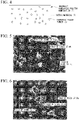
- Fig. 5 shows the case where the polishing time was 3 minutes
- Fig. 6 shows the case where the polishing time was 30 minutes
- Fig. 7 shows the case where the polishing time was 45 minutes
- Fig. 8 shows the case where the polishing time was 60 minutes.
- a black background portion is an enlarged portion of the surface of one inorganic particle, and many particles having a size of less than 0.1 ⁇ m displayed on this background portion are inorganic microparticles.
- an inorganic filler powder in which the surface of inorganic particles having a particle size of 1 ⁇ m or more is covered with inorganic microparticles having a particle size of 10 nm or more and less than 0.1 ⁇ m can be generated by subjecting a raw material slurry obtained by diffusing an electro-fused alumina powder as an inorganic raw material powder in a solvent to swirling flow at a circumferential speed of 10 m/sec or greater and thereby polishing the inorganic raw material powder.
- the hardness was measured for each thermally conductive polymer composition that used an inorganic filler powder (average coverage ratio 21.4%) at a polishing time of 3 minutes, an inorganic filler powder (average coverage ratio 30.1%) at a polishing time of 30 minutes, an inorganic filler powder (average coverage ratio 56.2%) at a polishing time of 45 minutes, an inorganic filler powder (average coverage ratio of 90.9%) at a polishing time of 60 minutes, and an electro-fused alumina powder (average coverage ratio 14.5%), which was a raw material that was not polished.
- Measurement of hardness Durometer (Asker rubber hardness meter A type: Kobunshi Keiki Co., Ltd.)
- Hardness improvement ratio (%) of the thermally conductive polymer composition that used each of the inorganic filler powders with varying polishing time was measured with respect to the hardness of the thermally conductive polymer composition that used an electro-fused alumina powder as a raw material.
- Hardness improvement ratio % Hardness of thermally conductive polymer composition using inorganic filler powder / hardness of thermally conductive polymer composition using electro ⁇ fused alumina powder ⁇ 100
- the raw material alumina particles were prepared into a slurry having a concentration of 72% by mass with ion-exchanged water, and a polishing treatment of the raw material alumina particles was performed by using an emulsifying and dispersing apparatus (Apex Disperser ZERO, manufactured by Hiroshima Metal & Machinery Co., Ltd.) and setting the circumferential speed of the stirring rotor to 35 m/s and the time to 60 minutes.
- electro-fused alumina particles of Verification Example 3 (hereinafter, referred to as polished alumina particles 1) were obtained.
- a graph showing the relationship between the number of parts by mass (PHR) of each of the raw material alumina particles and the polished alumina particles 1 added to 100 parts by mass of the resin 1, and the thermal conductivity of the obtained thermally conductive resin composition is shown in Fig. 12 .
- the measurement of the thermal conductivity was carried out by a disc heat flux meter method (manufactured in-house, JIS A 1412-1, or a device based on ASTMD5470 with a rod made of aluminum).
- the thermally conductive resin composition using the polished electro-fused alumina particles as a filler could have a higher thermal conductivity because a larger amount of the filler could be added.
- raw material alumina particles electro-fused alumina particles
- the specific surface areas and the average particle sizes D50 of the raw material 1 and the samples 01 to 04, and the rate of change of each of the samples with respect to the raw material 1 are presented in Table 2. Furthermore, the hardness of each of the thermally conductive resin compositions that used the raw material 1 and the samples 01 to 04, and the rates of change with respect to the thermally conductive resin composition that used the raw material 1 are presented in Table 2.
- the instrument used for each measurement is as follows.
- alumina particles electro-fused alumina particles
- the specific surface areas and the average particle sizes D50 of the raw material 2 and the samples 11 to 13, and the rate of change of each of the samples with respect to the raw material 2 are presented in Table 3. Furthermore, the hardness of each of the thermally conductive resin compositions that used the raw material 2 and the samples 11 to 13, and the rates of change with respect to the thermally conductive resin composition that used the raw material 2 are presented in Table 3.
- the instrument used for each measurement is similar to that used in Verification Example 3.
- alumina particles electro-fused alumina particles
- the specific surface areas and the average particle sizes D50 of the raw material 3 and the samples 21 to 23, and the rate of change of each of the samples with respect to the raw material 3 are presented in Table 4. Furthermore, the hardness of each of the thermally conductive resin compositions that used the raw material 3 and the samples 21 to 23, and the rates of change with respect to the thermally conductive resin composition that used the raw material 3 are presented in Table 4.
- the instrument used for each measurement is similar to that used in Verification Example 3.
- the specific surface areas and the average particle sizes D50 of the raw material 4 and the samples 31 and 32, and the rate of change of each of the samples with respect to the raw material 4 are presented in Table 5. Furthermore, the hardness of each of the thermally conductive resin compositions that used the raw material 4 and the samples 31 and 32, and the rates of change with respect to the thermally conductive resin composition that used the raw material 4 are presented in Table 5.
- the instrument used for each measurement is similar to that used in Verification Example 3.
- thermally conductive resin compositions of the present embodiment produced by using the samples 01 to 04, 11 to 13, 21 to 23, 31, and 32 obtained by subjecting such raw materials 1 to 4 to a polishing treatment, can reduce the hardness (-9% to -57%) and enhance the shape followability as compared with the conventional thermally conductive resin compositions produced by using the raw materials 1 to 4.
- the instrument used for the measurement is as follows. Measurement of viscosity: B type viscometer (PM-2A manufactured by Malcom Co., Ltd.) [Table 6] Number of mixed parts of alumina particles Viscosity (Pa ⁇ s) Rate of change in viscosity Raw material 1 400 parts by mass 129 - 600 parts by mass 670 - Sample 04 400 parts by mass 81 -37% 600 parts by mass 272 -59%
- thermally conductive resin compositions 3 and 4 that used the sample 04 which was the polished electro-fused alumina particles of the present embodiment, can reduce the viscosity (-37% to -59%) and enhance the shape followability as compared with the conventional thermally conductive resin compositions 1 and 2 that used the raw material 1.
- sample 04 In order to specify the characteristics of the raw material 1 of Verification Example 3, the sample 04, and an electro-fused alumina powder (sample 05) obtained by polishing the raw material 1 with a bead mill (manufactured by IMEX Co., Ltd.: circumferential speed 7.2 m/s), a 2-hour sedimentation test was performed.
- a bead mill manufactured by IMEX Co., Ltd.: circumferential speed 7.2 m/s
Landscapes
- Chemical & Material Sciences (AREA)
- Organic Chemistry (AREA)
- Life Sciences & Earth Sciences (AREA)
- Geology (AREA)
- Inorganic Chemistry (AREA)
- Engineering & Computer Science (AREA)
- Chemical Kinetics & Catalysis (AREA)
- Polymers & Plastics (AREA)
- Medicinal Chemistry (AREA)
- Physics & Mathematics (AREA)
- Health & Medical Sciences (AREA)
- Combustion & Propulsion (AREA)
- Thermal Sciences (AREA)
- Materials Engineering (AREA)
- Compositions Of Macromolecular Compounds (AREA)
- Compounds Of Alkaline-Earth Elements, Aluminum Or Rare-Earth Metals (AREA)
Applications Claiming Priority (3)
| Application Number | Priority Date | Filing Date | Title |
|---|---|---|---|
| JP2020045795A JP7584225B2 (ja) | 2020-03-16 | 2020-03-16 | 熱伝導性樹脂組成物用アルミナフィラー、熱伝導性樹脂組成物、および熱伝導性樹脂組成物用アルミナフィラーの製造方法 |
| JP2021024242A JP7829280B2 (ja) | 2021-02-18 | 2021-02-18 | 無機フィラー粉末、熱伝導性高分子組成物、無機フィラー粉末の製造方法 |
| PCT/JP2021/010363 WO2021187415A1 (fr) | 2020-03-16 | 2021-03-15 | Poudre de charge anorganique, composition polymère thermoconductrice et méthode de fabrication de poudre de charge inorganique |
Publications (2)
| Publication Number | Publication Date |
|---|---|
| EP4122888A1 true EP4122888A1 (fr) | 2023-01-25 |
| EP4122888A4 EP4122888A4 (fr) | 2024-04-24 |
Family
ID=77770961
Family Applications (1)
| Application Number | Title | Priority Date | Filing Date |
|---|---|---|---|
| EP21770791.8A Pending EP4122888A4 (fr) | 2020-03-16 | 2021-03-15 | Poudre de charge anorganique, composition polymère thermoconductrice et méthode de fabrication de poudre de charge inorganique |
Country Status (5)
| Country | Link |
|---|---|
| US (1) | US20230107924A1 (fr) |
| EP (1) | EP4122888A4 (fr) |
| CN (1) | CN115279695B (fr) |
| TW (1) | TWI862806B (fr) |
| WO (1) | WO2021187415A1 (fr) |
Families Citing this family (1)
| Publication number | Priority date | Publication date | Assignee | Title |
|---|---|---|---|---|
| WO2023007894A1 (fr) * | 2021-07-29 | 2023-02-02 | 昭和電工株式会社 | Composition de résine thermoconductrice, produit durci, élément de transfert de chaleur et dispositif électronique |
Family Cites Families (19)
| Publication number | Priority date | Publication date | Assignee | Title |
|---|---|---|---|---|
| JPS62191420A (ja) * | 1986-02-17 | 1987-08-21 | Showa Alum Ind Kk | 球状コランダム粒子の製造方法 |
| JP2665737B2 (ja) * | 1986-05-27 | 1997-10-22 | 宇部興産株式会社 | 微粒子状無機フイラー分散液の製造法 |
| JPS6320340A (ja) * | 1986-07-14 | 1988-01-28 | Showa Denko Kk | 高熱伝導性ゴム・プラスチック組成物 |
| JPH0651778B2 (ja) | 1986-11-11 | 1994-07-06 | 住友ベークライト株式会社 | 高熱伝導性エポキシ樹脂成形材料 |
| JP3110526B2 (ja) * | 1991-11-08 | 2000-11-20 | 水澤化学工業株式会社 | ハイドロタルサイト被覆粒子、その製法及び樹脂用配合剤 |
| CN1037898C (zh) * | 1994-07-05 | 1998-04-01 | 北京医科大学口腔医学研究所 | 具有固位力外形的复合式无机填料颗粒及其制造方法和应用 |
| JP4361997B2 (ja) | 2000-02-17 | 2009-11-11 | 電気化学工業株式会社 | 球状アルミナ粉末及び樹脂組成物 |
| JP2002020652A (ja) * | 2000-07-13 | 2002-01-23 | Kao Corp | 複合粉体 |
| CN1910122A (zh) * | 2004-01-08 | 2007-02-07 | 昭和电工株式会社 | 无机粉末、用该粉末填充的树脂组合物及其用途 |
| US7789330B2 (en) | 2004-03-15 | 2010-09-07 | Showa Denko K.K. | Roundish fused alumina particles, production process thereof, and resin composition containing the particles |
| JP2008189835A (ja) * | 2007-02-06 | 2008-08-21 | Shin Etsu Polymer Co Ltd | 熱伝導性組成物及びその製造方法 |
| WO2010093035A1 (fr) * | 2009-02-16 | 2010-08-19 | 株式会社村田製作所 | Composition de résine conductrice, procédé de production d'une pièce électronique à l'aide de celle-ci, procédé de connexion, structure de connexion, et pièce électronique |
| JP2011016962A (ja) | 2009-07-10 | 2011-01-27 | Sekisui Chem Co Ltd | 熱伝導性樹脂組成物及び電子回路用基板 |
| JP2012121742A (ja) | 2010-12-06 | 2012-06-28 | Tokuyama Corp | 球状窒化アルミニウム粉末の製造方法 |
| JP2012140510A (ja) * | 2010-12-28 | 2012-07-26 | Toyo Tire & Rubber Co Ltd | ゴム配合用老化防止剤及びその製造方法、並びにゴム組成物 |
| JP5642147B2 (ja) * | 2012-12-27 | 2014-12-17 | 学校法人 関西大学 | 熱伝導性導電性接着剤組成物 |
| US20180009719A1 (en) * | 2015-02-02 | 2018-01-11 | Itochu Ceratech Corporation | Porous fired granulated body and method for manufacturing the same |
| JP2020045795A (ja) | 2018-09-18 | 2020-03-26 | スズキ株式会社 | 内燃機関のピストン |
| JP7270501B2 (ja) | 2019-08-08 | 2023-05-10 | マクセル株式会社 | 発泡成形体の押出製造装置、押出製造方法および発泡成形体押出製造装置用スクリュ |
-
2021
- 2021-03-15 EP EP21770791.8A patent/EP4122888A4/fr active Pending
- 2021-03-15 WO PCT/JP2021/010363 patent/WO2021187415A1/fr not_active Ceased
- 2021-03-15 US US17/911,248 patent/US20230107924A1/en active Pending
- 2021-03-15 CN CN202180021074.1A patent/CN115279695B/zh active Active
- 2021-03-16 TW TW110109277A patent/TWI862806B/zh active
Also Published As
| Publication number | Publication date |
|---|---|
| CN115279695B (zh) | 2024-07-05 |
| TWI862806B (zh) | 2024-11-21 |
| WO2021187415A1 (fr) | 2021-09-23 |
| CN115279695A (zh) | 2022-11-01 |
| TW202200714A (zh) | 2022-01-01 |
| EP4122888A4 (fr) | 2024-04-24 |
| US20230107924A1 (en) | 2023-04-06 |
Similar Documents
| Publication | Publication Date | Title |
|---|---|---|
| EP2455339B1 (fr) | Particules d'oxyde de magnésium, leur procédé de fabrication, charge à dissipation de chaleur, composition de résine, graisse à dissipation de chaleur, et composition de revêtement à dissipation de chaleur | |
| TWI858007B (zh) | 填料組成物、聚矽氧樹脂組成物、以及散熱零件 | |
| EP2351709B1 (fr) | Particules d oxyde de zinc, leur procédé de fabrication, charge libérant de la chaleur, composition de résine, graisse libérant de la chaleur et composition de revêtement libérant de la chaleur | |
| CN110944943B (zh) | 氧化镁粉末、其制造方法、导热性树脂组合物、导热性膏和导热性涂料 | |
| JP2019521064A (ja) | 窒化ホウ素凝集体を製造するためのプロセス | |
| EP3575363A1 (fr) | Composition de silicone à faible résistance à la chaleur | |
| KR20200127159A (ko) | 용융 구형 실리카 분말 및 그 제조 방법 | |
| EP3945564A1 (fr) | Matériau d'interface thermique et procédé de transfert de chaleur | |
| JP2019019045A (ja) | 窒化アルミニウム系粉末及びその製造方法 | |
| EP4122888A1 (fr) | Poudre de charge anorganique, composition polymère thermoconductrice et méthode de fabrication de poudre de charge inorganique | |
| EP4269346A1 (fr) | Poudre d'oxyde de magnésium, charge thermoconductrice, composition de résine et procédé de production de poudre d'oxyde de magnésium | |
| JP7584225B2 (ja) | 熱伝導性樹脂組成物用アルミナフィラー、熱伝導性樹脂組成物、および熱伝導性樹脂組成物用アルミナフィラーの製造方法 | |
| JP7829280B2 (ja) | 無機フィラー粉末、熱伝導性高分子組成物、無機フィラー粉末の製造方法 | |
| JP2024146815A (ja) | 窒化ホウ素凝集粒子、窒化ホウ素凝集粉末、複合材組成物、放熱部材、半導体デバイス | |
| EP3632843A1 (fr) | Poudre à base de nitrure d'aluminium et méthode de production de celle-ci | |
| KR20250043493A (ko) | 알루미나 분말, 수지 조성물, 및 알루미나 분말의 제조 방법 | |
| KR20250170589A (ko) | 질화알루미늄 분말 | |
| EP4299510A1 (fr) | Poudre d'oxyde métallique et procédé de production associé | |
| JP7688194B1 (ja) | 窒化ケイ素粉末、樹脂組成物、および窒化ケイ素粉末の製造方法 | |
| CN120882663B (zh) | 氧化镁粉末及其制造方法 | |
| EP4582372A1 (fr) | Poudre de nitrure d'aluminium et composition de résine | |
| KR102798327B1 (ko) | 질화알루미늄 분말 및 수지 조성물 | |
| US20230312353A1 (en) | Silicon carbide powder and manufacturing method for same | |
| EP4494783A1 (fr) | Poudre d'argent en bloc, son procédé de fabrication, et pâte électriquement conductrice | |
| JP2025040106A (ja) | 炭化ケイ素粉末及びその製造方法 |
Legal Events
| Date | Code | Title | Description |
|---|---|---|---|
| STAA | Information on the status of an ep patent application or granted ep patent |
Free format text: STATUS: THE INTERNATIONAL PUBLICATION HAS BEEN MADE |
|
| PUAI | Public reference made under article 153(3) epc to a published international application that has entered the european phase |
Free format text: ORIGINAL CODE: 0009012 |
|
| STAA | Information on the status of an ep patent application or granted ep patent |
Free format text: STATUS: REQUEST FOR EXAMINATION WAS MADE |
|
| 17P | Request for examination filed |
Effective date: 20220913 |
|
| AK | Designated contracting states |
Kind code of ref document: A1 Designated state(s): AL AT BE BG CH CY CZ DE DK EE ES FI FR GB GR HR HU IE IS IT LI LT LU LV MC MK MT NL NO PL PT RO RS SE SI SK SM TR |
|
| DAV | Request for validation of the european patent (deleted) | ||
| DAX | Request for extension of the european patent (deleted) | ||
| REG | Reference to a national code |
Ref country code: DE Ref legal event code: R079 Free format text: PREVIOUS MAIN CLASS: C01F0007020000 Ipc: C09K0005140000 |
|
| A4 | Supplementary search report drawn up and despatched |
Effective date: 20240320 |
|
| RIC1 | Information provided on ipc code assigned before grant |
Ipc: C08K 3/22 20060101ALI20240315BHEP Ipc: C08L 101/00 20060101ALI20240315BHEP Ipc: C08K 9/02 20060101ALI20240315BHEP Ipc: C01F 7/44 20060101ALI20240315BHEP Ipc: C01F 7/02 20060101ALI20240315BHEP Ipc: C09K 5/14 20060101AFI20240315BHEP |
|
| STAA | Information on the status of an ep patent application or granted ep patent |
Free format text: STATUS: EXAMINATION IS IN PROGRESS |
|
| 17Q | First examination report despatched |
Effective date: 20250314 |