EP4130055A1 - Verfahren zur herstellung von erdölharz für schmelzklebstoff und verfahren zur herstellung von hydriertem erdölharz - Google Patents
Verfahren zur herstellung von erdölharz für schmelzklebstoff und verfahren zur herstellung von hydriertem erdölharz Download PDFInfo
- Publication number
- EP4130055A1 EP4130055A1 EP21782105.7A EP21782105A EP4130055A1 EP 4130055 A1 EP4130055 A1 EP 4130055A1 EP 21782105 A EP21782105 A EP 21782105A EP 4130055 A1 EP4130055 A1 EP 4130055A1
- Authority
- EP
- European Patent Office
- Prior art keywords
- petroleum resin
- polymerization reaction
- producing
- residence time
- reactor
- Prior art date
- Legal status (The legal status is an assumption and is not a legal conclusion. Google has not performed a legal analysis and makes no representation as to the accuracy of the status listed.)
- Withdrawn
Links
Images


Classifications
-
- C—CHEMISTRY; METALLURGY
- C08—ORGANIC MACROMOLECULAR COMPOUNDS; THEIR PREPARATION OR CHEMICAL WORKING-UP; COMPOSITIONS BASED THEREON
- C08F—MACROMOLECULAR COMPOUNDS OBTAINED BY REACTIONS ONLY INVOLVING CARBON-TO-CARBON UNSATURATED BONDS
- C08F240/00—Copolymers of hydrocarbons and mineral oils, e.g. petroleum resins
-
- C—CHEMISTRY; METALLURGY
- C08—ORGANIC MACROMOLECULAR COMPOUNDS; THEIR PREPARATION OR CHEMICAL WORKING-UP; COMPOSITIONS BASED THEREON
- C08F—MACROMOLECULAR COMPOUNDS OBTAINED BY REACTIONS ONLY INVOLVING CARBON-TO-CARBON UNSATURATED BONDS
- C08F2/00—Processes of polymerisation
- C08F2/001—Multistage polymerisation processes characterised by a change in reactor conditions without deactivating the intermediate polymer
-
- C—CHEMISTRY; METALLURGY
- C08—ORGANIC MACROMOLECULAR COMPOUNDS; THEIR PREPARATION OR CHEMICAL WORKING-UP; COMPOSITIONS BASED THEREON
- C08F—MACROMOLECULAR COMPOUNDS OBTAINED BY REACTIONS ONLY INVOLVING CARBON-TO-CARBON UNSATURATED BONDS
- C08F2/00—Processes of polymerisation
- C08F2/04—Polymerisation in solution
- C08F2/06—Organic solvent
-
- C—CHEMISTRY; METALLURGY
- C08—ORGANIC MACROMOLECULAR COMPOUNDS; THEIR PREPARATION OR CHEMICAL WORKING-UP; COMPOSITIONS BASED THEREON
- C08F—MACROMOLECULAR COMPOUNDS OBTAINED BY REACTIONS ONLY INVOLVING CARBON-TO-CARBON UNSATURATED BONDS
- C08F32/00—Homopolymers and copolymers of cyclic compounds having no unsaturated aliphatic radicals in a side chain, and having one or more carbon-to-carbon double bonds in a carbocyclic ring system
- C08F32/02—Homopolymers and copolymers of cyclic compounds having no unsaturated aliphatic radicals in a side chain, and having one or more carbon-to-carbon double bonds in a carbocyclic ring system having no condensed rings
- C08F32/06—Homopolymers and copolymers of cyclic compounds having no unsaturated aliphatic radicals in a side chain, and having one or more carbon-to-carbon double bonds in a carbocyclic ring system having no condensed rings having two or more carbon-to-carbon double bonds
-
- C—CHEMISTRY; METALLURGY
- C08—ORGANIC MACROMOLECULAR COMPOUNDS; THEIR PREPARATION OR CHEMICAL WORKING-UP; COMPOSITIONS BASED THEREON
- C08F—MACROMOLECULAR COMPOUNDS OBTAINED BY REACTIONS ONLY INVOLVING CARBON-TO-CARBON UNSATURATED BONDS
- C08F8/00—Chemical modification by after-treatment
- C08F8/04—Reduction, e.g. hydrogenation
-
- C—CHEMISTRY; METALLURGY
- C08—ORGANIC MACROMOLECULAR COMPOUNDS; THEIR PREPARATION OR CHEMICAL WORKING-UP; COMPOSITIONS BASED THEREON
- C08F—MACROMOLECULAR COMPOUNDS OBTAINED BY REACTIONS ONLY INVOLVING CARBON-TO-CARBON UNSATURATED BONDS
- C08F212/00—Copolymers of compounds having one or more unsaturated aliphatic radicals, each having only one carbon-to-carbon double bond, and at least one being terminated by an aromatic carbocyclic ring
- C08F212/02—Monomers containing only one unsaturated aliphatic radical
- C08F212/04—Monomers containing only one unsaturated aliphatic radical containing one ring
- C08F212/06—Hydrocarbons
- C08F212/08—Styrene
-
- C—CHEMISTRY; METALLURGY
- C08—ORGANIC MACROMOLECULAR COMPOUNDS; THEIR PREPARATION OR CHEMICAL WORKING-UP; COMPOSITIONS BASED THEREON
- C08F—MACROMOLECULAR COMPOUNDS OBTAINED BY REACTIONS ONLY INVOLVING CARBON-TO-CARBON UNSATURATED BONDS
- C08F232/00—Copolymers of cyclic compounds containing no unsaturated aliphatic radicals in a side chain, and having one or more carbon-to-carbon double bonds in a carbocyclic ring system
- C08F232/02—Copolymers of cyclic compounds containing no unsaturated aliphatic radicals in a side chain, and having one or more carbon-to-carbon double bonds in a carbocyclic ring system having no condensed rings
- C08F232/06—Copolymers of cyclic compounds containing no unsaturated aliphatic radicals in a side chain, and having one or more carbon-to-carbon double bonds in a carbocyclic ring system having no condensed rings having two or more carbon-to-carbon double bonds
-
- C—CHEMISTRY; METALLURGY
- C08—ORGANIC MACROMOLECULAR COMPOUNDS; THEIR PREPARATION OR CHEMICAL WORKING-UP; COMPOSITIONS BASED THEREON
- C08F—MACROMOLECULAR COMPOUNDS OBTAINED BY REACTIONS ONLY INVOLVING CARBON-TO-CARBON UNSATURATED BONDS
- C08F232/00—Copolymers of cyclic compounds containing no unsaturated aliphatic radicals in a side chain, and having one or more carbon-to-carbon double bonds in a carbocyclic ring system
- C08F232/08—Copolymers of cyclic compounds containing no unsaturated aliphatic radicals in a side chain, and having one or more carbon-to-carbon double bonds in a carbocyclic ring system having condensed rings
-
- C—CHEMISTRY; METALLURGY
- C09—DYES; PAINTS; POLISHES; NATURAL RESINS; ADHESIVES; COMPOSITIONS NOT OTHERWISE PROVIDED FOR; APPLICATIONS OF MATERIALS NOT OTHERWISE PROVIDED FOR
- C09J—ADHESIVES; NON-MECHANICAL ASPECTS OF ADHESIVE PROCESSES IN GENERAL; ADHESIVE PROCESSES NOT PROVIDED FOR ELSEWHERE; USE OF MATERIALS AS ADHESIVES
- C09J125/00—Adhesives based on homopolymers or copolymers of compounds having one or more unsaturated aliphatic radicals, each having only one carbon-to-carbon double bond, and at least one being terminated by an aromatic carbocyclic ring; Adhesives based on derivatives of such polymers
- C09J125/02—Homopolymers or copolymers of hydrocarbons
- C09J125/04—Homopolymers or copolymers of styrene
- C09J125/08—Copolymers of styrene
-
- C—CHEMISTRY; METALLURGY
- C09—DYES; PAINTS; POLISHES; NATURAL RESINS; ADHESIVES; COMPOSITIONS NOT OTHERWISE PROVIDED FOR; APPLICATIONS OF MATERIALS NOT OTHERWISE PROVIDED FOR
- C09J—ADHESIVES; NON-MECHANICAL ASPECTS OF ADHESIVE PROCESSES IN GENERAL; ADHESIVE PROCESSES NOT PROVIDED FOR ELSEWHERE; USE OF MATERIALS AS ADHESIVES
- C09J145/00—Adhesives based on homopolymers or copolymers of compounds having no unsaturated aliphatic radicals in a side chain, and having one or more carbon-to-carbon double bonds in a carbocyclic or in a heterocyclic system; Adhesives based on derivatives of such polymers
Definitions
- the present invention relates to a method of producing a petroleum resin used as a tackifier for hot-melt adhesives, and a method of producing a hydrogenated petroleum resin by adding hydrogen to the petroleum resin.
- Hot-melt adhesives are expanding their use in various fields because they are excellent in high-speed coating property, quick-curing property, solvent-free property, barrier property, energy saving property, and economic efficiency.
- a common hot-melt adhesive a composition in which a tackifier or a plasticizer is mixed with a base polymer such as a styrene-isoprene-styrene block copolymer and a hydrogenate thereof is used.
- Hydrogenated petroleum resins and the like are used as tackifiers.
- the hydrogenated petroleum resin is obtained by, for example, hydrogenating a petroleum resin obtained by thermally polymerizing a raw material containing a cyclopentadiene-based compound and a vinyl aromatic compound.
- Patent Literature 1 to 4 various production methods have been conventionally proposed for producing petroleum resins or hydrogenated petroleum resins.
- Patent Literature 1 and 2 When a raw material containing a cyclopentadiene-based compound and a vinyl aromatic compound is thermally polymerized to produce a petroleum resin, as shown in Patent Literature 1 and 2, a batch-type or continuous-type apparatus has been conventionally used for carrying out the polymerization reaction.
- tank-type reactors equipped with an agitator are used for both types.
- the batch-type polymerization reaction is advantageous in that a high softening point grade resin having a relatively narrow molecular weight distribution (so-called sharp molecular weight distribution) can be obtained because the residence time distribution is uniform, but is disadvantageous in that the production efficiency is low. Further, in the batch-type polymerization reaction, after the resin is produced by the polymerization reaction, a cleaning step or the like is required when moving to the next production, which is troublesome.
- the poor production efficiency of the batch-type polymerization reaction can be solved.
- the molecular weight is difficult to control, and thus it is difficult to produce a resin having a high softening point showing a sharp molecular weight distribution.
- the tank-type reactor equipped with an agitator used in the above-described patent literature has the following problems. Since the polymerization reaction is a high-temperature and high-pressure reaction, the plate thickness required for the tank-type reactor having a large diameter becomes thicker, which results in restrictions on the material and production. In the case of a commercial plant, the weights of the reactor and the support and foundation for installing the reactor become large, and the installation and maintenance become a large scale.
- the tank-type reactor since the tank-type reactor has an agitating device, it is necessary to prevent leakage of liquid, gas, or the like from the rotating agitating shaft when carrying out a reaction at high temperatures and high pressures, and therefore, it is necessary to ensure high manufacturing accuracy of the device, which results in high demands for maintenance.
- an object of the present invention is to provide a method of producing a petroleum resin using a tube-type reactor, by which a petroleum resin that has a narrow molecular weight distribution, a high softening point, favorable adhesive performance, and less insoluble matter, exhibiting favorable quality as an adhesive component of a hot-melt adhesive is produced.
- the present inventors made intensive studies to solve the above-described problems. As a result, the inventors found that the petroleum resin which is the object of the present invention can be produced using two types of tube-type reactors which are a loop reactor and a plug flow reactor by carrying out a thermal polymerization reaction of a raw material using the loop reactor and then further carrying out a thermal polymerization reaction of the obtained polymerization reaction product using the plug flow reactor. This has led to the completion of the present invention.
- the present invention includes the following aspects.
- a method of producing a petroleum resin using a tube-type reactor by which a petroleum resin that has a narrow molecular weight distribution, a high softening point, favorable adhesive performance, and less insoluble matter, exhibiting favorable quality as an adhesive component of a hot-melt adhesive can be provided.
- the method of producing a petroleum resin of the present invention comprises:
- the raw material used in the method of producing the petroleum resin of the present invention contains at least a cyclopentadiene-based component (A) and a styrene-indene-based aromatic component (B).
- the styrene-indene-based aromatic component (B) means containing both a styrene-based aromatic component (B-1) and an indene-based aromatic component (B-2).
- the cyclopentadiene-based component (A) used as a raw material in the present invention includes a cyclopentadiene and a polymer thereof or an alicyclic diene compound such as an alkyl-substituted compound thereof.
- This cyclopentadiene-based component (A) may contain one or more of or two or more of alicyclic diene compounds as described above, or may be a cyclopentadiene-based fraction (CPD fraction) containing a cyclopentadiene-based component obtained by steam cracking of naphtha or the like.
- This CPD fraction may contain an olefinic monomer copolymerizable with the alicyclic diene compound and a polymer thereof. Examples of such an olefinic monomer include aliphatic dienes such as isoprene or piperylene.
- cyclopentadiene-based components (A) used as a raw material in the present invention as cyclopentadiene derivatives (A-1) that contributes to the reaction, cyclopentadiene, lower alkyl-substituted cyclopentadiene such as methyl- and ethyl-substituted cyclopentadiene, and dimers and trimers thereof as well as codimers of cyclopentadiene and monomers such as isoprene and piperylene, monomers themselves such as isoprene and piperylene, and dimers and trimers of these monomers can be mentioned.
- Examples of a styrene-indene-based aromatic component (B) also used as a raw material include a styrene-based aromatic component (B-1) and an indene-based aromatic component (B-2) which are C9 aromatic hydrocarbons and are aromatic hydrocarbons having an ethylenically unsaturated bond.
- a so-called C9 fraction which is a by-product of steam cracking of naphtha or the like, can be used.
- styrene-indene aromatic components (B) As styrene-indene aromatic components (B), as styrene derivatives (C-1) that contribute to the thermal polymerization reaction, compounds having an olefin attached to the aromatic ring, such as styrene, vinyltoluene, and divinyltoluene can be mentioned.
- indene derivatives (C-2) that contribute to the thermal polymerization reaction compounds having an indene skeleton such as indene, methylindene, and dimethylindene can be mentioned.
- the weight ratio (C-1/C-2) of the styrene derivatives (C-1) contributing to the thermal polymerization reaction and the indene derivatives (C-2) contributing to the thermal polymerization reaction is not particularly limited, and can be selected as appropriate depending on the purpose, but is preferably from 0.6 to 4.0, for example. From the viewpoint of the petroleum resin yield, it is preferably 0.6 or more, and from the viewpoint of miscibility with the base polymer used when the product is used, it is preferably 4.0 or less.
- a solvent may be added as necessary so as to dilute the reaction raw material.
- the solvent is not particularly limited and can be appropriately selected depending on the purpose and the like.
- examples thereof include unreacted light fractions contained in the thermal polymerization reaction product such as pentane, hexane, heptane, benzene, toluene, and xylene.
- the total amount of the compounds contributing to the reaction i.e., cyclopentadiene derivatives (A-1), styrene derivatives (C-1), and indene derivatives (C-2), is preferably from 30% to 95% by weight, more preferably from 35% to 90% by weight, and still more preferably from 40% to 85% by weight in the mixture of the raw material and solvent.
- the total amount is equal to or more than the lower limit of the preferred range, it is possible to effectively prevent the problem that the excessively small amount of compounds contributing to the reaction causes the amount of the resulting petroleum resin to decrease, which is economically undesirable.
- the weight ratio of the amount of the cyclopentadiene derivatives (A-1) to the combined amount of the styrene derivatives (C-1) and the indene derivatives (C-2), i.e., the amount of A-1/(amount of C-1 + amount of C-2), is preferably from 0.1 to 20.
- the cyclopentadiene-based component (A) is preferably contained in an amount of from 50% to 90% by weight based on the raw material.
- the styrene-indene-based aromatic component (B) is preferably contained in an amount of from 10% to 50% by weight based on the raw material.
- the content of the styrene-indene-based aromatic component (B) is the sum of the contents of the styrene-based aromatic component (B-1) and the indene-based aromatic component (B-2).
- the cyclopentadiene-based component (A) is contained in an amount of from 50% to 80% by weight based on the raw material, and the styrene-indene-based aromatic component (B) is contained in an amount of from 20% to 50% by weight based on the raw material. It is still more preferable that the cyclopentadiene-based component (A) is contained in an amount of from 50% to 70% by weight based on the raw material, and the styrene-indene-based aromatic component (B) is contained in an amount of from 30% to 50% by weight based on the raw material.
- a tube-type reactor comprising a loop reactor and a plug flow reactor is used.
- a tube-type reactor is a type of reactor in which a fluid is caused to react while flowing through a tube.
- a static mixer may be arranged in these reactors.
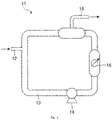
- FIG. 1 is a schematic view showing an example of the structure of a loop reactor.
- a raw material is introduced into a tube-type reactor body 13 through an introduction pipe 12 and undergoes a reaction.
- the polymerization reaction product is discharged from the tube-type reactor body 13 through an extraction pipe 16.
- the loop reactor 11 is a reactor in which a raw material and, if necessary, a solvent is continuously introduced into the tube-type reactor body 13, the raw material is polymerized while being circulated in the tube-type reactor body 13, and a polymerization reaction product is continuously extracted from the tube-type reactor body 13, thereby carrying out a polymerization reaction of the polymerization reaction product continuously.
- the loop reactor 11 is equipped with a pump 14 and a cooler 15.
- FIG. 2 is a schematic view showing an example of the structure of a plug flow reactor.
- a raw material is introduced into a tube-type reactor body 23 through an introduction pipe 22 and undergoes a reaction.
- the polymerization reaction product is discharged from the tube-type reactor body 23 through an extraction pipe 26.
- the plug flow reactor 21 is a reactor in which the tube-type reactor body 23 is provided, a raw material (a polymerization reaction product taken from the loop reactor in the present invention) and, if necessary, a solvent are continuously introduced from one end of the tube-type reactor body 23 and moved toward the other end thereof, while a polymerization reaction of the polymerization reaction product is further carried out, and then the polymerization reaction product is continuously extracted from the other end.
- the plug flow reactor 21 is equipped with a pump 24 and a cooler 25.
- the tube-type reactor body 23 is covered with a jacket 27 and cooled by the coolant inside this jacket 27.
- the coolant is circulated by the pump 24 and cooled by the cooler 25.
- the tube-type reactor body 23 is illustrated as a straight tube, but it may be coiled.
- a tube-type reactor in which a fluid is allowed to flow through a tube for reaction has a different structure from a conventional tank-type reactor in which a reaction occurs in an agitating tank.
- FIG. 3 is a schematic view showing an example of the structure of a tank-type reactor.
- a raw material is introduced into a tank-type reactor body 33 through an introduction pipe 32 and undergoes a reaction.
- the polymerization reaction product is discharged from the tank-type reactor body 33 through an extraction pipe 36.
- the tank-type reactor 31 has a pump 34, a cooler 35, a jacket 37, and an agitator 38.
- residence time represents the average amount of time that a fluid (e. g., a liquid) entering the reactor remains in the reactor.
- a larger (longer) residence time (HRT) means that a substance contained in a liquid undergoes a reaction for a longer period of time.
- V indicates the reactor volume (m 3 ) and Q indicates the flow rate (m 3 /hr).
- the method of producing a petroleum resin of the present invention comprises: a first polymerization reaction step of carrying out a thermal polymerization reaction using a loop reactor; and a second polymerization reaction step of thermally polymerizing the polymerization reaction product obtained in the first polymerization reaction step using a plug flow reactor.
- the present invention is characterized in that two types of tube-type reactors, which are a loop reactor and a plug flow reactor, are used for carrying out a polymerization reaction of a raw material, during which the polymerization reaction is carried out using the loop reactor before the plug flow reactor. Accordingly, As is clear from the results of the following Examples, a petroleum resin that has a narrow molecular weight distribution, a high softening point, favorable adhesive performance, and less insoluble matter, exhibiting favorable quality as an adhesive component of a hot-melt adhesive can be produced.
- the present inventors found that a petroleum resin having a narrow molecular weight distribution and favorable adhesive performance in which the production of insoluble matter is suppressed can be produced by carrying out the polymerization reaction in the order of the loop reactor and the plug flow reactor.
- the loop reactor in which the temperature of the exothermic reaction is easy to control, it is possible to prevent a rapid exothermic reaction in the plug flow reactor in the subsequent stage by partially advancing the polymerization reaction of the raw material.
- the polymerization reaction since the molecular weight increases remarkably in the latter half of the reaction, it is possible to produce a petroleum resin having a narrow molecular weight distribution by performing the polymerization by using the plug flow reactor giving a narrow residence time distribution.
- the object of the present invention cannot be achieved by simply using a loop reactor and a plug flow reactor together.
- a polymerization reaction is carried out in the order of a plug flow reactor and a loop reactor, as is clear from the results of the Reference Examples below, a large amount of insoluble matter is obtained, and the molecular weight distribution is widened. Thus, a high-quality petroleum resin cannot be produced.
- the method of producing a petroleum resin of the present invention suppresses the production of insoluble matter, it is possible to suppress the fouling phenomenon in which insoluble matter adheres and accumulates in the tube of the reactor.
- fouling causes clogging and temperature unevenness in the tube, stable supply of petroleum resin becomes difficult, and frequent operation stoppages and disassembly and cleaning of reactors are unavoidable, which reduces production efficiency. Therefore, according to the present invention, a petroleum resin can be stably produced with high production efficiency and without the burden of maintenance.
- the ratio of reaction residence time (x) of the loop reactor to a total reaction residence time (z), which is the sum of reaction residence time (x) of the loop reactor in the first polymerization reaction step and reaction residence time (y) of the plug flow reactor in the second polymerization reaction step, is preferably from 0.1 to 0.9. This is because it is necessary to use each reactor for a certain period of time in order to fully exert the effects of using the loop reactor and the plug flow reactor.
- the ratio (x/z) of the reaction residence time (x) of the loop reactor to the total reaction residence time (z) is preferably from 0.2 to 0.8, and more preferably from 0.3 to 0.8.
- the total residence time in the first and second polymerization reaction steps and the temperature during the polymerization reaction can be appropriately adjusted according to the constituent components of the raw material and their ratios.
- the total residence time is, for example, preferably 30 to 180 minutes and more preferably 45 to 160 minutes.
- the residence time is short, the polymerization does not proceed sufficiently, and sufficient adhesive performance is not exhibited.
- the residence time is long, the polymerization proceeds excessively, and as a result, the excessive polymerization proceeds, so that the insoluble matter increases, and continuous operation of the apparatus becomes difficult.
- the temperature during the polymerization reaction is, for example, preferably from 230°C to 320°C, and more preferably from 240°C to 300°C.
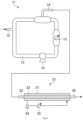
- FIG. 4 is a schematic view showing an example of equipment for performing the first and second polymerization reaction steps for producing a petroleum resin by the method of producing a petroleum resin of the present invention.
- the number of reactors such as the loop reactor and the plug flow reactor is not particularly limited and can be appropriately selected depending on the intended purpose.
- a plurality of loop reactors may be used for the polymerization.
- FIG. 5 is a schematic view showing another example of equipment for performing the first and second polymerization reaction steps for producing a petroleum resin by the method of producing a petroleum resin of the present invention in a case where a plurality of loop reactors are used.
- the blended raw materials are thermally copolymerized in the presence or absence of a solvent in a temperature range of from 230°C to 320°C for 30 to 180 minutes under a pressure equal to or higher than that capable of retaining the polymerization component in the liquid phase.
- a step of removing unreacted components and oligomers, or if necessary, the solvent may then be carried out.
- the step of removing unreacted components, oligomers, and the like can be carried out by vacuum distillation or steam distillation.
- a step of hydrogenating the obtained petroleum resin may be further carried out.
- the petroleum resin can be effectively used as an adhesive component of hot-melt adhesives.
- the method of producing a hydrogenated petroleum resin of the present invention is based on hydrogenating the petroleum resin obtained by the above-described method of producing a petroleum resin of the present invention.
- the method of hydrogenation is not particularly limited, and a generally known method can be used.
- a catalyst containing a metal such as nickel, palladium, cobalt, platinum, or rhodium can be used for hydrogenation at a temperature of from 100°C to 400°C in the presence of a diluent.
- the hydrogenated petroleum resin according to the present invention is produced by using a high-quality petroleum resin having a narrow molecular weight distribution and a high softening point and hydrogenating the petroleum resin. Therefore, when the hydrogenated petroleum resin according to the present invention is used as an adhesive component of a hot-melt adhesive, it exhibits excellent adhesive performance as is clear from the results of the following examples.
- a raw material containing a cyclopentadiene-based component (A), a styrene-indene-based aromatic component (B), and toluene as a solvent was prepared.
- the raw material composition is shown in Table 1 below.
- the prepared raw material solution was circulated in the loop reactor (internal volume: 100 cc; inner diameter: 10 mm) shown in FIG. 1 at a reactor inlet temperature of 275°C so as to yield the loop residence time (x (minutes)) as shown in Table 2 below.
- the product solution obtained via the loop reactor was further processed through the plug flow reactor shown in FIG. 2 at a reactor inlet temperature of 275°C and a flow rate of 0.2 cc/min.
- a plug flow reactor having an inner diameter of 7 mm and a length such that the plug flow residence time (y (minutes)) had a value shown in Table 2 below was used.
- the weight average molecular weight (Mw) and the number average molecular weight (Mn) of petroleum resin (I) were measured, and the molecular weight distribution (Mw/Mn: weight average molecular weight (Mw)/number average molecular weight (Mn)) was calculated.
- the weight average molecular weight (Mw) and the number average molecular weight (Mn) were measured by gel permeation chromatography (GPC) under the following conditions.
- the softening point of the petroleum resin (I) was measured in accordance with ASTM D6090 using a dropping point/softening point measuring system DP70 manufactured by METTLER TOLEDO.
- the thermally polymerized petroleum resin was dissolved in cyclohexane so as to yield a 50% by weight solution, and then filtered through a stainless steel mesh having a nominal diameter of 80 mesh. The weight (mg/Feed-kg) of the remaining substance was measured.
- this petroleum resin (I) 80 grams of this petroleum resin (I), 80 grams of cyclohexane as a diluent, and 2.0 grams of a nickel-based catalyst (N-113, manufactured by JGC Catalysts and Chemicals Ltd.) as a catalyst were charged into a 0.2-liter autoclave.
- a hydrogenation reaction was carried out at a hydrogen pressure of 150 kg/cm 2 G and 300°C for 1 hour.
- the adhesive performance of the hydrogenated petroleum resin (II) was evaluated by the method described below.
- the adhesive strength was evaluated by a method in accordance with JIS Z 0237: 2009. First, the hydrogenated petroleum resin (II), SBS resin (ASAPRENE (trademark) T-438 manufactured by Asahi Kasei Corporation), and a rubber processing oil (SUNPURE LW-500 manufactured by JAPAN SUN OIL COMPANY, LTD.) were mixed so as to have a mass ratio of 25/60/15, respectively, thereby obtaining an adhesive component.
- the obtained adhesive component was dissolved in toluene and coated on a test piece made of PET film. Here, the thickness of the adhesive component after evaporating the toluene was adjusted to 50 micrometers. Using this test piece, a 180° peel test was carried out at a tensile speed of 30 cm per minute so as to measure the adhesive strength.
- insoluble matter When insoluble matter is obtained in excess of 280 mg/Feed-kg, it is difficult to operate at the actual unit level.
- the production of insoluble matter is preferably suppressed to 280 mg or less, more preferably 230 mg or less, and still more preferably 150 mg or less.
- the adhesive performance is D in the above-described evaluation criteria, it is difficult to practically use the resin as an adhesive component.
- the adhesive performance is preferably C, more preferably B, and still more preferably A in the above-described evaluation criteria.
- a petroleum resin and a hydrogenated petroleum resin were produced in the same manner as in Example 1 except that the loop residence time (x (minutes)) and plug flow residence time (y (minutes)) in Example 1 were changed as shown in Table 2.
- Example 2 As described in Example 1, also in Examples 2 to 8, as the plug flow reactor, one having an inner diameter of 7 mm and a length such that the plug flow residence time (y (minutes)) had a value shown in Table 2 was used.
- a petroleum resin and a hydrogenated petroleum resin were produced in the same manner as in Example 1 except that the loop residence time (x (minutes)) and plug flow residence time (y (minutes)) in Example 1 were changed as shown in Table 2.
- Example 2 As described in Example 1, also in Comparative Example 1, as the plug flow reactor, one having an inner diameter of 7 mm and a length such that the plug flow residence time (y (minutes)) had a value shown in Table 2 was used.
- a petroleum resin and a hydrogenated petroleum resin were produced in the same manner as in Example 1 except that the loop residence time (x (minutes)) and plug flow residence time (y (minutes)) in Example 1 were changed as shown in Table 2.
- Example 2 As described in Example 1, also in Reference Example 1, as the plug flow reactor, one having an inner diameter of 7 mm and a length such that the plug flow residence time (y (minutes)) had a value shown in Table 2 was used.
- a petroleum resin and a hydrogenated petroleum resin were produced in the same manner as in Example 1 except that the raw material composition and the loop residence time (x (minutes)) and plug flow residence time (y (minutes)) in Example 1 were changed as shown in Tables 1 and 3, respectively.
- Example 3 As described in Example 1, also in Examples 9, as the plug flow reactor, one having an inner diameter of 7 mm and a length such that the plug flow residence time (y (minutes)) had a value shown in Table 3 was used.
- a petroleum resin and a hydrogenated petroleum resin were produced in the same manner as in Example 9 except that the loop residence time (x (minutes)) and plug flow residence time (y (minutes)) in Example 9 were changed as shown in Table 3.
- Example 3 As described in Example 1, also in Comparative Example 3, as the plug flow reactor, one having an inner diameter of 7 mm and a length such that the plug flow residence time (y (minutes)) had a value shown in Table 3 was used.
- a petroleum resin and a hydrogenated petroleum resin were produced in the same manner as in Example 1 except that the raw material composition and loop residence time (x (minutes)) and plug flow residence time (y (minutes)) in Example 1 were changed as shown in Tables 1 and 4, respectively.
- Example 10 As described in Example 1, also in Examples 10, as the plug flow reactor, one having an inner diameter of 7 mm and a length such that the plug flow residence time (y (minutes)) had a value shown in Table 4 was used.
- a petroleum resin and a hydrogenated petroleum resin were produced in the same manner as in Example 10 except that the loop residence time (x (minutes)) and plug flow residence time (y (minutes)) in Example 10 were changed as shown in Table 4.
- Example 1 As described in Example 1, also in Comparative Example 5, as the plug flow reactor, one having an inner diameter of 7 mm and a length such that the plug flow residence time (y (minutes)) had a value shown in Table 4 was used.
- the prepared raw material solution was processed through the plug flow reactor shown in FIG. 2 at a reactor inlet temperature of 275°C and a flow rate of 0.2 cc/min.
- a plug flow reactor having an inner diameter of 7 mm and a length such that the plug flow residence time (y (minutes)) had a value shown in Table 5 below was used.
- the product solution obtained via the plug flow reactor was circulated in the loop reactor (internal volume: 100 cc; inner diameter: 10 mm) shown in FIG. 1 at a reactor inlet temperature of 275°C so as to yield the loop residence time (x (minutes)) as shown in Table 5 below.
- the petroleum resin obtained by the present invention is a petroleum resin having a narrow molecular weight distribution, a high softening point, and less insoluble matter, and exhibiting favorable quality. It was found that the hydrogenated petroleum resin obtained by hydrogenating such a petroleum resin is a hydrogenated petroleum resin which exhibits favorable adhesive performance and excellent quality as an adhesive component of a hot-melt adhesive.
- the method of producing a petroleum resin of the present invention is a production method capable of continuous operation and excellent in economy.
- a petroleum resin that is particularly preferably used as a tackifier resin for a hot-melt adhesive and a hydrogenated petroleum resin can be produced.
Landscapes
- Chemical & Material Sciences (AREA)
- Health & Medical Sciences (AREA)
- Chemical Kinetics & Catalysis (AREA)
- Medicinal Chemistry (AREA)
- Polymers & Plastics (AREA)
- Organic Chemistry (AREA)
- General Chemical & Material Sciences (AREA)
- Engineering & Computer Science (AREA)
- Oil, Petroleum & Natural Gas (AREA)
- Addition Polymer Or Copolymer, Post-Treatments, Or Chemical Modifications (AREA)
- Polymerisation Methods In General (AREA)
Applications Claiming Priority (2)
| Application Number | Priority Date | Filing Date | Title |
|---|---|---|---|
| JP2020063497 | 2020-03-31 | ||
| PCT/JP2021/013242 WO2021200802A1 (ja) | 2020-03-31 | 2021-03-29 | ホットメルト接着剤用の石油樹脂の製造方法及び水素添加石油樹脂の製造方法 |
Publications (2)
| Publication Number | Publication Date |
|---|---|
| EP4130055A1 true EP4130055A1 (de) | 2023-02-08 |
| EP4130055A4 EP4130055A4 (de) | 2024-04-24 |
Family
ID=77929054
Family Applications (1)
| Application Number | Title | Priority Date | Filing Date |
|---|---|---|---|
| EP21782105.7A Withdrawn EP4130055A4 (de) | 2020-03-31 | 2021-03-29 | Verfahren zur herstellung von erdölharz für schmelzklebstoff und verfahren zur herstellung von hydriertem erdölharz |
Country Status (5)
| Country | Link |
|---|---|
| US (1) | US20230126192A1 (de) |
| EP (1) | EP4130055A4 (de) |
| JP (1) | JP7612668B2 (de) |
| TW (1) | TWI861379B (de) |
| WO (1) | WO2021200802A1 (de) |
Family Cites Families (14)
| Publication number | Priority date | Publication date | Assignee | Title |
|---|---|---|---|---|
| JPS61143413A (ja) | 1984-12-15 | 1986-07-01 | Maruzen Sekiyu Kagaku Kk | ジシクロペンタジエン系石油樹脂の製造方法 |
| JPH0786132B2 (ja) | 1987-04-20 | 1995-09-20 | 丸善石油化学株式会社 | 高軟化点シクロペンタジエン系石油樹脂の製造方法 |
| JPH02289603A (ja) | 1989-02-01 | 1990-11-29 | Nippon Zeon Co Ltd | 水素化炭化水素樹脂の連続的製造方法 |
| US5109081A (en) * | 1990-12-28 | 1992-04-28 | Exxon Chemical Patents, Inc. | Process for continuous thermal polymerization of cyclic hydrocarbon resins using recycle as a means of controlling molecular weight |
| JP3173841B2 (ja) * | 1992-01-17 | 2001-06-04 | トーネックス株式会社 | 水添石油樹脂 |
| US5502140A (en) * | 1994-10-19 | 1996-03-26 | Hercules Incorporated | Thermally polymerized dicyclopentadiene/vinyl aromatic resins |
| JPWO2002062892A1 (ja) * | 2001-02-02 | 2004-10-21 | 出光興産株式会社 | トナー用樹脂組成物及びトナー |
| JP2004189764A (ja) * | 2002-12-06 | 2004-07-08 | Idemitsu Petrochem Co Ltd | 石油樹脂及び水素添加石油樹脂の製造方法 |
| TW200940568A (en) * | 2008-02-28 | 2009-10-01 | Toray Industries | Method of producing thermal plastic copolymer |
| JP6403951B2 (ja) * | 2013-12-25 | 2018-10-10 | 出光興産株式会社 | 水素添加石油樹脂の製造方法 |
| KR101928079B1 (ko) * | 2016-12-12 | 2018-12-11 | 한화케미칼 주식회사 | 디시클로펜타디엔계 수지의 제조 방법 및 디시클로펜타디엔계 수지 |
| TWI804576B (zh) * | 2018-02-14 | 2023-06-11 | 德商呂特格德國有限公司 | 製備烴樹脂及其氫化產物的方法 |
| KR102294873B1 (ko) * | 2018-06-11 | 2021-08-27 | 한화솔루션 주식회사 | 디사이클로펜타디엔계 수지의 제조방법 |
| KR102382770B1 (ko) * | 2018-06-11 | 2022-04-06 | 한화솔루션 주식회사 | 석유수지의 제조방법 |
-
2021
- 2021-03-29 EP EP21782105.7A patent/EP4130055A4/de not_active Withdrawn
- 2021-03-29 JP JP2022512197A patent/JP7612668B2/ja active Active
- 2021-03-29 US US17/907,720 patent/US20230126192A1/en not_active Abandoned
- 2021-03-29 WO PCT/JP2021/013242 patent/WO2021200802A1/ja not_active Ceased
- 2021-03-30 TW TW110111432A patent/TWI861379B/zh active
Also Published As
| Publication number | Publication date |
|---|---|
| TW202144440A (zh) | 2021-12-01 |
| JPWO2021200802A1 (de) | 2021-10-07 |
| US20230126192A1 (en) | 2023-04-27 |
| EP4130055A4 (de) | 2024-04-24 |
| WO2021200802A1 (ja) | 2021-10-07 |
| TWI861379B (zh) | 2024-11-11 |
| JP7612668B2 (ja) | 2025-01-14 |
Similar Documents
| Publication | Publication Date | Title |
|---|---|---|
| JP3009460B2 (ja) | 粘着付与のための樹脂の使用 | |
| EP3318586A1 (de) | Kohlenwasserstoffharz, verfahren zur herstellung eines kohlenwasserstoffharzes und klebstoffzusammensetzung | |
| TWI636067B (zh) | Method for producing hydrogenated petroleum resin | |
| CN101081878A (zh) | 氢化丁腈橡胶的制备方法 | |
| TW201016726A (en) | Process for the continuous hydrogenation of carbon-carbon double bonds in an unsaturated polymer to produce a hydrogenated polymer | |
| CN114555665A (zh) | 具有统计嵌段和聚乙烯嵌段的富含乙烯的二烯嵌段聚合物 | |
| CN111971314A (zh) | 制备烃树脂及其氢化产物的方法 | |
| CN112142883A (zh) | 一种共轭二烯烃聚合物连续加氢方法及装置 | |
| CN1257513A (zh) | 芳烃改性的粗c5基树脂 | |
| US20240317906A1 (en) | Process for the preparation of vinylaromatic polymers | |
| JPH0251511A (ja) | 極性基含有環状オレフイン系共重合体およびその製法 | |
| CN101633714A (zh) | 用于不饱和聚合物中碳-碳双键的连续氢化反应的方法 | |
| CN105585666A (zh) | 一种双环戊二烯氢化石油树脂的制备方法 | |
| JP7799261B2 (ja) | 水添テルペン多価フェノール共重合樹脂 | |
| US20230126192A1 (en) | Method of producing petroleum resin for hot-melt adhesive and method of producing hydrogenated petroleum resin | |
| CN103788272A (zh) | 一种含烯烃类不饱和键聚合物的加氢方法 | |
| Salari et al. | Petroleum resin preparation by cationic polymerization of pyrolysis gasoline | |
| EP3778658B1 (de) | Verfahren zur herstellung von hydriertem erdölharz | |
| US20200223954A1 (en) | Hydrocarbon resin, method for preparing hydrocarbon resin, and adhesive composition | |
| KR102931118B1 (ko) | 디시클로펜타디엔계 수지의 제조 방법 및 디시클로펜타디엔계 수지 | |
| WO2011066959A1 (en) | Catalyst systems for rubber polymerizations | |
| CN117567684B (zh) | 一种改性石油树脂及其制备方法 | |
| GB2700602A (en) | Preparation method of vegetable oil polyol and application of vegetable oil polyol in polyurethane anti-corrosive coating | |
| EP3950765A1 (de) | Ringöffnendes polymerhydrid, harzzusammensetzung und geformter gegenstand | |
| EP4524171A1 (de) | Hydriertes harz auf dicyclopentadienbasis, herstellungsverfahren dafür und zusammensetzung für klebrigmacher oder klebstoff damit |
Legal Events
| Date | Code | Title | Description |
|---|---|---|---|
| STAA | Information on the status of an ep patent application or granted ep patent |
Free format text: STATUS: THE INTERNATIONAL PUBLICATION HAS BEEN MADE |
|
| PUAI | Public reference made under article 153(3) epc to a published international application that has entered the european phase |
Free format text: ORIGINAL CODE: 0009012 |
|
| STAA | Information on the status of an ep patent application or granted ep patent |
Free format text: STATUS: REQUEST FOR EXAMINATION WAS MADE |
|
| 17P | Request for examination filed |
Effective date: 20221013 |
|
| AK | Designated contracting states |
Kind code of ref document: A1 Designated state(s): AL AT BE BG CH CY CZ DE DK EE ES FI FR GB GR HR HU IE IS IT LI LT LU LV MC MK MT NL NO PL PT RO RS SE SI SK SM TR |
|
| DAV | Request for validation of the european patent (deleted) | ||
| DAX | Request for extension of the european patent (deleted) | ||
| A4 | Supplementary search report drawn up and despatched |
Effective date: 20240325 |
|
| RIC1 | Information provided on ipc code assigned before grant |
Ipc: C08F 2/06 20060101ALI20240319BHEP Ipc: C08F 2/00 20060101ALI20240319BHEP Ipc: C08F 240/00 20060101ALI20240319BHEP Ipc: C08F 8/04 20060101AFI20240319BHEP |
|
| RIN1 | Information on inventor provided before grant (corrected) |
Inventor name: KUGA, TOSHINORI Inventor name: OZAWA, MASAO Inventor name: KOBAYASHI, MASAHIDE |
|
| STAA | Information on the status of an ep patent application or granted ep patent |
Free format text: STATUS: EXAMINATION IS IN PROGRESS |
|
| 17Q | First examination report despatched |
Effective date: 20250723 |
|
| STAA | Information on the status of an ep patent application or granted ep patent |
Free format text: STATUS: THE APPLICATION HAS BEEN WITHDRAWN |
|
| 18W | Application withdrawn |
Effective date: 20251117 |