EP4131481A1 - Composition d'électrode positive destinée à des batteries au lithium-soufre, électrode positive destinée à des batteries au lithium-soufre et batterie au lithium-soufre - Google Patents
Composition d'électrode positive destinée à des batteries au lithium-soufre, électrode positive destinée à des batteries au lithium-soufre et batterie au lithium-soufre Download PDFInfo
- Publication number
- EP4131481A1 EP4131481A1 EP21779548.3A EP21779548A EP4131481A1 EP 4131481 A1 EP4131481 A1 EP 4131481A1 EP 21779548 A EP21779548 A EP 21779548A EP 4131481 A1 EP4131481 A1 EP 4131481A1
- Authority
- EP
- European Patent Office
- Prior art keywords
- lithium
- positive electrode
- transition metal
- lithium sulfur
- electrode composition
- Prior art date
- Legal status (The legal status is an assumption and is not a legal conclusion. Google has not performed a legal analysis and makes no representation as to the accuracy of the status listed.)
- Pending
Links
Images


Classifications
-
- H—ELECTRICITY
- H01—ELECTRIC ELEMENTS
- H01M—PROCESSES OR MEANS, e.g. BATTERIES, FOR THE DIRECT CONVERSION OF CHEMICAL ENERGY INTO ELECTRICAL ENERGY
- H01M4/00—Electrodes
- H01M4/02—Electrodes composed of, or comprising, active material
- H01M4/36—Selection of substances as active materials, active masses, active liquids
- H01M4/362—Composites
- H01M4/364—Composites as mixtures
-
- H—ELECTRICITY
- H01—ELECTRIC ELEMENTS
- H01M—PROCESSES OR MEANS, e.g. BATTERIES, FOR THE DIRECT CONVERSION OF CHEMICAL ENERGY INTO ELECTRICAL ENERGY
- H01M4/00—Electrodes
- H01M4/02—Electrodes composed of, or comprising, active material
- H01M4/13—Electrodes for accumulators with non-aqueous electrolyte, e.g. for lithium-accumulators; Processes of manufacture thereof
- H01M4/139—Processes of manufacture
- H01M4/1397—Processes of manufacture of electrodes based on inorganic compounds other than oxides or hydroxides, e.g. sulfides, selenides, tellurides, halogenides or LiCoFy
-
- H—ELECTRICITY
- H01—ELECTRIC ELEMENTS
- H01M—PROCESSES OR MEANS, e.g. BATTERIES, FOR THE DIRECT CONVERSION OF CHEMICAL ENERGY INTO ELECTRICAL ENERGY
- H01M10/00—Secondary cells; Manufacture thereof
- H01M10/05—Accumulators with non-aqueous electrolyte
- H01M10/052—Li-accumulators
-
- H—ELECTRICITY
- H01—ELECTRIC ELEMENTS
- H01M—PROCESSES OR MEANS, e.g. BATTERIES, FOR THE DIRECT CONVERSION OF CHEMICAL ENERGY INTO ELECTRICAL ENERGY
- H01M10/00—Secondary cells; Manufacture thereof
- H01M10/05—Accumulators with non-aqueous electrolyte
- H01M10/052—Li-accumulators
- H01M10/0525—Rocking-chair batteries, i.e. batteries with lithium insertion or intercalation in both electrodes; Lithium-ion batteries
-
- H—ELECTRICITY
- H01—ELECTRIC ELEMENTS
- H01M—PROCESSES OR MEANS, e.g. BATTERIES, FOR THE DIRECT CONVERSION OF CHEMICAL ENERGY INTO ELECTRICAL ENERGY
- H01M4/00—Electrodes
- H01M4/02—Electrodes composed of, or comprising, active material
- H01M4/04—Processes of manufacture in general
- H01M4/0402—Methods of deposition of the material
- H01M4/0404—Methods of deposition of the material by coating on electrode collectors
-
- H—ELECTRICITY
- H01—ELECTRIC ELEMENTS
- H01M—PROCESSES OR MEANS, e.g. BATTERIES, FOR THE DIRECT CONVERSION OF CHEMICAL ENERGY INTO ELECTRICAL ENERGY
- H01M4/00—Electrodes
- H01M4/02—Electrodes composed of, or comprising, active material
- H01M4/13—Electrodes for accumulators with non-aqueous electrolyte, e.g. for lithium-accumulators; Processes of manufacture thereof
-
- H—ELECTRICITY
- H01—ELECTRIC ELEMENTS
- H01M—PROCESSES OR MEANS, e.g. BATTERIES, FOR THE DIRECT CONVERSION OF CHEMICAL ENERGY INTO ELECTRICAL ENERGY
- H01M4/00—Electrodes
- H01M4/02—Electrodes composed of, or comprising, active material
- H01M4/13—Electrodes for accumulators with non-aqueous electrolyte, e.g. for lithium-accumulators; Processes of manufacture thereof
- H01M4/136—Electrodes based on inorganic compounds other than oxides or hydroxides, e.g. sulfides, selenides, tellurides, halogenides or LiCoFy
-
- H—ELECTRICITY
- H01—ELECTRIC ELEMENTS
- H01M—PROCESSES OR MEANS, e.g. BATTERIES, FOR THE DIRECT CONVERSION OF CHEMICAL ENERGY INTO ELECTRICAL ENERGY
- H01M4/00—Electrodes
- H01M4/02—Electrodes composed of, or comprising, active material
- H01M4/36—Selection of substances as active materials, active masses, active liquids
-
- H—ELECTRICITY
- H01—ELECTRIC ELEMENTS
- H01M—PROCESSES OR MEANS, e.g. BATTERIES, FOR THE DIRECT CONVERSION OF CHEMICAL ENERGY INTO ELECTRICAL ENERGY
- H01M4/00—Electrodes
- H01M4/02—Electrodes composed of, or comprising, active material
- H01M4/36—Selection of substances as active materials, active masses, active liquids
- H01M4/362—Composites
-
- H—ELECTRICITY
- H01—ELECTRIC ELEMENTS
- H01M—PROCESSES OR MEANS, e.g. BATTERIES, FOR THE DIRECT CONVERSION OF CHEMICAL ENERGY INTO ELECTRICAL ENERGY
- H01M4/00—Electrodes
- H01M4/02—Electrodes composed of, or comprising, active material
- H01M4/36—Selection of substances as active materials, active masses, active liquids
- H01M4/362—Composites
- H01M4/366—Composites as layered products
-
- H—ELECTRICITY
- H01—ELECTRIC ELEMENTS
- H01M—PROCESSES OR MEANS, e.g. BATTERIES, FOR THE DIRECT CONVERSION OF CHEMICAL ENERGY INTO ELECTRICAL ENERGY
- H01M4/00—Electrodes
- H01M4/02—Electrodes composed of, or comprising, active material
- H01M4/36—Selection of substances as active materials, active masses, active liquids
- H01M4/38—Selection of substances as active materials, active masses, active liquids of elements or alloys
-
- H—ELECTRICITY
- H01—ELECTRIC ELEMENTS
- H01M—PROCESSES OR MEANS, e.g. BATTERIES, FOR THE DIRECT CONVERSION OF CHEMICAL ENERGY INTO ELECTRICAL ENERGY
- H01M4/00—Electrodes
- H01M4/02—Electrodes composed of, or comprising, active material
- H01M4/36—Selection of substances as active materials, active masses, active liquids
- H01M4/38—Selection of substances as active materials, active masses, active liquids of elements or alloys
- H01M4/381—Alkaline or alkaline earth metals elements
- H01M4/382—Lithium
-
- H—ELECTRICITY
- H01—ELECTRIC ELEMENTS
- H01M—PROCESSES OR MEANS, e.g. BATTERIES, FOR THE DIRECT CONVERSION OF CHEMICAL ENERGY INTO ELECTRICAL ENERGY
- H01M4/00—Electrodes
- H01M4/02—Electrodes composed of, or comprising, active material
- H01M4/36—Selection of substances as active materials, active masses, active liquids
- H01M4/48—Selection of substances as active materials, active masses, active liquids of inorganic oxides or hydroxides
- H01M4/485—Selection of substances as active materials, active masses, active liquids of inorganic oxides or hydroxides of mixed oxides or hydroxides for inserting or intercalating light metals, e.g. LiTi2O4 or LiTi2OxFy
-
- H—ELECTRICITY
- H01—ELECTRIC ELEMENTS
- H01M—PROCESSES OR MEANS, e.g. BATTERIES, FOR THE DIRECT CONVERSION OF CHEMICAL ENERGY INTO ELECTRICAL ENERGY
- H01M4/00—Electrodes
- H01M4/02—Electrodes composed of, or comprising, active material
- H01M4/36—Selection of substances as active materials, active masses, active liquids
- H01M4/48—Selection of substances as active materials, active masses, active liquids of inorganic oxides or hydroxides
- H01M4/52—Selection of substances as active materials, active masses, active liquids of inorganic oxides or hydroxides of nickel, cobalt or iron
- H01M4/525—Selection of substances as active materials, active masses, active liquids of inorganic oxides or hydroxides of nickel, cobalt or iron of mixed oxides or hydroxides containing iron, cobalt or nickel for inserting or intercalating light metals, e.g. LiNiO2, LiCoO2 or LiCoOxFy
-
- H—ELECTRICITY
- H01—ELECTRIC ELEMENTS
- H01M—PROCESSES OR MEANS, e.g. BATTERIES, FOR THE DIRECT CONVERSION OF CHEMICAL ENERGY INTO ELECTRICAL ENERGY
- H01M4/00—Electrodes
- H01M4/02—Electrodes composed of, or comprising, active material
- H01M4/36—Selection of substances as active materials, active masses, active liquids
- H01M4/58—Selection of substances as active materials, active masses, active liquids of inorganic compounds other than oxides or hydroxides, e.g. sulfides, selenides, tellurides, halogenides or LiCoFy; of polyanionic structures, e.g. phosphates, silicates or borates
-
- H—ELECTRICITY
- H01—ELECTRIC ELEMENTS
- H01M—PROCESSES OR MEANS, e.g. BATTERIES, FOR THE DIRECT CONVERSION OF CHEMICAL ENERGY INTO ELECTRICAL ENERGY
- H01M4/00—Electrodes
- H01M4/02—Electrodes composed of, or comprising, active material
- H01M4/36—Selection of substances as active materials, active masses, active liquids
- H01M4/58—Selection of substances as active materials, active masses, active liquids of inorganic compounds other than oxides or hydroxides, e.g. sulfides, selenides, tellurides, halogenides or LiCoFy; of polyanionic structures, e.g. phosphates, silicates or borates
- H01M4/581—Chalcogenides or intercalation compounds thereof
-
- H—ELECTRICITY
- H01—ELECTRIC ELEMENTS
- H01M—PROCESSES OR MEANS, e.g. BATTERIES, FOR THE DIRECT CONVERSION OF CHEMICAL ENERGY INTO ELECTRICAL ENERGY
- H01M4/00—Electrodes
- H01M4/02—Electrodes composed of, or comprising, active material
- H01M4/36—Selection of substances as active materials, active masses, active liquids
- H01M4/58—Selection of substances as active materials, active masses, active liquids of inorganic compounds other than oxides or hydroxides, e.g. sulfides, selenides, tellurides, halogenides or LiCoFy; of polyanionic structures, e.g. phosphates, silicates or borates
- H01M4/581—Chalcogenides or intercalation compounds thereof
- H01M4/5815—Sulfides
-
- H—ELECTRICITY
- H01—ELECTRIC ELEMENTS
- H01M—PROCESSES OR MEANS, e.g. BATTERIES, FOR THE DIRECT CONVERSION OF CHEMICAL ENERGY INTO ELECTRICAL ENERGY
- H01M4/00—Electrodes
- H01M4/02—Electrodes composed of, or comprising, active material
- H01M4/36—Selection of substances as active materials, active masses, active liquids
- H01M4/58—Selection of substances as active materials, active masses, active liquids of inorganic compounds other than oxides or hydroxides, e.g. sulfides, selenides, tellurides, halogenides or LiCoFy; of polyanionic structures, e.g. phosphates, silicates or borates
- H01M4/583—Carbonaceous material, e.g. graphite-intercalation compounds or CFx
- H01M4/587—Carbonaceous material, e.g. graphite-intercalation compounds or CFx for inserting or intercalating light metals
-
- H—ELECTRICITY
- H01—ELECTRIC ELEMENTS
- H01M—PROCESSES OR MEANS, e.g. BATTERIES, FOR THE DIRECT CONVERSION OF CHEMICAL ENERGY INTO ELECTRICAL ENERGY
- H01M4/00—Electrodes
- H01M4/02—Electrodes composed of, or comprising, active material
- H01M4/62—Selection of inactive substances as ingredients for active masses, e.g. binders, fillers
-
- H—ELECTRICITY
- H01—ELECTRIC ELEMENTS
- H01M—PROCESSES OR MEANS, e.g. BATTERIES, FOR THE DIRECT CONVERSION OF CHEMICAL ENERGY INTO ELECTRICAL ENERGY
- H01M4/00—Electrodes
- H01M4/02—Electrodes composed of, or comprising, active material
- H01M4/62—Selection of inactive substances as ingredients for active masses, e.g. binders, fillers
- H01M4/624—Electric conductive fillers
-
- H—ELECTRICITY
- H01—ELECTRIC ELEMENTS
- H01M—PROCESSES OR MEANS, e.g. BATTERIES, FOR THE DIRECT CONVERSION OF CHEMICAL ENERGY INTO ELECTRICAL ENERGY
- H01M4/00—Electrodes
- H01M4/02—Electrodes composed of, or comprising, active material
- H01M4/62—Selection of inactive substances as ingredients for active masses, e.g. binders, fillers
- H01M4/624—Electric conductive fillers
- H01M4/625—Carbon or graphite
-
- H—ELECTRICITY
- H01—ELECTRIC ELEMENTS
- H01M—PROCESSES OR MEANS, e.g. BATTERIES, FOR THE DIRECT CONVERSION OF CHEMICAL ENERGY INTO ELECTRICAL ENERGY
- H01M4/00—Electrodes
- H01M4/02—Electrodes composed of, or comprising, active material
- H01M2004/021—Physical characteristics, e.g. porosity, surface area
-
- H—ELECTRICITY
- H01—ELECTRIC ELEMENTS
- H01M—PROCESSES OR MEANS, e.g. BATTERIES, FOR THE DIRECT CONVERSION OF CHEMICAL ENERGY INTO ELECTRICAL ENERGY
- H01M4/00—Electrodes
- H01M4/02—Electrodes composed of, or comprising, active material
- H01M2004/026—Electrodes composed of, or comprising, active material characterised by the polarity
- H01M2004/028—Positive electrodes
-
- Y—GENERAL TAGGING OF NEW TECHNOLOGICAL DEVELOPMENTS; GENERAL TAGGING OF CROSS-SECTIONAL TECHNOLOGIES SPANNING OVER SEVERAL SECTIONS OF THE IPC; TECHNICAL SUBJECTS COVERED BY FORMER USPC CROSS-REFERENCE ART COLLECTIONS [XRACs] AND DIGESTS
- Y02—TECHNOLOGIES OR APPLICATIONS FOR MITIGATION OR ADAPTATION AGAINST CLIMATE CHANGE
- Y02E—REDUCTION OF GREENHOUSE GAS [GHG] EMISSIONS, RELATED TO ENERGY GENERATION, TRANSMISSION OR DISTRIBUTION
- Y02E60/00—Enabling technologies; Technologies with a potential or indirect contribution to GHG emissions mitigation
- Y02E60/10—Energy storage using batteries
Definitions
- the present disclosure relates to a positive electrode composition for lithium sulfur batteries, a positive electrode for lithium sulfur batteries, and a lithium sulfur battery.
- a lithium sulfur battery is a secondary battery whose energy density per unit mass is high, and uses, for example, a mesoporous sulfur-carbon composite having sulfur disposed in mesopores thereof, as the material for the positive electrode thereof (see, e.g., Japanese Laid-Open Patent Publication No. 2010-095390 ).
- the lithium sulfur batteries are expected, for example, for use in large power devices in electric vehicles and the like, and for use to be mounted on aircrafts such as drones, as batteries each being lighter than a traditional lithium ion battery, and these uses require batteries each having a high cycle capacity retention.
- An object of one embodiment of the present disclosure is to provide a positive electrode composition with which a lithium sulfur battery may achieve a high cycle capacity retention.
- a first embodiment is a positive electrode composition for lithium sulfur batteries, that includes a sulfur-carbon composite that includes a carbon material having void spaces and an elemental sulfur containing material disposed in the void spaces of the carbon material, and a lithium transition metal composite oxide.
- a second embodiment is a positive electrode for lithium sulfur batteries, that includes a current collector and a positive electrode active material layer that is disposed on the current collector, and whose positive electrode active material layer includes the positive electrode composition for lithium sulfur batteries of the first embodiment.
- a third embodiment is a lithium sulfur battery that includes the positive electrode for lithium sulfur batteries of the second embodiment, a negative electrode, and an electrolyte disposed between the positive electrode and the negative electrode.
- a positive electrode composition with which a lithium sulfur battery may achieve a high cycle capacity retention may be provided.
- step includes not only an independent step but also a step that achieves the initial purpose thereof even in the case where the step is not clearly distinguishable from other steps.
- the content of each component of the composition means the total amount of the plural materials present in the composition.
- the numerical values can optionally be selected to be combined with each other. An embodiment of the present invention will be described below in detail.
- the embodiment described below exemplifies a positive electrode active material for lithium sulfur batteries, a positive electrode composition for lithium sulfur batteries, a positive electrode for lithium sulfur batteries, a lithium sulfur battery, and the like to embody the technical idea of the present invention, and the present invention is not limited to the positive electrode active material for lithium sulfur batteries, the positive electrode composition for lithium sulfur batteries, the positive electrode for lithium sulfur batteries, the lithium sulfur battery, and the like to be described below.
- the members described in the claims are not limited to the members of the embodiment.
- a positive electrode composition for lithium sulfur batteries (hereinafter, also referred to simply as “positive electrode composition”) includes a carbon material having therein void spaces, a material that includes elemental sulfur to be disposed in the void spaces of the carbon material, and a lithium transition metal composite oxide.
- the positive electrode composition for lithium sulfur batteries includes the carbon material having the elemental sulfur containing material that is disposed in its void spaces, and the lithium transition metal composite oxide, and the cycle capacity retention may be improved of the lithium sulfur battery acquired by using the above positive electrode composition for lithium sulfur batteries. It can be considered that the cycle capacity retention is improved by, for example, an interaction between the lithium transition metal composite oxide included in the positive electrode composition for lithium sulfur batteries, and a sulfur-including component, such as, for example, lithium sulfide, sulfur, or a metal sulfide, eluted from the carbon material having the elemental sulfur containing material that is disposed in its void spaces.
- a sulfur-including component such as, for example, lithium sulfide, sulfur, or a metal sulfide
- the carbon material constituting the positive electrode composition only has to be a carbon material that has void spaces on/in at least one of the surface thereof and the inside thereof.
- the carbon material include, for example, mesoporous carbon, Ketjen black, acetylene black, activated carbon, a carbon nanotube, multi-layer graphene, and graphite.
- the mesoporous carbon include, for example, Cnovel (a registered trademark, manufactured by TOYO TANSO JAPAN).
- the carbon materials whose secondary particles each have void spaces in the inside thereof are preferable and examples of these include, for example, mesoporous carbon, Ketjen black, and acetylene black, and the positive electrode composition may include at least one selected from the group consisting of these.
- the carbon material may be one of these alone or may be a combination of two or more of these.
- the specific surface area of the carbon material may be 100 m 2 /g or larger and 2,000 m 2 /g or smaller, is preferably 200 m 2 /g or larger, and is more preferably 500 m 2 /g or larger.
- the BET value is measured by one-point method that uses a nitrogen gas based on the Brunauer, Emmett, Teller (BET) theory.
- BET Brunauer, Emmett, Teller
- the carbon material may be secondary particles each formed by aggregated primary particles, or may be secondary particles each having connected pores each formed by the void spaces connected to each other inside thereof.
- the volume mean particle diameter of the secondary particles of the carbon material may be, for example, 0.5 ⁇ m or larger and 100 ⁇ m or smaller, is preferably 1 ⁇ m or larger, and is more preferably 2 ⁇ m or larger.
- the volume mean particle diameter of the carbon material is preferably 50 ⁇ m or smaller, and more preferably 30 ⁇ m or smaller.
- the volume mean particle diameter of the carbon material is measured as a particle diameter that corresponds to the cumulative 50% from the small diameter side in the particle size distribution on a volumetric basis.
- the particle size distribution on a volumetric basis is measured using, for example, a laser diffraction particle size distribution measuring apparatus.
- the primary particles constituting the secondary particles of the carbon material may each be a hollow particle.
- the particle diameter of each of the primary particles constituting the secondary particles may be, for example, 1 nm or larger and 500 nm or smaller.
- the particle diameter of each of the primary particles is preferably 2 nm or larger and is more preferably 5 nm or larger.
- the particle diameter of each of the primary particles is preferably 300 nm or smaller and is more preferably 100 nm or smaller.
- the spherical equivalent diameter is calculated from the contour length of each of 20 primary particles and the particle diameter of the primary particle is calculated as the arithmetic average of the spherical equivalent diameters.
- Examples of the elemental sulfur containing material that is disposed in the void spaces of the carbon material include, for example, a sulfur elemental substance, and polysulfide that is produced in the processes of charging and discharging of a lithium sulfur battery.
- Examples of the elemental sulfur containing material include, for example, S 8 , Li 2 S 8 , Li 2 S 6 , Li 2 S 4 , and Li 2 S 2 , and the sulfur elemental substance is preferable from the viewpoint of the yield.
- the content rate of the elemental sulfur containing material that is disposed in the void spaces of the carbon material of the sulfur-carbon composite may be, for example, 25% by mass or higher and 95% by mass or lower, is preferably 50% by mass or higher and 90% by mass or lower, and is more preferably 67% by mass or higher and 80% by mass or lower as the rate of the mass of the material that includes elemental sulfur to the total mass of the carbon material and the elemental sulfur containing material. "67% by mass" is the content rate acquired when the mixing ratio of the elemental sulfur containing material, and the carbon material is 2:1. When the content rate of the elemental sulfur containing material is in the above ranges, any reduction of the capacity as the sulfur-carbon composite is alleviated.
- the transition metal element constituting the lithium transition metal composite oxide only has to be at least one selected from the transition metal elements each capable of forming a lithium transition metal composite oxide.
- the transition metal element included in the lithium transition metal composite oxide include, for example, at least one element selected from the group consisting of scandium (Sc), titanium (Ti), vanadium (V), chromium (Cr), manganese (Mn), iron (Fe), Cobalt (Co), nickel (Ni), copper (Cu), zinc (Zn), yttrium (Y), zirconium (Zr), niobium (Nb), molybdenum (Mo), lanthanum (La), technetium (Tc), ruthenium (Ru), rhodium (Rh), palladium (Pd), silver (Ag), cadmium (Cd), hafnium (Hf), tantalum (Ta), tungsten (W), rhenium (Re), osmium (Os), iridium (Ir),
- the cycle capacity retention of the lithium sulfur battery may be improved because the lithium transition metal composite oxide is included in the positive electrode composition.
- the lithium transition metal composite oxide may improve the cycle capacity retention by including lithium. It is predicted that the lithium transition metal composite oxide more easily has an interaction with the eluted sulfur component than a transition metal composite oxide including no lithium.
- the transition metal element included in the lithium transition metal composite oxide is preferably at least one element selected from the group consisting of Sc, Ti, V, Cr, Mn, Fe, Co, Ni, Cu, Zn, Y, Zr, Nb, Mo, La, Ta, and W.
- the transition metal element included in the lithium transition metal composite oxide is preferably at least one selected from the group consisting of Ti, Ni, Zr, Nb, W and Fe. At least one of the cycle capacity retention and the capacity rate ratio of the lithium sulfur battery tends to be further improved because the lithium transition metal composite oxide includes these specific transition metals.
- the "capacity rate (hereinafter, referred to simply as C rate or rate) ratio" as used herein refers to, for example, a ratio calculated by a 1 C discharged capacity/a 0.2 C discharged capacity ⁇ 100 as a ratio (%) of a 1 C discharged capacity to a 0.2 C discharged capacity.
- the “ 1 C” is an electric current value acquired by the theoretical capacity of sulfur of 1,672 (mAh/g) ⁇ the weight of sulfur in the positive electrode composition (g)/l (h), and means the magnitude of the electric current that causes the theoretical capacity of sulfur (1,672 mAh/g) to be fully charged (or discharged) in one hour.
- the “0.2 C” is the magnitude of an electric current that has a 0.2-fold magnitude of 1 C.
- the 1 C discharged capacity means a discharged capacity that is measured when an electric current value of 1 C is caused to flow.
- the 0.2 C discharged capacity means a discharged capacity that is measured when an electric current value of 0.2 C is caused to flow.
- the 1 C discharged capacity is generally low compared to the 0.2 C discharged capacity and, therefore, the fact that the 1 C discharged capacity/the 0.2 C discharged capacity is closer to 100% means that the electricity quantity usable when the discharging is executed using a large electric current is larger.
- the transition metal element included in the lithium transition metal composite oxide is preferably at least one selected from the group consisting of Ni, Zr, and W.
- the cycle capacity retention and the rate ratio may both be improved because the lithium transition metal composite oxide includes these specific transition metal elements.
- the positive electrode composition includes the lithium transition metal composite oxide, and the sulfur and the lithium transition metal composite oxide thereby interact with each other. As a result, for example, any voltage drop may tend to be avoided until the end stage of the discharging.
- lithium transition metal composite oxide examples include, for example, lithium titanate (such as, for example, Li 2 TiO 3 ), lithium nickelate (such as, for example, Li 2 NiO 2 ), lithium zirconate (such as, for example, Li 2 ZrO 3 ), lithium niobate (such as, for example, LiNbO 3 ), lithium tungstate (such as, for example, Li 6 WO 6 ), and lithium ferrite (LiFeO 2 ).
- lithium titanate such as, for example, Li 2 TiO 3
- lithium nickelate such as, for example, Li 2 NiO 2
- lithium zirconate such as, for example, Li 2 ZrO 3
- lithium niobate such as, for example, LiNbO 3
- lithium tungstate such as, for example, Li 6 WO 6
- LiFeO 2 lithium ferrite
- the particle diameter of the lithium transition metal composite oxide in the positive electrode composition for lithium sulfur batteries may be, for example, 1 nm or larger and 1 ⁇ m or smaller, may preferably be 2 nm or larger, or 5 nm or larger, and may preferably be 800 nm or smaller, or 500 nm or smaller.
- the ratio of the particle diameter of the lithium transition metal composite oxide to the volume mean particle diameter of the carbon material (lithium transition metal composite oxide/carbon material) may be, for example, 0.0002 or greater and 0.2 or smaller, is preferably 0.1 or smaller, and is more preferably 0.05 or smaller.
- the particle diameter of the lithium transition metal composite oxide may be calculated using an electron microscope (SEM, TEM, or STEM).
- an energy dispersive X-ray analysis is executed for areas that are observed in a range from 200 magnifications to 100,000 magnifications by a scanning electron microscope (SEM).
- the lithium transition metal composite oxide is identified taking into consideration the contrast of each of the images observed by the electron microscope and the presence of the transition metal element confirmed by EDX.
- 50 particles of the lithium transition metal composite oxide are optionally selected and the spherical equivalent diameter is calculated from the contour length of each of the primary particles.
- the particle diameter of the lithium transition metal composite oxide is calculated as the arithmetic average of these.
- the range of the enlarging magnifications used in the case where the SEM images are acquired has been described, and the particles unable to be observed with the range may be observed using a transmission electron microscope (TEM) or a scanning transmission electron microscope (STEM).
- the enlarging magnification used in this case is in a range, for example, from 100,000 magnifications to 15,000,000 magnifications.
- the content rate of the lithium transition metal composite oxide in the positive electrode composition for lithium sulfur batteries may be 0.1% by mass or higher and 30% by mass or lower, may preferably be 0.1% by mass or higher and 20% by mass or lower, may more preferably be 1% by mass or higher and 20% by mass or lower, is further preferably 2% by mass or higher and 15% by mass or lower, and is yet further preferably 3% by mass or higher and 10% by mass or lower as the content rate of the lithium transition metal composite oxide to the sulfur-carbon composite.
- the content rate of the lithium transition metal composite oxide in the positive electrode composition for lithium sulfur batteries may be 1% by mass or higher and 30% by mass or lower, may preferably be 1% by mass or higher, may preferably be 1% by mass or higher, 2% by mass or higher, or 3% by mass or higher, and may preferably be 20% by mass or lower, 15% by mass or lower, or 10% by mass or lower as the content rate of the lithium transition metal composite oxide to the sulfur-carbon composite.
- the capacity retention of the lithium sulfur battery may further be improved only when the content rate of the lithium transition metal composite oxide is in the above ranges.
- the lithium transition metal composite oxide having a desired composition may be acquired using a known method.
- the lithium transition metal composite oxide may be manufactured using a manufacturing method that includes the steps of mixing an alkali metal compound, a transition metal oxide having a desired composition, and the like with each other to acquire a raw material mixture, and applying a thermal process to the acquired raw material mixture.
- a shredding process may be applied or a process of removing unreacted substances, side products, and the like by water washing or the like may be applied.
- a dispersion process, a classification process, and the like may further be also applied thereto.
- Methods of acquiring the transition metal oxide having a desired composition include a method of mixing a raw material compound (such as a hydroxide or a carbonated compound) to match with the target composition and decomposing the mixture to acquire the transition metal oxide using a thermal process. Methods are further present including a coprecipitation method according to which a raw material compound soluble in a solvent is dissolved in the solvent, precipitation of a precursor is acquired matching with the target composition using a temperature adjustment, a pH adjustment, input of a complexing agent, and the like, and a thermal process is applied to the acquired precursor to acquire the transition metal oxide.
- a raw material compound such as a hydroxide or a carbonated compound
- the lithium transition metal composite oxide may be disposed on the sulfur-carbon composite or may be disposed on a conductive additive described later.
- the lithium transition metal composite oxide may be disposed more on the outer surface of the carbon material than in the inside thereof.
- the cycle capacity retention tends to thereby be further improved.
- the lithium transition metal composite oxide may be disposed only on the outer surface of the carbon material.
- the cycle capacity retention tends to thereby be further improved.
- the outer surface of the carbon material may be the surface region of each of the particles identified as the carbon material in observation using, for example, a scanning electron microscope.
- the lithium transition metal composite oxide may be partially disposed on the outer surface of the carbon material. "The lithium transition metal composite oxide is partially disposed on the outer surface of the carbon material” refers to that the lithium transition metal composite oxide is discontinuously disposed on the outer surface of the carbon material. The lithium transition metal composite oxide may be dotted about on the outer surface of the carbon material.
- the electric conductivity may be improved by partially disposing the lithium transition metal composite oxide on the outer surface of the carbon material or by allowing the lithium transition metal composite oxide to be dotted about on the outer surface, compared to that of the case where the lithium transition metal composite oxide fully covers the outer surface of the carbon material. It can be considered that, for example, the rate ratio may thereby be improved.
- the positive electrode composition may further include, as necessary, a liquid medium, a binder, a conductive additive, and the like in addition to the carbon material, sulfur, and the lithium transition metal composite oxide described above.
- the positive electrode composition may be applied to the formation of the positive electrode of a lithium sulfur battery, and a lithium sulfur battery capable of being excellent in at least the cycle capacity retention may thereby be constituted.
- An organic solvent or water may be used accordingly the use as the liquid medium.
- the organic solvent include, for example, water, an amide-based solvent such as N-methyl-2-pyrolidon (NMP), a ketone-based solvent such as diisopropyl ketone, diisobutyl ketone, or methylethylketone, a hydrocarbon-based solvent such as heptane, an ether-based solvent such as tetrahydrofuran, dimethoxyethane, or dioxolane, an amine-based solvent such as diethylenetriamine, and an ester-based solvent.
- NMP N-methyl-2-pyrolidon
- a ketone-based solvent such as diisopropyl ketone, diisobutyl ketone, or methylethylketone
- a hydrocarbon-based solvent such as heptane
- an ether-based solvent such as tetrahydrofuran, dimethoxyethane, or di
- the binder is a material that assists, for example, adhesion of the positive electrode composition to the conductive additive and the like, and adhesion of the positive electrode composition to a current collector.
- the binder include polyvinylidene fluoride (PVDF), polyvinyl alcohol, carboxymethyl cellulose (CMC), starch, hydroxypropyl cellulose, regenerated cellulose, polyvinylpyrrolidone, tetrafluoroethylene, polyethylene, polypropylene, ethylene-propylene-diene rubber (EPDM), sulfonated EPDM, styrene-butylene rubber, fluorine-containing rubber, and various copolymers.
- the content rate of the binder may be, for example, 0.05% by mass or higher and 50% by mass or lower to the total mass of the positive electrode composition.
- the conductive additive is a material that improves the electric conductivity of, for example, the positive electrode active material layer described later.
- the conductive additive include, for example, graphite such as modified graphene, natural graphite, or artificial graphite, carbon black such as acetylene black, Ketjen black, channel black, furnace black, lamp black, or thermal black, an electric conductive fiber such as carbon fiber or metal fiber, and a carbon material such as graphene or a carbon nanotube.
- the content rate of the conductive additive may be, for example, 0.5% by mass or higher and 30% by mass or lower to the total mass of the positive electrode composition.
- the positive electrode composition for lithium sulfur batteries is acquired by mixing the sulfur-carbon composite and the lithium transition metal composite oxide described above with each other.
- the liquid medium, the binder, the conductive additive, and the like may further be mixed therein as necessary.
- the sulfur-carbon composite, the liquid medium, the binder, the conductive additive, and the like are mixed with each other in advance, the lithium transition metal composite oxide may be mixed therein.
- the sulfur-carbon composite may be mixed therein.
- Detailed description of each of the sulfur-carbon composite, the lithium transition metal composite oxide, the liquid medium, the binder, and the conductive additive is as above.
- the positive electrode active material for lithium sulfur batteries includes the carbon material having therein void spaces, the elemental sulfur containing material that is disposed in the void spaces of the carbon material, and the lithium transition metal composite oxide to be disposed on the surface of the carbon material.
- the lithium transition metal composite oxide is disposed on the surface of the carbon material whose void spaces have the elemental sulfur containing material, disposed therein, and the cycle capacity retention may be improved in the lithium sulfur battery that is acquired using the positive electrode active material for lithium sulfur batteries. It can be considered that the cycle capacity retention is improved because, for example, the lithium transition metal composite oxide disposed on the surface of the positive electrode active material for lithium sulfur batteries and the sulfur-including component, such as, for example, lithium sulfide, sulfur, or metal sulfide, eluted from the carbon material having the elemental sulfur containing material, disposed in its void spaces interact with each other.
- the positive electrode active material for lithium sulfur batteries may be acquired in the course of manufacturing the above composition for lithium sulfur batteries or may be acquired by mixing the sulfur-carbon composite and the lithium transition metal composite oxide with each other in advance. Detailed description of each of the sulfur-carbon composite and the lithium transition metal composite oxide is as above.
- the positive electrode for lithium sulfur batteries (hereinafter, also referred to simply as "positive electrode”) includes a current collector, and a positive electrode active material layer that is disposed the current collector and that includes the above positive electrode composition for lithium sulfur batteries.
- the positive electrode is manufactured by dispersing the above positive electrode composition in a solvent such as water or NMP to form slurry, thereafter applying the slurry on the current collector, and thereafter drying the slurry and pressure-forming the dried positive electrode composition and the current collector.
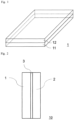
- Fig. 1 is a schematic perspective diagram depicting an example of the positive electrode according to this embodiment.
- a positive electrode 1 includes a current collector 11 and a positive electrode active material layer 12 disposed on the current collector 11.
- the current collector examples include a metal such as copper, stainless steel, aluminum, nickel, or titanium, a composite material formed by surface-processing the surface of copper, stainless steel, or the like with carbon, nickel, titanium, copper, or the like, and a carbon foil.
- a metal such as copper, stainless steel, aluminum, nickel, or titanium
- aluminum and a carbon foil are preferable each as the current collector.
- the bonding force of each of the positive electrode active material layer and the like may be enhanced by forming fine recesses and protrusions on the surface of the current collector.
- the current collector may take each of various forms such as a film, a sheet, a foil, a net, a porous body, a foamed body, and an unwoven cloth body.
- the thickness of the current collector may be, for example, 3 ⁇ m or larger and 500 ⁇ m or
- a known negative electrode only has to be used as the negative electrode constituting the lithium sulfur battery.
- a negative electrode material constituting the negative electrode may be, for example, an Li metal, an Li-Si alloy, an Li-Al alloy, an Li-In alloy, a lithium titanate (such as, for example, Li 4 Ti 5 O) 2 or LiTi 2 O 4 ), a lithium-titanium composite oxide (such as, for example, Li 4 Ti 5-x Mn x O) 2 : 0 ⁇ x ⁇ 0.3), or Li x C (x ⁇ 6).
- These negative electrode materials may each have a portion of lithium thereof substituted with another alkali metal. It is preferred that the negative electrode material be a Li metal, an Li-Si alloy, an Li-Al alloy, an Li-In alloy, Li x C (x ⁇ 6), or the like.
- a high voltage lithium sulfur battery may be obtained by using any of these materials.
- a known material only has to be used for a separator, and examples of the material include, for example, porous polyethylene and porous polypropylene.
- a known separator that is coated may be used.
- the lithium salt may include an anion having therein, for example, elemental fluorine.
- Specific examples of the lithium salt including the anion having therein elemental fluorine include LiPF 6 , LiBF 4 , LiSbF 6 , LiAsF 6 , LiSO 3 CF 3 , and LiN(SO 2 CF 3 ) 2 (LiTFSI).
- the electrolyte may include a lithium salt that does not include any elemental fluorine such as lithium nitrate or LiClO 4 .
- Lithium nitrate may form a film that protects the negative electrode, and is therefore preferable. From these electrolytes, one alone, or two or more in combination may be used.
- the electrolyte may include an organic solvent.
- a carbonate-based solvent, an ether-based solvent, an ester-based solvent, an amide-based solvent, a nitryl-based solvent, or a sulfur-including solvent may be used as the organic solvent, or an organic solvent formed by substituting a part of the elements of any of the above organic solvents with fluorine may be used.
- Fluoroethylene carbonate formed by substituting a part of the elements of a carbonate-based solvent with fluorine is usable as the carbonate-based solvent.
- Fluoroethylene carbonate forms a protective film on the negative electrode and may therefore alleviate any reduction of the cycle capacity retention.
- the organic solvent include, for example, a carbonate-based solvent such as propione carbonate, ethylene carbonate, dimethyl carbonate, or ethyl methyl carbonate, an ether-based solvent such as 1,3-dioxolane, 1,2-dimethoxyethane, 1,3-dimethoxypropane, 2,2,3,3-tetrafluoropropyl difluoromethyl ether, or tetrahydrofuran, an ester-based solvent such as methyl formate, methyl acetate, or ⁇ -butyllactone, an amide-based solvent such as N,N-dimethylacetamide, or N,N-dimethylformamide, and a sulfur-including solvent such as sulfolane, dimethyl sulfoxide, or 1,3-propanesultone. It is preferred that 1,3-dioxolane and 1,2-
- the lithium sulfur battery includes the above positive electrode for lithium sulfur batteries.
- the lithium sulfur battery includes the positive electrode for lithium sulfur batteries, the negative electrode, and the electrolyte disposed between the positive electrode and the negative electrode.
- the lithium sulfur battery may include the separator as necessary.
- Fig. 2 depicts an example of the lithium sulfur battery in this embodiment.
- a lithium sulfur battery 10 includes a positive electrode 1 for lithium sulfur batteries, a negative electrode 2, a separator 3 disposed between the positive electrode 1 for lithium sulfur battery and the negative electrode 2, and an electrolyte.
- the electrolyte is included in the positive electrode 1 for lithium sulfur batteries, the negative electrode 2, and the separator 3.
- Fig. 3 depicts an SEM image of the used porous carbon material.
- Fig. 4 depicts a chart of the pore distribution measured using a mercury porosimeter. It can be seen from Fig. 3 that the porous carbon material is a carbon material having the primary particles thereof aggregated therein to form the secondary particles thereof. It can be seen from the micropore distribution in Fig. 4 that the carbon material is mesoporous carbon whose pore volume ( ⁇ 20 nm) is 0.63 cm 3 /g and whose pore peak diameter is 12 nm. The BET specific surface area of the used porous carbon material was 1,472 m2/g.
- lithium tungstate Li 6 WO 6
- the acquired lithium tungstate was added to NMP to adjust the concentration thereof to be 5% by mass.
- a pulverizing process was applied to the acquired mixture in a bead mill using zirconia beads, and lithium tungstate slurry was thereby acquired.
- Lithium tungstate slurry whose concentration was 13% by mass was prepared in the same manner as that of Example 1.
- a positive electrode composition for Example 2 was acquired in the same manner as that of Example 1 except the fact that 3.0 g of the lithium tungstate slurry whose concentration was 13% by mass was used as the metal slurry.
- a positive electrode composition for Example 3 was acquired in the same manner as that of Example 1 except the fact that 3.0 g of the lithium zirconate slurry whose concentration was 5% by mass was used as the metal slurry.
- lithium carbonate 2.5 g
- 9.0 g of niobium oxide 9 g
- LiNbOs niobium oxide
- the acquired lithium niobate was added to NMP to adjust the concentration thereof to be 5% by mass.
- a pulverizing process was applied to the acquired mixture in a bead mill using zirconia beads, and lithium niobate slurry was thereby acquired.
- a positive electrode composition for Example 4 was acquired in the same manner as that of Example 1 except the fact that 3.0 g of the lithium niobate slurry whose concentration was 5% by mass was used as the metal slurry.
- lithium nickelate Li 2 NiO 2
- the acquired lithium nickelate was added to NMP to adjust the concentration thereof to be 5% by mass.
- a pulverizing process was applied to the acquired mixture in a bead mill using zirconia beads, and lithium nickelate slurry was thereby acquired.
- a positive electrode composition for Example 5 was acquired in the same manner as that of Example 1 except the fact that 3.0 g of the lithium nickelate slurry whose concentration was 5% by mass was used as the metal slurry.
- lithium carbonate and 7.3 g of titanium oxide (TiO 2 ) were mixed with each other and the acquired mixture was thermally processed at 900°C in an atmospheric air, and lithium titanate was thereby acquired.
- the fact that the acquired thermally processed substance was lithium titanate (Li 2 TiO 3 ) was confirmed by the fact that X-ray diffraction measurement was executed under the same conditions as those of Example 1 and the diffraction peak derived from the compound was acquired.
- the acquired lithium titanate was added to NMP to adjust the concentration thereof to be 5% by mass.
- a pulverizing process was applied to the acquired mixture in a bead mill using zirconia beads, and lithium titanate slurry was thereby acquired.
- a positive electrode composition for Example 6 was acquired in the same manner as that of Example 1 except the fact that 3.0 g of the lithium titanate slurry whose concentration was 5% by mass was used as the metal slurry.
- Lithium ferrite (LiFeOs, manufactured by Sigma-Aldrich Co. LLC) was first prepared. The lithium ferrite was added to NMP to adjust the concentration thereof to be 5% by mass. A pulverizing process was applied to the acquired mixture in a bead mill using zirconia beads, and lithium ferrite slurry was thereby acquired.
- a positive electrode composition for Example 7 was acquired in the same manner as that of Example 1 except the fact that 3.0 g of the lithium ferrite slurry whose concentration was 5% by mass was used as the metal slurry.
- a positive electrode composition for Comparative Example 1 was acquired in the same manner as that of Example 1 except the fact that no metal oxide slurry was added.
- a positive electrode composition for Comparative Example 2 was acquired in the same manner as that of Example 1 except the fact that 3.0 g of tungsten oxide slurry whose concentration was 5% by mass prepared using tungsten oxide (WO 3 ) was used instead of the lithium transition metal composite oxide, as the metal oxide slurry.
- the positive electrode compositions acquired in Example 1 to Example 7, Comparative Example 1, and Comparative Example 2 were each applied onto a current collector using a doctor blade having a gap of 240 ⁇ m to be dried, and dried articles were thereby acquired.
- An aluminum foil coated with carbon was used as the current collector.
- the dried articles were each compression-molded using a roll press machine such that the density of the active material layer was 0.63 g/cm 3 , and were thereafter each cut into a predetermined size to thereby acquire a positive electrode.
- Non-aqueous electrolyte was executed as follows. 1,3-dioxolane (DOL) and 1,2-dimethoxyethane (DME) were mixed with each other at the volume ratio of 5:5. Lithium-bis(trifluoromethanesulfonyl)imide (LiTFSI) was dissolved in the acquired mixed solution for the concentration thereof to be 1.0 mol/L. Lithium nitrate (LiNOs) was next dissolved therein for the concentration thereof to be 0.2 mol/L to produce the non-aqueous electrolyte solution.
- DI 1,3-dioxolane
- DME 1,2-dimethoxyethane
- LiTFSI Lithium-bis(trifluoromethanesulfonyl)imide
- LiTFSI Lithium-bis(trifluoromethanesulfonyl)imide
- LiNOs Lithium nitrate
- Electrodes were attached to the positive electrode acquired as above and a separator consisting of porous polypropylene (Celgard 2400) was disposed, and these were accommodated in a bag-like laminate pack. After the accommodation, the laminate pack was vacuum-dried at 50°C to remove any moisture adsorbed to each of the members. After the vacuum-drying, lithium metal of the negative electrode disposed on a SUS foil was disposed in the laminate pack to face the positive electrode through the porous polypropylene. The non-aqueous electrolyte solution was injected into the laminate pack and the laminate pack was sealed to acquire a non-aqueous electrolyte secondary battery of a laminate type as a battery for evaluation. Evaluation of the following battery properties was executed using the acquired battery for evaluation.
- a separator consisting of porous polypropylene (Celgard 2400) was disposed, and these were accommodated in a bag-like laminate pack. After the accommodation, the laminate pack was vacuum-dried at 50°C to remove any moisture adsorbed to each
- the battery for evaluation acquired as above was placed in a constant temperature chamber at 25°C and an evaluation test on the cycle capacity retention was executed.
- the evaluation test was executed for the charging and discharging voltage in the range from 1.8 V to 3.0 V.
- An electric current of a current value used when a capacity of 0.2 C is extracted was caused to flow as the discharging current.
- a discharged capacity Qcyc(1) at the first cycle immediately after the start of discharging was measured.
- Charging and discharging were thereafter repeated and a discharged capacity Qcyc(30) at the thirtieth cycle was measure.
- the battery for evaluation was placed in a constant temperature chamber at 25°C and an evaluation test of the rate ratio was executed.
- the evaluation test was executed for the charging and discharging voltage in the range from 1.8 V to 3.0 V.
- a 1 C discharged capacity was measured using an electric current value of 1 C.
- a 0.2 C discharged capacity was measured using an electric current value of 0.2 C.
- the rate ratio (the 1 C discharged capacity/the 0.2 C discharged capacity) was calculated using the 1 C discharged capacity and the 0.2 C discharged capacity. The result thereof is shown in Table 1.
- the addition rate in the table means the rate of the content of the transition metal oxide to the content of the sulfur-carbon composite.
- the rate ratio was improved in the case where the positive electrode composition for lithium sulfur batteries including the lithium transition metal composite oxide that included W, Zr, or Ni according to each of Example 1 to Example 3 and Example 5 was used.
- the positive electrode compositions for lithium sulfur batteries including Lithium tungstate according to Example 1 and Example 2 the content rate of the lithium transition metal composite oxide to the total amount of the materials including the carbon material and elemental sulfur was 1% by mass or higher and 30% by mass or lower. In any of the above cases, the cycle capacity retention was improved compared to that of the case where the positive electrode composition for lithium sulfur batteries of each of Comparative Examples was used.
- Observation was executed using a scanning electron microscope (SEM) for the positive electrode composition for lithium sulfur batteries of Example 1. The observation was executed using an SEM apparatus manufactured by Hitachi High-Tech Corporation (model: SU5000) and under the condition of the acceleration voltage of 3.0 kV.
- Fig. 5 is an SEM image by observation at a 4,000-times magnification. It is presumed from the contrast of the acquired SEM image that lithium tungstate was included in the white portions.
- An EDX analysis was executed for the positive electrode composition for lithium sulfur batteries produced in Example 1. Charging and discharging were executed for 30 times under the same conditions as those for the above cycle capacity retention for the battery for evaluation including the positive electrode composition for lithium sulfur batteries produced in Example 1, the positive electrode composition for lithium sulfur batteries was taken out from the lithium sulfur battery, and an EDX analysis was executed.
- the EDX analysis was executed using an EDX apparatus manufactured by Bruker (XFlash (a registered trademark) FlatQUAD 5060F) and under the condition of an acceleration voltage of 5 kV. As the result of the EDX analysis, in any of the above cases, presence of each of tungsten and oxygen was recognized in the positive electrode composition. It can therefore be stated based on the SEM observation and the EDX analysis that the lithium transition metal composite oxide was included in the positive electrode composition.
- Fig. 6 is a cross-sectional SEM image of the positive electrode composition for lithium sulfur batteries produced in Example 1. It was confirmed from the acquired SEM image that lithium tungstate was disposed on the surface of the carbon material. It was also confirmed that lithium tungstate was dotted about on the outer surface of the carbon material.
Landscapes
- Chemical & Material Sciences (AREA)
- Chemical Kinetics & Catalysis (AREA)
- Electrochemistry (AREA)
- General Chemical & Material Sciences (AREA)
- Inorganic Chemistry (AREA)
- Engineering & Computer Science (AREA)
- Composite Materials (AREA)
- Manufacturing & Machinery (AREA)
- Materials Engineering (AREA)
- Battery Electrode And Active Subsutance (AREA)
Applications Claiming Priority (2)
| Application Number | Priority Date | Filing Date | Title |
|---|---|---|---|
| JP2020063851 | 2020-03-31 | ||
| PCT/JP2021/013926 WO2021201127A1 (fr) | 2020-03-31 | 2021-03-31 | Composition d'électrode positive destinée à des batteries au lithium-soufre, électrode positive destinée à des batteries au lithium-soufre et batterie au lithium-soufre |
Publications (2)
| Publication Number | Publication Date |
|---|---|
| EP4131481A1 true EP4131481A1 (fr) | 2023-02-08 |
| EP4131481A4 EP4131481A4 (fr) | 2025-07-16 |
Family
ID=77929115
Family Applications (1)
| Application Number | Title | Priority Date | Filing Date |
|---|---|---|---|
| EP21779548.3A Pending EP4131481A4 (fr) | 2020-03-31 | 2021-03-31 | Composition d'électrode positive destinée à des batteries au lithium-soufre, électrode positive destinée à des batteries au lithium-soufre et batterie au lithium-soufre |
Country Status (3)
| Country | Link |
|---|---|
| US (1) | US20230187609A1 (fr) |
| EP (1) | EP4131481A4 (fr) |
| WO (1) | WO2021201127A1 (fr) |
Families Citing this family (4)
| Publication number | Priority date | Publication date | Assignee | Title |
|---|---|---|---|---|
| JP7789619B2 (ja) * | 2022-04-26 | 2025-12-22 | 古河電池株式会社 | リチウム硫黄電池用正極、リチウム硫黄電池及びその充放電方法 |
| JP7546190B1 (ja) * | 2022-10-26 | 2024-09-05 | 三井金属鉱業株式会社 | 金属酸リチウム混合液およびその製造方法 |
| JP7546189B1 (ja) * | 2022-10-26 | 2024-09-05 | 三井金属鉱業株式会社 | タングステン酸リチウム分散液およびその製造方法 |
| WO2024090406A1 (fr) * | 2022-10-26 | 2024-05-02 | 三井金属鉱業株式会社 | Dispersion de niobate de lithium |
Family Cites Families (7)
| Publication number | Priority date | Publication date | Assignee | Title |
|---|---|---|---|---|
| JP2010095390A (ja) | 2008-09-16 | 2010-04-30 | Tokyo Institute Of Technology | メソポーラス炭素複合材料およびこれを用いた二次電池 |
| JP5804557B2 (ja) * | 2010-10-29 | 2015-11-04 | 国立大学法人横浜国立大学 | アルカリ金属−硫黄系二次電池 |
| JP6004274B2 (ja) * | 2012-03-19 | 2016-10-05 | 国立大学法人横浜国立大学 | アルカリ金属−硫黄系二次電池 |
| JP6313491B2 (ja) * | 2016-03-11 | 2018-04-18 | 東京電力ホールディングス株式会社 | 全固体リチウム硫黄電池およびその製造方法 |
| EP3788666A4 (fr) * | 2018-04-30 | 2022-01-19 | Lyten, Inc. | Batterie au lithium-ion et matériaux de batterie |
| GB2577114B (en) * | 2018-09-14 | 2022-04-27 | Johnson Matthey Plc | Battery |
| JP2020063851A (ja) | 2018-10-15 | 2020-04-23 | 東邦瓦斯株式会社 | 熱交換器の異常診断装置 |
-
2021
- 2021-03-31 WO PCT/JP2021/013926 patent/WO2021201127A1/fr not_active Ceased
- 2021-03-31 EP EP21779548.3A patent/EP4131481A4/fr active Pending
- 2021-03-31 US US17/995,303 patent/US20230187609A1/en active Pending
Also Published As
| Publication number | Publication date |
|---|---|
| EP4131481A4 (fr) | 2025-07-16 |
| US20230187609A1 (en) | 2023-06-15 |
| WO2021201127A1 (fr) | 2021-10-07 |
Similar Documents
| Publication | Publication Date | Title |
|---|---|---|
| EP4131481A1 (fr) | Composition d'électrode positive destinée à des batteries au lithium-soufre, électrode positive destinée à des batteries au lithium-soufre et batterie au lithium-soufre | |
| EP3728134B1 (fr) | Matériau d'électrode positive pour batteries lithium-ion rechargeables et ses procédés de production | |
| EP3208872B1 (fr) | Matière active d'électrode positive pour batterie secondaire au lithium, électrode positive pour batterie secondaire au lithium, et batterie secondaire au lithium | |
| KR101787295B1 (ko) | 리튬 이온 배터리를 위한 활성 물질 | |
| CN106463721B (zh) | 锂二次电池用正极活性物质、锂二次电池用正极及锂二次电池 | |
| EP4092783A1 (fr) | Matière active d'électrode positive pour batterie au lithium-ion entièrement solide, électrode, et batterie au lithium-ion entièrement solide | |
| JP7083248B2 (ja) | リチウム二次電池用正極活物質、リチウム二次電池用正極活物質の製造方法、リチウム二次電池用正極及びリチウム二次電池 | |
| EP3556732A1 (fr) | Poudre d'oxyde composite de métal au lithium, matière active d'électrode positive pour batterie secondaire au lithium, électrode positive pour batterie secondaire au lithium, et batterie secondaire au lithium | |
| EP4455080A1 (fr) | Matériau composite phosphore-carbone, méthode de production de matériau composite phosphore-carbone, matériau actif d'électrode négative, électrode négative pour batterie secondaire au lithium, et batterie secondaire au lithium | |
| EP3806204B1 (fr) | Matériau actif d'électrode positive pour batterie secondaire à électrolyte non aqueux et batterie secondaire à électrolyte non aqueux | |
| EP2592050A1 (fr) | Composite, procédé de fabrication de ce composite, matériau actif d'électrode négative comprenant le composite, électrode négative comprenant le matériau actif d'électrode négative et batterie secondaire au lithium le comprenant | |
| EP4723238A2 (fr) | Oxyde composite de métal de transition contenant du lithium, matériau actif d'électrode positive pour batterie secondaire au lithium, matériau actif pour batterie secondaire au lithium, batterie secondaire au lithium, et procédé de fabrication d'oxyde composite de métal de transition contenant du lithium | |
| JP5373355B2 (ja) | 全固体型ポリマー電池用正極、その製造方法および全固体型ポリマー電池 | |
| JP6994990B2 (ja) | リチウム金属複合酸化物粉末、リチウム二次電池用正極活物質、正極及びリチウム二次電池 | |
| CN110050368A (zh) | 锂二次电池用正极活性物质、锂二次电池用正极和锂二次电池 | |
| EP4299514A1 (fr) | Matériau carboné, son procédé de production et substance active d'électrode | |
| WO2013122868A1 (fr) | Composition d'électrode à base de microsphères d'oxyde métallique mésoporeuses et leurs procédés de fabrication | |
| KR20220058498A (ko) | 리튬이차전지용 산화코발트, 이로부터 형성된 리튬이차전지용 리튬코발트산화물, 그 제조방법 및 이를 포함한 양극을 구비한 리튬 이차 전지 | |
| EP3993102A1 (fr) | Matériau actif d'électrode positive pour batteries rechargeables au lithium-ion, son procédé de fabrication et batterie rechargeable au lithium-ion | |
| EP3709397B1 (fr) | Électrode positive pour batterie à électrolyte non aqueux et batterie à électrolyte non aqueux | |
| EP4249437A1 (fr) | Précurseur, matériau actif d'électrode positive pour batterie secondaire au lithium, électrode positive pour batterie secondaire au lithium, et batterie secondaire au lithium | |
| EP4186867A1 (fr) | Méthode de production d'hydroxyde contenant du nickel, méthode de production de matériau actif d'électrode positive pour batteries secondaires au lithium-ion, matériau actif d'électrode positive pour batteries secondaires au lithium-ion et batterie secondaire au lithium-ion | |
| EP4079693A1 (fr) | Poudre d'oxyde composite de lithium-métal, matériau actif d'électrode positive pour batteries rechargeables au lithium, électrode positive pour batteries rechargeables au lithium, et batterie rechargeable au lithium | |
| CN119968717A (zh) | 正电极活性材料以及用于制造正电极活性材料的方法 | |
| EP3264520B1 (fr) | Batterie lithium-air et son procédé de fabrication |
Legal Events
| Date | Code | Title | Description |
|---|---|---|---|
| STAA | Information on the status of an ep patent application or granted ep patent |
Free format text: STATUS: THE INTERNATIONAL PUBLICATION HAS BEEN MADE |
|
| PUAI | Public reference made under article 153(3) epc to a published international application that has entered the european phase |
Free format text: ORIGINAL CODE: 0009012 |
|
| STAA | Information on the status of an ep patent application or granted ep patent |
Free format text: STATUS: REQUEST FOR EXAMINATION WAS MADE |
|
| 17P | Request for examination filed |
Effective date: 20221030 |
|
| AK | Designated contracting states |
Kind code of ref document: A1 Designated state(s): AL AT BE BG CH CY CZ DE DK EE ES FI FR GB GR HR HU IE IS IT LI LT LU LV MC MK MT NL NO PL PT RO RS SE SI SK SM TR |
|
| DAV | Request for validation of the european patent (deleted) | ||
| DAX | Request for extension of the european patent (deleted) | ||
| A4 | Supplementary search report drawn up and despatched |
Effective date: 20250617 |
|
| RIC1 | Information provided on ipc code assigned before grant |
Ipc: H01M 4/136 20100101AFI20250611BHEP Ipc: H01M 4/1397 20100101ALI20250611BHEP Ipc: H01M 4/36 20060101ALI20250611BHEP Ipc: H01M 10/052 20100101ALI20250611BHEP Ipc: H01M 4/38 20060101ALI20250611BHEP Ipc: H01M 4/62 20060101ALI20250611BHEP Ipc: H01M 4/04 20060101ALI20250611BHEP Ipc: H01M 4/485 20100101ALI20250611BHEP Ipc: H01M 4/13 20100101ALI20250611BHEP Ipc: H01M 4/587 20100101ALI20250611BHEP Ipc: H01M 4/525 20100101ALI20250611BHEP Ipc: H01M 10/0525 20100101ALI20250611BHEP Ipc: H01M 4/02 20060101ALI20250611BHEP Ipc: H01M 4/58 20100101ALI20250611BHEP |