EP4134032A1 - Katheter mit array mit geschlossenem regelkreis mit linearem elektrodenteil auf gleicher ebene - Google Patents
Katheter mit array mit geschlossenem regelkreis mit linearem elektrodenteil auf gleicher ebene Download PDFInfo
- Publication number
- EP4134032A1 EP4134032A1 EP22195201.3A EP22195201A EP4134032A1 EP 4134032 A1 EP4134032 A1 EP 4134032A1 EP 22195201 A EP22195201 A EP 22195201A EP 4134032 A1 EP4134032 A1 EP 4134032A1
- Authority
- EP
- European Patent Office
- Prior art keywords
- catheter
- electrode
- distal
- spine
- portions
- Prior art date
- Legal status (The legal status is an assumption and is not a legal conclusion. Google has not performed a legal analysis and makes no representation as to the accuracy of the status listed.)
- Pending
Links
Images







Classifications
-
- A—HUMAN NECESSITIES
- A61—MEDICAL OR VETERINARY SCIENCE; HYGIENE
- A61B—DIAGNOSIS; SURGERY; IDENTIFICATION
- A61B18/00—Surgical instruments, devices or methods for transferring non-mechanical forms of energy to or from the body
- A61B18/04—Surgical instruments, devices or methods for transferring non-mechanical forms of energy to or from the body by heating
- A61B18/12—Surgical instruments, devices or methods for transferring non-mechanical forms of energy to or from the body by heating by passing a current through the tissue to be heated, e.g. high-frequency current
-
- A—HUMAN NECESSITIES
- A61—MEDICAL OR VETERINARY SCIENCE; HYGIENE
- A61B—DIAGNOSIS; SURGERY; IDENTIFICATION
- A61B18/00—Surgical instruments, devices or methods for transferring non-mechanical forms of energy to or from the body
- A61B18/04—Surgical instruments, devices or methods for transferring non-mechanical forms of energy to or from the body by heating
- A61B18/12—Surgical instruments, devices or methods for transferring non-mechanical forms of energy to or from the body by heating by passing a current through the tissue to be heated, e.g. high-frequency current
- A61B18/14—Probes or electrodes therefor
- A61B18/1492—Probes or electrodes therefor having a flexible, catheter-like structure, e.g. for heart ablation
-
- A—HUMAN NECESSITIES
- A61—MEDICAL OR VETERINARY SCIENCE; HYGIENE
- A61B—DIAGNOSIS; SURGERY; IDENTIFICATION
- A61B5/00—Measuring for diagnostic purposes; Identification of persons
- A61B5/24—Detecting, measuring or recording bioelectric or biomagnetic signals of the body or parts thereof
- A61B5/25—Bioelectric electrodes therefor
- A61B5/279—Bioelectric electrodes therefor specially adapted for particular uses
- A61B5/28—Bioelectric electrodes therefor specially adapted for particular uses for electrocardiography [ECG]
- A61B5/283—Invasive
-
- A—HUMAN NECESSITIES
- A61—MEDICAL OR VETERINARY SCIENCE; HYGIENE
- A61B—DIAGNOSIS; SURGERY; IDENTIFICATION
- A61B5/00—Measuring for diagnostic purposes; Identification of persons
- A61B5/24—Detecting, measuring or recording bioelectric or biomagnetic signals of the body or parts thereof
- A61B5/25—Bioelectric electrodes therefor
- A61B5/279—Bioelectric electrodes therefor specially adapted for particular uses
- A61B5/28—Bioelectric electrodes therefor specially adapted for particular uses for electrocardiography [ECG]
- A61B5/283—Invasive
- A61B5/287—Holders for multiple electrodes, e.g. electrode catheters for electrophysiological study [EPS]
-
- A—HUMAN NECESSITIES
- A61—MEDICAL OR VETERINARY SCIENCE; HYGIENE
- A61B—DIAGNOSIS; SURGERY; IDENTIFICATION
- A61B5/00—Measuring for diagnostic purposes; Identification of persons
- A61B5/68—Arrangements of detecting, measuring or recording means, e.g. sensors, in relation to patient
- A61B5/6846—Arrangements of detecting, measuring or recording means, e.g. sensors, in relation to patient specially adapted to be brought in contact with an internal body part, i.e. invasive
- A61B5/6847—Arrangements of detecting, measuring or recording means, e.g. sensors, in relation to patient specially adapted to be brought in contact with an internal body part, i.e. invasive mounted on an invasive device
- A61B5/6852—Catheters
-
- A—HUMAN NECESSITIES
- A61—MEDICAL OR VETERINARY SCIENCE; HYGIENE
- A61B—DIAGNOSIS; SURGERY; IDENTIFICATION
- A61B5/00—Measuring for diagnostic purposes; Identification of persons
- A61B5/68—Arrangements of detecting, measuring or recording means, e.g. sensors, in relation to patient
- A61B5/6846—Arrangements of detecting, measuring or recording means, e.g. sensors, in relation to patient specially adapted to be brought in contact with an internal body part, i.e. invasive
- A61B5/6847—Arrangements of detecting, measuring or recording means, e.g. sensors, in relation to patient specially adapted to be brought in contact with an internal body part, i.e. invasive mounted on an invasive device
- A61B5/6852—Catheters
- A61B5/6859—Catheters with multiple distal splines
-
- A—HUMAN NECESSITIES
- A61—MEDICAL OR VETERINARY SCIENCE; HYGIENE
- A61B—DIAGNOSIS; SURGERY; IDENTIFICATION
- A61B18/00—Surgical instruments, devices or methods for transferring non-mechanical forms of energy to or from the body
- A61B2018/00053—Mechanical features of the instrument of device
- A61B2018/0016—Energy applicators arranged in a two- or three dimensional array
-
- A—HUMAN NECESSITIES
- A61—MEDICAL OR VETERINARY SCIENCE; HYGIENE
- A61B—DIAGNOSIS; SURGERY; IDENTIFICATION
- A61B18/00—Surgical instruments, devices or methods for transferring non-mechanical forms of energy to or from the body
- A61B2018/00053—Mechanical features of the instrument of device
- A61B2018/00214—Expandable means emitting energy, e.g. by elements carried thereon
- A61B2018/00267—Expandable means emitting energy, e.g. by elements carried thereon having a basket shaped structure
-
- A—HUMAN NECESSITIES
- A61—MEDICAL OR VETERINARY SCIENCE; HYGIENE
- A61B—DIAGNOSIS; SURGERY; IDENTIFICATION
- A61B18/00—Surgical instruments, devices or methods for transferring non-mechanical forms of energy to or from the body
- A61B2018/00315—Surgical instruments, devices or methods for transferring non-mechanical forms of energy to or from the body for treatment of particular body parts
- A61B2018/00345—Vascular system
-
- A—HUMAN NECESSITIES
- A61—MEDICAL OR VETERINARY SCIENCE; HYGIENE
- A61B—DIAGNOSIS; SURGERY; IDENTIFICATION
- A61B18/00—Surgical instruments, devices or methods for transferring non-mechanical forms of energy to or from the body
- A61B2018/00571—Surgical instruments, devices or methods for transferring non-mechanical forms of energy to or from the body for achieving a particular surgical effect
- A61B2018/00577—Ablation
-
- A—HUMAN NECESSITIES
- A61—MEDICAL OR VETERINARY SCIENCE; HYGIENE
- A61B—DIAGNOSIS; SURGERY; IDENTIFICATION
- A61B18/00—Surgical instruments, devices or methods for transferring non-mechanical forms of energy to or from the body
- A61B18/04—Surgical instruments, devices or methods for transferring non-mechanical forms of energy to or from the body by heating
- A61B18/12—Surgical instruments, devices or methods for transferring non-mechanical forms of energy to or from the body by heating by passing a current through the tissue to be heated, e.g. high-frequency current
- A61B18/14—Probes or electrodes therefor
- A61B2018/1405—Electrodes having a specific shape
- A61B2018/1407—Loop
Definitions
- This invention relates to catheters, in particular, intravascular catheters for tissue diagnostics and ablation.
- Cardiac arrhythmia such as atrial fibrillation, occurs when regions of cardiac tissue abnormally conduct electric signals to adjacent tissue, thereby disrupting the normal cardiac cycle and causing asynchronous rhythm.
- Important sources of undesired signals are located in the tissue region, for example, one of the atria or one of the ventricles. Regardless of the sources, unwanted signals are conducted elsewhere through heart tissue where they can initiate or continue arrhythmia.
- Procedures for treating arrhythmia include surgically disrupting the origin of the signals causing the arrhythmia, as well as disrupting the conducting pathway for such signals. More recently, it has been found that by mapping the electrical properties of the endocardium and the heart volume, and selectively ablating cardiac tissue by application of energy, it is possible to cease or modify the propagation of unwanted electrical signals from one portion of the heart to another. The ablation process destroys the unwanted electrical pathways by formation of non-conducting lesions.
- a mapping catheter For greater mapping resolution, it is desirable for a mapping catheter to provide very high density signal maps through the use of a multitude of electrodes sensing electrical activity within a small area, for example, about a square centimeter. For mapping within an atria or a ventricle (for example, an apex of a ventricle), it is desirable for a catheter to collect larger amounts of data signals within shorter time spans. It is also desirable for such a catheter to be adaptable to different tissue surfaces, for example, flat, curved, irregular or nonplanar surface tissue, yet remain in a predetermined configuration where electrode spatial relationships are generally maintained during sensing and mapping.
- the catheter of the present invention is intended to enable high density mapping and/or ablation of tissue surface, with a distal electrode array having a plurality of closed spine loops that are laterally offset from each other.
- the spine loops have electrode-carrying main portions and distal connecting portions, where the electrode-carrying main portions are arranged in a common plane ("in-plane"), with a predetermined configuration that is generally maintained by the distal connecting portions which are off-plane and noninterfering with the in-plane arrangement of the electrode-carrying portions.
- the in-plane arrangement of the spine loops maximizes electrode-to-tissue contact for high density mapping signals while the predetermined configuration provides greater regularity, consistency and predictability in electrode placement on the tissue surface.
- the predetermined configuration includes one or more spatial relationships between adjacent spine loops and/or adjacent electrodes on adjacent spine loops.
- the electrode-carrying main portions of the spine loops may be linear and parallel to each other such that a consistent spacing is provided and maintained between adjacent electrodes during use of the catheter for electrophysiologic procedures, including, pacing, ECG reading, and the like).
- the catheter includes an elongated catheter body and a distal electrode array comprising a plurality of offset spine loops, with each spine loop having at least a pair of electrode-carrying portions and a distal portion connecting the pair of electrode-carrying portions, wherein the electrode-carrying portions of the offset spine loops are arranged in-plane in a single common plane, and the distal portions of the offset spine loops are arranged off-plane from the single common plane.
- the electrode-carrying portions of the offset spine loops are linear.
- the electrode-carrying portions of the offset spine loops may be parallel to each other.
- the distal portions may be nonlinear, for example, curved or angularly shaped with corners.
- the offset configuration of the spine loops includes at least one electrode-carrying portion of each spine loop being positioned between electrode-carrying portions of one or more different spine loops.
- the offset configuration of the spine loops includes the pair of electrode-carrying portions of each spine loop being separated therebetween by at least an electrode-carrying portion of a different spine loop.
- the distal portions of adjacent spine loops are angled oppositely off-plane from each other so as to remain noninterfering with the in-plane arrangement of the electrode-carrying portions.
- the catheter includes an elongated catheter body, a distal electrode array comprising a plurality of offset spine loops, with each spine loop having at least a pair of linear portions and a distal portion connecting the pair of linear portions, wherein the linear portions of the offset spine loops are arranged in-plane in a single common plane, and the distal portions of the plurality of offset spine loops are arranged off-plane from the single common plane.
- the linear portions of the offset spine loops are parallel to each other and the distal portions are nonlinear.
- the offset arrangement of the spine loops includes at least one linear portion of each spine loop being positioned between linear portions of one or more different spine loops.
- the offset arrangement of the spine loops includes the pair of linear portions of each spine loop being separated therebetween by at least a linear portion of a different spine loop.
- the distal portions of adjacent spine loops are angled oppositely off-plane from each other.
- a catheter of the present invention may also include one or more space members extending between at least two adjacent linear portions to help maintain the predetermined configuration and/or spatial relationship(s).
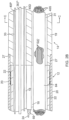
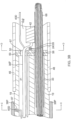
- the catheter 10 comprises an elongated catheter body 12, an intermediate deflection section 14, a distal electrode assembly or array 15, and a deflection control handle 16 attached to the proximal end of the catheter body 12.
- the distal electrode array 15 has a plurality of closed offset spine loops 17 whose electrode-carrying portions lie within a common plane.
- the catheter body 12 comprises an elongated tubular construction having a single, axial or central lumen 18.
- the catheter body 12 is flexible, i.e., bendable, but substantially non-compressible along its length.
- the catheter body 12 can be of any suitable construction and made of any suitable material.
- the catheter body 12 comprises an outer wall 20 made of polyurethane or PEBAX.
- the outer wall 20 comprises an imbedded braided mesh of stainless steel or the like to increase torsional stiffness of the catheter body 12 so that, when the control handle 16 is rotated, the intermediate section 14 of the catheter 10 rotates in a corresponding manner.
- the outer diameter of the catheter body 12 is not critical. Likewise, the thickness of the outer wall 20 is not critical, but is thin enough so that the central lumen 18 can accommodate a puller wire, one or more lead wires, and any other desired wires, cables or tubes. If desired, the inner surface of the outer wall 20 is lined with a stiffening tube 22 to provide improved torsional stability..
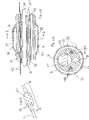
- the intermediate section 14 comprises a shorter section of tubing 19 having multiple lumens, for example, four off-axis lumens 31, 32, 33 and 34.
- the first lumen 31 carries a plurality of lead wires 40S for ring electrodes 37 carried on the spine loops 17.
- the second lumen 32 carries a first puller wire 24.
- the third lumen 33 carries a cable 36 for an electromagnetic position sensor 42 and a plurality of lead wires 40D and 40P for distal and proximal ring electrodes 38D and 38P carried on the catheter proximally of the distal electrode array 15.
- the fourth lumen 34 (for example, diametrically opposite of the second lumen 32 in the illustrated embodiment) carries a second puller wire 26.
- the tubing 19 is made of a suitable nontoxic material that is preferably more flexible than the catheter body 12.
- One suitable material for the tubing 19 is braided polyurethane, i.e., polyurethane with an embedded mesh of braided stainless steel or the like.
- the size of each lumen is not critical, but is sufficient to house the lead wires, puller wires, the cable and any other components.
- the useful length of the catheter i.e., that portion that can be inserted into the body excluding the distal electrode array 15, can vary as desired. Preferably the useful length ranges from about 110 cm to about 120 cm.
- the length of the intermediate section 14 is a relatively smaller portion of the useful length, and preferably ranges from about 3.5 cm to about 10 cm, more preferably from about 5 cm to about 6.5 cm.
- FIGS. 2A and 2B A means for attaching the catheter body 12 to the intermediate section 14 is illustrated in FIGS. 2A and 2B .
- the proximal end of the intermediate section 14 comprises an outer circumferential notch 27 that receives the inner surface of the catheter body 12.
- the intermediate section 14 and catheter body 12 are attached by glue or the like.
- a spacer (not shown) can be located within the catheter body between the distal end of the stiffening tube (if provided) and the proximal end of the intermediate section.
- the spacer provides a transition in flexibility at the junction of the catheter body and intermediate section, which allows this junction to bend smoothly without folding or kinking.
- a catheter having such a spacer is described in U.S. Pat. No. 5,964,757 , the disclosure of which is incorporated herein by reference.
- the distal electrode array 15 includes a mounting stem 46 in the form of a short tubing mounted on a distal end of the tubing 19 of the intermediate deflection section 14. (In that regard, it is understood that where the catheter 10 is without a deflection section 14, the mounting stem 46 is mounted on a distal end of the catheter body 12.)
- the stem 46 has a central lumen 48 to house various components.
- the intermediate section 14 and stem 46 are attached by glue or the like.
- the stem 46 may be constructed of any suitable material, including nitinol.
- the stem 46 houses various components, including the electromagnetic position sensor 42, and a distal anchor for the puller wires 24 and 26.
- the distal anchor includes one or more washers, for example, a distal washer 50D and a proximal washer 50P, each of which has a plurality of matching axial through-holes that allow passage of components between the deflection section 14 and the stem 46 while maintaining axial alignment of these components relative to the longitudinal axis 95 of the catheter 10.
- the through-holes include holes 54 and 56 that are axially aligned with the second and fourth lumens 32 and 34 of the tubing 19, respectively, to receive a distal end of puller wires 24 and 26, respectively.
- the puller wires 24 and 26 may form a single tensile member with a distal U-bend section that passes through the holes 54 and 56. With tension on the washers 50D and 50P exerted by the U-bend section of the puller wires 24 and 26, the washers firmly and fixedly abut against the distal end of the tubing 19 of the deflection section 14 to distally anchor the U-bend section.
- each washer also includes through-hole 58 which is axially aligned with the first lumen 31 and allows passage of the lead wires 40S from the deflection section 14 and into the lumen 48 of the stem 46.
- Each washer further includes through-hole 57 which is axially aligned with the third lumen 33 of the tubing 19 and allows passage of the sensor cable 36 from the deflection section 14 into lumen 48 of the stem 46 where the electromagnetic position sensor 42 is housed.
- the lead wire 40D also passes through the hole 57 to enter the lumen 48 for attachment to the distal ring electrode 38D carried on the outer surface of the stem 46 via an opening (not shown) formed in the side wall of the stem 46 through which a distal end of the lead wire 40D is welded or otherwise attached to the distal ring electrode 38D as known in the art.
- a proximal ring electrode 38P Carried on the outer surface of the tubing 19 near the distal end of the intermediate deflection section 14, a proximal ring electrode 38P is connected to lead wire 40P via an opening 87 ( FIG. 3B ) formed in the side wall of the tubing 19 that provides communication between the third lumen 33 and outside of the tubing 19.
- the distal end of the lead wire is welded or otherwise attached to the proximal ring electrode 38P as known in the art.
- each spine loop has a non-conductive covering 64 that extends the exposed length of each spine loop.
- the non-conductive covering 64 of each spine may be sealed at its proximal end to the stem 46 by the polyurethane 67 or the like.
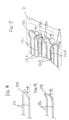
- each spine loop 17 has a distal nonlinear connecting portion 17D, a pair of linear main electrode-carrying portions 17L, and a pair of linear proximal support portions 17P that converge into the stem 46.
- all linear main portions e.g., 17L1, 17L2, 17L3 and 17L4 in the array 15 lie within a common plane P ("in-plane") so as to maximum electrode-to-tissue contact.
- the linear main portions 17L are arranged in a predetermined configuration within the common plane P, defined by one or more predetermined spatial relationships with each other, as maintained by the distal portions 17D of the loops which connect corresponding pairs of main portions 17L at their distal ends.
- the distal portions 17D are angled out of the common plane P ("off-plane") so that the distal portions 17D are free from contact with each other and are thus noninterfering with the linear main portions 17L remaining in-plane.
- the distal portions 17D are nonlinear, and may assume any curved or angular shape, for example, triangular ( FIG. 8 ) or rectangular ( FIG. 9 ).
- a first distal portion 17D1 is angled out of plane in one direction (e.g., upwardly) and a second distal portion 17D2 is angled out of plane in an opposite direction (e.g., downwardly).
- a third spine loop 17D3 is angled out of plane in the one direction (e.g., upwardly) and a fourth spine loop 17D4 is angled out of plane in the opposite direction (e.g., downwardly).
- adjacent pair distal portions 17D1 and 17D2 are angled oppositely of each other, as well as adjacent pair distal portions 17D2 and 17D3, and similarly adjacent pair distal portions 17D3 and 17D4.
- the off-plane angle ⁇ may range between about 1 and 45 degrees from the common plane, and preferably between about 5 and 20 degrees, and more preferably be about 10 degrees.
- the spine loops 17 are in a laterally offset arrangement where at least one linear main portion 17L of each spine loop is positioned between linear main portions 17L of one or more different spine loop. Or, in other words, each pair of linear main portions 17L of a spine loop is separated therebetweenby at least a linear main portion 17L of a different spine loop.
- the array 15 is able to provide greater electrode density yet remain of a more simplistic construction where the electrode-carrying linear main portions 17L of each spine loop extend in-plane as supported by the noninterfering distal portions 17D.
- the spine loops are laterally offset.
- at least one linear portion 17L1 is positioned between linear portions 17L2.
- the pair of linear portions 17L3 is separated therebetween by the linear portion 17L4.
- Predetermined configuration within the common plane P may include one or more predetermined spatial relationships between the spine loops or portions thereof.
- One or more spatial relationships may be defined by spacing S between adjacent linear main portions 17L along the length of the array, for example, proximal spacing SP and distal spacing SD, as shown in FIG. 5 .
- Predetermined spatial relationships may also include predetermined spacing d between the ring electrodes 37 carried on the linear main portions 17L.
- the linear main portions 17L are parallel with each other such that proximal spacings SPi and distal spacings SDi are equal between pairs of adjacent linear main portions 17L.
- the array 15 is configured to support the electrodes in a grid-like pattern, as shown in FIG. 5 . It is understood that the spacings SPi and SDi may be varied throughout the array, as desired or appropriate, to provide different configurations.
- the proximal portions 17P of the spine loops can be configured, as desired or appropriate, to support the linear main portions 17L in-plane, for example, in equi-angular distribution around a center of the stem.
- the four proximal portions 17P are potted in four quadrants about the center longitudinal axis 46A of the stem 46.
- the plurality of loops may range between about 2 and 4.
- Each spine loop may have a exposed linear length ranging between about 5 and 50 mm, preferably about 10 and 35 mm, and more preferably about 28 mm.
- the array may have dimensions of about 1.5 cm x 1.0 cm
- the spacing SP and SD between adjacent linear main portions 17L each may range between about 1mm and 20 mm, preferably about 2 and 10 mm, and more preferably about 4 mm.
- the spacing d between electrodes ranges between about 0.5mm - 12mm.
- the surface area of the array 15 may range between about 1.5 cm 2 to 3.0 cm 2 , preferably between about 1.9 cm 2 and 2.5 cm 2 , and more preferably about 2.2 cm 2
- each spine loop 17 has an elongated shape-memory support member 62 extending through the length of the loop. A proximal portion of each member 62 extends into a distal end portion of the stem 46 and is anchored in the lumen 48 of the stem 46.
- Each spine loop 17 has a nonconductive tubing or covering 64 that covers the shape-memory member 62 and the plurality of ring electrode 37 carried on each linear main portion 17L may range between about 6 and 12, preferably about 6 and 9, and more preferably about 8.
- the distal electrode array 15 carries a plurality of electrodes ranging between about 20 and 72, preferably between about 28 and 36 electrodes, and more preferably about 32 electrodes. In some embodiments, the electrode density is about 15 electrodes per square centimeter and dimensions of about 12mm x 18mm.
- the shape-support support member 62 is made of a material having shape-memory, i.e., that can be temporarily straightened or bent out of its original shape upon exertion of a force and is capable of substantially returning to its original shape in the absence or removal of the force.
- One suitable material for the support member is a nickel/titanium alloy. Such alloys typically comprise about 55% nickel and 45% titanium, but may comprise from about 54% to about 57% nickel with the balance being titanium.
- a nickel/titanium alloy is nitinol, which has excellent shape memory, together with ductility, strength, corrosion resistance, electrical resistivity and temperature stability.
- the non-conductive covering 64 can be made of any suitable material, and is preferably made of a biocompatible plastic such as polyurethane or PEBAX. If desired, the support member 62 can be eliminated and the distal end of the non-conductive covering 64 can be pre-formed to have the desired curvature or configuration.
- Each shape-memory support member 62 extending through its respective nonconductive covering 64 has a proximal end that is received and anchored in the stem 46 by polyurethane 67 or the like.
- Lead wires 40S for the spine electrodes 37 extend through a protective polytube 68, as shown in FIG. 4 .
- the lead wires 40S diverge at the distal end of the polytube 68, and extend toward their respective shape-memory support member 62, into their respective nonconductive covering 64 of their respective spines. As shown in FIG.
- each lead wire 40S is connected to its respective ring electrode 37 on the spine loop 17 via a respective opening 69 formed in the side wall of the covering 64 through which a distal end of the lead wire reaches outside of the covering 64 and is welded or otherwise attached to its ring electrode 37.
- irrigated ring electrodes 371 are carried on the spine loops 17, as shown in FIGS. 6, 6A and 6B .
- the spines forming the loops 17 include a multi-lumened tubing 80 having, for example, multiple lumens, including a first lumen 81 for the shape-memory member 62, a second lumen 82 for lead wires 40S, and a third lumen 83 for passing irrigation fluid via a passage 88 formed in the sidewall of the tubing 80 to annular space gap G between outer wall of the tubing 80 and side wall of the ring electrode 371 which are formed with fluid ports 85.
- a fourth lumen 84 may be provided to pass cable 36D for distal electromagnetic position sensor 42D (not shown).
- the proximal ends of the lead wires 40S, 40D and 40P for the spine loop ring electrodes 37 and for the distal and proximal ring electrodes 38D and 38P, respectively, are electrically connected to a suitable connector (not shown) in the distal end of the control handle 16, which is connected to a source of ablation energy, e.g., RF energy, as is known in the art.
- the lead wires 40S, 40D and 40P extend through the central lumen 18 of the catheter body 12 ( FIG. 2B ).
- the lead wires 40S extend through the first lumen 31 of the tubing 19 of the intermediate section 14, and the lead wires 40D and 40P extend through the third lumen 33 of the tubing 19 ( FIGS. 2C and 3C ). Passing through the holes 58 in the washers 50D and 50P, the lead wires 40S extend through the polytube 68 which protects them from being damaged by the hole 58 ( FIGS. 3D and 4 ).
- the lead wires 40S extending through the central lumen 18 of the catheter body 12 and the first lumen 31 in the deflection section 14 may be enclosed within a protective sheath 94 to prevent contact with other components in the catheter.
- the protective sheath can be made of any suitable material, preferably polyimide. As would be recognized by one skilled in the art, the protective sheath can be eliminated if desired.
- the ring electrodes 37, 371 and 38D and 38P can be made of any suitable solid conductive material, such as platinum or gold, preferably a combination of platinum and iridium, and mounted onto the non-conductive cover 64, the stem 46 and or the tubing 19 with glue or the like.
- the ring electrodes can be formed by coating the non-conductive cover 64, the stem 46 and/or the tubing 19 with an electrically conducting material, like platinum, gold and/or iridium. The coating can be applied using sputtering, ion beam deposition or an equivalent technique.
- each ring electrode is relatively short, having a length ranging from about 0.4 mm to about 0.75 mm.
- the electrodes may also be arranged in pairs, where two electrodes of a pair are spaced more closely to each other than they are to other pairs of electrodes.
- the closely-spaced electrode pairs allow for more accurate detection of near field pulmonary vein potential versus far field atrial signals, which is very useful when trying to treat atrial fibrillation.
- the near field pulmonary vein potentials are very small signals whereas the atria, located very close to the pulmonary vein, provides much larger signals.
- Closely-spaced bipole electrodes permit the physician to more accurately determine whether he is looking at a close signal or a far signal. Accordingly, by having closely-spaced electrodes, one is able to target exactly the locations of myocardial tissue that have pulmonary vein potentials and therefore allows the clinician to deliver therapy to the specific tissue. Moreover, the closely-spaced electrodes allow the physician to determine the exact anatomical location of the ostium/ostia by the electrical signal.
- the proximal electromagnetic position sensor 42P is housed in the lumen of the stem ( FIG. 4 ).
- a sensor cable 36P extends from a proximal end of the position sensor 42P, and through the hole 57 of the washers 50 ( FIG. 3D ), the third lumen 33 of the tubing 19 of the deflection section 14 ( FIG. 2C ), and the central lumen 18 of the catheter body 12 ( FIG. 2B ).
- the cable 36P is attached to a PC board in the control handle 16, as known in the art.
- one or more distal electromagnetic position sensors may be housed in the array, for example, in one or more distal portions of the array.
- Sensor cables 36D may extend through the spine covering 64 ( FIG. 5C ) or the lumen 84 of the tubing 80 ( FIG. 6B ).
- the puller wires 24 and 26 (whether as two separate tensile members or parts of a single tensile member) are provided for bi-directional deflection of the intermediate section 14.
- the puller wires 24 and 26 are actuated by mechanisms in the control handle 16 that are responsive to a thumb control knob or a deflection control knob 11.
- Suitable control handles are disclosed in U.S. Patent Nos. 6,123,699 ; 6,171,277 ; 6,183,435 ; 6,183,463 ; 6,198,974 ; 6,210,407 and 6,267,746 , the entire disclosures of which are incorporated herein by reference.
- the puller wires 24 and 26 extend through the central lumen 18 of the catheter body 12 ( FIG. 2A ) and through the second and fourth lumens 32 and 34, respectively, of the tubing 19 of the deflection section 14 ( FIG. 2C ). As shown in FIGS. 3A and 3C , they extend through holes 54 and 56, respectively of the washers 50.
- the puller wires are part of a single tensile member
- the single tensile member has a U-bend 24/26U ( FIG. 3A ) at the distal face of the distal washer 50D which anchors the distal ends of the puller wires.
- the U-bend extends through a short protective tubing 70 to protect the puller wires from the holes 54 and 56.
- the puller wires are separate tensile members, their distal ends may be anchored via T-bars, as known in the art and described in, for example, U.S. Patent No. 8,603,069 , the entire content of which is incorporated herein by reference.
- the puller wires 24 and 26 are made of any suitable metal, such as stainless steel or Nitinol, and each is preferably coated with TEFLON or the like. The coating imparts lubricity to the puller wires.
- the puller wires preferably have a diameter ranging from about 0.006 to about 0.010 inch.
- a compression coil 66 is situated within the central lumen 18 of the catheter body 12 in surrounding relation to each puller wire 24, as shown in FIG. 2B .
- Each compression coil 66 extends from the proximal end of the catheter body 12 to the proximal end of the intermediate section 14.
- the compression coils 66 are made of any suitable metal, preferably stainless steel.
- Each compression coil 66 is tightly wound on itself to provide flexibility, i.e., bending, but to resist compression.
- the inner diameter of the compression coil 66 is preferably slightly larger than the diameter of its puller wire.
- the Teflon coating on each puller wire allows it to slide freely within its compression coil.
- the compression coil 66 is anchored at its proximal end to the outer wall 20 of the catheter body 12 by a proximal glue joint (not shown) and at its distal end to the intermediate section 14 by a distal glue joint 92.
- Both glue joints may comprise polyurethane glue or the like.
- the glue may be applied by means of a syringe or the like through a hole made the sidewalls of the catheter body 12 and the tubing 19. Such a hole may be formed, for example, by a needle or the like that punctures the sidewalls which are heated sufficiently to form a permanent hole.
- the glue is then introduced through the hole to the outer surface of the compression coil 66 and wicks around the outer circumference to form a glue joint about the entire circumference of the compression coil.
- each puller wire 24 and 26 extends through a plastic, preferably Teflon, puller wire sheath 39 ( FIGS. 2A and 2C ), which prevents the puller wires from cutting into the sidewall of the tubing 19 of the deflection section 14 when the deflection section 14 is deflected.
- a suitable guiding sheath (not shown) is inserted into the patient with its distal end positioned at or near a desired tissue location for diagnostics such as mapping and/or treatment such as ablation.
- An example of a suitable guiding sheath for use in connection with the present invention is the Preface Braided Guiding Sheath, commercially available from Biosense Webster, Inc. (Diamond Bar, Calif.).
- the catheter 10 is passed through the guiding sheath and advanced therethrough to the desired tissue location.
- the spine loops 17 of the distal electrode array 15 fed into the proximal end of the guiding sheath.
- the guiding sheath is pulled proximally, exposing at least the array.
- the linear main portions 17L of the spine loops extend generally in a common plane, as shown in FIG. 5 , as supported by the noninterfering angled distal portions 17D.
- the distal portions 17D connecting the linear main portions 17L prevent the latter from spreading, diverging and/or going out of plane.
- the array 15 has a first side and a second side.
- the user places the first side against the tissue surface, with at least the intermediate section 14 (if not also a distal portion of the catheter body 12) generally perpendicular to the tissue surface, and actuates the control handle to deflect the intermediate deflection section 14 (arrow D) such that the first side deflects toward the catheter, which drags the first side of the linear main portions 17L across the tissue surface as the section 14 is deflecting.
- the linear main portions 17L are dragged across the tissue surface while remaining generally parallel to each other (as maintained by the distal portions 17D) along tracks T which are generally linear and parallel, and in the same direction as the deflection direction D.
- the user actuates the control handle to deflect the section 14 along direction D with the first surface of the array 15 deflected toward the catheter.
- the user positions at least the distal portion of the catheter body 12 generally parallel with the tissue surface and places the second surface of the array 15 against the tissue surface.
- the user then releases the deflection (along opposite direction R) which drags the second surface of the linear main portions 17L across the tissue surface as the deflection section 14 straightens.
- the linear main portions 17L are dragged across the tissue surface while remaining generally parallel to each other (as maintained by the distal portions 17D) along tracks T which are generally linear and parallel, and in the direction R opposite to the deflection direction D.
- the spine electrodes 37 are carried in-plane on the linear main portions 17L for maximizing contact with the tissue surface while the linear main portions 17L generally maintain a consistent separation spacing from each other as the spine loops are dragged across the tissue surface for high density electrode sensing and uniform and predictable mapping.
- the linear main portions 17L are less prone to overlap and the electrodes 37 are less susceptible to "cross talk" or electromagnetic interference that can arise when two electrodes are in overly close proximity or contact.
- the array has an "n x m" electrode layout or arrangement, for example, four spines, with eight electrodes on each spine, for a total of 32 closely-spaced ring electrodes 37 for mapping.
- the distal electrode array 15 includes a spacer member 86, e.g., a bar or bracket that extends between at least two spines to mechanically restrain them and keep them in a predetermined spatial relationship.
- the spacer member can be configured to restrain movement in one or more directions while allowing movement in other directions.
- the spacer member 86 extends between linear portions 17L, fixed at their ends to the linear portions 17L by adhesive, e.g. polyurethane, although it is understand that the spacer member may extend between any two or more of the same and/or different portions of the spine loops 17, as desired or appropriate. Regions of the spine loops may also be heat bonded or melted together as desired or appropriate.
- the ring electrodes 38D and 38P proximal of the array 15 serve as reference electrodes for visualization of the catheter on a 3-D mapping system, such as CARTO.RTM 3 SYSTEM available from Biosense Webster, Inc., which automatically locates the EM sensor 42, processes reference location values from electrodes 38D and 38P, which are at a constant location from the EM sensor(s) and determines the location of the electrodes 37 and 371 and visualizes the remainder of the electrode array 15.
- a 3-D mapping system such as CARTO.RTM 3 SYSTEM available from Biosense Webster, Inc.
Landscapes
- Health & Medical Sciences (AREA)
- Life Sciences & Earth Sciences (AREA)
- Surgery (AREA)
- Engineering & Computer Science (AREA)
- Veterinary Medicine (AREA)
- General Health & Medical Sciences (AREA)
- Physics & Mathematics (AREA)
- Public Health (AREA)
- Biomedical Technology (AREA)
- Heart & Thoracic Surgery (AREA)
- Medical Informatics (AREA)
- Molecular Biology (AREA)
- Animal Behavior & Ethology (AREA)
- Biophysics (AREA)
- Pathology (AREA)
- Cardiology (AREA)
- Otolaryngology (AREA)
- Plasma & Fusion (AREA)
- Nuclear Medicine, Radiotherapy & Molecular Imaging (AREA)
- Physiology (AREA)
- Measurement And Recording Of Electrical Phenomena And Electrical Characteristics Of The Living Body (AREA)
- Surgical Instruments (AREA)
- Media Introduction/Drainage Providing Device (AREA)
Applications Claiming Priority (3)
| Application Number | Priority Date | Filing Date | Title |
|---|---|---|---|
| US14/754,553 US10537259B2 (en) | 2015-06-29 | 2015-06-29 | Catheter having closed loop array with in-plane linear electrode portion |
| EP16176598.7A EP3111872B1 (de) | 2015-06-29 | 2016-06-28 | Katheter mit array mit geschlossenen schleifen mit geraden elektrodenteilen auf gleicher ebene |
| EP18166678.5A EP3363397B1 (de) | 2015-06-29 | 2016-06-28 | Katheter mit array mit geschlossenem regelkreis mit linearem elektrodenteil auf gleicher ebene |
Related Parent Applications (2)
| Application Number | Title | Priority Date | Filing Date |
|---|---|---|---|
| EP16176598.7A Division EP3111872B1 (de) | 2015-06-29 | 2016-06-28 | Katheter mit array mit geschlossenen schleifen mit geraden elektrodenteilen auf gleicher ebene |
| EP18166678.5A Division EP3363397B1 (de) | 2015-06-29 | 2016-06-28 | Katheter mit array mit geschlossenem regelkreis mit linearem elektrodenteil auf gleicher ebene |
Publications (1)
| Publication Number | Publication Date |
|---|---|
| EP4134032A1 true EP4134032A1 (de) | 2023-02-15 |
Family
ID=56289355
Family Applications (3)
| Application Number | Title | Priority Date | Filing Date |
|---|---|---|---|
| EP22195201.3A Pending EP4134032A1 (de) | 2015-06-29 | 2016-06-28 | Katheter mit array mit geschlossenem regelkreis mit linearem elektrodenteil auf gleicher ebene |
| EP16176598.7A Active EP3111872B1 (de) | 2015-06-29 | 2016-06-28 | Katheter mit array mit geschlossenen schleifen mit geraden elektrodenteilen auf gleicher ebene |
| EP18166678.5A Active EP3363397B1 (de) | 2015-06-29 | 2016-06-28 | Katheter mit array mit geschlossenem regelkreis mit linearem elektrodenteil auf gleicher ebene |
Family Applications After (2)
| Application Number | Title | Priority Date | Filing Date |
|---|---|---|---|
| EP16176598.7A Active EP3111872B1 (de) | 2015-06-29 | 2016-06-28 | Katheter mit array mit geschlossenen schleifen mit geraden elektrodenteilen auf gleicher ebene |
| EP18166678.5A Active EP3363397B1 (de) | 2015-06-29 | 2016-06-28 | Katheter mit array mit geschlossenem regelkreis mit linearem elektrodenteil auf gleicher ebene |
Country Status (8)
| Country | Link |
|---|---|
| US (5) | US10537259B2 (de) |
| EP (3) | EP4134032A1 (de) |
| JP (3) | JP6776021B2 (de) |
| CN (1) | CN106264715B (de) |
| AU (1) | AU2016204351A1 (de) |
| CA (1) | CA2934214A1 (de) |
| IL (1) | IL246414B (de) |
| RU (1) | RU2016125763A (de) |
Cited By (7)
| Publication number | Priority date | Publication date | Assignee | Title |
|---|---|---|---|---|
| US12263014B2 (en) | 2020-08-18 | 2025-04-01 | St. Jude Medical, Cardiology Division, Inc. | High-density electrode catheters with magnetic position tracking |
| US12376901B2 (en) | 2018-05-21 | 2025-08-05 | St. Jude Medical, Cardiology Division, Inc. | Radio-frequency ablation and direct current electroporation catheters |
| US12465721B2 (en) | 2017-11-28 | 2025-11-11 | St. Jude Medical, Cardiology Division, Inc. | Controllable expandable catheter |
| US12551656B2 (en) | 2017-07-07 | 2026-02-17 | St. Jude Medical, Cardiology Division, Inc. | Layered high density electrode mapping catheter |
| US12551658B2 (en) | 2022-03-25 | 2026-02-17 | St. Jude Medical, Cardiology Division, Inc. | Steerable introducer with slide block divider |
| US12575877B2 (en) | 2018-04-05 | 2026-03-17 | St. Jude Medical, Cardiology Division, Inc. | High density electrode mapping catheter |
| US12588851B2 (en) | 2018-03-13 | 2026-03-31 | St. Jude Medical, Cardiology Division, Inc. | Variable density mapping catheter |
Families Citing this family (36)
| Publication number | Priority date | Publication date | Assignee | Title |
|---|---|---|---|---|
| US20140200639A1 (en) | 2013-01-16 | 2014-07-17 | Advanced Neuromodulation Systems, Inc. | Self-expanding neurostimulation leads having broad multi-electrode arrays |
| US9820664B2 (en) | 2014-11-20 | 2017-11-21 | Biosense Webster (Israel) Ltd. | Catheter with high density electrode spine array |
| JP6514334B2 (ja) | 2015-01-28 | 2019-05-15 | セント・ジュード・メディカル,カーディオロジー・ディヴィジョン,インコーポレイテッド | 熱マッピング・カテーテル |
| US10537259B2 (en) | 2015-06-29 | 2020-01-21 | Biosense Webster (Israel) Ltd. | Catheter having closed loop array with in-plane linear electrode portion |
| US9949656B2 (en) | 2015-06-29 | 2018-04-24 | Biosense Webster (Israel) Ltd. | Catheter with stacked spine electrode assembly |
| US10575742B2 (en) | 2015-06-30 | 2020-03-03 | Biosense Webster (Israel) Ltd. | Catheter having closed electrode assembly with spines of uniform length |
| CN114668490B (zh) | 2015-10-21 | 2025-10-03 | 圣犹达医疗用品心脏病学部门有限公司 | 高密度电极标测导管 |
| CN111657866B (zh) | 2015-10-21 | 2023-10-20 | 圣犹达医疗用品心脏病学部门有限公司 | 高密度电极标测导管 |
| CN109310469B (zh) | 2016-05-03 | 2021-07-23 | 圣犹达医疗用品心脏病学部门有限公司 | 冲洗高密度电极导管 |
| US11786705B2 (en) | 2016-10-24 | 2023-10-17 | St. Jude Medical, Cardiology Division, Inc. | Catheter insertion devices |
| US11172858B2 (en) | 2016-10-28 | 2021-11-16 | St. Jude Medical, Cardiology Division, Inc. | Flexible high-density mapping catheter |
| JP7329442B2 (ja) | 2017-01-19 | 2023-08-18 | セント・ジュード・メディカル,カーディオロジー・ディヴィジョン,インコーポレイテッド | シースの可視化 |
| DE102017001971A1 (de) * | 2017-03-01 | 2018-09-06 | Peter Osypka Stiftung Stiftung des bürgerlichen Rechts | Multi-Elektrodenanordnung |
| US11647935B2 (en) | 2017-07-24 | 2023-05-16 | St. Jude Medical, Cardiology Division, Inc. | Masked ring electrodes |
| US10702178B2 (en) | 2017-10-13 | 2020-07-07 | St. Jude Medical, Cardiology Division, Inc. | Catheter with high-density mapping electrodes |
| US12156979B2 (en) | 2018-05-21 | 2024-12-03 | St. Jude Medical, Cardiology Division, Inc. | Deflectable catheter shaft with pullwire anchor feature |
| US12569295B2 (en) | 2018-08-03 | 2026-03-10 | Biosense Webster (Israel) Ltd. Israel | Unipolar reference electrode for electrophysiology mapping catheter |
| WO2020039392A2 (en) * | 2018-08-23 | 2020-02-27 | St. Jude Medical, Cardiology Division, Inc. | Curved high density electrode mapping catheter |
| WO2020065587A2 (en) | 2018-09-27 | 2020-04-02 | St. Jude Medical, Cardiology Division, Inc. | Uniform mapping balloon |
| US11918762B2 (en) | 2018-10-03 | 2024-03-05 | St. Jude Medical, Cardiology Division, Inc. | Reduced actuation force electrophysiology catheter handle |
| US11850051B2 (en) * | 2019-04-30 | 2023-12-26 | Biosense Webster (Israel) Ltd. | Mapping grid with high density electrode array |
| US20200397338A1 (en) | 2019-06-19 | 2020-12-24 | Biosense Webster (Israel) Ltd. | Multi-Arm Probe Rendering |
| IL277697B2 (en) * | 2020-05-29 | 2025-08-01 | Biosense Webster Israel Ltd | Electrode apparatus for diagnosis of arrhythmias |
| US12232874B2 (en) * | 2020-05-29 | 2025-02-25 | Biosense Webster (Israel) Ltd. | Electrode apparatus for diagnosis of arrhythmias |
| US11771373B2 (en) * | 2020-11-09 | 2023-10-03 | Biosense Webster (Israel) Ltd. | Staggered electrode arrangements for electrophysiological sensing |
| CA3215962A1 (en) * | 2021-04-26 | 2022-11-03 | Roman Turovskiy | Circumferential ablation devices and methods |
| US12564440B2 (en) | 2021-04-26 | 2026-03-03 | Pulse Biosciences, Inc. | Multi-strut ablation and sensing catheter devices and methods |
| US20230029648A1 (en) * | 2021-07-30 | 2023-02-02 | Biosense Webster (Israel) Ltd. | Planar end effector with irrigation |
| IL310283A (en) * | 2021-07-30 | 2024-03-01 | Biosense Webster Israel Ltd | A planar edge operator with irrigation |
| US20230149069A1 (en) * | 2021-11-16 | 2023-05-18 | Biosense Webster (Israel) Ltd. | Planar catheter with overlapping electrode pairs |
| CN114052895B (zh) * | 2021-11-19 | 2024-02-27 | 武汉拓扑转化医学研究中心有限公司 | 一种脉冲房颤消融系统及导管 |
| EP4504085A1 (de) * | 2022-04-06 | 2025-02-12 | St. Jude Medical, Cardiology Division, Inc. | Hybrider mapping- und pulsfeldablationskatheter |
| US12558013B2 (en) * | 2022-07-22 | 2026-02-24 | Biosense Webster (Israel) Ltd. | Loop configuration for cardiac catheter end effector |
| US20240197389A1 (en) * | 2022-12-16 | 2024-06-20 | Biosense Webster (Israel) Ltd. | Catheter with pull ring coupler |
| US20250107741A1 (en) | 2023-09-28 | 2025-04-03 | Biosense Webster (Israel) Ltd. | Epicardial ablation and mapping catheter |
| CN117752404B (zh) * | 2024-02-22 | 2024-05-07 | 四川锦江电子医疗器械科技股份有限公司 | 一种心脏电生理标测和消融导管 |
Citations (14)
| Publication number | Priority date | Publication date | Assignee | Title |
|---|---|---|---|---|
| US5964757A (en) | 1997-09-05 | 1999-10-12 | Cordis Webster, Inc. | Steerable direct myocardial revascularization catheter |
| US6123699A (en) | 1997-09-05 | 2000-09-26 | Cordis Webster, Inc. | Omni-directional steerable catheter |
| US6171277B1 (en) | 1997-12-01 | 2001-01-09 | Cordis Webster, Inc. | Bi-directional control handle for steerable catheter |
| US6183435B1 (en) | 1999-03-22 | 2001-02-06 | Cordis Webster, Inc. | Multi-directional steerable catheters and control handles |
| US6183463B1 (en) | 1997-12-01 | 2001-02-06 | Cordis Webster, Inc. | Bidirectional steerable cathether with bidirectional control handle |
| US6198974B1 (en) | 1998-08-14 | 2001-03-06 | Cordis Webster, Inc. | Bi-directional steerable catheter |
| US6210407B1 (en) | 1998-12-03 | 2001-04-03 | Cordis Webster, Inc. | Bi-directional electrode catheter |
| US6267746B1 (en) | 1999-03-22 | 2001-07-31 | Biosense Webster, Inc. | Multi-directional steerable catheters and control handles |
| WO2013028998A2 (en) * | 2011-08-25 | 2013-02-28 | Tyco Health Care Group Lp | Systems, devices, and methods for treatment of luminal tissue |
| US8603069B2 (en) | 2004-06-14 | 2013-12-10 | Biosense Webster, Inc. | Steering mechanism for bi-directional catheter |
| WO2014022436A1 (en) * | 2012-07-30 | 2014-02-06 | Fractyl Laboratories Inc. | Electrical energy ablation systems, devices and methods for the treatment of tissue |
| WO2014113612A1 (en) * | 2013-01-16 | 2014-07-24 | St. Jude Medical, Cardiology Division, Inc. | Flexible high-density mapping catheter tips and flexible ablation catheter tips with onboard high-density mapping electrodes |
| WO2014168987A1 (en) * | 2013-04-08 | 2014-10-16 | Shifamed Holdings, Llc | Cardiac ablation catheters and methods of use thereof |
| US20150105645A1 (en) * | 2013-10-14 | 2015-04-16 | Boston Scientific Scimed, Inc. | High resolution cardiac mapping electrode array catheter |
Family Cites Families (101)
| Publication number | Priority date | Publication date | Assignee | Title |
|---|---|---|---|---|
| US4529912A (en) | 1983-03-25 | 1985-07-16 | Xerox Corporation | Mechanism and method for controlling the temperature and light output of a fluorescent lamp |
| US4522212A (en) | 1983-11-14 | 1985-06-11 | Mansfield Scientific, Inc. | Endocardial electrode |
| US6071280A (en) | 1993-11-08 | 2000-06-06 | Rita Medical Systems, Inc. | Multiple electrode ablation apparatus |
| US6405732B1 (en) | 1994-06-24 | 2002-06-18 | Curon Medical, Inc. | Method to treat gastric reflux via the detection and ablation of gastro-esophageal nerves and receptors |
| US5885278A (en) | 1994-10-07 | 1999-03-23 | E.P. Technologies, Inc. | Structures for deploying movable electrode elements |
| US5702438A (en) | 1995-06-08 | 1997-12-30 | Avitall; Boaz | Expandable recording and ablation catheter system |
| NL1001890C2 (nl) | 1995-12-13 | 1997-06-17 | Cordis Europ | Catheter met plaatvormige elektrode-reeks. |
| US6071279A (en) * | 1996-12-19 | 2000-06-06 | Ep Technologies, Inc. | Branched structures for supporting multiple electrode elements |
| US5916213A (en) * | 1997-02-04 | 1999-06-29 | Medtronic, Inc. | Systems and methods for tissue mapping and ablation |
| US6652515B1 (en) | 1997-07-08 | 2003-11-25 | Atrionix, Inc. | Tissue ablation device assembly and method for electrically isolating a pulmonary vein ostium from an atrial wall |
| US6179832B1 (en) * | 1997-09-11 | 2001-01-30 | Vnus Medical Technologies, Inc. | Expandable catheter having two sets of electrodes |
| US6415187B1 (en) | 1998-02-10 | 2002-07-02 | Advanced Bionics Corporation | Implantable, expandable, multicontact electrodes and insertion needle for use therewith |
| US6522932B1 (en) | 1998-02-10 | 2003-02-18 | Advanced Bionics Corporation | Implantable, expandable, multicontact electrodes and tools for use therewith |
| US6029091A (en) | 1998-07-09 | 2000-02-22 | Irvine Biomedical, Inc. | Catheter system having lattice electrodes |
| US6529756B1 (en) * | 1999-11-22 | 2003-03-04 | Scimed Life Systems, Inc. | Apparatus for mapping and coagulating soft tissue in or around body orifices |
| US6711428B2 (en) | 2000-01-27 | 2004-03-23 | Biosense Webster, Inc. | Catheter having mapping assembly |
| US7387628B1 (en) | 2000-09-15 | 2008-06-17 | Boston Scientific Scimed, Inc. | Methods and systems for focused bipolar tissue ablation |
| US6961602B2 (en) | 2001-12-31 | 2005-11-01 | Biosense Webster, Inc. | Catheter having multiple spines each having electrical mapping and location sensing capabilities |
| JP2003290247A (ja) * | 2002-04-04 | 2003-10-14 | Excel Medei Kk | アブレーション用電極カテーテル |
| DE60314164T2 (de) | 2002-08-09 | 2008-02-07 | Jsr Corp. | Prüfverbinder mit anisotroper leitfähigkeit |
| US7089045B2 (en) | 2002-08-30 | 2006-08-08 | Biosense Webster, Inc. | Catheter and method for mapping Purkinje fibers |
| US7027851B2 (en) | 2002-10-30 | 2006-04-11 | Biosense Webster, Inc. | Multi-tip steerable catheter |
| US7003342B2 (en) | 2003-06-02 | 2006-02-21 | Biosense Webster, Inc. | Catheter and method for mapping a pulmonary vein |
| US7435248B2 (en) | 2003-09-26 | 2008-10-14 | Boston Scientific Scimed, Inc. | Medical probes for creating and diagnosing circumferential lesions within or around the ostium of a vessel |
| US7326206B2 (en) | 2004-01-16 | 2008-02-05 | St. Jude Medical, Atrial Fibrillation Division, Inc. | Conforming-electrode catheter and method for ablation |
| US7458971B2 (en) * | 2004-09-24 | 2008-12-02 | Boston Scientific Scimed, Inc. | RF ablation probe with unibody electrode element |
| US20060089637A1 (en) | 2004-10-14 | 2006-04-27 | Werneth Randell L | Ablation catheter |
| US20090240249A1 (en) | 2004-11-08 | 2009-09-24 | Cardima, Inc. | System and Method for Performing Ablation and Other Medical Procedures Using An Electrode Array with Flexible Circuit |
| US7429261B2 (en) | 2004-11-24 | 2008-09-30 | Ablation Frontiers, Inc. | Atrial ablation catheter and method of use |
| US7623899B2 (en) | 2005-09-16 | 2009-11-24 | Biosense Webster, Inc. | Catheter with flexible pre-shaped tip section |
| EP1971285B1 (de) | 2005-12-30 | 2012-01-18 | C.R.Bard, Inc. | Gerät zur ablation von herzgewebe |
| US7879029B2 (en) | 2005-12-30 | 2011-02-01 | Biosense Webster, Inc. | System and method for selectively energizing catheter electrodes |
| US8744599B2 (en) | 2007-03-09 | 2014-06-03 | St. Jude Medical, Atrial Fibrillation Division, Inc. | High density mapping catheter |
| US8187267B2 (en) | 2007-05-23 | 2012-05-29 | St. Jude Medical, Atrial Fibrillation Division, Inc. | Ablation catheter with flexible tip and methods of making the same |
| US8979837B2 (en) | 2007-04-04 | 2015-03-17 | St. Jude Medical, Atrial Fibrillation Division, Inc. | Flexible tip catheter with extended fluid lumen |
| GB0709834D0 (en) | 2007-05-22 | 2007-07-04 | Gillbe Ivor S | Array stimulator |
| WO2009023385A1 (en) | 2007-07-03 | 2009-02-19 | Irvine Biomedical, Inc. | Magnetically guided catheter with flexible tip |
| US8734440B2 (en) | 2007-07-03 | 2014-05-27 | St. Jude Medical, Atrial Fibrillation Division, Inc. | Magnetically guided catheter |
| US20120010490A1 (en) | 2010-06-16 | 2012-01-12 | Kauphusman James V | Medical devices having flexible electrodes mounted thereon |
| US10220187B2 (en) | 2010-06-16 | 2019-03-05 | St. Jude Medical, Llc | Ablation catheter having flexible tip with multiple flexible electrode segments |
| US10492729B2 (en) | 2007-05-23 | 2019-12-03 | St. Jude Medical, Cardiology Division, Inc. | Flexible high-density mapping catheter tips and flexible ablation catheter tips with onboard high-density mapping electrodes |
| US8974454B2 (en) | 2009-12-31 | 2015-03-10 | St. Jude Medical, Atrial Fibrillation Division, Inc. | Kit for non-invasive electrophysiology procedures and method of its use |
| US11395694B2 (en) | 2009-05-07 | 2022-07-26 | St. Jude Medical, Llc | Irrigated ablation catheter with multiple segmented ablation electrodes |
| US8565894B2 (en) | 2007-10-17 | 2013-10-22 | Neuronexus Technologies, Inc. | Three-dimensional system of electrode leads |
| US8157848B2 (en) | 2008-02-01 | 2012-04-17 | Siemens Medical Solutions Usa, Inc. | System for characterizing patient tissue impedance for monitoring and treatment |
| WO2010039443A1 (en) * | 2008-10-04 | 2010-04-08 | Boston Scientific Scimed, Inc. | Loop structures for supporting diagnostic and/or therapeutic elements in contact with tissue |
| US8712550B2 (en) | 2008-12-30 | 2014-04-29 | Biosense Webster, Inc. | Catheter with multiple electrode assemblies for use at or near tubular regions of the heart |
| US20100185197A1 (en) | 2009-01-21 | 2010-07-22 | Satomi Sakao | Medical treatment apparatus, treatment instrument and treatment method for living tissue using energy |
| US8271099B1 (en) | 2009-03-23 | 2012-09-18 | Advanced Neuromodulation Systems, Inc. | Implantable paddle lead comprising compressive longitudinal members for supporting electrodes and method of fabrication |
| US8287532B2 (en) * | 2009-04-13 | 2012-10-16 | Biosense Webster, Inc. | Epicardial mapping and ablation catheter |
| EP2926757B1 (de) * | 2009-10-27 | 2023-01-25 | Nuvaira, Inc. | Freisetzungsvorrichtungen mit kühlbaren energieemissionsanordnungen |
| AU2010319477A1 (en) * | 2009-11-11 | 2012-05-24 | Holaira, Inc. | Systems, apparatuses, and methods for treating tissue and controlling stenosis |
| CA2781951A1 (en) | 2009-11-13 | 2011-05-19 | St. Jude Medical, Inc. | Assembly of staggered ablation elements |
| WO2011075328A1 (en) | 2009-12-14 | 2011-06-23 | Mayo Foundation For Medical Education And Research | Device and method for treating cardiac disorders by modulating autonomic response |
| JP5339630B2 (ja) | 2010-02-25 | 2013-11-13 | 日本ライフライン株式会社 | 電極カテーテル |
| JP2012130392A (ja) | 2010-12-20 | 2012-07-12 | Japan Lifeline Co Ltd | 電極カテーテル |
| US8391947B2 (en) * | 2010-12-30 | 2013-03-05 | Biosense Webster (Israel), Ltd. | Catheter with sheet array of electrodes |
| JP5956463B2 (ja) * | 2010-12-30 | 2016-07-27 | セント・ジュード・メディカル・エイトリアル・フィブリレーション・ディヴィジョン・インコーポレーテッド | 身体組織から電子生理学的データを分析しマッピングするシステム、電子生理学的データを分析するシステムの作動方法及び心臓組織から測定されるデータを分析するカテーテルシステム |
| US9044245B2 (en) | 2011-01-05 | 2015-06-02 | Medtronic Ablation Frontiers Llc | Multipolarity epicardial radiofrequency ablation |
| US8682410B2 (en) | 2011-03-10 | 2014-03-25 | Medtronic Ablation Frontiers Llc | Multi-array monophasic action potential medical device |
| US8909316B2 (en) | 2011-05-18 | 2014-12-09 | St. Jude Medical, Cardiology Division, Inc. | Apparatus and method of assessing transvascular denervation |
| US20120296232A1 (en) | 2011-05-18 | 2012-11-22 | St. Jude Medical, Inc. | Method and apparatus of assessing transvascular denervation |
| US9220433B2 (en) | 2011-06-30 | 2015-12-29 | Biosense Webster (Israel), Ltd. | Catheter with variable arcuate distal section |
| US10743932B2 (en) | 2011-07-28 | 2020-08-18 | Biosense Webster (Israel) Ltd. | Integrated ablation system using catheter with multiple irrigation lumens |
| US9592091B2 (en) | 2011-08-30 | 2017-03-14 | Biosense Webster (Israel) Ltd. | Ablation catheter for vein anatomies |
| US8498686B2 (en) * | 2011-10-04 | 2013-07-30 | Biosense Webster (Israel), Ltd. | Mapping catheter with spiral electrode assembly |
| US10064678B2 (en) | 2011-10-26 | 2018-09-04 | Medtronic Ablation Frontiers Llc | Semi-circular pulmonary vein ablation catheter |
| US9867996B2 (en) * | 2011-11-16 | 2018-01-16 | Btl Holdings Limited | Methods and systems for skin treatment |
| US8825130B2 (en) | 2011-12-30 | 2014-09-02 | St. Jude Medical, Atrial Fibrillation Division, Inc. | Electrode support structure assemblies |
| US9314299B2 (en) | 2012-03-21 | 2016-04-19 | Biosense Webster (Israel) Ltd. | Flower catheter for mapping and ablating veinous and other tubular locations |
| US9717555B2 (en) | 2012-05-14 | 2017-08-01 | Biosense Webster (Israel), Ltd. | Catheter with helical end section for vessel ablation |
| US8986300B2 (en) | 2012-06-25 | 2015-03-24 | Biosense Webster (Israel) Ltd. | Irrigated electrodes with enhanced heat conduction |
| US9248255B2 (en) | 2012-11-14 | 2016-02-02 | Biosense Webster (Israel) Ltd. | Catheter with improved torque transmission |
| US9833608B2 (en) | 2012-11-20 | 2017-12-05 | NeuroTronik IP Holding (Jersey) Limited | Positioning methods for intravascular electrode arrays for neuromodulation |
| US20140316496A1 (en) | 2012-11-21 | 2014-10-23 | NeuroTronik IP Holding (Jersey) Limited | Intravascular Electrode Arrays for Neuromodulation |
| US9050010B2 (en) * | 2012-12-31 | 2015-06-09 | Biosense Webster (Israel) Ltd. | Double loop lasso with single puller wire for bi-directional actuation |
| US10537286B2 (en) | 2013-01-08 | 2020-01-21 | Biosense Webster (Israel) Ltd. | Catheter with multiple spines of different lengths arranged in one or more distal assemblies |
| US10426545B2 (en) | 2013-04-15 | 2019-10-01 | Mayo Foundation For Medical Education And Research | Method and apparatus for percutaneous epicardial ablation of cardiac ganglionated plexi without myocardial injury |
| DE102013110595A1 (de) | 2013-09-25 | 2015-04-09 | Aesculap Ag | HF-chirurgisches Instrument |
| US10568686B2 (en) | 2013-11-21 | 2020-02-25 | Biosense Webster (Israel) Ltd. | Multi-electrode balloon catheter with circumferential and point electrodes |
| US10105073B2 (en) | 2013-11-21 | 2018-10-23 | Biosense Webster (Israel) Ltd | Flexible multiple-arm diagnostic catheter |
| US11096736B2 (en) | 2013-12-09 | 2021-08-24 | Biosense Webster (Israel) Ltd. | Pericardial catheter with temperature sensing array |
| EP3062688B1 (de) | 2013-12-20 | 2019-01-16 | St. Jude Medical, Cardiology Division, Inc. | Koaxiale elektrodenkatheter zur extraktion elektrophysiologischer parameter |
| CN203693745U (zh) * | 2014-01-21 | 2014-07-09 | 深圳市惠泰医疗器械有限公司 | 多电极网篮导管 |
| US9750422B2 (en) | 2014-02-12 | 2017-09-05 | Biosense Webster (Israel) Ltd | Catheter with transverse branches |
| EP3073907B1 (de) | 2014-02-25 | 2020-06-17 | St. Jude Medical, Cardiology Division, Inc. | System zur lokalen elektrophysiologischen charakterisierung eines kardialen substrats mit mehrfachelektrodenkathetern |
| IL232423A0 (en) | 2014-05-01 | 2014-08-31 | Wave Guard Technologies Ltd | System and method for identifying active simulated cellular sites based on active network measurements |
| EP3151773B1 (de) | 2014-06-04 | 2018-04-04 | Boston Scientific Scimed, Inc. | Elektrodenanordnung |
| US9498142B2 (en) | 2014-07-03 | 2016-11-22 | Heraeus Deutschland GmbH & Co. KG | Multi-layered structure and method |
| US9820664B2 (en) | 2014-11-20 | 2017-11-21 | Biosense Webster (Israel) Ltd. | Catheter with high density electrode spine array |
| CN107530018B (zh) * | 2015-05-12 | 2020-06-30 | 圣犹达医疗用品心脏病学部门有限公司 | 用于方向独立感测的系统和方法 |
| US10537259B2 (en) | 2015-06-29 | 2020-01-21 | Biosense Webster (Israel) Ltd. | Catheter having closed loop array with in-plane linear electrode portion |
| US9949656B2 (en) | 2015-06-29 | 2018-04-24 | Biosense Webster (Israel) Ltd. | Catheter with stacked spine electrode assembly |
| US10575742B2 (en) | 2015-06-30 | 2020-03-03 | Biosense Webster (Israel) Ltd. | Catheter having closed electrode assembly with spines of uniform length |
| EP3331465B1 (de) | 2015-08-03 | 2022-11-30 | Boston Scientific Scimed, Inc. | Systeme und verfahren für mapping und ablation in der harnblase |
| CN111657866B (zh) * | 2015-10-21 | 2023-10-20 | 圣犹达医疗用品心脏病学部门有限公司 | 高密度电极标测导管 |
| CN114668490B (zh) | 2015-10-21 | 2025-10-03 | 圣犹达医疗用品心脏病学部门有限公司 | 高密度电极标测导管 |
| US9907480B2 (en) | 2016-02-08 | 2018-03-06 | Biosense Webster (Israel) Ltd. | Catheter spine assembly with closely-spaced bipole microelectrodes |
| CN109310469B (zh) | 2016-05-03 | 2021-07-23 | 圣犹达医疗用品心脏病学部门有限公司 | 冲洗高密度电极导管 |
| WO2017223264A1 (en) | 2016-06-23 | 2017-12-28 | St. Jude Medical, Cardiology Division, Inc. | Catheter system and electrode assembly for intraprocedural evaluation of renal denervation |
| US11172858B2 (en) | 2016-10-28 | 2021-11-16 | St. Jude Medical, Cardiology Division, Inc. | Flexible high-density mapping catheter |
-
2015
- 2015-06-29 US US14/754,553 patent/US10537259B2/en active Active
-
2016
- 2016-06-23 IL IL246414A patent/IL246414B/en active IP Right Grant
- 2016-06-24 AU AU2016204351A patent/AU2016204351A1/en not_active Withdrawn
- 2016-06-27 CA CA2934214A patent/CA2934214A1/en not_active Abandoned
- 2016-06-28 EP EP22195201.3A patent/EP4134032A1/de active Pending
- 2016-06-28 EP EP16176598.7A patent/EP3111872B1/de active Active
- 2016-06-28 JP JP2016127351A patent/JP6776021B2/ja active Active
- 2016-06-28 RU RU2016125763A patent/RU2016125763A/ru not_active Application Discontinuation
- 2016-06-28 EP EP18166678.5A patent/EP3363397B1/de active Active
- 2016-06-29 CN CN201610496549.3A patent/CN106264715B/zh active Active
-
2018
- 2018-06-25 US US16/017,298 patent/US10542899B2/en active Active
-
2020
- 2020-01-21 US US16/748,545 patent/US10966623B2/en active Active
- 2020-09-16 US US17/023,273 patent/US12193823B2/en active Active
- 2020-10-06 JP JP2020168985A patent/JP7080949B2/ja active Active
-
2021
- 2021-11-24 JP JP2021190013A patent/JP7242816B2/ja active Active
-
2024
- 2024-12-03 US US18/966,661 patent/US20250090070A1/en active Pending
Patent Citations (14)
| Publication number | Priority date | Publication date | Assignee | Title |
|---|---|---|---|---|
| US6123699A (en) | 1997-09-05 | 2000-09-26 | Cordis Webster, Inc. | Omni-directional steerable catheter |
| US5964757A (en) | 1997-09-05 | 1999-10-12 | Cordis Webster, Inc. | Steerable direct myocardial revascularization catheter |
| US6171277B1 (en) | 1997-12-01 | 2001-01-09 | Cordis Webster, Inc. | Bi-directional control handle for steerable catheter |
| US6183463B1 (en) | 1997-12-01 | 2001-02-06 | Cordis Webster, Inc. | Bidirectional steerable cathether with bidirectional control handle |
| US6198974B1 (en) | 1998-08-14 | 2001-03-06 | Cordis Webster, Inc. | Bi-directional steerable catheter |
| US6210407B1 (en) | 1998-12-03 | 2001-04-03 | Cordis Webster, Inc. | Bi-directional electrode catheter |
| US6183435B1 (en) | 1999-03-22 | 2001-02-06 | Cordis Webster, Inc. | Multi-directional steerable catheters and control handles |
| US6267746B1 (en) | 1999-03-22 | 2001-07-31 | Biosense Webster, Inc. | Multi-directional steerable catheters and control handles |
| US8603069B2 (en) | 2004-06-14 | 2013-12-10 | Biosense Webster, Inc. | Steering mechanism for bi-directional catheter |
| WO2013028998A2 (en) * | 2011-08-25 | 2013-02-28 | Tyco Health Care Group Lp | Systems, devices, and methods for treatment of luminal tissue |
| WO2014022436A1 (en) * | 2012-07-30 | 2014-02-06 | Fractyl Laboratories Inc. | Electrical energy ablation systems, devices and methods for the treatment of tissue |
| WO2014113612A1 (en) * | 2013-01-16 | 2014-07-24 | St. Jude Medical, Cardiology Division, Inc. | Flexible high-density mapping catheter tips and flexible ablation catheter tips with onboard high-density mapping electrodes |
| WO2014168987A1 (en) * | 2013-04-08 | 2014-10-16 | Shifamed Holdings, Llc | Cardiac ablation catheters and methods of use thereof |
| US20150105645A1 (en) * | 2013-10-14 | 2015-04-16 | Boston Scientific Scimed, Inc. | High resolution cardiac mapping electrode array catheter |
Cited By (7)
| Publication number | Priority date | Publication date | Assignee | Title |
|---|---|---|---|---|
| US12551656B2 (en) | 2017-07-07 | 2026-02-17 | St. Jude Medical, Cardiology Division, Inc. | Layered high density electrode mapping catheter |
| US12465721B2 (en) | 2017-11-28 | 2025-11-11 | St. Jude Medical, Cardiology Division, Inc. | Controllable expandable catheter |
| US12588851B2 (en) | 2018-03-13 | 2026-03-31 | St. Jude Medical, Cardiology Division, Inc. | Variable density mapping catheter |
| US12575877B2 (en) | 2018-04-05 | 2026-03-17 | St. Jude Medical, Cardiology Division, Inc. | High density electrode mapping catheter |
| US12376901B2 (en) | 2018-05-21 | 2025-08-05 | St. Jude Medical, Cardiology Division, Inc. | Radio-frequency ablation and direct current electroporation catheters |
| US12263014B2 (en) | 2020-08-18 | 2025-04-01 | St. Jude Medical, Cardiology Division, Inc. | High-density electrode catheters with magnetic position tracking |
| US12551658B2 (en) | 2022-03-25 | 2026-02-17 | St. Jude Medical, Cardiology Division, Inc. | Steerable introducer with slide block divider |
Also Published As
| Publication number | Publication date |
|---|---|
| JP2021007772A (ja) | 2021-01-28 |
| EP3363397B1 (de) | 2022-09-14 |
| US10542899B2 (en) | 2020-01-28 |
| US10966623B2 (en) | 2021-04-06 |
| EP3111872A1 (de) | 2017-01-04 |
| US10537259B2 (en) | 2020-01-21 |
| JP2017012750A (ja) | 2017-01-19 |
| US20250090070A1 (en) | 2025-03-20 |
| AU2016204351A1 (en) | 2017-01-19 |
| US12193823B2 (en) | 2025-01-14 |
| EP3111872B1 (de) | 2018-04-11 |
| IL246414B (en) | 2019-12-31 |
| CA2934214A1 (en) | 2016-12-29 |
| US20160374753A1 (en) | 2016-12-29 |
| US20180303361A1 (en) | 2018-10-25 |
| US20200155021A1 (en) | 2020-05-21 |
| CN106264715B (zh) | 2020-11-06 |
| JP2022020838A (ja) | 2022-02-01 |
| EP3363397A1 (de) | 2018-08-22 |
| US20200405166A1 (en) | 2020-12-31 |
| JP7080949B2 (ja) | 2022-06-06 |
| CN106264715A (zh) | 2017-01-04 |
| IL246414A0 (en) | 2016-11-30 |
| JP7242816B2 (ja) | 2023-03-20 |
| JP6776021B2 (ja) | 2020-10-28 |
| RU2016125763A (ru) | 2018-01-10 |
Similar Documents
| Publication | Publication Date | Title |
|---|---|---|
| US20250090070A1 (en) | Catheter having closed loop array with in-plane linear electrode portion | |
| US11690552B2 (en) | Catheter with stacked spine electrode assembly | |
| US12089940B2 (en) | Catheter with high density electrode spine array | |
| EP3114987B1 (de) | Katheter mit geschlossener elektrodenanordnung mit zinken mit einheitlicher länge |
Legal Events
| Date | Code | Title | Description |
|---|---|---|---|
| PUAI | Public reference made under article 153(3) epc to a published international application that has entered the european phase |
Free format text: ORIGINAL CODE: 0009012 |
|
| STAA | Information on the status of an ep patent application or granted ep patent |
Free format text: STATUS: THE APPLICATION HAS BEEN PUBLISHED |
|
| AC | Divisional application: reference to earlier application |
Ref document number: 3111872 Country of ref document: EP Kind code of ref document: P Ref document number: 3363397 Country of ref document: EP Kind code of ref document: P |
|
| AK | Designated contracting states |
Kind code of ref document: A1 Designated state(s): AL AT BE BG CH CY CZ DE DK EE ES FI FR GB GR HR HU IE IS IT LI LT LU LV MC MK MT NL NO PL PT RO RS SE SI SK SM TR |
|
| STAA | Information on the status of an ep patent application or granted ep patent |
Free format text: STATUS: REQUEST FOR EXAMINATION WAS MADE |
|
| 17P | Request for examination filed |
Effective date: 20230602 |
|
| P01 | Opt-out of the competence of the unified patent court (upc) registered |
Effective date: 20230527 |
|
| RBV | Designated contracting states (corrected) |
Designated state(s): AL AT BE BG CH CY CZ DE DK EE ES FI FR GB GR HR HU IE IS IT LI LT LU LV MC MK MT NL NO PL PT RO RS SE SI SK SM TR |
|
| STAA | Information on the status of an ep patent application or granted ep patent |
Free format text: STATUS: EXAMINATION IS IN PROGRESS |
|
| 17Q | First examination report despatched |
Effective date: 20251126 |