EP4134866B1 - Procédé de calibration pour un dispositif de lecture de transpondeurs - Google Patents
Procédé de calibration pour un dispositif de lecture de transpondeurs Download PDFInfo
- Publication number
- EP4134866B1 EP4134866B1 EP22200145.5A EP22200145A EP4134866B1 EP 4134866 B1 EP4134866 B1 EP 4134866B1 EP 22200145 A EP22200145 A EP 22200145A EP 4134866 B1 EP4134866 B1 EP 4134866B1
- Authority
- EP
- European Patent Office
- Prior art keywords
- transponders
- transponder
- read
- reading
- data
- Prior art date
- Legal status (The legal status is an assumption and is not a legal conclusion. Google has not performed a legal analysis and makes no representation as to the accuracy of the status listed.)
- Active
Links
Images




Classifications
-
- G—PHYSICS
- G06—COMPUTING OR CALCULATING; COUNTING
- G06K—GRAPHICAL DATA READING; PRESENTATION OF DATA; RECORD CARRIERS; HANDLING RECORD CARRIERS
- G06K7/00—Methods or arrangements for sensing record carriers, e.g. for reading patterns
- G06K7/10—Methods or arrangements for sensing record carriers, e.g. for reading patterns by electromagnetic radiation, e.g. optical sensing; by corpuscular radiation
- G06K7/10009—Methods or arrangements for sensing record carriers, e.g. for reading patterns by electromagnetic radiation, e.g. optical sensing; by corpuscular radiation sensing by radiation using wavelengths larger than 0.1 mm, e.g. radio-waves or microwaves
-
- G—PHYSICS
- G06—COMPUTING OR CALCULATING; COUNTING
- G06K—GRAPHICAL DATA READING; PRESENTATION OF DATA; RECORD CARRIERS; HANDLING RECORD CARRIERS
- G06K7/00—Methods or arrangements for sensing record carriers, e.g. for reading patterns
- G06K7/10—Methods or arrangements for sensing record carriers, e.g. for reading patterns by electromagnetic radiation, e.g. optical sensing; by corpuscular radiation
- G06K7/10009—Methods or arrangements for sensing record carriers, e.g. for reading patterns by electromagnetic radiation, e.g. optical sensing; by corpuscular radiation sensing by radiation using wavelengths larger than 0.1 mm, e.g. radio-waves or microwaves
- G06K7/10019—Methods or arrangements for sensing record carriers, e.g. for reading patterns by electromagnetic radiation, e.g. optical sensing; by corpuscular radiation sensing by radiation using wavelengths larger than 0.1 mm, e.g. radio-waves or microwaves resolving collision on the communication channels between simultaneously or concurrently interrogated record carriers.
Definitions
- the invention relates to a calibration method.
- HF High Frequency
- the areas of application can be in automated production plants, in the detection of goods on shelves, in article security, on conveyor belts, at employee workstations, for the recording of documents of all kinds, recording and checking out of laundry in laundries. or cleaning, of books in libraries, in logistics, in the pharmaceutical sector, in packaging, etc.
- UHF RFID systems have the disadvantage that several transponders are often received simultaneously, for example as a result of so-called "over-range”.
- known RFID read/write devices or RFID readers are equipped with filter devices that are intended to ensure that only a single, desired transponder is forwarded to an application, for example a control device for an automation task.
- Such filters regularly attempt to select or choose the transponder closest to the application and thus to the read/write device or reader from the set of transponders received or read based on reception parameters, for example based on radio signal strength.
- reflections are another common problem in UHF applications. For example, if a transponder is attached to each piece of laundry in a laundry and these pieces of laundry are moved by hand, for example brought into the detection range of a read/write device or a reader, absorption and/or reflections occur due to the hands of the operators.
- Possible measures to increase reading reliability and to select the closest transponder are known from practice, for example a dynamic adjustment of the transmission power, a signal threshold for the expected minimum signal strength ("RSSI") of a transponder response, statistical evaluations of a reading frequency in the case of repeated detection, etc.
- RSSI expected minimum signal strength
- These measures are implemented as filter criteria and filter algorithms in known RFID read/write devices or RFID readers in order to select the correct transponder, i.e. the one relevant for the respective application, from a broadly read "transponder population", whereby this should usually be the closest of the transponders - as already mentioned.
- Such an application could be, for example, a laundry where stacks of, for example, ten T-shirts each are to be read or laundry packages consisting of, for example, a bath towel, a hand towel and a bathrobe.
- the information is usually transmitted in such a way that the reader or read/write device (hereinafter referred to as a read/write device, but it can also just be a reader if data is not explicitly to be transferred to the transponder) generates a high-frequency electromagnetic alternating field to which the RFID transponder is exposed.
- the high-frequency energy absorbed by the transponder via the antenna serves as a power supply for its chip during the communication process.
- the power supply can also be provided by a built-in battery.
- the battery only supplies the microchip.
- the RFID transponders operate in the long wave range at 125 kHz, 134 kHz, 250 kHz, the medium wave at 375 kHz, 500 kHz, 625 kHz, 750 kHz, 875 kHz, the short wave (HF) at 13.56 MHz, the UHF at 865 - 868 MHz or 915 - 921 MHz (European frequencies) or 902 - 928 MHz (US and Asian frequency bands) or the SHF at 2.45 GHz and 5.8 GHz.
- the approved frequencies for LF and UHF transponders differ regionally for Asia, Europe and America and are coordinated by the ITU.
- HF transponders use load modulation, which means that they consume part of the energy of the alternating magnetic field by short-circuiting. This can be detected by the read/write device or the reader, but theoretically also by a receiver further away.
- the antennas of an HF transponder form an induction coil with several turns.
- US 2008/197193 A1 involves a monitoring system that includes a tag attached to a sign or marketing material or a shopper ID card, where the tag communicates with a reader.
- the tag contains a memory for storing tag data and a transmitter.
- This tag detection system can be further developed to read only certain transponders placed within range of the reader.
- This calibration procedure can advantageously be carried out automatically.
- this time period is specified, for example during calibration. This time period can be varied depending on the application.
- the transponder data read out is also deleted within the reading cycle if the test to determine whether a start value is reached or exceeded is negative. In this case, all transponder data read out up to that point is also deleted.
- the transponder data can be temporarily stored in the working memory of the read/write device and then saved in a permanent memory, such as a computer. They are deleted from the working memory of the read/write device before or after the end of a reading and data processing cycle.
- This data can be stored permanently, for example, in a storage medium or data storage device.
- the transponders are reset to the basic state, i.e. to a state marked "unread", at least once during a reading and data processing cycle, so that the transponders can be read again. In this way, incorrect detections or non-detections of transponders are reduced or avoided.
- the transponder(s) By sending a corresponding protocol from the read/write device to the transponder(s), the transponder(s) can be reset.
- a transponder to automatically return to the basic state marked "unread" after a predetermined period of time that is shorter than the period of a reading and data processing cycle, for example 0.5 seconds.
- Another alternative is to temporarily switch off the high-frequency electromagnetic alternating field. This also allows the transponders to be reset to their basic state.
- the setting can be made in 10 mW steps, 25 mW steps or 50 mW steps, for example. However, it is advantageous for the steps to be smaller than 50 mW each. Other step sizes are also possible.
- the power is preferably set so that all transponders in the detection area can just be read. An almost continuous setting would be optimal. The small power between 10 and 500 mW is advantageous in order to keep reflections to a minimum.
- Limiting the reading and data processing cycle to a predetermined period of time has the advantage that all transponders can be read during this period of time, but that subsequent transponders are no longer read, thus avoiding incorrect readings.
- the system can learn what the measured values and signal thresholds look like.
- Fig.2 Goods 5 in this case books, are arranged on the device 1.
- the books 5 are arranged on the support surface 3.
- transponders in Fig.2 not shown, which are read out by the device 1, as will be explained below.
- the display device 10 shows whether the transponder(s) or at least one transponder has been read.
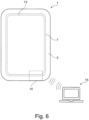
- Fig.6 shows the device 1 in plan view.
- the device 1 has the marking 7, within which the goods or objects are to be arranged on and above the support surface 3.
- a transmitting/receiving antenna 13 and a writing/reading device 14 are arranged within the support surface 3 of the display device 1.
- the writing/reading device 14 and the transmitting/receiving antenna 13 are only shown schematically.
- the writing/reading device 14 has a transmitter for generating a high-frequency electromagnetic alternating field.
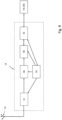
- the individual components of the writing/reading device are shown in Fig.6 not shown, but in Fig.8
- the high-frequency electromagnetic alternating field is radiated by the transmitting/receiving antenna 13.
- the reading and data processing cycle is limited to a maximum time period, for example to a time period of less than two seconds.
- the high frequency power is set in the transmitter/receiver 31, for example between 10 mW and 500 mW.
- the transponders 20 to 29 can be put into a non-reading mode for a predetermined time so that they can only be read again after 20 seconds have elapsed, for example.
- a transmitter/receiver 31 is arranged in the read/write device.
- the transmitter/receiver 31 generates a high-frequency electromagnetic alternating field in the transmitting/receiving antenna 13, which is only shown schematically.
- the read/write device 14 has a filter device 30 for selecting at least one of the read transponders.
- the filter device 30 can also consist of a software algorithm.
- the transmitter/receiver 31, the filter device 30 and the evaluation unit 35 are controlled by a control device 33.
- the control device 33 also controls the data interface 32.
- the control device 33 can receive data, such as the first or second signal threshold value, from the computer 15 via the data interface 32.
- the control device 33 can also have further Fig.8 control functional units not shown.
- the various functional units such as transmitter/receiver 31, filter device 30, evaluation unit 35, data interface 32 and control device 33 are connected to one another via corresponding data lines and/or communication lines.
- This interruption occurs automatically. This interruption is not an interruption initiated by operators.
- a starting value first signal threshold
- the transponder data is then deleted.
- the procedure can then be carried out again. If none of the termination criteria is met, the reading of all transponders 19 to 29 within radio range is continued and in the filter device 30 the transponders 19 that are not to be selected are again filtered out and the data of the transponders 20 to 29 that are to be selected are transmitted to the data interface and further processed.
Landscapes
- Engineering & Computer Science (AREA)
- Physics & Mathematics (AREA)
- Health & Medical Sciences (AREA)
- Toxicology (AREA)
- General Health & Medical Sciences (AREA)
- Electromagnetism (AREA)
- Artificial Intelligence (AREA)
- Computer Vision & Pattern Recognition (AREA)
- General Physics & Mathematics (AREA)
- Theoretical Computer Science (AREA)
- Computer Networks & Wireless Communication (AREA)
- Near-Field Transmission Systems (AREA)
- Radar Systems Or Details Thereof (AREA)
Claims (8)
- Procédé permettant de calibrer un appareil de lecture/écriture (14) ou d'un lecteur pour lire, sélectionner ou signaler à une unité d'évaluation (35) un nombre d'une pluralité de transpondeurs (20 à 29) lisibles sans contact,caractérisé en ce qu'une mesure de référence est effectuée, dans laquelle- un nombre prédéterminé de n transpondeurs (20 à 29) est disposé dans la zone de détection de l'appareil de lecture/écriture (14) ou du lecteur, où n ≥ 1, et- le signal le plus fort du transpondeur ou des n transpondeurs (20 à 29) est détecté, et ce signal est défini comme une première valeur seuil de signal, et- le signal le plus faible du transpondeur ou des n transpondeurs (20 à 29) est détecté, et ce signal est défini comme une deuxième valeur seuil de signal,et en ce que le procédé suivant permettant de détecter, sélectionner et signaler à une unité d'évaluation (35) un nombre d'une pluralité de transpondeurs lisibles sans contact est effectué :- dans lequel le procédé est effectué à l'aide d'au moins un appareil de lecture/écriture (14) ou lecteur,- dans lequel l'appareil de lecture/écriture (14) ou le lecteur génère un champ alternatif électromagnétique haute fréquence et l'émet par l'intermédiaire d'une antenne d'émission/réception (13),- dans lequel l'appareil de lecture/écriture (14) ou le lecteur lit des données du ou des transpondeur(s) (19 à 29) se trouvant dans une portée radio au moyen d'au moins un cycle de lecture, et au moins un cycle de traitement de données est effectué,- dans lequel l'appareil de lecture/écriture (14) ou le lecteur sélectionne à l'aide d'un équipement de filtrage (30) au moins l'un des transpondeurs (19 à 29) lus,- dans lequel l'appareil de lecture/écriture (14) ou le lecteur signale le ou les transpondeur(s) sélectionné(s) (20 à 29) à l'unité d'évaluation (35),- dans lequel une lecture en continu des données des transpondeurs (19 à 29) a lieu,- dans lequel, lorsqu'un transpondeur (19 à 29) est disposé dans la portée radio de l'appareil de lecture/écriture (14) ou du lecteur, une valeur RSSI, indicateur de force de signal reçue, de ce transpondeur (19 à 29) est détectée,- dans lequel une première valeur seuil de signal est utilisée,- dans lequel, lorsque la première valeur seuil de signal est atteinte ou dépassée, un transpondeur (19 à 29) démarre le cycle de lecture et de traitement de données des données du ou des transpondeur(s) (20 à 29), c'est-à-dire que lorsque la valeur RSSI du ou des transpondeur(s) (19 à 29) qui est/sont disposé(s) dans la zone de détection de l'appareil de lecture/écriture (14) ou du lecteur est supérieure à la première valeur seuil de signal ou égale à la première valeur seuil de signal, le cycle de traitement de lecture et de données est démarré,- dans lequel une deuxième valeur seuil de signal, différente de la première valeur seuil de signal, est utilisée pour éliminer par filtrage des transpondeurs (19) à ignorer,- dans lequel les valeurs seuils de signal sont réalisées sous forme de valeurs RSSI,- dans lequel le cycle de lecture et de traitement de données est terminé,- dans lequel des données évaluées des transpondeurs (20 à 29) sont transmises à l'unité d'évaluation (35),- dans lequel les données des transpondeurs (19 à 29) sont ignorées ou supprimées après une transmission des données évaluées des transpondeurs (20 à 29) à l'unité d'évaluation (35).
- Procédé selon la revendication 1, caractérisé en ce qu'un contrôle optique est effectué si l'ensemble des n transpondeurs (20 à 29) a été lu.
- Procédé selon l'une quelconque des revendications 1 ou 2, caractérisé en ce que la première valeur seuil de signal, la valeur initiale, est définie par une valeur RSSI maximale d'au moins l'un des n transpondeurs à lire, moins une tolérance x prédéterminée.
- Procédé selon l'une quelconque des revendications 1 à 3, caractérisé en ce que la deuxième valeur seuil de signal est définie par une valeur RSSI minimale d'au moins l'un des n transpondeurs à lire moins une tolérance y prédéterminée.
- Procédé selon l'une quelconque des revendications 1 à 4, caractérisé en ce que le procédé de calibrage est répété au moins deux fois.
- Procédé selon l'une quelconque des revendications 1 à 5, caractérisé en ce que le procédé de calibrage est effectué à différentes puissances du champ alternatif électromagnétique haute fréquence.
- Procédé selon l'une quelconque des revendications 1 à 6, caractérisé en ce que le procédé de calibrage détermine- les valeurs seuils de signal et la durée du cycle de lecture et de traitement de données, et/ou- la puissance nécessaire du champ alternatif haute fréquence pour effectuer le procédé selon la revendication 1.
- Procédé selon l'une quelconque des revendications 1 à 7, caractérisé en ce que le procédé de calibrage est effectué avec une série de numéros UID/EPC prédéfinie.
Priority Applications (2)
| Application Number | Priority Date | Filing Date | Title |
|---|---|---|---|
| EP22200145.5A EP4134866B1 (fr) | 2021-05-27 | 2021-05-27 | Procédé de calibration pour un dispositif de lecture de transpondeurs |
| ES22200145T ES2991996T3 (es) | 2021-05-27 | 2021-05-27 | Procedimiento de calibración para un dispositivo de lectura de transpondedor |
Applications Claiming Priority (2)
| Application Number | Priority Date | Filing Date | Title |
|---|---|---|---|
| EP22200145.5A EP4134866B1 (fr) | 2021-05-27 | 2021-05-27 | Procédé de calibration pour un dispositif de lecture de transpondeurs |
| EP21176344.6A EP4095740B1 (fr) | 2021-05-27 | 2021-05-27 | Procédé de lecture, de sélection et de notification d'un nombre à partir d'une pluralité de transpondeurs lisibles sans contact, ainsi que dispositif de lecture, de sélection et de notification d'un nombre à partir d'une pluralité de transpondeurs sans contact |
Related Parent Applications (2)
| Application Number | Title | Priority Date | Filing Date |
|---|---|---|---|
| EP21176344.6A Division-Into EP4095740B1 (fr) | 2021-05-27 | 2021-05-27 | Procédé de lecture, de sélection et de notification d'un nombre à partir d'une pluralité de transpondeurs lisibles sans contact, ainsi que dispositif de lecture, de sélection et de notification d'un nombre à partir d'une pluralité de transpondeurs sans contact |
| EP21176344.6A Division EP4095740B1 (fr) | 2021-05-27 | 2021-05-27 | Procédé de lecture, de sélection et de notification d'un nombre à partir d'une pluralité de transpondeurs lisibles sans contact, ainsi que dispositif de lecture, de sélection et de notification d'un nombre à partir d'une pluralité de transpondeurs sans contact |
Publications (2)
| Publication Number | Publication Date |
|---|---|
| EP4134866A1 EP4134866A1 (fr) | 2023-02-15 |
| EP4134866B1 true EP4134866B1 (fr) | 2024-07-10 |
Family
ID=76159397
Family Applications (2)
| Application Number | Title | Priority Date | Filing Date |
|---|---|---|---|
| EP22200145.5A Active EP4134866B1 (fr) | 2021-05-27 | 2021-05-27 | Procédé de calibration pour un dispositif de lecture de transpondeurs |
| EP21176344.6A Active EP4095740B1 (fr) | 2021-05-27 | 2021-05-27 | Procédé de lecture, de sélection et de notification d'un nombre à partir d'une pluralité de transpondeurs lisibles sans contact, ainsi que dispositif de lecture, de sélection et de notification d'un nombre à partir d'une pluralité de transpondeurs sans contact |
Family Applications After (1)
| Application Number | Title | Priority Date | Filing Date |
|---|---|---|---|
| EP21176344.6A Active EP4095740B1 (fr) | 2021-05-27 | 2021-05-27 | Procédé de lecture, de sélection et de notification d'un nombre à partir d'une pluralité de transpondeurs lisibles sans contact, ainsi que dispositif de lecture, de sélection et de notification d'un nombre à partir d'une pluralité de transpondeurs sans contact |
Country Status (2)
| Country | Link |
|---|---|
| EP (2) | EP4134866B1 (fr) |
| ES (2) | ES2973143T3 (fr) |
Families Citing this family (1)
| Publication number | Priority date | Publication date | Assignee | Title |
|---|---|---|---|---|
| EP4703965A1 (fr) * | 2024-08-30 | 2026-03-04 | Siemens Aktiengesellschaft | Procédé rfid, dispositif rfid pour exécuter le procédé rfid et produit de programme informatique pour exécuter une partie du procédé rfid |
Family Cites Families (6)
| Publication number | Priority date | Publication date | Assignee | Title |
|---|---|---|---|---|
| US6837427B2 (en) * | 2001-11-21 | 2005-01-04 | Goliath Solutions, Llc. | Advertising compliance monitoring system |
| US20090243801A1 (en) * | 2008-03-31 | 2009-10-01 | Martin Strzelczyk | Method and System for Utilizing an RFID Sensor Tag as RF Power Measurement Embedded in Antenna |
| US8279112B2 (en) * | 2008-11-03 | 2012-10-02 | Trimble Navigation Limited | Methods and apparatuses for RFID tag range determination |
| ES2460015T3 (es) * | 2011-08-19 | 2014-05-13 | Siemens Aktiengesellschaft | Procedimiento y aparato de escritura-lectura para una disposición con varios transpondedores legibles sin contacto |
| DE102012212856B4 (de) | 2012-07-23 | 2014-11-06 | Siemens Aktiengesellschaft | Verfahren und Schreib-/Lesegerät zur Erfassung, Selektion und Meldung von zumindest einem aus einer Mehrzahl von berührungslos auslesbaren Transpondern |
| EP2990989B1 (fr) * | 2014-08-27 | 2017-01-25 | Siemens Aktiengesellschaft | Méthode et appareil de lecture/écriture pour séléctionner une étiquette sans fil |
-
2021
- 2021-05-27 EP EP22200145.5A patent/EP4134866B1/fr active Active
- 2021-05-27 EP EP21176344.6A patent/EP4095740B1/fr active Active
- 2021-05-27 ES ES21176344T patent/ES2973143T3/es active Active
- 2021-05-27 ES ES22200145T patent/ES2991996T3/es active Active
Also Published As
| Publication number | Publication date |
|---|---|
| ES2991996T3 (es) | 2024-12-05 |
| EP4095740A1 (fr) | 2022-11-30 |
| ES2973143T3 (es) | 2024-06-18 |
| EP4095740B1 (fr) | 2024-01-03 |
| EP4134866A1 (fr) | 2023-02-15 |
Similar Documents
| Publication | Publication Date | Title |
|---|---|---|
| DE60103742T2 (de) | Modul zur leistungsbewertung eines rf-identifizierungsetiketts (rfid) | |
| DE602004007013T2 (de) | Näherungsdetektionsgerät | |
| DE19956908B4 (de) | Sicherungssystem, Transponder und Empfangsvorrichtung | |
| DE69323995T2 (de) | Verfahren zum Abstimmen von elektronischen Antwortgeräten | |
| DE10107208B4 (de) | System für das Kommunizieren mit Hochfrequenz-Etiketten | |
| DE69331556T2 (de) | Erfassung verschiedener Waren | |
| DE102005003228B4 (de) | Lese-Schreib-Verarbeitungsvorrichtung und Verfahren für RFID-Tag | |
| EP2024897A2 (fr) | Principe de determination de la position d`un transpondeur dans un systeme rfid | |
| EP2754086B1 (fr) | Methode pour tester une bobine d'antenne | |
| EP2256662B1 (fr) | Procédé de détection de supports d'identification | |
| EP3291144B1 (fr) | Dispositif rfid et procede de reconnaissance d'occupation de casier | |
| DE69315132T2 (de) | Metallsuchgerät mit Anzeige | |
| EP3290948B1 (fr) | Capteur et systeme de determination de position | |
| EP4134866B1 (fr) | Procédé de calibration pour un dispositif de lecture de transpondeurs | |
| DE602004006980T2 (de) | Transponderleser mit der Fähigkeit zum lesen von Transpondern mit verschiedenen Zeichengabeprotokollen | |
| DE102004061452A1 (de) | Mehrfaches RFID-Antikollisions-Abfrageverfahren | |
| DE102013012335A1 (de) | Nahfeldkommunikationsgerät | |
| DE102018114012B4 (de) | Rfid-system und informationsverarbeitungsverfahren | |
| EP3070636B1 (fr) | Indicateur de champ de lecture destiné à vérifier le champ de lecture d'un lecteur rfid | |
| DE102016213240A1 (de) | Vorrichtung und Verfahren zur Positionsbestimmung eines Senders relativ zu einem Detektionsbereich | |
| EP2705462B1 (fr) | Lecteur pour la communication sans contact avec une unité de transpondeur | |
| EP2990989B1 (fr) | Méthode et appareil de lecture/écriture pour séléctionner une étiquette sans fil | |
| EP3273381B1 (fr) | Dispositif rfid et procédé de communication avec au moins un transpondeur rfid | |
| EP4075155B1 (fr) | Procédé et appareil de mesure destinés à l'essai de matériaux d'une carte de stockage de données en forme de carte | |
| WO2022199895A1 (fr) | Procédé de détermination d'une valeur d'intensité de champ électromagnétique, procédé de couplage d'un appareil de lecture, carte à puce et appareil de lecture pour carte à puce |
Legal Events
| Date | Code | Title | Description |
|---|---|---|---|
| PUAI | Public reference made under article 153(3) epc to a published international application that has entered the european phase |
Free format text: ORIGINAL CODE: 0009012 |
|
| STAA | Information on the status of an ep patent application or granted ep patent |
Free format text: STATUS: THE APPLICATION HAS BEEN PUBLISHED |
|
| AC | Divisional application: reference to earlier application |
Ref document number: 4095740 Country of ref document: EP Kind code of ref document: P |
|
| AK | Designated contracting states |
Kind code of ref document: A1 Designated state(s): AL AT BE BG CH CY CZ DE DK EE ES FI FR GB GR HR HU IE IS IT LI LT LU LV MC MK MT NL NO PL PT RO RS SE SI SK SM TR |
|
| STAA | Information on the status of an ep patent application or granted ep patent |
Free format text: STATUS: REQUEST FOR EXAMINATION WAS MADE |
|
| 17P | Request for examination filed |
Effective date: 20230511 |
|
| RBV | Designated contracting states (corrected) |
Designated state(s): AL AT BE BG CH CY CZ DE DK EE ES FI FR GB GR HR HU IE IS IT LI LT LU LV MC MK MT NL NO PL PT RO RS SE SI SK SM TR |
|
| GRAP | Despatch of communication of intention to grant a patent |
Free format text: ORIGINAL CODE: EPIDOSNIGR1 |
|
| STAA | Information on the status of an ep patent application or granted ep patent |
Free format text: STATUS: GRANT OF PATENT IS INTENDED |
|
| INTG | Intention to grant announced |
Effective date: 20240220 |
|
| GRAS | Grant fee paid |
Free format text: ORIGINAL CODE: EPIDOSNIGR3 |
|
| GRAA | (expected) grant |
Free format text: ORIGINAL CODE: 0009210 |
|
| STAA | Information on the status of an ep patent application or granted ep patent |
Free format text: STATUS: THE PATENT HAS BEEN GRANTED |
|
| AC | Divisional application: reference to earlier application |
Ref document number: 4095740 Country of ref document: EP Kind code of ref document: P |
|
| AK | Designated contracting states |
Kind code of ref document: B1 Designated state(s): AL AT BE BG CH CY CZ DE DK EE ES FI FR GB GR HR HU IE IS IT LI LT LU LV MC MK MT NL NO PL PT RO RS SE SI SK SM TR |
|
| REG | Reference to a national code |
Ref country code: CH Ref legal event code: EP |
|
| REG | Reference to a national code |
Ref country code: DE Ref legal event code: R096 Ref document number: 502021004354 Country of ref document: DE |
|
| REG | Reference to a national code |
Ref country code: LT Ref legal event code: MG9D |
|
| REG | Reference to a national code |
Ref country code: NL Ref legal event code: MP Effective date: 20240710 |
|
| REG | Reference to a national code |
Ref country code: ES Ref legal event code: FG2A Ref document number: 2991996 Country of ref document: ES Kind code of ref document: T3 Effective date: 20241205 |
|
| PG25 | Lapsed in a contracting state [announced via postgrant information from national office to epo] |
Ref country code: PT Free format text: LAPSE BECAUSE OF FAILURE TO SUBMIT A TRANSLATION OF THE DESCRIPTION OR TO PAY THE FEE WITHIN THE PRESCRIBED TIME-LIMIT Effective date: 20241111 |
|
| PG25 | Lapsed in a contracting state [announced via postgrant information from national office to epo] |
Ref country code: NL Free format text: LAPSE BECAUSE OF FAILURE TO SUBMIT A TRANSLATION OF THE DESCRIPTION OR TO PAY THE FEE WITHIN THE PRESCRIBED TIME-LIMIT Effective date: 20240710 |
|
| PG25 | Lapsed in a contracting state [announced via postgrant information from national office to epo] |
Ref country code: PT Free format text: LAPSE BECAUSE OF FAILURE TO SUBMIT A TRANSLATION OF THE DESCRIPTION OR TO PAY THE FEE WITHIN THE PRESCRIBED TIME-LIMIT Effective date: 20241111 Ref country code: NL Free format text: LAPSE BECAUSE OF FAILURE TO SUBMIT A TRANSLATION OF THE DESCRIPTION OR TO PAY THE FEE WITHIN THE PRESCRIBED TIME-LIMIT Effective date: 20240710 |
|
| PG25 | Lapsed in a contracting state [announced via postgrant information from national office to epo] |
Ref country code: NO Free format text: LAPSE BECAUSE OF FAILURE TO SUBMIT A TRANSLATION OF THE DESCRIPTION OR TO PAY THE FEE WITHIN THE PRESCRIBED TIME-LIMIT Effective date: 20241010 |
|
| PG25 | Lapsed in a contracting state [announced via postgrant information from national office to epo] |
Ref country code: GR Free format text: LAPSE BECAUSE OF FAILURE TO SUBMIT A TRANSLATION OF THE DESCRIPTION OR TO PAY THE FEE WITHIN THE PRESCRIBED TIME-LIMIT Effective date: 20241011 Ref country code: FI Free format text: LAPSE BECAUSE OF FAILURE TO SUBMIT A TRANSLATION OF THE DESCRIPTION OR TO PAY THE FEE WITHIN THE PRESCRIBED TIME-LIMIT Effective date: 20240710 Ref country code: PL Free format text: LAPSE BECAUSE OF FAILURE TO SUBMIT A TRANSLATION OF THE DESCRIPTION OR TO PAY THE FEE WITHIN THE PRESCRIBED TIME-LIMIT Effective date: 20240710 |
|
| PG25 | Lapsed in a contracting state [announced via postgrant information from national office to epo] |
Ref country code: BG Free format text: LAPSE BECAUSE OF FAILURE TO SUBMIT A TRANSLATION OF THE DESCRIPTION OR TO PAY THE FEE WITHIN THE PRESCRIBED TIME-LIMIT Effective date: 20240710 |
|
| PG25 | Lapsed in a contracting state [announced via postgrant information from national office to epo] |
Ref country code: LV Free format text: LAPSE BECAUSE OF FAILURE TO SUBMIT A TRANSLATION OF THE DESCRIPTION OR TO PAY THE FEE WITHIN THE PRESCRIBED TIME-LIMIT Effective date: 20240710 |
|
| PG25 | Lapsed in a contracting state [announced via postgrant information from national office to epo] |
Ref country code: IS Free format text: LAPSE BECAUSE OF FAILURE TO SUBMIT A TRANSLATION OF THE DESCRIPTION OR TO PAY THE FEE WITHIN THE PRESCRIBED TIME-LIMIT Effective date: 20241110 |
|
| PG25 | Lapsed in a contracting state [announced via postgrant information from national office to epo] |
Ref country code: HR Free format text: LAPSE BECAUSE OF FAILURE TO SUBMIT A TRANSLATION OF THE DESCRIPTION OR TO PAY THE FEE WITHIN THE PRESCRIBED TIME-LIMIT Effective date: 20240710 |
|
| PG25 | Lapsed in a contracting state [announced via postgrant information from national office to epo] |
Ref country code: RS Free format text: LAPSE BECAUSE OF FAILURE TO SUBMIT A TRANSLATION OF THE DESCRIPTION OR TO PAY THE FEE WITHIN THE PRESCRIBED TIME-LIMIT Effective date: 20241010 |
|
| PG25 | Lapsed in a contracting state [announced via postgrant information from national office to epo] |
Ref country code: RS Free format text: LAPSE BECAUSE OF FAILURE TO SUBMIT A TRANSLATION OF THE DESCRIPTION OR TO PAY THE FEE WITHIN THE PRESCRIBED TIME-LIMIT Effective date: 20241010 Ref country code: PL Free format text: LAPSE BECAUSE OF FAILURE TO SUBMIT A TRANSLATION OF THE DESCRIPTION OR TO PAY THE FEE WITHIN THE PRESCRIBED TIME-LIMIT Effective date: 20240710 Ref country code: NO Free format text: LAPSE BECAUSE OF FAILURE TO SUBMIT A TRANSLATION OF THE DESCRIPTION OR TO PAY THE FEE WITHIN THE PRESCRIBED TIME-LIMIT Effective date: 20241010 Ref country code: LV Free format text: LAPSE BECAUSE OF FAILURE TO SUBMIT A TRANSLATION OF THE DESCRIPTION OR TO PAY THE FEE WITHIN THE PRESCRIBED TIME-LIMIT Effective date: 20240710 Ref country code: IS Free format text: LAPSE BECAUSE OF FAILURE TO SUBMIT A TRANSLATION OF THE DESCRIPTION OR TO PAY THE FEE WITHIN THE PRESCRIBED TIME-LIMIT Effective date: 20241110 Ref country code: HR Free format text: LAPSE BECAUSE OF FAILURE TO SUBMIT A TRANSLATION OF THE DESCRIPTION OR TO PAY THE FEE WITHIN THE PRESCRIBED TIME-LIMIT Effective date: 20240710 Ref country code: GR Free format text: LAPSE BECAUSE OF FAILURE TO SUBMIT A TRANSLATION OF THE DESCRIPTION OR TO PAY THE FEE WITHIN THE PRESCRIBED TIME-LIMIT Effective date: 20241011 Ref country code: FI Free format text: LAPSE BECAUSE OF FAILURE TO SUBMIT A TRANSLATION OF THE DESCRIPTION OR TO PAY THE FEE WITHIN THE PRESCRIBED TIME-LIMIT Effective date: 20240710 Ref country code: BG Free format text: LAPSE BECAUSE OF FAILURE TO SUBMIT A TRANSLATION OF THE DESCRIPTION OR TO PAY THE FEE WITHIN THE PRESCRIBED TIME-LIMIT Effective date: 20240710 |
|
| REG | Reference to a national code |
Ref country code: DE Ref legal event code: R097 Ref document number: 502021004354 Country of ref document: DE |
|
| PG25 | Lapsed in a contracting state [announced via postgrant information from national office to epo] |
Ref country code: SM Free format text: LAPSE BECAUSE OF FAILURE TO SUBMIT A TRANSLATION OF THE DESCRIPTION OR TO PAY THE FEE WITHIN THE PRESCRIBED TIME-LIMIT Effective date: 20240710 Ref country code: DK Free format text: LAPSE BECAUSE OF FAILURE TO SUBMIT A TRANSLATION OF THE DESCRIPTION OR TO PAY THE FEE WITHIN THE PRESCRIBED TIME-LIMIT Effective date: 20240710 Ref country code: RO Free format text: LAPSE BECAUSE OF FAILURE TO SUBMIT A TRANSLATION OF THE DESCRIPTION OR TO PAY THE FEE WITHIN THE PRESCRIBED TIME-LIMIT Effective date: 20240710 |
|
| PG25 | Lapsed in a contracting state [announced via postgrant information from national office to epo] |
Ref country code: EE Free format text: LAPSE BECAUSE OF FAILURE TO SUBMIT A TRANSLATION OF THE DESCRIPTION OR TO PAY THE FEE WITHIN THE PRESCRIBED TIME-LIMIT Effective date: 20240710 |
|
| PG25 | Lapsed in a contracting state [announced via postgrant information from national office to epo] |
Ref country code: CZ Free format text: LAPSE BECAUSE OF FAILURE TO SUBMIT A TRANSLATION OF THE DESCRIPTION OR TO PAY THE FEE WITHIN THE PRESCRIBED TIME-LIMIT Effective date: 20240710 |
|
| PG25 | Lapsed in a contracting state [announced via postgrant information from national office to epo] |
Ref country code: SK Free format text: LAPSE BECAUSE OF FAILURE TO SUBMIT A TRANSLATION OF THE DESCRIPTION OR TO PAY THE FEE WITHIN THE PRESCRIBED TIME-LIMIT Effective date: 20240710 Ref country code: IT Free format text: LAPSE BECAUSE OF FAILURE TO SUBMIT A TRANSLATION OF THE DESCRIPTION OR TO PAY THE FEE WITHIN THE PRESCRIBED TIME-LIMIT Effective date: 20240710 |
|
| PLBE | No opposition filed within time limit |
Free format text: ORIGINAL CODE: 0009261 |
|
| STAA | Information on the status of an ep patent application or granted ep patent |
Free format text: STATUS: NO OPPOSITION FILED WITHIN TIME LIMIT |
|
| 26N | No opposition filed |
Effective date: 20250411 |
|
| PGFP | Annual fee paid to national office [announced via postgrant information from national office to epo] |
Ref country code: DE Payment date: 20250519 Year of fee payment: 5 |
|
| PGFP | Annual fee paid to national office [announced via postgrant information from national office to epo] |
Ref country code: GB Payment date: 20250522 Year of fee payment: 5 Ref country code: ES Payment date: 20250616 Year of fee payment: 5 |
|
| PGFP | Annual fee paid to national office [announced via postgrant information from national office to epo] |
Ref country code: FR Payment date: 20250521 Year of fee payment: 5 |
|
| PGFP | Annual fee paid to national office [announced via postgrant information from national office to epo] |
Ref country code: AT Payment date: 20250721 Year of fee payment: 5 |
|
| PG25 | Lapsed in a contracting state [announced via postgrant information from national office to epo] |
Ref country code: SE Free format text: LAPSE BECAUSE OF FAILURE TO SUBMIT A TRANSLATION OF THE DESCRIPTION OR TO PAY THE FEE WITHIN THE PRESCRIBED TIME-LIMIT Effective date: 20240710 |
|
| REG | Reference to a national code |
Ref country code: DE Ref legal event code: R082 Ref document number: 502021004354 Country of ref document: DE |
|
| REG | Reference to a national code |
Ref country code: CH Ref legal event code: H13 Free format text: ST27 STATUS EVENT CODE: U-0-0-H10-H13 (AS PROVIDED BY THE NATIONAL OFFICE) Effective date: 20251223 |
|
| PG25 | Lapsed in a contracting state [announced via postgrant information from national office to epo] |
Ref country code: LU Free format text: LAPSE BECAUSE OF NON-PAYMENT OF DUE FEES Effective date: 20250527 |
|
| PG25 | Lapsed in a contracting state [announced via postgrant information from national office to epo] |
Ref country code: CH Free format text: LAPSE BECAUSE OF NON-PAYMENT OF DUE FEES Effective date: 20250531 |
|
| REG | Reference to a national code |
Ref country code: BE Ref legal event code: MM Effective date: 20250531 |
|
| PG25 | Lapsed in a contracting state [announced via postgrant information from national office to epo] |
Ref country code: MC Free format text: LAPSE BECAUSE OF FAILURE TO SUBMIT A TRANSLATION OF THE DESCRIPTION OR TO PAY THE FEE WITHIN THE PRESCRIBED TIME-LIMIT Effective date: 20240710 |
|
| PG25 | Lapsed in a contracting state [announced via postgrant information from national office to epo] |
Ref country code: IE Free format text: LAPSE BECAUSE OF NON-PAYMENT OF DUE FEES Effective date: 20250527 |
|
| PG25 | Lapsed in a contracting state [announced via postgrant information from national office to epo] |
Ref country code: BE Free format text: LAPSE BECAUSE OF NON-PAYMENT OF DUE FEES Effective date: 20250531 |