EP4137002A1 - Verpackungshülle für parfüm-, kosmetik- oder toilettenartikelflaschen - Google Patents
Verpackungshülle für parfüm-, kosmetik- oder toilettenartikelflaschen Download PDFInfo
- Publication number
- EP4137002A1 EP4137002A1 EP21306127.8A EP21306127A EP4137002A1 EP 4137002 A1 EP4137002 A1 EP 4137002A1 EP 21306127 A EP21306127 A EP 21306127A EP 4137002 A1 EP4137002 A1 EP 4137002A1
- Authority
- EP
- European Patent Office
- Prior art keywords
- shell
- bottle
- wall
- packaging
- volume
- Prior art date
- Legal status (The legal status is an assumption and is not a legal conclusion. Google has not performed a legal analysis and makes no representation as to the accuracy of the status listed.)
- Granted
Links
Images




Classifications
-
- B—PERFORMING OPERATIONS; TRANSPORTING
- B65—CONVEYING; PACKING; STORING; HANDLING THIN OR FILAMENTARY MATERIAL
- B65D—CONTAINERS FOR STORAGE OR TRANSPORT OF ARTICLES OR MATERIALS, e.g. BAGS, BARRELS, BOTTLES, BOXES, CANS, CARTONS, CRATES, DRUMS, JARS, TANKS, HOPPERS, FORWARDING CONTAINERS; ACCESSORIES, CLOSURES, OR FITTINGS THEREFOR; PACKAGING ELEMENTS; PACKAGES
- B65D81/00—Containers, packaging elements, or packages, for contents presenting particular transport or storage problems, or adapted to be used for non-packaging purposes after removal of contents
- B65D81/02—Containers, packaging elements, or packages, for contents presenting particular transport or storage problems, or adapted to be used for non-packaging purposes after removal of contents specially adapted to protect contents from mechanical damage
- B65D81/025—Containers made of sheet-like material and having a shape to accommodate contents
-
- A—HUMAN NECESSITIES
- A45—HAND OR TRAVELLING ARTICLES
- A45D—HAIRDRESSING OR SHAVING EQUIPMENT; EQUIPMENT FOR COSMETICS OR COSMETIC TREATMENTS, e.g. FOR MANICURING OR PEDICURING
- A45D34/00—Containers or accessories specially adapted for handling liquid toiletry or cosmetic substances, e.g. perfumes
- A45D34/02—Scent flasks, e.g. with evaporator
Definitions
- the present invention relates to the field of so-called secondary packaging, in particular secondary packaging for a bottle of cosmetic, toiletry or perfume product.
- cosmetic product is understood to mean in particular all products for making up the skin, including the lips, and all compositions intended for bodily application, including so-called care products such as moisturizing creams. Toiletries include shower gels, bath products and body lotions. Perfumes designate in particular all perfuming or fragrant compositions intended for bodily application.
- a secondary packaging corresponds to a packaging formed around the so-called primary packaging, the primary packaging being that which is in direct contact with the packaged product.
- Secondary packaging is generally used to group products together to form batches and/or transport them to their place of distribution, but in the field of cosmetics and in the field of perfumery, secondary packaging is primarily used to aesthetic and protective functions, each individual product being packed in one or more secondary packaging.
- the secondary packaging of such a bottle thus generally comprises a case, optionally a wedge, and a sheath.
- the case is a cardboard element, made of plastic, or of another suitable material (leather, wood, etc.), forming a box or a box for receiving the bottle.
- the case generally bears the legal and commercial notices.
- the wedge is a piece of cardboard, plastic, foam, etc., which is shaped to prevent movement of the bottle in the case.
- the wedge can be configured to match the shape of the bottle or simply to compensate for a clearance present in the case around the bottle.
- the sheath is the outer packaging, in paper or cardboard, which surrounds the case.
- a solution comprising three secondary packaging elements is complex. It requires the supply and storage of various elements. For the manufacture of each element, bending and cutting are necessary. The design of the secondary packaging is thus complex.
- the packaging shapeing of the packaging, placement of the bottle in the packaging, etc.
- several manipulations are necessary and can be complex to automate.
- the production costs associated with the secondary packaging are thus high in the field of bottling, in particular the bottling of cosmetics, toiletries, and perfumes.
- plastic materials and more generally of heterogeneous materials for the secondary packaging of cosmetic or perfume products makes the recycling of the packaging complex or impossible.
- the invention thus aims to propose a secondary packaging for a bottle solving all or part of the aforementioned problems. It thus aims in particular to propose a packaging for a bottle which is aesthetic and distinctive, particularly suitable for the field of perfumery and cosmetic products, and which can be easily recycled or biodegraded.
- the packaging proposed in the invention aims to obtain these functions while offering high-level protection, for the bottle in all its components: the glassware of the reservoir and/or of the bottle cap, its label (or other form of marking ), etc.
- the invention relates to a packaging shell for a bottle of perfume, cosmetic or toiletry product, said shell being able to assume a closed position in which it forms a receiving volume adapted to envelop a bottle and an open position allowing the placing the bottle in the shell or removing the bottle from the shell, said shell comprising two half-shells each forming a concavity and essentially formed of a material based on molded natural plant fibres.
- Each half-shell has a peripheral edge which is contiguous, when the shell is in the closed position, with a peripheral edge of the other half-shell so that the receiving volume is a closed volume and in that the shell has at least one retaining element projecting into the receiving volume.
- the support elements are molded with the shell.
- Forming a natural fiber shell by molding has multiple advantages.
- the method of molding a material based on natural fibers makes it possible in a single operation to produce the shell, or part of the shell. Above all, this process makes it possible to obtain complex and aesthetic shapes.
- Such a shell is thus particularly aesthetic, forming a kind of skin around the bottle.
- the shell can thus take on the general shape of the bottle, making the product immediately identifiable for the consumer, in particular for certain perfumes for which the shape of the bottle is extremely well known and distinctive.
- the packaging suggests the shape and volume of the bottle, and thus respects the regulations in terms of the ratio between the primary packaging and the secondary packaging which aim to avoid any deception. of the consumer on the dimensions and the actual capacity of the product present in the package. More generally, the volume of the packaging is optimized, and the user thus has a good idea of the volume of the bottle present in the packaging.
- the material essentially (that is to say at least very predominantly) used to make the shell is recyclable and/or biodegradable.
- the process used to form the shell essentially implements a pulp of fibrous plant(s) containing natural plant fibers and water, in order to produce a hot molding of this pulp.
- the transport of packaged products is optimized by light packaging, containing little material, and compact (which allows more bottles to be transported in the same volume). This allows a reduction of the "carbon footprint" due to the transport of the packaged bottles.
- the shell may include a hinge which connects the two half-shells.
- hull Different constitutions of the hull are thus possible, on the basis of one or more molded elements of a material based on natural plant fibers.
- the shell may comprise an outer wall and an inner wall, the inner wall defining the reception volume in the closed position of the shell.
- the outer wall of the hull and the inner wall of the hull may be formed of two distinct layers of said material based on natural fibers, namely an inner layer forming the inner wall and an outer layer forming the outer wall, the inner layer comprising the means of maintenance.
- each half-shell of two separate layers By forming each half-shell of two separate layers, it is thus possible to mold the holding means only on the inner layer of the shell. Appearance aesthetics, in particular the shape, of the outer layer is preserved.
- a hollow pocket can be formed between the two layers at the level of the holding elements, which improves their deformability. This allows the holding means to adapt more easily to the manufacturing tolerances of the bottles intended to be placed in the shell, and this improves their ability to absorb shocks and other stresses to which the shell is subjected.
- the natural fibers used may include sugar cane, bamboo, wood, cotton, flax, hemp, sisal, jute, kenaf or coir fibers.
- the use of bagasse fibers (from sugar cane) or bamboo is particularly preferred.
- the use of one or more of the plant fibers mentioned allows the formation of a molded “paper” type shell having various mechanical and aesthetic properties.
- the packaging shell may for example have a wall thickness of between 0.5 mm and 3 mm, preferably between 0.8 and 2 mm at any point of said shell with the exception of the zones where a holding element is formed.
- Tests have made it possible to determine that such a thickness allows satisfactory protection of a glassware bottle, for example a perfume bottle of conventional size (for example 100 ml), in the event of a fall from a height of 90 cm on a solid surface, which corresponds to a common fall situation for a bottle of perfume or cosmetic product (falling from a table, a display, a bag, etc.).
- a glassware bottle for example a perfume bottle of conventional size (for example 100 ml)
- a height of 90 cm on a solid surface which corresponds to a common fall situation for a bottle of perfume or cosmetic product (falling from a table, a display, a bag, etc.).
- the receiving volume formed by the shell may comprise a front wall, a rear wall, and side walls connecting the front wall to the rear wall, and the retaining elements comprise: at least one buttress projecting from at least one of the side walls, and/or at least one projecting stud on at least one of the front and rear faces, and/or at least one elongated bead or defining a closed shape, on at least one of the front and rear faces.
- the holding elements can thus take various shapes and sizes, adapted to their particular function.
- the holding elements located on the inner side walls of the shell can thus have the shape of a block or of holding wedges, in order to provide a relatively large bearing surface for the bottle contained in the shell.
- the holding elements located on the front and rear faces may have the form of small cylindrical or hemispherical studs, which provide occasional holding in selected areas of the bottle contained in the shell, while being aesthetic.
- Beads make it possible to form a linear support vis-à-vis the bottle.
- the studs and/or the beads can make it possible to form a support on the bottle around a marking zone of the latter, in order to preserve the marking from any degradation by friction, even of low amplitude, on the hull.
- the conformation of the shell as close as possible to the bottle it contains offers good protection for the bottle and good aesthetics of the shell, in that it perfectly matches the general shape of the bottle it contains and thus benefits from its appearance. distinctive.
- the invention also relates to an assembly comprising a packaging shell for a bottle as defined above and a bottle contained in said packaging shell.
- the shell can match the external shape of the bottle it contains, so that at any point of said shell, a maximum play of 4 mm, preferably a maximum of 2 mm, is present between a wall exterior of the bottle and the interior wall of the shell.
- the holding elements can be configured to hold the bottle away from the front, rear and side walls of the shell.
- the holding elements can be configured so that the added marking is kept at a distance from the shell and that said holding elements are not in contact with said added marking.
- the shell is thus configured for optimal protection of the bottle it contains.
- the shell can completely envelop said bottle, so that no part of the bottle protrudes from said shell when the latter is closed. Protection of the entire bottle is thus obtained.
- the shell when it is closed helps to prevent accidental removal of the stopper.
- the bottle can advantageously be a glassware bottle.
- the shell is particularly suitable for the protection of a bottle of glassware, sensitive to shocks by nature.
- glassware bottle is meant any glass bottle, of any kind, including crystal.
- Bottle 1 shown in figure 1 comprises a body 2 which forms a reservoir for the perfume and a neck 3.
- the neck 3 comprises an opening allowing the introduction of the perfume into the reservoir of the body 2 and the outlet of the perfume from the reservoir of the body 2.
- the collar 3 comprises means for dispensing the perfume, namely a pump and a push button.
- the neck 3 is surmounted by a plug 4 allowing the closure of the neck 3 and/or covering the dispensing means.
- such a bottle has a complex but particularly aesthetic and distinctive general shape, which should be highlighted, including when the bottle is packaged.
- FIG 2 represents a packaging shell 5 in accordance with one embodiment of the invention. This shell is shown in an open position. This shell is configured to receive, protect, and dress the bottle 1 shown in figure 1 .
- the open position of the shell 5 shown in figure 2 corresponds to a position in which the bottle 1 can be placed in the shell 5 or extracted from the shell 5.
- the shell 5 comprises a first half-shell 6 and a second half-shell 7.
- the first half-shell 6 and the second half-shell 7 are interconnected by a hinge 8.
- the hinge 8 makes it possible to move the shell 5 from its open position to a closed position in which it forms an interior volume adapted to envelop the bottle 1.
- the first half-shell 6 and the second half-shell 7 each have a concave shape suitable for receiving the bottle 1.
- Bottle 1 of the figure 1 having two vertical planes of symmetry the shell 5 is itself formed of two half-shells 6.7.
- the first half-shell 6 and the second half-shell 7 can be symmetrical with respect to the axis formed by the hinge 8.
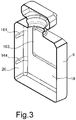
- FIG. 3 represents a part of the shell 5 of the figure 2 , namely the first half-shell 6, according to a perspective view making it possible to appreciate certain details of the interior of the concavity of the half-shell 6.
- each half-shell is obtained by molding a material based on natural plant fibres.
- the shell 5 is essentially made of molded vegetable pulp, the hot molding of the pulp making it possible to give the material a shape which perfectly matches the contours of the bottle to be packaged.
- the pulp is advantageously obtained from bagasse fibers and/or bamboo fibers.
- the natural fibers used can generally be all the fibers used in the paper industry, in particular, in addition to sugar cane fibers (in the form of bagasse) and bamboo, in particular wood, cotton, linen, hemp , sisal, jute, kenaf or coconut. Any mixture comprising these fibers can also be envisaged.
- the first half-shell 6 and the second half-shell 7 can be formed in one piece, the hinge 8 then being formed by bending between the two half-shells.
- each half-shell can be formed from a separate piece, and the hinge formed from an added piece.
- the hinge 8 is positioned in the zone of the shell 5 intended to receive the bottom of the bottle 1. This makes the hinge 8 not very visible, improves the aesthetics of the whole, and offers a natural opening of the shell.
- a side opening of the shell by a side hinge could be made within the framework of the invention, allowing the shell to be opened in a manner analogous to the opening of a book.
- the shell 5 has the particularity of having holding elements 16.
- the holding elements 16 are elements which protrude inside the shell 5, that is to say inside the reception volume 10 that the shell 5 forms when it is in the closed position.
- the holding elements 16 can have several functions. First of all, they make it possible to compensate for the manufacturing tolerances of the bottle which is received in the shell.
- the manufacturing tolerances of a glassware bottle can indeed be significant, relative to the dimensions of said bottle.
- the retaining elements are adapted to crush slightly when a bottle is placed in the shell 5. Once in place, the bottle is thus perfectly immobilized in the shell 5.
- Another function of the holding means 16 may be to maintain a space between the bottle which is placed in the shell 5 and the walls of said shell 5.
- the added marking may correspond to a label 15 which bears a print, a lacquer, a varnish, or a screen print, etc., and which is stuck on the bottle 1 (see figure 1 ).
- the added marking can alternatively be a lacquer, a varnish, a print, or a screen print made directly on the bottle 1. Such an added marking is likely to be damaged or even erased by the rubbing of the bottle 1 in the shell 5. Maintain the marking reported at a distance from the wall of the shell 5 avoids such deterioration.
- the holding elements 16 contribute to the protection of the bottle contained in the shell 5 against shocks, in particular in the event of the shell 5 containing a bottle 1 falling.
- the shell has a front wall 18, a rear wall 19, and side walls 20.
- the side walls 20 can be equipped, as retaining means 16, with reliefs called buttresses 161.
- the buttresses 161 are small parallelepipedic or “corner” extra thicknesses, that is to say having a regularly variable thickness.
- Two buttresses 161 can be provided on each side wall of each half-shell, or on only one of the half-shells, i.e. four or eight buttresses in total in a shell 5. In the example shown, eight buttresses 161 are formed in the hull 5.
- the buttresses 161 may have a sloping edge 164 which facilitates the introduction of a bottle 1 into the shell 5.
- the front wall 18 and/or the rear wall 19 can be equipped with studs 162 or with one or more beads 163, as a holding element.
- the front wall 18 comprises a bead 163 and the rear wall 19 comprises four studs 162.
- Beads and studs can be employed to perform similar functions.
- a stud 162 makes it possible to obtain a small zone of contact with the bottle 1, for example an almost point-like zone of contact, while a bead 163 makes it possible to obtain a linear contact with the bottle 1.
- the bead 163 has, in the example shown, a configuration in which it defines a closed shape, in this case substantially a rectangle.
- the bead can define various closed shapes: circle, oval, square, rectangle, or any other shape.
- the rectangular shape of the bead 163 of the example represented here makes it possible to create a support on the bottle 1 all around the label 17 (or any other marking attached to the bottle 1) in order to offer optimal protection of this marking. .
- the holding means 16 can be more or less deformed.
- the holding means 16 can be formed by an extra thickness of the shell, or by a local deformation of the shell towards the reception volume that it forms.
- the first half-shell 6 and the second half-shell 7 each have a peripheral edge 9 which is in contact with the peripheral edge 9 of the other half-shell when the shell 5 is in the closed position.
- the junction of the side walls 20 of the two half-shells is thus made edge against edge, or if necessary with a slight overlap between said side walls 20 respectively of the first half-shell 6 and of the second half-shell 7.
- a very clean peripheral edge 9 can be obtained by cutting the half-shells using a cutting tool. Such cutting is carried out after the molding of the half-shells and, where appropriate, after assembly of the two layers constituting the half-shells as detailed below. This cutting is advantageously carried out by a blade or by mechanical machining, in particular by cutting with a cutting ring.
- FIG 4 represents, according to a schematic view in three dimensions, a packaging shell in the open position.
- Hull 5 of the figure 4 essentially corresponds to that of the figure 2 , so that the description of figure 2 And 3 mainly applies to shell 5 of the figure 4 , with two exceptions: the type of retaining elements 16 used in the shell, and the presence of a flat portion 21 in each half-shell.
- studs 162 are formed on the front wall 18 instead of the bead 163 of the embodiment of the picture 2 and some picture 3 . As previously explained, these two alternatives make it possible to obtain substantially similar functions.
- each half-shell 6.7 forms a concavity adapted to the bottle 1.
- a flat portion 21 surrounds the concavity of each half-shell.
- the flat portion of the first half-shell 6 is, over all or part of its surface, in contact with all or part of the flat portion of the second half-shell 7. This allows in particular closing without play of the shell 5.
- This also makes it possible to give the shell 5 the desired shape in the plane of contact of the flat portions of the two half-shells, namely here a generally rectangular shape.
- the flat portions 21 can also be used to guarantee the closure of the shell 5 using a locking device 22 adapted to hold the shell in the closed position.
- a locking device 22 adapted to hold the shell in the closed position.
- an orifice 23 is made in each of the planar portions of the two half-shells, so that the orifices 23 are aligned when the shell 5 is brought into the closed position.
- the locking device 22 is positioned in the orifices 23 and holds the respective planar portions 21 of the two half-shells against each other, at the level of the orifices 23.
- the locking device can be a system of added clips.
- only one of the two half-shells may include an orifice 23, and the other of the two half-shells may include a deformation suitable for locking in the orifice 23 to ensure the locking of the shell 5.
- the flat portions can be used to adapt the packaging to certain displays.
- a hole can be formed therein to attach the shell 5 to a blister pin, conventionally used in stores.
- FIG 5 represents, according to a schematic sectional view, the packaging shell of the figure 2 in closed position.
- FIG 5 more particularly represents the packaging shell 1 seen according to section plane AA shown in figure 4 .
- the shell 5 forms, in the closed position shown in picture 3 , a receiving volume 10 configured to accommodate and wrap the bottle 1.
- the receiving volume 10 is configured to match the general shape of the bottle 1.
- a maximum play of 4 mm, or even less, for example a maximum play of 1 mm can be provided between the inner wall 11 of the shell 5 and the bottle 1.
- the holding means 16 that the shell 5 comprises the bottle is immobilized without play in the said shell 5.
- the bottle 1 can thus be introduced by force into the shell 5, so that it is held there by friction between certain holding elements 16 (typically the buttresses 161) and the bottle 1.
- certain holding elements 16 typically the buttresses 161
- the shell 5 can be kept in the closed position by any known means.
- an adhesive means can be applied straddling the first half-shell 6 and the second half-shell 7.
- Any other closing means can be employee.
- a local overlap between the side edges 9 of the first half-shell and of the second half-shell can be provided. At this local overlap, it is possible to form, during the molding of the half-shells or afterwards, an extra thickness in one of the half-shells which is housed in a corresponding housing of the other half-shell. A closure by clipping can thus be obtained.
- the figures make it possible to appreciate the complex geometry of the reception volume 10 that it is possible to obtain in the invention to correspond to the general shape of the bottle 1.
- the reception volume 10 can thus be formed of a plurality of volumes with different geometries.
- the reservoir receiving volume has a first cross section S1 which has a first surface; the receiving volume of a neck has a second cross-section S2 which has a lower surface than the first surface S1, and the receiving volume of a plug has a third cross-section S3 which has a surface between the first surface and the second surface.
- the sectional view of the picture 3 presents another optional aspect of the invention.
- each half-shell comprises an inner layer 13 and an outer layer 14.
- the inner layer 13 and the outer layer 14 are molded independently of one another and then assembled to form the half-shells.
- the inner layer and the outer layer are thus assembled, nested one inside the other and for example glued.
- the holding elements 16 for example the studs 161 shown in figure 5
- the holding elements 16 can be obtained by a local deformation of the inner layer 13 only.
- the crushing of the holding element is facilitated and its ability to absorb a shock is improved, due to the presence of a space 24 between the two layers at the level of the holding element 16.
- the appearance exterior of the hull is not altered.
- the thickness of the shell offering the desired level of protection, in particular against shocks is of the order of 1 mm.
- the total thickness is obtained by the sum of the thickness of each layer.
- a total thickness of the order of 1 mm can be obtained by assembling two layers each having a thickness of the order of 0.5 mm.
- a thickness of more than 0.5 mm and preferably more than 0.8 mm appears appropriate for the protection of a glassware bottle of conventional dimensions for a perfume or a cosmetic product. or toilet.
- the shell may have a wall thickness that is substantially constant over its entire surface (by substantially constant is meant for example constant to within plus or minus 0.2 mm).
- the molding process also makes it possible to produce a shell having a wall of variable thickness, for example in order to protect by a wall of greater thickness the most fragile or most exposed areas of the bottle (edges, bottom, stopper ). This variation in thickness is added to the presence of retaining elements to protect the bottle.
- the shell may thus have a nominal wall thickness of between 0.5 mm and 3 mm, preferably of the order of 1 mm to 1.2 mm, the wall of the shell having on at least a majority (or all) of its surface a thickness equal to the nominal thickness to within plus or minus 0.2 mm, preferably within plus or minus 0.1 mm.
- figure 6 represents, according to a schematic view in three dimensions, the shell of the figure 2 And 3 , in the closed position.
- FIG. 6 shows that the shell 5, which envelops the bottle 1, forms a skin around this bottle so that the general shape of the shell reproduces the outer shape of the bottle and thus forms an aesthetic and distinctive case for the bottle.
- the technique of molding a pulp of one or more fibrous plants used for the formation of the shell 5 makes it possible to obtain complex three-dimensional shapes, having low angles of tapers and well-marked edges. This is not permitted by other shaping techniques such as thermoforming.
- the molding also allows the production of a three-dimensional pattern or a three-dimensional structure (for example an embossing) on the surface of the shell.
- a printing zone 15 intended for example for printing a logo, a brand, a commercial name, etc., is provided on the shell.
- the printing zone 15 can in particular be an unstructured zone, optionally delimited by being formed in hollow or in relief vis-à-vis the rest of the shell 5.
- the retaining elements included in the shell according to the invention guarantee good retention of the product in the shell, and participate in its protection against shocks.
- the manufacturing tolerances of the bottle, which are potentially significant for a glassware bottle, are compensated by means of the holding elements.
- the single packaging constituted by the shell replaces three packaging elements currently used, namely the case, the wedge, and the sheath.
- the shell envelops the bottle as closely as possible, it is less voluminous than the secondary packaging currently used, which reduces the total volume occupied by the products in their secondary packaging, and thus reduces storage and transport costs.
- the constituent material of the packaging shell is recyclable and biodegradable.
Landscapes
- Engineering & Computer Science (AREA)
- Mechanical Engineering (AREA)
- Details Of Rigid Or Semi-Rigid Containers (AREA)
Priority Applications (2)
| Application Number | Priority Date | Filing Date | Title |
|---|---|---|---|
| EP21306127.8A EP4137002B1 (de) | 2021-08-18 | 2021-08-18 | Verpackungshülle für parfüm-, kosmetik- oder toilettenartikelflaschen |
| ES21306127T ES3029059T3 (en) | 2021-08-18 | 2021-08-18 | Packaging shell for perfume, cosmetic or toiletry product bottle |
Applications Claiming Priority (1)
| Application Number | Priority Date | Filing Date | Title |
|---|---|---|---|
| EP21306127.8A EP4137002B1 (de) | 2021-08-18 | 2021-08-18 | Verpackungshülle für parfüm-, kosmetik- oder toilettenartikelflaschen |
Publications (2)
| Publication Number | Publication Date |
|---|---|
| EP4137002A1 true EP4137002A1 (de) | 2023-02-22 |
| EP4137002B1 EP4137002B1 (de) | 2025-03-05 |
Family
ID=77666441
Family Applications (1)
| Application Number | Title | Priority Date | Filing Date |
|---|---|---|---|
| EP21306127.8A Active EP4137002B1 (de) | 2021-08-18 | 2021-08-18 | Verpackungshülle für parfüm-, kosmetik- oder toilettenartikelflaschen |
Country Status (2)
| Country | Link |
|---|---|
| EP (1) | EP4137002B1 (de) |
| ES (1) | ES3029059T3 (de) |
Citations (5)
| Publication number | Priority date | Publication date | Assignee | Title |
|---|---|---|---|---|
| US5950829A (en) * | 1998-05-14 | 1999-09-14 | Gale; Gregory W. | Packaging including a shell for bottles |
| US20020088810A1 (en) * | 2001-01-11 | 2002-07-11 | Yasuhiro Murakami | Vacuum insulated can holder |
| CN2889948Y (zh) * | 2006-05-11 | 2007-04-18 | 马兆元 | 包装盒内衬 |
| US20120318812A1 (en) * | 2011-06-17 | 2012-12-20 | Berry Plastics Corporation | Insulated sleeve for a cup |
| CN202828496U (zh) * | 2012-09-20 | 2013-03-27 | 浙江长诚包装建材有限公司 | 一种节能灯纸浆模塑缓冲托 |
Family Cites Families (1)
| Publication number | Priority date | Publication date | Assignee | Title |
|---|---|---|---|---|
| US10059495B1 (en) * | 2015-02-12 | 2018-08-28 | Berk Korustan | Biodegradable insulative shipping container |
-
2021
- 2021-08-18 EP EP21306127.8A patent/EP4137002B1/de active Active
- 2021-08-18 ES ES21306127T patent/ES3029059T3/es active Active
Patent Citations (5)
| Publication number | Priority date | Publication date | Assignee | Title |
|---|---|---|---|---|
| US5950829A (en) * | 1998-05-14 | 1999-09-14 | Gale; Gregory W. | Packaging including a shell for bottles |
| US20020088810A1 (en) * | 2001-01-11 | 2002-07-11 | Yasuhiro Murakami | Vacuum insulated can holder |
| CN2889948Y (zh) * | 2006-05-11 | 2007-04-18 | 马兆元 | 包装盒内衬 |
| US20120318812A1 (en) * | 2011-06-17 | 2012-12-20 | Berry Plastics Corporation | Insulated sleeve for a cup |
| CN202828496U (zh) * | 2012-09-20 | 2013-03-27 | 浙江长诚包装建材有限公司 | 一种节能灯纸浆模塑缓冲托 |
Also Published As
| Publication number | Publication date |
|---|---|
| ES3029059T3 (en) | 2025-06-23 |
| EP4137002B1 (de) | 2025-03-05 |
Similar Documents
| Publication | Publication Date | Title |
|---|---|---|
| EP1256521B1 (de) | Schaustellungsbehälter für mindestens zwei Gegenstände | |
| EP3687336B1 (de) | Nachfüllbare vorrichtung zum verpacken und auftragen eines kosmetikproduktes | |
| EP1237795B1 (de) | Kompositverschlusskappe | |
| FR2772011A1 (fr) | Etui pour produits, et article obtenu | |
| EP0803210A1 (de) | Beutelverpackung für ein cremiges oder pastiges Produkt; Herstellungsverfahren dafür und Schminkdose mit einem derartigen Beutel | |
| FR3141685A1 (fr) | Élément d’emballage multicouche, emballage comprenant cet élément et procédé de réalisation de cet élément d’emballage | |
| FR3067229A1 (fr) | Recipient cosmetique | |
| EP3889067B1 (de) | Nachfüllbare verpackungsvorrichtung eines kosmetikprodukts und entsprechende nachfüllpackung | |
| EP0905033B1 (de) | Glas- oder Keramikflasche | |
| EP4137002B1 (de) | Verpackungshülle für parfüm-, kosmetik- oder toilettenartikelflaschen | |
| FR2796368A1 (fr) | Distributeur de produit fluide du type echantillon | |
| FR2796044A1 (fr) | Recipient composite realise en au moins deux materiaux differents | |
| EP1394052B1 (de) | Behälter | |
| EP2117373B1 (de) | Anordnung für die ausgabe eines flüssigprodukts | |
| EP3092183B1 (de) | Artikel mit einer flasche eines kosmetischen produkts und verpackung | |
| FR3136228A1 (fr) | Emballage destiné à contenir et à exposer des produits ou articles de haute qualité et de luxe | |
| WO2002000507A1 (fr) | Boitier ultra-plat pour encart | |
| FR2959494A1 (fr) | Emballage rigide pour produit cosmetique ou pharmaceutique sensible au rayonnement ultraviolet | |
| EP0860124B1 (de) | Auftragvorrichtung für Substanzen wie Lippenstift | |
| FR2596736A1 (fr) | Emballage, notamment pour montre | |
| FR3096875A1 (fr) | Distributeur de produit cosmétique | |
| CA2017806A1 (fr) | Article en carton ou matiere analogue et procede de fabrication | |
| WO2003004378A1 (fr) | Assemblage distributeur comprenant au moins un recipient | |
| FR3161534A1 (fr) | Contenant amovible pour dispositif de conditionnement de produit cosmétique rechargeable et dispositif de conditionnement de produit cosmétique rechargeable | |
| FR2810303A1 (fr) | Emballage pour articles vendus en lots |
Legal Events
| Date | Code | Title | Description |
|---|---|---|---|
| PUAI | Public reference made under article 153(3) epc to a published international application that has entered the european phase |
Free format text: ORIGINAL CODE: 0009012 |
|
| STAA | Information on the status of an ep patent application or granted ep patent |
Free format text: STATUS: THE APPLICATION HAS BEEN PUBLISHED |
|
| AK | Designated contracting states |
Kind code of ref document: A1 Designated state(s): AL AT BE BG CH CY CZ DE DK EE ES FI FR GB GR HR HU IE IS IT LI LT LU LV MC MK MT NL NO PL PT RO RS SE SI SK SM TR |
|
| STAA | Information on the status of an ep patent application or granted ep patent |
Free format text: STATUS: REQUEST FOR EXAMINATION WAS MADE |
|
| 17P | Request for examination filed |
Effective date: 20230713 |
|
| RBV | Designated contracting states (corrected) |
Designated state(s): AL AT BE BG CH CY CZ DE DK EE ES FI FR GB GR HR HU IE IS IT LI LT LU LV MC MK MT NL NO PL PT RO RS SE SI SK SM TR |
|
| STAA | Information on the status of an ep patent application or granted ep patent |
Free format text: STATUS: EXAMINATION IS IN PROGRESS |
|
| 17Q | First examination report despatched |
Effective date: 20231010 |
|
| GRAP | Despatch of communication of intention to grant a patent |
Free format text: ORIGINAL CODE: EPIDOSNIGR1 |
|
| STAA | Information on the status of an ep patent application or granted ep patent |
Free format text: STATUS: GRANT OF PATENT IS INTENDED |
|
| INTG | Intention to grant announced |
Effective date: 20241008 |
|
| GRAS | Grant fee paid |
Free format text: ORIGINAL CODE: EPIDOSNIGR3 |
|
| GRAA | (expected) grant |
Free format text: ORIGINAL CODE: 0009210 |
|
| STAA | Information on the status of an ep patent application or granted ep patent |
Free format text: STATUS: THE PATENT HAS BEEN GRANTED |
|
| AK | Designated contracting states |
Kind code of ref document: B1 Designated state(s): AL AT BE BG CH CY CZ DE DK EE ES FI FR GB GR HR HU IE IS IT LI LT LU LV MC MK MT NL NO PL PT RO RS SE SI SK SM TR |
|
| REG | Reference to a national code |
Ref country code: GB Ref legal event code: FG4D Free format text: NOT ENGLISH |
|
| REG | Reference to a national code |
Ref country code: CH Ref legal event code: EP |
|
| REG | Reference to a national code |
Ref country code: DE Ref legal event code: R096 Ref document number: 602021027102 Country of ref document: DE |
|
| REG | Reference to a national code |
Ref country code: IE Ref legal event code: FG4D Free format text: LANGUAGE OF EP DOCUMENT: FRENCH |
|
| REG | Reference to a national code |
Ref country code: ES Ref legal event code: FG2A Ref document number: 3029059 Country of ref document: ES Kind code of ref document: T3 Effective date: 20250623 |
|
| PG25 | Lapsed in a contracting state [announced via postgrant information from national office to epo] |
Ref country code: RS Free format text: LAPSE BECAUSE OF FAILURE TO SUBMIT A TRANSLATION OF THE DESCRIPTION OR TO PAY THE FEE WITHIN THE PRESCRIBED TIME-LIMIT Effective date: 20250605 |
|
| PG25 | Lapsed in a contracting state [announced via postgrant information from national office to epo] |
Ref country code: FI Free format text: LAPSE BECAUSE OF FAILURE TO SUBMIT A TRANSLATION OF THE DESCRIPTION OR TO PAY THE FEE WITHIN THE PRESCRIBED TIME-LIMIT Effective date: 20250305 |
|
| REG | Reference to a national code |
Ref country code: NL Ref legal event code: MP Effective date: 20250305 |
|
| REG | Reference to a national code |
Ref country code: LT Ref legal event code: MG9D |
|
| PG25 | Lapsed in a contracting state [announced via postgrant information from national office to epo] |
Ref country code: NO Free format text: LAPSE BECAUSE OF FAILURE TO SUBMIT A TRANSLATION OF THE DESCRIPTION OR TO PAY THE FEE WITHIN THE PRESCRIBED TIME-LIMIT Effective date: 20250605 |
|
| PG25 | Lapsed in a contracting state [announced via postgrant information from national office to epo] |
Ref country code: HR Free format text: LAPSE BECAUSE OF FAILURE TO SUBMIT A TRANSLATION OF THE DESCRIPTION OR TO PAY THE FEE WITHIN THE PRESCRIBED TIME-LIMIT Effective date: 20250305 |
|
| PG25 | Lapsed in a contracting state [announced via postgrant information from national office to epo] |
Ref country code: LV Free format text: LAPSE BECAUSE OF FAILURE TO SUBMIT A TRANSLATION OF THE DESCRIPTION OR TO PAY THE FEE WITHIN THE PRESCRIBED TIME-LIMIT Effective date: 20250305 |
|
| PG25 | Lapsed in a contracting state [announced via postgrant information from national office to epo] |
Ref country code: BG Free format text: LAPSE BECAUSE OF FAILURE TO SUBMIT A TRANSLATION OF THE DESCRIPTION OR TO PAY THE FEE WITHIN THE PRESCRIBED TIME-LIMIT Effective date: 20250305 Ref country code: GR Free format text: LAPSE BECAUSE OF FAILURE TO SUBMIT A TRANSLATION OF THE DESCRIPTION OR TO PAY THE FEE WITHIN THE PRESCRIBED TIME-LIMIT Effective date: 20250606 |
|
| REG | Reference to a national code |
Ref country code: AT Ref legal event code: MK05 Ref document number: 1772061 Country of ref document: AT Kind code of ref document: T Effective date: 20250305 |
|
| PG25 | Lapsed in a contracting state [announced via postgrant information from national office to epo] |
Ref country code: NL Free format text: LAPSE BECAUSE OF FAILURE TO SUBMIT A TRANSLATION OF THE DESCRIPTION OR TO PAY THE FEE WITHIN THE PRESCRIBED TIME-LIMIT Effective date: 20250305 |
|
| PG25 | Lapsed in a contracting state [announced via postgrant information from national office to epo] |
Ref country code: SE Free format text: LAPSE BECAUSE OF FAILURE TO SUBMIT A TRANSLATION OF THE DESCRIPTION OR TO PAY THE FEE WITHIN THE PRESCRIBED TIME-LIMIT Effective date: 20250305 |
|
| PG25 | Lapsed in a contracting state [announced via postgrant information from national office to epo] |
Ref country code: SM Free format text: LAPSE BECAUSE OF FAILURE TO SUBMIT A TRANSLATION OF THE DESCRIPTION OR TO PAY THE FEE WITHIN THE PRESCRIBED TIME-LIMIT Effective date: 20250305 |
|
| PG25 | Lapsed in a contracting state [announced via postgrant information from national office to epo] |
Ref country code: PT Free format text: LAPSE BECAUSE OF FAILURE TO SUBMIT A TRANSLATION OF THE DESCRIPTION OR TO PAY THE FEE WITHIN THE PRESCRIBED TIME-LIMIT Effective date: 20250707 |
|
| PGFP | Annual fee paid to national office [announced via postgrant information from national office to epo] |
Ref country code: ES Payment date: 20250903 Year of fee payment: 5 |
|
| PGFP | Annual fee paid to national office [announced via postgrant information from national office to epo] |
Ref country code: DE Payment date: 20250826 Year of fee payment: 5 |
|
| PG25 | Lapsed in a contracting state [announced via postgrant information from national office to epo] |
Ref country code: PL Free format text: LAPSE BECAUSE OF FAILURE TO SUBMIT A TRANSLATION OF THE DESCRIPTION OR TO PAY THE FEE WITHIN THE PRESCRIBED TIME-LIMIT Effective date: 20250305 |
|
| PGFP | Annual fee paid to national office [announced via postgrant information from national office to epo] |
Ref country code: IT Payment date: 20250826 Year of fee payment: 5 |
|
| PGFP | Annual fee paid to national office [announced via postgrant information from national office to epo] |
Ref country code: GB Payment date: 20250728 Year of fee payment: 5 |
|
| PG25 | Lapsed in a contracting state [announced via postgrant information from national office to epo] |
Ref country code: AT Free format text: LAPSE BECAUSE OF FAILURE TO SUBMIT A TRANSLATION OF THE DESCRIPTION OR TO PAY THE FEE WITHIN THE PRESCRIBED TIME-LIMIT Effective date: 20250305 |
|
| PGFP | Annual fee paid to national office [announced via postgrant information from national office to epo] |
Ref country code: FR Payment date: 20250825 Year of fee payment: 5 |
|
| PG25 | Lapsed in a contracting state [announced via postgrant information from national office to epo] |
Ref country code: EE Free format text: LAPSE BECAUSE OF FAILURE TO SUBMIT A TRANSLATION OF THE DESCRIPTION OR TO PAY THE FEE WITHIN THE PRESCRIBED TIME-LIMIT Effective date: 20250305 Ref country code: CZ Free format text: LAPSE BECAUSE OF FAILURE TO SUBMIT A TRANSLATION OF THE DESCRIPTION OR TO PAY THE FEE WITHIN THE PRESCRIBED TIME-LIMIT Effective date: 20250305 |
|
| PG25 | Lapsed in a contracting state [announced via postgrant information from national office to epo] |
Ref country code: RO Free format text: LAPSE BECAUSE OF FAILURE TO SUBMIT A TRANSLATION OF THE DESCRIPTION OR TO PAY THE FEE WITHIN THE PRESCRIBED TIME-LIMIT Effective date: 20250305 |
|
| PG25 | Lapsed in a contracting state [announced via postgrant information from national office to epo] |
Ref country code: SK Free format text: LAPSE BECAUSE OF FAILURE TO SUBMIT A TRANSLATION OF THE DESCRIPTION OR TO PAY THE FEE WITHIN THE PRESCRIBED TIME-LIMIT Effective date: 20250305 |
|
| PG25 | Lapsed in a contracting state [announced via postgrant information from national office to epo] |
Ref country code: IS Free format text: LAPSE BECAUSE OF FAILURE TO SUBMIT A TRANSLATION OF THE DESCRIPTION OR TO PAY THE FEE WITHIN THE PRESCRIBED TIME-LIMIT Effective date: 20250705 |
|
| REG | Reference to a national code |
Ref country code: DE Ref legal event code: R097 Ref document number: 602021027102 Country of ref document: DE |
|
| PLBE | No opposition filed within time limit |
Free format text: ORIGINAL CODE: 0009261 |
|
| STAA | Information on the status of an ep patent application or granted ep patent |
Free format text: STATUS: NO OPPOSITION FILED WITHIN TIME LIMIT |
|
| PG25 | Lapsed in a contracting state [announced via postgrant information from national office to epo] |
Ref country code: DK Free format text: LAPSE BECAUSE OF FAILURE TO SUBMIT A TRANSLATION OF THE DESCRIPTION OR TO PAY THE FEE WITHIN THE PRESCRIBED TIME-LIMIT Effective date: 20250305 |
|
| REG | Reference to a national code |
Ref country code: CH Ref legal event code: L10 Free format text: ST27 STATUS EVENT CODE: U-0-0-L10-L00 (AS PROVIDED BY THE NATIONAL OFFICE) Effective date: 20260114 |
|
| 26N | No opposition filed |
Effective date: 20251208 |
|
| REG | Reference to a national code |
Ref country code: CH Ref legal event code: H13 Free format text: ST27 STATUS EVENT CODE: U-0-0-H10-H13 (AS PROVIDED BY THE NATIONAL OFFICE) Effective date: 20260324 |
|
| PG25 | Lapsed in a contracting state [announced via postgrant information from national office to epo] |
Ref country code: MC Free format text: LAPSE BECAUSE OF FAILURE TO SUBMIT A TRANSLATION OF THE DESCRIPTION OR TO PAY THE FEE WITHIN THE PRESCRIBED TIME-LIMIT Effective date: 20250305 |
|
| PG25 | Lapsed in a contracting state [announced via postgrant information from national office to epo] |
Ref country code: LU Free format text: LAPSE BECAUSE OF NON-PAYMENT OF DUE FEES Effective date: 20250818 |
|
| PG25 | Lapsed in a contracting state [announced via postgrant information from national office to epo] |
Ref country code: CH Free format text: LAPSE BECAUSE OF NON-PAYMENT OF DUE FEES Effective date: 20250831 |