EP4137230A1 - Komposite zum gleichzeitigen und irreversiblen entfernen von anorganischen und organischen kontaminationen aus wasser und boden - Google Patents
Komposite zum gleichzeitigen und irreversiblen entfernen von anorganischen und organischen kontaminationen aus wasser und boden Download PDFInfo
- Publication number
- EP4137230A1 EP4137230A1 EP22382781.7A EP22382781A EP4137230A1 EP 4137230 A1 EP4137230 A1 EP 4137230A1 EP 22382781 A EP22382781 A EP 22382781A EP 4137230 A1 EP4137230 A1 EP 4137230A1
- Authority
- EP
- European Patent Office
- Prior art keywords
- composite
- soil
- hydroxide
- oxide
- water
- Prior art date
- Legal status (The legal status is an assumption and is not a legal conclusion. Google has not performed a legal analysis and makes no representation as to the accuracy of the status listed.)
- Pending
Links
Images





Classifications
-
- B—PERFORMING OPERATIONS; TRANSPORTING
- B01—PHYSICAL OR CHEMICAL PROCESSES OR APPARATUS IN GENERAL
- B01J—CHEMICAL OR PHYSICAL PROCESSES, e.g. CATALYSIS OR COLLOID CHEMISTRY; THEIR RELEVANT APPARATUS
- B01J20/00—Solid sorbent compositions or filter aid compositions; Sorbents for chromatography; Processes for preparing, regenerating or reactivating thereof
- B01J20/02—Solid sorbent compositions or filter aid compositions; Sorbents for chromatography; Processes for preparing, regenerating or reactivating thereof comprising inorganic material
- B01J20/04—Solid sorbent compositions or filter aid compositions; Sorbents for chromatography; Processes for preparing, regenerating or reactivating thereof comprising inorganic material comprising compounds of alkali metals, alkaline earth metals or magnesium
- B01J20/041—Oxides or hydroxides
-
- B—PERFORMING OPERATIONS; TRANSPORTING
- B01—PHYSICAL OR CHEMICAL PROCESSES OR APPARATUS IN GENERAL
- B01F—MIXING, e.g. DISSOLVING, EMULSIFYING OR DISPERSING
- B01F23/00—Mixing according to the phases to be mixed, e.g. dispersing or emulsifying
- B01F23/60—Mixing solids with solids
-
- B—PERFORMING OPERATIONS; TRANSPORTING
- B01—PHYSICAL OR CHEMICAL PROCESSES OR APPARATUS IN GENERAL
- B01J—CHEMICAL OR PHYSICAL PROCESSES, e.g. CATALYSIS OR COLLOID CHEMISTRY; THEIR RELEVANT APPARATUS
- B01J20/00—Solid sorbent compositions or filter aid compositions; Sorbents for chromatography; Processes for preparing, regenerating or reactivating thereof
- B01J20/02—Solid sorbent compositions or filter aid compositions; Sorbents for chromatography; Processes for preparing, regenerating or reactivating thereof comprising inorganic material
- B01J20/06—Solid sorbent compositions or filter aid compositions; Sorbents for chromatography; Processes for preparing, regenerating or reactivating thereof comprising inorganic material comprising oxides or hydroxides of metals not provided for in group B01J20/04
- B01J20/08—Solid sorbent compositions or filter aid compositions; Sorbents for chromatography; Processes for preparing, regenerating or reactivating thereof comprising inorganic material comprising oxides or hydroxides of metals not provided for in group B01J20/04 comprising aluminium oxide or hydroxide; comprising bauxite
-
- B—PERFORMING OPERATIONS; TRANSPORTING
- B01—PHYSICAL OR CHEMICAL PROCESSES OR APPARATUS IN GENERAL
- B01J—CHEMICAL OR PHYSICAL PROCESSES, e.g. CATALYSIS OR COLLOID CHEMISTRY; THEIR RELEVANT APPARATUS
- B01J20/00—Solid sorbent compositions or filter aid compositions; Sorbents for chromatography; Processes for preparing, regenerating or reactivating thereof
- B01J20/02—Solid sorbent compositions or filter aid compositions; Sorbents for chromatography; Processes for preparing, regenerating or reactivating thereof comprising inorganic material
- B01J20/20—Solid sorbent compositions or filter aid compositions; Sorbents for chromatography; Processes for preparing, regenerating or reactivating thereof comprising inorganic material comprising free carbon; comprising carbon obtained by carbonising processes
-
- B—PERFORMING OPERATIONS; TRANSPORTING
- B01—PHYSICAL OR CHEMICAL PROCESSES OR APPARATUS IN GENERAL
- B01J—CHEMICAL OR PHYSICAL PROCESSES, e.g. CATALYSIS OR COLLOID CHEMISTRY; THEIR RELEVANT APPARATUS
- B01J20/00—Solid sorbent compositions or filter aid compositions; Sorbents for chromatography; Processes for preparing, regenerating or reactivating thereof
- B01J20/30—Processes for preparing, regenerating, or reactivating
-
- B—PERFORMING OPERATIONS; TRANSPORTING
- B09—DISPOSAL OF SOLID WASTE; RECLAMATION OF CONTAMINATED SOIL
- B09C—RECLAMATION OF CONTAMINATED SOIL
- B09C1/00—Reclamation of contaminated soil
-
- C—CHEMISTRY; METALLURGY
- C01—INORGANIC CHEMISTRY
- C01B—NON-METALLIC ELEMENTS; COMPOUNDS THEREOF; METALLOIDS OR COMPOUNDS THEREOF NOT COVERED BY SUBCLASS C01C
- C01B32/00—Carbon; Compounds thereof
- C01B32/30—Active carbon
-
- C—CHEMISTRY; METALLURGY
- C01—INORGANIC CHEMISTRY
- C01F—COMPOUNDS OF THE METALS BERYLLIUM, MAGNESIUM, ALUMINIUM, CALCIUM, STRONTIUM, BARIUM, RADIUM, THORIUM, OR OF THE RARE-EARTH METALS
- C01F5/00—Compounds of magnesium
- C01F5/02—Magnesia
-
- C—CHEMISTRY; METALLURGY
- C01—INORGANIC CHEMISTRY
- C01F—COMPOUNDS OF THE METALS BERYLLIUM, MAGNESIUM, ALUMINIUM, CALCIUM, STRONTIUM, BARIUM, RADIUM, THORIUM, OR OF THE RARE-EARTH METALS
- C01F5/00—Compounds of magnesium
- C01F5/14—Magnesium hydroxide
-
- C—CHEMISTRY; METALLURGY
- C02—TREATMENT OF WATER, WASTE WATER, SEWAGE, OR SLUDGE
- C02F—TREATMENT OF WATER, WASTE WATER, SEWAGE, OR SLUDGE
- C02F1/00—Treatment of water, waste water, or sewage
- C02F1/28—Treatment of water, waste water, or sewage by sorption
- C02F1/281—Treatment of water, waste water, or sewage by sorption using inorganic sorbents
-
- C—CHEMISTRY; METALLURGY
- C02—TREATMENT OF WATER, WASTE WATER, SEWAGE, OR SLUDGE
- C02F—TREATMENT OF WATER, WASTE WATER, SEWAGE, OR SLUDGE
- C02F1/00—Treatment of water, waste water, or sewage
- C02F1/28—Treatment of water, waste water, or sewage by sorption
- C02F1/283—Treatment of water, waste water, or sewage by sorption using coal, charred products, or inorganic mixtures containing them
-
- C—CHEMISTRY; METALLURGY
- C02—TREATMENT OF WATER, WASTE WATER, SEWAGE, OR SLUDGE
- C02F—TREATMENT OF WATER, WASTE WATER, SEWAGE, OR SLUDGE
- C02F1/00—Treatment of water, waste water, or sewage
- C02F1/28—Treatment of water, waste water, or sewage by sorption
- C02F1/288—Treatment of water, waste water, or sewage by sorption using composite sorbents, e.g. coated, impregnated, multi-layered
-
- C—CHEMISTRY; METALLURGY
- C09—DYES; PAINTS; POLISHES; NATURAL RESINS; ADHESIVES; COMPOSITIONS NOT OTHERWISE PROVIDED FOR; APPLICATIONS OF MATERIALS NOT OTHERWISE PROVIDED FOR
- C09K—MATERIALS FOR MISCELLANEOUS APPLICATIONS, NOT PROVIDED FOR ELSEWHERE
- C09K17/00—Soil-conditioning materials or soil-stabilising materials
- C09K17/02—Soil-conditioning materials or soil-stabilising materials containing inorganic compounds only
-
- B—PERFORMING OPERATIONS; TRANSPORTING
- B01—PHYSICAL OR CHEMICAL PROCESSES OR APPARATUS IN GENERAL
- B01J—CHEMICAL OR PHYSICAL PROCESSES, e.g. CATALYSIS OR COLLOID CHEMISTRY; THEIR RELEVANT APPARATUS
- B01J2220/00—Aspects relating to sorbent materials
- B01J2220/40—Aspects relating to the composition of sorbent or filter aid materials
- B01J2220/42—Materials comprising a mixture of inorganic materials
-
- C—CHEMISTRY; METALLURGY
- C02—TREATMENT OF WATER, WASTE WATER, SEWAGE, OR SLUDGE
- C02F—TREATMENT OF WATER, WASTE WATER, SEWAGE, OR SLUDGE
- C02F2101/00—Nature of the contaminant
- C02F2101/10—Inorganic compounds
- C02F2101/103—Arsenic compounds
-
- C—CHEMISTRY; METALLURGY
- C02—TREATMENT OF WATER, WASTE WATER, SEWAGE, OR SLUDGE
- C02F—TREATMENT OF WATER, WASTE WATER, SEWAGE, OR SLUDGE
- C02F2101/00—Nature of the contaminant
- C02F2101/10—Inorganic compounds
- C02F2101/20—Heavy metals or heavy metal compounds
-
- C—CHEMISTRY; METALLURGY
- C02—TREATMENT OF WATER, WASTE WATER, SEWAGE, OR SLUDGE
- C02F—TREATMENT OF WATER, WASTE WATER, SEWAGE, OR SLUDGE
- C02F2101/00—Nature of the contaminant
- C02F2101/30—Organic compounds
- C02F2101/306—Pesticides
-
- C—CHEMISTRY; METALLURGY
- C02—TREATMENT OF WATER, WASTE WATER, SEWAGE, OR SLUDGE
- C02F—TREATMENT OF WATER, WASTE WATER, SEWAGE, OR SLUDGE
- C02F2101/00—Nature of the contaminant
- C02F2101/30—Organic compounds
- C02F2101/32—Hydrocarbons, e.g. oil
-
- C—CHEMISTRY; METALLURGY
- C02—TREATMENT OF WATER, WASTE WATER, SEWAGE, OR SLUDGE
- C02F—TREATMENT OF WATER, WASTE WATER, SEWAGE, OR SLUDGE
- C02F2101/00—Nature of the contaminant
- C02F2101/30—Organic compounds
- C02F2101/34—Organic compounds containing oxygen
- C02F2101/345—Phenols
-
- C—CHEMISTRY; METALLURGY
- C02—TREATMENT OF WATER, WASTE WATER, SEWAGE, OR SLUDGE
- C02F—TREATMENT OF WATER, WASTE WATER, SEWAGE, OR SLUDGE
- C02F2103/00—Nature of the water, waste water, sewage or sludge to be treated
- C02F2103/42—Nature of the water, waste water, sewage or sludge to be treated from bathing facilities, e.g. swimming pools
Definitions
- the invention relates to a composite for the removal of inorganic and organic contaminants in soil or water characterised in that it consists of activated carbon and a solid composition comprising an Mg oxide and a layered solid hydroxide made up of an Mg oxide-hydroxide and a trivalent metal selected from Fe(III), AI(III) and a combination thereof, wherein said layered solid hydroxide is located on the surface of the Mg oxide, and/or a precursor of said layered solid hydroxide. Furthermore, the invention relates to the method for producing said composite and to the use thereof as a decontaminating agent for the simultaneous and irreversible removal of inorganic and organic contaminants in water or soil media.
- the present invention can fall within the area of soil and water remediation.
- Heavy metals and organic molecules have been identified as the main contaminants in soils. Heavy metals include lead (Pb), cadmium (Cd), mercury (Hg) and arsenic (As); and among the organic contaminants certain hydrocarbons, phenols and organochlorine pesticides such as lindane must be mentioned.
- compositions and materials capable of removing inorganic contaminants or degrading organic contaminants can be found in the literature. However, they do not act simultaneously removing a wide range of heavy metals and at the same time degrading polar and non-polar organic contaminants, both in water and soil, in an irreversible manner.
- Activated carbon is one of them, but in order to be used as an effective reducer, it must be activated by acid components which, in turn, hinder the removal of heavy metals.
- Biochar/LDH composite materials are currently taking on special relevance, for example, for the removal of inorganic and organic contaminants from polluted water (" sustainable wastewater treatment by biochar/layered double hydroxide composites: Progress, challenges, and Outlook” Mukarram et al Bioresource Technology Volume 319, January 2021, 124128 and " Implications of layered double hydroxides assembled biochar composite in adsorptive removal of contaminants: Current status and future perspectives" Meththika Vithanage Ahmed Ashiq Sammani Ramanayaka and Amit Bhatnagar et al Science of The Total Environment Volume 737, 1 October 2020, 139718 ).
- this type of biochar has been proven to be less effective in the degradation of organic contaminants than other compounds such as activated carbon.
- Activated carbon/LDH composites can also be found in the literature (" Tailoring an efficient nanocomposite of activated carbon-layered double hydroxide for elimination of water-soluble dyes" October 2020 Abdullah M. Aldawsari et al Journal of Alloys and Compounds 857(4 ); " Functionalized layered double hydroxide applied to heavy metal ions absorption: A review' Zhen Tang et al Nanotechnology Reviews 2020; 9: 800-819 and " Using of activated carbon derived from agricultural waste coating by layered double hydroxide for copper adsorption" AI Juboury et al Iraqi Journal of Agricultural Sciences 2019:50(5):1446-1454 ), but the effectiveness thereof in the simultaneous and irreversible removal of organic and inorganic contaminants in water and soil has not been proven.
- activation of activated carbon is required to increase the reducing power thereof
- Enhanced electron transfer and methane production from low-strength wastewater using a new granular activated carbon modified with nano-Fe3O4 Song, Xiangru, et al. Chemical Engineering Journal 374 (2019): 1344-1352 ; " Review of modifications of activated carbon for enhancing contaminant uptakes from aqueous solutions.” Yin, Chun Yang, Mohd Kheireddine Aroua, and Wan Mohd Ashri Wan Daud. Separation and purification technology 52.3 (2007): 403-415 .
- the use of these components of the composite fulfils a coating or carrier function in many cases.
- the composites used are based on nanoparticles, carbonaceous compounds in general or a specific activated carbon obtained from agricultural waste.
- the present invention relates to a composite for the simultaneous and irreversible removal of inorganic and organic contaminants in water or soil (hereinafter “the composite of the present invention”) characterised in that it consists of
- inorganic contaminants are understood as those heavy metals, with high atomic weight between 63.55 (Cu) and 200.59 (Hg), that can be absorbed and accumulated in living beings and are harmful to human and animal health.
- organic contaminant is understood as those toxic and persistent organic compounds that can accumulate in living organisms.
- the composite of the present invention degrades the organic contaminants and simultaneously fixes inorganic contaminants such as heavy metals.
- the reducing power of the activated carbons is activated, activated carbons which are transformed into strong reducing agents that degrade organic contaminants.
- the combination of organic and inorganic remediation also entails an increase in the decontaminating effectiveness due to said activation. As such, and using a single application of the composite to the soil or water, any environmental problem concerning water and soil contamination can be solved.
- This versatility of the composite of the present invention extends its effectiveness to any type of remediation requirement, making the composite universal and, therefore, valid for any type of soil and water.
- a second aspect of the invention relates to the method for producing the composite of the present invention (hereinafter “the method of the invention") characterised in that it comprises a step of physically mixing or physical mixing of
- the method of the present invention is carried out at room temperature and atmospheric pressure (1 atm).
- Room temperature is understood in the present invention as a temperature between 18 °C and 25 °C. This fact allows the "in situ” use or “in situ” application of the composite of the present invention for the simultaneous and irreversible removal of organic and inorganic contaminants in soil or water.
- the composite of the invention can be used as a decontaminating agent. Therefore, another aspect of the present invention relates to the use of the composite of the present invention as a decontaminating agent for water or soil.
- in situ use is understood in the present invention as the direct mixing of the composite of the invention with the contaminated soil to be treated or with the contaminated water to be treated for the simultaneous and irreversible removal of inorganic and organic contaminants.
- ex situ use of soils is understood in the present invention as the extraction of the contaminated soil or contaminated water and the transfer thereof to a safe decontamination site and the subsequent direct mixing of the composite of the present invention with the contaminated soil to be treated or with the contaminated water to be treated.
- Another preferred embodiment of the use of the composite of the present invention relates to the use of the composite of the invention for the simultaneous and irreversible removal of inorganic and organic contaminants in water.
- water relates to any body of water including aquatic ecosystems.
- the present invention is not intended to be restricted by the term “water” to aquatic ecosystems, it also contemplates other water for human use such as swimming pools.
- An "aquatic ecosystem” is an ecosystem in a body of water. communities of organisms that depend on each other and their environment live in aquatic ecosystems. The two main types of aquatic ecosystems are marine and freshwater.
- a more preferred embodiment of the use of the composite of the invention relates to the use of the composite of the present invention for the simultaneous and irreversible removal of inorganic and organic contaminants in aquatic ecosystems.
- Another preferred embodiment of the use of the composite of the invention relates to the use for the simultaneous and irreversible removal of inorganic and organic contaminants in soils.
- oil relates to the mixture of organic matter, minerals, gases, liquids and organisms which, overall, sustain life.
- the land mass of planet Earth, called pedosphere, has four important functions:
- Figure 1 shows an image obtained by scanning electron microscopy of the Mg oxide of the solid composition.
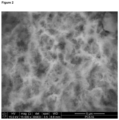
- Figure 2 shows an image obtained by scanning electron microscopy of the layered solid hydroxide of the solid composition.
- Component B is activated carbon which corresponds to the product characterised by this name and which has a CAS number of 7440-44-0 .
- the composite is obtained by simple intimate mixing of components A and B (85 - 92.5% of A and 15 - 7.5% of B). This mixture can be made at room temperature (25 °C). The mixture is prepared at atmospheric pressure.
- Figure 3 shows the results of the determination of the reduction power by means of a test with ferricyanide for a control without the composite, component A, component B and the composite formed by component A and B.
- FIG. 4 (a) shows the ppm concentration of each of the metals in the aqueous solution. After 24 hours, the concentration of each of the metals in the aqueous solution is determined (See Figure 4 (b)).
- Figure 4 (b) shows a decrease in the concentration of metals either completely or greater than 80% in all of them.
- Figure 5 (a) shows an image obtained by scanning electron microscopy (SEM) of Composite after 24h in contact with the aqueous solution of heavy metals (Mn, Cu, Ni, Zn) and Figure 5 (b) a microanalysis obtained by the energy-dispersive X-ray spectroscopy technique of the surface of said Sample 1.
- Figure 5 (b) shows the peaks corresponding to the heavy metals contained in the treated solution. This result agrees with that obtained when analysing the presence of metals in solution after being treated with the composite ( Figure 4b ), linking the disappearance of metals from the solution with their presence in the composite.
- the composite is added to 200 ml of a lindane aqueous solution (Control).
- components A and B of the composite are added separately to 200 ml of two lindane aqueous solutions (Control), independently.
- Figure 6 shows the ppb concentration of lindane in the control solution and in the rest of the solutions with the composite, components A and B, after desorption thereof with hexane.
- 0.1 g of activated carbon are added to 200 ml of an aqueous solution of 200 ppm of phenol.
- Bcc relates to a biochar obtained from leonardite
- Bcv relates to a biochar of vegetable origin.
- phenol in solution is determined by measuring the absorbance at 270 nm, and the adsorbed phenol is calculated by the difference.
- Figure 7 shows the percentage of phenol adsorbed for activated carbon and biochar. It can be seen how the two biochars are less efficient when it comes to adsorbing phenol compared to the sample comprising activated carbon.
- a 15% dose of the composite is added to 5 kg of soil and compared with another untreated soil. After applying the treatments, it is watered to hydrate the mixture and put it in contact with the contaminant.
- the soils are sludge that are part of the Bail ⁇ n landfill in Sabi ⁇ ánigo and contain 500 ppm of different hexachlorocyclohexane isomers.
- the concentration of the sum of hexachlorocyclohexane isomers in the soil is determined at 7, 14, 28 and 50 days from the application of the composite.
- Figure 8 shows the concentration of the sum of hexachlorocyclohexane isomers in real Sabi ⁇ ánigo soil (ppm) at 7, 14, 28 and 50 days after the application of 15% of the composite to the soil.
- the composite is capable of removing between 60-70% of the hexachlorocyclohexanes present in the soil, beyond the 20% that disappears over time in the non-composite control.
- the composite is applied at a dose of 15% to 15 kg of soil and compared to untreated soil. After applying the treatments, it is watered to hydrate the mixture and put it in contact with the contaminant.
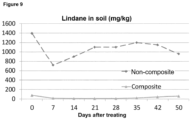
- the test is carried out on an alkaline soil doped with 500 ppm of lindane and 1000 ppm of heavy metals (Cu, Mn, Ni, Zn, Cd, As and Pb).
- the concentration of the sum of lindane in soil is determined from 24 hours to 50 days after the application of the composite.
- the concentration of heavy metals (Cu, Mn, Ni, Zn, Cd, As and Pb) soluble in soil (ppm) extracted with DTPA, triethanolamine and CaCl 2 is determined.
- Figure 9 shows the concentration of the sum of lindane isomers in soil (ppm) in an alkaline soil doped with 500 ppm lindane and 1000 ppm heavy metals (Cu, Mn, Ni, Zn, Cd, As and Pb) from 24 hours to 50 days from the application of 15% of the composite to the soil. As can be observed, there is an irreversible and total removal of the lindane present in the soil from the first intake.
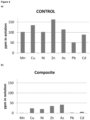
- Figure 10 shows the soil-soluble heavy metal concentration (ppm) in an alkaline soil doped with 500 ppm lindane and 1000 ppm heavy metals (Cu, Mn, Ni, Zn, Cd, As and Pb) after 24 hours ( Figure 10 a) and 50 days ( Figure 10 b) from the application of 15% of the composite to the soil.
- the results show that the metals that persist in soil solution (Mn, Ni, Cd and Zn) are completely fixed by the composite after 24 hours of application and that said removal from the medium remains stable over time when observing the results at 50 days.
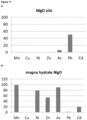
- MgO silo magnesium oxide of different origins
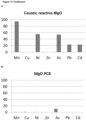
- magna hydrate MgO reactive caustic
- MgO, MgO PC8 MgO from the exemplary composite
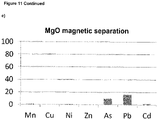
- MgO magnetic separation 0.1 g of the different types of magnesium oxide were applied to a solution of 100 ppm of Mn, Cu, Ni, Zn, As, Pb and Cd and after 24h of contact, the concentration of metals present in the supernatant was determined.
- Figure 11 shows the ppm concentration of Mn, Cu, Ni, Zn, As, Pb and Cd in aqueous solution after 24h of contact between the starting aqueous solution and 0.1 g of the different types of magnesium oxide tested. According to said figure, it can be seen how there is a variation in the effectiveness of the different magnesium oxides with the various metals, the magnesium oxide of the composite being the most effective in the essentially complete removal of all metals.
Landscapes
- Chemical & Material Sciences (AREA)
- Organic Chemistry (AREA)
- Inorganic Chemistry (AREA)
- Chemical Kinetics & Catalysis (AREA)
- Life Sciences & Earth Sciences (AREA)
- Analytical Chemistry (AREA)
- Engineering & Computer Science (AREA)
- Environmental & Geological Engineering (AREA)
- Hydrology & Water Resources (AREA)
- Water Supply & Treatment (AREA)
- Geology (AREA)
- Soil Sciences (AREA)
- General Life Sciences & Earth Sciences (AREA)
- Materials Engineering (AREA)
- Processing Of Solid Wastes (AREA)
Applications Claiming Priority (1)
| Application Number | Priority Date | Filing Date | Title |
|---|---|---|---|
| ES202130802A ES2934262B2 (es) | 2021-08-20 | 2021-08-20 | Composite para la eliminación simultánea e irreversible de contaminantes inorgánicos y orgánicos en aguas o suelos |
Publications (1)
| Publication Number | Publication Date |
|---|---|
| EP4137230A1 true EP4137230A1 (de) | 2023-02-22 |
Family
ID=83149562
Family Applications (1)
| Application Number | Title | Priority Date | Filing Date |
|---|---|---|---|
| EP22382781.7A Pending EP4137230A1 (de) | 2021-08-20 | 2022-08-11 | Komposite zum gleichzeitigen und irreversiblen entfernen von anorganischen und organischen kontaminationen aus wasser und boden |
Country Status (2)
| Country | Link |
|---|---|
| EP (1) | EP4137230A1 (de) |
| ES (1) | ES2934262B2 (de) |
Families Citing this family (1)
| Publication number | Priority date | Publication date | Assignee | Title |
|---|---|---|---|---|
| CN116459838B (zh) * | 2023-06-02 | 2026-03-17 | 东华大学 | 一种ZnFe-LDH@LCF复合材料、其制备方法以及应用 |
Citations (4)
| Publication number | Priority date | Publication date | Assignee | Title |
|---|---|---|---|---|
| US20040065619A1 (en) * | 2002-10-04 | 2004-04-08 | Klabunde Kenneth J. | Carbon-coated metal oxide nanoparticles |
| CN106311138A (zh) * | 2016-09-01 | 2017-01-11 | 桂林理工大学 | 一种蔗渣炭/镁铁水滑石复合吸附剂的制备方法 |
| CN111001375A (zh) * | 2019-12-29 | 2020-04-14 | 福建工程学院 | 一种层状双氢氧化物复合吸附材料的制备方法 |
| CN112221469A (zh) * | 2020-10-26 | 2021-01-15 | 成都达奇环境科技有限公司 | 一种去除水中硝酸盐吸附材料及其制备方法 |
Family Cites Families (1)
| Publication number | Priority date | Publication date | Assignee | Title |
|---|---|---|---|---|
| JPS58214338A (ja) * | 1982-06-04 | 1983-12-13 | Kyowa Chem Ind Co Ltd | 複合吸着剤 |
-
2021
- 2021-08-20 ES ES202130802A patent/ES2934262B2/es active Active
-
2022
- 2022-08-11 EP EP22382781.7A patent/EP4137230A1/de active Pending
Patent Citations (4)
| Publication number | Priority date | Publication date | Assignee | Title |
|---|---|---|---|---|
| US20040065619A1 (en) * | 2002-10-04 | 2004-04-08 | Klabunde Kenneth J. | Carbon-coated metal oxide nanoparticles |
| CN106311138A (zh) * | 2016-09-01 | 2017-01-11 | 桂林理工大学 | 一种蔗渣炭/镁铁水滑石复合吸附剂的制备方法 |
| CN111001375A (zh) * | 2019-12-29 | 2020-04-14 | 福建工程学院 | 一种层状双氢氧化物复合吸附材料的制备方法 |
| CN112221469A (zh) * | 2020-10-26 | 2021-01-15 | 成都达奇环境科技有限公司 | 一种去除水中硝酸盐吸附材料及其制备方法 |
Non-Patent Citations (9)
| Title |
|---|
| ABDULLAH M. ALDAWSARI ET AL.: "Tailoring an efficient nanocomposite of activated carbon-layered double hydroxide for elimination of water-soluble dyes", JOURNAL OF ALLOYS AND COMPOUNDS, vol. 857, no. 4, October 2020 (2020-10-01), XP086467593, DOI: 10.1016/j.jallcom.2020.157551 |
| AL JUBOURY ET AL.: "Using of activated carbon derived from agricultural waste coating by layered double hydroxide for copper adsorption", IRAQI JOURNAL OF AGRICULTURAL SCIENCES, vol. 50, no. 5, 2019, pages 1446 - 1454 |
| ALAGHA OMAR ET AL: "Magnetic Mg-Fe/LDH Intercalated Activated Carbon Composites for Nitrate and Phosphate Removal from Wastewater: Insight into Behavior and Mechanisms", NANOMATERIALS, vol. 10, no. 7, 12 July 2020 (2020-07-12), pages 1361, XP093010716, ISSN: 2079-4991, DOI: 10.3390/nano10071361 * |
| CAS , no. 7440-44-0 |
| METHTHIKA VITHANAGEAHMED ASHIQSAMMANI RAMANAYAKAAMIT BHATNAGAR ET AL.: "Implications of layered double hydroxides assembled biochar composite in adsorptive removal of contaminants: Current status and future perspectives", SCIENCE OF THE TOTAL ENVIRONMENT, vol. 737, 1 October 2020 (2020-10-01), pages 139718 |
| MUKARRAM ET AL.: "Sustainable wastewater treatment by biochar/layered double hydroxide composites: Progress, challenges, and Outlook", BIORESOURCE TECHNOLOGY, vol. 319, January 2021 (2021-01-01), pages 124128 |
| SONG, XIANGRU ET AL.: "Enhanced electron transfer and methane production from low-strength wastewater using a new granular activated carbon modified with nano-Fe304", CHEMICAL ENGINEERING JOURNAL, vol. 374, 2019, pages 1344 - 1352, XP085749099, DOI: 10.1016/j.cej.2019.05.216 |
| YIN, CHUN YANGMOHD KHEIREDDINE AROUAWAN MOHD ASHRIWAN DAUD: "Review of modifications of activated carbon for enhancing contaminant uptakes from aqueous solutions", SEPARATION AND PURIFICATION TECHNOLOGY, vol. 52, no. 3, 2007, pages 403 - 415, XP005785609, DOI: 10.1016/j.seppur.2006.06.009 |
| ZHEN TANG ET AL.: "Functionalized layered double hydroxide applied to heavy metal ions absorption: A review", NANOTECHNOLOGY REVIEWS, vol. 9, 2020, pages 800 - 819 |
Also Published As
| Publication number | Publication date |
|---|---|
| ES2934262A1 (es) | 2023-02-20 |
| ES2934262B2 (es) | 2023-11-16 |
Similar Documents
| Publication | Publication Date | Title |
|---|---|---|
| Dong et al. | Simultaneous adsorption of Cr (VI) and phenol by biochar-based iron oxide composites in water: Performance, kinetics and mechanism | |
| Kanel et al. | Arsenic contamination in groundwater: Geochemical basis of treatment technologies | |
| Gao et al. | Risk assessment of heavy metals in pipe scales and loose deposits formed in drinking water distribution systems | |
| Kawahara et al. | Polynuclear aromatic hydrocarbon (PAH) release from soil during treatment with Fenton's reagent | |
| CN103608104B (zh) | 含多孔碳基材的复合吸附材料 | |
| Qiu et al. | A study of cadmium remediation and mechanisms: Improvements in the stability of walnut shell-derived biochar | |
| Pourrezaei et al. | Removal of organic compounds and trace metals from oil sands process-affected water using zero valent iron enhanced by petroleum coke | |
| Mandal et al. | Disposal problem of arsenic sludge generated during arsenic removal from drinking water | |
| Majeed et al. | A review on environmental contamination of petroleum hydrocarbons, its effects and remediation approaches | |
| Islam et al. | Immobilization and reduction of bioavailability of lead in shooting range soil through hydrothermal treatment | |
| WO2022109661A1 (en) | Modified clay sorbents | |
| Bo et al. | Influence of supercritical water treatment on heavy metals in medical waste incinerator fly ash | |
| EP4137230A1 (de) | Komposite zum gleichzeitigen und irreversiblen entfernen von anorganischen und organischen kontaminationen aus wasser und boden | |
| Abbas et al. | Virgin (Fe0) and microbially regenerated (Fe2+) iron turning waste for treating chlorinated pesticides in water | |
| Ai et al. | Chlorinated solvent degradation in groundwater by green rust–bone char composite: solute interactions and chlorinated ethylene competition | |
| Ma et al. | Ligand-mediated contaminant degradation by bare and carboxymethyl cellulose-coated bimetallic palladium-zero valent iron nanoparticles in high salinity environments | |
| Erro et al. | MgO-mediated activation of active carbon as an affordable strategy to “in situ” degradation of lindane in contaminated soils | |
| Morris et al. | An assessment of the reductive debromination of polybrominated biphenyls in the Pine River Reservoir | |
| Göktepeli et al. | Phenol adsorption on magnetic biochar derived from olive pomace: Equilibrium, kinetic and thermodynamics | |
| Sil et al. | Strategies for mitigation of polychlorinated biphenyls (PCBs): A review | |
| Zhang et al. | Effects of sedimentary organic matter degradation and structure on nonylphenol degradation by sodium persulfate | |
| Akbari et al. | Remediation of soil and groundwater polluted by polycyclic aromatic hydrocarbons: a review | |
| Faizan et al. | Nanotechnology in the restoration of polluted/degraded soil | |
| Emmanuel et al. | Zero-valent iron and its derivative composites for heavy metal adsorption | |
| Allamin | Phytoremediation of heavy metals in contaminated soils: a review |
Legal Events
| Date | Code | Title | Description |
|---|---|---|---|
| PUAI | Public reference made under article 153(3) epc to a published international application that has entered the european phase |
Free format text: ORIGINAL CODE: 0009012 |
|
| STAA | Information on the status of an ep patent application or granted ep patent |
Free format text: STATUS: THE APPLICATION HAS BEEN PUBLISHED |
|
| AK | Designated contracting states |
Kind code of ref document: A1 Designated state(s): AL AT BE BG CH CY CZ DE DK EE ES FI FR GB GR HR HU IE IS IT LI LT LU LV MC MK MT NL NO PL PT RO RS SE SI SK SM TR |
|
| STAA | Information on the status of an ep patent application or granted ep patent |
Free format text: STATUS: REQUEST FOR EXAMINATION WAS MADE |
|
| 17P | Request for examination filed |
Effective date: 20230328 |
|
| RBV | Designated contracting states (corrected) |
Designated state(s): AL AT BE BG CH CY CZ DE DK EE ES FI FR GB GR HR HU IE IS IT LI LT LU LV MC MK MT NL NO PL PT RO RS SE SI SK SM TR |