EP4137968A1 - Procédé et dispositif informatique dans lesquels les définitions sémantiques sont composées sous la forme d'un méta-ensemble sémantique - Google Patents
Procédé et dispositif informatique dans lesquels les définitions sémantiques sont composées sous la forme d'un méta-ensemble sémantique Download PDFInfo
- Publication number
- EP4137968A1 EP4137968A1 EP22191008.6A EP22191008A EP4137968A1 EP 4137968 A1 EP4137968 A1 EP 4137968A1 EP 22191008 A EP22191008 A EP 22191008A EP 4137968 A1 EP4137968 A1 EP 4137968A1
- Authority
- EP
- European Patent Office
- Prior art keywords
- semantic
- statements
- concept
- operator
- definition
- Prior art date
- Legal status (The legal status is an assumption and is not a legal conclusion. Google has not performed a legal analysis and makes no representation as to the accuracy of the status listed.)
- Withdrawn
Links
Images




Classifications
-
- G—PHYSICS
- G06—COMPUTING OR CALCULATING; COUNTING
- G06F—ELECTRIC DIGITAL DATA PROCESSING
- G06F16/00—Information retrieval; Database structures therefor; File system structures therefor
- G06F16/50—Information retrieval; Database structures therefor; File system structures therefor of still image data
- G06F16/53—Querying
- G06F16/532—Query formulation, e.g. graphical querying
-
- G—PHYSICS
- G06—COMPUTING OR CALCULATING; COUNTING
- G06F—ELECTRIC DIGITAL DATA PROCESSING
- G06F16/00—Information retrieval; Database structures therefor; File system structures therefor
- G06F16/30—Information retrieval; Database structures therefor; File system structures therefor of unstructured textual data
- G06F16/33—Querying
- G06F16/338—Presentation of query results
-
- G—PHYSICS
- G06—COMPUTING OR CALCULATING; COUNTING
- G06F—ELECTRIC DIGITAL DATA PROCESSING
- G06F16/00—Information retrieval; Database structures therefor; File system structures therefor
- G06F16/30—Information retrieval; Database structures therefor; File system structures therefor of unstructured textual data
- G06F16/31—Indexing; Data structures therefor; Storage structures
- G06F16/316—Indexing structures
-
- G—PHYSICS
- G06—COMPUTING OR CALCULATING; COUNTING
- G06F—ELECTRIC DIGITAL DATA PROCESSING
- G06F16/00—Information retrieval; Database structures therefor; File system structures therefor
- G06F16/30—Information retrieval; Database structures therefor; File system structures therefor of unstructured textual data
- G06F16/35—Clustering; Classification
- G06F16/353—Clustering; Classification into predefined classes
-
- G—PHYSICS
- G06—COMPUTING OR CALCULATING; COUNTING
- G06F—ELECTRIC DIGITAL DATA PROCESSING
- G06F40/00—Handling natural language data
- G06F40/20—Natural language analysis
- G06F40/237—Lexical tools
- G06F40/242—Dictionaries
-
- G—PHYSICS
- G06—COMPUTING OR CALCULATING; COUNTING
- G06F—ELECTRIC DIGITAL DATA PROCESSING
- G06F40/00—Handling natural language data
- G06F40/30—Semantic analysis
-
- G—PHYSICS
- G06—COMPUTING OR CALCULATING; COUNTING
- G06F—ELECTRIC DIGITAL DATA PROCESSING
- G06F40/00—Handling natural language data
- G06F40/40—Processing or translation of natural language
Definitions
- the invention relates to the field of semantic definitions. More particularly, the invention relates to representing semantic definitions in a computing device as semantic metadata for use in semantic processing and configurable semantic search.
- An object can be described by its visual semantic attributes and non-visual semantic attributes, where relationships between the semantic attributes are determined based on definitions provided in databases during steps of visual processing, as described in Japan Patent No. 6830514 .
- a database may provide semantic relationships between "lemon” and semantic attributes such as "citrus fruit”, “sour”, “vitamin C,” and "edible.”
- the present application discloses a method of representing semantic definitions on a computing device.
- Semantic definition statements are composed using operators.
- the semantic definition statements include semantic concept statements using semantic concept operators and semantic context statements using semantic context operators.
- the semantic definition statements are saved in a metaset.
- the metaset is converted into a digital data structure and stored in a memory storage device of a computing device.
- the semantic definition statements may also include operators for semantic marker statements, semantic marker collection statements, semantic realm statements, semantic inheritance statements, semantic instance statements, lexical function statements, semantic internationalization statements, or semantic references.
- the present application further discloses a method of semantically searching for a visual.
- Input is received via a computer interface, and semantic expressions are derived from the input.
- Types of semantic definitions are determined to be applied to a search.
- the types of semantic definitions may include semantic element definitions, semantic concept definitions, semantic context definitions, semantic marker definitions, semantic realm definitions, semantic instance definitions, semantic inheritance definitions, semantic internationalization definitions, lexical functions definitions, or semantic reference definitions.
- Metasets having semantic definition statements representing semantic definitions may also be applied to the search.
- the search is performed based on the input and the determined types of semantic definitions, as well as any selected metasets.
- a list of visuals determined to have semantic relevance to the input based on the search is output.
- the present application further discloses a method of selecting semantic definitions from a metaset.
- Semantic definition statements representing semantic definitions are retrieved from metasets.
- Each semantic definition statement includes a subject operand, an operator, and at least one object operand.
- a set of semantic expressions based on the semantic definition statements is output.
- the semantic expressions have selectable items corresponding to the operand(s).
- a selection of the selectable items is received.
- Selected semantic definitions are determined based on the set of semantic expressions and the selection of the selectable items. Selecting semantic definitions from a metaset may be used for metaset navigation or metaset filtering.
- Composing, editing, querying, saving, searching, or otherwise interacting with a metaset may be performed using a semantic definition management editor.
- the methods disclosed in this application may be stored on a non-transitory computer readable medium as instructions executable by a processor.
- Fig. 1 illustrates a method of representing semantic definitions on a computing device 100 according to an embodiment of the present invention.
- Representing semantic definitions according to a method of representing semantic definitions on a computing device 100 has several technical advantages over the prior art.
- Metasets provide an efficient data structure for representing semantic attributes and the relationships between the various semantic attributes. Metasets can be easily stored and accessed for a wide variety of functions, including visual definition processing, editing, querying, filtering, navigation, and search.
- the representations of semantic definitions as semantic definition statements may be configured to strictly follow and implement the precise semantic definitions described in Japan Patent No. 6830514 .
- metasets and semantic definition statements are flexible (semantic definitions can be represented across unlimited knowledge domains), extensible (various semantic definitions in Japan Patent No. 6830514 can be implemented along with new definitions such as semantic references, semantic internationalization, and further not-yet-specified definitions without any limitation), and personalized/specialized/democratized (knowledge can be expressed in semantic definitions differently by experts/individual via metasets with references to sources of knowledge).
- semantic definition statements are composed.
- the semantic definition statements represent semantic definitions, which describe semantic attributes and their relationships.
- the semantic definition statements may represent various types of semantic definitions described in Japan Patent No. 6830514 , including but not limited to semantic element, semantic concept, semantic context, semantic marker, semantic realm, semantic inheritance, semantic instance, and lexical function.
- the semantic definition statements may further represent semantic internationalization and semantic references (described below).
- the semantic definition statements may further represent non-yet-specified semantic definitions.
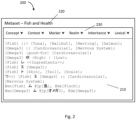
- Semantic definitions may be composed in a semantic definition management editor, as seen in Fig. 2 . Alternatively, semantic definitions may be composed in any program capable of text editing.
- Semantic definition statements are constructed using operators and operands. Semantic definition statements generally include a subject operand, an operator, and an object operand. Some semantic definitions may include multiple subject operands, multiple operators, or multiple object operands. Subject operands, operators, and object operands may appear in any order. In one embodiment, the left-to-right order is subject operands, operators, and object operands. Operands may be words, and the operators may be symbols and/or alphanumeric. Semantic definition statements can be composed in any language or character set, including those of double-byte languages such as Japanese. Each semantic definition statement may end with a semi-colon or another character to indicate the end of the statement.
- a semantic element is the most basic component of a semantic definition statement. Semantic elements may be visual or non-visual semantic attributes.
- a semantic element statement may include a semantic element operator indicating that a block of text is defined as a semantic element.
- two square brackets are a semantic element operator defining the text within the brackets as a semantic element, such as "[Grape]".
- a semantic element may also refer generally to any individual element of a semantic definition statement, such as a semantic concept, a semantic realm, a semantic instance, etc.
- a semantic concept is a general notion, taxonomy, or hierarchical structure that expresses a semantic relationship.
- a semantic concept statement expresses a semantic concept relationship through a semantic element representing the semantic concept as a subject operand, a semantic concept operator, and one or more semantic elements that are object operands.
- a general semantic concept statement may have the form "[A] :: [B], [C], [D];", where "::” is a general semantic concept operator and object operands are separated by commas.
- a semantic concept relationship in a hierarchical structure describing a "type of” relationship, an "is a" relationship, or a taxonomical structure is defined as a hypernym/hyponym relationship.
- "::>” is a hypernym operator
- " ⁇ ::” is a hyponym operator.
- “[Fruit] ::> [Grape], [Orange], [Mango];” may be a hypernym semantic concept statement
- “[Grape], [Raspberry], [Blueberry] ⁇ :: [Berry];” may be a hyponym semantic concept statement.
- a semantic concept relationship in a hierarchical structure describing a whole/part relationship is defined as a holonym/meronym relationship.
- " " is a holonym operator
- " " is a meronym operator.
- [Fruit] [Skin], [Flesh], [Seed];” is a holonym semantic concept statement
- [Root], [Trunk], [Branch], [Bark], [Leaves], [Flower] [Tree];” is a meronym semantic concept statement.
- a semantic concept relationship in which a precise action word is used to define a general verb is defined as a troponym relationship.
- "//>" and “// ⁇ ” are troponym operators. For example, “[Cut] //> [Trim], [Slice];”, “[Walk] //> [Stroll];”, and "[Snack], [Nibble] // ⁇ [Eat];” are troponym semantic concept statements.
- a specific type of semantic concept relationship not indicated by a pre-defined operator may be indicated using a free semantic concept operator.
- a free semantic concept operator may be a set of double parentheses appended to a semantic concept statement that uses the general semantic concept operator, and the double parentheses may surround a free text description of the semantic concept relationship.
- “[Anti-Oxidant] :: (( protect cell membrane from radical damage ));” is a free semantic concept statement defining the semantic concept "Anti-Oxidant” as having a semantic concept relationship with the free text "protect cell membrane from radical damage” because anti-oxidants protect cell membranes from radical damage.
- a semantic context defines a semantic relationship between two or more semantic concepts.
- a semantic context statement expresses a semantic context relationship through at least a first semantic concept as a subject operand, a semantic context operator, and a second semantic concept as an object operand.
- the semantic context relationship may be further defined using another semantic context operator and one or more semantic elements.
- a semantic context statement may have the form "[A] [B];” where A and B are semantic concepts and " " is a semantic context operator. For example, "[Plants] [Soil];” is a semantic context statement defining a semantic context relationship between "Plants" and "Soil”.
- Another semantic context statement may have the form "[A] [B] :: [C];” where "::” is a second semantic context operator and C is a semantic element describing the semantic context relationship.
- the second semantic context operator may be the same symbol as the general semantic concept operator.
- [Plants] [Soil] :: [Nutrients];” is a semantic context statement defining a semantic context relationship between "Plants” and “Soil” with “Nutrients” as a member of the relationship.
- “Plants” and “Soil” are semantic contextually related via "Nutrients”.
- a specific type of semantic context relationship not indicated by a pre-defined semantic context operator may be indicated using a free semantic context operator.
- a free semantic context operator may be a set of double parentheses appended to a semantic context statement, and the double parentheses may surround a free text description of the semantic context relationship. For example, "[Anti-Inflammation] [Grape] :: (( * research studies done with grape extracts. ));” describes a free semantic context where the relationship between Anti-Inflammation and Grapes is supported by research studies done with grape extracts.
- a semantic marker defines a semantic relationship between semantic elements, such as those in semantic concept or semantic context relationships, in specific terms.
- a semantic marker statement may have a similar syntax as another type of statement, such as a semantic concept statement or a semantic context statement, but with a semantic marker operator replacing another operator.
- Text associated with the semantic marker operator may represent the semantic marker.
- a semantic marker operator is a set of single parentheses surrounding the descriptive text of a semantic marker.
- a semantic concept statement having the syntax "[A] :: [B], [C];” or a semantic context statement having the syntax "[A] [B], [C];” may be further described by a corresponding semantic marker statement having the syntax "[A] (semantic marker) [B], [C];”.
- the semantic concept statement “[Grape] :: [Raisin], [Wine];” may be further defined using the semantic marker statement “[Grape] (made into) [Raisin], [Wine];”.
- the semantic context statement "[Plants] [Soil];” may be further defined using the semantic marker statement "[Plants] (grown in) [Soil];”.
- semantic markers related to a common operand may be collected as a semantic marker collection.
- the common operand may be a semantic concept that appears as a subject operand in multiple semantic marker statements having different semantic markers.
- a semantic marker collection statement represents a semantic marker collection relationship using a semantic marker collection operator.
- a semantic marker collection statement may have the form "[A] (SemanticMarker1), (SemanticMarker2);” where " " is a semantic marker collection operator.
- semantic concept "[Fruit]” may appear in the following semantic concept statements and semantic context statements: "[Fruit] :: [Juice];” , “[Fruit] :: [Grape];", “[Fruit] :: [Citrus Fruit];”, “[Fruit] [Orchard];", and “[Fruit] [Health];”.
- semantic concept statements and semantic context statements may be further described in the following semantic marker statements: "[Fruit] (made into) [Juice];” , “[Fruit] (type) [Grape];", “[Fruit] (variety) [Citrus Fruit];”, “[Fruit] (grown in) [Orchard];", and “[Fruit] (good for) [Health];”.
- the semantic markers used in these semantic marker statements, which are related by having the semantic concept "[Fruit]” in common may be represented as a semantic marker collection in the semantic marker collection statement "[Fruit] (grown in), (made into), (type), (variety), (good for);”.
- a semantic realm defines a domain of knowledge that intersects with a number of other domains of knowledge.
- a semantic realm may be less specific than a semantic concept.
- a semantic realm relationship may differ from a semantic concept relationship in that the semantic realm relationship is not bound by a structure or hierarchical nature.
- a semantic realm statement may include a semantic realm, a semantic realm operator, and a semantic element, a semantic concept, a semantic marker, or another semantic realm to assign to the semantic realm.
- a semantic realm statement has the general form "[A] ⁇ Semantic Realm>>;" where " " is a semantic realm operator and the operator " « »" indicates a semantic realm.
- the semantic realm statement "[Cardiovascular], [Respiratory] ⁇ Medicine>>;” assigns the semantic elements or semantic concepts "Cardiovascular” and “Respiratory” to the semantic realm of "Medicine”.
- the semantic realm statement "(grown in) ⁇ Geography>>;” assigns the semantic marker "grown in” to the semantic realm of "Geography”.
- Multiple semantic markers may be assigned to a single semantic realm in one semantic realm statement, such as "(good for), (benefits) ⁇ Health>>;”.
- a semantic realm may be assigned to another semantic realm, such as " ⁇ City>> «Geography»;”.
- a semantic realm may be a semantic super-realm, which is one of two mutually exclusive semantic realms.
- a pair of semantic super-realms may be " ⁇ EDIBLE>>” and " ⁇ NON-EDIBLE>>”.
- the semantic realm statement " ⁇ Ingredients>> ⁇ EDIBLE>>;” assigns the semantic realm "Ingredients” to the sematic super-realm “EDIBLE”.
- « Ingredients » may not be assigned to « NON-EDIBLE Museum
- Semantic inheritance allows semantic relationships of semantic elements or semantic concepts that are defined via semantic concepts or semantic contexts to be extended to other semantic elements or semantic concepts. Semantic inheritance can be applied to siblings of semantic elements or semantic concepts, to children (descendingly) of semantic elements or semantic concepts, or to parents (ascendingly) of semantic elements or semantic concepts, for a specified number of levels (N-levels) or all levels of available semantic concept or semantic context relationships of a semantic element or semantic concept marked for inheritance.
- a semantic inheritance statement for siblings as applied to semantic concept statements has the form " s [A] :: [X], [Y], [Z];” where " s” is a semantic inheritance operator indicating semantic inheritance at the sibling level to be applied to the semantic concept statement "[A] :: [X], [Y], [Z];”.
- a semantic inheritance statement for siblings as applied to semantic context statements has the form " s [A] [B] :: [X], [Y], [Z];” where " s” is a semantic inheritance operator indicating semantic inheritance at the sibling level to be applied to the semantic context statement "[A] [B] :: [X], [Y], [Z];”.
- Semantic concept relationships can be extended N-levels descendingly to children of a semantic element or semantic concept. This may be done by indicating the descending direction and the inheritance level with the semantic inheritance operator and the intended semantic element or semantic concept.
- the computer system performing the method of representing semantic definitions on a computing device 100 will search for the existence of Hypernym/Hyponym, Holonym/Meronym, or Troponym relationships containing the intended semantic element or semantic concept and traverse accordingly through the indicated number of descending levels, and extend the semantic concept relationship for each of the applicable semantic elements or semantic concepts.
- an N-level descending semantic inheritance statement for semantic concept relationships has the form " >>n [A] :: [X], [Y], [Z];” where " >>n” is a semantic inheritance operator in which "»" indicates the descending direction and "n” indicates the number of levels to traverse.
- "[Fruit] ::> [Grape], [Tomato], [Persimmon];” exists, " >>1 [Fruit] :: [Anti-microbial];” will create semantic inheritance descending one level such that "Grape", “Tomato”, and “Persimmon” which are hyponyms of "Fruit” will each inherit a semantic concept relationship with the semantic element "Anti-microbial”.
- semantic context relationships can be extended N-levels descendingly to children of a semantic element or semantic concept. This may be done by indicating the descending direction and the inheritance level with the semantic inheritance operator and the intended semantic element or semantic concept.
- the system will search for the existence of Hypernym/Hyponym, Holonym/Meronym or Troponym relationships containing the intended semantic element or semantic concept and traverse accordingly through the indicated number of descending levels, and extend the semantic context relationship for each of the applicable semantic elements or semantic concepts.
- an N-level descending semantic inheritance statement for semantic context relationships has the form " >>n [A] [B];" where " >>n” is a semantic inheritance operator in which ">>” indicates the descending direction and "n” indicates the number of levels to traverse.
- an N-level descending semantic inheritance statement has the form " >>n [A] [B] :: [X], [Y], [Z];”.
- semantic context relationships has the form " >>n [A] [B] :: [X], [Y], [Z];”.
- Semantic concept relationships can be extended to all available levels descendingly to children of a semantic element or semantic concept. This may be done by indicating the descending direction and all levels with the semantic inheritance operator and the intended semantic element or semantic concept.
- the system will search for the existence of Hypernym/Hyponym, Holonym/Meronym, or Troponym relationships containing the intended semantic element and traverse all descending levels, and extend the semantic concept relationship for each of the applicable semantic elements or semantic concepts.
- an all-level descending semantic inheritance statement for semantic concept relationships has the form " >>a [A] :: [X], [Y], [Z];” where " >>a” is a semantic inheritance operator in which ">>” indicates the descending direction and "a” indicates traversal of all levels.
- semantic context relationships can be extended to all available levels descendingly to children of a semantic element or semantic concept. This may be done by indicating the descending direction and all levels with the semantic inheritance operator and the intended semantic element or semantic concept.
- the system will search for the existence of Hypernym/Hyponym, Holonym/Meronym, or Troponym relationships containing the intended semantic element or semantic concept and traverse all descending levels, and extend the semantic context relationship for each of the applicable semantic elements or semantic concepts.
- an all-level descending semantic inheritance statement for semantic context relationships has the form " >>a [X] [A], [B], [C];” where " >>a” is a semantic inheritance operator in which ">>” indicates the descending direction and "a” indicates the traversal of all levels.
- semantic concept relationships can be extended N-levels ascendingly to parents of a semantic element or semantic concept. This may be done by indicating the ascending direction and the inheritance level with the semantic inheritance operator and the intended semantic element or semantic concept.
- the system will search for the existence of Hypernym/Hyponym, Holonym/Meronym, or Troponym relationships containing the intended semantic element or semantic concept and traverse the indicated number of ascending levels, and extend the semantic concept relationship for each of the applicable semantic elements or semantic concept.
- relationships may be further extended to members of parents, such as hyponyms, meronyms, or troponyms of parents.
- an N-level ascending semantic inheritance statement for semantic concept relationships has the form “ ⁇ n [A] :: [X], [Y], [Z];” where " ⁇ n” is a semantic inheritance operator in which " ⁇ ” indicates the ascending direction and "n” indicates the number of levels to traverse.
- ⁇ n is a semantic inheritance operator in which " ⁇ ” indicates the ascending direction and "n” indicates the number of levels to traverse.
- ascending inheritance includes siblings, or other children of the parent, such that "Raspberry” and “Blueberry” would also inherent “Anti-microbial”.
- semantic context relationships can be extended N-levels ascendingly to parents of a semantic element or semantic concept. This may be done by indicating the ascending direction and the inheritance level with the semantic inheritance operator and the intended semantic element or semantic concept.
- the system will search for the existence of Hypernym/Hyponym, Holonym/Meronym, or Troponym relationships containing the intended semantic element or semantic concept and traverse the indicated number of ascending levels, and extend the semantic context relationship for each of the applicable semantic elements or semantic concepts.
- an N-level ascending semantic inheritance statement for semantic context relationships has the form “ ⁇ n [A] [B];” where " ⁇ n” is a semantic inheritance operator in which " ⁇ ” indicates the ascending direction and “n” indicates the number of levels to traverse.
- an N-level ascending semantic inheritance statement for semantic context relationships has the form " ⁇ n [A] [B] :: [X], [Y], [Z];”.
- the statements "[Vegetables] ::> [Cruciferous vegetables], [Root vegetables];” and “[Cruciferous vegetables] ::> [Broccoli], [Cauliflower];” exist, " ⁇ 2 [Cauliflower] [Health] :: [Anti-inflammation];” will create semantic inheritance ascending two levels above “Cauliflower” such that "Cruciferous vegetables", which is a first level hypernym of "Cauliflower”, and “Vegetables", which is a second level hypernym of "Cauliflower” through “Cruciferous vegetables”, will inherit a semantic context relationship with the semantic concept "Health” together with the semantic element "Anti-inflammation” as a member of the semantic context relationship.
- Semantic concept relationships can be extended to all available levels ascendingly to parents of a semantic element or semantic concept. This may be done by indicating the ascending direction and all levels with the semantic inheritance operator and the intended semantic element or semantic concept.
- the system will search for the existence of Hypernym/Hyponym, Holonym/Meronym, or Troponym relationships containing the intended semantic element or semantic concept and traverse all ascending levels, and extend the semantic concept relationship for each of the applicable semantic elements or semantic concepts.
- an all-level ascending semantic inheritance statement for semantic concept relationships has the form " ⁇ a [A] :: [X], [Y], [Z];” where " ⁇ a” is a semantic inheritance operator in which " ⁇ ” indicates the ascending direction and "a” indicates traversal of all levels.
- semantic context relationships can be extended to all levels ascendingly to parents of a semantic element or semantic concept. This may be done by indicating the ascending direction and all levels with the semantic inheritance operator and the intended semantic element or semantic concept.
- the system will search for the existence of Hypernym/Hyponym, Holonym/Meronym, or Troponym relationships containing the intended semantic element or semantic concept and traverse all ascending levels, and extend the semantic context relationship for each of the applicable semantic elements or semantic concepts.
- an all-level ascending semantic inheritance statement has the form " ⁇ a [X] [A], [B], [C];” where " ⁇ a” is a semantic inheritance operator in which " ⁇ ” indicates the ascending direction and "a” indicates traversing all levels.
- the semantic context relationship is further extended to hyponym members of "Cruciferous vegetables” ("Broccoli” and “Cauliflower”), “Vegetables” ("Cruciferous vegetables” and “Root vegetables”), and “Plant-based Food” (“Vegetables”, “Tofu”, and “Grain”).
- a semantic instance further defines a semantic element or semantic concept with specific content.
- a semantic element "[Winery]” may have a semantic instance that is the exact name of a winery, such as "[Deer Hills Winery]”.
- Semantic instances may be defined by a user who has authoring rights in a semantic definition management editor. In the semantic definition management editor, semantic instances may be chosen from a menu as a single selection, multiple exclusive selections (OR conditions), and/or multiple non-exclusive selections (AND conditions).
- a semantic instance statement has the general form "[A] ⁇ B ⁇ ;" where A is a semantic element or a sematic concept, " " is a semantic instance operator, and B is a semantic instance, such as "[Winery] ⁇ Deer Hills Winery ⁇ ".
- Semantic instance statements may have the form "[A] ⁇ B ⁇ , ⁇ C ⁇ ” for multiple non-exclusive selections (AND conditions) such as “[Taste] ⁇ Sweet ⁇ , ⁇ Sour ⁇ , ⁇ Bitter ⁇ ;", in which a user may select any combination of "Sweet", “Sour”, “Bitter” as semantic instances of "Taste”.
- Semantic instance statements having multiple exclusive selections may have the form "[A] ⁇ B ⁇
- a semantic instance statement may have the form "[A] 0;” such as "[Grape] 0;”, which prevents a user form defining a semantic instance of "Grape”.
- multiple non-exclusive selections may be presented to a user as checkboxes, and multiple exclusive selections may be presented to a user as radio buttons during visual processing and/or visual search.
- Semantic instances may be represented in other languages or writing systems through semantic instance internationalization definitions represented in semantic instance internationalization statements.
- Semantic instance internationalization statements include a semantic instance in a first language or writing system, a semantic instance internationalization operator, and a translation of the semantic instance into a second language or writing system.
- a user may select languages via a language switch of a graphical user interface to determine which languages to use during search or other processing.
- a semantic instance internationalization statement has the general form "@aa ⁇ SemanticlnstanceX ⁇ @xx ⁇ TranslatedSemanticlnstanceX ⁇ ” where " " is a semantic instance internationalization operator, "@aa” is a language code operator including a two-letter language code identifying the original language of the semantic instance, and "@xx” is a language code operator including a two-letter language code identifying the translated language of the semantic instance.
- semantic instance internationalization can be defined for each of the writing systems.
- a default writing system for a language may be selected from multiple writing systems.
- a semantic instance internationalization statement indicating different writings systems for a single language uses a writing system operator of the form "@xx-yy” where "xx" identifies the language and "yy" identifies the writing system.
- the semantic instance internationalization statement may use "! as a default writing system operator.
- the semantic instance internationalization statement "@en ⁇ Grape ⁇ !@jp-hg ⁇ ⁇ , @jp-kj ⁇ ⁇ , @jp-kk ⁇ ⁇ , @jp-rj ⁇ budou ⁇ ;” represents that the English language semantic instance "Grape” is translatable into Japanese in four different writing systems (Hiragana abbreviated as “hg”, Kanji abbreviated as “kj”, Katakana abbreviated as “kk”, and Romaji abbreviated as "rj”).
- Hiragana is selected as the default writing system by the default writing system operator, so if a user interface's language selection is Japanese without any writing system specified, results will be returned to the user in Hiragana.
- Semantic internationalization definitions may be used to translate semantic elements or semantic concepts into other languages or writing systems. Semantic internationalization statements may be formed substantially similarly to semantic instance internationalization statements, as described above.
- a semantic internationalization statement has the general form "@aa[SemanticElement/SemanticConcept] @xx[Translated SemanticElement/SemanticConcept]” where " " is a semantic internationalization operator (which may be the same as a semantic instance internationalization operator), and "@aa” and “@xx” are respective language code operators for the original and translated languages (which may be the same as language code operators for semantic instance internationalization statements).
- a semantic element or concept may be translated into a different writing system in a manner substantially similarly to semantic instances, as described above.
- a semantic internationalization statement for translation to different writing systems has the general form "@aa[SemanticlnstanceX] @xx-yy[TranslatedSemanticlnstance written in system yy of language xx]".
- “@en[Grape] !@jp-hg[ ], @jp-kj[ ], @jp-kk[ ], @jp-rj[budou];” represents that the English language semantic element "Grape” is translatable into Japanese in four different writing systems, and Hiragana is selected as the default writing system using the default writing system operator "!.
- Lexical functions define synonyms, antonyms, and grammatical forms of semantic elements and semantic concepts.
- a lexical function definition may be represented as a lexical function statement including a semantic element or semantic concept, a lexical function operator, and a synonym, antonym, or grammatical form of the semantic element or semantic concept, depending on the lexical function operator.
- a synonym lexical function statement has the general form "[A] [Synonym];” where " " is a synonym lexical function operator.
- “[Vegetables] [Veggies];” represents that “Vegetables” and “Veggies” are synonyms.
- the system may treat synonyms interchangeably, such that any semantic relationship including “Vegetables” is also applicable to “Veggies”.
- an antonym lexical function statement has the general form "[A] > ⁇ [B]” where "> ⁇ ” is an antonym lexical function operator.
- "[North] > ⁇ [South]” represents that "North” and “South” are antonyms.
- Grammatical forms of a semantic element or semantic concept may include singular/plural forms.
- Grammatical forms of a semantic element or a semantic concept may include word form variations.
- Word form variations are similar to synonyms; however, the difference is that word form variations can be further defined with grammatical rules.
- Word form variations may be restricted to particular semantic realms.
- the author can and preferably does provide a reference to a trustable source, such as a Uniform Resource Locator (URL) referring to the source of the knowledge/information supporting the semantic definition.
- a trustable source such as a Uniform Resource Locator (URL) referring to the source of the knowledge/information supporting the semantic definition.
- the reference may include a brief description of the source.
- the source can be the author's personal site or another external site.
- a single reference or multiple references can be applied for one semantic definition statement, or references can be applied to a full metaset.
- a semantic reference definition may be added to any semantic definition statement using a semantic reference operator.
- a semantic reference statement has the form "[A] :: [B]; URL ((description));” where "[A] :: [B];” is any type of semantic definition statement described above, " " is a semantic reference operator, "URL” is a URL linking to a source of information, and "((description))” is a free text description of the source.
- a semantic reference definition applied to a full metaset includes a reference to the metaset, a semantic reference operator, and a citation to a source.
- a statement including a semantic reference definition applied to a full metaset has the general form "( ) URL ((description));” where "( )” refers to the metaset currently being edited. For example, "( ) http://www.xyz.org ((XYZ Health Institute, July 2010)), http://www.cde.com ((CDE Association, August 2016));” represents two sources applied to the metaset currently being edited.
- a metaset may be referred to by filename, URL, or other reference indicator.
- the semantic definition statements are saved in a collection known as a metaset.
- the metaset is a database.
- the metaset may be any type of file capable of storing text and operators.
- a metaset may have a unifying semantic theme, such as "Fruit" or "Fish”.
- a metaset may be edited by a unique author or by any number of authors with editing rights.
- An example of a metaset may be a collection of all of the semantic definitions statements regarding fruits and vegetables described above.
- the metaset is converted into a digital data structure.
- the digital data structure is stored in a memory storage device of a computer device.
- the memory storage device may be a hard disk.
- the memory storage device may be RAM, cloud storage, a USB drive, CD, or any other memory storage device known in the art.
- Various embodiments of computer systems that may execute the method of representing semantic definitions on a computing device 100 are described below with reference to Fig. 7 .
- Fig. 2 illustrates a semantic definition management editor 200 according to an embodiment of the present invention.
- the semantic definition management editor may be used to compose semantic definition statements 210 of metaset 220 as in step 110.
- the editor may be enhanced with a pre-configured set of templates 230 of semantic definition statements providing ready-to-use semantic definition statements for users with authoring rights to define and assign semantic relationships as a metaset.
- the templates may include template semantic definition statements to assist in defining semantic concepts, semantic contexts, semantic markers, semantic realms, semantic inheritances, semantic instances, lexical functions, semantic references, and semantic internationalizations.
- Semantics of a metaset may include a title, such as "Fish and Health”, semantics in the form of key:value pairs, such as "animal:Fish”, and a free text description of the metaset, such as "Fish and their health benefits”.
- Key:value pairs may allow for convenient organization of metasets, while free text descriptions may allow users to easily include any information they consider relevant to the metasets.
- Semantic definition management editor 200 is equipped with functions such as open, create, save, and save as to manage metasets. Once a metaset is saved, it is converted into a data structure and stored in a digital format available for editing, querying, and searching during semantic definition and visual semantic search operations.
- semantic definition statements including semantic concept (general, hypernym/hyponym, holonym/meronym, troponym, free), semantic context (general, free), semantic marker (general, semantic marker collection), semantic realm (general, marker-realm, realm-realm, realm-super-realm), semantic inheritance, semantic instance, lexical function, semantic references, and semantic internationalization statements.
- Auto-recognition of semantic definition statements may identify the types of semantic definitions statements and components of the semantic definition statements.
- the semantic definition management editor may provide feedback indicating successful recognition of semantic definition statements or errors in the semantic definition statements.
- Editing of a metaset via the semantic definition management editor 200 is available while in visual processing or outside of visual processing. While in visual processing, the author of the metaset being used for visual semantic processing (or in the case of a non-author for a metaset marked as either publicly editable or selectively editable with the current user having rights to modify the metaset) can pause or temporarily exit the visual semantic processing to edit the metaset.
- the computer system running the semantic definition management editor 200 will verify the changes made to the metaset. Once verified, the user will be redirected back to the visual semantic processing interface where the user left off. The user can then continue the visual semantic processing using the modified metaset.
- a user would access semantic definition management editor 200, search for the filename of a metaset or select the filename from a list of metasets, and open the metaset using the open function in the interface. Once opened, the metaset is presented inside an online editor for an author to edit and save the metaset. The system will then verify the changes to ensure the format is fully compliant before the system updates the data structure of the metaset.
- All saved metasets may be compiled together and published as a playlist in a metaset library with their attributes/descriptors such as title, metaset name, author, username, semantics, description, and last modified date made available and searchable to users in order to explore, discover, and edit the metaset (for users with such rights).
- the metaset library may be viewed in a window of the semantic definition management editor, or it may be viewable independently.
- the metaset library playlist may provide a function where the content of the metaset can be viewed directly via a click or single action on a user interface, without having to access the online editor.
- Fig. 3 illustrates a method of semantically searching for a visual 300 according to an embodiment of the present invention.
- step 310 input is received via a computer interface.
- the input may include text.
- text terms may include “Fish” and "Herring”.
- the input may include multiple choice selections from a graphical user interface. For example, a selection may be made to indicate a semantic relationship between "Fish” and "Herring”.
- the input may include an image, such as a picture of a herring, for finding detailed information or semantics of the input image or visuals similar to the input image.
- the input may be received from a local system or a remote system across a network.
- semantic expressions are derived from the input.
- Semantic expressions convey semantic meaning in a form that may be different than the form of a semantic definition statement.
- the semantic expressions may be identical to text input.
- the semantic expressions may be simple keywords.
- the semantic expressions may have the strict form of semantic definition statements as described above.
- the semantic expressions may be text derived from an input visual through visual processing.
- the semantic expressions may express all or part of a semantic definition.
- the semantic expressions may be user-intuitive framings of semantic definitions statements. For example, semantic expressions may associate keywords or phrases through multiple choice selections from a user interface, and the keywords or phrases may correspond to operands of semantic definition statements. Users may also select items from a menu corresponding to operators of semantic definition statements.
- At least one type of semantic definition is determined to apply to the visual search.
- the types of semantic definitions may include any of the semantic definitions described above, such as semantic element definitions, semantic concept definitions, semantic context definitions, semantic marker definitions, semantic realm definitions, semantic inheritance definitions, semantic instance definitions, semantic internationalization definitions, lexical function definitions, and semantic reference definitions.
- the search may be performed only according to semantic element definitions, semantic concept definitions, and semantic context definitions.
- the determination of which types of semantic definitions to apply may be based on user input. The determination may alternatively be automatically applied by the computer system performing the method of semantically searching for a visual 300.
- the search is performed based on the input, such as by using the semantic expressions, and the at least one type of semantic definition that was determined to apply to the search.
- the search may additionally be based on "active" metasets selected by the user.
- a metaset created in a manner described above may be used to apply semantic definitions to the search, where the types of semantic definitions are chosen by the user and applied to the input or semantic expressions derived from the input.
- Active metasets may be selected from a user interface in which metasets may be searched, sorted, or otherwise presented by attributes such as a metaset name, title, semantics, description, author, authorized users, or last modified date. For example, a "Fish" metaset including semantic definitions for visuals of various types of Fish may be applied to a search for "Herring" as a hyponym of "Fish”.
- the search may be executed to require that semantic definitions match all of the semantic expressions, such as both "Fish” and "Herring", or any subset of the semantic expressions, such as any of "Fish” and "Herring".
- a strict semantic search may be chosen to require that semantic expressions strictly match the form of a semantic definition in order to be considered a match.
- a semantic expression may match terms of a semantic definition without regard to the strict form of a semantic definition to be considered a match.
- a pivot search may match certain specified semantic expressions to semantic definitions strictly while matching other semantic expressions loosely. For example, a pivot search may require “Herring” to be searched strictly as a hyponym of "Fish” while “Tuna” may match a semantic definition that does not specify "Tuna” being a hyponym of "Fish”.
- the search can be specified to include all visuals available for search or only "my visuals", which are visuals processed by the logged-in user performing the search.
- a list of visuals determined to have semantic relevance to the input based on the search is output.
- the list of visuals may contain images including herring. A user may select a visual from the list of visuals to view the visual or to view semantic definitions associated with the visual.
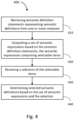
- Fig. 4 illustrates a method of selecting semantic definitions from a metaset 400 according to an embodiment of the present invention. Allowing a user to select semantic definitions from a metaset has several applications, including navigating through the metaset ( Fig. 5 ) and filtering the metaset ( Fig. 6 ).
- semantic definition statements are retrieved from one or more metasets.
- the semantic definition statements represent semantic definitions and may have the general form of a subject operand, an operator, and at least one object operand.
- a set of semantic expressions based on the semantic definition statements is output.
- the set of semantic expressions includes selectable items, such as selectable operands and operators or user-intuitive items corresponding to operands and operators such as images or pictographs.
- the output may be displayed on a graphical user interface.
- step 430 a selection of the selectable items is received.
- the selection may be made by a user in a graphical user interface.
- selected semantic definitions are determined based on the set of semantic expressions and the selection of selectable items. This may be done by matching the semantic expressions and the selection of selectable items to corresponding operators and operands of semantic definition statements.
- Fig. 5 illustrates a user interface 500 for navigating a metaset according to an embodiment of the present invention.
- an accordion menu 510 is output in which semantic expressions 520 corresponding to operands of semantic definition statements from a metaset are selectable (step 420).
- a user selects a selection 530 desired for navigation from semantic expressions 520.
- the computer system running the user interface 500 receives the selection 530 (step 430), determines corresponding semantic definitions (step 440), and updates the accordion menu 510 accordingly, such as by expanding beneath selection 530 with additional menu items 540.
- Accordion menu 510 may later be updated by collapsing additional menu items 540 beneath the selection 530.
- Visuals 550 may be provided to display one or more visuals associated with the selection 530. For example, if selection 530 corresponds to the semantic concept "Fish", a sub-menu of additional items 540 is expanded such that different types of semantic concepts are selectable, such as "General” and "Hyponym”. Further selecting "Hyponym” expands another sub-menu that lists hyponyms of "Fish” such as "Herring”. In this manner, a metaset may be navigated.
- Fig. 6 illustrates a user interface 600 for filtering a metaset according to an embodiment of the present invention.
- a menu 610 is output displaying a semantic expression 620 corresponding to a subject operand, a list of selectable semantic expression pairs 630 corresponding to object operands 632 and operators 634 (step 420).
- a user may select a confirmation box 640 for each of the semantic expression pairs 630 that the user wishes to use to filter the metaset.
- Visuals 650 may be one or more visuals included to guide the selection of the user. Additionally or alternatively, text or sound may be included to guide the selection of the user.
- the computer system running user interface 600 receives the selection (step 430) and filters the metaset to exclude semantic definitions corresponding to semantic expression 620 and the semantic expression pairs 630 with unselected confirmation boxes 640 (step 440).
- semantic expression 620 may correspond to the semantic concept "Fish”.
- Semantic expression pairs 630 may include types of fish as object operands 632 and indicate that the types of fish are hyponyms as operators 634.
- a user may view visual 650 and recognize a herring. The user then selects only the confirmation box 640 corresponding to "Herring". The system receives this selection of only "Herring” as a hyponym of "Fish” and filters the metaset to exclude “Halibut", “Tuna", and "Salmon” as hyponyms of "Fish”.
- Fig. 7 illustrates a computer system 700 according to an embodiment of the present invention.
- Computer system 700 comprises a client computer 710 and a server computer 720 connected by a network 730.
- Network 730 may be any kind of network, such as a local area network or the internet. In an alternate embodiment, only a single client computing device may be needed.
- Client computer 710 includes memory 711, CPU 712, input device 713, output device 714, and a network interface 715.
- Client computer 710 may be a personal computer, a tablet PC, a smartphone, a laptop computer, or any other well-known computing device.
- Memory 711 may be a non-transitory medium storing instructions for executing any of the methods described above.
- Memory 711 may include RAM, a hard disk, a flash drive, or any other memory storage device that is well known in the art.
- memory 711 is used to store image files, metasets, digital data structures, program software for visual processing and visual search, or any other data desirable for running the methods described above.
- Memory 711 may include removable or portable memory devices, such as CDs, USB drives, external hard drives, etc.
- the instructions stored in memory 711 may be executed by CPU 712. Instructions may additionally or alternatively be processed by another processor of client computer 710 or another processor of a client-side device in communication with client computer 710. Users may provide input through input device 713, such as a keyboard, mouse, scanner, webcam, etc. Output, such as a semantic definition management editor or any other graphical user interface described above, may be displayed on output device 714, which may be a monitor.
- a network interface 715 allows for communication with server computer 720 over network 730. For example, a user at client computer 710 may transmit a visual search request to server computer 720 and receive results from the search request from server computer 720 over network 730.
- Server computer 720 includes memory 721, CPU 722, and network interface 723.
- Memory 721 may include one or more databases for storing visuals and metasets describing the visuals.
- Memory 721 may store visual processing or visual search programs as instructions executable by CPU 722.
- Memory 721 may have a substantially larger capacity for storage than memory 711 of client computer 710.
- CPU 722 may have substantially larger processing capacity than CPU 712 of client computer 710.
- CPU 722 may be configured to execute instructions for visual processing, visual search, or other requests, according to the methods described above, from various client computers in parallel.
- Server computer 720 may send the results of any processing over network 730 to client computer 710 or any other appropriate target.
Landscapes
- Engineering & Computer Science (AREA)
- Theoretical Computer Science (AREA)
- Physics & Mathematics (AREA)
- General Engineering & Computer Science (AREA)
- General Physics & Mathematics (AREA)
- Data Mining & Analysis (AREA)
- Databases & Information Systems (AREA)
- Computational Linguistics (AREA)
- Health & Medical Sciences (AREA)
- Artificial Intelligence (AREA)
- Audiology, Speech & Language Pathology (AREA)
- General Health & Medical Sciences (AREA)
- Software Systems (AREA)
- Mathematical Physics (AREA)
- Machine Translation (AREA)
- Information Retrieval, Db Structures And Fs Structures Therefor (AREA)
Applications Claiming Priority (1)
| Application Number | Priority Date | Filing Date | Title |
|---|---|---|---|
| JP2021134904A JP7710231B2 (ja) | 2021-08-20 | 2021-08-20 | 意味定義が意味論的メタセットとして構成される方法およびコンピューティングデバイス |
Publications (1)
| Publication Number | Publication Date |
|---|---|
| EP4137968A1 true EP4137968A1 (fr) | 2023-02-22 |
Family
ID=83004551
Family Applications (1)
| Application Number | Title | Priority Date | Filing Date |
|---|---|---|---|
| EP22191008.6A Withdrawn EP4137968A1 (fr) | 2021-08-20 | 2022-08-18 | Procédé et dispositif informatique dans lesquels les définitions sémantiques sont composées sous la forme d'un méta-ensemble sémantique |
Country Status (3)
| Country | Link |
|---|---|
| US (1) | US12235883B2 (fr) |
| EP (1) | EP4137968A1 (fr) |
| JP (1) | JP7710231B2 (fr) |
Citations (4)
| Publication number | Priority date | Publication date | Assignee | Title |
|---|---|---|---|---|
| JPH0530514B2 (fr) | 1984-03-08 | 1993-05-10 | Seirei Ind | |
| US20110276581A1 (en) * | 2010-05-10 | 2011-11-10 | Vladimir Zelevinsky | Dynamic creation of topical keyword taxonomies |
| US20150026101A1 (en) * | 2013-07-17 | 2015-01-22 | Xerox Corporation | Image search system and method for personalized photo applications using semantic networks |
| WO2015175736A1 (fr) * | 2014-05-16 | 2015-11-19 | Microsoft Technology Licensing, Llc | Recherche d'images en langage naturel |
Family Cites Families (3)
| Publication number | Priority date | Publication date | Assignee | Title |
|---|---|---|---|---|
| JPH0727532B2 (ja) * | 1992-03-27 | 1995-03-29 | 株式会社日立製作所 | 情報検索方法及びシステム |
| US20120010870A1 (en) * | 2010-07-09 | 2012-01-12 | Vladimir Selegey | Electronic dictionary and dictionary writing system |
| JP6830514B2 (ja) | 2019-07-26 | 2021-02-17 | zro株式会社 | 視覚的な意味属性および非視覚的な意味属性がビジュアルに関連付けられる方法ならびにコンピューティングデバイス |
-
2021
- 2021-08-20 JP JP2021134904A patent/JP7710231B2/ja active Active
-
2022
- 2022-08-12 US US17/886,486 patent/US12235883B2/en active Active
- 2022-08-18 EP EP22191008.6A patent/EP4137968A1/fr not_active Withdrawn
Patent Citations (4)
| Publication number | Priority date | Publication date | Assignee | Title |
|---|---|---|---|---|
| JPH0530514B2 (fr) | 1984-03-08 | 1993-05-10 | Seirei Ind | |
| US20110276581A1 (en) * | 2010-05-10 | 2011-11-10 | Vladimir Zelevinsky | Dynamic creation of topical keyword taxonomies |
| US20150026101A1 (en) * | 2013-07-17 | 2015-01-22 | Xerox Corporation | Image search system and method for personalized photo applications using semantic networks |
| WO2015175736A1 (fr) * | 2014-05-16 | 2015-11-19 | Microsoft Technology Licensing, Llc | Recherche d'images en langage naturel |
Also Published As
| Publication number | Publication date |
|---|---|
| JP7710231B2 (ja) | 2025-07-18 |
| US20230069957A1 (en) | 2023-03-09 |
| US12235883B2 (en) | 2025-02-25 |
| JP2023028921A (ja) | 2023-03-03 |
Similar Documents
| Publication | Publication Date | Title |
|---|---|---|
| US8810583B2 (en) | Apparatus and method for creating animation from web text | |
| US9870550B2 (en) | Modifying existing recipes to incorporate additional or replace existing ingredients | |
| JP5699789B2 (ja) | 情報処理装置、情報処理方法、プログラム及び情報処理システム | |
| CN106716408B (zh) | 语义文本搜索 | |
| US8972440B2 (en) | Method and process for semantic or faceted search over unstructured and annotated data | |
| US9817823B2 (en) | Active knowledge guidance based on deep document analysis | |
| Bast et al. | Broccoli: Semantic full-text search at your fingertips | |
| Khalili et al. | Wysiwym authoring of structured content based on schema. org | |
| JP6260294B2 (ja) | 情報検索装置、情報検索方法および情報検索プログラム | |
| US11302100B2 (en) | Method and computing device in which visual and non-visual semantic attributes are associated with a visual | |
| US9547645B2 (en) | Machine translation apparatus, translation method, and translation system | |
| JP6305630B2 (ja) | 文書検索装置、方法及びプログラム | |
| Van Erp et al. | More than the name of the rose: how to make computers read, see, and organize smells | |
| JP2009128949A (ja) | グラフ表示装置およびプログラム | |
| EP4137968A1 (fr) | Procédé et dispositif informatique dans lesquels les définitions sémantiques sont composées sous la forme d'un méta-ensemble sémantique | |
| KR101835994B1 (ko) | 키워드 맵을 이용한 전자책 검색 서비스 제공 방법 및 장치 | |
| JP6451414B2 (ja) | 情報処理装置、要約文編集方法、及びプログラム | |
| Nguyen et al. | Inside ASCENT: Exploring a deep commonsense knowledge base and its usage in question answering | |
| WO2020026229A2 (fr) | Identification de proposition en langage naturel et son utilisation | |
| Singh et al. | Query relational databases in Punjabi language | |
| Keepanasseril | PubMed alternatives to search MEDLINE: an environmental scan | |
| Kolar et al. | Computer-aided document indexing system | |
| Kásler et al. | Framework for semi automatically generating topic maps | |
| KR101693783B1 (ko) | 키워드 인스턴스 기반 온톨로지 데이터 생성 시스템 및 방법 | |
| Trewhitt et al. | Topic Mapping to Support Users in Literature Search |
Legal Events
| Date | Code | Title | Description |
|---|---|---|---|
| PUAI | Public reference made under article 153(3) epc to a published international application that has entered the european phase |
Free format text: ORIGINAL CODE: 0009012 |
|
| STAA | Information on the status of an ep patent application or granted ep patent |
Free format text: STATUS: THE APPLICATION HAS BEEN PUBLISHED |
|
| AK | Designated contracting states |
Kind code of ref document: A1 Designated state(s): AL AT BE BG CH CY CZ DE DK EE ES FI FR GB GR HR HU IE IS IT LI LT LU LV MC MK MT NL NO PL PT RO RS SE SI SK SM TR |
|
| STAA | Information on the status of an ep patent application or granted ep patent |
Free format text: STATUS: REQUEST FOR EXAMINATION WAS MADE |
|
| 17P | Request for examination filed |
Effective date: 20230728 |
|
| RBV | Designated contracting states (corrected) |
Designated state(s): AL AT BE BG CH CY CZ DE DK EE ES FI FR GB GR HR HU IE IS IT LI LT LU LV MC MK MT NL NO PL PT RO RS SE SI SK SM TR |
|
| STAA | Information on the status of an ep patent application or granted ep patent |
Free format text: STATUS: EXAMINATION IS IN PROGRESS |
|
| 17Q | First examination report despatched |
Effective date: 20231129 |
|
| STAA | Information on the status of an ep patent application or granted ep patent |
Free format text: STATUS: THE APPLICATION HAS BEEN WITHDRAWN |
|
| 18W | Application withdrawn |
Effective date: 20240109 |