EP4143184B1 - Composés utiles pour inhiber la kinase ret - Google Patents
Composés utiles pour inhiber la kinase ret Download PDFInfo
- Publication number
- EP4143184B1 EP4143184B1 EP21725633.8A EP21725633A EP4143184B1 EP 4143184 B1 EP4143184 B1 EP 4143184B1 EP 21725633 A EP21725633 A EP 21725633A EP 4143184 B1 EP4143184 B1 EP 4143184B1
- Authority
- EP
- European Patent Office
- Prior art keywords
- amino
- cancer
- isomer
- ethyl
- phenyl
- Prior art date
- Legal status (The legal status is an assumption and is not a legal conclusion. Google has not performed a legal analysis and makes no representation as to the accuracy of the status listed.)
- Active
Links
Classifications
-
- A—HUMAN NECESSITIES
- A61—MEDICAL OR VETERINARY SCIENCE; HYGIENE
- A61K—PREPARATIONS FOR MEDICAL, DENTAL OR TOILETRY PURPOSES
- A61K31/00—Medicinal preparations containing organic active ingredients
- A61K31/33—Heterocyclic compounds
- A61K31/395—Heterocyclic compounds having nitrogen as a ring hetero atom, e.g. guanethidine or rifamycins
- A61K31/41—Heterocyclic compounds having nitrogen as a ring hetero atom, e.g. guanethidine or rifamycins having five-membered rings with two or more ring hetero atoms, at least one of which being nitrogen, e.g. tetrazole
- A61K31/42—Oxazoles
- A61K31/422—Oxazoles not condensed and containing further heterocyclic rings
-
- A—HUMAN NECESSITIES
- A61—MEDICAL OR VETERINARY SCIENCE; HYGIENE
- A61K—PREPARATIONS FOR MEDICAL, DENTAL OR TOILETRY PURPOSES
- A61K31/00—Medicinal preparations containing organic active ingredients
- A61K31/33—Heterocyclic compounds
- A61K31/395—Heterocyclic compounds having nitrogen as a ring hetero atom, e.g. guanethidine or rifamycins
- A61K31/41—Heterocyclic compounds having nitrogen as a ring hetero atom, e.g. guanethidine or rifamycins having five-membered rings with two or more ring hetero atoms, at least one of which being nitrogen, e.g. tetrazole
- A61K31/425—Thiazoles
- A61K31/427—Thiazoles not condensed and containing further heterocyclic rings
-
- A—HUMAN NECESSITIES
- A61—MEDICAL OR VETERINARY SCIENCE; HYGIENE
- A61K—PREPARATIONS FOR MEDICAL, DENTAL OR TOILETRY PURPOSES
- A61K31/00—Medicinal preparations containing organic active ingredients
- A61K31/33—Heterocyclic compounds
- A61K31/395—Heterocyclic compounds having nitrogen as a ring hetero atom, e.g. guanethidine or rifamycins
- A61K31/435—Heterocyclic compounds having nitrogen as a ring hetero atom, e.g. guanethidine or rifamycins having six-membered rings with one nitrogen as the only ring hetero atom
- A61K31/44—Non condensed pyridines; Hydrogenated derivatives thereof
- A61K31/4427—Non condensed pyridines; Hydrogenated derivatives thereof containing further heterocyclic ring systems
- A61K31/4439—Non condensed pyridines; Hydrogenated derivatives thereof containing further heterocyclic ring systems containing a five-membered ring with nitrogen as a ring hetero atom, e.g. omeprazole
-
- A—HUMAN NECESSITIES
- A61—MEDICAL OR VETERINARY SCIENCE; HYGIENE
- A61P—SPECIFIC THERAPEUTIC ACTIVITY OF CHEMICAL COMPOUNDS OR MEDICINAL PREPARATIONS
- A61P35/00—Antineoplastic agents
-
- C—CHEMISTRY; METALLURGY
- C07—ORGANIC CHEMISTRY
- C07D—HETEROCYCLIC COMPOUNDS
- C07D231/00—Heterocyclic compounds containing 1,2-diazole or hydrogenated 1,2-diazole rings
- C07D231/02—Heterocyclic compounds containing 1,2-diazole or hydrogenated 1,2-diazole rings not condensed with other rings
- C07D231/10—Heterocyclic compounds containing 1,2-diazole or hydrogenated 1,2-diazole rings not condensed with other rings having two or three double bonds between ring members or between ring members and non-ring members
- C07D231/14—Heterocyclic compounds containing 1,2-diazole or hydrogenated 1,2-diazole rings not condensed with other rings having two or three double bonds between ring members or between ring members and non-ring members with hetero atoms or with carbon atoms having three bonds to hetero atoms with at the most one bond to halogen, e.g. ester or nitrile radicals, directly attached to ring carbon atoms
- C07D231/38—Nitrogen atoms
-
- C—CHEMISTRY; METALLURGY
- C07—ORGANIC CHEMISTRY
- C07D—HETEROCYCLIC COMPOUNDS
- C07D231/00—Heterocyclic compounds containing 1,2-diazole or hydrogenated 1,2-diazole rings
- C07D231/02—Heterocyclic compounds containing 1,2-diazole or hydrogenated 1,2-diazole rings not condensed with other rings
- C07D231/10—Heterocyclic compounds containing 1,2-diazole or hydrogenated 1,2-diazole rings not condensed with other rings having two or three double bonds between ring members or between ring members and non-ring members
- C07D231/14—Heterocyclic compounds containing 1,2-diazole or hydrogenated 1,2-diazole rings not condensed with other rings having two or three double bonds between ring members or between ring members and non-ring members with hetero atoms or with carbon atoms having three bonds to hetero atoms with at the most one bond to halogen, e.g. ester or nitrile radicals, directly attached to ring carbon atoms
- C07D231/38—Nitrogen atoms
- C07D231/40—Acylated on said nitrogen atom
-
- C—CHEMISTRY; METALLURGY
- C07—ORGANIC CHEMISTRY
- C07D—HETEROCYCLIC COMPOUNDS
- C07D413/00—Heterocyclic compounds containing two or more hetero rings, at least one ring having nitrogen and oxygen atoms as the only ring hetero atoms
- C07D413/02—Heterocyclic compounds containing two or more hetero rings, at least one ring having nitrogen and oxygen atoms as the only ring hetero atoms containing two hetero rings
- C07D413/12—Heterocyclic compounds containing two or more hetero rings, at least one ring having nitrogen and oxygen atoms as the only ring hetero atoms containing two hetero rings linked by a chain containing hetero atoms as chain links
-
- C—CHEMISTRY; METALLURGY
- C07—ORGANIC CHEMISTRY
- C07D—HETEROCYCLIC COMPOUNDS
- C07D413/00—Heterocyclic compounds containing two or more hetero rings, at least one ring having nitrogen and oxygen atoms as the only ring hetero atoms
- C07D413/14—Heterocyclic compounds containing two or more hetero rings, at least one ring having nitrogen and oxygen atoms as the only ring hetero atoms containing three or more hetero rings
-
- C—CHEMISTRY; METALLURGY
- C07—ORGANIC CHEMISTRY
- C07D—HETEROCYCLIC COMPOUNDS
- C07D417/00—Heterocyclic compounds containing two or more hetero rings, at least one ring having nitrogen and sulfur atoms as the only ring hetero atoms, not provided for by group C07D415/00
- C07D417/02—Heterocyclic compounds containing two or more hetero rings, at least one ring having nitrogen and sulfur atoms as the only ring hetero atoms, not provided for by group C07D415/00 containing two hetero rings
- C07D417/12—Heterocyclic compounds containing two or more hetero rings, at least one ring having nitrogen and sulfur atoms as the only ring hetero atoms, not provided for by group C07D415/00 containing two hetero rings linked by a chain containing hetero atoms as chain links
-
- C—CHEMISTRY; METALLURGY
- C07—ORGANIC CHEMISTRY
- C07B—GENERAL METHODS OF ORGANIC CHEMISTRY; APPARATUS THEREFOR
- C07B2200/00—Indexing scheme relating to specific properties of organic compounds
- C07B2200/05—Isotopically modified compounds, e.g. labelled
Definitions
- the Rearranged during transfection (RET) kinase is a single-pass transmembrane receptor belonging to the tyrosine kinase superfamily that is required for normal development, maturation, and maintenance of several tissues and cell types.
- the extracellular portion of the RET kinase contains four calcium-dependent cadherin-like repeats involved in ligand binding and a juxtamembrane cysteine-rich region necessary for the correct folding of the RET extracellular domain, while the cytoplasmic portion of the receptor includes two tyrosine kinase subdomains.
- RET signaling is mediated by the binding of a group of 35 soluble proteins of the glial cell line-derived neurotrophic factor (GDNF) family ligands (GFLs), which also includes neurturin (NTRN), artemin (ARTN), and persephin (PSPN).
- GDNF glial cell line-derived neurotrophic factor family ligands
- NTRN neurturin
- ARTN artemin
- PSPN persephin
- GFLs and GFR ⁇ family members form binary complexes that in turn bind to RET and recruit it into cholesterol-rich membrane subdomains where RET signaling occurs.
- RET dimerization and autophosphorylation on intracellular tyrosine residues recruits adaptor and signaling proteins to stimulate multiple downstream pathways.
- Adaptor protein binding to these docking sites leads to activation of Ras-MAPK and PI3K-Akt/mTOR signaling pathways or to recruitment of the CBL family of ubiquitin ligases that functions in RET downregulation of the RET-mediated functions.
- Disruptions in normal RET activity due to abnormal RET expression stemming from genetic alterations in the RET kinase, including protein-gene fusions and activating point mutations, lead to overactive RET signaling and uncontrolled cell growth, e.g., various cancer types and certain gastrointestinal disorders such as irritable bowel syndrome (IBS).
- IBS irritable bowel syndrome
- the ability to inhibit abnormal RET activity in patients with cancer or other disorders related to overactive RET signaling would be of great benefit to those patients.
- some RET kinase genetic alterations are altering the conformational structure of a RET kinase to such an extent that a given RET kinase inhibitor may be less effective (or ineffective). In such cases, new RET kinase inhibitors that are effective to the modified RET kinase would greatly benefit patients.
- A can be a five- or six-member aryl or heteroaryl;
- R 1 can be hydrogen, halogen, C 1 -C 6 alkyl, C 1 -C 6 heteroalkyl, -(C 0 -C 4 alkyl)(C 5 -C 6 heteroalkyl), -(C 0 -C 4 alkyl)(C 3 -C 7 cycloalkyl), -(C 0 -C 4 heteroalkyl)(C 3 -C 7 cycloalkyl), -(C 0 -C 4 heteroalkyl)(C 3 -C 7 cycloalkyl), -(C 0 -C 4 alkyl)(C 4 -C 7 cycloheteroalkyl), -(C 0 -C 4 heteroalkyl)(C 3 -C 7 cycloheteroalkyl), -(C 0 -C 4 alkyl)(C 4 -C 10 bicyclic), -
- R-enantiomer and S-enantiomer, pharmaceutically acceptable salts thereof, and pharmaceutical compositions thereof, in which A, R 1 , n, X 1 , X 2 , X 3 , X 4 , and R 2 are defined herein are also provided. It is understood that formulas II and III are subspecies of formula I, and thus, references to formula I throughout this application also apply to formulas II and III.
- Methods of using the compounds of formulas I, II, or III, pharmaceutically acceptable salts thereof, and pharmaceutical compositions thereof, to treat cancer, in particular for the treatment of cancer with abnormal RET expression are also provided.
- the methods include administering a therapeutically effective amount of a compound of formulas I, II, or III, or a pharmaceutically acceptable salt thereof, to a patient in need.
- compounds of formulas I, II, and III, and pharmaceutically acceptable salts thereof, for use in therapy are also provided herein.
- the compounds of formulas I, II, and III, and pharmaceutically acceptable salts thereof, for use in the treatment of cancer, in particular for use in the treatment of cancer with abnormal RET expression e.g., a RET-associated cancer like medullary thyroid cancer or RET fusion lung cancer.
- abnormal RET expression e.g., a RET-associated cancer like medullary thyroid cancer or RET fusion lung cancer.
- the use of compounds of formulas I, II, and III, or pharmaceutically acceptable salts thereof, in the manufacture of a medicament for treating cancer, in particular for use in the treatment of cancer with abnormal RET expression is also provided.
- Novel RET kinase inhibitor compounds are described herein. These new compounds could address the need for potent, effective treatment of disorders associated with abnormal RET activity, e.g., IBS or cancer, especially cancer stemming from overactive RET signaling (i.e., RET-associated cancers).
- RET-associated cancers such as lung cancer (e.g., small cell lung carcinoma or non-small cell lung carcinoma), thyroid cancer (e.g., papillary thyroid cancer, medullary thyroid cancer, differentiated thyroid cancer, recurrent thyroid cancer, or refractory differentiated thyroid cancer), thyroid ademona, endocrine gland neoplasms, lung adenocarcinoma, bronchioles lung cell carcinoma, multiple endocrine neoplasia type 2A or 2B (MEN2A or MEN2B, respectively), pheochromocytoma, parathyroid hyperplasia, breast cancer, mammary cancer, mammary carcinoma, mammary neoplasm, colorectal cancer (e.g., metastatic colorectal cancer), papillary renal cell carcinoma, ganglioneuromatosis of the gastroenteric mucosa, inflammatory myofibroblastic tumor, or cervical cancer.
- lung cancer e.g., small cell lung carcinoma or non-small cell lung
- n is defined as 1, 2, 3, 4, or 5
- some A-rings have 5 positions that may accommodate an R 1 group, while others do not.
- phenyl has 5 substitutable positions
- pyrazoles have three substitutable positions
- an isoxazole has only two.
- the maximum value of the variable n can depend on the identity of the A-ring.
- alkyl means saturated linear or branched-chain monovalent hydrocarbon radicals of one to four atoms, e.g., "C 1 -C 4 alkyl.”
- this component of the substituent group can be absent, thus, if a C 5 heterocycloalkyl substituent is at the R 2 position in formula (I), the C 5 heterocycloalkyl substituent would be described by the -(C 0 -C 4 alkyl)(C 4 -C 7 heterocycloalkyl) substituent as described for R 2 (i.e., the substituent group would be - (C 0 )(C 5 heterocycloalkyl).
- heteroalkyl means saturated linear or branched-chain monovalent alkyl molecules as defined herein containing one or more heteroatoms that have replaced carbon(s) in the alkyl chain.
- C 5 -C 6 aryl refers to a functional group or substituent derived from an aromatic ring containing five to seven carbon atoms and no heteroatoms.
- C 5 -C 6 heteroaryl refers to a functional group or substituent derived from an aromatic ring containing carbon atoms and one or more heteroatoms (e.g., nitrogen, oxygen, or sulphur) as part of the aromatic ring such that that ring contains from five to seven atoms.
- aryl and heteroaryl groups include, but are not limited to, benzene, pyridine, pyrazine, pyrimidine, pyridazine, furan, pyrrole, thiophene, imidazole, pyrazole, oxazole, isoxazole, and thiazole.
- C 3 -C 7 cycloalkyl means a cyclic alkyl molecule containing three to seven carbon atoms.
- Examples of C 3 -C 7 cycloalkyls include, but are not limited to, cyclopropyl, cyclobutyl, and cyclopentyl.
- C 4 -C 7 cycloheteroalkyl means a cycloalkyl molecule as defined herein, containing four to seven total atoms and including one or more hetero atoms that have replaced carbon(s) in the cycloalkyl chain.
- C 4 -C 10 bicyclic refers to a group having two or more fused or bridged rings made from four to ten carbon atoms. When the C 4 -C 10 bicyclic group is fused, the two rings share two adjacent atoms. When the C 4 -C 10 bicyclic group is bridged, the two rings share three or more atoms. Bicyclic molecules can be all aliphatic, all aromatic, or mixed aromatic and aliphatic.
- C 4 -C 10 heterobicyclic refers to C 4 -C 10 bicyclic groups as defined that also include one or more hetero atoms.
- bridged C 4 -C 8 bicycloalkyl molecules useful with the compounds of formula (I) include, but are not limited to: 3-methyl-bicyclo[1.1.1]pentyl, and 3-(trifluoromethyl)-bicyclo[1.1.1]pentyl.
- C 5 -C 12 spirane refers to a group having two or more rings made from seven to twelve carbon atoms connected through a single common carbon atom.
- C 5 -C 12 heterospirane refers to a group having two or more rings made from seven to twelve atoms including carbon and at least one hetero atom joined by a spirocyclic linkage through a carbon atom, wherein each ring has three to six ring atoms (with one carbon atom being common to both rings), and wherein two of the ring atoms are nitrogen atoms.
- C 5 -C 12 spiranes and heterospiranes useful with the compounds of formula (I) include, but are not limited to: spiro[3.3]heptanyl, spiro[3.3]heptan-2-onyl, spiro[3.3]heptan-2-olyl, 2-methylspiro[3.3]heptan-2-olyl, 7-methyl-7-azaspiro[3.5]nonanyl, and 8-methyl-8-azaspiro[4.5]decanyl.
- halogen means fluoro (F), chloro (Cl), bromo (Br), or iodo (I).
- oxo means an oxygen that is double-bonded to a carbon atom.
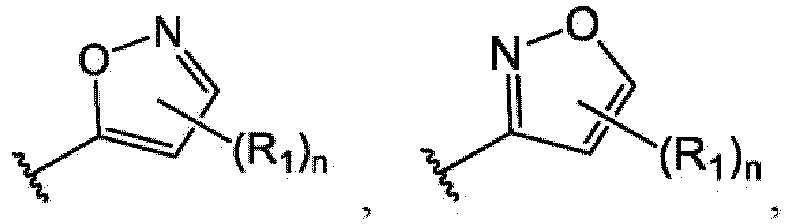
- A-(R 1 ) n can be wherein a wavy line indicates the connection point of A to the backbone as shown in formula (I).
- A-(R 1 ) n is
- A-(R 1 ) n is In another embodiment, in the compounds of formula (I), A-(R 1 ) n is In a preferred embodiment, the halogen is F or Cl.
- A-(R 1 ) n in the compounds of formula (I), can be
- A-(R 1 ) n is and n is 1.
- A-(R 1 ) n is a phenyl substituted with (R 1 ) n .
- n is 1-4, or 1-3, or 1-2, or 1, or 2, or 2-4, or 2-5.
- A-(R 1 ) n is a phenyl substituted with (R 1 ) n
- two R 1 groups fuse to form a ring structure that includes a portion of A and is optionally aromatic, the resulting A-ring is optionally substituted, as described herein.
- each R 1 is independently selected from the group consisting of H, -CH 3 , -CH 2 C(CH 3 ) 3 , -C(CH 3 ) 2 CF 3 ,
- At least one R 1 group is H or CH 3 .
- At least one R 1 is halogen, -CH 2 C(CH 3 ) 3 , 2-chloro-4-fluorophenyl, 2,4-dichlorophenyl, - CH 2 C(CH 3 ) 3 , -C(CH 3 ) 2 CF 3 , -C(CH 3 ) 2 CH 2 CH 3 , -C(CH 3 ) 2 CF 2 CH 3 , -C(CH 3 ) 2 CH 2 CF 3 , -C(CH 3 ) 3 , or CF 3 .
- At least one R 1 is halogen, -CH 2 C(CH 3 ) 3 ,
- At least one R 1 is CH 3 , -CH 2 C(CH 3 ) 3 , -C(CH 3 ) 2 CF 3 , C(CH 3 ) 2 CH 2 CH 3 , -C(CH 3 ) 2 CF 2 CH 3 , -C(CH 3 ) 2 CH 2 CF 3 , -C(CH 3 ) 3 , or CF 3 .
- At least one R 1 is an optionally substituted C 5 -C 12 spirane.
- At least one R 1 is 2-fluoro-4-chlorophenyl; 2-chloro-4-fluorophenyl; 2,4-dichlorophenyl; or 2,4-difluorophenyl.
- R 2 is -CH(CH 3 ) 2 , - CH(CF 3 )CH 3 , -CH(CH 3 )CHF 2 , or
- R 2 is
- R 2 is
- R 2 is deuterated, i.e., it contains at least one deuterium.
- deuterated R 2 is - CH(CH 3 )CF 2 D, -CH(CD 3 ) 2 , -CH(CF 3 )CD 3 , -CH(CH 3 )CDF 2 , -CD(CD 3 ) 2 , or - CD(CH 3 )CD 3 .
- two of X 1 , X 2 , X 3 , and X 4 are CH, while the other two are C-halogen.
- X 1 and X 2 are CF, and X 3 and X 4 are CH.
- one of X 1 , X 2 , X 3 , and X 4 is N.
- X 2 is N and at least two of X 1 , X 3 , and X 4 is CH.
- the chiral center noted in the compound of formula (I) provides an R-enantiomeric form shown by formula (II) and an S-enantiomeric from shown by formula (III):
- Compounds of formula (II) and formula (III) or pharmaceutically acceptable salts thereof, in which A, R 1 , n, X 1 , X 2 , X 3 , X 4 , and R 2 are defined as for formula (I), are also provided herein. If multiple chiral centers are present, then diastereomers may also be present.
- R 2 is isopropyl; X 1 , X 2 , X 3 , and X 4 are CH; A-(R 1 ) n is where R 1 is selected from the group consisting of H, -CH 3 , -CH 2 C(CH 3 ) 3 , -C(CH 3 ) 2 CF 3 , and
- R 2 is isopropyl; three of X 1 , X 2 , X 3 , and X 4 are CH, while one of X 1 , X 2 , X 3 , and X 4 is N; A-(R 1 ) n is where R 1 is selected from the group consisting of H, -CH 3 , - CH 2 C(CH 3 ) 3 , -C(CH 3 ) 2 CF 3 ,
- R 2 is X 1 , X 2 , X 3 , and X 4 are CH;
- A-(R 1 ) n is where R 1 is selected from the group consisting of H, -CH 3 , -CH 2 C(CH 3 ) 3 , -C(CH 3 ) 2 CF 3 , and
- R 2 is three of X 1 , X 2 , X 3 , and X 4 are CH, while one of X 1 , X 2 , X 3 , and X 4 is N;
- A-(R 1 ) n is where R 1 is selected from the group consisting of H, -CH 3 , - CH 2 C(CH 3 ) 3 , -C(CH 3 ) 2 CF 3 ,
- R 2 is - CH(CH 3 )CF 2 D, -CH(CD 3 ) 2 , -CH(CF 3 )CD 3 , -CH(CH 3 )CDF 2 , -CD(CD 3 ) 2 , or - CD(CH 3 )CD 3 ;
- X 1 , X 2 , X 3 , and X 4 are CH;
- A-(R 1 ) n is where R 1 is selected from the group consisting of H, -CH 3 , -CH 2 C(CH 3 ) 3 , -C(CH 3 ) 2 CF 3 ,
- R 2 is -CH(CH 3 )CF 2 D, -CH(CD 3 ) 2 , -CH(CF 3 )CD 3 , -CH(CH 3 )CDF 2 , -CD(CD 3 ) 2 , or - CD(CH 3 )CD 3 ;
- three of X 1 , X 2 , X 3 , and X 4 are CH, while one of X 1 , X 2 , X 3 , and X 4 is N;
- A-(R 1 ) n is where R 1 is selected from the group consisting of H, -CH 3 , - CH 2 C(CH 3 ) 3 , -C(CH 3 ) 2 CF 3 ,
- R 2 is isopropyl; X 1 , X 2 , X 3 , and X 4 are CH; A-(R 1 ) n is where R 1 is selected from the group consisting of H, -CH 3 , -CH 2 C(CH 3 ) 3 , -C(CH 3 ) 2 CF 3 ,
- R 2 is isopropyl; three of X 1 , X 2 , X 3 , and X 4 are CH, while one of X 1 , X 2 , X 3 , and X 4 is N; A-(R 1 ) n is where R 1 is selected from the group consisting of H, -CH 3 , - CH 2 C(CH 3 ) 3 , -C(CH 3 ) 2 CF 3 ,
- R 2 is X 1 , X 2 , X 3 , and X 4 are CH;
- A-(R 1 ) n is where R 1 is selected from the group consisting of H, -CH 3 , -CH 2 C(CH 3 ) 3 , -C(CH 3 ) 2 CF 3 , and
- R 2 is three of X 1 , X 2 , X 3 , and X 4 are CH, while one of X 1 , X 2 , X 3 , and X 4 is N;
- A-(R 1 ) n is where R 1 is selected from the group consisting of H, -CH 3 , - CH 2 C(CH 3 ) 3 , -C(CH 3 ) 2 CF 3 ,
- R 2 is - CH(CH 3 )CF 2 D, -CH(CD 3 ) 2 , -CH(CF 3 )CD 3 , -CH(CH 3 )CDF 2 , -CD(CD 3 ) 2 , or - CD(CH 3 )CD 3 ;
- X 1 , X 2 , X 3 , and X 4 are CH;
- A-(R 1 ) n is where R 1 is selected from the group consisting of H, -CH 3 , -CH 2 C(CH 3 ) 3 , -C(CH 3 ) 2 CF 3 ,
- R 2 is -CH(CH 3 )CF 2 D, -CH(CD 3 ) 2 , -CH(CF 3 )CD 3 , -CH(CH 3 )CDF 2 , -CD(CD 3 ) 2 , or - CD(CH 3 )CD 3 ;
- three of X 1 , X 2 , X 3 , and X 4 are CH, while one of X 1 , X 2 , X 3 , and X 4 is N;
- A-(R 1 ) n is where R 1 is selected from the group consisting of H, -CH 3 , - CH 2 C(CH 3 ) 3 , -C(CH 3 ) 2 CF 3 ,
- R 2 is isopropyl; X 1 , X 2 , X 3 , and X 4 are CH; A-(R 1 ) n is where each R 1 is selected from the group consisting of H, -CH 3 , -CH 2 C(CH 3 ) 3 , -C(CH 3 ) 2 CF 3 ,
- R 2 is isopropyl; three of X 1 , X 2 , X 3 , and X 4 are CH, while one of X 1 , X 2 , X 3 , and X 4 is N; A-(R 1 ) n is where each R 1 is selected from the group consisting of H, -CH 3 , - CH 2 C(CH 3 ) 3 , -C(CH 3 ) 2 CF 3 ,
- R 2 is X 1 , X 2 , X 3 , and X 4 are CH;
- A-(R 1 ) n is where each R 1 is selected from the group consisting of H, -CH 3 , -CH 2 C(CH 3 ) 3 , -C(CH 3 ) 2 CF 3 ,
- R 2 is three of X 1 , X 2 , X 3 , and X 4 are CH, while one of X 1 , X 2 , X 3 , and X 4 is N;
- A-(R 1 ) n is where each R 1 is selected from the group consisting of H, -CH 3 , - CH 2 C(CH 3 ) 3 , -C(CH 3 ) 2 CF 3 ,
- R 2 is - CH(CH 3 )CF 2 D, -CH(CD 3 ) 2 , -CH(CF 3 )CD 3 , -CH(CH 3 )CDF 2 , -CD(CD 3 ) 2 , or - CD(CH 3 )CD 3 ;
- X 1 , X 2 , X 3 , and X 4 are CH;
- A-(R 1 ) n is where each R 1 is selected from the group consisting of H, -CH 3 , -CH 2 C(CH 3 ) 3 , -C(CH 3 ) 2 CF 3 ,
- R 2 is -CH(CH 3 )CF 2 D, -CH(CD 3 ) 2 , -CH(CF 3 )CD 3 , -CH(CH 3 )CDF 2 , -CD(CD 3 ) 2 , or - CD(CH 3 )CD 3 ;
- three of X 1 , X 2 , X 3 , and X 4 are CH, while one of X 1 , X 2 , X 3 , and X 4 is N;
- A-(R 1 ) n is where each R 1 is selected from the group consisting of H, - CH 3 , -CH 2 C(CH 3 ) 3 , -C(CH 3 ) 2 CF 3 ,
- R 2 is isopropyl; X 1 , X 2 , X 3 , and X 4 are CH; A-(R 1 ) n is where each R 1 is selected from the group consisting of H, -CH 3 , -CH 2 C(CH 3 ) 3 , -C(CH 3 ) 2 CF 3 ,
- R 2 is isopropyl; three of X 1 , X 2 , X 3 , and X 4 are CH, while one of X 1 , X 2 , X 3 , and X 4 is N; A-(R 1 ) n is where each R 1 is selected from the group consisting of H, -CH 3 , - CH 2 C(CH 3 ) 3 , -C(CH 3 ) 2 CF 3 ,
- R 2 is X 1 , X 2 , X 3 , and X 4 are CH;
- A-(R 1 ) n is where each R 1 is selected from the group consisting of H, -CH 3 , -CH 2 C(CH 3 ) 3 , -C(CH 3 ) 2 CF 3 ,
- R 2 is three of X 1 , X 2 , X 3 , and X 4 are CH, while one of X 1 , X 2 , X 3 , and X 4 is N;
- A-(R 1 ) n is where each R 1 is selected from the group consisting of H, -CH 3 , - CH 2 C(CH 3 ) 3 , -C(CH 3 ) 2 CF 3 ,
- R 2 is isopropyl; three of X 1 , X 2 , X 3 , and X 4 are CH, while one of X 1 , X 2 , X 3 , and X 4 is N; A-(R 1 ) n is where R 1 is selected from the group consisting of H, -CH 3 , -CH 2 C(CH 3 ) 3 , -C(CH 3 ) 2 CF 3 ,
- R 2 is X 1 , X 2 , X 3 , and X 4 are CH;
- A-(R 1 ) n is where R 1 is selected from the group consisting of H, -CH 3 , -CH 2 C(CH 3 ) 3 , -C(CH 3 ) 2 CF 3 ,
- R 2 is X 1 , X 2 , X 3 , and X 4 are CH;
- A-(R 1 ) n is where each R 1 is selected from the group consisting of H, -CH 3 , -CH 2 C(CH 3 ) 3 , -C(CH 3 ) 2 CF 3 ,
- R 2 is isopropyl; three of X 1 , X 2 , X 3 , and X 4 are CH, while one of X 1 , X 2 , X 3 , and X 4 is N; A-(R 1 ) n is where R 1 is halogen, -CH 2 C(CH 3 ) 3 , 2-chloro-4-fluorophenyl, 2,4-dichlorophenyl, -CH 2 C(CH 3 ) 3 , -C(CH 3 ) 2 CF 3 , -C(CH 3 ) 2 CH 2 CH 3 , -C(CH 3 ) 2 CF 2 CH 3 , -C(CH 3 ) 2 CH 2 CF 3 , -C(CH 3 ) 3 , -C(CH 3 ) 3 , or CF 3 .
- R 2 is -CH(CH 3 )CF 2 D, -CH(CD 3 ) 2 , -CH(CF 3 )CD 3 , -CH(CH 3 )CDF 2 , -CD(CD 3 ) 2 , or - CD(CH 3 )CD 3 ; three of X 1 , X 2 , X 3 , and X 4 are CH, while one of X 1 , X 2 , X 3 , and X 4 is N;
- A-(R 1 ) n is where R 1 is halogen, -CH 2 C(CH 3 ) 3 , 2-chloro-4-fluorophenyl, 2,4-dichlorophenyl, -CH 2 C(CH 3 ) 3 , -C(CH 3 ) 2 CF 3 , -C(CH 3 ) 2 CH 2 CH 3 , -C(CH 3 ) 3 ;
- R 2 is isopropyl; X 1 , X 2 , X 3 , and X 4 are CH; A-(R 1 ) n is where R 1 is halogen, -CH 2 C(CH 3 ) 3 , 2-chloro-4-fluorophenyl, 2,4-dichlorophenyl, -CH 2 C(CH 3 ) 3 , - C(CH 3 ) 2 CF 3 , -C(CH 3 ) 2 CH 2 CH 3 , - C(CH 3 ) 2 CF 2 CH 3 , -C(CH 3 ) 2 CH 2 CF 3 , -C(CH 3 ) 3 , or CF 3 .
- R 2 is isopropyl; three of X 1 , X 2 , X 3 , and X 4 are CH, while one of X 1 , X 2 , X 3 , and X 4 is N; A-(R 1 ) n is where R 1 is halogen, -CH 2 C(CH 3 ) 3 , 2-chloro-4-fluorophenyl, 2,4-dichlorophenyl, -CH 2 C(CH 3 ) 3 , -C(CH 3 ) 2 CF 3 , , -C(CH 3 ) 2 CH 2 CH 3 , -C(CH 3 ) 2 CF 2 CH 3 , -C(CH 3 ) 2 CH 2 CF 3 , -C(CH 3 ) 3 , -C(CH 3 ) 3 , or CF 3 .
- R 2 is X 1 , X 2 , X 3 , and X 4 are CH;
- A-(R 1 ) n is where R 1 is halogen, CH 2 C(CH 3 ) 3 , 2-chloro-4-fluorophenyl, 2,4-dichlorophenyl, -CH 2 C(CH 3 ) 3 , -C(CH 3 ) 2 CF 3 , -C(CH 3 ) 2 CH 2 CH 3 , -C(CH 3 ) 2 CF 2 CH 3 , - C(CH 3 ) 2 CH 2 CF 3 , -C(CH 3 ) 3 , or CF 3 .
- R 2 is three of X 1 , X 2 , X 3 , and X 4 are CH, while one of X 1 , X 2 , X 3 , and X 4 is N;
- A-(R 1 ) n is , where R 1 is halogen, , -CH 2 C(CH 3 ) 3 , 2-chloro-4-fluorophenyl, 2,4-dichlorophenyl, -CH 2 C(CH 3 ) 3 , -C(CH 3 ) 2 CF 3 , -C(CH 3 ) 2 CH 2 CH 3 , -C(CH 3 ) 2 CF 2 CH 3 , -C(CH 3 ) 2 CH 2 CF 3 , -C(CH 3 ) 3 , or CF 3 .
- R 2 is - CH(CH 3 )CF 2 D, -CH(CD 3 ) 2 , -CH(CF 3 )CD 3 , -CH(CH 3 )CDF 2 , -CD(CD 3 ) 2 , or - CD(CH 3 )CD 3 ;
- X 1 , X 2 , X 3 , and X 4 are CH;
- A-(R 1 ) n is where R 1 is halogen, -CH 2 C(CH 3 ) 3 , 2-chloro-4-fluorophenyl, 2,4-dichlorophenyl, - CH 2 C(CH 3 ) 3 , -C(CH 3 ) 2 CF 3 , -C(CH 3 ) 2 CH 2 CH 3 , -C(CH 3 ) 2 CF 2 CH 3 , -C(CH 3 ) 2 CH 2 CF 3 , -C(CH 3 ) 2 CH 2 CF 3 , -C(CH 3 )
- R 2 is -CH(CH 3 )CF 2 D, -CH(CD 3 ) 2 , -CH(CF 3 )CD 3 , -CH(CH 3 )CDF 2 , -CD(CD 3 ) 2 , or - CD(CH 3 )CD 3 ; three of X 1 , X 2 , X 3 , and X 4 are CH, while one of X 1 , X 2 , X 3 , and X 4 is N;
- A-(R 1 ) n is where R 1 is halogen, -CH 2 C(CH 3 ) 3 , 2-chloro-4-fluorophenyl, 2,4-dichlorophenyl, -CH 2 C(CH 3 ) 3 , -C(CH 3 ) 2 CF 3 , -C(CH 3 ) 2 CH 2 CH 3 , -C(CH 3 ) 3 ;
- R 2 is isopropyl; X 1 , X 2 , X 3 , and X 4 are CH; A-(R 1 ) n is where at least one R 1 is halogen, -CH 2 C(CH 3 ) 3 , 2-chloro-4-fluorophenyl, 2,4-dichlorophenyl, - CH 2 C(CH 3 ) 3 , -C(CH 3 ) 2 CF 3 , -C(CH 3 ) 2 CH 2 CH 3 , -C(CH 3 ) 2 CF 2 CH 3 , -C(CH 3 ) 2 CH 2 CF 3 , -C(CH 3 ) 3 , or CF 3 .
- R 2 is isopropyl; three of X 1 , X 2 , X 3 , and X 4 are CH, while one of X 1 , X 2 , X 3 , and X 4 is N; A-(R 1 ) n is where at least one R 1 is halogen, -CH 2 C(CH 3 ) 3 , 2-chloro-4-fluorophenyl, 2,4-dichlorophenyl, -CH 2 C(CH 3 ) 3 , -C(CH 3 ) 2 CF 3 , -C(CH 3 ) 2 CH 2 CH 3 , -C(CH 3 ) 2 CF 2 CH 3 , -C(CH 3 ) 2 CH 2 CF 3 , -C(CH 3 ) 3 , or CF 3 .
- R 2 is X 1 , X 2 , X 3 , and X 4 are CH;
- A-(R 1 ) n is , where at least one R 1 is halogen, , -CH 2 C(CH 3 ) 3 , 2-chloro-4-fluorophenyl, 2,4-dichlorophenyl, -CH 2 C(CH 3 ) 3 , - C(CH 3 ) 2 CF 3 , -C(CH 3 ) 2 CH 2 CH 3 , - C(CH 3 ) 2 CF 2 CH 3 , -C(CH 3 ) 2 CH 2 CF 3 , -C(CH 3 ) 3 , or CF 3 .
- R 2 is three of X 1 , X 2 , X 3 , and X 4 are CH, while one of X 1 , X 2 , X 3 , and X 4 is N;
- A-(R 1 ) n is where at least one R 1 is halogen, -CH 2 C(CH 3 ) 3 , 2-chloro-4-fluorophenyl, 2,4-dichlorophenyl, -CH 2 C(CH 3 ) 3 , -C(CH 3 ) 2 CF 3 , -C(CH 3 ) 2 CH 2 CH 3 , -C(CH 3 ) 2 CF 2 CH 3 , -C(CH 3 ) 2 CH 2 CF 3 , -C(CH 3 ) 3 , or CF 3 .
- R 2 is - CH(CH 3 )CF 2 D, -CH(CD 3 ) 2 , -CH(CF 3 )CD 3 , -CH(CH 3 )CDF 2 , -CD(CD 3 ) 2 , or - CD(CH 3 )CD 3 ;
- X 1 , X 2 , X 3 , and X 4 are CH;
- A-(R 1 ) n is where at least one R 1 is halogen, -CH 2 C(CH 3 ) 3 , 2-chloro-4-fluorophenyl, 2,4-dichlorophenyl, - CH 2 C(CH 3 ) 3 , -C(CH 3 ) 2 CF 3 , -C(CH 3 ) 2 CH 2 CH 3 , -C(CH 3 ) 2 CF 2 CH 3 , -C(CH 3 ) 2 CH 2 CF 3 , -C(CH 3 ) 2 CH 2 CF 3 , -C(CH
- R 2 is -CH(CH 3 )CF 2 D, -CH(CD 3 ) 2 , -CH(CF 3 )CD 3 , -CH(CH 3 )CDF 2 , -CD(CD 3 ) 2 , or - CD(CH 3 )CD 3 ; three of X 1 , X 2 , X 3 , and X 4 are CH, while one of X 1 , X 2 , X 3 , and X 4 is N;
- A-(R 1 ) n is where at least one R 1 is halogen, -CH 2 C(CH 3 ) 3 , 2-chloro-4-fluorophenyl, 2,4-dichlorophenyl, -CH 2 C(CH 3 ) 3 , -C(CH 3 ) 2 CF 3 , -C(CH 3 ) 2 CH 2 CH 3 , -C(CH 3 )
- R 2 is isopropyl; X 1 , X 2 , X 3 , and X 4 are CH; A-(R 1 ) n is where at least one R 1 is halogen, -CH 2 C(CH 3 ) 3 , 2-chloro-4-fluorophenyl, 2,4-dichlorophenyl, -CH 2 C(CH 3 ) 3 , - C(CH 3 ) 2 CF 3 , -C(CH 3 ) 2 CH 2 CH 3 , - C(CH 3 ) 2 CF 2 CH 3 , -C(CH 3 ) 2 CH 2 CF 3 , -C(CH 3 ) 3 , or CF 3 .
- R 2 is isopropyl; three of X 1 , X 2 , X 3 , and X 4 are CH, while one of X 1 , X 2 , X 3 , and X 4 is N; A-(R 1 ) n is where at least one R 1 is halogen, -CH 2 C(CH 3 ) 3 , 2-chloro-4-fluorophenyl, 2,4-dichlorophenyl, -CH 2 C(CH 3 ) 3 , -C(CH 3 ) 2 CF 3 , -C(CH 3 ) 2 CH 2 CH 3 , -C(CH 3 ) 2 CF 2 CH 3 , -C(CH 3 ) 2 CH 2 CF 3 , -C(CH 3 ) 2 CH 2 CF 3 , - C(CH 3 ) 3 , or CF 3 .
- R 2 is X 1 , X 2 , X 3 , and X 4 are CH;
- A-(R 1 ) n is where at least one R 1 is halogen, -CH 2 C(CH 3 ) 3 , 2-chloro-4-fluorophenyl, 2,4-dichlorophenyl, -CH 2 C(CH 3 ) 3 , - C(CH 3 ) 2 CF 3 , -C(CH 3 ) 2 CH 2 CH 3 , - C(CH 3 ) 2 CF 2 CH 3 , -C(CH 3 ) 2 CH 2 CF 3 , -C(CH 3 ) 3 , or CF 3 .
- R 2 is three of X 1 , X 2 , X 3 , and X 4 are CH, while one of X 1 , X 2 , X 3 , and X 4 is N;
- A-(R 1 ) n is where at least one R 1 is halogen, -CH 2 C(CH 3 ) 3 , 2-chloro-4-fluorophenyl, 2,4-dichlorophenyl, -CH 2 C(CH 3 ) 3 , -C(CH 3 ) 2 CF 3 , -C(CH 3 ) 2 CH 2 CH 3 , -C(CH 3 ) 2 CF 2 CH 3 , -C(CH 3 ) 2 CH 2 CF 3 , -C(CH 3 ) 3 , or CF 3 .
- R 2 is - CH(CH 3 )CF 2 D, -CH(CD 3 ) 2 , -CH(CF 3 )CD 3 , -CH(CH 3 )CDF 2 , -CD(CD 3 ) 2 , or - CD(CH 3 )CD 3 ;
- X 1 , X 2 , X 3 , and X 4 are CH;
- A-(R 1 ) n is where at least one R 1 is halogen, -CH 2 C(CH 3 ) 3 , 2-chloro-4-fluorophenyl, 2,4-dichlorophenyl, - CH 2 C(CH 3 ) 3 , -C(CH 3 ) 2 CF 3 , -C(CH 3 ) 2 CH 2 CH 3 , -C(CH 3 ) 2 CF 2 CH 3 , -C(CH 3 ) 2 CH 2 CF 3 , -C(CH 3 ) 2 CH 2 CF 3 , -C(CH
- R 2 is -CH(CH 3 )CF 2 D, -CH(CD 3 ) 2 , -CH(CF 3 )CD 3 , -CH(CH 3 )CDF 2 , -CD(CD 3 ) 2 , or - CD(CH 3 )CD 3 ; three of X 1 , X 2 , X 3 , and X 4 are CH, while one of X 1 , X 2 , X 3 , and X 4 is N;
- A-(R 1 ) n is where at least one R 1 is halogen, -CH 2 C(CH 3 ) 3 , 2-chloro-4-fluorophenyl, 2,4-dichlorophenyl, -CH 2 C(CH 3 ) 3 , -C(CH 3 ) 2 CF 3 , -C(CH 3 ) 2 CH 2 CH 3 , -C(CH 3 )
- R 2 is isopropyl; X 1 , X 2 , X 3 , and X 4 are CH; A-(R 1 ) n is where R 1 is halogen, -CH 2 C(CH 3 ) 3 , 2-chloro-4-fluorophenyl, 2,4-dichlorophenyl, - CH 2 C(CH 3 ) 3 , -C(CH 3 ) 2 CF 3 , -C(CH 3 ) 2 CH 2 CH 3 , -C(CH 3 ) 2 CF 2 CH 3 , -C(CH 3 ) 2 CH 2 CF 3 , -C(CH 3 ) 3 , or CF 3 .
- R 2 is isopropyl; three of X 1 , X 2 , X 3 , and X 4 are CH, while one of X 1 , X 2 , X 3 , and X 4 is N; A-(R 1 ) n is where R 1 is halogen, -CH 2 C(CH 3 ) 3 , 2-chloro-4-fluorophenyl, 2,4-dichlorophenyl, -CH 2 C(CH 3 ) 3 , -C(CH 3 ) 2 CF 3 , -C(CH 3 ) 2 CH 2 CH 3 , -C(CH 3 ) 2 CF 2 CH 3 , -C(CH 3 ) 2 CH 2 CF 3 , -C(CH 3 ) 3 , or CF 3 .
- R 2 is X 1 , X 2 , X 3 , and X 4 are CH;
- A-(R 1 ) n is where R 1 is halogen, -CH 2 C(CH 3 ) 3 , 2-chloro-4-fluorophenyl, 2,4-dichlorophenyl, -CH 2 C(CH 3 ) 3 , - C(CH 3 ) 2 CF 3 , -C(CH 3 ) 2 CH 2 CH 3 , - C(CH 3 ) 2 CF 2 CH 3 , -C(CH 3 ) 2 CH 2 CF 3 , -C(CH 3 ) 3 , or CF 3 .
- R 2 is three of X 1 , X 2 , X 3 , and X 4 are CH, while one of X 1 , X 2 , X 3 , and X 4 is N;
- A-(R 1 ) n is where R 1 is halogen, -CH 2 C(CH 3 ) 3 , 2-chloro-4-fluorophenyl, 2,4-dichlorophenyl, -CH 2 C(CH 3 ) 3 , -C(CH 3 ) 2 CF 3 , -C(CH 3 ) 2 CH 2 CH 3 , -C(CH 3 ) 2 CF 2 CH 3 , -C(CH 3 ) 2 CH 2 CF 3 , -C(CH 3 ) 2 CH 2 CF 3 , - C(CH 3 ) 3 , or CF 3 .
- R 2 is -CH(CH 3 )CF 2 D, -CH(CD 3 ) 2 , -CH(CF 3 )CD 3 , -CH(CH 3 )CDF 2 , -CD(CD 3 ) 2 , or - CD(CH 3 )CD 3 ; three of X 1 , X 2 , X 3 , and X 4 are CH, while one of X 1 , X 2 , X 3 , and X 4 is N;
- A-(R 1 ) n is where R 1 is halogen, -CH 2 C(CH 3 ) 3 , 2-chloro-4-fluorophenyl, 2,4-dichlorophenyl, -CH 2 C(CH 3 ) 3 , -C(CH 3 ) 2 CF 3 , -C(CH 3 ) 2 CH 2 CH 3 , -C(CH 3 ) 3 ;
- R 2 is isopropyl; X 1 , X 2 , X 3 , and X 4 are CH; A-(R 1 ) n is where each R 1 is halogen, -CH 2 C(CH 3 ) 3 , 2-chloro-4-fluorophenyl, 2,4-dichlorophenyl, -CH 2 C(CH 3 ) 3 , - C(CH 3 ) 2 CF 3 , -C(CH 3 ) 2 CH 2 CH 3 , - C(CH 3 ) 2 CF 2 CH 3 , -C(CH 3 ) 2 CH 2 CF 3 , -C(CH 3 ) 3 , or CF 3 .
- R 2 is isopropyl; three of X 1 , X 2 , X 3 , and X 4 are CH, while one of X 1 , X 2 , X 3 , and X 4 is N; A-(R 1 ) n is where each R 1 is halogen, -CH 2 C(CH 3 ) 3 , 2-chloro-4-fluorophenyl, 2,4-dichlorophenyl, -CH 2 C(CH 3 ) 3 , -C(CH 3 ) 2 CF 3 , -C(CH 3 ) 2 CH 2 CH 3 , -C(CH 3 ) 2 CF 2 CH 3 , -C(CH 3 ) 2 CH 2 CF 3 , -C(CH 3 ) 2 CH 2 CF 3 , - C(CH 3 ) 3 , or CF 3 .
- R 2 is three of X 1 , X 2 , X 3 , and X 4 are CH, while one of X 1 , X 2 , X 3 , and X 4 is N;
- A-(R 1 ) n is where each R 1 is halogen, -CH 2 C(CH 3 ) 3 , 2-chloro-4-fluorophenyl, 2,4-dichlorophenyl, -CH 2 C(CH 3 ) 3 , -C(CH 3 ) 2 CF 3 , -C(CH 3 ) 2 CH 2 CH 3 , -C(CH 3 ) 2 CF 2 CH 3 , -C(CH 3 ) 2 CH 2 CF 3 , -C(CH 3 ) 3 , , or CF 3 .
- R 2 is - CH(CH 3 )CF 2 D, -CH(CD 3 ) 2 , -CH(CF 3 )CD 3 , -CH(CH 3 )CDF 2 , -CD(CD 3 ) 2 , or - CD(CH 3 )CD 3 ;
- X 1 , X 2 , X 3 , and X 4 are CH;
- A-(R 1 ) n is where each R 1 is halogen, -CH 2 C(CH 3 ) 3 , 2-chloro-4-fluorophenyl, 2,4-dichlorophenyl, - CH 2 C(CH 3 ) 3 , -C(CH 3 ) 2 CF 3 , -C(CH 3 ) 2 CH 2 CH 3 , -C(CH 3 ) 2 CF 2 CH 3 , -C(CH 3 ) 2 CH 2 CF 3 , -C(CH 3 ) 2 CH 2 CF 3 , -C(CH 3
- R 2 is -CH(CH 3 )CF 2 D, -CH(CD 3 ) 2 , -CH(CF 3 )CD 3 , -CH(CH 3 )CDF 2 , -CD(CD 3 ) 2 , or - CD(CH 3 )CD 3 ; three of X 1 , X 2 , X 3 , and X 4 are CH, while one of X 1 , X 2 , X 3 , and X 4 is N;
- A-(R 1 ) n is where each R 1 is halogen, -CH 2 C(CH 3 ) 3 , 2-chloro-4-fluorophenyl, 2,4-dichlorophenyl, -CH 2 C(CH 3 ) 3 , -C(CH 3 ) 2 CF 3 , -C(CH 3 ) 2 CH 2 CH 3 , -C(CH 3 )
- Specific enantiomers may be prepared beginning with chiral reagents or by stereoselective or stereo-specific synthetic techniques. Alternatively, single enantiomers may be isolated from mixtures of different chiral forms by standard chiral chromatographic or crystallization techniques at any convenient point in the synthesis of compounds of formula (I), formula (II), and formula (III). All individual enantiomers, as well as mixtures of the enantiomers of the compounds of formula (II) and formula (III) including racemates are intended to be included herein.
- Table A Example # Structure 1 (Isomer 1) 15 (Isomer 1) 17 (Isomer 1) 31 (Isomer 1) 33 (Isomer 1) 35 (Isomer 1) 45 (Isomer 1) 52 (Isomer 2) 64 (Isomer 2) 66 (Isomer 2) 68 (Isomer 2) 70 (Isomer 2) 76 (Isomer 2) 80 (Isomer 2) 81 (Isomer 1) 84 (Isomer 2) 90 (Isomer 2) 94 (Isomer 2) 98 (Isomer 1) 36c (Isomer 1) 36g (Isomer 1) 36h (Isomer 1) 36t (Isomer 1) 36v (Isomer 1) 36zf (Isomer 1)
- the compounds of formulas (I), (II), and (III) described herein may form pharmaceutically acceptable salts.
- Such pharmaceutically acceptable salts of the compounds of formulas (I), (II), and (III) are intended to be included.
- Pharmaceutically acceptable salts and common methodology for preparing them are well known in the art ( see, e.g., P. Stahl, et al. Handbook of Pharmaceutical Salts: Properties, Selection and Use, 2nd Revised Edition (Wiley-VCH, 2011 ); S.M. Berge, et al., "Pharmaceutical Salts," Journal of Pharmaceutical Sciences, Vol. 66, No. 1, January 1977 ).
- the compounds of formulas (I), (II), and (III) as described herein are generally effective over a wide dosage range. For example, dosages per day fall within the range of about 1 mg/kg to about 200 mg/kg. Further, the compounds of formulas (I), (II), and (III) as described herein can be administered, for example, in an amount of about 1 mg/kg to about 150 mg/kg, about 1 mg/kg to about 100 mg/kg, about 5 mg/kg to about 150 mg/kg, about 5 mg/kg to about 100 mg/kg, about 20 mg/kg to about 40 mg/kg, about 25 mg/kg to about 35 mg/kg, about 50 mg/kg to about 70 mg/kg, about 55 mg/kg to about 65 mg/kg, about 90 mg/kg to about 110 mg/kg, about 95 mg/kg to about 105 mg/kg, or about 50 mg/kg to about 150 mg/kg.
- Daily administration can be once-daily or in multiple doses, e.g., twice-daily (BID) administration. It will be understood that the amount of a compound actually administered will be determined by a physician, in light of the relevant circumstances, including the condition to be treated, the chosen route of administration, the actual compound or compounds administered, the age, weight, and response of the individual patient, and the severity of the patient's symptoms.
- BID twice-daily
- the compounds of formulas (I), (II), and (III) as described herein can be formulated as pharmaceutical compositions that can be administered by a variety of routes. Such pharmaceutical compositions and processes for preparing the same are well known in the art (see, e.g., Remington: The Science and Practice of Pharmacy (A. Gennaro, et al., eds., 21st ed., Mack Publishing Co., 2005 )). Specifically, the compounds of formulas (I), (II), and (III), as described herein, or pharmaceutically acceptable salts thereof, can be combined with one or more pharmaceutically acceptable carriers, diluents, or excipients.
- the compounds described herein by formulas (I), (II), and (III) can be formulated as pharmaceutical compositions. Further, the compounds of formulas (I), (II), and (III) as described herein, or pharmaceutically acceptable salts thereof, can be combined with one or more other therapeutic agents.
- the compounds of formulas (I), (II), and (III) as described herein, or pharmaceutically acceptable salts thereof can be a component in a pharmaceutical composition for the treatment of cancer in combination with one or more pharmaceutically acceptable carriers, diluents, or excipients, and optionally with one or more additional therapeutic agents.
- Pharmaceutical compositions containing the compounds of formulas (I), (II), and (III) as described herein, or pharmaceutically acceptable salts thereof, can be used in the methods described herein.
- treating refers to restraining, slowing, stopping, or reversing the progression or severity of an existing symptom, condition or disorder.
- the references to methods of treatment in the subsequent paragraphs of this description are to be interpreted as references to the compounds, pharmaceutical compositions and medicaments of the present invention for use in a method for treatment of the human (or animal) body by therapy (or for diagnosis).
- the term "irritiable bowel syndrome" or “IBS” means gastrointestinal disorders including, but not limited to, diarrhea-predominant, constipation-predominant or alternating stool pattern, functional bloating, functional constipation, functional diarrhea, unspecified functional bowel disorder, functional abdominal pain syndrome, chronic idiopathic constipation, functional esophageal disorders, functional gastroduodenal disorders, functional anorectal pain, and inflammatory bowel disease.
- cancer and “cancerous” refer to or describe the physiological condition in patients that is typically characterized by unregulated cell proliferation. Included in this definition are benign and malignant cancers.
- head stage cancer or “early stage tumor” is meant a cancer that is not advanced or metastatic or is classified as a Stage 0, I, or II cancer.
- cancer examples include, but are not limited to, lung cancer (e.g., small cell lung carcinoma or non-small cell lung carcinoma), thyroid cancer (e.g., papillary thyroid cancer, medullary thyroid cancer, differentiated thyroid cancer, recurrent thyroid cancer, or refractory differentiated thyroid cancer), thyroid ademona, endocrine gland neoplasms, lung adenocarcinoma, bronchioles lung cell carcinoma, multiple endocrine neoplasia type 2A or 2B (MEN2A or MEN2B, respectively), pheochromocytoma, parathyroid hyperplasia, breast cancer, mammary cancer, mammary carcinoma, mammary neoplasm, colorectal cancer (e.g., metastatic colorectal cancer), papillary renal cell carcinoma, ganglioneuromatosis of the gastroenteric mucosa, inflammatory myofibroblastic tumor, and cervical cancer.
- lung cancer e.g., small cell lung carcinoma or non-small
- RET-associated disease or disorder refers to diseases or disorders associated with or having a dysregulation of a RET gene, a RET kinase (also called herein RET kinase protein), or the expression or activity or level of any (e.g., one or more) of the same (e.g., any of the types of dysregulation of a RET gene, a RET kinase, a RET kinase domain, or the expression or activity or level of any of the same described herein).
- RET-associated cancer refers to cancers associated with or having a dysregulation of a RET gene, a RET kinase (also called herein RET kinase protein), or expression or activity, or level of any of the same.
- RET-associated cancer is described herein.
- RET gene translocation that results in the expression of a fusion protein
- a mutation in a RET gene that results in the expression of a RET protein with one or more point mutations or an alternative spliced version of a RET mRNA that results in a RET protein having a deletion of at least one amino acid in the RET protein as compared to the wild-type RET protein or a RET gene amplification that results in overexpression of a RET protein or an
- a dysregulation of a RET gene, a RET protein, or expression or activity, or level of any of the same can be a mutation in a RET gene that encodes a RET protein that is constitutively active or has increased activity as compared to a protein encoded by a RET gene that does not include the mutation.
- a dysregulation of a RET gene, a RET protein, or expression or activity, or level of any of the same can be the result of a gene or chromosome translocation which results in the expression of a fusion protein that contains a first portion of RET that includes a functional kinase domain, and a second portion of a partner protein (i.e., that is not RET).
- dysregulation of a RET gene, a RET protein, or expression or activity or level of any of the same can be a result of a gene translocation of one RET gene with another non-RET gene.
- RET-associated diseases or disorders in particular for the treatment of IBS or cancer with abnormal RET expression, using the compounds of formulas (I), (II), and (III) as described herein are provided.
- cancers with abnormal RET expression include cancers caused by dysregulation of a RET gene, a RET kinase, or the expression or activity or level of any of the same.
- One such method of treating RET-associated diseases or disorders such as IBS or cancer includes administering a therapeutically effective amount of to a patient in need thereof.
- Another method of treating RET-associated diseases or disorders such as IBS or cancer includes a) detecting a dysregulation of a RET gene, a RET kinase, or the expression or activity or level of any of the same in a sample from the patient; and b) administering a therapeutically effective amount of a compound of formula I or a pharmaceutically acceptable salt.
- the dysregulation of a RET gene, a RET kinase, or the expression or activity or level of any of the same can be the result of one or more chromosome translocations or inversions resulting in a RET gene fusion (i.e., the genetic translocations result in an expressed protein that is a fusion protein containing residues from a non-RET partner protein and including a minimum of a functional RET kinase domain).
- Non-limiting examples of RET fusion partners and their associated cancers include ACBD5 (papillary thyroid cancer); AFAP1 (NSCLC); AFAP1L2 (papillary thyroid cancer); AKAP13 (papillary thyroid cancer); BCR (chronic myelomonocytic leukemia); C10orf118 (papillary thyroid cancer); CCDC6 (also called PTC1, D10S170, or H4) (NSCLC, colon cancer, papillary thyroid cancer, adenocarcinomas, lung adenocarcinoma, metastatic colorectal cancer, adenosquamous carcinomas, breast cancer); CCDC88C (NSCLC); CEP55 (diffuse gastric cancer); CGNL1 (pancreatic cancer); CLIP1 (adenocarcinoma); CUX1 (lung adenocarcinoma); DLG5 (non-anaplastic thyroid cancer); DOCK1 (NSCLC); EML4 (papillary thyroid cancer);
- the fusion protein can be, for example, KIF5B-RET.
- Other RET fusion proteins may not be included in the listing herein or are not yet known; however, the compounds of formulas (I), (II), and (III) and methods for their use as described herein are expected to be effective inhibitors.
- the dysregulation of a RET gene, a RET kinase, or expression or activity or level of any of the same, can be caused by one or more point mutations, insertions, or deletions in a RET gene (compared to wildtype RET).
- sequence of mature human RET protein (SEQ ID NO: 1) is provided here:
- Non-limiting examples of activating RET kinase protein point mutations, insertions, or deletions as compared to wild-type RET kinase can occur at the following amino acid positions: 2, 3, 4, 5, 6, 7, 8, 11, 12, 13, 20, 32 (e.g., S32L), 34 (e.g., D34S), 40 (e.g., L40P), 56 (e.g., L56M), 64 (e.g., P64L), 67 (e.g., R67H), 114 (e.g., R114H), 136 (e.g., glutamic acid to stop codon), 145 (e.g., V145G), Amino acid position 180 (e.g., arginine to stop codon), 200, 292 (e.g., V292M), 294, 321 (e.g., G321R), 330 (e.g., R330Q), 338 (e.g., T338I), 360 (e.g., R360W
- the RET kinase protein point mutations/insertions/deletions can be, for example, M918T, M918V, C634W, V804L, or V804M.
- Other RET kinase protein point mutations/insertions/deletions may not be included in the listing herein or are not yet known; however, the compounds of formulas (I), (II), and (III) and methods for their use as described herein are expected to be effective inhibitors.
- a dysregulation of a RET gene, a RET kinase, or expression or activity or level of any of the same can also include a splice variation in a RET mRNA which results in an expressed protein that is an alternatively spliced variant of RET having at least one residue deleted (as compared to the wild-type RET kinase) resulting in a constitutive activity of a RET kinase domain.
- RET kinase inhibitor refers to compounds that inhibit RET activity using a measurement such as the Biological Assays described below in the examples.
- a RET kinase containing a mutation, insertion, or deletion is more resistant to inhibition of its phosphotransferase activity by one or more first RET kinase inhibitor(s), as compared to a wildtype RET kinase or a RET kinase not including the same mutation.
- Such mutations may not decrease the sensitivity of the cancer cell or tumor having the RET kinase to treatment a compound of formulas (I), (II), and (III) as described herein (e.g., as compared to a cancer cell or a tumor that does not include the particular RET inhibitor resistance mutation).
- a RET inhibitor resistance mutation can result in a RET kinase that has one or more of an increased V max , a decreased K m for ATP, and an increased K D for a first RET kinase inhibitor, when in the presence of a first RET kinase inhibitor, as compared to a wildtype RET kinase or a RET kinase not having the same mutation in the presence of the same first RET kinase inhibitor.
- a RET kinase containing a mutation, insertion, or deletion has increased resistance to a compound of formulas (I), (II), and (III) as described herein, as compared to a wildtype RET kinase or a RET kinase not including the same mutation.
- a RET inhibitor resistance mutation can result in a RET kinase that has one or more of an increased V max , a decreased K m , and a decreased K D in the presence of a compound of formulas (I), (II), and (III) as described herein, as compared to a wildtype RET kinase or a RET kinase not having the same mutation in the presence of the same compound of formulas (I), (II), and (III) as described herein.
- RET inhibitor resistance mutations can include point mutations, insertions, or deletions in and near the ATP binding site in the tertiary structure of RET kinase, including, but not limited to, the gatekeeper residue, P-loop residues, residues in or near the DFG motif, and ATP cleft solvent front amino acid residues. Additional examples of these types of mutations include changes in residues that may affect enzyme activity and/or drug binding including but are not limited to residues in the activation loop, residues near or interacting with the activation loop, residues contributing to active or inactive enzyme conformations, changes including mutations, deletions, and insertions in the loop proceeding the C-helix and in the C-helix.
- RET inhibitor resistance include but are not limited to the following amino acids (based on the human wildtype RET protein sequence (SEQ ID NO: 1)): 732 (e.g., E732K); 788 (e.g., I788N); 804 (e.g., V804M, V804L, V804E); 804/805 (e.g., V804M/E805K); 806 (e.g., Y806C, Y806E, Y806S, Y806H, Y806N); 810 (e.g., G810A, G810C, G810R, G810S, G810V); and 865 (e.g., L865V).
- RET inhibitor resistance mutation positions include, but are not limited to, the following amino acids (based on the human wildtype RET protein sequence (SEQ ID NO: 1)): L730P, G731V, E732K, G733V, E734K, L760M, K761E, E762K, N763D, A764V, S765N, P766A, S767C, E768K, L779M, I788M, M868R, K869E, L870Q, V871M, H872R, R873P, D874Y, L881R, L895M, S896N, R897C, D898Y, V899G, Y900D, E901K, E902K, D903Y, S904C, Y905D, V906M, K907E, R908P, S909C, Q910R, G911C, and R912P.
- amino acids
- Compounds of formulas (I), (II), and (III) as described herein may be useful in treating patients that develop cancers with certain RET inhibitor resistance mutations.
- resistance mutations that result in an increased resistance to a RET inhibitor like a substitution at amino acid position 804 e.g., V804M, V804L, or V804E
- one or more other RET inhibitor resistance mutations like those discussed above may be treated by either dosing in combination or as a follow-up therapy to existing drug treatments.
- a patient is treated with a first RET kinase inhibitor and the patient develops a RET inhibitor resistance mutation
- the patient could then be subsequently treated with a compound of formulas (I), (II), and (III) as described herein, or pharmaceutically acceptable salts thereof (assuming that the compound of formulas (I), (II), and (III) as described herein is a suitable inhibitor of the particular RET kinase inhibitor mutation present).
- RET kinase inhibitors including a compound (or compounds) of formulas (I), (II), and (III) as described herein, or pharmaceutically acceptable salts thereof that are effective against the RET kinase inhibitor mutation(s) present).
- RET kinase inhibitors examples include alectinib, BLU6864, cabozantinib, dovitinib, foretinib, lenvatinib, ponatinib, pralsetinib, selpercatinib, sorafenib, sunitinib, and vandetanib.
- the types of cancers that can be treated using the methods described herein include hematological cancer or solid tumor cancer.
- Examples of the types of cancer that can be treated using a compound of formulas (I), (II), and (III) as described herein include lung cancer (e.g., small cell lung carcinoma or non-small cell lung carcinoma), thyroid cancer (e.g., papillary thyroid cancer, medullary thyroid cancer, differentiated thyroid cancer, recurrent thyroid cancer, or refractory differentiated thyroid cancer), thyroid ademona, endocrine gland neoplasms, lung adenocarcinoma, bronchioles lung cell carcinoma, multiple endocrine neoplasia type 2A or 2B (MEN2A or MEN2B, respectively), pheochromocytoma, parathyroid hyperplasia, breast cancer, mammary cancer, mammary carcinoma, mammary neoplasm, colorectal cancer (e.g., metastatic colorectal cancer), papillary renal
- the types of cancer can be lung cancer or thyroid cancer. More specifically, the cancer can be non-small cell lung carcinoma or medullary thyroid cancer.
- Further examples of the types of cancers that can be treated using the compounds of formulas (I), (II), and (III) and the methods as described herein include acute lymphoblastic leukemia (ALL), acute myeloid leukemia (AML), cancer in adolescents, adrenocortical carcinoma, anal cancer, appendix cancer, astrocytoma, atypical teratoid/rhabdoid tumor, basal cell carcinoma, bile duct cancer, bladder cancer, bone cancer, brain stem glioma, brain tumor, breast cancer, bronchial tumor, Burkitt lymphoma, carcinoid tumor, unknown primary carcinoma, cardiac tumors, cervical cancer, childhood cancers, chordoma, chronic lymphocytic leukemia (CLL), chronic myelogenous leukemia (CML), chronic myeloproliferative neoplasms,
- Examples of the types of hematological cancers that can be treated using the compounds of formulas (I), (II), and (III) and the methods as described herein include leukemias, lymphomas (non-Hodgkin's lymphoma), Hodgkin's disease (also called Hodgkin's lymphoma), and myeloma, for instance, acute lymphocytic leukemia (ALL), acute myeloid leukemia (AML), acute promyelocytic leukemia (APL), chronic lymphocytic leukemia (CLL), chronic myeloid leukemia (CML), chronic myelomonocytic leukemia (CMML), chronic neutrophilic leukemia (CNL), acute undifferentiated leukemia (AUL), anaplastic large-cell lymphoma (ALCL), prolymphocytic leukemia (PML), juvenile myelomonocyctic leukemia (JMML), adult T-cell ALL, AML with trilineage
- hematological cancers include myeloproliferative disorders (MPD) such as polycythemia vera (PV), essential thrombocytopenia (ET) and idiopathic primary myelofibrosis (IMF/IPF/PMF).
- MPD myeloproliferative disorders
- PV polycythemia vera
- ET essential thrombocytopenia
- IMF/IPF/PMF idiopathic primary myelofibrosis
- the hematological cancer e.g., the hematological cancer that is a RET-associated cancer
- AML or CMML.
- Examples of the types of solid tumor cancers that can be treated using the compounds of formulas (I), (II), and (III) and the methods as described herein include thyroid cancer (e.g., papillary thyroid carcinoma, medullary thyroid carcinoma), lung cancer (e.g., lung adenocarcinoma, small-cell lung carcinoma), pancreatic cancer, pancreatic ductal carcinoma, breast cancer, colon cancer, colorectal cancer, prostate cancer, renal cell carcinoma, head and neck tumors, neuroblastoma, and melanoma.
- thyroid cancer e.g., papillary thyroid carcinoma, medullary thyroid carcinoma
- lung cancer e.g., lung adenocarcinoma, small-cell lung carcinoma
- pancreatic cancer pancreatic ductal carcinoma
- breast cancer colon cancer
- colorectal cancer prostate cancer
- renal cell carcinoma head and neck tumors
- neuroblastoma melanoma
- a compound of formulas (I), (II), and (III) as described herein, or pharmaceutically acceptable salts thereof, can be used in the manufacture of a medicament for the treatment of RET-associated diseases or disorders such as IBS or cancer. Cancers that can be treated using such a medicament are described herein above.
- Use of a compound of formulas (I), (II), or (III) as described herein, or pharmaceutically acceptable salts thereof, in the manufacture of a medicament can also include a step of performing an in vitro assay using a biological sample from a patient, determining the presence of a dysregulation of a RET gene, a RET kinase, or expression or activity or level of any of the same, and administering a therapeutically effective amount of the compound of formulas (I), (II), and (III) as described herein, to the patient if a dysregulation of a RET gene, a RET kinase, or expression or activity or level of any of the same is present.
- the biological sample can be a tumor sample and the tumor sample can be analyzed using methods known to those of skill in the art such as genomic/DNA sequencing. Additionally, in these uses the sample can be obtained from the patient prior to the first administration of the compound of formulas (I), (II), and (III) as described herein. In these uses of the compound of formulas (I), (II), and (III) as described herein in a therapy can be based upon a patient being selected for treatment by having at least one dysregulation of a RET gene, a RET kinase, or expression or activity or level of any of the same.
- a compound of formulas (I), (II), and (III), as described herein, or pharmaceutically acceptable salts thereof may be administered to the patient at a dose of about 1 mg/kg to 200 mg/kg (effective dosage sub-ranges are noted herein above).
- the compounds of formulas (I), (II), and (III) as described herein or pharmaceutically acceptable salts thereof, may be prepared by a variety of procedures known in the art, as well as the Preparations and Examples below.
- the specific synthetic steps for each of the routes described may be combined in different ways, or in conjunction with steps from different schemes, to prepare compounds of formulas (I), (II), and (III) or pharmaceutically acceptable salts thereof.
- the products of each step in the schemes below can be recovered by conventional methods well known in the art, including extraction, evaporation, precipitation, chromatography, filtration, trituration, and crystallization.
- the reagents and starting materials are readily available to one of ordinary skill in the art.
- the following molecule has two chiral centers designated by a ⁇ (as above in formula (I) ⁇ ) and an asterisk (*) to show a second chiral center.
- a ⁇ as above in formula (I) ⁇
- an asterisk (*) to show a second chiral center.
- these diastereomer pairs can be RR, RS, SR, and SS.
- the molecules may be differentiated by their retention time on a chiral column.
- the designations "isomer 1" and “isomer 2” refer to the compounds that elute from chiral chromatography first and second, respectively, under the conditions described herein and if chiral chromatography is initiated early in the synthesis, the same designation is applied to subsequent intermediates and examples.
- the designations "diastereomer A” and “diastereomer B” in addition to the isomer 1 and isomer 2 designations are used.
- the intermediates described in the following schemes may contain a number of nitrogen protecting groups.
- the variable protecting group may be the same or different in each occurrence depending on the particular reaction conditions and the particular transformations to be performed.
- ACN refers to acetonitrile
- ATP refers to adenosine triphosphate
- BSA Bovine Serum Albumin
- n-BuLi n-butyl lithium
- DCM dichloromethane or methylene chloride
- DEA refers to diethylamine
- DIPEA refers to N,N-diisopropylethylamine or N-ethyl-N-isopropyl-propan-2-amine
- DMA refers to dimethylamine
- DF refers to N,N-dimethylformamide
- DMSO refers to dimethyl sulfoxide
- DTT refers to dithiothreitol
- Et 3 N refers to triethylamine
- EtOAc refers to ethyl acetate
- ee refers to enantiomeric excess
- Scheme 1 depicts the preparation of the compounds of (13), which can be used to prepare the compounds of formulas (I), (II), and (III).
- aryl aldehyde (1) may undergo condensation with alkyl hydrazine (4) to furnish hydrazone (2).
- Hydrazone (2) may be halogenated by employing reagents well known in the art to provide hydrazonoyl bromide (3).
- Amino pyrazole (6) may be formed via condensation of hydrazonoyl bromide (3) with malononitrile and an ensuing annulation.
- Amino pyrazole (6) may also be synthesized by reacting the appropriately substituted hydrazine (4) with the appropriate dinitrile Michael acceptor (5). Borylation of aryl bromide (6) under typical Miyaura reaction conditions may provide boronic ester (7). Treatment of boronic ester (7) with the appropriate metal catalyst and halide may afford ⁇ , ⁇ unsaturated ester (8). Reduction of olefin (8) may be achieved under reductive conditions such as a hydrogen atmosphere and suitable metal catalyst, preferably Pd/C, to furnish the ⁇ -methyl ester (13).
- Scheme 2 depicts the preparation of the compounds of formulas (I), (II), and (III), as described herein.
- ⁇ -methyl ester (13) may be achieved by ⁇ -methylation of methyl acetate (9) under archetypal enolate alkylation conditions to provide ⁇ methyl ester (10).
- Borylation via Miyaura conditions of the aryl bromide (10) may furnish boronate (11) in essentially the same manner as described for the boranate (7) in Scheme 1.
- Treatment of boronate ester (11) with the appropriate bromopyrazole (12) and metal catalyst, under Suzuki coupling conditions may afford ⁇ -methyl ester (13).
- Carboxylic acid (14) may be obtained by saponification of ester (13) with the proper nucleophilic base.
- the enantiomers of the carboxylic acid (14) may be separated using chiral separation techniques well known in the art or separated at a later step in the synthesis.
- Carboxylic acid (14) and primary amine (15) may be joined by utilizing the appropriate amide coupling reagent under conditions suitable for amide bond formation to provide (16).
- the nitrile moiety of amino pyrazole (16) may be converted to compounds of formulas (I), (II), and (III), as described herein, under a variety of conditions such as metal catalyzed hydration, acidic hydrolysis, and oxidation.
- the enantiomers may be separated using chiral separation techniques well known in the art to give the compounds of formulas (I), (II), and (III), as described herein.
- the reaction is quenched by the addition of saturated NH 4 Cl aq. (20 mL) at 0 °C.
- the mixture is acidified to pH 4 with HCl (1 N) aq. and extracted with DCM (3x50 mL).
- the combined organic extracts are washed with brine (2x100 mL), dried over anhydrous Na 2 SO 4 , filtered and concentrated under reduced pressure, to give the title compound (360 mg, 84.5%) as a brown liquid.
- n-BuLi (0.83 mL, 2.087 mmol, 2.5 M in hexanes) is added to THF (10 mL) at 0 °C under N 2 .
- ACN 91.34 mg, 2.23 mmol
- Methyl 3-(trifluoromethyl)bicyclo[1.1.1]pentane-1-carboxylate (270.00 mg, 1.39 mmol) in THF (2 mL) is added dropwise to the reaction mixture at -78 °C and the reaction is stirred at RT for 12 hr.
- Table 1a The following compounds in Table 1a are prepared essentially as described for N-[(E)-(4-bromophenyl)methyleneamino]propan-2-amine using the appropriate reagents and adjusting reaction times to determine completion of the reactions.
- Table 1a Prep. No. Chemical name Structure ES/MS (m/z) (M+H) 12 5-Bromo-2-[(1E)-[2-(1-methylcyclopropyl)hydrazin-1-ylidene]methyl]pyridine 254.0, 256.0 13 5-Bromo-2-[(1E)-[2-(1,1,1-trifluoropropan-2-yl)hydrazin-1-ylidene]methyl]pyridine 295.9, 297.9
- Table 1c The following compounds in Table 1c are prepared essentially as described for [2,2,2-trideuterio-1-(trideuteriomethyl)ethyl]hydrazine.HCl using the appropriate reagents and adjusting reaction times to determine completion of the reactions.
- Table 1c Prep. No. Chemical name Structure 13j (2,2,2-Trideuterio-1-methylethyl)hydrazine.HCl 13k (1,2,2,2-Tetradeuterio-1-methylethyl)hydrazine.HCl 13l [1,2,2,2-Tetradeuterio-1-(trideuteriomethyl)ethyl]hydrazine.HCl 13m (1-Bromo-1,1-difluoropropan-2-yl)hydrazine.HCl
- NBS N-[(E)-(4-bromophenyl)methyleneamino]propan-2-amine is added NBS (106.04 g, 595.77 mmol) in DMF dropwise and the mixture is stirred for 3 hrs at 0 °C under N 2 . The resulting mixture is used directly without workup or further purification.
- Table 2 Prep. No. Chemical name Structure ES/MS (m/z) (M+H) 15 (Z)-5 Bromo-N-(1-methylcyclopropyl)pyridine-2-carbohydrazonoyl bromide 333.9 16 (Z)-5-Bromo-N-(1,1,1-trifluoropropan-2-yl)pyridine-2-carbohydrazonoyl bromide 373.9, 377.9
- the aqueous layer is extracted with EtOAc (3x20 mL) and the combined organic extracts are washed with saturated aqueous NaCl solution, dried over Na 2 SO 4 , filtered, and concentrated under reduced pressure.
- the crude is purified by silica gel flash chromatography eluting with a gradient of EtOAc in cyclohexane from 2% to 30% to give the title compound as a pale yellow solid (9.29 g, 31%) and a second batch as a pale yellow solid (4.86 g, 16%) which combined gives 14.15 g, 47% yield.
- the mixture is stirred and heated at 80 °C for 6 hrs.
- the reaction mixture is cooled to RT and stirred overnight.
- the reaction mixture is concentrated under reduced pressure and the residue is dissolved in a mixture of DCM/EtOAc 3:1 (10 mL) and this solution is passed through a pad of silica gel and washed with DCM/EtOAc 3:1 (2x10 mL).
- the filtrates are combined, concentrated under reduced pressure, and dried under vacuum to give a crude residue.
- Methyl 2-[4-[5-amino-4-cyano-1-(1,1,1-trifluoropropan-2-yl)pyrazol-3-yl]phenyl]prop-2-enoate (2.00 g) is purified by Prep-HPLC with the following conditions: Column: N-(R,R)-Whelk-O1 4.6*50 mm, 3.5 ⁇ m; mobile phase A: mobile phase B: MeOH (0.1% DEA), with flow rate of 2 mL/min; eluting with 10% B, UV 254 nm; t (R) Isomer 1 is 6.7 min; t (R) Isomer 2 is 7.2; (700 mg, 35.0%, 100% ee) as a yellow solid and (700 mg, 35.0%, 100% ee) as a yellow solid.
- Methyl 2-[4-[5-amino-4-cyano-1-(1-methylcyclopropyl)pyrazol-3-yl]phenyl]propanoate 220.00 mg, 0.68 mmol
- NaOH 109 mg, 2.71 mmol
- the solution is stirred for 2 hrs at 50 °C and then MeOH is removed under reduced pressure.
- the pH of the mixture is adjusted to 4 with 4 N HCl and the mixture is extracted with EtOAc (2 ⁇ 50 mL).
- the precipitated solids are collected by filtration and washed with H 2 O (2x10 mL).
- the solid is purified by reverse Combi-flash chromatography with the following conditions: column, C18; mobile phase, ACN in H 2 O eluting with a gradient of 30% to 60% in 25 min; detector, UV 220 nm and then lyophilized to give the title compound (670 mg, 62.5%) as an off-white solid.
- the following compound in Table 12 is prepared essentially as described for 3-(2-chloro-4-fluorophenyl)-1,2-oxazol-5-amine using the appropriate reagents, adjusting the reaction time to determine completion of the reaction, and purification conditions as appropriate.
- the reaction temperature can range from about 70 °C to 100 °C.
- NaOAc can be substituted for KOAc and EtOH can be substituted for 1,4-dioxane.
- Table 12 Prep. No. Chemical name Structure ES/MS m/z (M+H) 70 3-(3-Bicyclo[1.1.1]pentanylmethyl)isoxazol-5-amine 165.1
- the aqueous layer is extracted with EtOAc (2x).
- the combined organic extracts are washed with saturated aqueous NaCl solution, dried over Na 2 SO 4 , filtered, and concentrated under reduced pressure.
- the crude material is purified by silica gel flash chromatography eluting with a gradient of acetone in DCM from 1 to 10% to give the title compound (181.3 mg, 43%).
- T3P ® (250 ⁇ L, 0.427 mmol, 50% solution in EtOAc) is added dropwise to a stirring solution of 2-[4-(5-amino-4-cyano-1-isopropylpyrazol-3-yl)phenyl]propanoic acid, Isomer 1 (51 mg, 0.171 mmol), 3-(3-bicyclo[1.1.1]pentanylmethyl)isoxazol-5-amine (28.1 mg, 0.171 mmol) and pyridine (27.7 ⁇ L, 0.342 mmol) in EtOAc (2 mL, 0.1 M). The reaction is stirred at RT for 18 hrs.
- the combined organic extract is washed with saturated aqueous NaCl solution, dried over Na 2 SO 4 , filtered, and concentrated under reduced pressure.
- the crude material is purified by silica gel flash chromatography eluting with a gradient of MeOH in DCM from 0% to 5% to give the title compound (68 mg, 61.95%).
- the residue is purified by reverse Combi-flash chromatography with the following conditions: column, C18; mobile phase, ACN in H 2 O (0.1% FA) eluting with a gradient of 55% to 65% in 10 min; UV 220 nm, (6.1315 g, 35.7%) as white solid with 99.8% ee, MP 128 °C, ES/MS (m/z) 453.2 (M+H).
- N-Terminal GST-tagged recombinant human G810S (1.25 nM Enzyme; produced in insect cells) is incubated with 62.5 nM TK-substrate biotin (CisBio, part of Catalog No. 62TK0PEC) and 1 mM ATP along with test compound (0.4% final DMSO in the assay) in a 1X Cisbio enzymatic buffer consisting of 1 nM DTT, 5 mM MgCl 2 , 0.04% BSA and 0.05% Tween20 in a volume of 10 ⁇ L.
- the extent of reaction is determined using a PHERastar plate reader via HTRF detection at excitation/emission 337/665 nm. Percent of inhibition is calculated with 0% inhibition referring to control conditions containing no compound (0.4% DMSO only) and 100% inhibition represented by conditions containing no enzyme. The % inhibition values are fit to a 4 parameter logistic curve, and the determined IC 50 value is defined as the estimated concentration of inhibitor at the inflexion point of the fitted curve.
- HEK293 cells containing a doxycycline-inducible plasmid for inducible expression of KIF5B-RET WT and RET mutant forms V804M and G810S are seeded at 25,000 cells/ well into black poly-D-lysine pre-coated 384-well plates (Corning, Catalog No. 356697). Expression of KIF5B-RET is induced with doxycycline at 1 ⁇ g/mL and cells are incubated at 37 °C overnight.
- Compounds are prepared in a threefold serial dilution in DMSO before further diluting 1:100 in media prior to the addition to the cells (0.1% final DMSO concentration). Compound treatment is performed for 1 hr at 37 °C followed by fixation of cells with 4% formaldehyde for 20 min at RT and cell permeabilisation with ice-cold MeOH for 10 min at RT. Cells are incubated with Intercept ® blocking buffer (Li-COR, Catalogue No. 927-70010) for 1 hr at RT. Incubation with primary antibodies against human phospho-RET (Y1062) (R&D, Catalogue No.
- AF5009, 1/250 dilution) and human glyceraldehyde-3-phosphate dehydrogenase (clone 6C5, Merck, Catalog No. MAB374, 1/1000 dilution) are performed overnight at 4 °C.
- Incubation with secondary antibodies IRDye ® 800CW goat anti-rabbit IgG (Li-COR, Catalogue No. 926-32211, 1/1000 dilution) and IRDye ® 680CW goat antimouse IgG (Li-COR, Catalogue No. 926-68070, 1/1000 dilution) are performed for 1 hr at RT.
- the compounds of Examples 1, 15, 17, 31, 33, 35, 45, 52, 64, 66, 68, 70, 76, 80, 81, 84, 90, 94, and 98 all inhibited the intracellular autophosphorylation of RET at tyrosine 1062 with EC 50 values of less than 100 nM in each of wildtype, V804M, and G810S RET mutant cells in these assays. All of the compounds in Table B have IC 50 values of less than 700 nm in the wildtype, V804M, and G810S mutant RET kinase assays.
Landscapes
- Chemical & Material Sciences (AREA)
- Organic Chemistry (AREA)
- Health & Medical Sciences (AREA)
- Veterinary Medicine (AREA)
- General Health & Medical Sciences (AREA)
- Medicinal Chemistry (AREA)
- Public Health (AREA)
- Pharmacology & Pharmacy (AREA)
- Life Sciences & Earth Sciences (AREA)
- Animal Behavior & Ethology (AREA)
- Epidemiology (AREA)
- General Chemical & Material Sciences (AREA)
- Nuclear Medicine, Radiotherapy & Molecular Imaging (AREA)
- Chemical Kinetics & Catalysis (AREA)
- Pharmaceuticals Containing Other Organic And Inorganic Compounds (AREA)
- Acyclic And Carbocyclic Compounds In Medicinal Compositions (AREA)
- Enzymes And Modification Thereof (AREA)
- Plural Heterocyclic Compounds (AREA)
Claims (24)
- Composé de la formule :
 A est un aryle ou hétéroaryle à cinq ou six chaînons ;Chaque R1 est indépendamment hydrogène, halogène, alkyle en C1-C6, hétéroalkyle en C1-C6, -(alkyl en C0-C4)(hétéroalkyle en C5-C6), -(alkyl en C0-C4)(cycloalkyle en C3-C7), -(hétéroalkyl en C0-C4)(cycloalkyle en C3-C7), -(alkyl en C0-C4)(cyclohétéroalkyle en C4-C7), -(hétéroalkyl en C0-C4)(cyclohétéroalkyle en C3-C7), -(alkyl en C0-C4)(bicyclique en C4-C10), -(alkyl en C0-C4)(aryle en C5-C6), - (alkyl en C0-C4)(hétéroaryle en C5-C6), -(alkyl en C0-C4)(hétérobicyclique en C4-C10), spirane en C5-C12, hétérospirane en C5-C12, adamantane, difluorométhylsulfane, ou pentafluorosulfane, dans lequel chaque R1 est facultativement substitué par un ou plusieurs groupes qui sont indépendamment halogène, cyano, hydroxyle, oxo, méthyle, méthoxy, hydroxyméthyle, éthyle, éthoxy, hydroxyéthyle, méthylamine, N,N-diméthylméthylamine, ou mono-, di-, ou tri-halométhyle, et dans lequel deux groupes R1 peuvent fusionner pour former une structure cyclique qui comporte une partie de A et est facultativement aromatique, et n vaut 1, 2, ou 3 ;X1, X2, X3, et X4 sont chacun indépendamment N, CH, C-CH3, C-CH2-OH, C-OCH3, C-CH2-OCH3, ou C-halogène ; etR2 est alkyle en C1-C4, -(alkyl en C0-C4)(cycloalkyle en en C3-C7), -(alkyl en C0-C4)(hétérocycloalkyle en C4-C7), -(alkyl en C0-C4)(bicyclique en C4-C10), chacun facultativement substitué par un ou plusieurs groupes qui sont indépendamment deutérium, halogène, cyano, hydroxyle, oxo, méthyle, méthoxy, hydroxyméthyle, éthyle, éthoxy, hydroxyéthyle, cyclopropyle, ou mono-, di-, ou tri-halométhyle ;ou sel pharmaceutiquement acceptable de celui-ci.
 - Composé selon la revendication 1, dans lequel chacun de X1, X2, X3, et X4 est CH, ou sel pharmaceutiquement acceptable de celui-ci.
- Composé selon la revendication 1, dans lequel X1 est N et chacun de X2, X3, et X4 est CH, ou sel pharmaceutiquement acceptable de celui-ci.
- Composé selon la revendication 1, dans lequel X2 est N et chacun de X1, X3, et X4 est CH, ou sel pharmaceutiquement acceptable de celui-ci.
- Composé selon l'une quelconque des revendications 1 à 4, dans lequel A-(R1)n est

- Composé selon l'une quelconque des revendications 1 à 5, dans lequel A-(R1)n est

- Composé selon la revendication 5 ou 6, dans lequel R1 est 2,2-diméthylpropyle ; 2-chloro-4-fluoro-phényle ; 2,4-dichlorophényle ; 1,1-diméthyl-2,2,2-trifluoroéthyle ; 1,1-diméthyléthyle ; 1,1-diméthylpropyle ; trifluorométhyle ; 1,1-diméthyl-2,2-difluoropropyle ; 1,1-diméthyl-3,3,3-trifluoropropyle ; 1-méthylcyclopropyle ; (1-méthylcyclopropyl)méthyle ; 3-méthylbicyclo[1.1.1]pentan-1-yle ; 3-(trifluorométhyl)bicyclo[1.1.1]pentan-1-yle ; (3,3-diméthylcyclobutyl)méthyle, ou sel pharmaceutiquement acceptable de celui-ci.
- Composé selon la revendication 5, 6 ou 7, dans lequel R1 est 2,2-diméthylpropyle, ou sel pharmaceutiquement acceptable de celui-ci.
- Composé selon la revendication 5 ou 6, dans lequel au moins un R1 est halogène, -CH2C(CH3)3,

- Composé selon l'une quelconque des revendications 1 à 9, dans lequel R2 est


- Composé selon l'une quelconque des revendications 1 à 9, dans lequel R2 est -CH(CH3)2, -CH(CF3)CH3, -CH(CH3)CHF2, ou

- Composé selon l'une quelconque des revendications 1 à 9, dans lequel R2 est

- Composé selon l'une quelconque des revendications 1 à 12 de la formule :

- Composé selon l'une quelconque des revendications 1 à 12 de la formule :

- Composé selon la revendication 1 de la formule :


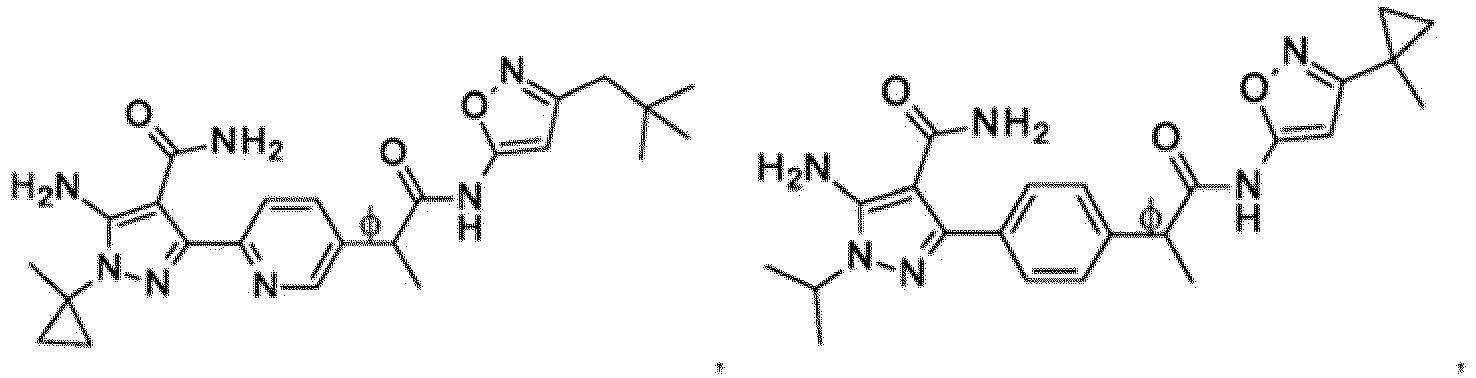


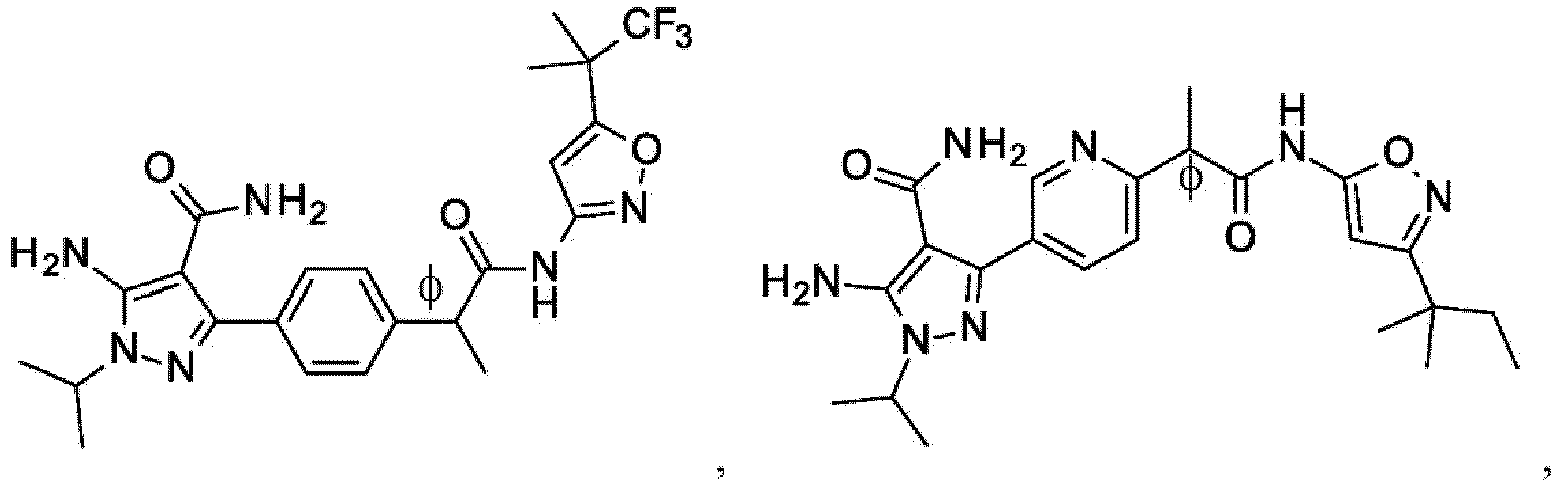


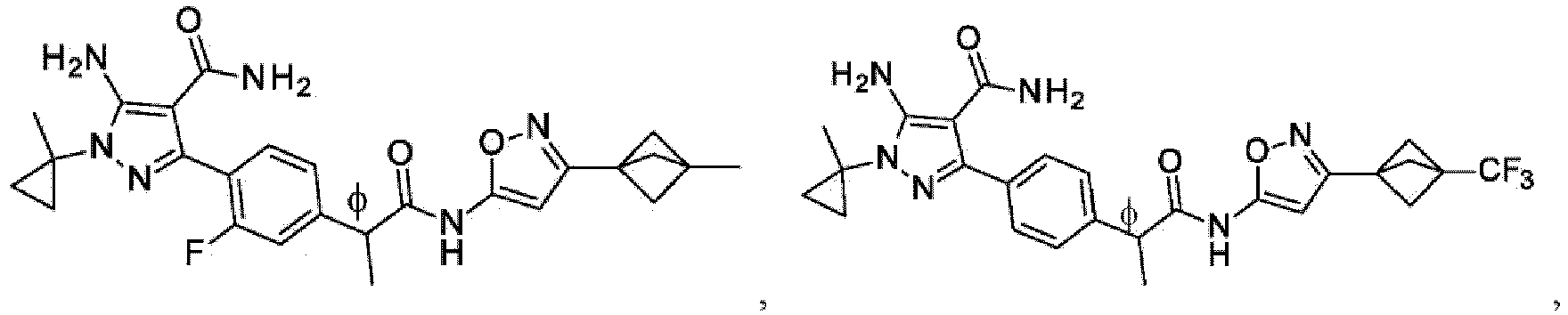

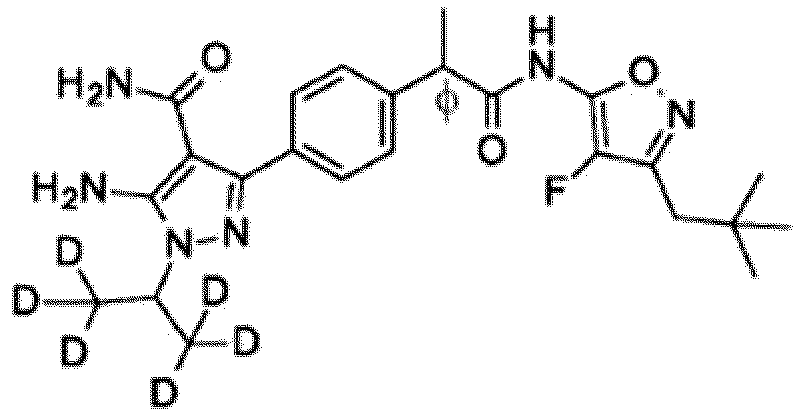
- Composé selon la revendication 15, dans lequel les formules ont une chiralité énantiomérique R au niveau de la position ϕ.
- Composé selon la revendication 15, dans lequel les formules ont une chiralité énantiomérique S au niveau de la position ϕ.
- Composé, ou sel pharmaceutiquement acceptable de celui-ci, selon l'une quelconque des revendications 1 à 17 pour une utilisation en thérapie.
- Composé, ou sel pharmaceutiquement acceptable de celui-ci, selon l'une quelconque des revendications 1 à 17 pour une utilisation dans le traitement du cancer.
- Composé, ou sel pharmaceutiquement acceptable de celui-ci, pour une utilisation dans le traitement du cancer selon la revendication 19, le cancer étant un cancer associé à RET.
- Composé, ou sel pharmaceutiquement acceptable de celui-ci, pour une utilisation dans le traitement du cancer selon la revendication 19 ou 20, le cancer étant choisi dans le groupe constitué de : cancer du poumon, cancer papillaire de la thyroïde, cancer médullaire de la thyroïde, cancer différencié de la thyroïde, cancer récurrent de la thyroïde, cancer différencié réfractaire de la thyroïde, néoplasie endocrinienne multiple de type 2A ou 2B (MEN2A ou MEN2B, respectivement), phéochromocytome, hyperplasie parathyroïdienne, cancer du sein, cancer colorectal, carcinome papillaire à cellules rénales, ganglioneuromatose de la muqueuse gastro-entérique, et cancer du col de l'utérus.
- Composé, ou sel pharmaceutiquement acceptable de celui-ci, pour une utilisation dans le traitement du cancer selon la revendication 21, le cancer étant un cancer médullaire de la thyroïde.
- Composé, ou sel pharmaceutiquement acceptable de celui-ci, pour une utilisation dans le traitement du cancer selon la revendication 21, le cancer du poumon étant un carcinome pulmonaire à petites cellules, un cancer du poumon non à petites cellules, un carcinome pulmonaire des bronchioles, un cancer du poumon de fusion RET, ou un adénocarcinome pulmonaire.
- Composition pharmaceutique comprenant un composé, ou un sel pharmaceutiquement acceptable de celui-ci, selon l'une quelconque des revendications 1 à 17 avec un ou plusieurs supports, diluants, ou excipients pharmaceutiquement acceptables.
Applications Claiming Priority (2)
| Application Number | Priority Date | Filing Date | Title |
|---|---|---|---|
| US202063015933P | 2020-04-27 | 2020-04-27 | |
| PCT/US2021/028836 WO2021222017A1 (fr) | 2020-04-27 | 2021-04-23 | Composés utiles pour inhiber la kinase ret |
Publications (2)
| Publication Number | Publication Date |
|---|---|
| EP4143184A1 EP4143184A1 (fr) | 2023-03-08 |
| EP4143184B1 true EP4143184B1 (fr) | 2025-04-23 |
Family
ID=75914595
Family Applications (1)
| Application Number | Title | Priority Date | Filing Date |
|---|---|---|---|
| EP21725633.8A Active EP4143184B1 (fr) | 2020-04-27 | 2021-04-23 | Composés utiles pour inhiber la kinase ret |
Country Status (20)
| Country | Link |
|---|---|
| US (2) | US11613533B2 (fr) |
| EP (1) | EP4143184B1 (fr) |
| JP (1) | JP7441972B2 (fr) |
| KR (1) | KR102876271B1 (fr) |
| CN (1) | CN115667253B (fr) |
| AR (1) | AR121914A1 (fr) |
| AU (1) | AU2021263541B2 (fr) |
| BR (1) | BR112022021735A2 (fr) |
| CA (1) | CA3177080A1 (fr) |
| CL (1) | CL2022003000A1 (fr) |
| CO (1) | CO2022016013A2 (fr) |
| DO (1) | DOP2022000234A (fr) |
| EC (1) | ECSP22083926A (fr) |
| ES (1) | ES3029367T3 (fr) |
| IL (1) | IL297551B2 (fr) |
| JO (1) | JOP20220282A1 (fr) |
| MX (1) | MX2022013482A (fr) |
| PE (1) | PE20230780A1 (fr) |
| TW (1) | TWI777509B (fr) |
| WO (1) | WO2021222017A1 (fr) |
Families Citing this family (20)
| Publication number | Priority date | Publication date | Assignee | Title |
|---|---|---|---|---|
| AU2021376367C1 (en) * | 2020-11-06 | 2025-05-15 | Eli Lilly And Company | Pyrazole derivatives as ret kinase inhibitors |
| CN116421730B (zh) * | 2023-03-06 | 2025-08-01 | 浙江大学 | Cux1抑制剂及其用途 |
| EP4687905A1 (fr) | 2023-03-30 | 2026-02-11 | Revolution Medicines, Inc. | Compositions pour induire une hydrolyse de ras gtp et leurs utilisations |
| AU2024265078A1 (en) | 2023-05-04 | 2025-12-11 | Revolution Medicines, Inc. | Combination therapy for a ras related disease or disorder |
| IL326136A (en) | 2023-08-07 | 2026-03-01 | Revolution Medicines Inc | RMC-6291 for use in the treatment of a disease or disorder associated with the RAS protein |
| US20250154171A1 (en) | 2023-10-12 | 2025-05-15 | Revolution Medicines, Inc. | Ras inhibitors |
| EP4574819A1 (fr) | 2023-12-22 | 2025-06-25 | Basf Se | Composés de diazinone pour la lutte contre les invertébrés nuisibles |
| WO2025131957A1 (fr) | 2023-12-22 | 2025-06-26 | Basf Se | Composés de diazinon pour la lutte contre les invertébrés nuisibles |
| WO2025171296A1 (fr) | 2024-02-09 | 2025-08-14 | Revolution Medicines, Inc. | Inhibiteurs de ras |
| WO2025240847A1 (fr) | 2024-05-17 | 2025-11-20 | Revolution Medicines, Inc. | Inhibiteurs de ras |
| CN118580162A (zh) * | 2024-05-27 | 2024-09-03 | 中国药科大学 | 一种酰肼类化合物及无金属策略促进酰肼类化合物制备的方法 |
| US20250375445A1 (en) | 2024-06-07 | 2025-12-11 | Revolution Medicines, Inc. | Methods of treating a ras protein-related disease or disorder |
| WO2025265060A1 (fr) | 2024-06-21 | 2025-12-26 | Revolution Medicines, Inc. | Compositions thérapeutiques et procédés de gestion d'effets liés au traitement |
| WO2026006747A1 (fr) | 2024-06-28 | 2026-01-02 | Revolution Medicines, Inc. | Inhibiteurs de ras |
| WO2026015796A1 (fr) | 2024-07-12 | 2026-01-15 | Revolution Medicines, Inc. | Méthodes de traitement d'une maladie ou d'un trouble lié à ras |
| WO2026015825A1 (fr) | 2024-07-12 | 2026-01-15 | Revolution Medicines, Inc. | Utilisation d'un inhibiteur de ras pour traiter le cancer du pancréas |
| WO2026015790A1 (fr) | 2024-07-12 | 2026-01-15 | Revolution Medicines, Inc. | Méthodes de traitement d'une maladie ou d'un trouble lié à ras |
| WO2026015801A1 (fr) | 2024-07-12 | 2026-01-15 | Revolution Medicines, Inc. | Méthodes de traitement d'une maladie ou d'un trouble liés à ras |
| WO2026050446A1 (fr) | 2024-08-29 | 2026-03-05 | Revolution Medicines, Inc. | Inhibiteurs de ras |
| WO2026072904A2 (fr) | 2024-09-26 | 2026-04-02 | Revolution Medicines, Inc. | Compositions et méthodes de traitement du cancer du poumon |
Family Cites Families (6)
| Publication number | Priority date | Publication date | Assignee | Title |
|---|---|---|---|---|
| US20110189167A1 (en) * | 2007-04-20 | 2011-08-04 | Flynn Daniel L | Methods and Compositions for the Treatment of Myeloproliferative Diseases and other Proliferative Diseases |
| BR112015023618A2 (pt) * | 2013-03-15 | 2017-07-18 | Glaxosmithkline Ip Dev Ltd | derivados de piridina como inibidores de quinase reorganizada durante a transfecção (ret) |
| WO2017145050A1 (fr) * | 2016-02-23 | 2017-08-31 | Glaxosmithkline Intellectual Property Development Limited | Dérivé de pyridylpyridone utile comme inhibiteur de la kinase ret dans le traitement du sci et du cancer |
| TW201738228A (zh) * | 2016-03-17 | 2017-11-01 | 藍圖醫藥公司 | Ret之抑制劑 |
| US11168090B2 (en) * | 2017-01-18 | 2021-11-09 | Array Biopharma Inc. | Substituted pyrazolo[1,5-a]pyrazines as RET kinase inhibitors |
| WO2020035065A1 (fr) * | 2018-08-17 | 2020-02-20 | 南京明德新药研发有限公司 | Dérivé de pyrazole en tant qu'inhibiteur de ret |
-
2021
- 2021-04-22 AR ARP210101083A patent/AR121914A1/es not_active Application Discontinuation
- 2021-04-22 TW TW110114546A patent/TWI777509B/zh not_active IP Right Cessation
- 2021-04-23 US US17/238,370 patent/US11613533B2/en active Active
- 2021-04-23 PE PE2022002489A patent/PE20230780A1/es unknown
- 2021-04-23 IL IL297551A patent/IL297551B2/en unknown
- 2021-04-23 WO PCT/US2021/028836 patent/WO2021222017A1/fr not_active Ceased
- 2021-04-23 CA CA3177080A patent/CA3177080A1/fr active Pending
- 2021-04-23 EP EP21725633.8A patent/EP4143184B1/fr active Active
- 2021-04-23 AU AU2021263541A patent/AU2021263541B2/en active Active
- 2021-04-23 CN CN202180044981.8A patent/CN115667253B/zh active Active
- 2021-04-23 ES ES21725633T patent/ES3029367T3/es active Active
- 2021-04-23 BR BR112022021735A patent/BR112022021735A2/pt unknown
- 2021-04-23 MX MX2022013482A patent/MX2022013482A/es unknown
- 2021-04-23 KR KR1020227041444A patent/KR102876271B1/ko active Active
- 2021-04-23 JP JP2022565547A patent/JP7441972B2/ja active Active
-
2022
- 2022-10-27 JO JOJO/P/2022/0282A patent/JOP20220282A1/ar unknown
- 2022-10-27 CL CL2022003000A patent/CL2022003000A1/es unknown
- 2022-10-27 EC ECSENADI202283926A patent/ECSP22083926A/es unknown
- 2022-10-27 DO DO2022000234A patent/DOP2022000234A/es unknown
- 2022-11-09 CO CONC2022/0016013A patent/CO2022016013A2/es unknown
-
2023
- 2023-02-06 US US18/165,037 patent/US11964968B2/en active Active
Also Published As
| Publication number | Publication date |
|---|---|
| JP2023523315A (ja) | 2023-06-02 |
| IL297551B2 (en) | 2024-06-01 |
| EP4143184A1 (fr) | 2023-03-08 |
| ES3029367T3 (en) | 2025-06-24 |
| AU2021263541A1 (en) | 2022-11-24 |
| TW202206428A (zh) | 2022-02-16 |
| ECSP22083926A (es) | 2022-11-30 |
| US11613533B2 (en) | 2023-03-28 |
| DOP2022000234A (es) | 2022-11-30 |
| AU2021263541B2 (en) | 2024-03-07 |
| TWI777509B (zh) | 2022-09-11 |
| US20230312544A1 (en) | 2023-10-05 |
| JP7441972B2 (ja) | 2024-03-01 |
| JOP20220282A1 (ar) | 2022-10-27 |
| BR112022021735A2 (pt) | 2022-12-06 |
| CA3177080A1 (fr) | 2021-11-04 |
| US20210363140A1 (en) | 2021-11-25 |
| KR102876271B1 (ko) | 2025-10-28 |
| MX2022013482A (es) | 2022-11-16 |
| CL2022003000A1 (es) | 2023-06-23 |
| US11964968B2 (en) | 2024-04-23 |
| CO2022016013A2 (es) | 2022-11-18 |
| WO2021222017A1 (fr) | 2021-11-04 |
| CN115667253B (zh) | 2025-06-17 |
| AR121914A1 (es) | 2022-07-20 |
| PE20230780A1 (es) | 2023-05-09 |
| IL297551B1 (en) | 2024-02-01 |
| CN115667253A (zh) | 2023-01-31 |
| KR20230005301A (ko) | 2023-01-09 |
| IL297551A (en) | 2022-12-01 |
Similar Documents
| Publication | Publication Date | Title |
|---|---|---|
| EP4143184B1 (fr) | Composés utiles pour inhiber la kinase ret | |
| CN118221698A (zh) | Kras g12d抑制剂 | |
| JP2008530011A (ja) | Rafインヒビター化合物および方法 | |
| CN118221685A (zh) | 作为kras g12d抑制剂的吲哚类化合物 | |
| TWI434840B (zh) | 吡唑啶-3-酮衍生物 | |
| EP4240738B1 (fr) | Derives de pyrazole comme des inhibiteurs de ret kinase |
Legal Events
| Date | Code | Title | Description |
|---|---|---|---|
| STAA | Information on the status of an ep patent application or granted ep patent |
Free format text: STATUS: UNKNOWN |
|
| STAA | Information on the status of an ep patent application or granted ep patent |
Free format text: STATUS: THE INTERNATIONAL PUBLICATION HAS BEEN MADE |
|
| PUAI | Public reference made under article 153(3) epc to a published international application that has entered the european phase |
Free format text: ORIGINAL CODE: 0009012 |
|
| STAA | Information on the status of an ep patent application or granted ep patent |
Free format text: STATUS: REQUEST FOR EXAMINATION WAS MADE |
|
| 17P | Request for examination filed |
Effective date: 20221128 |
|
| AK | Designated contracting states |
Kind code of ref document: A1 Designated state(s): AL AT BE BG CH CY CZ DE DK EE ES FI FR GB GR HR HU IE IS IT LI LT LU LV MC MK MT NL NO PL PT RO RS SE SI SK SM TR |
|
| REG | Reference to a national code |
Ref country code: HK Ref legal event code: DE Ref document number: 40080666 Country of ref document: HK |
|
| P01 | Opt-out of the competence of the unified patent court (upc) registered |
Effective date: 20230530 |
|
| RAV | Requested validation state of the european patent: fee paid |
Extension state: TN Effective date: 20221128 Extension state: MD Effective date: 20221128 Extension state: MA Effective date: 20221128 |
|
| GRAP | Despatch of communication of intention to grant a patent |
Free format text: ORIGINAL CODE: EPIDOSNIGR1 |
|
| STAA | Information on the status of an ep patent application or granted ep patent |
Free format text: STATUS: GRANT OF PATENT IS INTENDED |
|
| INTG | Intention to grant announced |
Effective date: 20241113 |
|
| GRAS | Grant fee paid |
Free format text: ORIGINAL CODE: EPIDOSNIGR3 |
|
| GRAA | (expected) grant |
Free format text: ORIGINAL CODE: 0009210 |
|
| STAA | Information on the status of an ep patent application or granted ep patent |
Free format text: STATUS: THE PATENT HAS BEEN GRANTED |
|
| AK | Designated contracting states |
Kind code of ref document: B1 Designated state(s): AL AT BE BG CH CY CZ DE DK EE ES FI FR GB GR HR HU IE IS IT LI LT LU LV MC MK MT NL NO PL PT RO RS SE SI SK SM TR |
|
| REG | Reference to a national code |
Ref country code: GB Ref legal event code: FG4D |
|
| REG | Reference to a national code |
Ref country code: CH Ref legal event code: EP |
|
| REG | Reference to a national code |
Ref country code: DE Ref legal event code: R096 Ref document number: 602021029602 Country of ref document: DE |
|
| REG | Reference to a national code |
Ref country code: IE Ref legal event code: FG4D |
|
| REG | Reference to a national code |
Ref country code: ES Ref legal event code: FG2A Ref document number: 3029367 Country of ref document: ES Kind code of ref document: T3 Effective date: 20250624 |
|
| PGFP | Annual fee paid to national office [announced via postgrant information from national office to epo] |
Ref country code: DE Payment date: 20250423 Year of fee payment: 5 |
|
| PGFP | Annual fee paid to national office [announced via postgrant information from national office to epo] |
Ref country code: ES Payment date: 20250523 Year of fee payment: 5 |
|
| PGFP | Annual fee paid to national office [announced via postgrant information from national office to epo] |
Ref country code: AT Payment date: 20250721 Year of fee payment: 5 |
|
| REG | Reference to a national code |
Ref country code: NL Ref legal event code: MP Effective date: 20250423 |
|
| PG25 | Lapsed in a contracting state [announced via postgrant information from national office to epo] |
Ref country code: NL Free format text: LAPSE BECAUSE OF FAILURE TO SUBMIT A TRANSLATION OF THE DESCRIPTION OR TO PAY THE FEE WITHIN THE PRESCRIBED TIME-LIMIT Effective date: 20250423 |
|
| REG | Reference to a national code |
Ref country code: AT Ref legal event code: MK05 Ref document number: 1787682 Country of ref document: AT Kind code of ref document: T Effective date: 20250423 |
|
| PG25 | Lapsed in a contracting state [announced via postgrant information from national office to epo] |
Ref country code: FI Free format text: LAPSE BECAUSE OF FAILURE TO SUBMIT A TRANSLATION OF THE DESCRIPTION OR TO PAY THE FEE WITHIN THE PRESCRIBED TIME-LIMIT Effective date: 20250423 Ref country code: PT Free format text: LAPSE BECAUSE OF FAILURE TO SUBMIT A TRANSLATION OF THE DESCRIPTION OR TO PAY THE FEE WITHIN THE PRESCRIBED TIME-LIMIT Effective date: 20250825 |
|
| REG | Reference to a national code |
Ref country code: LT Ref legal event code: MG9D |
|
| PG25 | Lapsed in a contracting state [announced via postgrant information from national office to epo] |
Ref country code: GR Free format text: LAPSE BECAUSE OF FAILURE TO SUBMIT A TRANSLATION OF THE DESCRIPTION OR TO PAY THE FEE WITHIN THE PRESCRIBED TIME-LIMIT Effective date: 20250724 Ref country code: NO Free format text: LAPSE BECAUSE OF FAILURE TO SUBMIT A TRANSLATION OF THE DESCRIPTION OR TO PAY THE FEE WITHIN THE PRESCRIBED TIME-LIMIT Effective date: 20250723 |
|
| PG25 | Lapsed in a contracting state [announced via postgrant information from national office to epo] |
Ref country code: PL Free format text: LAPSE BECAUSE OF FAILURE TO SUBMIT A TRANSLATION OF THE DESCRIPTION OR TO PAY THE FEE WITHIN THE PRESCRIBED TIME-LIMIT Effective date: 20250423 |
|
| PG25 | Lapsed in a contracting state [announced via postgrant information from national office to epo] |
Ref country code: BG Free format text: LAPSE BECAUSE OF FAILURE TO SUBMIT A TRANSLATION OF THE DESCRIPTION OR TO PAY THE FEE WITHIN THE PRESCRIBED TIME-LIMIT Effective date: 20250423 |
|
| PG25 | Lapsed in a contracting state [announced via postgrant information from national office to epo] |
Ref country code: HR Free format text: LAPSE BECAUSE OF FAILURE TO SUBMIT A TRANSLATION OF THE DESCRIPTION OR TO PAY THE FEE WITHIN THE PRESCRIBED TIME-LIMIT Effective date: 20250423 |
|
| PG25 | Lapsed in a contracting state [announced via postgrant information from national office to epo] |
Ref country code: AT Free format text: LAPSE BECAUSE OF FAILURE TO SUBMIT A TRANSLATION OF THE DESCRIPTION OR TO PAY THE FEE WITHIN THE PRESCRIBED TIME-LIMIT Effective date: 20250423 |
|
| PG25 | Lapsed in a contracting state [announced via postgrant information from national office to epo] |
Ref country code: RS Free format text: LAPSE BECAUSE OF FAILURE TO SUBMIT A TRANSLATION OF THE DESCRIPTION OR TO PAY THE FEE WITHIN THE PRESCRIBED TIME-LIMIT Effective date: 20250723 |
|
| PG25 | Lapsed in a contracting state [announced via postgrant information from national office to epo] |
Ref country code: IS Free format text: LAPSE BECAUSE OF FAILURE TO SUBMIT A TRANSLATION OF THE DESCRIPTION OR TO PAY THE FEE WITHIN THE PRESCRIBED TIME-LIMIT Effective date: 20250823 |
|
| PG25 | Lapsed in a contracting state [announced via postgrant information from national office to epo] |
Ref country code: LV Free format text: LAPSE BECAUSE OF FAILURE TO SUBMIT A TRANSLATION OF THE DESCRIPTION OR TO PAY THE FEE WITHIN THE PRESCRIBED TIME-LIMIT Effective date: 20250423 |
|
| REG | Reference to a national code |
Ref country code: CH Ref legal event code: H13 Free format text: ST27 STATUS EVENT CODE: U-0-0-H10-H13 (AS PROVIDED BY THE NATIONAL OFFICE) Effective date: 20251125 |
|
| PG25 | Lapsed in a contracting state [announced via postgrant information from national office to epo] |
Ref country code: LU Free format text: LAPSE BECAUSE OF NON-PAYMENT OF DUE FEES Effective date: 20250423 |
|
| REG | Reference to a national code |
Ref country code: BE Ref legal event code: MM Effective date: 20250430 |
|
| PG25 | Lapsed in a contracting state [announced via postgrant information from national office to epo] |
Ref country code: SM Free format text: LAPSE BECAUSE OF FAILURE TO SUBMIT A TRANSLATION OF THE DESCRIPTION OR TO PAY THE FEE WITHIN THE PRESCRIBED TIME-LIMIT Effective date: 20250423 Ref country code: DK Free format text: LAPSE BECAUSE OF FAILURE TO SUBMIT A TRANSLATION OF THE DESCRIPTION OR TO PAY THE FEE WITHIN THE PRESCRIBED TIME-LIMIT Effective date: 20250423 |
|
| VS25 | Lapsed in a validation state [announced via postgrant information from nat. office to epo] |
Ref country code: MD Free format text: LAPSE BECAUSE OF FAILURE TO SUBMIT A TRANSLATION OF THE DESCRIPTION OR TO PAY THE FEE WITHIN THE PRESCRIBED TIME-LIMIT Effective date: 20250423 |
|
| PG25 | Lapsed in a contracting state [announced via postgrant information from national office to epo] |
Ref country code: BE Free format text: LAPSE BECAUSE OF NON-PAYMENT OF DUE FEES Effective date: 20250430 |
|
| PG25 | Lapsed in a contracting state [announced via postgrant information from national office to epo] |
Ref country code: CH Free format text: LAPSE BECAUSE OF NON-PAYMENT OF DUE FEES Effective date: 20250430 |
|
| PG25 | Lapsed in a contracting state [announced via postgrant information from national office to epo] |
Ref country code: CZ Free format text: LAPSE BECAUSE OF FAILURE TO SUBMIT A TRANSLATION OF THE DESCRIPTION OR TO PAY THE FEE WITHIN THE PRESCRIBED TIME-LIMIT Effective date: 20250423 |
|
| PG25 | Lapsed in a contracting state [announced via postgrant information from national office to epo] |
Ref country code: EE Free format text: LAPSE BECAUSE OF FAILURE TO SUBMIT A TRANSLATION OF THE DESCRIPTION OR TO PAY THE FEE WITHIN THE PRESCRIBED TIME-LIMIT Effective date: 20250423 |
|
| REG | Reference to a national code |
Ref country code: DE Ref legal event code: R097 Ref document number: 602021029602 Country of ref document: DE |
|
| PG25 | Lapsed in a contracting state [announced via postgrant information from national office to epo] |
Ref country code: SK Free format text: LAPSE BECAUSE OF FAILURE TO SUBMIT A TRANSLATION OF THE DESCRIPTION OR TO PAY THE FEE WITHIN THE PRESCRIBED TIME-LIMIT Effective date: 20250423 |
|
| PG25 | Lapsed in a contracting state [announced via postgrant information from national office to epo] |
Ref country code: MC Free format text: LAPSE BECAUSE OF FAILURE TO SUBMIT A TRANSLATION OF THE DESCRIPTION OR TO PAY THE FEE WITHIN THE PRESCRIBED TIME-LIMIT Effective date: 20250423 |
|
| PG25 | Lapsed in a contracting state [announced via postgrant information from national office to epo] |
Ref country code: RO Free format text: LAPSE BECAUSE OF FAILURE TO SUBMIT A TRANSLATION OF THE DESCRIPTION OR TO PAY THE FEE WITHIN THE PRESCRIBED TIME-LIMIT Effective date: 20250423 |
|
| VS25 | Lapsed in a validation state [announced via postgrant information from nat. office to epo] |
Ref country code: MA Free format text: FAILURE TO ELECT DOMICILE IN THE NATIONAL COUNTRY Effective date: 20250724 |
|
| PLBE | No opposition filed within time limit |
Free format text: ORIGINAL CODE: 0009261 |
|
| STAA | Information on the status of an ep patent application or granted ep patent |
Free format text: STATUS: NO OPPOSITION FILED WITHIN TIME LIMIT |
|
| REG | Reference to a national code |
Ref country code: CH Ref legal event code: L10 Free format text: ST27 STATUS EVENT CODE: U-0-0-L10-L00 (AS PROVIDED BY THE NATIONAL OFFICE) Effective date: 20260304 |
|
| VS25 | Lapsed in a validation state [announced via postgrant information from nat. office to epo] |
Ref country code: MA Free format text: LAPSE BECAUSE OF FAILURE TO SUBMIT A TRANSLATION OF THE DESCRIPTION OR TO PAY THE FEE WITHIN THE PRESCRIBED TIME-LIMIT Effective date: 20250423 |
|
| 26N | No opposition filed |
Effective date: 20260126 |
|
| PGFP | Annual fee paid to national office [announced via postgrant information from national office to epo] |
Ref country code: GB Payment date: 20260319 Year of fee payment: 6 |
|
| PGFP | Annual fee paid to national office [announced via postgrant information from national office to epo] |
Ref country code: IE Payment date: 20260320 Year of fee payment: 6 |
|
| PGFP | Annual fee paid to national office [announced via postgrant information from national office to epo] |
Ref country code: IT Payment date: 20260319 Year of fee payment: 6 |
|
| PGFP | Annual fee paid to national office [announced via postgrant information from national office to epo] |
Ref country code: FR Payment date: 20260320 Year of fee payment: 6 |