EP4144936A1 - Dispositif de positionnement d'encadrement et procédé de positionnement d'encadrement - Google Patents
Dispositif de positionnement d'encadrement et procédé de positionnement d'encadrement Download PDFInfo
- Publication number
- EP4144936A1 EP4144936A1 EP21000285.3A EP21000285A EP4144936A1 EP 4144936 A1 EP4144936 A1 EP 4144936A1 EP 21000285 A EP21000285 A EP 21000285A EP 4144936 A1 EP4144936 A1 EP 4144936A1
- Authority
- EP
- European Patent Office
- Prior art keywords
- frame
- recess
- positioning device
- positioning plate
- positioning
- Prior art date
- Legal status (The legal status is an assumption and is not a legal conclusion. Google has not performed a legal analysis and makes no representation as to the accuracy of the status listed.)
- Pending
Links
Images




Classifications
-
- E—FIXED CONSTRUCTIONS
- E04—BUILDING
- E04F—FINISHING WORK ON BUILDINGS, e.g. STAIRS, FLOORS
- E04F21/00—Implements for finishing work on buildings
- E04F21/0007—Implements for finishing work on buildings for mounting doors, windows or frames; their fitting
- E04F21/0015—Implements for finishing work on buildings for mounting doors, windows or frames; their fitting for mounting frames
Definitions
- the invention relates to a frame positioning device and a frame positioning method.
- a frame is a component and, in the most general definition, has the task of enclosing other spatial elements, such as doors, windows, chairs, beds and/or products from trade fair construction, packaging technology and/or beekeeping.
- the frame that encloses the door is referred to as a door frame or door frame.
- the door jamb generally has the function of holding the door and embellishing the doorway by concealing an opening in a wall and thus raw stone or concrete.
- the door frame generally seals the side and top of the door.
- the door frame can also serve as a one-sided stop, for example with swing doors.
- the door jamb typically has a three-part jamb frame which is generally in the shape of a downwardly open "U".
- the frame has two side parts and one upper part connecting the side parts.
- a locking plate for receiving a door lock is arranged on one of the frame side parts and at least one is arranged on the other frame side part, with two hinge mounts or hinges usually being arranged.
- the door frame can hold, in particular anchor, door hinges or hinge elements of the door by means of the hinge mounts. The respective position on the door frame depends on the opening direction of the door.
- the locking plate is mounted on the side opposite the door hinge.
- the frame that frames the window is referred to as a window frame and is used to accommodate windows or multiple window sashes and typically has four frame parts.
- Frames can be made from different materials. Frames are typically made of wood, wood-based materials, plastic, sheet steel, stainless steel or aluminium.
- the assembly of the frame is typically done manually with several screw clamps for fastening the frame to the wall in which it is to be installed, and several spreaders for spacing the frame side parts.
- the object of the invention is to create an improved possibility for mounting a frame in a wall. Furthermore, the object of the invention is to provide an improved method for installing the frame in the recess in the wall.
- the object is achieved by a frame positioning device according to claim 1.
- the object is achieved by a frame positioning method according to claim 11.
- the frame positioning device has a positioning plate which has a height, a width and a plate thickness, the positioning plate having a first side boundary and a second side boundary, the first side boundary and the second side boundary being arranged essentially opposite one another, with the area of the first side boundary being a first connecting means for connecting the positioning plate to a frame and a second connecting means for connecting the positioning plate to the frame are arranged in the region of the second side boundary.
- the positioning plate has a substantially rectangular shape.
- the first connecting means can be connected to a first frame side part and the second connecting means can be connected to a second frame side part. With the first connection means and the second connection means, the positioning plate can each be connected to the frame, preferably releasably connected.
- Recesses and screws, recesses and dowels, nails, clamps and other known connecting means and/or connecting elements can be used which can create a detachable connection between the frame and the positioning plate.
- the frame positioning device is a mounting device for installing the frame in a wall, whereby the installation can include transporting the frame, positioning it, aligning it with the wall and fixing the frame to the wall.
- the frame positioning device is preferably constructed in one piece.
- the frame positioning device is therefore a one-piece device, in particular a one-piece assembly aid.
- the frame positioning device is set up for transport, assembly and installation, in particular for fixing the frame in or on a wall.
- the frame positioning device can advantageously be detachably connected to the frame.
- the assembled frame can be connected to the frame positioning device, with the connection during transport, positioning of the frame in a recess in the wall, alignment of the frame to the wall, in particular horizontal alignment of the frame relative to the wall and fixing of the frame to the wall persists.
- the connection can preferably be released after the frame is firmly fixed in the wall.
- the first connecting means has at least one left-hand recess and the second connecting means has a right-hand recess.
- the left and right cavities are substantially circular cavities.
- the at least one left recess is arranged in the area of the first side boundary and the at least one right recess is arranged in the area of the second side boundary.
- a second, preferably a third recess is provided on both sides.
- the first, second and third left recesses are each vertically spaced in the positioning plate.
- the first, second and third right recesses are each vertically spaced in the positioning plate.
- the frame positioning device can be connected to the respective side of the frame on both sides at two, preferably three positions each.
- a stable connection can thus be produced between the frame and the frame positioning device, which represents a stable, particularly torsion-proof connection, particularly when the frame is being moved and/or transported.
- connection between the frame and the frame positioning device can be realized by means of screws.
- the screws can be releasably fastened through the at least one left-hand recess and the at least one right-hand recess in an adjacent groove of the frame, in particular of the respective frame side part.
- a sealing lip arranged in the region of the groove is preferably removed at least partially from the frame, in particular from the side parts of the frame.
- the frame and the frame positioning device are always essentially rigidly connected.
- no individual components of a frame of the frame for example frame side parts and a frame upper part, can be displaced in relation to one another. This prevents damage to the frame, in particular to the surface of the frame, during transport and installation.
- a bushing in particular a guide bushing, is preferably arranged in each of the at least one left-hand recess and the at least one right-hand recess.
- a bushing in particular a guide bushing, is also arranged in each of the second and third recesses, in particular inserted therein. The bushing ensures that the walls of the recess are protected and that the screws can be passed through the respective recess more easily.
- the at least one left-hand recess is arranged at a distance from the first side boundary and the at least one right-hand recess is arranged at a distance from the second side boundary.
- the distance is preferably small, in particular several mm to a few cm.
- the second and third right recesses are spaced from the right side boundary and the second and third recesses are spaced from the left side boundary.
- the first recess preferably has a central axis, the central axis including an angle ⁇ to a surface normal of the positioning plate, as a result of which the first recess has a sloping course in the positioning plate. This advantageously ensures good positioning of the screw in the groove of the frame.
- the second recess preferably has a central axis, the central axis including an angle - ⁇ to the surface normal of the positioning plate, as a result of which the second recess has a sloping course in the positioning plate.
- the inclinations of the slope of the left recess and right recess are aligned oppositely. As a result, the screw guided through the respective recess is at an angle to the groove in the respective associated frame side part.
- the positioning plate preferably has at least one holding device.
- the at least one holding device is preferably a holding recess.
- two transport recesses are provided.
- the holding device can also be a handle arranged on the positioning plate.
- the holding recess represents a holding opening through which a person carrying the frame can reach with one hand and hold the frame positioning device and thereby carry the frame.
- the positioning plate of the frame positioning device has a passage recess, in particular a passage opening.
- the passage opening is also referred to as a manhole.
- the positioning plate preferably has a working recess, in particular a working opening.
- a working recess By means of the working recess, work can be carried out on both sides of the frame and/or the frame positioning device.
- a spirit level is preferably arranged on the frame positioning device, in particular on the positioning plate, preferably in the lower area of the positioning plate.
- the level can be a BMI level.
- the horizontal alignment of the frame positioning device can be checked and checked using the spirit level.
- the spirit level is preferably a plastic or glass tube that is typically slightly curved and is filled with a liquid and a gas bubble, in particular an air bubble.
- the level can be used to check the horizontal and/or vertical position of the positioning plate and thus the frame.
- the advantage here is that no external spirit level has to be used to see whether the frame is aligned. If the bubble level is arranged horizontally on the positioning plate, horizontal alignment can be checked. If the bubble level is arranged vertically, a vertical alignment can be checked.
- the spirit level is rotatably arranged on the positioning plate. Using the on the Positioning plate arranged spirit level can advantageously be made possible by one person to assemble the frame.
- At least one adjusting device is arranged on the frame positioning device, in particular on the lower edge of the positioning plate, the adjusting device having in particular at least one adjustable foot.
- the adjustment device is preferably a height adjustment device.
- the adjusting device can have a screw-nut combination, as a result of which an easy adjustment option can be implemented.
- the adjusting device can also be a telescopic base.
- the frame positioning method is set up for positioning a frame, in particular for transporting, positioning, installing and fixing the frame in an opening in the wall and uses the frame positioning device according to the invention.
- the frame positioning device By means of the frame positioning device, the frame can advantageously be moved, transported, positioned, aligned and fixed by one person.
- the fixation can take place, for example, by foaming.
- a frame with a first frame side part and a second frame side part the first frame side part and the second frame side part being connected to a frame positioning device according to one of claims 1 to 10 according to the invention.
- the frame with the frame positioning device can advantageously be handled as a one-piece element. Handling can include moving, in particular transporting, positioning, aligning and/or fixing. In particular, the frame can be handled, in particular moved, by one person.
- Several frames can also be stacked in this way, with each frame being connected to a frame positioning device, in particular being detachably connected.
- the task is also solved by an assembly aid for the installation of frames and is a combination element that allows a single person to pre-assemble, carry and install a frame, having 2 carrying handles, solved.
- the assembly aid preferably has a manhole (item 3) and/or a BMI bubble level is preferably integrated and/or the assembly aid is equipped with guide bushings for screw connections along both of its sides.
- the assembly aid can be equipped with two height-adjustable feet.
- the advantage here is that the assembly aid for installing a frame is a reusable assembly jig that simplifies and accelerates the assembly of a 3-part frame and enables it to be set up and carried by just one person.
- the disadvantages of the prior art which previously only one inconvenient range of assembly systems with an increased risk of damage during assembly and disassembly of surfaces/veneers of door frames has been overcome. It is particularly advantageous that this is not possible with just one person, as is the case with previous assembly devices, which sometimes have to be installed by two people or are carried out in several work steps. The alignment of the frame in all levels must be observed at the same time.
- current practice shows that erecting and carrying a pre-assembled door frame involves the risk of the connecting elements or the frame elements being damaged due to the leverage forces during erecting and carrying.
- the assembly teaching according to the invention consists of only one component that can be used by just one person and carried alone when mounted on the frame. Many work trips are saved by eliminating the 2-3-piece clamping and spreading elements that have been customary up to now.
- the application of the invention also automatically ensures horizontal alignment in one plane.
- the mounting aid preferably consists of a multiplex board with two small cut-outs that serve as a carrying handle and a large cut-out that functions as a manhole. After the frame has been installed (foaming of the gaps, etc.), the man hole allows enough space to leave or re-enter the room.
- the two carrying handles make it easy to carry the frame mounted on the assembly aid, regardless of which side.
- the jig is installed as follows: The hinge side and the lock side of a frame each have a groove for the sealing lip (frame rebate). This is first removed a little. The assembly aid is first placed in the bracket next to the groove (e.g. hinge side), aligned at the lower end by hand flush with the frame and screwed tight through the guide bushings. Now the process is repeated with the lock side. Finally, the cross piece of the frame is professionally fitted to the hinge and lock side.
- the pre-assembled frame can now be set up and carried alone. After the frame has been roughly fitted into the door opening provided for this purpose, it can be balanced manually using the two adjustable feet. The spirit level attached below is used for checking. A fine adjustment of the adjustable feet, if necessary, could be done with an open-end wrench.
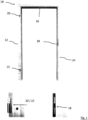
- FIG 1 shows a Zarge10 in a schematic representation as a plan view.
- the frame 10 is preferably a door frame 10 and has a first frame side part 12 and a second frame side part 14 which are connected by means of a frame center part 16 .
- a locking plate 18 is installed in the first frame side part 12 and two hinge mounts 20 and 22 are installed in the second frame side part 16 .
- the tape mounts 20 and 22 are also referred to as hinges 20 and 22.
- a door (not shown) can be mounted between the first frame side part 12 and the second frame side part 14 by hinges or hinges arranged on the door being hung in the hinge receptacle 20 and hinge receptacle 22 .
- the locking plate 16 can also be mounted in the second frame side part 14 and the hinge mounts 20 and 22 in the first frame side part 12 .
- FIG 2 shows the frame 10 in a schematic sectional view.
- the frame 10 comprises a decorative lining 24, a lining bed 26 and a folded lining 28.
- the lining bed 26 has an outer frame dimension 30 and a frame passage dimension 32.
- a sealing element 34 which is preferably designed as a sealing lip 34 , is arranged between the lining bed 26 and the folded cladding 24 .
- the sealing element 34 is arranged at least in regions to the side of a groove 36 .
- the sealing element 34 can be removed from the frame 10, in particular pulled out.
- the trim 24 is mounted in the assembled frame 10 from the bed 26 separable.
- Figure 3a shows a frame positioning device 40 in plan view in the left part of the figure.
- the frame positioning device 40 has an essentially rectangular positioning plate 41 with a height 42, a width 44 and a thickness 45.
- the positioning panel 41 is preferably a multiplex panel 41.
- the positioning panel 41 can also be a solid wood panel, plastic panel or aluminum panel.
- the positioning plate 41 can also be made from one or more plastics or a material mix composition.
- the positioning plate 41 is at least in one direction, preferably in the torsion-resistant in the vertical direction.
- the frame positioning device 40 has a first side limit 46 and a second side limit 48 .
- At least one first connecting means 49 which serves as a fastening means 49 , is arranged at a distance from the first side boundary 46 .
- the connecting means 49 has a first, left-hand recess 50a.
- the position of the first recesses 50a is chosen such that the frame positioning device 40 can be detachably connected to the frame 10 .
- the first recess 50a is preferably arranged approximately at half the height 42 as seen in the vertical direction.
- the frame positioning device 40 can be releasably connected to the frame 10, in particular the frame side part 12, by screwing a screw into the groove 36 on the frame 10 through the recess 50a, 50b, 50c.
- At least one second connecting means 51 in particular a second, right-hand recess 52a, is arranged in the positioning plate 41 at a distance from the side boundary 48.
- the second connecting means 51 is arranged opposite the first connecting means 49 .
- the second recess 52a is arranged approximately opposite the first recess 50a.
- Second, in particular three, right-hand recesses 52a, 52b, 52c are preferably arranged at a distance from the side boundary 48.
- the second recesses 52a, 52b, 52c are arranged vertically one above the other. With the second recess 52a, 52b, 52c, the frame positioning device 40 can be releasably connected to the frame 10, in particular the frame side part 14, by screwing a screw into the groove 36 on the frame through the recess 52a, 52b, 52c.
- the recesses 50a, 50b, 50c and 52a, 52b, 52c are designed as bores, in particular as essentially circular bores 50a, 50b, 50c and 52a, 52b, 52c.
- the recesses 50a, 50b, 50c and 52a, 52b, 52c are preferably arranged in the frame positioning device 40 at an angle ⁇ and ⁇ of unequal 90 degrees.
- the inclinations of the angle ⁇ and the angle - ⁇ are opposite, so that the screws guided through the recesses 50, 50a, 50b, 50c and 52, 52a, 52b, 52c each have an angle with
- the recesses 50a, 50b, 50c, 52a, 52b, 52c completely penetrate the positioning plate 41 and thus the frame positioning device 40 and extend over the entire thickness 45.
- the positioning plate 41 has a height 42 of about 1500mm, a width 44 of about 840mm and a thickness 45 of about 45mm.
- the dimensions of the positioning plate 41 are adapted to the dimensions of the frame 10, with the height 42 comprising approximately 2/3 of the height of the frame 10. Stable mounting of the frame 10 in the frame positioning device 40 is thus ensured.
- the width of the positioning plate 41 is adapted to a clear width of the frame 10 and is approximately 591 mm, 716 mm, 841 mm, 966 mm and/or 1091 mm.
- the positioning plate 41 can also be foldable by means of a hinge (not shown). As a result, the frame positioning device 40 takes up only half the storage space.
- the height 42 of the positioning plate 41 is preferably approximately 2/3 of the height of the frame 10.
- the hinge is arranged at approximately half the height 42 of the positioning plate 41 on both sides.
- the frame positioning device 40 has at least one, preferably two, holding devices 54a, 54b.
- the holding devices 54a, 54b are in FIG figure 3 Zarzpositioniervorraum 40 shown executed as holding recesses 54a, 54b.
- the holding recesses 54a, 54b are dimensioned such that a human hand can reach through them.
- the holding devices 54a, 54b can also be designed as handles connected to the positioning plate 41, with which the frame positioning device 40 can be transported.
- the frame positioning device 40 has a through-hole 56 which is arranged in the lower part of the frame positioning device 40 and is dimensioned such that a person can pass through the through-hole 56 in order to get from a first side of the frame positioning device 40 to a second, opposite side. Furthermore, the frame positioning device 40 has a working recess 58 arranged in an upper area. The working recess 58 is typically arranged above the holding device 54a, 54b. The working recess 58 is arranged at working height and is thus arranged in the upper third of the overall height 42 of the frame positioning device 40 . The working recess 58 allows the frame positioning device 40 to be held by one person on either side can be.
- the frame positioning device 40 has a spirit level 60, by means of which it can be checked whether the frame positioning device 40 is arranged in a horizontal position.
- the spirit level 60 is preferably arranged on the lower third of the frame positioning device 40 .
- At least one adjusting device 62 is arranged on a lower edge 61 of the positioning plate 41 .
- the frame positioning device 40 preferably has two adjusting devices 62, 62a, 62b, by means of which the horizontal position of the frame positioning device 40 can be changed.
- the adjustment device 62, 62a, 62b is designed in such a way that the adjustment device 62, 62a and 62b has a height adjustment element 64, 64a, 64b.
- the height adjustment element 64, 64a, 64b preferably has a screw element 66, 66a, 66b and a nut element 68, 68a, 68b, the screw element 66, 66a, 66b being displaceable relative to the nut element 68a, 68b, 68c.
- the height adjustment element 64, 64a, 64b has feet 70, 70a, 70b arranged on the screw element 66, 66a, 66b, by means of which the frame positioning device 40 can be positioned on a floor.
- the adjusting device 64 is preferably arranged in a recess 69 in the lower edge 61 .
- the adjustment device 62, 62a, 62b can be designed as a telescopic adjustment device 62, 62a, 62b.
- Figure 3b shows the frame positioning device 40 in a perspective view. It can be seen that the holding recesses 54a, 54b, the passage recess 56 and the working recess 58 penetrate the thickness 45 of the frame positioning device 40 completely.
- the holding recess 54a, 54b is a holding opening 54a, 54b
- the through-hole 56 is a through-hole 56
- the working hole 58 is a working opening 58 in the positioning plate 41.
- the level 60 is on the positioning plate 41 to check the horizontal position of the frame positioning device 40 on the positioning plate 41 arranged.
- the adjusting devices 62a, 62b can be arranged on the lower edge 61 of the positioning plate 41.
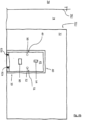
- FIG 4a shows a simplified embodiment of the frame positioning device 40 in a schematic representation.
- the positioning plate 41 has at least one holding device 54 which serves to transport and position the positioning plate 41 .
- the at least one holding device 54 can be at least one handle 54 or at least one holding opening 54.
- the frame positioning device 40 has the at least a first recess 50 and the at least one second recess 52, each designed as a bore.
- the Zarzpositioniervoriques 40 according to Figure 4a can be used, for example, for mounting the frame 10 in spatially limited wall sections 72 of a wall, in which there is a wall opening 74 adjacent to the wall position 72 of the frame 10 to be installed, as is shown in Figure 4b is shown as an example.
- the wall boundary is designated by reference numerals 72' and 76'.
- the wall penetration 74 is between the wall border 72' and the wall border 76'.
- figure 5 shows a section of the frame positioning device 40.
- the recess 52, 52c on the side part 48 is shown.
- the recess 52c is drilled obliquely into the positioning plate 41 and a central axis 80 of the recess 52c encloses the angle ⁇ to a surface normal 82 of the positioning plate 41 .
- a guide bushing 84 can be positioned in each of the recesses 52, 52a, 52b, 52c.
- the guide bushing 84 is also provided in the recesses 50, 50, 50b, 50c.
- the adjusting device 64, 64a, 64b is mounted in a respective recess 69, which extends upwards from the lower edge 61 of the positioning plate 41.
- the positioning plate typically has two recesses 69a and 69b.
- figure 6 12 shows the frame positioning device 40 with the frame 10 positioned in a wall 90.
- the positioning plate 41 is detachably connected to the frame 10 in that a screw (not shown) in each case has passed through the recesses 50, 50a, 50b and 52a, 52b and 52c into an operative connection with the frame 10, in particular with the respective frame side part 12 and 14.
- the screw (not shown) is preferably screwed into the respective groove 36 in the frame side part 12 and frame side part 14 .
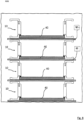
- figure 8 12 shows stacked pods 10, each pod 10 being connected to pod positioning device 40.
- FIG. A securing plate 92 is arranged between the frame 10 with the frame positioning device 40 .
- several frames 10 can be stored as stacked frames 10 and/or easily and safely transported in a vehicle (not shown).
Landscapes
- Engineering & Computer Science (AREA)
- Architecture (AREA)
- Civil Engineering (AREA)
- Structural Engineering (AREA)
- Door And Window Frames Mounted To Openings (AREA)
- Automatic Assembly (AREA)
Priority Applications (6)
| Application Number | Priority Date | Filing Date | Title |
|---|---|---|---|
| AU2022336965A AU2022336965A1 (en) | 2021-09-02 | 2022-08-26 | Frame-positioning device and method for positioning a frame |
| EP22769917.0A EP4396424A1 (fr) | 2021-09-02 | 2022-08-26 | Dispositif de positionnement de cadre et procédé de positionnement d'un cadre |
| CN202280059493.9A CN118140030A (zh) | 2021-09-02 | 2022-08-26 | 边框定位设备和用于定位边框的方法 |
| PCT/EP2022/073825 WO2023031052A1 (fr) | 2021-09-02 | 2022-08-26 | Dispositif de positionnement de cadre et procédé de positionnement d'un cadre |
| CA3230065A CA3230065A1 (fr) | 2021-09-02 | 2022-08-26 | Dispositif de positionnement de cadre et procede de positionnement d'un cadre |
| US18/588,351 US20240247502A1 (en) | 2021-09-02 | 2024-02-27 | Frame-positioning device and method for positioning a frame |
Applications Claiming Priority (1)
| Application Number | Priority Date | Filing Date | Title |
|---|---|---|---|
| DE202021002855.2U DE202021002855U1 (de) | 2021-09-02 | 2021-09-02 | Montagehilfe für den Einbau einer Zarge |
Publications (1)
| Publication Number | Publication Date |
|---|---|
| EP4144936A1 true EP4144936A1 (fr) | 2023-03-08 |
Family
ID=78086970
Family Applications (1)
| Application Number | Title | Priority Date | Filing Date |
|---|---|---|---|
| EP21000285.3A Pending EP4144936A1 (fr) | 2021-09-02 | 2021-10-07 | Dispositif de positionnement d'encadrement et procédé de positionnement d'encadrement |
Country Status (2)
| Country | Link |
|---|---|
| EP (1) | EP4144936A1 (fr) |
| DE (1) | DE202021002855U1 (fr) |
Cited By (1)
| Publication number | Priority date | Publication date | Assignee | Title |
|---|---|---|---|---|
| US20240247502A1 (en) * | 2021-09-02 | 2024-07-25 | Andreas Stauf | Frame-positioning device and method for positioning a frame |
Families Citing this family (1)
| Publication number | Priority date | Publication date | Assignee | Title |
|---|---|---|---|---|
| DE102024101870A1 (de) | 2024-01-23 | 2025-07-24 | Adolf Würth GmbH & Co. KG | Vorrichtung zum Montieren und/oder Positionieren einer Zarge und Verfahren zum Montieren und/oder Festlegen der Vorrichtung an die Zarge |
Citations (7)
| Publication number | Priority date | Publication date | Assignee | Title |
|---|---|---|---|---|
| FR1056602A (fr) * | 1952-05-16 | 1954-03-01 | Huisserie | |
| DE8014314U1 (de) * | 1980-05-28 | 1980-10-02 | Sehr, Alfred, 8000 Muenchen | Vorrichtung zur ausrichtung einer zarge in einer wandoeffnung |
| DE3422414A1 (de) * | 1984-06-16 | 1985-12-19 | Werner 2730 Oldendorf Fahjen | Vorrichtung zur montage von tuerrahmen in dem vorgesehenen mauerloch |
| EP0918127A1 (fr) * | 1997-11-20 | 1999-05-26 | Schreinerei Plüss | Châssis de porte et dispositif de montage |
| DE29822526U1 (de) * | 1998-12-17 | 2000-04-20 | Müller, Georg, 84149 Velden | Montagevorrichtung zum Montieren einer Zarge |
| US6233901B1 (en) * | 1999-11-08 | 2001-05-22 | John R. Kurfees | Door frame installation kit |
| DE102017119445A1 (de) * | 2017-08-24 | 2019-02-28 | Matthias Hofinger | Montagehilfe |
-
2021
- 2021-09-02 DE DE202021002855.2U patent/DE202021002855U1/de active Active
- 2021-10-07 EP EP21000285.3A patent/EP4144936A1/fr active Pending
Patent Citations (7)
| Publication number | Priority date | Publication date | Assignee | Title |
|---|---|---|---|---|
| FR1056602A (fr) * | 1952-05-16 | 1954-03-01 | Huisserie | |
| DE8014314U1 (de) * | 1980-05-28 | 1980-10-02 | Sehr, Alfred, 8000 Muenchen | Vorrichtung zur ausrichtung einer zarge in einer wandoeffnung |
| DE3422414A1 (de) * | 1984-06-16 | 1985-12-19 | Werner 2730 Oldendorf Fahjen | Vorrichtung zur montage von tuerrahmen in dem vorgesehenen mauerloch |
| EP0918127A1 (fr) * | 1997-11-20 | 1999-05-26 | Schreinerei Plüss | Châssis de porte et dispositif de montage |
| DE29822526U1 (de) * | 1998-12-17 | 2000-04-20 | Müller, Georg, 84149 Velden | Montagevorrichtung zum Montieren einer Zarge |
| US6233901B1 (en) * | 1999-11-08 | 2001-05-22 | John R. Kurfees | Door frame installation kit |
| DE102017119445A1 (de) * | 2017-08-24 | 2019-02-28 | Matthias Hofinger | Montagehilfe |
Cited By (1)
| Publication number | Priority date | Publication date | Assignee | Title |
|---|---|---|---|---|
| US20240247502A1 (en) * | 2021-09-02 | 2024-07-25 | Andreas Stauf | Frame-positioning device and method for positioning a frame |
Also Published As
| Publication number | Publication date |
|---|---|
| DE202021002855U1 (de) | 2021-10-04 |
Similar Documents
| Publication | Publication Date | Title |
|---|---|---|
| EP4144936A1 (fr) | Dispositif de positionnement d'encadrement et procédé de positionnement d'encadrement | |
| EP4216763A1 (fr) | Élément de meuble et meuble | |
| EP4396424A1 (fr) | Dispositif de positionnement de cadre et procédé de positionnement d'un cadre | |
| EP2935742A1 (fr) | Système de porte | |
| DE102007019876B4 (de) | Vorrichtung zum Montieren und Bearbeiten von vorgefertigten Bauelementen | |
| DE102013000105A1 (de) | Vorrichtung zur Verhinderung von Abstürzen | |
| DE29724007U1 (de) | Türsystem | |
| DE202022001083U1 (de) | Zargenpositioniervorrichtung | |
| DE69833994T2 (de) | Verstellbarer Rahmen | |
| EP0752511B1 (fr) | Penture et fixation d'une penture | |
| DE102021130014A1 (de) | Statikteil für einen Rollladenkasten, Rollladenkasten mit einem Statikteil sowie Verfahren zur Befestigung eines Rollladenkastens | |
| DE102008061572A1 (de) | Fensterelement und Verfahren zur Montage | |
| DE2319189A1 (de) | Hilfsvorrichtung zur anordnung von oeffnungen in gussbeton | |
| DE202020105056U1 (de) | Vorrichtung zur Sicherung einer Ladestelle | |
| WO1996014489A1 (fr) | Penture de porte | |
| DE19615447A1 (de) | Wandsystem insbesondere für Messestände | |
| AT524668B1 (de) | Montageelement | |
| EP3816389B1 (fr) | Structure porteuse pour un agencement de porte coulissante de navire et agencement de porte coulissante de navire | |
| DE19928827C2 (de) | Vorrichtung zur Halterung einer aus Türfutter und Falzbekleidung bestehenden Türzarge | |
| DE29606690U1 (de) | Trennwandvorrichtung für Ladenlokale | |
| EP3540135B1 (fr) | Utilisation d'un jeu de montage | |
| DE102005056850B3 (de) | Türband | |
| DE19808759A1 (de) | Montagewerkzeug für Glasabschnitte | |
| DE8812938U1 (de) | Beschlag zur Sicherung von beweglichen Flügeln für Fenster, Türen o.dgl. gegen Aufhebeln von außen | |
| DE3416031C2 (de) | Vorrichtung zum Einhängen eines Fensters, einer Tür oder dergleichen in einer Wandöffnung |
Legal Events
| Date | Code | Title | Description |
|---|---|---|---|
| PUAI | Public reference made under article 153(3) epc to a published international application that has entered the european phase |
Free format text: ORIGINAL CODE: 0009012 |
|
| STAA | Information on the status of an ep patent application or granted ep patent |
Free format text: STATUS: THE APPLICATION HAS BEEN PUBLISHED |
|
| AK | Designated contracting states |
Kind code of ref document: A1 Designated state(s): AL AT BE BG CH CY CZ DE DK EE ES FI FR GB GR HR HU IE IS IT LI LT LU LV MC MK MT NL NO PL PT RO RS SE SI SK SM TR |
|
| STAA | Information on the status of an ep patent application or granted ep patent |
Free format text: STATUS: REQUEST FOR EXAMINATION WAS MADE |
|
| 17P | Request for examination filed |
Effective date: 20230907 |
|
| RBV | Designated contracting states (corrected) |
Designated state(s): AL AT BE BG CH CY CZ DE DK EE ES FI FR GB GR HR HU IE IS IT LI LT LU LV MC MK MT NL NO PL PT RO RS SE SI SK SM TR |
|
| STAA | Information on the status of an ep patent application or granted ep patent |
Free format text: STATUS: EXAMINATION IS IN PROGRESS |
|
| 17Q | First examination report despatched |
Effective date: 20240624 |