EP4144944A1 - Antivol de cadre - Google Patents
Antivol de cadre Download PDFInfo
- Publication number
- EP4144944A1 EP4144944A1 EP22188453.9A EP22188453A EP4144944A1 EP 4144944 A1 EP4144944 A1 EP 4144944A1 EP 22188453 A EP22188453 A EP 22188453A EP 4144944 A1 EP4144944 A1 EP 4144944A1
- Authority
- EP
- European Patent Office
- Prior art keywords
- fastening
- frame lock
- housing
- pieces
- displacement
- Prior art date
- Legal status (The legal status is an assumption and is not a legal conclusion. Google has not performed a legal analysis and makes no representation as to the accuracy of the status listed.)
- Granted
Links
Images

Classifications
-
- B—PERFORMING OPERATIONS; TRANSPORTING
- B62—LAND VEHICLES FOR TRAVELLING OTHERWISE THAN ON RAILS
- B62H—CYCLE STANDS; SUPPORTS OR HOLDERS FOR PARKING OR STORING CYCLES; APPLIANCES PREVENTING OR INDICATING UNAUTHORIZED USE OR THEFT OF CYCLES; LOCKS INTEGRAL WITH CYCLES; DEVICES FOR LEARNING TO RIDE CYCLES
- B62H5/00—Appliances preventing or indicating unauthorised use or theft of cycles; Locks integral with cycles
- B62H5/14—Appliances preventing or indicating unauthorised use or theft of cycles; Locks integral with cycles preventing wheel rotation
- B62H5/147—Appliances preventing or indicating unauthorised use or theft of cycles; Locks integral with cycles preventing wheel rotation by means of circular bolts
-
- B—PERFORMING OPERATIONS; TRANSPORTING
- B62—LAND VEHICLES FOR TRAVELLING OTHERWISE THAN ON RAILS
- B62H—CYCLE STANDS; SUPPORTS OR HOLDERS FOR PARKING OR STORING CYCLES; APPLIANCES PREVENTING OR INDICATING UNAUTHORIZED USE OR THEFT OF CYCLES; LOCKS INTEGRAL WITH CYCLES; DEVICES FOR LEARNING TO RIDE CYCLES
- B62H5/00—Appliances preventing or indicating unauthorised use or theft of cycles; Locks integral with cycles
- B62H5/14—Appliances preventing or indicating unauthorised use or theft of cycles; Locks integral with cycles preventing wheel rotation
-
- E—FIXED CONSTRUCTIONS
- E05—LOCKS; KEYS; WINDOW OR DOOR FITTINGS; SAFES
- E05B—LOCKS; ACCESSORIES THEREFOR; HANDCUFFS
- E05B71/00—Locks specially adapted for bicycles, other than padlocks
Definitions
- the invention relates to a frame lock for a bicycle.
- Frame locks typically differ from mobile two-wheeler locks in that they are firmly and generally permanently connected to the frame of the two-wheeler, for example screwed to struts of a frame of the two-wheeler.
- the frame lock is arranged in such a way that a striker of the frame lock can be moved from an open position, in which it does not lock the wheels of the two-wheeler against rotation, to a closed position, in which it engages between the spokes of one of the wheels in order to Way to prevent driving with the two-wheeler. In this closed position, the striker can be conveniently locked by means of a locking device of the frame lock, d. H.
- Typical designs for the locking bar are, on the one hand, a design as a swivel bar with a straight course and, on the other hand, a design as a rotary bar with a course in the shape of a circular arc.
- the frame lock must be in a suitable position so that the locking bar of the frame lock can reliably lock the respective wheel of the two-wheeler in its closed position, while in its open position it is safely arranged outside the path of movement of the wheel, and so that the locking bar can also be adjusted between these positions without hindrance be attached to the bicycle.
- a frame lock to the two rear struts of the two-wheeler, ie to the two struts of the rear triangle of the two-wheeler, which connect the seat tube to the hub of the rear wheel on opposite sides of the rear wheel of the two-wheeler. Threaded sockets are often provided on the rear stays for attaching accessories, to which the frame lock can be screwed tight.
- two-wheelers can have very different frame geometries, so that the positions of the threaded bushings relative to one another and to the respective wheel can vary greatly.
- a two-wheeler has no threaded bushings or no threaded bushings that are suitable for fastening the respective frame lock.
- the frame lock according to the invention for a two-wheeler comprises a housing, a locking device which is accommodated in the housing and a striker which is movably mounted on the housing between an open position and a closed position and can be locked in the closed position by means of the locking device.
- the closing bar can be designed, for example, as a swivel bar or as a rotating bar.
- the frame lock can be designed in particular to be arranged on the two-wheeler in such a way that the striker locks a wheel of the two-wheeler against rotation in its closed position, whereas it releases it for rotation in its open position.
- the striker can be moved between the closed position and the open position, namely, it can be adjusted by hand, for example.
- the locking device which can lock the striker in the closed position.
- the locking device can be adjustable between a locking state, in which it locks the striker in its closed position, and a release state, in which it releases the striker for movement between its closed position and its open position.
- An adjustment of the locking device from the blocked state to the released state preferably requires the possession of a secret code. In this way it can be ensured that only an authorized person can unlock the striker and thus open the frame lock.
- the locking device can, for example, comprise a bolt which can interact in a locking manner with the striker.
- the locking device can include a lock cylinder, via which the bolt can be actuated, in which case the secret code can then be present in the form of a key assigned to the lock cylinder.
- the latch may also be motorized adjustable, which may allow remote actuation.
- the locking device can include a motor and optionally communication means.
- the type of mobility of the striker is defined in particular by its mounting on the housing.
- the striker can be mounted pivotably on the housing.
- the hasp at least partially accommodated in a bracket receptacle of the housing and guided therein by the bracket receptacle along its course. In principle, this can involve linear displaceability along a straight line.
- the locking bar is preferably a rotating bar which extends along a circular path and can be displaced between its open position and its closed position along this circular path.
- Such a displacement of the rotary bracket along the circular path is not linear, since it is not a pure translation, but corresponds to a rotation about an axis of rotation that runs perpendicular to the plane of the circular path through the center point of the circular path.
- the frame lock For attachment to the two-wheeler, the frame lock has two attachment sections, each with at least one hole. At least one such hole is formed in each of the two fastening sections.
- the frame lock is designed to be attached to the two-wheeler by screwing screws through the holes in a screwing-in direction into threaded bushings provided on the two-wheeler, in particular on the rear stays of the two-wheeler.
- the fastening sections and in particular their respective hole are designed and arranged on the frame lock in such a way that such fastening is possible by means of screws screwed through the holes into the threaded bushings.
- the fastening sections can be arranged in particular on a rear side of the frame lock or of its housing, which is designed to rest on the rear struts of the two-wheeler.
- the holes formed in the fastening sections are in particular shaped and aligned within the respective fastening section in such a way that a respective screw can extend through them in the said screwing-in direction.
- a respective screw can extend through them in the said screwing-in direction.
- the holes preferably extend continuously through the respective fastening section, so that a screwed-in screw can bear against the hole with its head on one side and protrude with its shank on the opposite side of the hole.
- the screw can in particular be a screw with a metric ISO thread of size M 5.
- the holes in the fastening sections then expediently have corresponding dimensions.
- the number of fastening sections is not limited to two.
- the frame lock preferably has exactly two attachment sections of the type mentioned, in each of which exactly one hole is formed for receiving a respective screw, since this reduces the complexity of the attachment.
- a screw can then be screwed through the hole in one of the two fastening sections into a threaded bushing which is provided on one side of the respective wheel of the two-wheeler, in particular on one of the two rear stays of the two-wheeler, and through the hole in the other fastening section a Screw are screwed into a threaded bushing, which is provided on the other side of the respective wheel, in particular on the other of the two rear struts.
- the threaded bushings can, for example, each be designed as a base with an internal thread, with the base being able to be welded or soldered to the two-wheeler, in particular to a respective rear strut of the two-wheeler.
- the threaded bushings can also be retrofitted, for example as screw-on sockets with an internal thread that are initially independent of the bicycle and can be attached to the bicycle and can be fastened to the bicycle in the desired position by fastening means.
- Such retrofittable threaded bushes can be used as accessories for the frame lock be provided.
- the threaded bushings are not an integral part of the frame lock and, in particular, are not provided either on its housing or on its fastening pieces.
- each of the two fastening sections is designed as a fastening piece which is formed separately from the housing and in which the respective hole is formed and which is mounted on the housing in a linearly displaceable manner along a displacement direction. Since the two fastening sections are each designed as such a fastening piece, the frame lock comprises at least two, in particular exactly two, such fastening pieces.
- the fastening pieces are preferably structurally identical to one another, which simplifies their manufacture.
- the two fastening pieces are formed separately from the housing does not mean that they have no connection to the housing or are at a distance from the housing, but rather that they are formed as components which are fundamentally independent of the housing and are in particular manufactured separately from the housing can be and can also have a different material than the housing.
- the two fastening pieces are connected to the housing, namely movably mounted on the housing. This mobility is a displaceability along a direction of displacement. In other words, the respective fastening piece can be displaced relative to the housing both in the displacement direction and just opposite thereto in the opposite direction.
- the direction of displacement can be identical for both fastening pieces. However, this is not necessarily the case, rather each of the two fastening pieces can be mounted on the housing so as to be displaceable along a respective displacement direction, it being possible for the displacement directions of the two fastening pieces to differ. In both cases it can be advantageous if the (respective) displacement direction is perpendicular to the screwing-in direction, in which for fastening the frame lock to the two-wheeler, screws can be screwed through the hole of the respective fastening piece into threaded bushings provided on the two-wheeler.
- the (respective) displacement direction can deviate from an orientation perpendicular to the screwing-in direction, for example by an angle of no more than 15°, preferably no more than 10°, in particular no more than 5°. It can be advantageous if both directions of displacement deviate from an alignment perpendicular to the screwing-in direction by the same angle, but in opposite directions.
- the two directions of displacement can be aligned with mirror symmetry with respect to the screwing-in direction or a plane parallel to the screwing-in direction.
- the displaceability of the fastening pieces is linear, in particular insofar as each of the fastening pieces can be displaced in a straight line along the respective direction of displacement.
- the respective fastening piece is guided along the respective direction of displacement, in particular due to the way in which it is mounted on the housing.
- This can in particular include the fact that the respective fastening piece can only be displaced along the respective displacement direction within the scope of its displaceability and is not movable in any other direction or manner relative to the housing (apart from any play that may be present).
- the respective fastening piece can neither be rotated nor pivoted relative to the housing.
- the mobility of the fastening piece resulting from the mounting of the respective fastening piece on the housing preferably has exactly one degree of freedom.
- the fastening pieces can serve as fastening sections for fastening the frame lock to the two-wheeler, they are preferably on mounted on an outside of the housing.
- the fastening pieces can in particular be arranged completely outside of the housing and be displaceable.
- the two fastening pieces are designed to be at least essentially rigid. As rigid components, they are in particular not designed to be deformed for attachment to the two-wheeler; Rather, each of the fastening pieces is designed to retain the shape in which it is linearly displaceably mounted on the housing, both during and after fastening to the two-wheeler.
- the fastening sections for fastening the respective frame lock to the two-wheeler are generally designed as an integral part of the housing, with the holes formed in the fastening sections being formed, for example, in a rear wall of the housing or in flange sections of the housing, in the frame lock according to the invention the Fastening sections are formed separately from the housing and, moreover, are mounted such that they can be displaced relative to the housing. In this way it is achieved that the position of the fastening sections, in particular the holes formed therein, can be adapted to the frame geometry of the respective two-wheeler, so that the frame lock according to the invention can be fastened in a particularly flexible manner to two-wheelers with different frame geometries.
- the directions of displacement of both fastening pieces are at least essentially parallel to one another.
- the two fastening pieces are thus slidably mounted on the housing along the same displacement direction common to both fastening pieces.
- the two fastening pieces can be displaced relative to one another along the common direction of displacement be moved towards or away from each other, so that the distance between the holes formed in the two fastening pieces can be flexibly adjusted.
- the two fastening pieces can be slid together in the same direction relative to the housing.
- the frame lock as a whole (apart from the fastening pieces) can be moved relative to both fastening pieces, which allows subsequent adjustment of the position of the frame lock relative to the threaded bushings even after screws have been screwed through the holes in the fastening pieces into the threaded bushings.
- the two displacement directions can be aligned at an angle to one another. For example, they can enclose an angle of no more than 30°, preferably no more than 20°, in particular no more than 10°.
- the plane that is spanned by the two directions of displacement is preferably parallel to the screwing direction.
- the respective hole is designed as an elongated hole, the longitudinal extension of which is transverse, in particular perpendicular, to the direction of displacement of the respective fastening piece.
- the elongated hole can have a straight course and, with respect to the direction of this course, can be aligned transversely, in particular perpendicularly, to the direction of displacement of the respective fastening piece.
- the longitudinal extent of the elongated hole is preferably also transverse, in particular perpendicular, to the said screwing-in direction.
- each of these holes is preferably designed as a slot and is aligned transversely, in particular perpendicularly, to the direction of displacement of the respective fastening piece.
- the multiple elongated holes of a respective fastening piece can then be aligned parallel to one another.
- the flexible adaptability of the frame lock to different frame geometries of different two-wheelers is significantly improved by the combination of the linear displaceability of the fastening pieces with oblong holes, which are formed in the fastening pieces and are aligned transversely to this displaceability.
- the fastening pieces in which the elongated holes are formed can be displaced transversely thereto, not only can the distance between the elongated holes be adapted to the distance between the threaded bushes, but can the housing of the frame lock, even after the screws have been screwed through the elongated holes into the threaded bushes, can be moved to a suitable position in the manner of a compound slide both along the direction of displacement of the fastening pieces and transversely thereto along the longitudinal extent of the elongated holes relative to the threaded bushes (at least as long as the screws are not tightened).
- the fastening pieces are captively mounted on the housing, so that they cannot become detached from the housing automatically (e.g. due to gravity) even if the frame lock is not yet attached to the two-wheeler. Within the distance along which they are supported on the housing so as to be displaceable relative thereto, they can be held on the housing precisely by this guide. In order to avoid that the fastening pieces can detach from the housing at the ends of their guided displacement, means can be provided which block the fastening pieces against being moved beyond these ends.
- stops can be formed on the housing and/or on the fastening pieces, which limit the displaceability of the fastening pieces to a defined distance along the direction of displacement of the respective fastening piece.
- the fastening pieces can basically be moved freely along the respective displacement direction within the section, but strike at the ends of the section with a stop formed on the respective fastening piece and/or against a stop formed on the housing, so that they do not exceed the be moved beyond a defined distance and also cannot (at least not automatically) detach from the housing.
- At least one respective stop can be pushed back elastically, for example to be able to mount the respective fastening piece on the housing, in particular to insert it into the bearing on the housing, and/or to be able to remove it from the housing, for example for replacement to be able to solve.
- the respective stopper can elastically return from its pushed-back position to its normal position after the fastening piece has been attached to the housing. In this way, the fastening piece can engage in its displaceable mounting on the housing.
- each of the fastening pieces is designed as a flat fastening plate aligned parallel to a fastening plane, the direction of displacement of the respective fastening piece being parallel to the fastening plane.
- the fastening pieces are designed as fastening plates, one fastening plate can be aligned and displaceable parallel to another respective fastening plane than another.
- it is preferably the same fastening plane in each case, so that the fastening plates are aligned and displaceable parallel to a common fastening plane.
- the fastening plates are flat in particular in that they each have two side surfaces perpendicular to a normal direction and opposite in relation to the normal direction, the distance between which is significantly less than their respective extent in two spatial directions perpendicular to one another and to the normal direction. In particular, this distance is at most 50%, preferably at most 40%, of the smallest extension of a respective side surface in a spatial direction perpendicular to the normal direction.
- the fact that a respective fastening plate is parallel to a plane means in particular that the direction of least extension of the respective fastening plate (which can correspond to the normal direction mentioned) is perpendicular to this plane.
- One of the two side faces of the respective fastening plate, which are perpendicular to the normal direction, can lie in the fastening plane. In particular, both such a side face of one fastening plate and such a side face of the other fastening plate can lie in a common fastening plane.
- the housing has a C or U shape, so that the frame lock can be arranged on the bicycle in such a way that the housing of the frame lock with the legs of the C or U shape the tire and the Can encompass the rim of a wheel of the two-wheeler and the striker of the frame lock can extend in its closed position between the spokes of the wheel through from one leg to the other in order to lock the wheel against rotation in this way.
- the C-shape or U-shape of the housing can be at least essentially mirror-symmetrical with respect to a center plane that runs between the two legs of the C-shape or U-shape.
- this center plane can be parallel to the screwing-in direction, in which, for fastening the frame lock to the two-wheeler, screws can be screwed through the holes in the fastening sections into threaded bushings provided on the two-wheeler.
- the mirror symmetry mentioned does not imply that the housing as a whole has to be formed with exactly mirror symmetry, but refers to the idealized C or U shape to which the housing can be reduced in a simplified view.
- the paths along which the two fastening pieces can be displaced are mirror-symmetrical to one another with respect to the aforesaid median plane.
- the directions of displacement of both fastening pieces can be perpendicular to this center plane (and thus also parallel to one another).
- the holes formed in the fastening pieces are each formed as oblong holes, their respective longitudinal extent is preferably parallel to the said central plane. Such symmetries and alignments allow the frame lock to be positioned equally flexibly in both directions perpendicular to the central plane.
- each of the fastening pieces is designed in at least two parts and comprises a first fastening part and a second fastening part which are firmly connected to one another, the first fastening part having a hole and the second fastening part having a hole and the holes of the two fastening parts being related in this way the screwing are arranged overlapping that they together form the at least one hole of the respective fastening piece.
- the respective fastening piece is designed in two parts in that the first fastening part and the second fastening part are two separate parts which together form the fastening piece, although it is not fundamentally impossible for the fastening piece to include other parts.
- the first fastening part can be a front part in the screwing-in direction and the second fastening part can be a rear part in the screwing-in direction, see above that the second fastening part is arranged further in the screwing-in direction than the first fastening part.
- the first fastening part preferably comprises a metal as the material and can in particular be in the form of a stamped sheet metal plate, for example.
- the material used for the second fastening part can include a plastic, for example, and can in particular be in the form of an injection-molded part.
- the fastening parts are preferably connected to one another in such a way that they cannot be moved relative to one another, at least along the direction of displacement.
- the first fastening part and the second fastening part are connected to one another in a form-fitting manner. In particular, they can be clipped together so that when the two fastening parts are connected, one engages in a form-fitting manner on the other.
- the at least one hole formed in the respective fastening piece extends through the two fastening parts of the respective fastening piece, so that both fastening parts each have a hole themselves and the hole of the fastening piece results from the overlapping of the two holes formed in a respective one of the two fastening parts .
- the holes overlap with respect to the screwing-in direction insofar as they lie one behind the other along the screwing-in direction, so that one hole covers the other when viewed along the screwing-in direction.
- the through hole of the fastening piece has the shape of the intersection of the shapes of the holes of the fastening parts from which the fastening piece is formed.
- the holes in the fastening parts are preferably at least essentially congruent.
- holes of the two fastening parts do not necessarily have to be in direct contact with one another along the screwing-in direction, but can also be arranged at a certain distance from one another.
- the fastening pieces can be mounted on the housing so as to be linearly displaceable along their respective displacement direction, in that grooves are formed on the fastening pieces or on the housing, into which webs provided on the respective other component engage.
- the grooves and the webs preferably have a straight course and are aligned parallel to the direction of displacement with regard to their respective course.
- each of the fastening pieces has one or more grooves aligned parallel to the direction of displacement, a respective web formed on the housing engaging in each of the grooves.
- the alignment of the grooves parallel to the direction of displacement relates to their respective course.
- the webs engaging in the grooves are aligned accordingly in order to enable the respective fastening piece to be displaced relative to the housing.
- the webs can be formed, for example, as sheet metal edges that protrude from an outside of the housing.
- Each of the fastening pieces preferably has two grooves which are arranged opposite one another, in particular with respect to a direction perpendicular to the direction of displacement.
- the grooves can be provided, for example, on two opposite edges of the respective fastening part, in particular on opposite edge sides of a respective fastening part designed as a flat fastening plate.
- the grooves are in particular arranged opposite one another insofar as they extend into the fastening piece from opposite directions, in particular towards one another extend and correspondingly with the open side of their respective cross section in opposite directions, in particular away from each other.
- the webs formed on the housing, which engage in the grooves of a respective fastening piece, can in particular be arranged in such a way that they engage in a respective one of the grooves from opposite directions towards one another.
- the respective fastening piece can thus be arranged between the webs.
- the respective fastening piece can be pushed in between the webs formed on the housing for mounting on the housing.
- the grooves can be designed to be open at least at one of their ends or also at both ends, in order to enable said insertion.
- one or more of the grooves, in particular all grooves are closed at least at one of their ends by a blocking section, so that the web engaging in the respective groove cannot leave the groove at this end.
- the blocking section can act as a stop, as described above, and as such can limit the displaceability of the respective fastening piece in at least one direction.
- the blocking section can be designed so that it can be pushed back elastically, so that the respective web can be guided past the blocking section for assembly or for replacing the respective fastening piece.
- the fastening pieces are designed in two parts, as explained, it is advantageous if one or more of the grooves are formed between the two fastening parts of the respective fastening piece.
- the groove can then be delimited transversely to its course on one side by one fastening part and on the other side by the other fastening part.
- the bottom of the groove can be partly through one and partly through the other fastener or also be formed by only one of the two fastening parts. In principle, the bottom of the groove can also be designed to be at least partially open.
- the fastening parts of the respective fastening piece have play with one another in the screwing-in direction, at least as long as the frame lock is not yet fastened to the bicycle , i.e. are movable relative to one another at least to a certain extent in the screwing-in direction, and are designed to be tensioned against one another along the screwing-in direction when the frame lock is fastened to the bicycle by the screw screwed through the hole in the fastening piece in such a way that at least one of the respective groove of the fastening piece engaging webs of the housing is clamped in the respective groove.
- a receptacle for receiving a screw-on base with an internal thread is formed in each of the fastening pieces on its side pointing in the screwing-in direction, which widens the hole of the respective fastening piece on one side in some areas.
- Screw-on bases of this type with an internal thread can replace these on two-wheelers that do not have threaded bushings at a suitable point and can also be attached to a respective two-wheeler afterwards.
- the frame lock can then be designed to be attached to the two-wheeler by screwing through the holes in the screwing-in direction into the two-wheeler attached screw base with internal thread.
- the receptacle can be formed in particular in the area of the hole of the respective fastening piece.
- the screw-on sockets (unlike threaded bushings permanently formed on the two-wheeler) are not set to a precisely defined position on the two-wheeler, it may be expedient instead to clearly define their arrangement relative to a respective fastening piece of the frame lock.
- the named receptacle can be designed to complement the shape of the screw-on base, so that the screw-on base can be accommodated in the receptacle transversely to the screwing-in direction, at least essentially without play.
- the receptacle While the hole does not need to be significantly wider than the diameter of the internal thread of the screw-on base in order to be able to accommodate the screw, the receptacle must be able to accommodate the screw-on base, which is wider than the internal thread, and is therefore at least partially widened compared to the hole.
- the hole is in the form of a slot, the receptacle can be used in particular to fix the screw-on base in a specific position along the length of the slot.
- the elongated hole is preferably not widened along its entire longitudinal extent, but only in a region of the longitudinal extent corresponding to the position, for example in the central area, by the receptacle.
- the receptacle is formed on the side of the respective fastening piece pointing in the screwing-in direction and the hole in the fastening piece is therefore only widened on one side, i.e. only on the side mentioned and in particular not continuously, especially since with a continuous widening there would be a risk that the screw could get through the hole with its head and thus could not fasten the fastening piece to the screw-on base.
- the screw-on sockets can be independent of the frame lock.
- the screw-on base is attached to the frame lock.
- the frame lock comprises two band clamps which are designed for attachment to a respective strut, in particular a rear strut, of the bicycle, with each of the band clamps having a screw-on socket with an internal thread arranged on the respective band clamp, the one has a shape complementary to the housings formed in the fastening pieces.
- the screw-on bases can be attached to the two-wheeler using the band clamps.
- the screw-on bases are preferably arranged to be displaceable on the respective band clamp.
- the frame lock with the fastening pieces can be placed on the screw-on base in such a way that they engage in the receptacles formed in the fastening pieces.
- the mutually complementary shapes of the screw-on base and the receptacles advantageously ensure a precise fit.
- the screw-on base can, for example, have the shape of a conical dome, which makes it easier to insert the screw-on base into the receptacle designed to complement it.
- the method according to the invention for fastening a frame lock according to the invention (which can in particular be designed in one of the ways described above) on a two-wheeler comprises the following steps: Displacing the fastening pieces relative to one another until the distance between the holes formed in the fastening pieces corresponds to the distance between two on the two-wheeler provided threaded bushings or two attached to the bicycle Screw-on base with internal thread corresponds; Screwing in two screws through the holes in the threaded bushings or in the screw-on base; Displacing the housing of the frame lock relative to the threaded bushings or the screw-on sockets until a desired position of the frame lock relative to the bicycle is reached; Tighten the screws to fix the position.
- the displacement of the fastening pieces relative to one another can be limited to one of the two fastening pieces being displaced.
- the displacement is limited to displacement along the displacement direction of the respective fastening piece.
- the displacement of the housing of the frame lock relative to the threaded bushings does not have to be restricted to the direction of displacement as well.
- the holes formed in the fastening pieces are oblong holes whose longitudinal extent is transverse to the direction of displacement, the mobility of the screws within the oblong holes means that the housing can also be displaced along the respective longitudinal extent of the oblong holes relative to the threaded bushings.
- screw-on bases were attached to struts of the bicycle, these can be displaceable parallel to the course of the struts, which is preferably transverse to the direction of displacement.
- the housing can advantageously be positioned at least essentially freely within an entire two-dimensional surface area before the position is fixed by tightening the screws.
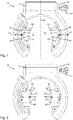
- the frame lock 11 comprises a housing 13 which has a C-shape with a cuboid central section and two arcuate legs extending opposite one another out of the central section.
- the frame lock 11 is connected to a center plane M (only in 1 marked) mirror-symmetrical.
- the frame lock 11 is at least largely mirror-symmetrical to the center plane M.
- a striker of the frame lock 11 designed as a rotating bracket is accommodated, which extends along a circular path.
- the striker is along the circular path between an open position, in which it is arranged completely within the bracket receptacle of the housing 13, and a closed position, in which it protrudes from the housing 13 at the end face of the first leg and extends to the end face of the second leg or optionally extending through the end face of the second leg into an access opening provided there, adjustable.
- the open position is shown in each of the figures.
- the frame lock 11 is designed to be attached to a wheel of a respective bicycle such that the housing 13 of the frame lock encloses the tire and rim of the wheel, with the legs of the C-shape of the housing 13 being arranged on opposite sides of the wheel. In its closed position, the striker can then reach through the spokes of the wheel to lock the wheel against rotation. In the open position against it the area between the end faces of the legs of the C-shape of the housing 13 remains free, so that the wheel can rotate freely.
- a locking device 15 is also accommodated in the housing 13, of which only an end section of a lock cylinder comprised by the locking device 15 can be seen in the figures, with which the locking device 15 protrudes from the central section of the housing 13 and into which a key 17 is inserted can be used to actuate the locking device 15.
- the major part of the locking device 15 is arranged within the housing 13 and comprises in particular a bolt (not visible in the figures) which can be adjusted between an unlocking position and a locking position by means of the key 17 and which is designed to lock the striker in its locked position To lock the closed position, so that the frame lock 11 can only be opened by means of the key 17.
- the frame lock 11 has two fastening sections 19 which, in contrast to conventional frame locks, are not designed as an integral part of the housing 13 in the frame lock 11 according to the invention, but as fastening pieces 21 designed separately from the housing 13.
- Each of the fastening pieces 21 has a respective hole 23 which is designed as a slot.
- the fastening pieces 21 are arranged in two flange portions of the housing 13, which on the concave side of each of the two legs of the C-shape of the housing 13 adjoin the respective leg. Also the ones in the Holes 23 formed on fastening pieces 21 are thereby located in respective ones of the two flange portions.
- the fastening pieces 21 are each formed as two flat fastening plates which are arranged parallel to one another.
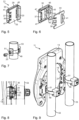
- the mounting pieces 21 are with a respective back 27 in a common mounting plane to the image plane Figures 1 and 2 is parallel.
- the fastening pieces 21 are linear relative to the housing 13 along a displacement direction V (only in 1 marked) slidably mounted, which is parallel to said mounting plane.
- V a displacement direction
- the rear sides 27 of the two fastening pieces 21 are always in the fastening plane, regardless of the respective position of the fastening pieces 21 .
- the fastening pieces 21 are arranged mirror-symmetrically with respect to said median plane M, with their displacement direction V being oriented perpendicularly to the median plane M, so that both fastening pieces 21 can be displaced parallel to one another along a continuous line.
- the fastening pieces 21 can be displaced independently of one another both in the displacement direction V and counter to the displacement direction V. However, the displaceability is limited to a defined distance along the direction of displacement V for both fastening pieces 21 .
- the fastening pieces 21 at a respective end of this defined distance, ie at a respective end of their respective displaceability.
- the fastening pieces 21 are thereby shifted farthest away from one another, so that they are at their greatest possible distance from one another; in the 2 and 4 the fastening pieces 21 are, on the other hand, furthest shifted towards each other so that they have their smallest possible distance from each other.
- the holes 23 of the fastening pieces 21 embodied as oblong holes are aligned parallel to one another and also perpendicular to the displacement direction V with respect to their respective longitudinal extent.
- a screw 25 can be movable within a respective hole 23 along a direction perpendicular to the screwing direction and to the displacement direction V.
- the housing 13 of the frame lock 11 can also be moved vice versa relative to the screws 25 that may be screwed into the two-wheeler along the direction of the longitudinal extension of the holes 21 and thus perpendicular to the displacement direction V.
- the housing 13 of the frame lock 11 can also be moved parallel to the displacement direction V relative to the screw 25 due to the displaceability of the fastening pieces 21 .
- the superimposition of these two movabilities means that after the screws 25 have been screwed into the two-wheeler, at least as long as the screws 25 have not yet been tightened, the housing 13 within a two-dimensional surface area parallel to the fastening plane and spanned by the mutually perpendicular movabilities can still be positioned essentially freely. By tightening the screws 25, the position of the frame lock 11 can then be set to the position occupied.
- the displaceability of the fastening pieces 21 results from the way in which they are mounted on the housing 13.
- Each of the two fastening pieces 21, which are structurally identical to one another, has two grooves 29 formed in mutually opposite edge sides of the respective fastening piece 21, one of which is parallel to the direction of displacement V Course and have substantially the same length.
- two webs 31 designed as sheet metal edges are also provided on the housing 13, which protrude from the housing 13 and, at least with their respective free end, on top of each other are aligned too pointing.
- the spacing of the two webs 31 from one another essentially corresponds to the spacing of the two grooves 29 of a respective fastening piece 21 from one another.
- a respective fastening piece 21 can be inserted between the two webs 31 along the displacement direction V in such a way that a respective one of the webs 31 engages in each of the two grooves 29 of the fastening piece 21 .
- the fastening piece 21 is mounted on the housing 13 and can be displaced relative to the housing 13 in a guided manner.
- the fastening pieces 21 are designed in two parts and each comprise a first fastening part 33 and a second fastening part 35.
- the two fastening parts 33, 35 are designed to be clipped together .
- the second fastening part 35 has a snap-in socket 37 in which a snap-in projection (not visible in the figures) is formed, which engages behind a snap-in tab 39 formed on the first fastening part 33 when the snap-in tab 39 is inserted into the snap-in socket 37.
- the first fastening part 33 is designed as a stamped sheet metal plate, while the second fastening part 35 is produced as an injection molded part made of plastic. Said rear side 27 of the respective fastening piece 21, which lies in the fastening plane and points in the direction of screwing, is formed on the second fastening part 35 (cf. Figures 3 and 4 ). Both fastening parts 33, 35 each have a hole 41 or 43, which is designed as a slot.
- the holes 41, 43 of the two fastening parts 33, 35 are congruent with respect to the screwing-in direction, i.e. in particular they have the same length and the same width and are arranged in such a way that together they form the continuous hole 23, designed as an elongated hole, in the respective fastening piece 21, the also has the same length and width.
- the grooves 29 of a respective fastening piece 21 are formed between the two fastening parts 33,35.
- the side wall of the groove 29 delimiting the respective groove 29 against the screwing-in direction is formed by the first fastening part 33
- the side wall delimiting the groove 29 in the screwing-in direction is formed by the second fastening part 35 .
- a part of a bottom of the groove 29 is also formed by the second fastening part 35 .
- a free space remains in the bottom of the groove 29 between the first fastening part 33 and the second fastening part 35.
- the fastening parts 33, 35 have play with one another in the screwing-in direction so that the width of the groove 29 (i.e. its extent along the screwing direction) is variable to some extent.
- the frame lock 11 can thus be fixed in the position then assumed within the said two-dimensional surface area relative to the two-wheeler.
- Structures are formed on the second fastening part 35 of a respective fastening piece 21, which act as stops 45, 47 in order to limit the displaceability of the fastening piece 21, which is guided and displaceably mounted on the housing 13, to a defined distance.
- Structures of the second fastening part 35 which are provided in the corner regions of the side of the respective fastening piece 21 oriented in the direction of the other fastening piece 21, form two inner stops 45, with which the respective fastening piece 21 ultimately strikes one of the two legs of the housing 13 , when it is displaced outward relative to the housing 13, ie in the direction pointing away from the median plane M.
- the respective fastening piece 21 is not in the 1 and 3 position shown also slidable outwards.
- the second fastening part 35 has further structures which are provided in the corner regions of the side of the respective fastening piece 21 pointing away from the other fastening piece 21 and which form two outer stops 47 .
- Both grooves 29 formed on the respective fastening piece 21 are blocked at one of the two ends of their course by a respective one of the outer stops 47, so that the web 31 engaging in the respective groove 29 ultimately strikes the outer stop 47 when the respective fastening piece 21 relative to the housing 13 inwards, ie in the direction of the center plane M, is displaced.
- the outer stops form 47 blocking portions for the grooves 29. Due to the striking of the webs 31 to the outer stops 47, the respective attachment piece 21 (in the context of normal use of the frame lock 11) is not on in the 2 and 4 position shown also inwardly slidable.
- the outer stops 47 can be pushed out to the side from their position blocking one end of the respective groove 29, so that the end of the groove 29 engaging web 31 can be guided past the respective stop 47 . In this way, the fastening pieces 21 can be inserted between the corresponding two webs 31 when they are mounted on the housing 13 .
- the outer stops 47 are advantageously shaped in such a way that they can be pushed back comparatively easily into the respective groove 29 when they are acted upon in the displacement direction V from the outside, but not out of the groove 29 when the respective web 31 is acted upon in the opposite direction .
- a starting bevel is formed on the side of the stops 47 facing away from the respective groove 29 .
- the frame lock 11 includes two band clamps 49 in the Figures 7 to 9 are shown.
- Each of the band clamps 49 has a screw-on base 51 which is arranged on the respective band clamp 49 so that it can be displaced along the longitudinal extension thereof and has an internal thread in the manner of a threaded bush.
- the internal thread for screws with a metric ISO thread size M 5 is designed to fit.
- the band clamps 49 can be tied around a respective rear strut 53 of a bicycle. As long as they are not yet tightened, they can be displaceable along the course of the respective rear strut 53 . In this way, the position of the screw-on base 51 on the respective rear strut 53 can be flexibly fixed.
- the screw-on base 51 has (at least partially) the shape of a conical dome.
- the two fastening pieces 21 each have a receptacle 55 which is formed in the rear side 27 of the second fastening part 35 of the respective fastening piece 21 .
- the receptacles 55 are each formed in the area of the hole 23 of the respective fastening piece 21, namely in the center of the longitudinal extent of this hole 23, which is designed as an elongated hole.
- the hole 23 is widened on both sides by the respective receptacle 55.
- the shape of the receptacles 55 is complementary to the named shape of the screw-on base 51 .
- the housing 13 of the frame lock 11 with the fastening pieces 21 can be arranged on the band clamps 49 fastened to the two-wheeler in such a way that the screw-on bases 51 are received with a precise fit in the receptacles 55 (cf. 8 ).
- the frame lock 11 Admittedly, by receiving the screw-on base 51 in the receptacles 55, the mobility of the screws 25 within the holes 23 of the two fastening pieces 21, which are designed as oblong holes, is prevented. However, this is compensated for by the fact that the band clamps 49 can be moved parallel to the course of the rear stays 53 as long as they are not yet tightened. Irrespective of whether the screwing takes place on screw sockets 51 subsequently attached to the two-wheeler or on threaded bushings already provided on the two-wheeler, the frame lock 11 can thus be movable parallel to the longitudinal extent of the elongated holes before it is finally fixed. The displaceability of the two fastening pieces 21 has the additional effect that the frame lock 11 can be moved along the displacement direction V. As a result, the frame lock 11 according to the invention thus has a particularly flexible positionability, which allows largely free positioning within a two-dimensional surface area.
Landscapes
- Engineering & Computer Science (AREA)
- Mechanical Engineering (AREA)
- Clamps And Clips (AREA)
- Lock And Its Accessories (AREA)
- Connection Of Plates (AREA)
Applications Claiming Priority (1)
| Application Number | Priority Date | Filing Date | Title |
|---|---|---|---|
| DE102021122850.6A DE102021122850A1 (de) | 2021-09-03 | 2021-09-03 | Rahmenschloss |
Publications (3)
| Publication Number | Publication Date |
|---|---|
| EP4144944A1 true EP4144944A1 (fr) | 2023-03-08 |
| EP4144944B1 EP4144944B1 (fr) | 2025-10-01 |
| EP4144944C0 EP4144944C0 (fr) | 2025-10-01 |
Family
ID=82786400
Family Applications (1)
| Application Number | Title | Priority Date | Filing Date |
|---|---|---|---|
| EP22188453.9A Active EP4144944B1 (fr) | 2021-09-03 | 2022-08-03 | Antivol de cadre |
Country Status (7)
| Country | Link |
|---|---|
| US (1) | US12179868B2 (fr) |
| EP (1) | EP4144944B1 (fr) |
| CN (1) | CN115743374A (fr) |
| DE (1) | DE102021122850A1 (fr) |
| ES (1) | ES3047541T3 (fr) |
| PL (1) | PL4144944T3 (fr) |
| TW (1) | TW202313392A (fr) |
Citations (2)
| Publication number | Priority date | Publication date | Assignee | Title |
|---|---|---|---|---|
| DE1842230U (de) * | 1961-07-10 | 1961-11-23 | Veenendaalsche Ijzerindustrie | Fahrradschloss. |
| DE10309599A1 (de) * | 2003-03-05 | 2004-09-16 | ABUS August Bremicker Söhne KG | Rahmenschloss |
Family Cites Families (5)
| Publication number | Priority date | Publication date | Assignee | Title |
|---|---|---|---|---|
| GB2239635A (en) * | 1990-01-02 | 1991-07-10 | Joei Jaw | Motorcycle lock |
| DE10040806A1 (de) | 2000-08-21 | 2002-03-07 | Bremicker Soehne Kg A | Halterung |
| NL1028758C2 (nl) * | 2005-04-13 | 2006-10-16 | Stenman Holland Nv | Samenstel voorzien van een fietsslot. |
| WO2010043848A1 (fr) * | 2008-10-15 | 2010-04-22 | Holageo Entreprise, Co. Limited | Dispositif de verrouillage de bicyclette |
| US10472010B2 (en) * | 2016-10-18 | 2019-11-12 | Cadet Gilomme | Bicycle security system |
-
2021
- 2021-09-03 DE DE102021122850.6A patent/DE102021122850A1/de active Pending
-
2022
- 2022-08-03 TW TW111129170A patent/TW202313392A/zh unknown
- 2022-08-03 PL PL22188453.9T patent/PL4144944T3/pl unknown
- 2022-08-03 ES ES22188453T patent/ES3047541T3/es active Active
- 2022-08-03 EP EP22188453.9A patent/EP4144944B1/fr active Active
- 2022-08-16 US US17/888,545 patent/US12179868B2/en active Active
- 2022-08-31 CN CN202211053292.6A patent/CN115743374A/zh active Pending
Patent Citations (2)
| Publication number | Priority date | Publication date | Assignee | Title |
|---|---|---|---|---|
| DE1842230U (de) * | 1961-07-10 | 1961-11-23 | Veenendaalsche Ijzerindustrie | Fahrradschloss. |
| DE10309599A1 (de) * | 2003-03-05 | 2004-09-16 | ABUS August Bremicker Söhne KG | Rahmenschloss |
Also Published As
| Publication number | Publication date |
|---|---|
| ES3047541T3 (en) | 2025-12-03 |
| PL4144944T3 (pl) | 2026-04-27 |
| US12179868B2 (en) | 2024-12-31 |
| EP4144944B1 (fr) | 2025-10-01 |
| TW202313392A (zh) | 2023-04-01 |
| DE102021122850A1 (de) | 2023-03-09 |
| CN115743374A (zh) | 2023-03-07 |
| US20230072909A1 (en) | 2023-03-09 |
| EP4144944C0 (fr) | 2025-10-01 |
Similar Documents
| Publication | Publication Date | Title |
|---|---|---|
| DE69315289T2 (de) | Verriegelbarer Mechanismus für Schnellentkupplung | |
| DE69018254T2 (de) | Verbessertes Fahrradschloss. | |
| DE69806907T2 (de) | Verschlussvorrichtung für eine tür | |
| EP0761130B1 (fr) | Ferrure de fixation pour panneaux frontaux de tiroir | |
| EP3741932A1 (fr) | Verrou d'aiguille à articulation | |
| EP4098526B1 (fr) | Fermeture de cadre | |
| DE3034750A1 (de) | Vorrichtung zur sicherung eines fahrradrahmens an einem dachtraeger auf einem kraftfahrzeug | |
| DE4000430A1 (de) | Halterung zur anbringung eines anbauteils an einem traegerstab | |
| EP0437211A1 (fr) | Point d'attache pour la fixation d'une pièce de montage à un baton de support | |
| EP4144944B1 (fr) | Antivol de cadre | |
| DE19701371B4 (de) | Einrichtung zur Befestigung eines Reserverades in einer Reserveradmulde eines Kraftfahrzeugs | |
| DE9310011U1 (de) | Bügelschloß mit Halter | |
| DE10146373C1 (de) | Verbindungseinrichtung und Tischsystem | |
| DE102018101285A1 (de) | Eckverbinder | |
| EP2514892B1 (fr) | Système de fixation d'une partie de ferrure | |
| EP1593861B1 (fr) | Elément de liaison | |
| EP1712458B1 (fr) | Unité réalisée avec un antivol de bicyclette | |
| DE19803307A1 (de) | Rahmenschloßbefestigung | |
| DE29803239U1 (de) | Türschließvorrichtung | |
| DE29917861U1 (de) | Klemmhalterung für eine Sonnen- und/oder Blickschutzvorrichtung | |
| DE10163707A1 (de) | Betätigungshandhabe | |
| DE69205819T2 (de) | Tragvorrichtung für einen Fernsehapparat. | |
| EP3741935B1 (fr) | Verrou d'aiguille à articulation | |
| DE102019103075B3 (de) | Schaltschrank mit einem Rahmengestell und einem daran festgelegten Seitenwandelement | |
| DE3506870A1 (de) | Tuerverschluss mit hebelfoermiger versenkbarer handhabe, insbesondere an schaltschranktueren |
Legal Events
| Date | Code | Title | Description |
|---|---|---|---|
| PUAI | Public reference made under article 153(3) epc to a published international application that has entered the european phase |
Free format text: ORIGINAL CODE: 0009012 |
|
| STAA | Information on the status of an ep patent application or granted ep patent |
Free format text: STATUS: THE APPLICATION HAS BEEN PUBLISHED |
|
| AK | Designated contracting states |
Kind code of ref document: A1 Designated state(s): AL AT BE BG CH CY CZ DE DK EE ES FI FR GB GR HR HU IE IS IT LI LT LU LV MC MK MT NL NO PL PT RO RS SE SI SK SM TR |
|
| STAA | Information on the status of an ep patent application or granted ep patent |
Free format text: STATUS: REQUEST FOR EXAMINATION WAS MADE |
|
| 17P | Request for examination filed |
Effective date: 20230831 |
|
| RBV | Designated contracting states (corrected) |
Designated state(s): AL AT BE BG CH CY CZ DE DK EE ES FI FR GB GR HR HU IE IS IT LI LT LU LV MC MK MT NL NO PL PT RO RS SE SI SK SM TR |
|
| GRAP | Despatch of communication of intention to grant a patent |
Free format text: ORIGINAL CODE: EPIDOSNIGR1 |
|
| STAA | Information on the status of an ep patent application or granted ep patent |
Free format text: STATUS: GRANT OF PATENT IS INTENDED |
|
| INTG | Intention to grant announced |
Effective date: 20250326 |
|
| GRAS | Grant fee paid |
Free format text: ORIGINAL CODE: EPIDOSNIGR3 |
|
| GRAA | (expected) grant |
Free format text: ORIGINAL CODE: 0009210 |
|
| STAA | Information on the status of an ep patent application or granted ep patent |
Free format text: STATUS: THE PATENT HAS BEEN GRANTED |
|
| AK | Designated contracting states |
Kind code of ref document: B1 Designated state(s): AL AT BE BG CH CY CZ DE DK EE ES FI FR GB GR HR HU IE IS IT LI LT LU LV MC MK MT NL NO PL PT RO RS SE SI SK SM TR |
|
| REG | Reference to a national code |
Ref country code: GB Ref legal event code: FG4D Free format text: NOT ENGLISH Ref country code: CH Ref legal event code: F10 Free format text: ST27 STATUS EVENT CODE: U-0-0-F10-F00 (AS PROVIDED BY THE NATIONAL OFFICE) Effective date: 20251001 |
|
| REG | Reference to a national code |
Ref country code: CH Ref legal event code: R17 Free format text: ST27 STATUS EVENT CODE: U-0-0-R10-R17 (AS PROVIDED BY THE NATIONAL OFFICE) Effective date: 20251006 |
|
| REG | Reference to a national code |
Ref country code: IE Ref legal event code: FG4D Free format text: LANGUAGE OF EP DOCUMENT: GERMAN |
|
| REG | Reference to a national code |
Ref country code: DE Ref legal event code: R096 Ref document number: 502022005606 Country of ref document: DE |
|
| U01 | Request for unitary effect filed |
Effective date: 20251001 |
|
| U07 | Unitary effect registered |
Designated state(s): AT BE BG DE DK EE FI FR IT LT LU LV MT NL PT RO SE SI Effective date: 20251009 |
|
| REG | Reference to a national code |
Ref country code: ES Ref legal event code: FG2A Ref document number: 3047541 Country of ref document: ES Kind code of ref document: T3 Effective date: 20251203 |
|
| PG25 | Lapsed in a contracting state [announced via postgrant information from national office to epo] |
Ref country code: HR Free format text: LAPSE BECAUSE OF FAILURE TO SUBMIT A TRANSLATION OF THE DESCRIPTION OR TO PAY THE FEE WITHIN THE PRESCRIBED TIME-LIMIT Effective date: 20251001 |
|
| PG25 | Lapsed in a contracting state [announced via postgrant information from national office to epo] |
Ref country code: RS Free format text: LAPSE BECAUSE OF FAILURE TO SUBMIT A TRANSLATION OF THE DESCRIPTION OR TO PAY THE FEE WITHIN THE PRESCRIBED TIME-LIMIT Effective date: 20260101 |
|
| PG25 | Lapsed in a contracting state [announced via postgrant information from national office to epo] |
Ref country code: IS Free format text: LAPSE BECAUSE OF FAILURE TO SUBMIT A TRANSLATION OF THE DESCRIPTION OR TO PAY THE FEE WITHIN THE PRESCRIBED TIME-LIMIT Effective date: 20260201 |
|
| PG25 | Lapsed in a contracting state [announced via postgrant information from national office to epo] |
Ref country code: CZ Free format text: LAPSE BECAUSE OF FAILURE TO SUBMIT A TRANSLATION OF THE DESCRIPTION OR TO PAY THE FEE WITHIN THE PRESCRIBED TIME-LIMIT Effective date: 20251001 |