EP4146964B1 - Soupape de commutation de vapeur de carburant et soupape de ventilation pour un moteur à combustion interne - Google Patents
Soupape de commutation de vapeur de carburant et soupape de ventilation pour un moteur à combustion interne Download PDFInfo
- Publication number
- EP4146964B1 EP4146964B1 EP20728413.4A EP20728413A EP4146964B1 EP 4146964 B1 EP4146964 B1 EP 4146964B1 EP 20728413 A EP20728413 A EP 20728413A EP 4146964 B1 EP4146964 B1 EP 4146964B1
- Authority
- EP
- European Patent Office
- Prior art keywords
- valve
- valve seat
- combustion engine
- internal combustion
- fuel vapour
- Prior art date
- Legal status (The legal status is an assumption and is not a legal conclusion. Google has not performed a legal analysis and makes no representation as to the accuracy of the status listed.)
- Active
Links
Images

Classifications
-
- F—MECHANICAL ENGINEERING; LIGHTING; HEATING; WEAPONS; BLASTING
- F16—ENGINEERING ELEMENTS AND UNITS; GENERAL MEASURES FOR PRODUCING AND MAINTAINING EFFECTIVE FUNCTIONING OF MACHINES OR INSTALLATIONS; THERMAL INSULATION IN GENERAL
- F16K—VALVES; TAPS; COCKS; ACTUATING-FLOATS; DEVICES FOR VENTING OR AERATING
- F16K17/00—Safety valves; Equalising valves, e.g. pressure relief valves
- F16K17/18—Safety valves; Equalising valves, e.g. pressure relief valves opening on surplus pressure on either side
- F16K17/19—Equalising valves predominantly for tanks
- F16K17/196—Equalising valves predominantly for tanks spring-loaded
-
- B—PERFORMING OPERATIONS; TRANSPORTING
- B60—VEHICLES IN GENERAL
- B60K—ARRANGEMENT OR MOUNTING OF PROPULSION UNITS OR OF TRANSMISSIONS IN VEHICLES; ARRANGEMENT OR MOUNTING OF PLURAL DIVERSE PRIME-MOVERS IN VEHICLES; AUXILIARY DRIVES FOR VEHICLES; INSTRUMENTATION OR DASHBOARDS FOR VEHICLES; ARRANGEMENTS IN CONNECTION WITH COOLING, AIR INTAKE, GAS EXHAUST OR FUEL SUPPLY OF PROPULSION UNITS IN VEHICLES
- B60K15/00—Arrangement in connection with fuel supply of combustion engines or other fuel consuming energy converters, e.g. fuel cells; Mounting or construction of fuel tanks
- B60K15/03—Fuel tanks
- B60K15/035—Fuel tanks characterised by venting means
- B60K15/03519—Valve arrangements in the vent line
-
- F—MECHANICAL ENGINEERING; LIGHTING; HEATING; WEAPONS; BLASTING
- F16—ENGINEERING ELEMENTS AND UNITS; GENERAL MEASURES FOR PRODUCING AND MAINTAINING EFFECTIVE FUNCTIONING OF MACHINES OR INSTALLATIONS; THERMAL INSULATION IN GENERAL
- F16K—VALVES; TAPS; COCKS; ACTUATING-FLOATS; DEVICES FOR VENTING OR AERATING
- F16K1/00—Lift valves or globe valves, i.e. cut-off apparatus with closure members having at least a component of their opening and closing motion perpendicular to the closing faces
- F16K1/32—Details
- F16K1/34—Cutting-off parts, e.g. valve members, seats
- F16K1/44—Details of seats or valve members of double-seat valves
-
- F—MECHANICAL ENGINEERING; LIGHTING; HEATING; WEAPONS; BLASTING
- F16—ENGINEERING ELEMENTS AND UNITS; GENERAL MEASURES FOR PRODUCING AND MAINTAINING EFFECTIVE FUNCTIONING OF MACHINES OR INSTALLATIONS; THERMAL INSULATION IN GENERAL
- F16K—VALVES; TAPS; COCKS; ACTUATING-FLOATS; DEVICES FOR VENTING OR AERATING
- F16K1/00—Lift valves or globe valves, i.e. cut-off apparatus with closure members having at least a component of their opening and closing motion perpendicular to the closing faces
- F16K1/32—Details
- F16K1/34—Cutting-off parts, e.g. valve members, seats
- F16K1/44—Details of seats or valve members of double-seat valves
- F16K1/443—Details of seats or valve members of double-seat valves the seats being in series
-
- F—MECHANICAL ENGINEERING; LIGHTING; HEATING; WEAPONS; BLASTING
- F16—ENGINEERING ELEMENTS AND UNITS; GENERAL MEASURES FOR PRODUCING AND MAINTAINING EFFECTIVE FUNCTIONING OF MACHINES OR INSTALLATIONS; THERMAL INSULATION IN GENERAL
- F16K—VALVES; TAPS; COCKS; ACTUATING-FLOATS; DEVICES FOR VENTING OR AERATING
- F16K1/00—Lift valves or globe valves, i.e. cut-off apparatus with closure members having at least a component of their opening and closing motion perpendicular to the closing faces
- F16K1/32—Details
- F16K1/52—Means for additional adjustment of the rate of flow
- F16K1/523—Means for additional adjustment of the rate of flow for limiting the maximum flow rate, using a stop
-
- F—MECHANICAL ENGINEERING; LIGHTING; HEATING; WEAPONS; BLASTING
- F16—ENGINEERING ELEMENTS AND UNITS; GENERAL MEASURES FOR PRODUCING AND MAINTAINING EFFECTIVE FUNCTIONING OF MACHINES OR INSTALLATIONS; THERMAL INSULATION IN GENERAL
- F16K—VALVES; TAPS; COCKS; ACTUATING-FLOATS; DEVICES FOR VENTING OR AERATING
- F16K24/00—Devices, e.g. valves, for venting or aerating enclosures
-
- F—MECHANICAL ENGINEERING; LIGHTING; HEATING; WEAPONS; BLASTING
- F16—ENGINEERING ELEMENTS AND UNITS; GENERAL MEASURES FOR PRODUCING AND MAINTAINING EFFECTIVE FUNCTIONING OF MACHINES OR INSTALLATIONS; THERMAL INSULATION IN GENERAL
- F16K—VALVES; TAPS; COCKS; ACTUATING-FLOATS; DEVICES FOR VENTING OR AERATING
- F16K31/00—Actuating devices; Operating means; Releasing devices
- F16K31/02—Actuating devices; Operating means; Releasing devices electric; magnetic
- F16K31/06—Actuating devices; Operating means; Releasing devices electric; magnetic using a magnet, e.g. diaphragm valves, cutting off by means of a liquid
- F16K31/0644—One-way valve
- F16K31/0655—Lift valves
-
- B—PERFORMING OPERATIONS; TRANSPORTING
- B60—VEHICLES IN GENERAL
- B60K—ARRANGEMENT OR MOUNTING OF PROPULSION UNITS OR OF TRANSMISSIONS IN VEHICLES; ARRANGEMENT OR MOUNTING OF PLURAL DIVERSE PRIME-MOVERS IN VEHICLES; AUXILIARY DRIVES FOR VEHICLES; INSTRUMENTATION OR DASHBOARDS FOR VEHICLES; ARRANGEMENTS IN CONNECTION WITH COOLING, AIR INTAKE, GAS EXHAUST OR FUEL SUPPLY OF PROPULSION UNITS IN VEHICLES
- B60K15/00—Arrangement in connection with fuel supply of combustion engines or other fuel consuming energy converters, e.g. fuel cells; Mounting or construction of fuel tanks
- B60K15/03—Fuel tanks
- B60K2015/03256—Fuel tanks characterised by special valves, the mounting thereof
- B60K2015/03302—Electromagnetic valves
-
- B—PERFORMING OPERATIONS; TRANSPORTING
- B60—VEHICLES IN GENERAL
- B60K—ARRANGEMENT OR MOUNTING OF PROPULSION UNITS OR OF TRANSMISSIONS IN VEHICLES; ARRANGEMENT OR MOUNTING OF PLURAL DIVERSE PRIME-MOVERS IN VEHICLES; AUXILIARY DRIVES FOR VEHICLES; INSTRUMENTATION OR DASHBOARDS FOR VEHICLES; ARRANGEMENTS IN CONNECTION WITH COOLING, AIR INTAKE, GAS EXHAUST OR FUEL SUPPLY OF PROPULSION UNITS IN VEHICLES
- B60K15/00—Arrangement in connection with fuel supply of combustion engines or other fuel consuming energy converters, e.g. fuel cells; Mounting or construction of fuel tanks
- B60K15/03—Fuel tanks
- B60K15/035—Fuel tanks characterised by venting means
- B60K15/03504—Fuel tanks characterised by venting means adapted to avoid loss of fuel or fuel vapour, e.g. with vapour recovery systems
- B60K2015/03514—Fuel tanks characterised by venting means adapted to avoid loss of fuel or fuel vapour, e.g. with vapour recovery systems with vapor recovery means
Definitions
- the invention relates to a fuel vapor switching and ventilation valve for an internal combustion engine with an actuator, a first connection and a second connection, a valve body which is coupled to an axially movable actuating member of the actuator and has a first support surface with which the valve body can be lowered onto a first valve seat and lifted off the first valve seat which is arranged between the first connection and the second connection, and has a second support surface with which the valve body can be moved against a second valve seat which is axially displaceable and is loaded in the direction of the valve body via a spring.
- Fuel vapor switching and venting valves serve as shut-off and relief valves and are fluidically arranged between the fuel tank of a vehicle and an activated carbon filter, which serves to absorb fuel vapors, through which pressure fluctuations in the fuel tank are compensated. If overpressure or underpressure occurs in the tank, the pressure is to be reduced by a mechanical bypass function; in the case of overpressure, the pressure is to be reduced by venting to the activated carbon filter; in the case of underpressure, the underpressure in the tank is to be limited or compensated by ventilation.
- the fuel vapor switching and ventilation valve must be opened immediately before and during the refueling process to ensure, on the one hand, that no fuel vapors reach the user due to excess pressure when the tank cap is opened and, on the other hand, that no increased pressure builds up in the tank during refueling.
- valves have become known that combine one or more of these functions.
- a valve arrangement is described in which a switching valve can be operated by means of an electromagnet in order to establish a connection between the tank and the activated carbon filter.
- the valve body of this valve has a second contact surface with which the valve body rests against the control body of a pressure relief valve, which rests against the valve body under spring load and thus closes a central passage in the valve body as long as there is no overpressure in the tank. Furthermore, if there is a negative pressure in the tank, the valve body can be moved away from the valve seat against a second spring element, so that the tank is ventilated.
- an active connection and disconnection of a fluidic connection between the tank and the activated carbon filter can be established and, in addition, ventilation or venting can be established at defined switching points in the event of excessive overpressure or underpressure.
- this valve also causes excessive pressure losses. Furthermore, the installation space required is relatively large.
- a tank valve in which a first valve body is fixedly attached to a valve rod, which is actuated by an electromagnet and a second valve body is movably arranged on the valve rod.
- Two support surfaces are formed on this second valve body, wherein the first support surface can be moved against the housing to close the flow cross-section and the first valve body can be moved against the second support surface Pressure equalization in both directions or pressure-dependent flow limitation is not achieved with this valve.
- the task is therefore to provide a fuel vapor switching and ventilation valve that causes a lower pressure loss and can be built smaller.
- a valve should be able to be manufactured as cost-effectively as possible.
- the fuel vapor switching and ventilation valve according to the invention has an actuator, which is usually designed as an electromagnet, but could also be designed as a pneumatic actuator, for example.
- the valve has a first connection and a second connection, which serve as inlet and outlet, whereby this can change depending on the flow direction, since air is fed into the fuel tank for ventilation, while the fuel vapor flows in the opposite direction to the activated carbon filter.
- a valve body which is coupled to an axially movable actuating element of the actuator. In the case of the electromagnetic actuator, this actuating element is the armature.
- the valve body has a first support surface, with which the valve body can be lowered onto a first valve seat and lifted off the first valve seat, and which is arranged between the first connection and the second connection and is usually designed or attached directly to the flow housing. Furthermore, the valve body has a second support surface with which the valve body can be moved against a second valve seat, which is axially displaceable and is loaded by a spring in the direction of the valve body. As soon as the valve body is lifted from one of the valve seats, a flow occurs from one connection to the other connection.
- the two support surfaces of the valve body are now arranged in such a way that the second support surface is arranged radially within the first support surface and is arranged axially closer to the actuator than the first support surface.
- the support surfaces can be formed on one component and the axial installation space can be reduced, since the second valve seat can be immersed in the valve body. This also enables a reduction in the pressure loss, since the component having the second valve seat is arranged at least largely outside the flow area when the first valve seat is open.
- the valve body preferably has a carrier element to which a sealing element is attached, on which the first support surface and the second support surface are formed.
- a mountable valve body is particularly cost-effective to produce and can be constructed in such a way that, on the one hand, the valve body is highly stable and, on the other hand, there is sufficient flexibility in the area of the support surfaces for a high level of tightness.
- the sealing element is made of an elastomer and the carrier element is made of a duroplastic, a thermoplastic or a metal and accordingly has a high rigidity, while the sealing element is deformable. This achieves high strength with a good sealing effect.
- a particularly simple and cost-effective fastening is achieved by attaching the sealing element to the carrier element by forming a radially outer collar of the carrier element. This means that an axially extending projection of the carrier element surrounds the sealing element and is formed below a shoulder of the sealing element and bent over the shoulder of the sealing element, whereby the latter is axially fixed in the carrier element.
- the two contact surfaces of the sealing element are designed as sealing lips, which extend from the sealing element at least axially in Direction of the respective valve seat.
- Such thin sealing lips have even greater flexibility, which further improves the sealing effect.
- the sealing lips have an extension component in the axial direction and an extension component radially inward, because this allows an even better sealing effect to be achieved through greater flexibility in the axial direction.
- the pressure loss during a flow from the fuel tank to the activated carbon filter between the first valve seat and the first support surface is reduced, because this sealing lip extends approximately in the direction of flow and thus offers low resistance.
- the second valve seat is formed on a valve seat plate of a valve seat body that extends perpendicular to the central axis. This provides a straight surface for resting on the second support surface and thus for closing the inner flow cross-section of the second support surface. Furthermore, this plate has a correspondingly small axial extension, so that the axial height of the valve is low.
- valve seat plate in its area forming the valve seat has a smaller axial extension than the axial distance between the two contact surfaces of the sealing element.
- the valve seat plate forming the valve seat is therefore completely in the slipstream of the first contact surface and thus offers only a low flow resistance, so that the pressure loss that occurs when the valve body is lifted off the first valve seat and the valve body is simultaneously resting on the second valve seat is minimized. This means that smaller flow areas are required for the same volume flows, so that the installation space can be reduced.
- the valve seat plate is preferably attached to a control body via a fastening pin, which has a central blind hole into which the fastening pin of the valve seat body extends to attach the control body to the valve seat body.
- the valve seat and a subsequent control body for regulating a free flow cross-section can thus be designed as one component, resulting in a high level of integration, since several functions are combined in one component.
- valve seat body is concave in a transition area between the valve seat plate and the fastening pin. If a flow occurs between the first support surface and the first valve seat, it is only gradually diverted, which again results in a reduced pressure loss.
- a passage opening is preferably formed on the valve body, which opens radially inside the second support surface.
- the pressure from the tank can act directly on the valve plate through this passage opening to open the second valve seat in the event of increased internal tank pressure.
- valve body is attached via the carrier element to a valve rod that is connected to the actuating element.
- This type of suspension allows the valve body to be tilted slightly towards the armature, which ensures that the valve body rests on the first valve seat in a comprehensive and therefore tight manner, even in the event of assembly inaccuracies or small deposits.
- control body serves as a flow limiting element which is movable into a nozzle arranged in a flow housing part of the second connection, wherein the spring Flow limiting element is loaded in a direction pointing out of the nozzle.
- This design also limits the mass flow from the tank to the activated carbon filter, which reliably prevents overloading of the activated carbon filter.
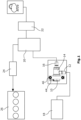
- the fuel vapor switching and ventilation valve 10 has a first connection 12 which protrudes laterally from a housing 14 of the fuel vapor switching and ventilation valve 10 and a second axial connection 16.
- the first, lateral connection 12 is connected to a fuel tank 18, while the second axial connection 16 is connected to an activated carbon filter 20.
- a line leads from the activated carbon filter 20 via a fuel vapor outlet valve 22 to the atmosphere or via a second line in which a purge valve 24 is arranged to an internal combustion engine 26, where the fuel vapors can be fed to the combustion.
- the structure of the fuel vapor switching and ventilation valve 10 is shown in Figure 2 It consists of an actuator 28 which is designed as an electromagnet and has a coil 32 wound on a coil carrier 30, an internal core 34, an axially displaceable armature which serves as an actuating element 36, as well as a yoke 38 which radially surrounds the coil 32 and a return plate 40 arranged at each of the axial ends of the coil carrier 30, which form an electromagnetic circuit.
- an actuator 28 which is designed as an electromagnet and has a coil 32 wound on a coil carrier 30, an internal core 34, an axially displaceable armature which serves as an actuating element 36, as well as a yoke 38 which radially surrounds the coil 32 and a return plate 40 arranged at each of the axial ends of the coil carrier 30, which form an electromagnetic circuit.
- This actuator 28 and in particular the yoke 38 is encapsulated with a plastic to form an actuator housing part 42 of the housing 14, which also forms a plug 44 and fastening eyes 46 and has an axial opening 48 at the end opposite the core, into which a sliding bushing 50 is inserted which guides the actuating element 36.
- This sliding bushing 50 is made of a non-magnetizable material and is pot-shaped, with the base 52 resting against the core 34.
- the main guide area of the sliding bushing 50 is surrounded by a soft magnetic bushing 54, which is pressed into the return plate 40 and the coil carrier 30.
- the sliding bushing 50 has a radial Extension 55, from which an expanded region 56 extends at its open end, which is arranged opposite the wall surfaces of the actuator housing part 42 delimiting the opening 48, wherein a sealing ring 58 is arranged between the expanded region 56 of the sliding bush 50 and the wall surface delimiting the opening 48, by means of which a penetration of fuel vapor in the direction of the coil 32 is prevented.
- a first flow housing part 60 is attached to the actuator housing part 42, which forms the first connection 12 and in which a valve body 62 is movable, which is coupled to the armature serving as the actuating element 36, in that a valve rod 64 is attached to the armature, to which the valve body 62 is attached in a gimbal manner.
- the valve rod 64 is attached to the actuating element 36 by pushing the valve rod 64 through a through hole 66 in the actuating element 36 until the valve rod 64 with an extension 68 axially rests against the end of the actuating element 36 pointing towards the valve body 62.
- valve rod 64 protrudes from the actuating member 36 at the opposite end and can be deformed there so that a type of rivet head 70 rests in a circular recess 72 on the side of the armature facing the core 34.
- the valve rod 64 also has a type of rivet head 74 which protrudes into the valve body 62 so that the valve body 62 rests on the armature side against the flat end of the rivet head 74, for which purpose an opening 76 is formed on the valve body 62, the diameter of which essentially corresponds to the diameter of the valve rod 64.
- the round side of the rivet head 74 is arranged opposite a projection 78 which protrudes radially into the interior of the valve body 62 so that the valve body 62 can only move slightly axially relative to the valve rod 64.
- a spring element 80 prestresses the valve body 62 against the flat side of the rivet head 74 on the one hand and presses the valve body 62 with the armature 36 against a first valve seat 82 which is formed on the first flow housing part 60 by clamping the spring element 80 between the valve body 62 and the extension 55 of the sliding bushing 50.
- valve body 62 rests with a first, radially outer bearing surface 84, which is designed as a sealing lip 85 of a sealing element 86, against the first valve seat 82, which surrounds a flow opening 87.
- the sealing element 86 consists of an elastic material, in particular an elastomer, and is attached to a rigid carrier element 88, via which the connection to the valve rod 64 also exists, so that the projection 78 and the opening 76 are formed on the carrier element 88.
- the carrier element 88 which is made of a duroplastic, a thermoplastic or metal, largely covers the sealing element 86 in the direction of the armature 36 and also surrounds it at least partially radially with a radially outer collar 89, which is deformed radially inwards to attach the sealing element 86 at the axially outer end, so that the end of the collar 89 rests axially against a shoulder 91 on the sealing element 86.
- the sealing element 86 in addition to the first support surface 84, has a further second support surface 90 placed radially inside the first support surface 84, which is also designed as a sealing lip 93 and is arranged axially closer to the armature 36 than the first support surface 84 and with which the sealing element 86 can be lowered onto a second valve seat 92.
- the sealing lips 85, 93 extend axially and have an extension component radially inwards, so that an undercut is created.
- This second valve seat 92 is axially movable and is formed on a flow limiting element 94 which, when resting on the second support surface 90, closes a passage opening 96 formed radially inside the second support surface 90 on the sealing element 86 and on the valve body 62.
- the flow limiting element 94 is designed in two parts and consists of a valve seat body 98, on which the second valve seat 92 is formed, and a control body 100.
- the valve seat body 98 has a valve seat plate 99 which extends perpendicular to the movement axis or central axis of the valve 10 and on whose side facing the valve body 62 the second valve seat 92 is formed, and from which a fastening pin 101 extends which is fastened in a blind hole 103 of the control body 100.
- a transition region 105 between the valve seat plate 99 and the fastening pin 101 is concavely shaped.
- valve seat plate 99 has an axial extension, at least in the region of the valve seat 92, which is less than the axial offset of the two support surfaces 84, 90 on the valve body 62. This has the consequence that the valve seat plate 99 is arranged completely axially between the two support surfaces as long as the valve body 62 is not lifted off the second valve seat 92.
- the control body 100 has a spherically shaped flow surface 102, which corresponds to a nozzle 104 formed on an inner surface 106 of a second flow housing part 108, which is fastened to the first flow housing part 60 and forms the second, axial connection 16.
- the flow limiting element 94 has webs 110 which extend radially outward from the control body 100 and connect the flow surface 102 with a radially outer ring 112. Accordingly, Several passage openings 114 are formed between the webs 110 and between the flow surface 102 and the ring 112.
- the second flow housing part 108 has a radially inner, annular projection 116, on the inside of which the nozzle 104 is formed and whose axial end serves as a stop 118 for the movement of the flow limiting element 94, which only opens up a narrow gap 120 between the flow surface 102 and the nozzle 104 when the ring 112 rests against the stop 118.
- the flow limiting element 94 is loaded in the direction of the valve body 62 and away from the stop 118 by means of a spring 122, which is clamped between an axial groove 124 of the ring 112 and a support surface 126 on the second flow housing part 108, so that the spring 122 presses the second valve seat 92 against the valve body 62 and loads the control body 100 from the smallest cross section of the nozzle 104.
- valve body 62 With its deformed sealing lips 85, 93 rests on the first valve seat 82 and the second valve seat 92 and thus there is no flow between the connections 12, 16.
- the second valve seat 92 is lifted off the second support surface 90 of the valve body 62 by the pressure acting on the valve seat plate 99, since at this pressure the forces acting on the flow limiting element 94 due to the pressure difference are greater than the spring force of the spring 122. Accordingly, fuel vapor flows from the first connection 12 via the passage opening 96 on the valve body 62 and the flow opening 87 inside the first valve seat 82 as well as through the passage openings 114 between the webs 110 and the gap 120 to the second connection 16 and thus in the direction of the activated carbon filter 20, so that the pressure in the fuel tank 18 is reduced.
- the function of the flow limiting element 94 comes into effect. This is moved against the stop 118 at very high pressure differences. In this position, only a minimal gap 120 is opened between the control body 100 and the nozzle 104, which allows a maximum flow that corresponds to the maximum permissible flow of the activated carbon filter 20 of, for example, approximately 220 l/min. In the other states, the flow through the gap is changed depending on the applied pressure difference, i.e. a larger flow cross-section is made available as the pressure falls.
- the valve body 62 is lifted off the first valve seat 82 because, at this pressure, the forces acting on the valve body 62 due to the pressure difference are greater than the spring force of the spring element 80. Accordingly, air flows from the second connection 16 through the gap 120 between the control body 100 and the nozzle 104 and through the flow opening 87 and radially between the valve body 62 and the first valve seat 82 to the first connection 12 so that pressure is equalized in the tank.
- valve seat plate 99 continues to rest on the second support surface 90 of the valve body 62, and is therefore moved by the spring 122 in the direction of the electromagnet 28. Accordingly, the valve seat plate 99 is located completely outside the cross-section through which the flow passes, so that no pressure loss occurs through the valve seat plate 99 either.
- the electromagnet 28 it is possible to actively operate the fuel vapor switching and ventilation valve 10. This takes place, for example, before initiating the refueling process in order to ensure that there are no overpressures or underpressures in the tank 18 at this time.
- the valve 10 By lifting, the valve 10 is brought into the same state as in the case of a high underpressure in the tank 18.
- a flow of air from the second connection 16 to the first connection 12 is just as possible as a flow of fuel vapor in the opposite direction, whereby the function of the flow limiting element 94 is retained.
- the flow resistance remains low, however, since the valve seat plate 99 is still arranged outside the flow cross-section.
- a fuel vapor switching and ventilation valve 10 which can reliably reduce both negative and positive pressures in the tank 18 and also limits the flow of fuel vapor to a maximum permissible value. Active switching is also possible. All of these functions are implemented in a small valve with a minimal number of parts, since several functions are implemented in one component and the low flow resistance and low pressure loss mean that the existing cross-sections can be kept relatively small in order to achieve the necessary volume flows. This also eliminates weight on the components to be moved, so that the actuator can also be made smaller.
- the flow limiting element or the actuator can also be designed differently.
- the switching points can be individually adjusted with the existing springs depending on the application. The same applies to the maximum permissible flow, which can be determined by constructive Modification of the nozzle and/or the flow limiting element or the valve elements and flow cross-sections in the valve can be adapted.
Landscapes
- Engineering & Computer Science (AREA)
- General Engineering & Computer Science (AREA)
- Mechanical Engineering (AREA)
- Transportation (AREA)
- Chemical & Material Sciences (AREA)
- Combustion & Propulsion (AREA)
- Life Sciences & Earth Sciences (AREA)
- Sustainable Energy (AREA)
- Sustainable Development (AREA)
- Physics & Mathematics (AREA)
- Fluid Mechanics (AREA)
- Cooling, Air Intake And Gas Exhaust, And Fuel Tank Arrangements In Propulsion Units (AREA)
- Lift Valve (AREA)
- Magnetically Actuated Valves (AREA)
Claims (13)
- Soupape de commutation et ventilation des vapeurs de carburant (10) pour un moteur à combustion interne (26) avecun actionneur (28),un premier port (12) et un deuxième port (16),un corps de vanne (62) qui est couplé à un organe d'actionnement (36) déplaçable axialement de l'actionneur (28) et qui comprend une première surface d'appui (84) avec laquelle le corps de vanne (62) peut être abaissé sur un premier siège de vanne (82) et soulevé du premier siège de vanne (82), qui est disposé entre le premier port (12) et le deuxième port (16), et comprenant une deuxième surface d'appui (90) avec laquelle le corps de vanne (62) est déplaçable contre un deuxième siège de vanne (92) qui est déplaçable axialement et est sollicité par un ressort (122) en direction du corps de vanne (62),
caractérisé en ce que
la deuxième surface d'appui (90) est disposée radialement à l'intérieur de la première surface d'appui (84) et est disposée axialement plus près de l'actionneur (28) que la première surface d'appui (84). - Soupape de commutation et de ventilation des vapeurs de carburant (10) pour un moteur à combustion interne selon la revendication 1,
caractérisé en ce que
le corps de vanne (62) comprend un élément de support (88) sur lequel est fixé un élément d'étanchéité (86) sur lequel sont formées la première surface d'appui (84) et la deuxième surface d'appui (90). - Soupape de commutation et de ventilation des vapeurs de carburant (10) pour un moteur à combustion interne selon la revendication 2,
caractérisé en ce que
l'élément d'étanchéité (86) est fait d'un élastomère et l'élément de support (88) est fait d'une matière duroplastique, d'une matière thermoplastique ou d'un métal. - Soupape de commutation et de ventilation des vapeurs de carburant (10) pour un moteur à combustion interne selon la revendication 3,
caractérisé en ce que
l'élément d'étanchéité (86) est fixé à l'élément de support (88) par déformation d'un collier radialement extérieur (89) de l'élément de support (88). - Soupape de commutation et de ventilation des vapeurs de carburant (10) pour un moteur à combustion interne selon l'une quelconque des revendications 2 à 4,
caractérisé en ce que
les deux surfaces d'appui (84, 90) de l'élément d'étanchéité (86) sont réalisées sous forme de lèvres d'étanchéité (85, 93) qui s'étendent depuis l'élément d'étanchéité (86) au moins axialement en direction du siège de vanne (82, 92) correspondant. - Soupape de commutation et de ventilation des vapeurs de carburant (10) pour un moteur à combustion interne selon la revendication 5,
caractérisé en ce que
les lèvres d'étanchéité (85, 93) comprennent une composante d'extension dans la direction axiale et une composante d'extension vers l'intérieur dans la direction radiale. - Soupape de commutation et de ventilation des vapeurs de carburant (10) pour un moteur à combustion interne selon l'une des revendications précédentes,
caractérisé en ce que
le deuxième siège de vanne (92) est formé sur une plaque de siège de vanne (99) d'un corps de siège de vanne (98) s'étendant perpendiculairement à l'axe central. - Soupape de commutation et ventilation des vapeurs de carburant (10) pour un moteur à combustion interne selon la revendication 7,
caractérisé en ce que
la plaque de siège de soupape (99) comprend, dans sa zone formant le siège de soupape (92), une extension axiale inférieure à la distance axiale entre les deux surfaces d'appui (84, 90) de l'élément d'étanchéité (86). - Soupape de commutation et de ventilation des vapeurs de carburant (10) pour un moteur à combustion interne selon la revendication 7 ou 8,
caractérisé en ce que
la plaque de siège de soupape (99) est fixée par une tige de fixation (101) à un corps de régulation (100) qui comprend un trou borgne central (103) dans lequel s'étend la tige de fixation (101) du corps de siège de soupape (98) pour fixer le corps de régulation (100) au corps de siège de soupape (98). - Soupape de commutation et ventilation des vapeurs de carburant (10) pour un moteur à combustion interne selon la revendication 9,
caractérisé en ce que
le corps de siège de soupape (98) a une forme concave dans une zone de transition (105) entre la plaque de siège de soupape (99) et la tige de fixation (101). - Soupape de commutation et ventilation des vapeurs de carburant (10) pour un moteur à combustion interne selon l'une des revendications précédentes,
caractérisé en ce que
un orifice de passage (96) est formé sur le corps de vanne (62) et débouche radialement à l'intérieur de la deuxième surface d'appui (90). - Soupape de commutation et ventilation des vapeurs de carburant (10) pour un moteur à combustion interne selon l'une quelconque des revendications 2 à 11,
caractérisé en ce que
le corps de vanne (62) est fixé à la cardan, par l'intermédiaire de l'élément de support (88), à une tige de vanne (64) qui est reliée à l'organe d'actionnement (36). - Soupape de commutation et ventilation des vapeurs de carburant (10) pour un moteur à combustion interne selon l'une quelconque des revendications 9 à 12,
caractérisé en ce que
le corps de régulation (100) sert d'élément de limitation de débit (94) déplaçable dans une buse (104) disposée dans une partie de logement d'écoulement (108) du deuxième orifice (16), le ressort (122) sollicitant l'élément de limitation de débit (94) dans une direction orientée vers l'extérieur de la buse (104).
Applications Claiming Priority (1)
| Application Number | Priority Date | Filing Date | Title |
|---|---|---|---|
| PCT/EP2020/062935 WO2021223891A1 (fr) | 2020-05-08 | 2020-05-08 | Soupape de commutation de vapeur de carburant et soupape de ventilation pour un moteur à combustion interne |
Publications (2)
| Publication Number | Publication Date |
|---|---|
| EP4146964A1 EP4146964A1 (fr) | 2023-03-15 |
| EP4146964B1 true EP4146964B1 (fr) | 2024-10-02 |
Family
ID=70857141
Family Applications (1)
| Application Number | Title | Priority Date | Filing Date |
|---|---|---|---|
| EP20728413.4A Active EP4146964B1 (fr) | 2020-05-08 | 2020-05-08 | Soupape de commutation de vapeur de carburant et soupape de ventilation pour un moteur à combustion interne |
Country Status (2)
| Country | Link |
|---|---|
| EP (1) | EP4146964B1 (fr) |
| WO (1) | WO2021223891A1 (fr) |
Families Citing this family (1)
| Publication number | Priority date | Publication date | Assignee | Title |
|---|---|---|---|---|
| CN120062370A (zh) * | 2025-04-28 | 2025-05-30 | 富临精工股份有限公司 | 电磁阀 |
Citations (1)
| Publication number | Priority date | Publication date | Assignee | Title |
|---|---|---|---|---|
| DE102010044336A1 (de) * | 2010-09-03 | 2012-03-08 | A. Kayser Automotive Systems Gmbh | Entlüftungsanordnung für einen Kraftstofftank |
Family Cites Families (4)
| Publication number | Priority date | Publication date | Assignee | Title |
|---|---|---|---|---|
| US3414232A (en) * | 1966-08-08 | 1968-12-03 | Westport Dev & Mfg Company Inc | Gimbal valve |
| US6651953B2 (en) * | 2000-08-08 | 2003-11-25 | Siemens Automotive Inc. | Fuel tank pressure control valve including an in-line flow-through construction |
| US20160123490A1 (en) * | 2009-04-22 | 2016-05-05 | Eaton Corporation | Overmolded valve assembly |
| US10458366B2 (en) * | 2016-10-31 | 2019-10-29 | Stant Usa Corp. | Fuel tank pressure regulator |
-
2020
- 2020-05-08 EP EP20728413.4A patent/EP4146964B1/fr active Active
- 2020-05-08 WO PCT/EP2020/062935 patent/WO2021223891A1/fr not_active Ceased
Patent Citations (1)
| Publication number | Priority date | Publication date | Assignee | Title |
|---|---|---|---|---|
| DE102010044336A1 (de) * | 2010-09-03 | 2012-03-08 | A. Kayser Automotive Systems Gmbh | Entlüftungsanordnung für einen Kraftstofftank |
Also Published As
| Publication number | Publication date |
|---|---|
| WO2021223891A1 (fr) | 2021-11-11 |
| EP4146964A1 (fr) | 2023-03-15 |
Similar Documents
| Publication | Publication Date | Title |
|---|---|---|
| DE102010044336A1 (de) | Entlüftungsanordnung für einen Kraftstofftank | |
| EP0400395A2 (fr) | Amortisseur de choc | |
| EP0681128A1 (fr) | Electrovanne | |
| DE102020203700A1 (de) | Ventilvorrichtung für ein Brennstoffzellensystem und Tankvorrichtung zur Speicherung eines gasförmigen Mediums | |
| WO2021052560A1 (fr) | Électrovanne pour véhicule automobile et procédé de production d'une unité déplacement à partir d'une armature et unité vanne pour électrovanne de ce type | |
| DE102011089951A1 (de) | Hydraulisch gesteuertes Speicherkammerventil | |
| EP1373704A1 (fr) | Electrovanne | |
| DE102010025171A1 (de) | Fluiddruckumschaltventil | |
| EP4146964B1 (fr) | Soupape de commutation de vapeur de carburant et soupape de ventilation pour un moteur à combustion interne | |
| DE10161995A1 (de) | Magnetventil | |
| EP3556621B1 (fr) | Clapet de limitation de pression | |
| EP4146963B1 (fr) | Commutateur à vapeur de carburant et soupape de ventilation pour un moteur à combustion interne | |
| WO2021223890A1 (fr) | Soupape de commutation de vapeur de carburant et soupape de ventilation pour un moteur à combustion interne | |
| WO2021223994A1 (fr) | Électrovanne conçue pour ventiler et dégazer un réservoir de carburant d'un moteur à combustion interne | |
| EP4139596B1 (fr) | Clapet de surpression | |
| EP4423422A1 (fr) | Soupape d'arrêt et système de réservoir d'hydrogène comprenant une soupape d'arrêt | |
| DE102020115850B4 (de) | Durchflussbegrenzungselement für ein Kraftstoffdampfschalt- und -lüftungsventil einer Verbrennungskraftmaschine | |
| DE102022114324A1 (de) | Elektromagnet | |
| WO2022161596A1 (fr) | Élément de limitation de flux pour une soupape de régulation et de mise à l'atmosphère de vapeur de carburant d'un moteur à combustion interne | |
| WO2021223888A1 (fr) | Élément de limitation de débit pour une soupape de commutation et de ventilation de vapeur de carburant d'un moteur à combustion interne | |
| DE102020212948A1 (de) | Magnetventil für einen Druckgasbehälter, Druckgasbehälter mit Magnetventil | |
| DE102022123317B4 (de) | Magnetventil | |
| EP1208297A1 (fr) | Soupape d'injection pour moteur a combustion | |
| DE102022202170A1 (de) | Absperrventil sowie Wasserstofftanksystem mit Absperrventil | |
| DE102024202948A1 (de) | Sicherheitsmagnetventileinrichtung und Verfahren zum Betreiben einer Sicherheitsmagnetventileinrichtung |
Legal Events
| Date | Code | Title | Description |
|---|---|---|---|
| STAA | Information on the status of an ep patent application or granted ep patent |
Free format text: STATUS: UNKNOWN |
|
| STAA | Information on the status of an ep patent application or granted ep patent |
Free format text: STATUS: THE INTERNATIONAL PUBLICATION HAS BEEN MADE |
|
| PUAI | Public reference made under article 153(3) epc to a published international application that has entered the european phase |
Free format text: ORIGINAL CODE: 0009012 |
|
| STAA | Information on the status of an ep patent application or granted ep patent |
Free format text: STATUS: REQUEST FOR EXAMINATION WAS MADE |
|
| 17P | Request for examination filed |
Effective date: 20221116 |
|
| AK | Designated contracting states |
Kind code of ref document: A1 Designated state(s): AL AT BE BG CH CY CZ DE DK EE ES FI FR GB GR HR HU IE IS IT LI LT LU LV MC MK MT NL NO PL PT RO RS SE SI SK SM TR |
|
| DAV | Request for validation of the european patent (deleted) | ||
| DAX | Request for extension of the european patent (deleted) | ||
| REG | Reference to a national code |
Ref legal event code: R079 Ref country code: DE Ref legal event code: R079 Ref document number: 502020009372 Country of ref document: DE Free format text: PREVIOUS MAIN CLASS: F16K0017196000 Ipc: B60K0015035000 |
|
| GRAP | Despatch of communication of intention to grant a patent |
Free format text: ORIGINAL CODE: EPIDOSNIGR1 |
|
| STAA | Information on the status of an ep patent application or granted ep patent |
Free format text: STATUS: GRANT OF PATENT IS INTENDED |
|
| RIC1 | Information provided on ipc code assigned before grant |
Ipc: F16K 17/196 20060101ALI20240521BHEP Ipc: B60K 15/03 20060101ALI20240521BHEP Ipc: F16K 24/00 20060101ALI20240521BHEP Ipc: F16K 31/06 20060101ALI20240521BHEP Ipc: F16K 1/52 20060101ALI20240521BHEP Ipc: F16K 1/44 20060101ALI20240521BHEP Ipc: B60K 15/035 20060101AFI20240521BHEP |
|
| INTG | Intention to grant announced |
Effective date: 20240606 |
|
| GRAS | Grant fee paid |
Free format text: ORIGINAL CODE: EPIDOSNIGR3 |
|
| GRAA | (expected) grant |
Free format text: ORIGINAL CODE: 0009210 |
|
| STAA | Information on the status of an ep patent application or granted ep patent |
Free format text: STATUS: THE PATENT HAS BEEN GRANTED |
|
| AK | Designated contracting states |
Kind code of ref document: B1 Designated state(s): AL AT BE BG CH CY CZ DE DK EE ES FI FR GB GR HR HU IE IS IT LI LT LU LV MC MK MT NL NO PL PT RO RS SE SI SK SM TR |
|
| REG | Reference to a national code |
Ref country code: GB Ref legal event code: FG4D Free format text: NOT ENGLISH |
|
| REG | Reference to a national code |
Ref country code: CH Ref legal event code: EP |
|
| REG | Reference to a national code |
Ref country code: DE Ref legal event code: R096 Ref document number: 502020009372 Country of ref document: DE |
|
| REG | Reference to a national code |
Ref country code: IE Ref legal event code: FG4D Free format text: LANGUAGE OF EP DOCUMENT: GERMAN |
|
| REG | Reference to a national code |
Ref country code: LT Ref legal event code: MG9D |
|
| REG | Reference to a national code |
Ref country code: NL Ref legal event code: MP Effective date: 20241002 |
|
| PG25 | Lapsed in a contracting state [announced via postgrant information from national office to epo] |
Ref country code: NL Free format text: LAPSE BECAUSE OF FAILURE TO SUBMIT A TRANSLATION OF THE DESCRIPTION OR TO PAY THE FEE WITHIN THE PRESCRIBED TIME-LIMIT Effective date: 20241002 |
|
| PG25 | Lapsed in a contracting state [announced via postgrant information from national office to epo] |
Ref country code: NL Free format text: LAPSE BECAUSE OF FAILURE TO SUBMIT A TRANSLATION OF THE DESCRIPTION OR TO PAY THE FEE WITHIN THE PRESCRIBED TIME-LIMIT Effective date: 20241002 |
|
| PG25 | Lapsed in a contracting state [announced via postgrant information from national office to epo] |
Ref country code: PT Free format text: LAPSE BECAUSE OF FAILURE TO SUBMIT A TRANSLATION OF THE DESCRIPTION OR TO PAY THE FEE WITHIN THE PRESCRIBED TIME-LIMIT Effective date: 20250203 Ref country code: IS Free format text: LAPSE BECAUSE OF FAILURE TO SUBMIT A TRANSLATION OF THE DESCRIPTION OR TO PAY THE FEE WITHIN THE PRESCRIBED TIME-LIMIT Effective date: 20250202 Ref country code: HR Free format text: LAPSE BECAUSE OF FAILURE TO SUBMIT A TRANSLATION OF THE DESCRIPTION OR TO PAY THE FEE WITHIN THE PRESCRIBED TIME-LIMIT Effective date: 20241002 |
|
| PG25 | Lapsed in a contracting state [announced via postgrant information from national office to epo] |
Ref country code: FI Free format text: LAPSE BECAUSE OF FAILURE TO SUBMIT A TRANSLATION OF THE DESCRIPTION OR TO PAY THE FEE WITHIN THE PRESCRIBED TIME-LIMIT Effective date: 20241002 |
|
| PG25 | Lapsed in a contracting state [announced via postgrant information from national office to epo] |
Ref country code: BG Free format text: LAPSE BECAUSE OF FAILURE TO SUBMIT A TRANSLATION OF THE DESCRIPTION OR TO PAY THE FEE WITHIN THE PRESCRIBED TIME-LIMIT Effective date: 20241002 |
|
| PG25 | Lapsed in a contracting state [announced via postgrant information from national office to epo] |
Ref country code: ES Free format text: LAPSE BECAUSE OF FAILURE TO SUBMIT A TRANSLATION OF THE DESCRIPTION OR TO PAY THE FEE WITHIN THE PRESCRIBED TIME-LIMIT Effective date: 20241002 |
|
| PG25 | Lapsed in a contracting state [announced via postgrant information from national office to epo] |
Ref country code: NO Free format text: LAPSE BECAUSE OF FAILURE TO SUBMIT A TRANSLATION OF THE DESCRIPTION OR TO PAY THE FEE WITHIN THE PRESCRIBED TIME-LIMIT Effective date: 20250102 |
|
| PG25 | Lapsed in a contracting state [announced via postgrant information from national office to epo] |
Ref country code: GR Free format text: LAPSE BECAUSE OF FAILURE TO SUBMIT A TRANSLATION OF THE DESCRIPTION OR TO PAY THE FEE WITHIN THE PRESCRIBED TIME-LIMIT Effective date: 20250103 Ref country code: LV Free format text: LAPSE BECAUSE OF FAILURE TO SUBMIT A TRANSLATION OF THE DESCRIPTION OR TO PAY THE FEE WITHIN THE PRESCRIBED TIME-LIMIT Effective date: 20241002 |
|
| PG25 | Lapsed in a contracting state [announced via postgrant information from national office to epo] |
Ref country code: CZ Free format text: LAPSE BECAUSE OF FAILURE TO SUBMIT A TRANSLATION OF THE DESCRIPTION OR TO PAY THE FEE WITHIN THE PRESCRIBED TIME-LIMIT Effective date: 20241002 Ref country code: PL Free format text: LAPSE BECAUSE OF FAILURE TO SUBMIT A TRANSLATION OF THE DESCRIPTION OR TO PAY THE FEE WITHIN THE PRESCRIBED TIME-LIMIT Effective date: 20241002 |
|
| PG25 | Lapsed in a contracting state [announced via postgrant information from national office to epo] |
Ref country code: RS Free format text: LAPSE BECAUSE OF FAILURE TO SUBMIT A TRANSLATION OF THE DESCRIPTION OR TO PAY THE FEE WITHIN THE PRESCRIBED TIME-LIMIT Effective date: 20250102 |
|
| PG25 | Lapsed in a contracting state [announced via postgrant information from national office to epo] |
Ref country code: SM Free format text: LAPSE BECAUSE OF FAILURE TO SUBMIT A TRANSLATION OF THE DESCRIPTION OR TO PAY THE FEE WITHIN THE PRESCRIBED TIME-LIMIT Effective date: 20241002 |
|
| REG | Reference to a national code |
Ref country code: DE Ref legal event code: R097 Ref document number: 502020009372 Country of ref document: DE |
|
| PGFP | Annual fee paid to national office [announced via postgrant information from national office to epo] |
Ref country code: DE Payment date: 20250521 Year of fee payment: 6 |
|
| PG25 | Lapsed in a contracting state [announced via postgrant information from national office to epo] |
Ref country code: DK Free format text: LAPSE BECAUSE OF FAILURE TO SUBMIT A TRANSLATION OF THE DESCRIPTION OR TO PAY THE FEE WITHIN THE PRESCRIBED TIME-LIMIT Effective date: 20241002 |
|
| PGFP | Annual fee paid to national office [announced via postgrant information from national office to epo] |
Ref country code: GB Payment date: 20250527 Year of fee payment: 6 |
|
| PG25 | Lapsed in a contracting state [announced via postgrant information from national office to epo] |
Ref country code: EE Free format text: LAPSE BECAUSE OF FAILURE TO SUBMIT A TRANSLATION OF THE DESCRIPTION OR TO PAY THE FEE WITHIN THE PRESCRIBED TIME-LIMIT Effective date: 20241002 |
|
| PGFP | Annual fee paid to national office [announced via postgrant information from national office to epo] |
Ref country code: FR Payment date: 20250528 Year of fee payment: 6 |
|
| PG25 | Lapsed in a contracting state [announced via postgrant information from national office to epo] |
Ref country code: RO Free format text: LAPSE BECAUSE OF FAILURE TO SUBMIT A TRANSLATION OF THE DESCRIPTION OR TO PAY THE FEE WITHIN THE PRESCRIBED TIME-LIMIT Effective date: 20241002 |
|
| PG25 | Lapsed in a contracting state [announced via postgrant information from national office to epo] |
Ref country code: SK Free format text: LAPSE BECAUSE OF FAILURE TO SUBMIT A TRANSLATION OF THE DESCRIPTION OR TO PAY THE FEE WITHIN THE PRESCRIBED TIME-LIMIT Effective date: 20241002 |
|
| PG25 | Lapsed in a contracting state [announced via postgrant information from national office to epo] |
Ref country code: IT Free format text: LAPSE BECAUSE OF FAILURE TO SUBMIT A TRANSLATION OF THE DESCRIPTION OR TO PAY THE FEE WITHIN THE PRESCRIBED TIME-LIMIT Effective date: 20241002 |
|
| PLBE | No opposition filed within time limit |
Free format text: ORIGINAL CODE: 0009261 |
|
| STAA | Information on the status of an ep patent application or granted ep patent |
Free format text: STATUS: NO OPPOSITION FILED WITHIN TIME LIMIT |
|
| PG25 | Lapsed in a contracting state [announced via postgrant information from national office to epo] |
Ref country code: SE Free format text: LAPSE BECAUSE OF FAILURE TO SUBMIT A TRANSLATION OF THE DESCRIPTION OR TO PAY THE FEE WITHIN THE PRESCRIBED TIME-LIMIT Effective date: 20241002 |
|
| 26N | No opposition filed |
Effective date: 20250703 |
|
| REG | Reference to a national code |
Ref country code: CH Ref legal event code: H13 Free format text: ST27 STATUS EVENT CODE: U-0-0-H10-H13 (AS PROVIDED BY THE NATIONAL OFFICE) Effective date: 20251223 |
|
| PG25 | Lapsed in a contracting state [announced via postgrant information from national office to epo] |
Ref country code: LU Free format text: LAPSE BECAUSE OF NON-PAYMENT OF DUE FEES Effective date: 20250508 |
|
| PG25 | Lapsed in a contracting state [announced via postgrant information from national office to epo] |
Ref country code: CH Free format text: LAPSE BECAUSE OF NON-PAYMENT OF DUE FEES Effective date: 20250531 |
|
| REG | Reference to a national code |
Ref country code: BE Ref legal event code: MM Effective date: 20250531 |
|
| PG25 | Lapsed in a contracting state [announced via postgrant information from national office to epo] |
Ref country code: MC Free format text: LAPSE BECAUSE OF FAILURE TO SUBMIT A TRANSLATION OF THE DESCRIPTION OR TO PAY THE FEE WITHIN THE PRESCRIBED TIME-LIMIT Effective date: 20241002 |
|
| REG | Reference to a national code |
Ref country code: DE Ref legal event code: R082 Ref document number: 502020009372 Country of ref document: DE |
|
| PG25 | Lapsed in a contracting state [announced via postgrant information from national office to epo] |
Ref country code: IE Free format text: LAPSE BECAUSE OF NON-PAYMENT OF DUE FEES Effective date: 20250508 |
|
| PG25 | Lapsed in a contracting state [announced via postgrant information from national office to epo] |
Ref country code: BE Free format text: LAPSE BECAUSE OF NON-PAYMENT OF DUE FEES Effective date: 20250531 |