EP4155014A1 - Logement de meule - Google Patents
Logement de meule Download PDFInfo
- Publication number
- EP4155014A1 EP4155014A1 EP22196303.6A EP22196303A EP4155014A1 EP 4155014 A1 EP4155014 A1 EP 4155014A1 EP 22196303 A EP22196303 A EP 22196303A EP 4155014 A1 EP4155014 A1 EP 4155014A1
- Authority
- EP
- European Patent Office
- Prior art keywords
- grinding wheel
- tube
- base body
- holder according
- wheel holder
- Prior art date
- Legal status (The legal status is an assumption and is not a legal conclusion. Google has not performed a legal analysis and makes no representation as to the accuracy of the status listed.)
- Pending
Links
Images




Classifications
-
- B—PERFORMING OPERATIONS; TRANSPORTING
- B24—GRINDING; POLISHING
- B24B—MACHINES, DEVICES, OR PROCESSES FOR GRINDING OR POLISHING; DRESSING OR CONDITIONING OF ABRADING SURFACES; FEEDING OF GRINDING, POLISHING, OR LAPPING AGENTS
- B24B45/00—Means for securing grinding wheels on rotary arbors
-
- B—PERFORMING OPERATIONS; TRANSPORTING
- B24—GRINDING; POLISHING
- B24B—MACHINES, DEVICES, OR PROCESSES FOR GRINDING OR POLISHING; DRESSING OR CONDITIONING OF ABRADING SURFACES; FEEDING OF GRINDING, POLISHING, OR LAPPING AGENTS
- B24B41/00—Component parts such as frames, beds, carriages, headstocks
- B24B41/04—Headstocks; Working-spindles; Features relating thereto
-
- B—PERFORMING OPERATIONS; TRANSPORTING
- B23—MACHINE TOOLS; METAL-WORKING NOT OTHERWISE PROVIDED FOR
- B23B—TURNING; BORING
- B23B31/00—Chucks; Expansion mandrels; Adaptations thereof for remote control
- B23B31/005—Cylindrical shanks of tools
-
- B—PERFORMING OPERATIONS; TRANSPORTING
- B23—MACHINE TOOLS; METAL-WORKING NOT OTHERWISE PROVIDED FOR
- B23Q—DETAILS, COMPONENTS, OR ACCESSORIES FOR MACHINE TOOLS, e.g. ARRANGEMENTS FOR COPYING OR CONTROLLING; MACHINE TOOLS IN GENERAL CHARACTERISED BY THE CONSTRUCTION OF PARTICULAR DETAILS OR COMPONENTS; COMBINATIONS OR ASSOCIATIONS OF METAL-WORKING MACHINES, NOT DIRECTED TO A PARTICULAR RESULT
- B23Q11/00—Accessories fitted to machine tools for keeping tools or parts of the machine in good working condition or for cooling work; Safety devices specially combined with or arranged in, or specially adapted for use in connection with, machine tools
- B23Q11/10—Arrangements for cooling or lubricating tools or work
- B23Q11/1015—Arrangements for cooling or lubricating tools or work by supplying a cutting liquid through the spindle
- B23Q11/1023—Tool holders, or tools in general specially adapted for receiving the cutting liquid from the spindle
-
- B—PERFORMING OPERATIONS; TRANSPORTING
- B24—GRINDING; POLISHING
- B24B—MACHINES, DEVICES, OR PROCESSES FOR GRINDING OR POLISHING; DRESSING OR CONDITIONING OF ABRADING SURFACES; FEEDING OF GRINDING, POLISHING, OR LAPPING AGENTS
- B24B55/00—Safety devices for grinding or polishing machines; Accessories fitted to grinding or polishing machines for keeping tools or parts of the machine in good working condition
- B24B55/02—Equipment for cooling the grinding surfaces, e.g. devices for feeding coolant
Definitions
- the invention relates to a grinding wheel holder.
- grinding is one of the metal-cutting manufacturing processes and is usually used in the field of fine and final machining of workpieces.
- Machine tools are used for the grinding process, which are equipped with grinding tools held or accommodated in grinding wheel holders, also just grinding wheels for short. While special grinding machines used to be used for this purpose, the grinding process is now increasingly being carried out on milling machines, especially when large and heavy workpieces are to be machined. This means that even deep-lying and poorly accessible surfaces can be machined in a single clamping. The prerequisite for this are long, projecting grinding wheel holders with high rigidity.
- Such a grinding wheel recording with recorded grinding wheel is for example from DE 20 2017 000 560 U1 known.
- Such a grinding wheel mount essentially comprises a rotationally symmetrical cylindrical base body, at one end of this a grinding wheel support and at least one clamping flange, by means of which the grinding tool or the grinding wheel is clamped between the grinding wheel support and the clamping flange.
- this On the other side of the base body, this has an interface that establishes the connection between the grinding wheel mount and a work/grinding spindle of a machine tool.
- Coolant can be conducted—from the work spindle-side interface to the grinding wheel support—via an inner channel in the otherwise one-piece receiving base body.
- the DE 20 2017 000 560 U1 also notes that vibrations of the magnitude that can occur in the field of high-performance grinding cannot be adequately reduced even by a damping element such as that provided in her case.
- any terms used, such as top, bottom, front, back, left or right, as well as inside or outside, are to be understood according to common understanding unless otherwise explicitly defined.
- Terms such as radial and axial, if used and not otherwise explicitly defined, are to be understood in relation to the central axis or axis of symmetry or axis of rotation of the grinding wheel holder described here or its parts/components.
- the grinding wheel mount has a rotationally symmetrical, hollow-cylindrical base body.
- a through-tube is arranged in the cavity of the receiving base body--at a distance from the cylinder jacket of the (hollow-cylindrical) receiving base body--arranged in particular braced against the receiving base body.
- the through-tube is arranged rotationally symmetrically and/or coaxially with the receiving body (or its central axis/symmetry/rotational axis) in the latter.
- the passage tube is a coolant tube, in particular a coolant tube that is sealed off from the cavity.
- the through-tube or coolant tube can conduct coolant from one end of the base body (work/grinding spindle interface) through this to the other end of the base body (grinding wheel support/grinding wheel).
- the grinding wheel holder according to the invention combines several advantageous effects, due to its design.
- the hollow-cylindrical base body which is also provided for the grinding wheel holder, enables a noticeable weight reduction (approx. 40%) in the case of the grinding wheel holder Grinding wheel holder (compared to conventional grinding wheel holders) .
- the bracing of the (inner) through-tube against the base body of the grinding wheel which can also be provided when the grinding wheel holder is used, leads to increased rigidity of the system.
- the grinding wheel holder according to the invention is characterized by high rigidity, low weight and a high damping effect.
- a thread is provided at one end of the through-tube.
- a clamping shoulder causing the clamping with the receiving base body—can be provided. It is particularly expedient if the clamping shoulder has a cone (with a definable cone angle) (which is supported against a clamping shoulder with a complementary cone).
- the through-tube can be screwed - similar to a long screw - and its axial position can be adjusted, the tension of the through-tube can be adjusted (infinitely).
- Such a thread can be, for example, an external thread (or an internal thread provided there) provided on the passage tube.
- a complementary thread for screwing to the through-tube can be arranged on the base body itself—or on a component arranged in the base body, such as a holder or through-tube holder or an insert (component).
- a seal can also be provided at the screw connection point (or in its vicinity), which seals the interface between the through tube and the receiving base body or component/through tube holder.
- the task of such a seal is to prevent coolant—from the through-tube—as a coolant tube—from entering the cavity of the receiving base body.
- This component to be screwed to the through-tube and arranged on the receiving base body—or the through-tube holder can be connected, for example pinned, to the receiving base body (using pins), in particular in a torque-proof manner.
- a seal can be provided between the components.
- a coolant supply tube is connected, in particular screwed, to the through-tube holder, which serves to supply coolant.
- a seal (see above) between the components can also be provided and useful.
- a sleeve is arranged, in particular arranged in a sealed manner (see above), between the through-tube and the through-tube holder.
- the sleeve is pushed axially into a receiving bore in the through-tube holder (only freely), as this allows free axial displacement of the components when the through-tube is adjusted axially (cf. adjusting the tension, for example via the screw connection). is guaranteed.
- the (mentioned) clamping shoulder provided at the other end of the through-tube in particular a cone-shaped clamping shoulder, is provided for clamping to the base body or to another component connected to the base body and supported there (non-positively), such as a grinding wheel support.
- the through-tube is supported on the base body (itself) or on the other component connected to the base body or the grinding wheel support, for example this or this is screwed or pinned to the base body, whereby the through-tube is braced against the base body (direct/immediate or indirect) can be effected.
- Interfaces/contact surfaces between the components can be sealed.
- the other component or the grinding wheel support which can be screwed to the base body, for example, is also designed in one piece with the base body.
- the grinding wheel support is designed in several parts.
- the grinding wheel support has at least one filling hole which opens into the cavity (of the hollow-cylindrical receiving base body) and can be closed in particular by means of a screw plug. Damping or damping materials or damping substances, such as foams, for example aluminum foams, elastomers and the like, can be filled into the cavity via such a filling hole.
- the clamping of the through-tube (against the receiving body) via the clamping shoulder on the through-tube can expediently be implemented via a corresponding cone (with a definable cone angle) on the through-tube - for example on an outer circumference of the through-tube as an outer cone.
- Cone angles can vary over a wide range, for example very steep cones with a cone angle of approx. 40° to 60°, or very flat cones with a cone angle of approx. 5° to 20° can be realized.
- a complementary counter-shoulder/counter-cone - on the base body or on the other part or the grinding wheel support - is then to be provided in a correspondingly expedient manner.
- a clamping flange that can be screwed to the grinding wheel support is provided for the grinding wheel. Arranged between the grinding wheel support and the clamping flange - the grinding wheel can be clamped (held) in this way.
- a coolant borehole that extends axially through the grinding wheel support can expediently be provided in the grinding wheel support, by means of which coolant bore can be conducted (axially) through the grinding wheel support.
- a coolant borehole that extends axially through the clamping flange and can be closed in particular by means of a screw plug can also be provided in the clamping flange.
- radial coolant passage bores are provided in the clamping flange, which extend in particular from the axial coolant bore in the clamping flange to its outer circumference (surface). So coolant can be conducted - through the clamping flange - to the grinding wheel.
- the grinding wheel itself also has pores, it can also be well cooled in this way.
- a particularly sealed (see above) sleeve can be provided at an interface between the through-tube and the clamping flange between the through-tube and the clamping flange interface can provide.
- bores for balancing screws are arranged on an outer peripheral surface of the base body and/or the grinding wheel support.
- Such bores (for balancing screws) can also be provided at other points on the grinding wheel mount.
- the damping of the grinding wheel holder can be further increased if at least one damping body or one vibration mass is provided in the grinding wheel holder, in particular several or a large number of damping bodies or vibration masses.
- damping bodies can be variable in any form and/or material and/or location in the grinding wheel holder or within wide ranges.
- the base body is provided as a hollow-cylindrical tube, it is particularly and preferably expedient if at least a damping body is arranged. (Alternatively, an outside on the base body may also be possible.)
- the at least one damping body is an annular disk or a sleeve, in particular an annular disk or sleeve that is pushed into the cavity, held there, pressed in and/or braced, in particular an annular disk or sleeve made of plastic, metal (possibly also heavy metal, i.e. a metal that has a significantly higher density than steel (e.g. tungsten) or rubber.
- the at least one damping body can also be made for the at least one damping body to be a damping body held spaced apart from the cylinder jacket (of the base body) and/or from the through-tube in the cavity of the base body, in particular by means of a ring, in particular by means of a rubber or plastic ring , In particular made of a heavy metal or a plastic.
- the several or the many damping bodies are ring disks held at an axial distance by means of sleeves, which are held at a distance from the cylinder jacket (of the base body) or from the through-tube in particular by means of rings, in particular by means of rubber or plastic rings.
- damping bodies are ring disks that rest directly against one another ("stack (formation)").
- a damping material (already mentioned) can also be introduced into the hollow space, in particular an elastomer or an (aluminum) foam.
- the grinding wheel holder provides an interface for a grinding spindle, for example an HSK or a steep taper.
- a grinding spindle for example an HSK or a steep taper.
- the interface can be arranged at one end in one piece on the base body or as a separate component on the base body.
- the interface itself can also be designed in one or more parts.
- exemplary embodiments serve to explain the invention and do not limit the invention to the combinations of features specified therein, not even in relation to functional features.
- suitable features of each exemplary embodiment can also be explicitly considered in isolation, removed from one exemplary embodiment, introduced into another exemplary embodiment to supplement it and/or combined with any of the claims.
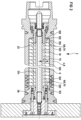
- FIG 1 shows a modular or multi-part grinding wheel holder 2.
- This grinding wheel holder 2 has an essentially rotationally symmetrical, hollow-cylindrical holder base body 4 (with a cylinder jacket 8).
- this base body 4 At one end of this base body 4 is a grinding wheel support 36 screwed by means of screws 138 to the body 4 - arranged (cf. 1a; 1a shows a section of the grinding wheel holder 2 on the cover side in another (longitudinal) section, which shows the screw connection 136 of the grinding wheel support 36 and the basic holder body 4).
- a grinding wheel 48 clamped (held) between the grinding wheel support 36 and a clamping flange 46 .
- a cover 90 is screwed (92) to the clamping flange 46 and covers a coolant bore 54 extending centrally and axially 14 through the clamping flange 46 .
- the clamping flange 46 provides radially 16 coolant bores 50 which extend radially 16 outwards from the central axial 14 coolant bore 54 to the outside 114 of the clamping flange 46 .
- the coolant hole 54 extending centrally and axially 14 through the clamping flange 46 is closed on the cover side by means of a screw plug 52 .
- the clamping of the grinding wheel 48 - between the clamping flange 46 and the grinding wheel support 36 - takes place via a screw connection of the clamping flange 46 and the grinding wheel support 36 by means of long screws 94, which pass through through bores 96 in the clamping flange 46 into threads 98 (screwed there) in bores 40, so-called filling bores 40 (see below for their purpose) in the grinding wheel support 36 extend.
- a damping material such as an elastomer or an (aluminum) foam 80, can be filled into the cavity 6 of the (hollow-cylindrical) receiving body (indicated as optional).
- FIG 1 shows, various bores 60, in particular threaded bores, for balancing screws (62, not shown) are made on the outer peripheral surface 64 of the base body 4 and the grinding wheel support 36.
- a through-tube 10, here a coolant tube 10 is arranged coaxially (with respect to the central/symmetry/rotational axis 12) to the receiving base body 4 in the hollow-cylindrical base body 4, which on the cover side is clamped in a through-bore 100 in the grinding wheel support 36 (braced - See below) - sealed (against the grinding wheel support) by a sealing ring 66 - is held.
- the coolant pipe 10 has a conical clamping shoulder 34 (forming an outer cone 42) at its end on the cover side - with a definable cone angle 44, for example approx. 50° - which clamps against a complementary clamping shoulder 88 in the through hole 100 of the grinding wheel support 36 is.
- This tensioning of the coolant pipe 10 and the grinding wheel support 36 also causes the grinding wheel support 36 - which is screwed (138) to the base body 4 - to lie braced via a flange 102 on the cover-side end face 104 of the base body 4 or against this on the cover-side Front side 104 of the receiving body 4 is used - and so ultimately the coolant tube 10 is braced against the receiving body 4 - which gives the system a high degree of rigidity.
- a sealing ring 140 seals the contact between the grinding wheel mount 36 and the base body 4 of the mount.
- the clamping force (application) for the clamping (of coolant tube 10 and grinding wheel support 36 or coolant tube 10 and base body 4) takes place by means of a screw connection 20 at the other end of coolant tube 10.
- the coolant tube 10 has an external thread 18 which engages in an internal thread 86 of a through-tube holder 22 (see later) which is connected in a torque-proof manner to the receiving base body 4, via which the coolant tube 10 can be inserted into the through-tube holder 22, more precisely into a through-bore 116 through the through-tube holder 22 (there cover side), can be screwed in (screw connection 20).
- the axial screw-in path determines the preload (infinitely variable).
- a seal 66 (in the form of a sealing ring 66) is also provided between the coolant tube 10 and the through-tube holder 22 in the area of the screw connection between the coolant tube 10 and the through-tube holder 22 .
- FIG 1 shows, in the coolant tube 10 - on the cover side at the interface 56 between the coolant tube 10 and the clamping flange 22 inside the grinding wheel support 36 - a sleeve 58 is pushed into the coolant tube 10 (which is also sealed against the coolant tube 10 (66)), the other End is received in the axial coolant bore 54 of the clamping flange 46 (also sealed here 66).
- FIG 1 shows, in the coolant tube 10 - at the end facing away from the cover - a sleeve 30 is pushed into the coolant tube 10 up to a stop 110 (which is also sealed against the coolant tube 10 (32)), the other end of which is inserted into the through hole 116 by the through tube holder 22 is inserted, - but here is axially free to ensure a maximum axial Verschraubungsweg.
- a seal 32 is provided—between sleeve 30 and through-tube holder 22 .
- FIG 1 how FIG 1 also shows, the through pipe holder 22 is supported on a (counter) shoulder 108 inside the receiving base body 4 via a shoulder 106 arranged on it. Pins 24 prevent twisting of through tube holder 22.
- FIG 1 Furthermore shows FIG 1 that - at the end of the through-tube holder 22 facing away from the cover - a coolant supply tube 26 - screwed on via a sleeve 112 (screw connection 28) - is connected to the through pipe holder (sealed 32).
- an interface 82 (in one piece) on the base body 4, here an HSK 82, which creates the connection between the grinding wheel base 4 and a work/grinding spindle (84 not shown) of a machine tool.
- HSK 82 which creates the connection between the grinding wheel base 4 and a work/grinding spindle (84 not shown) of a machine tool.
- the interface 82 which is in one piece with the receiving base body 4 here, can also be implemented by a separate component 82—possibly connected non-rotatably to the receiving base body 4 by means of pins 136)
- Coolant can reach the grinding wheel via the coolant feed tube 26, the through hole 116 in the through tube holder 22, the sleeve 30 there facing away from the cover side, the coolant tube 10, the sleeve 58 on the cover side and the clamping flange 46 having the axial through hole/coolant hole 54 and the radial coolant holes 50 48 are introduced. Pores (not illustrated) in the grinding wheel 48 allow coolant to penetrate into the grinding wheel 48 .
- the coolant can also be supplied to the grinding wheel 48 from the outside through radial bores in the grinding wheel support 36 and/or clamping flange 46 (not shown).
- FIGS. 2 to 8 show modified and/or further developed versions of the FIG 1 shown and described in the above grinding wheel holder 2 is shown.
- FIGS. 2 to 8 Since these designs of grinding wheel holders 2 (according to FIGS. 2 to 8) essentially correspond to the (described) grinding wheel holder 2 FIG 1 correspond, in the following descriptions there is no repetition of descriptions of identical components used in the same way for the other grinding wheel holders 2 in FIGS. 2 to 8. Only the modifications and developments (in FIGS. 2 to 8) are shown below.
- FIG 2 shows the grinding wheel holder 2, as it is improved by additional damping elements 68 in their damping behavior.
- FIG 2 shows, inside the cylinder casing 8 of the base body 4 there are a large number of damping elements 68 (arranged stacked one on top of the other) - in the form of ring disks 70.
- annular discs 70 are pressed - over their outer circumference 120 into the cylinder jacket 8 of the base body 4 - coaxially to the base body 4 and through-tube/coolant tube 10 - and extend (in the cavity 6 in the base body 4) essentially over the entire axial 14 length between through-tube holders 22 and grinding wheel support 36.
- the inner peripheral diameter 122 of the annular disks 70 essentially corresponds to an outer peripheral diameter 126 of the through-tube holder 22—and thus (where they are not seated on the through-tube holder 22—cf. FIG 2 ) a radial distance 72 to the outer circumference 124 of the coolant pipe 10.
- This sleeve 70 is pressed - over its outer circumference 120 into the cylinder jacket 8 of the base body 4 - coaxially to the base body 4 and the through pipe/coolant pipe 10 - and extends (in the cavity 6 in the base body 4) essentially over the entire axial 14 length between the through pipe holder 22 and grinding wheel support 36.
- the grinding wheel support 36 it can also be clamped axially in the cavity 6 of the base body 4.
- the wall thickness 128 of the sleeve 70 is thin-walled, so that a radial distance 72 to the outer circumference 124 of the coolant pipe 10 is formed.
- FIG 4 shows the grinding wheel holder 2 as it is improved in its damping behavior by yet other additional damping elements 68 .
- FIG 4 shows, there are two damping elements 68 inside the cylinder jacket 8 of the base body 4 - in the form of annular discs 70.
- ring disks 70 are held - via (rubber) rings 74 arranged on their outer circumference 120 at a radial distance 72 - in the cylinder jacket 8 of the base body 4 - coaxially to the base body 4 and through pipe/coolant pipe 10 - specifically (axially 14) on the grinding wheel support side End of the recording body 4 - with an axial distance 78 to each other.
- the annular disks 70 also leave a radial distance 72 to the outer circumference 124 of the coolant pipe 10.
- This sleeve 70 is held - by (rubber) rings 74 arranged at two axially spaced points on its outer circumference 120 at a radial distance 72 - in the cylinder jacket 8 of the base body 4 - coaxially to the base body 4 and through pipe/coolant pipe 10.
- the inner peripheral diameter 122 of the sleeve 70 is slightly larger than the outer peripheral diameter 126 of the through-tube 10, as a result of which the sleeve 70 can be pushed onto the coolant tube 10.
- the sleeve 70 extends axially over the entire axial length between the through-tube holder 22 and the grinding wheel support 36 - but can have play at both ends in relation to the through-tube holder 22 and the grinding wheel support 36 .
- ring disks 70 are held on the coolant pipe 10 coaxially to the receiving base body 4 and through-tube/coolant pipe 10 via (rubber) rings 74 arranged on their inner circumference 130 at a radial spacing 72 .
- the annular disks 70 also leave a radial distance 72 to the base body 4.
- the two ring disks 70 are held axially in position (with an axial distance of 78) by means of sleeves 76 arranged between and adjacent to them and pushed or arranged on the coolant tube between the through-tube holder 22 and the grinding wheel support 36.
- FIG 7 shows the grinding wheel holder 2 - with a modified bracing contact or surfaces between - in this case - coolant tube 10 and base body 4 (immediate direct bracing of the through-tube 10 with the base body 4).
- the force flow of the clamping of the coolant tube 10 does not take place via the grinding wheel support 36 in the base body 4, but directly and directly from the coolant tube 10 to the base body 4.
- the coolant tube 10 has a conical clamping shoulder 34 (forming a flat outer cone 42 forming a flat outer cone 42) with a definable cone angle 44, here for example approx. is braced on the receiving body 4.
- the sleeve 58 - between the coolant pipe 10 on the one hand and the clamping flange 22 on the other hand - is passed through the - in this case shoulder-free/cone-free, cylindrical - bore 100 in the grinding wheel support 36 and sealed there by means of a first seal 66.
- the sleeve 58 is also sealed off from the coolant pipe 10 by means of a second seal 66 .
- the interface 82 which is designed in one piece with the receiving base body 4 as described above, can also be embodied by a separate component 82 .
- This separate interface 82 is doing how 8 shows, by pins 136 with the receiving body 4 - non-rotatably - connected.
- the interface 82 is provided as a separate component, it would also be possible (not shown) to provide the through-tube holder 22 in one piece - instead of a separate component - at the interface Accessibility, which is necessary for the manufacture and assembly of the grinding wheel holder 2.
Landscapes
- Engineering & Computer Science (AREA)
- Mechanical Engineering (AREA)
- Polishing Bodies And Polishing Tools (AREA)
- Constituent Portions Of Griding Lathes, Driving, Sensing And Control (AREA)
- Grinding-Machine Dressing And Accessory Apparatuses (AREA)
- Grinding Of Cylindrical And Plane Surfaces (AREA)
Applications Claiming Priority (1)
| Application Number | Priority Date | Filing Date | Title |
|---|---|---|---|
| DE102021124802.7A DE102021124802A1 (de) | 2021-09-24 | 2021-09-24 | Schleifscheibenaufnahme |
Publications (1)
| Publication Number | Publication Date |
|---|---|
| EP4155014A1 true EP4155014A1 (fr) | 2023-03-29 |
Family
ID=83362527
Family Applications (1)
| Application Number | Title | Priority Date | Filing Date |
|---|---|---|---|
| EP22196303.6A Pending EP4155014A1 (fr) | 2021-09-24 | 2022-09-19 | Logement de meule |
Country Status (5)
| Country | Link |
|---|---|
| US (1) | US20230098808A1 (fr) |
| EP (1) | EP4155014A1 (fr) |
| JP (1) | JP2023047325A (fr) |
| CN (1) | CN115847290A (fr) |
| DE (1) | DE102021124802A1 (fr) |
Citations (4)
| Publication number | Priority date | Publication date | Assignee | Title |
|---|---|---|---|---|
| DE29980181U1 (de) * | 1999-02-01 | 2001-09-27 | Franz Haimer Maschinenbau KG, 86568 Hollenbach | Spannvorrichtung zur einspannung eines rotierenden maschinenelements sowie auswuchtmaschine mit einer solchen spannvorrichtung |
| DE19983838T1 (de) * | 1998-12-22 | 2002-06-20 | Richard A Kaiser | Hilfs-Oberflächenbehandlungsanordnung für die Oberflächenbehandlungsvorrichtung |
| CN201516576U (zh) * | 2009-09-17 | 2010-06-30 | 中国航空工业集团公司北京航空材料研究院 | 一种中心供料式机械抛光工具 |
| DE202017000560U1 (de) | 2017-02-02 | 2017-02-13 | Deckel Maho Pfronten Gmbh | Werkzeughalter zur Aufnahme eines Schleifwerkzeugs zur schleifenden Bearbeitung eines Werkstücks an einer numerisch gesteuerten Werkzeugmaschine mit werkzeugtragender Arbeitsspindel |
Family Cites Families (4)
| Publication number | Priority date | Publication date | Assignee | Title |
|---|---|---|---|---|
| EP0668810B1 (fr) * | 1993-09-14 | 1999-12-01 | Regofix Ag | Dispositif de serrage pour machines-outils |
| EP1597007B2 (fr) * | 2003-02-20 | 2017-06-21 | Gühring KG | Porte-outil |
| DE202010017882U1 (de) * | 2009-07-07 | 2012-12-04 | Gühring Ohg | Spannfutter für ein Werkzeug |
| DE102013108787A1 (de) * | 2013-08-14 | 2015-02-19 | Franz Haimer Maschinenbau Kg | Werkzeuganordnung und Werkzeugaufnahme für eine derartige Werkzeuganordnung |
-
2021
- 2021-09-24 DE DE102021124802.7A patent/DE102021124802A1/de active Pending
-
2022
- 2022-09-16 JP JP2022147840A patent/JP2023047325A/ja active Pending
- 2022-09-19 EP EP22196303.6A patent/EP4155014A1/fr active Pending
- 2022-09-22 CN CN202211160485.1A patent/CN115847290A/zh active Pending
- 2022-09-26 US US17/952,377 patent/US20230098808A1/en active Pending
Patent Citations (4)
| Publication number | Priority date | Publication date | Assignee | Title |
|---|---|---|---|---|
| DE19983838T1 (de) * | 1998-12-22 | 2002-06-20 | Richard A Kaiser | Hilfs-Oberflächenbehandlungsanordnung für die Oberflächenbehandlungsvorrichtung |
| DE29980181U1 (de) * | 1999-02-01 | 2001-09-27 | Franz Haimer Maschinenbau KG, 86568 Hollenbach | Spannvorrichtung zur einspannung eines rotierenden maschinenelements sowie auswuchtmaschine mit einer solchen spannvorrichtung |
| CN201516576U (zh) * | 2009-09-17 | 2010-06-30 | 中国航空工业集团公司北京航空材料研究院 | 一种中心供料式机械抛光工具 |
| DE202017000560U1 (de) | 2017-02-02 | 2017-02-13 | Deckel Maho Pfronten Gmbh | Werkzeughalter zur Aufnahme eines Schleifwerkzeugs zur schleifenden Bearbeitung eines Werkstücks an einer numerisch gesteuerten Werkzeugmaschine mit werkzeugtragender Arbeitsspindel |
Also Published As
| Publication number | Publication date |
|---|---|
| DE102021124802A1 (de) | 2023-03-30 |
| CN115847290A (zh) | 2023-03-28 |
| JP2023047325A (ja) | 2023-04-05 |
| US20230098808A1 (en) | 2023-03-30 |
Similar Documents
| Publication | Publication Date | Title |
|---|---|---|
| EP2934800B1 (fr) | Porte-outil avec des cavités incorporées | |
| DE69714781T2 (de) | Hydromechanisches futter | |
| DE69800037T2 (de) | Spannfutter | |
| EP2300183A1 (fr) | Outil d'alésage | |
| EP2815837A1 (fr) | Tête porte-lame améliorée et utilisation de celle-ci | |
| DE102010014322A1 (de) | Werkzeugkopf für ein rotierendes Werkzeug | |
| EP2832478B1 (fr) | Système de connexion et douille intermédiaire et kit doté d'une douille intermédiaire et d'une vis d'arrêt destinée à être utilisée dans un tel système de connexion | |
| WO2005097384A2 (fr) | Dispositif de serrage extensible | |
| WO2018162280A1 (fr) | Butée destinée à un outil de perçage, de fraisage ou de lamage | |
| DE3108438A1 (de) | Bohrwerkzeug | |
| EP4155023B1 (fr) | Logement pour un outil rotatif | |
| EP1768808B1 (fr) | Adaptateur d'outil | |
| EP3439816A1 (fr) | Outil d'usinage par enlèvement de copeaux pour ébavurer des alésages | |
| WO2010121613A1 (fr) | Mandrin de serrage | |
| EP2314403B1 (fr) | Dispositif de tension | |
| DE102005055622B3 (de) | Dehnspanneinrichtung | |
| EP3738700B1 (fr) | Support de serrage hydraulique pour outil/piece de travail | |
| DE202007013371U1 (de) | Werkzeugadapter | |
| EP4155014A1 (fr) | Logement de meule | |
| DE102017212200A1 (de) | Zerspanungswerkzeug mit einem an einem grundkörper einstellbar gehaltenen schneideinsatz | |
| EP2008748A2 (fr) | Mandrin à pince de serrage | |
| EP1789223B1 (fr) | Porte-outils destine a des outils de machines-outils | |
| WO2005107986A1 (fr) | Outil a brocher et procede pour usiner des surfaces de trous, par enlevement de matiere | |
| DE202007014828U1 (de) | Spannfutter für zu spannende Teile | |
| DE102015207955A1 (de) | Spannfutter |
Legal Events
| Date | Code | Title | Description |
|---|---|---|---|
| PUAI | Public reference made under article 153(3) epc to a published international application that has entered the european phase |
Free format text: ORIGINAL CODE: 0009012 |
|
| STAA | Information on the status of an ep patent application or granted ep patent |
Free format text: STATUS: THE APPLICATION HAS BEEN PUBLISHED |
|
| AK | Designated contracting states |
Kind code of ref document: A1 Designated state(s): AL AT BE BG CH CY CZ DE DK EE ES FI FR GB GR HR HU IE IS IT LI LT LU LV MC MK MT NL NO PL PT RO RS SE SI SK SM TR |
|
| STAA | Information on the status of an ep patent application or granted ep patent |
Free format text: STATUS: REQUEST FOR EXAMINATION WAS MADE |
|
| 17P | Request for examination filed |
Effective date: 20230919 |
|
| RBV | Designated contracting states (corrected) |
Designated state(s): AL AT BE BG CH CY CZ DE DK EE ES FI FR GB GR HR HU IE IS IT LI LT LU LV MC MK MT NL NO PL PT RO RS SE SI SK SM TR |