EP4155336B1 - Résine époxy contenant du carbonate, son procédé de fabrication, produit durcissable époxy préparé par celle-ci et procédé de dégradation de produit durcissable époxy - Google Patents
Résine époxy contenant du carbonate, son procédé de fabrication, produit durcissable époxy préparé par celle-ci et procédé de dégradation de produit durcissable époxy Download PDFInfo
- Publication number
- EP4155336B1 EP4155336B1 EP22193764.2A EP22193764A EP4155336B1 EP 4155336 B1 EP4155336 B1 EP 4155336B1 EP 22193764 A EP22193764 A EP 22193764A EP 4155336 B1 EP4155336 B1 EP 4155336B1
- Authority
- EP
- European Patent Office
- Prior art keywords
- group
- carbon atoms
- formula
- carbonate
- epoxy
- Prior art date
- Legal status (The legal status is an assumption and is not a legal conclusion. Google has not performed a legal analysis and makes no representation as to the accuracy of the status listed.)
- Active
Links
Images


Classifications
-
- C—CHEMISTRY; METALLURGY
- C08—ORGANIC MACROMOLECULAR COMPOUNDS; THEIR PREPARATION OR CHEMICAL WORKING-UP; COMPOSITIONS BASED THEREON
- C08G—MACROMOLECULAR COMPOUNDS OBTAINED OTHERWISE THAN BY REACTIONS ONLY INVOLVING UNSATURATED CARBON-TO-CARBON BONDS
- C08G59/00—Polycondensates containing more than one epoxy group per molecule; Macromolecules obtained by polymerising compounds containing more than one epoxy group per molecule using curing agents or catalysts which react with the epoxy groups
- C08G59/18—Macromolecules obtained by polymerising compounds containing more than one epoxy group per molecule using curing agents or catalysts which react with the epoxy groups ; e.g. general methods of curing
- C08G59/40—Macromolecules obtained by polymerising compounds containing more than one epoxy group per molecule using curing agents or catalysts which react with the epoxy groups ; e.g. general methods of curing characterised by the curing agents used
- C08G59/4007—Curing agents not provided for by the groups C08G59/42 - C08G59/66
-
- C—CHEMISTRY; METALLURGY
- C08—ORGANIC MACROMOLECULAR COMPOUNDS; THEIR PREPARATION OR CHEMICAL WORKING-UP; COMPOSITIONS BASED THEREON
- C08G—MACROMOLECULAR COMPOUNDS OBTAINED OTHERWISE THAN BY REACTIONS ONLY INVOLVING UNSATURATED CARBON-TO-CARBON BONDS
- C08G59/00—Polycondensates containing more than one epoxy group per molecule; Macromolecules obtained by polymerising compounds containing more than one epoxy group per molecule using curing agents or catalysts which react with the epoxy groups
- C08G59/18—Macromolecules obtained by polymerising compounds containing more than one epoxy group per molecule using curing agents or catalysts which react with the epoxy groups ; e.g. general methods of curing
- C08G59/20—Macromolecules obtained by polymerising compounds containing more than one epoxy group per molecule using curing agents or catalysts which react with the epoxy groups ; e.g. general methods of curing characterised by the epoxy compounds used
- C08G59/22—Di-epoxy compounds
- C08G59/24—Di-epoxy compounds carbocyclic
- C08G59/245—Di-epoxy compounds carbocyclic aromatic
-
- C—CHEMISTRY; METALLURGY
- C08—ORGANIC MACROMOLECULAR COMPOUNDS; THEIR PREPARATION OR CHEMICAL WORKING-UP; COMPOSITIONS BASED THEREON
- C08G—MACROMOLECULAR COMPOUNDS OBTAINED OTHERWISE THAN BY REACTIONS ONLY INVOLVING UNSATURATED CARBON-TO-CARBON BONDS
- C08G59/00—Polycondensates containing more than one epoxy group per molecule; Macromolecules obtained by polymerising compounds containing more than one epoxy group per molecule using curing agents or catalysts which react with the epoxy groups
- C08G59/18—Macromolecules obtained by polymerising compounds containing more than one epoxy group per molecule using curing agents or catalysts which react with the epoxy groups ; e.g. general methods of curing
- C08G59/20—Macromolecules obtained by polymerising compounds containing more than one epoxy group per molecule using curing agents or catalysts which react with the epoxy groups ; e.g. general methods of curing characterised by the epoxy compounds used
- C08G59/32—Epoxy compounds containing three or more epoxy groups
- C08G59/3218—Carbocyclic compounds
-
- C—CHEMISTRY; METALLURGY
- C08—ORGANIC MACROMOLECULAR COMPOUNDS; THEIR PREPARATION OR CHEMICAL WORKING-UP; COMPOSITIONS BASED THEREON
- C08G—MACROMOLECULAR COMPOUNDS OBTAINED OTHERWISE THAN BY REACTIONS ONLY INVOLVING UNSATURATED CARBON-TO-CARBON BONDS
- C08G59/00—Polycondensates containing more than one epoxy group per molecule; Macromolecules obtained by polymerising compounds containing more than one epoxy group per molecule using curing agents or catalysts which react with the epoxy groups
- C08G59/18—Macromolecules obtained by polymerising compounds containing more than one epoxy group per molecule using curing agents or catalysts which react with the epoxy groups ; e.g. general methods of curing
- C08G59/40—Macromolecules obtained by polymerising compounds containing more than one epoxy group per molecule using curing agents or catalysts which react with the epoxy groups ; e.g. general methods of curing characterised by the curing agents used
- C08G59/50—Amines
-
- C—CHEMISTRY; METALLURGY
- C08—ORGANIC MACROMOLECULAR COMPOUNDS; THEIR PREPARATION OR CHEMICAL WORKING-UP; COMPOSITIONS BASED THEREON
- C08G—MACROMOLECULAR COMPOUNDS OBTAINED OTHERWISE THAN BY REACTIONS ONLY INVOLVING UNSATURATED CARBON-TO-CARBON BONDS
- C08G59/00—Polycondensates containing more than one epoxy group per molecule; Macromolecules obtained by polymerising compounds containing more than one epoxy group per molecule using curing agents or catalysts which react with the epoxy groups
- C08G59/18—Macromolecules obtained by polymerising compounds containing more than one epoxy group per molecule using curing agents or catalysts which react with the epoxy groups ; e.g. general methods of curing
- C08G59/68—Macromolecules obtained by polymerising compounds containing more than one epoxy group per molecule using curing agents or catalysts which react with the epoxy groups ; e.g. general methods of curing characterised by the catalysts used
- C08G59/686—Macromolecules obtained by polymerising compounds containing more than one epoxy group per molecule using curing agents or catalysts which react with the epoxy groups ; e.g. general methods of curing characterised by the catalysts used containing nitrogen
-
- C—CHEMISTRY; METALLURGY
- C08—ORGANIC MACROMOLECULAR COMPOUNDS; THEIR PREPARATION OR CHEMICAL WORKING-UP; COMPOSITIONS BASED THEREON
- C08G—MACROMOLECULAR COMPOUNDS OBTAINED OTHERWISE THAN BY REACTIONS ONLY INVOLVING UNSATURATED CARBON-TO-CARBON BONDS
- C08G64/00—Macromolecular compounds obtained by reactions forming a carbonic ester link in the main chain of the macromolecule
- C08G64/42—Chemical after-treatment
-
- C—CHEMISTRY; METALLURGY
- C08—ORGANIC MACROMOLECULAR COMPOUNDS; THEIR PREPARATION OR CHEMICAL WORKING-UP; COMPOSITIONS BASED THEREON
- C08J—WORKING-UP; GENERAL PROCESSES OF COMPOUNDING; AFTER-TREATMENT NOT COVERED BY SUBCLASSES C08B, C08C, C08F, C08G or C08H
- C08J11/00—Recovery or working-up of waste materials
- C08J11/04—Recovery or working-up of waste materials of polymers
- C08J11/10—Recovery or working-up of waste materials of polymers by chemically breaking down the molecular chains of polymers or breaking of crosslinks, e.g. devulcanisation
- C08J11/18—Recovery or working-up of waste materials of polymers by chemically breaking down the molecular chains of polymers or breaking of crosslinks, e.g. devulcanisation by treatment with organic material
- C08J11/28—Recovery or working-up of waste materials of polymers by chemically breaking down the molecular chains of polymers or breaking of crosslinks, e.g. devulcanisation by treatment with organic material by treatment with organic compounds containing nitrogen, sulfur or phosphorus
-
- C—CHEMISTRY; METALLURGY
- C08—ORGANIC MACROMOLECULAR COMPOUNDS; THEIR PREPARATION OR CHEMICAL WORKING-UP; COMPOSITIONS BASED THEREON
- C08G—MACROMOLECULAR COMPOUNDS OBTAINED OTHERWISE THAN BY REACTIONS ONLY INVOLVING UNSATURATED CARBON-TO-CARBON BONDS
- C08G2230/00—Compositions for preparing biodegradable polymers
-
- C—CHEMISTRY; METALLURGY
- C08—ORGANIC MACROMOLECULAR COMPOUNDS; THEIR PREPARATION OR CHEMICAL WORKING-UP; COMPOSITIONS BASED THEREON
- C08J—WORKING-UP; GENERAL PROCESSES OF COMPOUNDING; AFTER-TREATMENT NOT COVERED BY SUBCLASSES C08B, C08C, C08F, C08G or C08H
- C08J2363/00—Characterised by the use of epoxy resins; Derivatives of epoxy resins
-
- Y—GENERAL TAGGING OF NEW TECHNOLOGICAL DEVELOPMENTS; GENERAL TAGGING OF CROSS-SECTIONAL TECHNOLOGIES SPANNING OVER SEVERAL SECTIONS OF THE IPC; TECHNICAL SUBJECTS COVERED BY FORMER USPC CROSS-REFERENCE ART COLLECTIONS [XRACs] AND DIGESTS
- Y02—TECHNOLOGIES OR APPLICATIONS FOR MITIGATION OR ADAPTATION AGAINST CLIMATE CHANGE
- Y02W—CLIMATE CHANGE MITIGATION TECHNOLOGIES RELATED TO WASTEWATER TREATMENT OR WASTE MANAGEMENT
- Y02W30/00—Technologies for solid waste management
- Y02W30/50—Reuse, recycling or recovery technologies
- Y02W30/62—Plastics recycling; Rubber recycling
Definitions
- the present disclosure relates to an epoxy resin, a manufacturing method thereof, an epoxy curable product prepared thereby and a method for degrading an epoxy curable product. More particularly, the present disclosure relates to a carbonate-containing epoxy resin, a manufacturing method thereof, an epoxy curable product prepared thereby and a method for degrading an epoxy curable product.
- the commercially available epoxy resins are mainly bisphenol A type bifunctional and novolac type multifunctional.
- the phenolic group reacts with epichlorohydrin to form the epoxy group, and the multifunctional type is based on the phenolic resin, so formaldehyde must be used in the preparation of the phenolic resin.
- this method is unfavorable for the preparation of the high molecular weight multifunctional epoxy.
- the epoxy resin has a unique three-membered ring structure, which can perform the various ring-opening reactions and can also perform the self-curing by the catalyst.
- the final homopolymerized curable product has the disadvantage of poor performance.
- Epoxy resin-based recyclable carbon fiber reinforced composites are disclosed in Fig. 7 in B. Wang et al., Green Chem., 2019, 21, 5781 (XP055758058 ).
- thermosetting materials have excellent thermal stability, chemical stability and high-density covalent bond cross-linked network structure, which is not easy to be dissolved and decomposed for recycling.
- the curable product has the potential to be degraded.
- the ester group has chemically decomposable, and it is gradually applied in PET recycling. Therefore, if the similar concept can be introduced into the epoxy resin, it is expected to have the opportunity to improve the degradability of waste and achieve the purpose of chemical recycling.
- ester group is mainly formed by the reaction of carboxylic acid compounds and phenolic or alcohol compounds, and it is difficult to retain the multifunctional alcohol or phenolic groups for epoxidation during the preparation process. Therefore, the preparation of derivatized epoxy resins is limited, resulting in no related products so far.
- a carbonate-containing epoxy resin includes a structure represented by formula (I) or formula (II): wherein R 1 , R 2 , R 7 and R 8 are each independently a hydrogen atom, an alkyl group of 1 to 6 carbon atoms, an allyl group, an alkoxy group of 1 to 6 carbon atoms, an aryl group of 6 to 12 carbon atoms or a halogen atom, a and b are each independently an integer from 0 to 4, e and f are each independently an integer from 0 to 5.
- X is a single bond, an alkyl group of 1 to 12 carbon atoms, a cycloalkyl group of 3 to 12 carbon atoms, an oxygen atom, a sulfur atom, a sulfonyl group, a thionyl group, an acyl group, the aryl group of 6 to 12 carbon atoms, a fluorenyl group or a structure represented by formula (i) or formula (ii): wherein X 1 is the hydrogen atom, the alkyl group of 1 to 6 carbon atoms or the aryl group of 6 to 12 carbon atoms.
- Y is an alkyl chain of 1 to 12 carbon atoms, an alkyl ether chain of 1 to 12 carbon atoms, isocyanurate or a structure represented by formula (iii), formula (iv) or formula (v): wherein R 3 and R 4 are each independently the hydrogen atom, the alkyl group of 1 to 6 carbon atoms, the allyl group, the alkoxy group of 1 to 6 carbon atoms, the aryl group of 6 to 12 carbon atoms or the halogen atom, R 5 is the hydrogen atom, the alkyl group of 1 to 6 carbon atoms, the allyl group or the alkoxy group of 1 to 6 carbon atoms, R 6 is a methylene group, a alkyl group of 5 to 12 carbon atoms or a cycloalkyl group of 5 to 12 carbon atoms, c and d are each independently an integer from 0 to 4.
- Z is the single bond, the alkyl group of 1 to 12 carbon atoms, the cycloalkyl group of 3 to 12 carbon atoms, the oxygen atom, the sulfur atom, the sulfonyl group, the thionyl group, the acyl group, the aryl group of 6 to 12 carbon atoms, a fluorenyl group or the structure represented by formula (i) or formula (ii).
- n is a degree of polymerization, and 1 ⁇ n ⁇ 500, p is an integer from 1 to 11, q is an integer from 0 to 20, and r is an integer from 1 to 15.
- a manufacturing method for a carbonate-containing epoxy resin includes steps as follows.
- An aromatic carbonate group-containing structure is provided, wherein the aromatic carbonate group-containing structure includes a structure represented by formula (A1) or formula (A2):
- An epoxy group-containing structure is provided, wherein the epoxy group-containing structure includes a structure represented by formula (B):
- a catalyzing step is performed, wherein the aromatic carbonate group-containing structure is mixed with the epoxy group-containing structure, and then at a catalysis of a catalyst to obtain a carbonate-containing epoxy resin, which includes a structure represented by formula (I) or formula (II): wherein R 1 , R 2 , R 7 and R 8 are each independently a hydrogen atom, an alkyl group of 1 to 6 carbon atoms, an allyl group, an alkoxy group of 1 to 6 carbon atoms, an aryl group of 6 to 12 carbon atoms or a halogen atom, a and b are each independently an integer from 0
- X is a single bond, an alkyl group of 1 to 12 carbon atoms, a cycloalkyl group of 3 to 12 carbon atoms, an oxygen atom, a sulfur atom, a sulfonyl group, a thionyl group, an acyl group, the aryl group of 6 to 12 carbon atoms, a fluorenyl group or a structure represented by formula (i) or formula (ii): wherein X 1 is the hydrogen atom, the alkyl group of 1 to 6 carbon atoms or the aryl group of 6 to 12 carbon atoms.
- Y is an alkyl chain of 1 to 12 carbon atoms, an alkyl ether chain of 1 to 12 carbon atoms, isocyanurate or a structure represented by formula (iii), formula (iv) or formula (v): wherein R 3 and R 4 are each independently the hydrogen atom, the alkyl group of 1 to 6 carbon atoms, the allyl group, the alkoxy group of 1 to 6 carbon atoms, the aryl group of 6 to 12 carbon atoms or the halogen atom, R 5 is the hydrogen atom, the alkyl group of 1 to 6 carbon atoms, the allyl group or the alkoxy group of 1 to 6 carbon atoms, R 6 is a methylene group, a alkyl group of 5 to 12 carbon atoms or a cycloalkyl group of 5 to 12 carbon atoms, c and d are each independently an integer from 0 to 4.
- Z is the single bond, the alkyl group of 1 to 12 carbon atoms, the cycloalkyl group of 3 to 12 carbon atoms, the oxygen atom, the sulfur atom, the sulfonyl group, the thionyl group, the acyl group, the aryl group of 6 to 12 carbon atoms, a fluorenyl group or the structure represented by formula (i) or formula (ii).
- n is a degree of polymerization, and 1 ⁇ n ⁇ 500, m is an integer from 2 to 12, p is an integer from 1 to 11, q is an integer from 0 to 20, and r is an integer from 1 to 15.
- the catalyst can be selected from a group consisting of 4-dimethylaminopyridine, imidazole, pyridine, 2-methylimidazole, 3-methylimidazole and 2-ethyl-4-methylimidazole.
- an added amount of the catalyst can be ranged from 0.1% by weight to 5% by weight of an amount of the epoxy group-containing structure.
- an equivalence ratio of an epoxy group of the epoxy group-containing structure to a carbonate group of the aromatic carbonate group-containing structure can be 1.3 to 10.0.
- an epoxy curable product is provided.
- the epoxy curable product is obtained by performing a curing reaction with the carbonate-containing epoxy resin according to the aforementioned aspect.
- the curing reaction can be completed by mixing the carbonate-containing epoxy resin and a curing agent and heating.
- the curing agent can be a phenolic resin, an amine compound, an active ester compound, a carboxylic acid compound, a cyanate ester compound, an isocyanate compound, an anhydride compound, benzoxazine, polycarbonate or a mixture thereof.
- a curing temperature of the curing reaction can be 180°C to 240°C.
- a method for degrading an epoxy curable product includes steps as follows.
- the epoxy curable product according to the aforementioned aspect is provided.
- a degrading step is performed, wherein an amine group-containing compound is reacted with the epoxy curable product to degrade the epoxy curable product.
- the compound structure can be represented by a skeleton formula, and the representation can omit the carbon atom, the hydrogen atom and the carbon-hydrogen bond.
- the functional group is depicted clearly in the structural formula, the depicted one is preferred.
- carbonate-containing epoxy resin comprising a structure represented by formula (I)
- a carbonate-containing epoxy resin represented by formula (I) can be represented as a carbonate-containing epoxy resin represented by formula (I) or a carbonate-containing epoxy resin (I) in some cases, and the other compounds or groups can be represented in the same manner.
- a carbonate-containing epoxy resin is provided of the present disclosure, which includes a structure represented by formula (I) or formula (II): wherein R 1 , R 2 , R 7 and R 8 are each independently a hydrogen atom, an alkyl group of 1 to 6 carbon atoms, an allyl group, an alkoxy group of 1 to 6 carbon atoms, an aryl group of 6 to 12 carbon atoms or a halogen atom, a and b are each independently an integer from 0 to 4, e and f are each independently an integer from 0 to 5.
- X is a single bond, an alkyl group of 1 to 12 carbon atoms, a cycloalkyl group of 3 to 12 carbon atoms, an oxygen atom, a sulfur atom, a sulfonyl group, a thionyl group, an acyl group, the aryl group of 6 to 12 carbon atoms, a fluorenyl group or a structure represented by formula (i) or formula (ii): wherein X 1 is the hydrogen atom, the alkyl group of 1 to 6 carbon atoms or the aryl group of 6 to 12 carbon atoms.
- Y is an alkyl chain of 1 to 12 carbon atoms, an alkyl ether chain of 1 to 12 carbon atoms, isocyanurate or a structure represented by formula (iii), formula (iv) or formula (v): wherein R 3 and R 4 are each independently the hydrogen atom, the alkyl group of 1 to 6 carbon atoms, the allyl group, the alkoxy group of 1 to 6 carbon atoms, the aryl group of 6 to 12 carbon atoms or the halogen atom, R 5 is the hydrogen atom, the alkyl group of 1 to 6 carbon atoms, the allyl group or the alkoxy group of 1 to 6 carbon atoms, R 6 is a methylene group, a alkyl group of 5 to 12 carbon atoms or a cycloalkyl group of 5 to 12 carbon atoms, c and d are each independently an integer from 0 to 4.
- Z is the single bond, the alkyl group of 1 to 12 carbon atoms, the cycloalkyl group of 3 to 12 carbon atoms, the oxygen atom, the sulfur atom, the sulfonyl group, the thionyl group, the acyl group, the aryl group of 6 to 12 carbon atoms, a fluorenyl group or the structure represented by formula (i) or formula (ii).
- n is a degree of polymerization, and 1 ⁇ n ⁇ 500, p is an integer from 1 to 11, q is an integer from 0 to 20, and r is an integer from 1 to 15.
- the carbonate-containing epoxy resin of the present disclosure can be directly used or can perform the subsequent reaction because of having the carbonate structure, and improves its degradability by introducing the carbonate structure to achieve the purpose of chemically recycling.
- Fig. 1 is a flow chart of a manufacturing method for a carbonate-containing epoxy resin 100 according to one embodiment of the present disclosure.
- the manufacturing method for the carbonate-containing epoxy resin 100 includes a step 110, a step 120 and a step 130.
- an aromatic carbonate group-containing structure wherein the aromatic carbonate group-containing structure includes a structure represented by formula (A1) or formula (A2):
- the definition of R 1 , R 2 , R 7 , R 8 , X, a, b, e, f, and n can refer to the aforementioned paragraph, and will not be described herein.
- the aromatic carbonate group-containing structure can be but not limited to a carbonate compound, a new carbonate plastic or a recycled polycarbonate material, and the waste recycled polycarbonate material can be recycled from the waste optical discs, which can reduce the burden on the environment.
- an epoxy group-containing structure is provided, wherein the epoxy group-containing structure includes a structure represented by formula (B):
- the definition of Y can refer to the aforementioned paragraph, and will not be described herein, wherein m is an integer from 2 to 12.
- a catalyzing step is performed, wherein the aromatic carbonate group-containing structure is mixed with the epoxy group-containing structure, and then at a catalysis of a catalyst to obtain a carbonate-containing epoxy resin, which includes a structure represented by formula (I) or formula (II):
- the definition of R 1 , R 2 , R 7 , R 8 , X, Y, a, b, e, f, p and n can refer to the aforementioned paragraph, and will not be described herein.
- an equivalence ratio of an epoxy group of the epoxy group-containing structure to a carbonate group of the aromatic carbonate group-containing structure can be 1.3 to 10.0, preferably can be 2.0 to 10.0.
- the aforementioned catalyst can include the unshared electron pairs, which is selected from a group consisting of 4-dimethylaminopyridine (DMAP), imidazole, pyridine, 2-methylimidazole, 3-methylimidazole and 2-ethyl-4-methylimidazole. Therefore, the unshared electron pairs of the catalyst can interact with the epoxy group of the epoxy group-containing structure to facilitate the subsequent curing reaction. Specifically, an added amount of the aforementioned catalyst can be ranged from 0.1% by weight to 5% by weight of an amount of the epoxy group-containing structure.
- DMAP 4-dimethylaminopyridine
- imidazole imidazole
- pyridine 2-methylimidazole
- 2-ethyl-4-methylimidazole 2-ethyl-4-methylimidazole. Therefore, the unshared electron pairs of the catalyst can interact with the epoxy group of the epoxy group-containing structure to facilitate the subsequent curing reaction.
- an added amount of the aforementioned catalyst can be ranged from 0.1% by
- the carbonate-containing epoxy resin of the present disclosure utilizes the carbonate group of the aromatic carbonate group-containing structure to react with the epoxy group of the epoxy group-containing structure.
- a model reaction is performed in the present disclosure by Synthesis Example 1, diphenyl carbonate and diglycidyl ether of bisphenol A (DGEBA) are reacted under the pyridine catalyst.
- DGEBA diglycidyl ether of bisphenol A
- An epoxy curable product is further provided of the present disclosure, which is obtained by performing a curing reaction with the aforementioned carbonate-containing epoxy resin.
- the aforementioned curing reaction is referred with Fig. 2 , which is a flow chart of a manufacturing method for an epoxy curable product 200 according to another embodiment of the present disclosure.
- the manufacturing method for the epoxy curable product 200 includes a step 210 and a step 220.
- a mixing step is performed, wherein the carbonate-containing epoxy resin is mixed with a curing agent to obtain a curable composition.
- the carbonate-containing epoxy resin and the curing agent can be formed a precursor solution containing the curable composition by the step 210.
- a solvent used in the precursor solution is for helping the carbonate-containing epoxy resin and the curing agent to blend. Therefore, the solvent, which can dissolve the carbonate-containing epoxy resin, the curing agent and do not react with them, can be used in the step 210.
- the detail of the carbonate-containing epoxy resin can refer to the aforementioned paragraph, and will not be described herein.
- the curing agent of the present disclosure can be but not limited to a phenolic resin, an amine compound, an active ester compound, a carboxylic acid compound, a cyanate ester compound, an isocyanate compound, an anhydride compound, benzoxazine, polycarbonate or a mixture thereof.
- a curing step is performed, wherein the carbonate-containing epoxy resin and the curing agent are cross-linked to form the epoxy curable product.
- the aforementioned curable composition can be directly ground to powder and heated to the molten state, or the precursor solution can be heated, so as to cross-link the carbonate-containing epoxy resin and the curing agent.
- a curing temperature of the curing reaction can be 80°C to 240°C, preferably can be 180°C to 240°C, and the heating time can be 1 hour to 6 hours. More specifically, the aforementioned heating method can adopt a multi-stage heating and curing method, such as heating at 180°C, 200°C, 220°C for 2 hours, respectively.
- the curing temperature and heating time can be adjusted flexibly according to the type of the used carbonate-containing epoxy resin and the curing agent, and the present disclosure is not limited thereto.
- Fig. 3 is a flow chart of a method for degrading an epoxy curable product 300 according to further embodiment of the present disclosure.
- the method for degrading the epoxy curable product 300 includes a step 310 and a step 320.
- the aforementioned epoxy curable product is provided.
- a degrading step is performed, wherein an amine group-containing compound is reacted with the aforementioned epoxy curable product to degrade the epoxy curable product.
- Example 1 1.0 g of diphenyl carbonate and 3.51 g of diglycidyl ether of bisphenol A (commodity code BE188 from CHANG CHUN PLASTICS CO., LTD.) are mixed at the equivalence ratio of 1:2, and heating to 100°C to confirm the dissolution. Further, adding 0.0175 g of pyridine and reacting for 8 hours to obtain the carbonate-containing epoxy resin (DPC-EP) of Example 1, and the epoxy equivalent of Example 1 is 476 g/eq (theoretical value is 483 g/eq).
- DPC-EP carbonate-containing epoxy resin
- Example 2 1.50 g of polycarbonate and 4.44 g of diglycidyl ether of bisphenol A (commodity code BE188 from CHANG CHUN PLASTICS CO., LTD.) are mixed at the equivalence ratio of 1:2, and in the nitrogen environment at 200°C to present the molten state, then reducing the temperature to 100°C. Further, adding 0.0133 g of pyridine (0.3 wt% DGEBA) and reacting for 8 hours under mechanical stirring to obtain the dark brown viscous liquid. After cooling to the room temperature, the carbonate-containing epoxy resin (WPC-EP2) of Example 2 is obtained, and the epoxy equivalent of Example 2 is 485 g/eq (theoretical value is 503 g/eq).
- WPC-EP2 carbonate-containing epoxy resin
- Example 3 1.50 g of polycarbonate and 6.66 g of diglycidyl ether of bisphenol A (commodity code BE188 from CHANG CHUN PLASTICS CO., LTD.) are mixed at the equivalence ratio of 1:3, and in the nitrogen environment at 200°C to present the molten state, then reducing the temperature to 100°C. Further, adding 0.0199 g of pyridine (0.3 wt% DGEBA) and the remaining steps are the same as those in Example 2. The carbonate-containing epoxy resin (WPC-EP3) of Example 3 is obtained, and the epoxy equivalent of Example 3 is 333 g/eq (theoretical value is 345 g/eq).
- WPC-EP3 carbonate-containing epoxy resin
- Example 4 1.50 g of polycarbonate and 8.88 g of diglycidyl ether of bisphenol A (commodity code BE188 from CHANG CHUN PLASTICS CO., LTD.) are mixed at the equivalence ratio of 1:4, and in the nitrogen environment at 200°C to present the molten state, then reducing the temperature to 100°C. Further, adding 0.0266 g of pyridine (0.3 wt% DGEBA) and the remaining steps are the same as those in Example 2. The carbonate-containing epoxy resin (WPC-EP4) of Example 4 is obtained, and the epoxy equivalent of Example 4 is 285 g/eq (theoretical value is 293 g/eq).
- WPC-EP4 carbonate-containing epoxy resin
- Example 1 to Example 4 is performed 1 H-NMR analysis to confirm the structure of Example 1 to Example 4. Please refer to Fig. 4 and Fig. 5 , wherein Fig. 4 is a 1 H-NMR spectrum of Example 1. Fig. 5 is a 1 H-NMR spectrum of Example 2 to Example 4. As shown in Fig. 4 and Fig. 5 , the products of Example 1 to Example 4 are all the carbonate-containing epoxy resins.
- Example 4 For the carbonate-containing epoxy resin of Example 1 to Example 4, adding the equal equivalent of the curing agent. First, grinding Example 1 to Example 4 to powder and then heating to 150°C to present molten state. After stirring evenly, putting into the oven to heat to 160°C for 1 hour, 180°C for 2 hours and 200°C for 2 hours to perform the curing.
- the carbonate-containing epoxy resin of Example 1 to Example 4 and the curing agent can be stirred to fully melting in a solution with a solid content of 20 wt% by a solvent method, and then poured into a mold to cure to obtain the epoxy curable product of Example 5 to Example 16.
- the curing agent used in the present disclosure can be diaminodiphenylmethane (DDM), phenolic resin (PN), dicyandiamide (DICY), polycarbonate (PC), diphenyl ether tetracarboxylic acid dianhydride (OPDA) and phthalic anhydride (PAH).
- DDM diaminodiphenylmethane
- PN phenolic resin
- DIY dicyandiamide
- PC polycarbonate
- OPDA diphenyl ether tetracarboxylic acid dianhydride
- PAH phthalic anhydride
- adding the equal equivalent means that the number of epoxy equivalent is equal to the number of active hydrogen equivalent.
- adding the equal equivalent means that the number of epoxy equivalent is equal to the number of carbonate group equivalent.
- Example 5 to Example 16 and Comparative Example 1 to Comparative Example 4 are shown in Table 5.
- Table 5 epoxy resin curing agent Example 5 Example 1 DDM Example 6 PN Example 7 PC Example 8
- Example 2 DDM Example 9
- Example 10 PC
- Example 3 DDM Example 12
- Example 13 PC
- Example 14 Example 4
- Example 15 PN
- Example 16 PC Comparative Example 1 BE188 DDM Comparative Example 2 PN Comparative Example 3 BE501 DDM Comparative Example 4 PN
- Example 5 to Example 16 and Comparative Example 1 to Comparative Example 4 are performed the thermal property evaluation, and the thermal property evaluation includes a glass transition temperature (T g ), 5% thermogravimetric loss temperature (T d5% ) and Char yield.
- the evaluation method is shown as follows.
- Glass transition temperature using the dynamic mechanical analyzer to measure the storage modulus, the relationship between Tan delta curves and the temperature and the glass transition temperature of the epoxy curable product of Example 5 to Example 16 and Comparative Example 1 to Comparative Example 4. Furthermore, using the thermo-mechanical analysis (TMA) to measure the glass transition temperature, and the condition of the thermo-mechanical analysis is detecting at a heating rate of 5°C/min.
- TMA thermo-mechanical analysis
- thermo-gravimetric loss temperature and Char yield using thermo-gravimetric analysis (TGA) to measure the 5% thermogravimetric loss temperature and Char yield of 800°C.
- TGA thermo-gravimetric analysis
- the condition of thermo-gravimetric analysis is detecting at a heating rate of 20°C/min under the nitrogen atmosphere to measure the weight change of the sample.
- the 5% thermogravimetric loss temperature refers to the temperature which the weight loss of the cured sample reaches 5%, wherein the higher the 5% thermogravimetric loss temperature, the better the thermal stability of the sample.
- the Char yield of 800°C refers to the residual weight ratio of the sample at a heating temperature of 800°C, wherein the higher the residual weight ratio of 800°C, the better the thermal stability of the sample.
- the glass transition temperature of the epoxy curable product obtained is higher than that of other curing agents, indicating that due to the functional number of the DDM curing agent is larger than that of other curing agents, so that the crosslinking density is increased, and the thermal properties are also excellent.
- the 5% thermogravimetric loss temperature is mainly related to the bond after cross-linking.
- the energy required to decompose the ether group is greater than that of the ester group and the amine group, so the epoxy curable product obtained has the excellent 5% thermogravimetric loss temperature.
- the main chain is mostly benzene ring structure, which can have closer molecules with epoxy resin, so the Char yield is relatively high.
- the carbonate-containing epoxy resin of Example 5 to Example 16 of the present disclosure can exhibit the similar thermal properties with the commercially available epoxy curable product resins of Comparative Example 1 to Comparative Example 4 after curing.
- Example 5 to Example 16 and Comparative Example 1 to Comparative Example 4 are performed the mechanical property evaluation.
- the tensile strength and the elongation at break are measured by the tensile test, wherein the tensile test is measured at the room temperature, and the size of the test piece is 5 cm of length, 1 cm of width, 0.04 mm to 0.10 mm of thickness.
- the measurement results of the tensile strength and the elongation at break of Example 5 to Example 16 and Comparative Example 1 to Comparative Example 4 are shown in Table 7.
- Example 7 Table 7 tensile strength (MPa) elongation at break (%) Example 5 46 2.2 Example 6 62 2.7 Example 7 67 3.5 Example 8 39 2.4 Example 9 62 2.5 Example 10 65 3.1 Example 11 45 2.1 Example 12 64 2.4 Example 13 72 3.0 Example 14 45 2.0 Example 15 66 2.3 Example 16 74 2.8 Comparative Example 1 30 1.7 Comparative Example 2 55 2.1 Comparative Example 3 49 2.0 Comparative Example 4 72 3.9
- the carbonate-containing epoxy resin of Example 5 to Example 16 of the present disclosure can exhibit the similar mechanical properties with the commercially available epoxy curable product resins of Comparative Example 1 to Comparative Example 4 after curing, even generally better than the results of Comparative Example 1 to Comparative Example 4.
- Example 17 to Example 19 is the result obtained from degradation reaction of the epoxy curable product of Example 8 to Example 10, respectively.
- Comparative Example 5 to Comparative Example 8 is the result obtained from degradation reaction of the epoxy curable product of Comparative Example 1 to Comparative Example 4, respectively.
- the epoxy curable product films of Example 8 to Example 10 and Comparative Example 1 to Comparative Example 4 and 1-hexylamine are placed in the reactor. After the completion of the reaction, 1-hexylamine is extracted by using the vacuum concentrator to obtain Example 17 to Example 19 and Comparative Example 5 to Comparative Example 8 in which the degradation is completed.
- the type of epoxy curable product, the reaction temperature, the reaction time and the residual weight of Example 17 to Example 19 and Comparative Example 5 to Comparative Example 8 are shown in Table 8.
- Example 17 Example 18 Example 19 epoxy curable product Example 8
- Example 9 Example 10 reaction temperature (°C) 125 125 125 reaction time (hrs) 8 8 2 residual weight (%) 85 77 0 Comparative Example 5 Comparative Example 6 epoxy curable product Comparative Example 1 Comparative Example 2 reaction temperature (°C) 125 125 reaction time (hrs) 24 24 residual weight(%) 100 100 Comparative Example 7 Comparative Example 8 epoxy curable product Comparative Example 3 Comparative Example 4 reaction temperature (°C) 125 125 reaction time (hrs) 24 24 residual weight(%) 100 100
- Fig. 6 is a 1 H-NMR spectrum of Example 19.
- part (a) in Fig. 6 is a 1 H-NMR spectrum of the product obtained by distilling 1-hexylamine after the aminolysis reaction of Example 10 with 1-hexylamine.
- Part (b) in Fig. 6 is a 1 H-NMR spectrum of the precipitate obtained by distilling 1-hexylamine and pouring methanol after the aminolysis reaction of Example 10 with 1-hexylamine.
- the characteristic signal of 1,3-dihexylurea can be observed, wherein 7.3 ppm is the amine group signal (NH-CO-NH) of urea structure, the methylene signal is located at 2.9 ppm (H') and 1.2-1.4 ppm (H c-h ), the methyl signal is located at 0.8 ppm (H d ).
- the characteristic signal of phenoxy resin can also be observed, wherein 5.3 ppm is the hydroxyl signal, 6.8 and 7.0 ppm are the benzene ring signals, the methine signal and the methylene signal are located at 4.1 ppm (H b ) and 3.9 ppm (H a ), respectively, and the methyl signal is located at 1.5 ppm (H c ). From the results in Fig. 6 and Table 8, it can be indicated that the epoxy curable product of Example 10 of the present disclosure has decomposability after the reaction with the amine group-containing compound, and the residual weight of epoxy curable product is 0%.
- Example 8 and Example 9 also have the partial degradability under the heating reaction of 1-hexylamine, wherein the residual weight is 85% and 77%, respectively.
- the epoxy curable product of Comparative Example 1 to Comparative Example 4 obtained from the commercially available epoxy resin do not degrade under the same conditions for a long time to 24 hours, and the residual weight are all 100%. It can be proved that the carbonate-containing epoxy resin synthesized by the present disclosure has the unique degradability, and has a considerable contribution to the recycling and waste reduction of the thermosetting materials.
- the carbonate-containing bifunctional or multifunctional epoxy resin of the present disclosure is obtained by a simple one-step reaction.
- This preparation method can use the recycled waste polycarbonate or carbonate compounds as the raw materials especially, and the atomic efficiency is high, which is favorable for reducing the polycarbonate waste.
- the carbonate-containing epoxy resin of the present disclosure can be performed the curing reaction with the curing agent to obtain the epoxy curable product with excellent properties, and has the excellent chemically degradation which can reduce the emission of thermosetting plastic waste and achieving the goal of sustainable utilization.
Landscapes
- Chemical & Material Sciences (AREA)
- Organic Chemistry (AREA)
- Health & Medical Sciences (AREA)
- Chemical Kinetics & Catalysis (AREA)
- Medicinal Chemistry (AREA)
- Polymers & Plastics (AREA)
- Life Sciences & Earth Sciences (AREA)
- Sustainable Development (AREA)
- General Chemical & Material Sciences (AREA)
- Epoxy Resins (AREA)
- Epoxy Compounds (AREA)
Claims (10)
- Résine époxy contenant des groupes carbonate, caractérisé en ce qu'elle comprend une structure représentée par la formule (I) ou la formule (II) :

 dans laquelle R1, R2, R7 et R8 sont chacun indépendamment un atome d'hydrogène, un groupe alkyle de 1 à 6 atomes de carbone, un groupe allyle, un groupe alcoxy de 1 à 6 atomes de carbone, un groupe aryle de 6 à 12 atomes de carbone ou un atome d'halogène, a et b sont chacun indépendamment un entier de 0 à 4, e et f sont chacun indépendamment un entier de 0 à 5 ;dans laquelle X est une simple liaison, un groupe alkyle de 1 à 12 atomes de carbone, un groupe cycloalkyle de 3 à 12 atomes de carbone, un atome d'oxygène, un atome de soufre, un groupe sulfonyle, un groupe thionyle, un groupe acyle, un groupe aryle de 6 à 12 atomes de carbone, un groupe fluorényle ou une structure représentée par la formule (i) ou la formule (ii) :
 dans laquelle X1 est un atome d'hydrogène, un groupe alkyle de 1 à 6 atomes de carbone ou un groupe aryle de 6 à 12 atomes de carbone ;dans laquelle Y est une chaîne alkyle de 1 à 12 atomes de carbone, une chaîne d'éther d'alkyle de 1 à 12 atomes de carbone, un isocyanurate ou une structure représentée par la formule (iii), la formule (iv) ou la formule (v) :
 dans laquelle R3 et R4 sont chacun indépendamment un atome d'hydrogène, un groupe alkyle de 1 à 6 atomes de carbone, un groupe allyle, un groupe alcoxy de 1 à 6 atomes de carbone, un groupe aryle de 6 à 12 atomes de carbone ou un atome d'halogène, R5 est un atome d'hydrogène, un groupe alkyle de 1 à 6 atomes de carbone, un groupe allyle ou un groupe alcoxy de 1 à 6 atomes de carbone, R6 est un groupe méthylène, un groupe alkyle de 5 à 12 atomes de carbone ou un groupe cycloalkyle de 5 à 12 atomes de carbone, c et d sont chacun indépendamment un entier de 0 à 4 ;dans laquelle Z est une simple liaison, un groupe alkyle de 1 à 12 atomes de carbone, un groupe cycloalkyle de 3 à 12 atomes de carbone, un atome d'oxygène, un atome de soufre, un groupe sulfonyle, un groupe thionyle, un groupe acyle, un groupe aryle de 6 à 12 atomes de carbone, un groupe fluorényle ou la structure représentée par la formule (i) ou la formule (ii) ;dans laquelle n est a degré de polymérisation, et 1 ≤ n ≤ 500, p est un entier de 1 à 11, q est un entier de 0 à 20, et r est un entier de 1 à 15.
 - Procédé de fabrication d'une résine époxy contenant des groupes carbonate (100), caractérisée en ce qu'elle comprend :la fourniture d'une structure contenant un groupe carbonate aromatique (110), dans lequel la structure contenant un groupe carbonate aromatique comprend une structure représentée par la formule (A1) ou la formule (A2) :
 la fourniture d'une structure contenant un groupe époxy (120), dans lequel la structure contenant un groupe époxy comprend une structure représentée par la formule (B) :
 la conduite d'une étape de catalyse (130), dans lequel la structure contenant un groupe carbonate aromatique est mélangée avec la structure contenant un groupe époxy, et ensuite soumise à la catalyse d'un catalyseur pour obtenir une résine époxy contenant des groupes carbonate, qui comprend une structure représentée par la formule (I) ou la formule (II) :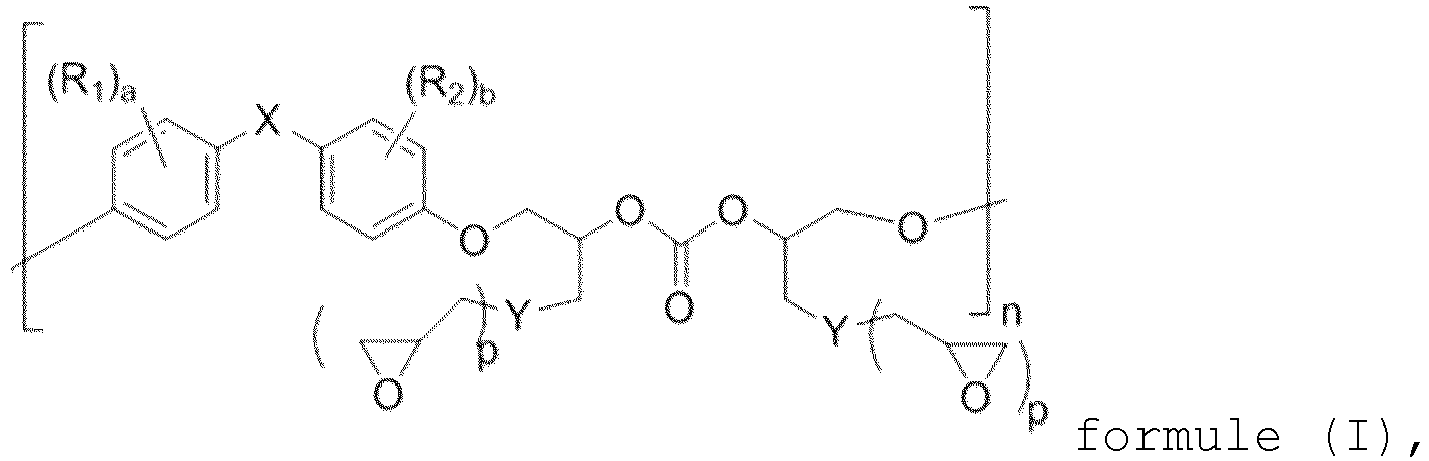
 dans laquelle R1, R2, R7 et R8 sont chacun indépendamment un atome d'hydrogène, un groupe alkyle de 1 à 6 atomes de carbone, un groupe allyle, un groupe alcoxy de 1 à 6 atomes de carbone, un groupe aryle de 6 à 12 atomes de carbone ou un atome d'halogène, a et b sont chacun indépendamment un entier de 0 à 4, e et f sont chacun indépendamment un entier de 0 à 5 ;dans laquelle X est une simple liaison, un groupe alkyle de 1 à 12 atomes de carbone, un groupe cycloalkyle de 3 à 12 atomes de carbone, un atome d'oxygène, un atome de soufre, un groupe sulfonyle, un groupe thionyle, un groupe acyle, un groupe aryle de 6 à 12 atomes de carbone, un groupe fluorényle ou une structure représentée par la formule (i) ou la formule (ii) :
 dans laquelle X1 est un atome d'hydrogène, un groupe alkyle de 1 à 6 atomes de carbone ou un groupe aryle de 6 à 12 atomes de carbone ;dans laquelle Y est une chaîne alkyle de 1 à 12 atomes de carbone, une chaîne d'éther d'alkyle de 1 à 12 atomes de carbone, un isocyanurate ou une structure représentée par la formule (iii), la formule (iv) ou la formule (v) :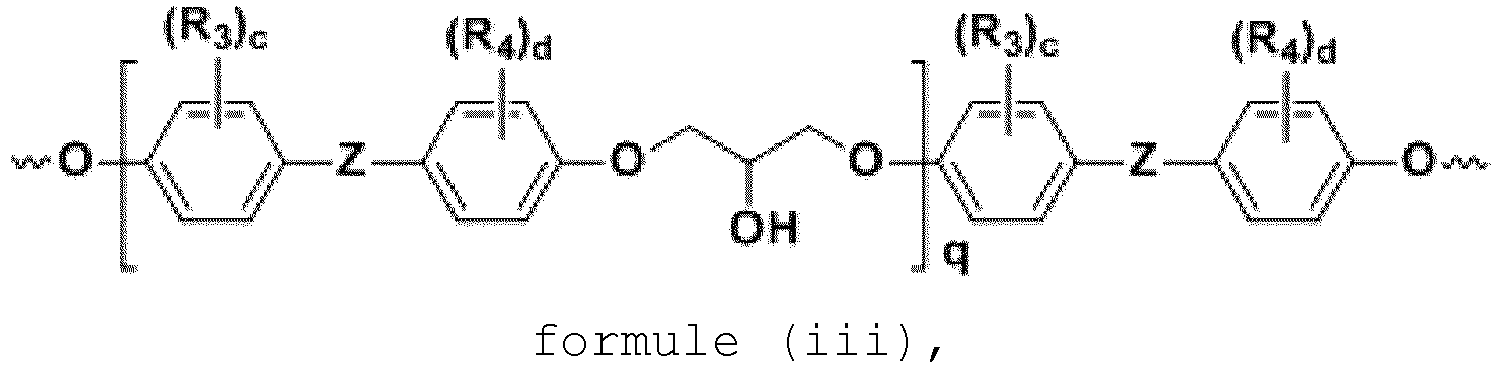
 dans laquelle R3 et R4 sont chacun indépendamment l'atome d'hydrogène, un groupe alkyle de 1 à 6 atomes de carbone, un groupe allyle, un groupe alcoxy de 1 à 6 atomes de carbone, un groupe aryle de 6 à 12 atomes de carbone ou un atome d'halogène, R5 est un atome d'hydrogène, un groupe alkyle de 1 à 6 atomes de carbone, un groupe allyle ou un groupe alcoxy de 1 à 6 atomes de carbone, R6 est un groupe méthylène, un groupe alkyle de 5 à 12 atomes de carbone ou un groupe cycloalkyle de 5 à 12 atomes de carbone, c et d sont chacun indépendamment un entier de 0 à 4 ;dans laquelle Z est une simple liaison, un groupe alkyle de 1 à 12 atomes de carbone, un groupe cycloalkyle de 3 à 12 atomes de carbone, un atome d'oxygène, un atome de soufre, un groupe sulfonyle, un groupe thionyle, un groupe acyle, un groupe aryle de 6 à 12 atomes de carbone, un groupe fluorényle ou la structure représentée par la formule (i) ou la formule (ii) ;dans laquelle n est un degré de polymérisation, et 1 ≤ n ≤ 500, m est un entier de 2 à 12, p est un entier de 1 à 11, q est un entier de 0 à 20, et r est un entier de 1 à 15.
 - Procédé de fabrication de la résine époxy contenant des groupes carbonate (100) selon la revendication 2, dans lequel le catalyseur est choisi dans un groupe constitué de 4-diméthylaminopyridine, imidazole, pyridine, 2-méthylimidazole, 3-méthylimidazole et 2-éthyl-4-méthylimidazole.
- Procédé de fabrication de la résine époxy contenant des groupes carbonate (100) des revendications 2 ou 3, dans lequel une quantité ajoutée du catalyseur est dans la plage de 0,1 % en poids à 5 % en poids d'une quantité de la structure contenant un groupe époxy.
- Procédé de fabrication de la résine époxy contenant des groupes carbonate (100) selon l'une quelconque des revendications 2 à 4, dans lequel un rapport d'équivalence d'un groupe époxy de la structure contenant un groupe époxy à un groupe carbonate de la structure contenant un groupe carbonate aromatique est de 1,3 à 10,0.
- Produit époxy durcissable, qui est obtenu par conduite d'une réaction de durcissement avec la résine époxy contenant des groupes carbonate selon la revendication 1.
- Produit époxy durcissable selon la revendication 6, dans lequel la réaction de durcissement est réalisée par mélange de la résine époxy contenant des groupes carbonate et d'un agent de durcissement et chauffage.
- Produit époxy durcissable selon la revendication 7, dans lequel l'agent de durcissement est une résine phénolique, un composé aminé, un composé d'ester actif, un composé d'acide carboxylique, un composé d'ester de cyanate, un composé d'isocyanate, un composé d'anhydride, la benzoxazine, un polycarbonate ou un mélange de ceux-ci.
- Produit époxy durcissable selon l'une quelconque des revendications 6 à 8, dans lequel une température de durcissement de la réaction de durcissement est de 180 °C à 240 °C.
- Procédé de dégradation d'un produit époxy durcissable (300), caractérisé en ce qu'il comprend :la fourniture du produit époxy durcissable (310) selon l'une quelconque des revendications 6 à 9 ; etla conduite d'une étape de dégradation (320), dans lequel un composé contenant un groupe amine réagit avec le produit époxy durcissable de façon à dégrader le produit époxy durcissable.
Priority Applications (2)
| Application Number | Priority Date | Filing Date | Title |
|---|---|---|---|
| RS20240039A RS65110B1 (sr) | 2021-09-28 | 2022-09-02 | Epoksi smola koja sadrži karbonat, postupak za njenu proizvodnju, tako pripremljen epoksi proizvod koji može da očvrsne i postupak za razgradnju epoksi proizvoda koji može da očvrsne |
| HRP20240020TT HRP20240020T1 (hr) | 2021-09-28 | 2022-09-02 | Epoksidna smola koja sadrži karbonat, postupak njezine proizvodnje, tako pripremljen epoksidni stvrdnjavajući proizvod i postupak za razgradnju epoksidnog stvrdnjavajućeg proizvoda |
Applications Claiming Priority (1)
| Application Number | Priority Date | Filing Date | Title |
|---|---|---|---|
| TW110136094A TWI817202B (zh) | 2021-09-28 | 2021-09-28 | 含碳酸酯之環氧樹脂、其製備方法、其製備之環氧固化物及降解環氧固化物的方法 |
Publications (3)
| Publication Number | Publication Date |
|---|---|
| EP4155336A1 EP4155336A1 (fr) | 2023-03-29 |
| EP4155336B1 true EP4155336B1 (fr) | 2023-11-01 |
| EP4155336C0 EP4155336C0 (fr) | 2023-11-01 |
Family
ID=83191849
Family Applications (1)
| Application Number | Title | Priority Date | Filing Date |
|---|---|---|---|
| EP22193764.2A Active EP4155336B1 (fr) | 2021-09-28 | 2022-09-02 | Résine époxy contenant du carbonate, son procédé de fabrication, produit durcissable époxy préparé par celle-ci et procédé de dégradation de produit durcissable époxy |
Country Status (11)
| Country | Link |
|---|---|
| US (1) | US12486355B2 (fr) |
| EP (1) | EP4155336B1 (fr) |
| JP (1) | JP7555376B2 (fr) |
| KR (2) | KR20230045538A (fr) |
| CN (1) | CN115873215B (fr) |
| ES (1) | ES2970396T3 (fr) |
| HR (1) | HRP20240020T1 (fr) |
| HU (1) | HUE065567T2 (fr) |
| PL (1) | PL4155336T3 (fr) |
| RS (1) | RS65110B1 (fr) |
| TW (1) | TWI817202B (fr) |
Families Citing this family (5)
| Publication number | Priority date | Publication date | Assignee | Title |
|---|---|---|---|---|
| EP4624520A4 (fr) * | 2023-05-08 | 2026-04-01 | Swancor Innovation & Incubation Co Ltd | Produit durci époxy contenant un ester et procédé de dégradation pour matériau composite de celui-ci |
| TWI851189B (zh) * | 2023-05-08 | 2024-08-01 | 上緯創新育成股份有限公司 | 含酯基環氧固化物及其複合材料的降解方法 |
| TWI880345B (zh) * | 2023-09-13 | 2025-04-11 | 國立中興大學 | 環氧樹脂、其製備方法及其複合材料 |
| KR20260047751A (ko) * | 2024-10-02 | 2026-04-09 | 국도화학 주식회사 | 재활용 및 재가공이 가능한 비결정성 에폭시 수지 조성물, 이를 포함하는 경화성 조성물 및 복합재료 |
| CN119552132A (zh) * | 2024-11-04 | 2025-03-04 | 北玻院(滕州)复合材料有限公司 | 一种可降解环氧树脂单体、环氧树脂、复合材料及其制备方法和降解方法 |
Family Cites Families (14)
| Publication number | Priority date | Publication date | Assignee | Title |
|---|---|---|---|---|
| US4943619A (en) * | 1988-12-19 | 1990-07-24 | The University Of Connecticut | Polycarbonate-epoxy polymer |
| US5182344A (en) | 1989-09-11 | 1993-01-26 | The Dow Chemical Company | Curing polyester or polycarbonate and polyepoxide with polyorgano phosphorous catalyst |
| US5037903A (en) | 1989-09-11 | 1991-08-06 | The Dow Chemical Company | Composition of aromatic polyester copolyester carbonate or polycarbonate with polyepoxide and polyorgano phosphorous catalyst |
| US5556927A (en) | 1994-06-16 | 1996-09-17 | Daicel Chemical Industries, Ltd. | Carbonate group-modified epoxy resin, a process for the preparation thereof, and a heat-curable resin composition |
| JPH11302369A (ja) * | 1998-04-15 | 1999-11-02 | Kanagawa University | 重付加共重合体およびその製造法 |
| JP3960861B2 (ja) * | 2002-06-06 | 2007-08-15 | 三井化学株式会社 | 炭酸エステル化樹脂及びその製造方法 |
| JP4090893B2 (ja) * | 2003-01-15 | 2008-05-28 | 帝人化成株式会社 | 難燃性熱可塑性樹脂組成物 |
| DE102005040464A1 (de) * | 2005-08-26 | 2007-03-01 | Bayer Materialscience Ag | Polycarbonat-Formmassen mit verbesserten rheologischen Eigenschaften |
| JP4621899B2 (ja) | 2007-09-26 | 2011-01-26 | 独立行政法人物質・材料研究機構 | 磁気媒体 |
| GB2536255B (en) | 2015-03-10 | 2017-11-01 | Gurit (Uk) Ltd | Moulding material for composite panels |
| EP3403800B1 (fr) | 2016-01-15 | 2020-09-16 | Hitachi Chemical Company, Ltd. | Préimprégné, carte de circuits imprimés, boîtier à semiconducteur et procédé de production de carte de circuits imprimés |
| JP6878076B2 (ja) * | 2017-03-24 | 2021-05-26 | 日鉄ケミカル&マテリアル株式会社 | オキサゾリドン環含有エポキシ樹脂組成物、その製造方法、硬化性樹脂組成物、及び硬化物 |
| WO2020075611A1 (fr) * | 2018-10-12 | 2020-04-16 | 本州化学工業株式会社 | Composition de résine époxy |
| TWI768347B (zh) | 2020-05-19 | 2022-06-21 | 國立中興大學 | 可固化組成物、其製備之環氧固化物及降解環氧固化物的方法 |
-
2021
- 2021-09-28 TW TW110136094A patent/TWI817202B/zh active
-
2022
- 2022-08-02 CN CN202210921978.6A patent/CN115873215B/zh active Active
- 2022-08-24 JP JP2022132934A patent/JP7555376B2/ja active Active
- 2022-09-01 KR KR1020220110771A patent/KR20230045538A/ko not_active Ceased
- 2022-09-02 EP EP22193764.2A patent/EP4155336B1/fr active Active
- 2022-09-02 HU HUE22193764A patent/HUE065567T2/hu unknown
- 2022-09-02 PL PL22193764.2T patent/PL4155336T3/pl unknown
- 2022-09-02 RS RS20240039A patent/RS65110B1/sr unknown
- 2022-09-02 ES ES22193764T patent/ES2970396T3/es active Active
- 2022-09-02 HR HRP20240020TT patent/HRP20240020T1/hr unknown
- 2022-09-06 US US17/929,938 patent/US12486355B2/en active Active
-
2026
- 2026-04-07 KR KR1020260063035A patent/KR20260051341A/ko active Pending
Also Published As
| Publication number | Publication date |
|---|---|
| EP4155336A1 (fr) | 2023-03-29 |
| US20230102899A1 (en) | 2023-03-30 |
| JP7555376B2 (ja) | 2024-09-24 |
| RS65110B1 (sr) | 2024-02-29 |
| TW202313771A (zh) | 2023-04-01 |
| CN115873215A (zh) | 2023-03-31 |
| KR20230045538A (ko) | 2023-04-04 |
| TWI817202B (zh) | 2023-10-01 |
| HRP20240020T1 (hr) | 2024-03-29 |
| ES2970396T3 (es) | 2024-05-28 |
| US12486355B2 (en) | 2025-12-02 |
| EP4155336C0 (fr) | 2023-11-01 |
| CN115873215B (zh) | 2025-06-10 |
| PL4155336T3 (pl) | 2024-04-02 |
| JP2023048991A (ja) | 2023-04-07 |
| HUE065567T2 (hu) | 2024-06-28 |
| KR20260051341A (ko) | 2026-04-16 |
Similar Documents
| Publication | Publication Date | Title |
|---|---|---|
| EP4155336A1 (fr) | Résine époxy contenant du carbonate, son procédé de fabrication, produit durcissable époxy préparé par celle-ci et procédé de dégradation de produit durcissable époxy | |
| Wang et al. | Synthesis of rosin‐based flexible anhydride‐type curing agents and properties of the cured epoxy | |
| TWI768347B (zh) | 可固化組成物、其製備之環氧固化物及降解環氧固化物的方法 | |
| JPH0625194B2 (ja) | 新規なエポキシ樹脂の製造方法 | |
| Shao et al. | Full atom-efficiency transformation of wasted polycarbonates into epoxy thermosets and the catalyst-free degradation of the thermosets for environmental sustainability | |
| JP5498200B2 (ja) | ベンゾオキサジン環を有する熱硬化性樹脂の製造方法、及びベンゾオキサジン環を有する熱硬化性樹脂 | |
| JP5049408B2 (ja) | ベンゾオキサジン環を有する熱硬化性樹脂組成物及びその製造方法、並びにその成形体及び硬化体 | |
| AU2022472898A1 (en) | Carbonate ester-containing epoxy resin, preparation method therefor, epoxy cured product prepared therefrom, and method for degrading epoxy cured product | |
| EP4382549A1 (fr) | Oligomère de polycarbonate, son procédé de fabrication, composition durcissable, produit réticulé époxy et procédé de dégradation de produit réticulé époxy par aminolyse | |
| Döring et al. | Polymerization of epoxy resins initiated by metal complexes | |
| KR20250110207A (ko) | 벤즈옥사진 화합물, 그것을 함유하는 수지 원료 조성물, 경화성 수지 조성물 및 그의 경화물 | |
| TWI832604B (zh) | 降解環氧固化物的方法 | |
| TWI854568B (zh) | 一種具有單酯基的環氧樹脂、其製備方法、其環氧固化物的製備及降解 | |
| TWI838046B (zh) | 含碳酸酯之環氧樹脂、其製備方法、其製備之環氧固化物及降解環氧固化物的方法 | |
| CN118562095A (zh) | 含碳酸酯的环氧树脂、其制备方法、其制备的环氧固化物及降解环氧固化物的方法 | |
| TWI880345B (zh) | 環氧樹脂、其製備方法及其複合材料 | |
| KR101203150B1 (ko) | 신규 에폭시 수지, 그 제조방법 및 상기 에폭시 수지를 포함하는 에폭시 수지 조성물 | |
| EP4242197A1 (fr) | Composé insaturé contenant du carbonate, son procédé de fabrication, produit réticulé préparé par celui-ci et procédé de dégradation de produit réticulé | |
| KR102661170B1 (ko) | 부분 에폭시 (메타)아크릴레이트 수지 조성물 및 이의 제조방법 | |
| JP3941659B2 (ja) | 熱硬化性樹脂組成物及びその硬化物 | |
| TW202523733A (zh) | 含碳酸酯之芳香族胺類化合物、其製備方法、其製備之環氧固化物與聚(碳酸酯亞胺)類玻璃態高分子固化物以及其降解方法 | |
| TW202513530A (zh) | 含碳酸酯之醛基衍生物、其製備方法、其製備之聚(碳酸酯亞胺)及聚(碳酸酯亞胺)之重塑性、再加工性與降解的方法 | |
| JPH058928B2 (fr) | ||
| JPS63178122A (ja) | 光デイスク用基板 | |
| JP2013185034A (ja) | ベンゾオキサジン樹脂組成物及びその製造方法、並びにその成形体及び硬化体 |
Legal Events
| Date | Code | Title | Description |
|---|---|---|---|
| PUAI | Public reference made under article 153(3) epc to a published international application that has entered the european phase |
Free format text: ORIGINAL CODE: 0009012 |
|
| STAA | Information on the status of an ep patent application or granted ep patent |
Free format text: STATUS: THE APPLICATION HAS BEEN PUBLISHED |
|
| AK | Designated contracting states |
Kind code of ref document: A1 Designated state(s): AL AT BE BG CH CY CZ DE DK EE ES FI FR GB GR HR HU IE IS IT LI LT LU LV MC MK MT NL NO PL PT RO RS SE SI SK SM TR |
|
| STAA | Information on the status of an ep patent application or granted ep patent |
Free format text: STATUS: REQUEST FOR EXAMINATION WAS MADE |
|
| 17P | Request for examination filed |
Effective date: 20230330 |
|
| RBV | Designated contracting states (corrected) |
Designated state(s): AL AT BE BG CH CY CZ DE DK EE ES FI FR GB GR HR HU IE IS IT LI LT LU LV MC MK MT NL NO PL PT RO RS SE SI SK SM TR |
|
| GRAP | Despatch of communication of intention to grant a patent |
Free format text: ORIGINAL CODE: EPIDOSNIGR1 |
|
| STAA | Information on the status of an ep patent application or granted ep patent |
Free format text: STATUS: GRANT OF PATENT IS INTENDED |
|
| RIC1 | Information provided on ipc code assigned before grant |
Ipc: C08J 11/28 20060101ALI20230418BHEP Ipc: C08G 64/42 20060101ALI20230418BHEP Ipc: C08G 59/32 20060101AFI20230418BHEP |
|
| INTG | Intention to grant announced |
Effective date: 20230508 |
|
| GRAS | Grant fee paid |
Free format text: ORIGINAL CODE: EPIDOSNIGR3 |
|
| GRAA | (expected) grant |
Free format text: ORIGINAL CODE: 0009210 |
|
| STAA | Information on the status of an ep patent application or granted ep patent |
Free format text: STATUS: THE PATENT HAS BEEN GRANTED |
|
| AK | Designated contracting states |
Kind code of ref document: B1 Designated state(s): AL AT BE BG CH CY CZ DE DK EE ES FI FR GB GR HR HU IE IS IT LI LT LU LV MC MK MT NL NO PL PT RO RS SE SI SK SM TR |
|
| REG | Reference to a national code |
Ref country code: GB Ref legal event code: FG4D |
|
| REG | Reference to a national code |
Ref country code: CH Ref legal event code: EP |
|
| REG | Reference to a national code |
Ref country code: IE Ref legal event code: FG4D |
|
| REG | Reference to a national code |
Ref country code: DE Ref legal event code: R096 Ref document number: 602022000854 Country of ref document: DE |
|
| U01 | Request for unitary effect filed |
Effective date: 20231113 |
|
| U07 | Unitary effect registered |
Designated state(s): AT BE BG DE DK EE FI FR IT LT LU LV MT NL PT SE SI Effective date: 20231120 |
|
| REG | Reference to a national code |
Ref country code: NO Ref legal event code: T2 Effective date: 20231101 |
|
| REG | Reference to a national code |
Ref country code: GR Ref legal event code: EP Ref document number: 20240400083 Country of ref document: GR Effective date: 20240209 |
|
| REG | Reference to a national code |
Ref country code: SK Ref legal event code: T3 Ref document number: E 43313 Country of ref document: SK |
|
| REG | Reference to a national code |
Ref country code: HR Ref legal event code: T1PR Ref document number: P20240020 Country of ref document: HR |
|
| PG25 | Lapsed in a contracting state [announced via postgrant information from national office to epo] |
Ref country code: IS Free format text: LAPSE BECAUSE OF FAILURE TO SUBMIT A TRANSLATION OF THE DESCRIPTION OR TO PAY THE FEE WITHIN THE PRESCRIBED TIME-LIMIT Effective date: 20240301 |
|
| PG25 | Lapsed in a contracting state [announced via postgrant information from national office to epo] |
Ref country code: IS Free format text: LAPSE BECAUSE OF FAILURE TO SUBMIT A TRANSLATION OF THE DESCRIPTION OR TO PAY THE FEE WITHIN THE PRESCRIBED TIME-LIMIT Effective date: 20240301 |
|
| REG | Reference to a national code |
Ref country code: ES Ref legal event code: FG2A Ref document number: 2970396 Country of ref document: ES Kind code of ref document: T3 Effective date: 20240528 |
|
| REG | Reference to a national code |
Ref country code: HU Ref legal event code: AG4A Ref document number: E065567 Country of ref document: HU |
|
| PG25 | Lapsed in a contracting state [announced via postgrant information from national office to epo] |
Ref country code: SM Free format text: LAPSE BECAUSE OF FAILURE TO SUBMIT A TRANSLATION OF THE DESCRIPTION OR TO PAY THE FEE WITHIN THE PRESCRIBED TIME-LIMIT Effective date: 20231101 |
|
| REG | Reference to a national code |
Ref country code: DE Ref legal event code: R097 Ref document number: 602022000854 Country of ref document: DE |
|
| PLBE | No opposition filed within time limit |
Free format text: ORIGINAL CODE: 0009261 |
|
| STAA | Information on the status of an ep patent application or granted ep patent |
Free format text: STATUS: NO OPPOSITION FILED WITHIN TIME LIMIT |
|
| REG | Reference to a national code |
Ref country code: HR Ref legal event code: ODRP Ref document number: P20240020 Country of ref document: HR Payment date: 20240823 Year of fee payment: 3 |
|
| 26N | No opposition filed |
Effective date: 20240802 |
|
| U20 | Renewal fee for the european patent with unitary effect paid |
Year of fee payment: 3 Effective date: 20240918 |
|
| PG25 | Lapsed in a contracting state [announced via postgrant information from national office to epo] |
Ref country code: MC Free format text: LAPSE BECAUSE OF FAILURE TO SUBMIT A TRANSLATION OF THE DESCRIPTION OR TO PAY THE FEE WITHIN THE PRESCRIBED TIME-LIMIT Effective date: 20231101 |
|
| U1N | Appointed representative for the unitary patent procedure changed after the registration of the unitary effect |
Representative=s name: TER MEER STEINMEISTER & PARTNER; DE |
|
| REG | Reference to a national code |
Ref country code: HR Ref legal event code: ODRP Ref document number: P20240020 Country of ref document: HR Payment date: 20250826 Year of fee payment: 4 |
|
| PGFP | Annual fee paid to national office [announced via postgrant information from national office to epo] |
Ref country code: NO Payment date: 20250919 Year of fee payment: 4 Ref country code: GR Payment date: 20250918 Year of fee payment: 4 |
|
| PGFP | Annual fee paid to national office [announced via postgrant information from national office to epo] |
Ref country code: TR Payment date: 20250829 Year of fee payment: 4 Ref country code: PL Payment date: 20250821 Year of fee payment: 4 |
|
| PGFP | Annual fee paid to national office [announced via postgrant information from national office to epo] |
Ref country code: HU Payment date: 20250827 Year of fee payment: 4 |
|
| PGFP | Annual fee paid to national office [announced via postgrant information from national office to epo] |
Ref country code: HR Payment date: 20250826 Year of fee payment: 4 |
|
| PGFP | Annual fee paid to national office [announced via postgrant information from national office to epo] |
Ref country code: IE Payment date: 20250919 Year of fee payment: 4 Ref country code: RS Payment date: 20250822 Year of fee payment: 4 Ref country code: CZ Payment date: 20250821 Year of fee payment: 4 |
|
| U20 | Renewal fee for the european patent with unitary effect paid |
Year of fee payment: 4 Effective date: 20250917 |
|
| PGFP | Annual fee paid to national office [announced via postgrant information from national office to epo] |
Ref country code: RO Payment date: 20250901 Year of fee payment: 4 |
|
| PGFP | Annual fee paid to national office [announced via postgrant information from national office to epo] |
Ref country code: SK Payment date: 20250825 Year of fee payment: 4 |
|
| PG25 | Lapsed in a contracting state [announced via postgrant information from national office to epo] |
Ref country code: CY Free format text: LAPSE BECAUSE OF FAILURE TO SUBMIT A TRANSLATION OF THE DESCRIPTION OR TO PAY THE FEE WITHIN THE PRESCRIBED TIME-LIMIT; INVALID AB INITIO Effective date: 20220902 |
|
| PGFP | Annual fee paid to national office [announced via postgrant information from national office to epo] |
Ref country code: ES Payment date: 20251020 Year of fee payment: 4 |
|
| REG | Reference to a national code |
Ref country code: CH Ref legal event code: H13 Free format text: ST27 STATUS EVENT CODE: U-0-0-H10-H13 (AS PROVIDED BY THE NATIONAL OFFICE) Effective date: 20260425 |