EP4155444A1 - Tige pour un article chaussant et son procédé de fabrication - Google Patents
Tige pour un article chaussant et son procédé de fabrication Download PDFInfo
- Publication number
- EP4155444A1 EP4155444A1 EP22200912.8A EP22200912A EP4155444A1 EP 4155444 A1 EP4155444 A1 EP 4155444A1 EP 22200912 A EP22200912 A EP 22200912A EP 4155444 A1 EP4155444 A1 EP 4155444A1
- Authority
- EP
- European Patent Office
- Prior art keywords
- yarn
- knitted component
- foamable
- foam
- protrusion
- Prior art date
- Legal status (The legal status is an assumption and is not a legal conclusion. Google has not performed a legal analysis and makes no representation as to the accuracy of the status listed.)
- Pending
Links
Images


Classifications
-
- D—TEXTILES; PAPER
- D04—BRAIDING; LACE-MAKING; KNITTING; TRIMMINGS; NON-WOVEN FABRICS
- D04B—KNITTING
- D04B1/00—Weft knitting processes for the production of fabrics or articles not dependent on the use of particular machines; Fabrics or articles defined by such processes
- D04B1/14—Other fabrics or articles characterised primarily by the use of particular thread materials
- D04B1/16—Other fabrics or articles characterised primarily by the use of particular thread materials synthetic threads
-
- D—TEXTILES; PAPER
- D06—TREATMENT OF TEXTILES OR THE LIKE; LAUNDERING; FLEXIBLE MATERIALS NOT OTHERWISE PROVIDED FOR
- D06M—TREATMENT, NOT PROVIDED FOR ELSEWHERE IN CLASS D06, OF FIBRES, THREADS, YARNS, FABRICS, FEATHERS OR FIBROUS GOODS MADE FROM SUCH MATERIALS
- D06M15/00—Treating fibres, threads, yarns, fabrics, or fibrous goods made from such materials, with macromolecular compounds; Such treatment combined with mechanical treatment
- D06M15/19—Treating fibres, threads, yarns, fabrics, or fibrous goods made from such materials, with macromolecular compounds; Such treatment combined with mechanical treatment with synthetic macromolecular compounds
- D06M15/21—Macromolecular compounds obtained by reactions only involving carbon-to-carbon unsaturated bonds
- D06M15/327—Macromolecular compounds obtained by reactions only involving carbon-to-carbon unsaturated bonds of unsaturated alcohols or esters thereof
- D06M15/333—Macromolecular compounds obtained by reactions only involving carbon-to-carbon unsaturated bonds of unsaturated alcohols or esters thereof of vinyl acetate; Polyvinylalcohol
-
- D—TEXTILES; PAPER
- D04—BRAIDING; LACE-MAKING; KNITTING; TRIMMINGS; NON-WOVEN FABRICS
- D04B—KNITTING
- D04B1/00—Weft knitting processes for the production of fabrics or articles not dependent on the use of particular machines; Fabrics or articles defined by such processes
- D04B1/10—Patterned fabrics or articles
- D04B1/12—Patterned fabrics or articles characterised by thread material
-
- A—HUMAN NECESSITIES
- A43—FOOTWEAR
- A43B—CHARACTERISTIC FEATURES OF FOOTWEAR; PARTS OF FOOTWEAR
- A43B1/00—Footwear characterised by the material
- A43B1/0009—Footwear characterised by the material made at least partially of alveolar or honeycomb material
-
- A—HUMAN NECESSITIES
- A43—FOOTWEAR
- A43B—CHARACTERISTIC FEATURES OF FOOTWEAR; PARTS OF FOOTWEAR
- A43B1/00—Footwear characterised by the material
- A43B1/02—Footwear characterised by the material made of fibres or fabrics made therefrom
- A43B1/025—Plant fibres
-
- A—HUMAN NECESSITIES
- A43—FOOTWEAR
- A43B—CHARACTERISTIC FEATURES OF FOOTWEAR; PARTS OF FOOTWEAR
- A43B1/00—Footwear characterised by the material
- A43B1/02—Footwear characterised by the material made of fibres or fabrics made therefrom
- A43B1/028—Synthetic or artificial fibres
-
- A—HUMAN NECESSITIES
- A43—FOOTWEAR
- A43B—CHARACTERISTIC FEATURES OF FOOTWEAR; PARTS OF FOOTWEAR
- A43B1/00—Footwear characterised by the material
- A43B1/02—Footwear characterised by the material made of fibres or fabrics made therefrom
- A43B1/04—Footwear characterised by the material made of fibres or fabrics made therefrom braided, knotted, knitted or crocheted
-
- A—HUMAN NECESSITIES
- A43—FOOTWEAR
- A43B—CHARACTERISTIC FEATURES OF FOOTWEAR; PARTS OF FOOTWEAR
- A43B23/00—Uppers; Boot legs; Stiffeners; Other single parts of footwear
- A43B23/02—Uppers; Boot legs
- A43B23/0205—Uppers; Boot legs characterised by the material
- A43B23/0225—Composite materials, e.g. material with a matrix
-
- A—HUMAN NECESSITIES
- A43—FOOTWEAR
- A43B—CHARACTERISTIC FEATURES OF FOOTWEAR; PARTS OF FOOTWEAR
- A43B23/00—Uppers; Boot legs; Stiffeners; Other single parts of footwear
- A43B23/02—Uppers; Boot legs
- A43B23/0205—Uppers; Boot legs characterised by the material
- A43B23/0235—Different layers of different material
-
- D—TEXTILES; PAPER
- D01—NATURAL OR MAN-MADE THREADS OR FIBRES; SPINNING
- D01D—MECHANICAL METHODS OR APPARATUS IN THE MANUFACTURE OF ARTIFICIAL FILAMENTS, THREADS, FIBRES, BRISTLES OR RIBBONS
- D01D11/00—Other features of manufacture
- D01D11/06—Coating with spinning solutions or melts
-
- D—TEXTILES; PAPER
- D01—NATURAL OR MAN-MADE THREADS OR FIBRES; SPINNING
- D01D—MECHANICAL METHODS OR APPARATUS IN THE MANUFACTURE OF ARTIFICIAL FILAMENTS, THREADS, FIBRES, BRISTLES OR RIBBONS
- D01D5/00—Formation of filaments, threads, or the like
- D01D5/24—Formation of filaments, threads, or the like with a hollow structure; Spinnerette packs therefor
- D01D5/247—Discontinuous hollow structure or microporous structure
-
- D—TEXTILES; PAPER
- D01—NATURAL OR MAN-MADE THREADS OR FIBRES; SPINNING
- D01D—MECHANICAL METHODS OR APPARATUS IN THE MANUFACTURE OF ARTIFICIAL FILAMENTS, THREADS, FIBRES, BRISTLES OR RIBBONS
- D01D5/00—Formation of filaments, threads, or the like
- D01D5/28—Formation of filaments, threads, or the like while mixing different spinning solutions or melts during the spinning operation; Spinnerette packs therefor
- D01D5/30—Conjugate filaments; Spinnerette packs therefor
- D01D5/34—Core-skin structure; Spinnerette packs therefor
-
- D—TEXTILES; PAPER
- D01—NATURAL OR MAN-MADE THREADS OR FIBRES; SPINNING
- D01F—CHEMICAL FEATURES IN THE MANUFACTURE OF ARTIFICIAL FILAMENTS, THREADS, FIBRES, BRISTLES OR RIBBONS; APPARATUS SPECIALLY ADAPTED FOR THE MANUFACTURE OF CARBON FILAMENTS
- D01F1/00—General methods for the manufacture of artificial filaments or the like
- D01F1/02—Addition of substances to the spinning solution or to the melt
- D01F1/08—Addition of substances to the spinning solution or to the melt for forming hollow filaments
-
- D—TEXTILES; PAPER
- D02—YARNS; MECHANICAL FINISHING OF YARNS OR ROPES; WARPING OR BEAMING
- D02G—CRIMPING OR CURLING FIBRES, FILAMENTS, THREADS, OR YARNS; YARNS OR THREADS
- D02G3/00—Yarns or threads, e.g. fancy yarns; Processes or apparatus for the production thereof, not otherwise provided for
- D02G3/22—Yarns or threads characterised by constructional features, e.g. blending, filament/fibre
- D02G3/40—Yarns in which fibres are united by adhesives; Impregnated yarns or threads
- D02G3/404—Yarns or threads coated with polymeric solutions
-
- D—TEXTILES; PAPER
- D04—BRAIDING; LACE-MAKING; KNITTING; TRIMMINGS; NON-WOVEN FABRICS
- D04B—KNITTING
- D04B1/00—Weft knitting processes for the production of fabrics or articles not dependent on the use of particular machines; Fabrics or articles defined by such processes
- D04B1/02—Pile fabrics or articles having similar surface features
- D04B1/04—Pile fabrics or articles having similar surface features characterised by thread material
-
- D—TEXTILES; PAPER
- D04—BRAIDING; LACE-MAKING; KNITTING; TRIMMINGS; NON-WOVEN FABRICS
- D04B—KNITTING
- D04B1/00—Weft knitting processes for the production of fabrics or articles not dependent on the use of particular machines; Fabrics or articles defined by such processes
- D04B1/10—Patterned fabrics or articles
- D04B1/12—Patterned fabrics or articles characterised by thread material
- D04B1/123—Patterned fabrics or articles characterised by thread material with laid-in unlooped yarn, e.g. fleece fabrics
-
- D—TEXTILES; PAPER
- D04—BRAIDING; LACE-MAKING; KNITTING; TRIMMINGS; NON-WOVEN FABRICS
- D04B—KNITTING
- D04B1/00—Weft knitting processes for the production of fabrics or articles not dependent on the use of particular machines; Fabrics or articles defined by such processes
- D04B1/22—Weft knitting processes for the production of fabrics or articles not dependent on the use of particular machines; Fabrics or articles defined by such processes specially adapted for knitting goods of particular configuration
-
- D—TEXTILES; PAPER
- D04—BRAIDING; LACE-MAKING; KNITTING; TRIMMINGS; NON-WOVEN FABRICS
- D04B—KNITTING
- D04B21/00—Warp knitting processes for the production of fabrics or articles not dependent on the use of particular machines; Fabrics or articles defined by such processes
- D04B21/20—Warp knitting processes for the production of fabrics or articles not dependent on the use of particular machines; Fabrics or articles defined by such processes specially adapted for knitting articles of particular configuration
-
- D—TEXTILES; PAPER
- D06—TREATMENT OF TEXTILES OR THE LIKE; LAUNDERING; FLEXIBLE MATERIALS NOT OTHERWISE PROVIDED FOR
- D06M—TREATMENT, NOT PROVIDED FOR ELSEWHERE IN CLASS D06, OF FIBRES, THREADS, YARNS, FABRICS, FEATHERS OR FIBROUS GOODS MADE FROM SUCH MATERIALS
- D06M15/00—Treating fibres, threads, yarns, fabrics, or fibrous goods made from such materials, with macromolecular compounds; Such treatment combined with mechanical treatment
- D06M15/19—Treating fibres, threads, yarns, fabrics, or fibrous goods made from such materials, with macromolecular compounds; Such treatment combined with mechanical treatment with synthetic macromolecular compounds
- D06M15/21—Macromolecular compounds obtained by reactions only involving carbon-to-carbon unsaturated bonds
- D06M15/227—Macromolecular compounds obtained by reactions only involving carbon-to-carbon unsaturated bonds of hydrocarbons, or reaction products thereof, e.g. afterhalogenated or sulfochlorinated
-
- D—TEXTILES; PAPER
- D06—TREATMENT OF TEXTILES OR THE LIKE; LAUNDERING; FLEXIBLE MATERIALS NOT OTHERWISE PROVIDED FOR
- D06M—TREATMENT, NOT PROVIDED FOR ELSEWHERE IN CLASS D06, OF FIBRES, THREADS, YARNS, FABRICS, FEATHERS OR FIBROUS GOODS MADE FROM SUCH MATERIALS
- D06M15/00—Treating fibres, threads, yarns, fabrics, or fibrous goods made from such materials, with macromolecular compounds; Such treatment combined with mechanical treatment
- D06M15/19—Treating fibres, threads, yarns, fabrics, or fibrous goods made from such materials, with macromolecular compounds; Such treatment combined with mechanical treatment with synthetic macromolecular compounds
- D06M15/37—Macromolecular compounds obtained otherwise than by reactions only involving carbon-to-carbon unsaturated bonds
- D06M15/507—Polyesters
-
- D—TEXTILES; PAPER
- D06—TREATMENT OF TEXTILES OR THE LIKE; LAUNDERING; FLEXIBLE MATERIALS NOT OTHERWISE PROVIDED FOR
- D06M—TREATMENT, NOT PROVIDED FOR ELSEWHERE IN CLASS D06, OF FIBRES, THREADS, YARNS, FABRICS, FEATHERS OR FIBROUS GOODS MADE FROM SUCH MATERIALS
- D06M15/00—Treating fibres, threads, yarns, fabrics, or fibrous goods made from such materials, with macromolecular compounds; Such treatment combined with mechanical treatment
- D06M15/19—Treating fibres, threads, yarns, fabrics, or fibrous goods made from such materials, with macromolecular compounds; Such treatment combined with mechanical treatment with synthetic macromolecular compounds
- D06M15/37—Macromolecular compounds obtained otherwise than by reactions only involving carbon-to-carbon unsaturated bonds
- D06M15/564—Polyureas, polyurethanes or other polymers having ureide or urethane links; Precondensation products forming them
-
- D—TEXTILES; PAPER
- D06—TREATMENT OF TEXTILES OR THE LIKE; LAUNDERING; FLEXIBLE MATERIALS NOT OTHERWISE PROVIDED FOR
- D06M—TREATMENT, NOT PROVIDED FOR ELSEWHERE IN CLASS D06, OF FIBRES, THREADS, YARNS, FABRICS, FEATHERS OR FIBROUS GOODS MADE FROM SUCH MATERIALS
- D06M23/00—Treatment of fibres, threads, yarns, fabrics or fibrous goods made from such materials, characterised by the process
- D06M23/04—Processes in which the treating agent is applied in the form of a foam
-
- D—TEXTILES; PAPER
- D06—TREATMENT OF TEXTILES OR THE LIKE; LAUNDERING; FLEXIBLE MATERIALS NOT OTHERWISE PROVIDED FOR
- D06M—TREATMENT, NOT PROVIDED FOR ELSEWHERE IN CLASS D06, OF FIBRES, THREADS, YARNS, FABRICS, FEATHERS OR FIBROUS GOODS MADE FROM SUCH MATERIALS
- D06M23/00—Treatment of fibres, threads, yarns, fabrics or fibrous goods made from such materials, characterised by the process
- D06M23/12—Processes in which the treating agent is incorporated in microcapsules
-
- D—TEXTILES; PAPER
- D10—INDEXING SCHEME ASSOCIATED WITH SUBLASSES OF SECTION D, RELATING TO TEXTILES
- D10B—INDEXING SCHEME ASSOCIATED WITH SUBLASSES OF SECTION D, RELATING TO TEXTILES
- D10B2401/00—Physical properties
- D10B2401/04—Heat-responsive characteristics
- D10B2401/041—Heat-responsive characteristics thermoplastic; thermosetting
-
- D—TEXTILES; PAPER
- D10—INDEXING SCHEME ASSOCIATED WITH SUBLASSES OF SECTION D, RELATING TO TEXTILES
- D10B—INDEXING SCHEME ASSOCIATED WITH SUBLASSES OF SECTION D, RELATING TO TEXTILES
- D10B2401/00—Physical properties
- D10B2401/08—Physical properties foamed
-
- D—TEXTILES; PAPER
- D10—INDEXING SCHEME ASSOCIATED WITH SUBLASSES OF SECTION D, RELATING TO TEXTILES
- D10B—INDEXING SCHEME ASSOCIATED WITH SUBLASSES OF SECTION D, RELATING TO TEXTILES
- D10B2403/00—Details of fabric structure established in the fabric forming process
- D10B2403/02—Cross-sectional features
- D10B2403/024—Fabric incorporating additional compounds
- D10B2403/0241—Fabric incorporating additional compounds enhancing mechanical properties
-
- D—TEXTILES; PAPER
- D10—INDEXING SCHEME ASSOCIATED WITH SUBLASSES OF SECTION D, RELATING TO TEXTILES
- D10B—INDEXING SCHEME ASSOCIATED WITH SUBLASSES OF SECTION D, RELATING TO TEXTILES
- D10B2501/00—Wearing apparel
- D10B2501/04—Outerwear; Protective garments
- D10B2501/043—Footwear
-
- Y—GENERAL TAGGING OF NEW TECHNOLOGICAL DEVELOPMENTS; GENERAL TAGGING OF CROSS-SECTIONAL TECHNOLOGIES SPANNING OVER SEVERAL SECTIONS OF THE IPC; TECHNICAL SUBJECTS COVERED BY FORMER USPC CROSS-REFERENCE ART COLLECTIONS [XRACs] AND DIGESTS
- Y10—TECHNICAL SUBJECTS COVERED BY FORMER USPC
- Y10T—TECHNICAL SUBJECTS COVERED BY FORMER US CLASSIFICATION
- Y10T442/00—Fabric [woven, knitted, or nonwoven textile or cloth, etc.]
- Y10T442/40—Knit fabric [i.e., knit strand or strip material]
- Y10T442/469—Including a foamed layer or component
Definitions
- the present disclosure relates generally to knitted components and methods of manufacturing knitted components, for example, knitted components for use in footwear applications, apparel applications, or the like.
- a variety of articles are formed from textiles.
- articles of apparel e.g., shirts, pants, socks, footwear, jackets and other outerwear, briefs and other undergarments, hats and other headwear
- containers e.g., backpacks, bags
- upholstery for furniture e.g., chairs, couches, car seats
- textiles are often formed by weaving or interlooping (e.g., knitting) a yarn or a plurality of yarns, usually through a mechanical process involving looms or knitting machines.
- One particular object that may be formed from a textile is an upper for an article of footwear.
- Knitting is an example of a process that may form a textile. Knitting may generally be classified as either weft knitting or warp knitting. In both weft knitting and warp knitting, one or more yarns are manipulated to form a plurality of intermeshed loops that define a variety of courses and wales. In weft knitting, which is more common, the courses and wales are perpendicular to each other and may be formed from a single yarn or many yarns. In warp knitting, the wales and courses run roughly parallel.
- knitting may be performed by hand, the commercial manufacture of knitted components is generally performed by knitting machines.
- An example of a knitting machine for producing a weft knitted component is a V-bed flat knitting machine, which includes two needle beds that are angled with respect to each other. Rails extend above and parallel to the needle beds and provide attachment points for feeders, which move along the needle beds and supply yarns to needles within the needle beds. Standard feeders have the ability to supply a yarn that is utilized to knit, tuck, and float. In situations where an inlay yarn is incorporated into a knitted component, an inlay feeder is typically utilized.
- a textile may be defined as a structure manufactured from fibers, filaments, or yarns characterized by flexibility, fineness, and a high ratio of length to thickness. Textiles generally fall into two categories. The first category includes textiles produced directly from webs of filaments or fibers by randomly (or non-randomly) interlocking or interconnecting to construct non-woven fabrics and felts. The second category includes textiles formed through a mechanical manipulation of yarn(s) (e.g., by interlacing or interlooping), thereby producing a woven fabric or a knitting fabric, for example.
- Textiles may include one or more yarns.
- a yarn is defined as an assembly having a substantial length and relatively small cross-section that is formed of at least one filament or a plurality of fibers.
- Fibers have a relatively short length and require spinning or twisting processes to produce a yarn of suitable length for use in textiles.
- Common examples of fibers are cotton and wool.
- Filaments however, have an indefinite length and may merely be combined with other filaments to produce a yarn suitable for use in textiles.
- Modern filaments include a plurality of synthetic materials such as rayon, nylon, polyester, and polyacrylic, with silk being the primary, naturally-occurring exception.
- Yarn may be formed of a single filament, which is conventionally referred to as a "monofilament yarn," or a plurality of individual filaments grouped together. Yarn may also include separate filaments formed of different materials, or the yarn may include filaments that are each formed of two or more different materials. Similar concepts also apply to yarns formed from fibers. Accordingly, yarns may have a variety of configurations that generally conform to the definition provided above.
- knitted textiles While the present embodiments may be formed with any type of textile, the following description is generally related to knitted textiles, or "knitted components.”
- certain articles may be at least partially formed as, and potentially fully formed as, a knitted component 100.
- forming articles that include a knitted component 100 may impart advantageous characteristics including, but not limited to, a particular degree of elasticity (for example, as expressed in terms of Young's modulus), breathability, bendability, strength, moisture absorption, weight, abrasion resistance, and/or a combination thereof.
- a particular single layer or multi-layer knit structure e.g., a ribbed knit structure, a single jersey knit structure, or a double jersey knit structure
- a particular material e.g., a polyester material, a relatively inelastic material, or a relatively elastic material such as spandex
- yarns of a particular size e.g., denier
- the weight of the article e.g., such as an upper 300 as shown in FIG.
- the knitted component 100 may also provide desirable aesthetic characteristics by incorporating yarns having different colors, textures or other visual properties arranged in a particular pattern.
- the yarns themselves and/or the knit structure formed by one or more of the yarns of the knitted components may be varied at different locations to provide different knit portions with different properties.
- the knitted component 100 may include at least one foamable yarn 102 when it is knitted and removed from a knitting machine. Additionally, the knitted component 100 may include a plurality of first yarns 104 that form a plurality of courses and/or a plurality of intermeshed loops of the knitted component 100 (e.g., where references to a "second yarn” may refer to the foamable yarn 102).
- the first yarns 104 may be formed of a polyester material and/or another suitable material appreciated by those with skill in the art. The first yarns 104 may not be foamable yarns.
- a foamable yarn 102 may be defined herein as a yarn that includes a foamable material, where the foamable material includes a thermoplastic polymer and a blowing agent.
- foamable yarns are described in U.S. Provisional Application No. 62/937,092, filed November 18, 2019 , and entitled "FOAMABLE YARNS, TEXTILES AND ARTICLES INCORPERATING FOAMABLE YARNS, AND THE PROCESS OF MANUFACTURING THE SAME," which is incorporated in the above description.
- thermoplastic material e.g., a thermoplastic polymer
- the thermoplastic polymer may comprise a natural polymeric material, a regenerated material, a synthetic polymeric material, or some combination thereof.
- the natural polymeric materials may be either plant-derived or animal-derived.
- Plant-derived natural polymeric materials may include cotton, flax, hemp, jute, or similar.
- Animal-derived natural polymeric materials may include spider silk, silkworm silk, sheep wool, alpaca wool, or similar.
- the regenerated material is created by dissolving the cellulose area of plant fiber in chemicals and making it into fiber again (by viscose method). Since it consists of cellulose like cotton and hemp, it is also called "regenerated cellulose fiber.”
- the regenerated material may include materials such a rayon and modal, among others.
- the synthetic polymeric material may include any of a variety of homopolymers or copolymers or a combination of homopolymers and copolymers.
- the thermoplastic polymer may comprise: a thermoplastic polyurethane homopolymer or copolymer; a thermoplastic polyethylene homopolymer or copolymer; a thermoplastic polypropylene homopolymer or copolymer; a thermoplastic polyester homopolymer or copolymer; a thermoplastic polyether homopolymer or copolymer, a thermoplastic polyamide homopolymer or copolymer; or any combination thereof.
- These may include homopolymers or copolumers of polyethylene terephtalates, ethylene-vinyl acetates, Nylons, such as Nylon 6, Nylon 11, or Nylon 6,6, among others.
- thermoplastic material comprises a thermosetting thermoplastic material.
- a thermosetting material may cure when exposed to specific thermosetting conditions at which point the thermosetting thermoplastic material undergoes a chemical change.
- a thermosetting material is uncured and, thus, may be thermoplastic.
- the cured thermosetting material has undergone a chemical change and is thermoset.
- the thermosetting conditions that trigger the thermosetting thermoplastic material to cure may include a specific temperature, an amount of UV light exposure, actinic radiation, microwave radiation, radiowave radiation, electron beam radiation, gamma beam radiation, infrared radiation, ultraviolet light, visible light, or a combination thereof, among other conditions.
- the thermosetting thermoplastic material further comprises a cross-linking agent.
- cross-linking agents are chemical products that chemically form bonds between two hydrocarbon chains. The reaction can be either exothermic or endothermic, depending on the cross-linking agent used.
- One skilled in the art would be able to select any number of appropriate cross-linking agents that would be compatible with the thermoplastic polymer and allow for cross-linking of the thermoplastic material under the desired processing conditions including temperature, pressure, UV light exposure, and the like.
- a suitable cross-linking agent comprises a homobifunctional cross-linking agent.
- Homobifunctional reagents consist of identical reactive groups on either end of a spacer arm.
- Examples of homobifunctional cross-linking agents include: dimethyl pimelimidate dihydrochloride, 3,3'-dithiodipropionic acid di(N-hydroxysuccinimide ester), suberic acid bis(3-sulfo-N-hydroxysuccinimide ester) sodium salt, among others.
- a suitable cross-linking agent comprises a heterobifunctional cross-linking agent.
- Heterobifunctional cross-linking agents have two distinct reactive groups, allowing for cross-linking reactions to progress in a controlled, two-step reaction. This can reduce the prevalence of dimers and oligomers while crosslinking.
- heterobifunctional cross-linking agents include: S-acetylthioglycolic acid N-hydroxysuccinimide ester, 5-azido-2-nitrobenzoic acid N-hydroxysuccinimide ester, 4-azidophenacyl bromide, bromoacetic acid N-hydroxysuccinimide ester, N-(3-Dimethylaminopropyl)-N'-ethylcarbodiimide hydrochloride, N-(3-Dimethylaminopropyl)-N'-ethylcarbodiimide hydrochloride, N-(3-dimethylaminopropyl)-N'-ethylcarbodiimide hydrochloride, N-(3-dimethylaminopropyl)-N'-ethylcarbodiimide hydrochloride, N-(3-dimethylaminopropyl)-N'-ethylcarbodiimide hydrochloride purum,
- the foamable material of the foamable yarn 102 further comprises a blowing agent.
- blowing agents are substances that decompose or vaporize at an activation temperature to produce quantities of gases or vapors. Accordingly, they can be categorized as either chemical or physical blowing agents.
- a chemical blowing agent is a compound which can release a gas at its activation temperature. Generally, this released gas does not chemically react with the thermoplastic polymer serving as the polymer matrix.
- the process of evolving gas from the blowing agent is usually exothermic; however, certain compounds that decompose through thermal dissociation, such as bicarbonates, evolve gas in a reversible and endothermic reaction.
- Chemical blowing agents can be further subcategorized as inorganic and organic agents. Inorganic blowing agents are used mainly in rubber technology but may be used in plastic applications to create additional cross-linking during the blowing process.
- a physical blowing agent is a compound which can phase transition to a gas when the temperature, pressure, or temperature and pressure are changed. At a given pressure, the temperature at which the physical blowing agent transitions to a gas is the activation temperature.
- Physical blowing agents include low-boiling-point hydrocarbons or supercritical fluids.
- blowing agent can influence foam quality, density, homogeneity, and the costs of the foamed product.
- the characteristic property of these compounds is their decomposition temperature, which determines their practical use as blowing agents for a given thermoplastic material and for its processing conditions.
- the thermoplastic material In order for the yarn to be able to form a stable foam, the thermoplastic material must be deformable or plastic at the activation temperature of the blowing agent. To that end, the thermoplastic-material deformation temperature may be lower than the blowing-agent activation temperature.
- thermoplastic-material deformation temperature is greater than about 10 degrees Celsius below the blowing-agent activation temperature. In some embodiments, the thermoplastic-material deformation temperature is greater than about 20 degrees Celsius below the blowing-agent activation temperature. In other embodiments, the first thermoplastic material 110 has a softening temperature from about 50 degrees Celsius to about 145 degrees Celsius.
- the chemical blowing agent has an activation temperature that is at least 5 degrees Celsius above a melting temperature of the first thermoplastic material. In other embodiments, the activation temperature of the blowing agent is at least 10 degrees Celsius above the melting temperature of the first thermoplastic material. In further embodiments, the activation temperature of the blowing agent is at least 20 degrees above the melting temperature of the first thermoplastic material.
- thermoplastic polymer properties that may be considered when selecting a chemical blowing agent include the following: affinity with the thermoplastic polymer, maximum production of gases; activation temperature at which the blowing agent evolves gas, rate of gas evolution, toxicity, corrosiveness, odor of decomposition products, effect of decomposition products on the color and other physicochemical properties of the thermoplastic polymer, cost, availability, stability against decomposition during storage, and others.
- the blowing agent comprises a chemical blowing agent.
- the chemical blowing agent comprises sodium bicarbonate, ammonium carbonate, ammonium bicarbonate, calcium azide, azodicarbonamide, hydrazocarbonamide, benzenesulfonyl hydrazide, dinitrosopentamethylene tetramine, toluenesulfonyl hydrazide, p,p'-oxybis(benzenesulfonylhydrazide), azobisisobutyronitrile, barium azodicarboxylate, or any combination thereof.
- the blowing agent comprises a physical blowing agent.
- a physical blowing agent In addition to partially halogenated fluorochlorohydrocarbons, hydrocarbons (e.g. isobutene and pentane) and inert gases, such as carbon dioxide or nitrogen, can serve as physical blowing agents.
- Inert gases offer many advantages, including, low environmentally harmful outputs, low gas consumption, increased foam volume per weight of blowing agent used, high cost-effectiveness, non-flammable, non-toxic, chemically inert, minimal or no residues left behind in the polymeric foam after processing. Additionally, carbon dioxide has the advantage of having a higher solubility in many thermoplastic polymers than other inert gases, such nitrogen.
- the blowing agent is present in the first thermoplastic material in an amount effective to foam the first thermoplastic material into a multicellular foam structure when the foamable yarn 102 is processed (as discussed in more detail below).
- the amount of blowing agent may be measured as the concentration of blowing agent by weight in the thermoplastic material.
- An amount of blowing agent is considered effective when activating the blowing results in at least a 10 percent increase in the volume of the thermoplastic material.
- blowing agents may comprise at least two chemical blowing agents, at least two physical blowing agents, or a combination of a physical blowing agent and a chemical blowing agent.
- Each blowing agent has an activation temperature at the given processing pressure. These activations temperatures may be about the same or may differ.
- blowing agents with different activation temperatures, processing of a foamable yarn into a multicellular foam structure can take place over a larger operation window of temperatures. Additionally, by controlling the temperature to activate a first blowing agent and then increasing the temperature of the foamable yarn to activate the second blowing agent, a variety of different desirable foam structures can be achieved.
- two blowing agents may have activation temperatures that differ by at least about 5 degrees Celsius. In some embodiments, two blowing agents may have activation temperatures that differ by at least about 10 degrees Celsius. In some embodiments, two blowing agents may have activation temperatures that differ by at least about 20 degrees Celsius.
- a wide range of additives may also be used in the foamable yarn 102.
- catalysts speed up the reaction or, in some cases, reduce the reaction initiation temperature.
- blowing agents that form gas bubbles in the polymer or polymerizing mixture produce foam.
- Surfactants may be added to control the size of bubbles.
- Other additives that may be used include cross-linking agents, chain-extending agents, fillers, flame retardants and coloring materials (such as dyes or pigments), ultraviolet light absorbers, antioxidants, lubricants, plasticizers, emulsifiers, rheology modifier, odorants, deodorants, or halogen scavenger, depending on the application.
- each formulation may be designed with the proper ingredients to achieve the desired properties of the final material.
- different blowing agents may require additional additives to maintain thermal properties.
- the density of the foam after the foamable yarn 102 is processed is determined by the number and size of the cells, which is affected, at least in part, by the amount of blowing that takes place during processing.
- the foamable yarn 102 may include a core having a material that is different from the foamable material.
- the core of the foamable yarn 102 may remain in substantially in-tact when subjected to an amount of heat for processing the yarn such that, even when the foamable material is softened due to its thermoplastic component being heated, the core of the foamable yarn 102 may retain structural integrity such that the core and/or the processing foamable material (and/or resulting foam) remains in a desirable location. Examples of core materials and structure are described in U.S. Provisional Application No. 62/937,092 , which is incorporated by reference in the above description.
- At least a portion of the foamable yarn 102 may be inlaid between certain loops of the knitted component 100 on a knitting machine during the manufacturing of the knitted component 100.
- the foamable yarn 102 may be inserted within a course of the knitted component during on a knitting machine, such as by utilizing an inlay process.
- an inlay process may include using an inlay feeder or other mechanical inlay device on a knitting machine (e.g., a combination feeder) to place the foamable yarn 102 between two needle beds (e.g., front and back needle beds) during a knitting process.
- an inlay process along with a combination feeder for enabling such a process, is described in U.S. Patent Application Publication No.
- the foamable yarn 102 may be attached to the remainder of the knitted component 100 in a different way, such as by using an adhesive to secure the foamable yarn 102 directly to the exterior surface of the knitted component 100, by embroidering or otherwise sewing the foamable yarn 102 such that it extends through the knitted component 100, etc. Further, while not shown, it is contemplated that the foamable yarn may be included in at least one of the loops forming the courses of the knitted component 100.
- certain portions of the foamable yarn 102 may be exposed on an outer surface 112 of the knitted component 100.
- the knitted component 100 includes a first portion 106 of the foamable yarn 102 that is located on the surface 112 (e.g., such that it is accessible from an external perspective).
- a second portion 108, third portion 110, etc. are exposed on the outer surface 112.
- the portion of the foamable yarn 102 between the first portion 106 and the second portion 108 (e.g., a depicted "covered portion 105") may be located beneath the outer surface 112 such that it is substantially covered by at least one loop of the first yarn 104.
- this exposure of the foamable yarn 102 may allow a foam protrusion and/or another foam surface characteristic to be formed on the surface 112 upon post-knit processing, for example.
- the portion of the foamable yarn 102 that remains beneath the surface 112 may be substantially protected from the processing stimulus (e.g., heat) since it is covered by loops of the knitted component 100.
- the covered portion of the foamable yarn 102 may still be at least partially processed (but, in certain embodiments, foam expansion may be limited by the surrounding knit structure, for example).
- Particular examples of knitting methods for exposing the first portion 106, second portion 108, etc. on the surface 112 are discussed below with reference to FIGS. 10-14 .
- multiple inlaid foamable yarns 102 may be included (e.g., extending substantially parallel as shown, or not).
- the different inlaid foamable yarns 102 may extend through different courses of the knitted component 100 formed by the first yarns 104. While the foamable yarns 102 are shown as being a consistent yarn type in FIG. 1 , it is contemplated that different types of foamable yarns 102 may be included.
- certain areas of the knitted component 100 may include a yarn with a relatively high density of the foamable material per unit length relative to other areas that are constructed similarly from a knitting perspective.
- certain exposed areas may have at least 10% more, at least 20% more, at least 30% more, at least 50% more, at least 75% more, at least 100% more, or even more than other exposed areas of the foamable yarns 102.
- certain areas may form foam protrusions of different sizes (as discussed below).
- the foam protrusions 212 may have a height of at least 2 mm, such as at least 5mm, 10mm, 20mm, or greater.
- the protrusions may be at least 2 mm in length and/or width, such as at least 5mm, 10mm, 20mm, or greater.
- a first area 116 of the knitted component 100 includes exposed portions that are longer than exposed portions in the second area 118.
- foam protrusions formed in the first area 116 will generally be larger in at least one dimension (e.g., at least longer) than foam protrusions formed in the second area 118 since more of the foamable material is exposed on the surface 112 in the first area 116 relative to the second area 118.
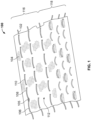
- FIG. 2 shows an example of an article 200, which may be initially formed as a knitted component in a manner similar to the knitted component 100 depicted by FIG. 1 .
- the article 200 may generally include five (5) regions.
- a first region 202 may include a plurality of foam protrusions 212.
- the foam protrusions 212 may include a multicellular foam formed as the reaction product of foaming the above-described foamable yarn 102, for example.
- the exposed portions 106, 108, etc. of FIG. 1 the exposed portions may be exposed to a particular amount of heat and/or another stimulus to activate the foamable material after the knitted component 100 of FIG. 1 is formed. Particular activation parameters are described in detail in U.S.
- the foamable material As the foamable material is activated, it may expand (e.g., away from the surface 112 of FIG. 1 ) and then set or harden in an expanded state as it is allowed cool (or otherwise obtain a relatively permanent material state).
- the resulting structures may be protrusions, such as the foam protrusions 212 that form a particular surface topography.
- the first region 202 may include protrusions 212 that are substantially the same size, but this is optional.
- the first region 202 may alternatively have variable amount of foamable material exposed on the surface of the knitted component, and/or may alter the processing procedure in different areas of the first region 202, such that the protrusions 212 vary.
- the protrusions 212 may form a surface pattern optimized for a certain function, for example.
- the second region 204 of FIG. 2 is similar to the first region 202, but the protrusions 212 are slightly smaller. This may be accomplished by either altering the knitting process (e.g., by exposing less of a foamable yarn inlay on a surface) and/or by switching types of the foamable yarn during knitting.
- the fourth region 208 and the fifth region 210 include protrusions 212 that are relatively spaced apart (e.g., by separating the exposed portions of the inlaid foamable yarns) and relatively low in height, respectively. A variety of additional and/or alternative patterns may be used. Further, while all of the protrusions 212 in FIG.
- the shape of the protrusions 212 could be altered by utilizing specific knit structures, specific material types, by using a mold press or other similar device during the foam activate step, or by any other suitable method.
- the third region 206 of FIG. 2 includes a foam surface 222 that is substantially formed of foam (e.g., the reaction product of the foamable yarn 102).
- the foam surface 222 may be formed via a variety of methods.
- the foamable material used in the foamable yarn may have a high enough concentration such that the foam fully covers the outer surface of the knitted component 100 once it is processed and embodies an expanded state.
- a unique knitting process may be used such that most or all of the surface 222 is formed of the foamable yarns 102 with less foam expansion (see, e.g., FIG. 12 and the associated description).
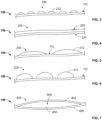
- FIG. 3-7 show various embodiments of articles 200 formed using the methods and processes described herein.
- FIG. 3 shows an article 200 having relatively small foam protrusions 212 that extend from the surface 112 of the knitted component 100.
- location between the foam protrusions 212 may include inlaid yarns having a foamable material (e.g., such that the foamable material, and/or a foam, extends through the knitted component 100 from one protrusion 212 to the next.
- the protrusions of FIG. 3 are substantially the same size, they may alternatively vary (e.g., due to using different yarns and/or by exposing different lengths of the yarns including the foamable material during knitting). While the foam protrusions 212 are shown only on one side of the fabric, they could additionally or alternatively be on the other side.
- FIG. 4 shows an article 200 having a foam surface 222, or a surface that is substantially covered with a multicellular foam.
- foam surface 222 may be formed by using a sufficient amount of foamable material within a yarn such that it substantially covers the knitted loops once it expands due to post-knit processing, for example.
- foam surface 222 is formed on only one side of the article 200 in the depicted embodiment, the opposite surface 224 may additionally or alternatively be covered in a foam (e.g., once the knitted component is processed such that the foamable yarn forms the foam).
- FIGS. 5-6 are similar to FIG. 3 , but the foam protrusions are different sizes.
- the foam protrusions 212 are about the same height as the foam protrusions 212 of FIG. 3 , but they are longer (e.g., due to foamable yarns being exposed for a longer distance).
- the foam protrusions are substantially taller than those of FIG. 3 or FIG. 5 . This may be accomplished by utilizing a foamable yarn having more of the foamable material per unit length, and or by processing the foamable yarn differently to achieve a relatively high degree of expansion.
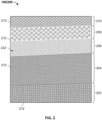
- FIG. 7 shows a different embodiment, where a multicellular foam 400 is located between a first layer 402 and a second layer 404 of the knitted component 100.
- a foamable yarn (as described above) may be inlaid through an area having a tubular knit construction, where the first layer 402 and the second layer 404 are formed.
- the first layer 402 may comprise a plurality of courses formed by intermeshed loops (e.g., of the above-described "first yarn")
- the second layer 404 may comprise a plurality of courses formed by intermeshed loops.
- a pocket 408 may be formed between the first layer 402 and the second layer 404, particularly where the loops of the first layer 402 are not directly connected to (e.g., interlooped with) the loops of the second layer 404.
- the pocket 408 may exist even prior to post-knit processing, and the foamable yarn may be located therein due to the inlay procedure. Once heated or otherwise processed, the foamable material of the foamable yarn may expand to fill the pocket 408.
- Such an embodiment may be advantageous for providing a foam cushion within a knit structure, for example, although other functions and/or uses are additionally or alternatively contemplated.
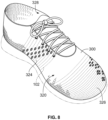
- FIG. 8 shows an upper 300 for an article of footwear that includes a plurality of foamable yarns 102.
- the upper 300 is shown in a preprocessed state in FIG. 8 (e.g., prior to forming the foam protrusions after the knitting process).
- the inlaid foamable yarns 102 may be exposed on an outer surface 320 of the upper 300 in select locations. Any suitable location may be chosen, such as in the midfoot area 324 and the toe area 326 in the depicted example (which is for illustration only).
- the foam protrusions, once formed, may provide suitable surface characteristics on the outer surface 320 of the upper 300.
- the foam protrusions may form gripping elements (e.g., suitable for kicking a soccer ball with a high degree of spin, for gripping a rope, rock wall, or other object during a particular athletic completion, etc.). If a relatively soft foam is used, it is also contemplated that the foamable yarns 102 may be exposed on an interior surface 328 of the upper 300 to provide cushioning and/or other comfort characteristics.
- gripping elements e.g., suitable for kicking a soccer ball with a high degree of spin, for gripping a rope, rock wall, or other object during a particular athletic completion, etc.
- the foamable yarns 102 may be exposed on an interior surface 328 of the upper 300 to provide cushioning and/or other comfort characteristics.
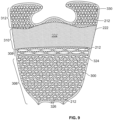
- FIG. 9 shows another embodiment of an upper 300, where the upper 300 is in a configuration that it may have just after knitting (and/or post-knit processing) but before being folded or otherwise manipulated into a wearable shape.
- the upper 300 may include multiple regions having different surface characteristics (e.g., similar to the embodiment of FIG. 2 ). The surface characteristics are formed by the foam protrusions 212, and/or the foam surface 222.
- the upper may include a first region 306 with a set of foam protrusions 212 covering the toe area 326.
- a second region 308, located in the midfoot area 324 of the upper, may include larger foam protrusion 212.
- a third region 310 may include a surface that is substantially formed of a multicellular foam (as discussed above), which may be advantageous for providing cushioning where a fastening system is located (e.g., where shoelaces are tightened over the throat area 332 of the upper 300, for example).
- the heel area 330 includes a fourth region 312 with relatively small foam protrusions 212. Notably, certain areas may lack protrusion, the regions may be reorganized, etc.
- FIGS. 10-13 show certain examples of knitting techniques that may be used to expose certain portions of an inlaid foamable yarn on a surface of a knitted component.
- an inlay jacquard procedure may be used to inlay a foamable yarn 102 within loops of a first yarn 104 (e.g., comprising a polyester and elastane in the depicted embodiment, though other suitable yarn types are also contemplated).
- a unique transfer process T may be utilized, which is key to ensuring that a length of the foamable yarn 102 will be exposed on a resulting surface.
- the transfer T causes certain loops of a course that would otherwise cover the foamable yarn 102 (e.g., where it is eventually exposed) to move to an opposite needle bed, thereby providing a hole or an "opening" where a plurality of needles are skipped on one needle bed (e.g., such that nothing covers the inlaid foamable yarn 102).
- the resulting exposed length of the foamable yarn 102 may be equal to or greater than the length of a portion of a knitted course comprising at least two consecutive loops, for example, and perhaps much larger (e.g., at least three, four, five, ten, fifteen, or even twenty or more consecutive loops). In metric units, this exposed length may be equal to at least 2 mm, for example, and potentially much larger (e.g., about equal to or greater than 5 mm, 10 mm, 20 mm, or more).
- the process of FIG. 10 may correspond to the first region 202 of FIG. 2 , for example.
- a fusible yarn 140 may additionally be included, which may cover and then "release" certain portions of the foamable yarn 102, for example (as described with reference to FIG. 12 ).
- the fusible yarn 140 may additionally or alternatively be included to provide rigidity, strength, and/or other advantageous features to the knitted component once processed with heat (which may be the same heat used to activate the foamable yarn, for example).
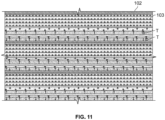
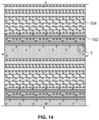
- FIGS. 11 and 13 -14 show processes that may form similar knit structures to the structure formed by FIG. 10 , for example, and the general principle used to form exposed portions of the foamable yarn 102 remains the same (e.g., by utilizing a transfer T).
- FIGS. 11 and 13 -14 may correspond to the regions 204, 208, and 210, of FIG. 2 , respectively.
- other yarns may be included, such as a high tenacity yarn 103 shown in FIG. 11 , which may provide a high degree of strength and rigidity.
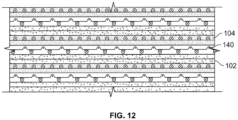
- FIG.12 is a knitting procedure that may be used to form a surface fully or substantially formed by a foam (e.g., once processed).
- the foamable yarn 102 is inlaid between courses formed by a first yarn 104 (e.g., a polyester or other high-melting-point yarn, potentially including an elastane, for example) and a fusible yarn 140 (e.g., formed of a thermoplastic material having a relatively low melting point suitable for heat processing).
- a first yarn 104 e.g., a polyester or other high-melting-point yarn, potentially including an elastane, for example
- a fusible yarn 140 e.g., formed of a thermoplastic material having a relatively low melting point suitable for heat processing.
- the only loops formed on the front side of the inlaid foamable yarn 102 are formed solely of the fusible yarn 140.
- the resulting knitting component may appear similar to other knitted components described using the knit processes depicted above.
- the fusible yarn 140 may substantially or fully melt, thereby allowing the foamable material of the foamable yarn 102 to "release" due to deformation of the fusible yarn 140.
- the foamable material may substantially or wholly cover the respective side of the fabric, thereby forming a foam surface similar to as described above (see, e.g., the third region 206 of FIG. 2 and the third region 310 of FIG. 9 ).
- the subject-matter of the disclosure may also relate, among others, to the following aspects:
Landscapes
- Engineering & Computer Science (AREA)
- Textile Engineering (AREA)
- Chemical & Material Sciences (AREA)
- Chemical Kinetics & Catalysis (AREA)
- Mechanical Engineering (AREA)
- Materials Engineering (AREA)
- Botany (AREA)
- Life Sciences & Earth Sciences (AREA)
- Composite Materials (AREA)
- Manufacturing & Machinery (AREA)
- General Chemical & Material Sciences (AREA)
- Knitting Of Fabric (AREA)
- Laminated Bodies (AREA)
Applications Claiming Priority (6)
| Application Number | Priority Date | Filing Date | Title |
|---|---|---|---|
| US201962937133P | 2019-11-18 | 2019-11-18 | |
| US201962937092P | 2019-11-18 | 2019-11-18 | |
| US201962937117P | 2019-11-18 | 2019-11-18 | |
| US201962939110P | 2019-11-22 | 2019-11-22 | |
| PCT/US2020/061032 WO2021101979A1 (fr) | 2019-11-18 | 2020-11-18 | Composant tricoté comportant une caractéristique de surface en mousse |
| EP20821564.0A EP4041944B1 (fr) | 2019-11-18 | 2020-11-18 | Composant tricoté ayant une caractéristique de surface en mousse |
Related Parent Applications (2)
| Application Number | Title | Priority Date | Filing Date |
|---|---|---|---|
| EP20821564.0A Division EP4041944B1 (fr) | 2019-11-18 | 2020-11-18 | Composant tricoté ayant une caractéristique de surface en mousse |
| EP20821564.0A Division-Into EP4041944B1 (fr) | 2019-11-18 | 2020-11-18 | Composant tricoté ayant une caractéristique de surface en mousse |
Publications (1)
| Publication Number | Publication Date |
|---|---|
| EP4155444A1 true EP4155444A1 (fr) | 2023-03-29 |
Family
ID=73790305
Family Applications (2)
| Application Number | Title | Priority Date | Filing Date |
|---|---|---|---|
| EP20821564.0A Active EP4041944B1 (fr) | 2019-11-18 | 2020-11-18 | Composant tricoté ayant une caractéristique de surface en mousse |
| EP22200912.8A Pending EP4155444A1 (fr) | 2019-11-18 | 2020-11-18 | Tige pour un article chaussant et son procédé de fabrication |
Family Applications Before (1)
| Application Number | Title | Priority Date | Filing Date |
|---|---|---|---|
| EP20821564.0A Active EP4041944B1 (fr) | 2019-11-18 | 2020-11-18 | Composant tricoté ayant une caractéristique de surface en mousse |
Country Status (4)
| Country | Link |
|---|---|
| US (2) | US12180625B2 (fr) |
| EP (2) | EP4041944B1 (fr) |
| CN (2) | CN114729480B (fr) |
| WO (1) | WO2021101979A1 (fr) |
Families Citing this family (8)
| Publication number | Priority date | Publication date | Assignee | Title |
|---|---|---|---|---|
| US20220240624A1 (en) * | 2021-01-29 | 2022-08-04 | Nike, Inc. | Knitted component with at least one expandable yarn |
| WO2022165108A1 (fr) * | 2021-01-29 | 2022-08-04 | Nike Innovate C.V. | Composant tricoté avec au moins un fil expansible |
| EP4214037B1 (fr) | 2021-02-24 | 2024-05-01 | Nike Innovate C.V. | Articles en mousse et leurs procédés de fabrication |
| US11685816B2 (en) | 2021-02-24 | 2023-06-27 | Nike, Inc. | Foamed articles and methods of making the same |
| EP4178780B1 (fr) | 2021-02-24 | 2023-11-08 | Nike Innovate C.V. | Articles en mousse et leurs procédés de fabrication |
| WO2023034505A1 (fr) * | 2021-09-01 | 2023-03-09 | Nike Innovate C.V. | Élément tricoté avec peluche à incrustation |
| US12043929B2 (en) * | 2021-09-01 | 2024-07-23 | Nike, Inc. | Knitted component with inlay plush |
| EP4369977B1 (fr) * | 2021-09-21 | 2025-02-19 | Nike Innovate C.V. | Articles en mousse et leurs procédés de fabrication |
Citations (5)
| Publication number | Priority date | Publication date | Assignee | Title |
|---|---|---|---|---|
| CN2572782Y (zh) * | 2002-10-24 | 2003-09-17 | 上海吉平袜业有限公司 | 按摩防滑袜 |
| JP2006249596A (ja) * | 2005-03-09 | 2006-09-21 | Kuwahara Knit:Kk | 滑り止め機能付き編成物及びこの編成物からなる靴下 |
| EP2530195A1 (fr) * | 2011-05-31 | 2012-12-05 | Mattes & Ammann GmbH & Co. KG | Etoffe tricotée ou tissée, procédé et fil destinés à sa fabrication, ainsi que son utilisation |
| US20130145652A1 (en) | 2011-03-15 | 2013-06-13 | Nike, Inc. | Knitted Footwear Component With An Inlaid Ankle Strand |
| WO2015100369A1 (fr) * | 2013-12-23 | 2015-07-02 | The North Face Apparel Corp. | Constructions textiles formées avec des filaments fusibles |
Family Cites Families (128)
| Publication number | Priority date | Publication date | Assignee | Title |
|---|---|---|---|---|
| CA624083A (en) * | 1961-07-18 | B. Richmond Earl | Expanded fabric material | |
| US1989617A (en) * | 1932-07-06 | 1935-01-29 | Brinton Company H | Knitting machine |
| US2440393A (en) | 1944-08-18 | 1948-04-27 | Frank W Clark | Process of making last-fitting fabric uppers |
| FR1176314A (fr) * | 1957-05-29 | 1959-04-09 | Ariegeoise De Bonneterie Soc | Tissu tricoté élastique en tous sens |
| US3100926A (en) * | 1958-04-03 | 1963-08-20 | Electric Storage Battery Co | Method of producing expanded fabric-like material |
| US3249129A (en) | 1960-07-08 | 1966-05-03 | Johnson & Johnson | Heat-sealable materials |
| US3389446A (en) | 1966-01-25 | 1968-06-25 | Du Pont | Process for producing foam fabrics |
| US3694873A (en) | 1970-04-02 | 1972-10-03 | Richard P Crowley | Method of preparing a tufted rug with cellular fibers |
| US3847719A (en) * | 1971-03-17 | 1974-11-12 | R Crowley | Tufted carpet with gas-expandable pile and method |
| US4144371A (en) | 1976-11-22 | 1979-03-13 | Engineered Yarns, Inc. | Flattened and bonded fabric of foamed vinyl plastisol on a filament core and method of preparing same |
| US4197345A (en) | 1978-09-05 | 1980-04-08 | Engineered Yarns, Inc. | Fabric having multiple solid colored stripes |
| US4265972A (en) | 1979-03-09 | 1981-05-05 | Bernard Rudner | Coated fibers and related process |
| US4561128A (en) | 1983-12-27 | 1985-12-31 | Harry Zimmerman | Fusing apparel seams |
| US4741941A (en) | 1985-11-04 | 1988-05-03 | Kimberly-Clark Corporation | Nonwoven web with projections |
| IT1191826B (it) | 1986-06-27 | 1988-03-23 | Fisi Fibre Sint Spa | Procedimento per la protezione e per l'impermeabilizzazione delle linee di cucitura di imbottiture ad elevato grado di isolamento termico,utilizzabili nell'abbigliamento e simili |
| US4777080A (en) | 1986-10-15 | 1988-10-11 | Kimberly-Clark Corporation | Elastic abrasion resistant laminate |
| GB8822521D0 (en) | 1988-09-26 | 1988-11-02 | Tech Textiles Ltd | Method of producing formable composite material |
| DE4319953A1 (de) | 1993-06-16 | 1994-12-22 | Basf Ag | Klebfreie, hochelastische mono- und multifile Polyester-Polyurethan-Elastomerfäden, Verfahren zu ihrer Herstellung durch Schmelzspinnen und ihre Verwendung |
| US5950554A (en) | 1994-05-17 | 1999-09-14 | Taltech Ltd. | Pucker free yoke-to-front and yoke-to-back garment seam and method for production |
| US5568779A (en) | 1994-05-17 | 1996-10-29 | Tal Apparel Ltd. | Pucker free garment seam and method of manufacture |
| JPH10130991A (ja) | 1996-10-31 | 1998-05-19 | Nippon Porikemu Kk | 経緯交差部を熱接着した不織布又は織編布およびそれを用いた積層体 |
| US6007911A (en) | 1997-01-15 | 1999-12-28 | Bowen, Jr.; David | Industrial fabrics having filaments characterized by foam segments within their cross section |
| US5904970A (en) | 1997-06-13 | 1999-05-18 | Nomaco, Inc. | Integrally bonded, multilayer foamed product |
| US6261679B1 (en) | 1998-05-22 | 2001-07-17 | Kimberly-Clark Worldwide, Inc. | Fibrous absorbent material and methods of making the same |
| US6225243B1 (en) | 1998-08-03 | 2001-05-01 | Bba Nonwovens Simpsonville, Inc. | Elastic nonwoven fabric prepared from bi-component filaments |
| US20010044477A1 (en) | 1998-12-10 | 2001-11-22 | Soane David S. | Expandable polymeric microspheres, their method of production, and uses and products thereof |
| GB9902955D0 (en) | 1999-02-11 | 1999-03-31 | Hyperlast Ltd | Waterproofing of stitched articles |
| US6558784B1 (en) | 1999-03-02 | 2003-05-06 | Adc Composites, Llc | Composite footwear upper and method of manufacturing a composite footwear upper |
| FR2801612B1 (fr) | 1999-11-29 | 2002-08-30 | Aplix Sa | Fibre a ame elastique et tissu non tisse elastique |
| WO2001042549A1 (fr) | 1999-12-10 | 2001-06-14 | Innovent, Inc. | Procede et appareil servant a reguler le flux d'air dans un tambour |
| US6430844B1 (en) | 2000-07-20 | 2002-08-13 | E.S. Originals, Inc. | Shoe with slip-resistant, shape-retaining fabric outsole |
| US6548166B2 (en) | 2000-09-29 | 2003-04-15 | E. I. Du Pont De Nemours And Company | Stretchable fibers of polymers, spinnerets useful to form the fibers, and articles produced therefrom |
| US6734273B2 (en) | 2001-02-12 | 2004-05-11 | Noveon Ip Holdings Corp. | High molecular weight thermoplastic polyurethanes made from polyols having high secondary hydroxyl content |
| US6911502B2 (en) | 2001-02-23 | 2005-06-28 | Noveon Ip Holdings Corp. | Polyurethane elastomeric fiber and process for making the fiber |
| US20020172792A1 (en) | 2001-04-06 | 2002-11-21 | Clemson University | Method of joining two or more substrates with a seam |
| DE10125480B4 (de) | 2001-05-25 | 2006-05-11 | Georg Sahm Gmbh & Co. Kg | Verfahren und Vorrichtung zur Herstellung eines Multifilament-Garns aus einem thermoplastischen Polymer |
| JP4155042B2 (ja) | 2002-02-20 | 2008-09-24 | チッソ株式会社 | 弾性長繊維不織布及びこれを用いた繊維製品 |
| US7081221B2 (en) | 2002-04-12 | 2006-07-25 | Paratore Stephen L | Injection-molded footwear having a textile-layered outer sole |
| US20030232933A1 (en) | 2002-06-17 | 2003-12-18 | Didier Lagneaux | Reactive blend ploymer compositions with thermoplastic polyurethane |
| US6896843B2 (en) | 2002-08-30 | 2005-05-24 | Kimberly-Clark Worldwide, Inc. | Method of making a web which is extensible in at least one direction |
| KR101088986B1 (ko) | 2002-10-24 | 2011-12-01 | 다우 글로벌 테크놀로지스 엘엘씨 | 탄성중합성 다중성분 섬유, 부직 웨브 및 부직물 |
| US6910288B2 (en) | 2002-12-18 | 2005-06-28 | Nike, Inc. | Footwear incorporating a textile with fusible filaments and fibers |
| EP1591572B1 (fr) | 2003-01-08 | 2009-07-29 | Solotex Corporation | Fil a coudre et tissu cousu |
| US7357889B2 (en) | 2003-04-09 | 2008-04-15 | Lubrizol Advanced Materials, Inc. | Melt spun TPU fibers and process |
| GB0308667D0 (en) | 2003-04-15 | 2003-05-21 | Gore W L & Ass Uk | Seam |
| US8148475B2 (en) | 2003-06-30 | 2012-04-03 | Lubrizol Advanced Materials, Inc. | Melt spun polyether TPU fibers having mixed polyols and process |
| US20050003184A1 (en) | 2003-07-03 | 2005-01-06 | Milliken & Company | Yarn having variable shrinkage zones |
| DE10346246A1 (de) | 2003-10-06 | 2005-04-28 | Bayer Faser Gmbh | Kombinationszwirne für Papiermaschinenfilze und Verfahren zu ihrer Hestellung |
| FR2862664B1 (fr) | 2003-11-25 | 2006-03-17 | Chavanoz Ind | Fil composite comprenant un fil continu et une matrice comprenant un polymere mousse |
| WO2005052235A1 (fr) | 2003-11-25 | 2005-06-09 | Tytex A/S | Materiaux textile 3d doux, amortissant et rigidifiant |
| PL1781852T3 (pl) | 2004-08-03 | 2013-05-31 | Dow Global Technologies Llc | Oddychający elastyczny kompozyt |
| US20070049153A1 (en) | 2005-08-31 | 2007-03-01 | Dunbar Charlene H | Textured wiper material with multi-modal pore size distribution |
| US7785509B2 (en) | 2005-12-21 | 2010-08-31 | Pascale Industries, Inc. | Expansible yarns and threads, and products made using them |
| DE102006009974A1 (de) | 2006-03-03 | 2007-09-06 | W.L. Gore & Associates Gmbh | Schuhstabilisierungsmaterial, Barriereeinheit, Schuhsohlenverbund und Schuhwerk |
| WO2007120147A1 (fr) | 2006-04-19 | 2007-10-25 | Exxonmobil Chemical Patents Inc. | Articles de formules de polyoléfines thermoplastiques plastifiées |
| JP5328088B2 (ja) | 2006-06-23 | 2013-10-30 | ユニ・チャーム株式会社 | 不織布 |
| EP1884582B1 (fr) | 2006-08-04 | 2009-09-30 | Stork Prints Austria GmbH | Tamis, en particulier pour la fabrication de non-tissés au moyen d' un procédé de consolidation par liage hydraulique ou pneumatique |
| EP2064319B1 (fr) | 2006-08-28 | 2017-02-22 | Yeda Research and Development Co. Ltd. | Méthodes de production de cellules gliales et neuronales et leur utilisation pour le traitement de troubles médicaux du système nerveux central |
| TW200829745A (en) | 2006-09-06 | 2008-07-16 | Dow Global Technologies Inc | Fibers and knit fabrics comprising olefin block interpolymers |
| US8034873B2 (en) | 2006-10-06 | 2011-10-11 | Lubrizol Advanced Materials, Inc. | In-situ plasticized thermoplastic polyurethane |
| WO2008045853A1 (fr) | 2006-10-13 | 2008-04-17 | Lubrizol Advanced Materials, Inc. | Polyuréthanes thermoplastiques contenant un sel de phosphate de zirconium |
| JP4785700B2 (ja) | 2006-10-17 | 2011-10-05 | 花王株式会社 | 不織布の製造方法 |
| US20080254253A1 (en) | 2007-04-12 | 2008-10-16 | Michael Gallager | Interchangeable and removably connected geometric carpet sections |
| FR2918081B1 (fr) | 2007-06-27 | 2009-09-18 | Cabinet Hecke Sa | Procede d'impregnation de fibres continues par une matrice polymerique composite renfermant un polymere thermoplastique |
| GB2454932B (en) | 2007-11-26 | 2010-07-14 | Montfort Services Sdn Bhd | Improvements in or relating to joining stretchable fabric portions to one another |
| US10590571B2 (en) | 2007-12-28 | 2020-03-17 | Albany International Corp. | Ultra-resilient pad |
| US10590569B2 (en) | 2007-12-28 | 2020-03-17 | Albany International Corp. | Ultra-resilient fabric |
| JP2009167538A (ja) | 2008-01-11 | 2009-07-30 | Toray Ind Inc | 導電性織物の縫合方法およびその方法を用いてなる導電性衣服 |
| US20090313856A1 (en) | 2008-06-20 | 2009-12-24 | Arizumi James K | Flexible sole for an article of footwear |
| CA2737534A1 (fr) | 2008-09-24 | 2010-04-01 | Lubrizol Advanced Materials, Inc. | Compositions de tpu pour procedes de revetement a l'etat fondu |
| US20100199406A1 (en) | 2009-02-06 | 2010-08-12 | Nike, Inc. | Thermoplastic Non-Woven Textile Elements |
| US20100199520A1 (en) | 2009-02-06 | 2010-08-12 | Nike, Inc. | Textured Thermoplastic Non-Woven Elements |
| TWI523980B (zh) | 2009-06-25 | 2016-03-01 | 盧伯利索先進材料有限公司 | 由薄規格持續擠壓彈性纖維所構成之高強度纖維及其製造方法 |
| US9834874B2 (en) | 2009-08-07 | 2017-12-05 | Pervormance International Gmbh | Textile fabric |
| US8641944B2 (en) | 2009-12-23 | 2014-02-04 | Oliver Wang | Synthetic yarn |
| KR101914104B1 (ko) | 2010-01-22 | 2018-11-01 | 루브리졸 어드밴스드 머티어리얼스, 인코포레이티드 | 가교 가능한 열가소성 폴리우레탄 |
| CN103119208A (zh) | 2010-04-07 | 2013-05-22 | 韦斯特高凡德森有限公司 | 具有3至12纤丝的杀生物性聚烯烃纱线 |
| WO2011127259A2 (fr) | 2010-04-07 | 2011-10-13 | University Of Delaware | Gant résistant à une perforation et/ou à une coupure et offrant une dextérité, des sensations tactiles, et un confort augmentés au maximum |
| WO2012073093A1 (fr) | 2010-11-30 | 2012-06-07 | Zhik Pty Ltd | Fabrication de matériaux pour vêtements |
| EP2655467B1 (fr) | 2010-12-21 | 2016-05-11 | Lubrizol Advanced Materials, Inc. | Résines élastomères, fibres et tissus de celles-ci, et utilisations de celles-ci |
| CN102162164A (zh) | 2011-02-14 | 2011-08-24 | 常州同维佳业新材料科技有限公司 | 一种由聚氨酯弹性体包覆纱形成的织物 |
| US8839532B2 (en) | 2011-03-15 | 2014-09-23 | Nike, Inc. | Article of footwear incorporating a knitted component |
| US8800172B2 (en) | 2011-04-04 | 2014-08-12 | Nike, Inc. | Article of footwear having a knit upper with a polymer layer |
| KR101318135B1 (ko) | 2011-12-30 | 2013-10-15 | 박희대 | 코팅 원사용 열가소성 폴리우레탄 컴파운드의 조성물 |
| WO2013112927A1 (fr) | 2012-01-27 | 2013-08-01 | Fuerst Group Inc. | Chaussure injectée |
| US8448474B1 (en) | 2012-02-20 | 2013-05-28 | Nike, Inc. | Article of footwear incorporating a knitted component with a tongue |
| WO2013138439A1 (fr) | 2012-03-13 | 2013-09-19 | New Balance Athletic Shoe, Inc. | Parties en mousse ayant un composant de tissu et systèmes et procédés de fabrication associés |
| US20130255103A1 (en) | 2012-04-03 | 2013-10-03 | Nike, Inc. | Apparel And Other Products Incorporating A Thermoplastic Polymer Material |
| DE102012206062B4 (de) | 2012-04-13 | 2019-09-12 | Adidas Ag | Schuhoberteil |
| US9320312B2 (en) | 2012-08-30 | 2016-04-26 | Nike, Inc. | Composite upper for shoe with selectively disposed bonding agent |
| EP2912216B1 (fr) | 2012-10-23 | 2016-03-23 | Lubrizol Advanced Materials, Inc. | Fibres polyuréthane thermoplastiques aptes à être teintes et ignifugées |
| US9398784B2 (en) | 2012-11-15 | 2016-07-26 | Nike, Inc. | Article of footwear incorporating a knitted component |
| US9861160B2 (en) | 2012-11-30 | 2018-01-09 | Nike, Inc. | Article of footwear incorporating a knitted component |
| US9241537B2 (en) * | 2013-01-15 | 2016-01-26 | Nike, Inc. | Spacer textile material with tensile strands that intersect |
| US9352530B2 (en) | 2013-03-15 | 2016-05-31 | Albany International Corp. | Industrial fabric comprising an extruded mesh and method of making thereof |
| US9545773B2 (en) | 2013-03-15 | 2017-01-17 | Albany International Corp. | Pad comprising an extruded mesh and method of making thereof |
| US20160295971A1 (en) | 2015-04-10 | 2016-10-13 | Adidas Ag | Sole for a sports shoe |
| DE102013207156B4 (de) | 2013-04-19 | 2025-12-24 | Adidas Ag | Schuh, insbesondere ein Sportschuh |
| US20160083540A1 (en) | 2013-05-22 | 2016-03-24 | Lubrizol Advanced Materials, Inc. | Articles made from thermoplastic polyurethanes with crystalline chain ends |
| CN108378463B (zh) | 2013-06-25 | 2021-06-25 | 耐克创新有限合伙公司 | 具有编织鞋面的鞋类物品 |
| US10863794B2 (en) | 2013-06-25 | 2020-12-15 | Nike, Inc. | Article of footwear having multiple braided structures |
| US20150059209A1 (en) | 2013-08-29 | 2015-03-05 | Nike, Inc. | Article Of Footwear Incorporating A Knitted Component With An Integral Knit Ankle Cuff |
| KR20160130973A (ko) | 2013-11-08 | 2016-11-15 | 루브리졸 어드밴스드 머티어리얼스, 인코포레이티드 | 레올로지적으로 비매칭된 폴리머의 공압출 |
| US9723890B2 (en) | 2013-11-22 | 2017-08-08 | Nike, Inc. | Article of footwear incorporating a knitted component with body and heel portions |
| US10349690B2 (en) | 2013-11-25 | 2019-07-16 | Ansell Limited | Supported glove having grip features |
| US10182619B2 (en) | 2014-02-21 | 2019-01-22 | Nike, Inc. | Article of footwear incorporating a woven or non-woven textile with durable water repellant properties |
| US9861162B2 (en) | 2014-04-08 | 2018-01-09 | Nike, Inc. | Components for articles of footwear including lightweight, selectively supported textile components |
| US9877536B2 (en) | 2014-05-30 | 2018-01-30 | Nike, Inc. | Method of making an article of footwear including knitting a knitted component of warp knit construction forming a seamless bootie with wrap-around portion |
| NL2012994B1 (en) * | 2014-06-12 | 2016-07-04 | Ten Cate Nederland B V | Foamed fabric. |
| US20170181498A1 (en) | 2014-07-25 | 2017-06-29 | Exxonmobil Chemical Patents Inc. | Footwear Compositions Comprising Propylene-Based Elastomers |
| DE102014220087B4 (de) | 2014-10-02 | 2016-05-12 | Adidas Ag | Flachgestricktes Schuhoberteil für Sportschuhe |
| EP4365340A3 (fr) | 2015-03-31 | 2024-09-04 | adidas AG | Semelle pour chaussures de sport |
| WO2017079188A1 (fr) | 2015-11-06 | 2017-05-11 | Lubrizol Advanced Materials, Inc. | Polyuréthane thermoplastique à haut module |
| ITUB20155474A1 (it) | 2015-11-11 | 2017-05-11 | Nike Innovate Cv | Apparecchiatura, e relativo procedimento, per il trattamento termico di calzature, in particolare calzature sportive |
| WO2017115806A1 (fr) | 2015-12-28 | 2017-07-06 | 株式会社アシックス | Chaussure |
| US10524530B2 (en) | 2016-02-16 | 2020-01-07 | Nike, Inc. | Upper for an article of footwear with at least one molded thermoplastic polymer element |
| CN107455840B (zh) | 2016-06-02 | 2021-04-16 | 阿迪达斯股份公司 | 具有部分熔合的织物部分的鞋和服饰制品及其制造方法 |
| US9915026B2 (en) | 2016-06-23 | 2018-03-13 | Heedae Park | Core-free thermoplastic polyurethane yarn formed with masterbatch and method for manufacturing same |
| KR101879981B1 (ko) | 2016-10-10 | 2018-07-19 | 박희대 | 열가소성 폴리우레탄 원사의 제조방법 |
| GB2571231B (en) | 2016-11-09 | 2020-03-25 | Nike Innovate Cv | Textiles and articles, and processes for making the same |
| KR20180060539A (ko) | 2016-11-29 | 2018-06-07 | 박희대 | 멀티 컬러 tpu 코팅사 |
| WO2018124385A1 (fr) | 2016-12-28 | 2018-07-05 | 박희대 | Semelle intercalaire en polyuréthane pour chaussure et son procédé de fabrication |
| US10194714B2 (en) | 2017-03-07 | 2019-02-05 | Adidas Ag | Article of footwear with upper having stitched polymer thread pattern and methods of making the same |
| TWI617432B (zh) * | 2017-04-11 | 2018-03-11 | Li Cheng Enterprise Co Ltd | Method for preparing foamed fabric |
| EP3662102B1 (fr) * | 2017-08-04 | 2022-02-09 | NIKE Innovate C.V. | Article constitué par une structure tricotée comprenant au moins une gaîne formée par couches et structure tricotée |
| US11001031B2 (en) | 2017-10-19 | 2021-05-11 | Nike, Inc. | Composite materials, methods of making, methods of use, and articles incorporating the composite materials |
| TW201930674A (zh) * | 2017-12-29 | 2019-08-01 | 耀億工業股份有限公司 | 一種織物 |
| EP3773050B1 (fr) | 2018-04-13 | 2025-07-02 | NIKE Innovate C.V. | Composant tricoté à rembourrage incrusté |
-
2020
- 2020-11-18 WO PCT/US2020/061032 patent/WO2021101979A1/fr not_active Ceased
- 2020-11-18 CN CN202080080566.3A patent/CN114729480B/zh active Active
- 2020-11-18 EP EP20821564.0A patent/EP4041944B1/fr active Active
- 2020-11-18 EP EP22200912.8A patent/EP4155444A1/fr active Pending
- 2020-11-18 CN CN202411987857.7A patent/CN120158862A/zh active Pending
- 2020-11-18 US US16/951,249 patent/US12180625B2/en active Active
-
2024
- 2024-12-11 US US18/977,113 patent/US20250109532A1/en active Pending
Patent Citations (5)
| Publication number | Priority date | Publication date | Assignee | Title |
|---|---|---|---|---|
| CN2572782Y (zh) * | 2002-10-24 | 2003-09-17 | 上海吉平袜业有限公司 | 按摩防滑袜 |
| JP2006249596A (ja) * | 2005-03-09 | 2006-09-21 | Kuwahara Knit:Kk | 滑り止め機能付き編成物及びこの編成物からなる靴下 |
| US20130145652A1 (en) | 2011-03-15 | 2013-06-13 | Nike, Inc. | Knitted Footwear Component With An Inlaid Ankle Strand |
| EP2530195A1 (fr) * | 2011-05-31 | 2012-12-05 | Mattes & Ammann GmbH & Co. KG | Etoffe tricotée ou tissée, procédé et fil destinés à sa fabrication, ainsi que son utilisation |
| WO2015100369A1 (fr) * | 2013-12-23 | 2015-07-02 | The North Face Apparel Corp. | Constructions textiles formées avec des filaments fusibles |
Also Published As
| Publication number | Publication date |
|---|---|
| EP4041944A1 (fr) | 2022-08-17 |
| US12180625B2 (en) | 2024-12-31 |
| US20210148017A1 (en) | 2021-05-20 |
| US20250109532A1 (en) | 2025-04-03 |
| WO2021101979A1 (fr) | 2021-05-27 |
| WO2021101979A8 (fr) | 2022-06-09 |
| CN120158862A (zh) | 2025-06-17 |
| EP4041944B1 (fr) | 2023-01-25 |
| CN114729480B (zh) | 2025-01-03 |
| CN114729480A (zh) | 2022-07-08 |
Similar Documents
| Publication | Publication Date | Title |
|---|---|---|
| US12180625B2 (en) | Knitted component having a foam surface feature | |
| EP4045705B1 (fr) | Tige pour une chaussure et son procédé de fabrication | |
| EP4079181B1 (fr) | Procédé de fabrication d'une tige de chaussure | |
| JP6479689B2 (ja) | 縦インレイ伸縮要素を有するニット構成要素を編む方法 | |
| JP4376792B2 (ja) | 可融性フィラメントおよび繊維を有する布地を組み入れた履物 | |
| JP6641360B2 (ja) | インレイ伸張要素を有するニット構成要素を組み込んだ履物製品および組立方法 | |
| KR101092190B1 (ko) | 스티치본딩된 포 | |
| US20120270455A1 (en) | Woven or knitted fabric | |
| US20250198059A1 (en) | Interlaced knitted upper and methods of manufacture | |
| EP4079953B1 (fr) | Composant textile à emblème brodé | |
| JP4725832B2 (ja) | 通気性編物製造法 | |
| US20260041198A1 (en) | Spacer knit component, uppers and footwear with the same, and methods of manufacturing the same | |
| WO2025128970A1 (fr) | Composant tricoté entrelacé et procédés de fabrication | |
| CN113968034A (zh) | 发泡编织元件的制作方法和发泡鞋面的制作方法 | |
| KR20230090464A (ko) | 한지를 이용한 신발용 갑피 제조 방법 및 이에 따라 제조된 신발용 갑피 | |
| HK40052538A (en) | Textile component with embroidered emblem | |
| HK1227647B (en) | Article of footwear incorporating a knitted component with a tongue | |
| HK1227647A1 (en) | Article of footwear incorporating a knitted component with a tongue | |
| HK1200507A1 (en) | Article of footwear incorporating a knitted component with a tongue |
Legal Events
| Date | Code | Title | Description |
|---|---|---|---|
| PUAI | Public reference made under article 153(3) epc to a published international application that has entered the european phase |
Free format text: ORIGINAL CODE: 0009012 |
|
| STAA | Information on the status of an ep patent application or granted ep patent |
Free format text: STATUS: THE APPLICATION HAS BEEN PUBLISHED |
|
| AC | Divisional application: reference to earlier application |
Ref document number: 4041944 Country of ref document: EP Kind code of ref document: P |
|
| AK | Designated contracting states |
Kind code of ref document: A1 Designated state(s): AL AT BE BG CH CY CZ DE DK EE ES FI FR GB GR HR HU IE IS IT LI LT LU LV MC MK MT NL NO PL PT RO RS SE SI SK SM TR |
|
| STAA | Information on the status of an ep patent application or granted ep patent |
Free format text: STATUS: REQUEST FOR EXAMINATION WAS MADE |
|
| P01 | Opt-out of the competence of the unified patent court (upc) registered |
Effective date: 20230515 |
|
| 17P | Request for examination filed |
Effective date: 20230602 |
|
| RBV | Designated contracting states (corrected) |
Designated state(s): AL AT BE BG CH CY CZ DE DK EE ES FI FR GB GR HR HU IE IS IT LI LT LU LV MC MK MT NL NO PL PT RO RS SE SI SK SM TR |
|
| STAA | Information on the status of an ep patent application or granted ep patent |
Free format text: STATUS: EXAMINATION IS IN PROGRESS |
|
| 17Q | First examination report despatched |
Effective date: 20240207 |