EP4155755B1 - Vorhersage des ressourcenbedarfs eines radars - Google Patents
Vorhersage des ressourcenbedarfs eines radars Download PDFInfo
- Publication number
- EP4155755B1 EP4155755B1 EP21198804.3A EP21198804A EP4155755B1 EP 4155755 B1 EP4155755 B1 EP 4155755B1 EP 21198804 A EP21198804 A EP 21198804A EP 4155755 B1 EP4155755 B1 EP 4155755B1
- Authority
- EP
- European Patent Office
- Prior art keywords
- radar
- resource requirement
- radar transceiver
- time
- environment
- Prior art date
- Legal status (The legal status is an assumption and is not a legal conclusion. Google has not performed a legal analysis and makes no representation as to the accuracy of the status listed.)
- Active
Links
Images


Classifications
-
- G—PHYSICS
- G01—MEASURING; TESTING
- G01S—RADIO DIRECTION-FINDING; RADIO NAVIGATION; DETERMINING DISTANCE OR VELOCITY BY USE OF RADIO WAVES; LOCATING OR PRESENCE-DETECTING BY USE OF THE REFLECTION OR RERADIATION OF RADIO WAVES; ANALOGOUS ARRANGEMENTS USING OTHER WAVES
- G01S7/00—Details of systems according to groups G01S13/00, G01S15/00, G01S17/00
- G01S7/02—Details of systems according to groups G01S13/00, G01S15/00, G01S17/00 of systems according to group G01S13/00
- G01S7/023—Interference mitigation, e.g. reducing or avoiding non-intentional interference with other HF-transmitters, base station transmitters for mobile communication or other radar systems, e.g. using electro-magnetic interference [EMI] reduction techniques
-
- G—PHYSICS
- G01—MEASURING; TESTING
- G01S—RADIO DIRECTION-FINDING; RADIO NAVIGATION; DETERMINING DISTANCE OR VELOCITY BY USE OF RADIO WAVES; LOCATING OR PRESENCE-DETECTING BY USE OF THE REFLECTION OR RERADIATION OF RADIO WAVES; ANALOGOUS ARRANGEMENTS USING OTHER WAVES
- G01S7/00—Details of systems according to groups G01S13/00, G01S15/00, G01S17/00
- G01S7/02—Details of systems according to groups G01S13/00, G01S15/00, G01S17/00 of systems according to group G01S13/00
- G01S7/023—Interference mitigation, e.g. reducing or avoiding non-intentional interference with other HF-transmitters, base station transmitters for mobile communication or other radar systems, e.g. using electro-magnetic interference [EMI] reduction techniques
- G01S7/0232—Avoidance by frequency multiplex
-
- G—PHYSICS
- G01—MEASURING; TESTING
- G01S—RADIO DIRECTION-FINDING; RADIO NAVIGATION; DETERMINING DISTANCE OR VELOCITY BY USE OF RADIO WAVES; LOCATING OR PRESENCE-DETECTING BY USE OF THE REFLECTION OR RERADIATION OF RADIO WAVES; ANALOGOUS ARRANGEMENTS USING OTHER WAVES
- G01S13/00—Systems using the reflection or reradiation of radio waves, e.g. radar systems; Analogous systems using reflection or reradiation of waves whose nature or wavelength is irrelevant or unspecified
- G01S13/88—Radar or analogous systems specially adapted for specific applications
- G01S13/93—Radar or analogous systems specially adapted for specific applications for anti-collision purposes
- G01S13/931—Radar or analogous systems specially adapted for specific applications for anti-collision purposes of land vehicles
Definitions
- the present disclosure relates to methods and devices for operating an automotive radar system involving a plurality of radar transceivers which are coordinated from a central or distributed scheduling entity.
- Modern vehicles for road transport such as cars and trucks, normally comprise one or more radar transceivers arranged to sense the environment around the vehicle, e.g., detect and classify objects, in order to perform functions such as adaptive cruise control (ACC), emergency brake assist (EBA), advanced driver assistance systems (ADAS) and autonomous drive (AD) functionality.
- ACC adaptive cruise control
- EBA emergency brake assist
- ADAS advanced driver assistance systems
- AD autonomous drive
- Automotive radar transmission is today largely uncoordinated, which means that radars may interfere with each other as radar transmission signals cross or come close to each other in frequency. When this happens, a burst of interference can be observed somewhere within the received signal. This is of course undesired since it makes object detection more difficult.
- CN 113 194 538 A discloses radar signal time-frequency resource allocation where a road side unit receives a time-frequency resource allocation requests sent by radars within the responsibility range of the roadside unit.
- CN 111 491 252 A discloses a network device that receives vehicle position information and automobile radar parameters sent by at least two vehicles, and predicts interference between the automobile radars of the vehicles based on these parameters.
- the network device allocates access resources to the automotive radars of the vehicles according to the interference situation between the automotive radars of the vehicles, and sends resource configuration information to the vehicles respectively.
- US 2017/293016 A1 discloses a vehicle including a sensor receiving data from an external computing device indicative of at least one other vehicle in an environment of the vehicle, the other vehicles including sensors. A likelihood of interference between the sensors of the vehicles is determined and an adjustment is initiated to reduce the likelihood of interference between the sensors.
- an automotive radar transceiver system comprising a radar transceiver arranged to transmit radar signals in time-frequency resources dynamically allocated by a remote scheduler function.
- the system further comprises an environment perception system arranged to obtain environment data indicative of a surrounding traffic environment of the radar transceiver, and a radar resource requirement prediction module configured to estimate a future time-frequency resource requirement for radar operation, based on the environment data.
- the perception system as an alternative may comprise the radar transceiver only, and no other sensors. Then, the entire system can be integrated into the radar transceiver, which is an advantage.
- the environment perception system comprises a vehicle telematics system arranged to obtain information related to the environment surrounding the radar transceiver via wireless link from one or more external entities.
- the vehicle telematics system is arranged to obtain information related to time-frequency resources dynamically allocated for radar operation by vehicles in vicinity of the radar transceiver.
- the radar resource requirement prediction module is configured to estimate the future time-frequency resource requirement as a pre-determined bandwidth in case an object is detected for the first time in the environment.
- the radar resource requirement prediction module comprises a database of previous environment perception data and corresponding radar resource requirements, wherein the radar resource requirement prediction module is arranged to estimate the future time-frequency resource requirement based on the database and on a current environment perception.
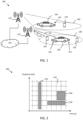
- FIG. 1 shows parts of a cellular access network 100 comprising radio base stations 110, 120 connected to a core network 130.
- the radio base stations 110, 120 as well as the different entities of the core network 130 will be referred to herein as network nodes.
- network node is to be construed broadly herein to encompass any form of radio access network infrastructure device, or software module executed on processing circuitry within the cellular access network 100.
- the radio base stations 110, 120 may also be realized as transmission points (TRP) in a wireless network, where the radio units are also at least in part realized as part of the core network 130.
- TRP transmission points
- the radio base stations 110, 120 provide cellular access 155 to a number of wireless devices 150 over respective coverage areas 140, 140'. As part of this cellular access, the radio base stations 110, 120 generate and transmit synchronization signals which are broadcasted over the coverage areas 140, 140', where they are used by the wireless devices 150 to synchronize both in time and in frequency with respect to the cellular access network 100. These synchronization signals are normally part of a global standard, meaning that they will have the same format regardless of where in the world they are transmitted.
- One or more vehicles 160 are also located within the coverage areas 140, 140' of the radio base stations 110, 120. These vehicles 160 comprise corresponding radar transceivers 161, 162 which may be controlled by one or more vehicle electronic control unit (ECU) in the vehicle 160.
- the radar transceivers 161, 162 are comprised in a corresponding radar system, such as a radar transceiver system 400 that will be discussed later with reference to Figure 4 .
- the present disclosure relates to a technique where the time-frequency resources used by a given radar transceiver are adapted according to need, and where the time-frequency resources of the vehicles within a given area are coordinated from a central entity, as discussed in EP 3 865 896 A1 .
- a radar transceiver only uses as much resources as it requires to fulfil the task at hand. For instance, if no targets are nearby, then perhaps the transmission repetition interval can be extended somewhat without jeopardizing vehicle safety, since it is highly unlikely that a nearby target will appear out of nowhere.
- a single radar transmission at high bandwidth may be sufficient for classifying the far away target or targets, and a reduced bandwidth radar transmission can be used in-between high bandwidth transmissions to keep track of, i.e., monitor, the far away object or objects to make sure they remain unthreatening to the ego-vehicle.
- Figure 2 illustrates a range 200 of time-frequency resources.
- Each block 210 amounts to a given time period of transmission in a certain frequency slot.
- the slots may, e.g., correspond to one or more resource blocks as discussed in 3GPP TS 36.400 V15.8.0.
- Some different transmission resource requests are exemplified in Figure 2 .
- a transmission grant indicates one or more time-frequency resources where transmission may take place, one transmission grant 220 extends over a wide frequency band and is therefore likely to result in radar operation at an increased spatial resolution.
- This type of transmission grant may be awarded to a radar system wishing to resolve two closely spaced targets, or which is in close proximity to some object.
- Another transmission grant 230 is on a smaller bandwidth, but over a longer time period. This transmission grant 230 is likely to result in a reduced spatial resolution radar operation, but the range of the radar transceiver 161, 162 will not be significantly affected due to the prolonged transmission duration.
- One transmission grant 240 may be intended for some other radar system or for some normal wireless device which does not perform any radar operation.
- the cellular access network 100 does not need to know which grant that is intended for radar operation and which grant that is intended for communications only. It is appreciated that the requested and/or granted transmission resources need not be contiguous in frequency nor in time.
- the situation can be improved if the request can be made sooner.
- the request is made before the need for additional radar transmission resources even arises. This becomes possible if the radar resource requirement is predicted by the vehicle. In other words, if the vehicle can predict what radar resources it will require in the future, then it can request those resources sooner, and have them available in good time before they are actually required. This in turn means that larger delays can be tolerated from transmission of the request to reception of the grant.
- One simple example is to just predict an increased radar resource assignment request in terms of bandwidth every time a new target is detected, since it is likely desired to be able to determine if the new target is a single target or in fact more than one target. After the high bandwidth transmission, the resource requirement is likely to reduce back to some nominal level.
- Another simple example is that, in case a target comes an goes at long distance, request a high energy radar resource assignment (either large bandwidth or long time duration) to illuminate target with more3 energy, and to maintain this resource request as long as the far away target remains on the detection list.
- More advanced radar resource prediction methods are of course also possible.
- a machine learning structure can be trained to generate predictions based on a video feed from the vehicle surroundings.
- the machine learning structure "sees” what happens around the vehicle, and learns to predict when more or less radar transmission resources in terms of time and or bandwidth will be required.
- the automotive radar systems discussed herein may also be implemented as cooperative systems, where the different radar systems work together and share experiences in order to collectively learn how to more accurately predict future radar resource requirements.
- FIG 4 illustrates an automotive radar transceiver system 400 arranged to predict a future radar resource requirement, based on environment perception and/or telematics.
- the automotive radar transceiver system 400 comprises a radar transceiver 450 arranged to transmit radar signals in time-frequency resources dynamically allocated 310, 330 by a remote scheduler function 320.
- the radar transceiver 450 can for example be one of the radar transceivers 161, 162 discussed above, and be mounted to a vehicle 160.
- the radar transceiver can, as mentioned above, be an ordinary FMCW radar transceiver.
- an access network such as the 3GPP 5G or 6G networks already have scheduling functions in place for dynamically scheduling radio resources between users. This infrastructure can be re-used with advantage also for scheduling automotive radar transceivers.
- the system 400 further comprises an environment perception system 430 arranged to obtain environment data indicative of a surrounding traffic environment of the radar transceiver 450.
- the environment perception system may only comprise the radar transceiver 450, but may optionally also comprise other sensors, such as vision-based sensors (cameras, IR sensors, and the like), and other radar sensors.
- Optional on-board sensors 410 are indicated in Figure 4 .
Landscapes
- Engineering & Computer Science (AREA)
- Radar, Positioning & Navigation (AREA)
- Remote Sensing (AREA)
- Physics & Mathematics (AREA)
- Computer Networks & Wireless Communication (AREA)
- General Physics & Mathematics (AREA)
- Electromagnetism (AREA)
- Radar Systems Or Details Thereof (AREA)
- Traffic Control Systems (AREA)
Claims (15)
- Automobilradartransceiversystem (400), umfassend einen Radartransceiver (450), der eingerichtet ist, um Radarsignale in Zeit-Frequenz-Ressourcen, die durch eine Funktion (320) eines entfernten Schedulers dynamisch zugewiesen werden (310, 330), zu übertragen, das System (400) ferner umfassendein Umgebungswahrnehmungssystem (430), das eingerichtet ist, um Umgebungsdaten zu erhalten, die eine umliegende Verkehrsumgebung des Radartransceivers (450) anzeigen, dadurch gekennzeichnet, dass das System (400) umfasstein Radarressourcenbedarfsvorhersagemodul (440), das konfiguriert ist, um einen zukünftigen Zeit-Frequenz-Ressourcenbedarf für einen Radarbetrieb basierend auf den Umgebungsdaten zu schätzen,wobei der Radartransceiver (450) eingerichtet ist, um Zeit-Frequenz-Ressourcen für den Radarbetrieb von der Funktion (320) des entfernten Schedulers basierend auf dem geschätzten zukünftigen Zeit-Frequenz-Ressourcenbedarf anzufordern.
- Automobilradartransceiversystem (400) nach Anspruch 1, wobei das Umgebungswahrnehmungssystem (430) den Radartransceiver (450) umfasst.
- Automobilradartransceiversystem (400) nach Anspruch 1 oder 2, wobei die Umgebungswahrnehmung (430) einen beliebigen von einem sichtbasierten Sensor, einem weiteren Radarsensor und/oder einem Lidar-Sensor umfasst.
- Automobilradartransceiversystem (400) nach einem der vorstehenden Ansprüche, wobei das Umgebungswahrnehmungssystem (430) ein Fahrzeugtelematiksystem (420) umfasst, das eingerichtet ist, um Informationen, die sich auf die Umgebung beziehen, die um den Radartransceiver (450) liegt, über eine drahtlose Verbindung von einer oder mehreren externen Einheiten zu erhalten.
- Automobilradartransceiversystem (400) nach Anspruch 4, wobei das Fahrzeugtelematiksystem (420) eingerichtet ist, um Informationen, die sich auf Zeit-Frequenz-Ressourcen beziehen, die durch Fahrzeuge in der Nähe des Radartransceivers (450) für den Radarbetrieb dynamisch zugewiesen werden, zu erhalten.
- Automobilradartransceiversystem (400) nach einem der vorstehenden Ansprüche, wobei das Radarressourcenbedarfsvorhersagemodul (440) konfiguriert ist, um den zukünftigen Zeit-Frequenz-Ressourcenbedarf als eine vorbestimmte Bandbreite zu schätzen, falls ein Objekt zum ersten Mal in der Umgebung erkannt wird.
- Automobilradartransceiversystem (400) nach einem der vorstehenden Ansprüche, wobei das Radarressourcenbedarfsvorhersagemodul (440) konfiguriert ist, um den zukünftigen Zeit-Frequenz-Ressourcenbedarf basierend auf einer vorbestimmten Zuordnung zwischen einem radialen Abstand zu einem Ziel und einer vorbestimmten Energie zu schätzen.
- Automobilradartransceiversystem (400) nach einem der vorstehenden Ansprüche, wobei das Radarressourcenbedarfsvorhersagemodul (440) eine Datenbank mit früheren Umgebungswahrnehmungsdaten und entsprechenden Radarressourcenanforderungen umfasst, wobei das Radarressourcenbedarfsvorhersagemodul (440) eingerichtet ist, um den zukünftigen Zeit-Frequenz-Ressourcenbedarf basierend auf der Datenbank und auf einer aktuellen Umgebungswahrnehmung zu schätzen.
- Automobilradartransceiversystem (400) nach einem der vorstehenden Ansprüche, wobei das Radarressourcenbedarfsvorhersagemodul (440) eine Maschinenlernstruktur umfasst, die mit einem Eingangsanschluss, der mit dem Umgebungswahrnehmungssystem (430) verbunden ist, und einem Ausgangsanschluss konfiguriert ist, der eingerichtet ist, um den geschätzten zukünftigen Zeit-Frequenz-Ressourcenbedarf zu erzeugen.
- Automobilradartransceiversystem (400) nach Anspruch 9, wobei die Maschinenlernstruktur eingerichtet ist, um basierend auf Umgebungswahrnehmungsdaten und entsprechenden Zeit-Frequenz-Ressourcenanforderungen für den Radarbetrieb an einem oder mehreren Fahrzeugen (160) trainiert zu werden.
- Automobilradartransceiversystem (400) nach Anspruch 9 oder 10, wobei das Fahrzeugtelematiksystem (420) eingerichtet ist, um eine mindestens teilweise trainierte Maschinenlernstruktur aufzunehmen, die zum Vorhersagen zukünftiger Radarressourcenbedarfe an einem gegebenen geografischen Standort und/oder zu einer gegebenen Tageszeit konfiguriert ist.
- Automobilradartransceiversystem (400) nach einem der vorstehenden Ansprüche, umfassend eine Zielverfolgungsfunktion (460), die eingerichtet ist, um eine Anforderung für eine Radarreichweite und/oder eine Radarreichweitenauflösung zu erzeugen, wobei das Radarressourcenbedarfsvorhersagemodul (440) eingerichtet ist, um eine zukünftige Anforderung durch die Zielverfolgungsfunktion (460) vorherzusagen.
- Automobilradartransceiversystem (400) nach einem der vorstehenden Ansprüche, wobei der Radartransceiver (450) eingerichtet ist, um eine Grundstufenanforderung für Radar-Zeit-Frequenz-Ressourcen aufrechtzuerhalten und um die Grundstufenanforderung basierend auf dem geschätzten zukünftigen Zeit-Frequenz-Ressourcenbedarf anzupassen.
- Fahrzeug (160), umfassend ein Automobilradartransceiversystem (400) nach einem der vorstehenden Ansprüche.
- Verfahren, das durch ein Automobilradartransceiversystem (400) durchgeführt wird, umfassend einen Radartransceiver (450), der eingerichtet ist, um Radarsignale in Zeit-Frequenz-Ressourcen, die durch eine Funktion (320) des entfernten Schedulers dynamisch zugewiesen werden (310, 330), zu übertragen, das Verfahren umfassendErhalten (S1) von Umgebungsdaten, die eine umliegende Verkehrsumgebung des Radartransceivers (450) anzeigen,
dadurch gekennzeichnet, dass das Verfahren ferner umfasstSchätzen (S2) eines zukünftigen Zeit-Frequenz-Ressourcenbedarfs für den Radarbetrieb basierend auf den Umgebungsdaten undAnfordern (S3) der Zeit-Frequenz-Ressourcen für den Radarbetrieb von der Funktion (320) des entfernten Schedulers basierend auf dem geschätzten zukünftigen Zeit-Frequenz-Ressourcenbedarf.
Priority Applications (4)
| Application Number | Priority Date | Filing Date | Title |
|---|---|---|---|
| EP21198804.3A EP4155755B1 (de) | 2021-09-24 | 2021-09-24 | Vorhersage des ressourcenbedarfs eines radars |
| PCT/EP2022/076357 WO2023046828A1 (en) | 2021-09-24 | 2022-09-22 | Radar resource requirement prediction |
| CN202280059118.4A CN117999493A (zh) | 2021-09-24 | 2022-09-22 | 雷达资源要求预测 |
| US18/694,661 US20240402286A1 (en) | 2021-09-24 | 2022-09-22 | Radar resource requirement prediction |
Applications Claiming Priority (1)
| Application Number | Priority Date | Filing Date | Title |
|---|---|---|---|
| EP21198804.3A EP4155755B1 (de) | 2021-09-24 | 2021-09-24 | Vorhersage des ressourcenbedarfs eines radars |
Publications (2)
| Publication Number | Publication Date |
|---|---|
| EP4155755A1 EP4155755A1 (de) | 2023-03-29 |
| EP4155755B1 true EP4155755B1 (de) | 2025-07-02 |
Family
ID=78086214
Family Applications (1)
| Application Number | Title | Priority Date | Filing Date |
|---|---|---|---|
| EP21198804.3A Active EP4155755B1 (de) | 2021-09-24 | 2021-09-24 | Vorhersage des ressourcenbedarfs eines radars |
Country Status (4)
| Country | Link |
|---|---|
| US (1) | US20240402286A1 (de) |
| EP (1) | EP4155755B1 (de) |
| CN (1) | CN117999493A (de) |
| WO (1) | WO2023046828A1 (de) |
Families Citing this family (2)
| Publication number | Priority date | Publication date | Assignee | Title |
|---|---|---|---|---|
| WO2024028409A1 (en) * | 2022-08-03 | 2024-02-08 | Continental Automotive Technologies GmbH | Method and apparatus for proactive mobile network-assisted incident management |
| CN121208807B (zh) * | 2025-11-26 | 2026-03-24 | 南京信息工程大学 | 基于深度学习的分布式雷达资源分配方法 |
Family Cites Families (9)
| Publication number | Priority date | Publication date | Assignee | Title |
|---|---|---|---|---|
| JPH08189965A (ja) * | 1995-01-09 | 1996-07-23 | Honda Motor Co Ltd | 車両用レーダ装置 |
| US9720072B2 (en) * | 2014-08-28 | 2017-08-01 | Waymo Llc | Methods and systems for vehicle radar coordination and interference reduction |
| US11079497B2 (en) * | 2017-09-25 | 2021-08-03 | Continental Automotive Systems, Inc. | Vehicle localization based on neural network |
| CN111491252B (zh) * | 2019-01-28 | 2021-11-02 | 电信科学技术研究院有限公司 | 一种汽车雷达接入资源分配方法及其装置 |
| US11714183B2 (en) * | 2019-09-03 | 2023-08-01 | Nxp B.V. | Impulse radar using variable pulse repetition frequency |
| EP4034912A4 (de) * | 2019-09-24 | 2023-06-07 | INTEL Corporation | Verfahren und vorrichtung zur verwaltung von kraftfahrzeugradarkoordination |
| EP3865896A1 (de) | 2020-02-11 | 2021-08-18 | Veoneer Sweden AB | Radar-sendeempfänger |
| US12164054B2 (en) * | 2020-11-09 | 2024-12-10 | Waymo Llc | Radar interference reduction techniques for autonomous vehicles |
| CN113194538B (zh) * | 2021-04-02 | 2022-04-29 | 深圳成谷科技有限公司 | 一种雷达信号时频资源分配方法、系统及设备 |
-
2021
- 2021-09-24 EP EP21198804.3A patent/EP4155755B1/de active Active
-
2022
- 2022-09-22 US US18/694,661 patent/US20240402286A1/en active Pending
- 2022-09-22 CN CN202280059118.4A patent/CN117999493A/zh active Pending
- 2022-09-22 WO PCT/EP2022/076357 patent/WO2023046828A1/en not_active Ceased
Also Published As
| Publication number | Publication date |
|---|---|
| WO2023046828A1 (en) | 2023-03-30 |
| US20240402286A1 (en) | 2024-12-05 |
| EP4155755A1 (de) | 2023-03-29 |
| CN117999493A (zh) | 2024-05-07 |
Similar Documents
| Publication | Publication Date | Title |
|---|---|---|
| CN109878516B (zh) | 车辆之间的间隙的监测和调整 | |
| KR102353558B1 (ko) | 통신 파트너 국, 이동국 및 차량에 대한 계획된 분산 무선 통신의 채널 품질을 예측하도록 제1 이동국을 지원하는 방법 | |
| EP4156729B1 (de) | Belegungsrasterkartenberechnung, komplementäre v2x-erfassung und koordination von kooperativer wahrnehmungsdatenübertragung in drahtlosen netzwerken | |
| TWI751974B (zh) | 專用短程通訊(dsrc)中的安全事件訊息傳輸定時 | |
| US12461232B2 (en) | Radar transceiver | |
| US20240402286A1 (en) | Radar resource requirement prediction | |
| US20190130754A1 (en) | Sensor data sharing management | |
| CN111200842B (zh) | 数据通信的方法、控制单元和车辆以及计算机程序 | |
| CN115015851A (zh) | 用于避免在汽车的雷达传感器之间的干涉的方法、雷达系统和软件产品 | |
| CN111491252B (zh) | 一种汽车雷达接入资源分配方法及其装置 | |
| JP7310126B2 (ja) | 情報解析装置、情報解析方法、情報解析システム、及びコンピュータプログラム | |
| CN111988164A (zh) | 用于预测至少两个通信伙伴之间的通信的服务质量的方法和用于执行该方法的步骤的装置 | |
| CN108934000B (zh) | 无线车内通信以及车辆的信息提供 | |
| CN115244418A (zh) | 用于运行雷达系统的方法 | |
| US20220236368A1 (en) | Transmission Control Method and Related Device | |
| JP2020184194A (ja) | 情報転送装置、車載装置、システム、情報転送方法及びコンピュータプログラム | |
| CN112640503B (zh) | 用于预测地估计两个通信伙伴之间的通信的传输条件的方法、用于执行该方法的方法步骤的设备、车辆以及计算机程序 | |
| US20250164606A1 (en) | High-resolution radar target signature smearing correction | |
| US10448344B2 (en) | Communication apparatus and communication system | |
| EP4002894B1 (de) | Verfahren, computerprogramm und vorrichtung zum aufrufen einer ferngesteuerten fahrsitzung | |
| CN117376867B (zh) | 一种通信感知一体化车联网通信建立方法及系统 | |
| US12580595B2 (en) | Communication control apparatus and communication control method | |
| EP4428564A1 (de) | Verbessertes radarsystem | |
| EP4040254A1 (de) | Fahrzeug, infrastrukturkomponente, vorrichtung, computerprogramm und verfahren für ein fahrzeug | |
| CN119183085A (zh) | 一种通信感知方法、装置和车辆 |
Legal Events
| Date | Code | Title | Description |
|---|---|---|---|
| PUAI | Public reference made under article 153(3) epc to a published international application that has entered the european phase |
Free format text: ORIGINAL CODE: 0009012 |
|
| STAA | Information on the status of an ep patent application or granted ep patent |
Free format text: STATUS: THE APPLICATION HAS BEEN PUBLISHED |
|
| AK | Designated contracting states |
Kind code of ref document: A1 Designated state(s): AL AT BE BG CH CY CZ DE DK EE ES FI FR GB GR HR HU IE IS IT LI LT LU LV MC MK MT NL NO PL PT RO RS SE SI SK SM TR |
|
| STAA | Information on the status of an ep patent application or granted ep patent |
Free format text: STATUS: REQUEST FOR EXAMINATION WAS MADE |
|
| 17P | Request for examination filed |
Effective date: 20230926 |
|
| RBV | Designated contracting states (corrected) |
Designated state(s): AL AT BE BG CH CY CZ DE DK EE ES FI FR GB GR HR HU IE IS IT LI LT LU LV MC MK MT NL NO PL PT RO RS SE SI SK SM TR |
|
| RAP3 | Party data changed (applicant data changed or rights of an application transferred) |
Owner name: MAGNA ELECTRONICS SWEDEN AB |
|
| RAP3 | Party data changed (applicant data changed or rights of an application transferred) |
Owner name: MAGNA ELECTRONICS SWEDEN AB |
|
| GRAP | Despatch of communication of intention to grant a patent |
Free format text: ORIGINAL CODE: EPIDOSNIGR1 |
|
| STAA | Information on the status of an ep patent application or granted ep patent |
Free format text: STATUS: GRANT OF PATENT IS INTENDED |
|
| INTG | Intention to grant announced |
Effective date: 20250128 |
|
| GRAS | Grant fee paid |
Free format text: ORIGINAL CODE: EPIDOSNIGR3 |
|
| GRAA | (expected) grant |
Free format text: ORIGINAL CODE: 0009210 |
|
| STAA | Information on the status of an ep patent application or granted ep patent |
Free format text: STATUS: THE PATENT HAS BEEN GRANTED |
|
| AK | Designated contracting states |
Kind code of ref document: B1 Designated state(s): AL AT BE BG CH CY CZ DE DK EE ES FI FR GB GR HR HU IE IS IT LI LT LU LV MC MK MT NL NO PL PT RO RS SE SI SK SM TR |
|
| REG | Reference to a national code |
Ref country code: GB Ref legal event code: FG4D |
|
| REG | Reference to a national code |
Ref country code: CH Ref legal event code: EP |
|
| REG | Reference to a national code |
Ref country code: DE Ref legal event code: R096 Ref document number: 602021033235 Country of ref document: DE |
|
| REG | Reference to a national code |
Ref country code: IE Ref legal event code: FG4D |
|
| PGFP | Annual fee paid to national office [announced via postgrant information from national office to epo] |
Ref country code: DE Payment date: 20250919 Year of fee payment: 5 |
|
| REG | Reference to a national code |
Ref country code: SE Ref legal event code: TRGR |
|
| PGFP | Annual fee paid to national office [announced via postgrant information from national office to epo] |
Ref country code: FR Payment date: 20250923 Year of fee payment: 5 Ref country code: AT Payment date: 20251020 Year of fee payment: 5 |
|
| PGFP | Annual fee paid to national office [announced via postgrant information from national office to epo] |
Ref country code: SE Payment date: 20250922 Year of fee payment: 5 |
|
| REG | Reference to a national code |
Ref country code: NL Ref legal event code: MP Effective date: 20250702 |
|
| PG25 | Lapsed in a contracting state [announced via postgrant information from national office to epo] |
Ref country code: PT Free format text: LAPSE BECAUSE OF FAILURE TO SUBMIT A TRANSLATION OF THE DESCRIPTION OR TO PAY THE FEE WITHIN THE PRESCRIBED TIME-LIMIT Effective date: 20251103 |
|
| PG25 | Lapsed in a contracting state [announced via postgrant information from national office to epo] |
Ref country code: NL Free format text: LAPSE BECAUSE OF FAILURE TO SUBMIT A TRANSLATION OF THE DESCRIPTION OR TO PAY THE FEE WITHIN THE PRESCRIBED TIME-LIMIT Effective date: 20250702 |
|
| REG | Reference to a national code |
Ref country code: AT Ref legal event code: MK05 Ref document number: 1809819 Country of ref document: AT Kind code of ref document: T Effective date: 20250702 |
|
| PG25 | Lapsed in a contracting state [announced via postgrant information from national office to epo] |
Ref country code: IS Free format text: LAPSE BECAUSE OF FAILURE TO SUBMIT A TRANSLATION OF THE DESCRIPTION OR TO PAY THE FEE WITHIN THE PRESCRIBED TIME-LIMIT Effective date: 20251102 |
|
| PG25 | Lapsed in a contracting state [announced via postgrant information from national office to epo] |
Ref country code: NO Free format text: LAPSE BECAUSE OF FAILURE TO SUBMIT A TRANSLATION OF THE DESCRIPTION OR TO PAY THE FEE WITHIN THE PRESCRIBED TIME-LIMIT Effective date: 20251002 |
|
| REG | Reference to a national code |
Ref country code: LT Ref legal event code: MG9D |
|
| PG25 | Lapsed in a contracting state [announced via postgrant information from national office to epo] |
Ref country code: AT Free format text: LAPSE BECAUSE OF FAILURE TO SUBMIT A TRANSLATION OF THE DESCRIPTION OR TO PAY THE FEE WITHIN THE PRESCRIBED TIME-LIMIT Effective date: 20250702 |
|
| PG25 | Lapsed in a contracting state [announced via postgrant information from national office to epo] |
Ref country code: FI Free format text: LAPSE BECAUSE OF FAILURE TO SUBMIT A TRANSLATION OF THE DESCRIPTION OR TO PAY THE FEE WITHIN THE PRESCRIBED TIME-LIMIT Effective date: 20250702 |
|
| PG25 | Lapsed in a contracting state [announced via postgrant information from national office to epo] |
Ref country code: HR Free format text: LAPSE BECAUSE OF FAILURE TO SUBMIT A TRANSLATION OF THE DESCRIPTION OR TO PAY THE FEE WITHIN THE PRESCRIBED TIME-LIMIT Effective date: 20250702 |
|
| PG25 | Lapsed in a contracting state [announced via postgrant information from national office to epo] |
Ref country code: GR Free format text: LAPSE BECAUSE OF FAILURE TO SUBMIT A TRANSLATION OF THE DESCRIPTION OR TO PAY THE FEE WITHIN THE PRESCRIBED TIME-LIMIT Effective date: 20251003 |
|
| PG25 | Lapsed in a contracting state [announced via postgrant information from national office to epo] |
Ref country code: CZ Free format text: LAPSE BECAUSE OF FAILURE TO SUBMIT A TRANSLATION OF THE DESCRIPTION OR TO PAY THE FEE WITHIN THE PRESCRIBED TIME-LIMIT Effective date: 20250702 |
|
| PG25 | Lapsed in a contracting state [announced via postgrant information from national office to epo] |
Ref country code: LV Free format text: LAPSE BECAUSE OF FAILURE TO SUBMIT A TRANSLATION OF THE DESCRIPTION OR TO PAY THE FEE WITHIN THE PRESCRIBED TIME-LIMIT Effective date: 20250702 |
|
| PG25 | Lapsed in a contracting state [announced via postgrant information from national office to epo] |
Ref country code: BG Free format text: LAPSE BECAUSE OF FAILURE TO SUBMIT A TRANSLATION OF THE DESCRIPTION OR TO PAY THE FEE WITHIN THE PRESCRIBED TIME-LIMIT Effective date: 20250702 Ref country code: PL Free format text: LAPSE BECAUSE OF FAILURE TO SUBMIT A TRANSLATION OF THE DESCRIPTION OR TO PAY THE FEE WITHIN THE PRESCRIBED TIME-LIMIT Effective date: 20250702 |
|
| PG25 | Lapsed in a contracting state [announced via postgrant information from national office to epo] |
Ref country code: RS Free format text: LAPSE BECAUSE OF FAILURE TO SUBMIT A TRANSLATION OF THE DESCRIPTION OR TO PAY THE FEE WITHIN THE PRESCRIBED TIME-LIMIT Effective date: 20251002 |
|
| PG25 | Lapsed in a contracting state [announced via postgrant information from national office to epo] |
Ref country code: ES Free format text: LAPSE BECAUSE OF FAILURE TO SUBMIT A TRANSLATION OF THE DESCRIPTION OR TO PAY THE FEE WITHIN THE PRESCRIBED TIME-LIMIT Effective date: 20250702 |
|
| PG25 | Lapsed in a contracting state [announced via postgrant information from national office to epo] |
Ref country code: RO Free format text: LAPSE BECAUSE OF FAILURE TO SUBMIT A TRANSLATION OF THE DESCRIPTION OR TO PAY THE FEE WITHIN THE PRESCRIBED TIME-LIMIT Effective date: 20250702 |
|
| PG25 | Lapsed in a contracting state [announced via postgrant information from national office to epo] |
Ref country code: SM Free format text: LAPSE BECAUSE OF FAILURE TO SUBMIT A TRANSLATION OF THE DESCRIPTION OR TO PAY THE FEE WITHIN THE PRESCRIBED TIME-LIMIT Effective date: 20250702 |
|
| PG25 | Lapsed in a contracting state [announced via postgrant information from national office to epo] |
Ref country code: DK Free format text: LAPSE BECAUSE OF FAILURE TO SUBMIT A TRANSLATION OF THE DESCRIPTION OR TO PAY THE FEE WITHIN THE PRESCRIBED TIME-LIMIT Effective date: 20250702 |
|
| PG25 | Lapsed in a contracting state [announced via postgrant information from national office to epo] |
Ref country code: IT Free format text: LAPSE BECAUSE OF FAILURE TO SUBMIT A TRANSLATION OF THE DESCRIPTION OR TO PAY THE FEE WITHIN THE PRESCRIBED TIME-LIMIT Effective date: 20250702 |