EP4156363A1 - Batterie au lithium-ion sûre et son procédé de fabrication - Google Patents
Batterie au lithium-ion sûre et son procédé de fabrication Download PDFInfo
- Publication number
- EP4156363A1 EP4156363A1 EP21922659.4A EP21922659A EP4156363A1 EP 4156363 A1 EP4156363 A1 EP 4156363A1 EP 21922659 A EP21922659 A EP 21922659A EP 4156363 A1 EP4156363 A1 EP 4156363A1
- Authority
- EP
- European Patent Office
- Prior art keywords
- lithium
- ion battery
- positive electrode
- iron phosphate
- plate
- Prior art date
- Legal status (The legal status is an assumption and is not a legal conclusion. Google has not performed a legal analysis and makes no representation as to the accuracy of the status listed.)
- Pending
Links
Images




Classifications
-
- H—ELECTRICITY
- H01—ELECTRIC ELEMENTS
- H01M—PROCESSES OR MEANS, e.g. BATTERIES, FOR THE DIRECT CONVERSION OF CHEMICAL ENERGY INTO ELECTRICAL ENERGY
- H01M10/00—Secondary cells; Manufacture thereof
- H01M10/42—Methods or arrangements for servicing or maintenance of secondary cells or secondary half-cells
- H01M10/4235—Safety or regulating additives or arrangements in electrodes, separators or electrolyte
-
- H—ELECTRICITY
- H01—ELECTRIC ELEMENTS
- H01M—PROCESSES OR MEANS, e.g. BATTERIES, FOR THE DIRECT CONVERSION OF CHEMICAL ENERGY INTO ELECTRICAL ENERGY
- H01M10/00—Secondary cells; Manufacture thereof
- H01M10/05—Accumulators with non-aqueous electrolyte
- H01M10/052—Li-accumulators
- H01M10/0525—Rocking-chair batteries, i.e. batteries with lithium insertion or intercalation in both electrodes; Lithium-ion batteries
-
- H—ELECTRICITY
- H01—ELECTRIC ELEMENTS
- H01M—PROCESSES OR MEANS, e.g. BATTERIES, FOR THE DIRECT CONVERSION OF CHEMICAL ENERGY INTO ELECTRICAL ENERGY
- H01M10/00—Secondary cells; Manufacture thereof
- H01M10/05—Accumulators with non-aqueous electrolyte
- H01M10/056—Accumulators with non-aqueous electrolyte characterised by the materials used as electrolytes, e.g. mixed inorganic/organic electrolytes
- H01M10/0564—Accumulators with non-aqueous electrolyte characterised by the materials used as electrolytes, e.g. mixed inorganic/organic electrolytes the electrolyte being constituted of organic materials only
- H01M10/0566—Liquid materials
- H01M10/0567—Liquid materials characterised by the additives
-
- H—ELECTRICITY
- H01—ELECTRIC ELEMENTS
- H01M—PROCESSES OR MEANS, e.g. BATTERIES, FOR THE DIRECT CONVERSION OF CHEMICAL ENERGY INTO ELECTRICAL ENERGY
- H01M10/00—Secondary cells; Manufacture thereof
- H01M10/05—Accumulators with non-aqueous electrolyte
- H01M10/058—Construction or manufacture
-
- H—ELECTRICITY
- H01—ELECTRIC ELEMENTS
- H01M—PROCESSES OR MEANS, e.g. BATTERIES, FOR THE DIRECT CONVERSION OF CHEMICAL ENERGY INTO ELECTRICAL ENERGY
- H01M4/00—Electrodes
- H01M4/02—Electrodes composed of, or comprising, active material
- H01M4/04—Processes of manufacture in general
- H01M4/0402—Methods of deposition of the material
- H01M4/0404—Methods of deposition of the material by coating on electrode collectors
-
- H—ELECTRICITY
- H01—ELECTRIC ELEMENTS
- H01M—PROCESSES OR MEANS, e.g. BATTERIES, FOR THE DIRECT CONVERSION OF CHEMICAL ENERGY INTO ELECTRICAL ENERGY
- H01M4/00—Electrodes
- H01M4/02—Electrodes composed of, or comprising, active material
- H01M4/13—Electrodes for accumulators with non-aqueous electrolyte, e.g. for lithium-accumulators; Processes of manufacture thereof
-
- H—ELECTRICITY
- H01—ELECTRIC ELEMENTS
- H01M—PROCESSES OR MEANS, e.g. BATTERIES, FOR THE DIRECT CONVERSION OF CHEMICAL ENERGY INTO ELECTRICAL ENERGY
- H01M4/00—Electrodes
- H01M4/02—Electrodes composed of, or comprising, active material
- H01M4/13—Electrodes for accumulators with non-aqueous electrolyte, e.g. for lithium-accumulators; Processes of manufacture thereof
- H01M4/131—Electrodes based on mixed oxides or hydroxides, or on mixtures of oxides or hydroxides, e.g. LiCoOx
-
- H—ELECTRICITY
- H01—ELECTRIC ELEMENTS
- H01M—PROCESSES OR MEANS, e.g. BATTERIES, FOR THE DIRECT CONVERSION OF CHEMICAL ENERGY INTO ELECTRICAL ENERGY
- H01M4/00—Electrodes
- H01M4/02—Electrodes composed of, or comprising, active material
- H01M4/13—Electrodes for accumulators with non-aqueous electrolyte, e.g. for lithium-accumulators; Processes of manufacture thereof
- H01M4/136—Electrodes based on inorganic compounds other than oxides or hydroxides, e.g. sulfides, selenides, tellurides, halogenides or LiCoFy
-
- H—ELECTRICITY
- H01—ELECTRIC ELEMENTS
- H01M—PROCESSES OR MEANS, e.g. BATTERIES, FOR THE DIRECT CONVERSION OF CHEMICAL ENERGY INTO ELECTRICAL ENERGY
- H01M4/00—Electrodes
- H01M4/02—Electrodes composed of, or comprising, active material
- H01M4/13—Electrodes for accumulators with non-aqueous electrolyte, e.g. for lithium-accumulators; Processes of manufacture thereof
- H01M4/139—Processes of manufacture
-
- H—ELECTRICITY
- H01—ELECTRIC ELEMENTS
- H01M—PROCESSES OR MEANS, e.g. BATTERIES, FOR THE DIRECT CONVERSION OF CHEMICAL ENERGY INTO ELECTRICAL ENERGY
- H01M4/00—Electrodes
- H01M4/02—Electrodes composed of, or comprising, active material
- H01M4/13—Electrodes for accumulators with non-aqueous electrolyte, e.g. for lithium-accumulators; Processes of manufacture thereof
- H01M4/139—Processes of manufacture
- H01M4/1391—Processes of manufacture of electrodes based on mixed oxides or hydroxides, or on mixtures of oxides or hydroxides, e.g. LiCoOx
-
- H—ELECTRICITY
- H01—ELECTRIC ELEMENTS
- H01M—PROCESSES OR MEANS, e.g. BATTERIES, FOR THE DIRECT CONVERSION OF CHEMICAL ENERGY INTO ELECTRICAL ENERGY
- H01M4/00—Electrodes
- H01M4/02—Electrodes composed of, or comprising, active material
- H01M4/13—Electrodes for accumulators with non-aqueous electrolyte, e.g. for lithium-accumulators; Processes of manufacture thereof
- H01M4/139—Processes of manufacture
- H01M4/1397—Processes of manufacture of electrodes based on inorganic compounds other than oxides or hydroxides, e.g. sulfides, selenides, tellurides, halogenides or LiCoFy
-
- H—ELECTRICITY
- H01—ELECTRIC ELEMENTS
- H01M—PROCESSES OR MEANS, e.g. BATTERIES, FOR THE DIRECT CONVERSION OF CHEMICAL ENERGY INTO ELECTRICAL ENERGY
- H01M4/00—Electrodes
- H01M4/02—Electrodes composed of, or comprising, active material
- H01M4/36—Selection of substances as active materials, active masses, active liquids
-
- H—ELECTRICITY
- H01—ELECTRIC ELEMENTS
- H01M—PROCESSES OR MEANS, e.g. BATTERIES, FOR THE DIRECT CONVERSION OF CHEMICAL ENERGY INTO ELECTRICAL ENERGY
- H01M4/00—Electrodes
- H01M4/02—Electrodes composed of, or comprising, active material
- H01M4/36—Selection of substances as active materials, active masses, active liquids
- H01M4/362—Composites
- H01M4/364—Composites as mixtures
-
- H—ELECTRICITY
- H01—ELECTRIC ELEMENTS
- H01M—PROCESSES OR MEANS, e.g. BATTERIES, FOR THE DIRECT CONVERSION OF CHEMICAL ENERGY INTO ELECTRICAL ENERGY
- H01M4/00—Electrodes
- H01M4/02—Electrodes composed of, or comprising, active material
- H01M4/36—Selection of substances as active materials, active masses, active liquids
- H01M4/48—Selection of substances as active materials, active masses, active liquids of inorganic oxides or hydroxides
- H01M4/50—Selection of substances as active materials, active masses, active liquids of inorganic oxides or hydroxides of manganese
- H01M4/505—Selection of substances as active materials, active masses, active liquids of inorganic oxides or hydroxides of manganese of mixed oxides or hydroxides containing manganese for inserting or intercalating light metals, e.g. LiMn2O4 or LiMn2OxFy
-
- H—ELECTRICITY
- H01—ELECTRIC ELEMENTS
- H01M—PROCESSES OR MEANS, e.g. BATTERIES, FOR THE DIRECT CONVERSION OF CHEMICAL ENERGY INTO ELECTRICAL ENERGY
- H01M4/00—Electrodes
- H01M4/02—Electrodes composed of, or comprising, active material
- H01M4/36—Selection of substances as active materials, active masses, active liquids
- H01M4/48—Selection of substances as active materials, active masses, active liquids of inorganic oxides or hydroxides
- H01M4/52—Selection of substances as active materials, active masses, active liquids of inorganic oxides or hydroxides of nickel, cobalt or iron
- H01M4/525—Selection of substances as active materials, active masses, active liquids of inorganic oxides or hydroxides of nickel, cobalt or iron of mixed oxides or hydroxides containing iron, cobalt or nickel for inserting or intercalating light metals, e.g. LiNiO2, LiCoO2 or LiCoOxFy
-
- H—ELECTRICITY
- H01—ELECTRIC ELEMENTS
- H01M—PROCESSES OR MEANS, e.g. BATTERIES, FOR THE DIRECT CONVERSION OF CHEMICAL ENERGY INTO ELECTRICAL ENERGY
- H01M4/00—Electrodes
- H01M4/02—Electrodes composed of, or comprising, active material
- H01M4/36—Selection of substances as active materials, active masses, active liquids
- H01M4/58—Selection of substances as active materials, active masses, active liquids of inorganic compounds other than oxides or hydroxides, e.g. sulfides, selenides, tellurides, halogenides or LiCoFy; of polyanionic structures, e.g. phosphates, silicates or borates
- H01M4/5825—Oxygenated metallic salts or polyanionic structures, e.g. borates, phosphates, silicates, olivines
-
- H—ELECTRICITY
- H01—ELECTRIC ELEMENTS
- H01M—PROCESSES OR MEANS, e.g. BATTERIES, FOR THE DIRECT CONVERSION OF CHEMICAL ENERGY INTO ELECTRICAL ENERGY
- H01M4/00—Electrodes
- H01M4/02—Electrodes composed of, or comprising, active material
- H01M4/36—Selection of substances as active materials, active masses, active liquids
- H01M4/58—Selection of substances as active materials, active masses, active liquids of inorganic compounds other than oxides or hydroxides, e.g. sulfides, selenides, tellurides, halogenides or LiCoFy; of polyanionic structures, e.g. phosphates, silicates or borates
- H01M4/583—Carbonaceous material, e.g. graphite-intercalation compounds or CFx
- H01M4/587—Carbonaceous material, e.g. graphite-intercalation compounds or CFx for inserting or intercalating light metals
-
- H—ELECTRICITY
- H01—ELECTRIC ELEMENTS
- H01M—PROCESSES OR MEANS, e.g. BATTERIES, FOR THE DIRECT CONVERSION OF CHEMICAL ENERGY INTO ELECTRICAL ENERGY
- H01M4/00—Electrodes
- H01M4/02—Electrodes composed of, or comprising, active material
- H01M4/62—Selection of inactive substances as ingredients for active masses, e.g. binders, fillers
-
- H—ELECTRICITY
- H01—ELECTRIC ELEMENTS
- H01M—PROCESSES OR MEANS, e.g. BATTERIES, FOR THE DIRECT CONVERSION OF CHEMICAL ENERGY INTO ELECTRICAL ENERGY
- H01M4/00—Electrodes
- H01M4/02—Electrodes composed of, or comprising, active material
- H01M4/62—Selection of inactive substances as ingredients for active masses, e.g. binders, fillers
- H01M4/621—Binders
- H01M4/622—Binders being polymers
-
- H—ELECTRICITY
- H01—ELECTRIC ELEMENTS
- H01M—PROCESSES OR MEANS, e.g. BATTERIES, FOR THE DIRECT CONVERSION OF CHEMICAL ENERGY INTO ELECTRICAL ENERGY
- H01M4/00—Electrodes
- H01M4/02—Electrodes composed of, or comprising, active material
- H01M4/62—Selection of inactive substances as ingredients for active masses, e.g. binders, fillers
- H01M4/624—Electric conductive fillers
- H01M4/625—Carbon or graphite
-
- H—ELECTRICITY
- H01—ELECTRIC ELEMENTS
- H01M—PROCESSES OR MEANS, e.g. BATTERIES, FOR THE DIRECT CONVERSION OF CHEMICAL ENERGY INTO ELECTRICAL ENERGY
- H01M4/00—Electrodes
- H01M4/02—Electrodes composed of, or comprising, active material
- H01M2004/026—Electrodes composed of, or comprising, active material characterised by the polarity
- H01M2004/027—Negative electrodes
-
- H—ELECTRICITY
- H01—ELECTRIC ELEMENTS
- H01M—PROCESSES OR MEANS, e.g. BATTERIES, FOR THE DIRECT CONVERSION OF CHEMICAL ENERGY INTO ELECTRICAL ENERGY
- H01M4/00—Electrodes
- H01M4/02—Electrodes composed of, or comprising, active material
- H01M2004/026—Electrodes composed of, or comprising, active material characterised by the polarity
- H01M2004/028—Positive electrodes
-
- Y—GENERAL TAGGING OF NEW TECHNOLOGICAL DEVELOPMENTS; GENERAL TAGGING OF CROSS-SECTIONAL TECHNOLOGIES SPANNING OVER SEVERAL SECTIONS OF THE IPC; TECHNICAL SUBJECTS COVERED BY FORMER USPC CROSS-REFERENCE ART COLLECTIONS [XRACs] AND DIGESTS
- Y02—TECHNOLOGIES OR APPLICATIONS FOR MITIGATION OR ADAPTATION AGAINST CLIMATE CHANGE
- Y02E—REDUCTION OF GREENHOUSE GAS [GHG] EMISSIONS, RELATED TO ENERGY GENERATION, TRANSMISSION OR DISTRIBUTION
- Y02E60/00—Enabling technologies; Technologies with a potential or indirect contribution to GHG emissions mitigation
- Y02E60/10—Energy storage using batteries
-
- Y—GENERAL TAGGING OF NEW TECHNOLOGICAL DEVELOPMENTS; GENERAL TAGGING OF CROSS-SECTIONAL TECHNOLOGIES SPANNING OVER SEVERAL SECTIONS OF THE IPC; TECHNICAL SUBJECTS COVERED BY FORMER USPC CROSS-REFERENCE ART COLLECTIONS [XRACs] AND DIGESTS
- Y02—TECHNOLOGIES OR APPLICATIONS FOR MITIGATION OR ADAPTATION AGAINST CLIMATE CHANGE
- Y02P—CLIMATE CHANGE MITIGATION TECHNOLOGIES IN THE PRODUCTION OR PROCESSING OF GOODS
- Y02P70/00—Climate change mitigation technologies in the production process for final industrial or consumer products
- Y02P70/50—Manufacturing or production processes characterised by the final manufactured product
Definitions
- the present invention relates to the field of lithium-ion batteries, and relates to a safe lithium-ion battery and manufacturing method therefor, specifically relates to a safe lithium-ion battery and its manufacturing method that adds a redox shuttle agent during the production process of an electrode plate (positive plate or negative plate).
- the protection board and the 100mA-level equalizing current provided by the electronic control device alone can barely meet the needs of practical applications. It is imminent to develop a lithium-ion battery with a large current balancing capability of 1 ampere to 10 amperes.
- the Chinese invention patent with application number 201310594341.1 discloses a float charge tolerant lithium-ion battery module and its float charge method. It can meet the application requirements of energy storage and other fields in terms of electrical performance and safety performance. However, it is also by means of adding redox shuttle additives in the electrolyte.
- the redox shuttle agent will be continuously consumed during the self-balancing process of the lithium-ion battery, its self-balancing capability (definition: self-balancing capability refers to the electric capacity consumed by the battery when it continues to carry out redox shuttle reactions at a certain self-balancing voltage, the unit is Ah, which reflects the strength of the battery's self-balancing ability) is basically proportional to the amount added.
- redox shuttle additives to the electrolyte is affected by the low solubility of the redox shuttle agent in the electrolyte solvent and the limited amount of electrolyte injected into the battery.
- the total addition amount of the redox shuttle agent is limited, which ultimately affects the self-balancing capability of the battery.
- the method to add more redox shuttle agents into the battery system to improve the self-balancing capability of the battery is the key to its large-scale application.
- the ways to increase the self-balancing capability of the battery and at the same time make it have high rate characteristics, low temperature performance, and safety performance is also a technical problem to be solved urgently in this field.
- the aim of the present invention is to provide a safe lithium-ion battery and a manufacturing method therefor.
- the invention relates to a safe lithium-ion battery, wherein the positive plate and/or the negative plate of the lithium-ion battery contain redox shuttle agent.
- the redox shuttle agent is selected one or more from 2,5-di-tert-butyl-1,4 dimethoxybenzene, 3,5-di-tert-butyl-1,2-dimethoxybenzene, 4-tert-butyl-1,2-dimethoxybenzene, naphthalene, anthracene, thianthrene, and anisole.
- a positive electrode active material of the lithium-ion battery is lithium iron phosphate, or a mixture of one or more of lithium iron phosphate and lithium nickel cobalt manganese oxide, lithium manganate, and lithium cobalt oxide.
- the positive electrode active material of the lithium-ion battery is the mixture of one or more of lithium iron phosphate and lithium nickel cobalt manganese oxide, lithium manganate, and lithium cobalt oxide
- the mass ratio of the lithium iron phosphate is greater than 60%.
- a positive electrode active material of the lithium-ion battery is a mixture of one or more of lithium iron phosphate, lithium manganese iron phosphate and lithium-rich lithium iron oxide.
- the positive electrode active material of the lithium-ion battery is a mixture of one or more of lithium iron phosphate, lithium manganese iron phosphate and lithium-rich lithium iron oxide, the mass ratio of the lithium iron phosphate is greater than 60%.
- the redox shuttle agent is added during a slurry-making process of the positive plate or the negative plate, and the addition amount of the redox shuttle agent is 0.1-10% of a total solid mass of the positive electrode or the negative electrode.
- the working temperature range of the lithium-ion battery is -40°C to 70°C.
- the invention also relates to a manufacturing method of a safe lithium-ion battery that mentioned before, the method including the following steps:
- a mass ratio of the positive electrode active material, the binder, the conductive agent and the redox shuttle agent is 83-97 : 1 ⁇ 3 : 1.9 ⁇ 4 : 0.1 ⁇ 10.
- a mass ratio of the graphite, the binder, the conductive agent and the redox shuttle agent is 85 ⁇ 97 : 2 ⁇ 3 : 0 ⁇ 2 : 0.1 ⁇ 10.
- a mass ratio of the positive electrode active material, the binder and the conductive agent is 93-97 : 1 ⁇ 3 : 1.9 ⁇ 4.
- a mass ratio of the graphite, the binder and the conductive agent is 95 ⁇ 98 : 2 ⁇ 3 : 0 ⁇ 2.
- the present invention has the following beneficial effects:
- Positive plate preparation first, dissolve the binder PVDF and the shuttle agent 1 in the solvent NMP, and keep stirring to dissolve them fully until the solution is clear. Add the lithium iron phosphate active material LiFePO 4 and the conductive agent SP (super P) to the above solution, and mix them to form a slurry. Among them, the solid mass ratio of LiFePO 4 , SP, PVDF and shuttle agent 1 is 94:2:2:2, and the solid content of the slurry solution is 50%. The slurry is coated on a 13 ⁇ m-thickness blank aluminum foil current collector (positive electrode current collector). The solvent is completely volatilized after being dried in an oven. The surface density of the coating is 340g/m 2 (double-sided), and then rolled by an electrode plate. The compaction density is 2.4g/cm 3 , and the positive plate is made.
- Negative plate preparation stir and disperse graphite, conductive agent SP, binder PVDF and NMP evenly into a slurry (the mass ratio of graphite, SP and binder is 96: 1:3).
- the solid content of the slurry is 50%.
- the slurry is coated on a 6 ⁇ m-thickness blank copper foil.
- the solvent is completely volatilized after drying in an oven.
- the surface density of the coating is 150g/m 2 (double-sided), and then rolled by an electrode plate.
- the compaction density is 1.65g/cm 3 , and the negative plate is made.
- Lithium-ion secondary battery preparation the positive and negative plate and isolating film (PP single-layer isolating film) are wound into an electrical cell. Then the electrical cell is put into a battery case, and the moisture is removed by drying. Then inject electrolyte (EC (ethylene carbonate)/EMC (ethyl methyl carbonate)/DMC (dimethyl carbonate) electrolyte of 1.1mol/L LiPF 6 , wherein the mass ratio of EC: EMC: DMC is 3:4:3), and 2wt.% VC (vinylene carbonate). Welding and sealing, and then through chemical formation and aging processes to produce a lithium-ion secondary battery 71173200-280Ah; as shown in FIG 1 . Test process: the test environment temperature is controlled at 25 ⁇ 2°C;
- Positive plate preparation first, dissolve the binder PVDF in the solvent NMP, and stir it until the solution is clear. Add the lithium iron phosphate active material LiFePO 4 and the conductive agent SP to the above solution, and mix them to form a slurry. Among them, the solid mass ratio of LiFePO 4 , SP and PVDF is 96:2:2, and the solid content of the slurry solution is 50%.
- the slurry is coated on a 13 ⁇ m-thickness blank aluminum foil current collector (positive electrode current collector). The solvent is completely volatilized after being dried in an oven. The surface density of the coating is 340g/m 2 (double-sided), and then rolled by an electrode plate, the compaction density is 2.4g/cm 3 , and the positive plate is made.
- Negative plate preparation stir and disperse graphite, conductive agent SP, binder PVDF, shuttle agent 1 and NMP evenly into a slurry (the mass ratio of graphite, SP, binder and shuttle agent 1 is 92: 1:3:4), and the solid content of the slurry is 50%.
- the slurry is coated on a 6 ⁇ m-thickness blank copper foil.
- the solvent is completely volatilized after drying in an oven.
- the surface density of the coating is 150g/m 2 (double-sided), and then rolled by an electrode plate, the compaction density is 1.65g/cm 3 , and the negative plate is made.
- Lithium-ion secondary battery preparation the positive and negative plate and isolating film (PP single-layer isolating film) are wound into an electrical cell. Then the electrical cell is put into a battery case, and the moisture is removed by drying. Then inject electrolyte (EC (ethylene carbonate)/EMC (ethyl methyl carbonate)/DMC (dimethyl carbonate) electrolyte of 1.1mol/L LiPF 6 , wherein the mass ratio of EC: EMC: DMC is 3:4: 3), and 2wt.% VC (vinylene carbonate). Welding and sealing, and then through chemical formation and aging processes to produce a lithium-ion secondary battery 71173200-280Ah.
- EC ethylene carbonate
- EMC ethyl methyl carbonate
- DMC dimethyl carbonate
- Positive plate preparation first, dissolve the binder PVDF and the shuttle agent 1 in the solvent NMP, and keep stirring to dissolve them fully until the solution is clear. Add the lithium iron phosphate active material LiFePO 4 and the conductive agent SP to the above solution, and mix them to form a slurry. Among them, the solid mass ratio of LiFePO 4 , SP, PVDF and shuttle agent 1 is 95:2:2:1, and the solid content of the slurry solution is 50%. The slurry is coated on a 13 ⁇ m-thickness blank aluminum foil current collector (positive electrode current collector). The solvent is completely volatilized after being dried in an oven. The surface density of the coating is 340g/m 2 (double-sided), and then rolled by an electrode plate, the compaction density is 2.4g/cm 3 , and the positive plate is made.
- Negative plate preparation stir and disperse graphite, conductive agent SP, binder PVDF, shuttle agent 1 and NMP evenly into a slurry (the mass ratio of graphite, SP, binder and shuttle agent 1 is 94: 1:3:2), and the solid content of the slurry is 50%.
- the slurry is coated on a 6 ⁇ m-thickness blank copper foil.
- the solvent is completely volatilized after drying in an oven.
- the surface density of the coating is 150g/m 2 (double-sided), and then rolled by an electrode plate, the compaction density is 1.65g/cm 3 , and the negative plate is made.
- Lithium-ion secondary battery preparation the positive and negative plate and isolating film (PP single-layer isolating film) are wound into an electrical cell. Then the electrical cell is put into a battery case, and the moisture is removed by drying. Then inject electrolyte (EC (ethylene carbonate)/EMC (ethyl methyl carbonate)/DMC (dimethyl carbonate) electrolyte of 1.1mol/L LiPF 6 , wherein the mass ratio of EC: EMC: DMC is 3:4:3), and 2wt.% VC (vinylene carbonate). Welding and sealing, and then through chemical formation and aging processes to produce a lithium-ion secondary battery 71173200-280Ah.
- EC ethylene carbonate
- EMC ethyl methyl carbonate
- DMC dimethyl carbonate
- Positive plate preparation first, dissolve the binder PVDF and the shuttle agent 2 in the solvent NMP, and keep stirring to dissolve them fully until the solution is clear. Add the lithium iron phosphate active material LiFePO 4 and the conductive agent SP to the above solution, and mix them to form a slurry. Among them, the solid mass ratio of LiFePO 4 , SP, PVDF and shuttle agent 2 is 94:2:2:2, and the solid content of the slurry solution is 50%. The slurry is coated on a 13 ⁇ m-thickness blank aluminum foil current collector (positive electrode current collector). The solvent is completely volatilized after being dried in an oven. The surface density of the coating is 340g/m 2 (double-sided), and then rolled by an electrode plate, the compaction density is 2.4g/cm 3 , and the positive plate is made.
- Negative plate preparation stir and disperse graphite, conductive agent SP, binder PVDF and NMP evenly into a slurry (the mass ratio of graphite, SP and binder is 96:1:3), and the solid content of the slurry is 50%.
- the slurry is coated on a 6 ⁇ m-thickness blank copper foil, the solvent is completely volatilized after drying in an oven.
- the surface density of the coating is 150g/m 2 (double-sided), and then rolled by an electrode plate, the compaction density is 1.65g/cm 3 , and the negative plate is made.
- Lithium-ion secondary battery preparation the positive and negative plate and isolating film (PP single-layer isolating film) are wound into an electrical cell. Then the electrical cell is put into a battery case, and the moisture is removed by drying. Then inject electrolyte (EC (ethylene carbonate)/EMC (ethyl methyl carbonate)/DMC (dimethyl carbonate) electrolyte of 1.1mol/L LiPF 6 , wherein the mass ratio of EC: EMC: DMC is 3:4:3), and 2wt.% VC (vinylene carbonate). Welding and sealing, and then through chemical formation and aging processes to produce a lithium-ion secondary battery 71173200-280Ah.
- EC ethylene carbonate
- EMC ethyl methyl carbonate
- DMC dimethyl carbonate
- Positive plate preparation first, dissolve the binder PVDF and the shuttle agent 1 in the solvent NMP, and keep stirring to dissolve them fully until the solution is clear. Add the active material LiFePO 4 , lithium manganese iron phosphate and the conductive agent SP to the above solution, and mix them to form a slurry, among them, the solid mass ratio of LiFePO 4 , lithium manganese iron phosphate, SP, PVDF and shuttle agent 1 is 70:24:2:2:2. The solid content of the slurry solution is 50%. The slurry is coated on a 13 ⁇ m-thickness blank aluminum foil current collector (positive electrode current collector). The solvent is completely volatilized after being dried in an oven. The surface density of the coating is 340g/m 2 (double-sided), and then rolled by an electrode plate, the compaction density is 2.4g/cm 3 , and the positive plate is made.
- Negative plate preparation stir and disperse graphite, conductive agent SP, binder PVDF and NMP evenly into a slurry (the mass ratio of graphite, SP and binder is 96: 1:3), and the solid content of the slurry is 50%.
- the slurry is coated on a 6 ⁇ m-thickness blank copper foil.
- the solvent is completely volatilized after drying in an oven.
- the surface density of the coating is 150g/m 2 (double-sided), and then rolled by an electrode plate, the compaction density is 1.65g/cm 3 , and the negative plate is made.
- Lithium-ion secondary battery preparation the positive and negative plate and isolating film (PP single-layer isolating film) are wound into an electrical cell. Then the electrical cell is put into a battery case, and the moisture is removed by drying. Then inject electrolyte (EC (ethylene carbonate)/EMC (ethyl methyl carbonate)/DMC (dimethyl carbonate) electrolyte of 1.1mol/L LiPF 6 , wherein the mass ratio of EC: EMC: DMC is 3:4:3), and 2wt.% VC (vinylene carbonate). Welding and sealing, and then through chemical formation and aging processes to produce a lithium-ion secondary battery 71173200-280Ah; as shown in FIG 1 .
- EC ethylene carbonate
- EMC ethyl methyl carbonate
- DMC dimethyl carbonate
- Positive plate preparation first, dissolve the binder PVDF in the solvent NMP, and keep stirring to dissolve it fully until the solution is clear. Add the lithium iron phosphate active material LiFePO 4 and the conductive agent SP to the above solution, and mix them to form a slurry. Among them, the solid mass ratio of LiFePO 4 , SP and PVDF is 96:2:2, and the solid content of the slurry solution is 50%.
- the slurry is coated on a 13 ⁇ m-thickness blank aluminum foil current collector (positive electrode current collector). The solvent is completely volatilized after being dried in an oven. The surface density of the coating is 340g/m 2 (double-sided), and then rolled by an electrode plate. The compaction density is 2.4g/cm 3 , and the positive plate is made.
- Negative plate preparation stir and disperse graphite, conductive agent SP, binder PVDF and NMP evenly into a slurry (the mass ratio of graphite, SP and binder is 96:1:3), and the solid content of the slurry is 50%.
- the slurry is coated on a 6 ⁇ m-thickness blank copper foil.
- the solvent is completely volatilized after drying in an oven.
- the surface density of the coating is 150g/m 2 (double-sided), and then rolled by an electrode plate.
- the compaction density is 1.65g/cm 3 , and the negative plate is made.
- Lithium-ion secondary battery preparation the positive and negative plate and isolating film (PP single-layer isolating film) are wound into an electrical cell. Then the electrical cell is put into the battery case, and the moisture is removed by drying. Then inject electrolyte (EC (ethylene carbonate)/EMC (ethyl methyl carbonate)/DMC (dimethyl carbonate) electrolyte of 1.1mol/L LiPF 6 , wherein the mass ratio of EC: EMC: DMC is 3:4:3), 2wt.% VC (vinylene carbonate), and 1% shuttle agent 1. Welding and sealing, and then through chemical formation and aging processes to produce a lithium-ion secondary battery 71173200-280Ah.
- EC ethylene carbonate
- EMC ethyl methyl carbonate
- DMC dimethyl carbonate
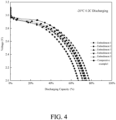
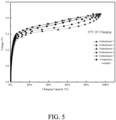
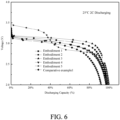
- Table 1 Shuttle agent type Adding method and ratio Self-bal ancing voltage V Self-balanc ing capability (multiple of the capacity of a battery cell) -20°C 0.2C discha rging ratio 2C charging constant current ratio 2C dischargi ng ratio Embodiment 1 Shuttle agent 1 2% of the positive electrode 3.83 120 73.53 % 92.75% 97.71% Embodiment 2 Shuttle agent 1 4% of the negative electrode 3.83 110 74.94 % 93.79% 98.83% Embodiment 3 Shuttle agent 1 1% of the positive electrode 2% of the negative electrode 3.83 120 77.72 % 94.99% 99.80% Embodiment 4 Shuttle agent 2 2% of the positive electrode 3.88 20 71.33 % 90.94% 97.02% Embodiment 5 Shuttle agent 1 2% of the positive electrode 3.83 120 75.02 % 90.08% 96% Comparative example 1 Shuttle agent 1 1%
Landscapes
- Chemical & Material Sciences (AREA)
- Electrochemistry (AREA)
- General Chemical & Material Sciences (AREA)
- Chemical Kinetics & Catalysis (AREA)
- Engineering & Computer Science (AREA)
- Manufacturing & Machinery (AREA)
- Inorganic Chemistry (AREA)
- Materials Engineering (AREA)
- Composite Materials (AREA)
- Crystallography & Structural Chemistry (AREA)
- Physics & Mathematics (AREA)
- Condensed Matter Physics & Semiconductors (AREA)
- General Physics & Mathematics (AREA)
- Secondary Cells (AREA)
- Battery Electrode And Active Subsutance (AREA)
Applications Claiming Priority (2)
| Application Number | Priority Date | Filing Date | Title |
|---|---|---|---|
| CN202110114583.0A CN112467193B (zh) | 2021-01-28 | 2021-01-28 | 一种安全型锂离子电池及其制备方法 |
| PCT/CN2021/141716 WO2022161070A1 (fr) | 2021-01-28 | 2021-12-27 | Batterie au lithium-ion sûre et son procédé de fabrication |
Publications (2)
| Publication Number | Publication Date |
|---|---|
| EP4156363A1 true EP4156363A1 (fr) | 2023-03-29 |
| EP4156363A4 EP4156363A4 (fr) | 2025-02-12 |
Family
ID=74802732
Family Applications (1)
| Application Number | Title | Priority Date | Filing Date |
|---|---|---|---|
| EP21922659.4A Pending EP4156363A4 (fr) | 2021-01-28 | 2021-12-27 | Batterie au lithium-ion sûre et son procédé de fabrication |
Country Status (5)
| Country | Link |
|---|---|
| US (1) | US20230187709A1 (fr) |
| EP (1) | EP4156363A4 (fr) |
| CN (1) | CN112467193B (fr) |
| AU (1) | AU2021422773B2 (fr) |
| WO (1) | WO2022161070A1 (fr) |
Families Citing this family (6)
| Publication number | Priority date | Publication date | Assignee | Title |
|---|---|---|---|---|
| CN112467193B (zh) * | 2021-01-28 | 2021-10-29 | 上海瑞浦青创新能源有限公司 | 一种安全型锂离子电池及其制备方法 |
| CN121076123A (zh) * | 2022-08-24 | 2025-12-05 | 上海兰钧新能源科技有限公司 | 锂离子电池正极、锂离子电池、电池装置和方法 |
| CN118511296A (zh) * | 2022-09-27 | 2024-08-16 | 宁德时代新能源科技股份有限公司 | 负极组合物及制备方法、负极浆料及制备方法、负极极片及制备方法、二次电池、用电装置以及噻蒽类化合物的应用 |
| CN116130782A (zh) * | 2023-02-09 | 2023-05-16 | 湖北亿纬动力有限公司 | 一种制备锂离子电池的方法和应用 |
| CN116040600A (zh) * | 2023-02-23 | 2023-05-02 | 无锡晶石新型能源股份有限公司 | 一种利用回收的锰酸锂和磷酸铁锂制备磷酸锰铁锂的方法 |
| CN118040084B (zh) * | 2024-03-05 | 2025-02-11 | 广东比沃新能源股份有限公司 | 一种电子烟锂离子电池 |
Family Cites Families (19)
| Publication number | Priority date | Publication date | Assignee | Title |
|---|---|---|---|---|
| JPH09232001A (ja) * | 1996-02-21 | 1997-09-05 | Fuji Elelctrochem Co Ltd | 非水電解液二次電池 |
| JPH09231976A (ja) * | 1996-02-21 | 1997-09-05 | Fuji Elelctrochem Co Ltd | 非水電解液二次電池 |
| US5858573A (en) * | 1996-08-23 | 1999-01-12 | Eic Laboratories, Inc. | Chemical overcharge protection of lithium and lithium-ion secondary batteries |
| US6045952A (en) * | 1998-03-23 | 2000-04-04 | The United States Of America As Represented By The United States Department Of Energy | Electrochemical storage cell containing a substituted anisole or di-anisole redox shuttle additive for overcharge protection and suitable for use in liquid organic and solid polymer electrolytes |
| JP5053834B2 (ja) * | 2004-04-01 | 2012-10-24 | スリーエム イノベイティブ プロパティズ カンパニー | 再充電可能なリチウム−イオンバッテリーの過放電保護のためのレドックスシャトル |
| JP4819795B2 (ja) * | 2004-04-01 | 2011-11-24 | スリーエム イノベイティブ プロパティズ カンパニー | リチウムイオン電池電解質及びリチウムイオン電池 |
| JP4963186B2 (ja) * | 2006-03-31 | 2012-06-27 | パナソニック株式会社 | 非水電解質二次電池 |
| GB0808059D0 (en) * | 2008-05-02 | 2008-06-11 | Oxis Energy Ltd | Rechargeable battery with negative lithium electrode |
| CN101577348B (zh) * | 2009-05-15 | 2011-03-23 | 中南大学 | 锂离子电池多重过充防护功能性电解液 |
| WO2013108365A1 (fr) * | 2012-01-17 | 2013-07-25 | トヨタ自動車株式会社 | Batterie rechargeable au lithium sans entretien |
| JP2013178935A (ja) * | 2012-02-28 | 2013-09-09 | Tdk Corp | リチウムイオン二次電池及びそれを用いた組電池並びに蓄電装置 |
| EP2858150B1 (fr) * | 2012-05-31 | 2017-03-15 | Hitachi, Ltd. | Batterie secondaire au lithium-ion |
| CN102931432A (zh) * | 2012-12-06 | 2013-02-13 | 上海航天电源技术有限责任公司 | 一种自均衡锂离子电池 |
| CN106654331B (zh) * | 2015-11-04 | 2020-05-08 | 天津大学 | 一种有机相氧化还原电解液及其在液流电池中的应用 |
| CN105552426A (zh) * | 2015-12-16 | 2016-05-04 | 上海航天电源技术有限责任公司 | 一种具有过充保护功能的锂离子电池 |
| JP6867821B2 (ja) * | 2016-02-23 | 2021-05-12 | 信越化学工業株式会社 | 負極活物質、混合負極活物質材料、非水電解質二次電池用負極、リチウムイオン二次電池用負極、リチウムイオン二次電池、負極活物質の製造方法、負極の製造方法、及びリチウムイオン二次電池の製造方法 |
| TWI686415B (zh) * | 2016-08-05 | 2020-03-01 | 德商贏創運營有限公司 | 含有噻嗯之聚合物作為電荷儲存裝置之用途 |
| CN109994732A (zh) * | 2019-04-15 | 2019-07-09 | 上海电气国轩新能源科技有限公司 | 酚类锂盐化合物的应用、锂离子二次电池及其制备方法 |
| CN112467193B (zh) * | 2021-01-28 | 2021-10-29 | 上海瑞浦青创新能源有限公司 | 一种安全型锂离子电池及其制备方法 |
-
2021
- 2021-01-28 CN CN202110114583.0A patent/CN112467193B/zh active Active
- 2021-12-27 WO PCT/CN2021/141716 patent/WO2022161070A1/fr not_active Ceased
- 2021-12-27 AU AU2021422773A patent/AU2021422773B2/en active Active
- 2021-12-27 EP EP21922659.4A patent/EP4156363A4/fr active Pending
-
2023
- 2023-02-10 US US18/108,123 patent/US20230187709A1/en active Pending
Also Published As
| Publication number | Publication date |
|---|---|
| CN112467193A (zh) | 2021-03-09 |
| US20230187709A1 (en) | 2023-06-15 |
| AU2021422773A9 (en) | 2025-03-13 |
| EP4156363A4 (fr) | 2025-02-12 |
| WO2022161070A1 (fr) | 2022-08-04 |
| CN112467193B (zh) | 2021-10-29 |
| AU2021422773A1 (en) | 2023-08-10 |
| AU2021422773B2 (en) | 2026-02-12 |
Similar Documents
| Publication | Publication Date | Title |
|---|---|---|
| EP4156363A1 (fr) | Batterie au lithium-ion sûre et son procédé de fabrication | |
| CN105845984A (zh) | 锂离子电池电解液及使用该电解液的锂离子电池 | |
| CN113013414B (zh) | 一种无钴正极浆料及其制备方法、正极片和锂离子电池 | |
| CN115275354A (zh) | 一种适用于碱金属离子电池的无碳酸乙烯酯电解液及应用 | |
| JP7454059B2 (ja) | リチウムイオン電池、電池モジュール、電池パック及び電力消費装置 | |
| US20260088370A1 (en) | Electrode assembly, battery cell, battery, and electric device | |
| CN112615056B (zh) | 一种用于制备电解液的添加剂组合物、及包含添加剂组合物的电解液、锂离子二次电池 | |
| JP2024504217A (ja) | 二次電池、電池モジュール、電池パック及び電力消費装置 | |
| CN106953073A (zh) | 磷酸铁锂正极复合材料及其制备方法 | |
| CN113889667B (zh) | 一种适配可快充钴酸锂电池的高电压电解液及其应用 | |
| CN113921803A (zh) | 锂离子电池的一种补锂方法 | |
| CN117153999B (zh) | 一种含有无机和有机钠盐层的钠离子电池负极片、制备方法和钠离子电池 | |
| CN118970055A (zh) | 一种锂离子电池 | |
| CN118983527A (zh) | 一种高压锂电池的全氟化局部浓缩宽温域电解液及其应用 | |
| EP4325604A1 (fr) | Suspension de matériau d'électrode positive sans cobalt, procédé de préparation s'y rapportant et son champ technique d'application | |
| CN115692862A (zh) | 一种用于高电压锂电池电解液的添加剂组合物、电解液以及高电压钴酸锂电池 | |
| KR20230172520A (ko) | 전해액, 이차 전지, 전지 모듈, 전지 팩 및 전기 장치 | |
| CN119324223B (zh) | 一种正极活性材料及原位电化学改性方法与应用 | |
| EP4492498A1 (fr) | Batterie au lithium-ion et son application | |
| CN118431569B (zh) | 一种用于低温锂电池的低温电解质的制备方法及其应用 | |
| CN103840210B (zh) | 一种非水有机电解液及其制备方法和锂离子二次电池 | |
| Life | A Tuned Ether Electrolyte for Microporous Carbon-based Lithium–Sulfur Batteries | |
| CN119725749A (zh) | 一种具有高电压稳定性的电解液及二次电池 | |
| CN121249220A (zh) | 一种涂炭铝箔浆料及其制备方法 | |
| CN118919843A (zh) | 一种低温高压钠离子电池电解液 |
Legal Events
| Date | Code | Title | Description |
|---|---|---|---|
| STAA | Information on the status of an ep patent application or granted ep patent |
Free format text: STATUS: THE INTERNATIONAL PUBLICATION HAS BEEN MADE |
|
| PUAI | Public reference made under article 153(3) epc to a published international application that has entered the european phase |
Free format text: ORIGINAL CODE: 0009012 |
|
| STAA | Information on the status of an ep patent application or granted ep patent |
Free format text: STATUS: REQUEST FOR EXAMINATION WAS MADE |
|
| 17P | Request for examination filed |
Effective date: 20221221 |
|
| AK | Designated contracting states |
Kind code of ref document: A1 Designated state(s): AL AT BE BG CH CY CZ DE DK EE ES FI FR GB GR HR HU IE IS IT LI LT LU LV MC MK MT NL NO PL PT RO RS SE SI SK SM TR |
|
| DAV | Request for validation of the european patent (deleted) | ||
| DAX | Request for extension of the european patent (deleted) | ||
| RIC1 | Information provided on ipc code assigned before grant |
Ipc: H01M 4/02 20060101ALN20241009BHEP Ipc: H01M 10/0567 20100101ALI20241009BHEP Ipc: H01M 4/62 20060101ALI20241009BHEP Ipc: H01M 4/587 20100101ALI20241009BHEP Ipc: H01M 4/58 20100101ALI20241009BHEP Ipc: H01M 4/525 20100101ALI20241009BHEP Ipc: H01M 4/505 20100101ALI20241009BHEP Ipc: H01M 4/36 20060101ALI20241009BHEP Ipc: H01M 4/1397 20100101ALI20241009BHEP Ipc: H01M 4/1391 20100101ALI20241009BHEP Ipc: H01M 4/139 20100101ALI20241009BHEP Ipc: H01M 4/136 20100101ALI20241009BHEP Ipc: H01M 4/131 20100101ALI20241009BHEP Ipc: H01M 4/13 20100101ALI20241009BHEP Ipc: H01M 4/04 20060101ALI20241009BHEP Ipc: H01M 10/058 20100101ALI20241009BHEP Ipc: H01M 10/42 20060101ALI20241009BHEP Ipc: H01M 10/0525 20100101AFI20241009BHEP |
|
| A4 | Supplementary search report drawn up and despatched |
Effective date: 20250113 |
|
| RIC1 | Information provided on ipc code assigned before grant |
Ipc: H01M 4/02 20060101ALN20250107BHEP Ipc: H01M 10/0567 20100101ALI20250107BHEP Ipc: H01M 4/62 20060101ALI20250107BHEP Ipc: H01M 4/587 20100101ALI20250107BHEP Ipc: H01M 4/58 20100101ALI20250107BHEP Ipc: H01M 4/525 20100101ALI20250107BHEP Ipc: H01M 4/505 20100101ALI20250107BHEP Ipc: H01M 4/36 20060101ALI20250107BHEP Ipc: H01M 4/1397 20100101ALI20250107BHEP Ipc: H01M 4/1391 20100101ALI20250107BHEP Ipc: H01M 4/139 20100101ALI20250107BHEP Ipc: H01M 4/136 20100101ALI20250107BHEP Ipc: H01M 4/131 20100101ALI20250107BHEP Ipc: H01M 4/13 20100101ALI20250107BHEP Ipc: H01M 4/04 20060101ALI20250107BHEP Ipc: H01M 10/058 20100101ALI20250107BHEP Ipc: H01M 10/42 20060101ALI20250107BHEP Ipc: H01M 10/0525 20100101AFI20250107BHEP |
|
| RAP3 | Party data changed (applicant data changed or rights of an application transferred) |
Owner name: SHANGHAI RUIPU ENERGY CO., LTD. Owner name: REPT BATTERO ENERGY CO., LTD. |