EP4159896A2 - Procédé de passivation de la surface d'une tôle étamée et système d'électrolyse destiné à la mise en uvre du procédé - Google Patents
Procédé de passivation de la surface d'une tôle étamée et système d'électrolyse destiné à la mise en uvre du procédé Download PDFInfo
- Publication number
- EP4159896A2 EP4159896A2 EP22187442.3A EP22187442A EP4159896A2 EP 4159896 A2 EP4159896 A2 EP 4159896A2 EP 22187442 A EP22187442 A EP 22187442A EP 4159896 A2 EP4159896 A2 EP 4159896A2
- Authority
- EP
- European Patent Office
- Prior art keywords
- chromium
- tinplate
- passivation layer
- electrolysis
- layer
- Prior art date
- Legal status (The legal status is an assumption and is not a legal conclusion. Google has not performed a legal analysis and makes no representation as to the accuracy of the status listed.)
- Pending
Links
- 238000000034 method Methods 0.000 title claims abstract description 46
- 238000005868 electrolysis reaction Methods 0.000 title claims description 102
- 238000002161 passivation Methods 0.000 claims abstract description 146
- 239000005028 tinplate Substances 0.000 claims abstract description 131
- 229910000423 chromium oxide Inorganic materials 0.000 claims abstract description 88
- 239000008151 electrolyte solution Substances 0.000 claims abstract description 88
- WGLPBDUCMAPZCE-UHFFFAOYSA-N Trioxochromium Chemical compound O=[Cr](=O)=O WGLPBDUCMAPZCE-UHFFFAOYSA-N 0.000 claims abstract description 87
- 239000011651 chromium Substances 0.000 claims abstract description 84
- 229910052804 chromium Inorganic materials 0.000 claims abstract description 71
- VYZAMTAEIAYCRO-UHFFFAOYSA-N Chromium Chemical compound [Cr] VYZAMTAEIAYCRO-UHFFFAOYSA-N 0.000 claims abstract description 68
- 230000008021 deposition Effects 0.000 claims abstract description 34
- 238000007669 thermal treatment Methods 0.000 claims abstract description 33
- 150000001845 chromium compounds Chemical class 0.000 claims abstract description 29
- 239000008139 complexing agent Substances 0.000 claims abstract description 16
- 150000003839 salts Chemical class 0.000 claims abstract description 16
- 239000002253 acid Substances 0.000 claims abstract description 15
- XLYOFNOQVPJJNP-UHFFFAOYSA-M hydroxide Chemical compound [OH-] XLYOFNOQVPJJNP-UHFFFAOYSA-M 0.000 claims abstract description 15
- 239000006172 buffering agent Substances 0.000 claims abstract description 9
- XOLBLPGZBRYERU-UHFFFAOYSA-N tin dioxide Chemical compound O=[Sn]=O XOLBLPGZBRYERU-UHFFFAOYSA-N 0.000 claims description 65
- 229910001887 tin oxide Inorganic materials 0.000 claims description 63
- ATJFFYVFTNAWJD-UHFFFAOYSA-N Tin Chemical compound [Sn] ATJFFYVFTNAWJD-UHFFFAOYSA-N 0.000 claims description 56
- 238000000576 coating method Methods 0.000 claims description 44
- VQWFNAGFNGABOH-UHFFFAOYSA-K chromium(iii) hydroxide Chemical compound [OH-].[OH-].[OH-].[Cr+3] VQWFNAGFNGABOH-UHFFFAOYSA-K 0.000 claims description 40
- 238000000151 deposition Methods 0.000 claims description 33
- 238000010438 heat treatment Methods 0.000 claims description 33
- 229910006404 SnO 2 Inorganic materials 0.000 claims description 30
- 239000011248 coating agent Substances 0.000 claims description 28
- 239000003792 electrolyte Substances 0.000 claims description 26
- 239000000203 mixture Substances 0.000 claims description 26
- 229910000831 Steel Inorganic materials 0.000 claims description 25
- 239000010959 steel Substances 0.000 claims description 25
- QVGXLLKOCUKJST-UHFFFAOYSA-N atomic oxygen Chemical compound [O] QVGXLLKOCUKJST-UHFFFAOYSA-N 0.000 claims description 22
- 239000001301 oxygen Substances 0.000 claims description 22
- 229910052760 oxygen Inorganic materials 0.000 claims description 22
- 238000003860 storage Methods 0.000 claims description 16
- 239000000758 substrate Substances 0.000 claims description 13
- XLYOFNOQVPJJNP-UHFFFAOYSA-N water Substances O XLYOFNOQVPJJNP-UHFFFAOYSA-N 0.000 claims description 12
- QAOWNCQODCNURD-UHFFFAOYSA-L Sulfate Chemical compound [O-]S([O-])(=O)=O QAOWNCQODCNURD-UHFFFAOYSA-L 0.000 claims description 11
- GRWVQDDAKZFPFI-UHFFFAOYSA-H chromium(III) sulfate Chemical compound [Cr+3].[Cr+3].[O-]S([O-])(=O)=O.[O-]S([O-])(=O)=O.[O-]S([O-])(=O)=O GRWVQDDAKZFPFI-UHFFFAOYSA-H 0.000 claims description 11
- 239000012535 impurity Substances 0.000 claims description 10
- 239000012298 atmosphere Substances 0.000 claims description 8
- 239000002904 solvent Substances 0.000 claims description 6
- 229910001128 Sn alloy Inorganic materials 0.000 claims description 5
- 230000006698 induction Effects 0.000 claims description 5
- NNIPDXPTJYIMKW-UHFFFAOYSA-N iron tin Chemical compound [Fe].[Sn] NNIPDXPTJYIMKW-UHFFFAOYSA-N 0.000 claims description 5
- BTBUEUYNUDRHOZ-UHFFFAOYSA-N Borate Chemical compound [O-]B([O-])[O-] BTBUEUYNUDRHOZ-UHFFFAOYSA-N 0.000 claims description 2
- BVKZGUZCCUSVTD-UHFFFAOYSA-L Carbonate Chemical compound [O-]C([O-])=O BVKZGUZCCUSVTD-UHFFFAOYSA-L 0.000 claims description 2
- 229910019142 PO4 Inorganic materials 0.000 claims description 2
- 238000001978 electrochemical passivation Methods 0.000 claims description 2
- NBIIXXVUZAFLBC-UHFFFAOYSA-K phosphate Chemical compound [O-]P([O-])([O-])=O NBIIXXVUZAFLBC-UHFFFAOYSA-K 0.000 claims description 2
- 239000010452 phosphate Substances 0.000 claims description 2
- 239000006227 byproduct Substances 0.000 claims 1
- 229910000356 chromium(III) sulfate Inorganic materials 0.000 claims 1
- 235000015217 chromium(III) sulphate Nutrition 0.000 claims 1
- 239000011696 chromium(III) sulphate Substances 0.000 claims 1
- 239000010410 layer Substances 0.000 description 229
- 229910052718 tin Inorganic materials 0.000 description 50
- 229940021013 electrolyte solution Drugs 0.000 description 28
- 230000003647 oxidation Effects 0.000 description 17
- 238000007254 oxidation reaction Methods 0.000 description 17
- QAOWNCQODCNURD-UHFFFAOYSA-N Sulfuric acid Chemical compound OS(O)(=O)=O QAOWNCQODCNURD-UHFFFAOYSA-N 0.000 description 12
- 239000002585 base Substances 0.000 description 12
- 230000000052 comparative effect Effects 0.000 description 11
- UOUJSJZBMCDAEU-UHFFFAOYSA-N chromium(3+);oxygen(2-) Chemical class [O-2].[O-2].[O-2].[Cr+3].[Cr+3] UOUJSJZBMCDAEU-UHFFFAOYSA-N 0.000 description 10
- 239000003973 paint Substances 0.000 description 10
- BFGKITSFLPAWGI-UHFFFAOYSA-N chromium(3+) Chemical compound [Cr+3] BFGKITSFLPAWGI-UHFFFAOYSA-N 0.000 description 9
- 238000002844 melting Methods 0.000 description 9
- 230000008018 melting Effects 0.000 description 9
- 239000000126 substance Substances 0.000 description 9
- CDBYLPFSWZWCQE-UHFFFAOYSA-L Sodium Carbonate Chemical compound [Na+].[Na+].[O-]C([O-])=O CDBYLPFSWZWCQE-UHFFFAOYSA-L 0.000 description 8
- -1 chromium carbides Chemical class 0.000 description 7
- 238000005260 corrosion Methods 0.000 description 6
- 230000007797 corrosion Effects 0.000 description 6
- 239000000463 material Substances 0.000 description 6
- 239000005029 tin-free steel Substances 0.000 description 6
- PMZURENOXWZQFD-UHFFFAOYSA-L Sodium Sulfate Chemical compound [Na+].[Na+].[O-]S([O-])(=O)=O PMZURENOXWZQFD-UHFFFAOYSA-L 0.000 description 5
- 150000004675 formic acid derivatives Chemical class 0.000 description 5
- 238000004806 packaging method and process Methods 0.000 description 5
- 229920006254 polymer film Polymers 0.000 description 5
- 239000000243 solution Substances 0.000 description 5
- 229910021653 sulphate ion Inorganic materials 0.000 description 5
- 229910005382 FeSn Inorganic materials 0.000 description 4
- NINIDFKCEFEMDL-UHFFFAOYSA-N Sulfur Chemical compound [S] NINIDFKCEFEMDL-UHFFFAOYSA-N 0.000 description 4
- 238000004519 manufacturing process Methods 0.000 description 4
- BASFCYQUMIYNBI-UHFFFAOYSA-N platinum Chemical compound [Pt] BASFCYQUMIYNBI-UHFFFAOYSA-N 0.000 description 4
- 229920000642 polymer Polymers 0.000 description 4
- 239000012487 rinsing solution Substances 0.000 description 4
- 229910052938 sodium sulfate Inorganic materials 0.000 description 4
- 235000011152 sodium sulphate Nutrition 0.000 description 4
- DGAQECJNVWCQMB-PUAWFVPOSA-M Ilexoside XXIX Chemical compound C[C@@H]1CC[C@@]2(CC[C@@]3(C(=CC[C@H]4[C@]3(CC[C@@H]5[C@@]4(CC[C@@H](C5(C)C)OS(=O)(=O)[O-])C)C)[C@@H]2[C@]1(C)O)C)C(=O)O[C@H]6[C@@H]([C@H]([C@@H]([C@H](O6)CO)O)O)O.[Na+] DGAQECJNVWCQMB-PUAWFVPOSA-M 0.000 description 3
- 230000004888 barrier function Effects 0.000 description 3
- KGBXLFKZBHKPEV-UHFFFAOYSA-N boric acid Chemical compound OB(O)O KGBXLFKZBHKPEV-UHFFFAOYSA-N 0.000 description 3
- 239000004327 boric acid Substances 0.000 description 3
- 238000001035 drying Methods 0.000 description 3
- 230000001965 increasing effect Effects 0.000 description 3
- 229910044991 metal oxide Inorganic materials 0.000 description 3
- 150000004706 metal oxides Chemical class 0.000 description 3
- 229910003455 mixed metal oxide Inorganic materials 0.000 description 3
- 239000012044 organic layer Substances 0.000 description 3
- WFIZEGIEIOHZCP-UHFFFAOYSA-M potassium formate Chemical compound [K+].[O-]C=O WFIZEGIEIOHZCP-UHFFFAOYSA-M 0.000 description 3
- 229910052708 sodium Inorganic materials 0.000 description 3
- 239000011734 sodium Substances 0.000 description 3
- 229910000029 sodium carbonate Inorganic materials 0.000 description 3
- 229920001169 thermoplastic Polymers 0.000 description 3
- 238000011144 upstream manufacturing Methods 0.000 description 3
- ZLMJMSJWJFRBEC-UHFFFAOYSA-N Potassium Chemical compound [K] ZLMJMSJWJFRBEC-UHFFFAOYSA-N 0.000 description 2
- 239000005864 Sulphur Substances 0.000 description 2
- XLOMVQKBTHCTTD-UHFFFAOYSA-N Zinc monoxide Chemical compound [Zn]=O XLOMVQKBTHCTTD-UHFFFAOYSA-N 0.000 description 2
- 238000007743 anodising Methods 0.000 description 2
- 239000007864 aqueous solution Substances 0.000 description 2
- 229910052799 carbon Inorganic materials 0.000 description 2
- PHFQLYPOURZARY-UHFFFAOYSA-N chromium trinitrate Chemical compound [Cr+3].[O-][N+]([O-])=O.[O-][N+]([O-])=O.[O-][N+]([O-])=O PHFQLYPOURZARY-UHFFFAOYSA-N 0.000 description 2
- JOPOVCBBYLSVDA-UHFFFAOYSA-N chromium(6+) Chemical compound [Cr+6] JOPOVCBBYLSVDA-UHFFFAOYSA-N 0.000 description 2
- 150000001875 compounds Chemical class 0.000 description 2
- 238000005238 degreasing Methods 0.000 description 2
- 239000008367 deionised water Substances 0.000 description 2
- 229910021641 deionized water Inorganic materials 0.000 description 2
- HTXDPTMKBJXEOW-UHFFFAOYSA-N dioxoiridium Chemical compound O=[Ir]=O HTXDPTMKBJXEOW-UHFFFAOYSA-N 0.000 description 2
- 230000005764 inhibitory process Effects 0.000 description 2
- 239000013067 intermediate product Substances 0.000 description 2
- 229910000457 iridium oxide Inorganic materials 0.000 description 2
- 239000011368 organic material Substances 0.000 description 2
- 238000010422 painting Methods 0.000 description 2
- 238000007747 plating Methods 0.000 description 2
- 229910052697 platinum Inorganic materials 0.000 description 2
- 229910052939 potassium sulfate Inorganic materials 0.000 description 2
- 235000011151 potassium sulphates Nutrition 0.000 description 2
- 229910001220 stainless steel Inorganic materials 0.000 description 2
- 239000010935 stainless steel Substances 0.000 description 2
- 229910052717 sulfur Inorganic materials 0.000 description 2
- 239000011593 sulfur Substances 0.000 description 2
- 239000012815 thermoplastic material Substances 0.000 description 2
- 239000004416 thermosoftening plastic Substances 0.000 description 2
- OKTJSMMVPCPJKN-UHFFFAOYSA-N Carbon Chemical compound [C] OKTJSMMVPCPJKN-UHFFFAOYSA-N 0.000 description 1
- VEXZGXHMUGYJMC-UHFFFAOYSA-M Chloride anion Chemical compound [Cl-] VEXZGXHMUGYJMC-UHFFFAOYSA-M 0.000 description 1
- BDAGIHXWWSANSR-UHFFFAOYSA-M Formate Chemical compound [O-]C=O BDAGIHXWWSANSR-UHFFFAOYSA-M 0.000 description 1
- XEEYBQQBJWHFJM-UHFFFAOYSA-N Iron Chemical group [Fe] XEEYBQQBJWHFJM-UHFFFAOYSA-N 0.000 description 1
- 229910002651 NO3 Inorganic materials 0.000 description 1
- NHNBFGGVMKEFGY-UHFFFAOYSA-N Nitrate Chemical compound [O-][N+]([O-])=O NHNBFGGVMKEFGY-UHFFFAOYSA-N 0.000 description 1
- 229910021607 Silver chloride Inorganic materials 0.000 description 1
- BPNRRQFZIBQRMK-UHFFFAOYSA-N [O-2].[Ta+5].[Ir+3].[O-2].[O-2].[O-2] Chemical compound [O-2].[Ta+5].[Ir+3].[O-2].[O-2].[O-2] BPNRRQFZIBQRMK-UHFFFAOYSA-N 0.000 description 1
- REDNGDDUEDWIQI-UHFFFAOYSA-N [O].[Ta].[Ir] Chemical compound [O].[Ta].[Ir] REDNGDDUEDWIQI-UHFFFAOYSA-N 0.000 description 1
- WDNIVTZNAPEMHF-UHFFFAOYSA-N acetic acid;chromium Chemical compound [Cr].CC(O)=O.CC(O)=O WDNIVTZNAPEMHF-UHFFFAOYSA-N 0.000 description 1
- 229910052936 alkali metal sulfate Inorganic materials 0.000 description 1
- 230000015572 biosynthetic process Effects 0.000 description 1
- 239000000872 buffer Substances 0.000 description 1
- 150000003841 chloride salts Chemical class 0.000 description 1
- GVEHJMMRQRRJPM-UHFFFAOYSA-N chromium(2+);methanidylidynechromium Chemical compound [Cr+2].[Cr]#[C-].[Cr]#[C-] GVEHJMMRQRRJPM-UHFFFAOYSA-N 0.000 description 1
- OGDYVWQEAVKKDI-UHFFFAOYSA-N chromium(3+);oxygen(2-);hydrate Chemical compound O.[O-2].[O-2].[O-2].[Cr+3].[Cr+3] OGDYVWQEAVKKDI-UHFFFAOYSA-N 0.000 description 1
- BNQYBOIDDNFHHC-UHFFFAOYSA-N chromium;oxalic acid Chemical compound [Cr].OC(=O)C(O)=O BNQYBOIDDNFHHC-UHFFFAOYSA-N 0.000 description 1
- 239000010960 cold rolled steel Substances 0.000 description 1
- 238000000354 decomposition reaction Methods 0.000 description 1
- 230000001419 dependent effect Effects 0.000 description 1
- 238000005137 deposition process Methods 0.000 description 1
- 238000009792 diffusion process Methods 0.000 description 1
- 239000012153 distilled water Substances 0.000 description 1
- 230000007613 environmental effect Effects 0.000 description 1
- 238000011049 filling Methods 0.000 description 1
- 150000004820 halides Chemical class 0.000 description 1
- ZYCMDWDFIQDPLP-UHFFFAOYSA-N hbr bromine Chemical compound Br.Br ZYCMDWDFIQDPLP-UHFFFAOYSA-N 0.000 description 1
- 230000001939 inductive effect Effects 0.000 description 1
- 239000011261 inert gas Substances 0.000 description 1
- 230000003993 interaction Effects 0.000 description 1
- 238000010409 ironing Methods 0.000 description 1
- 238000009533 lab test Methods 0.000 description 1
- 239000004922 lacquer Substances 0.000 description 1
- 238000010030 laminating Methods 0.000 description 1
- 230000035515 penetration Effects 0.000 description 1
- 239000004033 plastic Substances 0.000 description 1
- 239000002985 plastic film Substances 0.000 description 1
- 229920006255 plastic film Polymers 0.000 description 1
- 239000011591 potassium Substances 0.000 description 1
- 239000001120 potassium sulphate Substances 0.000 description 1
- 239000000047 product Substances 0.000 description 1
- HKZLPVFGJNLROG-UHFFFAOYSA-M silver monochloride Chemical compound [Cl-].[Ag+] HKZLPVFGJNLROG-UHFFFAOYSA-M 0.000 description 1
- 239000002356 single layer Substances 0.000 description 1
- LSNNMFCWUKXFEE-UHFFFAOYSA-L sulfite Chemical compound [O-]S([O-])=O LSNNMFCWUKXFEE-UHFFFAOYSA-L 0.000 description 1
- QHGNHLZPVBIIPX-UHFFFAOYSA-N tin(ii) oxide Chemical group [Sn]=O QHGNHLZPVBIIPX-UHFFFAOYSA-N 0.000 description 1
- 229910003470 tongbaite Inorganic materials 0.000 description 1
- 230000000007 visual effect Effects 0.000 description 1
- 239000011787 zinc oxide Substances 0.000 description 1
Images

Classifications
-
- C—CHEMISTRY; METALLURGY
- C25—ELECTROLYTIC OR ELECTROPHORETIC PROCESSES; APPARATUS THEREFOR
- C25D—PROCESSES FOR THE ELECTROLYTIC OR ELECTROPHORETIC PRODUCTION OF COATINGS; ELECTROFORMING; APPARATUS THEREFOR
- C25D3/00—Electroplating: Baths therefor
- C25D3/02—Electroplating: Baths therefor from solutions
- C25D3/04—Electroplating: Baths therefor from solutions of chromium
- C25D3/06—Electroplating: Baths therefor from solutions of chromium from solutions of trivalent chromium
-
- C—CHEMISTRY; METALLURGY
- C25—ELECTROLYTIC OR ELECTROPHORETIC PROCESSES; APPARATUS THEREFOR
- C25D—PROCESSES FOR THE ELECTROLYTIC OR ELECTROPHORETIC PRODUCTION OF COATINGS; ELECTROFORMING; APPARATUS THEREFOR
- C25D11/00—Electrolytic coating by surface reaction, i.e. forming conversion layers
- C25D11/38—Chromatising
-
- C—CHEMISTRY; METALLURGY
- C25—ELECTROLYTIC OR ELECTROPHORETIC PROCESSES; APPARATUS THEREFOR
- C25D—PROCESSES FOR THE ELECTROLYTIC OR ELECTROPHORETIC PRODUCTION OF COATINGS; ELECTROFORMING; APPARATUS THEREFOR
- C25D11/00—Electrolytic coating by surface reaction, i.e. forming conversion layers
- C25D11/02—Anodisation
- C25D11/34—Anodisation of metals or alloys not provided for in groups C25D11/04 - C25D11/32
-
- C—CHEMISTRY; METALLURGY
- C25—ELECTROLYTIC OR ELECTROPHORETIC PROCESSES; APPARATUS THEREFOR
- C25D—PROCESSES FOR THE ELECTROLYTIC OR ELECTROPHORETIC PRODUCTION OF COATINGS; ELECTROFORMING; APPARATUS THEREFOR
- C25D17/00—Constructional parts, or assemblies thereof, of cells for electrolytic coating
- C25D17/02—Tanks; Installations therefor
-
- C—CHEMISTRY; METALLURGY
- C25—ELECTROLYTIC OR ELECTROPHORETIC PROCESSES; APPARATUS THEREFOR
- C25D—PROCESSES FOR THE ELECTROLYTIC OR ELECTROPHORETIC PRODUCTION OF COATINGS; ELECTROFORMING; APPARATUS THEREFOR
- C25D5/00—Electroplating characterised by the process; Pretreatment or after-treatment of workpieces
- C25D5/48—After-treatment of electroplated surfaces
- C25D5/50—After-treatment of electroplated surfaces by heat-treatment
-
- C—CHEMISTRY; METALLURGY
- C25—ELECTROLYTIC OR ELECTROPHORETIC PROCESSES; APPARATUS THEREFOR
- C25D—PROCESSES FOR THE ELECTROLYTIC OR ELECTROPHORETIC PRODUCTION OF COATINGS; ELECTROFORMING; APPARATUS THEREFOR
- C25D7/00—Electroplating characterised by the article coated
- C25D7/06—Wires; Strips; Foils
- C25D7/0614—Strips or foils
-
- C—CHEMISTRY; METALLURGY
- C25—ELECTROLYTIC OR ELECTROPHORETIC PROCESSES; APPARATUS THEREFOR
- C25D—PROCESSES FOR THE ELECTROLYTIC OR ELECTROPHORETIC PRODUCTION OF COATINGS; ELECTROFORMING; APPARATUS THEREFOR
- C25D9/00—Electrolytic coating other than with metals
- C25D9/04—Electrolytic coating other than with metals with inorganic materials
- C25D9/08—Electrolytic coating other than with metals with inorganic materials by cathodic processes
-
- C—CHEMISTRY; METALLURGY
- C25—ELECTROLYTIC OR ELECTROPHORETIC PROCESSES; APPARATUS THEREFOR
- C25D—PROCESSES FOR THE ELECTROLYTIC OR ELECTROPHORETIC PRODUCTION OF COATINGS; ELECTROFORMING; APPARATUS THEREFOR
- C25D9/00—Electrolytic coating other than with metals
- C25D9/04—Electrolytic coating other than with metals with inorganic materials
- C25D9/08—Electrolytic coating other than with metals with inorganic materials by cathodic processes
- C25D9/10—Electrolytic coating other than with metals with inorganic materials by cathodic processes on iron or steel
Definitions
- the invention relates to a method for passivating the surface of a tinplate by electrolytic deposition of a chromium oxide-containing passivation layer on the surface, and an electrolysis system for the electrolytic deposition of a chromium oxide-containing passivation layer on the surface of a tinplate.
- steel sheets electrolytically coated with a passivation layer of chromium and chromium oxide/chromium hydroxide are known from the prior art, which are known as tin-free steel sheet ("Tin Free Steel", TFS) or as “Electrolytic Chromium Coated Steel (ECCS)". be called and represent an alternative to tinplate.
- TFS Tin Free Steel
- ECCS Electrolytic Chromium Coated Steel
- These tin-free steel sheets are particularly characterized by good adhesion for paint or organic coatings (such as polymer coatings made of PP or PET).
- these chromium-coated steel sheets have good corrosion resistance and good processing properties in forming processes for the production of packaging, e.g. in deep-drawing and ironing processes .
- Tinned steel sheets are usually provided with a passivation layer after electrolytic tinning in order to prevent oxidation of the tin surface by atmospheric oxygen.
- Chromium-containing layers which can be deposited electrolytically from a chromium(VI)-containing electrolyte on the tin surface of tinplate have proven to be suitable passivation layers. These chromium-containing passivation layers are composed of metallic chromium and chromium oxides. Chromium oxide is understood to mean all compounds of chromium and oxygen, including chromium hydroxides.
- electrolytic coating processes are known from the prior art, with which a metallic chromium and chromium oxide/ Chromium hydroxide-containing passivation layer can be applied to a strip-shaped substrate (uncoated sheet steel or tinplate).
- these coating processes have significant disadvantages due to the environmental and health-endangering properties of the chromium-VI-containing electrolytes used in the electrolysis process and must be replaced by alternative coating processes in the foreseeable future, since the use of chromium-VI-containing materials will be banned in the future.
- electrolytic coating processes have already been developed in the prior art, which can dispense with the use of electrolytes containing chromium VI.
- a method for the electrolytic passivation of a strip-shaped steel sheet, in particular a strip-shaped black or tin sheet, with a chromium metal-chromium oxide (Cr-CrOx) layer is known, in which the steel sheet is connected as a cathode in a strip coating plant with high strip speeds of more than 100 m/ min is passed through a single electrolyte solution which contains a trivalent chromium compound (especially Cr-III-sulphate) as well as a complexing agent and a conductivity-increasing salt and is free of chlorides and buffering agents such as boric acid.
- a trivalent chromium compound especially Cr-III-sulphate
- a complexing agent and a conductivity-increasing salt is free of chlorides and buffering agents such as boric acid.
- Organic substances in particular formates and preferably sodium or potassium formate, are used as complexing agents.
- the electrolyte solution can contain sulfuric acid.
- the passivation layer of chromium metal and chromium oxide can be deposited layer by layer in successive electrolysis tanks or in successively arranged coil coating systems, with the electrolysis tanks each being filled with the same electrolyte solution.
- the electrolytically deposited passivation layer can also contain chromium sulfates and chromium carbides in addition to the components chromium metal and chromium oxide/chromium hydroxide and that the proportions of these components in the total weight of the passivation layer depends very significantly on the current densities set in the electrolysis tanks.
- the passivation layer contains a higher one Portion of chromium oxide that makes up between 1 ⁇ 4 and 1/3 of the total weight of the passivation layer in the area of higher current densities.
- the values of the current density thresholds which delimit the areas (regimes I to III) from one another, depend on the belt speed at which the steel sheet is moved through the electrolyte solution.
- a high percentage of the Chromium oxide in the chromium-containing passivation layer advantageous.
- a method for passivating the surface of a tinplate by depositing a passivation layer, which consists at least essentially only of chromium oxide and chromium hydroxide, using an aqueous solution of an electrolyte with a trivalent chromium compound that contains no organic substances and in particular no organic complexing agents contains. Due to the use of an aqueous electrolyte solution, the deposited passivation layer has a high proportion of chromium hydroxide in addition to chromium oxide.
- the chromium hydroxide content of the passivation layer enables atmospheric oxygen to diffuse through the passivation layer if the passivated tinplate is stored in an air atmosphere for a long period of time. Due to the diffusion of atmospheric oxygen through the Passivation layer A harmful layer of tin oxide forms on the tin surface of the tinplate, which essentially consists of divalent tin oxide (SnO).
- the object of the present invention is therefore to provide an efficient, cost-effective and environmentally friendly and health-friendly electrolysis process for passivating the surface of a tinplate with a chromium oxide-containing passivation layer based on an electrolytic solution with a trivalent chromium compound, which causes a zinc oxide layer to grow on the tin surface of the tinplate in an oxygen- or air-containing atmosphere.
- the use of substances containing chromium VI, also as intermediate products of the electrolysis process should be avoided in order to be able to fully meet the legal requirements regarding the ban on substances containing chromium VI.
- the tinplate coated according to the process should have the highest possible resistance to oxidation in an oxygen-containing environment, in particular in atmospheric oxygen, and should have a good adhesion base for organic coatings, such as e.g. for organic paints and for polymer layers, in particular for polymer films, e.g. made of PET, PE or PP, form.
- organic coatings such as e.g. for organic paints and for polymer layers, in particular for polymer films, e.g. made of PET, PE or PP, form.
- a passivation layer containing chromium oxide is electrolytically removed from an electrolyte solution which contains a trivalent chromium compound and at least one salt to increase conductivity and at least one acid or one base to set a desired pH value and is free from organic complexing agents and free from Buffering agents is applied to a tinned steel strip (tin strip), whereby after the electrolytic deposition of the passivation layer, the passivated tin plate is subjected to a thermal treatment in which the passivated tin plate is heated to a treatment temperature of 100°C for a treatment time of at least 0.5 seconds °C or more is maintained.
- the chromium hydroxide components contained in the passivation layer are removed from the passivation layer by the thermal treatment of the passivated tinplate immediately after the electrolytic deposition of the passivation layer. This will make the Passivation layer impermeable to oxygen, which can prevent the growth of a tin oxide layer on the tin surface of the tinplate.
- the tinplates which have been thermally treated according to the invention after the passivation layer has been deposited have a tin oxide layer with a tin oxide coating of less than 70 C/m 2 under the passivation layer.
- the coverage of the tin oxide layer is preferably less than 55 C/m 2 and particularly preferably less than 40 C/m 2 , in particular in the range from 20 C/m 2 to 60 C/m 2 .
- the entire coating of the tin oxide layer can consist of divalent tin oxide (SnO), which is produced by natural oxidation of the tin surface in atmospheric oxygen, and of tetravalent tin oxide (SnO 2 ), which is produced by targeted anodic oxidation before the passivation layer is electrolytically deposited. put together.
- the proportion of the tetravalent tin oxide preferably has a coating of less than 40 C/m 2 and particularly preferably less than 30 C/m 2 .
- Substances containing chromium VI are not used in the process according to the invention, not even as intermediate products, so that the process is entirely free of substances containing chromium VI and is therefore environmentally friendly and health-friendly when the process is carried out.
- the passivation layer Due to the use of an electrolyte solution free of organic complexing agents, which in particular does not contain formates, for the electrolytic deposition of the passivation layer or at least an upper layer of the passivation layer and because of the subsequent thermal treatment of the tinplate provided with the passivation layer, the passivation layer consists, apart from unavoidable impurities (which can in particular be residues of chromium hydroxide and chromium sulphate if Cr(III) sulphate is used as the trivalent chromium compound in the electrolytic solution), at least essentially of pure chromium oxide or it contains at least an upper layer of pure chromium oxide.
- unavoidable impurities which can in particular be residues of chromium hydroxide and chromium sulphate if Cr(III) sulphate is used as the trivalent chromium compound in the electrolytic solution
- the passivation layer consisting of pure chromium oxide or the upper layer of the passivation layer forms a very good barrier against the penetration of oxygen on the one hand and on the other hand represents a good adhesion base for organic coatings, such as organic paints or polymer films made of PET, PP or PE.
- chromium oxide When speaking of chromium oxide, all (trivalent) oxide forms of chromium (CrO x ) are meant.
- chromium hydroxide When speaking of chromium hydroxide, all hydrated forms of chromium oxide are meant, in particular chromium(III) hydroxide and chromium(III) oxide hydrate, as well as mixtures thereof.
- the electrolytically applied passivation layer has the highest possible proportion by weight of chromium oxide.
- the proportion by weight of chromium oxide is preferably more than 95%.
- this ensures good passivation against oxidation of the surface of the tinplate and, on the other hand, offers a good adhesion base with good adhesion for organic coatings such as organic paints or polymer layers made of thermoplastics such as PET; PE or PP.
- the tinplate strip For the electrolytic deposition of the passivation layer, the tinplate strip, connected as a cathode, is brought into contact with the electrolyte solution in at least one electrolysis tank for a predetermined electrolysis period.
- the duration of the electrolysis is preferably in the range from 0.3 to 5.0 seconds and particularly preferably between 0.6 and 1.5 seconds.
- the tinplate strip is guided at a predetermined strip speed through at least one electrolysis tank or successively through several electrolysis tanks arranged one behind the other in the direction of strip travel, with the strip speed preferably being at least 100 m/min and particularly preferably between 200 m/min and 750 m/min.
- the high belt speeds ensure that the process is highly efficient.
- the thickness or the weight applied to the electrolytically deposited passivation layer can be controlled via the duration of the electrolysis and thus via the belt speed.
- the duration of the electrolysis is preferably selected such that the deposited chromium oxide has a weight of at least 3 mg/m 2 and preferably from 8 mg/m 2 to 12 mg/m 2 , based on the chromium.
- a coating of an organic material, in particular a lacquer, which adheres well to the chromium oxide layer of the passivation layer can be applied or a thermoplastic material, in particular a polymer film made of PET, PE, PP or a mixture thereof, by painting the surface of the passivation layer with an organic paint or by providing it with a plastic layer made of a thermoplastic material such as PET, PP and/or PE .
- a suitable anode is suitably selected for the electrolytic deposition of the passivation layer and arranged in the or each electrolysis tank in order to oxidize chromium (III) from the trivalent chromium compound of the electrolyte solution Chromium(VI) too prevents.
- steel and stainless steel-free anodes with an outer surface or a passivation layer made of a metal oxide, in particular iridium oxide, or of a mixed metal oxide, in particular iridium-tantalum oxide, have proven to be suitable for this.
- the anode preferably contains neither stainless steel nor platinum.
- the electrolysis system comprises a plurality of electrolysis tanks arranged one behind the other, of which at least the last electrolysis tank seen in the direction of strip travel is filled with the first electrolytic solution and the preceding electrolysis tanks are filled with another electrolytic solution which, in addition to the trivalent chromium compound, contains at least one salt to increase conductivity and contains at least one acid or one base for setting a desired pH and organic complexing agents.
- the trivalent chromium compound contains at least one salt to increase conductivity and contains at least one acid or one base for setting a desired pH and organic complexing agents.
- formates and preferably sodium or potassium formate can be used as complexing agents.
- the temperatures of the electrolyte solutions in the individual electrolysis tanks can also be chosen to be different. This embodiment makes it possible to deposit a passivation layer containing chromium oxide on the surface of the tinplate with several layers which differ in their composition.
- a passivation layer with a lower layer made of metallic chromium and chromium oxide/chromium hydroxide and possibly chromium carbides and an upper layer made of pure chromium oxide can be produced.
- the individual layers of the passivation layer are deposited on the tin surface of the tinplate in the individual electrolysis tanks of the electrolysis system arranged one behind the other.
- the different composition of the layers results from the differences in the composition and/or the temperature of the electrolyte solutions in the individual electrolysis tanks Passivation layer, which differ from each other in particular by the proportion by weight of chromium oxide.
- the chromium hydroxide components of the passivation layer or at least the chromium hydroxide components in the upper layer of the passivation layer can be converted into chromium oxide, so that the passivation layer either consists entirely of pure chromium oxide or at least the upper layer of the passivation layer contains essentially only chromium oxide and in particular no metallic one Has chromium and possibly still unavoidable residual components of chromium hydroxide.
- the heating device is preferably arranged immediately after the electrolysis tank or after the last electrolysis tank of the plurality of electrolysis tanks, viewed in the direction of strip travel. This makes it possible for the thermal treatment of the passivation layer to be carried out immediately at a short time interval of, for example, less than 10 seconds after the end of the electrolytic application of the passivation layer.
- the electrolysis system according to the invention can expediently be arranged immediately after an electrolytic tinning line in which the steel sheet substrate of the tinplate is electrolytically provided with a layer of tin.
- the steel sheet substrate of the tinplate which is fed through the tinning line at a predetermined line speed for tinning as a steel strip, can therefore be fed further through the inventive electrolysis system at the same line speed directly after tinning by means of the transport device.
- the electrolysis system according to the invention can also contain a further heating device, which is arranged in front of the (first) electrolysis tank or in front of the several electrolysis tanks, viewed in the direction of strip travel.
- this additional heating device which is preferably designed as an induction heater, the tin layer applied to the tinplate in the tinning line can be at least partially melted by the tinplate strip being the further heating device is heated to temperatures above the melting point of tin.
- the electrolyte solution preferably has an electrolyte temperature in the range from 20°C to 80°C and particularly preferably in the range from 30°C to 65°C and in particular between 40°C and 60°C. At these temperatures, the electrolytic deposition of the passivation layer containing chromium oxide is very efficient.
- the electrolyte temperature or the temperature of the electrolyte solution or the temperature in an electrolysis tank what is meant in each case is the mean temperature that is averaged over the entire volume of the electrolysis tank. As a rule, there is a temperature gradient in the electrolysis tank with a temperature increase from top to bottom.
- the electrolyte temperature in the individual electrolysis tanks can differ, which can influence the composition of the layers of the passivation layer deposited in the individual electrolysis tanks. For example, at electrolyte temperatures below 40°C, a layer with a higher proportion of chromium oxide is deposited compared to electrolysis tanks with a higher electrolyte temperature. It is therefore advantageous in the method according to the invention to set an electrolyte temperature of 40° C. or less in the last electrolysis tank in order to maximize the proportion of chromium oxide in the upper layer of the passivation layer.
- the first electrolytic solution which is filled in at least one and preferably in the last electrolysis tank seen in the direction of strip travel, contains, in addition to the trivalent chromium compound and the solvent, water, at least one salt that increases the conductivity and at least one acid or base for setting a suitable pH value and is preferably free of chloride ions and free of buffering agents, especially free of a boric acid buffer.
- the trivalent chromium compound of the electrolyte solution is preferably selected from the group consisting of basic Cr(III) sulfate (Cr2(SO4)3), Cr(III) nitrate (Cr(NO3)3), Cr(III) oxalate (CrC2O4 ), Cr(III) acetate (C12H36ClCr3O22), Cr(III) formate (Cr(OOCH)3) or a mixture thereof.
- the concentration of the trivalent chromium compound in the electrolyte solution is preferably at least 10 g/l and particularly preferably more than 15 g/l and in particular 20 g/l or more.
- the electrolyte solution contains at least one salt, which is preferably an alkali metal sulphate, in particular potassium or sodium sulphate.
- a very efficient deposition of a passivation layer containing chromium oxide and chromium hydroxide is achieved when the pH value (measured at a temperature of 20°C) of the electrolytic solution is in a range from 2.3 to 5.0 and preferably between 2.5 and 3. 5 lies.
- the desired pH can be adjusted by adding an acid or base to the electrolyte solution.
- sulfuric acid or an acid mixture containing sulfuric acid is particularly suitable for setting the desired pH.
- compositions of the electrolyte solution each include basic Cr(III) sulfate (Cr 2 (SO 4 ) 3 ) as a trivalent chromium compound, and sodium sulfate as a conductivity-increasing salt and sulfuric acid to set a preferred pH in the range from 2.5 to 3. 5.
- the electrolyte solution contains at least one salt to increase the conductivity and the at least one acid or base to adjust the pH, and apart from the solvent water, no other components. This ensures a simple and inexpensive production of the electrolyte solution and leads to the deposition of a passivation layer, which consists at least essentially only of chromium oxide and chromium hydroxide and otherwise only contains unavoidable impurities such as chromium sulfate, if Cr (III) sulfate as a trivalent chromium compound is used.
- the chromium hydroxide contained in the electrolytically deposited passivation layer is removed from the passivation layer by subjecting the passivated tinplate to a thermal treatment, the passivated tinplate being heated to a treatment temperature of 100° C. for a treatment time of at least 0.5 seconds or more is held.
- the water in the hydrated chromium oxides evaporates and the chromium hydroxide components are converted into chromium oxides.
- the treatment time is preferably between 0.5 seconds and 30 minutes and particularly preferably between 1.0 seconds and 1 minute.
- the treatment temperatures are preferably between 150° C. and the melting temperature of tin (232° C.) in order to avoid melting the tin surface of the tinplate.
- the thermal treatment takes place in particular immediately after the electrolytic deposition of the passivation layer on the tinplate strip, in that the tinplate strip is guided through an oven at the strip speed at which the tinplate strip is passed through the electrolysis tank or tanks.
- the high strip speeds of preferably more than 100 m/min and up to 900 m/min result in very short treatment times of a few seconds or even less than one, depending on the length of the furnace in the direction of strip travel, which is preferably between 5 and 30 m Second.
- higher treatment temperatures are expediently selected, which can be between 170°C and 230°C, for example.
- Very short treatment times of one second or less are sufficient even at lower treatment temperatures of below 150°C if the temperature of the electrolyte in the last electrolysis tank seen in the direction of strip travel is relatively high, e.g. in the range of 50°C or more, because then the passivated tinplate strip has this temperature and only has to be heated to the (maximum) treatment temperature within a short time for thermal treatment.
- the passivated tinplate can be heated particularly quickly and efficiently to the (maximum) treatment temperature by inductive heating in an induction coil. Heating rates of 100 K/s to 700 K/s can be achieved, with which the passivated tinplate is heated from the electrolyte temperature of the last electrolysis tank to the (maximum) treatment temperature.
- the thermal process is carried out Treatment preferably immediately after the electrolytic deposition of the passivation layer, i.e. immediately after leaving the last electrolysis tank. There is preferably an interval of at most 10 seconds between the end of the deposition of the passivation layer, ie leaving the last electrolysis tank, and reaching the treatment temperature.
- a tin oxide layer consisting essentially of tetravalent tin oxide (SnO 2 ) is produced on the surface of the tinplate before the electrolytic deposition of the passivation layer, in that the tinplate is connected as an anode in an aqueous and, in particular, basic electrolyte which contains a phosphate, contains borate, sulfate or carbonate.
- SnO 2 tetravalent tin oxide
- tetravalent tin oxide layer which is more inert to further oxidation in an oxygen atmosphere compared to divalent tin oxide, minimizes unhindered growth of the oxide layer on the tin surface of tinplate in an oxygen-containing atmosphere and improves the marbling resistance of the tinplate to sulfur-containing substances, such as sulfur-containing filling goods of packaging made from the tinplate.
- Targeted anodic oxidation can be used to control the stoichiometry of the tin oxide layer and the ratio of divalent and tetravalent tin oxide, and the tin oxide layer is distributed homogeneously on the surface of the tinplate.
- the anodic oxidation is expediently carried out in the electrolysis line in which the electrolytic application of the passivation layer takes place, i.e. the tinplate strip is passed through a first electrolysis tank before the electrolytic application of the passivation layer in the electrolysis system according to the invention, which is the electrolysis tank with the trivalent chromium electrolyte solution upstream and filled with the basic electrolyte.
- the tinplate strip is connected in the electrolysis tank with the basic electrolyte as the anode and in the subsequent electrolysis tanks with the trivalent chromium electrolytic solution as the cathode.
- the basic electrolyte which can be, for example, an aqueous sodium carbonate solution with a concentration in the range from 1% by weight to 10% by weight, preferably has a temperature in the range from 30 to 60° C. and a pH value in the range from 7 to 11 and in particular between 10 and 11 for sodium carbonate.
- the current density in first electrolysis tank in which the anodic oxidation takes place is preferably in the range of 0.1 to 10 A/dm 2 and more preferably between 0.2 and 3 A/dm 2 .
- the anodizing time i.e.
- the time during which the tinplate is in electrolytically active contact with the basic electrolyte is preferably less than 5 seconds and preferably in the range from 0.1 to 1.0 seconds and can be appropriately adapted to the strip speed. with which the tinplate strip is fed through the electrolysis system.
- a tin oxide layer (SnO 2 ) is applied to the still unpassivated tin surface of the tinplate, which preferably has a coating in the range from 10 to 40 C/m 2 and particularly preferably less than 30 C/m 2 , in particular between 10 and 28 C/m 2 , corresponding to a thickness of a few nm.
- the coating of the tin oxide layer on a sample can be determined coulometrically in a chrono-amperometric measuring method by measuring the applied tin oxide layer with a working electrode made of the material to be measured and previously degreased, a counter electrode consisting of a carbon rod and a Ag/AgCl reference electrode in a 47% hydrobromic acid (HBr) diluted to a 0.01 N solution (0.01 mol/l) in water and purged with an inert gas (e.g.
- HBr hydrobromic acid
- N 2 is completely deaerated, reduced by the tinplate sample and the amount of charge in coulombs required for a complete reduction of the tin oxide layer at a current density in the range of 0.5 to 0.7 A/m 2 (determined from the product of the cathode current A and the reduction time t ) is recorded, whereby the coating per unit area in C/m 2 results from the quotient of the amount of charge in Coulomb (C) and the area of the sample (in m 2 ) (according to ANNEX D to the draft European standard EN 10202: 2001).
- the tin layer of the tinplate can optionally be partially melted by heating the tinplate to temperatures above the melting point of tin (232°C).
- the heating preferably takes place inductively, so that only part of the tin layer facing the steel substrate can be melted and metallic tin remains on the surface of the tin layer.
- the melted area of the tin layer forms an iron-tin alloy layer with the iron atoms of the steel substrate, which forms a barrier against corrosion.
- the chromium oxide-containing passivation layer can be a pure chromium oxide layer, apart from unavoidable impurities.
- the passivation layer can also be made up of several layers with different compositions arranged one on top of the other, with the individual layers containing metallic chromium, chromium oxides and/or chromium hydroxides and possibly chromium carbides and differing from one another in their proportion of chromium oxide.
- the passivation layer can contain a lower layer of metallic chromium and chromium oxide/chromium hydroxide and optionally chromium carbides and an upper layer of pure chromium oxide.
- the individual layers of the passivation layer can be deposited on the tin surface of the tinplate in the individual electrolysis tanks arranged one behind the other in the electrolysis system according to the invention, with the individual electrolysis tanks being filled with an electrolyte solution of different composition and/or having different electrolyte temperatures.
- the different compositions of the individual layers of the passivation layer result from the differences in the composition and/or the temperature of the electrolyte solutions in the individual electrolysis tanks.
- the upper layer of the electrolytically deposited passivation layer contains expediently only chromium oxides and chromium hydroxides, the chromium hydroxides being converted into chromium oxides in the process according to the invention by the thermal treatment, so that the upper layer of the tinplate according to the invention apart of unavoidable impurities and residual components of chromium hydroxides, consists at least essentially of pure chromium oxide after the thermal treatment.
- the method according to the invention can therefore be used to produce tinplate with a passivation layer containing chromium oxide, the passivation layer having at least one upper layer which consists essentially only of trivalent chromium oxides and, in particular, contains no chromium hydroxides apart from residual components.
- At least the upper layer of the passivation layer preferably has a chromium oxide content by weight of more than 95%, particularly preferably more than 98%.
- the passivation layer or its upper layer preferably contains at least essentially only compounds of chromium and oxygen in which the chromium is present in trivalent form, in particular as Cr 2 O 3 and/or Cr(OH) 3 .
- the tinplates according to the invention are characterized by high corrosion resistance, good marbling resistance to sulphur-containing materials and good adhesion for organic coatings such as paints or polymer layers.
- the passivation layer or its upper layer may contain, apart from unavoidable impurities, residual components of chromium sulphate (as the starting chromium compound of the electrolytic deposition process, if e.g. Cr(III) sulphate is used as a trivalent chromium compound in the electrolyte solution).
- the passivation layer of the tinplate according to the invention consists of at least one lower layer facing the surface of the tinplate and an upper layer forming the surface of the tinplate, the lower layer containing metallic chromium as well as chromium oxide/chromium hydroxide and optionally chromium carbides and the upper layer consists of pure chromium oxide, apart from the mentioned residual components of chromium hydroxide and chromium sulphate and unavoidable impurities.
- the passivation layer has a total weight requirement based on chromium of at least 3 mg/m 2 , preferably from 5 mg/m 2 to 15 mg/m 2 .
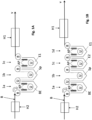
- FIG. 1A and 1B various embodiments of electrolysis systems for carrying out the method according to the invention are shown schematically.
- the electrolysis system of Figure 1A comprises three tanks 1a, 1b, 1c arranged next to one another or one behind the other in the direction of strip travel, the first tank 1a being filled with a basic electrolyte BE, the middle tank 1b with a rinsing solution Sp and the last tank 1c with a first electrolyte solution E1.
- the basic electrolyte BE consists of an aqueous soda solution (sodium carbonate solution with a concentration of 1 to 10% by weight and a pH of 10 to 11).
- the rinsing solution Sp consists of distilled or deionized water.
- the first electrolytic solution E1 is an aqueous solution of a trivalent chromium compound, which also has a salt to increase conductivity and an acid to set a desired pH between 2.5 and 3.5 and is free from organic complexing agents and free of buffering agents.
- the first electrolytic solution E1 consists of the trivalent one Chromium compound, in particular Cr (III) sulfate, the salt (e.g. potassium or sodium sulfate), the acid (e.g. sulfuric acid) and water as a solvent and otherwise has no other components.
- the first electrolytic solution E1 contains in particular no organic components, in particular no organic complexing agents such as formates and no buffering agents such as boric acid and is free from halides.
- composition of the first electrolytic solution E1 is given in Table 1.
- concentration of the trivalent chromium compound in the first electrolytic solution E1 is preferably at least 10 g/l and particularly preferably 20 g/l or more.
- the temperature of the first electrolytic solution E1 is preferably between 25°C and 70°C.
- a pair of cathodes KP is arranged in the first tank 1a and a pair of anodes AP is arranged in the last tank 1c.
- the pair of anodes AP is free of stainless steel and platinum and contains a coating of a metal oxide such as iridium oxide or a mixed metal oxide such as tantalum-iridium oxide.
- the anodes of the anode pair AP can also consist entirely of a metal oxide or a mixed metal oxide. Electric current can be applied to the cathodes of the cathode pair KP and the anodes of the anode pair AP.
- a tinned steel strip (tin plate strip, also referred to below as strip B) is passed through the tanks 1a-1c in succession.
- the strip B is pulled through the tanks 1a-1c by a transport device (not shown here) in a strip running direction v at a predetermined strip speed of preferably more than 100 m/min and in particular in the range from 100 to 750 m/min.
- Current rollers S are arranged above the tanks 1a-1c, via which the strip B can be connected as an anode or as a cathode.
- deflection rollers U In each electrolysis tank and above the tanks 1a-1c there are also deflection rollers U around which the strip B is guided and thereby guided through the tanks 1a-1c.
- the tape B is passed between the opposing cathodes of the cathode pair KP and between the two anodes of the anode pair AP.
- a first heater H1 is arranged downstream of the last tank 1c, and a second heater H2 is arranged upstream of the first tank.
- the heating devices H1 and H2 can each be a continuous furnace in which the strip B is heated to a predeterminable temperature and is kept at this temperature for a holding time. The holding time is determined by the belt speed and the length of the continuous furnace determined.
- the heating devices H1 and H2 can preferably also contain induction coils for inductively heating the strip.
- the first heating device H1 is set up to rapidly heat the strip B to temperatures between 100° C. and 232° C. for a treatment time of at least 0.5 seconds.
- the second heating device H2 is designed to heat the strip B to temperatures above the melting point of tin (232° C.).
- the strip B is first degreased, rinsed, pickled and rinsed again and first passed through the second heating device H2, then successively through the tanks 1a-1c and finally through the first heating device H1.
- the tin coating of the tinplate strip B is at least partially melted by heating to temperatures above the melting point of tin.
- the melting of the tin layer creates a dense iron-tin alloy layer at the interface of the steel sheet substrate and the tin coating of the tinplate, the composition of which depends on the temperature and which may contain FeSn and FeSn 2 or a mixture thereof.
- the tin coating is preferably only partially melted, so that a layer of free metallic tin remains on the surface. This can be anodically oxidized in the first tank 1a.
- the strip B in the first tank 1a is connected as an anode and a current density in the range from 0.1 to 10 A/dm 2 and preferably between 0.2 and 3 A/dm is generated by the pair of cathodes KP, depending on the strip speed 2 generated.
- a tin oxide layer which consists at least essentially of tetravalent tin oxide (SnO 2 )
- SnO 2 tetravalent tin oxide
- the thickness of the tin oxide layer produced electrolytically in the first tank 1a depends on the strip speed and the current density.
- the first tank 1a can also be passed through without current, so that no (tetravalent) tin oxide layer forms on the tin surface of the tinplate strip B.
- the band B is passed through the middle tank 1b with the rinsing solution Sp to rinse the band. This is followed by drying by means of a drying device not shown here.
- the strip B is connected as a cathode and a current density of more than 15 A/dm 2 , in particular in the range from 20 A/dm 2 to 40 A/dm 2 , is generated by means of the anodes of the anode pair AP.
- a chromium oxide-containing passivation layer P is deposited on the (oxidized) surface of the tinplate strip B, which, in addition to chromium oxide, can primarily contain chromium hydroxide and the unavoidable impurities of chromium sulfate.
- the weight of the layer containing chromium oxide can be controlled by the duration of the electrolysis in the last tank 1c, which in turn can be controlled by the strip speed and the current density.
- the minimum current density required for electrolytic deposition of a layer containing chromium oxide increases with higher belt speed.
- the duration of electrolysis in the last tank is between 0.5 and 2.0 seconds, depending on the belt speed.
- a passivation layer P containing chromium oxide is preferably deposited on the (oxidized) surface of the tinplate strip B in the last tank 1c with a weight requirement of 3 to 12 mg/m 2 based on the chromium.
- the electrolytically deposited passivation layer P consists essentially of chromium oxide and chromium hydroxide and in particular has a proportion by weight of chromium oxide and chromium hydroxide of at least 90%, preferably more than 95%, of the total weight of the passivation layer.
- the passivation layer can also contain unavoidable impurities such as residual components of chromium sulphate if Cr(III) sulphate has been used as the chromium compound in the first electrolytic solution E1.
- the passivated strip B is passed through the first heating device H1 and therein over a treatment time of at least 0.5 seconds to treatment temperatures above 100° C., in particular in the range from 100° C. to 230 °C.
- the treatment temperature should not exceed the melting point of tin (232°C) to prevent the tin layer from melting.
- the treatment time depends on the belt speed and the length of the first heating device H1, which can be in the range from 3 m to 30 m. When using induction heating, the length of the heating device can also be shorter.
- the proportion by weight of the chromium oxide in the total weight of the passivation layer is preferably at least 95% and particularly preferably more than 98%.
- FIG 2A is a schematic sectional view of one with the electrolysis system Figure 1A producible tinplate strip B shown.
- the passivation layer P is on one side of the strip B, which consists of the sheet steel substrate S, the iron-tin alloy layer (FeSn/FeSn 2 ), the metallic tin layer (Sn) and the (tetravalent) tin oxide layer (SnO 2 ). applied, which essentially consists of pure chromium oxide.
- the strip B can also be provided with a corresponding passivation layer P on both sides.
- the strip B provided with the dried passivation layer P can be rinsed, dried and oiled (for example with DOS).
- the passivated strip B can also be provided with an organic layer.
- the organic layer is applied in a known manner, for example by painting or laminating a plastic film onto the surface of the chromium oxide passivation layer.
- the chromium oxide surface of the passivation layer offers a good adhesion base for the organic material of the coating.
- the organic coating can be, for example, an organic paint or polymer films made from thermoplastic polymers such as PET, PE, PP or mixtures thereof.
- the organic coating can be applied, for example, in a "coil coating" process or in a panel process, with the coated strip being first divided into panels in the panel process, which are then coated with an organic paint or with a polymer film be coated.
- FIG 1B a second embodiment of an electrolysis system is shown, which contains four tanks 1a, 1b, 1c, 1d arranged one behind the other in the strip running direction v.
- the two front tanks 1a, 1b seen in the belt running direction correspond to the tanks 1a and 1b of the embodiment of FIG Figure 1A and are filled with the basic electrolyte BE and the rinsing solution Sp.
- a third tank 1c is arranged, which is filled with a second electrolytic solution E2.
- a fourth tank 1d which is filled with the first electrolytic solution E1, adjoins the third tank 1c in the strip travel direction v.
- Table 1 component concentration chromium sulfate 120g/L sodium sulfate 100g/L diluted sulfuric acid 96% 7ml/L VE water rest
- the composition of the first and the second electrolytic solution E1, E2 differs in that the first electrolytic solution E1 (as in the embodiment of Figure 1A ) is free of organic components and in particular free of organic complexing agents, whereas the second electrolytic solution E2 also contains organic complexing agents in addition to the trivalent chromium compound, a conductivity-increasing salt, an acid and the solvent water.
- organic complexing agents in addition to the trivalent chromium compound, a conductivity-increasing salt, an acid and the solvent water.
- formates for example sodium or potassium formate, are used as organic complexing agents.
- the electrolytic solutions E1 and E2 which are filled in the two downstream tanks 1c and 1d, in these last two tanks 1c and 1d, layers containing chromium oxide are electrolytically deposited on the surface of the tinplate strip B, which differ from each other in terms of their composition differentiate.
- a lower layer L1 of a passivation layer P is deposited in the tank 1c from the second electrolytic solution E2, and an upper layer L2 is deposited from the first electrolytic solution E1 in the last tank 1d.
- the lower layer L1 deposited from the second electrolytic solution E2 in the tank 1c also contains metallic chromium and chromium carbides.
- the upper layer L2 essentially consists of chromium oxide/chromium hydroxide. Therefore, the weight fraction of chromium oxide and chromium hydroxide is lower in the lower layer L1 deposited in the upstream tank 1c than in the upper layer L2 deposited on the surface of the tinplate strip B in the last tank 1d in the strip running direction.
- the passivation layer P deposited in the last two tanks 1c, 1d is therefore composed of a lower layer L1, which faces the sheet steel substrate S, and an upper layer L2 deposited thereon, the Composition of the lower and the upper layer differs in terms of the proportion by weight of chromium oxide and chromium hydroxide and of metallic chromium and chromium carbide.
- the upper layer L2 has a higher proportion by weight of chromium oxide/chromium hydroxide and contains no metallic chromium.
- 10% to 50% by weight can be metallic chromium and the remainder chromium oxide/chromium hydroxide and chromium carbides.
- FIG 2A is a schematic sectional view of one with the electrolysis system Figure 1B producible tinplate strips B shown with a passivation layer P.
- the passivation layer P on the surface of the passivated tinplate strip is composed of two layers, namely the lower layer L1 and the upper layer L2, which differ from one another in terms of composition and in particular the proportion by weight of chromium metal and chromium oxide/chromium hydroxide with a higher one Weight percentage of chromium oxide/ chromium hydroxide in the upper layer L2.
- a thermal treatment is carried out in the first heating device H1 in order to remove the chromium hydroxides from the passivation layer P and in particular from the upper layer L2 by drying and converting them into chromium oxides.
- the upper layer L2 consists essentially of pure chromium oxide, apart from unavoidable impurities, the proportion by weight of chromium oxide in the total weight of the passivation layer P being at least 95% and preferably more than 98%.
- tinplate panels were in the laboratory by electrolytic deposition of a passivated chromium oxide-containing passivation layer and then subjected to a thermal treatment according to the invention.
- the samples were then stored in an oxygen-containing atmosphere (air) in a climatic cabinet at 40° C. and a humidity of 80% for a period of 6 weeks.
- the amount of tin oxide layer that had formed on the tin surface of the tinplate samples as a result of oxidation with atmospheric oxygen was recorded.
- the amount of tin oxide layer formed by oxidation in atmospheric oxygen was determined coulometrically.
- the weight of chromium of the electrodeposited passivation layer P is shown in Table 2 as "chromium layer (Cr)".
- the tinplate samples provided with the passivation layer P were then subjected to a thermal treatment according to the invention in an oven for 600 seconds exposed to a temperature of 200 °C.
- this thermal treatment was not carried out.
- the samples thermally treated according to the invention and the comparison samples were then stored for 6 weeks in a climate chamber in atmospheric oxygen at 40° C. and 80% humidity, the amount of the tin oxide layer (SnO 2 ) being determined coulometrically at the beginning of storage and at 2-week intervals , which has formed on the tin surface of the tinplate samples in the respective storage period.
- Table 2 lists the initial amounts of tin oxide (SnO 2 ) layer present at the surface prior to sample placement and the amounts of tin oxide (SnO 2 ) layer detected after 2, 4 and 6 weeks of storage .
- the last column of Table 2 shows the difference in the amount of the tin oxide layer (SnO 2 ) after six weeks of storage in the climatic cabinet and the initial amount of the tin oxide layer (SnO 2 ).
- samples 1c, 2c, 3b and 4b in which the thermal treatment according to the invention was carried out after the electrolytic deposition of the passivation layer P, exhibit significantly less growth of tin oxide , in comparison to the comparative samples (samples 1a, 1b, 2a, 2b, 3a and 4a) in which no thermal treatment has taken place.
- the thermal treatment according to the invention of the passivated tinplate samples accordingly leads to a significant reduction in the tin oxide growth in an oxygen-containing atmosphere when the tinplate samples are stored for a longer period of time.
- the samples treated according to the invention show an inhibition of tin oxide growth of more than 50% compared to the comparison samples.
- tinplate strips with a tin coating of 2.4 g/m 2 on both sides were run at a strip speed of 300 m/min in a plant test.
- the electrolysis tanks were filled with the electrolyte E1 from Table 1.
- the tin layer was partially melted in the second heating device H2 and the first tank 1a was passed through without current, ie no anodic oxidation of the tin surface was carried out.
- a passivation layer P containing chromium oxide was deposited electrolytically on the tin surface of the tinplate strip with a weight layer (chromium layer) of approximately 9 mg/m 2 based on the chromium.
- the tinplate samples according to the invention were cooled to room temperature and thermally treated in the first heating device H1 for different treatment times between 10 seconds and 120 seconds at a treatment temperature of 187°C. This thermal treatment was not carried out on a comparative sample (sample no. 1 from Table 3). Thereafter, the tinplate strip was cut into sheets and the initial amount of tin oxide on the tin surface of the samples thus produced was coulometrically determined.
- the tinplate samples were stored in air for 4 weeks in a climatic chamber at 40° C. and a humidity of 80%, and the amount of tin oxide that accumulated during storage due to oxidation with atmospheric oxygen on the tin surface of the tinplate was measured at 2-week intervals Samples formed, recorded coulometrically.
- the comparative example (sample no. 1) has a tin oxide coating (SnO 2 ) of 11 C/m 2 on the tin surface at the beginning of the climate chamber storage and this oxide coating has increased to 44 C/m 2 after 2 weeks and to 60 C after 4 weeks /m 2 increased.
- SnO 2 tin oxide coating
- samples nos. 2 to 5 from Table 3 already have a lower tin oxide layer at the beginning of storage in the climatic chamber, and the growth of the tin oxide layer during storage in the climatic cabinet falls significantly in the samples according to the invention lower, with the inhibition of tin oxide growth being higher with longer treatment time.
- samples nos. 4 and 5 which have been thermally treated at 187°C for a treatment time of 60 seconds (sample no. 4) or 120 seconds (sample no. 5), exhibit a Tin oxide layer of less than 40 C / m 2 .
- Such tin oxide coatings of less than 40 C/m 2 are preferred both optically and with regard to paint adhesion and paintability.
- Tinplate with tin oxide coatings between 41 C/m 2 and 69 C/m 2 have sufficient adhesion for organic coatings, but have a pale yellowish surface and are therefore not ideal. With tin oxide occupancies above 69 C/m 2 it can lead to a complete failure of the material and in particular detachment of the organic layer due to poor adhesion to the surface of the passivated tinplate.
- the tin oxide growth on the tin surface of tinplate which has been provided with a passivation layer electrolytically from a trivalent chromium electrolyte can be significantly reduced, resulting in better adhesion of organic coatings and a pleasing visual appearance of the surface can.
Landscapes
- Chemical & Material Sciences (AREA)
- Engineering & Computer Science (AREA)
- Chemical Kinetics & Catalysis (AREA)
- Electrochemistry (AREA)
- Materials Engineering (AREA)
- Metallurgy (AREA)
- Organic Chemistry (AREA)
- Inorganic Chemistry (AREA)
- Electroplating Methods And Accessories (AREA)
- Electroplating And Plating Baths Therefor (AREA)
- Chemical Treatment Of Metals (AREA)
Applications Claiming Priority (1)
| Application Number | Priority Date | Filing Date | Title |
|---|---|---|---|
| DE102021125696.8A DE102021125696A1 (de) | 2021-10-04 | 2021-10-04 | Verfahren zur Passivierung der Oberfläche eines Weißblechs und Elektrolysesystem zur Durchführung des Verfahrens |
Publications (2)
| Publication Number | Publication Date |
|---|---|
| EP4159896A2 true EP4159896A2 (fr) | 2023-04-05 |
| EP4159896A3 EP4159896A3 (fr) | 2023-07-26 |
Family
ID=82781067
Family Applications (1)
| Application Number | Title | Priority Date | Filing Date |
|---|---|---|---|
| EP22187442.3A Pending EP4159896A3 (fr) | 2021-10-04 | 2022-07-28 | Procédé de passivation de la surface d'une tôle étamée et système d'électrolyse destiné à la mise en uvre du procédé |
Country Status (7)
| Country | Link |
|---|---|
| US (1) | US12065754B2 (fr) |
| EP (1) | EP4159896A3 (fr) |
| JP (1) | JP7554805B2 (fr) |
| KR (1) | KR102774047B1 (fr) |
| CN (1) | CN115928164A (fr) |
| CA (1) | CA3170557A1 (fr) |
| DE (1) | DE102021125696A1 (fr) |
Citations (3)
| Publication number | Priority date | Publication date | Assignee | Title |
|---|---|---|---|---|
| WO2015177314A1 (fr) | 2014-05-21 | 2015-11-26 | Tata Steel Ijmuiden B.V. | Procédé permettant de plaquer une bande métallique mobile, et bande métallique revêtue ainsi produite |
| WO2015177315A1 (fr) | 2014-05-21 | 2015-11-26 | Tata Steel Ijmuiden B.V. | Procédé pour la fabrication de substrats revêtus de chrome-oxyde de chrome et substrats revêtus produits de cette manière |
| EP3722464A1 (fr) | 2019-04-09 | 2020-10-14 | ThyssenKrupp Rasselstein GmbH | Procédé de passivation de la surface d'une tôle noire ou d'une tôle blanche et système d'électrolyse permettant la mise en oeuvre dudit procédé |
Family Cites Families (13)
| Publication number | Priority date | Publication date | Assignee | Title |
|---|---|---|---|---|
| FR2687693B1 (fr) * | 1992-02-25 | 1994-05-27 | Lorraine Laminage | Procede de traitement de surface d'un produit forme d'un substrat metallique comportant un revetement metallique multicouche et un revetement organique et produits obtenus par ce procede. |
| JP3449087B2 (ja) * | 1996-01-19 | 2003-09-22 | Jfeスチール株式会社 | 電子機器部品用錫めっき鋼板 |
| US6099714A (en) * | 1996-08-30 | 2000-08-08 | Sanchem, Inc. | Passification of tin surfaces |
| US6068755A (en) * | 1996-12-06 | 2000-05-30 | Canon Kabushiki Kaisha | Process for forming zinc oxide film and processes for producing semiconductor device plate and photo-electricity generating device using the film |
| KR101270833B1 (ko) * | 2011-05-24 | 2013-06-05 | 동부제철 주식회사 | 3가크롬 화학처리용 용액 조성물, 그 제조방법 및 이를 이용한 전기주석도금강판의 화학처리 방법 |
| DE102012000414B4 (de) * | 2012-01-12 | 2014-03-20 | Thyssenkrupp Rasselstein Gmbh | Verfahren zur Passivierung von Weißblech, sowie verzinntes Stahlband oder -blech |
| CA2869032C (fr) * | 2012-03-30 | 2016-07-05 | Tata Steel Ijmuiden B.V. | Substrat revetu pour applications d'emballage et procede de production dudit substrat revetu |
| ES2607114T3 (es) * | 2012-04-11 | 2017-03-29 | Tata Steel Ijmuiden Bv | Sustrato revestido con polímero para aplicaciones de envasado y un procedimiento para producir dicho sustrato revestido |
| RS56562B1 (sr) * | 2012-07-02 | 2018-02-28 | Tata Steel Ijmuiden Bv | Postupak za proizvodnju belog lima i proizvod proizveden njime |
| CA2892114C (fr) * | 2012-11-21 | 2017-02-28 | Tata Steel Ijmuiden B.V. | Revetements de chrome et d'oxyde de chrome appliques a des substrats en acier pour des applications de conditionnement et procede permettant de produire lesdits revetements |
| DE102013101847B3 (de) * | 2013-02-25 | 2014-03-27 | Thyssenkrupp Rasselstein Gmbh | Verfahren zur Herstellung eines korrosionsbeständigen Stahlblechs |
| US20220136121A1 (en) * | 2019-02-25 | 2022-05-05 | Tata Steel Ijmuiden B.V. | Method for manufacturing chromium oxide coated tinplate |
| DE102019109356A1 (de) * | 2019-04-09 | 2020-10-15 | Thyssenkrupp Rasselstein Gmbh | Verfahren zur Herstellung eines mit einer Beschichtung aus Chrom und Chromoxid beschichteten Metallbands auf Basis einer Elektrolytlösung mit einer dreiwertigen Chromverbindung und Elektrolysesystem zur Durchführung des Verfahrens |
-
2021
- 2021-10-04 DE DE102021125696.8A patent/DE102021125696A1/de active Pending
-
2022
- 2022-07-28 EP EP22187442.3A patent/EP4159896A3/fr active Pending
- 2022-08-17 CA CA3170557A patent/CA3170557A1/fr active Pending
- 2022-09-29 JP JP2022155876A patent/JP7554805B2/ja active Active
- 2022-09-30 CN CN202211230497.7A patent/CN115928164A/zh active Pending
- 2022-10-03 US US17/958,551 patent/US12065754B2/en active Active
- 2022-10-04 KR KR1020220126380A patent/KR102774047B1/ko active Active
Patent Citations (3)
| Publication number | Priority date | Publication date | Assignee | Title |
|---|---|---|---|---|
| WO2015177314A1 (fr) | 2014-05-21 | 2015-11-26 | Tata Steel Ijmuiden B.V. | Procédé permettant de plaquer une bande métallique mobile, et bande métallique revêtue ainsi produite |
| WO2015177315A1 (fr) | 2014-05-21 | 2015-11-26 | Tata Steel Ijmuiden B.V. | Procédé pour la fabrication de substrats revêtus de chrome-oxyde de chrome et substrats revêtus produits de cette manière |
| EP3722464A1 (fr) | 2019-04-09 | 2020-10-14 | ThyssenKrupp Rasselstein GmbH | Procédé de passivation de la surface d'une tôle noire ou d'une tôle blanche et système d'électrolyse permettant la mise en oeuvre dudit procédé |
Also Published As
| Publication number | Publication date |
|---|---|
| JP2023054762A (ja) | 2023-04-14 |
| JP7554805B2 (ja) | 2024-09-20 |
| KR102774047B1 (ko) | 2025-03-04 |
| CA3170557A1 (fr) | 2023-04-04 |
| US20230109499A1 (en) | 2023-04-06 |
| CN115928164A (zh) | 2023-04-07 |
| US12065754B2 (en) | 2024-08-20 |
| EP4159896A3 (fr) | 2023-07-26 |
| DE102021125696A1 (de) | 2023-04-06 |
| KR20230048621A (ko) | 2023-04-11 |
Similar Documents
| Publication | Publication Date | Title |
|---|---|---|
| EP3666931B1 (fr) | Procédé de fabrication d'une bande métallique ayant un revêtement de chrome et d'oxyde de chrome avec un électrolyte à base de chromium trivalent | |
| DE69520350T2 (de) | Galvanisiertes stahlblech und verfahren zur herstellung | |
| DE69408189T2 (de) | Kupferfolie für Leiterplatten und Verfahren zu ihrer Herstellung | |
| EP3733932A1 (fr) | Procédé de fabrication d'une bande métallique revêtue d'un revêtement de chrome et d'oxyde de chrome à base d'une solution électrolytique avec un composé à base de chrome trivalent et système d'électrolyse permettant la mise en oeuvre dudit procédé | |
| EP3722464A1 (fr) | Procédé de passivation de la surface d'une tôle noire ou d'une tôle blanche et système d'électrolyse permettant la mise en oeuvre dudit procédé | |
| DE3407830C2 (fr) | ||
| DE69809486T2 (de) | Mit einer zinkhaltigen Schicht versehenes Stahlblech und Verfahren zu seiner Herstellung | |
| DE3024932C2 (fr) | ||
| DE1771533A1 (de) | Verfahren zur Herstellung von ueberzogenen Metallblechen | |
| EP0366941B1 (fr) | Procédé de revêtement par électrodéposition de surfaces métalliques aptes au chromatage | |
| EP3666928B1 (fr) | Procédé de fabrication d'une bande métallique ayant un revêtement de chrome et d'oxyde de chrome avec un électrolyte à base de chromium trivalent | |
| DE69109029T2 (de) | Anode für Chrom-Elektroplattierung, Verfahren zur Herstellung und Verwendung dieser Anode. | |
| EP1570115B1 (fr) | Procede de depot electrolytique de magnesium sur une tole galvanisee | |
| EP4159896A2 (fr) | Procédé de passivation de la surface d'une tôle étamée et système d'électrolyse destiné à la mise en uvre du procédé | |
| DE1796253A1 (de) | Verfahren zur kontinuierlichen Herstellung von korrosionsfestem Flachstahlwalzgut | |
| DE3106361C2 (de) | Verfahren zum Herstellen galvanisch verzinkter Stahlbänder bzw. -bleche | |
| DE2246653B2 (de) | Beschichteter organischer Polymerisatformkörper und Verfahren zur Herstellung desselben | |
| EP3434807A1 (fr) | Tôle d'acier pourvue d'une couche de conversion, procédé de fabrication d'un tôle d'acier revêtue de la couche de conversion et milieu de traitement destiné à l'application d'une couche de conversion sur un tôle d'acier | |
| DE1621898B2 (de) | Verfahren zur elektrolytischen und elektrophoretischen Oberflächenbehandelung von Bändern aus Stahlblech | |
| DE102021116367A1 (de) | Verfahren zur Herstellung eines Stahlflachprodukts mit einem zink- oder aluminiumbasierten metallischen Überzug und entsprechendes Stahlflachprodukt | |
| DE102004037673B4 (de) | Verfahren zur simultanen elektrolytischen Abscheidung von Zink und Magnesium auf einem Substrat aus Blech und Verfahren zur Herstellung eines korrosionsgeschützten lackierten Formteils aus Blech | |
| DE102022106091A1 (de) | Verfahren zum Modifizieren einer Oberfläche eines beschichteten Stahlblechs | |
| DE1916049C3 (de) | Verfahren zur kathodischen Herstellung von hydratisieren Chromoxidüberzügen auf Stahlblech | |
| DE102022105844A1 (de) | Passivierungsschicht für metallhaltige Substrate | |
| DE2323336C2 (de) | Elektrolyt und Verfahren zur kathodischen Nachbehandlung von Weißblech oder-band |
Legal Events
| Date | Code | Title | Description |
|---|---|---|---|
| PUAI | Public reference made under article 153(3) epc to a published international application that has entered the european phase |
Free format text: ORIGINAL CODE: 0009012 |
|
| STAA | Information on the status of an ep patent application or granted ep patent |
Free format text: STATUS: THE APPLICATION HAS BEEN PUBLISHED |
|
| AK | Designated contracting states |
Kind code of ref document: A2 Designated state(s): AL AT BE BG CH CY CZ DE DK EE ES FI FR GB GR HR HU IE IS IT LI LT LU LV MC MK MT NL NO PL PT RO RS SE SI SK SM TR |
|
| PUAL | Search report despatched |
Free format text: ORIGINAL CODE: 0009013 |
|
| AK | Designated contracting states |
Kind code of ref document: A3 Designated state(s): AL AT BE BG CH CY CZ DE DK EE ES FI FR GB GR HR HU IE IS IT LI LT LU LV MC MK MT NL NO PL PT RO RS SE SI SK SM TR |
|
| RIC1 | Information provided on ipc code assigned before grant |
Ipc: C25D 11/34 20060101ALI20230621BHEP Ipc: C25D 9/10 20060101ALI20230621BHEP Ipc: C25D 9/08 20060101ALI20230621BHEP Ipc: C25D 5/50 20060101ALI20230621BHEP Ipc: C25D 3/06 20060101AFI20230621BHEP |
|
| STAA | Information on the status of an ep patent application or granted ep patent |
Free format text: STATUS: REQUEST FOR EXAMINATION WAS MADE |
|
| 17P | Request for examination filed |
Effective date: 20240126 |
|
| RBV | Designated contracting states (corrected) |
Designated state(s): AL AT BE BG CH CY CZ DE DK EE ES FI FR GB GR HR HU IE IS IT LI LT LU LV MC MK MT NL NO PL PT RO RS SE SI SK SM TR |