EP4163851A1 - Hybrides digitales ereignissteuerungssystem und verfahren dafür - Google Patents
Hybrides digitales ereignissteuerungssystem und verfahren dafür Download PDFInfo
- Publication number
- EP4163851A1 EP4163851A1 EP22200350.1A EP22200350A EP4163851A1 EP 4163851 A1 EP4163851 A1 EP 4163851A1 EP 22200350 A EP22200350 A EP 22200350A EP 4163851 A1 EP4163851 A1 EP 4163851A1
- Authority
- EP
- European Patent Office
- Prior art keywords
- sub
- event
- module
- modality
- control
- Prior art date
- Legal status (The legal status is an assumption and is not a legal conclusion. Google has not performed a legal analysis and makes no representation as to the accuracy of the status listed.)
- Pending
Links
Images

Classifications
-
- G—PHYSICS
- G06—COMPUTING OR CALCULATING; COUNTING
- G06Q—INFORMATION AND COMMUNICATION TECHNOLOGY [ICT] SPECIALLY ADAPTED FOR ADMINISTRATIVE, COMMERCIAL, FINANCIAL, MANAGERIAL OR SUPERVISORY PURPOSES; SYSTEMS OR METHODS SPECIALLY ADAPTED FOR ADMINISTRATIVE, COMMERCIAL, FINANCIAL, MANAGERIAL OR SUPERVISORY PURPOSES, NOT OTHERWISE PROVIDED FOR
- G06Q10/00—Administration; Management
- G06Q10/10—Office automation; Time management
Definitions
- the present invention relates to a system for controlling an event organized according to at least two modalities. It also relates to a control method using the control system.
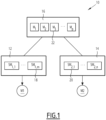
- FIG. 1 An example of the architecture of a control system 10 of a mixed event is illustrated schematically on the figure 1 .
- a mixed event is an event organized according to at least two modalities M1 and M2.
- a mixed event is an event taking place both face-to-face and virtually.
- the first modality M1 is the face-to-face and the second modality M2 is the virtual.
- each physical place would then correspond to a modality.
- a configuration could thus be envisaged in which as many modalities as there are places, counting the virtual as a place.
- a mixed event is described with a first modality M1 in person and a second modality M2 in virtual mode.
- the control system 10 makes it possible to control the event by offering management, measurement, analysis or monitoring functionalities.
- the control system 10 can therefore be seen as a management system, a measurement system, an analysis system or even a monitoring system.
- control system 10 comprises a first control subunit 12, a second control subunit 14 and a control unit 16.
- the first control subunit 12 is an event control subunit organized according to the first modality M1.
- the first control subunit 12 will be referred to below as “face-to-face control subunit 12” and the first modality M1 will be referred to as “face-to-face modality”.
- the face-to-face control sub-unit 12 comprises a set of sub-modules 18.
- Each sub-module 18 of the face-to-face control sub-unit 12 performs a specific function.
- the sub-modules 18 can be associated with the reference sign SM 1,i , i being a index between 1 and m and depending on the SM sub-module considered.
- the face-to-face control subunit 12 comprises a sub-module SM 1.1 for collecting information relating to the event organized face-to-face.
- this collection sub-module SM 1.1 can be referred to as the presential collection sub-module SM 1.1 .
- the face-to-face collection sub-module SM 1.1 is suitable for collecting information relating to the event organized face-to-face.
- At least one measurement relating to the event according to the face-to-face modality is present.
- the face-to-face collection sub-module SM 1.1 collects the number of people attending said face-to-face event.
- the face-to-face control subunit 12 is positioned in the place where the event takes place.
- the face-to-face control subunit 12 is a terminal, such as a computer or a smartphone (more often referred to by the corresponding English name of “ smartphone ”) .
- the second control subunit 14 is an event control subunit organized according to the second modality M2.
- the second control subunit 14 will be referred to below as “virtual control subunit 14” and the second modality will be referred to as “virtual modality M2”.
- the virtual control subunit 14 has a set of submodules 20.
- Each sub-module 20 of the virtual control sub-unit 14 performs a specific function.
- the sub-modules 20 can be associated with the reference sign SM 2,j , j being a index between 1 and n and depending on the SM sub-module considered.
- the virtual control sub-unit 14 comprises a sub-module SM 2.1 for collecting information relating to the event organized in virtual mode.
- this collection sub-module SM 2.1 can be referred to as a virtual collection sub-module SM 2.1 .
- the virtual collection sub-module SM 2.1 is suitable for collecting information relating to the event organized virtually.
- At least one measurement relating to the event according to the virtual modality is present.
- the virtual collection sub-module SM 2.1 collects the number of people attending said virtual event.
- the number of participants present at a session the number of online registrants, the number of connections per category of registrants, this list is not exhaustive.
- the virtual control subunit 14 and the control unit 16 are servers located remotely from the first control subunit 12.
- virtual control subunit 14 and control unit 16 are located in the same server farm.
- control system 10 will comprise as many control subunits as there are modalities.
- the associated control subunit will be located at the given location.
- the control unit 16 is suitable for controlling each control subunit 12, 14.
- the control unit 16 has a set of modules 22.
- each module M k can be identified by an index k, i.e. an integer between 1 and p.
- control unit 16 comprises a communication module M 1 , a processing module M 2 and a statistics module M 3 .
- the communication module M 1 is capable of communicating with each control subunit 12 and 14.
- the processing module M 2 is suitable for processing the information relating to each modality M1 and M2 to determine measures relating to the event.
- the statistical module M 3 is capable of applying statistical functions to the measurements relating to the event to obtain statistical information relating to the event.
- the statistical module M 3 will be able to provide the average number of participants, a correlation between the presence of certain types of exhibitors and the number of participants or even the percentage of increase in sales.
- the statistics module M 3 uses as statistical function an artificial intelligence technique, such as a neural network or an algorithm driven by supervised learning.
- control system 10 has the advantage of allowing the user to benefit from remarkable adaptability.
- each module M and each sub-module SM have an activated state and a deactivated state.
- each module M and of each sub-module SM are checked by the control unit 16.
- control can simply take the form of inhibition or an activation of the communication.
- the protocols used for such communications are not arbitrary.
- a protocol used is the hypertext transfer protocol.
- Such a protocol is more often designated by the abbreviation HTTP which refers to the corresponding English denomination of “ Hypertext Transfer Protocol ” .
- protocol used for inter-module communications is the GRPC and public communications are done via APIs.
- GRPC refers to the corresponding English name of “Google Remote Procedure Call” which literally means Google's remote call procedure.
- an application programming interface is more often designated by the abbreviation API which refers to the corresponding English denomination of “Application Programming Interface” of the REST type.
- the abbreviation REST refers to the English name corresponding to “Representational State Transfer Application Program Interface” which literally means state representation transfer application programming interface.
- one way of adding or deleting a module M and/or a sub-module SM is to send a request to the control unit 16 using an application programming interface present in the first sub-module. control unit 12.
- SaaS refers to the corresponding English denomination of “ Software as as a service ” which literally means software as a service.
- control system 10 With reference to the flowchart of the figure 2 , an example of use of the control system 10 is now described by the presentation of an example of implementation of a method for controlling the event.
- the method comprises two phases P1 and P2.
- the first phase P1 is an event preparation phase.
- This preparation phase is in particular implemented just before the start of the event, for example a few days before the start of the event.
- the first phase P1 comprises, for example, a step of sending a request 30 and an activation step 32.
- the user will request the activation of the modules M and sub-modules SM that he needs.
- This request can take the form of a general functionality, the user then coming to request the functionality of counting the people present by selecting the latter on a man-machine interface of the control unit 16.
- control unit 16 receives the request and here activates the communication module M 1 , the processing module M 2 and the collection sub-modules SM 1.1 and SM 2, 1 .
- the second phase P2 can then be implemented.
- the second phase P2 comprises a first collection step 34, a first sending step 36, a second collection step 38, a second sending step 40, a receiving step 42 and a treatment 44.
- the first collection sub-module SM 1.1 collects the measurements of the number of people present in person.
- Every scan of an event invitation by a staff member of the organizing company is logged. This constitutes a first measurement collected.
- the face-to-face control sub-unit 12 sends the first measurement collected to the control unit 16.
- the virtual collection sub-module 14 collects the measurements of the number of people present in virtual mode.
- each connection to the event is recorded. This is a second measurement collected.
- the virtual control subunit 14 sends the second measurement collected to the control unit 10.
- control unit 16 receives both the first measurement and the second measurement.
- control unit 16 processes the two measurements.
- control unit 16 will detect any redundancies in the measurements, in particular a person present in the morning face-to-face and in the afternoon virtually must be counted as a single person. Similarly, a person who clicked the event login link multiple times in the same day should be counted as one person.
- control system 10 makes it easy to control the entire event.
- control system 10 has a very high adaptability.
- control system 10 preparation of the control system 10 is very simple since it suffices for the user to select the functionalities he needs. In particular, it is no longer necessary to install a tool for each desired functionality.
- control system 10 proposed is adapted to be used by an event organizer for each event that he organizes. The latter will only have to request the functionalities adapted to the event being organised.
- sub-modules SM 1,1 , ..., SM 1,n of the first control sub-unit 12 may be chosen from among a sub-module suitable for generating badges, a sub- access control module for the event or a sub-module for broadcasting the scientific presentations made within the framework of the event.
- sub-modules SM 2.1 , ..., SM 2.m of the second control sub-unit 14 may be chosen from among a specific sub-module for placing hybrid services online, a sub-module management of the scientific presentations made within the framework of the event, a sub-module for controlling access to the event, a sub-module for creating a virtual exhibition, a sub-module for distributing media content and a ad management sub-module.
- control system 10 which has just been described is not limited to the specific embodiment described. In particular, any combination of module(s) and sub-module(s) and hence of functionalities is possible.
Landscapes
- Engineering & Computer Science (AREA)
- Business, Economics & Management (AREA)
- Strategic Management (AREA)
- Entrepreneurship & Innovation (AREA)
- Human Resources & Organizations (AREA)
- Operations Research (AREA)
- Economics (AREA)
- Marketing (AREA)
- Data Mining & Analysis (AREA)
- Quality & Reliability (AREA)
- Tourism & Hospitality (AREA)
- Physics & Mathematics (AREA)
- General Business, Economics & Management (AREA)
- General Physics & Mathematics (AREA)
- Theoretical Computer Science (AREA)
- Computer And Data Communications (AREA)
- Selective Calling Equipment (AREA)
- Debugging And Monitoring (AREA)
Applications Claiming Priority (1)
| Application Number | Priority Date | Filing Date | Title |
|---|---|---|---|
| FR2110631A FR3128046A1 (fr) | 2021-10-07 | 2021-10-07 | Système de contrôle d’un événement numérique hybride et procédé associé |
Publications (1)
| Publication Number | Publication Date |
|---|---|
| EP4163851A1 true EP4163851A1 (de) | 2023-04-12 |
Family
ID=78827922
Family Applications (1)
| Application Number | Title | Priority Date | Filing Date |
|---|---|---|---|
| EP22200350.1A Pending EP4163851A1 (de) | 2021-10-07 | 2022-10-07 | Hybrides digitales ereignissteuerungssystem und verfahren dafür |
Country Status (2)
| Country | Link |
|---|---|
| EP (1) | EP4163851A1 (de) |
| FR (1) | FR3128046A1 (de) |
Citations (1)
| Publication number | Priority date | Publication date | Assignee | Title |
|---|---|---|---|---|
| US20200404218A1 (en) * | 2019-06-18 | 2020-12-24 | Tmrw Foundation Ip & Holding S. À R.L. | Merged reality live event management system and method |
-
2021
- 2021-10-07 FR FR2110631A patent/FR3128046A1/fr active Pending
-
2022
- 2022-10-07 EP EP22200350.1A patent/EP4163851A1/de active Pending
Patent Citations (1)
| Publication number | Priority date | Publication date | Assignee | Title |
|---|---|---|---|---|
| US20200404218A1 (en) * | 2019-06-18 | 2020-12-24 | Tmrw Foundation Ip & Holding S. À R.L. | Merged reality live event management system and method |
Also Published As
| Publication number | Publication date |
|---|---|
| FR3128046A1 (fr) | 2023-04-14 |
Similar Documents
| Publication | Publication Date | Title |
|---|---|---|
| MC2199A1 (fr) | Procede et systeme de traitement d'encheres | |
| EP2586175B1 (de) | Verfahren und vorrichtung zur überprüfung der physischen erkennung zwischen einem anrufer und einem angerufenen | |
| EP2507965B1 (de) | Abgestufter dienstwiederverkaufsmechanismus für iptv | |
| EP1590931A1 (de) | Verfahren zum präsentieren des status eines benutzers, der mehrere kommunikationseinrichtungen verwendet | |
| BE1023440A1 (fr) | Système de portier vidéo à canaux multiples avec accès à des services numériques avancés | |
| EP4256830A1 (de) | Verfahren und vorrichtung, gateway und computerprogramme zum zugriff auf ein lokales netzwerk | |
| EP3011712B1 (de) | Kommunikationsverfahren für eine interaktive anwendung zwischen endgeräten in einem bildschirmprojektionsraum | |
| EP4163851A1 (de) | Hybrides digitales ereignissteuerungssystem und verfahren dafür | |
| EP2360889A1 (de) | Erstellung und Benutzung einer Telekommunikationsverbindung zwischen zwei Benutzern eines Telekommunikationsnetzes | |
| EP1836823B1 (de) | Verfahren und system zum verbinden von personen in einem telekommunikationsnetz des internettyps | |
| EP2545437B1 (de) | Verfahren und system zur fernsteuerung eines anzeigeschirms | |
| EP2923482B1 (de) | Sprachkommunikationsdienst aus einem sozialen netzwerk | |
| EP3913911A1 (de) | Einfaches bildtelefonsystem | |
| EP1432171B1 (de) | Verfahren und System zur automatischen und simultanen Verteilung elektronischer Dokumente mit verschiedenen Formaten auf dem Internet | |
| EP2360890B1 (de) | Erstellung und Nutzung eines gemeinsamen Raums basierend auf zumindest einem, einem Quellenbenutzer zugeordnete Inhalts bestimmt für mehrere Zielbenutzer. | |
| FR2867931A1 (fr) | Procede de mise en relation de personnes jointes par multi-diffusion | |
| EP2701398B1 (de) | Verarbeitungsverfahren eines Multimediaflusses, entsprechende Server und Computerprogramm | |
| Saint-André et al. | La télépsychiatrie au service de l’autisme | |
| FR2811504A1 (fr) | Dispositif serveur de realisation multi-utilisateur en libre-service et de diffusion d'emissions de television et reseau de television | |
| FR2999854A1 (fr) | Procede et systeme pour visionner en direct l'ambiance dans des lieux de divertissement. | |
| WO2022043306A1 (fr) | Système de gestion de contenus multimédias publiés via un réseau social, paramétré pour adapter la durée de diffusion d'un fichier à partager en fonction d'appréciations | |
| FR3120462A1 (fr) | Méthode de conception d’une installation de sécurité par collecte dématérialisée d’informations | |
| FR3003984A1 (fr) | Procede conditionne de partage de facettes d'utilisateurs et serveur de partage pour la mise en oeuvre du procede | |
| WO2008065295A1 (fr) | Systeme de telecommunication permettant d'acheminer un appel vers une destination inconnue d'un emetteur dudit appel | |
| FR2857127A1 (fr) | Dispositif de communication et d'affichage de donnees numeriques incluant au moins une image, notamment a caractere medical |
Legal Events
| Date | Code | Title | Description |
|---|---|---|---|
| PUAI | Public reference made under article 153(3) epc to a published international application that has entered the european phase |
Free format text: ORIGINAL CODE: 0009012 |
|
| STAA | Information on the status of an ep patent application or granted ep patent |
Free format text: STATUS: THE APPLICATION HAS BEEN PUBLISHED |
|
| AK | Designated contracting states |
Kind code of ref document: A1 Designated state(s): AL AT BE BG CH CY CZ DE DK EE ES FI FR GB GR HR HU IE IS IT LI LT LU LV MC ME MK MT NL NO PL PT RO RS SE SI SK SM TR |
|
| STAA | Information on the status of an ep patent application or granted ep patent |
Free format text: STATUS: REQUEST FOR EXAMINATION WAS MADE |
|
| 17P | Request for examination filed |
Effective date: 20230913 |
|
| RBV | Designated contracting states (corrected) |
Designated state(s): AL AT BE BG CH CY CZ DE DK EE ES FI FR GB GR HR HU IE IS IT LI LT LU LV MC ME MK MT NL NO PL PT RO RS SE SI SK SM TR |
|
| STAA | Information on the status of an ep patent application or granted ep patent |
Free format text: STATUS: EXAMINATION IS IN PROGRESS |
|
| 17Q | First examination report despatched |
Effective date: 20231113 |
|
| GRAP | Despatch of communication of intention to grant a patent |
Free format text: ORIGINAL CODE: EPIDOSNIGR1 |
|
| STAA | Information on the status of an ep patent application or granted ep patent |
Free format text: STATUS: GRANT OF PATENT IS INTENDED |
|
| INTG | Intention to grant announced |
Effective date: 20250926 |