EP4165236B1 - Procédé de fabrication électrochimique d'acides alcanicarboxyliques par oxydation avec ouverture de cycle au moyen d'une électrode en mousse ni(o)oh dopée - Google Patents
Procédé de fabrication électrochimique d'acides alcanicarboxyliques par oxydation avec ouverture de cycle au moyen d'une électrode en mousse ni(o)oh dopée Download PDFInfo
- Publication number
- EP4165236B1 EP4165236B1 EP21727488.5A EP21727488A EP4165236B1 EP 4165236 B1 EP4165236 B1 EP 4165236B1 EP 21727488 A EP21727488 A EP 21727488A EP 4165236 B1 EP4165236 B1 EP 4165236B1
- Authority
- EP
- European Patent Office
- Prior art keywords
- carbon atoms
- weight
- mol
- carried out
- hydrogen
- Prior art date
- Legal status (The legal status is an assumption and is not a legal conclusion. Google has not performed a legal analysis and makes no representation as to the accuracy of the status listed.)
- Active
Links
Images

Classifications
-
- C—CHEMISTRY; METALLURGY
- C25—ELECTROLYTIC OR ELECTROPHORETIC PROCESSES; APPARATUS THEREFOR
- C25B—ELECTROLYTIC OR ELECTROPHORETIC PROCESSES FOR THE PRODUCTION OF COMPOUNDS OR NON-METALS; APPARATUS THEREFOR
- C25B3/00—Electrolytic production of organic compounds
- C25B3/20—Processes
- C25B3/23—Oxidation
-
- C—CHEMISTRY; METALLURGY
- C25—ELECTROLYTIC OR ELECTROPHORETIC PROCESSES; APPARATUS THEREFOR
- C25B—ELECTROLYTIC OR ELECTROPHORETIC PROCESSES FOR THE PRODUCTION OF COMPOUNDS OR NON-METALS; APPARATUS THEREFOR
- C25B11/00—Electrodes; Manufacture thereof not otherwise provided for
- C25B11/02—Electrodes; Manufacture thereof not otherwise provided for characterised by shape or form
- C25B11/03—Electrodes; Manufacture thereof not otherwise provided for characterised by shape or form perforated or foraminous
- C25B11/031—Porous electrodes
-
- C—CHEMISTRY; METALLURGY
- C25—ELECTROLYTIC OR ELECTROPHORETIC PROCESSES; APPARATUS THEREFOR
- C25B—ELECTROLYTIC OR ELECTROPHORETIC PROCESSES FOR THE PRODUCTION OF COMPOUNDS OR NON-METALS; APPARATUS THEREFOR
- C25B11/00—Electrodes; Manufacture thereof not otherwise provided for
- C25B11/04—Electrodes; Manufacture thereof not otherwise provided for characterised by the material
- C25B11/042—Electrodes formed of a single material
- C25B11/047—Ceramics
-
- C—CHEMISTRY; METALLURGY
- C25—ELECTROLYTIC OR ELECTROPHORETIC PROCESSES; APPARATUS THEREFOR
- C25B—ELECTROLYTIC OR ELECTROPHORETIC PROCESSES FOR THE PRODUCTION OF COMPOUNDS OR NON-METALS; APPARATUS THEREFOR
- C25B3/00—Electrolytic production of organic compounds
- C25B3/01—Products
- C25B3/07—Oxygen containing compounds
-
- C—CHEMISTRY; METALLURGY
- C25—ELECTROLYTIC OR ELECTROPHORETIC PROCESSES; APPARATUS THEREFOR
- C25B—ELECTROLYTIC OR ELECTROPHORETIC PROCESSES FOR THE PRODUCTION OF COMPOUNDS OR NON-METALS; APPARATUS THEREFOR
- C25B9/00—Cells or assemblies of cells; Constructional parts of cells; Assemblies of constructional parts, e.g. electrode-diaphragm assemblies; Process-related cell features
- C25B9/13—Single electrolytic cells with circulation of an electrolyte
- C25B9/15—Flow-through cells
Definitions
- the invention relates to a process for the electrochemical production of alkylenedicarboxylic acids by ring-opening oxidation using a doped Ni(O)OH foam electrode in an aqueous alkaline solution.
- BV Lyalin and VA Petrosyan disclose the production of unsubstituted adipic acid and the oxidation of carbohydrates.
- EP 2907898 A1 ( US 2015/0225861 A1 ) discloses the use of nickel foam at reaction temperatures of 80 ° C for the oxidative ring cleavage of 3,3,5-trimethylcyclohexanol in one embodiment variant. The reaction was carried out in a highly diluted solution with low yields.
- Schmitt et al. (Beilstein J. Org. Chem., 2015, 11, 473-480 ) reveal the cleavage of lignin into various oxo-substituted aromatics using different electrodes. The oxidation to the corresponding acids was not successful.
- Another advantage is the high yield of the process according to the invention.
- the present invention thus opens up for the first time the possibility of developing a technically relevant continuous process for obtaining alkanedicarboxylic acids without the use of aggressive chemicals and still in high yields.
- R 1 , R 2 , R 3 can be the same or different, hydrogen or alkyl radical with 1 to 8 carbon atoms, preferably 1 to 5 carbon atoms, linear or branched, where at least one of the radicals R 1 , R 2 , R 3 is an alkyl radical.
- radicals R 1 , R 2 , R 3 are particularly preferably hydrogen and R 2 is an alkyl radical with 1 to 4 carbon atoms.
- the process according to the invention is preferably carried out according to scheme (IV).
- A is a hydrocarbon with 4 to 9 carbons, all ring carbons of A in the cyclic starting material of scheme (IV) carrying at least one hydrogen substituent, A has at least 2 ring carbon atoms, more preferably 3 to 9 ring carbon atoms.
- the process according to the invention is preferably carried out according to at least one of the schemes (II), (III) or (IV).
- Isomers are known to those skilled in the art; reference is made in particular to the definitions by Prof. Kazmaier of Saarland University, e.g. E.g. http://www.uni-saarland.de/fak8/kazmaier/PDF_files/vorlesungen/Stereochemie%20Strassb%20V orlage.pdf.
- the doping content information relates to the elementary state of the doping based on the mass of the metal of the electrode.
- the Ni(O)OH foam electrode preferably has 3 to 9% by weight of phosphorus and more preferably 4 to 9% by weight; phosphorus is considered an element and is based on the metal mass of the electrode.
- the content determination of the phosphorus doping is preferably carried out in accordance with DIN EN ISO 5427, Appendix D.1.
- the Ni(O)OH foam electrode preferably has a thickness of several millimeters, more preferably more than 3 mm, more preferably more than 5 mm and particularly preferably equal to or thicker than 6 mm.
- the Ni(O)OH foam electrode preferably contains at least 90% by weight of metal, more preferably at least 95, 98, 99% by weight, more preferably at least 99.9, particularly preferably at least 99.99% by weight. Nickel, based on the total metal content.
- Ni(O)OH foam electrode can contain other metals besides nickel.
- Preferred other metals are Co, Fe and Cu.
- Content of other metals in the Ni(O)OH foam electrode is preferably equal to or less than 10% by weight, more preferably 5% by weight, more preferably 2% by weight, particularly preferably less than or equal to 1% by weight based on the total metal content.
- the Ni(O)OH foam electrode preferably contains a maximum of 5% by weight, preferably 2% by weight, more preferably 1% by weight and particularly preferably 0.5% by weight and particularly preferably a maximum of 0.1% by weight.
- % iron or iron compounds where the content information relates to the element in relation to the total metal content.
- the Ni(O)OH foam electrode preferably contains a maximum of 1% by weight, preferably 0.1% by weight and more preferably a maximum of 0.01% by weight of V, Wo and Mo; These metals are subject to corrosion in an alkaline-aqueous medium, which can have an unfavorable effect on the process according to the invention.
- any metal that is inert to the reaction medium can be used as a cathode material.
- cosolvents can be alcohols or DMSO. Up to 30% by volume of a cosolvent is preferably present, more preferably 1 to 20% by volume, based on the sum of the solvents, more preferably the solvent consists of water.
- alkaline additives are suitable as alkaline additives.
- Alkaline metal hydroxides such as LiOH, NaOH, KOH, and soluble alkaline earth metal hydroxides are preferred in the process according to the invention.
- Sodium hydroxide is particularly preferably used according to the invention.
- the concentration of the alkaline additive is preferably 0.5 to 2 mol/l based on the aqueous alkaline solution, more preferably 0.8 to 1.5 mol/l and particularly preferably 1 mol/l with a possible deviation of up to 10% , preferably a deviation of up to 5% of the molarity.
- the concentration of the starting materials according to scheme (I) is preferably 0.06 to 0.5 mol/l, more preferably 0.08 to 0.3 and particularly preferably 0.09 to 0.11 mol/l.
- the total current that leads to the reaction according to the invention according to schemes (II) and (III) is 8 F.
- 8 to 10 F are used, more preferably 8.5 to 9 F.
- 6 F are required for implementation according to scheme (IV).
- 6 to 8 F are used, more preferably 6.5 to 7 F.
- the method according to the invention is preferably carried out with a current density of 2 to 10 mA/cm 2 , more preferably 2.5 to 7.5 mA/cm 2 and particularly preferably 3.3 to 6 mA/cm 2 .
- the area specification refers to the geometric area without taking the inner surface of the foam into account.
- This current density information refers to the largest area on one of the sides and is therefore independent of the flow direction in the case of the flow cell.
- the process according to the invention can be carried out discontinuously, for example in a batch electrolysis cell or continuously in an electrolysis cell through which flow occurs, preferably in an electrolysis cell through which flow is continuous.
- the process according to the invention is preferably carried out at temperatures of 20 - 70°C, preferably 30 - 60°C, more preferably 35 - 50°C.
- the method according to the invention is carried out using a doped Ni(O)OH foam electrode, the doping being selected from phosphorus, arsenic, selenium and sulfur, the concentration of alkali being 0.8 to 1.5 mol/l and the concentration of starting material according to scheme (I) is 0.08 to 0.3 mol/l.
- the method according to the invention is carried out using a Ni(O)OH foam electrode doped with phosphorus, the concentration of alkali being 0.8 to 1.5 mol/l and the current density being 2 to 10 mA/cm 2 .
- the method according to the invention is carried out using a Ni(O)OH foam electrode doped with phosphorus according to scheme (IV).
- A is a hydrocarbon with 4 to 9 carbons, all ring carbons of A in the cyclic starting material of scheme (IV) carrying at least one hydrogen substituent, preferably A has at least 2 ring carbon atoms, more preferably 3 to 9 ring carbon atoms.
- the method according to the invention is more preferably carried out using a phosphorus-doped Ni(O)OH foam electrode in a flow cell, the concentration of alkali being 0.8 to 1.5 mol/l and the concentration of starting material according to scheme (I). is 0.08 to 0.3 mol/l.
- the method according to the invention is particularly preferably carried out using a phosphorus-doped Ni(O)OH foam electrode in a flow cell, the concentration of alkali being 0.8 to 1.5 mol/l, whereby the Concentration of starting material according to scheme (I) is 0.08 to 0.3 mol/l and the flow rate of the reaction medium in the anode space is at least 5 cm/min, preferably at least 8 cm/min, more preferably at least 10 cm/min .
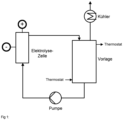
- Figure 1 shows the schematic structure with a reaction cell with continuous flow
- Figure 2 shows the temperature dependence of the yield of the reaction according to Table 1, entry 1, for the doped anode in the batch test.
- All anodes used had dimensions of length 60 mm, width 20 and thickness 6 mm. In the batch process, however, only half of the surface (length 30 mm) was immersed to carry out the process according to the invention.
- the cathodes have the same surface area as the anodes, but are made of sheet metal. The thickness does not play a significant role, especially in the flow process only one surface is exposed to the reaction medium.
- the nickel foam electrodes had a density of 0.35 to 0.44 g/cm 3 . This corresponds to a porosity of 95 to 96%.
- the phosphorus-doped electrodes were purchased from Aqua Titan, Dortmund.
- Ni(O)OH layer of the anodes was carried out in 280 ml of a solution of 0.1 mol/l NiSO 4 * 6H 2 O, 0.1 mol/l NaOAc * 3H 2 O, 0.005 mol/l NaOH in carried out with distilled water.
- the electrodes were completely immersed and coated with a pole change (10 s) at 150 coulombs and 10 mA/cm 2 at room temperature. After the reaction was complete, the electrodes were rinsed and then dried.
- the reaction cell was filled (25 ml) with water and sodium hydroxide dissolved therein (1 mol/l) and the substance to be oxidized (educt according to scheme (I)). The concentration of starting material was 0.1 mol/l. The stirred solution was then tempered. The electrooxidation was carried out under galvanostatic conditions.
- the doped Ni(O)OH foam electrode prepared above was used as the anode in the experiments according to the invention; in the experiments not according to the invention, electrodes of basically the same construction and not doped with phosphorus were used and stainless steel sheet electrodes were used as cathodes.
- the solution was discharged quantitatively (with rinsing using demineralised water and dichloromethane (20 ml each)) and extracted with dichloromethane (volume ratio: water to organic solvent approximately 2 to 1).
- the remaining aqueous phase was adjusted to pH 1 with 50% sulfuric acid and extracted four times with diethyl ether (volume ratio: water to organic solvent approximately 2 to 1).
- the organic phases were dried separately over sodium sulfate and the solvent was then removed on a rotary evaporator.
- the doped Ni(O)OH foam electrode produced above was installed in a multilayer Teflon block in such a way that it was completely flowed through; the entry area was 6 mm * 20 mm, i.e. the flow direction was in the longitudinal axis of the electrode.
- the cathode was separated by a slot plate at a distance of less than a millimeter.
- the chamber was flowed through from bottom to top in an upright position.
- a Ritmo ® 05 from Fink Chem+Tec GmbH & Co. KG was used as the pump.
- reaction solutions were carried out as in the batch process.
- the workup was carried out as in the batch process.
- DC6 octanedioic acid
Landscapes
- Chemical & Material Sciences (AREA)
- Organic Chemistry (AREA)
- Engineering & Computer Science (AREA)
- Chemical Kinetics & Catalysis (AREA)
- Electrochemistry (AREA)
- Materials Engineering (AREA)
- Metallurgy (AREA)
- Ceramic Engineering (AREA)
- Electrolytic Production Of Non-Metals, Compounds, Apparatuses Therefor (AREA)
- Organic Low-Molecular-Weight Compounds And Preparation Thereof (AREA)
- Electrodes For Compound Or Non-Metal Manufacture (AREA)
Claims (14)
- Procédé pour la préparation électrochimique d'acides alcanedicarboxyliques par oxydation avec ouverture de cycle en solution alcaline aqueuse, caractérisé en ce que l'oxydation est effectuée sur une électrode en mousse de Ni(O)OH dopée par des éléments du 5e et/ou 6e groupe principal, l'électrode en mousse de Ni(O)OH présentant 2 à 10% en poids de phosphore, le phosphore étant pris comme élément et se rapportant à la masse métallique de l'électrode,
selon le schéma (I)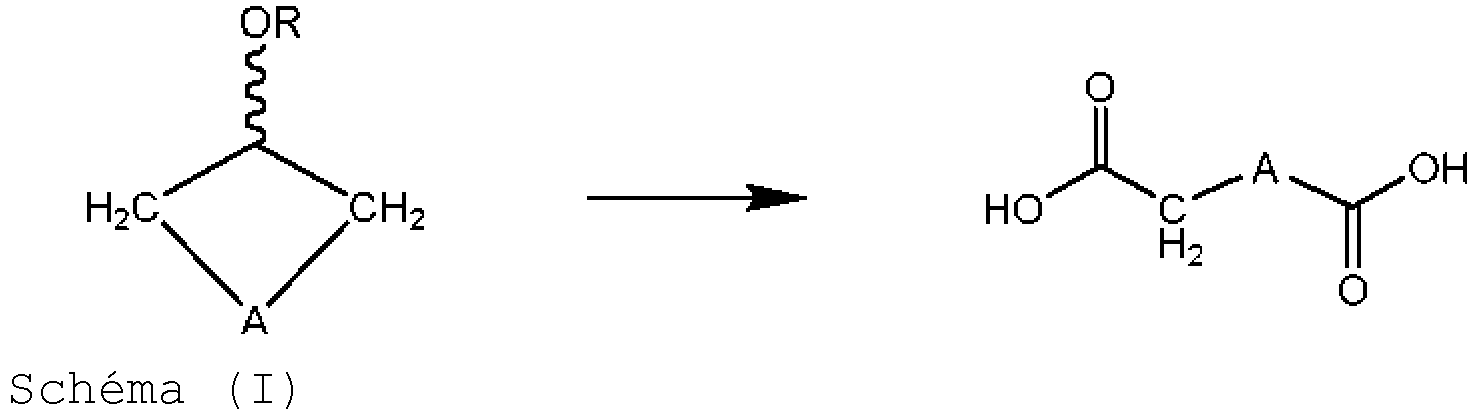 dans lequelreprésente une simple ou une double liaison, R étant de manière correspondante présent ou non,
 R représentant hydrogène ou un radical acyle, le radical acyle étant le radical d'un acide monocarboxylique aliphatique comprenant 2 à 8 atomes de carbone et A représentant un hydrocarbure comprenant 4 à 30 atomes de carbone, tous les carbones de cycle de A dans le produit de départ cyclique du schéma (I) portant au moins un substituant hydrogène.
 - Procédé selon la revendication 1, caractérisé en ce que l'électrode en mousse de Ni(O)OH présente 3 à 9% en poids et de préférence 4 à 9% en poids, le phosphore étant pris comme élément et se rapportant à la masse métallique de l'électrode.
- Procédé selon la revendication 1 à 2, caractérisé en ce que l'électrode en mousse de Ni(O)OH présente une épaisseur de plusieurs millimètres, de préférence de plus de 3 mm, plus préférablement de plus de 5 mm et en particulier de préférence une épaisseur de 6 mm ou plus.
- Procédé selon au moins l'une des revendications 1 à 3, caractérisé en ce que l'électrode en mousse de Ni(O)OH contient, comme métal, au moins 80% en poids, de préférence 90, 95, 98, 99% en poids, plus préférablement au moins 99,9, en particulier de préférence 99,99% en poids de nickel.
- Procédé selon au moins l'une des revendications 1 à 4, caractérisé en ce que la solution aqueuse signifie que jusqu'à 30% en volume d'un cosolvant peuvent être présents dans la solution.
- Procédé selon au moins l'une des revendications 1 à 5, caractérisé en ce que l'ajout alcalin de la solution aqueuse est l'hydroxyde de lithium, l'hydroxyde de sodium ou l'hydroxyde de potassium, d'autres anions des bases n'étant de préférence pas présents.
- Procédé selon au moins l'une des revendications 1 à 6, caractérisé en ce que la concentration de l'ajout alcalin est de 0,5 à 2 moles/l par rapport à la solution alcaline aqueuse, de préférence 0,8 à 1,5 mole/l et en particulier de préférence 1 mole/l avec un écart possible de jusqu'à 10%, de préférence avec un écart de jusqu'à 5% de la molarité.
- Procédé selon au moins l'une des revendications 1 à 7, caractérisé en ce que la concentration en cycloalcanols, c'est-à-dire que dans le schéma (I) R = hydrogène et représente une simple liaison, est de 0,06 à 0,5 mole/l, de préférence de 0,08 à 0,3 et en particulier de préférence 0,09 à 0,11 mole/l.
- Procédé selon au moins l'une des revendications 1 à 8, caractérisé en ce que le procédé est effectué selon

- Procédé selon la revendication 9, la quantité appliquée totale d'électrons étant de 8 à 10 F, plus préférablement de 8,5 à 9 F, F représentant l'unité Faraday.
- Procédé selon au moins l'une des revendications 1 à 9, caractérisé en ce que le procédé est réalisé à une densité de courant de 2 à 10 mA/cm2, plus préférablement de 2,5 à 7,5 mA/cm2 et en particulier de préférence de 3,3 à 6 mA/cm2, l'indication de surface se rapportant à la surface géométrique sans prendre en compte la surface interne de la mousse.
- Procédé selon au moins l'une des revendications précédentes, caractérisé en ce que l'électrolyse est effectuée dans une cellule d'électrolyse par lots ou dans une cellule d'électrolyse à écoulement continu, de préférence dans une cellule d'électrolyse à écoulement continu.
- Procédé selon au moins l'une des revendications précédentes, caractérisé en ce que de l'acier inoxydable, du platine ou du nickel ou un mélange est utilisé comme matériau de la cathode.
- Procédé selon au moins l'une des revendications précédentes, caractérisé en ce que l'électrolyse est effectuée à des températures de 20 - 70°C, de préférence de 30 - 60°C, plus préférablement de 35 - 50°C.
Applications Claiming Priority (2)
| Application Number | Priority Date | Filing Date | Title |
|---|---|---|---|
| EP20179245.4A EP3922758A1 (fr) | 2020-06-10 | 2020-06-10 | Procédé de fabrication électrochimique d'acides alcanicarboxyliques par oxydation avec ouverture de cycle au moyen d'une électrode en mousse ni(o)oh dopée |
| PCT/EP2021/064057 WO2021249775A1 (fr) | 2020-06-10 | 2021-05-26 | Procédé de production électrochimique d'acides alcanedicarboxyliques au moyen d'une oxydation par ouverture de cycle au moyen d'une électrode en mousse de ni(o)oh dopé |
Publications (2)
| Publication Number | Publication Date |
|---|---|
| EP4165236A1 EP4165236A1 (fr) | 2023-04-19 |
| EP4165236B1 true EP4165236B1 (fr) | 2023-12-27 |
Family
ID=71083537
Family Applications (2)
| Application Number | Title | Priority Date | Filing Date |
|---|---|---|---|
| EP20179245.4A Withdrawn EP3922758A1 (fr) | 2020-06-10 | 2020-06-10 | Procédé de fabrication électrochimique d'acides alcanicarboxyliques par oxydation avec ouverture de cycle au moyen d'une électrode en mousse ni(o)oh dopée |
| EP21727488.5A Active EP4165236B1 (fr) | 2020-06-10 | 2021-05-26 | Procédé de fabrication électrochimique d'acides alcanicarboxyliques par oxydation avec ouverture de cycle au moyen d'une électrode en mousse ni(o)oh dopée |
Family Applications Before (1)
| Application Number | Title | Priority Date | Filing Date |
|---|---|---|---|
| EP20179245.4A Withdrawn EP3922758A1 (fr) | 2020-06-10 | 2020-06-10 | Procédé de fabrication électrochimique d'acides alcanicarboxyliques par oxydation avec ouverture de cycle au moyen d'une électrode en mousse ni(o)oh dopée |
Country Status (6)
| Country | Link |
|---|---|
| US (1) | US11976373B2 (fr) |
| EP (2) | EP3922758A1 (fr) |
| JP (1) | JP7801256B2 (fr) |
| CN (1) | CN115917047B (fr) |
| ES (1) | ES2975117T3 (fr) |
| WO (1) | WO2021249775A1 (fr) |
Families Citing this family (9)
| Publication number | Priority date | Publication date | Assignee | Title |
|---|---|---|---|---|
| EP3741790A1 (fr) | 2019-05-20 | 2020-11-25 | Evonik Operations GmbH | Polyamide à sous-structures de terpénoïdes cycliques |
| EP4253602A1 (fr) * | 2022-03-28 | 2023-10-04 | Evonik Operations GmbH | Oxydation électrochimique des cycloalcènes et des cycloalcanes en acides alpha,oméga-dicarboniques ou en acides cétocarboniques et en composés de cycloalkanones |
| EP4253604A1 (fr) * | 2022-03-28 | 2023-10-04 | Evonik Operations GmbH | Oxydation électrochimique des acides gras et des esters d'acides gras en acides monocarboniques et en acides alpha,omega-dicarboniques |
| EP4253603A1 (fr) * | 2022-03-28 | 2023-10-04 | Evonik Operations GmbH | Oxydation électrochimique des cycloalcanes en composés de cycloalkanone |
| EP4253605A1 (fr) | 2022-03-28 | 2023-10-04 | Evonik Operations GmbH | Oxydation électrochimique des cycloalcènes en acides alpha,oméga-dicarboniques et en acides cétocarboniques |
| CN116143607B (zh) * | 2023-02-24 | 2024-11-22 | 广西科学院 | 一种制备木质素基3-乙基己二酸或3-丙基己二酸的方法 |
| EP4459010A1 (fr) * | 2023-05-02 | 2024-11-06 | Evonik Operations GmbH | Fabrication d'une électrode en mousse d'oxyde hydroxyde de nickel activée stable |
| EP4459011A1 (fr) | 2023-05-02 | 2024-11-06 | Evonik Operations GmbH | Procede d'oxydation electrochimique a haut rendement |
| CN119615199B (zh) * | 2024-12-09 | 2025-10-14 | 北京化工大学 | 一种电催化环己烯制备己二酸的方法 |
Family Cites Families (12)
| Publication number | Priority date | Publication date | Assignee | Title |
|---|---|---|---|---|
| DE3700709A1 (de) * | 1987-01-13 | 1988-07-21 | Basf Ag | Verfahren zur herstellung von (poly)oxatetramethylendicarbonsaeuren |
| DE19536056A1 (de) | 1995-09-28 | 1997-04-03 | Huels Chemische Werke Ag | Flüssige Lösungen von Dicarbonsäuren |
| DE10207924A1 (de) | 2002-02-23 | 2003-09-04 | Clariant Gmbh | Hochkonzentrierte wässrige Lösungen von Betainen oder Aminoxiden |
| DE102010002809A1 (de) | 2010-03-12 | 2011-11-17 | Evonik Degussa Gmbh | Verfahren zur Herstellung von linearen alpha,omega-Dicarbonsäurediestern |
| DE102013203866A1 (de) | 2013-03-07 | 2014-09-11 | Evonik Industries Ag | Elektrochemische Kupplung eines Phenols mit einem Naphthol |
| DE102013203865A1 (de) | 2013-03-07 | 2014-09-11 | Evonik Industries Ag | Elektrochemische Kupplung zweier Phenole, welche sich in ihrem Oxidationspotential unterscheiden |
| DE102014202502A1 (de) | 2014-02-12 | 2015-08-13 | Evonik Degussa Gmbh | Verfahren zur elektrochemischen Herstellung von 2.2.4-Trimethyladipinsäure und 2.4.4-Trimethyladipinsäure |
| EP3498759A1 (fr) | 2017-12-13 | 2019-06-19 | Evonik Degussa GmbH | Procédé de fabrication de polymères à base de monomères comportant du lauryllactame |
| CN109837555B (zh) * | 2019-04-11 | 2019-12-31 | 浙江工业大学 | 一种镍钒磷化物催化剂电催化氧化制取2,5-呋喃二甲酸的方法 |
| EP3741790A1 (fr) | 2019-05-20 | 2020-11-25 | Evonik Operations GmbH | Polyamide à sous-structures de terpénoïdes cycliques |
| US20220246252A1 (en) | 2019-10-01 | 2022-08-04 | Evonik Operations Gmbh | Method for producing thermoplastic compositions for mechanically and/or thermally stressed components |
| CN111229267B (zh) * | 2020-01-16 | 2021-04-20 | 湖南大学 | 负载型磷掺杂金属羟基氧化物纳米片材料及其制备方法和应用 |
-
2020
- 2020-06-10 EP EP20179245.4A patent/EP3922758A1/fr not_active Withdrawn
-
2021
- 2021-05-26 CN CN202180041010.8A patent/CN115917047B/zh active Active
- 2021-05-26 US US18/001,079 patent/US11976373B2/en active Active
- 2021-05-26 ES ES21727488T patent/ES2975117T3/es active Active
- 2021-05-26 EP EP21727488.5A patent/EP4165236B1/fr active Active
- 2021-05-26 WO PCT/EP2021/064057 patent/WO2021249775A1/fr not_active Ceased
- 2021-05-26 JP JP2022574171A patent/JP7801256B2/ja active Active
Also Published As
| Publication number | Publication date |
|---|---|
| CN115917047A (zh) | 2023-04-04 |
| ES2975117T3 (es) | 2024-07-03 |
| WO2021249775A1 (fr) | 2021-12-16 |
| JP7801256B2 (ja) | 2026-01-16 |
| EP4165236A1 (fr) | 2023-04-19 |
| CN115917047B (zh) | 2025-06-10 |
| US20230212762A1 (en) | 2023-07-06 |
| JP2023529827A (ja) | 2023-07-12 |
| EP3922758A1 (fr) | 2021-12-15 |
| US11976373B2 (en) | 2024-05-07 |
Similar Documents
| Publication | Publication Date | Title |
|---|---|---|
| EP4165236B1 (fr) | Procédé de fabrication électrochimique d'acides alcanicarboxyliques par oxydation avec ouverture de cycle au moyen d'une électrode en mousse ni(o)oh dopée | |
| EP0280120B1 (fr) | Procédé électrochimique d'échange d'atomes d'halogène dans un composé organique | |
| EP0011712B1 (fr) | La préparation de dialcoylacétals de benzaldéhyd substitués en position 4 | |
| EP0012240B1 (fr) | Procédé de préparation de dialcoylacétals de benzaldéhyde éventuellement substitués | |
| DE2460754C2 (de) | Verfahren zur Herstellung von p-Benzochinondiketalen | |
| DE2343054B1 (de) | Verfahren zur elektrochemischen Herstellung von Pinacolen | |
| EP4459011A1 (fr) | Procede d'oxydation electrochimique a haut rendement | |
| EP2411564B1 (fr) | Procédé électrochimique de production de 3-tert-butylbenzaldehyde-dimetylacetals | |
| EP0308838B1 (fr) | Procédé de production d'acides fluorés et leurs dérivés | |
| DE602004001782T2 (de) | Verfahren zur herstellung a-substituierter carbonsäuren aus der reihe der a-hydroxycarbonsäuren und n-substituierten a-aminocarbonsäuren | |
| WO2008145627A1 (fr) | Oxydation électrochimique sur des groupes allyle | |
| EP0326855B1 (fr) | Procédé de préparation de l'acide fluoromalonique et de ses dérivés | |
| DE1618838C3 (fr) | ||
| WO1992005299A1 (fr) | Procede de production d'acides acryliques halogenes | |
| DE2738274A1 (de) | Verfahren zur entfernung von bleiionen aus formose | |
| DE69706668T2 (de) | Verfahren zur herstellung von tetraalkyl 1,2,3,4-butantetracarboxylaten | |
| DE102013211744A1 (de) | Elektrochemisches Verfahren zur Herstellung von symmetrischen Biphenolen unter Verwendung einer Glaskohlenstoffanode | |
| EP0040331B1 (fr) | Méthode de préparation de l'acide diacétogulonique | |
| DE2812508B2 (de) | Verfahren zur Herstellung von NJS'dialkylsubstituierten Tetrahydro-4,4'bipyridylen | |
| DE102009001168A1 (de) | Verfahren zur Herstellung von Hypophosphiten und Phosphiten | |
| DE2851732A1 (de) | Verfahren zur herstellung von substituierten benzaldehyd-dialkylacetalen | |
| DE2505911A1 (de) | Verfahren zur herstellung von diaceton- 2-ketogulonsaeure | |
| DE3028758A1 (de) | Verfahren zur herstellung von anisaldehyd | |
| DE102013211745A1 (de) | Elektrochemisches Verfahren zur Herstellung von symmetrischen Biphenolen unter Verwendung von Essigsäure als Elektrolyt | |
| DE1668151B2 (de) | Verfahren zur Herstellung von Dimethylsulfoxid |
Legal Events
| Date | Code | Title | Description |
|---|---|---|---|
| STAA | Information on the status of an ep patent application or granted ep patent |
Free format text: STATUS: UNKNOWN |
|
| STAA | Information on the status of an ep patent application or granted ep patent |
Free format text: STATUS: THE INTERNATIONAL PUBLICATION HAS BEEN MADE |
|
| PUAI | Public reference made under article 153(3) epc to a published international application that has entered the european phase |
Free format text: ORIGINAL CODE: 0009012 |
|
| STAA | Information on the status of an ep patent application or granted ep patent |
Free format text: STATUS: REQUEST FOR EXAMINATION WAS MADE |
|
| 17P | Request for examination filed |
Effective date: 20221206 |
|
| AK | Designated contracting states |
Kind code of ref document: A1 Designated state(s): AL AT BE BG CH CY CZ DE DK EE ES FI FR GB GR HR HU IE IS IT LI LT LU LV MC MK MT NL NO PL PT RO RS SE SI SK SM TR |
|
| DAV | Request for validation of the european patent (deleted) | ||
| DAX | Request for extension of the european patent (deleted) | ||
| GRAP | Despatch of communication of intention to grant a patent |
Free format text: ORIGINAL CODE: EPIDOSNIGR1 |
|
| STAA | Information on the status of an ep patent application or granted ep patent |
Free format text: STATUS: GRANT OF PATENT IS INTENDED |
|
| INTG | Intention to grant announced |
Effective date: 20231017 |
|
| GRAS | Grant fee paid |
Free format text: ORIGINAL CODE: EPIDOSNIGR3 |
|
| GRAA | (expected) grant |
Free format text: ORIGINAL CODE: 0009210 |
|
| STAA | Information on the status of an ep patent application or granted ep patent |
Free format text: STATUS: THE PATENT HAS BEEN GRANTED |
|
| AK | Designated contracting states |
Kind code of ref document: B1 Designated state(s): AL AT BE BG CH CY CZ DE DK EE ES FI FR GB GR HR HU IE IS IT LI LT LU LV MC MK MT NL NO PL PT RO RS SE SI SK SM TR |
|
| REG | Reference to a national code |
Ref country code: GB Ref legal event code: FG4D Free format text: NOT ENGLISH |
|
| REG | Reference to a national code |
Ref country code: CH Ref legal event code: EP |
|
| REG | Reference to a national code |
Ref country code: DE Ref legal event code: R096 Ref document number: 502021002301 Country of ref document: DE |
|
| P01 | Opt-out of the competence of the unified patent court (upc) registered |
Effective date: 20231206 |
|
| REG | Reference to a national code |
Ref country code: IE Ref legal event code: FG4D Free format text: LANGUAGE OF EP DOCUMENT: GERMAN |
|
| REG | Reference to a national code |
Ref country code: NL Ref legal event code: FP |
|
| PG25 | Lapsed in a contracting state [announced via postgrant information from national office to epo] |
Ref country code: GR Free format text: LAPSE BECAUSE OF FAILURE TO SUBMIT A TRANSLATION OF THE DESCRIPTION OR TO PAY THE FEE WITHIN THE PRESCRIBED TIME-LIMIT Effective date: 20240328 |
|
| REG | Reference to a national code |
Ref country code: LT Ref legal event code: MG9D |
|
| PG25 | Lapsed in a contracting state [announced via postgrant information from national office to epo] |
Ref country code: LT Free format text: LAPSE BECAUSE OF FAILURE TO SUBMIT A TRANSLATION OF THE DESCRIPTION OR TO PAY THE FEE WITHIN THE PRESCRIBED TIME-LIMIT Effective date: 20231227 |
|
| PG25 | Lapsed in a contracting state [announced via postgrant information from national office to epo] |
Ref country code: LT Free format text: LAPSE BECAUSE OF FAILURE TO SUBMIT A TRANSLATION OF THE DESCRIPTION OR TO PAY THE FEE WITHIN THE PRESCRIBED TIME-LIMIT Effective date: 20231227 Ref country code: GR Free format text: LAPSE BECAUSE OF FAILURE TO SUBMIT A TRANSLATION OF THE DESCRIPTION OR TO PAY THE FEE WITHIN THE PRESCRIBED TIME-LIMIT Effective date: 20240328 Ref country code: FI Free format text: LAPSE BECAUSE OF FAILURE TO SUBMIT A TRANSLATION OF THE DESCRIPTION OR TO PAY THE FEE WITHIN THE PRESCRIBED TIME-LIMIT Effective date: 20231227 Ref country code: BG Free format text: LAPSE BECAUSE OF FAILURE TO SUBMIT A TRANSLATION OF THE DESCRIPTION OR TO PAY THE FEE WITHIN THE PRESCRIBED TIME-LIMIT Effective date: 20240327 |
|
| PG25 | Lapsed in a contracting state [announced via postgrant information from national office to epo] |
Ref country code: SE Free format text: LAPSE BECAUSE OF FAILURE TO SUBMIT A TRANSLATION OF THE DESCRIPTION OR TO PAY THE FEE WITHIN THE PRESCRIBED TIME-LIMIT Effective date: 20231227 Ref country code: RS Free format text: LAPSE BECAUSE OF FAILURE TO SUBMIT A TRANSLATION OF THE DESCRIPTION OR TO PAY THE FEE WITHIN THE PRESCRIBED TIME-LIMIT Effective date: 20231227 Ref country code: NO Free format text: LAPSE BECAUSE OF FAILURE TO SUBMIT A TRANSLATION OF THE DESCRIPTION OR TO PAY THE FEE WITHIN THE PRESCRIBED TIME-LIMIT Effective date: 20240327 Ref country code: LV Free format text: LAPSE BECAUSE OF FAILURE TO SUBMIT A TRANSLATION OF THE DESCRIPTION OR TO PAY THE FEE WITHIN THE PRESCRIBED TIME-LIMIT Effective date: 20231227 Ref country code: HR Free format text: LAPSE BECAUSE OF FAILURE TO SUBMIT A TRANSLATION OF THE DESCRIPTION OR TO PAY THE FEE WITHIN THE PRESCRIBED TIME-LIMIT Effective date: 20231227 |
|
| PG25 | Lapsed in a contracting state [announced via postgrant information from national office to epo] |
Ref country code: IS Free format text: LAPSE BECAUSE OF FAILURE TO SUBMIT A TRANSLATION OF THE DESCRIPTION OR TO PAY THE FEE WITHIN THE PRESCRIBED TIME-LIMIT Effective date: 20240427 |
|
| REG | Reference to a national code |
Ref country code: ES Ref legal event code: FG2A Ref document number: 2975117 Country of ref document: ES Kind code of ref document: T3 Effective date: 20240703 |
|
| PG25 | Lapsed in a contracting state [announced via postgrant information from national office to epo] |
Ref country code: CZ Free format text: LAPSE BECAUSE OF FAILURE TO SUBMIT A TRANSLATION OF THE DESCRIPTION OR TO PAY THE FEE WITHIN THE PRESCRIBED TIME-LIMIT Effective date: 20231227 |
|
| PG25 | Lapsed in a contracting state [announced via postgrant information from national office to epo] |
Ref country code: SK Free format text: LAPSE BECAUSE OF FAILURE TO SUBMIT A TRANSLATION OF THE DESCRIPTION OR TO PAY THE FEE WITHIN THE PRESCRIBED TIME-LIMIT Effective date: 20231227 |
|
| PG25 | Lapsed in a contracting state [announced via postgrant information from national office to epo] |
Ref country code: SM Free format text: LAPSE BECAUSE OF FAILURE TO SUBMIT A TRANSLATION OF THE DESCRIPTION OR TO PAY THE FEE WITHIN THE PRESCRIBED TIME-LIMIT Effective date: 20231227 Ref country code: SK Free format text: LAPSE BECAUSE OF FAILURE TO SUBMIT A TRANSLATION OF THE DESCRIPTION OR TO PAY THE FEE WITHIN THE PRESCRIBED TIME-LIMIT Effective date: 20231227 Ref country code: RO Free format text: LAPSE BECAUSE OF FAILURE TO SUBMIT A TRANSLATION OF THE DESCRIPTION OR TO PAY THE FEE WITHIN THE PRESCRIBED TIME-LIMIT Effective date: 20231227 Ref country code: IS Free format text: LAPSE BECAUSE OF FAILURE TO SUBMIT A TRANSLATION OF THE DESCRIPTION OR TO PAY THE FEE WITHIN THE PRESCRIBED TIME-LIMIT Effective date: 20240427 Ref country code: EE Free format text: LAPSE BECAUSE OF FAILURE TO SUBMIT A TRANSLATION OF THE DESCRIPTION OR TO PAY THE FEE WITHIN THE PRESCRIBED TIME-LIMIT Effective date: 20231227 Ref country code: CZ Free format text: LAPSE BECAUSE OF FAILURE TO SUBMIT A TRANSLATION OF THE DESCRIPTION OR TO PAY THE FEE WITHIN THE PRESCRIBED TIME-LIMIT Effective date: 20231227 |
|
| PG25 | Lapsed in a contracting state [announced via postgrant information from national office to epo] |
Ref country code: PT Free format text: LAPSE BECAUSE OF FAILURE TO SUBMIT A TRANSLATION OF THE DESCRIPTION OR TO PAY THE FEE WITHIN THE PRESCRIBED TIME-LIMIT Effective date: 20240429 Ref country code: PL Free format text: LAPSE BECAUSE OF FAILURE TO SUBMIT A TRANSLATION OF THE DESCRIPTION OR TO PAY THE FEE WITHIN THE PRESCRIBED TIME-LIMIT Effective date: 20231227 |
|
| PG25 | Lapsed in a contracting state [announced via postgrant information from national office to epo] |
Ref country code: PT Free format text: LAPSE BECAUSE OF FAILURE TO SUBMIT A TRANSLATION OF THE DESCRIPTION OR TO PAY THE FEE WITHIN THE PRESCRIBED TIME-LIMIT Effective date: 20240429 Ref country code: PL Free format text: LAPSE BECAUSE OF FAILURE TO SUBMIT A TRANSLATION OF THE DESCRIPTION OR TO PAY THE FEE WITHIN THE PRESCRIBED TIME-LIMIT Effective date: 20231227 |
|
| REG | Reference to a national code |
Ref country code: DE Ref legal event code: R097 Ref document number: 502021002301 Country of ref document: DE |
|
| PG25 | Lapsed in a contracting state [announced via postgrant information from national office to epo] |
Ref country code: DK Free format text: LAPSE BECAUSE OF FAILURE TO SUBMIT A TRANSLATION OF THE DESCRIPTION OR TO PAY THE FEE WITHIN THE PRESCRIBED TIME-LIMIT Effective date: 20231227 |
|
| PG25 | Lapsed in a contracting state [announced via postgrant information from national office to epo] |
Ref country code: DK Free format text: LAPSE BECAUSE OF FAILURE TO SUBMIT A TRANSLATION OF THE DESCRIPTION OR TO PAY THE FEE WITHIN THE PRESCRIBED TIME-LIMIT Effective date: 20231227 |
|
| PLBE | No opposition filed within time limit |
Free format text: ORIGINAL CODE: 0009261 |
|
| STAA | Information on the status of an ep patent application or granted ep patent |
Free format text: STATUS: NO OPPOSITION FILED WITHIN TIME LIMIT |
|
| 26N | No opposition filed |
Effective date: 20240930 |
|
| PG25 | Lapsed in a contracting state [announced via postgrant information from national office to epo] |
Ref country code: MC Free format text: LAPSE BECAUSE OF FAILURE TO SUBMIT A TRANSLATION OF THE DESCRIPTION OR TO PAY THE FEE WITHIN THE PRESCRIBED TIME-LIMIT Effective date: 20231227 |
|
| PG25 | Lapsed in a contracting state [announced via postgrant information from national office to epo] |
Ref country code: LU Free format text: LAPSE BECAUSE OF NON-PAYMENT OF DUE FEES Effective date: 20240526 |
|
| PG25 | Lapsed in a contracting state [announced via postgrant information from national office to epo] |
Ref country code: MC Free format text: LAPSE BECAUSE OF FAILURE TO SUBMIT A TRANSLATION OF THE DESCRIPTION OR TO PAY THE FEE WITHIN THE PRESCRIBED TIME-LIMIT Effective date: 20231227 Ref country code: LU Free format text: LAPSE BECAUSE OF NON-PAYMENT OF DUE FEES Effective date: 20240526 |
|
| PG25 | Lapsed in a contracting state [announced via postgrant information from national office to epo] |
Ref country code: IE Free format text: LAPSE BECAUSE OF NON-PAYMENT OF DUE FEES Effective date: 20240526 |
|
| PG25 | Lapsed in a contracting state [announced via postgrant information from national office to epo] |
Ref country code: SI Free format text: LAPSE BECAUSE OF FAILURE TO SUBMIT A TRANSLATION OF THE DESCRIPTION OR TO PAY THE FEE WITHIN THE PRESCRIBED TIME-LIMIT Effective date: 20231227 |
|
| PGFP | Annual fee paid to national office [announced via postgrant information from national office to epo] |
Ref country code: NL Payment date: 20250521 Year of fee payment: 5 |
|
| PGFP | Annual fee paid to national office [announced via postgrant information from national office to epo] |
Ref country code: DE Payment date: 20250521 Year of fee payment: 5 |
|
| PGFP | Annual fee paid to national office [announced via postgrant information from national office to epo] |
Ref country code: GB Payment date: 20250527 Year of fee payment: 5 |
|
| PGFP | Annual fee paid to national office [announced via postgrant information from national office to epo] |
Ref country code: BE Payment date: 20250521 Year of fee payment: 5 Ref country code: IT Payment date: 20250527 Year of fee payment: 5 |
|
| PGFP | Annual fee paid to national office [announced via postgrant information from national office to epo] |
Ref country code: FR Payment date: 20250528 Year of fee payment: 5 |
|
| PGFP | Annual fee paid to national office [announced via postgrant information from national office to epo] |
Ref country code: CH Payment date: 20250601 Year of fee payment: 5 |
|
| PGFP | Annual fee paid to national office [announced via postgrant information from national office to epo] |
Ref country code: AT Payment date: 20250721 Year of fee payment: 5 |
|
| PG25 | Lapsed in a contracting state [announced via postgrant information from national office to epo] |
Ref country code: HU Free format text: LAPSE BECAUSE OF FAILURE TO SUBMIT A TRANSLATION OF THE DESCRIPTION OR TO PAY THE FEE WITHIN THE PRESCRIBED TIME-LIMIT; INVALID AB INITIO Effective date: 20210526 |
|
| PG25 | Lapsed in a contracting state [announced via postgrant information from national office to epo] |
Ref country code: CY Free format text: LAPSE BECAUSE OF FAILURE TO SUBMIT A TRANSLATION OF THE DESCRIPTION OR TO PAY THE FEE WITHIN THE PRESCRIBED TIME-LIMIT; INVALID AB INITIO Effective date: 20210526 |
|
| PGFP | Annual fee paid to national office [announced via postgrant information from national office to epo] |
Ref country code: ES Payment date: 20250630 Year of fee payment: 5 |