EP4165236B1 - Verfahren zur elektrochemischen herstellung von alkandicarbonsäuren durch ringöffnende oxidation mittels einer dotierten ni(o)oh schaumelektrode - Google Patents
Verfahren zur elektrochemischen herstellung von alkandicarbonsäuren durch ringöffnende oxidation mittels einer dotierten ni(o)oh schaumelektrode Download PDFInfo
- Publication number
- EP4165236B1 EP4165236B1 EP21727488.5A EP21727488A EP4165236B1 EP 4165236 B1 EP4165236 B1 EP 4165236B1 EP 21727488 A EP21727488 A EP 21727488A EP 4165236 B1 EP4165236 B1 EP 4165236B1
- Authority
- EP
- European Patent Office
- Prior art keywords
- carbon atoms
- weight
- mol
- carried out
- hydrogen
- Prior art date
- Legal status (The legal status is an assumption and is not a legal conclusion. Google has not performed a legal analysis and makes no representation as to the accuracy of the status listed.)
- Active
Links
Images

Classifications
-
- C—CHEMISTRY; METALLURGY
- C25—ELECTROLYTIC OR ELECTROPHORETIC PROCESSES; APPARATUS THEREFOR
- C25B—ELECTROLYTIC OR ELECTROPHORETIC PROCESSES FOR THE PRODUCTION OF COMPOUNDS OR NON-METALS; APPARATUS THEREFOR
- C25B3/00—Electrolytic production of organic compounds
- C25B3/20—Processes
- C25B3/23—Oxidation
-
- C—CHEMISTRY; METALLURGY
- C25—ELECTROLYTIC OR ELECTROPHORETIC PROCESSES; APPARATUS THEREFOR
- C25B—ELECTROLYTIC OR ELECTROPHORETIC PROCESSES FOR THE PRODUCTION OF COMPOUNDS OR NON-METALS; APPARATUS THEREFOR
- C25B11/00—Electrodes; Manufacture thereof not otherwise provided for
- C25B11/02—Electrodes; Manufacture thereof not otherwise provided for characterised by shape or form
- C25B11/03—Electrodes; Manufacture thereof not otherwise provided for characterised by shape or form perforated or foraminous
- C25B11/031—Porous electrodes
-
- C—CHEMISTRY; METALLURGY
- C25—ELECTROLYTIC OR ELECTROPHORETIC PROCESSES; APPARATUS THEREFOR
- C25B—ELECTROLYTIC OR ELECTROPHORETIC PROCESSES FOR THE PRODUCTION OF COMPOUNDS OR NON-METALS; APPARATUS THEREFOR
- C25B11/00—Electrodes; Manufacture thereof not otherwise provided for
- C25B11/04—Electrodes; Manufacture thereof not otherwise provided for characterised by the material
- C25B11/042—Electrodes formed of a single material
- C25B11/047—Ceramics
-
- C—CHEMISTRY; METALLURGY
- C25—ELECTROLYTIC OR ELECTROPHORETIC PROCESSES; APPARATUS THEREFOR
- C25B—ELECTROLYTIC OR ELECTROPHORETIC PROCESSES FOR THE PRODUCTION OF COMPOUNDS OR NON-METALS; APPARATUS THEREFOR
- C25B3/00—Electrolytic production of organic compounds
- C25B3/01—Products
- C25B3/07—Oxygen containing compounds
-
- C—CHEMISTRY; METALLURGY
- C25—ELECTROLYTIC OR ELECTROPHORETIC PROCESSES; APPARATUS THEREFOR
- C25B—ELECTROLYTIC OR ELECTROPHORETIC PROCESSES FOR THE PRODUCTION OF COMPOUNDS OR NON-METALS; APPARATUS THEREFOR
- C25B9/00—Cells or assemblies of cells; Constructional parts of cells; Assemblies of constructional parts, e.g. electrode-diaphragm assemblies; Process-related cell features
- C25B9/13—Single electrolytic cells with circulation of an electrolyte
- C25B9/15—Flow-through cells
Definitions
- the invention relates to a process for the electrochemical production of alkylenedicarboxylic acids by ring-opening oxidation using a doped Ni(O)OH foam electrode in an aqueous alkaline solution.
- BV Lyalin and VA Petrosyan disclose the production of unsubstituted adipic acid and the oxidation of carbohydrates.
- EP 2907898 A1 ( US 2015/0225861 A1 ) discloses the use of nickel foam at reaction temperatures of 80 ° C for the oxidative ring cleavage of 3,3,5-trimethylcyclohexanol in one embodiment variant. The reaction was carried out in a highly diluted solution with low yields.
- Schmitt et al. (Beilstein J. Org. Chem., 2015, 11, 473-480 ) reveal the cleavage of lignin into various oxo-substituted aromatics using different electrodes. The oxidation to the corresponding acids was not successful.
- Another advantage is the high yield of the process according to the invention.
- the present invention thus opens up for the first time the possibility of developing a technically relevant continuous process for obtaining alkanedicarboxylic acids without the use of aggressive chemicals and still in high yields.
- R 1 , R 2 , R 3 can be the same or different, hydrogen or alkyl radical with 1 to 8 carbon atoms, preferably 1 to 5 carbon atoms, linear or branched, where at least one of the radicals R 1 , R 2 , R 3 is an alkyl radical.
- radicals R 1 , R 2 , R 3 are particularly preferably hydrogen and R 2 is an alkyl radical with 1 to 4 carbon atoms.
- the process according to the invention is preferably carried out according to scheme (IV).
- A is a hydrocarbon with 4 to 9 carbons, all ring carbons of A in the cyclic starting material of scheme (IV) carrying at least one hydrogen substituent, A has at least 2 ring carbon atoms, more preferably 3 to 9 ring carbon atoms.
- the process according to the invention is preferably carried out according to at least one of the schemes (II), (III) or (IV).
- Isomers are known to those skilled in the art; reference is made in particular to the definitions by Prof. Kazmaier of Saarland University, e.g. E.g. http://www.uni-saarland.de/fak8/kazmaier/PDF_files/vorlesungen/Stereochemie%20Strassb%20V orlage.pdf.
- the doping content information relates to the elementary state of the doping based on the mass of the metal of the electrode.
- the Ni(O)OH foam electrode preferably has 3 to 9% by weight of phosphorus and more preferably 4 to 9% by weight; phosphorus is considered an element and is based on the metal mass of the electrode.
- the content determination of the phosphorus doping is preferably carried out in accordance with DIN EN ISO 5427, Appendix D.1.
- the Ni(O)OH foam electrode preferably has a thickness of several millimeters, more preferably more than 3 mm, more preferably more than 5 mm and particularly preferably equal to or thicker than 6 mm.
- the Ni(O)OH foam electrode preferably contains at least 90% by weight of metal, more preferably at least 95, 98, 99% by weight, more preferably at least 99.9, particularly preferably at least 99.99% by weight. Nickel, based on the total metal content.
- Ni(O)OH foam electrode can contain other metals besides nickel.
- Preferred other metals are Co, Fe and Cu.
- Content of other metals in the Ni(O)OH foam electrode is preferably equal to or less than 10% by weight, more preferably 5% by weight, more preferably 2% by weight, particularly preferably less than or equal to 1% by weight based on the total metal content.
- the Ni(O)OH foam electrode preferably contains a maximum of 5% by weight, preferably 2% by weight, more preferably 1% by weight and particularly preferably 0.5% by weight and particularly preferably a maximum of 0.1% by weight.
- % iron or iron compounds where the content information relates to the element in relation to the total metal content.
- the Ni(O)OH foam electrode preferably contains a maximum of 1% by weight, preferably 0.1% by weight and more preferably a maximum of 0.01% by weight of V, Wo and Mo; These metals are subject to corrosion in an alkaline-aqueous medium, which can have an unfavorable effect on the process according to the invention.
- any metal that is inert to the reaction medium can be used as a cathode material.
- cosolvents can be alcohols or DMSO. Up to 30% by volume of a cosolvent is preferably present, more preferably 1 to 20% by volume, based on the sum of the solvents, more preferably the solvent consists of water.
- alkaline additives are suitable as alkaline additives.
- Alkaline metal hydroxides such as LiOH, NaOH, KOH, and soluble alkaline earth metal hydroxides are preferred in the process according to the invention.
- Sodium hydroxide is particularly preferably used according to the invention.
- the concentration of the alkaline additive is preferably 0.5 to 2 mol/l based on the aqueous alkaline solution, more preferably 0.8 to 1.5 mol/l and particularly preferably 1 mol/l with a possible deviation of up to 10% , preferably a deviation of up to 5% of the molarity.
- the concentration of the starting materials according to scheme (I) is preferably 0.06 to 0.5 mol/l, more preferably 0.08 to 0.3 and particularly preferably 0.09 to 0.11 mol/l.
- the total current that leads to the reaction according to the invention according to schemes (II) and (III) is 8 F.
- 8 to 10 F are used, more preferably 8.5 to 9 F.
- 6 F are required for implementation according to scheme (IV).
- 6 to 8 F are used, more preferably 6.5 to 7 F.
- the method according to the invention is preferably carried out with a current density of 2 to 10 mA/cm 2 , more preferably 2.5 to 7.5 mA/cm 2 and particularly preferably 3.3 to 6 mA/cm 2 .
- the area specification refers to the geometric area without taking the inner surface of the foam into account.
- This current density information refers to the largest area on one of the sides and is therefore independent of the flow direction in the case of the flow cell.
- the process according to the invention can be carried out discontinuously, for example in a batch electrolysis cell or continuously in an electrolysis cell through which flow occurs, preferably in an electrolysis cell through which flow is continuous.
- the process according to the invention is preferably carried out at temperatures of 20 - 70°C, preferably 30 - 60°C, more preferably 35 - 50°C.
- the method according to the invention is carried out using a doped Ni(O)OH foam electrode, the doping being selected from phosphorus, arsenic, selenium and sulfur, the concentration of alkali being 0.8 to 1.5 mol/l and the concentration of starting material according to scheme (I) is 0.08 to 0.3 mol/l.
- the method according to the invention is carried out using a Ni(O)OH foam electrode doped with phosphorus, the concentration of alkali being 0.8 to 1.5 mol/l and the current density being 2 to 10 mA/cm 2 .
- the method according to the invention is carried out using a Ni(O)OH foam electrode doped with phosphorus according to scheme (IV).
- A is a hydrocarbon with 4 to 9 carbons, all ring carbons of A in the cyclic starting material of scheme (IV) carrying at least one hydrogen substituent, preferably A has at least 2 ring carbon atoms, more preferably 3 to 9 ring carbon atoms.
- the method according to the invention is more preferably carried out using a phosphorus-doped Ni(O)OH foam electrode in a flow cell, the concentration of alkali being 0.8 to 1.5 mol/l and the concentration of starting material according to scheme (I). is 0.08 to 0.3 mol/l.
- the method according to the invention is particularly preferably carried out using a phosphorus-doped Ni(O)OH foam electrode in a flow cell, the concentration of alkali being 0.8 to 1.5 mol/l, whereby the Concentration of starting material according to scheme (I) is 0.08 to 0.3 mol/l and the flow rate of the reaction medium in the anode space is at least 5 cm/min, preferably at least 8 cm/min, more preferably at least 10 cm/min .
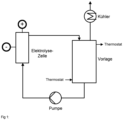
- Figure 1 shows the schematic structure with a reaction cell with continuous flow
- Figure 2 shows the temperature dependence of the yield of the reaction according to Table 1, entry 1, for the doped anode in the batch test.
- All anodes used had dimensions of length 60 mm, width 20 and thickness 6 mm. In the batch process, however, only half of the surface (length 30 mm) was immersed to carry out the process according to the invention.
- the cathodes have the same surface area as the anodes, but are made of sheet metal. The thickness does not play a significant role, especially in the flow process only one surface is exposed to the reaction medium.
- the nickel foam electrodes had a density of 0.35 to 0.44 g/cm 3 . This corresponds to a porosity of 95 to 96%.
- the phosphorus-doped electrodes were purchased from Aqua Titan, Dortmund.
- Ni(O)OH layer of the anodes was carried out in 280 ml of a solution of 0.1 mol/l NiSO 4 * 6H 2 O, 0.1 mol/l NaOAc * 3H 2 O, 0.005 mol/l NaOH in carried out with distilled water.
- the electrodes were completely immersed and coated with a pole change (10 s) at 150 coulombs and 10 mA/cm 2 at room temperature. After the reaction was complete, the electrodes were rinsed and then dried.
- the reaction cell was filled (25 ml) with water and sodium hydroxide dissolved therein (1 mol/l) and the substance to be oxidized (educt according to scheme (I)). The concentration of starting material was 0.1 mol/l. The stirred solution was then tempered. The electrooxidation was carried out under galvanostatic conditions.
- the doped Ni(O)OH foam electrode prepared above was used as the anode in the experiments according to the invention; in the experiments not according to the invention, electrodes of basically the same construction and not doped with phosphorus were used and stainless steel sheet electrodes were used as cathodes.
- the solution was discharged quantitatively (with rinsing using demineralised water and dichloromethane (20 ml each)) and extracted with dichloromethane (volume ratio: water to organic solvent approximately 2 to 1).
- the remaining aqueous phase was adjusted to pH 1 with 50% sulfuric acid and extracted four times with diethyl ether (volume ratio: water to organic solvent approximately 2 to 1).
- the organic phases were dried separately over sodium sulfate and the solvent was then removed on a rotary evaporator.
- the doped Ni(O)OH foam electrode produced above was installed in a multilayer Teflon block in such a way that it was completely flowed through; the entry area was 6 mm * 20 mm, i.e. the flow direction was in the longitudinal axis of the electrode.
- the cathode was separated by a slot plate at a distance of less than a millimeter.
- the chamber was flowed through from bottom to top in an upright position.
- a Ritmo ® 05 from Fink Chem+Tec GmbH & Co. KG was used as the pump.
- reaction solutions were carried out as in the batch process.
- the workup was carried out as in the batch process.
- DC6 octanedioic acid
Landscapes
- Chemical & Material Sciences (AREA)
- Organic Chemistry (AREA)
- Engineering & Computer Science (AREA)
- Chemical Kinetics & Catalysis (AREA)
- Electrochemistry (AREA)
- Materials Engineering (AREA)
- Metallurgy (AREA)
- Ceramic Engineering (AREA)
- Electrolytic Production Of Non-Metals, Compounds, Apparatuses Therefor (AREA)
- Organic Low-Molecular-Weight Compounds And Preparation Thereof (AREA)
- Electrodes For Compound Or Non-Metal Manufacture (AREA)
Description
- Die Erfindung bezieht sich auf ein Verfahren zur elektrochemischen Herstellung von Alkylendicarbonsäuren durch ringöffnende Oxidation mittels einer dotierten Ni(O)OH Schaumelektrode in wässriger alkalischer Lösung.
- Johannes Kaulen und Hans-Jürgen Schäfer (Tetrahedron 1982, 38(22), 3299 - 3308) offenbaren die Umsetzung von unsubstituiertem Cyclohexanol zu unsubstituierter Adipinsäure an einer Ni(O)OH Elektrode. Diese Elektrode war als Plattenelektrode ausgebildet. Die Produkte wurden in keinem Fall tatsächlich isoliert. Zu gleichen Ergebnissen kam auch Hans-Jürgen Schäfer (Topics in Current Chemistry, 1987, 142, 101-129).
- Johannes Kaulen ("Oxidation von Diolen und sekundären Alkoholen an der Nickelhydroxid-Elektrode. Anwendung zur selektiven Oxidation von Hydroxysteroiden", Dissertation Universität Münster 1981) offenbart Untersuchungen zur elektrochemischen Oxidation von Cyclohexanol. Nennenswerte Umsätze erzielte er an Nickelhydroxidelektroden bei höheren Temperaturen zum Teil unter ringspaltender Bildung von Adipinsäure.
- B.V. Lyalin und V.A. Petrosyan (Russian Journal of Electrochemistry, 2010, 46(11), 1199-1214 offenbaren die Herstellung von unsubstituierter Adipinsäure und die Oxidation von Kohlenhydraten.
- Dieselben Autoren offenbaren in "Electrosynthesis of adipic acid by undivided cell electrolysis" (Russian Chemical Bulletin, International Edition, Vol. 53 No. 3 pp. 688-692, March, 2004) die ringspaltende elektrochemische Oxidation von Cyclohexanol zu Adipinsäure an Nickelhydroxid-Elektroden. In der Veröffentlichung ist eine maximale Ausbeute an Adipinsäure von 46,7 % bei gleichzeitiger Stromausbeute von 11,5 % angegeben. Nebenprodukte bei der Umsetzung sind Bernsteinsäure und Glutarsäure, die mit einer Ausbeute von 6,3 % bzw. 11,5 % gebildet werden. Diese Komponenten entstehen durch oxidative Abspaltung von CH2-Gruppen aus dem C6-Grundkörper von Cyclohexanol.
-
EP 2907898 A1 (US 2015/0225861 A1 ) offenbart zur oxidativen Ringspaltung von 3,3,5-Trimethylcyclohexanol in einer Ausführungsvariante die Verwendung von Nickelschaum bei Reaktionstemperaturen von 80°C. Die Umsetzung erfolgte in stark verdünnter Lösung mit geringen Ausbeuten. - Schmitt et al. (Beilstein J. Org. Chem., 2015, 11, 473-480) offenbaren die Spaltung von Lignin in diverse Oxo-substituierte Aromaten unter Verwendung unterschiedlicher Elektroden. Die Oxidation zu den entsprechenden Säuren gelang nicht.
- Weiterer Stand der Technik findet sich in
CN 109 837 555 A undCN 111 229 267 A . - Gegenstand der vorliegenden Erfindung ist ein Verfahren zur elektrochemischen Herstellung von Alkandicarbonsäuren durch ringöffnende Oxidation mittels einer mit Elementen der 5. und/oder 6. Hauptgruppe dotierten Ni(O)OH Schaumelektrode in wässriger alkalischer Lösung,
- wobei die Ni(O)OH Schaumelektrode 2 bis 10 Gew.-% Phosphor aufweist, hierbei wird Phosphor als Element betrachtet und auf die Metallmasse der Elektrode bezogen,
- gemäß Schema (I)

- wobei eine Einfach- oder Doppelbindung darstellt, entsprechend ist R vorhanden oder nicht,

- wobei R Wasserstoff oder ein Acylrest ist, wobei der Acylrest der Rest einer aliphatischen Monocarbonsäure mit 2 bis 8 Kohlenstoffatomen ist und wobei A ein Kohlenwasserstoff mit 4 bis 30 Kohlenstoffen ist, wobei alle Ringkohlenstoffe von A im cyclischen Edukt des Schemas (I) mindestens einen Wasserstoffsubstituenten tragen.
- wobei
- Das erfindungsgemäße Verfahren wird nachfolgend beispielhaft beschrieben, ohne dass die Erfindung auf diese beispielhaften Ausführungsformen beschränkt sein soll. Sind nachfolgend Bereiche, allgemeine Formeln oder Verbindungsklassen angegeben, so sollen diese nicht nur die entsprechenden Bereiche oder Gruppen von Verbindungen umfassen, die explizit erwähnt sind, sondern auch alle Teilbereiche und Teilgruppen von Verbindungen, die durch Herausnahmen von einzelnen Werten (Bereichen) oder Verbindungen erhalten werden können. Werden im Rahmen der vorliegenden Beschreibung Dokumente zitiert, so soll deren Inhalt vollständig zum Offenbarungsgehalt der vorliegenden Erfindung gehören. Werden nachfolgend %-Angaben gemacht, so handelt es sich, wenn nicht anders angegeben, um Angaben in Gewichts-%. Bei Zusammensetzungen beziehen sich die %-Angaben, wenn nicht anders angegeben auf die Gesamtzusammensetzung. Werden nachfolgend Mittelwerte angegeben, so handelt es sich, wenn nicht anders angegeben, um Massenmittel (Gewichtsmittel). Werden nachfolgend Messwerte angegeben, so wurden diese Messwerte, wenn nicht anders angegeben, bei einem Druck von 101325 Pa und einer Temperatur von 25 °C ermittelt.
- Vorteil dieses Verfahrens gegenüber chemischen Oxidationsverfahren ist die Vermeidung des Einsatzes von chemischen Oxidationsmitteln wie z.B. Sal petersäure.
- Ein weiterer Vorteil ist die hohe Ausbeute des erfindungsgemäßen Verfahrens.
- Die Ausführung in einer Durchflusszelle ist technisch einfacher und robuster als alle Ausführungen des Standes der Technik. Alle mechanisch aufwendigen Prozesse, wie z.B. Rührprozesse, können entfallen.
- Damit eröffnet die vorliegende Erfindung erstmals die Möglichkeit der Entwicklung eines technisch relevanten kontinuierlichen Prozesses zur Gewinnung von Alkandicarbonsäuren ohne die Verwendung von aggressiven Chemikalien und trotzdem in hohen Ausbeuten.
- Bevorzugt werden im erfindungsgemäßen Verfahren Alkandicarbonsäuren (DC) gemäß Schema (I) hergestellt

- wobei eine Einfach- oder Doppelbindung darstellt, entsprechend ist R vorhanden oder nicht,

- wobei R Wasserstoff oder ein Acylrest ist, wobei der Acylrest der Rest einer aliphatischen Monocarbonsäure mit 2 bis 5 Kohlenstoffatomen, besonders bevorzugt ein Acetyl ist, und
- wobei A ein Kohlenwasserstoff mit 4 bis 30 Kohlenstoffen ist, wobei alle Ringkohlenstoffe von A im cyclischen Edukt des Schemas (I) mindestens einen Wasserstoffsubstituenten tragen, A weist mindestens 2 Ringkohlenstoffatome auf, mehr bevorzugt 3 bis 9 Ringkohlenstoffatome.
- Für den Fall dassgleich einer Einfachbindung und R gleich Wasserstoff ist (Cycloalkanole), wird das erfindungsgemäße Verfahren bevorzugt nach Schema (II) durchgeführt.


- R1, R2, R3 können gleich oder verschieden sein, Wasserstoff oder Alkylrest mit 1 bis 8 Kohlenstoffatomen bevorzugt 1 bis 5 Kohlenstoffatomen, linear oder verzweigt, wobei mindestens einer der Reste R1, R2, R3 ein Alkylrest ist.
- Mehr bevorzugt ist nur einer der Reste R1, R2, R3 ein Alkylrest mit 1 bis 4 Kohlenstoffatomen. Besonders bevorzugt sind die Reste R1 und R3 Wasserstoff und R2 ein Alkylrest mit 1 bis 4 Kohlenstoffatomen.
- Für den Fall dassgleich einer Einfachbindung und R gleich ein Acylrest ist (Acylcycloalkanole), wird das erfindungsgemäße Verfahren bevorzugt nach Schema (III) durchgeführt.


- wobei der Acylrest ein Acetyl ist, und
- A ein Kohlenwasserstoff mit 4 bis 9 Kohlenstoffen ist, wobei alle Ringkohlenstoffe von A im cyclischen Edukt des Schemas (III) mindestens einen Wasserstoffsubstituenten tragen, A weist mindestens 3 Ringkohlenstoffatome auf (Acylhexanole), mehr bevorzugt 3 bis 9 Ringkohlenstoffatome.
- Für den Fall dassgleich einer Doppelbindung und R nicht vorhanden ist (Cycloalkanone), wird das erfindungsgemäße Verfahren bevorzugt nach Schema (IV) durchgeführt.


- Bevorzugt wird das erfindungsgemäße Verfahren nach mindestens einem der Schemas (II), (III) oder (IV) durchgeführt.
- Wo immer Moleküle beziehungsweise Molekülfragmente ein oder mehrere Stereozentren aufweisen oder aufgrund von Symmetrien in Isomere unterschieden werden können oder aufgrund anderer Effekte z.B. eingeschränkter Rotation in Isomere unterschieden werden können, sind alle möglichen Isomere von der vorliegenden Erfindung mit eingeschlossen.
- Isomere sind dem Fachmann bekannt, in besonderer Weise wird auf die Definitionen von Prof. Kazmaier der Universität des Saarlandes verwiesen, z. B. http://www.uni-saarland.de/fak8/kazmaier/PDF_files/vorlesungen/Stereochemie%20Strassb%20V orlage.pdf verwiesen.
- Die Gehaltsangaben der Dotierung beziehen sich auf den Elementarzustand der Dotierung bezogen auf die Masse des Metalls der Elektrode.
- Bevorzugt weist die Ni(O)OH Schaumelektrode 3 bis 9 Gew.-% Phosphor und mehr bevorzugt 4 bis 9 Gew.-% auf, hierbei wird Phosphor als Element betrachtet und auf die Metallmasse der Elektrode bezogen.
- Die Gehaltsbestimmung der Phosphordotierung wird bevorzugt gemäß DIN EN ISO 5427, Anhang D.1 durchgeführt.
- Bevorzugt weist die Ni(O)OH Schaumelektrode eine Dicke von mehreren Millimetern auf, mehr bevorzugt von mehr als 3 mm, weiter mehr bevorzugt mehr als 5 mm und insbesondere bevorzugt gleich oder dicker als 6 mm.
- Die Ni(O)OH Schaumelektrode enthält als Metall bevorzugt mindestens zu 90 Gew.-%, mehr bevorzugt mindestens 95, 98, 99 Gew.-%, weiter mehr bevorzugt mindestens 99,9, insbesondere bevorzugt mindestens 99,99 Gew.-% Nickel, bezogen auf den Gesamtmetallgehalt.
- Die Ni(O)OH Schaumelektrode kann außer Nickel weitere Metalle enthalten. Bevorzugte weitere Metalle sind Co, Fe und Cu.
- Gehalt anderer Metalle in der Ni(O)OH Schaumelektrode ist bevorzugt gleich oder kleiner als 10 Gew.-%, mehr bevorzugt 5 Gew.-%, weiter mehr bevorzugt 2 Gew.-%, insbesondere bevorzugt kleiner oder gleich 1 Gew.-% bezogen auf den Gesamtmetallgehalt.
- Bevorzugt enthält die Ni(O)OH Schaumelektrode maximal 5 Gew.-%, bevorzugt 2 Gew.-%, mehr bevorzugt 1 Gew.-% und besonders bevorzugt 0,5 Gew.-% und insbesondere bevorzugt maximal 0,1 Gew.-% Eisen oder Eisenverbindungen, wobei die Gehaltsangaben auf das Element in Bezug auf den Gesamtmetallgehalt bezogen sind.
- Bevorzugt enthält die Ni(O)OH Schaumelektrode maximal je 1 Gew.-%, bevorzugt je 0,1 Gew.-% und mehr bevorzugt maximal je 0,01 Gew.-% an V, Wo und Mo; diese Metalle unterliegen in alkalisch-wässrigen Medium einer Korrosion, dies kann sich ungünstig auf das erfindungsgemäße Verfahren auswirken.
- Als Kathodenmaterial kommt prinzipiell jedes gegenüber dem Reaktionsmedium inerte Metall in Frage. Bevorzugt wird erfindungsgemäß Edelstahl, Platin oder Nickel oder eine Mischung eingesetzt.
- Das erfindungsgemäße Verfahren wird in wässriger alkalischer Lösung durchgeführt. Bevorzugte Cosolventien können Alkohole oder DMSO sein. Bevorzugt sind bis zu 30 Vol.-% eines Cosolvenzes anwesend, mehr bevorzugt 1 bis 20 Vol.-%, bezogen auf die Summe der Lösungsmittel, mehr bevorzugt besteht das Lösungsmittel aus Wasser.
- Als alkalische Zusätze eignen sich im Prinzip alle bekannten anorganischen Basen. Bevorzugt werden im erfindungsgemäßen Verfahren Alkalimetallhydroxide, wie LiOH, NaOH, KOH, und lösliche Erdalkalimetallhydroxide. Besonders bevorzugt wird erfindungsgemäß Natriumhydroxid eingesetzt. Bevorzugt liegen keine weiteren Anionen von Basen vor.
- Die Konzentration des alkalischen Zusatzes beträgt bevorzugt 0,5 bis 2 mol/l bezogen auf die wässrige alkalische Lösung, mehr bevorzugt 0,8 bis 1,5 mol/l und insbesondere bevorzugt 1 mol/l mit einer möglichen Abweichung von bis zu 10%, bevorzugt einer Abweichung von bis zu 5% der Molarität.
- Bevorzugt beträgt im erfindungsgemäßen Verfahren die Konzentration der Edukte gemäß Schema (I) 0,06 bis 0,5 mol/l, mehr bevorzugt 0,08 bis 0,3 und insbesondere bevorzugt 0,09 bis 0,11 mol/l.
- Der Gesamtstrom, der zur erfindungsgemäßen Umsetzung nach Schema (II) und (III) führt, beträgt gemäß der Theorie 8 F. Bevorzugt werden 8 bis 10 F eingesetzt, mehr bevorzugt 8,5 bis 9 F.
- Die Einheit F steht für Faraday, welche definiert ist als Produkt aus Avogadrokonstante und Elementarladung eines Elektrons: F = NA * e.
- Zur Umsetzung gemäß Schema (IV) werden theoretisch 6 F benötigt. Bevorzugt werden 6 bis 8 F eingesetzt, mehr bevorzugt 6,5 bis 7 F.
- Bevorzugt wird das erfindungsgemäße Verfahren mit einer Stromdichte von 2 bis 10 mA/cm2, mehr bevorzugt 2,5 bis 7,5 mA/cm2und insbesondere bevorzugt 3,3 bis 6 mA/cm2 ausgeführt. Die Flächenangabe bezieht sich auf die geometrische Fläche ohne Berücksichtigung der inneren Oberfläche des Schaumes. Diese Angaben zur Stromdichte beziehen sich auf die größte Fläche einer der Seiten und sind damit im Fall der Durchflusszelle unabhängig von der Fließrichtung.
- Das erfindungsgemäße Verfahren kann diskontinuierlich zum Beispiel in einer Batch-Elektrolysezelle oder kontinuierlich in einer durchströmbaren Elektrolysezelle erfolgen, bevorzugt in einer kontinuierlich durchströmten Elektrolysezelle.
- Das erfindungsgemäße Verfahren wird bevorzugt bei Temperaturen von 20 - 70°C, bevorzugt von 30 - 60°C, mehr bevorzugt von 35 - 50°C durchgeführt.
- Weiter bevorzugt wird das erfindungsgemäße Verfahren unter Verwendung einer dotierten Ni(O)OH-Schaumelektrode durchgeführt, wobei die Dotierung ausgewählt ist aus Phosphor, Arsen, Selen und Schwefel, wobei die Konzentration an Alkali 0,8 bis 1,5 mol/l beträgt und die Konzentration an Edukt gemäß Schema (I) 0,08 bis 0,3 mol/l beträgt.
- Weiter bevorzugt wird das erfindungsgemäße Verfahren unter Verwendung einer mit Phosphor dotierten Ni(O)OH-Schaumelektrode durchgeführt, wobei die Konzentration an Alkali 0,8 bis 1,5 mol/l beträgt und die Stromdichte von 2 bis 10 mA/cm2 beträgt.
- Weiter mehr bevorzugt wird das erfindungsgemäße Verfahren unter Verwendung einer mit Phosphor dotierten Ni(O)OH-Schaumelektrode nach Schema (II) durchgeführt

- wobei R1, R2, R3 gleich oder verschieden sind, Wasserstoff oder Alkylrest mit 1 bis 8 Kohlenstoffatomen bevorzugt 1 bis 5 Kohlenstoffatomen, linear oder verzweigt, wobei mindestens einer der Reste R1, R2, R3 ein Alkylrest ist,
- wobei mehr bevorzugt nur einer der Reste R1, R2, R3 ein Alkylrest mit 1 bis 4 Kohlenstoffatomen ist und besonders bevorzugt sind die Reste R1 und R3 Wasserstoff und R2 ein Alkylrest mit 1 bis 4 Kohlenstoffatomen.
- Weiter mehr bevorzugt wird das erfindungsgemäße Verfahren unter Verwendung einer mit Phosphor dotierten Ni(O)OH-Schaumelektrode nach Schema (IV) durchgeführt

- Das erfindungsgemäße Verfahren wird mehr bevorzugt unter Verwendung einer mit Phosphor dotierten Ni(O)OH-Schaumelektrode in einer Durchflusszelle durchgeführt, wobei die Konzentration an Alkali 0,8 bis 1,5 mol/l beträgt und die Konzentration an Edukt gemäß Schema (I) 0,08 bis 0,3 mol/l beträgt.
- Das erfindungsgemäße Verfahren wird besonders bevorzugt unter Verwendung einer mit Phosphor dotierten Ni(O)OH-Schaumelektrode in einer Durchflusszelle durchgeführt, wobei die Konzentration an Alkali 0,8 bis 1,5 mol/l beträgt, wobei die Konzentration an Edukt gemäß Schema (I) 0,08 bis 0,3 mol/l beträgt und wobei die die Strömungsgeschwindigkeit des Reaktionsmediums im Anodenraum mindestens 5 cm/min beträgt, bevorzugt mindestens als 8 cm/min, mehr bevorzugt mindestens 10 cm/min.
-
Figur 1 zeigt den schematischen Aufbau mit einer kontinuierlich durchströmten Reaktionszellezelle
Figur 2 zeigt die Temperaturabhängigkeit der Ausbeute der Reaktion gemäß Tabelle 1, entry 1, für die dotierte Anode im Batchversuch. - Alle verwendeten Anoden hatten die Abmessungen Länge 60 mm, Breite 20 und Dicke 6 mm. Im Batchverfahren wurde jedoch zur Durchführung des erfindungsgemäßen Verfahrens nur die Hälfte der Fläche (Länge 30mm) eingetaucht. Die Kathoden haben die gleichen Flächenausdehnungen wie die Anoden, jedoch als Blech ausgearbeitet. Die Dicke spielt keine wesentliche Rolle, insbesondere im Durchflussverfahren ist lediglich eine Oberfläche dem Reaktionsmedium ausgesetzt.
- Die Nickelschaumelektroden hatten eine Dichte von 0,35 bis 0,44 g/cm3. Das entspricht einer Porosität von 95 bis 96%.
- Die Phosphor-dotierten Elektroden wurden von der Firma Aqua Titan, Dortmund bezogen.
- Die Ausbildung der Ni(O)OH-Schicht der Anoden wurde in 280 ml einer Lösung aus 0,1 mol/l NiSO4 * 6H2O, 0,1 mol/l NaOAc * 3H2O, 0,005 mol/l NaOH in destilliertem Wasser durchgeführt. Die Elektroden wurden vollständig eingetaucht und unter Polwechsel (10 s) bei 150 Coulomb und 10 mA/cm2 bei Raumtemperatur beschichtet. Die Elektroden wurden nach beendeter Reaktion abgespült und anschließend getrocknet.
- Zur Elektrooxidation wurde die Reaktionszelle mit Wasser sowie darin gelöstem Natriumhydroxid (1 mol/l) und der zu oxidierenden Substanz (Edukt nach Schema (I)) befüllt (25ml). Die Konzentration an Edukt betrug 0,1 mol/l. Anschließend wurde die gerührte Lösung temperiert. Die Elektrooxidation wurde unter galvanostatischen Bedingungen durchgeführt. Als Anode wurde in den erfindungsgemäßen Versuchen die oben hergestellte dotierte Ni(O)OH Schaumelektrode verwendet, in den nicht erfindungsgemäßen Versuchen wurden prinzipiell baugleiche nicht mit Phosphor dotierte Elektroden verwendet und als Kathoden dienten Edelstahlblechelektroden.
- Nach Beendigung der Reaktion wurde die Lösung quantitativ (mit Nachspülen mittels VE-Wasser und Dichlormethan (jeweils 20 ml)) ausgetragen und mit Dichlormethan (Volumenverhältnis: Wasser zu org. Lösemittel etwa 2 zu 1) extrahiert. Die verbliebene wässrige Phase wurde mit 50%-iger Schwefelsäure auf pH 1 eingestellt und viermal mit Diethylether (Volumenverhältnis: Wasser zu org. Lösemittel etwa 2 zu 1) extrahiert. Die organischen Phasen wurden beide (Dichlormethan/Diethylther) getrennt voneinander über Natriumsulfat getrocknet und anschließend das Lösungsmittel am Rotationsverdampfer entfernt.
- In einem mehrschichtigen Teflonblock wurde die oben hergestellte dotierte Ni(O)OH Schaumelektrode so eingebaut, dass sie vollständig durchflossen wurde, die Eintrittsfläche war 6 mm * 20 mm groß, die Fließrichtung also in Längsachse der Elektrode. Die Kathode war durch eine Schlitzplatte getrennt im Abstand von weniger als einem Millimeter angebracht. Die Kammer wurde aufrechtstehend von unten nach oben durchströmt. Als Pumpe wurde eine Ritmo® 05 der Fink Chem+Tec GmbH & Co. KG verwendet.
- Die Reaktionslösungen waren wie im Batch-Verfahren ausgeführt.
- Die Aufarbeitung wurde wie im Batch-Verfahren durchgeführt.
- 1H- und 13C-NMR-Spektren wurden an einem Multikernresonanzspektrometer des Typs AC 300 und AC II 400 der Firma Bruker Analytische Messtechnik, Karlsruhe vorgenommen. Als Lösungsmittel diente CDCl3. Die chemischen Verschiebungen sind dabei in ppm angegeben und beziehen sich auf das Protonensignal des deuterierten Lösungsmittels. Die Zuordnung der Signale erfolgte dann unter zur Hilfenahme von H-COSY, H,C-HSQC sowie H,C-HMBC-Experimenten, wobei die letztendliche Auswertung der Spektren mit dem Programm MestReNova (Version: 7.01-8414) durchgeführt wurde.
- Die in den Tabellen angegebenen Ausbeuten wurden mittels Integration der Signale im 13C-NMR (inverse gated) gegen den Standard Trimethoxybenzol bestimmt. Die Ausbeuten sind molar bezogene Angaben.
Tabelle 1: Umsetzungsbespiele unterschiedlicher Alkylcycloalkanole (CH) zu Alkandicarbonsäuren (DC) entry Alkylcycloalkanol (CH) Alkandicarbonsäuren (DC) 1 

2 

3 

4 

5 

6 

Tabelle 2: Umsetzungsbespiele unterschiedlicher Alkylcycloalkanone (CO) zu Alkandicarbonsäuren (DC) entry Alkylcycloalkanone (CO) Alkandicarbonsäuren (DC) 7 

8 

9 

Tabelle 3: Effekt der Phosphordotierung auf die Ausbeute diverser Alkylcycloalkanole (CH) gemäß Tabelle 1; undotierte Anode ist nicht anspruchsgemäß (Batch), dotierte Anode (Batch) und Durchfluss (dotierte Anode) sind anspruchsgemäß Entry undotierte Anode dotierte Anode Durchfluss Ausbeute [%] Temperatur; Stromdichte, Ladungsmenge Ausbeute [%] Temperatur; Stromdichte, Ladungsmenge Ausbeute [%] 1 53 20°C; 5 mA/cm2, 8,5 F 63 20°C; 2,5 mA/cm2, 8 F 63 2 44 50°C; 2,5 mA/cm2, 8,5 F 54 3 36 50°C; 2,5 mA/cm2, 8,5 F 66 4 30 50°C; 2,5 mA/cm2, 8,5 F 42 45°C; 2,5 mA/cm2, 8 F 43 5 18 50°C; 2,5 mA/cm2, 8,5 F 43 20°C; 5 mA/cm2, 8 F 6 60 45°C; 2,5 mA/cm2, 8 F Tabelle 4: Abhängigkeit der Ausbeute von der Durchflussgeschwindigkeit; Umsetzung in der Durchflusszelle (dotierte Anode) (CH1 zu DC1); 60 mA, 8 F, 20°C entry Flow rate [ml/min] DC1 [%] 1a 0,47* 10 E-3 51 1b 0,1 53 1c 1,0 56 1d 7,5 60 1e 10,0 62 1f 12,5 64 Tabelle 5: Abhängigkeit der Ausbeute vom Alkali (1 M = 1 mol/l) und vom Lösungsmittel (Verhältnis bezogen auf das Volumen), Umsetzung im Batchverfahren mit dotierter Anode, CH1 zu DC1 entry Lösungsmittel Alkalizusatz DC 1 [%] 1-1 H2O 0,1 M NaOH 20 1-2 H2O 0,5 M NaOH 45 1-3 H2O 1,0 M NaOH 51 1-4 H2O 2,0 M NaOH 45 1-5 H2O 5,0 M NaOH 16 1-6 H2O 1,0 M K2CO3 3 1-7 H2O 1,0 M KOH 50 1-8 H2O/tBuOH (3:7) 1,0 M NaOH 1 1-9 H2O/ tBuOH (2:1) 0,25 M NaOH 26 1-10 H2O/ tBuOH (1:1) 0,18 M KOH 7 1-11 H2O/PE (1:1) 1,0 M NaOH 16 1-12 H2O/DMSO (1:1) 1,0 M NaOH 7 1-13 H2O/ tAmylOH (2:1) 1,0 M NaOH 27 tBuOH = tert. Butanol, PE = Petrolether, DMSO = Dimethylsulfoxid, tAmylOH = tert. Amylalkohol (2-Methyl-2-butanol); 30 mA, 8 F, 20°C Tabelle 6: Umsetzung von Alkylcycloalkanonen (CO) zu Alkandicarbonsäuren (CD); Umsetzung im Batch-Verfahren mit dotierter Anode Entry dotierte Anode Ausbeute [%] Temperatur; Stromdichte, Ladungsmenge 7 61 20°C; 2,5 mA/cm2, 6 F 8 66 20°C; 2,5 mA/cm2, 6 F 9 64 40°C; 2,5 mA/cm2, 6 F Cyclooctanol-Essigsäureester wurde im Batch-Verfahren an der dotierten Anode bei 20°C, 5 mA/cm2 und 8 F in 30% Ausbeute zur Octandisäure (DC6) umgesetzt.
Claims (14)
- Verfahren zur elektrochemischen Herstellung von Alkandicarbonsäuren durch ringöffnende Oxidation in wässriger alkalischer Lösung dadurch gekennzeichnet, dass die Oxidation an einer mit Elementen der 5. und/oder 6. Hauptgruppe dotierten Ni(O)OH Schaumelektrode durchgeführt wird,wobei die Ni(O)OH Schaumelektrode 2 bis 10 Gew.-% Phosphor aufweist, hierbei wird Phosphor als Element betrachtet und auf die Metallmasse der Elektrode bezogen,gemäß Schema (I)
 wobeieine Einfach- oder Doppelbindung darstellt, entsprechend ist R vorhanden oder nicht,
 wobei R Wasserstoff oder ein Acylrest ist, wobei der Acylrest der Rest einer aliphatischen Monocarbonsäure mit 2 bis 8 Kohlenstoffatomen ist und wobei A ein Kohlenwasserstoff mit 4 bis 30 Kohlenstoffen ist, wobei alle Ringkohlenstoffe von A im cyclischen Edukt des Schemas (I) mindestens einen Wasserstoffsubstituenten tragen.
 - Verfahren nach Anspruch 1 dadurch gekennzeichnet, dass die Ni(O)OH Schaumelektrode 3 bis 9 Gew.-% und bevorzugt 4 bis 9 Gew.-% aufweist, hierbei wird Phosphor als Element betrachtet und auf die Metallmasse der Elektrode bezogen.
- Verfahren nach Anspruch 1 bis 2 dadurch gekennzeichnet, dass die Ni(O)OH Schaumelektrode mehrere Millimeter dick ist, bevorzugt mehr als 3 mm, mehr bevorzugt mehr als 5 mm und insbesondere bevorzugt gleich oder dicker als 6 mm.
- Verfahren nach mindestens einem der Ansprüche 1 bis 3 4 dadurch gekennzeichnet, dass die Ni(O)OH Schaumelektrode als Metall mindestens zu 80 Gew.-%, bevorzugt mindestens 90, 95, 98, 99 Gew.-%, mehr bevorzugt mindestens 99,9, insbesondere bevorzugt mindestens 99,99 Gew.-% Nickel enthält.
- Verfahren nach mindestens einem der Ansprüche 1 bis 4 dadurch gekennzeichnet, dass die wässrige Lösung bedeutet, dass bis zu 30 Vol.-% eines Cosolvenzes in der Lösung vorhanden sein können.
- Verfahren nach mindestens einem der Ansprüche 1 bis 5 dadurch gekennzeichnet, dass der alkalische Zusatz der wässrigen Lösung Lithiumhydroxid, Natriumhydroxid oder Kaliumhydroxid ist, bevorzugt liegen keine weiteren Anionen der Basen vor.
- Verfahren nach mindestens einem der Ansprüche 1 bis 6 dadurch gekennzeichnet, dass die Konzentration des alkalischen Zusatzes beträgt 0,5 bis 2 mol/l bezogen auf die wässrige alkalische Lösung, bevorzugt 0,8 bis 1,5 mol/l und insbesondere bevorzugt 1 mol/l mit einer möglichen Abweichung von bis zu 10%, bevorzugt einer Abweichung von bis zu 5% der Molarität.
- Verfahren nach mindestens einem der Ansprüche 1 bis 7 dadurch gekennzeichnet, dass die Konzentration der Cycloalkanole, also ist in Schema (I) R = Wasserstoff undeine Einfachbindung, 0,06 bis 0,5 mol/l, bevorzugt 0,08 bis 0,3 und insbesondere bevorzugt 0,09 bis 0,11 mol/l beträgt.

- Verfahren nach mindestens einem der Ansprüche 1 bis 8 dadurch gekennzeichnet, dass das Verfahren gemäß

wobei R1, R2, R3 gleich oder verschieden sind, Wasserstoff oder Alkylrest mit 1 bis 8 Kohlenstoffatomen bevorzugt 1 bis 5 Kohlenstoffatomen, linear oder verzweigt, wobei mindestens einer der Reste R1, R2, R3 ein Alkylrest ist, wobei mehr bevorzugt nur einer der Reste R1, R2, R3 ein Alkylrest mit 1 bis 4 Kohlenstoffatomen ist und besonders bevorzugt sind die Reste R1 und R3 Wasserstoff und R2 ein Alkylrest mit 1 bis 4 Kohlenstoffatomen. - Verfahren nach Anspruch 9, wobei die applizierte Gesamtelektronenmenge 8 bis 10 F beträgt, mehr bevorzugt 8,5 bis 9 F, wobei F für die Einheit Faraday steht.
- Verfahren nach mindestens einem der Ansprüche 1 bis 9 dadurch gekennzeichnet, dass das Verfahren mit einer Stromdichte von 2 bis 10 mA/cm2, mehr bevorzugt 2,5 bis 7,5 mA/cm2 und insbesondere bevorzugt 3,3 bis 6 mA/cm2 ausgeführt, die Flächenangabe bezieht sich auf die geometrische Fläche ohne Berücksichtigung der inneren Oberfläche des Schaumes.
- Verfahren nach mindestens einem der vorherigen Ansprüche dadurch gekennzeichnet, dass die Elektrolyse in einer Batch-Elektrolysezelle oder in einer kontinuierlich durchströmten Elektrolysezelle durchgeführt wird, bevorzugt in einer kontinuierlich durchströmten Elektrolysezelle.
- Verfahren nach mindestens einem der vorherigen Ansprüche dadurch gekennzeichnet, dass als Kathodenmaterial Edelstahl, Platin oder Nickel oder eine Mischung eingesetzt wird.
- Verfahren nach mindestens einem der vorherigen Ansprüche dadurch gekennzeichnet, dass die Elektrolyse bei Temperaturen von 20 - 70°C, bevorzugt von 30 - 60°C, mehr bevorzugt von 35 - 50°C durchgeführt wird.
Applications Claiming Priority (2)
| Application Number | Priority Date | Filing Date | Title |
|---|---|---|---|
| EP20179245.4A EP3922758A1 (de) | 2020-06-10 | 2020-06-10 | Verfahren zur elektrochemischen herstellung von alkandicarbonsäuren durch ringöffnende oxidation mittels einer dotierten ni(o)oh schaumelektrode |
| PCT/EP2021/064057 WO2021249775A1 (de) | 2020-06-10 | 2021-05-26 | Verfahren zur elektrochemischen herstellung von alkandicarbonsäuren durch ringöffnende oxidation mittels einer dotierten ni(o)oh schaumelektrode |
Publications (2)
| Publication Number | Publication Date |
|---|---|
| EP4165236A1 EP4165236A1 (de) | 2023-04-19 |
| EP4165236B1 true EP4165236B1 (de) | 2023-12-27 |
Family
ID=71083537
Family Applications (2)
| Application Number | Title | Priority Date | Filing Date |
|---|---|---|---|
| EP20179245.4A Withdrawn EP3922758A1 (de) | 2020-06-10 | 2020-06-10 | Verfahren zur elektrochemischen herstellung von alkandicarbonsäuren durch ringöffnende oxidation mittels einer dotierten ni(o)oh schaumelektrode |
| EP21727488.5A Active EP4165236B1 (de) | 2020-06-10 | 2021-05-26 | Verfahren zur elektrochemischen herstellung von alkandicarbonsäuren durch ringöffnende oxidation mittels einer dotierten ni(o)oh schaumelektrode |
Family Applications Before (1)
| Application Number | Title | Priority Date | Filing Date |
|---|---|---|---|
| EP20179245.4A Withdrawn EP3922758A1 (de) | 2020-06-10 | 2020-06-10 | Verfahren zur elektrochemischen herstellung von alkandicarbonsäuren durch ringöffnende oxidation mittels einer dotierten ni(o)oh schaumelektrode |
Country Status (6)
| Country | Link |
|---|---|
| US (1) | US11976373B2 (de) |
| EP (2) | EP3922758A1 (de) |
| JP (1) | JP7801256B2 (de) |
| CN (1) | CN115917047B (de) |
| ES (1) | ES2975117T3 (de) |
| WO (1) | WO2021249775A1 (de) |
Families Citing this family (9)
| Publication number | Priority date | Publication date | Assignee | Title |
|---|---|---|---|---|
| EP3741790A1 (de) | 2019-05-20 | 2020-11-25 | Evonik Operations GmbH | Polyamide mit cyclischen terpenoiden substrukturen |
| EP4253602A1 (de) * | 2022-03-28 | 2023-10-04 | Evonik Operations GmbH | Elektrochemische oxidation von cycloalkenen und cycloalkanen zu alpha,omega-dicarbonsäuren oder ketocarbonsäuren und cycloalkanon-verbindungen |
| EP4253604A1 (de) * | 2022-03-28 | 2023-10-04 | Evonik Operations GmbH | Elektrochemische oxidation von fettsäuren und fettsäureestern zu monocarbonsäuren und alpha,omega-dicarbonsäuren |
| EP4253603A1 (de) * | 2022-03-28 | 2023-10-04 | Evonik Operations GmbH | Elektrochemische oxidation von cycloalkanen zu cycloalkanon-verbindungen |
| EP4253605A1 (de) | 2022-03-28 | 2023-10-04 | Evonik Operations GmbH | Elektrochemische oxidation von cycloalkenen zu alpha,omega-dicarbonsäuren und ketocarbonsäuren |
| CN116143607B (zh) * | 2023-02-24 | 2024-11-22 | 广西科学院 | 一种制备木质素基3-乙基己二酸或3-丙基己二酸的方法 |
| EP4459010A1 (de) * | 2023-05-02 | 2024-11-06 | Evonik Operations GmbH | Herstellung einer stabilen aktivierten nickeloxidhydroxid-schaum-elektrode |
| EP4459011A1 (de) | 2023-05-02 | 2024-11-06 | Evonik Operations GmbH | Elektrochemisches hochdurchsatz-oxidationsverfahren |
| CN119615199B (zh) * | 2024-12-09 | 2025-10-14 | 北京化工大学 | 一种电催化环己烯制备己二酸的方法 |
Family Cites Families (12)
| Publication number | Priority date | Publication date | Assignee | Title |
|---|---|---|---|---|
| DE3700709A1 (de) * | 1987-01-13 | 1988-07-21 | Basf Ag | Verfahren zur herstellung von (poly)oxatetramethylendicarbonsaeuren |
| DE19536056A1 (de) | 1995-09-28 | 1997-04-03 | Huels Chemische Werke Ag | Flüssige Lösungen von Dicarbonsäuren |
| DE10207924A1 (de) | 2002-02-23 | 2003-09-04 | Clariant Gmbh | Hochkonzentrierte wässrige Lösungen von Betainen oder Aminoxiden |
| DE102010002809A1 (de) | 2010-03-12 | 2011-11-17 | Evonik Degussa Gmbh | Verfahren zur Herstellung von linearen alpha,omega-Dicarbonsäurediestern |
| DE102013203866A1 (de) | 2013-03-07 | 2014-09-11 | Evonik Industries Ag | Elektrochemische Kupplung eines Phenols mit einem Naphthol |
| DE102013203865A1 (de) | 2013-03-07 | 2014-09-11 | Evonik Industries Ag | Elektrochemische Kupplung zweier Phenole, welche sich in ihrem Oxidationspotential unterscheiden |
| DE102014202502A1 (de) | 2014-02-12 | 2015-08-13 | Evonik Degussa Gmbh | Verfahren zur elektrochemischen Herstellung von 2.2.4-Trimethyladipinsäure und 2.4.4-Trimethyladipinsäure |
| EP3498759A1 (de) | 2017-12-13 | 2019-06-19 | Evonik Degussa GmbH | Verfahren zur herstellung von polymeren aus monomeren umfassend laurinlactam |
| CN109837555B (zh) * | 2019-04-11 | 2019-12-31 | 浙江工业大学 | 一种镍钒磷化物催化剂电催化氧化制取2,5-呋喃二甲酸的方法 |
| EP3741790A1 (de) | 2019-05-20 | 2020-11-25 | Evonik Operations GmbH | Polyamide mit cyclischen terpenoiden substrukturen |
| US20220246252A1 (en) | 2019-10-01 | 2022-08-04 | Evonik Operations Gmbh | Method for producing thermoplastic compositions for mechanically and/or thermally stressed components |
| CN111229267B (zh) * | 2020-01-16 | 2021-04-20 | 湖南大学 | 负载型磷掺杂金属羟基氧化物纳米片材料及其制备方法和应用 |
-
2020
- 2020-06-10 EP EP20179245.4A patent/EP3922758A1/de not_active Withdrawn
-
2021
- 2021-05-26 CN CN202180041010.8A patent/CN115917047B/zh active Active
- 2021-05-26 US US18/001,079 patent/US11976373B2/en active Active
- 2021-05-26 ES ES21727488T patent/ES2975117T3/es active Active
- 2021-05-26 EP EP21727488.5A patent/EP4165236B1/de active Active
- 2021-05-26 WO PCT/EP2021/064057 patent/WO2021249775A1/de not_active Ceased
- 2021-05-26 JP JP2022574171A patent/JP7801256B2/ja active Active
Also Published As
| Publication number | Publication date |
|---|---|
| CN115917047A (zh) | 2023-04-04 |
| ES2975117T3 (es) | 2024-07-03 |
| WO2021249775A1 (de) | 2021-12-16 |
| JP7801256B2 (ja) | 2026-01-16 |
| EP4165236A1 (de) | 2023-04-19 |
| CN115917047B (zh) | 2025-06-10 |
| US20230212762A1 (en) | 2023-07-06 |
| JP2023529827A (ja) | 2023-07-12 |
| EP3922758A1 (de) | 2021-12-15 |
| US11976373B2 (en) | 2024-05-07 |
Similar Documents
| Publication | Publication Date | Title |
|---|---|---|
| EP4165236B1 (de) | Verfahren zur elektrochemischen herstellung von alkandicarbonsäuren durch ringöffnende oxidation mittels einer dotierten ni(o)oh schaumelektrode | |
| EP0280120B1 (de) | Elektrochemisches Verfahren zum Austausch von Halogenatomen in einer organischen Verbindung | |
| EP0011712B1 (de) | Verfahren zur Herstellung von in 4-Stellung substituierten Benzaldehyddialkylacetalen | |
| EP0012240B1 (de) | Verfahren zur Herstellung von gegebenenfalls substituierten Benzaldehyd-dialkylacetalen | |
| DE2460754C2 (de) | Verfahren zur Herstellung von p-Benzochinondiketalen | |
| DE2343054B1 (de) | Verfahren zur elektrochemischen Herstellung von Pinacolen | |
| EP4459011A1 (de) | Elektrochemisches hochdurchsatz-oxidationsverfahren | |
| EP2411564B1 (de) | Elektrochemisches verfahern zur herstellung von 3-tert.-butylbenzaldehyd-dimethylacetal | |
| EP0308838B1 (de) | Verfahren zur Herstellung von fluorierten Acrylsäuren und ihren Derivaten | |
| DE602004001782T2 (de) | Verfahren zur herstellung a-substituierter carbonsäuren aus der reihe der a-hydroxycarbonsäuren und n-substituierten a-aminocarbonsäuren | |
| WO2008145627A1 (de) | Elektrochemische oxidation an allylgruppen | |
| EP0326855B1 (de) | Verfahren zur Herstellung von Fluormalonsäure und ihren Derivaten | |
| DE1618838C3 (de) | ||
| WO1992005299A1 (de) | Verfaharen zur herstellung von halogenierten acrylsäuren | |
| DE2738274A1 (de) | Verfahren zur entfernung von bleiionen aus formose | |
| DE69706668T2 (de) | Verfahren zur herstellung von tetraalkyl 1,2,3,4-butantetracarboxylaten | |
| DE102013211744A1 (de) | Elektrochemisches Verfahren zur Herstellung von symmetrischen Biphenolen unter Verwendung einer Glaskohlenstoffanode | |
| EP0040331B1 (de) | Verfahren zur Herstellung von Diacetonketogulonsäure | |
| DE2812508B2 (de) | Verfahren zur Herstellung von NJS'dialkylsubstituierten Tetrahydro-4,4'bipyridylen | |
| DE102009001168A1 (de) | Verfahren zur Herstellung von Hypophosphiten und Phosphiten | |
| DE2851732A1 (de) | Verfahren zur herstellung von substituierten benzaldehyd-dialkylacetalen | |
| DE2505911A1 (de) | Verfahren zur herstellung von diaceton- 2-ketogulonsaeure | |
| DE3028758A1 (de) | Verfahren zur herstellung von anisaldehyd | |
| DE102013211745A1 (de) | Elektrochemisches Verfahren zur Herstellung von symmetrischen Biphenolen unter Verwendung von Essigsäure als Elektrolyt | |
| DE1668151B2 (de) | Verfahren zur Herstellung von Dimethylsulfoxid |
Legal Events
| Date | Code | Title | Description |
|---|---|---|---|
| STAA | Information on the status of an ep patent application or granted ep patent |
Free format text: STATUS: UNKNOWN |
|
| STAA | Information on the status of an ep patent application or granted ep patent |
Free format text: STATUS: THE INTERNATIONAL PUBLICATION HAS BEEN MADE |
|
| PUAI | Public reference made under article 153(3) epc to a published international application that has entered the european phase |
Free format text: ORIGINAL CODE: 0009012 |
|
| STAA | Information on the status of an ep patent application or granted ep patent |
Free format text: STATUS: REQUEST FOR EXAMINATION WAS MADE |
|
| 17P | Request for examination filed |
Effective date: 20221206 |
|
| AK | Designated contracting states |
Kind code of ref document: A1 Designated state(s): AL AT BE BG CH CY CZ DE DK EE ES FI FR GB GR HR HU IE IS IT LI LT LU LV MC MK MT NL NO PL PT RO RS SE SI SK SM TR |
|
| DAV | Request for validation of the european patent (deleted) | ||
| DAX | Request for extension of the european patent (deleted) | ||
| GRAP | Despatch of communication of intention to grant a patent |
Free format text: ORIGINAL CODE: EPIDOSNIGR1 |
|
| STAA | Information on the status of an ep patent application or granted ep patent |
Free format text: STATUS: GRANT OF PATENT IS INTENDED |
|
| INTG | Intention to grant announced |
Effective date: 20231017 |
|
| GRAS | Grant fee paid |
Free format text: ORIGINAL CODE: EPIDOSNIGR3 |
|
| GRAA | (expected) grant |
Free format text: ORIGINAL CODE: 0009210 |
|
| STAA | Information on the status of an ep patent application or granted ep patent |
Free format text: STATUS: THE PATENT HAS BEEN GRANTED |
|
| AK | Designated contracting states |
Kind code of ref document: B1 Designated state(s): AL AT BE BG CH CY CZ DE DK EE ES FI FR GB GR HR HU IE IS IT LI LT LU LV MC MK MT NL NO PL PT RO RS SE SI SK SM TR |
|
| REG | Reference to a national code |
Ref country code: GB Ref legal event code: FG4D Free format text: NOT ENGLISH |
|
| REG | Reference to a national code |
Ref country code: CH Ref legal event code: EP |
|
| REG | Reference to a national code |
Ref country code: DE Ref legal event code: R096 Ref document number: 502021002301 Country of ref document: DE |
|
| P01 | Opt-out of the competence of the unified patent court (upc) registered |
Effective date: 20231206 |
|
| REG | Reference to a national code |
Ref country code: IE Ref legal event code: FG4D Free format text: LANGUAGE OF EP DOCUMENT: GERMAN |
|
| REG | Reference to a national code |
Ref country code: NL Ref legal event code: FP |
|
| PG25 | Lapsed in a contracting state [announced via postgrant information from national office to epo] |
Ref country code: GR Free format text: LAPSE BECAUSE OF FAILURE TO SUBMIT A TRANSLATION OF THE DESCRIPTION OR TO PAY THE FEE WITHIN THE PRESCRIBED TIME-LIMIT Effective date: 20240328 |
|
| REG | Reference to a national code |
Ref country code: LT Ref legal event code: MG9D |
|
| PG25 | Lapsed in a contracting state [announced via postgrant information from national office to epo] |
Ref country code: LT Free format text: LAPSE BECAUSE OF FAILURE TO SUBMIT A TRANSLATION OF THE DESCRIPTION OR TO PAY THE FEE WITHIN THE PRESCRIBED TIME-LIMIT Effective date: 20231227 |
|
| PG25 | Lapsed in a contracting state [announced via postgrant information from national office to epo] |
Ref country code: LT Free format text: LAPSE BECAUSE OF FAILURE TO SUBMIT A TRANSLATION OF THE DESCRIPTION OR TO PAY THE FEE WITHIN THE PRESCRIBED TIME-LIMIT Effective date: 20231227 Ref country code: GR Free format text: LAPSE BECAUSE OF FAILURE TO SUBMIT A TRANSLATION OF THE DESCRIPTION OR TO PAY THE FEE WITHIN THE PRESCRIBED TIME-LIMIT Effective date: 20240328 Ref country code: FI Free format text: LAPSE BECAUSE OF FAILURE TO SUBMIT A TRANSLATION OF THE DESCRIPTION OR TO PAY THE FEE WITHIN THE PRESCRIBED TIME-LIMIT Effective date: 20231227 Ref country code: BG Free format text: LAPSE BECAUSE OF FAILURE TO SUBMIT A TRANSLATION OF THE DESCRIPTION OR TO PAY THE FEE WITHIN THE PRESCRIBED TIME-LIMIT Effective date: 20240327 |
|
| PG25 | Lapsed in a contracting state [announced via postgrant information from national office to epo] |
Ref country code: SE Free format text: LAPSE BECAUSE OF FAILURE TO SUBMIT A TRANSLATION OF THE DESCRIPTION OR TO PAY THE FEE WITHIN THE PRESCRIBED TIME-LIMIT Effective date: 20231227 Ref country code: RS Free format text: LAPSE BECAUSE OF FAILURE TO SUBMIT A TRANSLATION OF THE DESCRIPTION OR TO PAY THE FEE WITHIN THE PRESCRIBED TIME-LIMIT Effective date: 20231227 Ref country code: NO Free format text: LAPSE BECAUSE OF FAILURE TO SUBMIT A TRANSLATION OF THE DESCRIPTION OR TO PAY THE FEE WITHIN THE PRESCRIBED TIME-LIMIT Effective date: 20240327 Ref country code: LV Free format text: LAPSE BECAUSE OF FAILURE TO SUBMIT A TRANSLATION OF THE DESCRIPTION OR TO PAY THE FEE WITHIN THE PRESCRIBED TIME-LIMIT Effective date: 20231227 Ref country code: HR Free format text: LAPSE BECAUSE OF FAILURE TO SUBMIT A TRANSLATION OF THE DESCRIPTION OR TO PAY THE FEE WITHIN THE PRESCRIBED TIME-LIMIT Effective date: 20231227 |
|
| PG25 | Lapsed in a contracting state [announced via postgrant information from national office to epo] |
Ref country code: IS Free format text: LAPSE BECAUSE OF FAILURE TO SUBMIT A TRANSLATION OF THE DESCRIPTION OR TO PAY THE FEE WITHIN THE PRESCRIBED TIME-LIMIT Effective date: 20240427 |
|
| REG | Reference to a national code |
Ref country code: ES Ref legal event code: FG2A Ref document number: 2975117 Country of ref document: ES Kind code of ref document: T3 Effective date: 20240703 |
|
| PG25 | Lapsed in a contracting state [announced via postgrant information from national office to epo] |
Ref country code: CZ Free format text: LAPSE BECAUSE OF FAILURE TO SUBMIT A TRANSLATION OF THE DESCRIPTION OR TO PAY THE FEE WITHIN THE PRESCRIBED TIME-LIMIT Effective date: 20231227 |
|
| PG25 | Lapsed in a contracting state [announced via postgrant information from national office to epo] |
Ref country code: SK Free format text: LAPSE BECAUSE OF FAILURE TO SUBMIT A TRANSLATION OF THE DESCRIPTION OR TO PAY THE FEE WITHIN THE PRESCRIBED TIME-LIMIT Effective date: 20231227 |
|
| PG25 | Lapsed in a contracting state [announced via postgrant information from national office to epo] |
Ref country code: SM Free format text: LAPSE BECAUSE OF FAILURE TO SUBMIT A TRANSLATION OF THE DESCRIPTION OR TO PAY THE FEE WITHIN THE PRESCRIBED TIME-LIMIT Effective date: 20231227 Ref country code: SK Free format text: LAPSE BECAUSE OF FAILURE TO SUBMIT A TRANSLATION OF THE DESCRIPTION OR TO PAY THE FEE WITHIN THE PRESCRIBED TIME-LIMIT Effective date: 20231227 Ref country code: RO Free format text: LAPSE BECAUSE OF FAILURE TO SUBMIT A TRANSLATION OF THE DESCRIPTION OR TO PAY THE FEE WITHIN THE PRESCRIBED TIME-LIMIT Effective date: 20231227 Ref country code: IS Free format text: LAPSE BECAUSE OF FAILURE TO SUBMIT A TRANSLATION OF THE DESCRIPTION OR TO PAY THE FEE WITHIN THE PRESCRIBED TIME-LIMIT Effective date: 20240427 Ref country code: EE Free format text: LAPSE BECAUSE OF FAILURE TO SUBMIT A TRANSLATION OF THE DESCRIPTION OR TO PAY THE FEE WITHIN THE PRESCRIBED TIME-LIMIT Effective date: 20231227 Ref country code: CZ Free format text: LAPSE BECAUSE OF FAILURE TO SUBMIT A TRANSLATION OF THE DESCRIPTION OR TO PAY THE FEE WITHIN THE PRESCRIBED TIME-LIMIT Effective date: 20231227 |
|
| PG25 | Lapsed in a contracting state [announced via postgrant information from national office to epo] |
Ref country code: PT Free format text: LAPSE BECAUSE OF FAILURE TO SUBMIT A TRANSLATION OF THE DESCRIPTION OR TO PAY THE FEE WITHIN THE PRESCRIBED TIME-LIMIT Effective date: 20240429 Ref country code: PL Free format text: LAPSE BECAUSE OF FAILURE TO SUBMIT A TRANSLATION OF THE DESCRIPTION OR TO PAY THE FEE WITHIN THE PRESCRIBED TIME-LIMIT Effective date: 20231227 |
|
| PG25 | Lapsed in a contracting state [announced via postgrant information from national office to epo] |
Ref country code: PT Free format text: LAPSE BECAUSE OF FAILURE TO SUBMIT A TRANSLATION OF THE DESCRIPTION OR TO PAY THE FEE WITHIN THE PRESCRIBED TIME-LIMIT Effective date: 20240429 Ref country code: PL Free format text: LAPSE BECAUSE OF FAILURE TO SUBMIT A TRANSLATION OF THE DESCRIPTION OR TO PAY THE FEE WITHIN THE PRESCRIBED TIME-LIMIT Effective date: 20231227 |
|
| REG | Reference to a national code |
Ref country code: DE Ref legal event code: R097 Ref document number: 502021002301 Country of ref document: DE |
|
| PG25 | Lapsed in a contracting state [announced via postgrant information from national office to epo] |
Ref country code: DK Free format text: LAPSE BECAUSE OF FAILURE TO SUBMIT A TRANSLATION OF THE DESCRIPTION OR TO PAY THE FEE WITHIN THE PRESCRIBED TIME-LIMIT Effective date: 20231227 |
|
| PG25 | Lapsed in a contracting state [announced via postgrant information from national office to epo] |
Ref country code: DK Free format text: LAPSE BECAUSE OF FAILURE TO SUBMIT A TRANSLATION OF THE DESCRIPTION OR TO PAY THE FEE WITHIN THE PRESCRIBED TIME-LIMIT Effective date: 20231227 |
|
| PLBE | No opposition filed within time limit |
Free format text: ORIGINAL CODE: 0009261 |
|
| STAA | Information on the status of an ep patent application or granted ep patent |
Free format text: STATUS: NO OPPOSITION FILED WITHIN TIME LIMIT |
|
| 26N | No opposition filed |
Effective date: 20240930 |
|
| PG25 | Lapsed in a contracting state [announced via postgrant information from national office to epo] |
Ref country code: MC Free format text: LAPSE BECAUSE OF FAILURE TO SUBMIT A TRANSLATION OF THE DESCRIPTION OR TO PAY THE FEE WITHIN THE PRESCRIBED TIME-LIMIT Effective date: 20231227 |
|
| PG25 | Lapsed in a contracting state [announced via postgrant information from national office to epo] |
Ref country code: LU Free format text: LAPSE BECAUSE OF NON-PAYMENT OF DUE FEES Effective date: 20240526 |
|
| PG25 | Lapsed in a contracting state [announced via postgrant information from national office to epo] |
Ref country code: MC Free format text: LAPSE BECAUSE OF FAILURE TO SUBMIT A TRANSLATION OF THE DESCRIPTION OR TO PAY THE FEE WITHIN THE PRESCRIBED TIME-LIMIT Effective date: 20231227 Ref country code: LU Free format text: LAPSE BECAUSE OF NON-PAYMENT OF DUE FEES Effective date: 20240526 |
|
| PG25 | Lapsed in a contracting state [announced via postgrant information from national office to epo] |
Ref country code: IE Free format text: LAPSE BECAUSE OF NON-PAYMENT OF DUE FEES Effective date: 20240526 |
|
| PG25 | Lapsed in a contracting state [announced via postgrant information from national office to epo] |
Ref country code: SI Free format text: LAPSE BECAUSE OF FAILURE TO SUBMIT A TRANSLATION OF THE DESCRIPTION OR TO PAY THE FEE WITHIN THE PRESCRIBED TIME-LIMIT Effective date: 20231227 |
|
| PGFP | Annual fee paid to national office [announced via postgrant information from national office to epo] |
Ref country code: NL Payment date: 20250521 Year of fee payment: 5 |
|
| PGFP | Annual fee paid to national office [announced via postgrant information from national office to epo] |
Ref country code: DE Payment date: 20250521 Year of fee payment: 5 |
|
| PGFP | Annual fee paid to national office [announced via postgrant information from national office to epo] |
Ref country code: GB Payment date: 20250527 Year of fee payment: 5 |
|
| PGFP | Annual fee paid to national office [announced via postgrant information from national office to epo] |
Ref country code: BE Payment date: 20250521 Year of fee payment: 5 Ref country code: IT Payment date: 20250527 Year of fee payment: 5 |
|
| PGFP | Annual fee paid to national office [announced via postgrant information from national office to epo] |
Ref country code: FR Payment date: 20250528 Year of fee payment: 5 |
|
| PGFP | Annual fee paid to national office [announced via postgrant information from national office to epo] |
Ref country code: CH Payment date: 20250601 Year of fee payment: 5 |
|
| PGFP | Annual fee paid to national office [announced via postgrant information from national office to epo] |
Ref country code: AT Payment date: 20250721 Year of fee payment: 5 |
|
| PG25 | Lapsed in a contracting state [announced via postgrant information from national office to epo] |
Ref country code: HU Free format text: LAPSE BECAUSE OF FAILURE TO SUBMIT A TRANSLATION OF THE DESCRIPTION OR TO PAY THE FEE WITHIN THE PRESCRIBED TIME-LIMIT; INVALID AB INITIO Effective date: 20210526 |
|
| PG25 | Lapsed in a contracting state [announced via postgrant information from national office to epo] |
Ref country code: CY Free format text: LAPSE BECAUSE OF FAILURE TO SUBMIT A TRANSLATION OF THE DESCRIPTION OR TO PAY THE FEE WITHIN THE PRESCRIBED TIME-LIMIT; INVALID AB INITIO Effective date: 20210526 |
|
| PGFP | Annual fee paid to national office [announced via postgrant information from national office to epo] |
Ref country code: ES Payment date: 20250630 Year of fee payment: 5 |