EP4166524B1 - Four permettant de chauffer un objet dentaire - Google Patents
Four permettant de chauffer un objet dentaire Download PDFInfo
- Publication number
- EP4166524B1 EP4166524B1 EP21202639.7A EP21202639A EP4166524B1 EP 4166524 B1 EP4166524 B1 EP 4166524B1 EP 21202639 A EP21202639 A EP 21202639A EP 4166524 B1 EP4166524 B1 EP 4166524B1
- Authority
- EP
- European Patent Office
- Prior art keywords
- dental object
- radiation source
- heating
- furnace
- chamber
- Prior art date
- Legal status (The legal status is an assumption and is not a legal conclusion. Google has not performed a legal analysis and makes no representation as to the accuracy of the status listed.)
- Active
Links
Images

Classifications
-
- C—CHEMISTRY; METALLURGY
- C03—GLASS; MINERAL OR SLAG WOOL
- C03C—CHEMICAL COMPOSITION OF GLASSES, GLAZES OR VITREOUS ENAMELS; SURFACE TREATMENT OF GLASS; SURFACE TREATMENT OF FIBRES OR FILAMENTS MADE FROM GLASS, MINERALS OR SLAGS; JOINING GLASS TO GLASS OR OTHER MATERIALS
- C03C23/00—Other surface treatment of glass not in the form of fibres or filaments
- C03C23/0005—Other surface treatment of glass not in the form of fibres or filaments by irradiation
- C03C23/002—Other surface treatment of glass not in the form of fibres or filaments by irradiation by ultraviolet light
-
- F—MECHANICAL ENGINEERING; LIGHTING; HEATING; WEAPONS; BLASTING
- F27—FURNACES; KILNS; OVENS; RETORTS
- F27B—FURNACES, KILNS, OVENS OR RETORTS IN GENERAL; OPEN SINTERING OR LIKE APPARATUS
- F27B17/00—Furnaces of a kind not covered by any of groups F27B1/00 - F27B15/00
- F27B17/02—Furnaces of a kind not covered by any of groups F27B1/00 - F27B15/00 specially designed for laboratory use
- F27B17/025—Furnaces of a kind not covered by any of groups F27B1/00 - F27B15/00 specially designed for laboratory use for dental workpieces
-
- A—HUMAN NECESSITIES
- A61—MEDICAL OR VETERINARY SCIENCE; HYGIENE
- A61C—DENTISTRY; APPARATUS OR METHODS FOR ORAL OR DENTAL HYGIENE
- A61C13/00—Dental prostheses; Making same
- A61C13/0003—Making bridge-work, inlays, implants or the like
-
- A—HUMAN NECESSITIES
- A61—MEDICAL OR VETERINARY SCIENCE; HYGIENE
- A61C—DENTISTRY; APPARATUS OR METHODS FOR ORAL OR DENTAL HYGIENE
- A61C13/00—Dental prostheses; Making same
- A61C13/08—Artificial teeth; Making same
- A61C13/082—Cosmetic aspects, e.g. inlays; Determination of the colour
-
- A—HUMAN NECESSITIES
- A61—MEDICAL OR VETERINARY SCIENCE; HYGIENE
- A61C—DENTISTRY; APPARATUS OR METHODS FOR ORAL OR DENTAL HYGIENE
- A61C13/00—Dental prostheses; Making same
- A61C13/12—Tools for fastening artificial teeth; Holders, clamps, or stands for artificial teeth
- A61C13/14—Vulcanising devices for artificial teeth
-
- A—HUMAN NECESSITIES
- A61—MEDICAL OR VETERINARY SCIENCE; HYGIENE
- A61C—DENTISTRY; APPARATUS OR METHODS FOR ORAL OR DENTAL HYGIENE
- A61C13/00—Dental prostheses; Making same
- A61C13/20—Methods or devices for soldering, casting, moulding or melting
-
- A—HUMAN NECESSITIES
- A61—MEDICAL OR VETERINARY SCIENCE; HYGIENE
- A61C—DENTISTRY; APPARATUS OR METHODS FOR ORAL OR DENTAL HYGIENE
- A61C19/00—Dental auxiliary appliances
- A61C19/003—Apparatus for curing resins by radiation
-
- A—HUMAN NECESSITIES
- A61—MEDICAL OR VETERINARY SCIENCE; HYGIENE
- A61C—DENTISTRY; APPARATUS OR METHODS FOR ORAL OR DENTAL HYGIENE
- A61C5/00—Filling or capping teeth
- A61C5/70—Tooth crowns; Making thereof
-
- A—HUMAN NECESSITIES
- A61—MEDICAL OR VETERINARY SCIENCE; HYGIENE
- A61C—DENTISTRY; APPARATUS OR METHODS FOR ORAL OR DENTAL HYGIENE
- A61C8/00—Means to be fixed to the jaw-bone for consolidating natural teeth or for fixing dental prostheses thereon; Dental implants; Implanting tools
- A61C8/0048—Connecting the upper structure to the implant, e.g. bridging bars
- A61C8/005—Connecting devices for joining an upper structure with an implant member, e.g. spacers
-
- F—MECHANICAL ENGINEERING; LIGHTING; HEATING; WEAPONS; BLASTING
- F27—FURNACES; KILNS; OVENS; RETORTS
- F27D—DETAILS OR ACCESSORIES OF FURNACES, KILNS, OVENS OR RETORTS, IN SO FAR AS THEY ARE OF KINDS OCCURRING IN MORE THAN ONE KIND OF FURNACE
- F27D21/00—Arrangement of monitoring devices; Arrangement of safety devices
-
- F—MECHANICAL ENGINEERING; LIGHTING; HEATING; WEAPONS; BLASTING
- F27—FURNACES; KILNS; OVENS; RETORTS
- F27D—DETAILS OR ACCESSORIES OF FURNACES, KILNS, OVENS OR RETORTS, IN SO FAR AS THEY ARE OF KINDS OCCURRING IN MORE THAN ONE KIND OF FURNACE
- F27D99/00—Subject matter not provided for in other groups of this subclass
- F27D99/0001—Heating elements or systems
- F27D99/0006—Electric heating elements or system
-
- A—HUMAN NECESSITIES
- A61—MEDICAL OR VETERINARY SCIENCE; HYGIENE
- A61C—DENTISTRY; APPARATUS OR METHODS FOR ORAL OR DENTAL HYGIENE
- A61C2201/00—Material properties
- A61C2201/002—Material properties using colour effect, e.g. for identification purposes
-
- F—MECHANICAL ENGINEERING; LIGHTING; HEATING; WEAPONS; BLASTING
- F27—FURNACES; KILNS; OVENS; RETORTS
- F27D—DETAILS OR ACCESSORIES OF FURNACES, KILNS, OVENS OR RETORTS, IN SO FAR AS THEY ARE OF KINDS OCCURRING IN MORE THAN ONE KIND OF FURNACE
- F27D99/00—Subject matter not provided for in other groups of this subclass
- F27D99/0001—Heating elements or systems
- F27D99/0006—Electric heating elements or system
- F27D2099/0026—Electric heating elements or system with a generator of electromagnetic radiations
Definitions
- the present invention relates to an oven for heating a dental object and a method for heating the dental object.
- Polychrome glasses and glass ceramics can be colored by exposure together with a thermal treatment, such as a quartz glass, a quartz glass ceramic, a lithium aluminosilicate glass, a lithium aluminosilicate glass ceramic, a lithium silicate glass or a lithium silicate glass ceramic.
- a thermal treatment such as a quartz glass, a quartz glass ceramic, a lithium aluminosilicate glass, a lithium aluminosilicate glass ceramic, a lithium silicate glass or a lithium silicate glass ceramic.
- the exposure here usually takes place using UV radiation. After exposure, the different color effects are mainly achieved through heat treatment.
- the polychrome glasses and glass ceramics include, for example, an oxidizable component and a reducible coloring component.
- the oxidizable component is a component that can be oxidized by irradiation or stimulated to release electrons. Oxidizable components include, for example, cerium ions, europium ions, copper ions and mixtures thereof.
- the reducible coloring component is, for example, a component that can be reduced to produce a color change.
- Preferred reducible coloring components are cations of metals such as silver, gold, copper or combinations thereof.
- the publication WO 2011/113568 A1 relates to a method for treating a dental implant component.
- the publication JP 3 203603 U relates to an ultraviolet radiation emitting device used as a cleaning device for cleaning bacteria from medical instruments, such as dental implants
- the publication WO 2004/051716 A1 relates to an exposure apparatus for forming a thin pattern on an electronic device, such as for etching conductive lines of a semiconductor element.
- the technical problem is solved by an oven for heating a dental object, with a chamber for receiving the dental object; a radiation source for emitting radiation with a wavelength smaller than 350 nm into the chamber; and a heater for heating the dental object in the chamber.
- the heating device is designed to heat the dental object to a temperature of up to 1200 ° C.
- the heating device can be designed to heat the dental object in a temperature range between 25°C and 1200°C, between 25°C and 1100°C or between 25°C and 1000°C. This achieves, for example, the technical advantage that the dental object can be heated to suitable temperatures for coloring.
- the oven comprises a control device for controlling the radiation source and/or the heating device.
- a control device for controlling the radiation source and/or the heating device.
- control device comprises a trained algorithm for controlling the radiation source and/or the heating device.
- the algorithm can be a machine learning algorithm. This achieves, for example, the technical advantage that the coloring of the dental object can be automated based on training data.
- control device is designed to temporally control an intensity of the radiation source and/or a temperature of the heating device.
- the control device can, for example, execute predetermined intensity and temperature curves. This achieves, for example, the technical advantage that a finely tuned exposure and thermal treatment can be carried out in order to obtain a desired color of the dental object.
- control device is designed to activate the radiation source and heating device simultaneously or with a time delay. This achieves, for example, the technical advantage that the exposure can be carried out before or during the thermal treatment.
- the oven comprises an electronic camera for detecting a color value of the dental object. This achieves, for example, the technical advantage that the color value of the dental object can be monitored during heating.
- the oven is designed to stop heating the dental object when the dental object has reached a predetermined color value. This achieves, for example, the technical advantage that the specified color value can be achieved precisely.
- the oven comprises a cooling device for cooling the heated dental object. This achieves, for example, the technical advantage that an achieved color value can be stabilized and recoloring of the dental object is prevented.
- the heating device is formed by an infrared radiation source, a laser radiation source, a microwave radiation source or an induction radiation source. This achieves, for example, the technical advantage that particularly suitable heating devices are used to heat the dental object.
- the oven comprises a movement device for moving the dental object in front of the heating device and/or the radiation source. This achieves, for example, the technical advantage that the thermal treatment and the radiation can be directed to different areas of the dental object.
- the technical problem is solved by a method for heating a dental object, with which Steps of receiving the dental object in a chamber; emitting radiation having a wavelength smaller than 350 nm into the chamber by a radiation source; and heating the dental object in the chamber by a heater.
- the process achieves the same technical advantages as the oven according to the first aspect.
- an intensity of the radiation source and a temperature of the heating device are time-controlled. This also achieves, for example, the technical advantage that a finely tuned exposure and thermal treatment can be carried out in order to obtain a desired color of the dental object.
- the radiation source and heating device are activated simultaneously or with a time delay. This also achieves, for example, the technical advantage that the exposure can be carried out before or during the thermal treatment.
- a color value of the dental object is recorded by an electronic camera. This also achieves, for example, the technical advantage that the color value of the dental object can be monitored during heating.
- heating of the dental object is stopped when the dental object has reached a predetermined color value. This also creates a technical advantage, for example ensures that the specified color value can be achieved precisely.
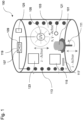
- Fig. 1 shows a schematic representation of an oven 100 for heating a dental object 101 in a chamber 103.
- the oven 100 comprises a heating device 113 for heating the dental object 101 in the chamber 103, such as a heating coil.
- the oven 100 can be operated under vacuum (adjustable oxygen partial pressure) or different atmospheres (air, inert gas) or mixtures.
- the dental object 101 is made of a polychrome glass and/or a polychrome glass ceramic, which can be colored by exposure together with a thermal treatment. After exposure, the different color effect of the dental object 101 is mainly produced via a temperature treatment.
- the dental object 101 is a dental restoration, such as a crown, a bridge, a veneer, an abutment, an inlay or an onlay.
- the heating device 113 can be provided, for example, by an infrared radiation source, a laser radiation source Microwave radiation source or an induction radiation source may be formed.
- the laser radiation source can be formed by a thermal laser or infrared laser, such as an Nd:YAG laser, an Er:YAG laser, a CO or CO2 laser.
- the heating device 113 can also be formed, for example, by an electrically operated infrared lamp, a red light lamp or a heat lamp.
- any other wavelength can also be used, such as in the visible or UV range, since only the thermal input into the dental object 101 is important for heating.
- the heat treatment can also be carried out using microwave radiation.
- the heating device 113 is capable of heating the dental object 101 to a temperature of up to 1200°C, in particular in a temperature range between 25°C and 1200°C, between 25°C and 1100°C or between 25°C and 1000 °C.
- the heating device 113 can be arranged inside or outside the chamber 103. Radiation can be guided into the chamber 103 using an optical fiber.
- the heating device 113 such as an IR laser, can also be arranged outside the chamber.
- the emitted radiation can then be scanned using a scanner (eg DMD - Digital Mirror Device) through a suitable viewing window over the dental object 101 arranged inside the chamber 103.
- a scanner eg DMD - Digital Mirror Device
- the oven 100 includes a radiation source 105.
- the radiation source 105 is used to expose the dental object 101 before or during the thermal treatment in the oven 100.
- the radiation source 105 is used to emit radiation with a wavelength that is smaller than 350 nm , into the chamber 103.
- the emitted radiation is used to expose the dental object.
- the radiation emitted from the radiation source 105 hits the dental object 101.
- the radiation stimulates electronic transitions in the dental object 101, which lead to a color change when the dental object 101 is subsequently or simultaneously heated.
- the radiation source 105 is operated electrically and is formed, for example, by a mercury vapor lamp, a quartz lamp, a black light lamp, a UV laser or a UV light-emitting diode.
- the radiation source 105 can also include an X-ray tube for generating X-rays. In this case, the radiation source 105 may emit radiation with a wavelength of 5 pm to 10 nm.
- the radiation source 105 is suitable for emitting radiation with a wavelength between 350 nm and 5 pm, preferably between 350 nm and 10 nm, or most preferably between 350 nm and 100 nm.
- a wavelength between 350 nm and 5 pm preferably between 350 nm and 10 nm, or most preferably between 350 nm and 100 nm.
- UV radiation it is also possible to expose the dental object 101 to high-energy radiation.
- high-energy radiation For example, with X-rays with a wavelength of 5 pm to 10 nm.
- radiation in the range from 100 nm to 350 nm is particularly preferred in order to stimulate electron transitions in the polychrome material.
- the oven 100 may include a UV-transparent holder on which a dental object 101 with a cavity can be placed can and which enables the dental object 101 to be illuminated on the inside.
- the chamber 103 may include a door 115 that is opened to place the dental object 101 inside. To expose the dental object 101, the door 115 is closed so that no light can escape from the chamber 103 to the outside.
- the radiation source 105 may include an electrical switch that is activated when the door 115 is opened and by which the radiation source 105 is deactivated. This achieves the technical advantage that dangerous radiation is prevented from escaping from the chamber 103.
- the radiation source 105 is arranged, for example, in a wall of the chamber 103 so that it can radiate into the interior.
- a diaphragm 121 can be arranged in front of the radiation source 105, which shields the lateral areas of the radiation, such as a pinhole diaphragm. This allows the emitted radiation to be directed to specific areas of the dental object 101.
- the oven 100 can also include a light guide with which the radiation from the radiation source 105 is brought to the dental object 101, such as a quartz glass fiber.
- the radiation source 105 can be arranged behind a special glass, such as behind a filter disk that only allows predetermined wavelength ranges to pass through.
- the oven 100 comprises an adjustment device 107.
- the adjustment device 107 can be formed by appropriate regulators with which the power of the radiation source 105 or the heating device 113 can be regulated. With this setting device 107, for example, the current or the voltage with which the Radiation source 105 or the heating device 113 is operated.
- the setting device 107 can also be implemented digitally.
- the oven 100 includes a data interface 117, via which data for controlling the intensity of the radiation source 105 or the power of the heating device 113 can be transmitted from an external device, such as a WLAN interface or a Bluetooth interface.
- a mobile phone or a tablet can be equipped with a suitable application with which the intensity of the radiation source 105 or the power of the heating device 113 can be controlled.
- the oven 100 includes a control device 119 which communicates with the application and which can increase or decrease the emitted intensity of the radiation source 105 or the power of the heating device 113.
- the control device 119 may include a microprocessor and a digital memory in which data and programs for controlling the functions of the oven 100 are stored.
- control device 119 can include a timer device 109, which activates the radiation source 105 or the heating device 113 for a predetermined period of time and automatically deactivates it after the predetermined period of time has expired.
- the control device 119 can activate the radiation source 105 or the heating device 113 simultaneously or with a time delay. This achieves the technical advantage that the dental object 101 can be automatically exposed for a specific exposure period and a defined exposure of the dental object 101 takes place with subsequent heat treatment.
- the control device 119 can be designed to control the intensity of the radiation source 105 and the temperature of the heating device 113 in time, for example based on predetermined intensity and temperature curves.
- the control device 119 can also include a trained algorithm for controlling the radiation source 105 and/or the heating device 113.
- the algorithm can be a machine learning algorithm or include an artificial neural network. The algorithm is trained using training data.
- the experimental data serves as training data to determine the color tone.
- the machine learning algorithm can determine a suitable exposure temperature program for controlling the radiation source 105 and/or the heating device 113. In this way, the exposure temperature program can be generated automatically using the machine learning algorithm.
- the exposure temperature program can be generated in the background using machine learning technology and transferred to the control device 119.
- the control device 119 can also include an electronic lookup table in which the respective control data for the radiation source 105 and the heating device 113 are stored for predetermined shades of the dental object 101. In this way lets The dental object 101 with the desired color can be generated automatically.
- the oven 100 may include a single or multiple radiation sources 105 for emitting radiation with a wavelength smaller than 350 nm.
- a single radiation source 105 reduces the technical effort required to produce the oven 100.
- the oven 100 comprises a movement device 111 for moving the dental object 101 in front of the radiation source 105 or the heating device 113.
- the movement direction 111 is designed to move the dental object 101 at a height and/or relative to the radiation source 105 or the heating device 113 turn.
- the axis of rotation is, for example, a vertical axis (z-axis).
- the dental object 101 can also be moved linearly along the axis of rotation.
- the movement device 111 is formed, for example, by a turntable on which the dental object 101 can be arranged.
- the turntable can be rotated in front of the radiation source 105 or the heating device 113 and its height can be adjusted.
- the turntable is driven, for example, by electric motors via suitable mechanics.
- the movement device 111 can also be formed by a mechanical arm with which the dental object 101 moves in all spatial directions inside the chamber 103 can be. With this arm, the dental object 101 can be moved controllably in front of the radiation source 105. Both the dental object 101 and the radiation source 105 or the heating device 113 can be positioned in the x, y and z directions.
- the dental object 101 can, for example, be arranged on a movable table that is movable in the three spatial directions.
- the radiation source 105 can comprise an optical fiber that is movable in the three spatial directions.
- the movement of the radiation source 105 or the heating device 113 as well as the dental object 101 can be realized via a robot arm.
- the movement device 111 can also be controlled by the electronic control device 119.
- a movement program can also be stored in the electronic control device 119, which controls the movement device 111 and thereby moves the dental object 101 in a predetermined time sequence in relation to the radiation source 105 or the heating device 113.
- the movement program can be used to position the dental object 101 relative to the radiation source 105 or the heating device 113. Different positions can be approached one after the other.
- the radiation source 105 or the heating device are moved at a height using a further movement device and/or to move it around the dental object 101.
- Electric motors can also be driven using suitable mechanics for this purpose.
- the dental object 101 and/or the radiation source are freely movable.
- these can be arranged around the dental object 101. This allows the dental object 101 to be illuminated from several sides. In this case, a movement device 111 can be dispensed with.
- the heating device 113 can also be arranged to be movable, so that its height can be changed and can be moved around the dental object 101.
- a diaphragm 121 can also be arranged in front of the heating device 113, which shields the lateral areas of the radiation, such as a pinhole diaphragm.
- the temperature of the dental object 101 in the chamber 103 can be determined using a radiation pyrometer or a suitable thermocouple.
- the thermocouple can be guided to the dental object 101.
- the signals about the temperature of the dental object 101 are fed to the control device 119. In this way, the control device 119 can precisely regulate the temperature to a predetermined value.
- the oven 100 may include an electronic camera 125 for detecting a color value of the dental object 101.
- the electronic camera 125 is able to take an image of the dental object 101.
- an RGB color value or an L*a*B color value of the dental object 101 can be captured by the electronic camera 125 and transmitted to the control device 119.
- the heating device 113 can be deactivated by the control device 119 if the RGB color value corresponds to a predetermined RGB color value.
- the dental object 101 can be cooled down to room temperature. This happens via a cooling device 123 for cooling the heated dental object 101.
- a cooling device 123 for cooling the heated dental object 101.
- the dental object 101 is cooled by means of an air flow which is generated by a fan as a cooling device 123.
- the cooling device 123 can also be activated and deactivated by the control device 119.
- Fig. 2 shows a block diagram of a method for heating the dental object 101.
- the method includes the step S101 of recording the dental object 101 in the chamber 103.
- step S102 radiation with a wavelength that is smaller than 350 nm is introduced into the chamber 103 by the radiation source 105 emitted so that it hits the dental object 101.
- step S103 the dental object 101 in the chamber 103 is heated to a predetermined temperature by the heater 113. Areas of the dental object 101 that are exposed to radiation take on a color after heating the dental object 101 that depends on the previous exposure. This method achieves the technical advantage that the dental object 101 can be safely exposed and heated for coloring in one and the same device.
- All method steps can be implemented by devices that are suitable for carrying out the respective method step. All functions that are carried out by physical features can be a procedural step of a process.
Landscapes
- Health & Medical Sciences (AREA)
- Oral & Maxillofacial Surgery (AREA)
- Life Sciences & Earth Sciences (AREA)
- Engineering & Computer Science (AREA)
- General Health & Medical Sciences (AREA)
- Animal Behavior & Ethology (AREA)
- Public Health (AREA)
- Veterinary Medicine (AREA)
- Epidemiology (AREA)
- Dentistry (AREA)
- General Engineering & Computer Science (AREA)
- Mechanical Engineering (AREA)
- Clinical Laboratory Science (AREA)
- Chemical & Material Sciences (AREA)
- Orthopedic Medicine & Surgery (AREA)
- Geochemistry & Mineralogy (AREA)
- Materials Engineering (AREA)
- Organic Chemistry (AREA)
- General Chemical & Material Sciences (AREA)
- Chemical Kinetics & Catalysis (AREA)
- Toxicology (AREA)
- Dental Tools And Instruments Or Auxiliary Dental Instruments (AREA)
Claims (15)
- Four (100) pour chauffer un objet dentaire (101), comprenant :- une chambre (103) pour recevoir l'objet dentaire (101) ;- une source de rayonnement (105) pour émettre un rayonnement ayant une longueur d'onde inférieure à 350 nm dans la chambre (103) ; et- un dispositif de chauffage (113) pour chauffer l'objet dentaire (101) dans la chambre (103).
- Four (100) selon la revendication 1, où le dispositif de chauffage (113) est adapté pour chauffer l'objet dentaire (101) à une température allant jusqu'à 1200°C.
- Four (100) selon l'une des revendications précédentes, où le four (100) comprend un dispositif de commande (119) pour commander la source de rayonnement (105) et/ou le dispositif de chauffage (113).
- Four (100) selon la revendication 3, où le dispositif de commande (119) comprend un algorithme appris pour commander la source de rayonnement (105) et/ou le dispositif de chauffage (113) .
- Four (100) selon la revendication 3 ou 4, où le dispositif de commande (119) est configuré pour activer la source de rayonnement (105) et le dispositif de chauffage (113) simultanément ou en différé.
- Four (100) selon l'une quelconque des revendications précédentes, où le four (100) comprend une caméra électronique (125) pour détecter une valeur de couleur de l'objet dentaire (101) .
- Four (100) selon la revendication 6, où le four (100) est configuré pour arrêter un chauffage de l'objet dentaire (101) lorsque l'objet dentaire (101) a atteint une valeur de couleur prédéterminée.
- Four (100) selon l'une des revendications précédentes, où le four (100) comprend un dispositif de refroidissement (123) pour refroidir l'objet dentaire (101) chauffé.
- Four (100) selon l'une quelconque des revendications précédentes, où le dispositif de chauffage (113) est formé par une source de rayonnement infrarouge, une source de rayonnement laser, une source de rayonnement micro-ondes ou une source de rayonnement inductif.
- Four (100) selon l'une des revendications précédentes, où le four (100) comprend un dispositif de déplacement (111) pour déplacer l'objet dentaire (101) devant le dispositif de chauffage (105) et/ou la source de rayonnement.
- Procédé de chauffage d'un objet dentaire (101), comprenant les étapes suivantes :- réception (S101) de l'objet dentaire (101) dans une chambre (103) ; et- émission (S102) d'un rayonnement ayant une longueur d'onde inférieure à 350 nm dans la chambre (103) par une source de rayonnement (105) ; et- chauffage (S103) de l'objet dentaire (101) dans la chambre (103) par un dispositif de chauffage (113).
- Procédé selon la revendication 11, où une intensité de la source de rayonnement (105) et une température du moyen de chauffage (113) sont contrôlées dans le temps.
- Procédé selon la revendication 11 ou 12, où la source de rayonnement (105) et le dispositif de chauffage (113) sont activés simultanément ou en différé.
- Procédé selon l'une des revendications 11 à 13, où une valeur de couleur de l'objet dentaire (101) est détectée par une caméra électronique (125).
- Procédé selon la revendication 14, où un chauffage de l'objet dentaire (101) est arrêté lorsque l'objet dentaire (101) a atteint une valeur de couleur prédéterminée.
Priority Applications (7)
| Application Number | Priority Date | Filing Date | Title |
|---|---|---|---|
| EP21202639.7A EP4166524B1 (fr) | 2021-10-14 | 2021-10-14 | Four permettant de chauffer un objet dentaire |
| ES21202639T ES2967699T3 (es) | 2021-10-14 | 2021-10-14 | Horno para calentar un objeto dental |
| CN202210830082.7A CN115974390A (zh) | 2021-10-14 | 2022-06-29 | 用于加热牙体的烘箱及方法 |
| KR1020220129362A KR20230053519A (ko) | 2021-10-14 | 2022-10-11 | 치과용 물체를 가열하기 위한 오븐 |
| JP2022164363A JP2023059257A (ja) | 2021-10-14 | 2022-10-12 | 歯科対象物を加熱する窯 |
| US18/046,429 US12516884B2 (en) | 2021-10-14 | 2022-10-13 | Oven for heating a dental object |
| US19/419,549 US20260104205A1 (en) | 2021-10-14 | 2025-12-15 | Oven for heating a dental object |
Applications Claiming Priority (1)
| Application Number | Priority Date | Filing Date | Title |
|---|---|---|---|
| EP21202639.7A EP4166524B1 (fr) | 2021-10-14 | 2021-10-14 | Four permettant de chauffer un objet dentaire |
Publications (2)
| Publication Number | Publication Date |
|---|---|
| EP4166524A1 EP4166524A1 (fr) | 2023-04-19 |
| EP4166524B1 true EP4166524B1 (fr) | 2023-11-22 |
Family
ID=78211944
Family Applications (1)
| Application Number | Title | Priority Date | Filing Date |
|---|---|---|---|
| EP21202639.7A Active EP4166524B1 (fr) | 2021-10-14 | 2021-10-14 | Four permettant de chauffer un objet dentaire |
Country Status (6)
| Country | Link |
|---|---|
| US (2) | US12516884B2 (fr) |
| EP (1) | EP4166524B1 (fr) |
| JP (1) | JP2023059257A (fr) |
| KR (1) | KR20230053519A (fr) |
| CN (1) | CN115974390A (fr) |
| ES (1) | ES2967699T3 (fr) |
Families Citing this family (5)
| Publication number | Priority date | Publication date | Assignee | Title |
|---|---|---|---|---|
| EP3845504A1 (fr) | 2019-12-30 | 2021-07-07 | Ivoclar Vivadent AG | Procédé de fabrication d'une restauration dentaire multicolore |
| EP4166523B1 (fr) * | 2021-10-14 | 2023-11-29 | Ivoclar Vivadent AG | Dispositif d'éclairage permettant d'éclairer un objet dentaire |
| EP4166522A1 (fr) | 2021-10-14 | 2023-04-19 | Ivoclar Vivadent AG | Appareil de formage pour un objet dentaire |
| EP4623862A1 (fr) * | 2024-03-26 | 2025-10-01 | Dentsply Sirona Inc. | Procédé de préparation d'une restauration dentaire indirecte |
| GB2644212A (en) * | 2024-09-20 | 2026-03-25 | Precisement Ltd | Unified crown abutment |
Family Cites Families (65)
| Publication number | Priority date | Publication date | Assignee | Title |
|---|---|---|---|---|
| US2628160A (en) | 1951-08-30 | 1953-02-10 | Corning Glass Works | Sculpturing glass |
| US2971853A (en) | 1953-03-05 | 1961-02-14 | Corning Glass Works | Ceramic body and method of making it |
| DE2656288C3 (de) | 1976-12-11 | 1981-06-11 | Vita Zahnfabrik H. Rauter GmbH & Co KG, 7880 Bad Säckingen | Brennofen für dental-keramische Arbeiten |
| JPS616899Y2 (fr) | 1981-04-27 | 1986-03-03 | ||
| FR2507296A1 (fr) | 1981-06-09 | 1982-12-10 | Cladi Marcel | Enceinte pour la polymerisation a froid de produits, en particulier de produits de restauration esthetique et fonctionnelle des dents |
| US4480044A (en) | 1984-02-01 | 1984-10-30 | Corning Glass Works | High expansion glass-ceramic articles |
| US5162130A (en) * | 1986-12-17 | 1992-11-10 | Mclaughlin Gerald G | Light activated coloration of dental restorations |
| US5094619A (en) | 1988-07-28 | 1992-03-10 | Mclaughlin Gerald G | Coloration of dental restorations |
| CA1316666C (fr) * | 1987-10-22 | 1993-04-27 | Robert E. Duthie, Jr. | Methode de sterilisation et equipement |
| JPH0698628B2 (ja) | 1989-09-01 | 1994-12-07 | 株式会社総合歯科医療研究所 | 可視光重合型レジンの連続硬化方法及び装置 |
| US5062877A (en) | 1989-11-06 | 1991-11-05 | Corning Incorporated | Method for making an optical device |
| DE19520016C2 (de) | 1995-05-26 | 1997-04-30 | Ivoclar Ag | Photochrome Dentalmaterialien |
| EP1554551A4 (fr) * | 2002-10-01 | 2008-01-23 | Next Safety Inc | Procedes et appareil pour une sterilisation par ultraviolets |
| WO2004051716A1 (fr) * | 2002-12-03 | 2004-06-17 | Nikon Corporation | Systeme d'exposition, procede d'exposition et procede de fabrication de dispositif |
| DE10304382A1 (de) | 2003-02-03 | 2004-08-12 | Schott Glas | Photostrukturierbarer Körper sowie Verfahren zur Bearbeitung eines Glases und/oder einer Glaskeramik |
| KR100934595B1 (ko) * | 2003-07-17 | 2009-12-31 | 가부시키가이샤 노리타케 캄파니 리미티드 | 치과용 보철물의 제조 방법 및 이에 사용하기 위한 키트 |
| DE10336913C9 (de) | 2003-08-07 | 2019-02-21 | Ivoclar Vivadent Ag | Verwendung eines Lithiumsilicatmaterials |
| JP3972126B2 (ja) | 2004-05-28 | 2007-09-05 | 独立行政法人産業技術総合研究所 | 紫外線発生源、紫外線照射処理装置及び半導体製造装置 |
| DE102005003595A1 (de) | 2004-12-31 | 2006-07-20 | Schott Ag | Verfahren zur Herstellung eines optischen Bauteils, verfahrensgemäß hergestelltes Bauteil sowie derartige Bauteile umfassende Einrichtung |
| DE502006009446D1 (de) | 2006-09-13 | 2011-06-16 | Ivoclar Vivadent Ag | Mehrfarbiger Formkörper |
| US7829489B2 (en) | 2007-05-31 | 2010-11-09 | Corning Incorporated | Low CTE photomachinable glass |
| US20100028829A1 (en) | 2008-07-31 | 2010-02-04 | Ultradent Products, Inc. | Chemically activated dental bleaching trays |
| DE102008015483B4 (de) * | 2008-03-25 | 2018-10-11 | Ivoclar Vivadent Ag | Ofen zur thermischen Behandlung eines dentalen Brennobjektes |
| DE202009019061U1 (de) | 2009-12-23 | 2016-02-23 | Degudent Gmbh | Lithiummetasilicat-Glaskeramik und deren Verwendung |
| WO2011113568A1 (fr) * | 2010-03-15 | 2011-09-22 | Nobel Biocare Services Ag | Procédé de traitement de surface |
| EP2407122B1 (fr) | 2010-07-16 | 2016-07-06 | Ivoclar Vivadent AG | Four à micro-ondes doté d'un plateau rotatif |
| JPWO2012057252A1 (ja) | 2010-10-29 | 2014-05-12 | 学校法人神奈川歯科大学 | 歯科用陶材焼き付け用基材の処理方法、歯科用陶材焼き付け用基材、歯冠修復材の製造方法、歯冠修復材の処理方法、及び歯冠修復材 |
| DE102010050275A1 (de) | 2010-11-02 | 2012-05-03 | Degudent Gmbh | Lithiumsilikat-Gläser oder -Glaskeramiken, Verfahren zu deren Herstellung sowie deren Verwendung |
| CN107010838B (zh) | 2011-04-20 | 2020-04-21 | 斯特劳曼控股公司 | 制备玻璃-陶瓷体的方法 |
| JP5989770B2 (ja) | 2011-06-22 | 2016-09-07 | ヴィタ ツァーンファブリク ハー.ラウター ゲーエムベーハー ウント コー.カーゲー | 歯科用修復材、その製造方法およびガラスセラミック |
| JP2014524906A (ja) | 2011-06-22 | 2014-09-25 | ヴィタ ツァーンファブリク ハー.ラウター ゲーエムベーハー ウント コー.カーゲー | 歯科用修復材、その製造方法およびインゴット |
| US10111282B2 (en) * | 2011-07-25 | 2018-10-23 | Ivoclar Vivadent Ag | Dental furnace |
| BR112014017265B1 (pt) | 2012-01-20 | 2021-11-09 | Straumann Holding Ag | Processo para a preparação de um elemento protético que compreende um corpo de vidro cerâmico |
| US9480544B2 (en) * | 2012-01-27 | 2016-11-01 | Ivoclar Vivadent Ag | Dental furnace |
| WO2013122662A1 (fr) | 2012-02-13 | 2013-08-22 | 3M Innovative Properties Company | Bloc de rodage dentaire contenant un article dentaire individualisé et procédé de fabrication |
| US9061082B2 (en) * | 2012-04-16 | 2015-06-23 | Sensor Electronic Technology, Inc. | Ultraviolet-based sterilization |
| CN104379113B (zh) | 2012-05-04 | 2018-03-02 | 义获嘉伟瓦登特公司 | 焦硅酸锂磷灰石玻璃陶瓷 |
| KR102025963B1 (ko) | 2012-05-11 | 2019-09-26 | 이보클라 비바덴트 아게 | 치과용 예비-소결된 블랭크 |
| EP2742909B1 (fr) * | 2012-12-13 | 2016-05-18 | Ivoclar Vivadent AG | Four dentaire |
| EP2792345B1 (fr) | 2013-04-15 | 2019-10-09 | Ivoclar Vivadent AG | Vitrocéramique et verre au lithium-silice ayant une teneur en oxyde de césium |
| ES2954898T3 (es) | 2014-05-13 | 2023-11-27 | Ivoclar Vivadent Ag | Procedimiento para la producción de vidrios de silicato de litio y materiales vitrocerámicos de silicato de litio |
| CA2948081C (fr) | 2014-05-16 | 2019-04-16 | Ivoclar Vivadent Ag | Ceramique vitreuse comportant du sio2 comme principale phase cristalline |
| US20160057816A1 (en) * | 2014-08-25 | 2016-02-25 | Nibu Alias | Method and system of a smart-microwave oven |
| EP3050856B1 (fr) | 2015-01-30 | 2019-05-29 | Ivoclar Vivadent AG | Vitrocéramique en diopside-lithium-silice |
| CN106167355B (zh) | 2015-05-18 | 2019-09-27 | 肖特股份有限公司 | 敏化的光敏玻璃及其生产方法 |
| EP3150563B1 (fr) | 2015-09-30 | 2019-05-22 | Ivoclar Vivadent AG | Vitroceramique en silicate de lithium-wollastonite |
| ES3050063T3 (en) | 2015-10-19 | 2025-12-19 | Vita Zahnfabrik H Rauter Gmbh & Co Kg | Process for producing a workpiece with low translucency |
| US10470853B2 (en) * | 2015-12-03 | 2019-11-12 | James R. Glidewell Dental Ceramics, Inc. | Continuous custom dental restoration manufacturing process and system |
| JP3203603U (ja) * | 2016-01-26 | 2016-04-07 | 株式会社ビィ・ソニック | 紫外線照射装置 |
| US11198639B2 (en) | 2016-06-13 | 2021-12-14 | Corning Incorporated | Multicolored photosensitive glass-based parts and methods of manufacture |
| EP3475056A4 (fr) | 2016-06-22 | 2020-02-26 | Boomer Advanced Manufacturing Holdings Pty Ltd | Procédé et appareil permettant de générer des objets tridimensionnels |
| JP2019520175A (ja) | 2016-07-12 | 2019-07-18 | ビタ ツァーンファブリク ハー.ラウター ゲーエムベーハー ウント コー カーゲーVita Zahnfabrik H.Rauter Gmbh & Co.Kg | 歯科用窯 |
| KR102210947B1 (ko) | 2017-03-08 | 2021-02-02 | 덴츠플라이 시로나 인코포레이티드 | 모놀리스 성형체를 제조하는 방법 |
| US10537411B2 (en) | 2017-03-08 | 2020-01-21 | Dentsply Sirona Inc. | Method to produce a monolithic form body |
| EP3372193B1 (fr) | 2017-03-08 | 2021-04-21 | Ivoclar Vivadent AG | Procédé de détermination d'une couleur de matériau d'une restauration dentaire |
| EP3388767B1 (fr) * | 2017-04-12 | 2019-08-28 | Ivoclar Vivadent AG | Appareil de traitement dentaire |
| CN109896729B (zh) | 2017-12-07 | 2024-07-16 | 安徽精卓光显技术有限责任公司 | 玻璃盖板及其制备方法和触摸屏 |
| US11408629B2 (en) | 2019-04-23 | 2022-08-09 | Lg Electronics Inc. | Artificial intelligence device |
| US12268567B2 (en) | 2019-09-12 | 2025-04-08 | Solventum Intellectual Properties Company | Apparatus, system, method of post-curing an article, and post-cured article |
| EP3845504A1 (fr) | 2019-12-30 | 2021-07-07 | Ivoclar Vivadent AG | Procédé de fabrication d'une restauration dentaire multicolore |
| CN111610157B (zh) * | 2020-07-17 | 2024-11-05 | 兰州大学 | 一种基于光反射与透射及物联网技术的动态颜色监测控制系统 |
| US11886825B2 (en) | 2021-03-31 | 2024-01-30 | Adobe, Inc. | Aspect-based sentiment analysis |
| US20220318683A1 (en) | 2021-03-31 | 2022-10-06 | aixplain, Inc. | Machine learning model aggregator |
| EP4166523B1 (fr) | 2021-10-14 | 2023-11-29 | Ivoclar Vivadent AG | Dispositif d'éclairage permettant d'éclairer un objet dentaire |
| EP4166522A1 (fr) | 2021-10-14 | 2023-04-19 | Ivoclar Vivadent AG | Appareil de formage pour un objet dentaire |
-
2021
- 2021-10-14 EP EP21202639.7A patent/EP4166524B1/fr active Active
- 2021-10-14 ES ES21202639T patent/ES2967699T3/es active Active
-
2022
- 2022-06-29 CN CN202210830082.7A patent/CN115974390A/zh active Pending
- 2022-10-11 KR KR1020220129362A patent/KR20230053519A/ko active Pending
- 2022-10-12 JP JP2022164363A patent/JP2023059257A/ja active Pending
- 2022-10-13 US US18/046,429 patent/US12516884B2/en active Active
-
2025
- 2025-12-15 US US19/419,549 patent/US20260104205A1/en active Pending
Also Published As
| Publication number | Publication date |
|---|---|
| KR20230053519A (ko) | 2023-04-21 |
| ES2967699T3 (es) | 2024-05-03 |
| EP4166524A1 (fr) | 2023-04-19 |
| US12516884B2 (en) | 2026-01-06 |
| CN115974390A (zh) | 2023-04-18 |
| US20230125010A1 (en) | 2023-04-20 |
| JP2023059257A (ja) | 2023-04-26 |
| US20260104205A1 (en) | 2026-04-16 |
Similar Documents
| Publication | Publication Date | Title |
|---|---|---|
| EP4166524A1 (fr) | Four permettant de chauffer un objet dentaire | |
| EP4166523B1 (fr) | Dispositif d'éclairage permettant d'éclairer un objet dentaire | |
| EP4166522A1 (fr) | Appareil de formage pour un objet dentaire | |
| DE19619155C2 (de) | Bestrahlungsgerät zur Aushärtung von Kunststoffen, sowie Verfahren und Verwendungen | |
| CN105342700B (zh) | 用于光学组织表面治疗的独立机头和方法 | |
| DE69425943T2 (de) | Lichtmusterschablone und Laserablationsverfahren bzw. -gerät zu deren Herstellung | |
| WO2015062564A1 (fr) | Procédé de fabrication d'un composant tridimensionnel | |
| EP0806239B1 (fr) | Appareil de polymérisation et procédé de contrôle dudit appareil | |
| CN103909352B (zh) | 基于局部离子注入实现电子状态调控的飞秒激光加工方法 | |
| DE69003326T2 (de) | Bestrahlungsgerät mit Kontrollvorrichtung. | |
| EP0024335A1 (fr) | Dispositif pour la réalisation de travaux à la chaleur dans la pratique dentaire | |
| WO2015086585A1 (fr) | Procédé de fabrication par frittage d'un objet structuré en trois dimensions et dispositif de frittage à cet effet | |
| EP4484873A1 (fr) | Appareil d'exposition pour illuminer un objet dentaire | |
| DE3904034C2 (fr) | ||
| DE901413C (de) | Einrichtung zum Erschmelzen von Kristallen hochschmelzender Mineralien, insbesondere kuenstlicher Edelsteine | |
| JPH01146280A (ja) | 高精度赤外線加熱装置 | |
| JP2679180B2 (ja) | 半田付け装置 | |
| DE892970C (de) | Heissluftsterilisator mit Temperaturregelung | |
| DE10135606A1 (de) | Verfahren und Einrichtung zum Bearbeiten von optischen Bauteilen, insbesondere eine asphärisch geformte Fläche aufweisenden Linsen, oder von anderen gegen thermisch verursachte Spannungen empfindlichen Bauteilen mit elektromagnetischer Strahlung | |
| DE2656316B2 (de) | Vorwärmofen, insbesondere für zahntechnische Zwecke | |
| Geissler et al. | A device for laser annealing of Nb films in Nb coated Cu cavities | |
| JPH06170528A (ja) | 自動半田付け装置 | |
| DE202012101234U1 (de) | Konditionierungseinrichtung | |
| JPS6180827A (ja) | 半導体ウエハの熱処理装置 | |
| JPS54140592A (en) | Sample heating and irradiating apparatus |
Legal Events
| Date | Code | Title | Description |
|---|---|---|---|
| PUAI | Public reference made under article 153(3) epc to a published international application that has entered the european phase |
Free format text: ORIGINAL CODE: 0009012 |
|
| STAA | Information on the status of an ep patent application or granted ep patent |
Free format text: STATUS: REQUEST FOR EXAMINATION WAS MADE |
|
| 17P | Request for examination filed |
Effective date: 20220901 |
|
| AK | Designated contracting states |
Kind code of ref document: A1 Designated state(s): AL AT BE BG CH CY CZ DE DK EE ES FI FR GB GR HR HU IE IS IT LI LT LU LV MC MK MT NL NO PL PT RO RS SE SI SK SM TR |
|
| GRAP | Despatch of communication of intention to grant a patent |
Free format text: ORIGINAL CODE: EPIDOSNIGR1 |
|
| STAA | Information on the status of an ep patent application or granted ep patent |
Free format text: STATUS: GRANT OF PATENT IS INTENDED |
|
| INTG | Intention to grant announced |
Effective date: 20230512 |
|
| P01 | Opt-out of the competence of the unified patent court (upc) registered |
Effective date: 20230707 |
|
| GRAS | Grant fee paid |
Free format text: ORIGINAL CODE: EPIDOSNIGR3 |
|
| GRAA | (expected) grant |
Free format text: ORIGINAL CODE: 0009210 |
|
| STAA | Information on the status of an ep patent application or granted ep patent |
Free format text: STATUS: THE PATENT HAS BEEN GRANTED |
|
| AK | Designated contracting states |
Kind code of ref document: B1 Designated state(s): AL AT BE BG CH CY CZ DE DK EE ES FI FR GB GR HR HU IE IS IT LI LT LU LV MC MK MT NL NO PL PT RO RS SE SI SK SM TR |
|
| REG | Reference to a national code |
Ref country code: GB Ref legal event code: FG4D Free format text: NOT ENGLISH |
|
| REG | Reference to a national code |
Ref country code: CH Ref legal event code: EP Ref country code: DE Ref legal event code: R096 Ref document number: 502021002014 Country of ref document: DE |
|
| REG | Reference to a national code |
Ref country code: IE Ref legal event code: FG4D Free format text: LANGUAGE OF EP DOCUMENT: GERMAN |
|
| REG | Reference to a national code |
Ref country code: LT Ref legal event code: MG9D |
|
| REG | Reference to a national code |
Ref country code: NL Ref legal event code: MP Effective date: 20231122 |
|
| PG25 | Lapsed in a contracting state [announced via postgrant information from national office to epo] |
Ref country code: GR Free format text: LAPSE BECAUSE OF FAILURE TO SUBMIT A TRANSLATION OF THE DESCRIPTION OR TO PAY THE FEE WITHIN THE PRESCRIBED TIME-LIMIT Effective date: 20240223 |
|
| PG25 | Lapsed in a contracting state [announced via postgrant information from national office to epo] |
Ref country code: IS Free format text: LAPSE BECAUSE OF FAILURE TO SUBMIT A TRANSLATION OF THE DESCRIPTION OR TO PAY THE FEE WITHIN THE PRESCRIBED TIME-LIMIT Effective date: 20240322 |
|
| PG25 | Lapsed in a contracting state [announced via postgrant information from national office to epo] |
Ref country code: LT Free format text: LAPSE BECAUSE OF FAILURE TO SUBMIT A TRANSLATION OF THE DESCRIPTION OR TO PAY THE FEE WITHIN THE PRESCRIBED TIME-LIMIT Effective date: 20231122 |
|
| PG25 | Lapsed in a contracting state [announced via postgrant information from national office to epo] |
Ref country code: NL Free format text: LAPSE BECAUSE OF FAILURE TO SUBMIT A TRANSLATION OF THE DESCRIPTION OR TO PAY THE FEE WITHIN THE PRESCRIBED TIME-LIMIT Effective date: 20231122 |
|
| PG25 | Lapsed in a contracting state [announced via postgrant information from national office to epo] |
Ref country code: NL Free format text: LAPSE BECAUSE OF FAILURE TO SUBMIT A TRANSLATION OF THE DESCRIPTION OR TO PAY THE FEE WITHIN THE PRESCRIBED TIME-LIMIT Effective date: 20231122 Ref country code: LT Free format text: LAPSE BECAUSE OF FAILURE TO SUBMIT A TRANSLATION OF THE DESCRIPTION OR TO PAY THE FEE WITHIN THE PRESCRIBED TIME-LIMIT Effective date: 20231122 Ref country code: IS Free format text: LAPSE BECAUSE OF FAILURE TO SUBMIT A TRANSLATION OF THE DESCRIPTION OR TO PAY THE FEE WITHIN THE PRESCRIBED TIME-LIMIT Effective date: 20240322 Ref country code: GR Free format text: LAPSE BECAUSE OF FAILURE TO SUBMIT A TRANSLATION OF THE DESCRIPTION OR TO PAY THE FEE WITHIN THE PRESCRIBED TIME-LIMIT Effective date: 20240223 Ref country code: BG Free format text: LAPSE BECAUSE OF FAILURE TO SUBMIT A TRANSLATION OF THE DESCRIPTION OR TO PAY THE FEE WITHIN THE PRESCRIBED TIME-LIMIT Effective date: 20240222 Ref country code: PT Free format text: LAPSE BECAUSE OF FAILURE TO SUBMIT A TRANSLATION OF THE DESCRIPTION OR TO PAY THE FEE WITHIN THE PRESCRIBED TIME-LIMIT Effective date: 20240322 |
|
| REG | Reference to a national code |
Ref country code: ES Ref legal event code: FG2A Ref document number: 2967699 Country of ref document: ES Kind code of ref document: T3 Effective date: 20240503 |
|
| PG25 | Lapsed in a contracting state [announced via postgrant information from national office to epo] |
Ref country code: SE Free format text: LAPSE BECAUSE OF FAILURE TO SUBMIT A TRANSLATION OF THE DESCRIPTION OR TO PAY THE FEE WITHIN THE PRESCRIBED TIME-LIMIT Effective date: 20231122 Ref country code: RS Free format text: LAPSE BECAUSE OF FAILURE TO SUBMIT A TRANSLATION OF THE DESCRIPTION OR TO PAY THE FEE WITHIN THE PRESCRIBED TIME-LIMIT Effective date: 20231122 Ref country code: PL Free format text: LAPSE BECAUSE OF FAILURE TO SUBMIT A TRANSLATION OF THE DESCRIPTION OR TO PAY THE FEE WITHIN THE PRESCRIBED TIME-LIMIT Effective date: 20231122 Ref country code: NO Free format text: LAPSE BECAUSE OF FAILURE TO SUBMIT A TRANSLATION OF THE DESCRIPTION OR TO PAY THE FEE WITHIN THE PRESCRIBED TIME-LIMIT Effective date: 20240222 Ref country code: LV Free format text: LAPSE BECAUSE OF FAILURE TO SUBMIT A TRANSLATION OF THE DESCRIPTION OR TO PAY THE FEE WITHIN THE PRESCRIBED TIME-LIMIT Effective date: 20231122 Ref country code: HR Free format text: LAPSE BECAUSE OF FAILURE TO SUBMIT A TRANSLATION OF THE DESCRIPTION OR TO PAY THE FEE WITHIN THE PRESCRIBED TIME-LIMIT Effective date: 20231122 |
|
| PG25 | Lapsed in a contracting state [announced via postgrant information from national office to epo] |
Ref country code: DK Free format text: LAPSE BECAUSE OF FAILURE TO SUBMIT A TRANSLATION OF THE DESCRIPTION OR TO PAY THE FEE WITHIN THE PRESCRIBED TIME-LIMIT Effective date: 20231122 |
|
| PG25 | Lapsed in a contracting state [announced via postgrant information from national office to epo] |
Ref country code: CZ Free format text: LAPSE BECAUSE OF FAILURE TO SUBMIT A TRANSLATION OF THE DESCRIPTION OR TO PAY THE FEE WITHIN THE PRESCRIBED TIME-LIMIT Effective date: 20231122 |
|
| PG25 | Lapsed in a contracting state [announced via postgrant information from national office to epo] |
Ref country code: SK Free format text: LAPSE BECAUSE OF FAILURE TO SUBMIT A TRANSLATION OF THE DESCRIPTION OR TO PAY THE FEE WITHIN THE PRESCRIBED TIME-LIMIT Effective date: 20231122 |
|
| PG25 | Lapsed in a contracting state [announced via postgrant information from national office to epo] |
Ref country code: SM Free format text: LAPSE BECAUSE OF FAILURE TO SUBMIT A TRANSLATION OF THE DESCRIPTION OR TO PAY THE FEE WITHIN THE PRESCRIBED TIME-LIMIT Effective date: 20231122 Ref country code: SK Free format text: LAPSE BECAUSE OF FAILURE TO SUBMIT A TRANSLATION OF THE DESCRIPTION OR TO PAY THE FEE WITHIN THE PRESCRIBED TIME-LIMIT Effective date: 20231122 Ref country code: RO Free format text: LAPSE BECAUSE OF FAILURE TO SUBMIT A TRANSLATION OF THE DESCRIPTION OR TO PAY THE FEE WITHIN THE PRESCRIBED TIME-LIMIT Effective date: 20231122 Ref country code: EE Free format text: LAPSE BECAUSE OF FAILURE TO SUBMIT A TRANSLATION OF THE DESCRIPTION OR TO PAY THE FEE WITHIN THE PRESCRIBED TIME-LIMIT Effective date: 20231122 Ref country code: DK Free format text: LAPSE BECAUSE OF FAILURE TO SUBMIT A TRANSLATION OF THE DESCRIPTION OR TO PAY THE FEE WITHIN THE PRESCRIBED TIME-LIMIT Effective date: 20231122 Ref country code: CZ Free format text: LAPSE BECAUSE OF FAILURE TO SUBMIT A TRANSLATION OF THE DESCRIPTION OR TO PAY THE FEE WITHIN THE PRESCRIBED TIME-LIMIT Effective date: 20231122 |
|
| REG | Reference to a national code |
Ref country code: DE Ref legal event code: R097 Ref document number: 502021002014 Country of ref document: DE |
|
| PLBE | No opposition filed within time limit |
Free format text: ORIGINAL CODE: 0009261 |
|
| STAA | Information on the status of an ep patent application or granted ep patent |
Free format text: STATUS: NO OPPOSITION FILED WITHIN TIME LIMIT |
|
| PG25 | Lapsed in a contracting state [announced via postgrant information from national office to epo] |
Ref country code: SI Free format text: LAPSE BECAUSE OF FAILURE TO SUBMIT A TRANSLATION OF THE DESCRIPTION OR TO PAY THE FEE WITHIN THE PRESCRIBED TIME-LIMIT Effective date: 20231122 |
|
| 26N | No opposition filed |
Effective date: 20240823 |
|
| PG25 | Lapsed in a contracting state [announced via postgrant information from national office to epo] |
Ref country code: SI Free format text: LAPSE BECAUSE OF FAILURE TO SUBMIT A TRANSLATION OF THE DESCRIPTION OR TO PAY THE FEE WITHIN THE PRESCRIBED TIME-LIMIT Effective date: 20231122 |
|
| PG25 | Lapsed in a contracting state [announced via postgrant information from national office to epo] |
Ref country code: MC Free format text: LAPSE BECAUSE OF FAILURE TO SUBMIT A TRANSLATION OF THE DESCRIPTION OR TO PAY THE FEE WITHIN THE PRESCRIBED TIME-LIMIT Effective date: 20231122 |
|
| PG25 | Lapsed in a contracting state [announced via postgrant information from national office to epo] |
Ref country code: BE Free format text: LAPSE BECAUSE OF NON-PAYMENT OF DUE FEES Effective date: 20241031 Ref country code: LU Free format text: LAPSE BECAUSE OF NON-PAYMENT OF DUE FEES Effective date: 20241014 |
|
| REG | Reference to a national code |
Ref country code: BE Ref legal event code: MM Effective date: 20241031 |
|
| PG25 | Lapsed in a contracting state [announced via postgrant information from national office to epo] |
Ref country code: FI Free format text: LAPSE BECAUSE OF FAILURE TO SUBMIT A TRANSLATION OF THE DESCRIPTION OR TO PAY THE FEE WITHIN THE PRESCRIBED TIME-LIMIT Effective date: 20231122 |
|
| PG25 | Lapsed in a contracting state [announced via postgrant information from national office to epo] |
Ref country code: IE Free format text: LAPSE BECAUSE OF NON-PAYMENT OF DUE FEES Effective date: 20241014 |
|
| REG | Reference to a national code |
Ref country code: CH Ref legal event code: U11 Free format text: ST27 STATUS EVENT CODE: U-0-0-U10-U11 (AS PROVIDED BY THE NATIONAL OFFICE) Effective date: 20251117 |
|
| PGFP | Annual fee paid to national office [announced via postgrant information from national office to epo] |
Ref country code: DE Payment date: 20251024 Year of fee payment: 5 |
|
| PGFP | Annual fee paid to national office [announced via postgrant information from national office to epo] |
Ref country code: GB Payment date: 20251024 Year of fee payment: 5 |
|
| PGFP | Annual fee paid to national office [announced via postgrant information from national office to epo] |
Ref country code: AT Payment date: 20260113 Year of fee payment: 5 |
|
| PGFP | Annual fee paid to national office [announced via postgrant information from national office to epo] |
Ref country code: IT Payment date: 20251015 Year of fee payment: 5 |
|
| PGFP | Annual fee paid to national office [announced via postgrant information from national office to epo] |
Ref country code: FR Payment date: 20251027 Year of fee payment: 5 |
|
| PGFP | Annual fee paid to national office [announced via postgrant information from national office to epo] |
Ref country code: CH Payment date: 20251117 Year of fee payment: 5 |
|
| PG25 | Lapsed in a contracting state [announced via postgrant information from national office to epo] |
Ref country code: CY Free format text: LAPSE BECAUSE OF FAILURE TO SUBMIT A TRANSLATION OF THE DESCRIPTION OR TO PAY THE FEE WITHIN THE PRESCRIBED TIME-LIMIT; INVALID AB INITIO Effective date: 20211014 |
|
| PGFP | Annual fee paid to national office [announced via postgrant information from national office to epo] |
Ref country code: ES Payment date: 20251104 Year of fee payment: 5 |
|
| PG25 | Lapsed in a contracting state [announced via postgrant information from national office to epo] |
Ref country code: HU Free format text: LAPSE BECAUSE OF FAILURE TO SUBMIT A TRANSLATION OF THE DESCRIPTION OR TO PAY THE FEE WITHIN THE PRESCRIBED TIME-LIMIT; INVALID AB INITIO Effective date: 20211014 |
|
| PG25 | Lapsed in a contracting state [announced via postgrant information from national office to epo] |
Ref country code: TR Free format text: LAPSE BECAUSE OF FAILURE TO SUBMIT A TRANSLATION OF THE DESCRIPTION OR TO PAY THE FEE WITHIN THE PRESCRIBED TIME-LIMIT Effective date: 20231122 |