EP4169707A1 - Emballage recyclable avec barrière élevée contre la vapeur d'eau et l'oxygène - Google Patents
Emballage recyclable avec barrière élevée contre la vapeur d'eau et l'oxygène Download PDFInfo
- Publication number
- EP4169707A1 EP4169707A1 EP22216138.2A EP22216138A EP4169707A1 EP 4169707 A1 EP4169707 A1 EP 4169707A1 EP 22216138 A EP22216138 A EP 22216138A EP 4169707 A1 EP4169707 A1 EP 4169707A1
- Authority
- EP
- European Patent Office
- Prior art keywords
- layer
- barrier
- paper
- barrier film
- packaging laminate
- Prior art date
- Legal status (The legal status is an assumption and is not a legal conclusion. Google has not performed a legal analysis and makes no representation as to the accuracy of the status listed.)
- Pending
Links
Images
Classifications
-
- B—PERFORMING OPERATIONS; TRANSPORTING
- B65—CONVEYING; PACKING; STORING; HANDLING THIN OR FILAMENTARY MATERIAL
- B65D—CONTAINERS FOR STORAGE OR TRANSPORT OF ARTICLES OR MATERIALS, e.g. BAGS, BARRELS, BOTTLES, BOXES, CANS, CARTONS, CRATES, DRUMS, JARS, TANKS, HOPPERS, FORWARDING CONTAINERS; ACCESSORIES, CLOSURES, OR FITTINGS THEREFOR; PACKAGING ELEMENTS; PACKAGES
- B65D65/00—Wrappers or flexible covers; Packaging materials of special type or form
- B65D65/38—Packaging materials of special type or form
- B65D65/40—Applications of laminates for particular packaging purposes
-
- B—PERFORMING OPERATIONS; TRANSPORTING
- B32—LAYERED PRODUCTS
- B32B—LAYERED PRODUCTS, i.e. PRODUCTS BUILT-UP OF STRATA OF FLAT OR NON-FLAT, e.g. CELLULAR OR HONEYCOMB, FORM
- B32B15/00—Layered products comprising a layer of metal
- B32B15/04—Layered products comprising a layer of metal comprising metal as the main or only constituent of a layer, which is next to another layer of the same or of a different material
- B32B15/08—Layered products comprising a layer of metal comprising metal as the main or only constituent of a layer, which is next to another layer of the same or of a different material of synthetic resin
- B32B15/085—Layered products comprising a layer of metal comprising metal as the main or only constituent of a layer, which is next to another layer of the same or of a different material of synthetic resin comprising polyolefins
-
- B—PERFORMING OPERATIONS; TRANSPORTING
- B32—LAYERED PRODUCTS
- B32B—LAYERED PRODUCTS, i.e. PRODUCTS BUILT-UP OF STRATA OF FLAT OR NON-FLAT, e.g. CELLULAR OR HONEYCOMB, FORM
- B32B15/00—Layered products comprising a layer of metal
- B32B15/20—Layered products comprising a layer of metal comprising aluminium or copper
-
- B—PERFORMING OPERATIONS; TRANSPORTING
- B32—LAYERED PRODUCTS
- B32B—LAYERED PRODUCTS, i.e. PRODUCTS BUILT-UP OF STRATA OF FLAT OR NON-FLAT, e.g. CELLULAR OR HONEYCOMB, FORM
- B32B27/00—Layered products comprising a layer of synthetic resin
- B32B27/06—Layered products comprising a layer of synthetic resin as the main or only constituent of a layer, which is next to another layer of the same or of a different material
- B32B27/08—Layered products comprising a layer of synthetic resin as the main or only constituent of a layer, which is next to another layer of the same or of a different material of synthetic resin
-
- B—PERFORMING OPERATIONS; TRANSPORTING
- B32—LAYERED PRODUCTS
- B32B—LAYERED PRODUCTS, i.e. PRODUCTS BUILT-UP OF STRATA OF FLAT OR NON-FLAT, e.g. CELLULAR OR HONEYCOMB, FORM
- B32B27/00—Layered products comprising a layer of synthetic resin
- B32B27/06—Layered products comprising a layer of synthetic resin as the main or only constituent of a layer, which is next to another layer of the same or of a different material
- B32B27/10—Layered products comprising a layer of synthetic resin as the main or only constituent of a layer, which is next to another layer of the same or of a different material of paper or cardboard
-
- B—PERFORMING OPERATIONS; TRANSPORTING
- B32—LAYERED PRODUCTS
- B32B—LAYERED PRODUCTS, i.e. PRODUCTS BUILT-UP OF STRATA OF FLAT OR NON-FLAT, e.g. CELLULAR OR HONEYCOMB, FORM
- B32B27/00—Layered products comprising a layer of synthetic resin
- B32B27/30—Layered products comprising a layer of synthetic resin comprising vinyl (co)polymers; comprising acrylic (co)polymers
- B32B27/306—Layered products comprising a layer of synthetic resin comprising vinyl (co)polymers; comprising acrylic (co)polymers comprising vinyl acetate or vinyl alcohol (co)polymers
-
- B—PERFORMING OPERATIONS; TRANSPORTING
- B32—LAYERED PRODUCTS
- B32B—LAYERED PRODUCTS, i.e. PRODUCTS BUILT-UP OF STRATA OF FLAT OR NON-FLAT, e.g. CELLULAR OR HONEYCOMB, FORM
- B32B27/00—Layered products comprising a layer of synthetic resin
- B32B27/32—Layered products comprising a layer of synthetic resin comprising polyolefins
-
- B—PERFORMING OPERATIONS; TRANSPORTING
- B32—LAYERED PRODUCTS
- B32B—LAYERED PRODUCTS, i.e. PRODUCTS BUILT-UP OF STRATA OF FLAT OR NON-FLAT, e.g. CELLULAR OR HONEYCOMB, FORM
- B32B27/00—Layered products comprising a layer of synthetic resin
- B32B27/34—Layered products comprising a layer of synthetic resin comprising polyamides
-
- B—PERFORMING OPERATIONS; TRANSPORTING
- B32—LAYERED PRODUCTS
- B32B—LAYERED PRODUCTS, i.e. PRODUCTS BUILT-UP OF STRATA OF FLAT OR NON-FLAT, e.g. CELLULAR OR HONEYCOMB, FORM
- B32B29/00—Layered products comprising a layer of paper or cardboard
- B32B29/002—Layered products comprising a layer of paper or cardboard as the main or only constituent of a layer, which is next to another layer of the same or of a different material
-
- B—PERFORMING OPERATIONS; TRANSPORTING
- B32—LAYERED PRODUCTS
- B32B—LAYERED PRODUCTS, i.e. PRODUCTS BUILT-UP OF STRATA OF FLAT OR NON-FLAT, e.g. CELLULAR OR HONEYCOMB, FORM
- B32B7/00—Layered products characterised by the relation between layers; Layered products characterised by the relative orientation of features between layers, or by the relative values of a measurable parameter between layers, i.e. products comprising layers having different physical, chemical or physicochemical properties; Layered products characterised by the interconnection of layers
- B32B7/04—Interconnection of layers
- B32B7/12—Interconnection of layers using interposed adhesives or interposed materials with bonding properties
-
- B—PERFORMING OPERATIONS; TRANSPORTING
- B32—LAYERED PRODUCTS
- B32B—LAYERED PRODUCTS, i.e. PRODUCTS BUILT-UP OF STRATA OF FLAT OR NON-FLAT, e.g. CELLULAR OR HONEYCOMB, FORM
- B32B2250/00—Layers arrangement
- B32B2250/40—Symmetrical or sandwich layers, e.g. ABA, ABCBA, ABCCBA
-
- B—PERFORMING OPERATIONS; TRANSPORTING
- B32—LAYERED PRODUCTS
- B32B—LAYERED PRODUCTS, i.e. PRODUCTS BUILT-UP OF STRATA OF FLAT OR NON-FLAT, e.g. CELLULAR OR HONEYCOMB, FORM
- B32B2255/00—Coating on the layer surface
- B32B2255/10—Coating on the layer surface on synthetic resin layer or on natural or synthetic rubber layer
-
- B—PERFORMING OPERATIONS; TRANSPORTING
- B32—LAYERED PRODUCTS
- B32B—LAYERED PRODUCTS, i.e. PRODUCTS BUILT-UP OF STRATA OF FLAT OR NON-FLAT, e.g. CELLULAR OR HONEYCOMB, FORM
- B32B2255/00—Coating on the layer surface
- B32B2255/20—Inorganic coating
-
- B—PERFORMING OPERATIONS; TRANSPORTING
- B32—LAYERED PRODUCTS
- B32B—LAYERED PRODUCTS, i.e. PRODUCTS BUILT-UP OF STRATA OF FLAT OR NON-FLAT, e.g. CELLULAR OR HONEYCOMB, FORM
- B32B2255/00—Coating on the layer surface
- B32B2255/20—Inorganic coating
- B32B2255/205—Metallic coating
-
- B—PERFORMING OPERATIONS; TRANSPORTING
- B32—LAYERED PRODUCTS
- B32B—LAYERED PRODUCTS, i.e. PRODUCTS BUILT-UP OF STRATA OF FLAT OR NON-FLAT, e.g. CELLULAR OR HONEYCOMB, FORM
- B32B2307/00—Properties of the layers or laminate
- B32B2307/30—Properties of the layers or laminate having particular thermal properties
- B32B2307/31—Heat sealable
-
- B—PERFORMING OPERATIONS; TRANSPORTING
- B32—LAYERED PRODUCTS
- B32B—LAYERED PRODUCTS, i.e. PRODUCTS BUILT-UP OF STRATA OF FLAT OR NON-FLAT, e.g. CELLULAR OR HONEYCOMB, FORM
- B32B2307/00—Properties of the layers or laminate
- B32B2307/50—Properties of the layers or laminate having particular mechanical properties
- B32B2307/514—Oriented
-
- B—PERFORMING OPERATIONS; TRANSPORTING
- B32—LAYERED PRODUCTS
- B32B—LAYERED PRODUCTS, i.e. PRODUCTS BUILT-UP OF STRATA OF FLAT OR NON-FLAT, e.g. CELLULAR OR HONEYCOMB, FORM
- B32B2307/00—Properties of the layers or laminate
- B32B2307/70—Other properties
- B32B2307/718—Weight, e.g. weight per square meter
-
- B—PERFORMING OPERATIONS; TRANSPORTING
- B32—LAYERED PRODUCTS
- B32B—LAYERED PRODUCTS, i.e. PRODUCTS BUILT-UP OF STRATA OF FLAT OR NON-FLAT, e.g. CELLULAR OR HONEYCOMB, FORM
- B32B2307/00—Properties of the layers or laminate
- B32B2307/70—Other properties
- B32B2307/724—Permeability to gases, adsorption
- B32B2307/7242—Non-permeable
- B32B2307/7244—Oxygen barrier
-
- B—PERFORMING OPERATIONS; TRANSPORTING
- B32—LAYERED PRODUCTS
- B32B—LAYERED PRODUCTS, i.e. PRODUCTS BUILT-UP OF STRATA OF FLAT OR NON-FLAT, e.g. CELLULAR OR HONEYCOMB, FORM
- B32B2307/00—Properties of the layers or laminate
- B32B2307/70—Other properties
- B32B2307/724—Permeability to gases, adsorption
- B32B2307/7242—Non-permeable
- B32B2307/7246—Water vapor barrier
-
- B—PERFORMING OPERATIONS; TRANSPORTING
- B32—LAYERED PRODUCTS
- B32B—LAYERED PRODUCTS, i.e. PRODUCTS BUILT-UP OF STRATA OF FLAT OR NON-FLAT, e.g. CELLULAR OR HONEYCOMB, FORM
- B32B2307/00—Properties of the layers or laminate
- B32B2307/70—Other properties
- B32B2307/724—Permeability to gases, adsorption
- B32B2307/7242—Non-permeable
- B32B2307/7248—Odour barrier
-
- B—PERFORMING OPERATIONS; TRANSPORTING
- B32—LAYERED PRODUCTS
- B32B—LAYERED PRODUCTS, i.e. PRODUCTS BUILT-UP OF STRATA OF FLAT OR NON-FLAT, e.g. CELLULAR OR HONEYCOMB, FORM
- B32B2307/00—Properties of the layers or laminate
- B32B2307/70—Other properties
- B32B2307/728—Hydrophilic
-
- B—PERFORMING OPERATIONS; TRANSPORTING
- B32—LAYERED PRODUCTS
- B32B—LAYERED PRODUCTS, i.e. PRODUCTS BUILT-UP OF STRATA OF FLAT OR NON-FLAT, e.g. CELLULAR OR HONEYCOMB, FORM
- B32B2439/00—Containers; Receptacles
- B32B2439/40—Closed containers
- B32B2439/62—Boxes, cartons, cases
-
- B—PERFORMING OPERATIONS; TRANSPORTING
- B32—LAYERED PRODUCTS
- B32B—LAYERED PRODUCTS, i.e. PRODUCTS BUILT-UP OF STRATA OF FLAT OR NON-FLAT, e.g. CELLULAR OR HONEYCOMB, FORM
- B32B2439/00—Containers; Receptacles
- B32B2439/70—Food packaging
-
- B—PERFORMING OPERATIONS; TRANSPORTING
- B32—LAYERED PRODUCTS
- B32B—LAYERED PRODUCTS, i.e. PRODUCTS BUILT-UP OF STRATA OF FLAT OR NON-FLAT, e.g. CELLULAR OR HONEYCOMB, FORM
- B32B2553/00—Packaging equipment or accessories not otherwise provided for
-
- Y—GENERAL TAGGING OF NEW TECHNOLOGICAL DEVELOPMENTS; GENERAL TAGGING OF CROSS-SECTIONAL TECHNOLOGIES SPANNING OVER SEVERAL SECTIONS OF THE IPC; TECHNICAL SUBJECTS COVERED BY FORMER USPC CROSS-REFERENCE ART COLLECTIONS [XRACs] AND DIGESTS
- Y02—TECHNOLOGIES OR APPLICATIONS FOR MITIGATION OR ADAPTATION AGAINST CLIMATE CHANGE
- Y02W—CLIMATE CHANGE MITIGATION TECHNOLOGIES RELATED TO WASTEWATER TREATMENT OR WASTE MANAGEMENT
- Y02W30/00—Technologies for solid waste management
- Y02W30/50—Reuse, recycling or recovery technologies
- Y02W30/80—Packaging reuse or recycling, e.g. of multilayer packaging
Definitions
- the present invention relates to a recyclable paper packaging laminate consisting of a paper layer with a paper with a basis weight of 30 to 360 g/m 2 and a barrier film connected thereto, which, in addition to being recyclable, also has a high oxygen, water vapor and/or aroma barrier.
- Paper packaging laminates are used in the packaging industry, which should have different properties depending on the application. Such paper packaging laminates are usually laminated with multi-layer plastic films that are produced in the extrusion process, co-extrusion process (in both cases both in the flat film and in the blown film process) or laminating process (connection of individual layers using a laminating adhesive), and mixtures thereof. Layers that are not made of plastic can also be integrated in the paper packaging laminate, for example a layer made of aluminum or other papers.
- the paper packaging laminate also typically has an outer sealing layer for thermosealing the paper packaging laminate into a desired package such as a pouch, sack, bag, etc.
- the paper packaging laminate usually contains a barrier layer made of aluminum or a suitable barrier polymer, such as ethylene vinyl alcohol copolymer (EVOH) or polyamide (PA).
- EVOH ethylene vinyl alcohol copolymer
- PA polyamide
- a paper packaging laminate usually also contains a sealing layer in order to be able to process the paper packaging laminate into a package by heat sealing.
- a sealing layer is typically made of a polyolefin, usually polypropylene (PP) or polyethylene (PE) in the various densities LLDPE, LDPE, MDPE or HDPE (also as a blend or multi-layered with the same or different types).
- Additional layers can also be included in order to give the paper packaging laminate the desired properties, such as toughness, rigidity, tear resistance, etc.
- the paper packaging laminate In order to be able to process the paper packaging laminate easily, the paper packaging laminate should of course not warp or roll up (so-called curling) during processing, which is why symmetrical layer structures are usually used for the laminated plastic films.
- a mono- or biaxial orientation of plastic layers of the paper packaging laminate change.
- Such an orientation can take place through the extrusion process, for example in a multiple bubble extrusion process (multiple bubble process), or only after the extrusion process by stretching (stretching) the plastic film in the machine direction (in the longitudinal direction of the paper packaging laminate) and / or in the transverse direction (normal to the longitudinal direction).
- the orientation of the plastic film can improve the rigidity, tensile strength and toughness in particular.
- the extrusion gap 1.5 to 2.5 mm for blown film or the gap of the extrusion die is significantly larger than the final thickness of the extruded film (typically between 10 and 200 ⁇ m) .
- the extruded melt is stretched at temperatures well above the melting point of the extruded polymer, giving it the final thickness.
- the melt is typically stretched by a factor of about 2 to 3 in the transverse direction (the so-called blow-up ratio) and by a factor of 1:10 to 1:100 in the longitudinal direction (the so-called draw-off ratio).
- paper should often be used as packaging material because paper is easily recyclable.
- paper alone cannot be used as packaging material because paper alone does not have any significant barrier properties. Paper is therefore mostly combined with other layers, such as layers of plastic or metal, in the field of flexible packaging in order to meet the barrier requirements.
- paper packaging laminates for example a frequently used paper/aluminum/polyethylene structure, are usually difficult or impossible to recycle due to the materials used.
- WO 2013/086950 A1 discloses recyclable laminates with "water-dispersible-ionomers” (WPI) as adhesives, with which a thermoplastic is bonded to a base material made of paper or aluminum.
- WPI water-dispersible-ionomers
- the laminate is recyclable because the paper layer and the thermoplastic can be separated by the WPI, but the recycling step requires high water temperatures of preferably 80° C. and exposure times of preferably 1 hour.
- EP 3194164 B1 describes laminate structures for food with paper as the material layer, aluminum as the gas barrier layer, and polymer layers as the laminating material. There, special attention is paid to better environmental compatibility by omitting the ozone treatment in the case of surface modification of the polymers.
- the barrier film comprises at least one substrate layer, connecting layer and barrier layer, the connecting layer being arranged between the substrate layer and the barrier layer, in that the substrate layer consists primarily of polyethylene or polypropylene with a polyethylene component or a polypropylene component of at least 60% by weight of the substrate layer 4, preferably at least 70% by weight and very particularly preferably at least 80% by weight, that the barrier layer is embodied as a layer made of a barrier polymer and the barrier polymer has a maximum thickness of 20%, preferably 5 to 15% total thickness of the barrier film, that the connecting layer has a maximum thickness of 10% of the total thickness of the barrier film, that at least one substrate layer of the barrier film is stretched, that the proportion of the paper layer is between 50% by weight and 90% by weight, preferably between 70% by weight and 90% by weight of the paper packaging laminate and that the barrier film is bonded to the paper layer with a hydrophilic adhesive layer, the side of the paper layer facing the barrier film being uncoated.
- the substrate layer consists primarily of polyethylene or polypropylene
- the barrier film can be designed asymmetrically with a substrate layer which is connected to the barrier layer via the connecting layer.
- Asymmetric barrier films can be made thinner, which means that the polymer content in the paper packaging laminate can be reduced.
- the barrier layer is preferably arranged facing the paper layer and is connected to the paper layer via the adhesive layer.
- the barrier film is designed symmetrically with a barrier layer which is connected to a substrate layer on both sides via a connecting layer, one of the substrate layers being connected to the paper layer via the adhesive layer.
- Symmetrical barrier films are easier to process because a symmetrical film curls less.
- the barrier layer is also well protected in a symmetrical structure.
- the barrier layer can be designed as a layer made of polyamide or ethylene-vinyl alcohol copolymer.
- the layer of the barrier polymer can be provided with a barrier coating in the form of a metallization or coating with silicon oxide or aluminum oxide in order to further increase the barrier effect. This makes it possible to adapt the barrier effect very well to the respective barrier requirements of a paper packaging laminate.
- the barrier film is preferably stretched. This can be achieved, for example, by co-extruding the barrier film as a whole and then stretching it. In addition, stretching a barrier polymer can also increase its barrier effect.
- sealing layer that can be bonded to the barrier film on the side facing away from the paper layer.
- the sealing layer consists of PE if the substrate layer consists primarily of PE, or if the sealing layer consists of PP if the substrate layer consists primarily of PP. This allows paper packaging laminates to be produced with a particularly pure polymer content, which is beneficial for recyclability.
- the sealing layer is also advantageously stretched. In this way, on the one hand, the thickness of the sealing layer can be reduced. On the other hand, the sealing layer can also be co-extruded and stretched with the barrier film, which simplifies production.
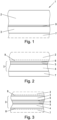
- the Fig.1 shows a paper packaging laminate 1 according to the invention with a paper layer 2 and a barrier film 3 connected thereto, which implements the required barrier effect against water vapour, oxygen and/or aroma.
- a sealing layer 7 can be provided on the side of the paper packaging laminate 1 facing away from the paper layer 2 .
- the paper layer 2 is bonded to the barrier film 3 with an adhesive layer 9 made of a hydrophilic laminating adhesive.
- Typical thicknesses of the paper packaging laminate 1 are 50 ⁇ m to 150 ⁇ m.
- the paper layer 2 consists of paper with a basis weight of 30 to 360 g/m 2 , preferably 30 to 100 g/m 2 in the case of flexible packaging.
- Paper is known to be made from fibrous materials, for example cellulose, mechanical pulp or waste paper.
- glassine is also understood to be paper.
- the paper layer is uncoated on at least one side (the side facing the barrier film 3 in the paper packaging laminate 1).
- Uncoated means that the paper is essentially untreated on this side, in particular that no plastic material is applied to the paper that can penetrate the paper, penetrate the paper fibers and bond to the paper fibers.
- Such a plastic coating would be an order inseparably linked to the paper layer on this page.
- this side is neither coated with a barrier lacquer, sealing lacquer or other lacquer, nor is it extrusion-coated with a plastic layer.
- the layers of phyllosilicates or minerals (clay coating) often applied in the paper industry, on the other hand, can definitely be present, since these usually do not interfere with paper recycling.
- the laminating adhesive used in the paper packaging laminate 1 for the adhesive layer 9 is hydrophilic.
- a hydrophilic laminating adhesive interacts strongly with water and is usually (but not necessarily) water soluble as well.
- a hydrophilic laminating adhesive used in the paper packaging laminate 1 according to the invention loses its adhesion when exposed to water, either due to chemical mechanisms, such as the breaking of hydrogen bonds, or because the laminating adhesive dissolves in water.
- the hydrophilic laminating adhesive can be based on starch, sugar derivatives, cellulose, amino resin, (poly)acrylate, polyvinyl alcohol (PVOH), polyvinyl acetate, polyacrylic acid, maleic acid-modified ethylene copolymers, methyl cellulose, carboxymethyl cellulose, carboxy-functional polyester, polyethylene succinate, polybutylene succinate, ionomers or hydrophilic polyurethane.
- hydrophilic laminating adhesives for extrusion lamination such as, for example, but not limited to, an ethylene copolymer with comonomers containing polar groups, such as ethylene-vinyl acetate copolymer (EVA), ethylene-butyl acrylate (EBA), ethylene-acrylic acid copolymer (EAA), or a maleic anhydride grafted polyethylene/polypropylene (PE-G-Mah, PP-G-Mah).
- EVA ethylene-vinyl acetate copolymer
- EBA ethylene-butyl acrylate
- EAA ethylene-acrylic acid copolymer
- PE-G-Mah polyethylene/polypropylene
- the laminating adhesive is of course chosen to provide sufficient adhesion between the paper layer 2 and the barrier film 3 to prevent undesirable delamination of the paper packaging laminate 1 in use.
- the adhesive layer 9 should preferably achieve a composite adhesion between the paper layer 2 and the barrier film 3 of at least 1N/15mm, preferably at least 1.5N/15mm.
- the bond strength is determined with a peel test.
- a peel test a test strip of the paper packaging laminate 1 is pulled apart at the free ends of the paper layer 2 and the barrier film 3. The free ends are clamped in a pulling machine and pulled apart at a specified angle (e.g. 90°) and the force measured. With a test strip width of 15mm, the bond adhesion is given as x N/15mm.
- the specification of the bond strength is the almost constant peel value (peel value) and not the maximum tear value that occurs as a force peak at the beginning of the peel test.
- peel test is carried out, for example, according to the ASTM F904 standard.
- a liquid laminating adhesive can be used to produce the adhesive layer 9 between the paper layer 2 and the barrier film 3, in particular a laminating adhesive dissolved in water or a suitable solvent. After the liquid laminating adhesive has been applied and after the paper layer 2 and barrier layer 3 have been brought together, the laminating adhesive is dried, with the water or solvent being able to diffuse through the paper. After drying, the adhesive layer 9 remains, producing a bond between the paper layer 2 and the barrier film 3.
- non-liquid laminating adhesives can also be used to produce the adhesive layer 9, as long as they are hydrophilic.
- Extrusion lamination is also conceivable, in which the molten lamination adhesive is extruded onto the paper layer 2 or the barrier film 3, or onto both, at high temperatures above 180° C. and the paper layer 2 and barrier film 3 are then brought together. After the laminating adhesive has solidified, it forms the adhesive layer 9 .
- the barrier film 3 consists of at least one stretched substrate layer 4 made primarily of polyethylene (PE) or primarily polypropylene (PP), a connecting layer 5 and a barrier layer 6 ( Fig.2 ).
- the thickness of the barrier film 3 is typically 10-40 ⁇ m.
- the barrier film 3 can be designed asymmetrically (as in Fig.2 ) with a substrate layer 4, a barrier layer 6 and a connecting layer 5 arranged in between, the connecting layer 5 being directly connected to the substrate layer 4 and the barrier layer 6.
- the barrier layer 6 in the paper packaging laminate 1 is preferably arranged facing the paper layer 2 and is connected directly to the uncoated side of the paper layer 2 with the adhesive layer 9, but can also face the sealing layer 7.
- the barrier film 3 can also be designed symmetrically (as in Fig.3 ). In this case, the barrier layer 6 would be connected on both sides via a respective connecting layer 5 to a respective substrate layer 4 (which can also be different).
- the uncoated side of the paper layer 2 is connected directly to a substrate layer 4 of the barrier film 3 via the adhesive layer 9 .
- the barrier layer 6 is a barrier coating applied to the connecting layer 5 in the form of a metallization, for example with aluminum, or a coating of silicon oxide (SiOx) or aluminum oxide (AlOx).
- a metallization for example with aluminum, or a coating of silicon oxide (SiOx) or aluminum oxide (AlOx).
- SiOx silicon oxide
- AlOx aluminum oxide
- This configuration is preferably used with an asymmetric barrier film 3 . Due to the barrier coating, a barrier layer 6 that is only a few nanometers thin (typically about 10 to 50 nm) is formed on the connecting layer 5 .
- the metallization can be done, for example, by a known vacuum metallization.
- the SiOx or AlOx coating can be applied, for example, using a chemical vapor deposition process or by evaporation in a vacuum. Of course, other methods for producing the barrier coating are also possible.
- the barrier coating can also be additionally coated with a protective varnish to protect against microcracking, which can impair the barrier function.
- the barrier layer 6 is a layer made of a barrier polymer (used both in asymmetrical and in symmetrical barrier films 3), ie a polymer with sufficient barrier properties, in particular against oxygen and/or aroma.
- the barrier polymer is preferably a polyamide (PA) or an ethylene vinyl alcohol copolymer (EVOH). EVOH is preferred as the barrier polymer used.
- the barrier polymer has a maximum thickness of 20%, preferably 5 to 10%, of the total thickness of the barrier film 3, ie, for example, a maximum of 2 to 8 ⁇ m with a barrier film thickness of 10-40 ⁇ m.
- barrier polymer As the barrier layer 6, it is not only possible to achieve low water vapor permeation (similar to or better than above), but also low oxygen permeation (oxygen transmission rate, OTR) of less than 2 cm 3 /m 2 /d (at 23° C., 75% relative humidity on both sides) and a high aroma barrier can be achieved. There is no objective measure for the aroma barrier, but the effect as an aroma barrier is determined subjectively by odor tests.
- the barrier layer 6 in an asymmetrical or symmetrical barrier film 3 can also be coated with a barrier coating, in particular metallized, for example with aluminum, or with an aluminum oxide or silicon oxide coating.
- a barrier coating in particular metallized, for example with aluminum, or with an aluminum oxide or silicon oxide coating.
- the barrier effect of the barrier film 3 can thus be increased even further, in particular the OTR and WVTR can thus be significantly further reduced, namely to less than 1 cm 3 /m 2 /d in each case.
- the barrier coating could be additionally coated with a protective lacquer.
- the substrate layer 4 is primarily made of a polyethylene (PE) or polypropylene (PP), each with a polyethylene content or a polypropylene content of at least 60% by weight of the substrate layer 4, preferably at least 70% by weight and very particularly preferably at least 80% by weight %.
- the thickness of a substrate layer 4 is preferably 5 to 35 ⁇ m, it also being possible to use substrate layers 4 of different thicknesses and/or different structures in a symmetrical barrier film 3 . However, in a symmetrical structure, both substrate layers 4 are preferably made of the same main component, PE or PP.
- Customary additives can be added to the substrate layer 4 .
- Different types of polyethylene or types of polypropylene can also be used in the substrate layer 4, in each case as a mixture or coextrudate.
- the substrate layer 4 can comprise, in addition to the respective main component PE or PP, a respectively compatible polyolefin material.
- Examples of types of polyethylene in the substrate layer 4 are HDPE (high-density polyethylene with a density of between 0.94-0.97 g/cm 3 ), MDPE (medium-density polyethylene), LDPE (low-density polyethylene with a density of between 0.915-0.935 g/cm 3 cm 3 ), LLDPE (linear low-density polyethylene with a density between 0.87-0.94 g/cm 3 ) or mLLDPE (linear metallocene low-density polyethylene) in question. come preferentially HDPE or MDPE used.
- Examples of suitable types of polypropylene in the substrate layer 4 are an atactic, syndiotactic or isotactic PP.
- any type of polyethylene can be used as a polyolefin material compatible with PE, in particular ethylene copolymers such as ethylene-vinyl acetate copolymer (EVA), ethyl methacrylate (EMA), ethylene/acrylic acid copolymer (EAA) or ethylene-butyl acrylate -copolymer (EBA).
- EVA ethylene-vinyl acetate copolymer
- EMA ethyl methacrylate
- EAA ethylene/acrylic acid copolymer
- EBA ethylene-butyl acrylate -copolymer
- Polypropylene (PP) or a cycloolefin copolymer (COC) can also be used as a polyolefin material compatible with PE in an amount of at most 20% by weight.
- a polypropylene random copolymer with ethylene as a comonomer usually 5 to 15%
- a polypropylene copolymer with ethylene or a polypropylene homopolymer with linear PE types such as mLLDPE, LLDPE or HDPE is preferably sufficient compatible, is used to achieve at least limited recyclability.
- PP copolymers such as random copolymers and block copolymers, can be used as the polyolefin material compatible with PP.
- An addition of up to 20% polyethylene also hardly affects the recyclability.
- the proportion of the main component polyethylene (PE) or polypropylene (PP) in the substrate layer 4 is preferably at least 60% by weight (based on the substrate layer 4), preferably at least 70 wt% and most preferably at least 80 wt% to improve recyclability.
- the PE or PP and the respective compatible polyolefin material can be present in the substrate layer 4 as a mixture.
- the substrate layer 4 can also be multi-layered (extruded or co-extruded) with one (or more) PE or PP layer(s) and one (or more) layer(s) made of the compatible polyolefin material.
- a cavitating agent can also be added to the main component PE or PP of the substrate layer 4, the cavitating agent being added to the substrate layer 4 in an amount of 5-30% by weight, preferably 15-25% by weight.
- a polymer that is incompatible with PE or PP i.e. a polymer that remains isolated in the PE or PP matrix
- PA polyamide
- polyester e.g. PET or PBT
- PVA polylactide
- a mineral cavitating agent such as calcium carbonate or mica can also preferably be used.
- the cavitating agent is usually in the form of a fine powder, which is embedded in a PE or PP matrix as a master batch and mixed with the PE or PP granules before extrusion.
- a cavitated PE or PP layer is used in the substrate layer 4, this is preferably surrounded on one or both sides by a non-cavitated PE or PP layer.
- a conceivable structure of the substrate layer 4 of the laminate layer 3 would be for example a cavitated PE layer bonded (e.g. coextruded) to a non-cavitated PE layer on one side, where the cavitated PE layer would face paper layer 2 in paper packaging laminate 1 .
- Another preferred structure of the substrate layer 4 would be, for example, a cavitated PE layer which is connected to a non-cavitated PE layer on both sides (eg coextruded).
- PP there are also such constructions with PP as the main component in the substrate layer 4.
- the use of a cavitated layer in the substrate layer 4 can also improve the sealing properties of the paper packaging laminate 1.
- the sum of PE or PP, cavitation agent, any additives and possible compatible polyolefin materials in the substrate layer 4 can, of course, add up to only 100% by weight.
- the decisive factor here is the proportion of the main component, polyethylene or polypropylene, to which the other proportions must be based.
- At least the substrate layer 4 in the barrier film 3 is stretched unidirectionally or bidirectionally, i.e. in the machine direction (MDO) (usually the longitudinal or extrusion direction) and/or in the transverse direction (TDO) (rotated 90° to the machine direction).
- MDO machine direction
- TDO transverse direction
- the entire barrier film 3 is preferably stretched.
- the connecting layer 5 or the barrier layer 6 is coated, it is stretched before coating.
- the degree of stretching in the machine direction and in the transverse direction does not have to be the same.
- the degree of stretching in the machine direction is preferably at least 4:1 to 8:1.
- the degree of stretching in the transverse direction is preferably at least 5:1 to 10:1.
- Unidirectional MDO stretching is preferred because unidirectional stretching is easier than bidirectional stretching.
- the proportion by weight of the polyolefin (PE or PP) in the paper packaging laminate 1 can be kept low, since a thin but nevertheless stiff film can only be produced by stretching.
- the barrier effect can also be significantly increased by stretching a barrier polymer.
- barrier values that are approximately three to four times higher than for unstretched barrier polymers of the same type are achieved, which means that less expensive barrier polymers can be used with the same barrier effect.
- the costs of the paper packaging laminate 1 can also be significantly reduced.
- the connecting layer 5 is used to connect the barrier layer 6 and the substrate layer 4. Adequate bond strength should be achieved here, in particular to reliably prevent an undesired delamination of the barrier film 3.
- Suitable polar connecting layers 5 preferably consist of polymers with increased polarity, for example based on maleic anhydride-grafted polyolefins (such as PE or PP), ethylene-vinyl acetate copolymer (EVA), ethylene/acrylic acid copolymer (EAA), ethylene-butyl acrylate copolymer (EBA), or similar polyolefin copolymers.
- the material of the bonding layer 5 is preferably selected according to the main component of the substrate layer 4.
- the thickness of the connecting layer 5 is at most 10% of the total thickness of the barrier film 3, for example 1 to 5 ⁇ m with a thickness of the barrier film 3 of 10-40 ⁇ m.
- the sealing layer 7 is preferably a polyethylene, for example LLDPE, LDPE, MDPE or HDPE, when the main component of the substrate layer 4 is a PE. Mixtures of different PE types in the sealing layer 7 are also conceivable, as is a multilayer sealing layer 7 made of the same or different PE types. If the main component of the substrate layer 4 is a polypropylene, the sealing layer 7 is preferably a polypropylene, for example an unstretched PP (CPP). In this case too, the sealing layer 7 can be a mixture of different PPs and/or have a multi-layer structure.
- the thickness of the sealing layer 7 should be as small as possible in the interest of better recyclability, in particular less than 50 ⁇ m, preferably less than 30 ⁇ m.
- a connecting layer 8 (indicated in Fig Fig.3 ), For example, as mentioned above, may be provided to improve adhesion.
- the polymer content of the paper packaging laminate 1 (essentially the barrier film 3 and, if present, the sealing layer 7) should make up between 10% by weight and 50% by weight of the paper packaging laminate 1, preferably a maximum of 30% by weight, particularly preferably a maximum of 20% by weight.
- the paper packaging laminate 1 according to the invention thus follows a different approach than the recommendation in the prior art, in which it is required to keep the polymer content below 5% by weight.
- the paper layer 2 is uncoated on the side facing the barrier film 3 and is connected to the barrier film 3 with a hydrophilic adhesive layer 9 .
- the paper packaging laminate 1 When recycling the paper packaging laminate 1, it is soaked in water at a specific water temperature and for a specific time (pulp process), usually after mechanical comminution. Due to the properties of the paper packaging laminate 1 according to the invention, the paper layer 2 can detach from the barrier film 3 during the pulping process during recycling, together with all layers and potential impurities for the paper recycling.
- the hydrophilic adhesive layer 9 reacts with the water during the pulping process and loses its adhesive properties or dissolves completely in water, so that the paper layer 2 is separated from the barrier film 3 .
- the paper layer 2 can thus dissolve in the water and form a pulp from which recycled paper can in turn be produced.
- the adhesive layer 9 sufficiently loses adhesion or dissolves at a water temperature of 40 ° C within a maximum of 20 minutes, preferably a maximum of 10 minutes, particularly preferably a maximum of 5 minutes, so that the paper layer 2 and the barrier film 3 with the sealing layer 7 easily separate.
- the metallization (if provided) remains on the detached barrier film 3 after separation during the pulping process in paper recycling, the recycled paper does not turn gray, which would inevitably happen with a barrier metallization of a paper surface.
- the barrier film 3 separated from the paper layer 2 in paper recycling, possibly with the sealing layer 7, can be fed to a further recycling process in order to be able to recycle the polyolefin contained therein (main component PE or PP).
- main component PE or PP polyolefin contained therein
- the barrier film 3 and the sealing layer 7 can also be easily and inexpensively recycled using common methods in mechanical recycling. Due to the small thickness of the barrier layer 6 in the barrier film 3 (if provided), the ease of recycling of the polyolefin stream discharged from the paper recycling pulp is not impaired.
- the barrier film 3 is advantageously produced by co-extrusion, because this enables particularly simple, cost-effective production.
- the known blown film or flat film extrusion method is preferably used.
- the individual layers of a symmetrical or asymmetrical layer structure as described above (i.e. substrate layer(s) 4 and connecting layer(s) 5 and optionally also barrier layer 6 made of barrier polymer) of the barrier film 3, with the exception of a possible coating, are preferably coextruded in one step. After co-extrusion, this laminate is stretched unidirectionally or bidirectionally. After stretching, a barrier coating can also be applied, either as a barrier layer 6 on the connecting layer 5 or on the barrier polymer of the barrier layer 6.
- the barrier film 3 can also be co-extruded with the sealing layer 7 in one go.
- the sealing layer 7 with the barrier film 3 is also stretched.
- the sealing layer 7 can be connected to the stretched barrier film 3, either by extrusion lamination (extruding the sealing layer 7 onto the barrier film 3) or in a lamination process (connecting the barrier film 3 to the sealing layer 7 with a laminating adhesive).
- extrusion lamination extruding the sealing layer 7 onto the barrier film 3
- a lamination process connecting the barrier film 3 to the sealing layer 7 with a laminating adhesive
- the sealing layer 7 is particularly preferably integrated directly into the barrier film 3 during production on the side of the barrier film 3 opposite the barrier layer 6 , for example by co-extrusion.
- the sealing layer 7 can thus be made thinner and the total proportion of polymer in the paper packaging laminate 1 can be lower than in the case of a sealing layer 7 applied subsequently. Apart from this, this also simplifies production.
- the barrier film 3 (possibly with the sealing layer 7) can be stretched in-line (ie immediately after the co-extrusion) or off-line (ie at a later point in time after the co-extrusion).
- bidirectional stretching it is possible to stretch first in the machine direction and then in the transverse direction, or it is also conceivable to stretch in both directions at the same time.
- the stretching typically takes place approx. 10°C to 30°C, typically approx. 20°C, below the lowest melting point of a plastic in the barrier film 3 or possibly also sealing layer 7 (in the case of HDPE approx. at 128°C to 130°C) instead of. In any case, the stretching takes place before a possible coating of the barrier layer 6 and/or the connecting layer 5 .
- the unidirectional or bidirectional stretching in the substrate layer 4 produces microcavities in the PE or PP in a known manner due to the cavitating agent. It was found that the density of the substrate layer 4 could be significantly reduced by the microcavities, to values between 0.4-0.85 g/cm 3 .
- the barrier film 3 can thus be made lighter, which further reduces the proportion of polymer.
- the paper layer 2 is laminated with the barrier film 3, optionally with the sealing layer 7.
- the hydrophilic laminating adhesive can be applied in liquid form either to the paper layer 2 or the barrier film 3, or to both, for example by means of roller or pressure application or by spraying. Thereafter, the paper layer 2 and the barrier film 3 are pressed against each other, for example between two rollers, to produce the paper packaging laminate 1. If required, the laminating adhesive can then be dried to form the adhesive layer 9, for example by passing it through a heat tunnel.
- the paper layer 2 and the stretched barrier film 3 can be bonded using an extrusion laminating process when using a suitable laminating adhesive.
- extrusion lamination the molten lamination adhesive is extruded onto the paper layer 2 or the barrier film 3, or both, and then the paper layer 2 and barrier film 3 are pressed together, for example between two rollers, to paper packaging laminate 1 to produce.
- the laminating adhesive can then cool down, which can usually be assisted by cooled rollers.
- a sealing layer 7 of the paper packaging laminate 1 could also be laminated after the paper layer 2 and the barrier film 3 have been laminated.
- a barrier film 3 with a thickness of 10-40 ⁇ m is used with a substrate layer 4 with the main component PE (at least 60% by weight PE content), preferably HDPE, which accounts for at least 60% of the thickness of the stretched barrier film 3.
- PE at least 60% by weight PE content
- a polar PE or PP material (depending on the main component of the substrate layer 4) is used as the connecting layer 5 .
- a barrier layer 6 made of EVOH (barrier polymer) is connected to the connecting layer 5 .
- the barrier film 3 is co-extruded and then stretched unidirectionally or bidirectionally.
- the barrier polymer can be coated with a barrier coating (metallization, SiOx or AlOx) after stretching.
- a barrier coating is applied to the stretched substrate layer 4 with the connecting layer 5 .
- the at least partially stretched barrier film 3 is bonded to a paper layer 2 by an adhesive layer 9 made of a hydrophilic laminating adhesive.
- a sealing layer 7 made of a PE material can be provided on the side of the paper packaging laminate 1 facing away from the paper layer.
Landscapes
- Engineering & Computer Science (AREA)
- Mechanical Engineering (AREA)
- Laminated Bodies (AREA)
- Wrappers (AREA)
Applications Claiming Priority (3)
| Application Number | Priority Date | Filing Date | Title |
|---|---|---|---|
| ATA50116/2020A AT522884B1 (de) | 2020-02-18 | 2020-02-18 | Recyclebare Papierverpackung mit hoher Barriere gegen Wasserdampf und Sauerstoff |
| EP20817234.6A EP4076944B1 (fr) | 2020-02-18 | 2020-11-27 | Emballage en papier recyclable formant une barrière efficace contre la vapeur d'eau et l'oxygène |
| PCT/EP2020/083727 WO2021164913A1 (fr) | 2020-02-18 | 2020-11-27 | Emballage en papier recyclable formant une barrière efficace contre la vapeur d'eau et l'oxygène |
Related Parent Applications (2)
| Application Number | Title | Priority Date | Filing Date |
|---|---|---|---|
| EP20817234.6A Division-Into EP4076944B1 (fr) | 2020-02-18 | 2020-11-27 | Emballage en papier recyclable formant une barrière efficace contre la vapeur d'eau et l'oxygène |
| EP20817234.6A Division EP4076944B1 (fr) | 2020-02-18 | 2020-11-27 | Emballage en papier recyclable formant une barrière efficace contre la vapeur d'eau et l'oxygène |
Publications (1)
| Publication Number | Publication Date |
|---|---|
| EP4169707A1 true EP4169707A1 (fr) | 2023-04-26 |
Family
ID=73694966
Family Applications (2)
| Application Number | Title | Priority Date | Filing Date |
|---|---|---|---|
| EP20817234.6A Active EP4076944B1 (fr) | 2020-02-18 | 2020-11-27 | Emballage en papier recyclable formant une barrière efficace contre la vapeur d'eau et l'oxygène |
| EP22216138.2A Pending EP4169707A1 (fr) | 2020-02-18 | 2020-11-27 | Emballage recyclable avec barrière élevée contre la vapeur d'eau et l'oxygène |
Family Applications Before (1)
| Application Number | Title | Priority Date | Filing Date |
|---|---|---|---|
| EP20817234.6A Active EP4076944B1 (fr) | 2020-02-18 | 2020-11-27 | Emballage en papier recyclable formant une barrière efficace contre la vapeur d'eau et l'oxygène |
Country Status (11)
| Country | Link |
|---|---|
| US (1) | US12577023B2 (fr) |
| EP (2) | EP4076944B1 (fr) |
| JP (2) | JP7843235B2 (fr) |
| CN (1) | CN115103765A (fr) |
| AT (1) | AT522884B1 (fr) |
| AU (1) | AU2020430816A1 (fr) |
| CA (1) | CA3167548A1 (fr) |
| ES (1) | ES2967139T3 (fr) |
| MX (1) | MX2022010060A (fr) |
| PL (1) | PL4076944T3 (fr) |
| WO (1) | WO2021164913A1 (fr) |
Families Citing this family (20)
| Publication number | Priority date | Publication date | Assignee | Title |
|---|---|---|---|---|
| EP4617057A3 (fr) | 2021-02-01 | 2025-11-26 | Amcor Flexibles North America, Inc. | Film d'emballage barrière à base de papier |
| AT525125B1 (de) * | 2021-06-02 | 2023-02-15 | Constantia Pirk Gmbh & Co Kg | Recyclingfähiges Papier-Verpackungslaminat mit dünner Barrierefolie und guter Aufreisseigenschaft |
| AU2022314199A1 (en) * | 2021-07-20 | 2024-01-18 | Société des Produits Nestlé S.A. | A multi-layer flexible packaging material |
| CN117957116A (zh) * | 2021-09-16 | 2024-04-30 | 凸版控股株式会社 | 易开封性包装材料及包装袋 |
| CN113997665B (zh) * | 2021-10-15 | 2023-09-01 | 江苏利特尔绿色包装股份有限公司 | 一种同质化烯烃类包装自立袋及其制备方法 |
| CN114407460B (zh) * | 2022-01-28 | 2023-07-04 | 佛山市南海利达印刷包装有限公司 | 高阻隔薄膜及其生产方法 |
| SE545650C2 (en) | 2022-02-28 | 2023-11-21 | Stora Enso Oyj | Paper or paperboard based packaging laminate |
| JP2023127770A (ja) * | 2022-03-02 | 2023-09-14 | 凸版印刷株式会社 | 包装袋 |
| US12179463B2 (en) | 2022-04-19 | 2024-12-31 | Sonoco Development, Inc. | Recyclable paper with polymeric barrier layer and method of recycling the same |
| US20260055555A1 (en) * | 2022-09-08 | 2026-02-26 | Amcor Flexibles North America, Inc. | Paper-based packaging films having multilayer barrier film |
| DE102022131875A1 (de) | 2022-12-01 | 2024-06-06 | Huhtamaki Flexible Packaging Germany Gmbh & Co. Kg | Laminat, insbesondere zur Herstellung von Verpackungen, Verwendung des Laminats zur Herstellung einer Verpackung sowie aus dem Laminat hergestellte Verpackung und Verfahren zur Herstellung des Laminats |
| DE202023102388U1 (de) | 2023-05-03 | 2024-08-06 | Société des Produits Nestlé S.A. | Recyclebare Verpackung mit einer Sperre gegen Sauerstoff und Feuchtigkeit |
| IT202300014199A1 (it) * | 2023-07-06 | 2025-01-06 | M G Lavorazione Materie Plastiche S P A | Film barriera e confezione per prodotti alimentari e metodo per la realizzazione di detto film barriera |
| TW202528140A (zh) | 2023-10-05 | 2025-07-16 | 瑞士商利樂拉伐控股財務公司 | 層壓包裝材料,包含該層壓包裝材料的包裝容器,以及製造該材料和該容器之方法 |
| EP4585414A1 (fr) | 2024-01-15 | 2025-07-16 | Tetra Laval Holdings & Finance S.A. | Matériau d'emballage stratifié pouvant être déliamine, récipient d'emballage comprenant le matériau d'emballage stratifié, et procédés de fabrication et de recyclage du matériau et du récipient |
| WO2025164664A1 (fr) * | 2024-01-29 | 2025-08-07 | 株式会社クラレ | Structure multicouche |
| WO2025176584A1 (fr) * | 2024-02-19 | 2025-08-28 | Société des Produits Nestlé S.A. | Film d'emballage |
| DE102024122210A1 (de) | 2024-08-02 | 2026-02-05 | Huhtamaki Flexible Packaging Germany Gmbh & Co. Kg | Verpackungsmaterial mit im Vakuum beschichteter Papierlage und Fettbarriere |
| DE102024122209A1 (de) | 2024-08-02 | 2026-02-05 | Huhtamaki Flexible Packaging Germany Gmbh & Co. Kg | Verpackungsmaterial mit im Vakuum beschichteter Papierlage aus ungestrichenem Papier |
| DE102024122211A1 (de) | 2024-08-02 | 2026-02-05 | Huhtamaki Flexible Packaging Germany Gmbh & Co. Kg | Verpackungsmaterial mit im Vakuum beschichteter Papierlage und Mineralölbarriere |
Citations (5)
| Publication number | Priority date | Publication date | Assignee | Title |
|---|---|---|---|---|
| WO2013086950A1 (fr) | 2011-12-12 | 2013-06-20 | Dupont (China) Research & Development And Management Co., Ltd. | Matériau d'emballage stratifié recyclable |
| DE102017201449A1 (de) * | 2017-01-30 | 2018-08-02 | Sig Technology Ag | Flächenförmiger Verbund zum Herstellen formstabiler Nahrungsmittelbehälter mit einer Barriereschicht, die eine Barrieresubstratschicht und eine nach innen weisende Barrierematerialschicht aufweist |
| US20180304607A1 (en) * | 2015-11-27 | 2018-10-25 | Tetra Laval Holdings & Finance S.A. | Method for manufacturing a laminated packaging material, the laminated packaging material and packaging containers made therefrom |
| US20190176455A1 (en) * | 2016-08-18 | 2019-06-13 | Toppan Printing Co., Ltd. | Methods for producing paper containers for liquid, and paper containers for liquid |
| EP3194164B1 (fr) | 2014-08-14 | 2020-04-08 | Tetra Laval Holdings & Finance SA | Verpackungslaminat, verfahren zur herstellung davon und aus dem verpackungslaminat hergestellter verpackungsbehälter |
Family Cites Families (45)
| Publication number | Priority date | Publication date | Assignee | Title |
|---|---|---|---|---|
| US4561920A (en) | 1984-02-08 | 1985-12-31 | Norchem, Inc. Formerly Northern Petrochemical Company | Biaxially oriented oxygen and moisture barrier film |
| JP3061664B2 (ja) | 1991-09-04 | 2000-07-10 | 日本テトラパック株式会社 | 再生利用の容易な包装用積層材料 |
| US5506036A (en) * | 1991-09-04 | 1996-04-09 | Ab Tetra Pak | Easy-to-recycle laminated material for packaging use |
| ATE153912T1 (de) | 1991-12-11 | 1997-06-15 | Mobil Oil Corp | Hoch sperrender film |
| JPH0713717U (ja) | 1993-08-10 | 1995-03-07 | 凸版印刷株式会社 | 液体用紙容器 |
| US5529834A (en) | 1994-12-02 | 1996-06-25 | Mobil Oil Corporation | Heat sealable muliilayer film comprising evoh skin and acrylic coating and its method of preparation |
| SE9503817D0 (sv) | 1995-10-30 | 1995-10-30 | Tetra Laval Holdings & Finance | Delaminerbart förpackningslaminat samt sätt att framställa detta |
| JPH10218170A (ja) | 1997-02-07 | 1998-08-18 | Dainippon Printing Co Ltd | 液体用紙容器 |
| JP2000128144A (ja) | 1998-10-29 | 2000-05-09 | Dainippon Printing Co Ltd | 液体用紙容器 |
| JP4121649B2 (ja) | 1998-12-18 | 2008-07-23 | 大日本印刷株式会社 | 液体用紙容器 |
| JP4580480B2 (ja) | 1999-01-18 | 2010-11-10 | 大日本印刷株式会社 | 液体用紙容器 |
| AU2002212715A1 (en) | 2000-11-09 | 2002-05-21 | Tetra Laval Holdings And Finance S.A. | Laminate for packaging material |
| FI20011388A7 (fi) * | 2001-06-28 | 2002-12-29 | Stora Enso Oyj | Polymeeripinnoitteinen kuumasaumattava pakkausmateriaali sekä siitä valmistettu suljettu pakkaus |
| TWI303211B (en) | 2002-05-02 | 2008-11-21 | Evergreen Packaging Internat B V | Barrier laminate structure for packaging beverages |
| JP2005096779A (ja) | 2003-09-22 | 2005-04-14 | Toppan Printing Co Ltd | 包装袋 |
| SE0402197D0 (sv) | 2004-09-10 | 2004-09-10 | Tetra Laval Holdings & Finance | A polymer film, a packaging laminate comprising the polymer film, a packaging container formed from the packaging laminate and a process for the production of the polymer film |
| EP1905806A1 (fr) | 2006-09-29 | 2008-04-02 | Kuraray Europe GmbH | Utilisation d'alcool polyvinylique soluble dans l'eau comme adhésif pour des étiquettes |
| US20090035594A1 (en) | 2007-08-01 | 2009-02-05 | Lee Chun D | Rheology-modified grafts and adhesive blends |
| CN101508369A (zh) | 2008-02-15 | 2009-08-19 | 艾尔坎技术及管理有限公司 | 用于泡罩基础部件的可冷成型层压材料 |
| SE532388C2 (sv) | 2008-03-14 | 2010-01-12 | Tetra Laval Holdings & Finance | Förpackningslaminat och -behållare med två separata gasbarriärskikt samt metod för deras framställning |
| RU2533128C2 (ru) | 2009-07-08 | 2014-11-20 | Тетра Лаваль Холдингз Энд Файнэнс С.А. | Высокобарьерный упаковочный ламинированный материал, способ изготовления упаковочного ламинированного материала и упаковочный контейнер |
| JP5992659B2 (ja) | 2010-10-18 | 2016-09-14 | 凸版印刷株式会社 | 液体用紙容器 |
| EP2497636A1 (fr) | 2011-03-11 | 2012-09-12 | Deutsche SiSi-Werke Betriebs GmbH | Système composite amélioré pour emballages |
| US8673451B2 (en) | 2011-08-26 | 2014-03-18 | Equistar Chemicals, Lp | Multilayer thermoplastic structures with improved tie layers |
| SA112330849B1 (ar) | 2011-09-20 | 2017-10-12 | تترا لافال هولدينجز اند فاينانس اس.ايه | أغشية حاجزة متعددة الطبقات، لدائن تغليف رقائقية ووعاء تعبئة مشكَّل منها |
| JP5523512B2 (ja) | 2012-06-21 | 2014-06-18 | ユニチカ株式会社 | 包装材料用接着剤および包装材料 |
| EP2767397A1 (fr) | 2013-02-18 | 2014-08-20 | Tetra Laval Holdings & Finance S.A. | Stratifié d'emballage, son procédé de fabrication et récipient d'emballage produit à partir du récipient d'emballage |
| ES2587558T3 (es) | 2013-07-03 | 2016-10-25 | Amcor Flexibles France | Lámina de envasado, envase y utilización de dicha lámina de envasado |
| DE102013213478A1 (de) | 2013-07-10 | 2015-01-15 | Mtm Plastics Gmbh | Verfahren und Vorrichtung zur Aufbereitung von Kunststoffabfällen |
| AU2015242245B2 (en) | 2014-04-03 | 2019-02-21 | Gimsa S.R.L. | Recyclable material |
| JP6412388B2 (ja) | 2014-09-30 | 2018-10-24 | 昭和電工パッケージング株式会社 | 成形用包装材 |
| BR112018000028B1 (pt) | 2015-07-03 | 2021-12-14 | Amcor Flexibles Kreuzlingen Ag | Película flexível de embalagem multicamadas, método para produzir uma película flexível de embalagem multicamadas e embalagem |
| JP6805480B2 (ja) | 2015-09-18 | 2020-12-23 | 凸版印刷株式会社 | 液体用紙容器 |
| WO2017089504A1 (fr) * | 2015-11-27 | 2017-06-01 | Tetra Laval Holdings & Finance S.A. | Matériau d'emballage stratifié, récipients d'emballage fabriqués à partir de celui-ci et procédé de fabrication du matériau stratifié |
| JP6893926B2 (ja) | 2015-12-02 | 2021-06-23 | テトラ ラバル ホールディングス アンド ファイナンス エス エイ | ラミネート包装材料、それから製造された包装容器、およびラミネート材料を製造するための方法 |
| US11535012B2 (en) | 2015-12-15 | 2022-12-27 | Borealis Ag | Polyethylene based laminated film structure with barrier properties |
| JP5941233B1 (ja) | 2016-01-28 | 2016-06-29 | 五條製紙株式会社 | 電子写真用基材 |
| US10842754B2 (en) | 2016-12-02 | 2020-11-24 | Howard University | Deoxyribonucleic acid nanoparticles for delivering proteins and protein-containing compounds and methods of manufacturing deoxyribonucleic acid nanoparticles |
| MX2019006246A (es) | 2016-12-09 | 2019-08-21 | Jindal Films Americas Llc | Peliculas de oxido de metal, de barrera alta. |
| WO2018202479A1 (fr) | 2017-05-05 | 2018-11-08 | Constantia Hueck Folien Gmbh & Co. Kg | Stratifié d'emballage recyclable, facilement déchirable, à effet barrière satisfaisant, et son procédé de fabrication |
| AT519866B1 (de) | 2017-05-05 | 2018-11-15 | Constantia Hueck Folien Gmbh & Co Kg | Recyclingfreundliches, einfach reißbares Verpackungslaminat mit guter Barrierewirkung und Verfahren zu dessen Herstellung |
| ES2774148T3 (es) | 2017-05-31 | 2020-07-17 | Tetra Laval Holdings & Finance | Material laminado de envasado, contenedores de envasado fabricados a partir del mismo y un método para la fabricación del material laminado |
| DE102017212144A1 (de) | 2017-07-14 | 2019-01-17 | Sig Technology Ag | Flächenförmiger Verbund, insbesondere zum Herstellen formstabiler Nahrungsmittelbehälter, mit einer ersten und einer weiteren Haftvermittlerschicht, die jeweils einen Acrylatanteil aufweisen |
| SE543190E (en) | 2018-06-12 | 2025-03-25 | Stora Enso Oyj | Re-pulpable packaging material |
| PL3594406T3 (pl) | 2018-07-13 | 2022-05-23 | Frosta Aktiengesellschaft | Nadające się do kompostowania i przyjazne dla środowiska opakowanie na produkt mrożony |
-
2020
- 2020-02-18 AT ATA50116/2020A patent/AT522884B1/de active
- 2020-11-27 MX MX2022010060A patent/MX2022010060A/es unknown
- 2020-11-27 EP EP20817234.6A patent/EP4076944B1/fr active Active
- 2020-11-27 JP JP2022549123A patent/JP7843235B2/ja active Active
- 2020-11-27 PL PL20817234.6T patent/PL4076944T3/pl unknown
- 2020-11-27 CA CA3167548A patent/CA3167548A1/fr active Pending
- 2020-11-27 US US17/904,591 patent/US12577023B2/en active Active
- 2020-11-27 CN CN202080096724.4A patent/CN115103765A/zh active Pending
- 2020-11-27 ES ES20817234T patent/ES2967139T3/es active Active
- 2020-11-27 WO PCT/EP2020/083727 patent/WO2021164913A1/fr not_active Ceased
- 2020-11-27 EP EP22216138.2A patent/EP4169707A1/fr active Pending
- 2020-11-27 AU AU2020430816A patent/AU2020430816A1/en active Pending
-
2024
- 2024-11-08 JP JP2024195904A patent/JP2025020348A/ja active Pending
Patent Citations (5)
| Publication number | Priority date | Publication date | Assignee | Title |
|---|---|---|---|---|
| WO2013086950A1 (fr) | 2011-12-12 | 2013-06-20 | Dupont (China) Research & Development And Management Co., Ltd. | Matériau d'emballage stratifié recyclable |
| EP3194164B1 (fr) | 2014-08-14 | 2020-04-08 | Tetra Laval Holdings & Finance SA | Verpackungslaminat, verfahren zur herstellung davon und aus dem verpackungslaminat hergestellter verpackungsbehälter |
| US20180304607A1 (en) * | 2015-11-27 | 2018-10-25 | Tetra Laval Holdings & Finance S.A. | Method for manufacturing a laminated packaging material, the laminated packaging material and packaging containers made therefrom |
| US20190176455A1 (en) * | 2016-08-18 | 2019-06-13 | Toppan Printing Co., Ltd. | Methods for producing paper containers for liquid, and paper containers for liquid |
| DE102017201449A1 (de) * | 2017-01-30 | 2018-08-02 | Sig Technology Ag | Flächenförmiger Verbund zum Herstellen formstabiler Nahrungsmittelbehälter mit einer Barriereschicht, die eine Barrieresubstratschicht und eine nach innen weisende Barrierematerialschicht aufweist |
Also Published As
| Publication number | Publication date |
|---|---|
| BR112022013793A2 (pt) | 2022-09-13 |
| AT522884A4 (de) | 2021-03-15 |
| EP4076944B1 (fr) | 2023-11-01 |
| JP2025020348A (ja) | 2025-02-12 |
| CA3167548A1 (fr) | 2021-08-26 |
| WO2021164913A1 (fr) | 2021-08-26 |
| MX2022010060A (es) | 2022-08-25 |
| ES2967139T3 (es) | 2024-04-26 |
| AU2020430816A1 (en) | 2022-09-22 |
| JP7843235B2 (ja) | 2026-04-09 |
| JP2023514272A (ja) | 2023-04-05 |
| EP4076944A1 (fr) | 2022-10-26 |
| US12577023B2 (en) | 2026-03-17 |
| AT522884B1 (de) | 2021-03-15 |
| PL4076944T3 (pl) | 2024-04-08 |
| CN115103765A (zh) | 2022-09-23 |
| US20230114239A1 (en) | 2023-04-13 |
Similar Documents
| Publication | Publication Date | Title |
|---|---|---|
| EP4076944B1 (fr) | Emballage en papier recyclable formant une barrière efficace contre la vapeur d'eau et l'oxygène | |
| AT519866B1 (de) | Recyclingfreundliches, einfach reißbares Verpackungslaminat mit guter Barrierewirkung und Verfahren zu dessen Herstellung | |
| WO2018202479A1 (fr) | Stratifié d'emballage recyclable, facilement déchirable, à effet barrière satisfaisant, et son procédé de fabrication | |
| EP3600889B1 (fr) | Laminé d'emballage recyclable ayant une résistance à la chaleur améliorée pendant le scellage | |
| EP1885558B2 (fr) | Feuille-barriere multicouche coextrudee comportant au moins une couche de feuille a base de copolymere ethylene-alcool vinylique (evoh), son procede de production, et son utilisation | |
| EP3880473B1 (fr) | Stratifié d'emballage recyclable à effet barrière satisfaisant et à faible densité et son procédé de fabrication | |
| AT525125B1 (de) | Recyclingfähiges Papier-Verpackungslaminat mit dünner Barrierefolie und guter Aufreisseigenschaft | |
| EP3840951B1 (fr) | Stratifié d'emballage recyclable, facilement déchirable, à effet barrière satisfaisant, et son procédé de fabrication | |
| EP3995307A1 (fr) | Feuille polyéthylène | |
| EP2094465A1 (fr) | Procédé de production d'un laminé multicouche, et laminé multicouche ainsi obtenu | |
| AT526598B1 (de) | Abrasionsbeständige Blasfolie mit EVOH-Aussenschicht und Verfahren zu ihrer Herstellung | |
| DE102023104566A1 (de) | Hochbarriere-Verpackungslaminat mit verbesserter Maschinenverarbeitbarkeit | |
| DE202025105940U1 (de) | Hochbarriere Verpackungslaminat | |
| DE10254731B4 (de) | Transparente biaxial orientierte Polyolefinfolie mit verbesserter Sauerstoffbarriere | |
| AT519469B1 (de) | Siegelfähiges Verpackungslaminat mit Vliesstoff | |
| DE102022133229A1 (de) | Kunststofffolie und Verfahren zu deren Herstellung | |
| AT528083A1 (de) | PFAS-freie Kunststofffolie | |
| WO2018091416A1 (fr) | Composite de séparation |
Legal Events
| Date | Code | Title | Description |
|---|---|---|---|
| PUAI | Public reference made under article 153(3) epc to a published international application that has entered the european phase |
Free format text: ORIGINAL CODE: 0009012 |
|
| STAA | Information on the status of an ep patent application or granted ep patent |
Free format text: STATUS: THE APPLICATION HAS BEEN PUBLISHED |
|
| AC | Divisional application: reference to earlier application |
Ref document number: 4076944 Country of ref document: EP Kind code of ref document: P |
|
| AK | Designated contracting states |
Kind code of ref document: A1 Designated state(s): AL AT BE BG CH CY CZ DE DK EE ES FI FR GB GR HR HU IE IS IT LI LT LU LV MC MK MT NL NO PL PT RO RS SE SI SK SM TR |
|
| STAA | Information on the status of an ep patent application or granted ep patent |
Free format text: STATUS: REQUEST FOR EXAMINATION WAS MADE |
|
| 17P | Request for examination filed |
Effective date: 20230629 |
|
| RBV | Designated contracting states (corrected) |
Designated state(s): AL AT BE BG CH CY CZ DE DK EE ES FI FR GB GR HR HU IE IS IT LI LT LU LV MC MK MT NL NO PL PT RO RS SE SI SK SM TR |
|
| GRAP | Despatch of communication of intention to grant a patent |
Free format text: ORIGINAL CODE: EPIDOSNIGR1 |
|
| STAA | Information on the status of an ep patent application or granted ep patent |
Free format text: STATUS: GRANT OF PATENT IS INTENDED |