EP4170063A1 - Procédé de fabrication de catalyseurs d'oxydes mixtes actifs et stables à base de titane à distribution optimisée de métaux précieux par dépôt de couche atomique conforme à la surface - Google Patents
Procédé de fabrication de catalyseurs d'oxydes mixtes actifs et stables à base de titane à distribution optimisée de métaux précieux par dépôt de couche atomique conforme à la surface Download PDFInfo
- Publication number
- EP4170063A1 EP4170063A1 EP22162190.7A EP22162190A EP4170063A1 EP 4170063 A1 EP4170063 A1 EP 4170063A1 EP 22162190 A EP22162190 A EP 22162190A EP 4170063 A1 EP4170063 A1 EP 4170063A1
- Authority
- EP
- European Patent Office
- Prior art keywords
- noble metal
- carrier material
- atomic layer
- layer deposition
- species
- Prior art date
- Legal status (The legal status is an assumption and is not a legal conclusion. Google has not performed a legal analysis and makes no representation as to the accuracy of the status listed.)
- Withdrawn
Links
Images




Classifications
-
- C—CHEMISTRY; METALLURGY
- C25—ELECTROLYTIC OR ELECTROPHORETIC PROCESSES; APPARATUS THEREFOR
- C25B—ELECTROLYTIC OR ELECTROPHORETIC PROCESSES FOR THE PRODUCTION OF COMPOUNDS OR NON-METALS; APPARATUS THEREFOR
- C25B1/00—Electrolytic production of inorganic compounds or non-metals
- C25B1/01—Products
- C25B1/02—Hydrogen or oxygen
- C25B1/04—Hydrogen or oxygen by electrolysis of water
-
- C—CHEMISTRY; METALLURGY
- C23—COATING METALLIC MATERIAL; COATING MATERIAL WITH METALLIC MATERIAL; CHEMICAL SURFACE TREATMENT; DIFFUSION TREATMENT OF METALLIC MATERIAL; COATING BY VACUUM EVAPORATION, BY SPUTTERING, BY ION IMPLANTATION OR BY CHEMICAL VAPOUR DEPOSITION, IN GENERAL; INHIBITING CORROSION OF METALLIC MATERIAL OR INCRUSTATION IN GENERAL
- C23C—COATING METALLIC MATERIAL; COATING MATERIAL WITH METALLIC MATERIAL; SURFACE TREATMENT OF METALLIC MATERIAL BY DIFFUSION INTO THE SURFACE, BY CHEMICAL CONVERSION OR SUBSTITUTION; COATING BY VACUUM EVAPORATION, BY SPUTTERING, BY ION IMPLANTATION OR BY CHEMICAL VAPOUR DEPOSITION, IN GENERAL
- C23C16/00—Chemical coating by decomposition of gaseous compounds, without leaving reaction products of surface material in the coating, i.e. chemical vapour deposition [CVD] processes
- C23C16/44—Chemical coating by decomposition of gaseous compounds, without leaving reaction products of surface material in the coating, i.e. chemical vapour deposition [CVD] processes characterised by the method of coating
- C23C16/455—Chemical coating by decomposition of gaseous compounds, without leaving reaction products of surface material in the coating, i.e. chemical vapour deposition [CVD] processes characterised by the method of coating characterised by the method used for introducing gases into reaction chamber or for modifying gas flows in reaction chamber
- C23C16/45523—Pulsed gas flow or change of composition over time
- C23C16/45525—Atomic layer deposition [ALD]
- C23C16/45555—Atomic layer deposition [ALD] applied in non-semiconductor technology
-
- C—CHEMISTRY; METALLURGY
- C25—ELECTROLYTIC OR ELECTROPHORETIC PROCESSES; APPARATUS THEREFOR
- C25B—ELECTROLYTIC OR ELECTROPHORETIC PROCESSES FOR THE PRODUCTION OF COMPOUNDS OR NON-METALS; APPARATUS THEREFOR
- C25B11/00—Electrodes; Manufacture thereof not otherwise provided for
- C25B11/04—Electrodes; Manufacture thereof not otherwise provided for characterised by the material
- C25B11/051—Electrodes formed of electrocatalysts on a substrate or carrier
- C25B11/052—Electrodes comprising one or more electrocatalytic coatings on a substrate
-
- C—CHEMISTRY; METALLURGY
- C25—ELECTROLYTIC OR ELECTROPHORETIC PROCESSES; APPARATUS THEREFOR
- C25B—ELECTROLYTIC OR ELECTROPHORETIC PROCESSES FOR THE PRODUCTION OF COMPOUNDS OR NON-METALS; APPARATUS THEREFOR
- C25B11/00—Electrodes; Manufacture thereof not otherwise provided for
- C25B11/04—Electrodes; Manufacture thereof not otherwise provided for characterised by the material
- C25B11/051—Electrodes formed of electrocatalysts on a substrate or carrier
- C25B11/055—Electrodes formed of electrocatalysts on a substrate or carrier characterised by the substrate or carrier material
- C25B11/057—Electrodes formed of electrocatalysts on a substrate or carrier characterised by the substrate or carrier material consisting of a single element or compound
- C25B11/059—Silicon
-
- C—CHEMISTRY; METALLURGY
- C25—ELECTROLYTIC OR ELECTROPHORETIC PROCESSES; APPARATUS THEREFOR
- C25B—ELECTROLYTIC OR ELECTROPHORETIC PROCESSES FOR THE PRODUCTION OF COMPOUNDS OR NON-METALS; APPARATUS THEREFOR
- C25B11/00—Electrodes; Manufacture thereof not otherwise provided for
- C25B11/04—Electrodes; Manufacture thereof not otherwise provided for characterised by the material
- C25B11/051—Electrodes formed of electrocatalysts on a substrate or carrier
- C25B11/073—Electrodes formed of electrocatalysts on a substrate or carrier characterised by the electrocatalyst material
- C25B11/091—Electrodes formed of electrocatalysts on a substrate or carrier characterised by the electrocatalyst material consisting of at least one catalytic element and at least one catalytic compound; consisting of two or more catalytic elements or catalytic compounds
-
- H—ELECTRICITY
- H01—ELECTRIC ELEMENTS
- H01M—PROCESSES OR MEANS, e.g. BATTERIES, FOR THE DIRECT CONVERSION OF CHEMICAL ENERGY INTO ELECTRICAL ENERGY
- H01M4/00—Electrodes
- H01M4/86—Inert electrodes with catalytic activity, e.g. for fuel cells
- H01M4/88—Processes of manufacture
- H01M4/8825—Methods for deposition of the catalytic active composition
- H01M4/8867—Vapour deposition
Definitions
- the invention in a first aspect, relates to a method for producing nanostructured electrode coatings.
- a carrier material is first provided, the carrier material comprising a noble metal-titanium mixed oxide.
- the support material is then coated with a catalytically active noble metal species using atomic layer deposition (ALD), so that the support material is surface-conformally modified by the catalytically active noble metal species.
- ALD atomic layer deposition
- the invention relates to the use of the support material surface-modified by means of atomic layer deposition as a catalyst and/or catalyst support, with a wide range of possible uses being available.
- the electrochemical production of hydrogen (H 2 ) through the electrolysis of water (H 2 O) represents an essential building block for the transition to sustainable generation, storage and conversion of energy.
- the electrolysis of water using proton exchange membrane electrolyzers (PEM, engl. proton exchange membrane) is regarded as one of the most promising key technologies in the growing hydrogen economy.
- PEM proton exchange membrane electrolyzers
- a recent feasibility study by Minke et al. (2021) shows that the economical production of large amounts of molecular hydrogen by PEM electrolysis is primarily limited by the high costs of the noble metal-based catalyst materials used.
- the use of the extremely rare and expensive, but at the same time extremely active and stable, iridium metal (Ir) on the anode side poses a particular challenge.
- the oxidative and corrosive conditions in a PEM electrolyzer require the development of highly active and corrosion-resistant materials for use as electrocatalysts for the oxygen evolution reaction (OER, oxygen formation reaction) taking place at the anode.
- OER oxygen evolution reaction
- iridium oxide and iridium-titania materials in particular are active for water electrolysis in acidic environments (pH ⁇ 7).
- a relatively high noble metal content has hitherto been necessary for a sufficiently high stability and protection against undesired degradation of the catalysts.
- Commercially available OER catalysts are currently based on iridium titanium oxide powders containing about 70-75% by weight Ir in TiO 2 (e.g. Elyst Ir 75 0480, Umicore).
- the high content of iridium results from the fact that iridium is required for the activity and stability as well as for good electrical conductivity of the catalyst.
- the object of the invention was to eliminate the disadvantages of the prior art and to provide a method for producing suitable surfaces, in particular suitable catalysts and/or electrodes, which has a suitable distribution of noble metals and thus enables efficient electrical conductivity. Furthermore, the method should be designed to be particularly process-efficient and economical.
- the preferred method has proven to be particularly advantageous in many respects.
- a sufficiently electrically conductive iridium-titania-based support material could be modified with catalytically active iridium oxide species (IrO x ) as catalytically active metal species using surface-conformal atomic layer deposition (ALD).
- IrO x catalytically active iridium oxide species
- ALD surface-conformal atomic layer deposition
- the use of the method of atomic layer deposition has proven particularly advantageous. It was completely unexpected that the parameters of the surface modification via ALD enabled the deposition of an extremely homogeneous, surface-conforming surface layer, which only has small thicknesses in the range of a few nanometers (nm). In addition, precise control over the crystallinity, layer thickness, and phase composition of this deposited surface layer was achieved by adjusting the relevant ALD parameters.
- the optimization of the parameters mentioned thus enables the development of highly efficient electrocatalysts with increased activity per total mass of Ir noble metal (mass activity), e.g. B. in electrochemical water splitting for H 2 generation.
- Increased activity is generally defined here as a higher production of gaseous reaction product (H 2 at the cathode, O 2 at the anode in the case of water electrolysis) at a specific applied potential.
- the OER partial reaction on the anode side was found to be limiting according to the prior art because complex reaction steps (in particular a high number of electrical charge carriers) and intermediates are involved.
- the method of atomic layer deposition is particularly suitable for the defined deposition of the smallest amounts of metal (oxide) species.
- the surface-conforming coating is characteristic of the ALD process, since ideally it is based on a self-limiting reaction mechanism with the surface.
- the inventive method is based on a method for producing electrode materials or electrode coatings with an optimized distribution of catalytically active noble metal species, for example based on electrically conductive noble metal titanium oxide, preferably Ir y Ti 1-y O 2 -, support materials, the entire material surface by means Atomic layer deposition with highly active noble metal, preferably IrO x -, species is modified.
- the number of exposed catalytically active, noble metal-based centers can be increased by the method according to the invention in order to improve the efficiency and the economy of the catalysts.
- This can be achieved through increased precious metal mass-specific activity of the catalysts, for example in electrochemical OER.
- a variation of the ALD parameters used, such as the precursor compounds, number and duration of the ALD cycles and/or the temperature, is decisive for this in order to guarantee a surface-conforming coverage or coating of the support and to advantageously increase the intrinsic catalytic activity of the precious metal centers close to the surface influence.
- the deposited surface layer with adjustable composition, crystallinity, layer thickness and morphology improved catalytic stability of the electrode can also be achieved.
- degradation and an associated reduction in OER catalytic activity over time can be significantly reduced compared to an electrode based on unmodified support material. Accordingly, a significant improvement over the prior art is achieved by the preferred method.
- Ir-based catalyst systems in the context of the invention, preferably an Ir y Ti 1-y O 2 mixed oxide as a conductive support material for the subsequent surface modification with thin atomic layers in the order of a few nm comprising catalytically highly active and stable IrO x described.
- a nanostructured electrode coating refers to a coating on an electrode that has nanostructures, a nanostructure meaning a structure in the nanoscale range.
- a nanostructure can mean a porosity that is in the nanometer range.
- the electrode coating can have pores that are microporous ( ⁇ 2 nm) or mesoporous (2-50 nm). Macroporosity (> 50 nm) is also possible.
- a nanostructure can also mean one or more layer thicknesses in the nanometer range.
- the nanostructured electrode coating is preferably used as a catalyst, for example as part of an electrolysis, preferably an electrocatalysis.
- a carrier material preferably designates a material on which particles and/or atomic layers of a noble metal and/or noble metal oxide are applied, the applied particles and/or atomic layers providing the catalyst for a chemical reaction.
- the carrier material can thus preferably be understood as the carrier of the active noble metal surface species.
- a high specific surface area (so-called BET surface area, typically specified mass-normalized) of a support material is generally aimed at in order to have an increased number of accessible, active catalyst species as well as a high electrochemically active surface (so-called ECSA, electrochemical surface area or also electrochemically active surface area).
- ECSA electrochemically active surface area or also electrochemically active surface area.
- a high number of accessible catalyst centers increases the mass-related activity of the entire catalyst system, including the support material and surface coating.
- a noble metal-titanium mixed oxide preferably designates a substance with a crystal lattice comprising oxygen anions, titanium cations and cations of a noble metal.
- a noble metal-titanium mixed oxide is therefore preferably a complex oxide, it being possible for different proportions of a noble metal, titanium and/or oxygen to be present.
- Atomic layer deposition refers to a process of thin film deposition.
- ALD Atomic layer deposition
- different chemical reactants so-called precursors
- the individual reactants are preferably introduced individually into the reactor chamber and their reactions with the support material or the exposed surface (species) is self-limiting (in the context of the invention, a self-limiting reaction preferably refers to a reaction on a surface in which the respective reactant is essentially completely is consumed and preferably gaseous by-products are formed).
- a self-limiting reaction preferably refers to a reaction on a surface in which the respective reactant is essentially completely is consumed and preferably gaseous by-products are formed).
- this results in only a very thin layer comprising a single atomic layer in each process step.
- another reactant reacts with this atomic layer and forms the desired chemical compound.
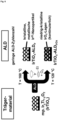
- the ALD in the context of the invention is also in the description of the 2 discussed.
- the choice of the precursors in combination with the chosen ALD parameters can influence the crystallinity, the composition, the mean oxidation state and also the morphology of the deposited near-surface structures. So far, no method for the deposition of homogeneous, conformal and at the same time very thin (a few nm layer thickness) and low-crystalline iridium oxide layers on a substrate could be identified.
- low-crystalline, oxidic iridium species have advantageous catalytic properties (high OER activity, sufficient stability in an acidic environment), which are due to the electronic structure and the tendency to form formal Ir V+ species ( cationic iridium species with a formal oxidation state of +5 bound to electron-deficient, anionic O I- - oxygen species with an oxidation state of -1) during OER electrocatalysis.
- This local depletion of electron density lowers the energy barrier for activation of an h 2 O molecule in the immediate vicinity of the surface.
- a catalytically active noble metal species preferably refers to a noble metal and/or a compound comprising a noble metal that can be used as a catalyst.
- the catalytically active noble metal species is preferably an iridium oxide species (IrO x ). Furthermore, it is preferable that the iridium oxide species is low-crystalline.
- the expression “lowly crystalline” preferably includes those materials or solids which have a limited spatial short-range order but no long-range order (ie no translational symmetry in the atomic lattice).
- X-ray spectroscopic characterization methods show weakly pronounced diffraction patterns consisting of (circular) symmetric, ring-shaped signals for low-crystalline materials, which are less pronounced compared to materials with a higher degree of crystallinity.
- the method is characterized in that the carrier material has a noble metal, the noble metal being present in a titanium-based metal oxide (lattice), so that an electrical (volume) conductivity of the carrier material can be varied.
- Ir y Ti 1-y O 2 mixed oxides can be deposited on suitable substrates on the basis of previously established production methods in the form of mesoporous templated layers by means of dip coating and converted into low-crystalline oxides after thermal treatment.
- Suitable metal precursors and a pore-forming template with amphiphilic properties in a specific solvent (mixture) can be used for this, for example.
- the stoichiometry of the resulting mixed oxides can be set precisely using the ratio of the metal precursors for Ir or Ti (titanium).
- the Ir content in the mixed oxide has a significant impact on the electrical and catalytic properties of the porous materials.
- a content of approx. 15 mol % or approx. 30% by weight Ir in Ir y Ti 1-y O 2 was identified as the minimum for a sufficiently high electrical conductivity.
- a drastically decreased catalytic activity in the electrochemical OER in acidic environment was observed.
- catalytically very active OER catalysts can be generated in this way (see also Bernicke et al. (2019) and Bernsmeier et al. (2016)).
- the process according to the invention thus represents a significant improvement over the prior art.
- the process advantageously allows improved utilization of the catalytically active noble metal species through an optimized structure of the materials.
- the majority of the noble metal species are exposed on the surface in order to be able to interact with the surrounding medium, e.g. H 2 O in the case of electrochemical water splitting.
- the surrounding medium e.g. H 2 O in the case of electrochemical water splitting.
- ATO carrier powder
- the ALD procedure offers decisive advantages.
- ALD advantageously enables the formation of homogeneous, ultra-thin atomic layers in the range of a few nm.
- the temperature of the ALD reaction is decisive for the resulting phase, composition and the crystallinity of the coating.
- different ALD precursors were used to modify the nucleation and growth behavior of the deposited thin films.
- (EtCp)Ir l (CHD) ethylcyclopentadienyl-1,3-cyclohexadieniridium(I)
- CHD ethylcyclopentadienyl-1,3-cyclohexadieniridium(I)
- Ir noble metal species in combination with in situ generated ozone (O 3 ).
- active OER catalysts could also be obtained by ALD on porous Ir y Ti 1-y O 2 supports using an alternative compound, iridium(III) acetylacetonate (Ir(acac) 3 ).
- (EtCp)Ir I (CHD) has in particular a higher vapor pressure, which is particularly reaction-efficient in gas-phase reactions.
- nanostructured, porous carrier materials for the catalytically active noble metal species, which are deposited using ALD, has proven to be particularly advantageous.
- the carrier materials are, for example, in the form of thin coatings on suitable metal grids, e.g. B.Titanium.
- model layer systems with a defined mesoporous pore structure enables targeted investigations of the structural and electronic interactions between the carrier material and the deposited surface species via ALD.
- inventive results of the electrical Conductivity studies of suitable carrier materials show a significant increase in the conductivity of titanium oxide-based model coating systems through the incorporation of small amounts of noble metal, e.g. Ir or ruthenium (Ru).
- noble metal e.g. Ir or ruthenium (Ru).
- a drastic activity increase in acidic OER catalysis was observed for Ir y Ti 1-y O 2 supports with a minimum of 15 mol% Ir in the mixed oxide.
- Atomic layers can be adjusted by a number of cycles, pulse durations and / or precursors used.
- the deposition of IrO x species surprisingly and advantageously favors both the catalytic activity and the stability compared to pure Ir y Ti 1-y O 2 supports in acidic OER catalysis.
- Targeted optimization of the ALD parameters can advantageously increase the intrinsic activity of the noble metal species introduced near the surface.
- T 1 approx. 120 °C in the ALD reaction chamber
- T 2 approx. 160 °C leads, in which mainly metallic Ir (0) species are formed.
- the temperature during ALD affects the morphology and conformance of the deposited species or coating. It was surprising that a temperature of approx. 120° C. turned out to be particularly advantageous.
- the ALD is performed within about 10, 20, 30, 40, 50, 60, 70, 80 or more cycles.
- an overall cycle of an ALD is composed of two sub-cycles (one sub-cycle for the precious metal precursor and one sub-cycle for the oxygen precursor).
- the pulse duration of the noble metal precursor compound is about 0.80 s, followed by about 40 seconds of exposure and subsequent about 20 seconds of purging the chamber with an inert gas (preferably N 2 ). This process is repeated (first sub-cycle) before the oxidation of the noble metal species adsorbed on the surface occurs by introducing a suitable oxygen precursor (preferably O 3 ) (second sub-cycle).
- the pulse duration of the oxygen precursor is about 0.25 s, followed by about 45 seconds of exposure and then about 30 seconds of purging the chamber with an inert gas (preferably N 2 ). The entire process described here represents an ALD cycle.
- the method is characterized in that the carrier material preferably has a surface area of between approx. 50 and approx. 500 m 2 /m 2 geom. substrate area , preferably between 100 and 200 m 2 /m 2 geom. substrate area , and /or the carrier material has an electrical conductivity between about 10 -3 and about 10 2 S/cm, preferably between 10 -3 and 10 -2 S/cm.
- the notation m 2 /m 2 geometric substrate surface preferably means a relative ratio of the total accessible surface of a porous material in the form of a thin layer or coating on a substrate to the surface of the substrate.
- an area-specific normalization of the surface of the layer or coating to the geometric area of the underlying substrate takes place, which has proven particularly advantageous for thin, templated (meso)porous layers and enables a comparison of different (carrier) materials with similar layer thicknesses .
- a volume or mass-specific indication of the surface of the carrier material can be made.
- the method is characterized in that a noble metal in the carrier material is selected from a group comprising platinum metals and/or a proportion of between approx. 5 and 75% by weight, preferably Ir noble metal with a relative proportion of between 25 - 35% by weight in the carrier material.
- the method is characterized in that a noble metal is coated on an entire inner and outer surface by means of atomic layer deposition, the noble metal preferably being selected from the group of platinum metals.
- the entire accessible pore wall structure or material surface of the support including all accessible cavities, is modified.
- the process offers the possibility of coating not only the easily accessible, outer surface (carrier layer), but also the entire inner pore system, including all pore walls located deeper in the layer, with the exception of inaccessible, closed, non-crosslinked pores.
- the method is characterized in that a noble metal deposited on the support material is present in the form of a reduced or oxidized species, preferably in the form of an amorphous and/or low-crystalline metal oxide, preferably in the form of low-crystalline oxidic IrO x -Species with a preferred oxidation state for the majority of the Ir atoms of +3 (Ir III+ ) in order to favorably influence the electronic and, concomitantly, catalytic properties.
- a noble metal deposited on the support material is present in the form of a reduced or oxidized species, preferably in the form of an amorphous and/or low-crystalline metal oxide, preferably in the form of low-crystalline oxidic IrO x -Species with a preferred oxidation state for the majority of the Ir atoms of +3 (Ir III+ ) in order to favorably influence the electronic and, concomitantly, catalytic properties.
- the method is characterized in that the carrier material and/or a deposited surface layer has one or more noble metal species, preferably combinations of iridium and/or ruthenium and/or platinum in the carrier material and combinations of iridium and/or ruthenium and/or or platinum in the surface layer.
- the carrier material and/or a deposited surface layer has one or more noble metal species, preferably combinations of iridium and/or ruthenium and/or platinum in the carrier material and combinations of iridium and/or ruthenium and/or or platinum in the surface layer.
- the method is characterized in that a temperature during the atomic layer deposition is between approx. 25°C and approx. 350°C, preferably between 110°C and 130°C, depending on the precursor compounds used.
- the precursors are selected from a group comprising (EtCp)Ir l (CHD) (ethylcyclopentadienyl-1,3-cyclohexadieniridium(I)) for the deposition of Ir noble metal species in combination with in-situ generated ozone (O 3 ).
- CHD ethylcyclopentadienyl-1,3-cyclohexadieniridium(I)
- Ir noble metal species in combination with in-situ generated ozone (O 3 ).
- B. iridium(III) acetylacetonate (Ir(acac) 3 ) advantageously active OER catalysts could be obtained using ALD at 200 °C on Ir y Ti 1-y O 2 supports.
- (EtCp)Ir I (CHD) has in particular a higher vapor pressure, which is particularly reaction-efficient, especially in gas-phase reactions.
- the method is characterized in that a layer deposited on the carrier material has a thickness of between approx. 0.1-25 nm, preferably between approx. 1-4 nm orthogonal to the modified surface.
- the deposition of noble metal-based surface layers has a beneficial effect on the electrical properties of the materials.
- a significant increase (up to a factor of 10 5 ) in the electrical conductivity of the entire material can already be achieved by introducing small layer thicknesses of the deposited surface layers, which is advantageous for the catalytic properties (in particular activity).
- excessively high applied layer thicknesses are disadvantageous, since they reduce the specific surface area of the material and, if appropriate, can lead to an undesirable blocking of the pore system.
- the method is characterized in that after the coating of the catalytically active noble metal species by means of atomic layer deposition a thermal treatment takes place, with a temperature between approx. 325° C.-475° C. preferably taking place during the thermal treatment, with a period of time preferably being between 1-300 min, with the thermal treatment particularly preferably taking place in an air atmosphere.
- the thermal treatment advantageously removes residues of the precursor compounds used during the ALD process (e.g. carbonaceous fragments) and provides a mild thermal oxidation of the deposited noble metal-based layers.
- Low-crystalline IrO x species are preferably formed which have a predominant oxidation state of +3 (Ir III+ ) without initiating sintering processes.
- an advantageous increase in the electrical conductivity of the materials can be achieved as a result of the thermal treatment, which in turn has an advantageous effect on the catalytic properties (activity and stability).
- the invention relates to the use of the support material surface-modified by means of atomic layer deposition as catalysts and/or catalyst supports, in the field of photovoltaics, in electrocatalysis, in photo(electro)catalysis, in chemical hydrogenation, alkylation or coupling reactions, in medical technology, in mechanical engineering, in the field of optics and/or optoelectronics, as energy storage and/or in the jewelry industry.
- Terms such as about, essentially, about, etc. preferably describe a tolerance range of less than ⁇ 40%, preferably less than ⁇ 20%, particularly preferably less than ⁇ 10%, even more preferably less than ⁇ 5% and in particular less than ⁇ 1% and include in particular the exact value.
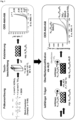
- FIG. 12 shows a schematic representation of the principle of surface modification already known in the prior art and as preferred according to the invention.
- the upper box for the production of active catalyst layers based on Ir y Ti 1-y O 2 mixed oxides (where the parameter y is between 0 and 1) for the electrochemical water splitting (acidic OER, English oxygen evolution reaction) by means of dip coating.
- the mixed oxide layers are deposited on suitable substrates and have an ordered, templated mesoporous structure as a result of thermal treatment in an air atmosphere.
- the newly developed synthesis concept uses the Ir y Ti 1-y O 2 mixed oxide layers produced in this way as conductive carrier materials for the controlled surface modification with highly active IrO x species using atomic layer deposition (ALD).
- the composition of the carrier mixed oxide is particularly preferably Ir 0.15 Ti 0.85 O 2 in order to ensure adequate conductivity.
- the calculated potential-dependent Ir mass-specific activities clearly exceed those of the pure Ir 0.15 Ti 0.85 O 2 carrier and that of a surface-modified TiO 2 carrier as well as a commercial reference (Elyst Ir75 0480, 75 wt.% Ir, Umicore). Surprisingly, the materials obtained have both improved mass-specific activity per noble metal content and higher catalytic stability.
- a purification or surface functionalization step is carried out, which comprises ten cycles and uses O 3 as the active species. IrO x atomic layers are then deposited in two repeated half-cycles.
- the noble metal precursor 1-ethylcyclopentadienyl-1,3-cyclohexadieniridium(I) was used in ALD without further purification.
- Ozone was generated from oxygen (Air Liquide, 99%) in-situ in an ozone generator (AC-2025, Teledyne API) manufactured.
- Nitrogen and argon were purchased from Air Liquide at 99.9% purity and used as inert gases.
- the isotropic ring in the Fast Fourier Transform (FFT) of the associated SEM image suggests a local ordering of the pores.
- FFT Fast Fourier Transform
- the mean pore diameter decreases almost linearly with the number of ALD cycles.
- the conformal character of ALD becomes clear, especially since the introduced porous structure of the support material is preserved after deposition (see FFTs in (b) & (c)).
- Figure 4 (a) provides electrocatalytic activity measurements (cyclic voltammetry) of the oxygen evolution reaction (OER) in a rotating disk electrode setup in 0.5 M sulfuric acid as the electrolyte at 25 °C. Shown are the current densities of different catalyst coatings at a certain applied potential (versus RHE (reversible hydrogen electrode); iR -corrected) in the OER regime. Mesoporous templated Ir 0.15 Ti 0.85 O 2 and IrO x -ALD-modified Ir 0.15 Ti 0.85 O 2 -60ALD were investigated as catalyst coatings.
- a commercially available catalyst powder containing 74.7% wt. Ir in Ir/TiO 2 was tested after preparation of a catalyst ink with the addition of Nafion binder as a reference. All layers examined were measured on a polished titanium sheet as substrate. After estimating the respective Ir content in the catalyst layers, graphs result for a potential-dependent Ir-specific OER mass activity (b).
- Nafion type N115 (127 ⁇ m thick) was used as the proton-conducting membrane, Pt/C (46.7% by weight Pt; Vulcan carbon) was used for the cathode side (loading approx. 0.35 mg Pt /cm 2 ) .
- Pt/C 46.7% by weight Pt; Vulcan carbon
- the cathode side loading approx. 0.35 mg Pt /cm 2
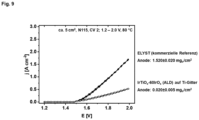
- the MEA with the surface-modified OER catalyst material shows improved activity and high stability.
- a reduced noble metal loading on the anode side surprisingly leads to higher current densities in the electrolyzer compared to the benchmark catalyst (ELYST).
- An approximately 20% increased iridium mass specific OER activity compared to the unmodified benchmark catalyst powder is advantageously achieved as a result of the surface modification.
- FIG. 8 shows representative scanning electron micrographs of the unmodified surface of a selected, commercially available titanium grating as an electrically conductive substrate with three-dimensional structure (left column), as well as the surface modified by dip coating and ALD (IrO x -ALD-modified Ir 0.15 Ti 0.85 O 2 -60ALD coating on titanium grid, right column).
- the developed process based on the combination of dip coating and ALD process, enables the production of defined porous catalyst layers on the entire exposed substrate surface.
- the coated and IrO x -ALD-modified, three-dimensionally structured titanium lattice has a hierarchical pore structure comprising meso (nm) and macropores ( ⁇ m).
- a commercially available, proton-conducting Nafion membrane of the type N115 (127 ⁇ m thick) was also used to produce the MEA of the newly developed catalyst coating via CCS.
- the coated grid was hot-pressed to the membrane at 150°C for 90 s with a pressure of about 1000 psi in order to achieve better attachment of the modified Irreich surface.
- Nafion ionomer (“binder”) dissolved in isopropanol was sprayed onto the grid surface in a controlled manner (3 layers, 1.0% by weight Nafion solution, approx. 75 ⁇ g ionomer /cm 2 ).
- the Pt/C cathode was then applied to the opposite side of the membrane at 60° C.
- the morphological and structural properties of the carrier materials were examined before and after the surface modification via ALD using scanning electron microscopy (SEM, JEOL JSM-7401F ) at an excitation voltage of approx. 10 kV. Cross-sectional images were taken and evaluated to estimate the mean thickness of the entire porous film on a given substrate. Investigations in a transmission electron microscope (TEM, FEI Talos , 200 kV acceleration voltage) provided further morphological and structural information. For the preparation of the samples, in the case of the layers, tiny fragments were carefully scraped off with a diamond scraper and deposited on carbon-coated copper grids (so-called TEM grids).
- TEM grids carbon-coated copper grids
- EDX measurements energy dispersive X-ray spectroscopy
- a Quantax 400 X-ray spectrometer (Bruker , energy-dispersive) coupled with a type 6517B electrometer ( Keithley ) was used to determine the average sample current in an SEM.
- the method of inductively coupled plasma emission spectroscopy (ICP-OES, Varian 715 ES , radial, CCD detector) was used to determine the geometric noble metal loadings, in particular of iridium, in the materials.
- the films were immersed in a mixture of hydrochloric acid (3.0 mL, Carl Roth, 37%), nitric acid (1.0 mL, Carl Roth, 69%), sulfuric acid (1.0 mL, Carl Roth, 96%), and sodium chlorate (20.0 mg, Alfa Aesar, 99%) resolved using ultrasound at 30 °C for at least 2 h and analyzed after instrument calibration.
- the present phases of the materials were characterized using X-ray diffractometry in glint incidence (GI-XRD, Bruker D8 Advance , Cu-Ka).
- GI-XRD glint incidence
- SAED electron diffraction
- the specific surface area of the films was investigated using krypton physisorption at 77 K ( Autosorb-iQ , Quantachrome; cooled with liquid nitrogen) and normalization to the coated substrate surface (polished silicon).
- the BET method known to those skilled in the art was used to evaluate the data.
- the electrical properties of the layers were examined using impedance spectroscopy. The measurements were made in a setup using an 8 ⁇ 8 gold array as the conductive probe with alternating polarity. A potentiostat ( SP-200 , biology ) was used for signal excitation and evaluation in a range between 100 mHz - 1 kHz.
- 0.5 molar sulfuric acid (Fixanal, Fluka Analytical ) was used as the electrolyte and platinum as the counter electrode ( Chempur , wire diameter approx. 0.06 mm, 99.9% purity).
- a reversible Hydrogen electrode (RHE, Gaskatel, HydroFlex ) was used and the temperature was about 25° C.
- the working electrode (catalyst material on a flat, polished sheet of titanium) was rotated at about 1600 revolutions per minute. A scan rate of 6 mV/s was selected for the cyclic voltammetry measurements.
Landscapes
- Chemical & Material Sciences (AREA)
- Engineering & Computer Science (AREA)
- Chemical Kinetics & Catalysis (AREA)
- Electrochemistry (AREA)
- Materials Engineering (AREA)
- Metallurgy (AREA)
- Organic Chemistry (AREA)
- General Chemical & Material Sciences (AREA)
- Manufacturing & Machinery (AREA)
- Inorganic Chemistry (AREA)
- Mechanical Engineering (AREA)
- Catalysts (AREA)
Applications Claiming Priority (2)
| Application Number | Priority Date | Filing Date | Title |
|---|---|---|---|
| DE102021127140 | 2021-10-19 | ||
| DE102021133530 | 2021-12-16 |
Publications (1)
| Publication Number | Publication Date |
|---|---|
| EP4170063A1 true EP4170063A1 (fr) | 2023-04-26 |
Family
ID=85686387
Family Applications (1)
| Application Number | Title | Priority Date | Filing Date |
|---|---|---|---|
| EP22162190.7A Withdrawn EP4170063A1 (fr) | 2021-10-19 | 2022-03-15 | Procédé de fabrication de catalyseurs d'oxydes mixtes actifs et stables à base de titane à distribution optimisée de métaux précieux par dépôt de couche atomique conforme à la surface |
Country Status (1)
| Country | Link |
|---|---|
| EP (1) | EP4170063A1 (fr) |
Cited By (2)
| Publication number | Priority date | Publication date | Assignee | Title |
|---|---|---|---|---|
| CN118272778A (zh) * | 2024-04-29 | 2024-07-02 | 深圳市氢瑞燃料电池科技有限公司 | 一种质子交换膜电解槽耐腐蚀涂层及其制备方法 |
| CN118878222A (zh) * | 2024-07-10 | 2024-11-01 | 湖南清牛新材料科技有限公司 | 一种基于原子层沉积法的pem电解水析氧催化剂及其制备方法 |
Citations (4)
| Publication number | Priority date | Publication date | Assignee | Title |
|---|---|---|---|---|
| US20060027847A1 (en) * | 2004-08-05 | 2006-02-09 | Samsung Electronics Co., Ltd. | Ferroelectric memory and ferroelectric capacitor with Ir-alloy electrode or Ru-alloy electrode and method of manufacturing same |
| US8288274B2 (en) * | 2008-04-21 | 2012-10-16 | Hynix Semiconductor Inc. | Method of forming noble metal layer using ozone reaction gas |
| KR20200126681A (ko) * | 2019-04-30 | 2020-11-09 | 포항공과대학교 산학협력단 | 원자층 증착법을 통한 M/TiX 기반 단일원자촉매 제조 방법 |
| EP3940116A1 (fr) * | 2020-07-13 | 2022-01-19 | Nederlandse Organisatie voor toegepast- natuurwetenschappelijk onderzoek TNO | Procédé de fourniture d'un substrat pour une cellule électrochimique avec un matériau catalytique |
-
2022
- 2022-03-15 EP EP22162190.7A patent/EP4170063A1/fr not_active Withdrawn
Patent Citations (4)
| Publication number | Priority date | Publication date | Assignee | Title |
|---|---|---|---|---|
| US20060027847A1 (en) * | 2004-08-05 | 2006-02-09 | Samsung Electronics Co., Ltd. | Ferroelectric memory and ferroelectric capacitor with Ir-alloy electrode or Ru-alloy electrode and method of manufacturing same |
| US8288274B2 (en) * | 2008-04-21 | 2012-10-16 | Hynix Semiconductor Inc. | Method of forming noble metal layer using ozone reaction gas |
| KR20200126681A (ko) * | 2019-04-30 | 2020-11-09 | 포항공과대학교 산학협력단 | 원자층 증착법을 통한 M/TiX 기반 단일원자촉매 제조 방법 |
| EP3940116A1 (fr) * | 2020-07-13 | 2022-01-19 | Nederlandse Organisatie voor toegepast- natuurwetenschappelijk onderzoek TNO | Procédé de fourniture d'un substrat pour une cellule électrochimique avec un matériau catalytique |
Non-Patent Citations (8)
| Title |
|---|
| BERNICKE MICHAEL ET AL: "Tailored mesoporous Ir/TiOx: Identification of structure-activity relationships for an efficient oxygen evolution reaction", JOURNAL OF CATALYSIS, ACADEMIC PRESS, DULUTH, MN, US, vol. 376, 19 July 2019 (2019-07-19), pages 209 - 218, XP085821973, ISSN: 0021-9517, [retrieved on 20190719], DOI: 10.1016/J.JCAT.2019.06.044 * |
| BERNICKE, MICHAEL ET AL.: "Tailored mesoporous Ir/TiO : Identification of structure-activity relationships for an efficient oxygen evolution reaction.", JOURNAL OF CATALYSIS, vol. 376, 2019, pages 209 - 218, XP085821973, DOI: 10.1016/j.jcat.2019.06.044 |
| BERNSMEIER, DENIS ET AL.: "Oxygen evolution catalysts based on Ir-Ti mixed oxides with templated mesopore structure: impact of Ir on activity and conductivity", CHEMSUSCHEM, vol. 11, 2018, pages 2367 - 2374 |
| DAIANE FERREIRA DA SILVA, CAMILA ET AL.: "Oxygen Evolution Reaction Activity and Stability Benchmarks for Supported and Unsupported IrOx Electrocatalysts.", ACS CATALYSIS, vol. 11, 2021, pages 4107 - 4116 |
| GEIGER, S. ET AL., STABILITY LIMITS OF TIN-BASED ELECTROCATALYST SUPPORTS, SCI, 2017, pages 4595 |
| HARTIG-WEISS, ALEXANDRA ET AL.: "Iridium oxide catalyst supported on antimony-doped tin oxide for high oxygen evolution reaction activity in acidic media", ACS APPLIED NANO MATERIALS, vol. 3, 2020, pages 2185 - 2196 |
| MINKE, CHRISTINE ET AL.: "Is iridium demand a potential bottleneck in the realization of large-scale PEM water electrolysis?", INTERNATIONAL JOURNAL OF HYDROGEN ENERGY, 2021 |
| ORTEL, ERIK ET AL.: "Mesoporous Ir0 films templated by PEO-PB-PEO block-copolymers: selfassembly, crystallization behavior, and electrocatalytic performance", CHEMISTRY OF MATERIALS, vol. 23, 2011, pages 3201 - 3209 |
Cited By (3)
| Publication number | Priority date | Publication date | Assignee | Title |
|---|---|---|---|---|
| CN118272778A (zh) * | 2024-04-29 | 2024-07-02 | 深圳市氢瑞燃料电池科技有限公司 | 一种质子交换膜电解槽耐腐蚀涂层及其制备方法 |
| CN118878222A (zh) * | 2024-07-10 | 2024-11-01 | 湖南清牛新材料科技有限公司 | 一种基于原子层沉积法的pem电解水析氧催化剂及其制备方法 |
| CN118878222B (zh) * | 2024-07-10 | 2025-06-27 | 湖南青启未来新材料科技有限公司 | 一种基于原子层沉积法的pem电解水析氧催化剂及其制备方法 |
Similar Documents
| Publication | Publication Date | Title |
|---|---|---|
| EP3764443B1 (fr) | Catalyseur pour la réaction de dégagement d'oxygène lors de l'électrolyse de l'eau | |
| DE102013225764B4 (de) | Katalysatorpartikel mit einer schichtförmig aufgebauten Kern-Schale-Schale-Struktur und Verfahren zu ihrer Herstellung | |
| EP2765223B1 (fr) | Catalyseur électrique, revêtement d'électrode et électrode pour la fabrication de chlore | |
| DE102014226464B4 (de) | Mit Stickstoff dotierte Metallboride für Wasserspaltung und Sauerstoffreduktion | |
| EP4019666A1 (fr) | Catalyseur d'iridium destiné à l'électrolyse de l'eau | |
| US9608278B2 (en) | Mixed metal oxide material of tin and titanium | |
| EP2765222A1 (fr) | Revêtement de catalyseur et son procédé de fabrication | |
| EP2954951A1 (fr) | Catalyseur sur support et procédé de fabrication d'un matériau de carbone graphité poreux, revêtu de nanoparticules métalliques | |
| DE102009035546A1 (de) | Elektrode und Elektrodenbeschichtung | |
| US20190055657A1 (en) | Oxygen evolution electrocatalysts with carbon coated cobalt (ii, iii) oxide layers | |
| EP4267781B1 (fr) | Membrane enduite pour l'électrolyse de l'eau | |
| EP2581971A1 (fr) | Revêtement de catalyseur et son procédé de fabrication | |
| DE102017205339A1 (de) | Chemisch beständiger, oxidischer Elektrokatalysator für die Sauerstoffentwicklung während der alkalischen Wasserelektrolyse basierend auf BaCoO3-delta, Verfahren zu seiner Herstellung und ihn umfassende Anode sowie katalytisch aktives und chemisch stabiles Reaktionsprodukt davon | |
| Nguyen et al. | Activity and stability optimization of RuxIr1-xO2 nanocatalyst for the oxygen evolution reaction by tuning the synthetic process | |
| EP4406644A1 (fr) | Catalyseur d'oxydation de spinelle en forme de nano-flocons pour électrolyse de l'eau par membrane échangeuse d'anions et procédé de préparation de celui-ci | |
| EP4170063A1 (fr) | Procédé de fabrication de catalyseurs d'oxydes mixtes actifs et stables à base de titane à distribution optimisée de métaux précieux par dépôt de couche atomique conforme à la surface | |
| DE68926306T2 (de) | Elektrokatalysator, verfahren zur herstellung, daraus hergestellte elektroden und deren verwendungsverfahren | |
| DE102010030293A1 (de) | Elektrode für die elektrolytische Chlorgewinnung | |
| DE112011105084T5 (de) | Metalloxid/Platin-Kompositkatalysator und Herstellungsverfahren desselben | |
| DE102021213822A1 (de) | Intermetallischer katalysator und verfahren zur herstellung dessen | |
| DE102020213953A1 (de) | Leitfähiges, antikorrosives magnesium-titanoxid-material | |
| EP4340990A1 (fr) | Procédé de production de couches de carbure de métal de transition mésoporeuses avec nanostructuration définie, et utilisation desdites couches de carbure de métal de transition en électrocatalyse | |
| US11142837B2 (en) | Electrocatalytic materials for oxygen evolution of formula A1-xBxO3-δ | |
| LU508279B1 (de) | Verfahren zur herstellung eines hierrarchisch strukturierten porösen edelmetallkatalysators in pulverform und dessen anwendung | |
| WO2025098664A1 (fr) | Catalyseurs à base d'oxyde mixte de ruthénium-iridium pour l'électrolyse de l'eau |
Legal Events
| Date | Code | Title | Description |
|---|---|---|---|
| PUAI | Public reference made under article 153(3) epc to a published international application that has entered the european phase |
Free format text: ORIGINAL CODE: 0009012 |
|
| STAA | Information on the status of an ep patent application or granted ep patent |
Free format text: STATUS: THE APPLICATION HAS BEEN PUBLISHED |
|
| AK | Designated contracting states |
Kind code of ref document: A1 Designated state(s): AL AT BE BG CH CY CZ DE DK EE ES FI FR GB GR HR HU IE IS IT LI LT LU LV MC MK MT NL NO PL PT RO RS SE SI SK SM TR |
|
| STAA | Information on the status of an ep patent application or granted ep patent |
Free format text: STATUS: REQUEST FOR EXAMINATION WAS MADE |
|
| 17P | Request for examination filed |
Effective date: 20231026 |
|
| RBV | Designated contracting states (corrected) |
Designated state(s): AL AT BE BG CH CY CZ DE DK EE ES FI FR GB GR HR HU IE IS IT LI LT LU LV MC MK MT NL NO PL PT RO RS SE SI SK SM TR |
|
| STAA | Information on the status of an ep patent application or granted ep patent |
Free format text: STATUS: THE APPLICATION IS DEEMED TO BE WITHDRAWN |
|
| 18D | Application deemed to be withdrawn |
Effective date: 20251001 |