EP4177079B1 - Festigkeitsträgerlage für elastomere erzeugnisse und fahrzeugluftreifen - Google Patents
Festigkeitsträgerlage für elastomere erzeugnisse und fahrzeugluftreifen Download PDFInfo
- Publication number
- EP4177079B1 EP4177079B1 EP22194089.3A EP22194089A EP4177079B1 EP 4177079 B1 EP4177079 B1 EP 4177079B1 EP 22194089 A EP22194089 A EP 22194089A EP 4177079 B1 EP4177079 B1 EP 4177079B1
- Authority
- EP
- European Patent Office
- Prior art keywords
- dtex
- fineness
- yarns
- cords
- reinforcement layer
- Prior art date
- Legal status (The legal status is an assumption and is not a legal conclusion. Google has not performed a legal analysis and makes no representation as to the accuracy of the status listed.)
- Active
Links
Images

Classifications
-
- B—PERFORMING OPERATIONS; TRANSPORTING
- B60—VEHICLES IN GENERAL
- B60C—VEHICLE TYRES; TYRE INFLATION; TYRE CHANGING; CONNECTING VALVES TO INFLATABLE ELASTIC BODIES IN GENERAL; DEVICES OR ARRANGEMENTS RELATED TO TYRES
- B60C9/00—Reinforcements or ply arrangement of pneumatic tyres
- B60C9/005—Reinforcements made of different materials, e.g. hybrid or composite cords
-
- B—PERFORMING OPERATIONS; TRANSPORTING
- B60—VEHICLES IN GENERAL
- B60C—VEHICLE TYRES; TYRE INFLATION; TYRE CHANGING; CONNECTING VALVES TO INFLATABLE ELASTIC BODIES IN GENERAL; DEVICES OR ARRANGEMENTS RELATED TO TYRES
- B60C9/00—Reinforcements or ply arrangement of pneumatic tyres
- B60C9/0042—Reinforcements made of synthetic materials
-
- B—PERFORMING OPERATIONS; TRANSPORTING
- B60—VEHICLES IN GENERAL
- B60C—VEHICLE TYRES; TYRE INFLATION; TYRE CHANGING; CONNECTING VALVES TO INFLATABLE ELASTIC BODIES IN GENERAL; DEVICES OR ARRANGEMENTS RELATED TO TYRES
- B60C9/00—Reinforcements or ply arrangement of pneumatic tyres
- B60C9/18—Structure or arrangement of belts or breakers, crown-reinforcing or cushioning layers
-
- B—PERFORMING OPERATIONS; TRANSPORTING
- B60—VEHICLES IN GENERAL
- B60C—VEHICLE TYRES; TYRE INFLATION; TYRE CHANGING; CONNECTING VALVES TO INFLATABLE ELASTIC BODIES IN GENERAL; DEVICES OR ARRANGEMENTS RELATED TO TYRES
- B60C9/00—Reinforcements or ply arrangement of pneumatic tyres
- B60C9/18—Structure or arrangement of belts or breakers, crown-reinforcing or cushioning layers
- B60C9/20—Structure or arrangement of belts or breakers, crown-reinforcing or cushioning layers built-up from rubberised plies each having all cords arranged substantially parallel
- B60C9/22—Structure or arrangement of belts or breakers, crown-reinforcing or cushioning layers built-up from rubberised plies each having all cords arranged substantially parallel the plies being arranged with all cords disposed along the circumference of the tyre
-
- D—TEXTILES; PAPER
- D02—YARNS; MECHANICAL FINISHING OF YARNS OR ROPES; WARPING OR BEAMING
- D02G—CRIMPING OR CURLING FIBRES, FILAMENTS, THREADS, OR YARNS; YARNS OR THREADS
- D02G3/00—Yarns or threads, e.g. fancy yarns; Processes or apparatus for the production thereof, not otherwise provided for
- D02G3/44—Yarns or threads characterised by the purpose for which they are designed
- D02G3/48—Tyre cords
-
- B—PERFORMING OPERATIONS; TRANSPORTING
- B60—VEHICLES IN GENERAL
- B60C—VEHICLE TYRES; TYRE INFLATION; TYRE CHANGING; CONNECTING VALVES TO INFLATABLE ELASTIC BODIES IN GENERAL; DEVICES OR ARRANGEMENTS RELATED TO TYRES
- B60C9/00—Reinforcements or ply arrangement of pneumatic tyres
- B60C2009/0071—Reinforcements or ply arrangement of pneumatic tyres characterised by special physical properties of the reinforcements
-
- B—PERFORMING OPERATIONS; TRANSPORTING
- B60—VEHICLES IN GENERAL
- B60C—VEHICLE TYRES; TYRE INFLATION; TYRE CHANGING; CONNECTING VALVES TO INFLATABLE ELASTIC BODIES IN GENERAL; DEVICES OR ARRANGEMENTS RELATED TO TYRES
- B60C9/00—Reinforcements or ply arrangement of pneumatic tyres
- B60C2009/0071—Reinforcements or ply arrangement of pneumatic tyres characterised by special physical properties of the reinforcements
- B60C2009/0092—Twist structure
-
- B—PERFORMING OPERATIONS; TRANSPORTING
- B60—VEHICLES IN GENERAL
- B60C—VEHICLE TYRES; TYRE INFLATION; TYRE CHANGING; CONNECTING VALVES TO INFLATABLE ELASTIC BODIES IN GENERAL; DEVICES OR ARRANGEMENTS RELATED TO TYRES
- B60C9/00—Reinforcements or ply arrangement of pneumatic tyres
- B60C9/18—Structure or arrangement of belts or breakers, crown-reinforcing or cushioning layers
- B60C9/1835—Rubber strips or cushions at the belt edges
- B60C2009/1857—Rubber strips or cushions at the belt edges radially above the belt plies
-
- B—PERFORMING OPERATIONS; TRANSPORTING
- B60—VEHICLES IN GENERAL
- B60C—VEHICLE TYRES; TYRE INFLATION; TYRE CHANGING; CONNECTING VALVES TO INFLATABLE ELASTIC BODIES IN GENERAL; DEVICES OR ARRANGEMENTS RELATED TO TYRES
- B60C9/00—Reinforcements or ply arrangement of pneumatic tyres
- B60C9/18—Structure or arrangement of belts or breakers, crown-reinforcing or cushioning layers
- B60C9/20—Structure or arrangement of belts or breakers, crown-reinforcing or cushioning layers built-up from rubberised plies each having all cords arranged substantially parallel
- B60C9/22—Structure or arrangement of belts or breakers, crown-reinforcing or cushioning layers built-up from rubberised plies each having all cords arranged substantially parallel the plies being arranged with all cords disposed along the circumference of the tyre
- B60C2009/2252—Physical properties or dimension of the zero degree ply cords
-
- B—PERFORMING OPERATIONS; TRANSPORTING
- B60—VEHICLES IN GENERAL
- B60C—VEHICLE TYRES; TYRE INFLATION; TYRE CHANGING; CONNECTING VALVES TO INFLATABLE ELASTIC BODIES IN GENERAL; DEVICES OR ARRANGEMENTS RELATED TO TYRES
- B60C15/00—Tyre beads, e.g. ply turn-up or overlap
- B60C15/06—Flipper strips, fillers, or chafing strips and reinforcing layers for the construction of the bead
- B60C15/0628—Flipper strips, fillers, or chafing strips and reinforcing layers for the construction of the bead comprising a bead reinforcing layer
- B60C2015/065—Flipper strips, fillers, or chafing strips and reinforcing layers for the construction of the bead comprising a bead reinforcing layer at the axially outer side of the carcass turn-up portion not wrapped around the bead core
-
- D—TEXTILES; PAPER
- D10—INDEXING SCHEME ASSOCIATED WITH SUBLASSES OF SECTION D, RELATING TO TEXTILES
- D10B—INDEXING SCHEME ASSOCIATED WITH SUBLASSES OF SECTION D, RELATING TO TEXTILES
- D10B2331/00—Fibres made from polymers obtained otherwise than by reactions only involving carbon-to-carbon unsaturated bonds, e.g. polycondensation products
- D10B2331/02—Fibres made from polymers obtained otherwise than by reactions only involving carbon-to-carbon unsaturated bonds, e.g. polycondensation products polyamides
-
- D—TEXTILES; PAPER
- D10—INDEXING SCHEME ASSOCIATED WITH SUBLASSES OF SECTION D, RELATING TO TEXTILES
- D10B—INDEXING SCHEME ASSOCIATED WITH SUBLASSES OF SECTION D, RELATING TO TEXTILES
- D10B2331/00—Fibres made from polymers obtained otherwise than by reactions only involving carbon-to-carbon unsaturated bonds, e.g. polycondensation products
- D10B2331/04—Fibres made from polymers obtained otherwise than by reactions only involving carbon-to-carbon unsaturated bonds, e.g. polycondensation products polyesters, e.g. polyethylene terephthalate [PET]
Definitions
- the invention relates to a reinforcement layer for elastomer products, in particular for a belt bandage, comprising cords as reinforcements, which are arranged essentially parallel to one another within the layer and are embedded in elastomer material, wherein the cords each have exactly two yarns, wherein the two yarns are twisted together at the ends, wherein the sum of the finenesses of the two yarns is a maximum of 1030 dtex and wherein one of the two yarns is a yarn made of polyamide 6.6 (PA 6.6).
- PA 6.6 polyamide 6.6
- Strength members for reinforcing various elastomer products are well known.
- a belt bandage for pneumatic vehicle tires which has at least one strength member layer as a belt bandage layer, which covers the belt edges and where each layer contains strength members embedded in rubber that run parallel and essentially in the circumferential direction.
- This belt bandage serves to prevent the tire from lifting due to the centrifugal forces that occur during driving, particularly in high-speed use.
- the bandage is applied in the form of layers, strips or individual cords with reinforcements embedded in an unvulcanized rubber mixture, which are wound or spooled onto the belt.
- the reinforcements are embedded in rubber by passing a group of essentially parallel thread-like reinforcements, which are usually pretreated thermally and/or with an impregnation in a manner known to the expert for better adhesion to the embedding rubber, longitudinally through a calender or an extruder to be coated with the rubber mixture.
- the development is moving towards reducing the rolling resistance of the tire.
- a low tire weight and a low hysteresis of the reinforcements of the belt bandage layer are advantageous for this.
- the bead reinforcement is arranged entirely or partially in the bead area. It is usually positioned axially outside and adjacent to the carcass.
- the bead reinforcement contains at least one reinforcement layer as a bead reinforcement layer, which runs in a ring-shaped manner around the tire in the area of the bead.
- the DE 102012105766 A1 discloses a reinforcement layer for elastomer products, such as a belt bandage, comprising hybrid cords of the construction HMNS-PET 1440 dtex + PA 6.6 1400 dtex.
- the high layer thickness of the reinforcement layer caused by the overall fineness of the hybrid cord, has a negative effect on the rolling resistance of the tire.
- PA 6.6 has shrinkage properties that are advantageous for use as a material for the strength members of the belt bandage, which enables the tire to be suitable for high speeds.
- a disadvantage of PA 6.6, however, is its hysteresis properties, which have a detrimental effect on rolling resistance.
- One of the objects of the invention is to provide a reinforcement layer for elastomer products, in particular for a belt bandage, which has improved hysteresis behavior while still having sufficient shrinkage properties. Likewise, the weight of this reinforcement layer should not be significantly increased.
- the task is solved in that another yarn of the two yarns of the cord is a yarn made of high-modulus-normal-shrinkage polyethylene terephthalate (HMNS - PET), that the yarn made of HMNS-PET has a greater fineness than the yarn made of PA 6.6 and that the weighted difference between the finenesses of the two yarns is greater than 0 and a maximum of 0.23.
- HMNS - PET high-modulus-normal-shrinkage polyethylene terephthalate
- a further object of the invention is to provide a pneumatic vehicle tire, in particular a pneumatic vehicle tire for a passenger car, a van or a light truck, which has a lower rolling resistance while still having good high-speed properties.
- the pneumatic vehicle tire in particular the pneumatic vehicle tire for a passenger car, a van or a light truck, has at least one reinforcement layer according to the invention.
- a pneumatic vehicle tire in particular a pneumatic vehicle tire for a passenger car, a van or a light truck, which contains at least one reinforcement layer according to the invention in at least one component, has a lower rolling resistance and a tire weight that remains almost constant while still having good high-speed properties.
- the reinforcement layer according to the invention is preferably designed as a belt bandage layer and/or bead reinforcement layer of the pneumatic vehicle tire.
- cords are linear structures which consist of two or more yarns twisted together at the end.
- a yarn is a linear structure based on DIN 60900 that consists of individual filaments or fibers. The filaments or fibers of a yarn can be twisted together at the end.
- a yarn made of a material is made entirely or partially from this material.
- the weighted difference in the fineness of the two yarns is defined as the ratio of the amount of the difference in the fineness of the two yarns of the cord to the sum of the fineness of the two yarns of the cord, i.e. amount (fineness (yarn made of HMNS-PET) - fineness (yarn made of PA 6.6) ) / (fineness (yarn made of HMNS-PET) + fineness (yarn made of PA 6.6)).
- the reinforcement layer contains cords made of two yarns twisted together at the ends, made of HMNS-PET and PA6.6.
- HMNS-PET has slightly disadvantageous shrinkage properties compared to PA 6.6, but in particular it has better shrinkage properties than HMLS (high-modulus-low-shrinkage)-PET.
- HMLS high-modulus-low-shrinkage
- Another common name for HMNS-PET is regular PET.
- HMNS-PET has greatly improved hysteresis properties compared to PA 6.6. It has been shown that with a weighted difference in the fineness of the two yarns of greater than 0 and a maximum of 0.23, improved properties of the reinforcement layer can be achieved with such cords.
- the fineness of the HMNS-PET yarn is greater than the fineness of the PA 6.6 yarn enables advantageous hysteresis properties, especially in comparison to cords with a largely corresponding sum of the finenesses of the two yarns, but the fineness of the PA 6.6 yarn is equal to or greater than the fineness of the HMNS-PET yarn or both yarns are PA 6.6. It has also been shown that sufficient shrinkage properties can still be achieved with a weighted difference in the fineness of the two yarns of a maximum of 0.23.
- a weighted difference in the fineness of the two yarns of greater than 0.23 leads to too great an asymmetry in the fineness of the two yarns, which reduces the stability of the cord in the twist process.
- the shrinkage properties of the cord are adversely affected by the insufficient proportion of PA 6.6.
- a reinforcement layer according to the invention for elastomer products in particular for a belt bandage, with the cord made of the yarn made of HMNS-PET and the yarn made of PA 6.6, where the yarn made of HMNS-PET has a greater fineness than the yarn made of PA 6.6 and the weighted difference in the fineness of the two yarns is a maximum of 0.23, has improved hysteresis properties while still having sufficient shrinkage properties.
- the low maximum sum of the finenesses of the two yarns of a maximum of 1030 dtex makes it possible to provide a reinforcement layer for elastomer products, in particular for a belt bandage, which also continues to have a low weight.
- the stability of the cord in the twist process is still ensured by the limited weighted difference in the finenesses of the two yarns and thus the limited asymmetry in the fineness of the two yarns.
- a pneumatic vehicle tire having such a reinforcement layer as a belt bandage layer has a reduced rolling resistance while still having good high-speed properties.
- the reduced rolling resistance is due to the advantageous hysteresis properties of the cord or the reinforcement layer while at the same time the belt bandage layer remains low in thickness and weight.
- the good high-speed properties are made possible by the continued sufficient shrinkage properties of the cord or the reinforcement layer. Continued sufficient shrinkage properties are also advantageous for reducing or avoiding compression on and next to the belt edge in the tire.
- a pneumatic vehicle tire having such a reinforcement layer as a bead reinforcement layer also has advantageous properties due to the advantageous hysteresis properties as well as sufficient shrinkage properties and the low weight of the reinforcement layer.
- the cords of the reinforcement layer according to the invention can all have the same construction.
- the cords each have a fineness of 510 dtex to 1020 dtex, preferably from 595 dtex to 900 dtex, particularly preferably from 672 dtex to 710 dtex.
- Cords of such fineness enable an excellent compromise between the processing effort and the weight of the reinforcement layer.
- Cords that have a lower fineness are more complex in terms of processing in the production of the reinforcement layer.
- Cords that have a greater fineness result in a disadvantageous weight of the reinforcement layer, in particular a disadvantageous rolling resistance in a pneumatic vehicle tire having such a reinforcement layer as a belt bandage layer and/or bead reinforcement layer.
- weighted difference of the finenesses of the two yarns of the cords is 0.01 to 0.21, preferably 0.014 to 0.08, particularly preferably 0.014 to 0.072.
- a reinforcement layer comprising a cord with a weighted difference of less than 0.01 has a high proportion of PA 6.6 which is detrimental to the hysteresis properties.
- weighted difference of the finenesses of the two yarns of the cords is 0.20 to 0.23.
- the yarn made of HMNS-PET has a fineness of 360 dtex, preferably that the yarn made of HMNS-PET has a fineness of 360 dtex and the yarn made of PA 6.6 has a fineness of 235 dtex to 350 dtex, particularly preferably that the yarn made of HMNS-PET has a fineness of 360 dtex and the yarn made of PA 6.6 has a fineness of 312 dtex to 350 dtex.
- the reinforcement layer can therefore be made thin, which advantageously keeps the hysteresis and weight of the reinforcement layer low.
- a cord in which the yarn made of HMNS-PET has a fineness of 360 dtex and the yarn made of PA 6.6 in particular has a fineness of 312 dtex to 350 dtex, has good stability in the twist process.
- a pneumatic vehicle tire having at least one such reinforcement layer in particular as a belt bandage layer and/or bead reinforcement layer, has good high-speed capability and particularly low rolling resistance.
- the yarn made of PA 6.6 has a fineness of 235 dtex, preferably that the yarn made of PA 6.6 has a fineness of 235 dtex and the yarn made of HMNS-PET has a fineness of 275 dtex to 360 dtex.
- the reinforcement layer can therefore be made particularly thin, which means that the weight of the reinforcement layer is advantageously low.
- the particularly low fineness of the PA 6.6 yarn results in the cord's particularly good hysteresis properties. Despite the very low sum of the finenesses of the two yarns, such a cord, in which the PA 6.6 yarn has a fineness of 235 dtex and the HMNS-PET yarn in particular has a fineness of 275 dtex, has good stability in the twist process.
- a pneumatic vehicle tire having at least one such reinforcement layer in particular as a belt bandage layer and/or as a bead reinforcement layer, has particularly good high-speed capability and low rolling resistance.
- the yarn made of HMNS-PET has a fineness of 550 dtex, preferably that the yarn made of HMNS-PET has a fineness of 550 dtex and the yarn made of PA 6.6 has a fineness of 350 dtex to 470 dtex.
- the reinforcement layer has a slightly higher strength while still being thin.
- a pneumatic vehicle tire having at least one such reinforcement layer in particular as a belt bandage layer and/or bead reinforcement layer, has particularly good high-speed capability and low rolling resistance.
- twist factor of the cords has a value of 130 to 230, preferably 140 to 220, particularly preferably 150 to 210.
- the twist factor is a measure of the final twist per meter of the cord, related to the fineness of the cord. This twist factor represents an advantageous compromise in terms of fatigue resistance and strength. A lower twist factor would be disadvantageous in terms of fatigue resistance, a higher twist factor would mean a lower strength of the reinforcement.
- Each yarn of the reinforcement layer according to the invention can be twisted in the S or Z direction. The two yarns of the cord expediently have the same direction of twist. They are therefore all twisted either in the S and/or in the Z direction.
- the two yarns of the cord are twisted together in the S or Z direction.
- the twist direction of the cord is expediently opposite to the twist direction of the yarns. This reduces internal tensions in the cord.
- the cords In order to ensure reliable adhesion of textile reinforcements to the rubber, it is advisable for the cords to be provided with an adhesive impregnation to ensure adhesion of the reinforcements to the rubber.
- this adhesive impregnation can be carried out using an RFL dip in a 1- or 2-bath process.
- RFL dip in a 1- or 2-bath process.
- all other processes and adhesives for impregnation known to those skilled in the art are also conceivable.
- cords are arranged with a spacing of 0.20 mm to 1.0 mm, preferably from 0.30 mm to 0.90 mm, particularly preferably from 0.35 mm to 0.80 mm.
- the spacing is the distance measured between the cords of two adjacent cords of the reinforcement layer. Such a spacing enables an advantageous rubberizing process and avoids excessive shear stresses in the rubber of the reinforcement layer, which are detrimental to durability, particularly during operation of a tire having such a reinforcement layer, e.g. as a belt bandage layer and/or bead reinforcement layer.
- the invention also relates to a pneumatic vehicle tire, in particular a pneumatic vehicle tire for a passenger car, a van or a light truck, comprising a reinforcement layer according to the invention according to one or more of the previously described embodiments.
- a pneumatic vehicle tire in particular a pneumatic vehicle tire for a passenger car, a van or a light truck, of a conventional design generally has a carcass, in particular of a radial design, with in particular textile carcass reinforcements.
- a tire also has a profiled tread, a belt with at least two layers and a belt bandage covering the belt at least at the belt edges and having at least one belt bandage layer with cords running largely in the circumferential direction of the tire.
- the tire can have a bead reinforcement with at least one bead reinforcement layer which runs in a ring-shaped manner around the tire in the area of the bead.
- An advantageous embodiment of the pneumatic vehicle tire in particular the pneumatic vehicle tire for a passenger car, a van or a light truck, is provided in that the reinforcement layer is a belt bandage layer and/or a bead reinforcement layer.
- the pneumatic vehicle tire in particular the pneumatic vehicle tire for a passenger car, a van or a light truck, has a belt bandage layer, the cords of the belt bandage layer run largely in the circumferential direction of the tire, in particular at an angle between 0° and 5° to the circumferential direction of the tire.
- a pneumatic vehicle tire in particular a pneumatic vehicle tire for a passenger car, a van or a light truck, having a belt bandage layer according to the invention, is characterized by good high-speed properties, lower rolling resistance and a nearly constant tire weight.
- the belt bandage can have one or more belt bandage layers. At least one, in particular all, belt bandage layers are designed according to the invention.
- a pneumatic vehicle tire in particular a pneumatic vehicle tire for a passenger car, a van or a light truck, having a bead reinforcement layer according to the invention, is characterized by the continued good elastic modulus of the layer, a lower rolling resistance and an almost constant tire weight.
- Table 1 shows examples of cords that are suitable for a reinforcement layer according to the invention.
- a reinforcement layer according to the invention can have the cords listed as reinforcements.
- the cords of the reinforcement layer according to the invention can all have the same construction.
- the fineness of the two yarns and the corresponding weighted difference in the fineness of the two yarns and the sum of the fineness of the two yarns of the cord are given for each cord.
- Cord No. 1 has the construction 550 dtex HMNS-PET + 470 dtex PA 6.6, the weighted difference in the fineness of the two yarns of 0.078 and a sum of the fineness of the two yarns of 1020 dtex.
- all cords of a reinforcement layer have the same construction.
- the cords given as examples in the table are ideally suited for use in a reinforcement layer of a tire, in particular in the belt bandage and/or the bead reinforcement.
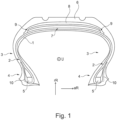
- the Figure 1 shows a radial cross section through a pneumatic vehicle tire according to the invention for a passenger car, comprising at least one reinforcement layer 8, 10 according to the invention.
- the invention is also suitable for a tire for a van or a light truck.
- the pneumatic vehicle tire has at least one reinforcement layer according to the invention.
- the essential components of which the pneumatic vehicle tire shown is composed are a largely air-impermeable inner layer 1, a carcass 2 in a particularly radial design with in particular textile carcass strength members, which in the conventional manner extends from the zenith region of the pneumatic vehicle tire over the side walls 3 into the bead regions 4 and is anchored there by wrapping around tensile bead cores 5, a profiled tread 6 located radially outside the carcass and a belt 7 arranged between the tread 6 and the carcass 2, in particular containing two reinforcement layers, which is covered radially on the outside with the belt bandage, which in this exemplary embodiment comprises exactly one belt bandage layer 8.
- the belt bandage layer 8 covers the belt edges 9 and contains strength members which are wound parallel to one another at an angle of 0° to 5° to the circumferential direction along the axial width of the tire and are embedded in elastomeric material.
- the pneumatic vehicle tire also has at least one bead reinforcement layer 10.
- the bead reinforcement layer 10 is arranged entirely or partially in the bead region 4.
- the bead reinforcement layer 10 is positioned axially outside and adjacent to the carcass 2.
- the bead reinforcement layer 10 is arranged in a ring-shaped manner in the area of the bead around the tire.
- the tire according to the invention can have at least one belt bandage layer 8 designed according to the invention and/or at least one bead reinforcement layer 10 designed according to the invention.
- the tire can also be designed without bead reinforcement and only with the belt bandage layer 8 according to the invention.
- the cords 20 of the reinforcement layer 8, 10 according to the invention are arranged essentially parallel to one another within the respective layer and embedded in elastomeric material, whereby the cords 20 each have exactly two yarns, whereby the two yarns are twisted together at the ends, whereby the sum of the finenesses of the two yarns is a maximum of 1030 dtex.
- the reinforcement layer 8, 10 can be as in the Fig.2 shown.
- One of the two yarns is a yarn made of polyamide 6.6 (PA 6.6), another yarn of the two yarns is a yarn made of high-modulus-normal-shrinkage - polyethylene terephthalate (HMNS - PET).
- the yarn made of HMNS-PET has a greater fineness than the yarn made of PA 6.6.
- the weighted difference in the fineness of the two yarns is greater than 0 and a maximum of 0.23.
- the cords 20 can each have a fineness of 510 dtex to 1020 dtex, preferably from 595 dtex to 900 dtex, particularly preferably from 672 dtex to 710 dtex.
- the weighted difference in the fineness of the two yarns of the cords 20 can be 0.01 to 0.21, preferably 0.014 to 0.08, particularly preferably 0.014 to 0.072.
- the weighted difference in the fineness of the two yarns of the cords 20 can also be 0.20 to 0.23.
- the cords 20 can be characterized in that the yarn made of HMNS-PET has a fineness of 360 dtex, preferably that the yarn made of HMNS-PET has a fineness of 360 dtex and the yarn made of PA 6.6 has a fineness of 235 dtex to 350 dtex, particularly preferably that the yarn made of HMNS-PET has a fineness of 360 dtex and the yarn made of PA 6.6 has a fineness of 312 dtex to 350 dtex.
- the cords 20 can also be characterized in that the yarn made of PA 6.6 has a fineness of 235 dtex, preferably that the yarn made of PA 6.6 has a fineness of 235 dtex and the yarn made of HMNS-PET has a fineness of 275 dtex to 360 dtex.
- the cords 20 can also be characterized in that the yarn made of HMNS-PET has a fineness of 550 dtex, preferably that the yarn made of HMNS-PET has a fineness of 550 dtex and the yarn made of PA 6.6 has a fineness of 350 dtex to 470 dtex.
- the cords 20 of the reinforcement layer 8, 10 according to the invention can be designed in particular according to the embodiments of Table 1.
- the twist factor of the cords 20 can have a value of 130 to 230, preferably 140 to 220, particularly preferably 150 to 210.
- Each yarn of the reinforcement layer according to the invention can be twisted in the S or Z direction.
- the two yarns of a cord expediently have the same direction of twist. They are therefore all twisted either in the S and/or Z direction.
- the two yarns of the cord are end-twisted with each other in the S or Z direction.
- the direction of twist to the cord is expediently opposite to the direction of twist of the yarns. This reduces internal tensions in the cord.
- the cords In order to ensure reliable adhesion of textile reinforcements to the rubber, it is advisable for the cords to be provided with an adhesive impregnation to ensure adhesion of the reinforcements to the rubber.
- the cords 20 can be arranged in the reinforcement layer 8, 10 with a spacing of 0.20 mm to 1.0 mm, preferably 0.30 mm to 0.90 mm, particularly preferably 0.35 mm to 0.80 mm, largely parallel to one another.
- the cords can be provided with an adhesive impregnation to ensure the adhesion of the reinforcements to the rubber.
Landscapes
- Engineering & Computer Science (AREA)
- Mechanical Engineering (AREA)
- Textile Engineering (AREA)
- Tires In General (AREA)
Description
- Die Erfindung betrifft eine Festigkeitsträgerlage für elastomere Erzeugnisse, insbesondere für eine Gürtelbandage, aufweisend Korde als Festigkeitsträger, welche innerhalb der Lage im Wesentlichen parallel zueinander angeordnet und in elastomeres Material eingebettet sind, wobei die Korde jeweils genau zwei Garnen aufweisen, wobei die beiden Garne miteinander endverdreht sind, wobei die Summe der Feinheiten der beiden Garne maximal 1030 dtex beträgt und wobei ein Garn der beiden Garne ein Garn aus Polyamid 6.6 (PA 6.6) ist. Weiter betrifft die Erfindung einen Fahrzeugluftreifen aufweisend eine solche Festigkeitsträgerlage.
- Festigkeitsträger zur Verstärkung verschiedener elastomerer Erzeugnisse sind hinreichend bekannt. So ist für Fahrzeugluftreifen bekannt, eine Gürtelbandage zu verwenden, die zumindest eine Festigkeitsträgerlage als Gürtelbandagenlage aufweist, die Gürtelränder abdeckt und wobei jede Lage parallel und im Wesentlichen in Umfangsrichtung verlaufende in Gummi eingebettete Festigkeitsträger enthält. Diese Gürtelbandage dient dazu, insbesondere im Hochgeschwindigkeitseinsatz, eine Erhebung des Reifen durch die im Fahrbetrieb auftretenden Fliehkräfte zu verhindern.
- Die Bandage wird bei der Reifenherstellung in Form von Lagen, Streifen oder Einzel-Korden mit in eine unvulkanisierte Kautschukmischung eingebetteten Festigkeitsträgern aufgebracht, die auf den Gürtel gewickelt oder gespult werden. Die Festigkeitsträger werden in Kautschuk eingebettet, indem eine Schar von im Wesentlichen parallel liegenden fadenförmigen Festigkeitsträgern, die in der Regel thermisch und/oder zur besseren Haftung am einbettenden Gummi in der der fachkundigen Person bekannten Art mit einer Imprägnierung vorbehandelt sind, in Längsrichtung einen Kalander oder einen Extruder zur Ummantelung mit der Kautschukmischung durchlaufen.
- Die Entwicklung geht dahin, den Rollwiderstand des Reifens zu verringern. Hierzu sind ein geringes Gewicht des Reifens sowie eine geringe Hysterese der Festigkeitsträger der Gürtelbandagenlage vorteilhaft.
- Der Wulstverstärker ist ganz oder teilweise im Wulstbereich angeordnet. Üblicherweise ist er axial außerhalb und anschließend an die Karkasse positioniert. Der Wulstverstärker beinhaltet zumindest eine Festigkeitsträgerlage als Wulstverstärkerlage, welche ringkreisförmig im Bereich des Wulstes um den Reifen umläuft.
- Auch für Fördergurte, Antriebsriemen, Schläuche und Luftfederbälge ist der Einsatz von Festigkeitsträgerlagen mit Festigkeitsträgern mit auf die Anforderungen abgestimmten physikalischen Eigenschaften notwendig.
- Die
DE 102012105766 A1 offenbart eine Festigkeitsträgerlage für elastomere Erzeugnisse, wie eine Gürtelbandage, aufweisend Hybridkorde der Konstruktion HMNS-PET 1440 dtex + PA 6.6 1400 dtex. Die durch die Gesamtfeinheit des Hybridkordes bedingte große Lagenstärke der Festigkeitsträgerlage wirkt sich negativ auf den Rollwiderstand des Reifens aus. - Aus der
EP 3254870 A1 ist eine Gürtelbandagenlage aufweisend einen Kord aus zwei miteinander endverdrehten Garnen aus PA 6.6 der Konstruktion PA 6.6 470 dtex x 2 auf. PA 6.6 weist eine für die Verwendung als Material für Festigkeitsträger der Gürtelbandage vorteilhafte Schrumpfeigenschaften auf, was eine gute Hochgeschwindigkeitstauglichkeit des Reifens ermöglicht. Ein Nachteil von PA 6.6 sind allerdings seine Hystereseeigenschaften, die sich nachteilig auf den Rollwiderstand auswirken. - Weitere Festigkeitsträgerlagen die Hybridkorde mit Garnen aus PA 6.6 und HMNS-PET verwenden, sind aus den Dokumenten
WO 2014/001039 A1 undEP 3 441 327 A1 bekannt. - Eine der Aufgaben der Erfindung besteht darin, eine Festigkeitsträgerlage für elastomere Erzeugnisse, insbesondere für eine Gürtelbandage, zur Verfügung zu stellen, die bei weiterhin ausreichenden Schrumpfeigenschaften ein verbessertes Hystereseverhalten aufweist. Ebenso soll das Gewicht dieser Festigkeitsträgerlage nicht signifikant erhöht sein.
- In Bezug auf die Festigkeitsträgerlage wird die Aufgabe dadurch gelöst, dass ein weiters Garn der beiden Garne des Kords ein Garn aus high-modulus-normal-shrinkage - Polyethylenterephthalat (HMNS - PET) ist, dass das Garn aus HMNS-PET eine größere Feinheit aufweist als das Garn aus PA 6.6 und dass die gewichtete Differenz der Feinheiten der beiden Garne größer als 0 und maximal 0,23 beträgt.
- Eine weitere Aufgabe der Erfindung besteht darin, einen Fahrzeugluftreifen, insbesondere einen Fahrzeugluftreifen für einen Personenkraftwagen, einen Van oder einen Light-Truck, bereitzustellen, der bei weiterhin guten Hochgeschwindigkeitseigenschaften einen geringeren Rollwiderstand aufweist.
- Gelöst wird diese Aufgabe dadurch, dass der Fahrzeugluftreifen, insbesondere der Fahrzeugluftreifen für einen Personenkraftwagen, einen Van oder einen Light-Truck, zumindest eine Festigkeitsträgerlage gemäß der Erfindung aufweist.
- Überraschenderweise wurde gefunden, dass sich eine solche erfindungsgemäße Festigkeitsträgerlage für elastomere Erzeugnisse, insbesondere für eine Gürtelbandage eines Fahrzeugluftreifens, bei weiterhin ausreichenden Schrumpfeigenschaften durch ein verbessertes Hystereseverhalten auszeichnet. Zusätzlich ist es dabei gelungen, dass das Gewicht dieser Festigkeitsträgerlage nicht signifikant erhöht ist.
- Ein Fahrzeugluftreifen, insbesondere ein Fahrzeugluftreifen für einen Personenkraftwagen, einen Van oder einen Light-Truck, der wenigstens eine erfindungsgemäße Festigkeitsträgerlage in wenigstens einem Bauteil enthält, weist bei weiterhin guten Hochgeschwindigkeitseigenschaften einen geringeren Rollwiderstand sowie ein nahezu gleichbleibendes Reifengewicht auf. Bevorzugt ist die erfindungsgemäße Festigkeitsträgerlage dabei als Gürtelbandagenlage und/oder Wulstverstärkerlage des Fahrzeugluftreifens ausgebildet.
- Im Rahmen der vorliegenden Erfindung stellen Korde linienförmige Gebilde dar, die aus zwei oder mehr miteinander endverdrehten Garnen bestehen. Ein Garn ist im Rahmen der vorliegenden Erfindung in Anlehnung an die DIN 60900 ein linienförmiges Gebilde, das aus einzelnen Filamenten oder Fasern besteht. Die Filamente oder Fasern eines Garns können miteinander erstverdreht sein. Ein Garn aus einem Material ist ganz oder teilweise aus diesem Material gebildet.
- Die gewichtete Differenz der Feinheiten der beiden Garne ist definiert als das Verhältnis des Betrags der Differenz der Feinheiten der beiden Garne des Kordes zur Summe der Feinheiten der beiden Garne des Kordes, also Betrag( Feinheit(Garn aus HMNS-PET) - Feinheit(Garn aus PA 6.6) ) / (Feinheit(Garn aus HMNS-PET) + Feinheit(Garn aus PA 6.6)).
- Erfindungsgemäß enthält die Festigkeitsträgerlage Korde aus zwei miteinander endverdrehten Garnen aus HMNS-PET und aus PA6.6. HMNS-PET hat im Vergleich zu PA 6.6 leicht nachteilige Schrumpfeigenschaften, insbesondere aber bessere Schrumpfeigenschaften als HMLS (high-modulus-low-shrinkage)-PET. Eine andere geläufige Bezeichnung für HMNS-PET ist Regular-PET. HMNS-PET hat im Vergleich zu PA 6.6 jedoch stark verbesserte Hystereseeigenschaften. Es hat sich gezeigt, dass bei einer gewichteten Differenz der Feinheiten der beiden Garne von größer 0 und maximal 0,23 verbesserte Eigenschaften der Festigkeitsträgerlage aufweisend derartige Korde erreichbar sind. Dadurch, dass die Feinheit des Garns aus HMNS-PET größer ist als die Feinheit des Garns aus PA 6.6 sind vorteilhafte Hystereseeigenschaften ermöglicht, insbesondere im Vergleich zu Korden einer weitgehend entsprechenden Summe der Feinheiten der beiden Garne, wobei aber die Feinheit des Garns aus PA 6.6 gleich oder größer ist als die Feinheit des Garns aus HMNS-PET oder aber beide Garne aus PA 6.6 sind. Weiter hat es sich gezeigt, dass bei einer gewichteten Differenz der Feinheiten der beiden Garne von maximal 0,23 weiterhin ausreichende Schrumpfeigenschaften erreichbar sind. Eine gewichtete Differenz in der Feinheit der beiden Garne von größer als 0,23 jedoch führt zu einer zu großen Asymmetrie in der Feinheit der beiden Garne, was die Stabilität des Kordes im Twist-Prozess nachteilig beeinflussen kann. Gleichzeitig sind die Schrumpfeigenschaften des Kordes durch den zu geringen Anteil an PA 6.6 nachteilig verschlechtert.
- Es hat sich gezeigt, dass eine erfindungsgemäße Festigkeitsträgerlage für elastomere Erzeugnisse, insbesondere für eine Gürtelbandage, mit dem Kord aus dem Garn aus HMNS-PET und dem Garn aus PA 6.6, wobei das Garn aus HMNS-PET eine größere Feinheit aufweist als das Garn aus PA 6.6 und die gewichtete Differenz der Feinheiten der beiden Garne maximal 0,23 beträgt, bei weiterhin ausreichenden Schrumpfeigenschaften verbesserte Hystereseeigenschaften aufweist. Die geringe maximale Summe der Feinheiten der beiden Garne von maximal 1030 dtex ermöglicht es dabei, eine Festigkeitsträgerlage für elastomere Erzeugnisse, insbesondere für eine Gürtelbandage, zur Verfügung zu stellen, die zudem weiterhin ein geringes Gewicht aufweist. Trotz der geringen Summe der Feinheiten der beiden Garne ist durch die begrenzte gewichtete Differenz der Feinheiten der beiden Garne und damit die begrenzte Asymmetrie in der Feinheit der beiden Garne ist die Stabilität des Kordes im Twist-Prozess weiterhin sichergestellt.
- Im Rahmen der Erfindung hat sich herausgestellt, dass sich eine solche Festigkeitsträgerlage sehr gut als Gürtelbandagenlage von Fahrzeugluftreifen eignet. Ein Fahrzeugluftreifen aufweisend eine solche Festigkeitsträgerlage als Gürtelbandagenlage weist bei weiterhin guten Hochgeschwindigkeitseigenschaften einen verminderten Rollwiderstand auf. Der verminderte Rollwiderstand ist durch die vorteilhaften Hystereseeigenschaften des Kordes bzw. der Festigkeitsträgerlage bei gleichzeitig weiterhin geringer Dicke und geringem Gewicht der Gürtelbandagenlage bedingt. Die guten Hochgeschwindigkeitseigenschaften sind durch die weiterhin ausreichenden Schrumpfeigenschaften des Kordes bzw. der Festigkeitsträgerlage ermöglicht. Weiterhin ausreichende Schrumpfeigenschaften sind auch zur Reduktion bzw. Vermeidung von Stauchungen an und neben der Gürtelkante im Reifen von Vorteil.
- Auch ein Fahrzeugluftreifen aufweisend eine solche Festigkeitsträgerlage als Wulstverstärkerlage weist vorteilhafte Eigenschaften durch die vorteilhaften Hystereseeigenschaften sowie weiterhin ausreichenden Schrumpfeigenschaften sowie dem geringen Gewicht der Festigkeitsträgerlage auf.
- Die Korde der erfindungsgemäßen Festigkeitsträgerlage können alle die gleiche Konstruktion aufweisen.
- Eine vorteilhafte Ausführungsform ist dadurch gegeben, dass die Korde jeweils eine Feinheit von 510 dtex bis 1020 dtex, bevorzugt von 595 dtex bis 900 dtex, besonders bevorzugt von 672 dtex bis 710 dtex, aufweisen.
- Korde derartiger Feinheit ermöglichen einen hervorragenden Kompromiss aus prozesstechnischem Aufwand sowie Gewicht der Festigkeitsträgerlage. Korde, die eine geringere aufweisen, sind prozesstechnisch aufwändiger in der Herstellung der Festigkeitsträgerlage. Korde, die eine größere Feinheit aufweisen, bedingen ein nachteiliges Gewicht der Festigkeitsträgerlage, insbesondere einen nachteiligen Rollwiderstand bei einem Fahrzeugluftreifen aufweisend eine solche Festigkeitsträgerlage als Gürtelbandagenlage und/oder Wulstverstärkerlage.
- Eine vorteilhafte Ausführungsform ist dadurch gegeben, dass die gewichtete Differenz der Feinheiten der beiden Garne der Korde 0,01 bis 0,21, bevorzugt 0,014 bis 0,08, besonders bevorzugt 0,014 bis 0,072, beträgt.
- Eine Festigkeitsträgerlage aufweisend einen Kord mit einer gewichteten Differenz von kleiner als 0,01 weist einen für die Hystereseeigenschaften nachteiligen hohen Anteil an PA 6.6 auf. Eine gewichtete Differenz von maximal 0,21, bevorzugt von maximal 0,08, besonders bevorzugt von maximal 0.072, bedingt eine besonders gute Stabilität des Kordes im Twist-Prozess.
- Eine vorteilhafte Ausführungsform ist dadurch gegeben, dass die gewichtete Differenz der Feinheiten der beiden Garne der Korde 0,20 bis 0,23 beträgt.
- Eine vorteilhafte Ausführungsform ist dadurch gegeben, dass das Garn aus HMNS-PET eine Feinheit von 360 dtex aufweist, bevorzugt dass das Garn aus HMNS-PET eine Feinheit von 360 dtex und das Garn aus PA 6.6 eine Feinheit von 235 dtex bis 350 dtex aufweist, besonders bevorzugt, dass das Garn aus HMNS-PET eine Feinheit von 360 dtex und das Garn aus PA 6.6 eine Feinheit von 312 dtex bis 350 dtex aufweist.
- Die Festigkeitsträgerlage kann somit mit geringer Dicke ausgestattet sein, wodurch die Hysterese und das Gewicht der Festigkeitsträgerlage vorteilhaft gering sind. Trotz der geringen Summe der Feinheiten der beiden Garne weist ein solcher Kord, bei dem das Garn aus HMNS-PET eine Feinheit von 360 dtex und das Garn aus PA 6.6 insbesondere eine Feinheit von 312 dtex bis 350 dtex aufweist, eine gute Stabilität im Twist-Prozess auf.
- Ein Fahrzeugluftreifen aufweisend zumindest eine solche Festigkeitsträgerlage, insbesondere als Gürtelbandagenlage und/oder Wulstverstärkerlage, weist eine gute Hochgeschwindigkeitstauglichkeit und einen besonders geringen Rollwiderstand auf.
- Eine vorteilhafte Ausführungsform ist dadurch gegeben, dass das Garn aus PA 6.6 eine Feinheit von 235 dtex aufweist, bevorzugt dass das Garn aus PA 6.6 eine Feinheit von 235 dtex und das Garn aus HMNS-PET eine Feinheit von 275 dtex bis 360 dtex aufweist.
- Die Festigkeitsträgerlage kann somit mit besonders geringer Dicke ausgestattet sein, wodurch das Gewicht der Festigkeitsträgerlage vorteilhaft gering sind. Die besonders geringe Feinheit des Garns aus PA 6.6 bedingt die besonders guten Hystereseeigenschaften des Kordes. Trotz der sehr geringen Summe der Feinheiten der beiden Garne weist ein solcher Kord, bei dem das Garn aus PA 6.6 eine Feinheit von 235 dtex und das Garn aus HMNS-PET insbesondere eine Feinheit von 275 dtex aufweist, eine gute Stabilität im Twist-Prozess auf.
- Ein Fahrzeugluftreifen aufweisend zumindest eine solche Festigkeitsträgerlage, insbesondere als Gürtelbandagenlage und/oder als Wulstverstärkerlage, weist eine besonders gute Hochgeschwindigkeitstauglichkeit und einen geringen Rollwiderstand auf.
- Eine vorteilhafte Ausführungsform ist dadurch gegeben, dass das Garn aus HMNS-PET eine Feinheit von 550 dtex aufweist, bevorzugt dass das Garn aus HMNS-PET eine Feinheit von 550 dtex und das Garn aus PA 6.6 eine Feinheit von 350 dtex bis 470 dtex aufweist.
- Die Festigkeitsträgerlage weist eine etwas größere Festigkeit bei noch immer geringer Dicke auf. Ein solcher Kord, bei dem das Garn aus HMNS-PET eine Feinheit von 550 dtex und das Garn aus PA 6.6 insbesondere eine Feinheit von 470 dtex aufweist, weist eine gute Stabilität im Twist-Prozess auf.
- Ein Fahrzeugluftreifen aufweisend zumindest eine solche Festigkeitsträgerlage, insbesondere als Gürtelbandagenlage und/oder Wulstverstärkerlage, weist eine besonders gute Hochgeschwindigkeitstauglichkeit und einen geringen Rollwiderstand auf.
- Eine vorteilhafte Ausführungsform ist dadurch gegeben, dass der Twistfaktor der Korde einen Wert von 130 bis 230, bevorzugt von 140 bis 220, besonders bevorzugt von 150 bis 210, aufweist.
- Vorteilhaft ist es, wenn der Twistfaktor des Kordes in einem Bereich von 130 bis 230, bevorzugt von 140 bis 220, besonders bevorzugt von 150 bis 210, liegt, wobei der Twistfaktor definiert ist als Twistfaktor = Twist [t/m] x (Feinheit [dtex]/ 10000)1/2.
- Der Twistfaktor ist ein Maß für die Endverdrehung pro Meter des Kordes, bezogen auf die Feinheit des Kordes. Dieser Twistfaktor stellt einen vorteilhaften Kompromiss bezüglich Ermüdungsbeständigkeit und Festigkeit dar. Ein geringerer Twistfaktor wäre nachteilig in Bezug auf die Ermüdungsbeständigkeit, ein höherer Twistfaktor würde eine geringere Festigkeit des Festigkeitsträgers bedeuten. Jedes Garn der erfindungsgemäßen Festigkeitsträgerlage kann in S- oder in Z-Richtung verdreht sein. Zweckmäßigerweise weisen die zwei Garne des Kords die gleiche Drehrichtung auf. Sie sind also entweder alle in S- und/oder in Z- Richtung verdreht.
- Erfindungsgemäß sind die zwei Garne des Kordes in S- oder in Z-Richtung miteinander endverdreht. Zweckmäßigerweise ist die Drehrichtung zum Kord der Drehrichtung der Garne entgegengesetzt. Hierdurch sind interne Spannungen im Kord reduziert.
- Um eine zuverlässige Haftung von textilen Festigkeitsträgern zum Gummi zu gewährleisten, ist es zweckmäßig, dass die Korde mit einer Haftimprägnierung zur Gewährleistung der Haftung der Festigkeitsträger zum Gummi versehen sind. Beispielsweise kann diese Haftimprägnierung mit einem RFL-Dip im 1- oder 2-Bad-Verfahren erfolgen. Es sind aber auch alle weiteren dem Fachmann bekannten Verfahren und Haftmittel zur Imprägnierung denkbar.
- Eine vorteilhafte Ausführungsform ist dadurch gegeben, dass die Korde mit einem Zwischenabstand von 0,20 mm bis 1,0 mm, bevorzugt von 0,30 mm bis 0,90 mm, besonders bevorzugt von 0,35 mm bis 0,80 mm, angeordnet sind.
- Der Zwischenabstand ist der zwischen den Korden gemessene Abstand zweier benachbarter Korde der Festigkeitsträgerlage. Ein derartiger Zwischenabstand ermöglicht einen vorteilhaften Gummierungsprozess und vermeidet für die Dauerhaltbarkeit nachteilige zu hohe Scherspannungen im Gummi der Festigkeitsträgerlage, insbesondere im Betrieb eines Reifens aufweisend eine derartige Festigkeitsträgerlage, z.B. als Gürtelbandagenlage und/oder Wulstverstärkerlage.
- Die Erfindung betrifft auch einen Fahrzeugluftreifen, insbesondere einen Fahrzeugluftreifen für einen Personenkraftwagen, einen Van oder einen Light-Truck, aufweisend eine erfindungsgemäße Festigkeitsträgerlage gemäß einer oder mehrerer der vorbeschriebenen Ausführungsformen.
- Ein Fahrzeugluftreifen, insbesondere einen Fahrzeugluftreifen für einen Personenkraftwagen, einen Van oder einen Light-Truck, üblicher Bauart weist in der Regel eine Karkasse insbesondere radialer Bauart mit insbesondere textilen Karkassfestigkeitsträgern auf. Weiter weist ein solcher Reifen einen profilierten Laufstreifen, einen zumindest zweilagigen Gürtel und eine den Gürtel zumindest an den Gürtelkanten bedeckende Gürtelbandage aufweisend zumindest eine Gürtelbandagenlage mit weitgehend in Umfangsrichtung der Reifens verlaufenden Korden auf. In einem Wulstbereich kann der Reifen eine Wulstverstärker mit zumindest einer Wulstverstärkerlage aufweisen, welche ringkreisförmig im Bereich des Wulstes um den Reifen umläuft.
- Eine vorteilhafte Ausführungsform des Fahrzeugluftreifens, insbesondere des Fahrzeugluftreifens für einen Personenkraftwagen, einen Van oder einen Light-Truck, ist dadurch gegeben, dass die Festigkeitsträgerlage eine Gürtelbandagenlage und/oder eine Wulstverstärkerlage ist.
- Weist der Fahrzeugluftreifen, insbesondere der Fahrzeugluftreifen für einen Personenkraftwagen, einen Van oder einen Light-Truck, eine Gürtelbandagenlage auf, so verlaufen die Korde der Gürtelbandagenlage weitgehend in Umfangsrichtung des Reifens, insbesondere in einem Winkel zwischen 0° und 5° zur Umfangsrichtung des Reifens.
- Ein Fahrzeugluftreifen, insbesondere ein Fahrzeugluftreifen für einen Personenkraftwagen, einen Van oder einen Light-Truck, aufweisend eine erfindungsgemäße Gürtelbandagenlage, zeichnet sich durch gute Hochgeschwindigkeitseigenschaften, einen geringeren Rollwiderstand sowie ein nahezu gleichbleibendes Reifengewicht aus. Die Gürtelbandage kann eine oder mehrere Gürtelbandagenlagen aufweisen. Zumindest eine, insbesondere alle, Gürtelbandagenlagen sind dabei erfindungsgemäß ausgeführt.
- Ein Fahrzeugluftreifen, insbesondere ein Fahrzeugluftreifen für einen Personenkraftwagen, einen Van oder einen Light-Truck, aufweisend eine erfindungsgemäße Wulstverstärkerlage, zeichnet sich durch den weiterhin guten Elastizitätsmodul der Lage, einen geringeren Rollwiderstand sowie ein nahezu gleichbleibendes Reifengewicht aus.
- Entsprechende Vorteile werden auch bei der Verwendung der vorbeschriebenen Festigkeitsträgerlage zur Herstellung von weiteren elastomeren Erzeugnissen, wie Fördergurte, Antriebsriemen, Schläuche und Luftfederbälge erzielt.
- In der Tabelle 1 sind Ausführungsbeispiele von Korden angeführt, die sich für eine erfindungsgemäße Festigkeitsträgerlage eignen. Eine erfindungsgemäße Festigkeitsträgerlage kann die angeführten Korde als Festigkeitsträger aufweisen. Die Korde der erfindungsgemäßen Festigkeitsträgerlage können alle die gleiche Konstruktion aufweisen. Angegeben sind für jeden Kord die Feinheiten der zwei Garne sowie die entsprechende gewichtete Differenz der Feinheiten der beiden Garne sowie die Summe der Feinheiten der beiden Garne des Kordes. So weist der Kord Nr. 1 die Konstruktion 550 dtex HMNS-PET + 470 dtex PA 6.6, die gewichtete Differenz der Feinheiten der beiden Garne von 0,078 und eine Summe der Feinheiten der beiden Garne von 1020 dtex auf. Bevorzugt weisen alle Korde einer Festigkeitsträgerlage die gleiche Konstruktion auf. Die in der Tabelle beispielhaft angegebenen Korde eignen sich hervorragend für den Einsatz in einer Festigkeitsträgerlage eines Reifens, insbesondere in der Gürtelbandage und/oder der Wulstverstärkung.
Tabelle 1 Kord Nr. Feinheit [dtex] Garn aus HMNS-PET Feinheit [dtex] Garn aus PA 6.6 gewichtete Differenz der Feinheiten Summe der Feinheiten [dtex] 1 550 470 0,078 1020 2 550 350 0,222 900 3 360 350 0,014 710 4 360 312 0,071 672 5 360 235 0,210 595 6 275 235 0,078 510 - Alle in dieser Beschreibung wiedergegebenen Ausführungsformen der erfindungsgemäßen Festigkeitsträgerlage und des erfindungsgemäßen Fahrzeugluftreifens stellen Beispiele der Ausgestaltung der Erfindung dar und sind nicht einschränkend zu sehen. Entsprechend sind auch durch einzelne oder mehrere Merkmale einer Ausführungsform alleine oder die Kombination der Merkmale verschiedener Ausführungsformen weitere Ausführungsformen der Erfindung gegeben, die Gegenstand der Erfindung sind, soweit diese nicht explizit anders in der Beschreibung erläutert wird. Ferner sind auch Kombinationen von bevorzugten und besonders bevorzugten Ausführungsformen untereinander miteinander kombinierbar.
- Weitere Merkmale, Vorteile und Einzelheiten der Erfindung werden nun anhand der schematischen Zeichnung, die ein Ausführungsbeispiel darstellt, näher erläutert. Dabei zeigt die
-
Fig. 1 einen radialen Querschnitt durch einen erfindungsgemäßen Fahrzeugluftreifen; -
Fig. 2 zeigt einen Schnitt durch eine erfindungsgemäße Festigkeitsträgerlage. - Die
Figur 1 zeigt einen radialen Querschnitt durch einen erfindungsgemäßen Fahrzeugluftreifen für einen Personenkraftwagen aufweisend zumindest eine erfindungsgemäße Festigkeitsträgerlage 8, 10. Die Erfindung eignet sich aber ebenso für einen Reifen für einen Van oder einen Light-Truck. Der Fahrzeugluftreifen weist zumindest eine erfindungsgemäße Festigkeitsträgerlage auf. Die wesentlichen Bauteile, aus welchen sich der dargestellte Fahrzeugluftreifen zusammensetzt, sind eine weitgehend luftundurchlässige Innenschicht 1, eine Karkasse 2 in insbesondere radialer Bauart mit insbesondere textilen Karkassfestigkeitsträgern, die in herkömmlicher Weise vom Zenitbereich des Fahrzeugluftreifens über die Seitenwände 3 bis in die Wulstbereiche 4 reicht und dort durch Umschlingen zugfester Wulstkerne 5 verankert ist, einen radial außerhalb der Karkasse befindlichen profilierten Laufstreifen 6 und einen zwischen dem Laufstreifen 6 und der Karkasse 2 angeordneten, insbesondere zwei Verstärkungslagen beinhaltenden Gürtel 7, welcher radial außen mit der Gürtelbandage abgedeckt ist, welche in diesem Ausführungsbeispiel genau eine Gürtelbandagenlage 8 umfasst. Die Gürtelbandagenlage 8 deckt die Gürtelkanten 9 ab und beinhaltet Festigkeitsträger, die in einem Winkel von 0° bis 5° zur Umfangsrichtung parallel zueinander entlang der axialen Breite des Reifens gewickelt und in elastomeres Material eingebettet sind. Weiter weist der Fahrzeugluftreifen zumindest eine Wulstverstärkerlage 10 auf. Die Wulstverstärkerlage 10 ist ganz oder teilweise im Wulstbereich 4 angeordnet. Die Wulstverstärkerlage 10 ist axial außerhalb und anschließend an die Karkasse 2 positioniert. Die Wulstverstärkerlage 10 ist ringkreisförmig im Bereich des Wulstes um den Reifen umlaufend angeordnet. - Der erfindungsgemäße Reifen kann zumindest eine erfindungsgemäß ausgeführte Gürtelbandagenlage 8 und / oder zumindest eine erfindungsgemäß ausgeführte Wulstverstärkerlage 10 aufweisen. Der Reifen kann auch ohne Wulstverstärker und nur mit erfindungsgemäßer Gürtelbandagenlage 8 ausgeführt sein.
- Die Korde 20 der erfindungsgemäßen Festigkeitsträgerlage 8, 10 sind innerhalb der jeweiligen Lage im Wesentlichen parallel zueinander angeordnet und in elastomeres Material eingebettet, wobei die Korde 20 jeweils genau zwei Garnen aufweisen, wobei die beiden Garne miteinander endverdreht sind, wobei die Summe der Feinheiten der beiden Garne maximal 1030 dtex beträgt. Die Festigkeitsträgerlage 8, 10 kann wie in der
Fig. 2 dargestellt ausgeführt sein. - Ein Garn der beiden Garne ist ein Garn aus Polyamid 6.6 (PA 6.6), ein weiteres Garn der beiden Garne ist ein Garn aus high-modulus-normal-shrinkage - Polyethylenterephthalat (HMNS - PET). Das Garn aus HMNS-PET weist eine größere Feinheit auf als das Garn aus PA 6.6. Die gewichtete Differenz der Feinheiten der beiden Garne ist größer als 0 und maximal 0,23.
- Die Korde 20 können jeweils eine Feinheit von 510 dtex bis 1020 dtex, bevorzugt von 595 dtex bis 900 dtex, besonders bevorzugt von 672 dtex bis 710 dtex, aufweisen.
- Die gewichtete Differenz der Feinheiten der beiden Garne der Korde 20 kann 0,01 bis 0,21, bevorzugt 0,014 bis 0,08, besonders bevorzugt 0,014 bis 0,072, betragen. Die gewichtete Differenz der Feinheiten der beiden Garne der Korde 20 kann aber auch 0,20 bis 0,23 betragen.
- Die Korde 20 können sich dadurch auszeichnen, dass das Garn aus HMNS-PET eine Feinheit von 360 dtex aufweist, bevorzugt dass das Garn aus HMNS-PET eine Feinheit von 360 dtex und das Garn aus PA 6.6 eine Feinheit von 235 dtex bis 350 dtex aufweist, besonders bevorzugt dass das Garn aus HMNS-PET eine Feinheit von 360 dtex und das Garn aus PA 6.6 eine Feinheit von 312 dtex bis 350 dtex aufweist.
- Die Korde 20 können sich auch dadurch auszeichnen, dass das Garn aus PA 6.6 eine Feinheit von 235 dtex aufweist, bevorzugt dass das Garn aus PA 6.6 eine Feinheit von 235 dtex und das Garn aus HMNS-PET eine Feinheit von 275 dtex bis 360 dtex aufweist.
- Die Korde 20 können sich auch dadurch auszeichnen, dass das Garn aus HMNS-PET eine Feinheit von 550 dtex aufweist, bevorzugt dass das Garn aus HMNS-PET eine Feinheit von 550 dtex und das Garn aus PA 6.6 eine Feinheit von 350 dtex bis 470 dtex aufweist.
- Die Korde 20 der erfindungsgemäßen Festigkeitsträgerlage 8, 10 können insbesondere gemäß den Ausführungsbeispielen der Tabelle 1 ausgeführt sein.
- Der Twistfaktor der Korde 20 kann einen Wert von 130 bis 230, bevorzugt von 140 bis 220, besonders bevorzugt von 150 bis 210, aufweisen. Jedes Garn der erfindungsgemäßen Festigkeitsträgerlage kann in S- oder in Z- Richtung verdreht sein. Zweckmäßigerweise weisen die zwei Garne eines Kords die gleiche Drehrichtung auf. Sie sind also entweder alle in S- und/oder in Z- Richtung verdreht. Erfindungsgemäß sind die zwei Garne des Kordes in S- oder in Z-Richtung miteinander endverdreht. Zweckmäßigerweise ist die Drehrichtung zum Kord der Drehrichtung der Garne entgegengesetzt. Hierdurch sind interne Spannungen im Kord reduziert.
- Um eine zuverlässige Haftung von textilen Festigkeitsträgern zum Gummi zu gewährleisten, ist es zweckmäßig, dass die Korde mit einer Haftimprägnierung zur Gewährleistung der Haftung der Festigkeitsträger zum Gummi versehen sind.
- Die Korde 20 können mit einem Zwischenabstand von 0,20 mm bis 1,0 mm, bevorzugt von 0,30 mm bis 0,90 mm, besonders bevorzugt von 0,35 mm bis 0,80 mm, weitgehend parallel zueinander in der Festigkeitsträgerlage 8,10 angeordnet sein. Die Korde können mit einer Haftimprägnierung zur Gewährleistung der Haftung der Festigkeitsträger zum Gummi versehen sein.
-
- 1
- Innenschicht
- 2
- Karkasse
- 3
- Seitenwand
- 4
- Wulstbereich
- 5
- Wulstkern
- 6
- Laufstreifen
- 7
- Gürtel
- 8
- Gürtelbandagenlage
- 9
- Gürtelkante
- 10
- Wulstverstärkerlage
- 20
- Kord
- aR
- axiale Richtung
- rR
- radiale Richtung
- U
- Umfangsrichtung
Claims (11)
- Festigkeitsträgerlage (8,10) für elastomere Erzeugnisse, insbesondere für eine Gürtelbandage eines Fahrzeugluftreifens, aufweisend Korde (20) als Festigkeitsträger, welche innerhalb der Lage im Wesentlichen parallel zueinander angeordnet und in elastomeres Material eingebettet sind, wobei die Korde jeweils genau zwei Garnen aufweisen, wobei die beiden Garne miteinander endverdreht sind, wobei die Summe der Feinheiten der beiden Garne maximal 1030 dtex beträgt und wobei ein Garn der beiden Garne ein Garn aus Polyamid 6.6 (PA 6.6) ist,
dadurch gekennzeichnet, dass∘ ein weiteres Garn der beiden Garne des Kordes (20) ein Garn aus high-modulus-normal-shrinkage - Polyethylenterephthalat (HMNS - PET) ist,∘ dass das Garn aus HMNS-PET eine größere Feinheit aufweist als das Garn aus PA 6.6 und∘ dass die gewichtete Differenz der Feinheiten der beiden Garne größer als 0 und maximal 0,23 beträgt, wobei die gewichtete Differenz der Feinheiten der beiden Garne definiert ist als das Verhältnis des Betrags der Differenz der Feinheiten der beiden Garne des Kordes zur Summe der Feinheiten der beiden Garne des Kordes. - Festigkeitsträgerlage (8,10) gemäß Anspruch 1, dadurch gekennzeichnet, dass die Korde (20) jeweils eine Feinheit von 510 dtex bis 1020 dtex, bevorzugt von 595 dtex bis 900 dtex, besonders bevorzugt von 672 dtex bis 710 dtex, aufweisen.
- Festigkeitsträgerlage (8,10) gemäß einem oder mehreren der vorhergehenden Ansprüche, dadurch gekennzeichnet, dass die gewichtete Differenz der Feinheiten der beiden Garne der Korde (20) 0,01 bis 0,21, bevorzugt 0,014 bis 0,08, besonders bevorzugt 0,014 bis 0,072, beträgt.
- Festigkeitsträgerlage (8,10) gemäß einem oder mehreren der vorhergehenden Ansprüche, dadurch gekennzeichnet, dass die gewichtete Differenz der Feinheiten der beiden Garne der Korde (20) 0,20 bis 0,23 beträgt.
- Festigkeitsträgerlage (8,10) gemäß einem oder mehreren der vorhergehenden Ansprüche, dadurch gekennzeichnet, dass das Garn aus HMNS-PET eine Feinheit von 360 dtex aufweist, bevorzugt dass das Garn aus HMNS-PET eine Feinheit von 360 dtex und das Garn aus PA 6.6 eine Feinheit von 235 dtex bis 350 dtex aufweist, besonders bevorzugt, dass das Garn aus HMNS-PET eine Feinheit von 360 dtex und das Garn aus PA 6.6 eine Feinheit von 312 dtex bis 350 dtex aufweist.
- Festigkeitsträgerlage (8,10) gemäß einem oder mehreren der vorhergehenden Ansprüche, dadurch gekennzeichnet, dass das Garn aus PA 6.6 eine Feinheit von 235 dtex aufweist, bevorzugt dass das Garn aus PA 6.6 eine Feinheit von 235 dtex und das Garn aus HMNS-PET eine Feinheit von 275 dtex bis 360 dtex aufweist.
- Festigkeitsträgerlage (8,10) gemäß einem oder mehreren der vorhergehenden Ansprüche, dadurch gekennzeichnet, dass das Garn aus HMNS-PET eine Feinheit von 550 dtex aufweist, bevorzugt dass das Garn aus HMNS-PET eine Feinheit von 550 dtex und das Garn aus PA 6.6 eine Feinheit von 350 dtex bis 470 dtex aufweist.
- Festigkeitsträgerlage (8,10) gemäß einem oder mehreren der vorhergehenden Ansprüche, dadurch gekennzeichnet, dass der Twistfaktor der Korde (20) einen Wert von 130 bis 230, bevorzugt von 140 bis 220, besonders bevorzugt von 150 bis 210, aufweist.
- Festigkeitsträgerlage (8,10) gemäß einem oder mehreren der vorhergehenden Ansprüche, dadurch gekennzeichnet, dass die Korde (20) mit einem Zwischenabstand von 0,20 mm bis 1,0 mm, bevorzugt von 0,30 mm bis 0,90 mm, besonders bevorzugt von 0,35 mm bis 0,80 mm, angeordnet sind.
- Fahrzeugluftreifen aufweisend eine Festigkeitsträgerlage (8,10) gemäß zumindest einem der Ansprüche 1 bis 9.
- Fahrzeugluftreifen gemäß Anspruch 10, dadurch gekennzeichnet, dass die Festigkeitsträgerlage eine Gürtelbandagenlage (8) und/oder eine Wulstverstärkerlage (10) ist.
Applications Claiming Priority (1)
| Application Number | Priority Date | Filing Date | Title |
|---|---|---|---|
| DE102021212529.8A DE102021212529A1 (de) | 2021-11-08 | 2021-11-08 | Festigkeitsträgerlage für elastomere Erzeugnisse und Fahrzeugluftreifen |
Publications (2)
| Publication Number | Publication Date |
|---|---|
| EP4177079A1 EP4177079A1 (de) | 2023-05-10 |
| EP4177079B1 true EP4177079B1 (de) | 2024-07-24 |
Family
ID=83228982
Family Applications (1)
| Application Number | Title | Priority Date | Filing Date |
|---|---|---|---|
| EP22194089.3A Active EP4177079B1 (de) | 2021-11-08 | 2022-09-06 | Festigkeitsträgerlage für elastomere erzeugnisse und fahrzeugluftreifen |
Country Status (2)
| Country | Link |
|---|---|
| EP (1) | EP4177079B1 (de) |
| DE (1) | DE102021212529A1 (de) |
Family Cites Families (4)
| Publication number | Priority date | Publication date | Assignee | Title |
|---|---|---|---|---|
| DE102012105766A1 (de) * | 2012-06-29 | 2014-02-20 | Continental Reifen Deutschland Gmbh | Festigkeitsträgerlage und Fahrzeugluftreifen |
| DE102013223573A1 (de) * | 2013-11-19 | 2015-05-21 | Continental Reifen Deutschland Gmbh | Dünner Hybridfestigkeitsträger für elastomere Erzeugnisse, insbesondere für die Gürtelbandage eines Fahrzeugluftreifens, sowie Verfahren zur Herstellung |
| EP3254870B1 (de) | 2016-06-09 | 2020-03-04 | Continental Reifen Deutschland GmbH | Verstärkungslage für gegenstände aus elastomerem material, vorzugsweise für fahrzeugluftreifen und fahrzeugluftreifen als solcher |
| DE102017214082A1 (de) * | 2017-08-11 | 2019-02-14 | Continental Reifen Deutschland Gmbh | Hybridkord zur Verwendung als Festigkeitsträger in einer Gürtelbandage eines Fahrzeugluftreifens |
-
2021
- 2021-11-08 DE DE102021212529.8A patent/DE102021212529A1/de active Pending
-
2022
- 2022-09-06 EP EP22194089.3A patent/EP4177079B1/de active Active
Also Published As
| Publication number | Publication date |
|---|---|
| DE102021212529A1 (de) | 2023-05-11 |
| EP4177079A1 (de) | 2023-05-10 |
Similar Documents
| Publication | Publication Date | Title |
|---|---|---|
| EP3071423B1 (de) | Hybridfestigkeitsträger | |
| EP3441237B1 (de) | Hybridkord zur verwendung als festigkeitsträger in einer gürtelbandage eines fahrzeugluftreifens | |
| WO2008145421A1 (de) | Hybridkord, insbesondere für eine gürtelbandage eines fahrzeugluftreifens | |
| EP3204239B1 (de) | Fahrzeugluftreifen aufweisend eine gürtelbandage | |
| EP3147138A1 (de) | Fahrzeugluftreifen und verwendung eines getwisteten garnes aus polyamid 6.6 | |
| EP3724003B1 (de) | Festigkeitsträgerlage und fahrzeugluftreifen | |
| EP2114697B1 (de) | Festigkeitsträgerlage aus hybridcorden für elastomere erzeugnisse, insbesondere für die gürtelbandage von fahrzeugluftreifen | |
| EP2113397B1 (de) | Festigkeitsträgerlage aus Hybridcorden für elastomere Erzeugnisse, insbesondere für die Gürtelbandage von Fahrzeugluftreifen | |
| EP2829419B1 (de) | Fahrzeugluftreifen | |
| EP3269561B1 (de) | Verstärkungslage für einen fahrzeugluftreifen, vorzugweise für eine gürtelbandagenlage eines fahrzeugluftreifens | |
| DE102007040674A1 (de) | Gürtelbandage für einen Fahrzeugluftreifen und Fahrzeugluftreifen, enthaltend diese Gürtelbandage | |
| EP3738789B1 (de) | Festigkeitsträgerlage für einen fahrzeugluftreifen | |
| EP2198080B1 (de) | Festigkeitsträgerlage aus hybridcorden für elastomere erzeugnisse | |
| EP2829420B1 (de) | Fahrzeugluftreifen | |
| EP4177079A1 (de) | Festigkeitsträgerlage für elastomere erzeugnisse und fahrzeugluftreifen | |
| DE102017215655A1 (de) | Fahrzeugluftreifen aufweisend eine Gürtelbandage | |
| EP4433312B1 (de) | Fahrzeugluftreifen mit einer gürtelbandage | |
| EP3738790B1 (de) | Festigkeitsträgerlage eines fahrzeugluftreifens | |
| EP3715144B1 (de) | Fahrzeugluftreifen aufweisend eine gürtelbandage mit einem hybridkord aufweisend pa 6.6 und pet | |
| EP3460111B1 (de) | Verstärkungscord zur verwendung als festigkeitsträger in einer gürtelbandage und/oder karkasse eines fahrzeugluftreifens | |
| DE102017217440A1 (de) | Festigkeitsträger für eine Festigkeitsträgerlage | |
| DE102017217437A1 (de) | Festigkeitsträger für eine Festigkeitsträgerlage | |
| DE102017217442A1 (de) | Festigkeitsträger für eine Festigkeitsträgerlage | |
| DE102017217597A1 (de) | Festigkeitsträger für eine Festigkeitsträgerlage |
Legal Events
| Date | Code | Title | Description |
|---|---|---|---|
| PUAI | Public reference made under article 153(3) epc to a published international application that has entered the european phase |
Free format text: ORIGINAL CODE: 0009012 |
|
| STAA | Information on the status of an ep patent application or granted ep patent |
Free format text: STATUS: THE APPLICATION HAS BEEN PUBLISHED |
|
| AK | Designated contracting states |
Kind code of ref document: A1 Designated state(s): AL AT BE BG CH CY CZ DE DK EE ES FI FR GB GR HR HU IE IS IT LI LT LU LV MC MK MT NL NO PL PT RO RS SE SI SK SM TR |
|
| STAA | Information on the status of an ep patent application or granted ep patent |
Free format text: STATUS: REQUEST FOR EXAMINATION WAS MADE |
|
| 17P | Request for examination filed |
Effective date: 20231110 |
|
| RBV | Designated contracting states (corrected) |
Designated state(s): AL AT BE BG CH CY CZ DE DK EE ES FI FR GB GR HR HU IE IS IT LI LT LU LV MC MK MT NL NO PL PT RO RS SE SI SK SM TR |
|
| RAP3 | Party data changed (applicant data changed or rights of an application transferred) |
Owner name: CONTINENTAL REIFEN DEUTSCHLAND GMBH |
|
| GRAP | Despatch of communication of intention to grant a patent |
Free format text: ORIGINAL CODE: EPIDOSNIGR1 |
|
| STAA | Information on the status of an ep patent application or granted ep patent |
Free format text: STATUS: GRANT OF PATENT IS INTENDED |
|
| INTG | Intention to grant announced |
Effective date: 20240412 |
|
| GRAS | Grant fee paid |
Free format text: ORIGINAL CODE: EPIDOSNIGR3 |
|
| P01 | Opt-out of the competence of the unified patent court (upc) registered |
Effective date: 20240515 |
|
| GRAA | (expected) grant |
Free format text: ORIGINAL CODE: 0009210 |
|
| STAA | Information on the status of an ep patent application or granted ep patent |
Free format text: STATUS: THE PATENT HAS BEEN GRANTED |
|
| AK | Designated contracting states |
Kind code of ref document: B1 Designated state(s): AL AT BE BG CH CY CZ DE DK EE ES FI FR GB GR HR HU IE IS IT LI LT LU LV MC MK MT NL NO PL PT RO RS SE SI SK SM TR |
|
| REG | Reference to a national code |
Ref country code: GB Ref legal event code: FG4D Free format text: NOT ENGLISH |
|
| REG | Reference to a national code |
Ref country code: CH Ref legal event code: EP |
|
| REG | Reference to a national code |
Ref country code: IE Ref legal event code: FG4D Free format text: LANGUAGE OF EP DOCUMENT: GERMAN Ref country code: DE Ref legal event code: R096 Ref document number: 502022001293 Country of ref document: DE |
|
| REG | Reference to a national code |
Ref country code: LT Ref legal event code: MG9D |
|
| REG | Reference to a national code |
Ref country code: NL Ref legal event code: MP Effective date: 20240724 |
|
| PG25 | Lapsed in a contracting state [announced via postgrant information from national office to epo] |
Ref country code: PT Free format text: LAPSE BECAUSE OF FAILURE TO SUBMIT A TRANSLATION OF THE DESCRIPTION OR TO PAY THE FEE WITHIN THE PRESCRIBED TIME-LIMIT Effective date: 20241125 |
|
| PG25 | Lapsed in a contracting state [announced via postgrant information from national office to epo] |
Ref country code: NL Free format text: LAPSE BECAUSE OF FAILURE TO SUBMIT A TRANSLATION OF THE DESCRIPTION OR TO PAY THE FEE WITHIN THE PRESCRIBED TIME-LIMIT Effective date: 20240724 |
|
| PG25 | Lapsed in a contracting state [announced via postgrant information from national office to epo] |
Ref country code: PT Free format text: LAPSE BECAUSE OF FAILURE TO SUBMIT A TRANSLATION OF THE DESCRIPTION OR TO PAY THE FEE WITHIN THE PRESCRIBED TIME-LIMIT Effective date: 20241125 Ref country code: NL Free format text: LAPSE BECAUSE OF FAILURE TO SUBMIT A TRANSLATION OF THE DESCRIPTION OR TO PAY THE FEE WITHIN THE PRESCRIBED TIME-LIMIT Effective date: 20240724 |
|
| PG25 | Lapsed in a contracting state [announced via postgrant information from national office to epo] |
Ref country code: NO Free format text: LAPSE BECAUSE OF FAILURE TO SUBMIT A TRANSLATION OF THE DESCRIPTION OR TO PAY THE FEE WITHIN THE PRESCRIBED TIME-LIMIT Effective date: 20241024 |
|
| PG25 | Lapsed in a contracting state [announced via postgrant information from national office to epo] |
Ref country code: GR Free format text: LAPSE BECAUSE OF FAILURE TO SUBMIT A TRANSLATION OF THE DESCRIPTION OR TO PAY THE FEE WITHIN THE PRESCRIBED TIME-LIMIT Effective date: 20241025 Ref country code: PL Free format text: LAPSE BECAUSE OF FAILURE TO SUBMIT A TRANSLATION OF THE DESCRIPTION OR TO PAY THE FEE WITHIN THE PRESCRIBED TIME-LIMIT Effective date: 20240724 Ref country code: FI Free format text: LAPSE BECAUSE OF FAILURE TO SUBMIT A TRANSLATION OF THE DESCRIPTION OR TO PAY THE FEE WITHIN THE PRESCRIBED TIME-LIMIT Effective date: 20240724 |
|
| PG25 | Lapsed in a contracting state [announced via postgrant information from national office to epo] |
Ref country code: BG Free format text: LAPSE BECAUSE OF FAILURE TO SUBMIT A TRANSLATION OF THE DESCRIPTION OR TO PAY THE FEE WITHIN THE PRESCRIBED TIME-LIMIT Effective date: 20240724 |
|
| PG25 | Lapsed in a contracting state [announced via postgrant information from national office to epo] |
Ref country code: LV Free format text: LAPSE BECAUSE OF FAILURE TO SUBMIT A TRANSLATION OF THE DESCRIPTION OR TO PAY THE FEE WITHIN THE PRESCRIBED TIME-LIMIT Effective date: 20240724 |
|
| PG25 | Lapsed in a contracting state [announced via postgrant information from national office to epo] |
Ref country code: IS Free format text: LAPSE BECAUSE OF FAILURE TO SUBMIT A TRANSLATION OF THE DESCRIPTION OR TO PAY THE FEE WITHIN THE PRESCRIBED TIME-LIMIT Effective date: 20241124 |
|
| PG25 | Lapsed in a contracting state [announced via postgrant information from national office to epo] |
Ref country code: HR Free format text: LAPSE BECAUSE OF FAILURE TO SUBMIT A TRANSLATION OF THE DESCRIPTION OR TO PAY THE FEE WITHIN THE PRESCRIBED TIME-LIMIT Effective date: 20240724 |
|
| PG25 | Lapsed in a contracting state [announced via postgrant information from national office to epo] |
Ref country code: RS Free format text: LAPSE BECAUSE OF FAILURE TO SUBMIT A TRANSLATION OF THE DESCRIPTION OR TO PAY THE FEE WITHIN THE PRESCRIBED TIME-LIMIT Effective date: 20241024 Ref country code: ES Free format text: LAPSE BECAUSE OF FAILURE TO SUBMIT A TRANSLATION OF THE DESCRIPTION OR TO PAY THE FEE WITHIN THE PRESCRIBED TIME-LIMIT Effective date: 20240724 |
|
| PG25 | Lapsed in a contracting state [announced via postgrant information from national office to epo] |
Ref country code: RS Free format text: LAPSE BECAUSE OF FAILURE TO SUBMIT A TRANSLATION OF THE DESCRIPTION OR TO PAY THE FEE WITHIN THE PRESCRIBED TIME-LIMIT Effective date: 20241024 Ref country code: PL Free format text: LAPSE BECAUSE OF FAILURE TO SUBMIT A TRANSLATION OF THE DESCRIPTION OR TO PAY THE FEE WITHIN THE PRESCRIBED TIME-LIMIT Effective date: 20240724 Ref country code: NO Free format text: LAPSE BECAUSE OF FAILURE TO SUBMIT A TRANSLATION OF THE DESCRIPTION OR TO PAY THE FEE WITHIN THE PRESCRIBED TIME-LIMIT Effective date: 20241024 Ref country code: LV Free format text: LAPSE BECAUSE OF FAILURE TO SUBMIT A TRANSLATION OF THE DESCRIPTION OR TO PAY THE FEE WITHIN THE PRESCRIBED TIME-LIMIT Effective date: 20240724 Ref country code: IS Free format text: LAPSE BECAUSE OF FAILURE TO SUBMIT A TRANSLATION OF THE DESCRIPTION OR TO PAY THE FEE WITHIN THE PRESCRIBED TIME-LIMIT Effective date: 20241124 Ref country code: HR Free format text: LAPSE BECAUSE OF FAILURE TO SUBMIT A TRANSLATION OF THE DESCRIPTION OR TO PAY THE FEE WITHIN THE PRESCRIBED TIME-LIMIT Effective date: 20240724 Ref country code: GR Free format text: LAPSE BECAUSE OF FAILURE TO SUBMIT A TRANSLATION OF THE DESCRIPTION OR TO PAY THE FEE WITHIN THE PRESCRIBED TIME-LIMIT Effective date: 20241025 Ref country code: FI Free format text: LAPSE BECAUSE OF FAILURE TO SUBMIT A TRANSLATION OF THE DESCRIPTION OR TO PAY THE FEE WITHIN THE PRESCRIBED TIME-LIMIT Effective date: 20240724 Ref country code: ES Free format text: LAPSE BECAUSE OF FAILURE TO SUBMIT A TRANSLATION OF THE DESCRIPTION OR TO PAY THE FEE WITHIN THE PRESCRIBED TIME-LIMIT Effective date: 20240724 Ref country code: BG Free format text: LAPSE BECAUSE OF FAILURE TO SUBMIT A TRANSLATION OF THE DESCRIPTION OR TO PAY THE FEE WITHIN THE PRESCRIBED TIME-LIMIT Effective date: 20240724 |
|
| PG25 | Lapsed in a contracting state [announced via postgrant information from national office to epo] |
Ref country code: DK Free format text: LAPSE BECAUSE OF FAILURE TO SUBMIT A TRANSLATION OF THE DESCRIPTION OR TO PAY THE FEE WITHIN THE PRESCRIBED TIME-LIMIT Effective date: 20240724 Ref country code: SM Free format text: LAPSE BECAUSE OF FAILURE TO SUBMIT A TRANSLATION OF THE DESCRIPTION OR TO PAY THE FEE WITHIN THE PRESCRIBED TIME-LIMIT Effective date: 20240724 Ref country code: RO Free format text: LAPSE BECAUSE OF FAILURE TO SUBMIT A TRANSLATION OF THE DESCRIPTION OR TO PAY THE FEE WITHIN THE PRESCRIBED TIME-LIMIT Effective date: 20240724 |
|
| PG25 | Lapsed in a contracting state [announced via postgrant information from national office to epo] |
Ref country code: MC Free format text: LAPSE BECAUSE OF FAILURE TO SUBMIT A TRANSLATION OF THE DESCRIPTION OR TO PAY THE FEE WITHIN THE PRESCRIBED TIME-LIMIT Effective date: 20240724 Ref country code: EE Free format text: LAPSE BECAUSE OF FAILURE TO SUBMIT A TRANSLATION OF THE DESCRIPTION OR TO PAY THE FEE WITHIN THE PRESCRIBED TIME-LIMIT Effective date: 20240724 |
|
| PG25 | Lapsed in a contracting state [announced via postgrant information from national office to epo] |
Ref country code: CZ Free format text: LAPSE BECAUSE OF FAILURE TO SUBMIT A TRANSLATION OF THE DESCRIPTION OR TO PAY THE FEE WITHIN THE PRESCRIBED TIME-LIMIT Effective date: 20240724 |
|
| REG | Reference to a national code |
Ref country code: DE Ref legal event code: R097 Ref document number: 502022001293 Country of ref document: DE |
|
| PG25 | Lapsed in a contracting state [announced via postgrant information from national office to epo] |
Ref country code: SK Free format text: LAPSE BECAUSE OF FAILURE TO SUBMIT A TRANSLATION OF THE DESCRIPTION OR TO PAY THE FEE WITHIN THE PRESCRIBED TIME-LIMIT Effective date: 20240724 Ref country code: IT Free format text: LAPSE BECAUSE OF FAILURE TO SUBMIT A TRANSLATION OF THE DESCRIPTION OR TO PAY THE FEE WITHIN THE PRESCRIBED TIME-LIMIT Effective date: 20240724 |
|
| PG25 | Lapsed in a contracting state [announced via postgrant information from national office to epo] |
Ref country code: LU Free format text: LAPSE BECAUSE OF NON-PAYMENT OF DUE FEES Effective date: 20240906 |
|
| PLBE | No opposition filed within time limit |
Free format text: ORIGINAL CODE: 0009261 |
|
| STAA | Information on the status of an ep patent application or granted ep patent |
Free format text: STATUS: NO OPPOSITION FILED WITHIN TIME LIMIT |
|
| 26N | No opposition filed |
Effective date: 20250425 |
|
| REG | Reference to a national code |
Ref country code: BE Ref legal event code: MM Effective date: 20240930 |
|
| PG25 | Lapsed in a contracting state [announced via postgrant information from national office to epo] |
Ref country code: BE Free format text: LAPSE BECAUSE OF NON-PAYMENT OF DUE FEES Effective date: 20240930 |
|
| PG25 | Lapsed in a contracting state [announced via postgrant information from national office to epo] |
Ref country code: IE Free format text: LAPSE BECAUSE OF NON-PAYMENT OF DUE FEES Effective date: 20240906 |
|
| PG25 | Lapsed in a contracting state [announced via postgrant information from national office to epo] |
Ref country code: SE Free format text: LAPSE BECAUSE OF FAILURE TO SUBMIT A TRANSLATION OF THE DESCRIPTION OR TO PAY THE FEE WITHIN THE PRESCRIBED TIME-LIMIT Effective date: 20240724 |
|
| PGFP | Annual fee paid to national office [announced via postgrant information from national office to epo] |
Ref country code: DE Payment date: 20250930 Year of fee payment: 4 |
|
| PGFP | Annual fee paid to national office [announced via postgrant information from national office to epo] |
Ref country code: AT Payment date: 20251020 Year of fee payment: 4 Ref country code: FR Payment date: 20250922 Year of fee payment: 4 |
|
| PG25 | Lapsed in a contracting state [announced via postgrant information from national office to epo] |
Ref country code: CY Free format text: LAPSE BECAUSE OF FAILURE TO SUBMIT A TRANSLATION OF THE DESCRIPTION OR TO PAY THE FEE WITHIN THE PRESCRIBED TIME-LIMIT; INVALID AB INITIO Effective date: 20220906 |
|
| PG25 | Lapsed in a contracting state [announced via postgrant information from national office to epo] |
Ref country code: HU Free format text: LAPSE BECAUSE OF FAILURE TO SUBMIT A TRANSLATION OF THE DESCRIPTION OR TO PAY THE FEE WITHIN THE PRESCRIBED TIME-LIMIT; INVALID AB INITIO Effective date: 20220906 |
|
| REG | Reference to a national code |
Ref country code: CH Ref legal event code: H13 Free format text: ST27 STATUS EVENT CODE: U-0-0-H10-H13 (AS PROVIDED BY THE NATIONAL OFFICE) Effective date: 20260504 |